

ISSN 1671-3710
CN 11-4766/R
主办:中国科学院心理研究所
出版:科学出版社
CN 11-4766/R
主办:中国科学院心理研究所
出版:科学出版社
心理科学进展 ›› 2025, Vol. 33 ›› Issue (6): 1057-1066.doi: 10.3724/SP.J.1042.2025.1057 cstr: 32111.14.2025.1057
彭彦琴, 史瑞琪( )
)
收稿日期:2024-10-10
出版日期:2025-06-15
发布日期:2025-04-09
通讯作者:
史瑞琪, E-mail: psyshiruiqi@163.com基金资助:
PENG Yanqin, SHI Ruiqi()
Received:2024-10-10
Online:2025-06-15
Published:2025-04-09
摘要:
在正念由佛学传统向心理学领域转化的过程中, 伦理问题逐渐成为关注的焦点。然而, 这一过程中形成的伦理观念是否真正契合佛学传统的伦理本义, 仍需深入探讨。通过梳理正念的伦理化历程, 发现这一趋势不失为逐渐回归佛学伦理的尝试, 但在正念发展的不同阶段对佛学伦理内涵的理解存在一定偏差。为此, 研究从规范性道德和超越性道德的双重维度出发对佛学伦理进行了澄清, 并结合正念与传统心性训练的内在关联, 揭示正念演进的机制, 即指向以智慧为核心的高级心智机能的完善与提升; 进而尝试构建“回归佛学伦理的正念训练”理论模型, 并对其实施边界进行了探讨。
中图分类号:
彭彦琴, 史瑞琪. (2025). 正念发展的伦理转向:基于智慧的超越性道德. 心理科学进展 , 33(6), 1057-1066.
PENG Yanqin, SHI Ruiqi. (2025). The ethical turn in mindfulness development: Wisdom-based transcendent morality. Advances in Psychological Science, 33(6), 1057-1066.
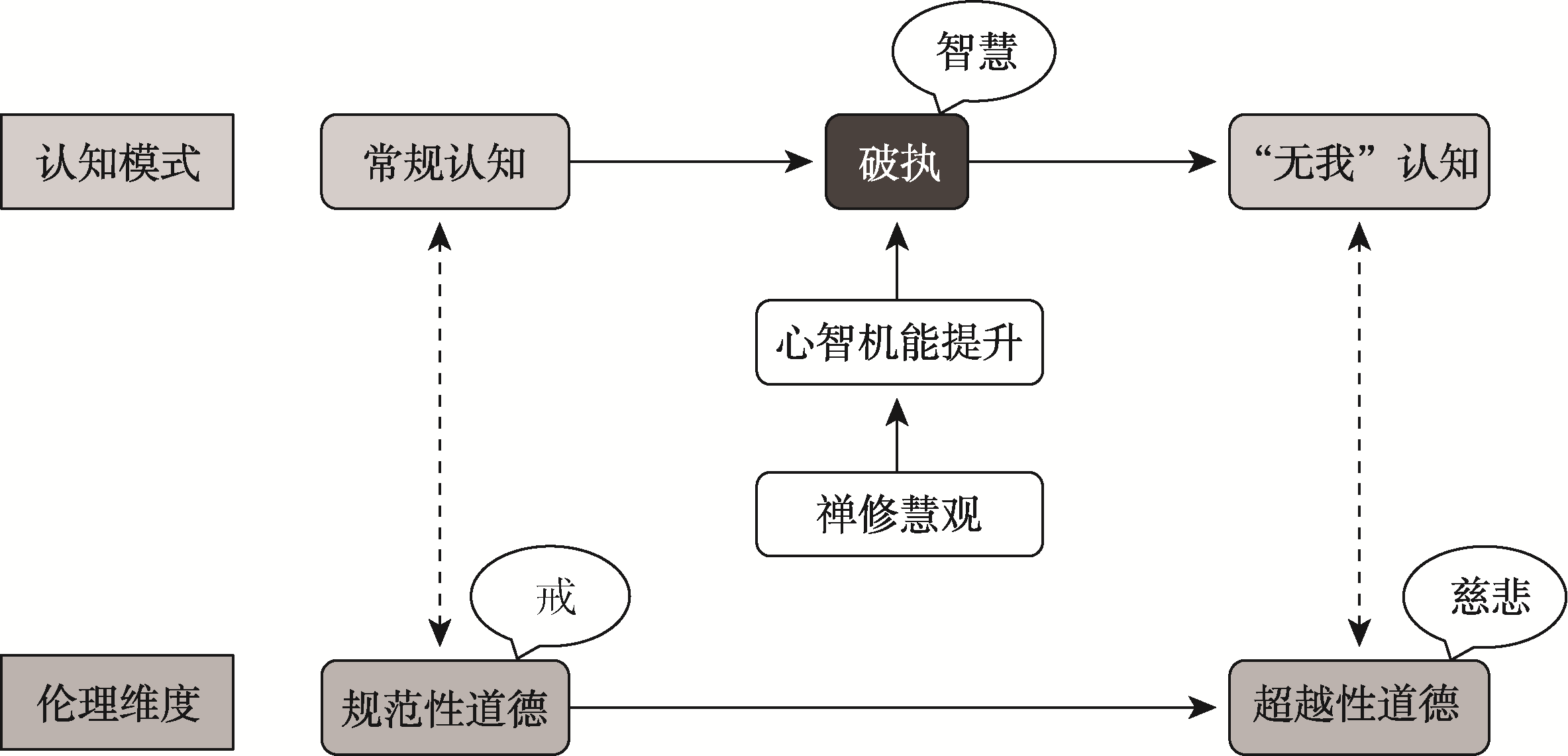
图1 佛学伦理的双重维度及其相应的认知模式
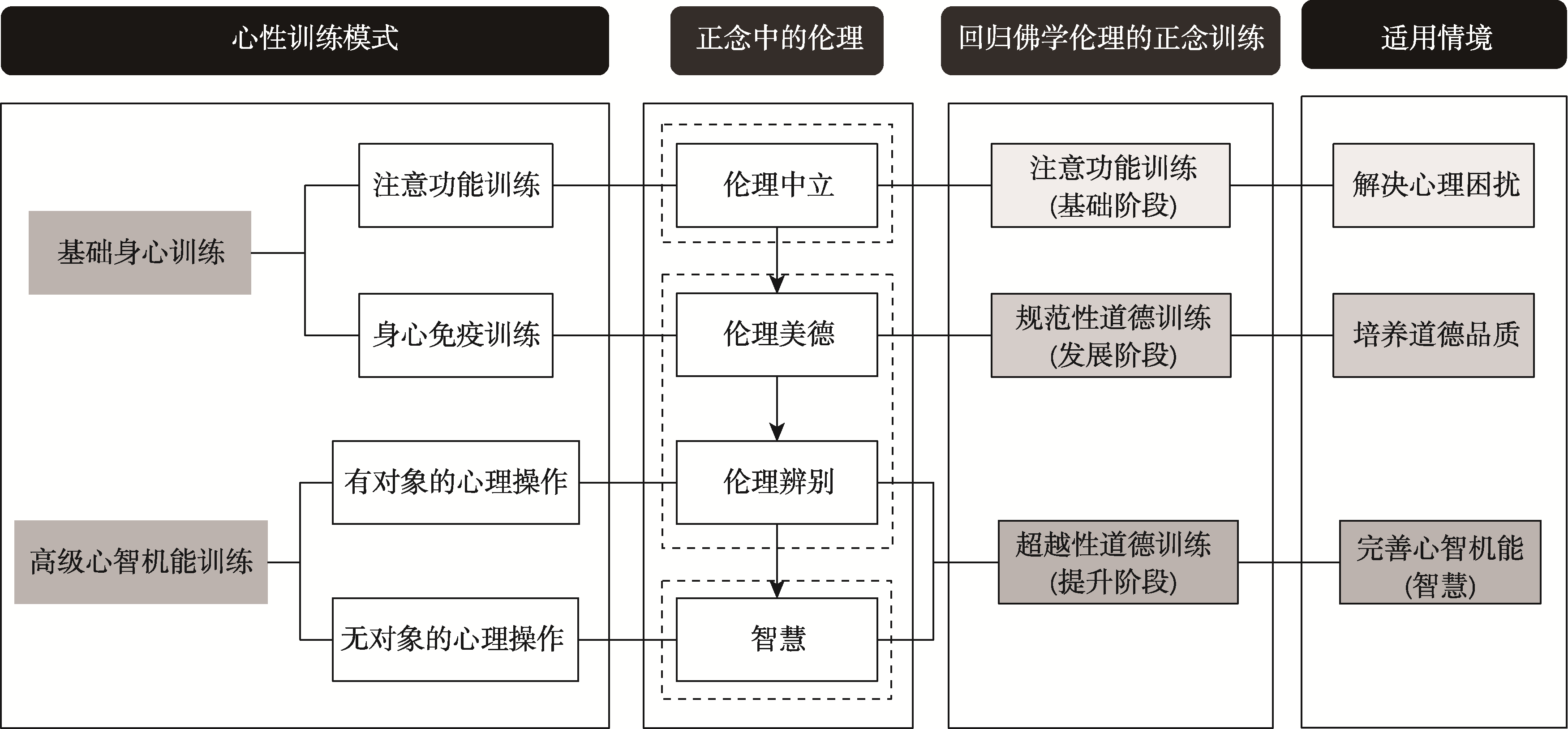
图2 回归佛学伦理的正念训练的理论模型
| [1] | 才吾加甫. (2001). 佛学道德考(四). 新疆社会科学信息, 25(4), 24-25. |
| [2] | 陈兵. (1998). 自净其心:重读释迦牟尼. 成都: 四川人民出版社, 249. |
| [3] | 陈巍, 蒋柯, 刘燊, 刘嘉, 傅安国, 彭彦琴, 王波, 张建新. (2022). 心理学的底层逻辑与框架(笔会). 苏州大学学报(教育科学版), 10(3), 1-28. |
| [4] | 丁小平. (2019). 佛教道德的双重维度. 伦理学研究, 18(4), 67-74. |
| [5] | 方立天. (2003). 佛教“空”义解析. 中国人民大学学报, 17(6), 55-60. |
| [6] | 方立天. (1996). 中国佛教伦理思想论纲. 中国社会科学, 17(2), 97-111. |
| [7] | 韩韬. (2018). 道德伪善及其消解 [硕士学位论文]. 中共广东省委党校. |
| [8] | 金子. (2017). 注视眼图片对道德伪善的抑制作用研究 [硕士学位论文]. 吉林大学. |
| [9] | 稂荻. (2011). 善的道德原则对于戒律规范的优先性——论佛教伦理思想的精神实质. 社会科学辑刊, 33(2), 40-42. |
| [10] | 李杭州. (2020). 道德伪善:自利性道德判断的产生及干预研究 [硕士学位论文]. 陕西师范大学. |
| [11] | 李杭州, 何宁, 李红, 韩雅伟. (2021). 宽以待己, 严于律人:道德伪善的双加工机制. 心理科学, 44(6), 1396-1402. |
| [12] | 梁启超. (2005). 佛学研究十八篇. 天津古籍出版社, 309. |
| [13] | 刘沐垚. (2023). 正念干预理论旨归及其本土化理论初探 [硕士学位论文]. 哈尔滨: 黑龙江中医药大学. |
| [14] | 倪培民. (2021). 修炼而成的自发性——以伯林为镜看儒家自由观. 哲学分析, 12(1), 73-97+197-198. |
| [15] | 欧阳竟无. (1996). 佛法非宗教非哲学而为今时所必需. 见王雷泉(编). 欧阳渐文选(pp. 3-6). 上海: 上海远东出版社. |
| [16] | 彭彦琴. (2020). 中国心性心理学的确立与体系构建. 西北师大学报(社会科学版), 57(4), 54-62. |
| [17] | 彭彦琴, 李清清. (2024). 德性认知:中国人独特的认知模式. 江海学刊, 67(2), 30-38+255. |
| [18] | 彭彦琴, 朱晓燕. (2023). 觉性:中国本土高级心理机能. 心理学探新, 43(5), 387-395. |
| [19] | 释隆莲. (1991). 佛教道德观. 法音, 11(4), 3-7. |
| [20] | 魏德东. (2002). 论佛教道德的层次性特征. 道德与文明, 21(6), 51-54. |
| [21] | 熊韦锐, 于璐. (2010). 禅宗心性学说中的心理治疗思想探究. 心理学探新, 30(2), 7-10. |
| [22] | 杨维中. (2007). 中国佛教心性论研究. 宗教文化出版社, 11. |
| [23] | 印顺. (1992). 佛在人间. 正闻出版社, 319-320. |
| [24] | Amaro A. (2015). A holistic mindfulness. Mindfulness, 6(1), 63-73. |
| [25] |
Batson C. D., Kobrynowicz D., Dinnerstein J. L., Kampf H. C., & Wilson A. D. (1997). In a very different voice: Unmasking moral hypocrisy. Journal of Personality and Social Psychology, 72(6), 1335-1348.
pmid: 9177020 |
| [26] | Berry D. R., Cairo A. H., Goodman R. J., Quaglia J. T., Green J. D., & Brown K. W. (2018). Mindfulness increases prosocial responses toward ostracized strangers through empathic concern. Journal of Experimental Psychology: General, 147(1), 93-112. |
| [27] |
Berry D. R., Hoerr J. P., Cesko S., Alayoubi A., Carpio K., Zirzow H., … Beaver V. (2020). Does mindfulness training without explicit ethics-based instruction promote prosocial behaviors? A meta-analysis. Personality and Social Psychology Bulletin, 46(8), 1247-1269.
doi: 10.1177/0146167219900418 pmid: 31971095 |
| [28] | Bian J., Li L., Xia X., & Fu X. (2020). Effects of the presence and behavior of in-group and out-group strangers on moral hypocrisy. Frontiers in Psychology, 11, 551625. |
| [29] | Bishop S. R., Lau M., Shapiro S., Carlson L., Anderson N. D., Carmody J., … Devins G. (2004). Mindfulness: A proposed operational definition. Clinical Psychology: Science and Practice, 11(3), 230-241. |
| [30] | Bodhi B. (1995). Nourishing the roots: Essays on Buddhist ethics (pp.2-3). Buddhist Publication Society. |
| [31] | Bodhi B. (2011). What does mindfulness really mean? A canonical perspective. Contemporary Buddhism, 12(1), 19-39. |
| [32] | Bryant R. A., Azevedo S., Yadav S., Cahill C., Kenny L., Maccallum F., … Dawson K. S. (2024). Cognitive behavior therapy vs mindfulness in treatment of prolonged grief disorder: A randomized clinical trial. JAMA Psychiatry, 81(7), 646-654. |
| [33] | Chen S., & Jordan C. H. (2020). Incorporating ethics into brief mindfulness practice: Effects on well-being and prosocial behavior. Mindfulness, 11(1), 18-29. |
| [34] |
Dahl C., Lutz A., & Davidson R. J. (2015). Reconstructing and deconstructing the self: Cognitive mechanisms in meditation practice. Trends in Cognitive Sciences, 19(9), 515-523.
doi: 10.1016/j.tics.2015.07.001 pmid: 26231761 |
| [35] |
Donald J. N., Sahdra B. K., Van Zanden B., Duineveld J. J., Atkins P. W. B., Marshall S. L., & Ciarrochi J. (2019). Does your mindfulness benefit others? A systematic review and meta-analysis of the link between mindfulness and prosocial behaviour. British Journal of Psychology, 110(1), 101-125.
doi: 10.1111/bjop.12338 pmid: 30094812 |
| [36] | Dorjee D. (2010). Kinds and dimensions of mindfulness: Why it is important to distinguish them. Mindfulness, 1(3), 152-160. |
| [37] | Dunne J. D. (2015). Buddhist styles of mindfulness:A heuristic approach. In Ostafin, B., Robinson, M., Meier, B. (Eds.). Handbook of mindfulness and self-regulation (pp.251-270). Springer New York. |
| [38] | Furnell M., Van Gordon W., & Elander J. (2024a). Calmer, kinder, wiser: A novel threefold categorization for mindfulness-based interventions. Mindfulness, 15(1), 144-156. |
| [39] | Furnell M., Van Gordon W., & Elander J. (2024b). Wisdom-based Buddhist-derived meditation practices for prosocial behaviour: A systematic review. Mindfulness, 15(3), 539-558. |
| [40] | Gopnik A. (2016). The problem with mindfulness. The New Yorker. |
| [41] | Greenberg M. T., & Mitra J. L. (2015). From mindfulness to right mindfulness: The intersection of awareness and ethics. Mindfulness, 6(1), 74-78. |
| [42] |
Hofmann S. G., Grossman P., & Hinton D. E. (2011). Loving-kindness and compassion meditation: Potential for psychological interventions. Clinical Psychology Review, 31(7), 1126-1132.
doi: 10.1016/j.cpr.2011.07.003 pmid: 21840289 |
| [43] | Kabat-Zinn J. (2003). Mindfulness-based interventions in context: Past, present, and future. Clinical Psychology Science & Practice, 10(2), 144-156. |
| [44] | Kabat-Zinn J. (2011). Some reflections on the origins of MBSR, skillful means, and the trouble with maps. Contemporary Buddhism, 12(1), 281-306. |
| [45] | Kang C., & Whittingham K.(2010). Mindfulness: A dialogue between Buddhism and clinical psychology. Mindfulness, 1(3), 161-173. |
| [46] | King E., & Badham R. (2018). The wheel of mindfulness: A generative framework for second-generation mindful leadership. Mindfulness, 11(1), 166-176. |
| [47] |
Lammers J., Stapel D. A., & Galinsky A. D. (2010). Power increases hypocrisy: Moralizing in reasoning, immorality in behavior. Psychological Science, 21(5), 737-744.
doi: 10.1177/0956797610368810 pmid: 20483854 |
| [48] | Landau S. D., & Jones F. W. (2021). Finding the spiritual in the secular: A meta-analysis of changes in spirituality following secular mindfulness-based programs. Mindfulness, 12(3), 1567-1581. |
| [49] |
Luberto C. M., Shinday N., Song R., Philpotts L. L., Park E. R., Fricchione G. L., & Yeh G. Y. (2018). A systematic review and meta-analysis of the effects of meditation on empathy, compassion, and prosocial behaviors. Mindfulness, 9(3), 708-724.
doi: 10.1007/s12671-017-0841-8 pmid: 30100929 |
| [50] | Lutz A., Chételat G., Collette F., Klimecki O. M., Marchant N. L., & Gonneaud J. (2021). The protective effect of mindfulness and compassion meditation practices on ageing: Hypotheses, models and experimental implementation. Ageing Research Reviews, 72(51), 101495. |
| [51] | Malin Y., & Gumpel T. P. (2022). Short mindfulness meditation increases help-giving intention towards a stranger in distress. Mindfulness, 13(9), 2337-2346. |
| [52] | Monteiro L. M., Musten R. F., & Compson J. (2015). Traditional and contemporary mindfulness: Finding the middle path in the tangle of concerns. Mindfulness, 6(1), 1-13. |
| [53] | Poulin M. J., Ministero L. M., Gabriel S., Morrison C. D., & Naidu E. (2021). Minding your own business? Mindfulness decreases prosocial behavior for people with independent self-construals. Psychological Science, 32(11), 1699-1708. |
| [54] | Purser R. (2015). Clearing the muddled path of traditional and contemporary mindfulness: A response to Monteiro, Musten, and Compson. Mindfulness, 6(1), 23-45. |
| [55] | Purser R., & Loy D. (July 1, 2013). Beyond McMindfulness. Huffington Post. Retrieved from http://www.huffingtonpost. com/ron-purser/beyond-mcmindfulness_b_3519289.html |
| [56] | Ridderinkhof A., de Bruin E. I., Brummelman E., & Bögels S. M. (2017). Does mindfulness meditation increase empathy? An experiment. Self and Identity, 16(3), 251-269. |
| [57] | Septianto F., Tjiptono F., Arli D., & Sun J.-M. (James). (2022). The differential effects of integral pride and gratitude on divergent moral judgment for the self versus others. Australian Journal of Management, 47(3), 579-594. |
| [58] | Sharf R. H. (2014). Is mindfulness Buddhist? (and why it matters). Transcultural Psychiatry. 52(4), 470-484. |
| [59] | Shonin E., & Van Gordon W. (2015a). Managers' experiences of meditation awareness training. Mindfulness, 6(4), 899-909. |
| [60] | Shonin E., & Van Gordon W. (2015b). The lineage of mindfulness. Mindfulness, 6(1), 141-145. |
| [61] |
Singh N. N., Lancioni G. E., Medvedev O. N., Myers R. E., Chan J., McPherson C. L.,... Kim E. (2020). Comparative effectiveness of caregiver training in mindfulness-based positive behavior support (MBPBS) and positive behavior support (PBS) in a randomized controlled trial. Mindfulness, 11(1), 99-111.
doi: 10.1007/s12671-018-0895-2 pmid: 32435317 |
| [62] | Shonin E., Van Gordon W., Compare A., Zangeneh M., & Griffiths M. D. (2014). Buddhist derived loving-kindness and compassion meditation for the treatment of psychopathology: A systematic review. Mindfulness, 6(5), 1161-1180. |
| [63] | Shonin E., Van Gordon W., & Griffiths M. D. (2014). The emerging role of Buddhism in clinical psychology: Towards effective integration. Psychology of Religion and Spirituality, 6(2), 123-137. |
| [64] |
Solhaug I., de Vibe M., Friborg O. Sørlie T., Tyssen R., Bjørndal A. & Rosenvinge J. H. (2019). Long-term mental health effects of mindfulness training: A 4-year follow-up study. Mindfulness, 10(8), 1661-1672.
doi: 10.1007/s12671-019-01100-2 |
| [65] | Thupten J. (2019). The question of mindfulness' connection with ethics and compassion. Current Opinion in Psychology, 28(4), 71-75. |
| [66] | Titmuss C. (July 19, 2013). The Buddha of mindfulness. The politics of mindfulness. Retrieved from http://christophertitmuss.org/blog/?p=1454 |
| [67] | Valor C., Martínez-de-Ibarreta C., Carrero I. & Merino A. (2024). Effects of loving-kindness meditation on prosocial behavior: Empirical and meta-analytic evidence. Journal of Social Marketing, 14(2), 280-300. |
| [68] | Van Gordon W., & Shonin E. (2020). Second-generation mindfulness-based interventions: Toward more authentic mindfulness practice and teaching. Mindfulness, 11(1), 1-4. |
| [69] | Van Gordon W., Shonin E., Dunn T. J., Sapthiang S., Kotera Y., Garcia-Campayo J. & Sheffield D. (2018). Exploring emptiness and its effects on non-attachment, mystical experiences, and psycho-spiritual wellbeing: A quantitative and qualitative study of advanced meditators. Explore: The Journal of Science and Healing, 15(4), 261-272. |
| [70] | Van Gordon W., Shonin E., & Griffiths M. D. (2015). Towards a second generation of mindfulness-based interventions. Australian & New Zealand Journal of Psychiatry, 49(7), 591-592. |
| [71] | Van Gordon W., Shonin E., Lomas T., & Griffiths M. D. (2016). Corporate use of mindfulness and authentic spiritual transmission: Competing or compatible ideals? Mindfulness and Compassion, 1(2), 75-83. |
| [72] | Vörös S. (2016). Sitting with the demons-mindfulness, suffering, and existential transformation. Asian Studies, 4(2), 59-83. |
| [73] | Yaden D. B., Haidt J., Hood R. W., Vago D. R., & Newberg A. B. (2017). The varieties of self-transcendent experience. Review of General Psychology, 21(2), 143-160. |
| [74] | Zheng Y., Zhou J., Zeng X., Jiang M., & Oei T. P. S. (2022). A new second-generation mindfulness-based intervention focusing on well-being: A randomized control trial of mindfulness-based positive psychology. Journal of Happiness Studies, 23(6), 2703-2724. |
| [1] | 张静, 孟煜, 张蒙, 陈慧雅. 员工正念对工作绩效的作用效果及机制:基于元分析的证据[J]. 心理科学进展, 2025, 33(4): 647-672. |
| [2] | 刘霞, 卫武. 职场正念的人际影响及作用机制[J]. 心理科学进展, 2024, 32(6): 981-994. |
| [3] | 刘贝妮, 张志学. 团队何以愈挫弥坚? 领导正念对团队韧性形成的影响[J]. 心理科学进展, 2023, 31(7): 1146-1159. |
| [4] | 叶伟豪, 于美琪, 张利会, 高琪, 傅明珠, 卢家楣. 精准的意义:负性情绪粒度的作用机制与干预[J]. 心理科学进展, 2023, 31(6): 1030-1043. |
| [5] | 张凯丽, 郑红, 汪凤炎. “一个序曲”与“两个阶段”:智慧心理学近50年研究历程的写照[J]. 心理科学进展, 2023, 31(5): 721-735. |
| [6] | 杨珍芝, 曾红. 正念训练对冲动性不同要素的影响:基于双加工理论[J]. 心理科学进展, 2023, 31(2): 274-287. |
| [7] | 邵红涛, 任桂琴, 丁晓茜, 史梦梦, 李蕊妍, 李阳. 正念冥想对走神的影响及其作用机制[J]. 心理科学进展, 2023, 31(12): 2368-2379. |
| [8] | 徐少卿, 刘兴华, 张会平, 李波, 唐信峰, 渠改萍, 鲍玉琴, 赵俊萍, 符仲芳. 正念在考试焦虑干预中的应用:基于NIH阶段模型的视角[J]. 心理科学进展, 2023, 31(12): 2380-2392. |
| [9] | 明晓东, 付静宇, 白新文, 杨建锋. 正念何以减少非伦理行为?双系统理论的视角[J]. 心理科学进展, 2023, 31(10): 1785-1799. |
| [10] | 贺淇, 刘晓明. 正念对实现型幸福感的影响及其理论解释[J]. 心理科学进展, 2023, 31(10): 1937-1951. |
| [11] | 陈婧, 王玉正, 王锦琰, 罗非. 正念在缓解社会排斥中的作用[J]. 心理科学进展, 2022, 30(6): 1294-1302. |
| [12] | 孙莎莎, 李小兵. 冥想的安全性[J]. 心理科学进展, 2022, 30(11): 2570-2585. |
| [13] | 陈浩彬, 汪凤炎. 老年人的智慧[J]. 心理科学进展, 2021, 29(5): 885-893. |
| [14] | 孙腾巍, 颜宇娴, 靳宇倡, 安俊秀. 基于正念的干预与自我同情的关系:一项元分析[J]. 心理科学进展, 2021, 29(10): 1808-1828. |
| [15] | 陈国典, 杨通平. 正念对亲密关系的影响[J]. 心理科学进展, 2020, 28(9): 1551-1563. |
| 阅读次数 | ||||||
|
全文 |
|
|||||
|
摘要 |
|
|||||
