

ISSN 1671-3710
CN 11-4766/R
主办:中国科学院心理研究所
出版:科学出版社
CN 11-4766/R
主办:中国科学院心理研究所
出版:科学出版社
心理科学进展 ›› 2026, Vol. 34 ›› Issue (8): 1456-1467.doi: 10.3724/SP.J.1042.2026.1456 cstr: 32111.14.2026.1456
寇彧1( ), 丁越1, 杨小钧2, 查一畅1
收稿日期:2025-12-19
出版日期:2026-08-15
发布日期:2026-06-03
通讯作者:
寇彧 教授, E-mail: kouyu@bnu.edu.cn作者简介:第一联系人:所有作者对本文有同等贡献
基金资助:
KOU Yu1(), DING Yue1, YANG Xiaojun2, ZHA Yichang1
Received:2025-12-19
Online:2026-08-15
Published:2026-06-03
摘要:
智慧干预通过重塑个体的意义建构, 使个体形成更具适应性的思维和应对方式, 为促进亲社会行为提供了新的方向。文章在系统梳理传统的亲社会行为干预策略的原理与现存问题的基础上, 构建了亲社会行为智慧干预框架。框架从理解需要、归属需要、自我完整性需要三个方面提出了具体干预策略, 依托“意义-行为-情境”的递归机制, 论述了如何助力个体形成自我延续的良性循环, 为亲社会行为培育提供了理论支持与实践启示。
中图分类号:
寇彧, 丁越, 杨小钧, 查一畅. (2026). 亲社会行为智慧干预框架的构建. 心理科学进展 , 34(8), 1456-1467.
KOU Yu, DING Yue, YANG Xiaojun, ZHA Yichang. (2026). Applying wise intervention to promote prosocial behavior. Advances in Psychological Science, 34(8), 1456-1467.
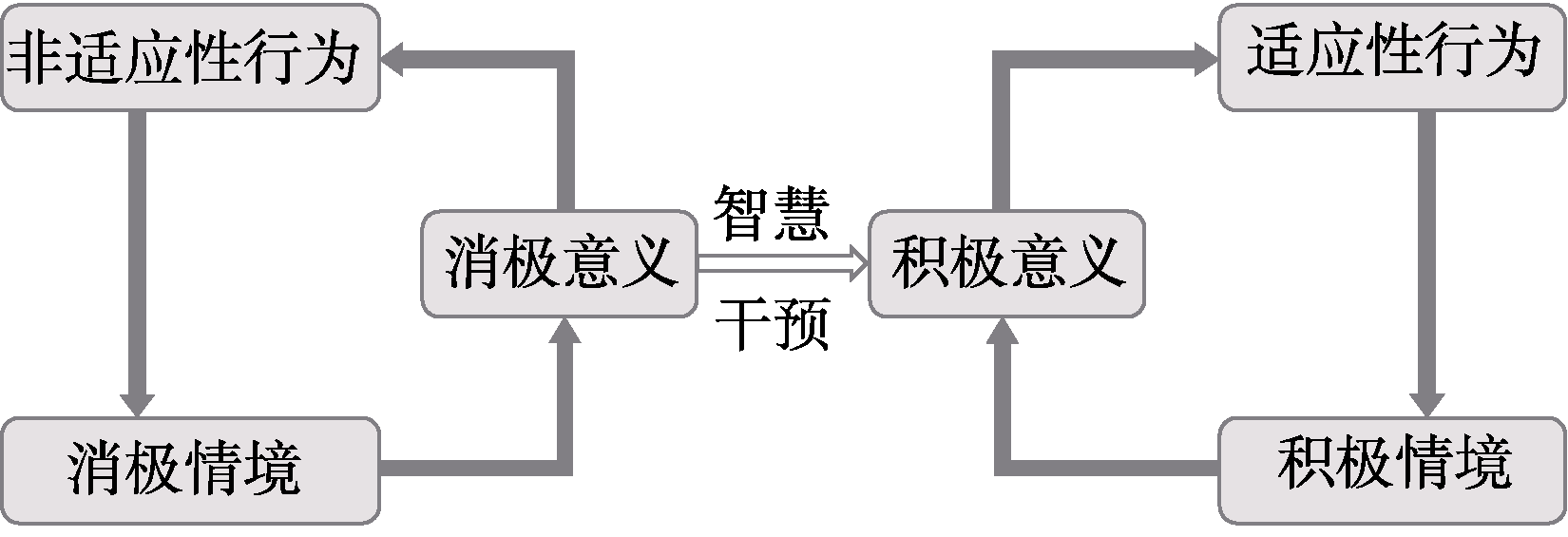
图1 递归过程模型
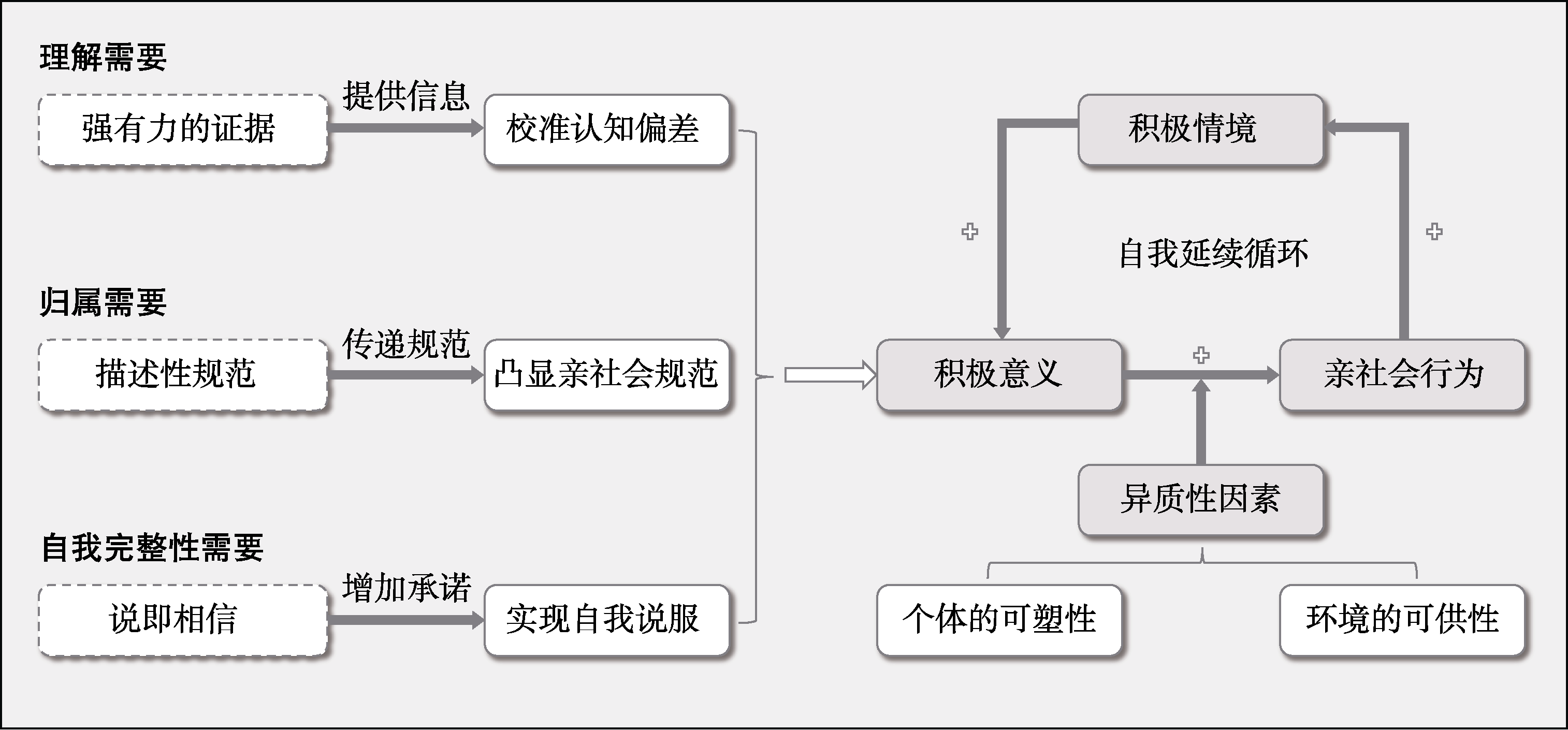
图2 亲社会行为的智慧干预框架
| [1] | 寇彧, 张庆鹏. (2017). 青少年亲社会行为促进:理论与方法. 北京: 北京师范大学出版社. https://book.cppinfo.cn/Encyclopedias/home/index?id=3785982 |
| [2] |
李俊朋, 周临舒, 江俊, 王丹妮, 蒋存梅. (2024). 音乐对亲社会行为的影响及其作用机制. 心理科学进展, 32(7), 1179-1194. https://doi.org/10.3724/SP.J.1042.2024.01179
doi: 10.3724/SP.J.1042.2024.01179 URL |
| [3] | 刘肖岑, 何祺, 窦东徽. (2021). 双人合作类电子/传统游戏对幼儿同伴交往与亲社会行为的影响. 心理科学, 44(3), 567-574. https://doi.org/10.16719/j.cnki.1671-6981.20210308 |
| [4] |
尚雪松, 陈卓, 陆静怡. (2021). 帮忙失败后我会被差评吗?好心帮倒忙中的预测偏差. 心理学报, 53(3), 291-305.
doi: 10.3724/SP.J.1041.2021.00291 |
| [5] | 王磊, 谭晨, 寇彧. (2005). 同伴冲突解决的干预训练对小学儿童合作的影响. 心理发展与教育, (4), 83-88. https://doi.org/10.16187/j.cnki.issn1001-4918.2005.04.016 |
| [6] | 吴思衡, 王灏, 张雨晴, 方美欣, 朱芯逸, 何木叶, 刘电芝. (2024). 分享-合作团体大社交提升孤独症儿童亲社会行为的干预效果. 中国临床心理学杂志, 32(3), 689-694. https://doi.org/10.16128/j.cnki.1005-3611.2024.03.037 |
| [7] |
谢晓非, 王逸璐, 顾思义, 李蔚. (2017). 利他仅仅利他吗?——进化视角的双路径模型. 心理科学进展, 25(9), 1441-1455. https://doi.org/10.3724/SP.J.1042.2017.01441
doi: 10.3724/SP.J.1042.2017.01441 URL |
| [8] | 杨晶, 余俊宣, 寇彧, 傅鑫媛. (2015). 干预初中生的同伴关系以促进其亲社会行为. 心理发展与教育, 31(2), 239-245. https://doi.org/10.16187/j.cnki.issn1001-4918.2015.02.14 |
| [9] | 张梦圆, 杨莹, 寇彧. (2015). 青少年的亲社会行为及其发展. 青年研究, (4), 10-18, 94. |
| [10] |
Abi-Esber, N., Abel, J. E., Schroeder, J., & Gino, F. (2022). “Just letting you know …” underestimating others’ desire for constructive feedback. Journal of Personality and Social Psychology, 123(6), 1362-1385. https://doi.org/10.1037/pspi0000393
doi: 10.1037/pspi0000393 URL pmid: 35324242 |
| [11] |
Agerström, J., Carlsson, R., Nicklasson, L., & Guntell, L. (2016). Using descriptive social norms to increase charitable giving: The power of local norms. Journal of Economic Psychology, 52, 147-153. https://doi.org/10.1016/j.joep.2015.12.007
doi: 10.1016/j.joep.2015.12.007 URL |
| [12] |
Armstrong-Carter, E., & Telzer, E. H. (2021). Daily provision of instrumental and emotional support to friends is associated with diurnal cortisol during adolescence. Developmental Psychobiology, 63(5), 1266-1278. https://doi.org/10.1002/dev.22101
doi: 10.1002/dev.22101 URL pmid: 33569768 |
| [13] | Aronson, E. (1968). Dissonance theory:Progress and problems. In R. P.Abelson, E.Aronson, W. J.McGuire, T. M.Newcomb, M. J.Rosenberg, M. J.Rosenberg, & P. H.Tannenbaum (Eds.), Theories of cognitive consistency: A sourcebook (pp. 5-27). Chicago: McNally. |
| [14] |
Aronson, E. (1999). The power of self-persuasion. American Psychologist, 54(11), 875-884. https://doi.org/10.1037/h0088188
doi: 10.1037/h0088188 URL |
| [15] |
Bandura, A. (1961). Psychotherapy as a learning process. Psychological Bulletin, 58(2), 143-159. https://doi.org/10.1037/h0040672
doi: 10.1037/h0040672 URL |
| [16] | Bandura, A. (1986). Social foundations of thought and action: A social cognitive theory. Englewood Cliffs: Prentice-Hall. |
| [17] |
Barry, M. M., Clarke, A. M., & Dowling, K. (2017). Promoting social and emotional well-being in schools. Health Education, 117(5), 434-451. https://doi.org/10.1108/HE-11-2016-0057
doi: 10.1108/HE-11-2016-0057 URL |
| [18] |
Baumeister, R. F., & Leary, M. R. (1995). The need to belong: Desire for interpersonal attachments as a fundamental human motivation. Psychological Bulletin, 117(3), 497-529. https://doi.org/10.1037/0033-2909.117.3.497
URL pmid: 7777651 |
| [19] |
Baumsteiger, R. (2019). What the World Needs Now: An Intervention for Promoting Prosocial Behavior. Basic and Applied Social Psychology, 41(4), 215-229. https://doi.org/10.1080/01973533.2019.1639507
doi: 10.1080/01973533.2019.1639507 URL |
| [20] |
Bryan, C. J., Tipton, E., & Yeager, D. S. (2021). Behavioural science is unlikely to change the world without a heterogeneity revolution. Nature Human Behaviour, 5(8), 980-989. https://doi.org/10.1038/s41562-021-01143-3
doi: 10.1038/s41562-021-01143-3 URL pmid: 34294901 |
| [21] |
Byrne, M., Tan, R. K. J., Wu, D., Marley, G., Hlatshwako, T. G., Tao, Y., … Tucker, J. D. (2023). Prosocial interventions and health outcomes: A systematic review and meta-analysis. JAMA Network Open, 6(12), Article e2346789. https://doi.org/10.1001/jamanetworkopen.2023.46789
doi: 10.1001/jamanetworkopen.2023.46789 URL |
| [22] |
Caprara, G. V., Kanacri, B. P. L., Gerbino, M., Zuffianò, A., Alessandri, G., Vecchio, G., … Bridglall, B. (2014). Positive effects of promoting prosocial behavior in early adolescence. International Journal of Behavioral Development, 38(4), 386-396. https://doi.org/10.1177/0165025414531464
doi: 10.1177/0165025414531464 URL |
| [23] |
Caprara, G. V., Luengo Kanacri, B. P., Zuffianò, A., Gerbino, M., & Pastorelli, C. (2015). Why and how to promote adolescents’ prosocial behaviors: Direct, mediated and moderated effects of the CEPIDEA school-based program. Journal of Youth and Adolescence, 44(12), 2211-2229. https://doi.org/10.1007/s10964-015-0293-1
doi: 10.1007/s10964-015-0293-1 URL |
| [24] |
Carlo, G., Crockett, L. J., Randall, B. A., & Roesch, S. C. (2007). A latent growth curve analysis of prosocial behavior among rural adolescents. Journal of Research on Adolescence, 17(2), 301-324. https://doi.org/10.1111/j.1532-7795.2007.00524.x
doi: 10.1111/jora.2007.17.issue-2 URL |
| [25] | Chen, S., & Yang, S. (2025). Longitudinal changes in Chinese prosociality. Personality & Social Psychology Bulletin, 51(9), 1574-1586. https://doi.org/10.1177/01461672231225367 |
| [26] |
Cohen, G. L., Garcia, J., Purdie-Vaughns, V., Apfel, N., & Brzustoski, P. (2009). Recursive processes in self- affirmation: Intervening to close the minority achievement gap. Science, 324(5925), 400-403. https://doi.org/10.1126/science.1170769
doi: 10.1126/science.1170769 URL |
| [27] |
Cohen, G. L., & Sherman, D. K. (2014). The psychology of change: Self-affirmation and social psychological intervention. Annual Review of Psychology, 65, 333-371. https://doi.org/10.1146/annurev-psych-010213-115137
doi: 10.1146/annurev-psych-010213-115137 URL pmid: 24405362 |
| [28] |
Corbit, J., Didkowsky, N., Gora, V., Reddy, H., Muhammad, S., & Callaghan, T. (2022). Facilitating the prosocial development of Rohingya refugee children. Journal of Experimental Child Psychology, 220, Article 105414. https://doi.org/10.1016/j.jecp.2022.105414
doi: 10.1016/j.jecp.2022.105414 URL |
| [29] |
Crompton, K., Kaklamanou, D., Fasulo, A., & Somogyi, E. (2024). The effects of a school-based mindfulness programme (paws b) on empathy and prosocial behaviour: A randomised controlled trial. Mindfulness, 15(5), 1080-1094. https://doi.org/10.1007/s12671-024-02345-2
doi: 10.1007/s12671-024-02345-2 URL |
| [30] |
Crum, A. J., Salovey, P., & Achor, S. (2013). Rethinking stress: The role of mindsets in determining the stress response. Journal of Personality and Social Psychology, 104(4), 716-733. https://doi.org/10.1037/a0031201
doi: 10.1037/a0031201 URL pmid: 23437923 |
| [31] |
Crum, A. J., Santoro, E., Handley-Miner, I., Smith, E. N., Evans, K., Moraveji, N., Achor, S., & Salovey, P. (2023). Evaluation of the “rethink stress” mindset intervention: A metacognitive approach to changing mindsets. Journal of Experimental Psychology: General, 152(9), 2603-2622. https://doi.org/10.1037/xge0001396
doi: 10.1037/xge0001396 URL |
| [32] |
Deci, E. L., & Ryan, R. M. (2000). The “what” and “why” of goal pursuits: Human needs and the self-determination of behavior. Psychological Inquiry, 11(4), 227-268. https://doi.org/10.1207/S15327965PLI1104_01
doi: 10.1207/S15327965PLI1104_01 URL |
| [33] |
Donald, J. N., Sahdra, B. K., Van Zanden, B., Duineveld, J. J., Atkins, P. W. B., Marshall, S. L., & Ciarrochi, J. (2019). Does your mindfulness benefit others? A systematic review and meta‐analysis of the link between mindfulness and prosocial behaviour. British Journal of Psychology, 110(1), 101-125. https://doi.org/10.1111/bjop.12338
doi: 10.1111/bjop.12338 URL pmid: 30094812 |
| [34] |
Dovidio, J. F., Gaertner, S. L., & Saguy, T. (2009). Commonality and the complexity of “we”: Social attitudes and social change. Personality and Social Psychology Review, 13(1), 3-20. https://doi.org/10.1177/1088868308326751
doi: 10.1177/1088868308326751 URL pmid: 19144903 |
| [35] |
Dryburgh, N. S. J., Ponath, E., Bukowski, W. M., & Dirks, M. A. (2022). Associations between interpersonal behavior and friendship quality in childhood and adolescence: A meta-analysis. Child Development, 93(3), e332-e347. https://doi.org/10.1111/cdev.13728
doi: 10.1111/cdev.13728 URL |
| [36] |
Dungan, J. A., Munguia Gomez, D. M., & Epley, N. (2022). Too reluctant to reach out: Receiving social support is more positive than expressers expect. Psychological Science, 33(8), 1300-1312. https://doi.org/10.1177/09567976221082942
doi: 10.1177/09567976221082942 URL pmid: 35802611 |
| [37] | Dweck, C. S. (2006). Mindset: The new psychology of success. New York: Random House. |
| [38] |
Dweck, C. S. (2017). From needs to goals and representations: Foundations for a unified theory of motivation, personality, and development. Psychological Review, 124(6), 689-719. https://doi.org/10.1037/rev0000082
doi: 10.1037/rev0000082 URL pmid: 28933872 |
| [39] |
Eden, S., & Oren, A. (2021). Computer‐mediated intervention to foster prosocial ability among children with autism. Journal of Computer Assisted Learning, 37(1), 275-286. https://doi.org/10.1111/jcal.12490
doi: 10.1111/jcal.v37.1 URL |
| [40] | Eisenberg, N., & Spinrad, T. L. (2014). Multidimensionality of prosocial behavior:Rethinking the conceptualization and development of prosocial behavior. In Prosocial development:A multidimensional approach (pp. 17-39). New York: Oxford University Press. https://doi.org/10.1093/acprof:oso/9780199964772.003.0002 |
| [41] |
Epley, N., Kardas, M., Zhao, X., Atir, S., & Schroeder, J. (2022). Undersociality: Miscalibrated social cognition can inhibit social connection. Trends in Cognitive Sciences, 26(5), 406-418. https://doi.org/10.1016/j.tics.2022.02.007
doi: 10.1016/j.tics.2022.02.007 URL |
| [42] | Festinger, L. (1957). A theory of cognitive dissonance (pp. xi, 291). Stanford: Stanford University Press. |
| [43] |
Finkel, E. J., Slotter, E. B., Luchies, L. B., Walton, G. M., & Gross, J. J. (2013). A brief intervention to promote conflict reappraisal preserves marital quality over time. Psychological Science, 24(8), 1595-1601. https://doi.org/10.1177/0956797612474938
doi: 10.1177/0956797612474938 URL pmid: 23804960 |
| [44] | Fiske, S. T. (2010). Social beings: Core motives in social psychology (2nd ed.). Hoboken: Wiley. |
| [45] |
Furnell, M., Van Gordon, W., & Elander, J. (2024). Wisdom-based Buddhist-derived meditation practices for prosocial behaviour: A systematic review. Mindfulness, 15(3), 539-558. https://doi.org/10.1007/s12671-024-02323-8
doi: 10.1007/s12671-024-02323-8 URL |
| [46] | Gaertner, S. L., & Dovidio, J. F. (2000). Reducing intergroup bias: The common ingroup identity model. Philadelphia: Psychology Press. |
| [47] |
Gan, Y., Wang, R., Li, J., Wang, X., Chen, J., Chen, Y., & Fan, H. (2024). The effects of prosocial video games on empathy and prosocial behavior in athletes: Evidence from cross-sectional survey and experimental studies. International Journal of Sport and Exercise Psychology, 23(8), 1418-1439. https://doi.org/10.1080/1612197X.2024.2432994
doi: 10.1080/1612197X.2024.2432994 URL |
| [48] |
Goldenberg, A., Cohen-Chen, S., Goyer, J. P., Dweck, C. S., Gross, J. J., & Halperin, E. (2018). Testing the impact and durability of a group malleability intervention in the context of the Israeli-Palestinian conflict. Proceedings of the National Academy of Sciences, 115(4), 696-701. https://doi.org/10.1073/pnas.1706800115
doi: 10.1073/pnas.1706800115 URL |
| [49] |
Grant, A., & Dutton, J. (2012). Beneficiary or benefactor: Are people more prosocial when they reflect on receiving or giving? Psychological Science, 23(9), 1033-1039. https://doi.org/10.1177/0956797612439424
doi: 10.1177/0956797612439424 URL pmid: 22868495 |
| [50] |
Grüning, D. J., Kamin, J., Panizza, F., Katsaros, M., & Lorenz-Spreen, P. (2024). A framework for promoting online prosocial behavior via digital interventions. Communications Psychology, 2(1), 6. https://doi.org/10.1038/s44271-023-00052-7
doi: 10.1038/s44271-023-00052-7 URL pmid: 39242897 |
| [51] |
Hagermoser Sanetti, L. M., & Kratochwill, T. R. (2009). Toward developing a science of treatment integrity: Introduction to the special series. School Psychology Review, 38(4), 445-459.
doi: 10.1080/2372966X.2009.12527788 URL |
| [52] |
Halperin, E., Russell, A. G., Trzesniewski, K. H., Gross, J. J., & Dweck, C. S. (2011). Promoting the middle east peace process by changing beliefs about group malleability. Science, 333(6050), 1767-1769. https://doi.org/10.1126/science.1202925
doi: 10.1126/science.1202925 URL pmid: 21868627 |
| [53] | Heider, F. (1958). The psychology of interpersonal relations. New York: Wiley. https://doi.org/10.1037/10628-000 |
| [54] |
Higgins, E. T., & Rholes, W. S. (1978). “Saying is believing”: Effects of message modification on memory and liking for the person described. Journal of Experimental Social Psychology, 14(4), 363-378. https://doi.org/10.1016/0022-1031(78)90032-X
doi: 10.1016/0022-1031(78)90032-X URL |
| [55] |
Hung, I. W., & Faust, N. T. (2024). Beauty growth-mindset promotes prosocial and altruistic behavior. Scientific Reports, 14(1), Article number 30244. https://doi.org/10.1038/s41598-024-82134-y
doi: 10.1038/s41598-024-82134-y URL |
| [56] |
Hui, B. P. H., Ng, J. C. K., Berzaghi, E., Cunningham-Amos, L. A., & Kogan, A. (2020). Rewards of kindness? A meta-analysis of the link between prosociality and well-being. Psychological Bulletin, 146(12), 1084-1116. https://doi.org/10.1037/bul0000298
doi: 10.1037/bul0000298 URL |
| [57] |
Kim, S., & McGill, A. L. (2018). Helping others by first affirming the self: When self-affirmation reduces ego- defensive downplaying of others’ misfortunes. Personality and Social Psychology Bulletin, 44(3), 345-358. https://doi.org/10.1177/0146167217741311
doi: 10.1177/0146167217741311 URL |
| [58] |
Klein, N. (2017). Prosocial behavior increases perceptions of meaning in life. The Journal of Positive Psychology, 12(4), 354-361. https://doi.org/10.1080/17439760.2016.1209541
doi: 10.1080/17439760.2016.1209541 URL |
| [59] |
Kumar, A., & Epley, N. (2023). A little good goes an unexpectedly long way: Underestimating the positive impact of kindness on recipients. Journal of Experimental Psychology: General, 152(1), 236-252. https://doi.org/10.1037/xge0001271
doi: 10.1037/xge0001271 URL |
| [60] |
Laguna, M., Mazur, Z., Kędra, M., & Ostrowski, K. (2020). Interventions stimulating prosocial helping behavior: A systematic review. Journal of Applied Social Psychology, 50(11), 676-696. https://doi.org/10.1111/jasp.12704
doi: 10.1111/jasp.v50.11 URL |
| [61] |
Li, Y., Coplan, R. J., Wang, Y., Yin, J., Zhu, J., Gao, Z., & Li, L. (2016). Preliminary evaluation of a social skills training and facilitated play early intervention programme for extremely shy young children in China. Infant and Child Development, 25(6), 565-574. https://doi.org/10.1002/icd.1959
doi: 10.1002/icd.v25.6 URL |
| [62] |
Lin-Healy, F., & Small, D. A. (2013). Nice guys finish last and guys in last are nice: The clash between doing well and doing good. Social Psychological and Personality Science, 4(6), 692-698. https://doi.org/10.1177/1948550613476308
doi: 10.1177/1948550613476308 URL |
| [63] |
Medina, L. G., Correa, I., Sierra-Puentes, M., Hazzouri, M. E., & Hurtado-Parrado, C. (2025). Emotion regulation and attitudes toward FARC-EP ex-combatants and Venezuelan migrants: Effects of a reappraisal training. BMC Psychology, 13(1), Article number 359. https://doi.org/10.1186/s40359-025-02571-w
doi: 10.1186/s40359-025-02571-w URL pmid: 40205407 |
| [64] |
Mesurado, B., Distefano, M. J., Robiolo, G., & Richaud, M. C. (2019). The hero program: Development and initial validation of an intervention program to promote prosocial behavior in adolescents. Journal of Social and Personal Relationships, 36(8), 2566-2584. https://doi.org/10.1177/0265407518793224
doi: 10.1177/0265407518793224 URL |
| [65] | Mesurado, B., Guerra, P., Richaud, M. C., & Rodriguez, L. M. (2019). Effectiveness of prosocial behavior interventions:A meta-analysis. In P. Á.Gargiulo & H. L. MesonesArroyo (Eds.), Psychiatry and neuroscience update: From translational research to a humanistic approach—Volume III (pp. 259-271). Cham: Springer International Publishing. https://doi.org/10.1007/978-3-319-95360-1_21 |
| [66] |
Moy, G. E., & Hazen, A. (2018). A systematic review of the Second Step program. Journal of School Psychology, 71, 18-41. https://doi.org/10.1016/j.jsp.2018.10.006
doi: S0022-4405(18)30108-0 URL pmid: 30463668 |
| [67] |
O’Hare, L., Biggart, A., Kerr, K. & Connolly, P., (2015). A randomized controlled trial evaluation of an after-school prosocial behavior program in an area of socioeconomic disadvantage. The Elementary School Journal, 116(1), 1-29. https://doi.org/10.1086/683102
doi: 10.1086/683102 URL |
| [68] |
Pavey, L., Greitemeyer, T., & Sparks, P. (2011). Highlighting relatedness promotes prosocial motives and behavior. Personality and Social Psychology Bulletin, 37(7), 905-917. https://doi.org/10.1177/0146167211405994
doi: 10.1177/0146167211405994 URL pmid: 21521720 |
| [69] |
Petruța, R. T.-R., & Stănculescu, E. (2025). The benefits of a school intervention for prosocial behaviour and psychological well-being in early adolescents. Current Psychology, 44(6), 5216-5226. https://doi.org/10.1007/s12144-025-07353-6
doi: 10.1007/s12144-025-07353-6 URL |
| [70] |
Proulx, J. D. E., Macchia, L., & Aknin, L. B. (2024). Can repeated and reflective prosocial experiences in sport increase generosity in adolescent athletes? The Journal of Positive Psychology, 19(5), 772-800. https://doi.org/10.1080/17439760.2023.2178955
doi: 10.1080/17439760.2023.2178955 URL |
| [71] |
Reeves, S. L., Henderson, M. D., Cohen, G. L., Steingut, R. R., Hirschi, Q., & Yeager, D. S. (2021). Psychological affordances help explain where a self-transcendent purpose intervention improves performance. Journal of Personality and Social Psychology, 120(1), 1-15. https://doi.org/10.1037/pspa0000246
doi: 10.1037/pspa0000246 URL |
| [72] |
Rogers, B. A., Christian, J. S., Jennings, R. E., & Lanaj, K. (2023). The growth mindset at work: Will employees help others to develop themselves? Academy of Management Discoveries, 9(1), 67-92. https://doi.org/10.5465/amd.2021.0144
doi: 10.5465/amd.2021.0144 URL |
| [73] |
Schneider, C. R., & Weber, E. U. (2022). Motivating prosocial behavior by leveraging positive self-regard through values affirmation. Journal of Applied Social Psychology, 52(2), 106-114. https://doi.org/10.1111/jasp.12841
doi: 10.1111/jasp.v52.2 URL |
| [74] |
Schreier, H. M. C., Schonert-Reichl, K. A., & Chen, E. (2013). Effect of volunteering on risk factors for cardiovascular disease in adolescents: A randomized controlled trial. JAMA Pediatrics, 167(4), 327-332. https://doi.org/10.1001/jamapediatrics.2013.1100
doi: 10.1001/jamapediatrics.2013.1100 URL pmid: 23440253 |
| [75] |
Schultz, P. W., Nolan, J. M., Cialdini, R. B., Goldstein, N. J., & Griskevicius, V. (2007). The constructive, destructive, and reconstructive power of social norms. Psychological Science, 18(5), 429-434. https://doi.org/10.1111/j.1467-9280.2007.01917.x
doi: 10.1111/j.1467-9280.2007.01917.x URL pmid: 17576283 |
| [76] |
Schultz, P. W., Nolan, J. M., Cialdini, R. B., Goldstein, N. J., & Griskevicius, V. (2018). The constructive, destructive, and reconstructive power of social norms: Reprise. Perspectives on Psychological Science, 13(2), 249-254. https://doi.org/10.1177/1745691617693325
doi: 10.1177/1745691617693325 URL pmid: 29592653 |
| [77] |
Shin, J., & Lee, B. (2021). The effects of adolescent prosocial behavior interventions: A meta-analytic review. Asia Pacific Education Review, 22(3), 565-577. https://doi.org/10.1007/s12564-021-09691-z
doi: 10.1007/s12564-021-09691-z URL |
| [78] |
Shiota, M. N., Papies, E. K., Preston, S. D., & Sauter, D. A. (2021). Positive affect and behavior change. Current Opinion in Behavioral Sciences, 39, 222-228. https://doi.org/10.1016/j.cobeha.2021.04.022
doi: 10.1016/j.cobeha.2021.04.022 URL |
| [79] |
Silke, C., Brady, B., Boylan, C., & Dolan, P. (2018). Factors influencing the development of empathy and pro-social behaviour among adolescents: A systematic review. Children and Youth Services Review, 94, 421-436. https://doi.org/10.1016/j.childyouth.2018.07.027
doi: 10.1016/j.childyouth.2018.07.027 URL |
| [80] |
Thomaes, S., Bushman, B. J., De Castro, B. O., & Reijntjes, A. (2012). Arousing “gentle passions” in young adolescents: Sustained experimental effects of value affirmations on prosocial feelings and behaviors. Developmental Psychology, 48(1), 103-110. https://doi.org/10.1037/a0025677
doi: 10.1037/a0025677 URL pmid: 21967565 |
| [81] |
Turnwald, B. P., Bertoldo, J. D., Perry, M. A., Policastro, P., Timmons, M., Bosso, C., … Crum, A. J. (2019). Increasing vegetable intake by emphasizing tasty and enjoyable attributes: A randomized controlled multisite intervention for taste-focused labeling. Psychological Science, 30(11), 1603-1615. https://doi.org/10.1177/0956797619872191
doi: 10.1177/0956797619872191 URL pmid: 31577177 |
| [82] |
Van De Vyver, J., Abrams, D., Spinner, L., Pelletier, J., Ali, S. Y., & Kapantai, I. (2019). Participatory arts interventions promote interpersonal and intergroup prosocial intentions in middle childhood. Journal of Applied Developmental Psychology, 65, Article 101069. https://doi.org/10.1016/j.appdev.2019.101069
doi: 10.1016/j.appdev.2019.101069 URL |
| [83] |
Walton, G. M. (2014). The new science of wise psychological interventions. Current Directions in Psychological Science, 23(1), 73-82. https://doi.org/10.1177/0963721413512856
doi: 10.1177/0963721413512856 URL |
| [84] | Walton, G. M., & Crum, A. J. (2021). Handbook of wise interventions: How social psychology can help people change. The Guilford Press. |
| [85] |
Walton, G. M., Murphy, M. C., Logel, C., Yeager, D. S., Goyer, J. P., Brady, S. T., … Krol, N. (2023). Where and with whom does a brief social-belonging intervention promote progress in college? Science, 380(6644), 499-505. https://doi.org/10.1126/science.ade4420
doi: 10.1126/science.ade4420 URL pmid: 37141344 |
| [86] |
Walton, G. M., & Wilson, T. D. (2018). Wise interventions: Psychological remedies for social and personal problems. Psychological Review, 125(5), 617-655. https://doi.org/10.1037/rev0000115
doi: 10.1037/rev0000115 URL pmid: 30299141 |
| [87] |
Walton, G. M., & Yeager, D. S. (2020). Seed and soil: Psychological affordances in contexts help to explain where wise interventions succeed or fail. Current Directions in Psychological Science, 29(3), 219-226. https://doi.org/10.1177/0963721420904453
doi: 10.1177/0963721420904453 URL pmid: 32719574 |
| [88] |
Yan, W., Wang, Y., Jiang, Z., Peng, K., & Cohen, G. (2023). Effects of a self-affirmation intervention among Chinese adolescents during the COVID-19 pandemic: A large-scale randomized controlled trial. Applied Psychology: Health and Well-Being, 16(3), 1100-1121. https://doi.org/10.1111/aphw.12516
doi: 10.1111/aphw.v16.3 URL |
| [89] |
Yang, Y., Zhao, H., Aidi, M., & Kou, Y. (2018). Three good deeds and three blessings: The kindness and gratitude interventions with Chinese prisoners. Criminal Behaviour and Mental Health, 28(5), 433-441. https://doi.org/10.1002/cbm.2085
doi: 10.1002/cbm.2085 URL pmid: 30051934 |
| [90] |
Yeager, D. S., Hanselman, P., Walton, G. M., Murray, J. S., Crosnoe, R., Muller, C., … Dweck, C. S. (2019). A national experiment reveals where a growth mindset improves achievement. Nature, 573(7774), 364-369. https://doi.org/10.1038/s41586-019-1466-y
doi: 10.1038/s41586-019-1466-y URL |
| [91] |
Zhao, X., & Epley, N. (2021). Insufficiently complimentary?: Underestimating the positive impact of compliments creates a barrier to expressing them. Journal of Personality and Social Psychology, 121(2), 239-256. https://doi.org/10.1037/pspa0000277
doi: 10.1037/pspa0000277 URL pmid: 34636586 |
| [1] | 宋方兴, 冯广, 鲍敏. 奖赏对短时程单眼剥夺效应的影响及机制[J]. 心理科学进展, 2026, 34(6): 919-931. |
| [2] | 申玥, 辛聪, 郑远霞, 刘国雄. 儿童亲社会行为中的声誉管理及其心理机制[J]. 心理科学进展, 2026, 34(4): 726-741. |
| [3] | 李沛祺, 张毓, 田梦雨. 感觉通道与经验剥夺对阅读神经基础的影响——来自盲文触觉阅读的证据[J]. 心理科学进展, 2026, 34(2): 271-282. |
| [4] | 郑亚, 杨子阳. 亲社会努力影响奖赏加工的双阶段模型[J]. 心理科学进展, 2026, 34(10): 1722-1732. |
| [5] | 范伟, 程颖. 悲伤与亲社会行为关系的三水平元分析[J]. 心理科学进展, 2026, 34(1): 83-96. |
| [6] | 沈殷琪, 蔡怡, 吴继霞. 第三方干预对亲社会行为的影响:一项三水平元分析[J]. 心理科学进展, 2025, 33(12): 2121-2137. |
| [7] | 刘楠, 邱钰婷, 董志强, 李爱梅. 抚育动机何以促进亲社会行为?基于进化适应性的认知−能量机制及助推[J]. 心理科学进展, 2025, 33(11): 1854-1869. |
| [8] | 陈兆劼, 王国芳. 从读脑到调脑:基于心理学视角的脑机接口神经调控应用与机制[J]. 心理科学进展, 2025, 33(10): 1745-1765. |
| [9] | 李俊朋, 周临舒, 江俊, 王丹妮, 蒋存梅. 音乐对亲社会行为的影响及其作用机制[J]. 心理科学进展, 2024, 32(7): 1179-1194. |
| [10] | 诸彦含, 贺彬, 孙蕾. 状态权力感对亲社会行为的影响:一项三水平元分析[J]. 心理科学进展, 2024, 32(11): 1786-1799. |
| [11] | 陈斯允, 徐惠琪, 李诗颖, 牛小曼, 许丽颖. 俭以养德?节俭对亲社会行为的双刃剑效应及其理论解释[J]. 心理科学进展, 2024, 32(10): 1680-1696. |
| [12] | 韩郑祺, 李鸿戬, 俞洪波. 匹配刺激精准调控成年期动物视觉功能[J]. 心理科学进展, 2023, 31(suppl.): 127-127. |
| [13] | 许销冰, 程兰萍, 孙洪杰. 时间拟人化倾向及其对亲社会行为的影响[J]. 心理科学进展, 2023, 31(9): 1569-1582. |
| [14] | 郭英, 田鑫, 胡东, 白书琳, 周蜀溪. 羞愧对亲社会行为影响的三水平元分析[J]. 心理科学进展, 2023, 31(3): 371-385. |
| [15] | 宋方兴, 王珏, 鲍敏. 从不平衡的视觉输入到不平衡的视觉注意:探寻短时程眼优势可塑性的神经机制[J]. 心理科学进展, 2023, 31(10): 1873-1882. |
| 阅读次数 | ||||||
|
全文 |
|
|||||
|
摘要 |
|
|||||
