

ISSN 1671-3710
CN 11-4766/R
主办:中国科学院心理研究所
出版:科学出版社
CN 11-4766/R
主办:中国科学院心理研究所
出版:科学出版社
心理科学进展 ›› 2026, Vol. 34 ›› Issue (2): 364-378.doi: 10.3724/SP.J.1042.2026.0364 cstr: 32111.14.2026.0364
段颖, 尹可丽( )
)
收稿日期:2025-09-04
出版日期:2026-02-15
发布日期:2025-12-15
通讯作者:
尹可丽, E-mail: yayasles@163.com
DUAN Ying, YIN Keli()
Received:2025-09-04
Online:2026-02-15
Published:2025-12-15
摘要:
集体欢腾这一概念源自涂尔干的社会理论, 是一种由集体集会引发的强烈共同情绪体验。当前心理学相关研究认为, 集体欢腾不仅是强烈的共同情绪体验, 而且是感知情绪同步的过程, 更是联系感与神圣感结合的社会联结与自我扩张感。集体欢腾广泛存在于传统的宗教仪式和世俗生活中, 也因网络突破了群体“身体共在”的条件而出现了线上集体欢腾这一新类型。集体欢腾的产生机制涉及到多维的心理与行为、情境及个体特质等因素, 而当下的研究证据较为一致地揭示了集体欢腾不仅能够带来积极情绪体验, 增强个体的归属感和促进心理健康, 还能提升群体认同和凝聚力, 强化群体规范。未来研究需揭示其自上而下的情绪趋同机制, 深入考察线上集体欢腾的产生机制, 关注其潜在的消极影响及文化心理效应, 并探索其应用路径。
中图分类号:
段颖, 尹可丽. (2026). 集体欢腾的产生机制、情境特征及其积极心理效应. 心理科学进展 , 34(2), 364-378.
DUAN Ying, YIN Keli. (2026). Mechanisms of generation, situational characteristics and positive psychological effects of collective effervescence. Advances in Psychological Science, 34(2), 364-378.
| 视角 | 内涵 | 学者(年份) |
|---|---|---|
| 情绪 | 一种强烈的积极情绪体验 | Hopkins et al., |
| 共同情绪的经历, 情绪相互激活与放大的状态, 是一种高强度的共同情绪状态 | Pizarro et al., | |
| 认知 | 一种感知情绪同步 | Páez et al., |
| 注意趋同 | Pizarro et al., | |
| 社会整合和自我扩展 | 联系感与神圣感结合的心理体验 | Gabriel et al., |
表1 集体欢腾的内涵
| 视角 | 内涵 | 学者(年份) |
|---|---|---|
| 情绪 | 一种强烈的积极情绪体验 | Hopkins et al., |
| 共同情绪的经历, 情绪相互激活与放大的状态, 是一种高强度的共同情绪状态 | Pizarro et al., | |
| 认知 | 一种感知情绪同步 | Páez et al., |
| 注意趋同 | Pizarro et al., | |
| 社会整合和自我扩展 | 联系感与神圣感结合的心理体验 | Gabriel et al., |
| 概念 | 情绪内涵 | 发生条件 | 常见情境 | 代表性研究 |
|---|---|---|---|---|
| 集体欢腾 | 一种共同情绪状态, 涉及基本情绪和复杂情绪, 体验到一种神圣感和联系感。 | 共同集中注意力、同步行为、情绪相互感染与放大 | 宗教、世俗仪式和日常生活场景 | Rimé & Páez, |
| 集体情绪 | 一种宏观人际情绪动态模式, 核心特征为情绪一致性、群体团结感与共同意识。 | 社会认同、共同注意、情绪模仿、情绪调节、人际夹带 | 集体活动 | von Scheve, Goldenberg et al., Thonhauser, Chung et al., |
| kama muta | 一种特定的共同情绪, 伴随着积极情绪体验。 | 通过观察、回忆、思考、想象等途径体验到CSRs的骤然强化等 | 日常生活情境、各种文化实践和仪式中(如帮助他人、观看感人电影、与动物互动、婚礼等) | Fiske et al., |
| 群体心流 | 本质为群体最佳体验, 情感非关键。 | 互动同步、共同目标、高技能整合等 | 团队运动、艺术创作、工作协作等任务情境 | Csíkszentmihályi, |
表2 集体欢腾与相关概念的比较
| 概念 | 情绪内涵 | 发生条件 | 常见情境 | 代表性研究 |
|---|---|---|---|---|
| 集体欢腾 | 一种共同情绪状态, 涉及基本情绪和复杂情绪, 体验到一种神圣感和联系感。 | 共同集中注意力、同步行为、情绪相互感染与放大 | 宗教、世俗仪式和日常生活场景 | Rimé & Páez, |
| 集体情绪 | 一种宏观人际情绪动态模式, 核心特征为情绪一致性、群体团结感与共同意识。 | 社会认同、共同注意、情绪模仿、情绪调节、人际夹带 | 集体活动 | von Scheve, Goldenberg et al., Thonhauser, Chung et al., |
| kama muta | 一种特定的共同情绪, 伴随着积极情绪体验。 | 通过观察、回忆、思考、想象等途径体验到CSRs的骤然强化等 | 日常生活情境、各种文化实践和仪式中(如帮助他人、观看感人电影、与动物互动、婚礼等) | Fiske et al., |
| 群体心流 | 本质为群体最佳体验, 情感非关键。 | 互动同步、共同目标、高技能整合等 | 团队运动、艺术创作、工作协作等任务情境 | Csíkszentmihályi, |
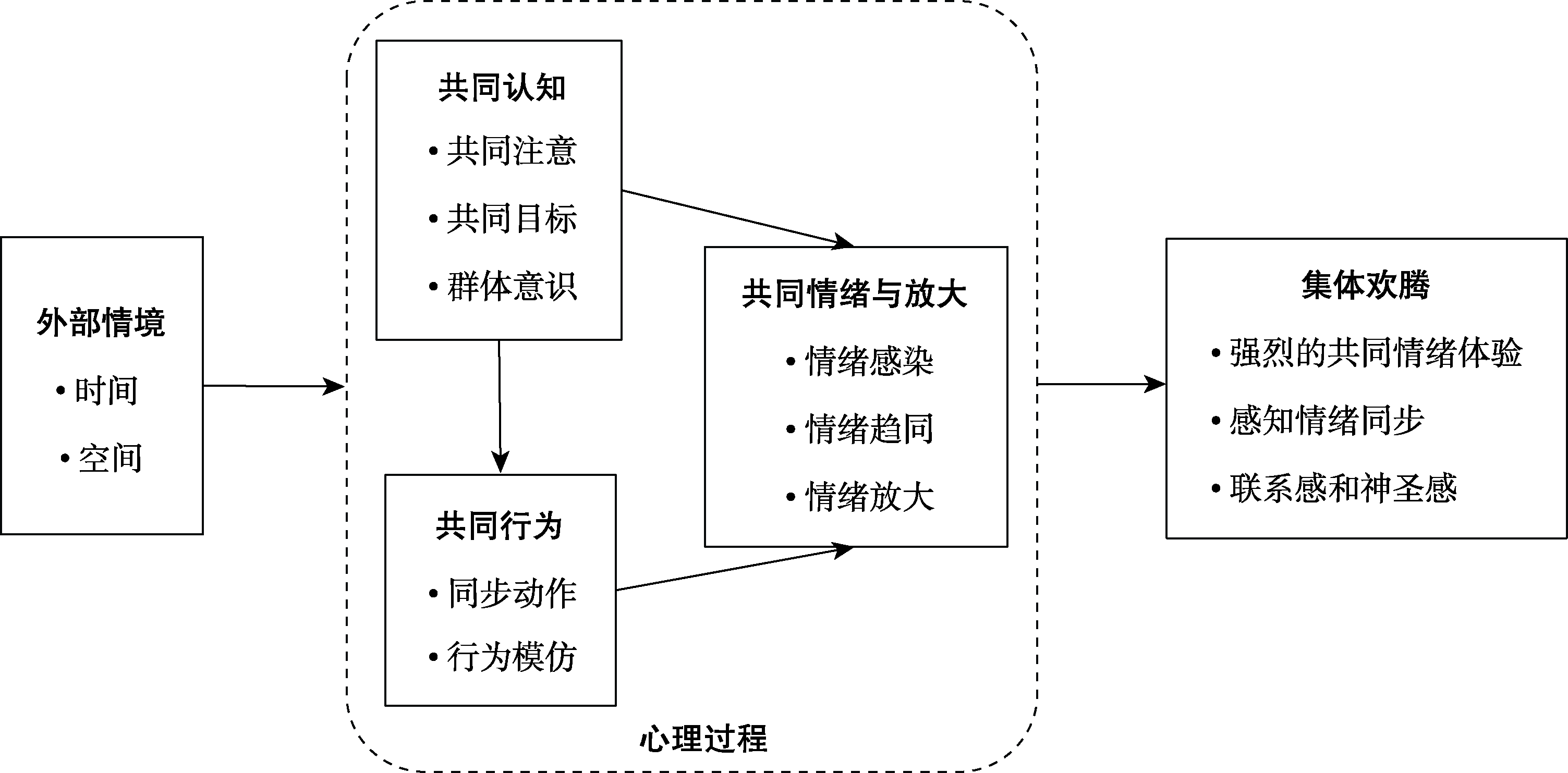
图1 集体欢腾的生成机制要素框架图
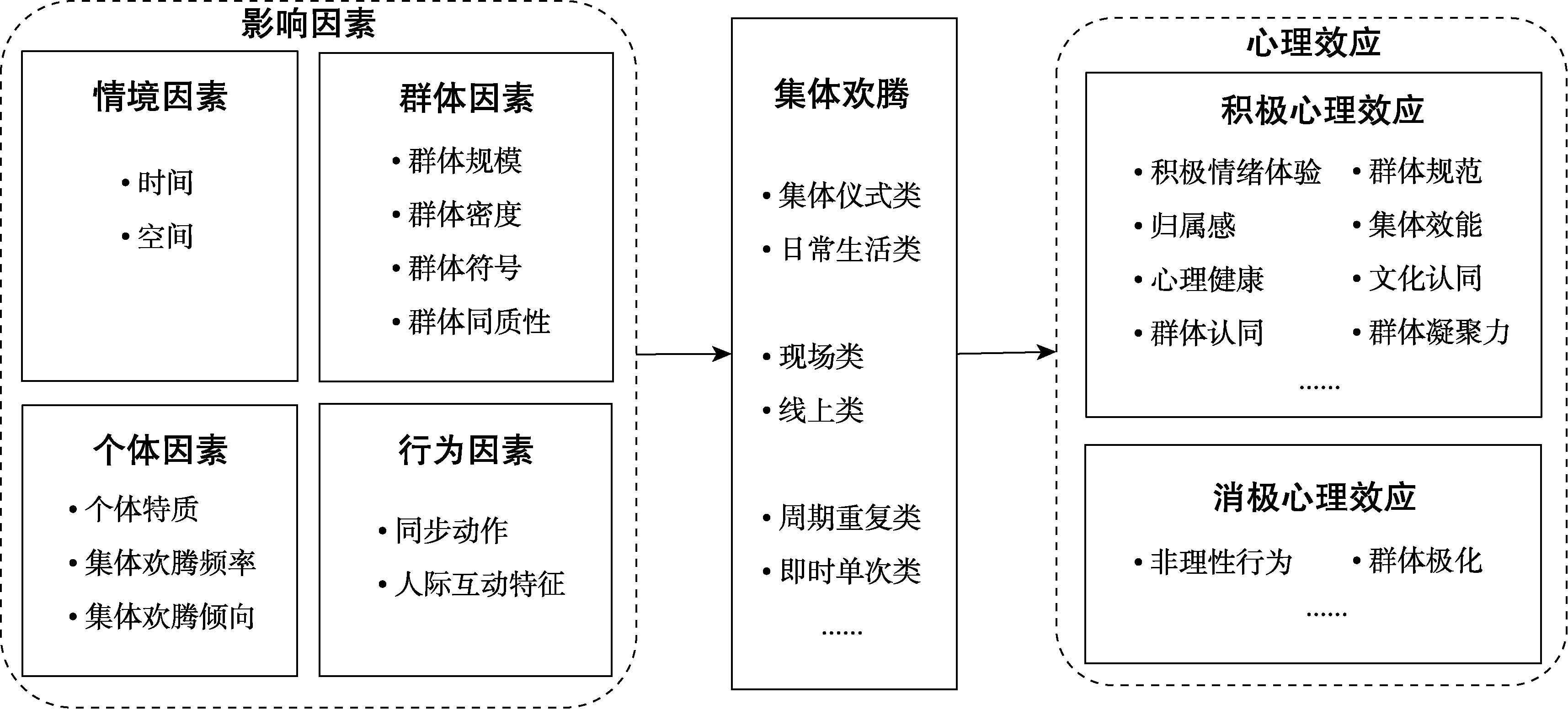
图2 日常集体活动中集体欢腾的心理模型
| [1] | 爱弥尔·涂尔干. (2011). 宗教生活的基本形式 (渠东, 汲喆译). 商务印书馆. |
| [2] | E·迪尔凯姆. (1995). 社会学方法的准则 (狄玉明译). 商务印书馆. |
| [3] | 李钧鹏, 许帅航. (2023). 作为集体欢腾的广场舞. 江海学刊, 1, 137-147+256. |
| [4] | 黎晓丹, 叶浩生, 丁道群. (2018). 通过身体动作理解人与环境: 具身的社会认知. 心理学探新, 38(1), 20-24. |
| [5] |
刘春晓, 刘立志, 王丹, 陈文锋. (2022). 集体仪式促进群体情绪感染的机制. 心理科学进展, 30(8), 1870-1882.
doi: 10.3724/SP.J.1042.2022.01870 |
| [6] | 汪祚军, 侯怡如, 匡仪, 唐辉一, 赵珍珍, 陈红霞. (2017). 群体共享情绪的放大效应. 心理科学进展, 25(4), 662-671. |
| [7] | 吴国栋, 殷怀刚. (2021). 训练、竞赛、观众: 疫情下竞技体育如何可能?——“没有赛事的训练”与“没有观众的赛场”工作坊综述. 体育与科学, 42(3), 112-120. |
| [8] | 伍秋萍, 冯聪, 陈斌斌. (2011). 具身框架下的社会认知研究述评. 心理科学进展, 19(3), 336-345. |
| [9] | 薛秋, 尹可丽. (2024). 同步动作对社会联结的影响: 集体欢腾的中介作用和团队规模的调节作用. 心理学报, 56(12), 1821. |
| [10] | 姚畅, 龚浩群. (2021). 欢腾式发展: 泰北乡村农家乐项目的民族志研究. 中国农业大学学报(社会科学版), 38(1), 69-82. |
| [11] | 余志远, 闫铭, 谷平平. (2023). 场域共在与集体欢腾: 节庆旅游剧场中的游客体验共睦态形成研究. 四川师范大学学报(社会科学版), 50(4), 82-88. |
| [12] | 张晓丽. (2025). 集体的欢腾: 观赏体育赛事提升中国居民幸福感的生成机制与实证检验. 武汉体育学院学报, 59(5), 19-26. |
| [13] | Afyonoğlu M. F., & Güre M. D. P. (2024). Unveiling collective grief: A qualitative study of X posts reflecting on the Kahramanmaraş earthquake anniversary in Türkiye. Death Studies. https://doi.org/10.1080/07481187.2024.2404927 |
| [14] |
Ainsworth M. S. (1989). Attachments beyond infancy. American Psychologist, 44(4), 709-716.
pmid: 2729745 |
| [15] |
Barrett L. F. (2006). Are emotions natural kinds? Perspectives on Psychological Science, 1(1), 28-58.
doi: 10.1111/j.1745-6916.2006.00003.x pmid: 26151184 |
| [16] |
Barsade S. G. (2002). The ripple effect: Emotional contagion and its influence on group behavior. Administrative Science Quarterly, 47(4), 644-675.
doi: 10.2307/3094912 URL |
| [17] |
Baumeister R. F., & Leary M. R. (1995). The need to belong: Desire for interpersonal attachments as a fundamental human motivation. Psychological Bulletin, 117(3), 497-529.
pmid: 7777651 |
| [18] | Beristain C. M., Paez D., & González J. L. (2000). Rituals, social sharing, silence, emotions and collective memory claims in the case of the guatemalan genocide. Psicothema, 12(Suppl), 117-130. |
| [19] |
Bouchat P., Rimé B., Eycken R. V., & Nils F. (2019). The virtues of collective gatherings: A study on the positive effects of a major scouting event. Journal of Applied Social Psychology, 50(3), 189-201.
doi: 10.1111/jasp.v50.3 URL |
| [20] |
Bravo D., Oriol X., Gómez M., Cortez D., & Unanue W. (2020). The effects of the 2016 Copa América Centenario victory on social trust, self-transcendent aspirations and evaluated subjective well-being: The role of identity with the national team and collective pride in major sport events. Frontiers in Psychology, 11, 591498.
doi: 10.3389/fpsyg.2020.591498 URL |
| [21] |
Bu F., Steptoe A., & Fancourt D. (2020). Who is lonely in lockdown? Cross-cohort analyses of predictors of loneliness before and during the COVID-19 pandemic. Public Health, 186, 31-34.
doi: S0033-3506(20)30274-2 pmid: 32768621 |
| [22] |
Castro-Abril P., Da Costa S., Navarro-Carrillo G., Caicedo-Moreno A., Gracia-Leiva M., Bouchat P.,... Paez D. (2021). Social identity, perceived emotional synchrony, creativity, social representations, and participation in social movements: The case of the 2019 Chilean populist protests. Frontiers in Psychology, 12, 764434.
doi: 10.3389/fpsyg.2021.764434 URL |
| [23] | Cheong J. H., Molani Z., Sadhukha S., & Chang L. J. (2023). Synchronized affect in shared experiences strengthens social connection. Communications Biology, 6(1), 1099. |
| [24] |
Chmiel A., Sienkiewicz J., Thelwall M., Paltoglou G., Buckley K., Kappas A., & Hołyst J. A. (2011). Collective emotions online and their influence on community life. PLOS ONE, 6(7), e22207.
doi: 10.1371/journal.pone.0022207 URL |
| [25] |
Chung V., Grèzes J., & Pacherie E. (2023). Collective emotion: A framework for experimental research. Emotion Review, 16(1), 28-45.
doi: 10.1177/17540739231214533 URL |
| [26] | Collins R. (2004). Interaction ritual chains. Princeton, NJ: Princeton University Press. |
| [27] | Csíkszentmihályi M. (1990). Flow: The psychology of optimal experience. New York, NY: Harper & Row Publishers, Inc. |
| [28] |
Draper S. (2014). Effervescence and solidarity in religious organizations. Journal for the Scientific Study of Religion, 53(2), 229-248.
doi: 10.1111/jssr.2014.53.issue-2 URL |
| [29] |
Evans N. D., Reyes J., Wildschut T., Sedikides C., & Fetterman A. K. (2021). Mental transportation mediates nostalgia’s psychological benefits. Cognition and Emotion, 35(1), 84-95.
doi: 10.1080/02699931.2020.1806788 URL |
| [30] |
Fattore T., Drake G., Falloon J., Mason J., & Mogensen L. (2023). Disruption, slowness, and collective effervescence: Children’s perspectives on COVID-19 lockdowns. International Journal on Child Maltreatment: Research, Policy and Practice, 6(3), 393-413.
doi: 10.1007/s42448-022-00147-4 |
| [31] |
Festinger L., Pepitone A., & Newcomb T. (1952). Some consequences of de-individuation in a group. The Journal of Abnormal and Social Psychology, 47(2), 382-389.
doi: 10.1037/h0057906 URL |
| [32] |
Fiske A. P. (1992). The four elementary forms of sociality: Framework for a unified theory of social relations. Psychological Review, 99(4), 689-723.
doi: 10.1037/0033-295x.99.4.689 pmid: 1454904 |
| [33] |
Fiske A. P. (2020). The lexical fallacy in emotion research: Mistaking vernacular words for psychological entities. Psychological Review, 127(1), 95-113.
doi: 10.1037/rev0000174 pmid: 31682141 |
| [34] |
Fiske A. P., Schubert T. W., & Seibt B. (2025). Seeking communal emotions in social practices that culturally evolved to evoke emotions: Worship, kitten videos, memorials, narratives of love, and more. Annual Review of Psychology, 76, 607-633.
doi: 10.1146/annurev-psych-020124-023338 URL |
| [35] |
Fiske A. P., Seibt B., & Schubert T. (2019). The sudden devotion emotion: Kama muta and the cultural practices whose function is to evoke it. Emotion Review, 11(1), 74-86.
doi: 10.1177/1754073917723167 |
| [36] |
Frijda N. H. (1988). The laws of emotion. American Psychologist, 43(5), 349-358.
doi: 10.1037//0003-066x.43.5.349 pmid: 3389582 |
| [37] |
Gabriel S., Naidu E., Paravati E., Morrison C. D., & Gainey K. (2020). Creating the sacred from the profane: Collective effervescence and everyday activities. The Journal of Positive Psychology, 15(1), 129-154.
doi: 10.1080/17439760.2019.1689412 URL |
| [38] | Gabriel S., Valenti J., Naragon-Gainey K., & Young A. F. (2017). The psychological importance of collective assembly: Development and validation of the Tendency for Effervescent Assembly Measure (TEAM). Psychologiccal Assessment, 29(11), 1349-1362. |
| [39] | Gabriel S., Valenti J., & Young A. F. (2016). Social surrogates, social motivations, and everyday activities: The case for a strong, subtle, and sneaky social self. Advances in Experimental Social Psychology, 53, 189-243. |
| [40] |
Gallese V. (2005). Embodied simulation: From neurons to phenomenal experience. Phenomenology and the Cognitive Sciences, 4(1), 23-48.
doi: 10.1007/s11097-005-4737-z URL |
| [41] |
Garcia D., & Rimé B. (2019). Collective emotions and social resilience in the digital traces after a terrorist attack. Psychological Science, 30(4), 617-628.
doi: 10.1177/0956797619831964 pmid: 30865565 |
| [42] | Gloor P. A., Oster D., & Fischbach K. (2013). JazzFlow— Analyzing “Group flow” among jazz musicians through “Honest Signals.” Künstliche Intelligenz, 27(1), 37-43. |
| [43] |
Goffman A. (2019). Go to more parties? Social occasions as home to unexpected turning points in life trajectories. Social Psychology Quarterly, 82(1), 51-74.
doi: 10.1177/0190272518812010 URL |
| [44] |
Goldenberg A., Garcia D., Halperin E., & Gross J. J. (2020). Collective emotions. Current Directions in Psychological Science, 29(2), 154-160.
doi: 10.1177/0963721420901574 URL |
| [45] |
Hackert B., Lumma A.-L., Raettig T., Berger B., & Weger U. (2022). Towards a re-conceptualization of flow in social contexts. Journal for the Theory of Social Behaviour, 53(1), 100-125.
doi: 10.1111/jtsb.v53.1 URL |
| [46] | Haidt J., Seder J. P., & Kesebir S. (2008). Hive psychology, happiness, and public policy. The Journal of Legal Studies, 37, S133-S156. |
| [47] |
Harlow H. F. (1958). The nature of love. American Psychologist, 13(12), 673-685.
doi: 10.1037/h0047884 URL |
| [48] |
Heider A., & Warner R. S. (2010). Bodies in sync: Interaction ritual theory applied to sacred harp singing. Sociology of Religion, 71(1), 76-97.
doi: 10.1093/socrel/srq001 URL |
| [49] |
Hochschild A. R. (2016). The ecstatic edge of politics: Sociology and Donald Trump. Contemporary Sociology, 45, 683-689.
doi: 10.1177/0094306116671947 URL |
| [50] |
Hopkins N., Reicher S. D., Khan S. S., Tewari S., Srinivasan N., & Stevenson C. (2016). Explaining effervescence: Investigating the relationship between shared social identity and positive experience in crowds. Cognition and Emotion, 30(1), 20-32.
doi: 10.1080/02699931.2015.1015969 URL |
| [51] |
Hyde C. A. (2018). Charisma, collectives, and commitment: Hybrid authority in radical feminist social movement organizations. Social Movement Studies, 17(4), 424-436.
doi: 10.1080/14742837.2018.1457519 URL |
| [52] |
Kearney M. (2018). Totally alive: The Wisconsin uprising and the source of collective effervescence. Theory and Society, 47(2), 233-254.
doi: 10.1007/s11186-018-9312-z |
| [53] |
Khan S. S., Hopkins N., Reicher S., Tewari S., Srinivasan N., & Stevenson C. (2016). How collective participation impacts social identity: A longitudinal study from India. Political Psychology, 37(3), 309-325.
doi: 10.1111/pops.2016.37.issue-3 URL |
| [54] |
Kidder J. L. (2006). Bike messengers and the really real: Effervescence, reflexivity, and postmodern identity. Symbolic Interaction, 29(3), 349-371.
doi: 10.1525/si.2006.29.issue-3 URL |
| [55] |
Koefler N., Naidu E., Gabriel S., Schneider V., Pascuzzi G. S., & Paravati E. (2026). Let the music play: Live music fosters collective effervescence and leads to lasting positive outcomes. Personality and Social Psychology Bulletin, 52(3), 546-558. https://doi.org/10.1177/01461672241288027
doi: 10.1177/01461672241288027 URL |
| [56] |
Krauss A. (2018). Luisa’s ghosts: Haunted legality and collective expressions of pain. Medical Anthropology, 37(8), 688-702.
doi: 10.1080/01459740.2018.1458308 pmid: 29693428 |
| [57] |
Labaree B. W. (1959). Review of the living and the dead: A study of the symbolic life of Americans, by W. L. Warner. The New England Quarterly, 32(4), 538-542.
doi: 10.2307/362509 URL |
| [58] | Lambert M. (1993). Ancient Greek and Zulu sacrificial ritual: A comparative analysis. Numen, 40(3), 293. |
| [59] | Levang L. E., Bye T. A., Hirrich A., Rokkum N. H. A., Torp T. U., & Tjora A. (2017). Musikkfestivalens kollektive effervesens. Tidsskrit for Samfunnsfordskning, 58(1), 62-83. |
| [60] |
Liebst L. S. (2019). Exploring the sources of collective effervescence: A multilevel study. Sociological Science, 6, 27-42.
doi: 10.15195/v6.a2 |
| [61] | Lobato R. M., & Sainz M. (2019). On the way to fusion through the pilgrims’ route: Factors that maintain identity fusion in collective rituals. Group Processes & Intergroup Relations, 23(4), 502-518. |
| [62] |
McCaffree K., & Shults F. L. (2022). Distributive effervescence: Emotional energy and social cohesion in secularizing societies. Theory and Society, 51(2), 233-268.
doi: 10.1007/s11186-021-09470-0 |
| [63] |
Mitchell J., Occhipinti S., & Oaten M. (2022). The affiliative power of others’ pain online. Journal of Applied Social Psychology, 53(4), 308-328.
doi: 10.1111/jasp.v53.4 URL |
| [64] |
Naidu E., Gabriel S., Wildschut T., & Sedikides C. (2023). Reliving the good old days: Nostalgia increases psychological wellbeing through collective effervescence. Social Psychological and Personality Science, 15(1), 22-32.
doi: 10.1177/19485506221149813 URL |
| [65] |
Naidu E. S., Paravati E., & Gabriel S. (2022). Staying happy even when staying 6 ft apart: The relationship between extroversion and social adaptability. Personality and Individual Differences, 190, 111549.
doi: 10.1016/j.paid.2022.111549 URL |
| [66] |
Nowland R., Necka E. A., & Cacioppo J. T. (2017). Loneliness and social internet use: Pathways to reconnection in a digital world? Perspectives on Psychological Science, 13(1), 70-87.
doi: 10.1177/1745691617713052 URL |
| [67] |
Páez D., Rimé B., Basabe N., Wlodarczyk A., & Zumeta L. (2015). Psychosocial effects of perceived emotional synchrony in collective gatherings. Journal of Personality and Social Psychology, 108(5), 711-729.
doi: 10.1037/pspi0000014 pmid: 25822033 |
| [68] | Pels F., Kleinert J., & Mennigen F. (2018). Group flow: A scoping review of definitions, theoretical approaches, measures and findings. PlOS ONE, 13(12), e0210117. |
| [69] |
Pizarro J. J., Alfaro-beracoechea L., Cusi O., Ibarra M. L., Zumeta L., & Basabe N. (2021). Eventos locales, efectos globales: Emociones trascendentes e identificación con toda la humanidad. Revista de Psicología, 39(2), 625-654.
doi: 10.18800/psico.202102.005 URL |
| [70] |
Pizarro J. J., Zumeta L. N., Bouchat P., Wlodarczyk A., Rime B., Basabe N.,... Paez D. (2022). Emotional processes, collective behavior, and social movements: A meta-analytic review of collective effervescence outcomes during collective gatherings and demonstrations. Frontiers in Psychology, 13, 974683.
doi: 10.3389/fpsyg.2022.974683 URL |
| [71] |
Plancke C. (2014). Affect, creativity, and community- making in a Congolese song-dance performance: Or how to follow the movement of the social. Journal of the Royal Anthropological Institute, 20(4), 653-669.
doi: 10.1111/jrai.2014.20.issue-4 URL |
| [72] |
Rai T. S., & Fiske A. P. (2011). Moral psychology is relationship regulation: Moral motives for unity, hierarchy, equality, and proportionality. Psychological Review, 118(1), 57-75.
doi: 10.1037/a0021867 pmid: 21244187 |
| [73] |
Richardson M. J., Marsh K. L., & Schmidt R. C. (2005). Effects of visual and verbal interaction on unintentional interpersonal coordination. Journal of Experimental Psychology: Human Perception and Performance, 31(1), 62-79.
doi: 10.1037/0096-1523.31.1.62 URL |
| [74] |
Rimé B., & Páez D. (2023). Why we gather: A new look, empirically documented, at Émile Durkheim’s theory of collective assemblies and collective effervescence. Perspectives on Psychological Science, 18(6), 1306-1330.
doi: 10.1177/17456916221146388 URL |
| [75] |
Rimé B., Páez D., Basabe N., & Martínez F. (2010). Social sharing of emotion, post-traumatic growth, and emotional climate: Follow-up of Spanish citizen’s response to the collective trauma of March 11th terrorist attacks in Madrid. European Journal of Social Psychology, 40(6), 1029-1045.
doi: 10.1002/ejsp.v40:6 URL |
| [76] | Saraei M., Paxton A., & Xygalatas D. (2024). Aligned bodies, united hearts: Embodied emotional dynamics of an Islamic ritual. Philosophical Transactions of the Royal Society B Biological Sciences, 379(1911), 20230162. |
| [77] |
Saweyer R. K. (2006). Group creativity: Musical performance and collaboration. Psychology of Music, 34(2), 148-165.
doi: 10.1177/0305735606061850 URL |
| [78] | Serazio M. (2013). The elementary forms of sports fandom: A Durkheimian exploration of team myths, kinship, and totemic rituals. Communication & Sport, 1(4), 303-325. |
| [79] |
Shao Q., Wang H., Zhu P., & Dong M. (2021). Group emotional contagion and simulation in large-scale flight delays based on the two-layer network model. Physica a Statistical Mechanics and Its Applications, 573, 125941.
doi: 10.1016/j.physa.2021.125941 URL |
| [80] | Simonot-Bérenger O., Chung V., Pelletier J., & Grèzes J. (2025). Collective effervescence mediates the effect of individual emotion on spectators' enjoyment of theatrical performances. Psychology of Aesthetics, Creativity, and the Arts. Advance online publication. https://doi.org/10.1037/aca0000765 |
| [81] |
Stephens N., Vrikki P., Riesch H., & Martin O. (2022). Protesting populist knowledge practices: Collective effervescence at the March for Science London. Cultural Sociology, 16(2), 212-230.
doi: 10.1177/17499755211033556 URL |
| [82] |
Stevens L. E., & Fiske S. T. (1995). Motivation and cognition in social life: A social survival perspective. Social Cognition, 13(3), 189-214.
doi: 10.1521/soco.1995.13.3.189 URL |
| [83] | Tajfel H., & Turner J. C. (1979). An integrative theory of inter-group conflict. In W. G. Austin & S. Worchel (Eds.), The social psychology of inter-group relations (pp. 33-47). Brooks/Cole. |
| [84] | Tewari S., Khan S., Hopkins N., Srinivasan N., & Reicher S. (2012). Participation in mass gatherings can benefit well-being: Longitudinal and control data from a north Indian Hindu pilgrimage event. PlOS ONE, 7(10), e47291. |
| [85] |
Thonhauser G. (2022). Towards a taxonomy of collective emotions. Emotion Review, 14(1), 31-42.
doi: 10.1177/17540739211072469 URL |
| [86] | Turner J. C. (1985). Social categorization and the self concept: A social cognitive theory of group behavior. Advances in Group Processes, 2, 77-122. |
| [87] |
van den Hout, J. J. J., Davis, O. C., & Weggeman, M. C. D. P. (2018). The conceptualization of team flow. The Journal of Psychology, 152(6), 388-423.
doi: 10.1080/00223980.2018.1449729 URL |
| [88] |
Vandenberg F., Berghman M., & van Eijck K. (2021). 'Wear clogs and just act normal': Defining collectivity in Dutch domestic music concerts. Cultural Sociology, 15(2), 233-251.
doi: 10.1177/1749975520961618 URL |
| [89] | von Scheve C. (2011). Collective emotions in rituals:Elicitation, transmission, and a “Matthew-effect”. In A. Michaels & C. Wulf (Eds.), Emotions in rituals and performances (pp. 55-77). Routledge. |
| [90] |
von Scheve C., & Ismer S. (2013). Towards a theory of collective emotions. Emotion Review, 5(4), 406-413.
doi: 10.1177/1754073913484170 URL |
| [91] |
Wakefield J. R. H., Hopkins N., Cockburn C., Shek K. M., Muirhead A., Reicher S., & Van Rijswijk W. (2011). The impact of adopting ethnic or civic conceptions of national belonging for others' treatment. Personality and Social Psychology Bulletin, 37(12), 1599-1610.
doi: 10.1177/0146167211416131 pmid: 21813780 |
| [92] | Walby K., & Cole D. (2019). Beyond emotional labour: Emotions and peer support in a Canadian prison. Emotion, Space and Society, 33, 100631. |
| [93] | White C., Morales D., Xygalatas D., Hernu M., Mathiassen A., Ainsworth A.,... Whitehouse H. (2024). How shared suffering bonded Britons witnessing the Queen's funeral. Scientific Reports, 14(1), 16620. |
| [94] |
Williams M. (2020). U2’s ‘360°’ tour: An episodic and perpetual experience of community. Leisure Studies, 39(6), 797-810.
doi: 10.1080/02614367.2020.1800803 URL |
| [95] |
Wlodarczyk A., Basabe N., Páez D., Reyes C., Villagrán L., Madariaga C.,... Martínez F. (2016). Communal coping and posttraumatic growth in a context of natural disasters in Spain, Chile, and Colombia. Cross-Cultural Research: The Journal of Comparative Social Science, 50(4), 325-355.
doi: 10.1177/1069397116663857 URL |
| [96] |
Wlodarczyk A., Basabe N., Páez D., Villagrán L., & Reyes C. (2017). Individual and collective posttraumatic growth in victims of natural disasters: A multidimensional perspective. Journal of Loss and Trauma, 22(5), 371-384.
doi: 10.1080/15325024.2017.1297657 URL |
| [97] |
Wlodarczyk A., Zumeta L., Basabe N., Rimé B., & Páez D. (2021). Religious and secular collective gatherings, perceived emotional synchrony and self-transcendent emotions: Two longitudinal studies. Current Psychology, 42(6), 4754-4771.
doi: 10.1007/s12144-021-01826-0 |
| [98] |
Wlodarczyk A., Zumeta L., Pizarro J. J., Bouchat P., Hatibovic F., Basabe N., & Rim B. (2020). Perceived emotional synchrony in collective gatherings: Validation of a short scale and proposition of an integrative measure. Frontiers in Psychology, 11, 1721.
doi: 10.3389/fpsyg.2020.01721 pmid: 32849030 |
| [99] | Xygalatas D., Konvalinka I., Bulbulia J., & Roepstorff A. (2011). Quantifying collective effervescence: Heart-rate dynamics at a fire-walking ritual. Communicative & Integrative Biology, 4(6), 735-738. |
| [100] | Xygalatas D., Lang M., Maňo P., Krátký J., & Fischer R. (2024). Emotional contagion in a collective ritual. American Journal of Human Biology, 36(12), e24111. |
| [101] |
Zabala J., Conejero S., Pascual A., Zumeta L. N., Pizarro J. J., & Alonso-Arbiol I. (2023). Korrika, running in collective effervescence through the Basque country: A model of collective processes and their positive psychological effects. Frontiers in Psychology, 14, 1095763.
doi: 10.3389/fpsyg.2023.1095763 URL |
| [102] |
Zabala J., Vázquez A., Conejero S., & Pascual A. (2024). Exploring the origins of identity fusion: Shared emotional experience activates fusion with the group over time. British Journal of Social Psychology, 63(3), 1479-1496.
doi: 10.1111/bjso.12723 pmid: 38426607 |
| [103] | Zheng W., Yu A., Fang P., & Peng K. (2020). Exploring collective emotion transmission in face-to-face interactions. PLOS ONE, 15(8), e0236953. |
| [104] | Zimbardo P. G. (1969). The human choice:Individuation, reason, and order versus deindividuation, impulse, and chaos. Nebraska Symposium on Motivation, 17, 237-307. |
| [105] |
Zlobina A., & Dávila M. C. (2022). Preventive behaviours during the pandemic: The role of collective rituals, emotional synchrony, social norms and moral obligation. British Journal of Social Psychology, 61(4), 1332-1350.
doi: 10.1111/bjso.12539 pmid: 35365893 |
| [106] |
Zumeta L. N., Castro-Abril P., Méndez L., Pizarro J. J., Włodarczyk A., Basabe N.,... Pinto I. R. (2020). Collective effervescence, self-transcendence, and gender differences in social well-being during 8 March demonstrations. Frontiers in Psychology, 11, 607538.
doi: 10.3389/fpsyg.2020.607538 URL |
| [1] | 楚克群, 朱风书. 运动干预对攻击行为的抑制及其作用机制[J]. 心理科学进展, 2025, 33(7): 1257-1266. |
| [2] | 岳童, 王洪, 田兴江, 吴婷, 傅安国, 周燕鹏. 感动的社会联结效应及其理论解释[J]. 心理科学进展, 2025, 33(11): 1983-1992. |
| [3] | 薛秋, 尹可丽. 集体仪式的替代品:世俗中的同步动作及其机制[J]. 心理科学进展, 2023, 31(7): 1303-1317. |
| [4] | 徐步霄, 白洁, 李晔, 郭永玉. 集体自恋:群际冲突的催化剂[J]. 心理科学进展, 2022, 30(9): 2100-2116. |
| [5] | 刘春晓, 刘立志, 王丹, 陈文锋. 集体仪式促进群体情绪感染的机制[J]. 心理科学进展, 2022, 30(8): 1870-1882. |
| [6] | 马昕玥, 崔丽莹. 人际同步对合作行为的促进机制及解释模型[J]. 心理科学进展, 2022, 30(6): 1317-1326. |
| [7] | 胡冰洁, 严璘璘, 夏文玲. 群体地位对面孔识别的影响[J]. 心理科学进展, 2019, 27(suppl.): 38-38. |
| [8] | 陈晓曦, 陈凤玲, 李斌, 刘耀中. 好奇影响灵感产生的现象与机制:认知与情绪双加工路径[J]. 心理科学进展, 2019, 27(1): 1-10. |
| [9] | 潘文静, 温芳芳, 佐斌. 老年刻板印象威胁及其研究操纵[J]. 心理科学进展, 2018, 26(9): 1670-1679. |
| [10] | 殷 融, 张菲菲, 王元元, 许志红. 群体内疚:界定、心理机制、行动倾向及干预策略[J]. 心理科学进展, 2017, 25(6): 1058-1068. |
| [11] | 殷融;张菲菲;王元元;魏晨明. 集体行动的效能动员路径[J]. 心理科学进展, 2017, 25(1): 156-168. |
| [12] | 王勍;俞国良. 群体认同与个体心理健康的关系:调节变量与作用机制[J]. 心理科学进展, 2016, 24(8): 1300-1308. |
| [13] | 殷融;张菲菲. 群体认同在集群行为中的作用机制[J]. 心理科学进展, 2015, 23(9): 1637-1646. |
| [14] | 陈诚;文鹏;舒晓兵. 多水平导师指导行为对员工结果的影响机制[J]. 心理科学进展, 2015, 23(4): 554-561. |
| [15] | 殷融;张菲菲. 不同类型集群行为的差异比较[J]. 心理科学进展, 2015, 23(1): 120-131. |
| 阅读次数 | ||||||
|
全文 |
|
|||||
|
摘要 |
|
|||||
