

ISSN 0439-755X
CN 11-1911/B
主办:中国心理学会
中国科学院心理研究所
出版:科学出版社
心理学报 ›› 2026, Vol. 58 ›› Issue (11): 2200-2217.doi: 10.3724/SP.J.1041.2026.2200 cstr: 32110.14.2026.2200
周志豪1, 乔煕诺1, 张文宇1, 童帅1, 郝宁1,2( )
收稿日期:2026-04-24
发布日期:2026-09-10
出版日期:2026-11-25
通讯作者:
郝宁, E-mail: nhao@psy.ecnu.edu.cn基金资助:
ZHOU Zhihao1, QIAO Xinuo1, ZHANG Wenyu1, TONG Shuai1, HAO Ning1,2()
Received:2026-04-24
Online:2026-09-10
Published:2026-11-25
摘要:
在生成式人工智能嵌入团队协作的背景下, AI观点特征如何影响团体创造表现目前仍缺乏深入探讨。本研究设计“双人−AI”团体协作场景, 要求双人与AI合作完成科学与日常两类创造性任务, 操纵AI输出观点的发散性, 考察其对团体创意新颖性与实用性的影响, 及对AI调用策略、观点采择策略、观点语义特征、双人脑间同步和单人脑功能连接的作用。结果表明, 高AI观点发散性显著提升了团体创意的新颖性, 但这一增益作用仅体现在日常创造性任务中; 高AI观点发散性削弱了两类创造性任务中团体创意的实用性。中介分析表明, AI排除性生成策略及人类观点语义特征在AI观点发散性影响团体创造表现的过程中发挥中介作用。脑−行为整合分析显示, 前额叶脑间同步与单脑功能连接可通过AI调用策略、观点采择策略与观点语义特征等变量, 与团体创意新颖性和实用性产生间接关联。本研究为理解AI观点发散性影响团体创意新颖性与实用性的认知神经机制提供了实证证据, 进一步拓展了团体动机性信息加工模型在人智共创情境中的应用范围。
中图分类号:
周志豪, 乔煕诺, 张文宇, 童帅, 郝宁. (2026). AI观点发散性对团体创造表现的影响及其认知神经机制. 心理学报, 58(11), 2200-2217.
ZHOU Zhihao, QIAO Xinuo, ZHANG Wenyu, TONG Shuai, HAO Ning. (2026). Effects of AI viewpoint divergence on group creative performance: Cognitive-neural mechanisms. Acta Psychologica Sinica, 58(11), 2200-2217.

图1 ROI分布(A)、实验现场(B)、实验界面(C)及实验程序(D)图 注:彩图见电子版, 下同
| 变量 | 低AI− 科学 | 低AI− 日常 | 高AI− 科学 | 高AI− 日常 |
|---|---|---|---|---|
| AI观点离散度 | 0.49 (0.06) | 0.50 (0.06) | 0.59 (0.06) | 0.56 (0.06) |
| 新颖性 | 2.60 (0.34) | 2.44 (0.48) | 2.71 (0.49) | 2.77 (0.51) |
| 实用性 | 3.68 (0.32) | 3.57 (0.32) | 3.58 (0.31) | 3.43 (0.26) |
表1 AI观点离散度和团体创造表现的描述性统计[M (SD)]
| 变量 | 低AI− 科学 | 低AI− 日常 | 高AI− 科学 | 高AI− 日常 |
|---|---|---|---|---|
| AI观点离散度 | 0.49 (0.06) | 0.50 (0.06) | 0.59 (0.06) | 0.56 (0.06) |
| 新颖性 | 2.60 (0.34) | 2.44 (0.48) | 2.71 (0.49) | 2.77 (0.51) |
| 实用性 | 3.68 (0.32) | 3.57 (0.32) | 3.58 (0.31) | 3.43 (0.26) |

图2 AI观点发散性和创造性任务类型对团体创造表现的影响 注: A、B分别代表团体创造新颖性和实用性, 误差棒代表标准误, * p < 0.05, ** p < 0.01

图3 AI观点发散性和创造性任务类型对AI调用策略、观点采择和语义指标的影响 注: A、B分别代表方向性生成和背景性探索策略, C和D分别代表采择AI和独立生成策略, E和F分别代表群体外部平均余弦值和群体外部中心距离, * p < 0.05, ** p < 0.01, *** p < 0.001
| 变量 | 指标 | 低AI−科学 | 低AI−日常 | 高AI−科学 | 高AI−日常 |
|---|---|---|---|---|---|
| AI调用策略 | 广泛性生成次数 | 0.87 (0.89) | 1.02 (0.96) | 0.89 (0.87) | 0.86 (0.73) |
| 方向性生成次数 | 1.27 (1.03) | 1.24 (1.00) | 1.41 (0.78) | 0.84 (0.83) | |
| 排除性生成次数 | 0.13 (0.41) | 0.24 (0.57) | 0.05 (0.21) | 0.09 (0.29) | |
| 评估性探索次数 | 0.04 (0.30) | 0.09 (0.36) | 0.21 (0.51) | 0.11 (0.39) | |
| 背景性探索次数 | 0.84 (1.07) | 0.18 (0.49) | 0.57 (0.93) | 0.25 (0.49) | |
| 完善性探索次数 | 0.02 (0.15) | 0.20 (0.51) | 0.18 (0.66) | 0.43 (0.87) | |
| 观点采择策略 | 采择队友次数 | 0.16 (0.42) | 0.33 (0.64) | 0.16 (0.37) | 0.32 (0.56) |
| 采择AI次数 | 4.47 (1.60) | 3.36 (1.55) | 4.93 (1.45) | 3.46 (1.68) | |
| 采择队友和AI次数 | 0.98 (1.03) | 0.62 (1.01) | 0.57 (1.04) | 0.68 (1.10) | |
| 独立生成次数 | 2.40 (1.47) | 3.69 (1.49) | 2.34 (1.50) | 3.55 (1.50) | |
| 观点语义特征 | 群体外部平均余弦值 | 0.32 (0.02) | 0.44 (0.03) | 0.29 (0.02) | 0.42 (0.03) |
| 群体外部中心距离 | 0.44 (0.04) | 0.34 (0.04) | 0.46 (0.04) | 0.35 (0.04) |
表2 AI调用策略、观点采择策略和观点语义特征的描述性统计[M (SD)]
| 变量 | 指标 | 低AI−科学 | 低AI−日常 | 高AI−科学 | 高AI−日常 |
|---|---|---|---|---|---|
| AI调用策略 | 广泛性生成次数 | 0.87 (0.89) | 1.02 (0.96) | 0.89 (0.87) | 0.86 (0.73) |
| 方向性生成次数 | 1.27 (1.03) | 1.24 (1.00) | 1.41 (0.78) | 0.84 (0.83) | |
| 排除性生成次数 | 0.13 (0.41) | 0.24 (0.57) | 0.05 (0.21) | 0.09 (0.29) | |
| 评估性探索次数 | 0.04 (0.30) | 0.09 (0.36) | 0.21 (0.51) | 0.11 (0.39) | |
| 背景性探索次数 | 0.84 (1.07) | 0.18 (0.49) | 0.57 (0.93) | 0.25 (0.49) | |
| 完善性探索次数 | 0.02 (0.15) | 0.20 (0.51) | 0.18 (0.66) | 0.43 (0.87) | |
| 观点采择策略 | 采择队友次数 | 0.16 (0.42) | 0.33 (0.64) | 0.16 (0.37) | 0.32 (0.56) |
| 采择AI次数 | 4.47 (1.60) | 3.36 (1.55) | 4.93 (1.45) | 3.46 (1.68) | |
| 采择队友和AI次数 | 0.98 (1.03) | 0.62 (1.01) | 0.57 (1.04) | 0.68 (1.10) | |
| 独立生成次数 | 2.40 (1.47) | 3.69 (1.49) | 2.34 (1.50) | 3.55 (1.50) | |
| 观点语义特征 | 群体外部平均余弦值 | 0.32 (0.02) | 0.44 (0.03) | 0.29 (0.02) | 0.42 (0.03) |
| 群体外部中心距离 | 0.44 (0.04) | 0.34 (0.04) | 0.46 (0.04) | 0.35 (0.04) |

图4 AI调用策略和观点语义特征中介路径
注: * p < 0.05, ** p < 0.01, *** p < 0.001
| 指标 | 低AI−科学 | 低AI−日常 | 高AI−科学 | 高AI−日常 |
|---|---|---|---|---|
| ROI06-ROI03 (脑间连接ΔIBS) | 0.08 (0.51) | −0.04 (0.46) | −0.05 (0.48) | 0.08 (0.47) |
| ROI03-ROI05 (单脑连接ΔFC) | 0.07 (0.43) | −0.07 (0.40) | −0.22 (0.44) | −0.10 (0.36) |
表3 脑神经指标的描述性统计[M (SD)]
| 指标 | 低AI−科学 | 低AI−日常 | 高AI−科学 | 高AI−日常 |
|---|---|---|---|---|
| ROI06-ROI03 (脑间连接ΔIBS) | 0.08 (0.51) | −0.04 (0.46) | −0.05 (0.48) | 0.08 (0.47) |
| ROI03-ROI05 (单脑连接ΔFC) | 0.07 (0.43) | −0.07 (0.40) | −0.22 (0.44) | −0.10 (0.36) |

图5 AI观点发散性和创造性任务类型对ΔIBS (A)和ΔFC (B)的影响
注: ** p < 0.01
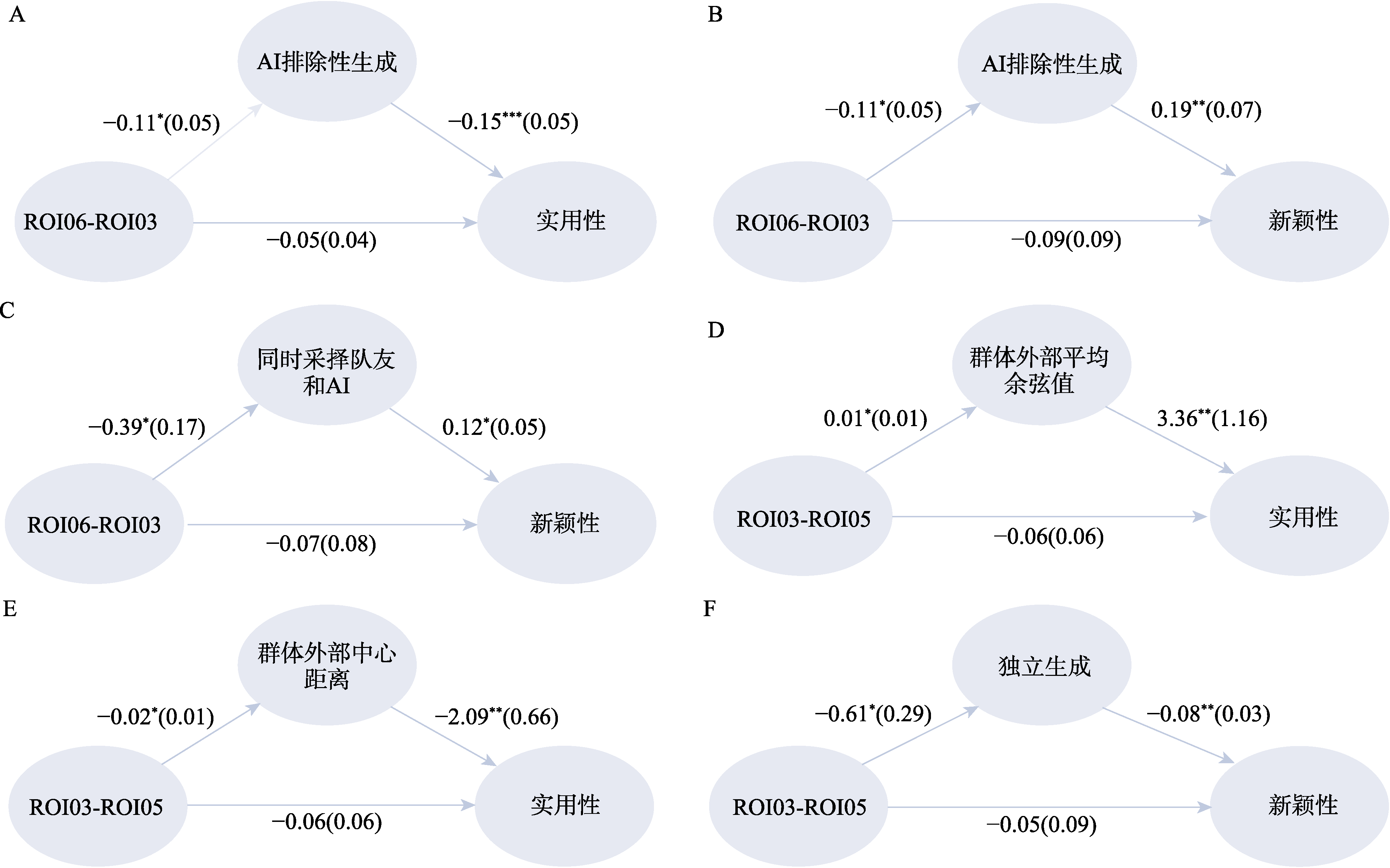
图6 脑神经指标中介路径
注: * p < 0.05, ** p < 0.01
| 通道(CHs) | MNI坐标(mm) | 布罗德曼分区及占比(Percentage) | ||
|---|---|---|---|---|
| x | y | z | ||
| P1 (None) | −40 | 61 | 0 | 额极区(63%) |
| P2 (ROI01) | −16 | 73 | 5 | 额极区(84%) |
| P3 (ROI02) | 18 | 73 | 4 | 额极区(84%) |
| P4 (None) | 41 | 63 | 1 | 额极区(69%) |
| P5 (ROI03) | −48 | 49 | 8 | 背外侧前额叶皮层(71%) |
| P6 (ROI01) | −28 | 66 | 15 | 额极区(87%) |
| P7 (None) | 7 | 71 | 18 | 额极区(100%) |
| P8 (ROI02) | 30 | 67 | 14 | 额极区(96%) |
| P9 (ROI04) | 49 | 52 | 9 | 背外侧前额叶皮层(86%) |
| P10 (ROI03) | −41 | 53 | 24 | 背外侧前额叶皮层(82%) |
| P11(ROI01) | −14 | 65 | 29 | 额极区(82%) |
| P12(ROI02) | 16 | 67 | 28 | 额极区(91%) |
| P13 (ROI04) | 42 | 56 | 23 | 背外侧前额叶皮层(88%) |
| P14 (ROI05) | −47 | 35 | 33 | 布罗卡区三角部(76%) |
| P15 (None) | 3 | 58 | 39 | 背外侧前额叶皮层(78%) |
| P16 (ROI06) | 50 | 38 | 30 | 布罗卡区三角部(88%) |
| P17 (ROI03) | −35 | 36 | 46 | 背外侧前额叶皮层(98%) |
| P18 (ROI03) | −11 | 50 | 49 | 背外侧前额叶皮层(98%) |
| P19 (ROI04) | 16 | 51 | 48 | 背外侧前额叶皮层(100%) |
| P20 (ROI04) | 39 | 39 | 43 | 背外侧前额叶皮层(98%) |
表S1 通道对应脑区的MNI坐标及其感兴趣区归属
| 通道(CHs) | MNI坐标(mm) | 布罗德曼分区及占比(Percentage) | ||
|---|---|---|---|---|
| x | y | z | ||
| P1 (None) | −40 | 61 | 0 | 额极区(63%) |
| P2 (ROI01) | −16 | 73 | 5 | 额极区(84%) |
| P3 (ROI02) | 18 | 73 | 4 | 额极区(84%) |
| P4 (None) | 41 | 63 | 1 | 额极区(69%) |
| P5 (ROI03) | −48 | 49 | 8 | 背外侧前额叶皮层(71%) |
| P6 (ROI01) | −28 | 66 | 15 | 额极区(87%) |
| P7 (None) | 7 | 71 | 18 | 额极区(100%) |
| P8 (ROI02) | 30 | 67 | 14 | 额极区(96%) |
| P9 (ROI04) | 49 | 52 | 9 | 背外侧前额叶皮层(86%) |
| P10 (ROI03) | −41 | 53 | 24 | 背外侧前额叶皮层(82%) |
| P11(ROI01) | −14 | 65 | 29 | 额极区(82%) |
| P12(ROI02) | 16 | 67 | 28 | 额极区(91%) |
| P13 (ROI04) | 42 | 56 | 23 | 背外侧前额叶皮层(88%) |
| P14 (ROI05) | −47 | 35 | 33 | 布罗卡区三角部(76%) |
| P15 (None) | 3 | 58 | 39 | 背外侧前额叶皮层(78%) |
| P16 (ROI06) | 50 | 38 | 30 | 布罗卡区三角部(88%) |
| P17 (ROI03) | −35 | 36 | 46 | 背外侧前额叶皮层(98%) |
| P18 (ROI03) | −11 | 50 | 49 | 背外侧前额叶皮层(98%) |
| P19 (ROI04) | 16 | 51 | 48 | 背外侧前额叶皮层(100%) |
| P20 (ROI04) | 39 | 39 | 43 | 背外侧前额叶皮层(98%) |
| [1] | Acar O. A., & van den Ende J. (2016). Knowledge distance, cognitive-search processes, and creativity: The making of winning solutions in science contests. Psychological Science, 27(5), 692-699. https://doi.org/10.1177/0956797616634665 |
| [2] | Acar O. A., Tuncdogan A., van Knippenberg D., & Lakhani K. R. (2024). Collective creativity and innovation: An interdisciplinary review, integration, and research agenda. Journal of Management, 50(6), 2119-2151. https://doi.org/10.1177/01492063231212416 |
| [3] | Aggarwal I., & Woolley A. W. (2019). Team creativity, cognition, and cognitive style diversity. Management Science, 65(4), 1586-1599. https://doi.org/10.1287/mnsc.2017.3001 |
| [4] | Anderson B. R., Shah J. H., & Kreminski M. (2024). Homogenization effects of large language models on human creative ideation. In Proceedings of the 16th Conference on Creativity & Cognition (pp. 413-425). ACM. https://doi.org/10.1145/3635636.3656204 |
| [5] | Beaty R. E., Johnson D. R., Zeitlen D. C., & Forthmann B. (2022). Semantic distance and the alternate uses task: Recommendations for reliable automated assessment of originality. Creativity Research Journal, 34(3), 245-260. https://doi.org/10.1080/10400419.2022.2025720 |
| [6] | Beaty R. E., & Kenett Y. N. (2023). Associative thinking at the core of creativity. Trends in Cognitive Sciences, 27(7), 671-683. https://doi.org/10.1016/j.tics.2023.04.004 |
| [7] | Beaty R. E., Kenett Y. N., Christensen A. P., Rosenberg M. D., Benedek M., Chen Q., … Silvia P. J. (2018). Robust prediction of individual creative ability from brain functional connectivity. Proceedings of the National Academy of Sciences of the United States of America, 115(5), 1087-1092. https://www.pnas.org/doi/10.1073/pnas.1713532115 |
| [8] | Chan M. M., Cho E., Ralph M. A. L., & Robinson G. A. (2025). The cognitive and neural bases of creative thought: A cross-domain systematic review and meta-analysis of transcranial direct current stimulation studies. Neuroscience & Biobehavioral Reviews, 175, 106237. https://doi.org/10.1016/j.neubiorev.2025.106237 |
| [9] | Che J. S., Sun H. L., Xiao C. J., & Li A. M. (2019). Why information overload damages decisions? An explanation based on limited cognitive resources. Advances in Psychological Science, 27(10), 1758-1768. https://doi.org/10.3724/SP.J.1042.2019.01758 |
| [车敬上, 孙海龙, 肖晨洁, 李爱梅. (2019). 为什么信息超载损害决策?基于有限认知资源的解释. 心理科学进展, 27(10), 1758-1768. https://doi.org/10.3724/SP.J.1042.2019.01758] | |
| [10] | Chen Z., & Chan J. (2024). Large language model in creative work: The role of collaboration modality and user expertise. Management Science, 70(12), 9101-9117. https://doi.org/10.1287/mnsc.2023.03014 |
| [11] | Cheng S., Zhang W., Xie C., & Hao N. (2026). Communication modality modulates dynamic switching between neural coupling and decoupling during group creative ideation. NeuroImage, 326, 121707. https://doi.org/10.1016/j.neuroimage.2026.121707 |
| [12] | Cohen J. (2013). Statistical power analysis for the behavioral sciences (2nd ed.). Routledge. https://doi.org/10.4324/9780203771587 |
| [13] | Cui X., Bray S., & Reiss A. L. (2010). Functional near infrared spectroscopy (NIRS) signal improvement based on negative correlation between oxygenated and deoxygenated hemoglobin dynamics. NeuroImage, 49(4), 3039-3046. https://doi.org/10.1016/j.neuroimage.2009.11.050 |
| [14] | Cui X., Bryant D. M., & Reiss A. L. (2012). NIRS-based hyperscanning reveals increased interpersonal coherence in superior frontal cortex during cooperation. NeuroImage, 59(3), 2430-2437. https://doi.org/10.1016/j.neuroimage.2011.09.003 |
| [15] | De Dreu C. K. W., Nijstad B. A., & van Knippenberg D. (2008). Motivated information processing in group judgment and decision making. Personality and Social Psychology Review, 12(1), 22-49. https://doi.org/10.1177/1088868307304092 |
| [16] | Doshi A. R., & Hauser O. P. (2024). Generative AI enhances individual creativity but reduces the collective diversity of novel content. Science Advances, 10(28), eadn5290. https://doi.org/10.1126/sciadv.adn5290 |
| [17] | Fink A., Grabner R. H., Benedek M., Reishofer G., Hauswirth V., Fally M., … Neubauer A. C. (2009). The creative brain: Investigation of brain activity during creative problem solving by means of EEG and fMRI. Human Brain Mapping, 30(3), 734-748. https://doi.org/10.1002/hbm.20538 |
| [18] | Fishburn F. A., Ludlum R. S., Vaidya C. J., & Medvedev A. V. (2019). Temporal derivative distribution repair (TDDR): A motion correction method for fNIRS. NeuroImage, 184, 171-179. https://doi.org/10.1016/j.neuroimage.2018.09.025 |
| [19] | Gramfort A., Luessi M., Larson E., Engemann D. A., Strohmeier D., Brodbeck C., Goj R., Jas M., Brooks T., Parkkonen L., & Hämäläinen M. S. (2013). MEG and EEG data analysis with MNE-Python. Frontiers in Neuroscience, 7, 267. https://doi.org/10.3389/fnins.2013.00267 |
| [20] | Grinsted A., Moore J. C., & Jevrejeva S. (2004). Application of the cross wavelet transform and wavelet coherence to geophysical time series. Nonlinear Processes in Geophysics, 11(6), 561-566. https://doi.org/10.5194/npg-11-561-2004 |
| [21] | Gulati S., Sousa S., & Lamas D. (2019). Design, development and evaluation of a human-computer trust scale. Behaviour & Information Technology, 38(10), 1004-1015. https://doi.org/10.1080/0144929X.2019.1656779 |
| [22] | Hayes A. F. (2017). Introduction to mediation, moderation, and conditional process analysis: A regression-based approach. New York: Guilford Press. |
| [23] | Hoever I. J., van Knippenberg D., van Ginkel W. P., & Barkema H. G. (2012). Fostering team creativity: Perspective taking as key to unlocking diversity’s potential. Journal of Applied Psychology, 97(5), 982-996. https://doi.org/10.1037/a0029159 |
| [24] | Ivcevic Z., & Grandinetti M. (2024). Artificial intelligence as a tool for creativity. Journal of Creativity, 34(2), 100079. https://doi.org/10.1016/j.yjoc.2024.100079 |
| [25] | Jackson R. L. (2021). The neural correlates of semantic control revisited. NeuroImage, 224, 117444. https://doi.org/10.1016/j.neuroimage.2020.117444 |
| [26] | Krieger-Redwood K., Steward A., Gao Z., Wang X., Halai A., Smallwood J., & Jefferies E. (2023). Creativity in verbal associations is linked to semantic control. Cerebral Cortex, 33(9), 5135-5147. https://doi.org/10.1093/cercor/bhac405 |
| [27] | Kranzle T., & Sharratt K. (2025). Evaluating creative output with generative artificial intelligence: Comparing GPT models and human experts in idea evaluation. Creativity and Innovation Management, 34(4), 991-1012. https://doi.org/10.1111/caim.70007 |
| [28] | Lamsiyah S., El Mahdaouy A., Espinasse B., & El Alaoui Ouatik S. (2021). An unsupervised method for extractive multi-document summarization based on centroid approach and sentence embeddings. Expert Systems with Applications, 167, 114152. https://doi.org/10.1016/j.eswa.2020.114152 |
| [29] | Larey T. S., & Paulus P. B. (1999). Group preference and convergent tendencies in small groups: A content analysis of group brainstorming performance. Creativity Research Journal, 12(3), 175-184. https://doi.org/10.1207/s15326 934crj1203_2 |
| [30] | Lu K., & Hao N. (2026). The interpersonal neural coupling in group creative ideation. Psychological Review, 133, 221-236. https://doi.org/10.1037/rev0000524 |
| [31] | Lu K., Gao Z., Wang X., Qiao X., He Y., Zhang Y., & Hao N. (2023). The hyper-brain neural couplings distinguishing high-creative group dynamics: An fNIRS hyperscanning study. Cerebral Cortex, 33(5), 1630-1642. https://doi.org/10.1093/cercor/bhac161 |
| [32] | Lu K., Teng J., & Hao N. (2020). Gender of partner affects the interaction pattern during group creative idea generation. Experimental Brain Research, 238(5), 1157-1168. https://doi.org/10.1007/s00221-020-05799-7 |
| [33] | Lu R., Lin C., & Tsao H. (2024). Empowering large language models to leverage domain-specific knowledge in E-learning. Applied Sciences, 14(12), 5264. https://doi.org/10.3390/app14125264 |
| [34] | Luchini S. A., Maliakkal N. T., DiStefano P. V., Laverghetta A., Patterson J. D., Beaty R. E., & Reiter-Palmon R. (2025). Automated scoring of creative problem solving with large language models: A comparison of originality and quality ratings. Psychology of Aesthetics, Creativity, and the Arts. Advance online publication. https://doi.org/10.1037/aca0000736 |
| [35] | Martin S., Ferrante M., Bruera A., & Hartwigsen G. (2025). Causal contributions of left inferior and medial frontal cortex to semantic and executive control. Communications Biology, 8, 1343. https://doi.org/10.1038/s42003-025-08848-5 |
| [36] | MacKinnon D. P., Krull J. L., & Lockwood C. M. (2000). Equivalence of the mediation, confounding and suppression effect. Prevention Science, 1(4), 173-181. https://doi.org/10.1023/A:1026595011371 |
| [37] | Medeiros K. E., Cropley D. H., Marrone R. L., & Reiter- Palmon R. (2025). Human-AI co-creativity: Does ChatGPT make us more creative? The Journal of Creative Behavior, 59(2), e70022. https://doi.org/10.1002/jocb.70022 |
| [38] | Moon K., Green A. E., & Kushlev K. (2025). Homogenizing effect of large language models (LLMs) on creative diversity: An empirical comparison of human and ChatGPT writing. Computers in Human Behavior: Artificial Humans, 6, 100207. https://doi.org/10.1016/j.chbah.2025.100207 |
| [39] | Nijstad B. A., & De Dreu C. K. W. (2012). Motivated information processing in organizational teams: Progress, puzzles, and prospects. Research in Organizational Behavior, 32, 87-111. https://doi.org/10.1016/j.riob.2012.11.004 |
| [40] | OpenAI. (2024). New embedding models and API updates. OpenAI. https://openai.com/index/new-embedding-models-and-api-updates |
| [41] | Peter L., Michinov N., Besançon M., Michinov E., Juhel J., Brown G., Jamet E., & Cherbonnier A. (2021). Revisiting the effects of gender diversity in small groups on divergent thinking: A large-scale study using synchronous electronic brainstorming. Frontiers in Psychology, 12, 723235. https://doi.org/10.3389/fpsyg.2021.723235 |
| [42] | Pick H., Fahoum N., Zoabi D., & Shamay-Tsoory S. G. (2024). Brainstorming: Interbrain coupling in groups forms the basis of group creativity. Communications Biology, 7, 911. https://doi.org/10.1038/s42003-024-06614-7 |
| [43] | Ruan K., Wang X., Hong J., Wang P., Liu Y., & Sun H. (2026). Evaluating LLMs’ divergent thinking capabilities for scientific idea generation with minimal context. Nature Communications, 17, 3625. https://doi.org/10.1038/s41467-026-70245-1 |
| [44] | Runco M. A., & Jaeger G. J. (2012). The standard definition of creativity. Creativity Research Journal, 24(1), 92-96. https://doi.org/10.1080/10400419.2012.650092 |
| [45] | Runco M. A., Plucker J. A., & Lim W. (2001). Development and psychometric integrity of a measure of ideational behavior. Creativity Research Journal, 13(3-4), 393-400. https://doi.org/10.1207/S15326934CRJ1334_16 |
| [46] | Saretzki J., Knopf T., Forthmann B., Goecke B., Jaggy A.-K., Benedek M., & Weiss S. (2025). Scoring German alternate uses items applying large language models. Journal of Intelligence, 13(6), 64. https://doi.org/10.3390/jintelligence13060064 |
| [47] | Schaum M., Pinzuti E., Sebastian A., Lieb K., Fries P., Mobascher A., Jung P., Wibral M., & Tüscher O. (2021). Right inferior frontal gyrus implements motor inhibitory control via beta-band oscillations in humans. eLife, 10, e61679. https://doi.org/10.7554/eLife.61679 |
| [48] | Shaw A. (2021). It works…but can we make it easier? A comparison of three subjective scoring indexes in the assessment of divergent thinking. Thinking Skills and Creativity, 40, 100789. https://doi.org/10.1016/j.tsc.2021.100789 |
| [49] | Silvia P. J., Winterstein B. P., Willse J. T., Barona C. M., Cram J. T., Hess K. I., Martinez J. L., & Richard C. A. (2008). Assessing creativity with divergent thinking tasks: Exploring the reliability and validity of new subjective scoring methods. Psychology of Aesthetics, Creativity, and the Arts, 2(2), 68-85. https://doi.org/10.1037/1931-3896.2.2.68 |
| [50] | Vinchon F., Lubart T., Bartolotta S., Gironnay V., Botella M., Bourgeois-Bougrine S., … Gaggioli A. (2023). Artificial intelligence & creativity: A manifesto for collaboration. The Journal of Creative Behavior, 57(4), 472-484. https://doi.org/10.1002/jocb.597 |
| [51] | Wadinambiarachchi S., Kelly R. M., Pareek S., Zhou Q., & Velloso E. (2024). The effects of generative AI on design fixation and divergent thinking. In Proceedings of the 2024 CHI Conference on Human Factors in Computing Systems (380, pp. 1-18). ACM. https://doi.org/10.1145/3613904.3642919 |
| [52] | Wan Q., Hu S., Zhang Y., Wang P., Wen B., & Lu Z. (2024). “It felt like having a second mind”. Investigating human-AI co-creativity in prewriting with Large Language Models. Proceedings of the ACM on Human-Computer Interaction, 8(CSCW1), 1-26. https://doi.org/10.1145/3637361 |
| [53] | Wan Y., Guo Y., Hu Y., Liu P., Qiu J., & Yang W. (2025). Measurement and automated scoring of scientific creative thinking. https://doi.org/10.31219/osf.io/dy9p8_v1 |
| [54] | Wang X., Chen Q., Zhuang K., Zhang J., Cortes R. A., Holzman D. D., … & Qiu J. (2024). Semantic associative abilities and executive control functions predict novelty and appropriateness of idea generation. Communications Biology, 7, 703. https://doi.org/10.1038/s42003-024-06405-0 |
| [55] | Wang X., Lu K., He Y., Qiao X., Gao Z., Zhang Y., & Hao N. (2024). Dynamic brain networks in spontaneous gestural communication. npj Science of Learning, 9, 59. |
| [56] | Wu W., Huang Y., & Qian L. (2024). Social trust and algorithmic equity: The societal perspectives of users’ intention to interact with algorithm recommendation systems. Decision Support Systems, 178, 114115. https://doi.org/10.1016/j.dss.2023.114115 |
| [57] | Yeo G. B., Celestine N. A., Parker S. K., To M. L., & Hirst G. (2024). A neurocognitive framework of attention and creativity: Maximizing usefulness and novelty via directed and undirected pathways. Journal of Organizational Behavior, 45(6), 912-934. https://doi.org/10.1002/job.2787 |
| [58] | Zhao H., Wang Z., Han M., & Huang Y. (2024). Collective thriving and team creativity in college students’ innovation teams: A serial mediation model. Thinking Skills and Creativity, 51, 101468. https://doi.org/10.1016/j.tsc.2024.101468 |
| [59] | Zhao X., Lynch J. G., Jr., & Chen Q. (2010). Reconsidering Baron and Kenny: Myths and truths about mediation analysis. Journal of Consumer Research, 37(2), 197-206. https://doi.org/10.1086/651257 |
| [60] | Zhou Z., Xiao L., Wang J., Tong S., Zhang W., & Hao N. (2026). Group-AI collaboration enhances creativity performance: The roles of perspective-taking and AI utilisation strategies. Journal of Computer Assisted Learning, 42(2), e70223. https://doi.org/10.1002/jcal.70223 |
| [1] | 刘顺, 王穗苹, 黄健. 语境性别影响元音和辅音范畴感知的计算建模[J]. 心理学报, 2026, 58(12): 2405-2420. |
| [2] | 肖容, 梁丹丹. 统计学习和感觉-运动联结: 婴儿语音感知的双重路径[J]. 心理学报, 2026, 58(12): 2421-2437. |
| [3] | 胡赛赛, 伏泽青, 周爱保, 尹玉龙. 任务状态动态调节汉字N200增强效应:来自贝叶斯阅读者模型的证据[J]. 心理学报, 2026, 58(12): 2438-2455. |
| [4] | 靳婷婷, 钱昱夫, 范昕茹, 王倩, 任桂琴, 李卫君. 汉语语义双关与谐音双关笑话加工的神经机制[J]. 心理学报, 2026, 58(12): 2456-2473. |
| [5] | 杜雅楠, 徐文苑, 葛枫岭, 孙凤娇, 夏天, 宗文惠, 周茂楠. 说话人观念与任务要求对反语理解中观点采择的影响[J]. 心理学报, 2026, 58(12): 2474-2493. |
| [6] | 刘欢, 李子媛, 胡明璐, 刘强. 视觉工作记忆在线编码导致离线态存储产生损耗[J]. 心理学报, 2026, 58(12): 2494-2505. |
| [7] | 李海峰, 杜嘉鑫, 杨云霞, 赖舒萍, 郑孝钤. 多列表学习情境下不同锚点的反馈对元记忆自信偏差的校准及机制[J]. 心理学报, 2026, 58(12): 2506-2519. |
| [8] | 谢婷婷, 杨联宇, 吴晓甜, 周典典, 于战宇. 指令记忆中被试执行任务效应的多模态依赖: 指令惯用性的调节作用[J]. 心理学报, 2026, 58(12): 2520-2531. |
| [9] | 袁梦琪, 邹迪, 代乔, 万蓓, 刘庆科, 顾思梦, 王福顺. 不确定性与预期误差对情绪强度的作用:来自行为、眼动和fMRI的证据[J]. 心理学报, 2026, 58(12): 2532-2546. |
| [10] | 张曼, 彭洋, 王雅洁, 胡慧清, 陈石, 赵庆柏. 观点采纳塑造人智协作中的创造性表现[J]. 心理学报, 2026, 58(11): 2178-2199. |
| [11] | 孙琪. 反馈通过降低感官噪音和校准知觉−反应映射来优化视知觉[J]. 心理学报, 2026, 58(11): 2167-2177. |
| [12] | 成嘉予, 王皓然, 冯旺, 傅根跃, 赛李阳. 基于P300的隐藏信息测试探测虚假身份信息[J]. 心理学报, 2026, 58(11): 2322-2336. |
| [13] | 齐芸, 蔡文琦, 李智林, 杨剑峰, 王小娟. 语言距离和任务需求共同调节双语者词汇加工的脑机制[J]. 心理学报, 2026, 58(11): 2308-2321. |
| [14] | 蔡金方, 王思博, 岳筱溪, 林幽町, 孙彦良. 情绪调控节律性时间注意的归一化机制[J]. 心理学报, 2026, 58(11): 2270-2288. |
| [15] | 吴洁, 车子轩. 多通道类别学习经验对特征加工和类别选择的调控机制[J]. 心理学报, 2026, 58(11): 2251-2269. |
| 阅读次数 | ||||||
|
全文 |
|
|||||
|
摘要 |
|
|||||
