

ISSN 0439-755X
CN 11-1911/B
主办:中国心理学会
中国科学院心理研究所
出版:科学出版社
心理学报 ›› 2026, Vol. 58 ›› Issue (11): 2178-2199.doi: 10.3724/SP.J.1041.2026.2178 cstr: 32110.14.2026.2178
张曼1, 彭洋1, 王雅洁1, 胡慧清1( ), 陈石2,3(), 赵庆柏1()
收稿日期:2026-04-17
发布日期:2026-09-10
出版日期:2026-11-25
通讯作者:
赵庆柏, E-mail: zqbznr@ccnu.edu.cn;基金资助:
ZHANG Man1, PENG Yang1, WANG Yajie1, HU Huiqing1(), CHEN Shi2,3(), ZHAO Qingbai1()
Received:2026-04-17
Online:2026-09-10
Published:2026-11-25
摘要:
本研究比较了双人协作与人智协作在创造性表现及观点采纳行为上的差异, 并进一步考察两者在观点采纳对创造性表现的作用关系上的差异。根据行动者−同伴相依模型, 个体创造性表现不仅受到个体观点采纳的影响(行动者效应), 也会受到同伴观点采纳的影响(同伴效应)。结果发现: (1)在替代用途任务(AUT)和产品改进任务(PIT)中, 人智协作的想法平均新颖性和观点采纳行为频率均显著高于双人协作。(2)观点采纳对创造性表现的作用模式在两种合作中存在差异。在双人协作中, 两个任务中自身和同伴的观点采纳行为均显著正向预测想法流畅性; 在PIT任务中, 同伴观点采纳行为显著正向预测想法灵活性。在人智协作中, AUT任务中AI即时观点采纳行为显著正向预测自身及人类同伴的想法流畅性, 人类即时观点采纳行为显著负向预测自身及AI想法灵活性; PIT任务中, 人类延迟观点采纳行为显著正向预测自身及AI同伴的想法流畅性与灵活性, 而AI延迟观点采纳行为显著负向预测自身及人类同伴的想法新颖性。研究表明, 观点采纳在人智协作中的作用与双人协作不同, 并在特定任务和指标上呈现出角色差异, 这为理解人智协作中的创造性互动机制提供了新的证据。
中图分类号:
张曼, 彭洋, 王雅洁, 胡慧清, 陈石, 赵庆柏. (2026). 观点采纳塑造人智协作中的创造性表现. 心理学报, 58(11), 2178-2199.
ZHANG Man, PENG Yang, WANG Yajie, HU Huiqing, CHEN Shi, ZHAO Qingbai. (2026). Perspective taking shapes creative performance in human−AI collaboration. Acta Psychologica Sinica, 58(11), 2178-2199.
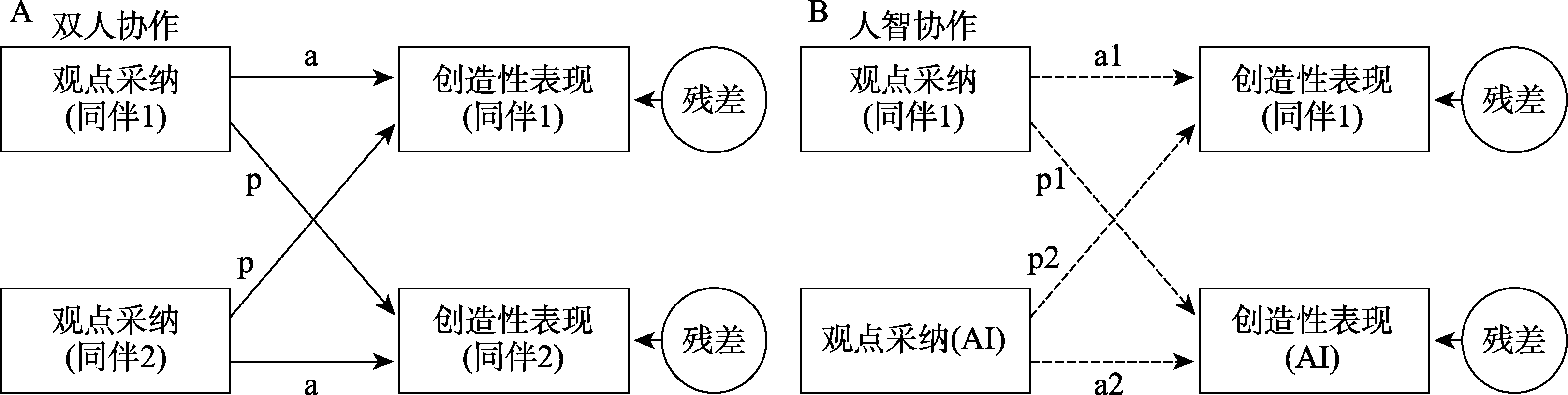
图1 行动者−同伴相依模型示意图 注: 双人协作由两名人类个体组成, 在概念上属于不可区分二元组, 因此假定两者的行动者效应与同伴效应相等, 分别以a和p表示。人智协作由人类个体与AI构成, 在概念上属于可区分二元组, 因此假定双方的行动者效应与同伴效应存在差异, 其中a1和a2表示行动者效应, p1和p2表示同伴效应。双人协作的效应路径基于既有研究已得到验证, 以实线表示; 人智协作的效应路径为本研究待检验的假设, 以虚线表示。
| 变量 | 水平 | 人智协作(55) | 双人协作(114) | t/χ2 | df | p |
|---|---|---|---|---|---|---|
| 性别 | 男 | 24 | 34 | 3.14 | 1 | 0.076 |
| 女 | 31 | 80 | ||||
| 专业 | 自然科学 | 29 | 70 | 1.15 | 1 | 0.283 |
| 人文社科 | 26 | 44 | ||||
| 年龄 | 19.63(1.35) | 19.54(1.21) | 0.45 | 167 | 0.655 | |
| 创造潜能 | 4.35(0.55) | 4.29(0.77) | 0.48 | 145.77 | 0.631 | |
| 大五人格 | 开放性 | 4.57(0.93) | 4.46(1.00) | 0.70 | 167 | 0.484 |
| 尽责性 | 4.16(1.01) | 4.36(1.01) | −1.18 | 140.05 | 0.242 | |
| 宜人性 | 5.13(0.86) | 5.08(0.98) | 0.31 | 139.26 | 0.761 | |
| 外向性 | 4.03(1.28) | 4.10(1.17) | −0.34 | 131.18 | 0.732 | |
| 神经质 | 3.88(1.02) | 3.87(0.97) | 0.08 | 132.83 | 0.936 | |
| 合作倾向 | 4.23(0.87) | 4.49(0.93) | −1.77 | 141.68 | 0.079 | |
| 观点采纳一般倾向 | 5.07(0.68) | 4.98(0.70) | 0.79 | 140.98 | 0.433 | |
| AI使用经验 | 6.29(0.79) | 6.16(0.94) | 0.91 | 167 | 0.364 |
表1 不同合作类型下人类被试的基本指标比较
| 变量 | 水平 | 人智协作(55) | 双人协作(114) | t/χ2 | df | p |
|---|---|---|---|---|---|---|
| 性别 | 男 | 24 | 34 | 3.14 | 1 | 0.076 |
| 女 | 31 | 80 | ||||
| 专业 | 自然科学 | 29 | 70 | 1.15 | 1 | 0.283 |
| 人文社科 | 26 | 44 | ||||
| 年龄 | 19.63(1.35) | 19.54(1.21) | 0.45 | 167 | 0.655 | |
| 创造潜能 | 4.35(0.55) | 4.29(0.77) | 0.48 | 145.77 | 0.631 | |
| 大五人格 | 开放性 | 4.57(0.93) | 4.46(1.00) | 0.70 | 167 | 0.484 |
| 尽责性 | 4.16(1.01) | 4.36(1.01) | −1.18 | 140.05 | 0.242 | |
| 宜人性 | 5.13(0.86) | 5.08(0.98) | 0.31 | 139.26 | 0.761 | |
| 外向性 | 4.03(1.28) | 4.10(1.17) | −0.34 | 131.18 | 0.732 | |
| 神经质 | 3.88(1.02) | 3.87(0.97) | 0.08 | 132.83 | 0.936 | |
| 合作倾向 | 4.23(0.87) | 4.49(0.93) | −1.77 | 141.68 | 0.079 | |
| 观点采纳一般倾向 | 5.07(0.68) | 4.98(0.70) | 0.79 | 140.98 | 0.433 | |
| AI使用经验 | 6.29(0.79) | 6.16(0.94) | 0.91 | 167 | 0.364 |

图2 实验场景示意 注: A)双人协作场景; B)人智协作场景; C)双人协作网页聊天界面; D)人智协作网页聊天界面。彩图见电子版, 下同。
| 变量 | 人智协作(49) | 双人协作(53) | t | df | d |
|---|---|---|---|---|---|
| 平均新颖性 | 3.52 (0.50) | 2.92 (0.55) | 5.74*** | 99.97 | 1.14 |
| 平均适用性 | 4.60 (0.50) | 4.79 (0.76) | −1.5 | 90.24 | −0.3 |
| 流畅性 | 22.51 (6.92) | 19.38 (9.30) | 1.94 | 95.77 | 0.38 |
| 灵活性 | 7.68 (1.59) | 7.26 (1.59) | 1.33 | 99.4 | 0.26 |
| 即时观点采纳 | 0.33 (0.18) | 0.21 (0.13) | 3.93*** | 86.45 | 0.78 |
| 延迟观点采纳 | 0.52(0.17) | 0.45(0.15) | 2.30* | 96.25 | 0.46 |
| 同伴观点采纳倾向 | 5.78 (0.53) | 5.28 (0.71) | 4.06*** | 96.07 | 0.8 |
| 任务努力 | 6.44 (0.51) | 6.12 (0.70) | 2.63* | 94.7 | 0.52 |
| 任务兴趣 | 5.92 (0.72) | 5.48 (0.83) | 2.86** | 99.62 | 0.57 |
| 任务难度 | 4.09 (0.80) | 4.50 (1.14) | −2.11* | 93.69 | −0.42 |
表2 AUT中不同合作类型在创造性表现、观点采纳及任务体验上的比较
| 变量 | 人智协作(49) | 双人协作(53) | t | df | d |
|---|---|---|---|---|---|
| 平均新颖性 | 3.52 (0.50) | 2.92 (0.55) | 5.74*** | 99.97 | 1.14 |
| 平均适用性 | 4.60 (0.50) | 4.79 (0.76) | −1.5 | 90.24 | −0.3 |
| 流畅性 | 22.51 (6.92) | 19.38 (9.30) | 1.94 | 95.77 | 0.38 |
| 灵活性 | 7.68 (1.59) | 7.26 (1.59) | 1.33 | 99.4 | 0.26 |
| 即时观点采纳 | 0.33 (0.18) | 0.21 (0.13) | 3.93*** | 86.45 | 0.78 |
| 延迟观点采纳 | 0.52(0.17) | 0.45(0.15) | 2.30* | 96.25 | 0.46 |
| 同伴观点采纳倾向 | 5.78 (0.53) | 5.28 (0.71) | 4.06*** | 96.07 | 0.8 |
| 任务努力 | 6.44 (0.51) | 6.12 (0.70) | 2.63* | 94.7 | 0.52 |
| 任务兴趣 | 5.92 (0.72) | 5.48 (0.83) | 2.86** | 99.62 | 0.57 |
| 任务难度 | 4.09 (0.80) | 4.50 (1.14) | −2.11* | 93.69 | −0.42 |
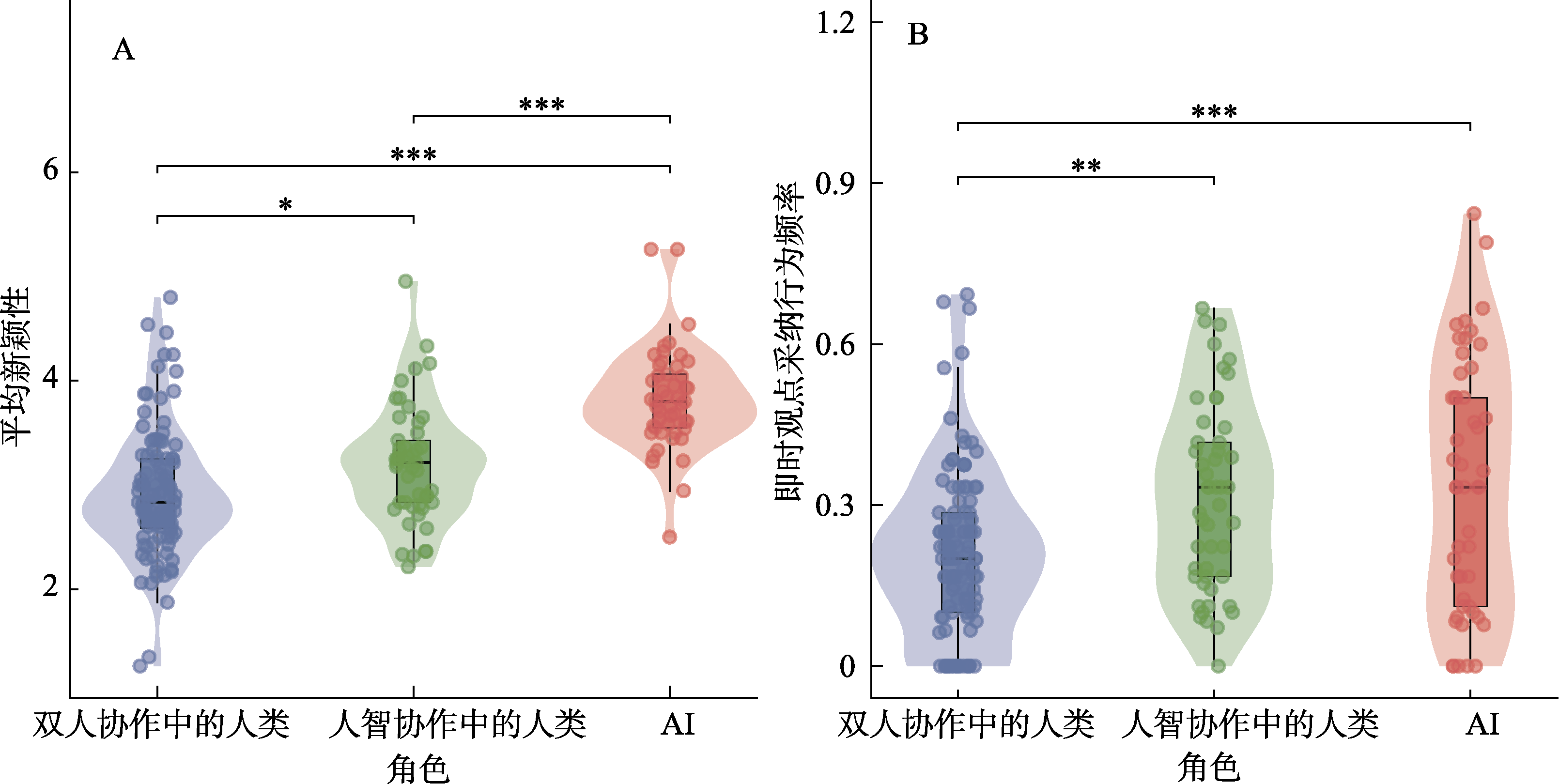
图3 不同角色类型下平均新颖性得分(A)和即时观点采纳行为(B)
| 变量 | 新颖性 | 适用性 | 流畅性 | 灵活性 | ||||||||
|---|---|---|---|---|---|---|---|---|---|---|---|---|
| M1 | M2 | M3 | M1 | M2 | M3 | M1 | M2 | M3 | M1 | M2 | M3 | |
| Intercept | 3.10(0.05)*** | 2.98(0.07)*** | 2.98(0.08)*** | 4.66(0.05)*** | 4.70(0.09)*** | 4.70(0.09)*** | 10.48(0.38)*** | 10.49(0.58)*** | 10.49(0.57)*** | 5.48(0.14)*** | 5.17(0.20)*** | 5.17(0.20)*** |
| IOC a | 0.77 (0.23)** | 0.42 (0.35) | 0.42 (0.36) | −0.71(0.19)*** | −0.81 (0.40)* | −0.81 (0.40)* | 4.55 (1.20)*** | 6.88 (2.14)** | 6.88 (2.10)** | −0.22 (0.52) | −0.72 (0.88) | −0.72 (0.87) |
| IOC p | 0.68 (0.21)** | 0.52 (0.35) | 0.52 (0.36) | −0.79(0.21)*** | −0.71 (0.40) | −0.71 (0.40) | 4.74 (1.19)*** | 7.08 (2.14)** | 7.08 (2.10)** | −0.35 (0.52) | −0.70 (0.88) | −0.70 (0.87) |
| 组别 | — | 0.64(0.11)*** | 0.14 (0.11) | — | −0.10 (0.12) | 0.07 (0.14) | — | 0.49 (0.82) | 0.50 (0.80) | — | 0.63 (0.29)* | 0.74 (0.30)* |
| IOC a × 组别 | — | 0.23 (0.45) | 0.42 (0.60) | — | 0.20 (0.46) | −0.01 (0.73) | — | −4.16 (2.67) | −11.67 (4.01)** | — | 0.23 (1.11) | −2.88 (1.59) |
| IOC p × 组别 | — | 0.00 (0.47) | 0.03 (0.50) | — | −0.02 (0.48) | −0.11 (0.59) | — | −4.17 (2.67) | 0.58 (3.24) | — | −0.03 (1.11) | 1.39 (1.30) |
| 角色 | — | — | 0.64 (0.06)*** | — | — | −0.17 (0.06)** | — | — | −0.19 (0.07)* | — | — | −0.21 (0.19) |
| IOC a ×角色 | — | — | −0.41 (0.65) | — | — | 0.25 (0.79) | — | — | 12.58 (4.98)* | — | — | 4.94 (1.84)** |
| IOC p ×角色 | — | — | 0.25 (0.64) | — | — | 0.03 (0.75) | — | — | −11.75 (4.99)* | — | — | −3.44 (1.84) |
表3 AUT中即时观点采纳对创造性表现的行动者−同伴相依模型结果
| 变量 | 新颖性 | 适用性 | 流畅性 | 灵活性 | ||||||||
|---|---|---|---|---|---|---|---|---|---|---|---|---|
| M1 | M2 | M3 | M1 | M2 | M3 | M1 | M2 | M3 | M1 | M2 | M3 | |
| Intercept | 3.10(0.05)*** | 2.98(0.07)*** | 2.98(0.08)*** | 4.66(0.05)*** | 4.70(0.09)*** | 4.70(0.09)*** | 10.48(0.38)*** | 10.49(0.58)*** | 10.49(0.57)*** | 5.48(0.14)*** | 5.17(0.20)*** | 5.17(0.20)*** |
| IOC a | 0.77 (0.23)** | 0.42 (0.35) | 0.42 (0.36) | −0.71(0.19)*** | −0.81 (0.40)* | −0.81 (0.40)* | 4.55 (1.20)*** | 6.88 (2.14)** | 6.88 (2.10)** | −0.22 (0.52) | −0.72 (0.88) | −0.72 (0.87) |
| IOC p | 0.68 (0.21)** | 0.52 (0.35) | 0.52 (0.36) | −0.79(0.21)*** | −0.71 (0.40) | −0.71 (0.40) | 4.74 (1.19)*** | 7.08 (2.14)** | 7.08 (2.10)** | −0.35 (0.52) | −0.70 (0.88) | −0.70 (0.87) |
| 组别 | — | 0.64(0.11)*** | 0.14 (0.11) | — | −0.10 (0.12) | 0.07 (0.14) | — | 0.49 (0.82) | 0.50 (0.80) | — | 0.63 (0.29)* | 0.74 (0.30)* |
| IOC a × 组别 | — | 0.23 (0.45) | 0.42 (0.60) | — | 0.20 (0.46) | −0.01 (0.73) | — | −4.16 (2.67) | −11.67 (4.01)** | — | 0.23 (1.11) | −2.88 (1.59) |
| IOC p × 组别 | — | 0.00 (0.47) | 0.03 (0.50) | — | −0.02 (0.48) | −0.11 (0.59) | — | −4.17 (2.67) | 0.58 (3.24) | — | −0.03 (1.11) | 1.39 (1.30) |
| 角色 | — | — | 0.64 (0.06)*** | — | — | −0.17 (0.06)** | — | — | −0.19 (0.07)* | — | — | −0.21 (0.19) |
| IOC a ×角色 | — | — | −0.41 (0.65) | — | — | 0.25 (0.79) | — | — | 12.58 (4.98)* | — | — | 4.94 (1.84)** |
| IOC p ×角色 | — | — | 0.25 (0.64) | — | — | 0.03 (0.75) | — | — | −11.75 (4.99)* | — | — | −3.44 (1.84) |
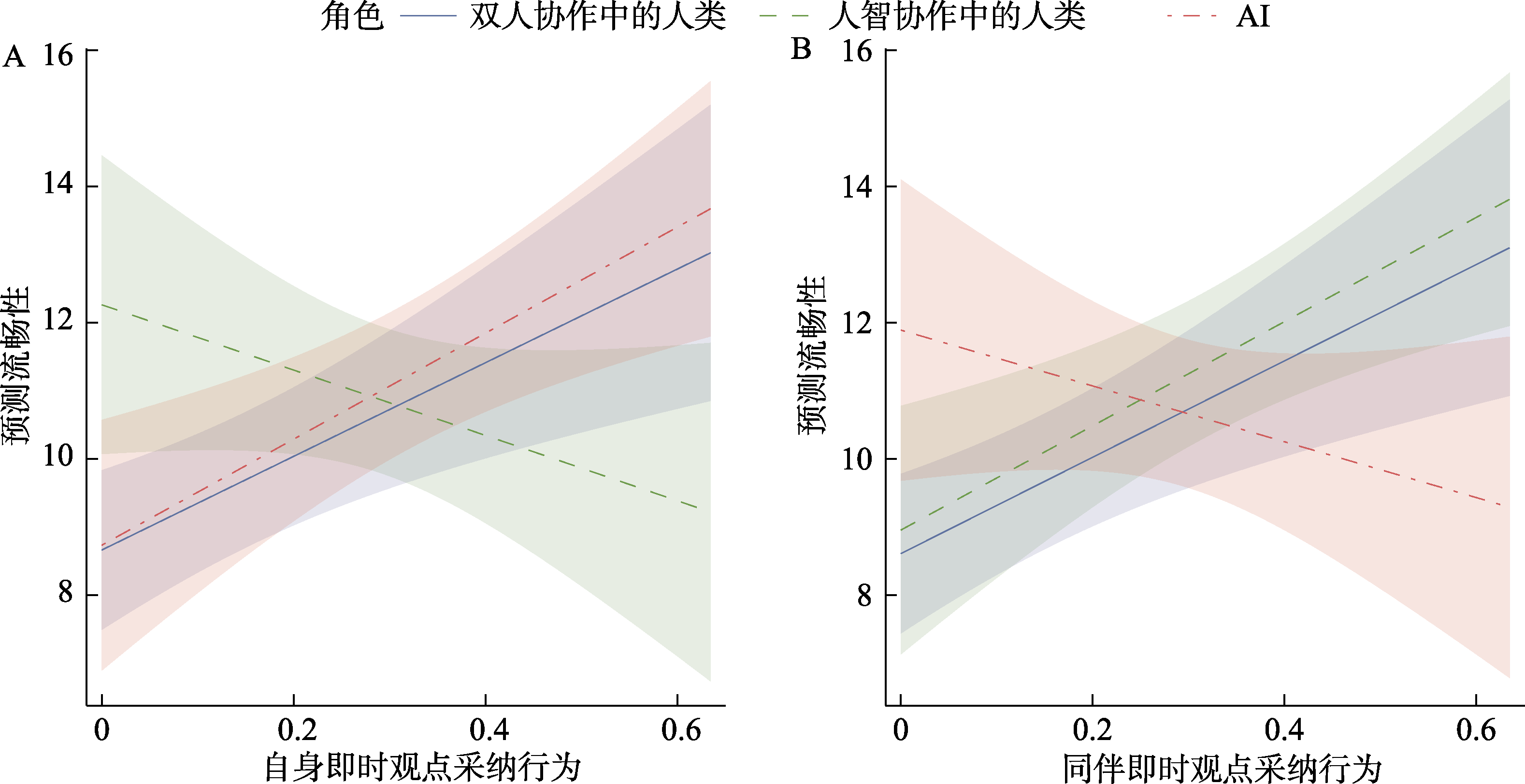
图4 不同角色类型下自身(A)与同伴(B)的即时观点采纳行为对想法流畅性的影响 注: 简单斜率基于最终APIM模型的固定效应估计计算得到。在不同角色类型下, 分别估计自身或同伴即时观点采纳行为对个体想法流畅性的预测效应; 模型同时纳入自身与同伴观点采纳行为, 因此各斜率反映在控制另一方观点采纳行为后的独立效应。阴影区域表示95%置信区间。
| 变量 | 人智协作(54) | 双人协作(55) | t | df | d |
|---|---|---|---|---|---|
| 平均新颖性 | 3.17 (0.36) | 2.76 (0.40) | 5.65*** | 106.12 | 1.08 |
| 平均适用性 | 4.98 (0.26) | 5.07 (0.48) | −1.27 | 84.21 | −0.24 |
| 流畅性 | 35.48 (12.99) | 24.56 (10.66) | 4.79*** | 102.33 | 0.92 |
| 灵活性 | 9.84 (2.15) | 9.10 (1.79) | 1.96 | 102.92 | 0.38 |
| 即时观点采纳 | 0.33 (0.15) | 0.20 (0.12) | 4.93*** | 102.47 | 0.95 |
| 延迟观点采纳 | 0.59 (0.13) | 0.44 (0.15) | 5.55*** | 105.19 | 1.06 |
| 同伴观点采纳倾向 | 5.74 (0.71) | 5.28 (0.80) | 3.18** | 106.07 | 0.61 |
| 任务努力 | 6.59 (0.41) | 6.08 (0.80) | 4.21*** | 81.31 | 0.8 |
| 任务兴趣 | 6.22 (0.73) | 5.78 (0.78) | 3.04** | 106.77 | 0.58 |
| 任务难度 | 3.93 (0.72) | 4.13 (1.04) | −1.17 | 96.35 | −0.23 |
表4 PIT中不同合作类型在创造性表现、观点采纳及任务体验上的比较
| 变量 | 人智协作(54) | 双人协作(55) | t | df | d |
|---|---|---|---|---|---|
| 平均新颖性 | 3.17 (0.36) | 2.76 (0.40) | 5.65*** | 106.12 | 1.08 |
| 平均适用性 | 4.98 (0.26) | 5.07 (0.48) | −1.27 | 84.21 | −0.24 |
| 流畅性 | 35.48 (12.99) | 24.56 (10.66) | 4.79*** | 102.33 | 0.92 |
| 灵活性 | 9.84 (2.15) | 9.10 (1.79) | 1.96 | 102.92 | 0.38 |
| 即时观点采纳 | 0.33 (0.15) | 0.20 (0.12) | 4.93*** | 102.47 | 0.95 |
| 延迟观点采纳 | 0.59 (0.13) | 0.44 (0.15) | 5.55*** | 105.19 | 1.06 |
| 同伴观点采纳倾向 | 5.74 (0.71) | 5.28 (0.80) | 3.18** | 106.07 | 0.61 |
| 任务努力 | 6.59 (0.41) | 6.08 (0.80) | 4.21*** | 81.31 | 0.8 |
| 任务兴趣 | 6.22 (0.73) | 5.78 (0.78) | 3.04** | 106.77 | 0.58 |
| 任务难度 | 3.93 (0.72) | 4.13 (1.04) | −1.17 | 96.35 | −0.23 |

图5 不同角色类型下平均新颖性(A), 灵活性(B)和流畅性(C)
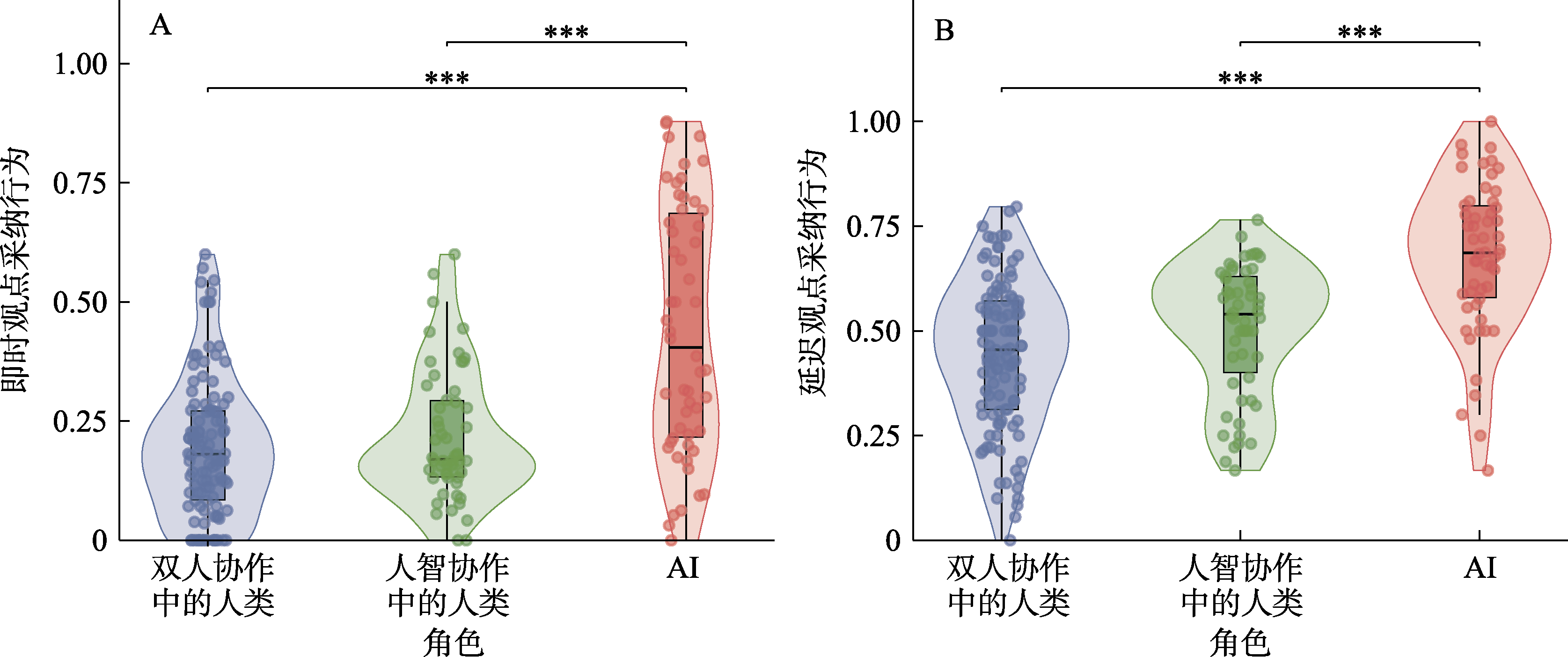
图6 不同角色类型下即时观点采纳行为(A)和延迟观点采纳行为(B)
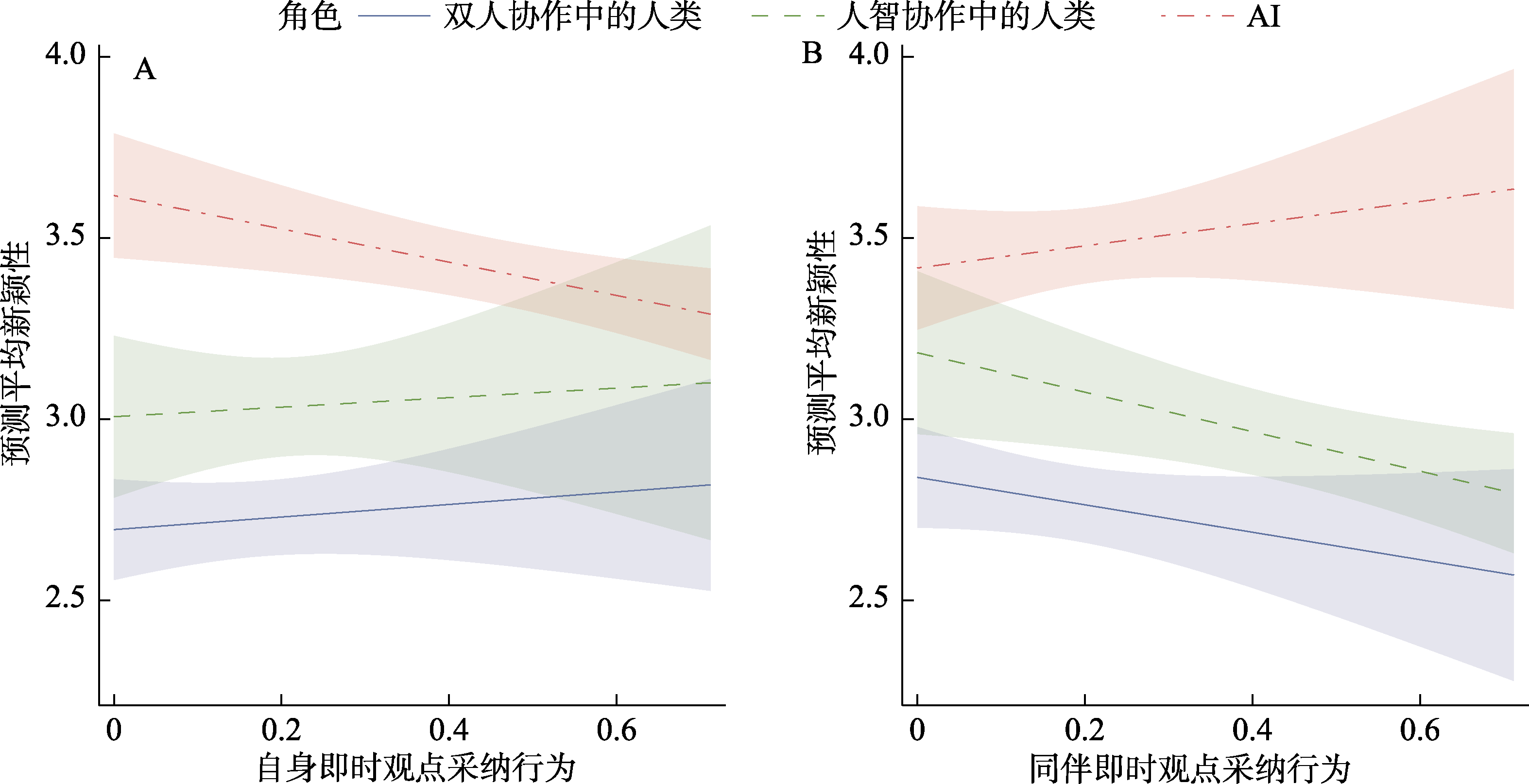
图7 不同角色类型下自身(A)与同伴(B)的即时观点采纳行为对想法新颖性的影响
| 变量 | 新颖性 | 适用性 | 流畅性 | 灵活性 | ||||||||
|---|---|---|---|---|---|---|---|---|---|---|---|---|
| M1 | M2 | M3 | M1 | M2 | M3 | M1 | M2 | M3 | M1 | M2 | M3 | |
| Intercept | 2.93 (0.04)*** | 2.74 (0.06)*** | 2.74 (0.06)*** | 5.01 (0.03)*** | 5.05 (0.06)*** | 5.05 (0.05)*** | 15.01 (0.48)*** | 13.49 (0.73)*** | 13.49 (0.69)*** | 7.42 (0.17)*** | 6.91 (0.26)*** | 6.91 (0.25)*** |
| DIOC a | 0.40 (0.16)* | −0.02 (0.22) | −0.02 (0.22) | −0.13 (0.11) | −0.02 (0.23) | −0.02 (0.23) | 13.00 (1.51)*** | 7.55 (2.25)** | 7.55 (2.12)*** | 1.41 (0.61)* | −0.05 (0.94) | −0.05 (0.91) |
| DIOC p | −0.26 (0.15) | −0.25 (0.22) | −0.25 (0.22) | −0.03 (0.12) | −0.21 (0.23) | −0.21 (0.23) | 13.03 (1.52)*** | 8.78 (2.25)*** | 8.78 (2.12)*** | 3.06 (0.61)*** | 1.96 (0.94)* | 1.96 (0.91)* |
| 组别 | — | 0.48 (0.08)*** | 0.33 (0.10)*** | — | −0.10 (0.07) | −0.14 (0.09) | — | 1.83 (1.06) | 3.47 (1.08)** | — | 0.78 (0.38)* | 1.17 (0.42)** |
| DIOC a ×组别 | — | 0.16 (0.32) | −0.07 (0.43) | — | 0.04 (0.28) | −0.20 (0.39) | — | 8.55 (3.40)* | 20.39 (4.40)*** | — | 1.89 (1.36) | 4.49 (1.81)* |
| DIOC p ×组别 | — | −0.63 (0.32)* | −0.55 (0.39) | — | 0.35 (0.28) | 0.75 (0.36)* | — | 7.33 (3.40)* | −2.80 (4.06) | — | 1.36 (1.36) | −1.54 (1.67) |
| 角色 | — | — | 0.42 (0.05)*** | — | — | 0.00 (0.04) | — | — | 0.03 (0.07) | — | — | 0.13 (0.27) |
| DIOC a ×角色 | — | — | −0.45 (0.47) | — | — | 0.52 (0.40) | — | — | −21.89 (5.53)*** | — | — | −5.26 (2.19)* |
| DIOC p ×角色 | — | — | 0.90 (0.45)* | — | — | −0.73 (0.39) | — | — | 22.27 (5.52)*** | — | — | 7.00 (2.19)** |
表5 PIT中延迟观点采纳对创造性表现的行动者−同伴相依模型结果
| 变量 | 新颖性 | 适用性 | 流畅性 | 灵活性 | ||||||||
|---|---|---|---|---|---|---|---|---|---|---|---|---|
| M1 | M2 | M3 | M1 | M2 | M3 | M1 | M2 | M3 | M1 | M2 | M3 | |
| Intercept | 2.93 (0.04)*** | 2.74 (0.06)*** | 2.74 (0.06)*** | 5.01 (0.03)*** | 5.05 (0.06)*** | 5.05 (0.05)*** | 15.01 (0.48)*** | 13.49 (0.73)*** | 13.49 (0.69)*** | 7.42 (0.17)*** | 6.91 (0.26)*** | 6.91 (0.25)*** |
| DIOC a | 0.40 (0.16)* | −0.02 (0.22) | −0.02 (0.22) | −0.13 (0.11) | −0.02 (0.23) | −0.02 (0.23) | 13.00 (1.51)*** | 7.55 (2.25)** | 7.55 (2.12)*** | 1.41 (0.61)* | −0.05 (0.94) | −0.05 (0.91) |
| DIOC p | −0.26 (0.15) | −0.25 (0.22) | −0.25 (0.22) | −0.03 (0.12) | −0.21 (0.23) | −0.21 (0.23) | 13.03 (1.52)*** | 8.78 (2.25)*** | 8.78 (2.12)*** | 3.06 (0.61)*** | 1.96 (0.94)* | 1.96 (0.91)* |
| 组别 | — | 0.48 (0.08)*** | 0.33 (0.10)*** | — | −0.10 (0.07) | −0.14 (0.09) | — | 1.83 (1.06) | 3.47 (1.08)** | — | 0.78 (0.38)* | 1.17 (0.42)** |
| DIOC a ×组别 | — | 0.16 (0.32) | −0.07 (0.43) | — | 0.04 (0.28) | −0.20 (0.39) | — | 8.55 (3.40)* | 20.39 (4.40)*** | — | 1.89 (1.36) | 4.49 (1.81)* |
| DIOC p ×组别 | — | −0.63 (0.32)* | −0.55 (0.39) | — | 0.35 (0.28) | 0.75 (0.36)* | — | 7.33 (3.40)* | −2.80 (4.06) | — | 1.36 (1.36) | −1.54 (1.67) |
| 角色 | — | — | 0.42 (0.05)*** | — | — | 0.00 (0.04) | — | — | 0.03 (0.07) | — | — | 0.13 (0.27) |
| DIOC a ×角色 | — | — | −0.45 (0.47) | — | — | 0.52 (0.40) | — | — | −21.89 (5.53)*** | — | — | −5.26 (2.19)* |
| DIOC p ×角色 | — | — | 0.90 (0.45)* | — | — | −0.73 (0.39) | — | — | 22.27 (5.52)*** | — | — | 7.00 (2.19)** |
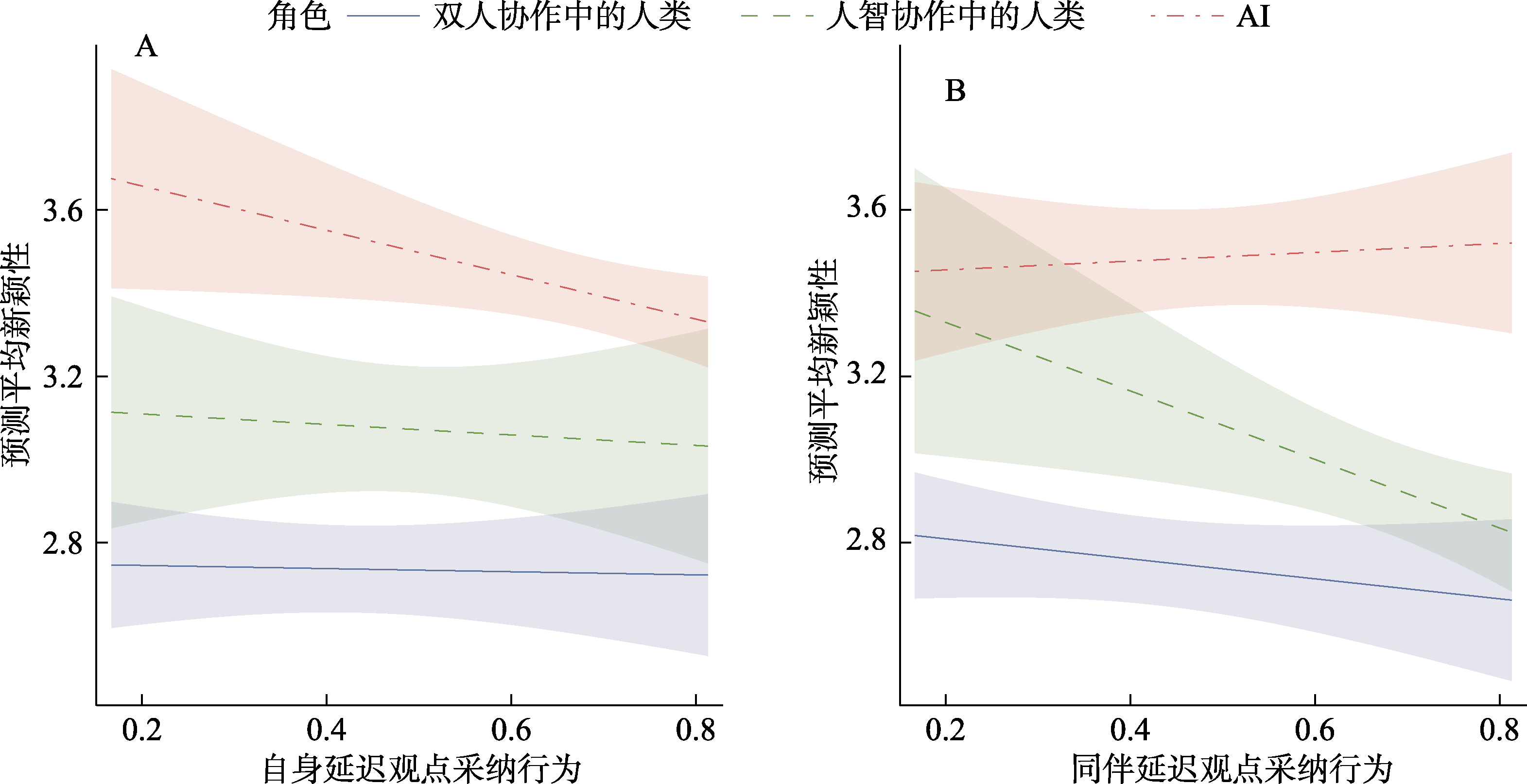
图8 不同角色类型下自身(A)与同伴(B)的延迟观点采纳行为对想法新颖性的影响
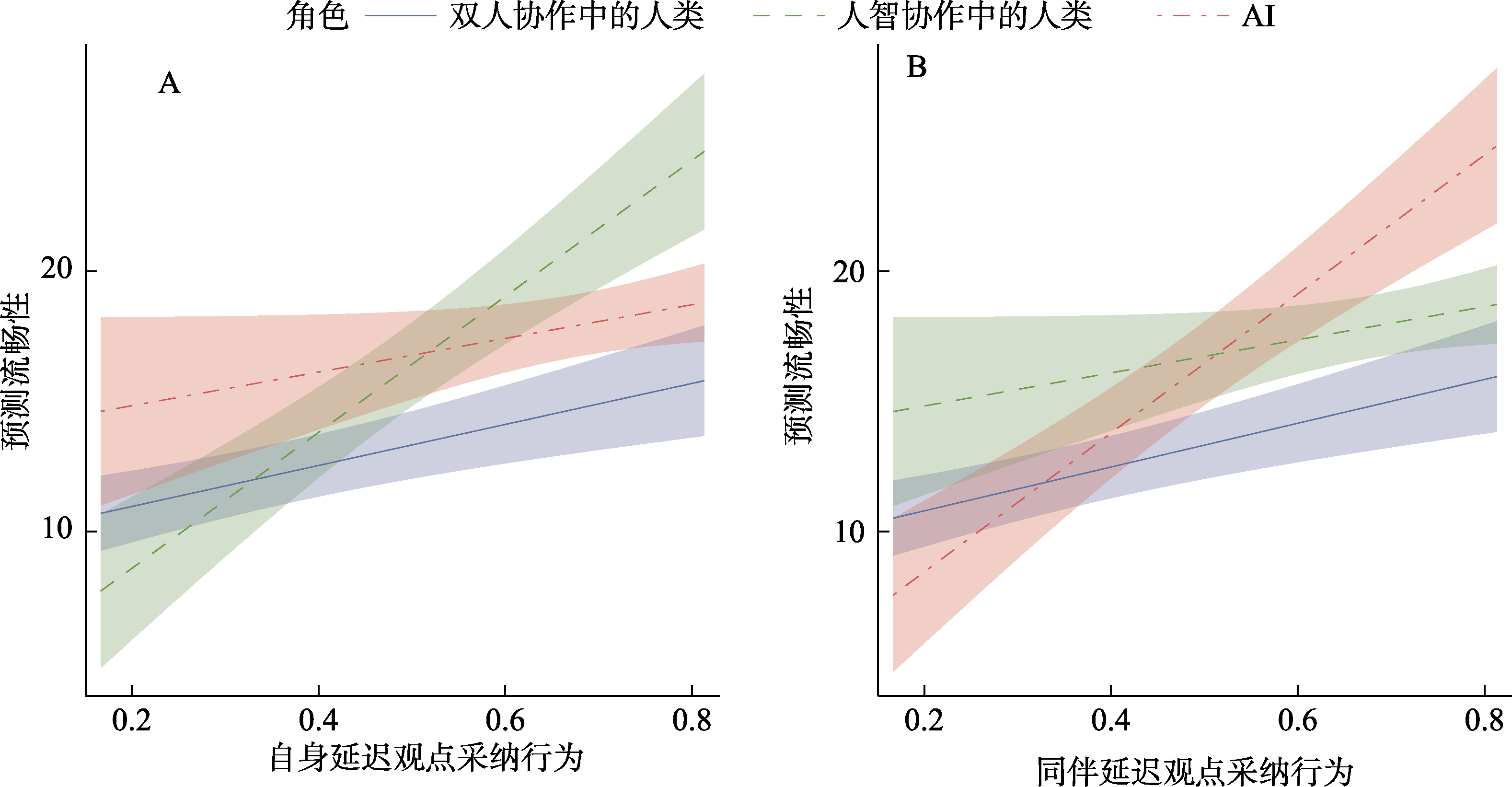
图9 不同角色类型下自身(A)与同伴(B)的延迟观点采纳行为对想法流畅性的影响
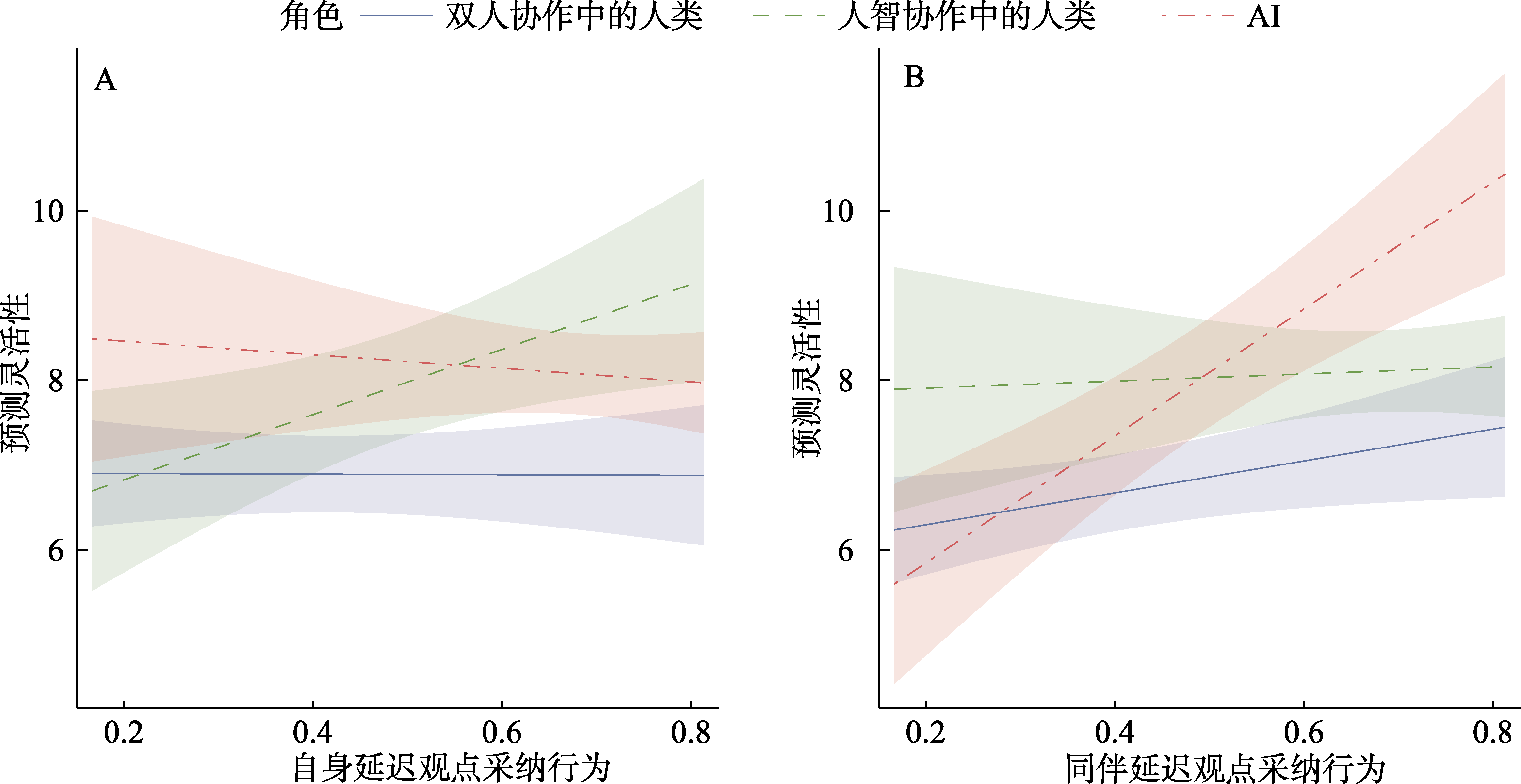
图10 不同角色类型下自身(A)与同伴(B)的延迟观点采纳行为对想法灵活性的影响
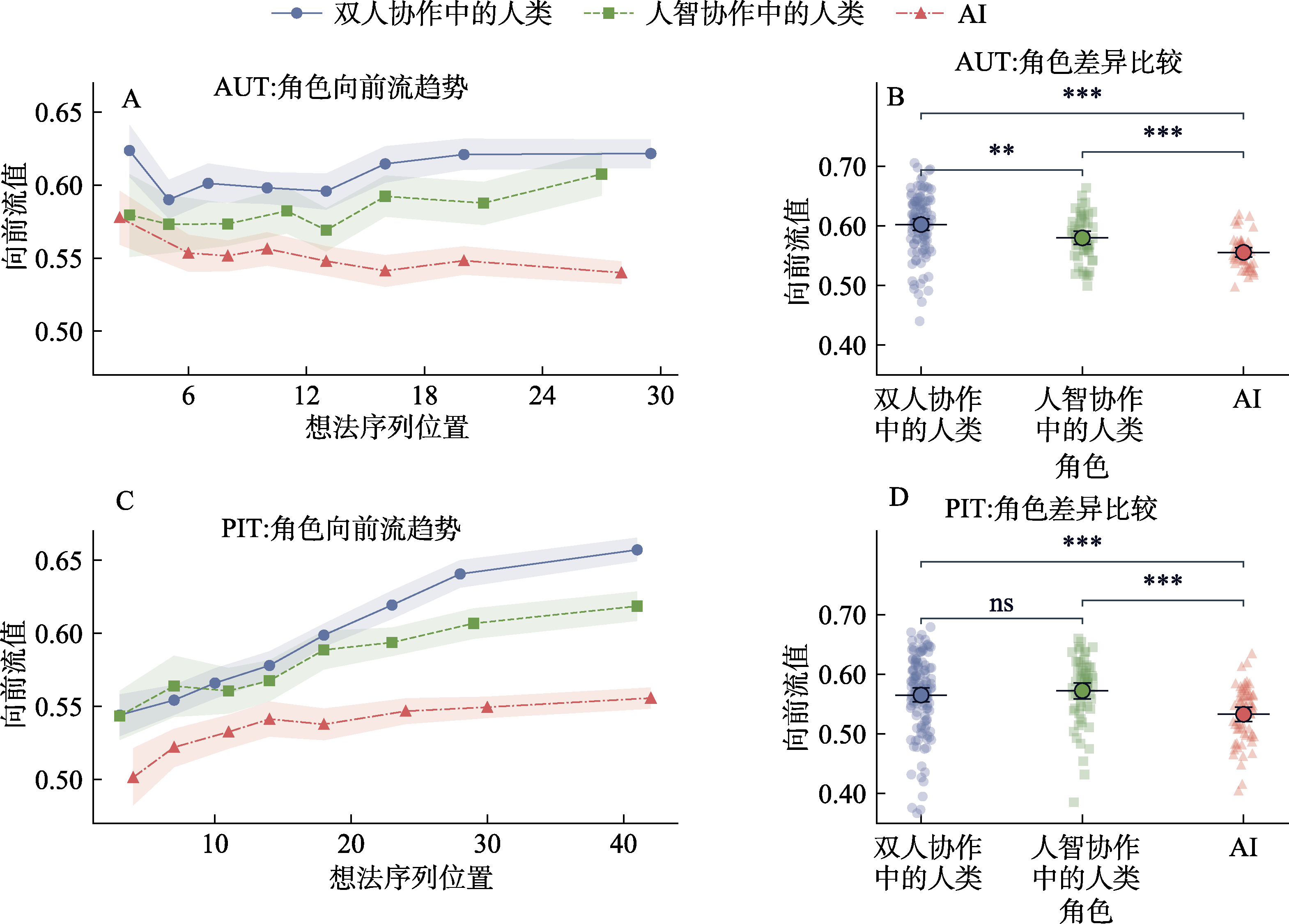
附图1 三类角色在两个任务想法生成过程中的向前流趋势与差异。 注: 自变量为角色类型, 包括双人协作中的人类、人智协作中的人类和AI; 因变量为向前流值。对于每一个由特定角色产生的当前想法, 向前流值计算为该想法与同一任务、同一小组中此前所有有效想法之间的平均语义距离。因此, 向前流值越低, 表示当前想法越贴近此前想法, 想法生成越趋于聚合; 向前流值越高, 表示当前想法与此前想法的语义关联较弱, 语义跳跃更大。图中左侧展示AUT与PIT两个任务中三类角色随想法序列位置变化的向前流趋势, 右侧展示各任务中三类角色的平均向前流差异。* p < 0.05, ** p < 0.01, *** p < 0.001。
| 变量 | 新颖性 | 适用性 | 流畅性 | 灵活性 | ||||||||
|---|---|---|---|---|---|---|---|---|---|---|---|---|
| M1 | M2 | M3 | M1 | M2 | M3 | M1 | M2 | M3 | M1 | M2 | M3 | |
| Intercept | 2.93 (0.04)*** | 2.75 (0.06)*** | 2.75 (0.06)*** | 5.01 (0.03)*** | 5.05 (0.06)*** | 5.05 (0.06)*** | 15.00 (0.60)*** | 12.62 (0.90)*** | 12.62 (0.90)*** | 7.42 (0.18)*** | 6.62 (0.27)*** | 6.62 (0.27)*** |
| IOC a | 0.43 (0.16)* | 0.15 (0.27) | 0.15 (0.27) | -0.05 (0.11) | -0.31 (0.27) | -0.31 (0.28) | 6.48 (2.00)** | 2.03 (3.35) | 2.03 (3.36) | -0.15 (0.67) | -1.68 (1.18) | -1.68 (1.18) |
| IOC p | -0.27 (0.15) | -0.40 (0.27) | -0.40 (0.27) | 0.07 (0.12) | 0.02 (0.27) | 0.02 (0.28) | 6.34 (2.00)** | 3.33 (3.35) | 3.33 (3.36) | 0.24 (0.67) | -0.62 (1.18) | -0.62 (1.18) |
| 组别 | — | 0.47 (0.08)*** | 0.29 (0.09)** | — | -0.11 (0.07) | -0.12 (0.08) | — | 4.69 (1.26)*** | 5.08 (1.34)*** | — | 1.59 (0.38)*** | 1.57 (0.43)*** |
| IOC a ×组别 | — | -0.10 (0.33) | -0.02 (0.50) | — | 0.46 (0.31) | 0.13 (0.46) | — | 1.40 (4.31) | 5.22 (6.80) | — | 0.50 (1.47) | -1.35 (2.28) |
| IOC p ×组别 | — | -0.32 (0.33) | -0.13 (0.35) | — | 0.23 (0.31) | 0.31 (0.34) | — | -0.05 (4.32) | -1.47 (4.59) | — | -0.31 (1.47) | -0.53 (1.57) |
| 角色 | — | — | 0.45 (0.05)*** | — | — | -0.02 (0.04) | — | — | 0.00 (0.06) | — | — | -0.06 (0.26) |
| IOC a ×角色 | — | — | -0.58 (0.46) | — | — | 0.42 (0.40) | — | — | -5.08 (6.75) | — | — | 2.40 (2.22) |
| IOC p ×角色 | — | — | 0.80 (0.40)* | — | — | -0.38 (0.35) | — | — | 5.86 (6.74) | — | — | 0.90 (2.22) |
附表1 PIT中即时观点采纳对创造性表现的行动者-同伴相依模型结果
| 变量 | 新颖性 | 适用性 | 流畅性 | 灵活性 | ||||||||
|---|---|---|---|---|---|---|---|---|---|---|---|---|
| M1 | M2 | M3 | M1 | M2 | M3 | M1 | M2 | M3 | M1 | M2 | M3 | |
| Intercept | 2.93 (0.04)*** | 2.75 (0.06)*** | 2.75 (0.06)*** | 5.01 (0.03)*** | 5.05 (0.06)*** | 5.05 (0.06)*** | 15.00 (0.60)*** | 12.62 (0.90)*** | 12.62 (0.90)*** | 7.42 (0.18)*** | 6.62 (0.27)*** | 6.62 (0.27)*** |
| IOC a | 0.43 (0.16)* | 0.15 (0.27) | 0.15 (0.27) | -0.05 (0.11) | -0.31 (0.27) | -0.31 (0.28) | 6.48 (2.00)** | 2.03 (3.35) | 2.03 (3.36) | -0.15 (0.67) | -1.68 (1.18) | -1.68 (1.18) |
| IOC p | -0.27 (0.15) | -0.40 (0.27) | -0.40 (0.27) | 0.07 (0.12) | 0.02 (0.27) | 0.02 (0.28) | 6.34 (2.00)** | 3.33 (3.35) | 3.33 (3.36) | 0.24 (0.67) | -0.62 (1.18) | -0.62 (1.18) |
| 组别 | — | 0.47 (0.08)*** | 0.29 (0.09)** | — | -0.11 (0.07) | -0.12 (0.08) | — | 4.69 (1.26)*** | 5.08 (1.34)*** | — | 1.59 (0.38)*** | 1.57 (0.43)*** |
| IOC a ×组别 | — | -0.10 (0.33) | -0.02 (0.50) | — | 0.46 (0.31) | 0.13 (0.46) | — | 1.40 (4.31) | 5.22 (6.80) | — | 0.50 (1.47) | -1.35 (2.28) |
| IOC p ×组别 | — | -0.32 (0.33) | -0.13 (0.35) | — | 0.23 (0.31) | 0.31 (0.34) | — | -0.05 (4.32) | -1.47 (4.59) | — | -0.31 (1.47) | -0.53 (1.57) |
| 角色 | — | — | 0.45 (0.05)*** | — | — | -0.02 (0.04) | — | — | 0.00 (0.06) | — | — | -0.06 (0.26) |
| IOC a ×角色 | — | — | -0.58 (0.46) | — | — | 0.42 (0.40) | — | — | -5.08 (6.75) | — | — | 2.40 (2.22) |
| IOC p ×角色 | — | — | 0.80 (0.40)* | — | — | -0.38 (0.35) | — | — | 5.86 (6.74) | — | — | 0.90 (2.22) |
| 变量 | 新颖性 | 适用性 | 流畅性 | 灵活性 | ||||||||
|---|---|---|---|---|---|---|---|---|---|---|---|---|
| M1 | M2 | M3 | M1 | M2 | M3 | M1 | M2 | M3 | M1 | M2 | M3 | |
| AUT: IOC | ||||||||||||
| 残差 | 357.18 | 346.43 | 283.97 | 318.9 | 317.85 | 310.27 | 763.56 | 760.49 | 746.69 | 686.3 | 681.48 | 673.23 |
| AIC | 371.18 | 366.43 | 309.97 | 330.9 | 335.85 | 334.27 | 777.56 | 780.49 | 772.69 | 696.3 | 697.48 | 695.23 |
| BIC | 394.41 | 399.61 | 353.1 | 350.81 | 365.71 | 374.09 | 800.78 | 813.67 | 815.82 | 712.89 | 724.03 | 731.73 |
| PIT: IOC | ||||||||||||
| 残差 | 235.06 | 208.38 | 136.51 | 124.55 | 118.93 | 117.05 | 963.11 | 948.38 | 944.26 | 849.31 | 832.17 | 828.14 |
| AIC | 247.06 | 226.38 | 160.51 | 138.55 | 138.93 | 143.05 | 977.11 | 968.38 | 970.26 | 859.31 | 848.17 | 850.14 |
| BIC | 267.37 | 256.84 | 201.13 | 162.24 | 172.78 | 187.05 | 1000.80 | 1002.22 | 1014.26 | 876.23 | 875.25 | 887.37 |
| PIT: DIOC | ||||||||||||
| 残差 | 241.34 | 208.69 | 139.19 | 124.86 | 121.19 | 116.83 | 917.00 | 906.65 | 889.44 | 825.88 | 819.09 | 807.88 |
| AIC | 253.34 | 226.69 | 163.19 | 138.86 | 141.19 | 142.83 | 931.00 | 926.65 | 915.44 | 835.88 | 835.09 | 829.88 |
| BIC | 273.64 | 257.15 | 203.80 | 162.55 | 175.04 | 186.83 | 954.69 | 960.49 | 959.44 | 852.80 | 862.16 | 867.11 |
附表2 模型拟合结果
| 变量 | 新颖性 | 适用性 | 流畅性 | 灵活性 | ||||||||
|---|---|---|---|---|---|---|---|---|---|---|---|---|
| M1 | M2 | M3 | M1 | M2 | M3 | M1 | M2 | M3 | M1 | M2 | M3 | |
| AUT: IOC | ||||||||||||
| 残差 | 357.18 | 346.43 | 283.97 | 318.9 | 317.85 | 310.27 | 763.56 | 760.49 | 746.69 | 686.3 | 681.48 | 673.23 |
| AIC | 371.18 | 366.43 | 309.97 | 330.9 | 335.85 | 334.27 | 777.56 | 780.49 | 772.69 | 696.3 | 697.48 | 695.23 |
| BIC | 394.41 | 399.61 | 353.1 | 350.81 | 365.71 | 374.09 | 800.78 | 813.67 | 815.82 | 712.89 | 724.03 | 731.73 |
| PIT: IOC | ||||||||||||
| 残差 | 235.06 | 208.38 | 136.51 | 124.55 | 118.93 | 117.05 | 963.11 | 948.38 | 944.26 | 849.31 | 832.17 | 828.14 |
| AIC | 247.06 | 226.38 | 160.51 | 138.55 | 138.93 | 143.05 | 977.11 | 968.38 | 970.26 | 859.31 | 848.17 | 850.14 |
| BIC | 267.37 | 256.84 | 201.13 | 162.24 | 172.78 | 187.05 | 1000.80 | 1002.22 | 1014.26 | 876.23 | 875.25 | 887.37 |
| PIT: DIOC | ||||||||||||
| 残差 | 241.34 | 208.69 | 139.19 | 124.86 | 121.19 | 116.83 | 917.00 | 906.65 | 889.44 | 825.88 | 819.09 | 807.88 |
| AIC | 253.34 | 226.69 | 163.19 | 138.86 | 141.19 | 142.83 | 931.00 | 926.65 | 915.44 | 835.88 | 835.09 | 829.88 |
| BIC | 273.64 | 257.15 | 203.80 | 162.55 | 175.04 | 186.83 | 954.69 | 960.49 | 959.44 | 852.80 | 862.16 | 867.11 |
| [1] | Amabile T. M. (1982). Social psychology of creativity: A consensual assessment technique. Journal of Personality and Social Psychology, 43(5), 997-1013. https://doi.org/10.1037/0022-3514.43.5.997 |
| [2] | Aru J., Labash A., Corcoll O., & Vicente R. (2023). Mind the gap: Challenges of deep learning approaches to Theory of Mind. Artificial Intelligence Review, 56(9), 9141-9156. https://doi.org/10.1007/s10462-023-10401-x |
| [3] | Bai H., Chan L. S., Luo A., Kroesbergen E. H., & Christie S. (2026). Creativity in dialogues: How do children interact with parents vs. strangers for generating creative ideas? Learning and Instruction, 102, 102286. https://doi.org/10.1016/j.learninstruc.2025.102286 |
| [4] | Batson C. D., Early S., & Salvarani G. (1997). Perspective taking: Imagining how another feels versus imagining how you would feel. Personality and Social Psychology Bulletin, 23(7), 751-758. https://doi.org/10.1177/0146167297237008 |
| [5] | Boyd R. L., & Markowitz D. M. (2026). Artificial intelligence and the psychology of human connection. Perspectives on Psychological Science, 21(2), 192-220. https://doi.org/10.1177/17456916251404394 |
| [6] | Brown V., Tumeo M., Larey T. S., & Paulus P. B. (1998). Modeling Cognitive Interactions During Group Brainstorming. Small Group Research, 29(4), 495-526. https://doi.org/10.1177/1046496498294005 |
| [7] | Brucks M. S., & Levav J. (2022). Virtual communication curbs creative idea generation. Nature, 605(7908), 108-112. https://doi.org/10.1038/s41586-022-04643-y |
| [8] | Champely S. (2020). pwr: Basic functions for power analysis (R package version 1.3-0). https://CRAN.R-project.org/package=pwr |
| [9] | Cheng X., & Zhang L. (2025). Inspiration booster or creative fixation? The dual mechanisms of LLMs in shaping individual creativity in tasks of different complexity. Humanities and Social Sciences Communications, 12(1), 1563. https://doi.org/10.1057/s41599-025-05867-9 |
| [10] | Davis M. H. (1980). Individual differences in empathy: A multidimensional approach. Dissertation Abstracts International, 40(7-B), 3480. |
| [11] | Doshi A. R., & Hauser O. P. (2024). Generative AI enhances individual creativity but reduces the collective diversity of novel content. Science Advances, 10(28), eadn5290. https://doi.org/10.1126/sciadv.adn5290 |
| [12] | Erwin A. K., Tran K., & Koutstaal W. (2022). Evaluating the predictive validity of four divergent thinking tasks for the originality of design product ideation. PLOS ONE, 17(3), e0265116. https://doi.org/10.1371/journal.pone.0265116 |
| [13] | Glăveanu V. P., Gillespie A., & Karwowski M. (2019). Are people working together inclined towards practicality? A process analysis of creative ideation in individuals and dyads. Psychology of Aesthetics, Creativity, and the Arts, 13(4), 388-401. |
| [14] | Glăveanu V. P. (2020). A sociocultural theory of creativity: Bridging the social, the material, and the psychological. Review of General Psychology, 24(4), 335-354. https://doi.org/10.1177/1089268020961763 |
| [15] | Gonzalez C., & Heidari H. (2025). A cognitive approach to human-AI complementarity in dynamic decision-making. Nature Reviews Psychology, 4(12), 808-822. https://doi.org/10.1038/s44159-025-00499-x |
| [16] | Grant A. M., & Berry J. W. (2011). The necessity of others is the mother of invention: Intrinsic and prosocial motivations, perspective taking, and creativity. Academy of Management Journal, 54(1), 73-96. https://doi.org/10.5465/amj.2011.59215085 |
| [17] | Grajzel K., Acar S., & Singer G. (2023). The Big Five and divergent thinking: A meta-analysis. Personality and Individual Differences, 214, 112338. https://doi.org/10.1016/j.paid.2023.112338 |
| [18] | Guilford J. P. (1967). Creativity: Yesterday, today, and tomorrow. The Journal of Creative Behavior, 1(1), 3-14.https://doi.org/10.1002/j.2162-6057.1967.tb00002.x |
| [19] | Guo W., Liang Z., Wang C., Li X., Hu H., Chen S., … Zhao Q. (2025). Student-AI collaborative creative problem- solving: The role of human agency. Computers & Education, 239, 105433. https://doi.org/10.1016/j.compedu.2025.105433 |
| [20] | Gupta A., Song X., & Anumanchipalli G. (2024). Self- assessment tests are unreliable measures of LLM personality. Proceedings of the 7th Blackbox NLP Workshop: Analyzing and Interpreting Neural Networks for NLP, 301-314. https://doi.org/10.18653/v1/2024.blackboxnlp-1.20 |
| [21] | Harvey S. (2014). Creative synthesis: Exploring the process of extraordinary group creativity. Academy of Management Review, 39(3), 324-343. https://doi.org/10.5465/amr.2012.0224 |
| [22] | Hoever I. J., van Knippenberg D., van Ginkel W. P., & Barkema H. G. (2012). Fostering team creativity: Perspective taking as key to unlocking diversity’s potential. Journal of Applied Psychology, 97(5), 982-996. https://doi.org/10.1037/a0029159 |
| [23] | Howard T. J., Dekoninck E. A., & Culley S. J. (2010). The use of creative stimuli at early stages of industrial product innovation. Research in Engineering Design, 21(4), 263-274. |
| [24] | Huang H.-C.(B.). (2025). Unlocking creativity with artificial intelligence (AI): Field and experimental evidence on the Goldilocks (curvilinear) effect of human-AI collaboration. Journal of Experimental Psychology: General, 154(12), 3294-3306. https://doi.org/10.1037/xge0001838 |
| [25] | Hubert K. F., Awa K. N., & Zabelina D. L. (2024). The current state of artificial intelligence generative language models is more creative than humans on divergent thinking tasks. Scientific Reports, 14(1), 3440. https://doi.org/10.1038/s41598-024-53303-w |
| [26] | Jolić Marjanović Z., Krstić K., Rajić M., Stepanović Ilić I., Videnović M., & Altaras Dimitrijević A. (2024). The big five and collaborative problem solving: A narrative systematic review. European Journal of Personality, 38(3), 457-475. https://doi.org/10.1177/08902070231198650 |
| [27] | Kenny D. A., Kashy D. A., & Cook W. L. (2006). Dyadic data analysis. Guilford Publications. |
| [28] | Krause V. (2013). Creative in someone else’s shoes? The effects of perspective taking and motivation on creativity. Academy of Management Proceedings, 2013(1), 11637. https://doi.org/10.5465/ambpp.2013.11637abstract |
| [29] | Labash A., Aru J., Matiisen T., Tampuu A., & Vicente R. (2020). Perspective taking in deep reinforcement learning agents. Frontiers in Computational Neuroscience, 14, 69. https://doi.org/10.3389/fncom.2020.00069 |
| [30] | Lai C., Luchini S., Lauharatanahirun N., & Beaty R. (2025). Creative or uncreative partner: Comparing humans and AI in collaborative creative tasks. Preprint. https://doi.org/10.31234/osf.io/ey7u4_v2 |
| [31] | Larey T. S., & Paulus P. B. (1999). Group preference and convergent tendencies in small groups: A content analysis of group brainstorming performance. Creativity Research Journal, 12(3), 175-184. https://doi.org/10.1207/s15326934crj1203_2 |
| [32] | Lee B. C., & Chung J. (2024). An empirical investigation of the impact of ChatGPT on creativity. Nature Human Behaviour, 8(10), 1906-1914. https://doi.org/10.1038/s41562-024-01953-1 |
| [33] | Li J. (2013). Psychometric properties of Ten-Item Personality Inventory in China. China Journal of Health Psychology, 21(11), 1688-1692. https://doi.org/10.13342/j.cnki.cjhp.2013.11.008 |
| [李金德. (2013). 中国版10项目大五人格量表(TIPI-C)的信效度检验. 中国健康心理学杂志, 21(11), 1688-1692. https://doi.org/10.13342/j.cnki.cjhp.2013.11.008] | |
| [34] | Li C., & Qi Y. (2025). Toward accurate psychological simulations: Investigating LLMs’ responses to personality and cultural variables. Computers in Human Behavior, 170, 108687. https://doi.org/10.1016/j.chb.2025.108687 |
| [35] | Liu R., Wu T., Chu J., & Qu P. (2026). Enhancing human computer collaboration in design process: How AI-generated content elevates students’ creativity. Thinking Skills and Creativity, 59, 101967. https://doi.org/10.1016/j.tsc.2025.101967 |
| [36] | Lu K., & Hao N. (2026). The interpersonal neural coupling in group creative ideation. Psychological Review, 133(1), 221-236. https://doi.org/10.1037/rev0000524 |
| [37] | Lu K., Gao Z., Wang X., Qiao X., He Y., Zhang Y., & Hao N. (2023). The hyper-brain neural couplings distinguishing high-creative group dynamics: An fNIRS hyperscanning study. Cerebral Cortex, 33(5), 1630-1642. https://doi.org/10.1093/cercor/bhac161 |
| [38] | Lu K., Qiao X., Yun Q., & Hao N. (2021). Educational diversity and group creativity: Evidence from fNIRS hyperscanning. NeuroImage, 243, 118564. https://doi.org/10.1016/j.neuroimage.2021.118564 |
| [39] | Lu K., Yu T., & Hao N. (2020). Creating while taking turns, the choice to unlocking group creative potential. NeuroImage, 219, 117025. https://doi.org/10.1016/j.neuroimage.2020.117025 |
| [40] | Medeiros K., Cropley D. H., Marrone R. L., & Reiter- Palmon R. (2025). Human-AI co-creativity: Does ChatGPT make us more creative? The Journal of Creative Behavior, 59(2), e70022. https://doi.org/10.1002/jocb.70022 |
| [41] | Nijstad B. A., & Stroebe W. (2006). How the group affects the mind: A cognitive model of idea generation in groups. Personality and Social Psychology Review, 10(3), 186-213. https://doi.org/10.1207/s15327957pspr1003_1 |
| [42] | Parker, S. K., Atkins P. W. B., & Axtell C. M. (2008). Building better workplaces through individual perspective taking:A fresh look at a fundamental human process. In G. P. Hodgkinson & J. K. Ford (Eds), International review of industrial and organizational psychology 2008 (pp. 149- 196). Wiley. https://doi.org/10.1002/9780470773277.ch5 |
| [43] | Rubenstein L. D., Callan G. L., Ridgley L. M., & Henderson A. (2019). Students’ strategic planning and strategy use during creative problem solving: The importance of perspective-taking. Thinking Skills and Creativity, 34, 100556. https://doi.org/10.1016/j.tsc.2019.02.004 |
| [44] | Runco M. A., Abdulla A. M., Paek S. H., Al-Jasim F. A., & Alsuwaidi H. N. (2016). Which test of divergent thinking is best? Creativity. Theories - Research - Applications, 3(1), 4-18. https://doi.org/10.1515/ctra-2016-0001 |
| [45] | Salecha A., Ireland M. E., Subrahmanya S., Sedoc J., Ungar L. H., & Eichstaedt J. C. (2024). Large language models display human-like social desirability biases in Big Five personality surveys. PNAS Nexus, 3(12), pgae533. https://doi.org/10.1093/pnasnexus/pgae533 |
| [46] | Sawyer R. K., & DeZutter S. (2009). Distributed creativity: How collective creations emerge from collaboration. Psychology of Aesthetics, Creativity, and the Arts, 3(2), 81-92. https://doi.org/10.1037/a0013282 |
| [47] | Serapio-García G., Safdari M., Crepy C., Sun L., Fitz S., Romero P., … Matarić M. (2025). A psychometric framework for evaluating and shaping personality traits in large language models. Nature Machine Intelligence, 7(12), 1954-1968. https://doi.org/10.1038/s42256-025-01115-6 |
| [48] | Sherf E. N., & Morrison E. W. (2020). I do not need feedback! Or do I? Self-efficacy, perspective taking, and feedback seeking. Journal of Applied Psychology, 105(2), 146-165. https://doi.org/10.1037/apl0000432 |
| [49] | Song Y., Huang L., Zheng L., Fan M., & Liu Z. (2025). Interactions with generative AI chatbots: Unveiling dialogic dynamics, students’ perceptions, and practical competencies in creative problem-solving. International Journal of Educational Technology in Higher Education, 22(1), 12. https://doi.org/10.1186/s41239-025-00508-2 |
| [50] | Sun S., Li Z. A., Foo M.-D., Zhou J., & Lu J. G. (2025). How and for whom using generative AI affects creativity: A field experiment. Journal of Applied Psychology, 110(12), 1561-1573. https://doi.org/10.1037/apl0001296 |
| [51] | Tang M., Hofreiter S., Werner C. H., Zielińska A., & Karwowski M. (2025). “Who” is the best creative thinking partner? An experimental investigation of human-human, human-internet, and human-AI co-creation. The Journal of Creative Behavior, 59(3), Article e1519. https://doi.org/10.1002/jocb.1519 |
| [52] | Torrance E. P. (2008). Torrance tests of creative thinking: Norms-technical manual, verbal forms A and B. Scholastic Testing Service. |
| [53] | Urban M., Děchtěrenko F., Lukavský J., Hrabalová V., Svacha F., Brom C., & Urban K. (2024). ChatGPT improves creative problem-solving performance in university students: An experimental study. Computers & Education, 215, 105031. https://doi.org/10.1016/j.compedu.2024.105031 |
| [54] | Urban M., Lukavský J., Brom C., Hein V., Svacha F., Děchtěrenko F., & Urban K. (2025). Prompting for creative problem-solving: A process-mining study. Learning and Instruction, 99, 102156. https://doi.org/10.1016/j.learninstruc.2025.102156 |
| [55] | Wang F., Tang X., & Yu S. (2025). Cognitive outsourcing based on generative artificial intelligence: An Analysis of interactive behavioral patterns and cognitive structural features. Acta Psychologica Sinica, 57(6), 967-986. https://doi.org/10.3724/SP.J.1041.2025.0967 |
| [汪凡淙, 汤筱玙, 余胜泉. (2025). 基于生成式人工智能的认知外包: 交互行为模式与认知结构特征分析. 心理学报, 57(6), 967-986. https://doi.org/10.3724/SP.J.1041.2025.0967] | |
| [56] | Yuan Y., Humphrey S. M., & van Knippenberg D. (2022). From individual creativity to team creativity: A meta- analytic test of task moderators. Journal of Occupational and Organizational Psychology, 95(2), 358-404. https://doi.org/10.1111/joop.12380 |
| [57] | Zhang M., Li Y., Peng Y., Sun Y., Guo W., Hu H., … Zhao Q. (2026). AI delivers creative output but struggles with thinking processes. Thinking Skills and Creativity, 61, 102196. https://doi.org/10.1016/j.tsc.2026.102196 |
| [58] | Zhou Z., Xiao L., Wang J., Tong S., Zhang W., & Hao N. (2026). Group-AI collaboration enhances creativity performance: The roles of perspective-taking and AI utilisation strategies. Journal of Computer Assisted Learning, 42(2), e70223. https://doi.org/10.1002/jcal.70223 |
| [1] | 周志豪, 乔煕诺, 张文宇, 童帅, 郝宁. AI观点发散性对团体创造表现的影响及其认知神经机制[J]. 心理学报, 2026, 58(11): 2200-2217. |
| 阅读次数 | ||||||
|
全文 |
|
|||||
|
摘要 |
|
|||||
