

ISSN 0439-755X
CN 11-1911/B
主办:中国心理学会
中国科学院心理研究所
出版:科学出版社
CN 11-1911/B
主办:中国心理学会
中国科学院心理研究所
出版:科学出版社
心理学报 ›› 2026, Vol. 58 ›› Issue (6): 1028-1041.doi: 10.3724/SP.J.1041.2026.1028 cstr: 32110.14.2026.1028
任国防1, 丁晓伟2, 张颖超2( ), 王盛元2()
收稿日期:2025-07-02
发布日期:2026-04-28
出版日期:2026-06-25
通讯作者:
王盛元, E-mail: wangshy56@mail2.sysu.edu.cn;基金资助:
REN Guofang1, DING Xiaowei2, ZHANG Yingchao2(), WANG Shengyuan2()
Received:2025-07-02
Online:2026-04-28
Published:2026-06-25
摘要:
从工作记忆中移除无关信息有助于高效利用其有限资源。关于工作记忆移除信息的研究均聚焦于非空间特征的移除, 而空间特征(如位置信息)在认知理论的特殊性存在争议。因此在工作记忆移除信息的视角下考察空间特征是否特殊具有理论必要性。为回答上述问题, 本文直接对比工作记忆中空间特征与非空间特征的移除, 并提出两个假设:空间特征相比非空间特征更难移除(位置特异假设)或二者移除难度相当(位置非特异假设)。实验中被试需记忆一个多特征客体(包含空间和非空间信息), 保持阶段根据线索提示移除任务无关特征, 仅保留任务相关特征, 检测阶段操纵任务无关信息的变化。核心逻辑在于若任务无关特征从工作记忆中有效移除, 则其在检测任务中发生变化不会影响任务相关特征的记忆绩效; 反之记忆绩效则会受影响。两实验结果一致显示, 相比非空间特征, 空间特征作为任务无关特征变化时对记忆绩效干扰更大。这表明, 空间位置比非空间特征更难从工作记忆中移除, 支持位置特异假设。
中图分类号:
任国防, 丁晓伟, 张颖超, 王盛元. (2026). 空间位置比非空间特征更难从工作记忆中移除. 心理学报, 58(6), 1028-1041.
REN Guofang, DING Xiaowei, ZHANG Yingchao, WANG Shengyuan. (2026). Spatial location is harder to remove from working memory than non-spatial features. Acta Psychologica Sinica, 58(6), 1028-1041.
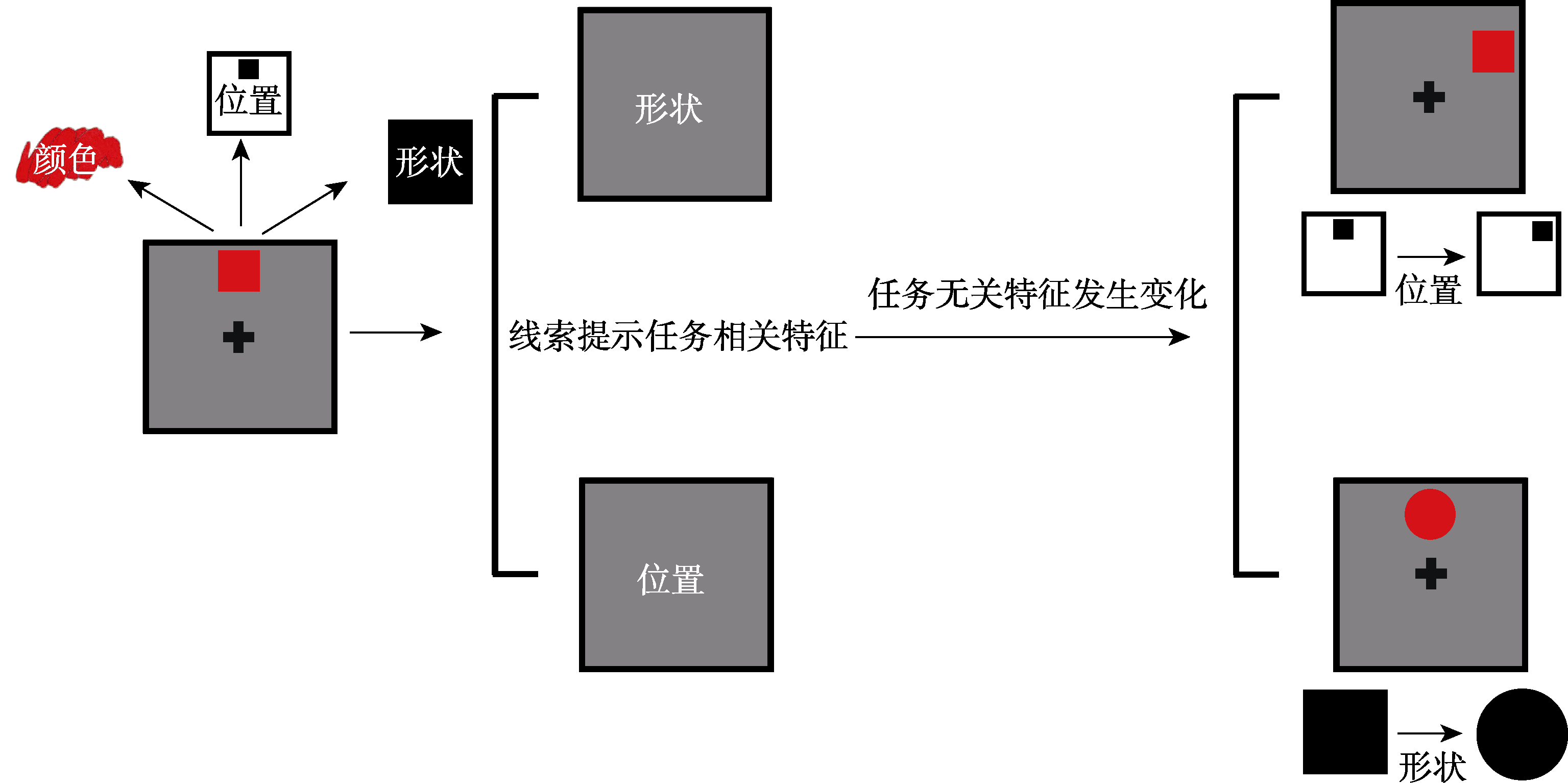
图1 实验范式。被试首先编码一个多特征客体, 然后根据回溯线索(如形状)的提示, 保留任务相关特征, 并主动移除无关特征(如位置、颜色), 在探测阶段, 被试需要判断相关特征是否改变, 同时忽略无关特征的变化(如图中“位置”特征, 任务无关特征在本示例中均未发生改变)。本研究通过测量无关特征变化所造成的干扰, 来间接评估其移除效果。彩图见电子版, 下同。
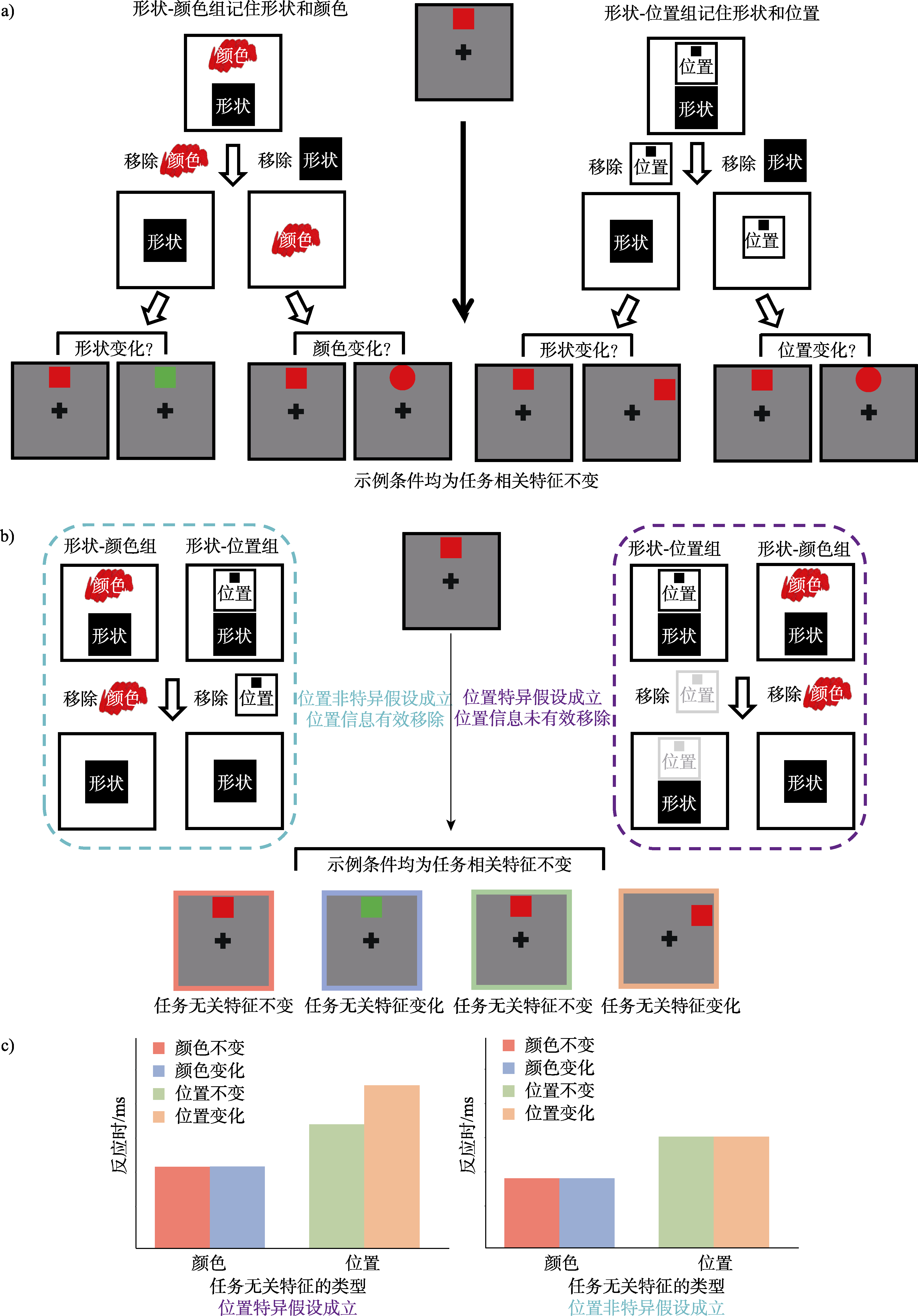
图2 研究设计及逻辑示意图(示例为实验1)。a)实验条件设置。实验包含两个条件:形状−颜色组(左侧)和形状−位置组(右侧), 在每个试次中, 被试根据回溯线索提示, 维持一个任务相关特征, 并主动移除另一任务无关特征, 最后对任务相关特征的变化进行判断。b)位置非特异性假设和位置特异性假设的逻辑。位置非特异性假设:位置信息已从工作记忆中有效移除, 其发生变化时不会干扰被试在任务相关维度上的记忆表现; 位置特异性假设:位置信息因其特殊性而难以有效移除, 该特征会在工作记忆中保持活跃, 其发生变化时会显著干扰被试在任务相关维度上的表现。c)对立假设的预期结果模式。
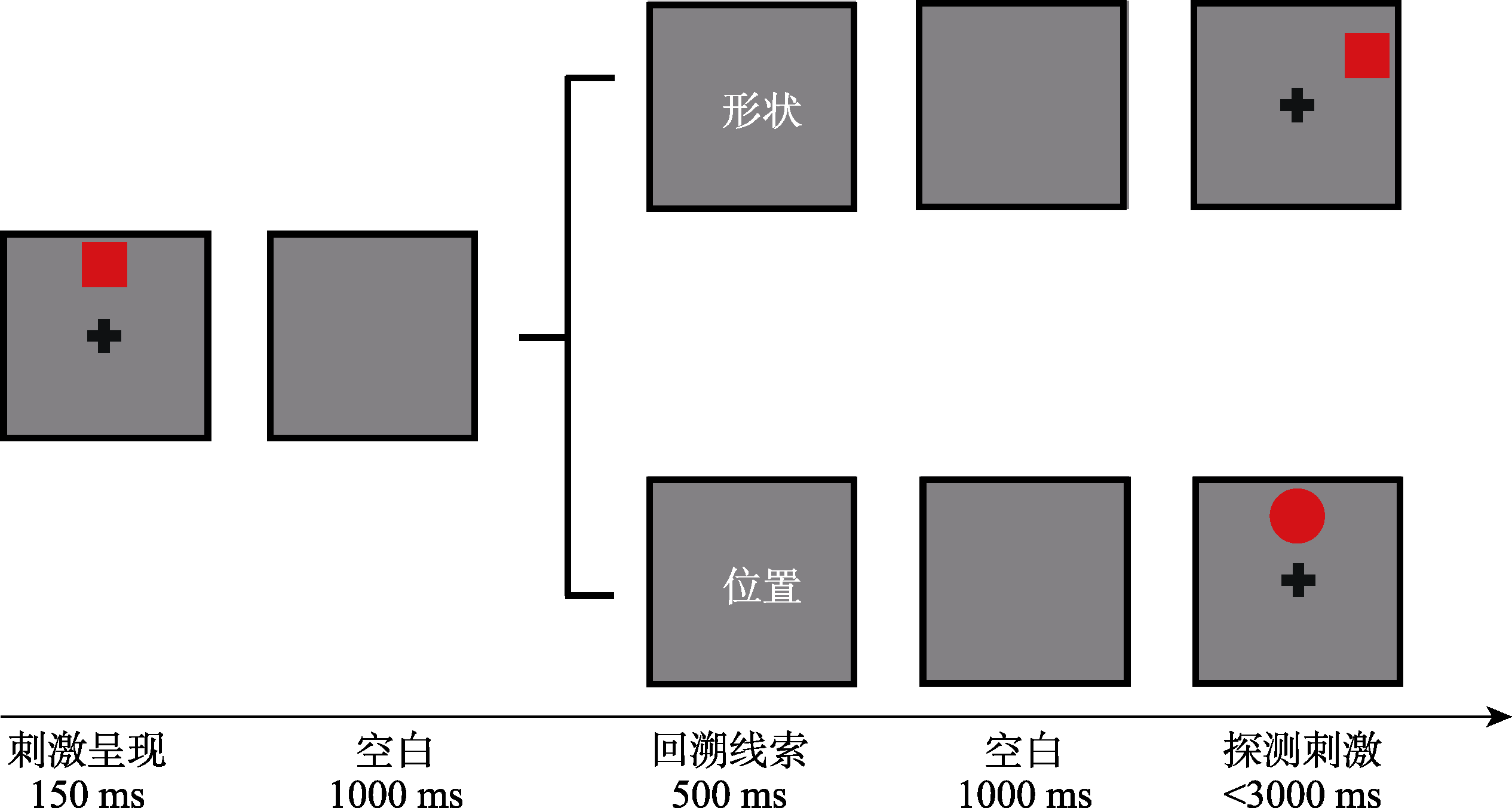
图3 实验1形状−位置条件的实验流程。在1000 ms的空白后呈现需记住的多边形150 ms, 要求被试记住多边形的形状和位置。接着回溯线索呈现500 ms提示任务相关特征, 被试继续记住任务相关特征, 并移除任务无关特征。空白间隔1000 ms后出现探测刺激, 被试要在保证正确的情况下, 尽快作出反应:报告任务相关特征是否发生变化。任务相关特征和任务无关特征均有50%的概率发生变化。在图3的示例中, 任务无关特征发生了变化, 而与任务相关的特征保持不变。
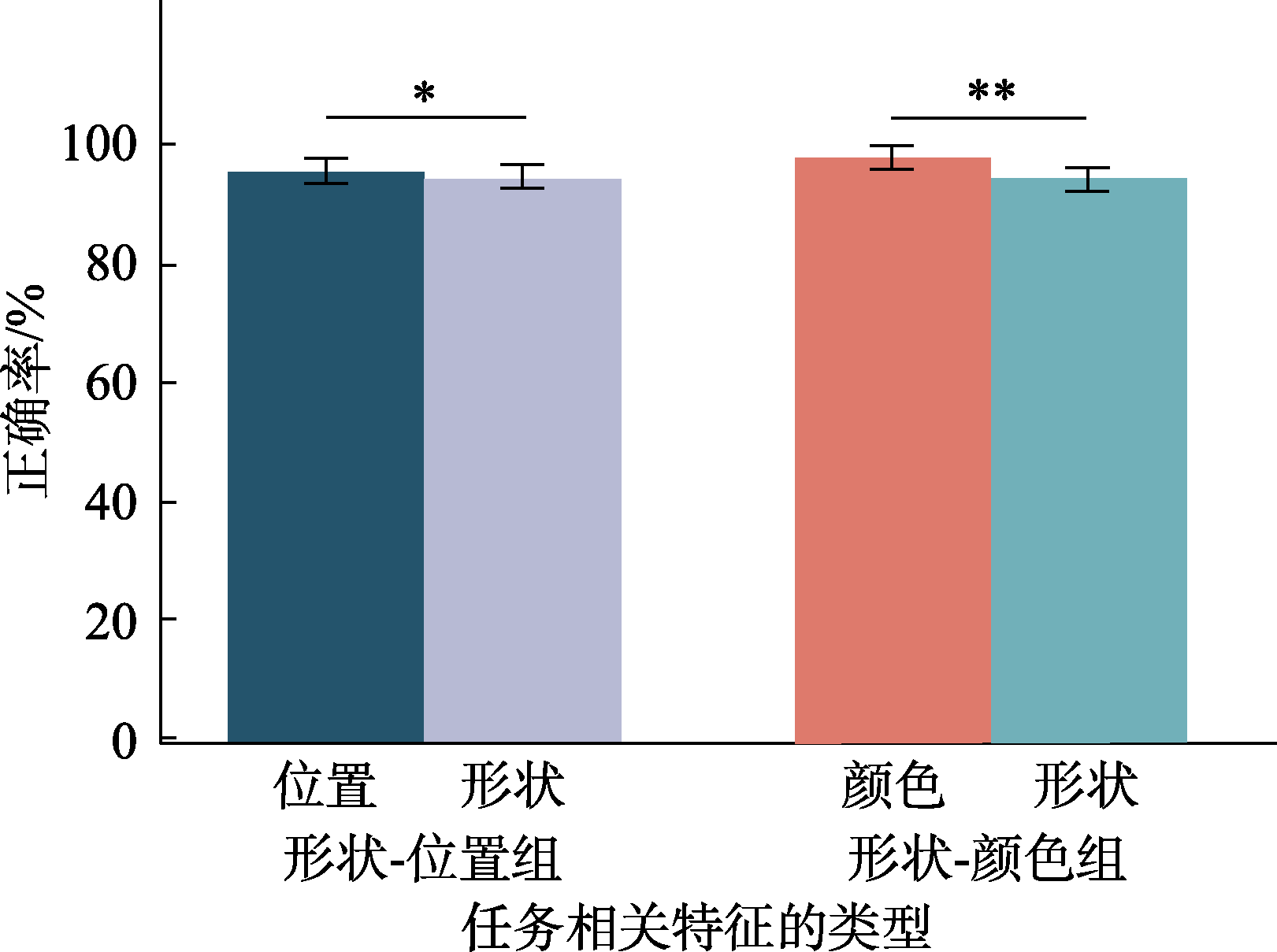
图4 实验1任务相关特征的正确率结果 注:柱状图表示组均值, 误差线表示被试内95%置信区间。* p < 0.05, ** p < 0.01。
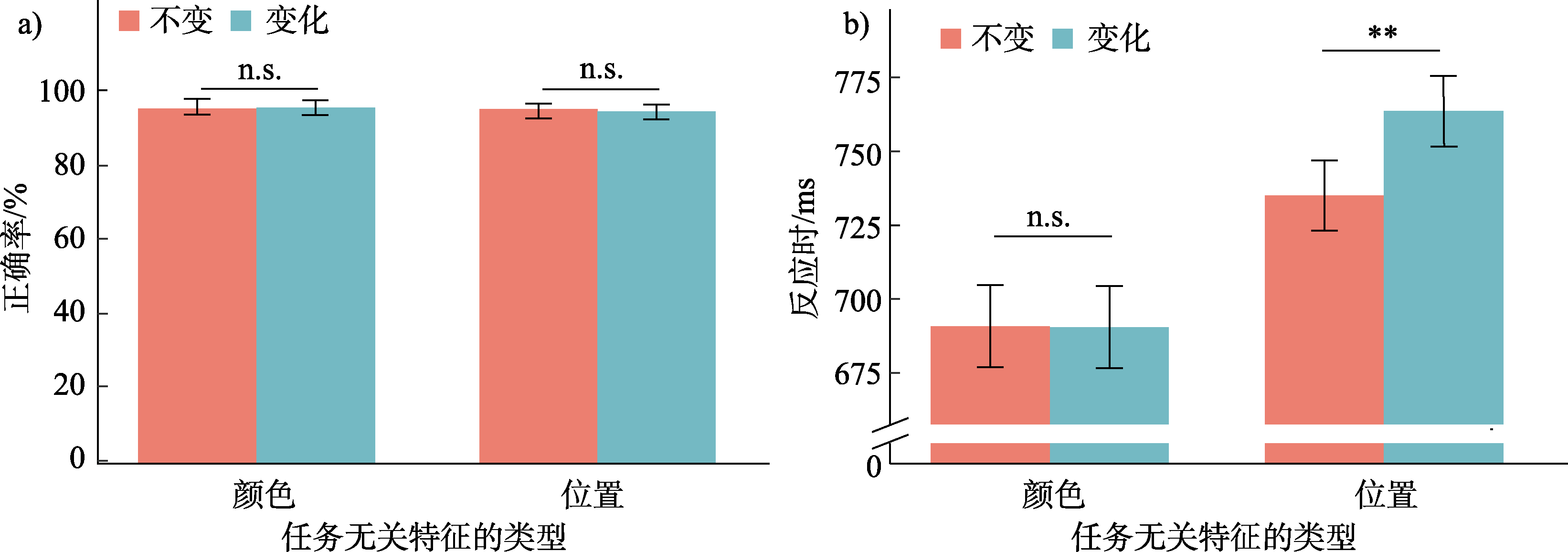
图5 a)实验1任务无关特征的正确率结果; b)实验1的反应时结果 注:柱状图表示组均值, 误差线表示被试内95%置信区间。** p < 0.01, n.s. p > 0.05。
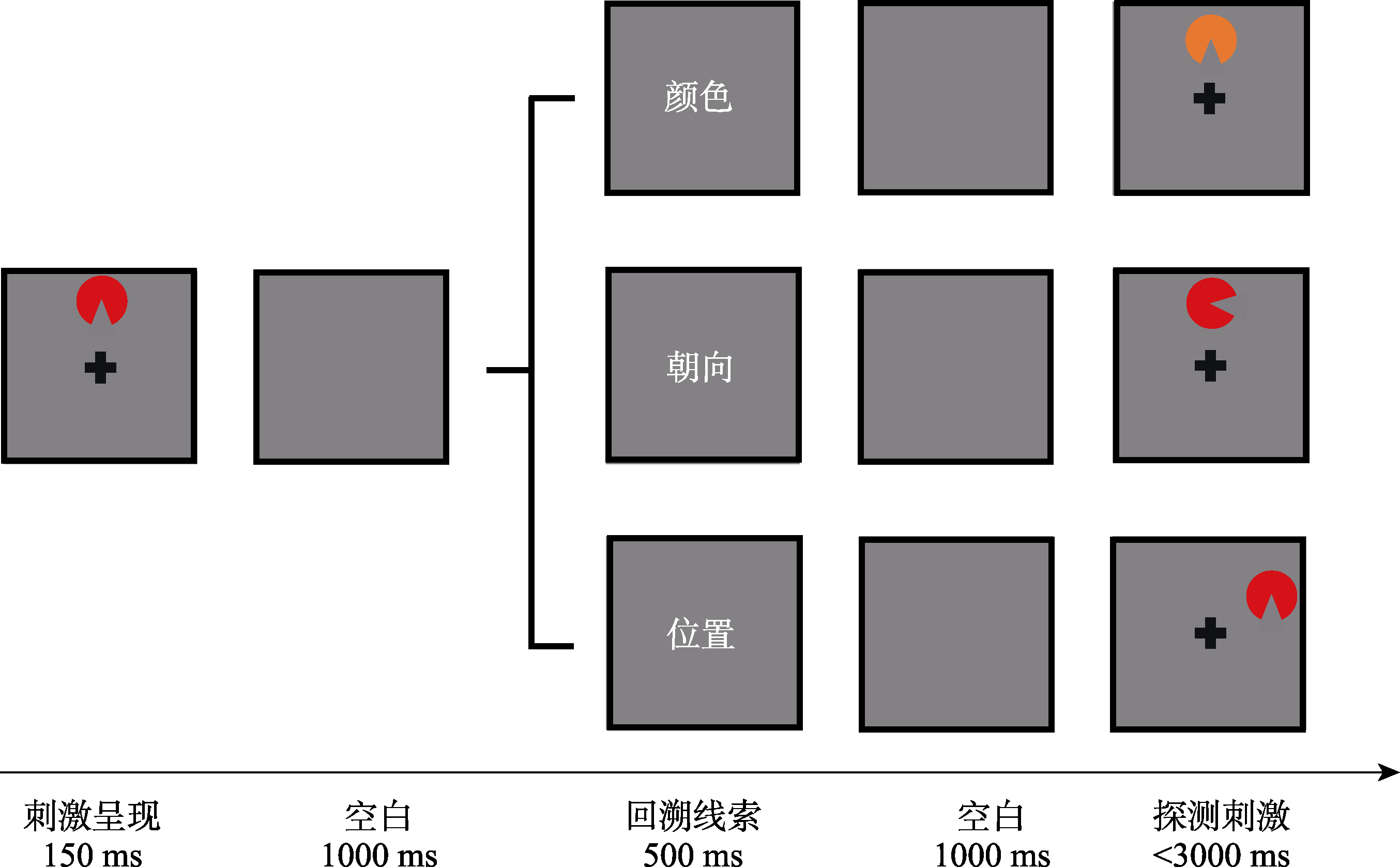
图6 实验2的实验流程。实验2的实验流程与实验1相同, 但有以下差异:刺激变成了有缺口的圆圈, 与任务相关的特征是颜色、朝向和位置。回溯线索仍然指示与任务相关的特征, 被试需移除其它两个任务无关特征。任务相关特征的变化概率为50%, 任务无关特征在50%的试次保持不变; 另外50%的试次中, 一个任务无关特征发生变化(两个任务无关特征各有25%的概率发生变化)。在图6的示例中, 与任务无关的特征保持不变, 而与任务相关的特征发生了变化。
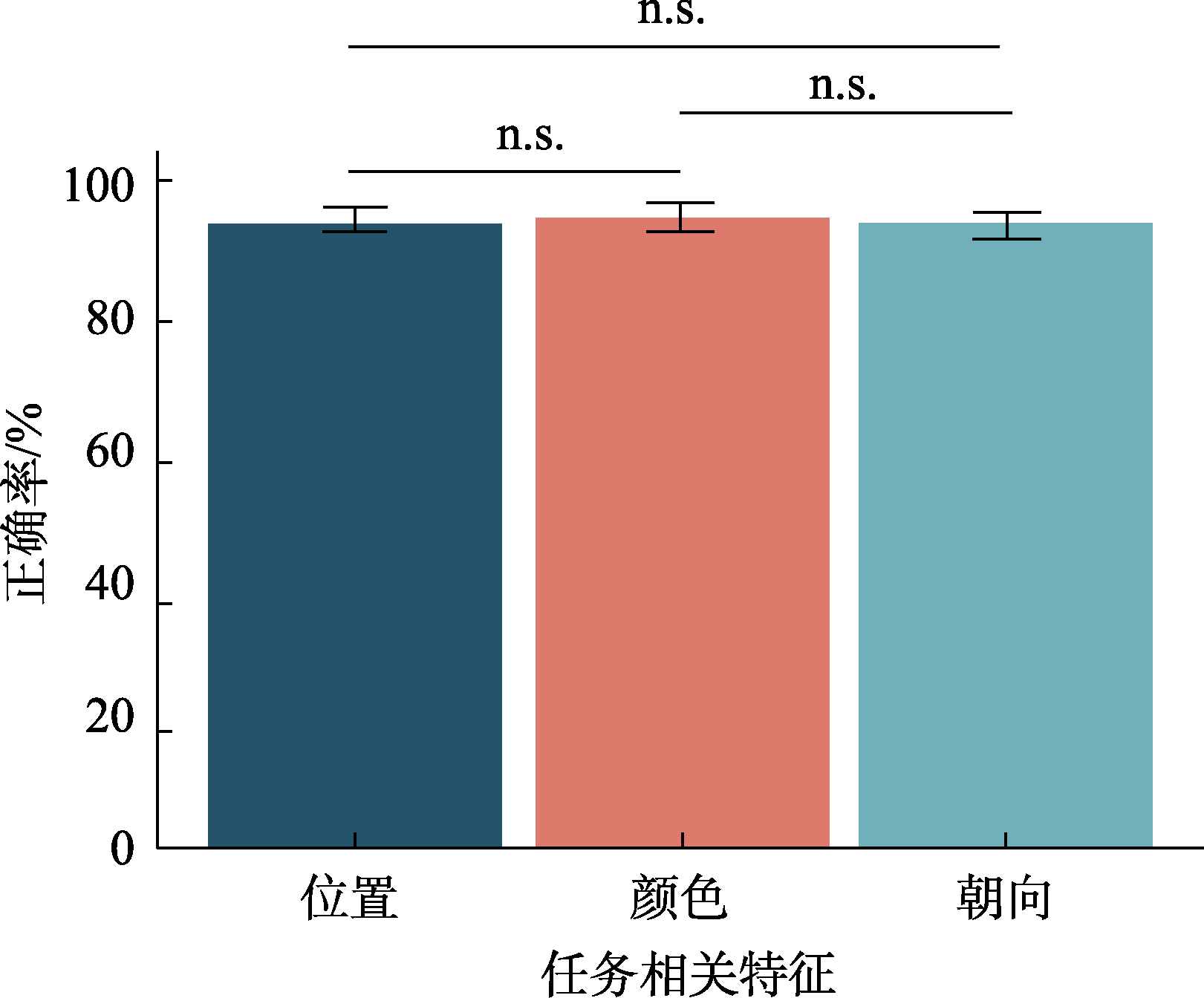
图7 实验2任务相关特征的正确率结果 注:柱状图表示组均值, 误差线表示被试内95%置信区间。n.s. p > 0.05。
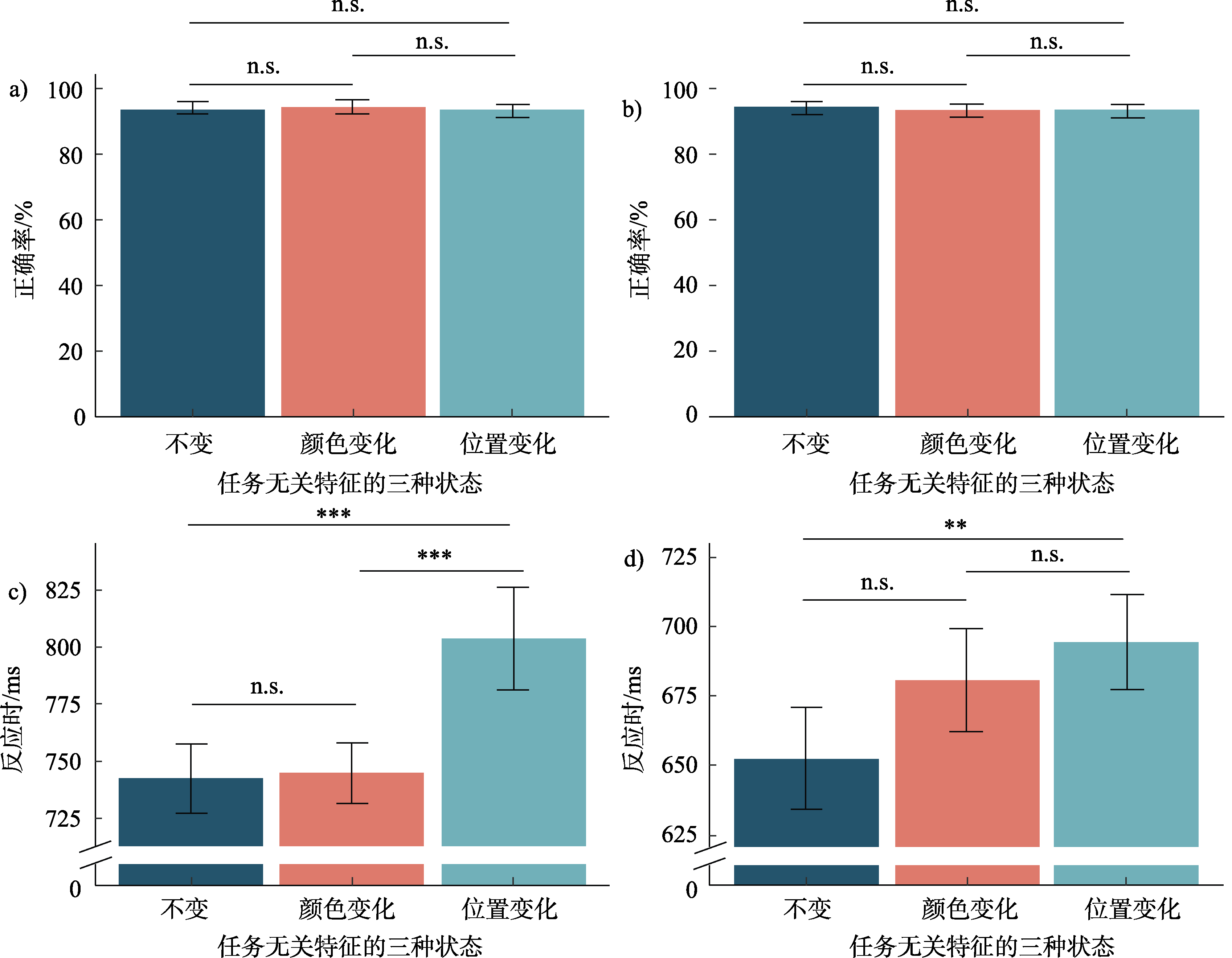
图8 a)实验2任务无关特征的正确率结果, 任务相关/目标特征为朝向。b)实验2任务无关特征的正确率结果, 任务相关/目标特征为颜色。c)实验2的反应时结果, 任务相关/目标特征为朝向。d)实验2的反应时结果, 任务相关/目标特征为颜色。柱状图表示组均值, 误差线表示被试内95%置信区间。*** p < 0.001, ** p < 0.01, n.s. p > 0.05。
| [1] |
Al Hadhrami, S. S., Bartsch, L. M., & Oberauer, K. (2025). A multinomial model-based analysis of bindings in working memory. Psychological Review, 132(4), 828-856. https://doi.org/10.1037/rev0000540
doi: 10.1037/rev0000540 URL pmid: 39964449 |
| [2] |
Baddeley, A. (2012). Working memory: Theories, models, and controversies. Annual Review of Psychology, 63, 1-29. https://doi.org/10.1146/annurev-psych-120710-100422
doi: 10.1146/annurev-psych-120710-100422 URL pmid: 21961947 |
| [3] |
Bays, P. M. (2014). Noise in neural populations accounts for errors in working memory. Journal of Neuroscience, 34(10), 3632-3645. https://doi.org/10.1523/JNEUROSCI.3204-13.2014
doi: 10.1523/JNEUROSCI.3204-13.2014 URL pmid: 24599462 |
| [4] |
Brainard, D. H. (1997). The psychophysics toolbox. Spatial Vision, 10(4), 433-436. https://doi.org/10.1163/156856897X00357
URL pmid: 9176952 |
| [5] |
Chen, H., & Wyble, B. (2015). The location but not the attributes of visual cues are automatically encoded into working memory. Vision Research, 107, 76-85. https://doi.org/10.1016/j.visres.2014.11.010
doi: 10.1016/j.visres.2014.11.010 URL pmid: 25490435 |
| [6] |
Chen, W., Ye, S., Ding, X., Shen, M., & Gao, Z. (2024). Selectively maintaining an object’s feature in visual working memory: A comparison between highly discriminable and fine-grained features. Memory & Cognition, 53, 853-868. https://doi.org/10.3758/s13421-024-01612-w
doi: 10.3758/s13421-024-01612-w URL |
| [7] |
Chun, M. M., & Jiang, Y. (1998). Contextual cueing: Implicit learning and memory of visual context guides spatial attention. Cognitive Psychology, 36(1), 28-71. https://doi.org/10.1006/cogp.1998.0681
URL pmid: 9679076 |
| [8] |
Foster, J. J., Bsales, E. M., Jaffe, R. J., & Awh, E. (2017). Alpha-band activity reveals spontaneous representations of spatial position in visual working memory. Current Biology, 27(20), 3216-3223. https://doi.org/10.1016/j.cub.2017.09.031
doi: S0960-9822(17)31196-X URL pmid: 29033335 |
| [9] |
Fougnie, D., Cormiea, S. M., & Alvarez, G. A. (2013). Object-based benefits without object based representations. Journal of Experimental Psychology: General, 142(3), 621-626. https://doi.org/10.1037/a0030300
doi: 10.1037/a0030300 URL |
| [10] |
Gao, T., Gao, Z., Li, J., Sun, Z., & Shen, M. (2011). The perceptual root of object-based storage: An interactive model of perception and visual working memory. Journal of Experimental Psychology: Human Perception and Performance, 37(6), 1803-1823. https://doi.org/10.1037/a0025637
doi: 10.1037/a0025637 URL pmid: 22004193 |
| [11] | Gao, Z., Li, J., Liang, J., Chen, H., Yin, J., & Shen, M. (2009). Storing fine detailed information in visual working memory—Evidence from event-related potentials. Journal of Vision, 9(7), 17. https://doi.org/10.1167/9.7.17 |
| [12] |
Gao, Z., Yu, S., Zhu, C., Shui, R., Weng, X., Li, P., & Shen, M. (2016). Object-based encoding in visual working memory: Evidence from memory-driven attentional capture. Scientific Reports, 6(1), 22822. https://doi.org/10.1038/srep22822
doi: 10.1038/srep22822 URL |
| [13] | Green, E. J., & Quilty-Dunn, J. (2021). What is an object file? The British Journal for the Philosophy of Science, 73(3), 665-699. https://doi.org/10.1093/bjps/axx055 |
| [14] |
Groen, I. I., Dekker, T. M., Knapen, T., & Silson, E. H. (2022). Visuospatial coding as ubiquitous scaffolding for human cognition. Trends in Cognitive Sciences, 26(1), 81-96. https://doi.org/10.1016/j.tics.2021.10.011
doi: 10.1016/j.tics.2021.10.011 URL |
| [15] |
Hollingworth, A., & Rasmussen, I. P. (2010). Binding objects to locations: The relationship between object files and visual working memory. Journal of Experimental Psychology: Human Perception and Performance, 36(3), 543-564. https://doi.org/10.1037/a0017836
doi: 10.1037/a0017836 URL pmid: 20515188 |
| [16] |
Huang, L. (2010). What is the unit of visual attention? Object for selection, but Boolean map for access. Journal of Experimental Psychology: General, 139(1), 162-179. https://doi.org/10.1037/a0018034
doi: 10.1037/a0018034 URL |
| [17] |
Huang, L. (2020). Unit of visual working memory: A Boolean map provides a better account than an object does. Journal of Experimental Psychology: General, 149(1), 1-30. https://doi.org/10.1037/xge0000616
doi: 10.1037/xge0000616 URL |
| [18] |
Huang, L., & Pashler, H. (2007). A Boolean map theory of visual attention. Psychological Review, 114(3), 599-631. https://doi.org/10.1037/0033-295X.114.3.599
URL pmid: 17638498 |
| [19] |
Johnston, W. A., & Dark, V. J. (1986). Selective attention. Annual Review of Psychology, 37(1), 43-75. https://doi.org/10.1146/annurev.ps.37.020186.000355
doi: 10.1146/psych.1986.37.issue-1 URL |
| [20] |
Kahneman, D., Treisman, A., & Gibbs, B. J. (1992). The reviewing of object files: Object-specific integration of information. Cognitive Psychology, 24(2), 175-219. https://doi.org/10.1016/0010-0285(92)90007-O
doi: 10.1016/0010-0285(92)90007-o URL pmid: 1582172 |
| [21] |
Kim, H., Smolker, H. R., Smith, L. L., Banich, M. T., & Lewis-Peacock, J. A. (2020). Changes to information in working memory depend on distinct removal operations. Nature Communications, 11(1), 6239. https://doi.org/10.1038/s41467-020-20085-4
doi: 10.1038/s41467-020-20085-4 URL pmid: 33288756 |
| [22] | Kleiner, M., Brainard, D., & Pelli, D., Ingling, A., Murray, R., & Broussard, C. (2007). What's new in Psychtoolbox-3? Perception, 36, 1-16. |
| [23] |
Kong, G., & Fougnie, D. (2022). How selection in the mind is different from attention to the world. Journal of Experimental Psychology: General, 151(3), 542-554. https://psycnet.apa.org/doi/10.1037/xge0001098
doi: 10.1037/xge0001098 URL |
| [24] |
Kovacs, O., & Harris, I. M. (2019). The role of location in visual feature binding. Attention, Perception, & Psychophysics, 81(5), 1551-1563. https://doi.org/10.3758/s13414-018-01638-8
doi: 10.3758/s13414-018-01638-8 URL |
| [25] |
Li, Q., & Saiki, J. (2015). Different effects of color-based and location-based selection on visual working memory. Attention, Perception, & Psychophysics, 77, 450-463. https://doi.org/10.3758/s13414-014-0775-3
doi: 10.3758/s13414-014-0775-3 URL |
| [26] |
Logie, R. H., Brockmole, J. R., & Jaswal, S. (2011). Feature binding in visual short-term memory is unaffected by task-irrelevant changes of location, shape, and color. Memory & Cognition, 39, 24-36. https://doi.org/10.3758/s13421-010-0001-z
doi: 10.3758/s13421-010-0001-z URL |
| [27] |
Lara, A. H., & Wallis, J. D. (2014). Executive control processes underlying multi-item working memory. Nature Neuroscience, 17(6), 876-883. https://doi.org/10.1038/nn.3702
doi: 10.1038/nn.3702 URL pmid: 24747574 |
| [28] |
Luck, S. J., & Hillyard, S. A. (1994). Spatial filtering during visual search: evidence from human electrophysiology. Journal of Experimental Psychology: Human Perception and Performance, 20(5), 1000-1014. https://doi.org/10.1037/0096-1523.20.5.1000
doi: 10.1037/0096-1523.20.5.1000 URL |
| [29] |
Luck, S. J., & Vogel, E. K. (1997). The capacity of visual working memory for features and conjunctions. Nature, 390(6657), 279-281. https://doi.org/10.1038/36846
doi: 10.1038/36846 URL |
| [30] |
Ma, W. J., Husain, M., & Bays, P. M. (2014). Changing concepts of working memory. Nature Neuroscience, 17(3), 347-356. https://doi.org/10.1038/nn.3655
doi: 10.1038/nn.3655 URL pmid: 24569831 |
| [31] |
Oberauer, K., Farrell, S., Jarrold, C., & Lewandowsky, S. (2016). What limits working memory capacity? Psychological Bulletin, 142(7), 758-799. https://doi.org/10.1037/bul0000046
doi: 10.1037/bul0000046 URL pmid: 26950009 |
| [32] |
Park, Y. E., Sy, J. L., Hong, S. W., & Tong, F. (2017). Reprioritization of features of multidimensional objects stored in visual working memory. Psychological Science, 28(12), 1773-1785. https://doi.org/10.1177/0956797617719949
doi: 10.1177/0956797617719949 URL pmid: 28957016 |
| [33] |
Posner, M. I., & Petersen, S. E. (1990). The attention system of the human brain. Annual Review of Neuroscience, 13(1), 25-42. https://doi.org/10.1146/annurev.ne.13.030190.000325
doi: 10.1146/neuro.1990.13.issue-1 URL |
| [34] |
Richard, F. D., Bond, C. F., Jr., & Stokes-Zoota, J. J. (2003). One hundred years of social psychology: Quantitative synthesis of 2,500 articles. Review of General Psychology, 7(4), 331-363. https://doi.org/10.1037/1089-2680.7.4.331
doi: 10.1037/1089-2680.7.4.331 URL |
| [35] |
Sasin, E., & Fougnie, D. (2020). Memory-driven capture occurs for individual features of an object. Scientific Reports, 10(1), 19499. https://doi.org/10.1038/s41598-020-76431-5
doi: 10.1038/s41598-020-76431-5 URL pmid: 33177574 |
| [36] |
Schneegans, S., & Bays, P. M. (2017). Neural architecture for feature binding in visual working memory. The Journal of Neuroscience, 37(14), 3913-3925. https://doi.org/10.1523/JNEUROSCI.3493-16.2017
doi: 10.1523/JNEUROSCI.3493-16.2017 URL |
| [37] |
Schneegans, S., McMaster, J., & Bays, P. M. (2022). Role of time in binding features in visual working memory. Psychological Review, 130(1), 137-154. https://doi.org/10.1037/rev0000331
doi: 10.1037/rev0000331 URL pmid: 35099211 |
| [38] |
Shen, M., Tang, N., Wu, F., Shui, R., & Gao, Z. (2013). Robust object-based encoding in visual working memory. Journal of Vision, 13(2), 1-11. https://doi.org/10.1167/13.2.1
doi: 10.1167/13.2.1 URL pmid: 23378130 |
| [39] |
Souza, A. S., Rerko, L., & Oberauer, K. (2016). Getting more from visual working memory: Retro-cues enhance retrieval and protect from visual interference. Journal of Experimental Psychology: Human Perception and Performance, 42(6), 890-910. https://doi.org/10.1037/xhp0000192
doi: 10.1037/xhp0000192 URL pmid: 26752731 |
| [40] |
Tam, J., & Wyble, B. (2023). Location has a privilege, but it is limited: Evidence from probing task-irrelevant location. Journal of Experimental Psychology: Learning, Memory, and Cognition, 49(7), 1051-1067. https://doi.org/10.1037/xlm0001147
doi: 10.1037/xlm0001147 URL |
| [41] |
Treisman, A., & Zhang, W. (2006). Location and binding in visual working memory. Memory & Cognition, 34(8), 1704-1719. https://doi.org/10.3758/BF03195932
doi: 10.3758/BF03195932 URL |
| [42] | Westfall, J. (2015). PANGEA: Power analysis for general ANOVA designs. Unpublished manuscript. Available at http://jakewestfall.org/publications/pangea.pdf |
| [43] |
Williams, M., Hong, S. W., Kang, M. S., Carlisle, N. B., & Woodman, G. F. (2013). The benefit of forgetting. Psychonomic Bulletin & Review, 20, 348-355. https://doi.org/10.3758/s13423-012-0354-3
doi: 10.3758/s13423-012-0354-3 URL |
| [44] |
Wolfe, J. M., & Horowitz, T. S. (2004). What attributes guide the deployment of visual attention and how do they do it? Nature Reviews Neuroscience, 5(6), 495-501. https://doi.org/10.1038/nrn1411
doi: 10.1038/nrn1411 URL pmid: 15152199 |
| [45] |
Woodman, G. F. (2021). Spatial location is filtered out of visual working memory representations when task irrelevant, just like other features. Attention, Perception, & Psychophysics, 83(4), 1391-1396. https://doi.org/10.3758/s13414-021-02263-8
doi: 10.3758/s13414-021-02263-8 URL |
| [46] |
Woodman, G. F., Vogel, E. K., & Luck, S. J. (2012). Flexibility in visual working memory: Accurate change detection in the face of irrelevant variations in position. Visual Cognition, 20(1), 1-28. https://doi.org/10.1080/13506285.2011.630694
URL pmid: 22287933 |
| [47] |
Yin, J., Gao, Z., Jin, X., Ding, X., Liang, J., & Shen, M. (2012). The neural mechanisms of percept-memory comparison in visual working memory. Biological Psychology, 90(1), 71-79. https://doi.org/10.1016/j.biopsycho.2012.02.023
doi: 10.1016/j.biopsycho.2012.02.023 URL pmid: 22410263 |
| [48] |
Yin, J., Zhou, J., Xu, H., Liang, J., Gao, Z., & Shen, M. (2012). Does high memory load kick task irrelevant information out of visual working memory? Psychonomic Bulletin & Review, 19(2), 218-224. https://doi.org/10.3758/s13423-011-0201-y
doi: 10.3758/s13423-011-0201-y URL |
| [1] | 高源霞, 王江洋. 奖惩动机诱发对网络游戏成瘾高风险大学生工作记忆刷新功能的影响[J]. 心理学报, 2026, 58(8): 1517-1531. |
| [2] | 郭芮巧, 李雯瑞, 郭雪, 赵娜, 雷鸣, 刘强. 经颅交流电刺激的刺激时机对工作记忆调控效果的影响[J]. 心理学报, 2026, 58(5): 827-839. |
| [3] | 王俊博, 赵娜, 李子媛, 刘强. 负性面孔的工作记忆离线态存储不影响在线态存储[J]. 心理学报, 2025, 57(8): 1323-1332. |
| [4] | 李子媛, 任国防, 袁子昕, 喻青青, 伍越, 刘强. 视觉工作记忆离线态表征具有稳固性优势[J]. 心理学报, 2025, 57(5): 739-748. |
| [5] | 连浩敏, 张倩, 谷雪敏, 李寿欣. 持续性视觉注意对视觉工作记忆项目优先加工的影响[J]. 心理学报, 2025, 57(2): 191-206. |
| [6] | 周临舒, 张雨青, 蔡丹超. 音乐训练促进音高与时间维度在听觉工作记忆中的交互[J]. 心理学报, 2025, 57(10): 1701-1714. |
| [7] | 周详, 张婧婧, 白博仁, 翟宏堃, 崔虞馨, 祖冲. “三心二意”胜过“一心一意”: 媒体多任务提升低工作记忆容量者创造力[J]. 心理学报, 2024, 56(8): 1031-1046. |
| [8] | 李子媛, 雷鸣, 刘强. 视觉工作记忆离线态表征的生成机制[J]. 心理学报, 2024, 56(4): 412-420. |
| [9] | 牛惠, 胡艳梅, 郑旭涛, 姜英杰, 刘佳. 奖赏对工作记忆提取准确性的促进及其机制[J]. 心理学报, 2024, 56(4): 435-446. |
| [10] | 张引, 李月, 梁腾飞, 陈江涛, 刘强. 自动激活的长时联结表征对工作记忆的促进效应[J]. 心理学报, 2024, 56(10): 1328-1339. |
| [11] | 庞超, 陈颜璋, 王莉, 杨喜端, 贺雅, 李芷莹, 欧阳小钰, 傅世敏, 南威治. 客体信息在视觉工作记忆编码和维持阶段的不同注意选择模式[J]. 心理学报, 2023, 55(9): 1397-1410. |
| [12] | 李海峰, 林世卿, 万博温. 价值导向的注意刷新及其机制[J]. 心理学报, 2023, 55(8): 1234-1242. |
| [13] | 董天天, 徐璐璐, 贺雯. 积极总是好的吗?积极元刻板印象对工作记忆的影响及其机制[J]. 心理学报, 2023, 55(8): 1344-1357. |
| [14] | 陈悦源, 方卫宁, 郭北苑, 鲍海峰. 作业中断对任务绩效的影响及心理疲劳的调节作用[J]. 心理学报, 2023, 55(1): 22-35. |
| [15] | 王强强, 张琦, 石文典, 王志伟, 章鹏程. 数字空间表征的在线建构:来自干扰情境中数字SNARC效应的证据[J]. 心理学报, 2022, 54(7): 761-771. |
| 阅读次数 | ||||||
|
全文 |
|
|||||
|
摘要 |
|
|||||
