

ISSN 0439-755X
CN 11-1911/B
主办:中国心理学会
中国科学院心理研究所
出版:科学出版社
CN 11-1911/B
主办:中国心理学会
中国科学院心理研究所
出版:科学出版社
心理学报 ›› 2025, Vol. 57 ›› Issue (10): 1777-1790.doi: 10.3724/SP.J.1041.2025.1777 cstr: 32110.14.2025.1777
李雅雯1, 蔡攀1, 左世江2, 王芳1( ), 董煜1, 周阳1, 黄旎雯1
收稿日期:2024-04-17
发布日期:2025-08-15
出版日期:2025-10-25
通讯作者:
王芳, E-mail: fwang@bnu.edu.cn作者简介:第一联系人:文中“适应性功能”指进化意义上的生物性适应(adaptation), 关注个体在特定环境压力下形成的生存策略匹配机制(Buss,
基金资助:
LI Yawen1, CAI Pan1, ZUO Shijiang2, WANG Fang1(), DONG Yu1, ZHOU Yang1, HUANG Niwen1
Received:2024-04-17
Online:2025-08-15
Published:2025-10-25
摘要:
当下社会, 人们在相亲择偶时日趋“明码标价”。本研究将此现象概念化为择偶中的计算心态, 并提出在人际关系的建立与结束更加自由的高关系流动性环境中, 此种将择偶信息转换为流畅易加工的量化指标的认知策略具有认知减负的适应性功能。通过相亲网站文本分析、问卷测量和实验室实验, 三个研究(4个子研究)分别从地区和个体水平上揭示了关系流动性与择偶计算心态之间的相关和因果关系。研究结果将关系流动性的心理后效拓展至个人择偶领域, 一方面在理论上丰富了对于个体如何适应特定社会生态环境的认识, 另一方面可在实践上为制定符合社会转型期大众择偶心理的政策或营销策略提供参考。
中图分类号:
李雅雯, 蔡攀, 左世江, 王芳, 董煜, 周阳, 黄旎雯. (2025). “量化”爱情:关系流动性促进择偶计算心态. 心理学报, 57(10), 1777-1790.
LI Yawen, CAI Pan, ZUO Shijiang, WANG Fang, DONG Yu, ZHOU Yang, HUANG Niwen. (2025). Measuring love: Relational mobility promotes calculative mindset in mate choice. Acta Psychologica Sinica, 57(10), 1777-1790.
| 示例 | 自我介绍内容 | 分词结果 | 总词汇量 | 匹配词汇 | 匹配词汇量 | 择偶计算心态(匹配词汇量/总词汇量) |
|---|---|---|---|---|---|---|
| 1 | 大家好, 我是一个开朗直率的女孩, 我在国有企业工作。对于我的另一半, 我希望他必须有房有稳定工作。 | '大家好', '我', '是', '一个', '开朗', '直率', '的', '女孩', '我', '在', '国有企业', '工作', '对于', '我', '的', '另一半', '我', '希望', '他', '必须', '有房', '有', '稳定', '工作' | 24 | '国有企业', ‘有房’, '稳定' | 3 | 0.13 |
| 2 | 32岁, 老家山东, 北京上的大学, 硕士毕业后留北京工作, 长相很一般。对于我的另一半, 我希望她是一个居家的女生。 | '32岁', '老家', '山东', '北京', '上', '的', '大学', '硕士', '毕业', '后', '留', '北京', '工作', '长相', '很一般', '对于', '我', '的', '另一半', '我', '希望', '她', '是', '一个', '居家', '的', '女生' | 27 | '32岁', '硕士', '很一般', '居家' | 4 | 0.15 |
表1 基于自我介绍文本的择偶计算心态指标构建举例
| 示例 | 自我介绍内容 | 分词结果 | 总词汇量 | 匹配词汇 | 匹配词汇量 | 择偶计算心态(匹配词汇量/总词汇量) |
|---|---|---|---|---|---|---|
| 1 | 大家好, 我是一个开朗直率的女孩, 我在国有企业工作。对于我的另一半, 我希望他必须有房有稳定工作。 | '大家好', '我', '是', '一个', '开朗', '直率', '的', '女孩', '我', '在', '国有企业', '工作', '对于', '我', '的', '另一半', '我', '希望', '他', '必须', '有房', '有', '稳定', '工作' | 24 | '国有企业', ‘有房’, '稳定' | 3 | 0.13 |
| 2 | 32岁, 老家山东, 北京上的大学, 硕士毕业后留北京工作, 长相很一般。对于我的另一半, 我希望她是一个居家的女生。 | '32岁', '老家', '山东', '北京', '上', '的', '大学', '硕士', '毕业', '后', '留', '北京', '工作', '长相', '很一般', '对于', '我', '的', '另一半', '我', '希望', '她', '是', '一个', '居家', '的', '女生' | 27 | '32岁', '硕士', '很一般', '居家' | 4 | 0.15 |
| 变量 | 1 | 2 | 3 | 4 | 5 | 6 | 7 | 8 |
|---|---|---|---|---|---|---|---|---|
| 1. 地区关系流动性 | − | |||||||
| 2. 性别 | 0.05*** | − | ||||||
| 3. 年龄 | −0.08*** | 0.53*** | − | |||||
| 4. 教育水平 | 0.10*** | 0.18*** | 0.01* | − | ||||
| 5. 地区人口总量 | 0.07 | −0.19*** | −0.20*** | −0.08*** | − | |||
| 6. 地区GDP | 0.14 | −0.10*** | −0.21*** | −0.03*** | 0.85*** | − | ||
| 7. 地区居住流动性 | −0.00 | −0.05*** | −0.01 | −0.05*** | −0.29 | −0.28 | − | |
| 8. 择偶计算心态 | 0.02*** | −0.04*** | −0.06*** | 0.02*** | 0.02*** | 0.03*** | −0.01** | − |
| M | 0.37 | − | 24.36 | 3.55 | 4478.52 | 27327.10 | 0.26 | 0.02 |
| SD | 0.12 | − | 2.29 | 1.31 | 2866.82 | 22186.91 | 0.11 | 0.04 |
表2 研究1描述统计及相关分析
| 变量 | 1 | 2 | 3 | 4 | 5 | 6 | 7 | 8 |
|---|---|---|---|---|---|---|---|---|
| 1. 地区关系流动性 | − | |||||||
| 2. 性别 | 0.05*** | − | ||||||
| 3. 年龄 | −0.08*** | 0.53*** | − | |||||
| 4. 教育水平 | 0.10*** | 0.18*** | 0.01* | − | ||||
| 5. 地区人口总量 | 0.07 | −0.19*** | −0.20*** | −0.08*** | − | |||
| 6. 地区GDP | 0.14 | −0.10*** | −0.21*** | −0.03*** | 0.85*** | − | ||
| 7. 地区居住流动性 | −0.00 | −0.05*** | −0.01 | −0.05*** | −0.29 | −0.28 | − | |
| 8. 择偶计算心态 | 0.02*** | −0.04*** | −0.06*** | 0.02*** | 0.02*** | 0.03*** | −0.01** | − |
| M | 0.37 | − | 24.36 | 3.55 | 4478.52 | 27327.10 | 0.26 | 0.02 |
| SD | 0.12 | − | 2.29 | 1.31 | 2866.82 | 22186.91 | 0.11 | 0.04 |
| 变量 | 择偶计算心态 | ||
|---|---|---|---|
| 零模型 | M1 | M2 | |
| 截距 | 1.64×10⁻²*** | 2.34×10⁻²*** | 2.04×10⁻²*** |
| M1:加入个体层次变量 | |||
| 性别 | −3.86×10⁻³*** | −3.68×10⁻³*** | |
| 年龄 | −3.08×10⁻⁴** | −3.00×10⁻⁴** | |
| 教育水平 | 6.86×10⁻⁴*** | 6.71×10⁻⁴*** | |
| M2:加入地区层次变量 | |||
| 地区人口总量 | 5.12×10⁻⁸ | ||
| 地区GDP总量 | 1.87×10⁻⁸ | ||
| 地区居住流动性 | −2.85×10⁻³ | ||
| 地区关系流动性 | 7.20×10⁻³** | ||
| δ2 | 1.38×10⁻³ | 1.37×10⁻³ | 1.37×10⁻³ |
| τ00 | 2.66×10⁻⁶*** | 1.72×10⁻⁶*** | 8.56×10⁻⁷** |
| R2 | 0.0019 | 0.0057 | 0.0062 |
| ΔR2 | 0.0038 | 0.0005 | |
表3 研究1择偶计算心态多层次回归模型参数估计
| 变量 | 择偶计算心态 | ||
|---|---|---|---|
| 零模型 | M1 | M2 | |
| 截距 | 1.64×10⁻²*** | 2.34×10⁻²*** | 2.04×10⁻²*** |
| M1:加入个体层次变量 | |||
| 性别 | −3.86×10⁻³*** | −3.68×10⁻³*** | |
| 年龄 | −3.08×10⁻⁴** | −3.00×10⁻⁴** | |
| 教育水平 | 6.86×10⁻⁴*** | 6.71×10⁻⁴*** | |
| M2:加入地区层次变量 | |||
| 地区人口总量 | 5.12×10⁻⁸ | ||
| 地区GDP总量 | 1.87×10⁻⁸ | ||
| 地区居住流动性 | −2.85×10⁻³ | ||
| 地区关系流动性 | 7.20×10⁻³** | ||
| δ2 | 1.38×10⁻³ | 1.37×10⁻³ | 1.37×10⁻³ |
| τ00 | 2.66×10⁻⁶*** | 1.72×10⁻⁶*** | 8.56×10⁻⁷** |
| R2 | 0.0019 | 0.0057 | 0.0062 |
| ΔR2 | 0.0038 | 0.0005 | |
| 变量 | 1 | 2 | 3 | 4 | 5 | 6 | 7 | 8 |
|---|---|---|---|---|---|---|---|---|
| 1. 关系流动性 | − | |||||||
| 2. 性别 | −0.11 | − | ||||||
| 3. 年龄 | 0.13* | −0.10 | − | |||||
| 4. 教育水平 | 0.10 | 0.04 | 0.22*** | − | ||||
| 5. 主观SES | 0.25*** | 0.03 | 0.21*** | 0.28*** | − | |||
| 6. 婚恋状况 | 0.08 | −0.01 | 0.17** | −0.04 | 0.09 | − | ||
| 7. 针对他人的择偶计算心态 | 0.17** | 0.05 | 0.01 | 0.03 | 0.11 | −0.10 | − | |
| 8. 针对自我的择偶计算心态 | 0.14* | −0.12* | 0.09 | −0.00 | 0.06 | −0.09 | 0.71*** | − |
| M | 4.98 | − | 27.74 | 3.67 | 2.71 | 1.57 | 4.45 | 4.94 |
| SD | 0.91 | − | 4.23 | 0.85 | 0.71 | 0.50 | 1.12 | 1.03 |
表4 研究2描述统计及相关分析
| 变量 | 1 | 2 | 3 | 4 | 5 | 6 | 7 | 8 |
|---|---|---|---|---|---|---|---|---|
| 1. 关系流动性 | − | |||||||
| 2. 性别 | −0.11 | − | ||||||
| 3. 年龄 | 0.13* | −0.10 | − | |||||
| 4. 教育水平 | 0.10 | 0.04 | 0.22*** | − | ||||
| 5. 主观SES | 0.25*** | 0.03 | 0.21*** | 0.28*** | − | |||
| 6. 婚恋状况 | 0.08 | −0.01 | 0.17** | −0.04 | 0.09 | − | ||
| 7. 针对他人的择偶计算心态 | 0.17** | 0.05 | 0.01 | 0.03 | 0.11 | −0.10 | − | |
| 8. 针对自我的择偶计算心态 | 0.14* | −0.12* | 0.09 | −0.00 | 0.06 | −0.09 | 0.71*** | − |
| M | 4.98 | − | 27.74 | 3.67 | 2.71 | 1.57 | 4.45 | 4.94 |
| SD | 0.91 | − | 4.23 | 0.85 | 0.71 | 0.50 | 1.12 | 1.03 |
| 自变量 | 针对他人的择偶计算心态 | 针对自我的择偶计算心态 | |||||
|---|---|---|---|---|---|---|---|
| R2 | F | R2 | F | ||||
| 第一层 | 性别 | 0.04 | 0.024 | 1.51 | −0.11 | 0.036 | 2.28* |
| 年龄 | 0.01 | 0.10 | |||||
| 教育水平 | −0.01 | −0.04 | |||||
| 主观SES | 0.12 | 0.07 | |||||
| 婚恋状况 | −0.11 | −0.12* | |||||
| 第二层 | 性别 | 0.06 | 0.024 | 2.58* | −0.09 | 0.013 | 2.63* |
| 年龄 | −0.00 | 0.09 | |||||
| 教育水平 | −0.01 | −0.05 | |||||
| 主观SES | 0.08 | 0.04 | |||||
| 婚恋状况 | −0.11* | −0.12* | |||||
| 关系流动性 | 0.16** | 0.12* | |||||
| 总R2 | 0.048 | 0.049 | |||||
表5 研究2感知关系流动性对择偶计算心态的回归分析
| 自变量 | 针对他人的择偶计算心态 | 针对自我的择偶计算心态 | |||||
|---|---|---|---|---|---|---|---|
| R2 | F | R2 | F | ||||
| 第一层 | 性别 | 0.04 | 0.024 | 1.51 | −0.11 | 0.036 | 2.28* |
| 年龄 | 0.01 | 0.10 | |||||
| 教育水平 | −0.01 | −0.04 | |||||
| 主观SES | 0.12 | 0.07 | |||||
| 婚恋状况 | −0.11 | −0.12* | |||||
| 第二层 | 性别 | 0.06 | 0.024 | 2.58* | −0.09 | 0.013 | 2.63* |
| 年龄 | −0.00 | 0.09 | |||||
| 教育水平 | −0.01 | −0.05 | |||||
| 主观SES | 0.08 | 0.04 | |||||
| 婚恋状况 | −0.11* | −0.12* | |||||
| 关系流动性 | 0.16** | 0.12* | |||||
| 总R2 | 0.048 | 0.049 | |||||
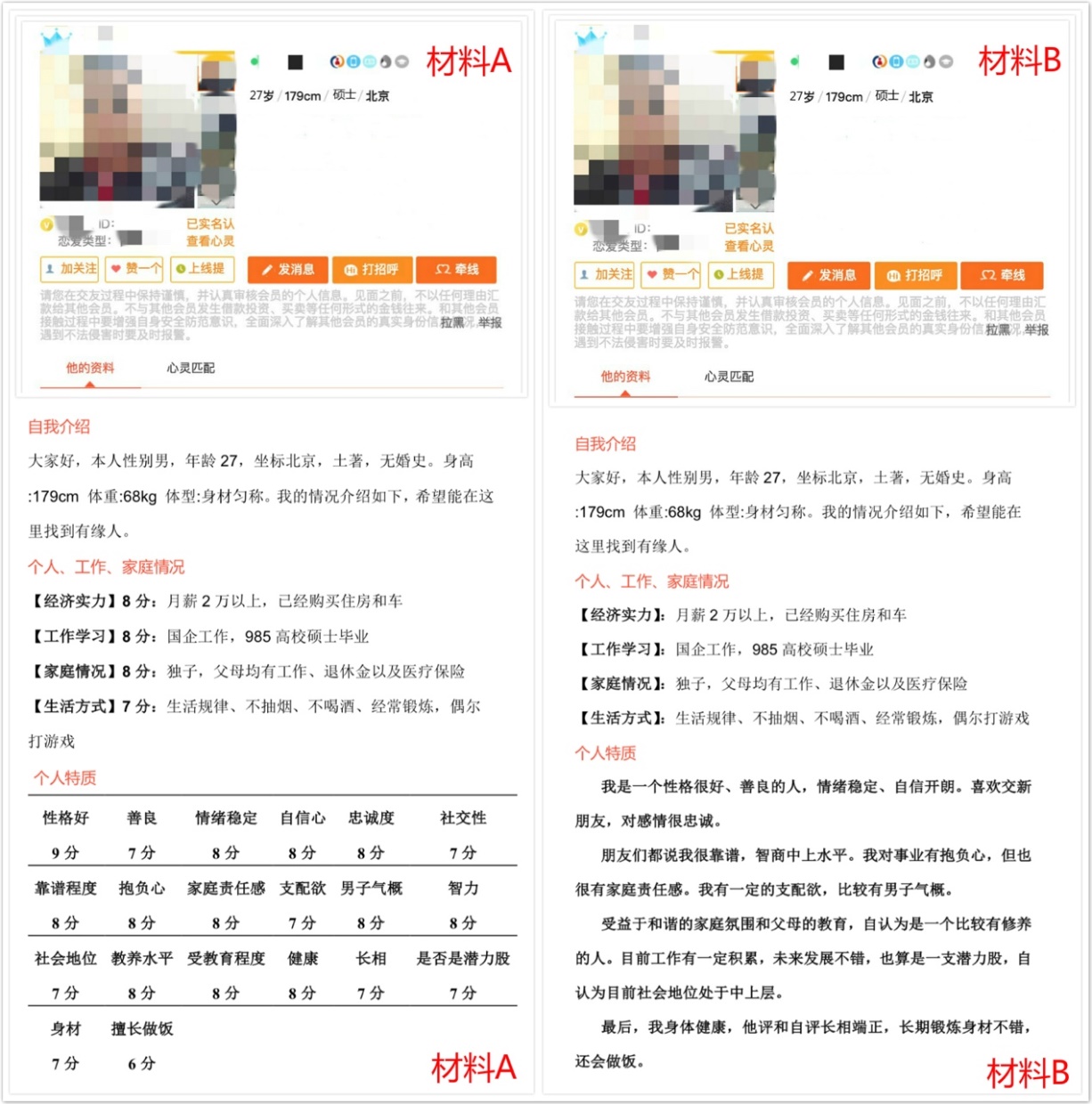
图1 研究3A实验材料示例(材料A为高计算, 材料B为低计算)
| [1] | Awad, E., Dsouza, S., Shariff, A., Rahwan, I., & Bonnefon, J. F. (2020). Universals and variations in moral decisions made in 42 countries by 70, 000 participants. Proceedings of the National Academy of Sciences, 117(5), 2332-2337. |
| [2] |
Bennis, W., Medin, D. L., & Bartels, D. M. (2010). The costs and benefits of calculation and moral rules. Perspectives on Psychological Science, 5(2), 187-202.
doi: 10.1177/1745691610362354 pmid: 26162125 |
| [3] |
Bruch, E., & Feinberg, F. (2017). Decision-making processes in social contexts. Annual Review of Sociology, 43, 207-227.
doi: 10.1146/annurev-soc-060116-053622 pmid: 28785123 |
| [4] | Buss, D. M. (1995). Evolutionary psychology: A new paradigm for psychological science. Psychological Inquiry, 6(1), 1-30. |
| [5] |
Chen, J. M., Kim, H. S., Mojaverian, T., & Morling, B. (2012). Culture and social support provision: Who gives what and why. Personality and Social Psychology Bulletin, 38(1), 3-13.
doi: 10.1177/0146167211427309 pmid: 22214884 |
| [6] | Cheng, L., Wang, X., Jetten, J., Klebl, C., Li, Z., & Wang, F. (2024). Subjective economic inequality evokes interpersonal objectification. British Journal of Social Psychology, 63(4), 1587-1607. |
| [7] | Collins, N. L., Ford, M. B., Guichard, A. C., Kane, H. S., & Feeney, B. C. (2010). Responding to need in intimate relationships:Social support and caregiving processes in couples. In M. Mikulincer & P. R. Shaver (Eds.), Prosocial motives, emotions, and behavior: The better angels of our nature (pp. 367-389). American Psychological Association. |
| [8] |
Ellis, B. J., & Del Giudice, M. (2019). Developmental adaptation to stress: An evolutionary perspective. Annual Review of Psychology, 70, 111-139.
doi: 10.1146/annurev-psych-122216-011732 pmid: 30125133 |
| [9] | Falk, C. F., Heine, S. J., Yuki, M., & Takemura, K. (2009). Why do westerners self-enhance more than east Asians? European Journal of Personality, 23(3), 183-203. |
| [10] |
Faul, F., Erdfelder, E., Lang, A. G., & Buchner, A. (2007). G*Power 3: A flexible statistical power analysis program for the social, behavioral, and biomedical sciences. Behavior Research Methods, 39(2), 175-191.
doi: 10.3758/bf03193146 pmid: 17695343 |
| [11] |
Gigerenzer, G., & Gaissmaier, W. (2011). Heuristic decision making. Annual Review of Psychology, 62, 451-482.
doi: 10.1146/annurev-psych-120709-145346 pmid: 21126183 |
| [12] |
Grossmann, I., & Varnum, M. E. W. (2015). Social structure, infectious diseases, disasters, secularism, and cultural change in America. Psychological Science, 26(3), 311-324.
doi: 10.1177/0956797614563765 pmid: 25656275 |
| [13] | Hertwig, R., & Hoffrage, U. (Eds.). (2013). Simple heuristics in a social world. Oxford University Press. |
| [14] | Hsee, C. K., & Rottenstreich, Y. (2004). Music, pandas, and muggers: On the affective psychology of value. Journal of Experimental Psychology: General, 133(1), 23-30. |
| [15] | Joel, S., MacDonald, G., & Plaks, J. E. (2013). Romantic relationships conceptualized as a judgment and decision- making domain. Current Directions in Psychological Science, 22(6), 461-465. |
| [16] | Johnson, E. J., & Payne, J. W. (1985). Effort and accuracy in choice. Management Science, 31(4), 381-513. |
| [17] |
Kim, H. S., Sherman, D. K., & Taylor, S. E. (2008). Culture and social support. American Psychologist, 63(6), 518-526.
doi: 10.1037/0003-066X pmid: 18793039 |
| [18] | Kim, J., Jawahar, I. M., Steinheider, B., Stone, T., & Ferrell, B. (2022). Development of a measure of calculative mindset (CM): Establishing a nomological net and predictive utility of the CM measure. Psychological Reports, 125(4), 2249-2273. |
| [19] | Kitayama, S., & Salvador, C. E. (2024). Cultural psychology: Beyond east and west. Annual Review of Psychology, 75(1), 495-526. |
| [20] | Kito, M., Yuki, M., & Thomson, R. (2017). Relational mobility and close relationships: A socioecological approach to explain cross-cultural differences. Personal Relationships, 24(1), 114-130. |
| [21] |
Komiya, A., Ohtsubo, Y., Nakanishi, D., & Oishi, S. (2019). Gift-giving in romantic couples serves as a commitment signal: Relational mobility is associated with more frequent gift-giving. Evolution and Human Behavior, 40(2), 160-166.
doi: 10.1016/j.evolhumbehav.2018.10.003 |
| [22] |
Lenton, A. P., & Francesconi, M. (2010). How humans cognitively manage an abundance of mate options. Psychological Science, 21(4), 528-533.
doi: 10.1177/0956797610364958 pmid: 20424095 |
| [23] | Lenton, A. P., & Stewart, A. (2008). Changing her ways: The number of options and mate-standard strength impact mate choice strategy and satisfaction. Judgment and Decision Making, 3(7), 501-511. |
| [24] | Li, L. M. W., Adams, G., Kurtiş, T., & Hamamura, T. (2015). Beware of friends: The cultural psychology of relational mobility and cautious intimacy. Asian Journal of Social Psychology, 18(2), 124-133. |
| [25] | Li, L. M. W., & Masuda, T. (2016). The role of regulatory focus in how much we care about enemies: Cross-cultural comparison between European Canadians and Hong Kong Chinese. Journal of Cross-Cultural Psychology, 47(1), 131-148. |
| [26] |
Li, L. M. W., Masuda, T., & Lee, H. (2018). Low relational mobility leads to greater motivation to understand enemies but not friends and acquaintances. British Journal of Social Psychology, 57(1), 43-60.
doi: 10.1111/bjso.12216 pmid: 28857198 |
| [27] | Liu, P. J., McFerran, B., & Haws, K. L. (2020). Mindful matching: Ordinal versus nominal attributes. Journal of Marketing Research, 57(1), 134-155. |
| [28] |
Martin, A. S., Schug, J., & Maddux, W. W. (2019). Relational mobility and cultural differences in analytic and holistic thinking. Journal of Personality and Social Psychology, 116(4), 495-518.
doi: 10.1037/pspa0000142 pmid: 30614727 |
| [29] |
Miller, G. F., & Todd, P. M. (1998). Mate choice turns cognitive. Trends in Cognitive Sciences, 2(5), 190-198.
pmid: 21227154 |
| [30] | Ministry of Civil Affairs of the People's Republic of China. (2018, June 4). Civil Affairs Data: Social Service Statistics of Provinces in the 1st Quarter of 2018. https://www.mca.gov.cn/mzsj/tjjb/sjsj/2018/201806041612.html |
| [中华人民共和国民政部. (2018, 6月4日). 民政数据2018年1季度各省社会服务统计数据. https://www.mca.gov.cn/mzsj/tjjb/sjsj/2018/201806041612.html] | |
| [31] | Ministry of Civil Affairs of the People's Republic of China. (2018, August 2). Civil Affairs Data: Social Service Statistics of Provinces in the 2nd Quarter of 2018. https://www.mca.gov.cn/mzsj/tjjb/sjsj/2018/20180608021510.html |
| [中华人民共和国民政部. (2018, 8月2日). 民政数据2018年2季度各省社会服务统计数据. https://www.mca.gov.cn/mzsj/tjjb/sjsj/2018/20180608021510.html] | |
| [32] | Ministry of Civil Affairs of the People's Republic of China. (2018, October 29). Civil Affairs Data: Social Service Statistics of Provinces in the 3rd Quarter of 2018. https://www.mca.gov.cn/mzsj/tjjb/sjsj/2018/20180910291033.html |
| [中华人民共和国民政部. (2018, 10月29日). 民政数据2018年3季度各省社会服务统计数据. https://www.mca.gov.cn/mzsj/tjjb/sjsj/2018/20180910291033.html] | |
| [33] | Ministry of Civil Affairs of the People's Republic of China. (2019, January 30). Civil Affairs Data: Social Service Statistics of Provinces in the 4th Quarter of 2018. https://www.mca.gov.cn/mzsj/tjjb/sjsj/2018/20181201301220.html |
| [中华人民共和国民政部. (2019, 1月30日). 民政数据2018年4季度各省社会服务统计数据. https://www.mca.gov.cn/mzsj/tjjb/sjsj/2018/20181201301220.html] | |
| [34] | Ministry of Public Security of the People's Republic of China. Bureau of Public Order. (2013). Population Statistics by County and City in the People's Republic of China (2011). Qunzhong Press. |
| [公安部治安管理局. (2013). 中华人民共和国全国分县市人口统计资料(2011年). 群众出版社.] | |
| [35] | Morrison, M., & Roese, N. J. (2011). Regrets of the typical American: Findings from a nationally representative sample. Social Psychological and Personality Science, 2(6), 576-583. |
| [36] | National Bureau of Statistics of China. (2018). China Statistical Yearbook 2018. China Statistics Press. |
| [国家统计局. (2018). 中国统计年鉴2018. 中国统计出版社.] | |
| [37] |
Oishi, S. (2014). Socioecological psychology. Annual Review of Psychology, 65, 581-609.
doi: 10.1146/annurev-psych-030413-152156 pmid: 23987114 |
| [38] |
Oishi, S., Rothman, A. J., Snyder, M., Su, J., Zehm, K., Hertel, A. W., Gonzales, M. H., & Sherman, G. D. (2007). The socioecological model of procommunity action: The benefits of residential stability. Journal of Personality and Social Psychology, 93(5), 831-844.
pmid: 17983303 |
| [39] | Oishi, S., Schug, J., Yuki, M., & Axt, J. (2015). The psychology of residential and relational mobilities. In M. J. Gelfand, C.-Y. Chiu, & Y.-Y. Hong (Eds.), Handbook of advances in culture and psychology (Vol. 5, pp. 221-272). Oxford University Press. |
| [40] | Payne, J. W., Bettman, J. R., & Johnson, E. J. (1993). The adaptive decision maker. Cambridge University Press. |
| [41] | Sato, K., & Yuki, M. (2014). The association between self-esteem and happiness differs in relationally mobile vs. stable interpersonal contexts. Frontiers in Psychology, 5, Article 1113. |
| [42] | Schönbrodt, F. D., & Perugini, M. (2013). At what sample size do correlations stabilize? Journal of Research in Personality, 47(5), 609-612. |
| [43] | Schug, J., Yuki, M., & Maddux, W. W. (2010). Relational mobility explains between-and within-culture differences in self-disclosure to close friends. Psychological Science, 21(10), 1471-1479. |
| [44] | Schug, J., Yuki, M., Horikawa, H., & Takemura, K. (2009). Similarity attraction and actually selecting similar others: How cross-societal differences in relational mobility affect interpersonal similarity in Japan and the USA. Asian Journal of Social Psychology, 12(2), 95-103. |
| [45] | Small, D. A., Loewenstein, G., & Slovic, P. (2007). Sympathy and callousness: The impact of deliberative thought on donations to identifiable and statistical victims. Organizational Behavior and Human Decision Processes, 102(2), 143-153. |
| [46] | Thomson, R. (2016). A socioecological approach to behavior and psychological tendencies on social network sites: The role of relational mobility [Unpublished doctoral dissertation]. Hokkaido University. |
| [47] |
Thomson, R., Yuki, M., Talhelm, T., Schug, J., Kito, M., Ayanian, A. H., … Visserman, M. L. (2018). Relational mobility predicts social behaviors in 39 countries and is tied to historical farming and threat. Proceedings of the National Academy of Sciences of the United States of America, 115(29), 7521-7526.
doi: 10.1073/pnas.1713191115 pmid: 29959208 |
| [48] | Wang, L., Malhotra, D., & Murnighan, J. K. (2011). Economics education and greed. Academy of Management Learning and Education, 10(4), 643-660. |
| [49] | Wang, L., Zhong, C. B., & Murnighan, J. K. (2014). The social and ethical consequences of a calculative mindset. Organizational Behavior and Human Decision Processes, 125(1), 39-49. |
| [50] | Weijters, B., & Baumgartner, H. (2012). Misresponse to reversed and negated items in surveys: A review. Journal of Marketing Research, 49(5), 737-747. |
| [51] | Yuki, M., & Schug, J. (2012). Relational mobility:A socioecological approach to personal relationships. In Gillath, O., Adams, G., & Kunkel, A. (Eds.). Relationship science: Integrating evolutionary, neuroscience, and sociocultural approaches (pp. 137-151). Washington, DC, US: American Psychological Association. |
| [52] |
Yuki, M., & Schug, J. (2020). Psychological consequences of relational mobility. Current Opinion in Psychology, 32, 129-132.
doi: S2352-250X(19)30109-5 pmid: 31491705 |
| [53] | Yuki, M., Schug, J., Horikawa, H., Takemura, K., Sato, K., Yokota, K., & Kamaya, K. (2007). Development of a scale to measure perceptions of relational mobility in society. CERSS Working Paper 75, Center for Experimental Research in Social Sciences, Hokkaido University. |
| [54] | Zhong, C. B. (2011). The ethical dangers of deliberative decision making. Administrative Science Quarterly, 56(1), 1-25. |
| [1] | 陈海德, 章横, 王佳, 高崚峰. 身份认同对吸烟者解释偏向的影响:认知负荷的作用[J]. 心理学报, 2025, 57(12): 2165-2176. |
| [2] | 李世豪, 栾墨, 李虹, 符国群. 礼物何以传递爱意: 便利型与合意型礼物对择偶交往意愿的影响[J]. 心理学报, 2024, 56(11): 1524-1540. |
| [3] | 王燕, 孙芯芸, 杨茵贝. 如何预测她会拥有“花心”男友?女性童年环境对其伴侣短期择偶策略的预测机制[J]. 心理学报, 2024, 56(11): 1512-1523. |
| [4] | 陈幼贞, 张曼曼, 林秋蓉. 认知负荷与编码方式影响小学数学学业不良生的前瞻记忆及其成分[J]. 心理学报, 2022, 54(12): 1491-1502. |
| [5] | 张积家, 陆禹同, 张启睿, 张金桥. 外语焦虑、紧张情绪与认知负荷对外语说谎的影响:来自中-英双语者的证据[J]. 心理学报, 2020, 52(7): 861-873. |
| [6] | 王燕, 钱啸云, 田芊, 高隽, 李晓煦. 亲子在子女择偶偏好上的一致性比较 及亲子关系的影响[J]. 心理学报, 2018, 50(1): 91-100. |
| [7] | 王燕, 侯博文, 李歆瑶, 李晓煦, 焦璐. 不同性别比和资源获取能力 对未婚男性择偶标准的影响[J]. 心理学报, 2017, 49(9): 1195-1205. |
| [8] | 程家萍;罗跃嘉;崔芳. 认知负荷对疼痛共情的影响:来自ERP研究的证据[J]. 心理学报, 2017, 49(5): 622-630. |
| [9] | 汪佳瑛; 陈斌斌. 童年压力及死亡威胁启动对择偶要求的影响[J]. 心理学报, 2016, 48(7): 857-866. |
| [10] | 王雨晴;姚鹏飞;周国梅. 面孔吸引力、人格标签对于男女择偶偏好的影响[J]. 心理学报, 2015, 47(1): 108-118. |
| [11] | 周爱保;马小凤;李晶;崔丹. 提取练习在记忆保持与迁移中的优势效应:基于认知负荷理论的解释[J]. 心理学报, 2013, 45(8): 849-859. |
| [12] | 汪涛,张琴,张辉,周玲,刘洪深. 如何削弱产品来源国效应*—— 产品信息呈现方式的影响研究[J]. 心理学报, 2012, 44(6): 841-852. |
| [13] | 刘永芳,苏丽娜,王怀勇. 女性择偶决策的线索偏好及信息加工方式[J]. 心理学报, 2011, 43(01): 21-29. |
| [14] | 李金波,许百华,田学红. 人机交互中认知负荷变化预测模型的构建[J]. 心理学报, 2010, 42(05): 559-568. |
| [15] | 李金波,许百华. 人机交互过程中认知负荷的综合测评方法[J]. 心理学报, 2009, 41(01): 35-43. |
| 阅读次数 | ||||||
|
全文 |
|
|||||
|
摘要 |
|
|||||
