

ISSN 0439-755X
CN 11-1911/B
主办:中国心理学会
中国科学院心理研究所
出版:科学出版社
CN 11-1911/B
主办:中国心理学会
中国科学院心理研究所
出版:科学出版社
心理学报 ›› 2025, Vol. 57 ›› Issue (10): 1762-1776.doi: 10.3724/SP.J.1041.2025.1762 cstr: 32110.14.2025.1762
王舒琪, 程峰, 郭冰, 王巧, 成晓君( )
)
收稿日期:2023-12-18
发布日期:2025-08-15
出版日期:2025-10-25
通讯作者:
成晓君, E-mail: chengxiaojun@szu.edu.cn基金资助:
WANG Shuqi, CHENG Feng, GUO Bing, WANG Qiao, CHENG Xiaojun()
Received:2023-12-18
Online:2025-08-15
Published:2025-10-25
摘要:
在经历负性情绪事件后, 人们往往会通过向他人倾诉的方式寻求支持, 以减轻情绪负担。然而, 负性情绪的自我表露对个体后续社会行为的影响和调节要素, 仍未得到充分的探究。本研究通过两个实验考察了负性情绪自我表露对同伴亲社会行为的影响及人称指示语的调节作用。实验1以讲述者为中心, 探究作为表露方的个体在负性情绪自我表露后的亲社会行为表现; 实验2则转向倾听者视角, 考察作为接收方的个体在倾听他人负性情绪表露后的亲社会行为表现。 结果发现,无论表露还是倾听负性情绪均能促进个体对同伴的亲社会行为、共情和好感度水平。对于讲述者而言, 讲述负性情绪经历时投入度更高, 且负性情绪表露对同伴亲社会行为的提升仅存在于使用第一人称指示语(“我”)场景中, 讲述的意义感和对同伴的好感度在其中起重要作用; 倾听他人的负性情绪自我表露所提升的同伴亲社会行为与共情和好感度的提升密切相关。综上, 研究揭示了负性情绪自我表露的积极社会效应, 为引导个体合理表露负性情绪、促进个体和社会的健康发展提供了重要启示。
中图分类号:
王舒琪, 程峰, 郭冰, 王巧, 成晓君. (2025). 倾诉的力量:负性情绪自我表露促进同伴亲社会行为. 心理学报, 57(10), 1762-1776.
WANG Shuqi, CHENG Feng, GUO Bing, WANG Qiao, CHENG Xiaojun. (2025). The power of confiding: Negative emotional self-disclosure facilitates peer prosocial behavior. Acta Psychologica Sinica, 57(10), 1762-1776.
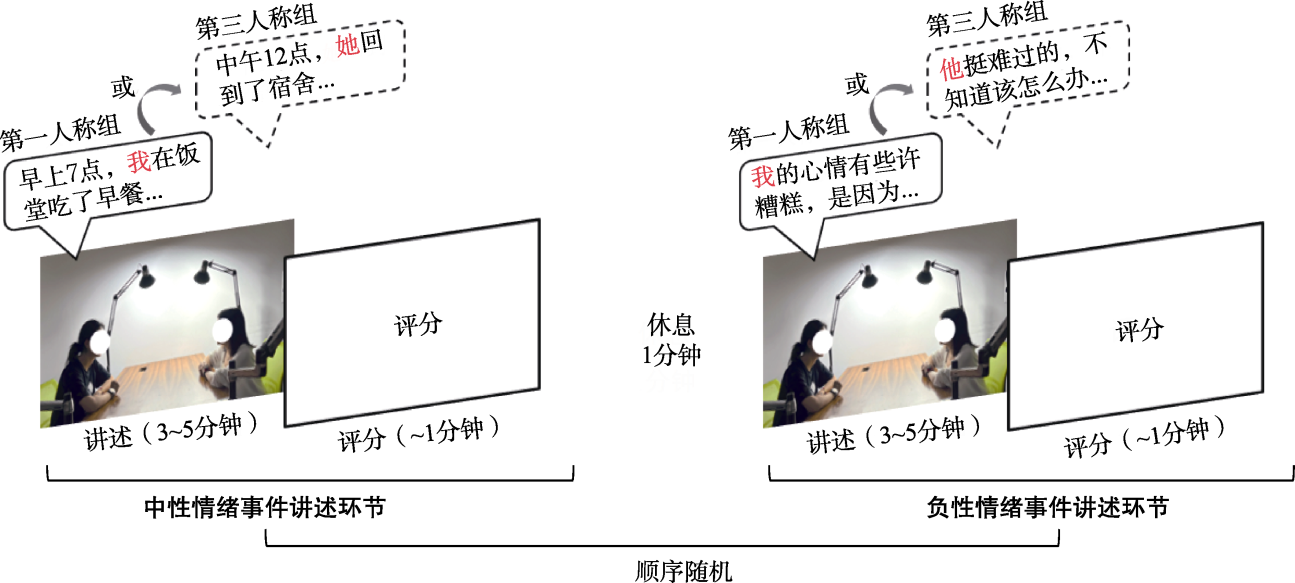
图1 实验1流程图
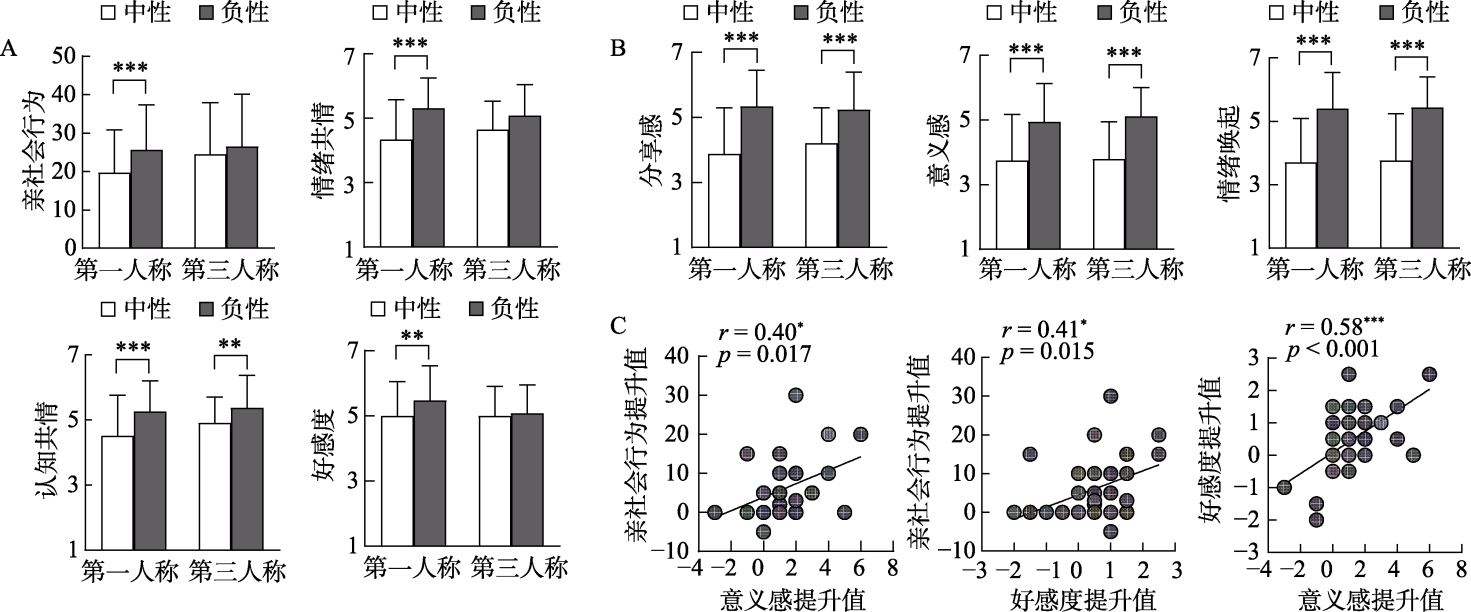
图2 实验1结果。(A)表露情绪性与人称指示语对亲社会行为、情绪共情、认知共情和好感度的影响。(B)表露情绪性与人称指示语对自我表露过程中的分享感、意义感以及情绪唤起的影响。(C)第一人称指示语条件下亲社会行为提升值、意义感提升值和好感度提升值的相关关系。* p < 0.05, ** p < 0.01, *** p < 0.001, 误差线为标准差。

图3 实验2流程图

图4 实验2结果。(A)表露情绪性与人称指示语对亲社会行为、好感度、情绪共情和认知共情的影响。(B)亲社会行为提升值、认知共情提升值和好感度提升值的相关关系。(C)好感度提升值在认知共情提升值和亲社会行为提升值之间的中介作用, 所有估计值均已标准化。* p < 0.05, ** p < 0.01, *** p < 0.001, 误差线为标准差。
| [3] |
Arewasikporn, A., Sturgeon, J. A., & Zautra, A. J. (2019). Sharing positive experiences boosts resilient thinking: Everyday benefits of social connection and positive emotion in a community sample. American Journal of Community Psychology, 63(1-2), 110-121.
doi: 10.1002/ajcp.12279 pmid: 30295327 |
| [4] |
Ayduk, Ö., & Kross, E. (2008). Enhancing the pace of recovery: Self-distanced analysis of negative experiences reduces blood pressure reactivity. Psychological Science, 19(3), 229-231.
doi: 10.1111/j.1467-9280.2008.02073.x pmid: 18315794 |
| [5] | Baker, J. M., Liu, N., Cui, X., Vrticka, P., Saggar, M., Hosseini, S. M. H., & Reiss, A. L. (2016). Sex differences in neural and behavioral signatures of cooperation revealed by fNIRS hyperscanning. Scientific Reports, 6(1), 26492. |
| [6] |
Barasch, A. (2020). The consequences of sharing. Current Opinion in Psychology, 31, 61-66.
doi: S2352-250X(19)30070-3 pmid: 31525577 |
| [7] |
Barnett, M. A., Tetreault, P. A., & Masbad, I. (1987). Empathy with a rape victim: The role of similarity of experience. Violence and Victims, 2(4), 255-262.
pmid: 3154168 |
| [8] |
Bastian, B., Jetten, J., & Ferris, L. J. (2014). Pain as social glue: Shared pain increases cooperation. Psychological Science, 25(11), 2079-2085.
doi: 10.1177/0956797614545886 pmid: 25193943 |
| [9] |
Batson, C. D., Batson, J. G., Slingsby, J. K., Harrell, K. L., Peekna, H. M., & Todd, R. M. (1991). Empathic joy and the empathy-altruism hypothesis. Journal of Personality and Social Psychology, 61(3), 413-426.
pmid: 1941512 |
| [10] | Bem, D. J. (1972). Self-perception theory. Advances in Experimental Social Psychology, 6, 1-62. |
| [11] | Berg, J. H., & Archer, R. L. (1983). The disclosure-liking relationship: Effects of self-perception, order of disclosure, and topical similarity. Human Communication Research, 10(2), 269-281. |
| [12] | Berger, C. R., & Calabrese, R. J. (1975). Some explorations in initial interaction and beyond: Toward a developmental theory of interpersonal communication. Human Communication Research, 1(2), 99-112. |
| [13] | Berntsen, D., & Rubin, D. C. (2006). Emotion and vantage point in autobiographical. Cognition & Emotion, 20(8), 1193-1215. |
| [14] | Brans, K., Van Mechelen, I., Rimé, B., & Verduyn, P. (2013). The relation between social sharing and the duration of emotional experience. Cognition & Emotion, 27(6), 1023-1041. |
| [15] |
Brunyé, T. T., Ditman, T., Mahoney, C. R., Augustyn, J. S., & Taylor, H. A. (2009). When you and I share perspectives: Pronouns modulate perspective taking during narrative comprehension. Psychological Science, 20(1), 27-32.
doi: 10.1111/j.1467-9280.2008.02249.x pmid: 19076318 |
| [16] | Cheng, X., Wang, S., Guo, B., Wang, Q., Hu, Y., & Pan, Y. (2024). How self-disclosure of negative experiences shapes prosociality? Social Cognitive and Affective Neuroscience, 19(1), nsae003. |
| [17] |
Collins, N. L., & Miller, L. C. (1994). Self-disclosure and liking: A meta-analytic review. Psychological Bulletin, 116(3), 457-475.
pmid: 7809308 |
| [18] | Curci, A., & Bellelli, G. (2004). Cognitive and social consequences of exposure to emotional narratives: Two studies on secondary social sharing of emotions. Cognition and Emotion, 18(7), 881-900. |
| [19] | Davis, M. (1983). Measuring individual differences in empathy: Evidence for a multidimensional approach. Journal of Personality and Social Psychology, 44(1), 113-126. |
| [20] | Derlega, V. J., Metts, S., Petronio, S., & Margulis, S. T. (1993). Self-disclosure. Sage Publications, Inc. |
| [21] | Ding, F. Q, & Lu, Z. H. (2016). Association between empathy and prosocial behavior: A systematic review and meta- analysis. Advances in Psychological Science, 24(8), 1159-1174. |
|
[丁凤琴, 陆朝晖. (2016). 共情与亲社会行为关系的元分析. 心理科学进展, 24(8), 1159-1174.]
doi: 10.3724/SP.J.1042.2016.01159 |
|
| [22] |
Eisenberg, N., Eggum, N. D., & Di Giunta, L. (2010). Empathy-related responding: Associations with prosocial behavior, aggression, and intergroup relations. Social Issues and Policy Review, 4(1), 143-180.
doi: 10.1111/j.1751-2409.2010.01020.x pmid: 21221410 |
| [23] |
Eisenberg, N., & Miller, P. A. (1987). The relation of empathy to prosocial and related behaviors. Psychological Bulletin, 101(1), 91-119.
pmid: 3562705 |
| [24] |
Faul, F., Erdfelder, E., Lang, A.-G., & Buchner, A. (2007). G*Power 3: A flexible statistical power analysis program for the social, behavioral, and biomedical sciences. Behavior Research Methods, 39(2), 175-191.
doi: 10.3758/bf03193146 pmid: 17695343 |
| [25] | Finlay, M., & Starmans, C. (2022). Not the same same: Distinguishing between similarity and identity in judgments of change. Cognition, 218, 104953. |
| [26] | Fu, X. L. & Zhang, K. (Eds.). (2023). Report on national mental health development in China (2021-2022). Social Sciences Academic Press (China) |
| [傅小兰, 张侃. (主编). (2023). 中国国民心理健康发展报告(2021-2022). 社会科学文献出版社.] | |
| [27] |
Garcia, D., & Rimé, B. (2019). Collective emotions and social resilience in the digital traces after a terrorist attack. Psychological Science, 30(4), 617-628.
doi: 10.1177/0956797619831964 pmid: 30865565 |
| [28] | Gottman, J. M. (1994). What predicts divorce?: The relationship between marital processes and marital outcomes. Psychology Press. |
| [29] |
Graham, S. M., Huang, J. Y., Clark, M. S., & Helgeson, V. S. (2008). The positives of negative emotions: Willingness to express negative emotions promotes relationships. Personality and Social Psychology Bulletin, 34(3), 394-406.
doi: 10.1177/0146167207311281 pmid: 18272807 |
| [30] | Harber, K. D. (2023). Why listening to traumatic disclosures sometimes fails and how it can succeed. Current Opinion in Psychology, 52, 101589. |
| [31] | Hinojosa, J. A., Moreno, E. M., & Ferré, P. (2020). Affective neurolinguistics: Towards a framework for reconciling language and emotion. Language, Cognition and Neuroscience, 35(7), 813-839. |
| [32] |
Indefrey, P. (2011). The spatial and temporal signatures of word production components: A critical update. Frontiers in Psychology, 2, 255. https://doi.org/10.3389/fpsyg.2011.00255
doi: 10.3389/fpsyg.2011.00255 URL pmid: 22016740 |
| [33] | Kahn, J. H., & Garrison, A. M. (2009). Emotional self- disclosure and emotional avoidance: Relations with symptoms of depression and anxiety. Journal of Counseling Psychology, 56(4), 573-584. |
| [34] |
Kanske, P., Böckler, A., Trautwein, F.-M., & Singer, T. (2015). Dissecting the social brain: Introducing the EmpaToM to reveal distinct neural networks and brain-behavior relations for empathy and theory of mind. NeuroImage, 122, 6-19.
doi: 10.1016/j.neuroimage.2015.07.082 pmid: 26254589 |
| [35] | Kim, N., Kim, H. K., Wojcieszak, M., Igartua, J.-J., & Lim, C. M. (2020). The presence of the protagonist: Explaining narrative perspective effects through social presence. Media Psychology, 23(6), 891-914. |
| [36] |
Koehne, S., Hatri, A., Cacioppo, J. T., & Dziobek, I. (2016). Perceived interpersonal synchrony increases empathy: Insights from autism spectrum disorder. Cognition, 146, 8-15.
doi: 10.1016/j.cognition.2015.09.007 pmid: 26398860 |
| [37] |
Korchmaros, J. D., & Kenny, D. A. (2001). Emotional closeness as a mediator of the effect of genetic relatedness on altruism. Psychological Science, 12(3), 262-265.
pmid: 11437312 |
| [38] | Kou, Y., & Tang, L. L. (2004). A survey of studies on the relationship between moods and prosocial behaviors. Journal of Beijing Normal University (Social Science Edition), (5), 44-49. |
| [寇彧, 唐玲玲. (2004). 心境对亲社会行为的影响. 北京师范大学学报(社会科学版), (5), 44-49.] | |
| [39] | Kross, E., & Ayduk, O. (2011). Making meaning out of negative experiences by self-distancing. Current Directions in Psychological Science, 20(3), 187-191. |
| [40] | Kross, E., Ayduk, O., & Mischel, W. (2005). When asking “Why” does not hurt distinguishing rumination from reflective processing of negative emotions. Psychological Science, 16(9), 709-715. |
| [41] | Lambert, N. M., Gwinn, A. M., Baumeister, R. F., Strachman, A., Washburn, I. J., Gable, S. L., & Fincham, F. D. (2013). A boost of positive affect: The perks of sharing positive experiences. Journal of Social and Personal Relationships, 30(1), 24-43. |
| [42] | Lepistö, S., Koskinen, E., Söderman, M., Celio, F., Wuolio, M., Jääskeläinen, I., … Harjunen, V. J. (2025). Listener’s disengagement heightens speaker’s arousal during in- person self-disclosure-but not via video call. Computers in Human Behavior Reports, 18, 100620. |
| [43] |
Levelt, W. J. M. (1999). Models of word production. Trends in Cognitive Sciences, 3(6), 223-232.
pmid: 10354575 |
| [44] | Lombard, M., & Ditton, T. (1997). At the heart of it all: The concept of presence. Journal of Computer-Mediated Communication, 3(2), JCMC321. |
| [45] | Lyons, J. (1968). Introduction to theoretical linguistics (Vol. 510). Cambridge University Press. |
| [46] |
Meyer, M. L., Masten, C. L., Ma, Y., Wang, C., Shi, Z., Eisenberger, N. I., & Han, S. (2013). Empathy for the social suffering of friends and strangers recruits distinct patterns of brain activation. Social Cognitive and Affective Neuroscience, 8(4), 446-454.
doi: 10.1093/scan/nss019 pmid: 22355182 |
| [47] | Nils, F., & Rimé, B. (2012). Beyond the myth of venting: Social sharing modes determine the benefits of emotional disclosure. European Journal of Social Psychology, 42(6), 672-681. |
| [48] | Oswald, P. (2002). The interactive effects of affective demeanor, cognitive processes, and perspective-taking focus on helping behavior. The Journal of Social Psychology, 142, 120-132. |
| [49] |
Park, C. L. (2010). Making sense of the meaning literature: An integrative review of meaning making and its effects on adjustment to stressful life events. Psychological Bulletin, 136(2), 257-301.
doi: 10.1037/a0018301 pmid: 20192563 |
| [50] | Park, C. L., & Folkman, S. (1997). Meaning in the context of stress and coping. Review of General Psychology, 1(2), 115-144. |
| [51] |
Pennebaker, J. W., & Beall, S. K. (1986). Confronting a traumatic event: Toward an understanding of inhibition and disease. Journal of Abnormal Psychology, 95(3), 274-281.
doi: 10.1037//0021-843x.95.3.274 pmid: 3745650 |
| [52] | Pennebaker, J. W., & Chung, C. K. (2007). Expressive writing, emotional upheavals, and health. In H. S. Friedman & R. C. Silver (Eds.), Foundations of health psychology (pp. 263-284). Oxford University Press. |
| [53] |
Peters, K., & Kashima, Y. (2007). From social talk to social action: Shaping the social triad with emotion sharing. Journal of Personality and Social Psychology, 93(5), 780-797.
pmid: 17983300 |
| [54] |
Plötner, M., Over, H., Carpenter, M., & Tomasello, M. (2015). The effects of collaboration and minimal-group membership on children’s prosocial behavior, liking, affiliation, and trust. Journal of Experimental Child Psychology, 139, 161-173.
doi: 10.1016/j.jecp.2015.05.008 pmid: 26112747 |
| [55] | Preckel, K., Kanske, P., & Singer, T. (2018). On the interaction of social affect and cognition: Empathy, compassion and theory of mind. Current Opinion in Behavioral Sciences, 19, 1-6. |
| [56] | Qiu, L., Zheng, X., & Wang, Y. F. (2008). Revision of the positive affect and negative affect scale. Chinese Journal of Applied Psychology, 14(3), 249-254. |
| [邱林, 郑雪, 王雁飞. (2008). 积极情感消极情感量表(PANAS)的修订. 应用心理学, 14(3), 249-254.] | |
| [57] |
Rice, H. J., & Rubin, D. C. (2009). I can see it both ways: First- and third-person visual perspectives at retrieval. Consciousness and Cognition, 18(4), 877-890.
doi: 10.1016/j.concog.2009.07.004 pmid: 19692271 |
| [58] |
Richman, L. S., & Leary, M. R. (2009). Reactions to discrimination, stigmatization, ostracism, and other forms of interpersonal rejection. Psychological Review, 116(2), 365-383.
doi: 10.1037/a0015250 pmid: 19348546 |
| [59] |
Riečanský, I. (2019). The role of sensorimotor processes in pain empathy. Brain Topography, 32(6), 965-976.
doi: 10.1007/s10548-019-00738-4 pmid: 31705422 |
| [60] | Rimé, B., Páez, D., Basabe, N., & Martínez, F. (2010). Social sharing of emotion, post-traumatic growth, and emotional climate: Follow-up of Spanish citizen’s response to the collective trauma of March 11th terrorist attacks in Madrid. European Journal of Social Psychology, 40(6), 1029-1045. |
| [61] | Rong, X., Sun, B. H., Huang, X. Z., Cai, M. Y., & Li, W. J. (2010). Reliabilities and Validities of Chinese Version of Interpersonal Reactivity Index. Chinese Journal of Clinical Psychology, 18(2), 158-160. |
| [戎幸, 孙炳海, 黄小忠, 蔡旻颖, 李伟健. (2010). 人际反应指数量表的信度和效度研究. 中国临床心理学杂志, (2), 158-160.] | |
| [62] | Sekiguchi, T., & Nonaka, S. (2014). The long-term effect of perspective change on the emotional intensity of autobiographical memories. Cognition and Emotion, 28(2), 375-383. |
| [63] | Sheng, J., Zheng, L., Lyu, B., Cen, Z., Qin, L., Tan, L. H., … Gao, J.-H. (2019). The cortical maps of hierarchical linguistic structures during speech perception. Cerebral Cortex, 29(8), 3232-3240. |
| [64] | Shin, J., Suh, E. M., Li, N. P., Eo, K., Chong, S. C., & Tsai, M.-H. (2019). Darling, get closer to me: Spatial proximity amplifies interpersonal liking. Personality and Social Psychology Bulletin, 45(2), 300-309. |
| [65] | Shoham, M., Moldovan, S., & Steinhart, Y. (2017). Positively useless: Irrelevant negative information enhances positive impressions. Journal of Consumer Psychology, 27(2), 147-159. |
| [66] | Slepian, M. L., & Greenaway, K. H. (2018). The benefits and burdens of keeping others’ secrets. Journal of Experimental Social Psychology, 78, 220-232. |
| [67] |
Slepian, M. L., & Moulton-Tetlock, E. (2019). Confiding secrets and well-being. Social Psychological and Personality Science, 10(4), 472-484.
doi: 10.1177/1948550618765069 |
| [68] | Tannen, D. (2007). Talking voices: Repetition, dialogue, and imagery in conversational discourse (Vol. 26). Cambridge University Press. |
| [69] | Titchener, E. B. (1909). Lectures on the experimental psychology of the thought-processes. Macmillan. |
| [1] | Altman, I., & Taylor, D. A. (1973). Social penetration: The development of interpersonal relationships. Holt, Rinehart & Winston. |
| [2] | Anderson, T., Carson, K. L., Darchuk, A. J., & Keefe, F. J. (2004). The influence of social skills on private and interpersonal emotional disclosure of negative events. Journal of Social and Clinical Psychology, 23(5), 635-652. |
| [70] | Uysal, A., Lin, H. L., Knee, C. R., & Bush, A. L. (2012). The association between self-concealment from one’s partner and relationship well-being. Personality and Social Psychology Bulletin, 38(1), 39-51. |
| [71] | Xie, E., Yin, Q., Li, K., Nastase, S. A., Zhang, R., Wang, N., & Li, X. (2021). Sharing happy stories increases interpersonal closeness: Interpersonal brain synchronization as a neural indicator. Eneuro, 8(6). https://doi.org/10.1523/ENEURO.0245-21.2021 |
| [72] | Yang, Y. W., & Guan, Q. (2015). The subjectivity of language and person deixis. Foreign Language Research, (3), 46-52. |
| [杨佑文, 管琼. (2015). 语言的主观性与人称指示语. 外语学刊, (3), 46-52.] | |
| [73] | Zhang, L., Jin, Y., Xia, L., Xu, B., & Syed Abdullah, S. M. (2022). The effects of social distance and asymmetric reward and punishment on individual cooperative behavior in dilemma situations. Frontiers in Psychology, 13, 816168. |
| [74] | Zhang, S., Fu, Y.-N., Liu, Q., Turel, O., & He, Q. (2022). Psychological capital mediates the influence of meaning in life on prosocial behavior of university students: A longitudinal study. Children and Youth Services Review, 140, 106600. |
| [75] | Zhong, J., & Qian, M. Y. (2005). A study of development and validation of Chinese mood adjective check list. Chinese Journal of Clinical Psychology, 13(1), 9-13. |
| [钟杰, 钱铭怡. (2005). 中文情绪形容词检测表的编制与信效度研究. 中国临床心理学杂志, 13(1), 9-13.] | |
| [76] | Wang, S., Lu, J., Yu, M., Wang, X., & Shangguan, C. (2022). “I’m listening, did it make any difference to your negative emotions?” Evidence from hyperscanning. Neuroscience Letters, 788, 136865. |
| [1] | 纪婷婷, 王嘉, 丁毅. 人们更同情流浪动物还是流浪汉?基于责任归因视角的解释[J]. 心理学报, 2025, 57(5): 838-859. |
| [2] | 华山, 姜欣桐, 高扬震宇, 穆妍, 杜忆. 音乐训练与音乐素养对共情能力的影响[J]. 心理学报, 2025, 57(4): 544-558. |
| [3] | 王丽丽, 张璇, 陈含郁. 忆往昔促进消费者宽恕:服务失误情境下怀旧对宽恕的影响及内在机制[J]. 心理学报, 2024, 56(4): 515-530. |
| [4] | 张文芸, 卓诗维, 郑倩倩, 关颖琳, 彭微微. 自闭特质对疼痛共情的影响:疼痛负性情绪和认知的中介作用[J]. 心理学报, 2023, 55(9): 1501-1517. |
| [5] | 孟现鑫, 俞德霖, 陈怡静, 张玲, 傅小兰. 儿童期创伤与共情的关系:一项三水平元分析[J]. 心理学报, 2023, 55(8): 1285-1300. |
| [6] | 郭晓栋, 郑泓, 阮盾, 胡丁鼎, 王毅, 王艳郁, 陈楚侨. 认知和情感共情与负性情绪:情绪调节的作用机制[J]. 心理学报, 2023, 55(6): 892-904. |
| [7] | 何怡娟, 胡馨木, 买晓琴. 共情关怀对公平决策的影响——来自ERP的证据[J]. 心理学报, 2022, 54(4): 385-397. |
| [8] | 杨集梅, 柴洁余, 邱天龙, 全小山, 郑茂平. 共情与中国民族音乐情绪识别的关系:来自ERP的证据[J]. 心理学报, 2022, 54(10): 1181-1192. |
| [9] | 赖丽足, 任志洪, 颜懿菲, 牛更枫, 赵春晓, 罗梅, 张琳. 共情的双刃剑效应:COVID-19心理热线咨询师的继发性创伤应激和替代性创伤后成长[J]. 心理学报, 2021, 53(9): 992-1002. |
| [10] | 张文新, 李曦, 陈光辉, 曹衍淼. 母亲积极教养与青少年亲社会行为:共情的中介作用与OXTR基因的调节作用[J]. 心理学报, 2021, 53(9): 976-991. |
| [11] | 陈杰, 伍可, 史宇鹏, 艾小青. 特质性自我构念与内外群体疼痛共情的关系: 来自事件相关电位的证据[J]. 心理学报, 2021, 53(6): 629-638. |
| [12] | 王文超, 伍新春. 共情对灾后青少年亲社会行为的影响:感恩、社会支持和创伤后成长的中介作用[J]. 心理学报, 2020, 52(3): 307-316. |
| [13] | 李雄, 李祚山, 向滨洋, 孟景. 注意线索对自闭特质个体疼痛共情的影响:来自事件相关电位的证据[J]. 心理学报, 2020, 52(3): 294-306. |
| [14] | 谢东杰, 路浩, 苏彦捷. 学龄前儿童分配模式的传递效应:心理理论和共情的作用 *[J]. 心理学报, 2018, 50(9): 1018-1028. |
| [15] | 程家萍;罗跃嘉;崔芳. 认知负荷对疼痛共情的影响:来自ERP研究的证据[J]. 心理学报, 2017, 49(5): 622-630. |
| 阅读次数 | ||||||
|
全文 |
|
|||||
|
摘要 |
|
|||||
