

ISSN 0439-755X
CN 11-1911/B
主办:中国心理学会
中国科学院心理研究所
出版:科学出版社
CN 11-1911/B
主办:中国心理学会
中国科学院心理研究所
出版:科学出版社
心理学报 ›› 2025, Vol. 57 ›› Issue (10): 1791-1812.doi: 10.3724/SP.J.1041.2025.1791 cstr: 32110.14.2025.1791
王永跃, 张范颖, 岳峰凯, 谢江佩( )
)
收稿日期:2023-11-14
发布日期:2025-08-15
出版日期:2025-10-25
通讯作者:
谢江佩, E-mail: xiejiangpei@126.com基金资助:
WANG Yongyue, ZHANG Fanying, YUE Fengkai, XIE Jiangpei()
Received:2023-11-14
Online:2025-08-15
Published:2025-10-25
摘要:
即兴行为是一种兼具即时性和创造性的行为模式。然而, 目前结合其本质内涵以详述即兴行为生成机制的研究尚显不足。为此, 本研究整合知识联结理论与激活理论, 分别契合即兴行为的创造性与即时性特征, 探讨了时间压力下知识存量对个体即兴行为的影响机制。研究1 (N = 163)和研究2 (N = 163)分别以大学生及组织员工为被试, 通过实验发现知识存量通过增强知识转化进而促进个体即兴行为; 尤其在中时间压力情境下, 上述关系更为强烈; 研究3 (N = 201)开展多时点配对问卷调查, 进一步确证了时间压力在知识存量对知识转化的影响过程中发挥倒U型调节效应, 进而通过知识转化作用于即兴行为。通过 3个研究得出结论:在中等时间压力下, 知识存量通过影响知识转化从而更有利于激发个体即兴行为; 而在高或低时间压力下则更弱, 以此全面揭示时间压力作用下知识存量赋能即兴行为的生成过程机制, 这为有效依据其特征进行理论整合提供了新视角, 并对理解即兴行为的动态性和复杂性具有积极的意义。
中图分类号:
王永跃, 张范颖, 岳峰凯, 谢江佩. (2025). 时间压力作用下知识存量对即兴行为的影响机制. 心理学报, 57(10), 1791-1812.
WANG Yongyue, ZHANG Fanying, YUE Fengkai, XIE Jiangpei. (2025). Influence of knowledge stock on improvisation under time pressure. Acta Psychologica Sinica, 57(10), 1791-1812.
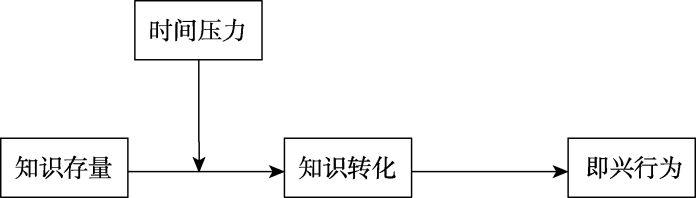
图1 理论模型
| 排序 | 要点 | 比例 |
|---|---|---|
| 1 | 桌椅多功能/桌椅设计 | 53.02% |
| 2 | 外观与内饰布局 | 49.84% |
| 3 | 选餐/订餐/餐品 | 47.94% |
| 4 | 餐具回收 | 47.62% |
| 5 | 食品安全 | 45.71% |
| 6 | 食堂服务 | 45.71% |
| 7 | 后厨流线 | 35.56% |
表1 食堂设计的要点(N = 315)
| 排序 | 要点 | 比例 |
|---|---|---|
| 1 | 桌椅多功能/桌椅设计 | 53.02% |
| 2 | 外观与内饰布局 | 49.84% |
| 3 | 选餐/订餐/餐品 | 47.94% |
| 4 | 餐具回收 | 47.62% |
| 5 | 食品安全 | 45.71% |
| 6 | 食堂服务 | 45.71% |
| 7 | 后厨流线 | 35.56% |
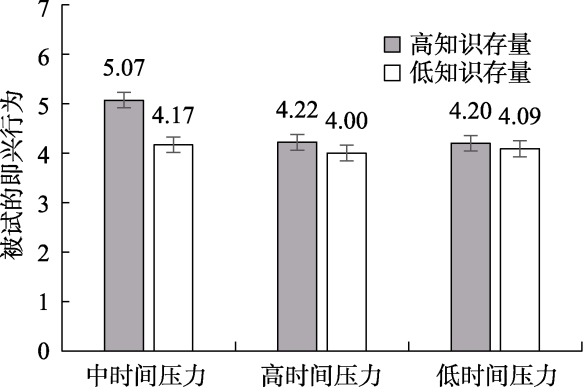
图2 知识存量与时间压力对即兴行为的影响
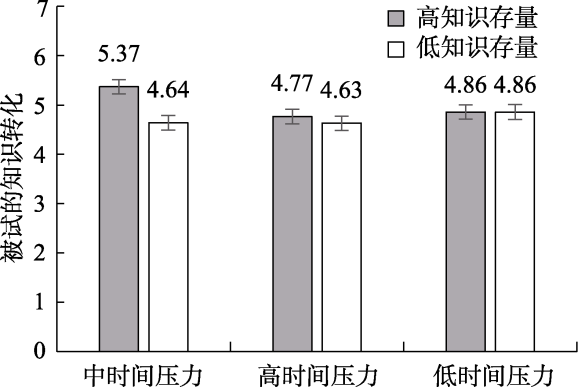
图3 知识存量与时间压力对知识转化的影响
| 变量 | 即兴行为 | 知识转化 | |||
|---|---|---|---|---|---|
| 模型1 | 模型2 | 模型3 | 模型4 | 模型5 | |
| 性别 | −0.19 (0.16) | −0.27 (0.16)+ | −0.31 (0.14)* | 0.14 (0.15) | 0.07 (0.15) |
| 年龄 | −0.05 (0.04) | −0.06 (0.04) | −0.07 (0.03)+ | 0.01 (0.04) | 0.01 (0.04) |
| 专业 | 0.21 (0.14) | 0.18 (0.14) | 0.21 (0.12)+ | −0.04 (0.13) | −0.06 (0.13) |
| 受教育程度 | 0.16 (0.13) | 0.17 (0.13) | 0.19 (0.11)+ | −0.06 (0.12) | −0.05 (0.12) |
| 主题熟悉度 | −0.05 (0.08) | −0.04 (0.07) | −0.09 (0.07) | 0.09 (0.07) | 0.10 (0.07) |
| 知识存量 | 0.40 (0.13)** | 0.93 (0.21)*** | 0.57 (0.20)** | 0.28 (0.12)* | 0.72 (0.20)*** |
| W1 | −0.49 (0.16)** | −0.10 (0.22) | −0.09 (0.19) | −0.33 (0.15)* | −0.03 (0.20) |
| W2 | −0.48 (0.16)** | −0.03 (0.22) | −0.16 (0.20) | −0.13 (0.15) | 0.25 (0.21) |
| 知识存量×W1 | −0.75 (0.30)* | −0.46 (0.27)+ | −0.59 (0.28)* | ||
| 知识存量×W2 | −0.86 (0.31)** | −0.49 (0.28)+ | −0.73 (0.28)* | ||
| 知识转化 | 0.49 (0.08)*** | ||||
| R2 | 0.16 | 0.21 | 0.37 | 0.08 | 0.12 |
表2 回归分析结果
| 变量 | 即兴行为 | 知识转化 | |||
|---|---|---|---|---|---|
| 模型1 | 模型2 | 模型3 | 模型4 | 模型5 | |
| 性别 | −0.19 (0.16) | −0.27 (0.16)+ | −0.31 (0.14)* | 0.14 (0.15) | 0.07 (0.15) |
| 年龄 | −0.05 (0.04) | −0.06 (0.04) | −0.07 (0.03)+ | 0.01 (0.04) | 0.01 (0.04) |
| 专业 | 0.21 (0.14) | 0.18 (0.14) | 0.21 (0.12)+ | −0.04 (0.13) | −0.06 (0.13) |
| 受教育程度 | 0.16 (0.13) | 0.17 (0.13) | 0.19 (0.11)+ | −0.06 (0.12) | −0.05 (0.12) |
| 主题熟悉度 | −0.05 (0.08) | −0.04 (0.07) | −0.09 (0.07) | 0.09 (0.07) | 0.10 (0.07) |
| 知识存量 | 0.40 (0.13)** | 0.93 (0.21)*** | 0.57 (0.20)** | 0.28 (0.12)* | 0.72 (0.20)*** |
| W1 | −0.49 (0.16)** | −0.10 (0.22) | −0.09 (0.19) | −0.33 (0.15)* | −0.03 (0.20) |
| W2 | −0.48 (0.16)** | −0.03 (0.22) | −0.16 (0.20) | −0.13 (0.15) | 0.25 (0.21) |
| 知识存量×W1 | −0.75 (0.30)* | −0.46 (0.27)+ | −0.59 (0.28)* | ||
| 知识存量×W2 | −0.86 (0.31)** | −0.49 (0.28)+ | −0.73 (0.28)* | ||
| 知识转化 | 0.49 (0.08)*** | ||||
| R2 | 0.16 | 0.21 | 0.37 | 0.08 | 0.12 |
| 调节变量 | 间接效应 | 95%置信区间 |
|---|---|---|
| 高时间压力 | 0.06 | [−0.13, 0.27] |
| 中时间压力 | 0.35 | [0.15, 0.59] |
| 低时间压力 | −0.01 | [−0.20, 0.19] |
| 组间差异(高vs.中) | −0.29 | [−0.60, −0.01] |
| 组间差异(低vs.中) | −0.36 | [−0.69, −0.08] |
| 组间差异(高vs.低) | 0.07 | [−0.21, 0.36] |
表3 被中介的调节效应分析结果
| 调节变量 | 间接效应 | 95%置信区间 |
|---|---|---|
| 高时间压力 | 0.06 | [−0.13, 0.27] |
| 中时间压力 | 0.35 | [0.15, 0.59] |
| 低时间压力 | −0.01 | [−0.20, 0.19] |
| 组间差异(高vs.中) | −0.29 | [−0.60, −0.01] |
| 组间差异(低vs.中) | −0.36 | [−0.69, −0.08] |
| 组间差异(高vs.低) | 0.07 | [−0.21, 0.36] |
| 变量 | M | SD | 1 | 2 | 3 | 4 | 5 | 6 | 7 | 8 | 9 |
|---|---|---|---|---|---|---|---|---|---|---|---|
| 1性别 | − | − | |||||||||
| 2工龄 | 12.94 | 7.30 | −0.07 | ||||||||
| 3年龄 | 36.05 | 7.47 | −0.02 | 0.85*** | |||||||
| 4职位 | 3.31 | 1.09 | 0.03 | −0.21** | −0.21** | ||||||
| 5受教育程度 | 2.00 | 0.74 | −0.05 | 0.08 | 0.07 | −0.03 | |||||
| 6主题熟悉度 | 4.96 | 1.26 | 0.03 | 0.09 | 0.06 | −0.04 | 0.03 | ||||
| 7时间压力 | 7.67 | 2.05 | −0.14+ | 0.12 | 0.12 | −0.12 | −0.12 | −0.14+ | |||
| 8知识存量 | 5.15 | 0.85 | −0.11 | 0.26** | 0.22** | −0.15+ | 0.05 | 0.12 | −0.02 | ||
| 9知识转化 | 5.08 | 1.00 | −0.24** | 0.24** | 0.21** | −0.11 | 0.04 | 0.12 | 0.44*** | 0.27*** | |
| 10即兴行为 | 3.74 | 1.32 | −0.12 | 0.18* | 0.13 | −0.25** | 0.11 | 0.05 | 0.15+ | 0.28*** | 0.52*** |
表4 各研究变量的描述性统计表(N = 163)
| 变量 | M | SD | 1 | 2 | 3 | 4 | 5 | 6 | 7 | 8 | 9 |
|---|---|---|---|---|---|---|---|---|---|---|---|
| 1性别 | − | − | |||||||||
| 2工龄 | 12.94 | 7.30 | −0.07 | ||||||||
| 3年龄 | 36.05 | 7.47 | −0.02 | 0.85*** | |||||||
| 4职位 | 3.31 | 1.09 | 0.03 | −0.21** | −0.21** | ||||||
| 5受教育程度 | 2.00 | 0.74 | −0.05 | 0.08 | 0.07 | −0.03 | |||||
| 6主题熟悉度 | 4.96 | 1.26 | 0.03 | 0.09 | 0.06 | −0.04 | 0.03 | ||||
| 7时间压力 | 7.67 | 2.05 | −0.14+ | 0.12 | 0.12 | −0.12 | −0.12 | −0.14+ | |||
| 8知识存量 | 5.15 | 0.85 | −0.11 | 0.26** | 0.22** | −0.15+ | 0.05 | 0.12 | −0.02 | ||
| 9知识转化 | 5.08 | 1.00 | −0.24** | 0.24** | 0.21** | −0.11 | 0.04 | 0.12 | 0.44*** | 0.27*** | |
| 10即兴行为 | 3.74 | 1.32 | −0.12 | 0.18* | 0.13 | −0.25** | 0.11 | 0.05 | 0.15+ | 0.28*** | 0.52*** |
| 变量 | 即兴行为 | 知识转化 | |||
|---|---|---|---|---|---|
| 模型1 | 模型2 | 模型3 | 模型4 | 模型5 | |
| 性别 | −0.13 (0.17) | −0.16 (0.17) | −0.04 (0.16) | −0.28 (0.12)* | −0.25 (0.12)* |
| 工龄 | 0.01 (0.02) | 0.01 (0.02) | 0.01 (0.02) | 0.01 (0.02) | 0.01 (0.02) |
| 年龄 | −0.01 (0.02) | −0.01 (0.02) | −0.01 (0.02) | 0.01 (0.02) | 0.01 (0.02) |
| 职位 | −0.22 (0.08)** | −0.22 (0.08)** | −0.23 (0.07)** | 0.02 (0.06) | 0.02 (0.05) |
| 受教育程度 | 0.23 (0.11)* | 0.23 (0.11)* | 0.17 (0.10) | 0.11 (0.08) | 0.11 (0.08) |
| 主题熟悉度 | 0.04 (0.07) | 0.03 (0.07) | −0.04 (0.06) | 0.13 (0.05)** | 0.13 (0.05)** |
| 知识存量 | 0.17 (0.10)+ | −0.13 (0.24) | −0.41 (0.23)+ | 0.16 (0.08)* | 0.57 (0.17)** |
| W1 | −1.54 (0.21)*** | −3.66 (1.59)* | −4.37 (1.49)** | −1.34 (0.15)*** | 1.44 (1.13) |
| W2 | −1.26 (0.20)*** | −3.08 (1.45)* | −4.23 (1.38)** | −0.35 (0.15)* | 2.29 (1.03)* |
| 知识存量×W1 | 0.40 (0.30) | 0.66 (0.28)* | −0.52 (0.21)* | ||
| 知识存量×W2 | 0.34 (0.27) | 0.58 (0.26)* | −0.49 (0.19)* | ||
| 知识转化 | 0.50 (0.10)*** | ||||
| R2 | 0.39 | 0.39 | 0.47 | 0.45 | 0.47 |
表5 回归分析结果
| 变量 | 即兴行为 | 知识转化 | |||
|---|---|---|---|---|---|
| 模型1 | 模型2 | 模型3 | 模型4 | 模型5 | |
| 性别 | −0.13 (0.17) | −0.16 (0.17) | −0.04 (0.16) | −0.28 (0.12)* | −0.25 (0.12)* |
| 工龄 | 0.01 (0.02) | 0.01 (0.02) | 0.01 (0.02) | 0.01 (0.02) | 0.01 (0.02) |
| 年龄 | −0.01 (0.02) | −0.01 (0.02) | −0.01 (0.02) | 0.01 (0.02) | 0.01 (0.02) |
| 职位 | −0.22 (0.08)** | −0.22 (0.08)** | −0.23 (0.07)** | 0.02 (0.06) | 0.02 (0.05) |
| 受教育程度 | 0.23 (0.11)* | 0.23 (0.11)* | 0.17 (0.10) | 0.11 (0.08) | 0.11 (0.08) |
| 主题熟悉度 | 0.04 (0.07) | 0.03 (0.07) | −0.04 (0.06) | 0.13 (0.05)** | 0.13 (0.05)** |
| 知识存量 | 0.17 (0.10)+ | −0.13 (0.24) | −0.41 (0.23)+ | 0.16 (0.08)* | 0.57 (0.17)** |
| W1 | −1.54 (0.21)*** | −3.66 (1.59)* | −4.37 (1.49)** | −1.34 (0.15)*** | 1.44 (1.13) |
| W2 | −1.26 (0.20)*** | −3.08 (1.45)* | −4.23 (1.38)** | −0.35 (0.15)* | 2.29 (1.03)* |
| 知识存量×W1 | 0.40 (0.30) | 0.66 (0.28)* | −0.52 (0.21)* | ||
| 知识存量×W2 | 0.34 (0.27) | 0.58 (0.26)* | −0.49 (0.19)* | ||
| 知识转化 | 0.50 (0.10)*** | ||||
| R2 | 0.39 | 0.39 | 0.47 | 0.45 | 0.47 |
| 调节变量 | 间接效应 | 95%置信区间 |
|---|---|---|
| 高时间压力 | 0.02 | [−0.11, 0.16] |
| 中时间压力 | 0.28 | [0.10, 0.51] |
| 低时间压力 | 0.04 | [−0.06, 0.15] |
| 组间差异(高vs.中) | −0.26 | [−0.52, −0.05] |
| 组间差异(低vs.中) | −0.24 | [−0.49, −0.05] |
| 组间差异(高vs.低) | −0.02 | [−0.18, 0.15] |
表6 被中介的调节效应分析结果
| 调节变量 | 间接效应 | 95%置信区间 |
|---|---|---|
| 高时间压力 | 0.02 | [−0.11, 0.16] |
| 中时间压力 | 0.28 | [0.10, 0.51] |
| 低时间压力 | 0.04 | [−0.06, 0.15] |
| 组间差异(高vs.中) | −0.26 | [−0.52, −0.05] |
| 组间差异(低vs.中) | −0.24 | [−0.49, −0.05] |
| 组间差异(高vs.低) | −0.02 | [−0.18, 0.15] |
| 变量 | M | SD | 1 | 2 | 3 | 4 | 5 | 6 | 7 | 8 | 9 |
|---|---|---|---|---|---|---|---|---|---|---|---|
| 1性别 | − | − | |||||||||
| 2工龄 | 10.50 | 5.32 | 0.13+ | ||||||||
| 3年龄 | 35.82 | 5.55 | 0.17* | 0.89*** | |||||||
| 4团队规模 | 3.23 | 0.71 | 0.07 | 0.24** | 0.10 | ||||||
| 5教育背景 | 2.26 | 0.74 | 0.08 | 0.09 | 0.03 | 0.19** | |||||
| 6与领导共事年限 | 6.50 | 3.89 | 0.13+ | 0.66*** | 0.65*** | 0.17* | 0.13+ | ||||
| 7知识存量 | 4.69 | 1.10 | 0.02 | 0.09 | 0.11 | 0.02 | 0.03 | 0.08 | |||
| 8知识转化 | 5.02 | 1.17 | −0.08 | 0.13+ | 0.15* | 0.02 | −0.01 | 0.27*** | 0.53*** | ||
| 9时间压力 | 4.36 | 1.37 | −0.01 | 0.05 | −0.06 | 0.04 | −0.12 | −0.02 | −0.08 | −0.04 | |
| 10即兴行为 | 4.85 | 1.22 | −0.02 | 0.05 | 0.06 | −0.02 | 0.09 | 0.18* | 0.58*** | 0.56*** | −0.15* |
表7 各研究变量的描述性统计表(N = 201)
| 变量 | M | SD | 1 | 2 | 3 | 4 | 5 | 6 | 7 | 8 | 9 |
|---|---|---|---|---|---|---|---|---|---|---|---|
| 1性别 | − | − | |||||||||
| 2工龄 | 10.50 | 5.32 | 0.13+ | ||||||||
| 3年龄 | 35.82 | 5.55 | 0.17* | 0.89*** | |||||||
| 4团队规模 | 3.23 | 0.71 | 0.07 | 0.24** | 0.10 | ||||||
| 5教育背景 | 2.26 | 0.74 | 0.08 | 0.09 | 0.03 | 0.19** | |||||
| 6与领导共事年限 | 6.50 | 3.89 | 0.13+ | 0.66*** | 0.65*** | 0.17* | 0.13+ | ||||
| 7知识存量 | 4.69 | 1.10 | 0.02 | 0.09 | 0.11 | 0.02 | 0.03 | 0.08 | |||
| 8知识转化 | 5.02 | 1.17 | −0.08 | 0.13+ | 0.15* | 0.02 | −0.01 | 0.27*** | 0.53*** | ||
| 9时间压力 | 4.36 | 1.37 | −0.01 | 0.05 | −0.06 | 0.04 | −0.12 | −0.02 | −0.08 | −0.04 | |
| 10即兴行为 | 4.85 | 1.22 | −0.02 | 0.05 | 0.06 | −0.02 | 0.09 | 0.18* | 0.58*** | 0.56*** | −0.15* |
| 变量 | 即兴行为 | 知识转化 | ||||
|---|---|---|---|---|---|---|
| 模型1 | 模型2 | 模型3 | 模型4 | 模型5 | 模型6 | |
| 性别 | −0.11 (0.17) | −0.10 (0.14) | 0.04 (0.14) | −0.02 (0.13) | −0.26 (0.16) | −0.26 (0.14)+ |
| 工龄 | −0.03 (0.04) | −0.02 (0.03) | −0.01 (0.03) | −0.01 (0.03) | −0.03 (0.04) | −0.02 (0.03) |
| 年龄 | 0.01 (0.04) | −0.02 (0.03) | −0.01 (0.03) | −0.01 (0.03) | 0.02 (0.03) | −0.01 (0.03) |
| 团队规模 | −0.09 (0.13) | −0.10 (0.10) | −0.09 (0.11) | −0.09 (0.10) | 0.01 (0.12) | −0.01 (0.10) |
| 教育背景 | 0.14 (0.12) | 0.12 (0.09) | 0.17 (0.10) + | 0.14 (0.09) | −0.05 (0.11) | −0.07 (0.10) |
| 与领导共事年限 | 0.08 (0.03)** | 0.07 (0.02)** | 0.02 (0.03) | 0.04 (0.02)+ | 0.10 (0.03)*** | 0.09 (0.02)*** |
| 知识存量 | 0.64 (0.06)*** | 0.45 (0.07)*** | 0.56 (0.06)*** | |||
| 知识转化 | 0.58 (0.06)*** | 0.34 (0.07)*** | ||||
| R2 | 0.05 | 0.38 | 0.33 | 0.45 | 0.09 | 0.35 |
表8 回归分析结果(主效应与中介效应)
| 变量 | 即兴行为 | 知识转化 | ||||
|---|---|---|---|---|---|---|
| 模型1 | 模型2 | 模型3 | 模型4 | 模型5 | 模型6 | |
| 性别 | −0.11 (0.17) | −0.10 (0.14) | 0.04 (0.14) | −0.02 (0.13) | −0.26 (0.16) | −0.26 (0.14)+ |
| 工龄 | −0.03 (0.04) | −0.02 (0.03) | −0.01 (0.03) | −0.01 (0.03) | −0.03 (0.04) | −0.02 (0.03) |
| 年龄 | 0.01 (0.04) | −0.02 (0.03) | −0.01 (0.03) | −0.01 (0.03) | 0.02 (0.03) | −0.01 (0.03) |
| 团队规模 | −0.09 (0.13) | −0.10 (0.10) | −0.09 (0.11) | −0.09 (0.10) | 0.01 (0.12) | −0.01 (0.10) |
| 教育背景 | 0.14 (0.12) | 0.12 (0.09) | 0.17 (0.10) + | 0.14 (0.09) | −0.05 (0.11) | −0.07 (0.10) |
| 与领导共事年限 | 0.08 (0.03)** | 0.07 (0.02)** | 0.02 (0.03) | 0.04 (0.02)+ | 0.10 (0.03)*** | 0.09 (0.02)*** |
| 知识存量 | 0.64 (0.06)*** | 0.45 (0.07)*** | 0.56 (0.06)*** | |||
| 知识转化 | 0.58 (0.06)*** | 0.34 (0.07)*** | ||||
| R2 | 0.05 | 0.38 | 0.33 | 0.45 | 0.09 | 0.35 |
| 变量 | 即兴行为 | 知识转化 | |||
|---|---|---|---|---|---|
| 模型7 | 模型8 | 模型9 | 模型10 | 模型11 | |
| 性别 | −0.09 (0.14) | −0.07 (0.14) | 0.02 (0.13) | −0.27 (0.14)* | −0.23 (0.13)+ |
| 工龄 | −0.01 (0.03) | 0.01 (0.03) | 0.01 (0.03) | −0.02 (0.03) | −0.02 (0.03) |
| 年龄 | −0.03 (0.03) | −0.04 (0.03) | −0.04 (0.03) | 0.01 (0.03) | −0.01 (0.03) |
| 团队规模 | −0.10 (0.10) | −0.09 (0.10) | −0.08 (0.10) | −0.01 (0.10) | −0.04 (0.09) |
| 教育背景 | 0.09 (0.09) | 0.07 (0.09) | 0.11 (0.09) | −0.06 (0.09) | −0.10 (0.09) |
| 与领导共事年限 | 0.07 (0.02)** | 0.07 (0.02)** | 0.04 (0.02) | 0.10 (0.02)*** | 0.09 (0.02)*** |
| 知识存量 | 0.74 (0.21)** | 0.85 (0.50)+ | 1.27 (0.48)** | 0.37 (0.21)+ | −1.17 (0.47)* |
| 时间压力 | −0.01 (0.19) | 0.92 (1.15) | 1.82 (1.10)+ | −0.17 (0.19) | −2.51 (1.07)* |
| 时间压力2 | −0.11 (0.13) | −0.21 (0.13) | 0.27 (0.12)* | ||
| 知识存量×时间压力 | −0.02 (0.04) | −0.11 (0.25) | −0.40 (0.24) | 0.04 (0.04) | 0.81 (0.23)*** |
| 知识存量×时间压力2 | 0.01 (0.03) | 0.04 (0.03) | −0.09 (0.03)** | ||
| 知识转化 | 0.36 (0.07)*** | ||||
| R2 | 0.39 | 0.40 | 0.47 | 0.36 | 0.44 |
表9 回归分析结果(时间压力的调节效应)
| 变量 | 即兴行为 | 知识转化 | |||
|---|---|---|---|---|---|
| 模型7 | 模型8 | 模型9 | 模型10 | 模型11 | |
| 性别 | −0.09 (0.14) | −0.07 (0.14) | 0.02 (0.13) | −0.27 (0.14)* | −0.23 (0.13)+ |
| 工龄 | −0.01 (0.03) | 0.01 (0.03) | 0.01 (0.03) | −0.02 (0.03) | −0.02 (0.03) |
| 年龄 | −0.03 (0.03) | −0.04 (0.03) | −0.04 (0.03) | 0.01 (0.03) | −0.01 (0.03) |
| 团队规模 | −0.10 (0.10) | −0.09 (0.10) | −0.08 (0.10) | −0.01 (0.10) | −0.04 (0.09) |
| 教育背景 | 0.09 (0.09) | 0.07 (0.09) | 0.11 (0.09) | −0.06 (0.09) | −0.10 (0.09) |
| 与领导共事年限 | 0.07 (0.02)** | 0.07 (0.02)** | 0.04 (0.02) | 0.10 (0.02)*** | 0.09 (0.02)*** |
| 知识存量 | 0.74 (0.21)** | 0.85 (0.50)+ | 1.27 (0.48)** | 0.37 (0.21)+ | −1.17 (0.47)* |
| 时间压力 | −0.01 (0.19) | 0.92 (1.15) | 1.82 (1.10)+ | −0.17 (0.19) | −2.51 (1.07)* |
| 时间压力2 | −0.11 (0.13) | −0.21 (0.13) | 0.27 (0.12)* | ||
| 知识存量×时间压力 | −0.02 (0.04) | −0.11 (0.25) | −0.40 (0.24) | 0.04 (0.04) | 0.81 (0.23)*** |
| 知识存量×时间压力2 | 0.01 (0.03) | 0.04 (0.03) | −0.09 (0.03)** | ||
| 知识转化 | 0.36 (0.07)*** | ||||
| R2 | 0.39 | 0.40 | 0.47 | 0.36 | 0.44 |
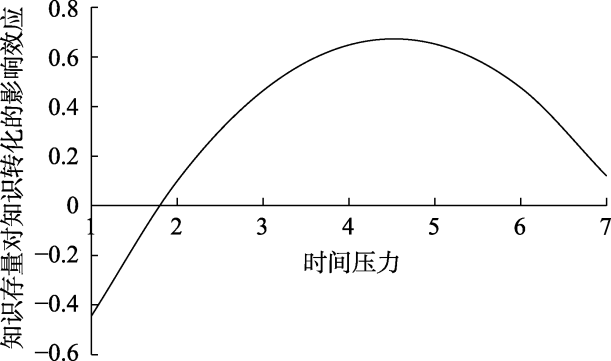
图4 时间压力的倒U型调节效应
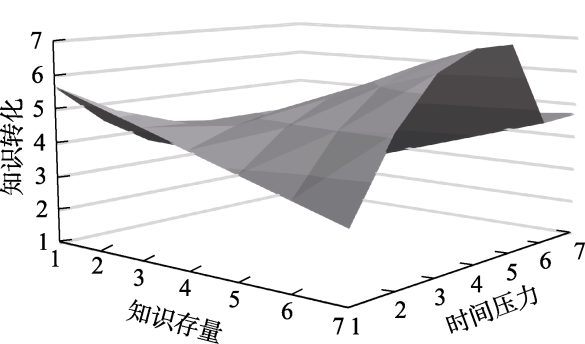
图5 时间压力倒U型调节下知识存量与知识转化关系效应
| 调节变量水平 | 间接效应 | 95%置信区间 |
|---|---|---|
| a. M - 2 SD | −0.03 | [−0.17, 0.10] |
| b. M - 1 SD | 0.17 | [0.08, 0.27] |
| c. M | 0.24 | [0.13, 0.36] |
| d. M + 1 SD | 0.19 | [0.11, 0.29] |
| e. M + 2 SD | 0.03 | [−0.11, 0.17] |
| 组间差异 (a − b) | −0.19 | [−0.34, −0.07] |
| 组间差异 (b − c) | −0.07 | [−0.14, −0.02] |
| 组间差异 (c − d) | 0.05 | [−0.01, 0.11] |
| 组间差异 (d − e) | 0.16 | [0.05, 0.32] |
表10 被中介的调节效应分析结果
| 调节变量水平 | 间接效应 | 95%置信区间 |
|---|---|---|
| a. M - 2 SD | −0.03 | [−0.17, 0.10] |
| b. M - 1 SD | 0.17 | [0.08, 0.27] |
| c. M | 0.24 | [0.13, 0.36] |
| d. M + 1 SD | 0.19 | [0.11, 0.29] |
| e. M + 2 SD | 0.03 | [−0.11, 0.17] |
| 组间差异 (a − b) | −0.19 | [−0.34, −0.07] |
| 组间差异 (b − c) | −0.07 | [−0.14, −0.02] |
| 组间差异 (c − d) | 0.05 | [−0.01, 0.11] |
| 组间差异 (d − e) | 0.16 | [0.05, 0.32] |
| [1] | Abell, P., Felin, T., & Foss, N. (2008). Building micro-foundations for the routines, capabilities, and performance links. Managerial and Decision Economics, 29(6), 489-502. |
| [2] | Abrantes, A. C. M., Passos, A. M., e Cunha, M. P., & Santos, C. M. (2018). Bringing team improvisation to team adaptation: The combined role of shared temporal cognitions and team learning behaviors fostering team performance. Journal of Business Research, 84, 59-71. |
| [3] | Al-Tit, A. A. (2016). The mediating role of knowledge management and the moderating part of organizational culture between HRM practices and organizational performance. International Business Research, 9(1), 43-54. |
| [4] | Amabile, T. M. (1983). The social psychology of creativity: A componential conceptualization. Journal of Personality and Social Psychology, 45(2), 357-376. |
| [5] | Arias-Pérez, J., & Cepeda-Cardona, J. (2022). Knowledge management strategies and organizational improvisation: What changed after the emergence of technological turbulence caused by artificial intelligence? Baltic Journal of Management, 17(2), 250-265. |
| [6] |
Baer, M., & Oldham, G. R. (2006). The curvilinear relation between experienced creative time pressure and creativity: Moderating effects of openness to experience and support for creativity. Journal of Applied Psychology, 91(4), 963-970.
pmid: 16834519 |
| [7] |
Bai, X. J., & Yao, H. J. (2018). Differences in cognitive inhibition between persons with high and low creativity: Evidences from behavioral and physiological studies. Acta Psychologica Sinica, 50(11), 1197-1211.
doi: 10.3724/SP.J.1041.2018.01197 |
|
[白学军, 姚海娟. (2018). 高低创造性思维水平者的认知抑制能力: 行为和生理的证据. 心理学报, 50(11), 1197-1211.]
doi: 10.3724/SP.J.1041.2018.01197 |
|
| [8] | Benson, L., & Svenson, O. (1993). Post-decision consolidation following the debriefing of subjects about experimental manipulations affecting their prior decisions. Psychological Research Bulletin, 32, 1-13. |
| [9] | Bliese, P. D. (2000). Within-group agreement, non-independence, and reliability:Implications for data aggregation and analysis. In K. J. Klein & S. W. J. Kozlowski (Eds.), Multi-level theory, research, and methods in organizations: Foundations, extensions, and new directions (pp. 349-381). San Francisco, CA: Jossey-Bass. |
| [10] | Bliese, P. D., & Hanges, P. J. (2004). Being both too liberal and too conservative: The perils of treating grouped data as though they were independent. Organizational Research Methods, 7(4), 400-417. |
| [11] | Bilsen, G. (2010). Leading organizational improvisiation: An exploration of the influence of leadership style on organizational improvisation [Unpublished master’s thesis]. University of Twente. |
| [12] | Cabrera, E. F., & Cabrera, A. (2005). Fostering knowledge sharing through people management practices. International Journal of Human Resource Management, 16(5), 720-735. |
| [13] | Caillies, S., Denhière, G., & Kintsch, W. (2002). The effect of prior knowledge on understanding from text: Evidence from primed recognition. European Journal of Cognitive Psychology, 14(2), 267-286. |
| [14] | Chen, J. (2009). The influence of attributive style and time pressure on information processing in decision making. Journal of Psychological Science, 32(6), 1445-1447. |
| [陈军. (2009). 归因风格、时间压力对决策信息加工的影响. 心理科学, 32(6), 1445-1447.] | |
| [15] | Chen, Y., Liu, D., Tang, G., & Hogan, T. M. (2021). Workplace events and employee creativity: A multistudy field investigation. Personnel Psychology, 74(2), 211-236. |
| [16] | Ciuchta, M. P., O’Toole, J., & Miner, A. S. (2021). The organizational improvisation landscape: Taking stock and looking forward. Journal of Management, 47(1), 288-316. |
| [17] | Collins, A. M., & Quillian, M. R. (1969). Retrieval time from semantic memory. Journal of Verbal Learning and Verbal Behavior, 8(2), 240-247. |
| [18] | Crossan, M., Cunha, M. P. E., Vera, D., & Cunha, J. (2005). Time and organizational improvisation. Academy of Management Review, 30(1), 129-145. |
| [19] | Crossan, M. M., & Hurst, D. K. (2006). Strategic renewal as improvisation: Reconciling the tension between exploration and exploitation. Ecology and Strategy, 23, 273-298. |
| [20] | Cunha, M. P., Cunha, J. V., & Kamoche, K. (1999). Organizational improvisation: What, when, how and why. International Journal of Management Reviews, 1(3), 299-341. |
| [21] | Edland, A., & Svenson, O. (1993). Judgment and decision making under time pressure. In O. Svenson & A. J. Maule (Eds.), Time pressure and stress in human judgment and decision making, (pp. 27-40). New York: Plenum Press. |
| [22] | Evans, K. O. (2016). Mining for solutions: How expertise distribution and influence structures impact team improvisation [Unpublished doctorial dissertation]. Washington University in St. Louis. |
| [23] | Faul, F., Erdfelder, E., Lang, A.-G., & Buchner, A. (2007). G* Power 3: A flexible statistical power analysis program for the social, behavioral, and biomedical sciences. Behavior Research Methods, 39(2), 175-191. |
| [24] | Flatten, T. C., Engelen, A., Zahra, S. A., & Brettel, M. (2011). A measure of absorptive capacity: Scale development and validation. European Management Journal, 29(2), 98-116. |
| [25] | Galotti, K. M. (2015). Cognitive psychology: In and out of the laboratory (5th ed). Los Angeles (CA): SAGE. |
| [26] |
Gardner, D. G. (1986). Activation theory and task design: An empirical test of several new predictions. Journal of Applied Psychology, 71(3), 411-418.
pmid: 3745078 |
| [27] | Griffith, T. L., & Sawyer, J. E. (2010). Multilevel knowledge and team performance. Journal of Organizational Behavior, 31(7), 1003-1031. |
| [28] | Hadida, A. L., Tarvainen, W., & Rose, J. (2015). Organizational improvisation: A consolidating review and framework. International Journal of Management Reviews, 17(4), 437-459. |
| [29] | Hamzeh, F. R., Faek, F., & AlHussein, H. (2019). Understanding improvisation in construction through antecedents, behaviours and consequences. Construction Management and Economics, 37(2), 61-71. |
| [30] |
Hayes, A. F., & Preacher, K. J. (2010). Quantifying and testing indirect effects in simple mediation models when the constituent paths are nonlinear. Multivariate Behavioral Research, 45(4), 627-660.
doi: 10.1080/00273171.2010.498290 pmid: 26735713 |
| [31] | Hill, K. E., Bush, V. D., Vorhies, D., & King, R. A. (2017). Performing under pressure: Winning customers through improvisation in team selling. Journal of Relationship Marketing, 16(4), 227-244. |
| [32] | Hodge, J., & Ratten, V. (2015). Time pressure and improvisation: Enhancing creativity, adaption and innovation at high speed. Development and Learning in Organizations, 29(6), 7-9. |
| [33] | Hu, L., Gu, J., Wu, J., & Lado, A. A. (2018). Regulatory focus, environmental turbulence, and entrepreneur improvisation. International Entrepreneurship and Management Journal, 14(1), 129-148. |
| [34] | Jiang, Y., & Chen, C. C. (2018). Integrating knowledge activities for team innovation: Effects of transformational leadership. Journal of Management, 44(5), 1819-1847. |
| [35] | Karau, S. J., & Kelly, J. R. (1992). The effects of time scarcity and time abundance on group performance quality and interaction process. Journal of Experimental Social Psychology, 28(6), 542-571. |
| [36] | Kelley, T. L. (1939). The selection of upper and lower groups for the validation of test items. Journal of Educational Psychology, 30(1), 17-24. |
| [37] | Khedhaouria, A., Montani, F., & Thurik, R. (2017). Time pressure and team member creativity within R&D projects: The role of learning orientation and knowledge sourcing. International Journal of Project Management, 35(6), 942-954. |
| [38] | Lee, C. Y., & Huang, Y. C. (2012). Knowledge stock, ambidextrous learning, and firm performance: Evidence from technologically intensive industries. Management Decision, 50(6), 1096-1116. |
| [39] | Lewis, C., Lovatt, P., & Kirk, E. (2015). Many hands make light work: The facilitative role of gesture in verbal improvisation. Thinking Skills and Creativity, 17, 149-157. |
| [40] | Leybourne, S., & Sadler-Smith, E. (2006). The role of intuition and improvisation in project management. International Journal of Project Management, 24(6), 483-492. |
| [41] |
Li, A. M., Yan, L., Wang, X. T., Ma, X. Q., & Li, F. J. (2015). The double-edged effect and mechanism of time pressure. Advances in Psychological Science, 23(9), 1627-1636.
doi: 10.3724/SP.J.1042.2015.01627 |
|
[李爱梅, 颜亮, 王笑天, 马学谦, 李方君. (2015). 时间压力的双刃效应及其作用机制. 心理科学进展, 23(9), 1627-1636.]
doi: 10.3724/SP.J.1042.2015.01627 |
|
| [42] | Li, X. X., & Li, J. (2019). Behavior tactics, resource structure and SMEs’ innovation output. Science Research Management, 40(7), 173-181. |
| [李晓翔, 李晶. (2019). 行为策略、资源结构与中小企业创新产出. 科研管理, 40(7), 173-181. ] | |
| [43] | Liu, C., Liu, Y. H., Gedeon, T., Zhao, Y., Wei, Y., & Yang, F. (2019). The effects of perceived chronic pressure and time constraint on information search behaviors and experience. Information Processing & Management, 56(5), 1667-1679. |
| [44] | Liu, J., Zhou, X., & Wang, Q. (2023). The influence of entrepreneurial leadership on employee improvisation in new ventures: Based on cognitive-affective processing system framework. Kybernetes, 52(9), 3566-3587. |
| [45] | Liu, J. D., & Dang, X. H. (2013). Research on the relationship of knowledge acquisition modes and radical innovation under different levels of knowledge potential. Management Review, 25(7), 88-98. |
| [刘景东, 党兴华. (2013). 不同知识位势下知识获取方式与突变创新的关系研究. 管理评论, 25(7), 88-98.] | |
| [46] | Liyanage, C., Elhag, T., Ballal, T., & Li, Q. (2009). Knowledge communication and translation-A knowledge transfer model. Journal of Knowledge Management, 13(3), 118-131. |
| [47] | Luo, Y., Sun, J., & Wang, S. L. (2011). Emerging economy copycats: Capability, environment, and strategy. Academy of Management Perspectives, 25(2), 37-56. |
| [48] | Mabey, C., & Zhao, S. (2017). Managing five paradoxes of knowledge exchange in networked organizations: New priorities for HRM? Human Resource Management Journal, 27(1), 39-57. |
| [49] | Magni, M., & Maruping, L. M. (2013). Sink or swim: Empowering leadership and overload in teams’ ability to deal with the unexpected. Human Resource Management, 52(5), 715-739. |
| [50] | Magni, M., Proserpio, L., Hoegl, M., & Provera, B. (2009). The role of team behavioral integration and cohesion in shaping individual improvisation. Research Policy, 38(6), 1044-1053. |
| [51] | Magni, M., Provera, B., & Proserpio, L. (2010). Individual attitude toward improvisation in information systems development. Behaviour & Information Technology, 29(3), 245-255. |
| [52] | Mahoney, J. T., & Kor, Y. Y. (2015). Advancing the human capital perspective on value creation by joining capabilities and governance approaches. Academy of Management Perspectives, 29(3), 296-308. |
| [53] | Mai, Y. Y., Ye, Z. X., & Chen, S. H. (2015). From “blocking the enemy’s attack with troops and hiding behind the earth against water” to the formation of organizational conventions: An improvisational strategic study of new enterprises in transitional economies. Journal of Management World, 263(8), 147-165. |
| [买忆媛, 叶竹馨, 陈淑华. (2015). 从“兵来将挡, 水来土掩”到组织惯例形成——转型经济中新企业的即兴战略研究. 管理世界, 263(8), 147-165. ] | |
| [54] | Mamédio, D. F., Cunha, M. P. E., & Meyer Jr, V. (2022). Strategic improvisation: An introductory conceptual framework. Cross Cultural & Strategic Management, 29(1), 24-47. |
| [55] | Mannucci, P. V., Orazi, D. C., & de Valck, K. (2021). Developing improvisation skills: The influence of individual orientations. Administrative Science Quarterly, 66(3), 612-658. |
| [56] | Mannucci, P. V., & Yong, K. (2018). The differential impact of knowledge depth and knowledge breadth on creativity over individual careers. Academy of Management Journal, 61(5), 1741-1763. |
| [57] | Maruping, L. M., Venkatesh, V., Thatcher, S. M., & Patel, P. C. (2015). Folding under pressure or rising to the occasion? Perceived time pressure and the moderating role of team temporal leadership. Academy of Management Journal, 58(5), 1313-1333. |
| [58] | Meurs, J. A., Gallagher, V. C., & Perrewé, P. L. (2010). The role of political skill in the stressor-outcome relationship: Differential predictions for self-and other-reports of political skill. Journal of Vocational Behavior, 76(3), 520-533. |
| [59] |
Meyer, D. E., & Schvaneveldt, R. W. (1971). Facilitation in recognizing pairs of words: Evidence of a dependence between retrieval operations. Journal of Experimental Psychology, 90(2), 227-234.
pmid: 5134329 |
| [60] | Miner, A. S., Bassof, P., & Moorman, C. (2001). Organizational improvisation and learning: A field study. Administrative Science Quarterly, 46(2), 304-337. |
| [61] | Nisula, A. M. (2015). The relationship between supervisor support and individual improvisation. Leadership & Organization Development Journal, 36(5), 473-488. |
| [62] | Nisula, A. M., & Kianto, A. (2016). The role of knowledge management practices in supporting employee capacity for improvisation. The International Journal of Human Resource Management, 27(17), 1920-1937. |
| [63] | Nonaka, I. (1994). A dynamic theory of organizational knowledge creation. Organization Science, 5(1), 14-37. |
| [64] | Nonaka, I., & Toyama, R. (2003). The knowledge-creating theory revisited: Knowledge creation as a synthesizing process. Knowledge Management Research & Practice, 1(1), 2-10. |
| [65] | Orasanu, J., & Fischer, U. (1997). Finding decisions in natural environments:The view from the cockpit. In C. E. Zsambok & G. Klein (Eds.), Naturalistic decision making (pp. 343-357). Lawrence Erlbaum Associates, Inc. |
| [66] | Parida, V., Wincent, J., & Kohtamäki, M. (2013). Offshoring and improvisational learning: Empirical insights into developing global R&D capabilities. Industry and Innovation, 20(6), 544-562. |
| [67] | Perrmann-Graham, J., Liu, J., Cangioni, C., & Spataro, S. E. (2022). Fostering psychological safety: Using improvisation as a team building tool in management education. The International Journal of Management Education, 20(2), 100617 |
| [68] | Rego, A., Vitória, A., e Cunha, M. P., Owens, B. P., Ventura, A., Leal, S., ... Lourenço-Gil, R. (2022). Employees’ improvisational behavior: Exploring the role of leader grit and humility. Human Performance, 35(2), 113-138. |
| [69] |
Ren, L., Zhang, X., Chen, P., & Liu, Q. (2022). The impact of empowering leadership on employee improvisation: Roles of challenge-hindrance stress and psychological availability. Psychology Research and Behavior Management, 15, 2783-2801.
doi: 10.2147/PRBM.S381092 pmid: 36186518 |
| [70] | Rui, Z. Y., Luo, J. L., & Gan, J. X. (2017). The innovation dilemma breakthrough of new ventures: Ambidexterity of external search and its matching with enterprise’s knowledge base. Nankai Business Review, 20(5), 155-164. |
| [芮正云, 罗瑾琏, 甘静娴. (2017). 新创企业创新困境突破: 外部搜寻双元性及其与企业知识基础的匹配. 南开管理评论, 20(5), 155-164. ] | |
| [71] | Schilling, M. A., Vidal, P., Ployhart, R. E., & Marangoni, A. (2003). Learning by doing something else: Variation, relatedness, and the learning curve. Management Science, 49(1), 39-56. |
| [72] | Selig, J. P., & Preacher, K. J. (2008). Monte Carlo method for assessing mediation: An interactive tool for creating confidence intervals for indirect effects [Computer software]. Available from http://quantpsy.org/ |
| [73] | Shan, B., Pu, Y., Lv, X., & Zhang, R. (2023). How do organizations deal with crisis? A case study on improvisational behaviours of Chinese companies during the COVID-19 epidemic. Asia Pacific Business Review, 29(4), 1125-1148. |
| [74] |
Soderberg, C. K., Callahan, S. P., Kochersberger, A. O., Amit, E., & Ledgerwood, A. (2015). The effects of psychological distance on abstraction: Two meta-analyses. Psychological Bulletin, 141(3), 525-548.
doi: 10.1037/bul0000005 pmid: 25420220 |
| [75] | Staw, B. M., Sandelands, L. E., & Dutton, J. E. (1981). Threat-rigidity effects in organizational behavior: A multilevel analysis. Administrative Science Quarterly, 26(4), 501-524. |
| [76] | Sung, S. Y., & Choi, J. N. (2018). Building knowledge stock and facilitating knowledge flow through human resource management practices toward firm innovation. Human Resource Management, 57(6), 1429-1442. |
| [77] | Svenson, O., & Edland, A. (1987). Change of preferences under time pressure: Choices and judgements. Scandinavian Journal of Psychology, 28(4), 322-330. |
| [78] | Tang, C. Y., Ye, L. N., Wang, F., & Zhou, J. Z. (2015). A study on the impact of external knowledge searching and knowledge assimilation capacity on R&D employees’ innovative performance. Studies in Science of Science, 33(4), 561-566. |
| [汤超颖, 叶琳娜, 王菲, 周寄中. (2015). 知识获取与知识消化对创新绩效的影响研究. 科学学研究, 33(4), 561-566.] | |
| [79] |
Urbach, T., & Weigelt, O. (2019). Time pressure and proactive work behaviour: A week-level study on intraindividual fluctuations and reciprocal relationships. Journal of Occupational and Organizational Psychology, 92(4), 931-952.
doi: 10.1111/joop.12269 |
| [80] | Vera, D., & Crossan, M. (2004). Theatrical improvisation: Lessons for organizations. Organization Studies, 25(5), 727-749. |
| [81] | Vera, D., & Crossan, M. (2005). Improvisation and innovative performance in teams. Organization Science, 16(3), 203-224. |
| [82] | Vera, D., Nemanich, L., Vélez-Castrillón, S., & Werner, S. (2016). Knowledge-based and contextual factors associated with R&D teams’ improvisation capability. Journal of Management, 42(7), 1874-1903. |
| [83] | Wang, J., Cao, G. M., & Jiang, R. C. (2016). On formation mechanism of organizational improvisation: Based on social network and organization learning theories. Foreign Economics & Management, 38(2), 33-48. |
| [王军, 曹光明, 江若尘. (2016). 组织即兴的形成机制研究: 基于社会网络和组织学习理论. 外国经济与管理, 38(2), 33-48.] | |
| [84] | Weenig, M. W., & Maarleveld, M. (2002). The impact of time constraint on information search strategies in complex choice tasks. Journal of Economic Psychology, 23(6), 689-702. |
| [85] | Wei, J., & Zhang, F. (2007). Dynamic capabilities based model of reactivating the enterprise technicians’ knowledge stock. Science Research Management, 28(1), 42-46. |
| [魏江, 张帆. (2007). 基于动态能力观的企业科技人员知识存量激活模式研究. 科研管理, 28(1), 42-46.] | |
| [86] | Weick, K. E. (1998). Improvisation as a mindset for organizational analysis. Organization Science, 9(5), 543-555. |
| [87] | Weick, K. E. (2001). Making sense of the organization. Malden, MA: Blackwell. |
| [88] |
Wen, F. F., Ke, W. L., He, S. F., Zuo, B., Li, L. X., Ma, S. H., & Wang, J. (2022). The effect of group identity shifting on impression updating in older adults: The mediating role of common ingroup identity. Acta Psychologica Sinica, 54(9), 1059-1075.
doi: 10.3724/SP.J.1041.2022.01059 |
|
[温芳芳, 柯文琳, 何赛飞, 佐斌, 李兰心, 马书瀚, 王晶. (2022). 群体身份变换性对老年人印象更新的影响: 共同内群体认同的中介作用. 心理学报, 54(9), 1059-1075. ]
doi: 10.3724/SP.J.1041.2022.01059 |
|
| [89] | Wu, J., & Shanley, M. T. (2009). Knowledge stock, exploration, and innovation: Research on the United States electromedical device industry. Journal of Business Research, 62(4), 474-483. |
| [90] | Wu, X., & Ma, Y. (2019). The effect of proactive personality on individual improvisation: The moderating role of job autonomy. Open Journal of Social Sciences, 7(4), 178-190. |
| [91] | Wu, X. Y., & Dai, H. Y. (2016). Effects of interaction between intellectual capital factors on competitiveness in knowledge- based service enterprises—Based on the mediating effect of knowledge conversion. R&D Management, 28(3), 12-24. |
| [吴晓云, 代海岩. (2016). 智力资本要素之间的交互作用对知识型服务企业竞争力的影响——基于知识转化的中介效应. 研究与发展管理, 28(3), 12-24.] | |
| [92] | Xiang, Q., Zhang, J., & Liu, H. (2020). Organisational improvisation as a path to new opportunity identification for incumbent firms: An organisational learning view. Innovation, 22(4), 422-446. |
| [93] | Zahra, S. A., & George, G. (2002). Absorptive capacity: A review, reconceptualization, and extension. Academy of Management Review, 27(2), 185-203. |
| [94] |
Zhang, J. H., Liu, X., Ren, F. F., Sun, X.W., & Yu, Q. (2016). The effects of group diversity and organizational support on group creativity. Acta Psychologica Sinica, 48(12), 1551-1560.
doi: 10.3724/SP.J.1041.2016.01551 |
| [张景焕, 刘欣, 任菲菲, 孙祥薇, 于颀. (2016). 团队多样性与组织支持对团队创造力的影响. 心理学报, 48(12), 1551-1560.] | |
| [95] | Zhang, Z. X., & Liang, F. (2019). The influence of knowledge search on organizational innovative performance: The curve moderating effect of knowledge base. Journal of Central University of Finance & Economics, (8), 108-117. |
| [张志鑫, 梁阜. (2019). 知识搜索对创新绩效的影响: 知识基础的曲线调节作用. 中央财经大学学报, (8), 108-117.] | |
| [96] |
Zhong, Y. P., Zhang, W. J., Li, Y. L., & Fan, W. (2018). Influence of time stress on mood-congruent false memories. Acta Psychologica Sinica, 50(9), 929-939.
doi: 10.3724/SP.J.1041.2018.00929 |
|
[钟毅平, 张文洁, 李亚蕾, 范伟. (2018). 时间压力对错误记忆的影响: 情绪的调节作用. 心理学报, 50(9), 929-939.]
doi: 10.3724/SP.J.1041.2018.00929 |
| [1] | 钟毅平, 张文洁, 李亚蕾, 范伟. 时间压力对错误记忆的影响:情绪的调节作用 *[J]. 心理学报, 2018, 50(9): 929-939. |
| [2] | 白学军, 姚海娟. 高低创造性思维水平者的认知抑制能力:行为和生理的证据[J]. 心理学报, 2018, 50(11): 1197-1211. |
| [3] | 周元元, 胡杨利, 张琴, 赵彦成. 时间压力下你想听什么?参照组影响对冲动购买的调节[J]. 心理学报, 2017, 49(11): 1439-1448. |
| [4] | 崔亚飞,李红,李富洪. 归纳推理属性效应中背景关系提取原则的探究[J]. 心理学报, 2010, 42(12): 1148-1155. |
| [5] | 刘儒德,陈琦. 不同情境下临场自我调节学习活动对学习结果的中介影响[J]. 心理学报, 2000, 32(2): 197-202. |
| 阅读次数 | ||||||
|
全文 |
|
|||||
|
摘要 |
|
|||||
