

ISSN 0439-755X
CN 11-1911/B
主办:中国心理学会
中国科学院心理研究所
出版:科学出版社
CN 11-1911/B
主办:中国心理学会
中国科学院心理研究所
出版:科学出版社
心理学报 ›› 2025, Vol. 57 ›› Issue (10): 1813-1831.doi: 10.3724/SP.J.1041.2025.1813 cstr: 32110.14.2025.1813
高雪原1, 张志朋2( ), 谢宝国3,4(), 龙立荣5, 尹奎2
收稿日期:2024-06-24
发布日期:2025-08-15
出版日期:2025-10-25
通讯作者:
张志朋, E-mail: zhangzhipeng@ustb.edu.cn;基金资助:
GAO Xueyuan1, ZHANG Zhipeng2(), XIE Baoguo3,4(), LONG Lirong5, YIN Kui2
Received:2024-06-24
Online:2025-08-15
Published:2025-10-25
摘要:
算法驱动的平台工作模式使零工工作者普遍面临算法规范压力。算法规范压力作为一种新型工作压力, 会对零工工作者的心理和行为产生复杂的双重影响。本文基于工作要求−资源模型, 阐释了算法规范压力的双元混融特性, 并构建了其对零工工作者服务绩效的双刃剑效应模型。通过在线情景实验(研究1)和三阶段、多来源的实地问卷调研(研究 2), 研究发现, 算法规范压力通过激发零工工作者的趋近式工作重塑正向影响服务绩效, 同时通过激发回避式工作重塑负向影响服务绩效。此外, 算法透明度和在线社群支持在这一过程中起到了重要的调节作用。具体而言, 在高算法透明度和高在线社群支持的情况下, 算法规范压力通过趋近式工作重塑对服务绩效的间接正向效应更强, 而通过回避式工作重塑对服务绩效的间接负向效应更弱。本文全面揭示了算法规范压力的作用机制, 为平台优化算法管理实践提供了理论依据和实践启示。
中图分类号:
高雪原, 张志朋, 谢宝国, 龙立荣, 尹奎. (2025). “好压力, 坏压力?” 算法规范压力对服务绩效的双刃剑效应. 心理学报, 57(10), 1813-1831.
GAO Xueyuan, ZHANG Zhipeng, XIE Baoguo, LONG Lirong, YIN Kui. (2025). “Good pressure, bad pressure?” The double-edged sword effect of algorithmic regulatory pressure on service performance. Acta Psychologica Sinica, 57(10), 1813-1831.
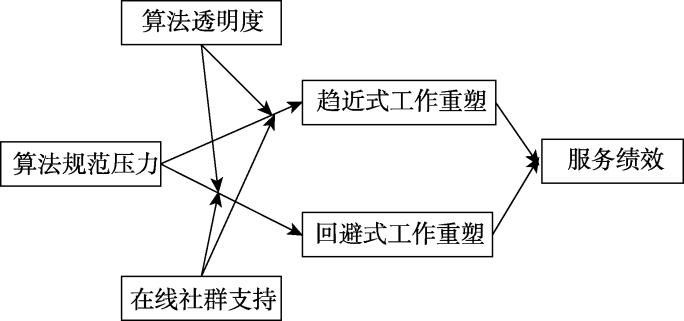
图1 研究模型
| 步骤与变量 | 趋近式工作重塑(模型1) | 回避式工作重塑(模型2) | 服务绩效(模型3) | |||
|---|---|---|---|---|---|---|
| β | SE | β | SE | β | SE | |
| 控制变量 | ||||||
| 性别 | −0.08 | 0.08 | 0.07 | 0.16 | −0.06 | 0.10 |
| 年龄 | −0.01 | 0.01 | 0.01 | 0.02 | 0.01 | 0.01 |
| 教育程度 | −0.11 | 0.07 | −0.11 | 0.13 | 0.04 | 0.08 |
| 职业类型 | 0.03 | 0.09 | −0.04 | 0.16 | 0.13 | 0.10 |
| 职业经验 | 0.04 | 0.04 | −0.13 | 0.07 | 0.04 | 0.04 |
| 主动性人格 | 0.21*** | 0.04 | −0.04 | 0.08 | 0.41*** | 0.05 |
| 社会赞许性 | −0.02 | 0.03 | 0.28*** | 0.06 | −0.19*** | 0.04 |
| 自变量 | ||||||
| 算法规范压力(操纵) | 0.29*** | 0.07 | 0.58*** | 0.14 | 0.03 | 0.10 |
| 中介变量 | ||||||
| 趋近式工作重塑 | 0.55*** | 0.07 | ||||
| 回避式工作重塑 | −0.17*** | 0.04 | ||||
| R2 | 0.14*** | 0.69 | 0.14*** | 1.33 | 0.29*** | 0.93 |
表1 多元回归分析表(研究1)
| 步骤与变量 | 趋近式工作重塑(模型1) | 回避式工作重塑(模型2) | 服务绩效(模型3) | |||
|---|---|---|---|---|---|---|
| β | SE | β | SE | β | SE | |
| 控制变量 | ||||||
| 性别 | −0.08 | 0.08 | 0.07 | 0.16 | −0.06 | 0.10 |
| 年龄 | −0.01 | 0.01 | 0.01 | 0.02 | 0.01 | 0.01 |
| 教育程度 | −0.11 | 0.07 | −0.11 | 0.13 | 0.04 | 0.08 |
| 职业类型 | 0.03 | 0.09 | −0.04 | 0.16 | 0.13 | 0.10 |
| 职业经验 | 0.04 | 0.04 | −0.13 | 0.07 | 0.04 | 0.04 |
| 主动性人格 | 0.21*** | 0.04 | −0.04 | 0.08 | 0.41*** | 0.05 |
| 社会赞许性 | −0.02 | 0.03 | 0.28*** | 0.06 | −0.19*** | 0.04 |
| 自变量 | ||||||
| 算法规范压力(操纵) | 0.29*** | 0.07 | 0.58*** | 0.14 | 0.03 | 0.10 |
| 中介变量 | ||||||
| 趋近式工作重塑 | 0.55*** | 0.07 | ||||
| 回避式工作重塑 | −0.17*** | 0.04 | ||||
| R2 | 0.14*** | 0.69 | 0.14*** | 1.33 | 0.29*** | 0.93 |
| 中介效应 | Indirect effect | Posterior S.D. | 95% CI |
|---|---|---|---|
| H2a: 算法规范压力→趋近式工作重塑→服务绩效 | 0.16 | 0.05 | [0.077, 0.256] |
| H2b: 算法规范压力→回避式工作重塑→服务绩效 | −0.10 | 0.03 | [−0.164, −0.045] |
| 整体中介: 算法规范压力→趋近式/回避式工作重塑→服务绩效 | 0.06 | 0.06 | [−0.050, 0.179] |
表2 中介效应检验结果(研究1)
| 中介效应 | Indirect effect | Posterior S.D. | 95% CI |
|---|---|---|---|
| H2a: 算法规范压力→趋近式工作重塑→服务绩效 | 0.16 | 0.05 | [0.077, 0.256] |
| H2b: 算法规范压力→回避式工作重塑→服务绩效 | −0.10 | 0.03 | [−0.164, −0.045] |
| 整体中介: 算法规范压力→趋近式/回避式工作重塑→服务绩效 | 0.06 | 0.06 | [−0.050, 0.179] |
| 变量 | 1 | 2 | 3 | 4 | 5 | 6 | 7 | 8 | 9 | 10 | 11 | 12 | 13 | 14 | 15 |
|---|---|---|---|---|---|---|---|---|---|---|---|---|---|---|---|
| 1.性别 | —— | ||||||||||||||
| 2.年龄 | 0.03 | —— | |||||||||||||
| 3.教育程度 | 0.14** | −0.03 | —— | ||||||||||||
| 4.职业类型 | 0.16*** | −0.21*** | 0.18*** | —— | |||||||||||
| 5.职业经验 | −0.03 | 0.48*** | −0.04 | −0.35** | —— | ||||||||||
| 6.主动性人格 | 0.05 | −0.03 | 0.13* | 0.03 | −0.02 | (0.95) | |||||||||
| 7.算法规范压力 | −0.02 | 0.10 | 0.04 | 0.03 | 0.06 | 0.29*** | (0.92) | ||||||||
| 8.时间压力 | −0.02 | 0.03 | 0.00 | 0.02 | −0.08 | 0.07 | 0.19*** | (0.90) | |||||||
| 9.疏离压力 | −0.06 | −0.04 | 0.02 | 0.08 | −0.08 | 0.11 | 0.21*** | 0.50*** | (0.88) | ||||||
| 10.身心压力 | 0.08 | −0.04 | 0.07 | 0.05 | −0.04 | 0.11* | 0.15** | 0.45*** | 0.40*** | (0.84) | |||||
| 11.算法透明度 | −0.04 | 0.05 | −0.08 | −0.08 | 0.01 | 0.07 | 0.13* | 0.05 | 0.09 | −0.02 | (0.87) | ||||
| 12.在线社群支持 | −0.06 | 0.04 | −0.03 | 0.02 | −0.04 | 0.19*** | 0.23*** | 0.09 | 0.13* | 0.06 | 0.16*** | (0.94) | |||
| 13.趋近式工作重塑 | −0.04 | −0.01 | 0.22*** | 0.06 | −0.05 | 0.11* | 0.30*** | 0.20*** | 0.14** | 0.14* | −0.05 | 0.11* | (0.94) | ||
| 14.回避式工作重塑 | −0.07 | 0.04 | 0.02 | −0.05 | 0.01 | 0.13* | 0.29*** | 0.26*** | 0.12* | 0.17*** | 0.15** | 0.16*** | 0.07 | (0.91) | |
| 15.服务绩效 | 0.01 | −0.02 | 0.06 | 0.10 | −0.06 | 0.13* | 0.06 | 0.00 | 0.08 | 0.03 | −0.08 | 0.31*** | 0.27*** | −0.14** | —— |
| 平均值 | 0.26 | 30.67 | 2.69 | 0.27 | 2.86 | 5.65 | 3.29 | 3.76 | 2.67 | 4.03 | 5.58 | 5.75 | 5.76 | 5.37 | 245.59 |
| 标准差 | 0.44 | 7.64 | 0.59 | 0.45 | 2.02 | 0.94 | 1.61 | 1.90 | 1.45 | 1.58 | 1.21 | 1.08 | 0.79 | 1.16 | 35.18 |
表3 描述性统计与相关分析表(研究2)
| 变量 | 1 | 2 | 3 | 4 | 5 | 6 | 7 | 8 | 9 | 10 | 11 | 12 | 13 | 14 | 15 |
|---|---|---|---|---|---|---|---|---|---|---|---|---|---|---|---|
| 1.性别 | —— | ||||||||||||||
| 2.年龄 | 0.03 | —— | |||||||||||||
| 3.教育程度 | 0.14** | −0.03 | —— | ||||||||||||
| 4.职业类型 | 0.16*** | −0.21*** | 0.18*** | —— | |||||||||||
| 5.职业经验 | −0.03 | 0.48*** | −0.04 | −0.35** | —— | ||||||||||
| 6.主动性人格 | 0.05 | −0.03 | 0.13* | 0.03 | −0.02 | (0.95) | |||||||||
| 7.算法规范压力 | −0.02 | 0.10 | 0.04 | 0.03 | 0.06 | 0.29*** | (0.92) | ||||||||
| 8.时间压力 | −0.02 | 0.03 | 0.00 | 0.02 | −0.08 | 0.07 | 0.19*** | (0.90) | |||||||
| 9.疏离压力 | −0.06 | −0.04 | 0.02 | 0.08 | −0.08 | 0.11 | 0.21*** | 0.50*** | (0.88) | ||||||
| 10.身心压力 | 0.08 | −0.04 | 0.07 | 0.05 | −0.04 | 0.11* | 0.15** | 0.45*** | 0.40*** | (0.84) | |||||
| 11.算法透明度 | −0.04 | 0.05 | −0.08 | −0.08 | 0.01 | 0.07 | 0.13* | 0.05 | 0.09 | −0.02 | (0.87) | ||||
| 12.在线社群支持 | −0.06 | 0.04 | −0.03 | 0.02 | −0.04 | 0.19*** | 0.23*** | 0.09 | 0.13* | 0.06 | 0.16*** | (0.94) | |||
| 13.趋近式工作重塑 | −0.04 | −0.01 | 0.22*** | 0.06 | −0.05 | 0.11* | 0.30*** | 0.20*** | 0.14** | 0.14* | −0.05 | 0.11* | (0.94) | ||
| 14.回避式工作重塑 | −0.07 | 0.04 | 0.02 | −0.05 | 0.01 | 0.13* | 0.29*** | 0.26*** | 0.12* | 0.17*** | 0.15** | 0.16*** | 0.07 | (0.91) | |
| 15.服务绩效 | 0.01 | −0.02 | 0.06 | 0.10 | −0.06 | 0.13* | 0.06 | 0.00 | 0.08 | 0.03 | −0.08 | 0.31*** | 0.27*** | −0.14** | —— |
| 平均值 | 0.26 | 30.67 | 2.69 | 0.27 | 2.86 | 5.65 | 3.29 | 3.76 | 2.67 | 4.03 | 5.58 | 5.75 | 5.76 | 5.37 | 245.59 |
| 标准差 | 0.44 | 7.64 | 0.59 | 0.45 | 2.02 | 0.94 | 1.61 | 1.90 | 1.45 | 1.58 | 1.21 | 1.08 | 0.79 | 1.16 | 35.18 |
| 步骤与变量 | 趋近式工作重塑(模型1) | 回避式工作重塑(模型2) | 服务绩效(模型3) | |||
|---|---|---|---|---|---|---|
| β | SE | β | SE | β | SE | |
| 控制变量 | ||||||
| 性别 | −0.14 | 0.09 | −0.11 | 0.13 | −0.46 | 4.03 |
| 年龄 | 0.00 | 0.01 | 0.00 | 0.01 | 0.07 | 0.26 |
| 教育程度 | 0.26*** | 0.07 | 0.08 | 0.10 | −0.48 | 3.04 |
| 职业类型 | 0.00 | 0.10 | −0.16 | 0.14 | 5.02 | 4.21 |
| 职业经验 | −0.01 | 0.02 | −0.01 | 0.03 | −0.22 | 1.02 |
| 主动性人格 | 0.01 | 0.04 | 0.02 | 0.06 | 3.41 | 1.93 |
| 时间压力 | 0.06* | 0.03 | 0.13*** | 0.04 | −1.23 | 1.14 |
| 疏离压力 | −0.03 | 0.03 | −0.03 | 0.05 | 0.75 | 1.44 |
| 身心压力 | 0.03 | 0.03 | 0.02 | 0.04 | 0.85 | 1.27 |
| 自变量 | ||||||
| 算法规范压力 | 0.11*** | 0.03 | 0.20*** | 0.04 | −1.45 | 1.25 |
| 中介变量 | ||||||
| 趋近式工作重塑 | 9.63*** | 2.43 | ||||
| 回避式工作重塑 | −4.57** | 1.66 | ||||
| 调节变量 | ||||||
| 算法透明度 | −0.04 | 0.03 | 0.08 | 0.05 | −2.38 | 1.46 |
| 在线社群支持 | 0.10* | 0.04 | −0.02 | 0.06 | 11.51*** | 1.80 |
| 交互项 | ||||||
| 算法规范压力×算法透明度 | 0.05** | 0.02 | −0.10*** | 0.03 | 1.80* | 0.87 |
| 算法规范压力×在线社群支持 | 0.08** | 0.02 | −0.12*** | 0.04 | 1.26 | 1.10 |
| R2 | 0.21*** | 0.71 | 0.23*** | 1.04 | 0.23*** | 31.65 |
表4 多元回归分析表(研究2)
| 步骤与变量 | 趋近式工作重塑(模型1) | 回避式工作重塑(模型2) | 服务绩效(模型3) | |||
|---|---|---|---|---|---|---|
| β | SE | β | SE | β | SE | |
| 控制变量 | ||||||
| 性别 | −0.14 | 0.09 | −0.11 | 0.13 | −0.46 | 4.03 |
| 年龄 | 0.00 | 0.01 | 0.00 | 0.01 | 0.07 | 0.26 |
| 教育程度 | 0.26*** | 0.07 | 0.08 | 0.10 | −0.48 | 3.04 |
| 职业类型 | 0.00 | 0.10 | −0.16 | 0.14 | 5.02 | 4.21 |
| 职业经验 | −0.01 | 0.02 | −0.01 | 0.03 | −0.22 | 1.02 |
| 主动性人格 | 0.01 | 0.04 | 0.02 | 0.06 | 3.41 | 1.93 |
| 时间压力 | 0.06* | 0.03 | 0.13*** | 0.04 | −1.23 | 1.14 |
| 疏离压力 | −0.03 | 0.03 | −0.03 | 0.05 | 0.75 | 1.44 |
| 身心压力 | 0.03 | 0.03 | 0.02 | 0.04 | 0.85 | 1.27 |
| 自变量 | ||||||
| 算法规范压力 | 0.11*** | 0.03 | 0.20*** | 0.04 | −1.45 | 1.25 |
| 中介变量 | ||||||
| 趋近式工作重塑 | 9.63*** | 2.43 | ||||
| 回避式工作重塑 | −4.57** | 1.66 | ||||
| 调节变量 | ||||||
| 算法透明度 | −0.04 | 0.03 | 0.08 | 0.05 | −2.38 | 1.46 |
| 在线社群支持 | 0.10* | 0.04 | −0.02 | 0.06 | 11.51*** | 1.80 |
| 交互项 | ||||||
| 算法规范压力×算法透明度 | 0.05** | 0.02 | −0.10*** | 0.03 | 1.80* | 0.87 |
| 算法规范压力×在线社群支持 | 0.08** | 0.02 | −0.12*** | 0.04 | 1.26 | 1.10 |
| R2 | 0.21*** | 0.71 | 0.23*** | 1.04 | 0.23*** | 31.65 |
| 中介效应/有调节的中介效应 | Indirect effect | Posterior S.D. | 95% CI |
|---|---|---|---|
| 中介效应 | |||
| H2a: 算法规范压力→趋近式工作重塑→服务绩效 | 1.21 | 0.41 | [0.546, 2.116] |
| H2b: 算法规范压力→回避式工作重塑→服务绩效 | −0.95 | 0.38 | [−1.800, −0.331] |
| 整体中介: 算法规范压力→趋近式/回避式工作重塑→服务绩效 | 0.26 | 0.55 | [−0.829, 1.365] |
| 有调节的中介效应 | |||
| H5a: 算法规范压力→趋近式工作重塑→服务绩效 | |||
| 高算法透明度 (+1 SD) | 1.94 | 0.58 | [0.945, 3.210] |
| 低算法透明度 (−1 SD) | 0.49 | 0.45 | [−0.306, 1.462] |
| 差异 | 1.41 | 0.64 | [0.353, 2.826] |
| H5b: 算法规范压力→回避式工作重塑→服务绩效 | |||
| 高算法透明度 (+1 SD) | −0.31 | 0.30 | [−1.003, 0.161] |
| 低算法透明度 (−1 SD) | −1.60 | 0.59 | [−2.873, −0.575] |
| 差异 | 1.24 | 0.55 | [0.379, 2.518] |
| H6a: 算法规范压力→趋近式工作重塑→服务绩效 | |||
| 高在线社群支持 (+1 SD) | 2.20 | 0.60 | [1.142, 3.472] |
| 低在线社群支持 (−1 SD) | 0.25 | 0.50 | [−0.700, 1.270] |
| 差异 | 1.91 | 0.74 | [0.671, 3.550] |
| H6b: 算法规范压力→回避式工作重塑→服务绩效 | |||
| 高在线社群支持 (+1 SD) | −0.31 | 0.29 | [−0.954, 0.166] |
| 低在线社群支持 (−1 SD) | −1.59 | 0.61 | [−2.961, −0.567] |
| 差异 | 1.24 | 0.59 | [0.339, 2.621] |
表5 中介效应与有调节的中介效应检验结果(研究2)
| 中介效应/有调节的中介效应 | Indirect effect | Posterior S.D. | 95% CI |
|---|---|---|---|
| 中介效应 | |||
| H2a: 算法规范压力→趋近式工作重塑→服务绩效 | 1.21 | 0.41 | [0.546, 2.116] |
| H2b: 算法规范压力→回避式工作重塑→服务绩效 | −0.95 | 0.38 | [−1.800, −0.331] |
| 整体中介: 算法规范压力→趋近式/回避式工作重塑→服务绩效 | 0.26 | 0.55 | [−0.829, 1.365] |
| 有调节的中介效应 | |||
| H5a: 算法规范压力→趋近式工作重塑→服务绩效 | |||
| 高算法透明度 (+1 SD) | 1.94 | 0.58 | [0.945, 3.210] |
| 低算法透明度 (−1 SD) | 0.49 | 0.45 | [−0.306, 1.462] |
| 差异 | 1.41 | 0.64 | [0.353, 2.826] |
| H5b: 算法规范压力→回避式工作重塑→服务绩效 | |||
| 高算法透明度 (+1 SD) | −0.31 | 0.30 | [−1.003, 0.161] |
| 低算法透明度 (−1 SD) | −1.60 | 0.59 | [−2.873, −0.575] |
| 差异 | 1.24 | 0.55 | [0.379, 2.518] |
| H6a: 算法规范压力→趋近式工作重塑→服务绩效 | |||
| 高在线社群支持 (+1 SD) | 2.20 | 0.60 | [1.142, 3.472] |
| 低在线社群支持 (−1 SD) | 0.25 | 0.50 | [−0.700, 1.270] |
| 差异 | 1.91 | 0.74 | [0.671, 3.550] |
| H6b: 算法规范压力→回避式工作重塑→服务绩效 | |||
| 高在线社群支持 (+1 SD) | −0.31 | 0.29 | [−0.954, 0.166] |
| 低在线社群支持 (−1 SD) | −1.59 | 0.61 | [−2.961, −0.567] |
| 差异 | 1.24 | 0.59 | [0.339, 2.621] |
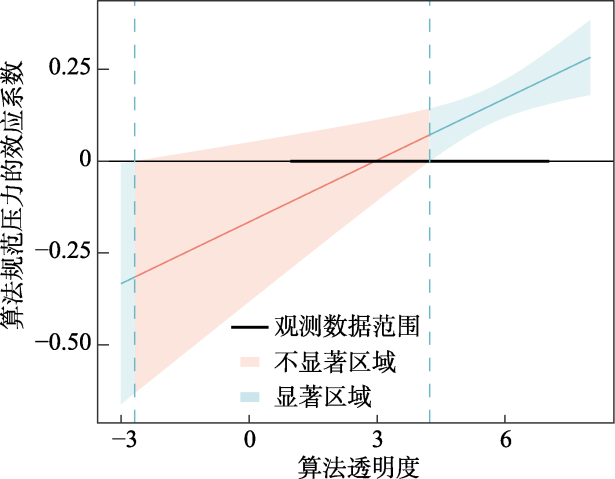
图2 算法透明度在算法规范压力与趋近式工作重塑之间的调节效应(研究2) 注:彩图见电子版, 下同
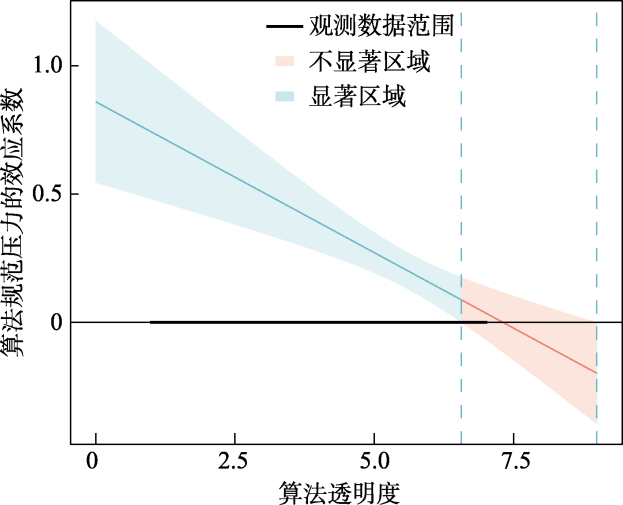
图3 算法透明度在算法规范压力与回避式工作重塑之间的调节效应(研究2)
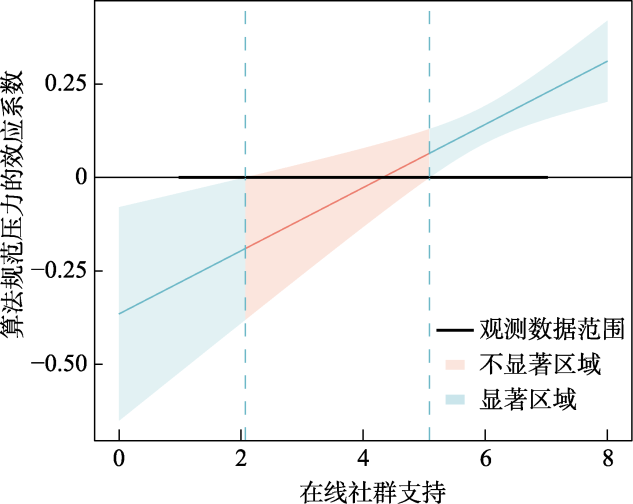
图4 在线社群支持在算法规范压力与趋近式工作重塑之间的调节效应(研究2)
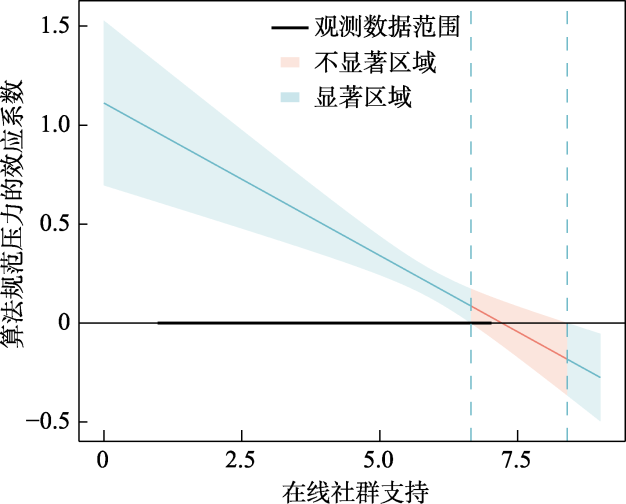
图5 在线社群支持在算法规范压力与回避式工作重塑之间的调节效应(研究2)
| [1] | Ashford, S. J., Caza, B. B., & Reid, E. M. (2018). From surviving to thriving in the gig economy: A research agenda for individuals in the new world of work. Research in Organizational Behavior, 38, 23-41. |
| [2] | Bakker, A. B., & Demerouti, E. (2017). Job demands- resources theory: Taking stock and looking forward. Journal of Occupational Health Psychology, 22(3), 273-285. |
| [3] | Bakker, A. B., Demerouti, E., & Sanz-Vergel, A. (2023). Job demands-resources theory: Ten years later. Annual Review of Organizational Psychology and Organizational Behavior, 10(1), 25-53. |
| [4] | Bakker, A. B., Demerouti, E., & Schaufeli, W. B. (2003). Dual processes at work in a call center: An application of the job demands-resources model. Journal of Vocational Behavior, 63(3), 393-417. |
| [5] | Bakker, A. B., & de Vries, J. D. (2021). Job demands- resources theory and self-regulation: New explanations and remedies for job burnout. Anxiety, Stress, & Coping, 34(1), 1-21. |
| [6] | Bakker, A. B., Tims, M., & Derks, D. (2012). Proactive personality and job performance: The role of job crafting and work engagement. Human Relations, 65(10), 1359-1378. |
| [7] | Bakker, A. B., van Veldhoven, M., & Xanthopoulou, D. (2010). Beyond the demand-control model: Thriving on high job demands and resources. Journal of Personnel Psychology, 9(1), 3-16. |
| [8] | Bettencourt, L. A., & Brown, S. W. (1997). Contact employees: Relationships among workplace fairness, job satisfaction, and prosocial service behaviors. Journal of Retailing, 73(1), 39-61. |
| [9] | Brislin, R. W. (1970). Back-translation for cross-cultural research. Journal of Cross-cultural Psychology, 1(3), 185-216. |
| [10] |
Brough, P., Drummond, S., & Biggs, A. (2018). Job support, coping, and control: Assessment of simultaneous impacts within the occupational stress process. Journal of Occupational Health Psychology, 23(2), 188-197.
doi: 10.1037/ocp0000074 pmid: 28192000 |
| [11] | Bruning, P. F., & Campion, M. A. (2018). A role-resource approach-avoidance model of job crafting: A multimethod integration and extension of job crafting theory. Academy of Management Journal, 61(2), 499-522. |
| [12] | Cameron, L. D. (2022). “Making out” while driving: Relational and efficiency games in the gig economy. Organization Science, 33(1), 231-252. |
| [13] | Carneiro, L. L., Medeiros, G. T., de Araújo, I. S., & Abbas, M. A. A. (2023). Demands and resources in work mediated by digital platforms: A scoping review of the literature. Organizações & Sociedade, 30(104), 110-140. |
| [14] | Caza, B. B., Reid, E. M., Ashford, S. J., & Granger, S. (2022). Working on my own: Measuring the challenges of gig work. Human Relations, 75(11), 2122-2159. |
| [15] | Cho, Y., & Jiang, W. Y. (2022). How work orientation impacts objective career outcomes via managerial (mis)perceptions. Academy of Management Journal, 65(4), 1353-1382. |
| [16] | Cram, W. A., Wiener, M., Tarafdar, M., & Benlian, A. (2022). Examining the impact of algorithmic control on Uber drivers’ technostress. Journal of Management Information Systems, 39(2), 426-453. |
| [17] |
Crawford, E. R., LePine, J. A., & Rich, B. L. (2010). Linking job demands and resources to employee engagement and burnout: A theoretical extension and meta-analytic test. Journal of Applied Psychology, 95(5), 834-848.
doi: 10.1037/a0019364 pmid: 20836586 |
| [18] | Cropanzano, R., Keplinger, K., Lambert, B. K., Caza, B., & Ashford, S. J. (2023). The organizational psychology of gig work: An integrative conceptual review. Journal of Applied Psychology, 108(3), 492-519. |
| [19] | Daniels, K., & De Jonge, J. (2010). Match making and match breaking: The nature of match within and around job design. Journal of Occupational and Organizational Psychology, 83(1), 1-16. |
| [20] | Demerouti, E., & Bakker, A. B. (2023). Job demands- resources theory in times of crises: New propositions. Organizational Psychology Review, 13(3), 209-236. |
| [21] |
Demerouti, E., Bakker, A. B., Nachreiner, F., & Schaufeli, W. B. (2001). The job demands-resources model of burnout. Journal of Applied Psychology, 86(3), 499-512.
pmid: 11419809 |
| [22] | Deng, J., Guo, Y., Ma, T., Yang, T., & Tian, X. (2019). How job stress influences job performance among Chinese healthcare workers: A cross-sectional study. Environmental Health and Preventive Medicine, 24(1), 1-11. |
| [23] |
Duggan, J., Sherman, U., Carbery, R., & McDonnell, A. (2020). Algorithmic management and app-work in the gig economy: A research agenda for employment relations and HRM. Human Resource Management Journal, 30(1), 114-132.
doi: 10.1111/1748-8583.12258 |
| [24] | Durcikova, A., & Gray, P. (2009). How knowledge validation processes affect knowledge contribution. Journal of Management Information Systems, 25(4), 81-108. |
| [25] | Gagné, M., Parent-Rocheleau, X., Bujold, A., Gaudet, M.-C., & Lirio, P. (2022). How algorithmic management influences worker motivation: A self-determination theory perspective. Canadian Psychology/Psychologie Canadienne, 63(2), 247-260. |
| [26] | Gao, X., Zhang, Z., Qian, Z., Xie, B., & Wen, X. (2023). Gig-worker’s work pressure: Formation mechanism and scale development. Nankai Business Review, 26(3), 244-256. |
| [高雪原, 张志朋, 钱智超, 谢宝国, 闻效仪. (2023). 零工工作者工作压力:形成机理与量表开发. 南开管理评论, 26(3), 244-256.] | |
| [27] | Hobfoll, S. E., Halbesleben, J., Neveu, J. P., & Westman, M. (2018). Conservation of resources in the organizational context: The reality of resources and their consequences. Annual Review of Organizational Psychology and Organizational Behavior, 5(1), 103-128. |
| [28] |
Jiang, F., & Wang, Z. (2022). Applications of cognitive appraisal theory of stress in managerial psychology research: Scenes, methods, and myths. Advances in Psychological Science, 30(12), 2825-2845.
doi: 10.3724/SP.J.1042.2022.02825 |
|
[姜福斌, 王震. (2022). 压力认知评价理论在管理心理学中的应用: 场景, 方式与迷思. 心理科学进展, 30(12), 2825-2845.]
doi: 10.3724/SP.J.1042.2022.02825 |
|
| [29] | Keegan, A., & Meijerink, J. (in press). Algorithmic human resource management: A critical review and research agenda. Human Resource Management Review. |
| [30] | Kellogg, K. C., Valentine, M. A., & Christin, A. (2020). Algorithms at work: The new contested terrain of control. Academy of Management Annals, 14(1), 366-410. |
| [31] | Lee, Y., Lee, J., & Hwang, Y. (2015). Relating motivation to information and communication technology acceptance: Self-determination theory perspective. Computers in Human Behavior, 51, 418-428. |
| [32] | Lepine, J. A., Podsakoff, N. P., & Lepine, M. A. (2005). A meta-analytic test of the challenge stressor-hindrance stressor framework: An explanation for inconsistent relationships among stressors and performance. Academy of Management Journal, 48(5), 764-775. |
| [33] | LePine, M. A. (2022). The challenge-hindrance stressor framework: An Integrative conceptual review and path forward. Group & Organization Management, 47(2), 223-254. |
| [34] | Lesener, T., Gusy, B., & Wolter, C. (2019). The job demands- resources model: A meta-analytic review of longitudinal studies. Work & Stress, 33(1), 76-103. |
| [35] | Li, Y., Tuckey, M. R., Bakker, A., Chen, P. Y., & Dollard, M. F. (2023). Linking objective and subjective job demands and resources in the JD-R model: A multilevel design. Work & Stress, 37(1), 27-54. |
| [36] | Liang, B., Wang, Y., Huo, W., Song, M., & Shi, Y. (2025). Algorithmic control as a double-edged sword: Its relationship with service performance and work well-being. Journal of Business Research, 189, 115199. |
| [37] | Liang, T. P., Ho, Y. T., Li, Y. W., & Turban, E. (2011). What drives social commerce: The role of social support and relationship quality. International Journal of Electronic Commerce, 16(2), 69-90. |
| [38] | Little, T. D., Cunningham, W. A., Shahar, G., & Widaman, K. F. (2002). To parcel or not to parcel: Exploring the question, weighing the merits. Structural Equation Modeling: A Multidisciplinary Journal, 9(2), 151-173. |
| [39] | Liu, S., Pei, J., Ge, C., Liu, X., & Chen, Y. (2022). Algorithmic management of online labor platforms: Theoretical exploration and research prospect. Journal of Management World, 38(2), 225-239. |
| [刘善仕, 裴嘉良, 葛淳棉, 刘小浪, 谌一璠. (2022). 在线劳动平台算法管理: 理论探索与研究展望. 管理世界, 38(2), 225-239.] | |
| [40] | Lu, Y., Yang, M. M., Zhu, J., & Wang, Y. (2024). Dark side of algorithmic management on platform worker behaviors: A mixed-method study. Human Resource Management, 63(3), 477-498. |
| [41] |
Meyer, B., Zill, A., Dilba, D., Gerlach, R., & Schumann, S. (2021). Employee psychological well-being during the COVID-19 pandemic in Germany: A longitudinal study of demands, resources, and exhaustion. International Journal of Psychology, 56(4), 532-550.
doi: 10.1002/ijop.12743 pmid: 33615477 |
| [42] | Möhlmann, M., de Lima Salge, C. A., & Marabelli, M. (2023). Algorithm sensemaking: How platform workers make sense of algorithmic management. Journal of the Association for Information Systems, 24(1), 35-64. |
| [43] | Möhlmann, M., Zalmanson, L., Henfridsson, O., & Gregory, R. W. (2021). Algorithmic management of work on online labor platforms: When matching meets control. MIS Quarterly, 45(4), 1999-2022. |
| [44] |
Motowidlo, S. J., Packard, J. S., & Manning, M. R. (1986). Occupational stress: Its causes and consequences for job performance. Journal of Applied Psychology, 71(4), 618-629.
pmid: 3804934 |
| [45] | Muthén, B., Muthén, L. K., & Asparouhov, T. (2010). Bayesian analysis using Mplus. https://www.statmodel.com/download/Bayes3.pdf |
| [46] | Pei, J., Liu, S., Cui, X., & Qu, J. (2021). Perceived algorithmic control of gig workers: Conceptualization, measurement, and verification the impact on service performance. Nankai Business Review, 24(6), 14-27. |
| [裴嘉良, 刘善仕, 崔勋, 瞿皎姣. (2021). 零工工作者感知算法控制: 概念化、测量与服务绩效影响验证. 南开管理评论, 24(6), 14-27.] | |
| [47] |
Poulton, E. C., Lin, S. H. J., Fatimah, S., Ho, C. M., Ferris, D. L., & Johnson, R. E. (2024). My manager endorsed my coworkers' voice: Understanding observers' positive and negative reactions to managerial endorsement of coworker voice. Journal of Applied Psychology, 109(8), 1250-1270.
doi: 10.1037/apl0001180 pmid: 38270994 |
| [48] | Rahman, H. A., Weiss, T., & Karunakaran, A. (2023). The experimental hand: How platform-based experimentation reconfigures worker autonomy. Academy of Management Journal, 66(6), 1803-1830. |
| [49] |
Roese, N. J. (1997). Counterfactual thinking. Psychological Bulletin, 121(1), 133-148.
pmid: 9000895 |
| [50] |
Seibert, S. E., Crant, J. M., & Kraimer, M. L. (1999). Proactive personality and career success. Journal of Applied Psychology, 84(3), 416-427.
doi: 10.1037/0021-9010.84.3.416 pmid: 10380421 |
| [51] |
Shevchuk, A., Strebkov, D., & Davis, S. N. (2019). The autonomy paradox: How night work undermines subjective well-being of internet-based freelancers. ILR Review, 72(1), 75-100.
doi: 10.1177/0019793918767114 |
| [52] | Shin, D., & Park, Y. J. (2019). Role of fairness, accountability, and transparency in algorithmic affordance. Computers in Human Behavior, 98, 277-284. |
| [53] | Strahan, R., & Gerbasi, K. C. (1972). Short, homogeneous versions of the Marlowe-Crowne social desirability scale. Journal of Clinical Psychology, 28(2), 191-193. |
| [54] | Tims, M., & Bakker, A. B. (2010). Job crafting: Towards a new model of individual job redesign. Journal of Industrial Psychology, 36(2), 1-9. |
| [55] | Tims, M., Bakker, A. B., & Derks, D. (2012). Development and validation of the job crafting scale. Journal of Vocational Behavior, 80(1), 173-186. |
| [56] |
Tims, M., Bakker, A. B., & Derks, D. (2013). The impact of job crafting on job demands, job resources, and well-being. Journal of Occupational Health Psychology, 18(2), 230-240.
doi: 10.1037/a0032141 pmid: 23506549 |
| [57] | Tims, M., Bakker, A. B., & Derks, D. (2015). Job crafting and job performance: A longitudinal study. European Journal of Work and Organizational Psychology, 24(6), 914-928. |
| [58] | Tims, M., Twemlow, M., & Fong, C. Y. M. (2022). A state-of-the-art overview of job-crafting research: Current trends and future research directions. Career Development International, 27(1), 54-78. |
| [59] | Van den Broeck, A., Vansteenkiste, M., De Witte, H., & Lens, W. (2010). Unpacking the demand-control-support model: The role of work-related basic need satisfaction. European Journal of Work and Organizational Psychology, 19(5), 555-577. |
| [60] | Verelst, L., De Cooman, R., & Verbruggen, M. (2023). Crafting when teleworking: A daily diary study on the combinations of job and home crafting and their relationship with energy depletion. Journal of Vocational Behavior, 143, 103880. |
| [61] |
Wallace, J. C., Edwards, B. D., Arnold, T., Frazier, M. L., & Finch, D. M. (2009). Work stressors, role-based performance, and the moderating influence of organizational support. Journal of Applied Psychology, 94(1), 254-262.
doi: 10.1037/a0013090 pmid: 19186910 |
| [62] |
Wang, H., Chen, Z., Li, Z., Liu, Z., Liang, C., & Zhao, B. (2025). How to break out of time dilemma: The subjective time boundaries for the effects of algorithmic control on gig workers. Acta Psychologica Sinica, 57(2), 275-297.
doi: 10.3724/SP.J.1041.2025.0275 |
|
[王红丽, 陈政任, 李振, 刘智强, 梁翠琪, 赵彬洁. (2025). 何以跳脱时间困境: 算法控制对零工工作者影响效应的主观时间边界. 心理学报, 57(2), 275-297.]
doi: 10.3724/SP.J.1041.2025.0275 |
|
| [63] |
Wang, J., Lan, Y., & Li, C. (2022). Challenge-hindrance stressors and innovation: A meta-analysis. Advances in Psychological Science, 30(4), 761-780.
doi: 10.3724/SP.J.1042.2022.00761 |
|
[王佳燕, 蓝媛美, 李超平. (2022). 二元工作压力与员工创新关系的元分析. 心理科学进展, 30(4), 761-780.]
doi: 10.3724/SP.J.1042.2022.00761 |
|
| [64] | Wang, X. (2020). Gig skills: The key to workers' "freedom of choice". Exploration and Free Views, 1(17), 29-31. |
| [王星. (2020). 零工技能: 劳动者“选择的自由”的关键. 探索与争鸣, 1(17), 29-31.] | |
| [65] | Watson, G. P., Kistler, L. D., Graham, B. A., & Sinclair, R. R. (2021). Looking at the gig picture: Defining gig work and explaining profile differences in gig workers’ job demands and resources. Group & Organization Management, 46(2), 327-361. |
| [66] | Wiener, M., Cram, W. A., & Benlian, A. (2023). Algorithmic control and gig workers: A legitimacy perspective of Uber drivers. MIS Quarterly, 47(1), 341-370. |
| [67] |
Wood, A. J., Graham, M., Lehdonvirta, V., & Hjorth, I. (2019). Good gig, bad gig: Autonomy and algorithmic control in the global gig economy. Work, Employment and Society, 33(1), 56-75.
doi: 10.1177/0950017018785616 pmid: 30886460 |
| [68] | Wrzesniewski, A., & Dutton, J. E. (2001). Crafting a job: Revisioning employees as active crafters of their work. Academy of Management Review, 26(2), 179-201. |
| [69] | Wu, D., & Huang, J. L. (2024). Gig work and gig workers: An integrative review and agenda for future research. Journal of Organizational Behavior, 45(2), 183-208. |
| [70] | Wu, G., Hu, Z., & Zheng, J. (2019). Role stress, job burnout, and job performance in construction project managers: The moderating role of career calling. International Journal of Environmental Research and Public Health, 16(13), 2394. |
| [71] | Zhang, X., & Xi, M. (2019). The double-paths effects of union practices on employee well-being: Based instrumental- emotional perspective. Advances in Psychological Science, 27(8), 1354-1362. |
|
[张戌凡, 席猛. (2019). 工会实践对员工工作幸福感的影响: 基于工具-情感的双路径视角. 心理科学进展, 27(8), 1354-1362.]
doi: 10.3724/SP.J.1042.2019.01354 |
|
| [72] | Zhang, Z., Wen, X., Qian, Z., Gao, X., & Pei, J. (2024). Emotional labor strategies of gig workers under algorithmic logic. Chinese Journal of Management, 21(3), 381-391. |
| [张志朋, 闻效仪, 钱智超, 高雪原, 裴嘉良. (2024). 算法逻辑下零工工作者的情绪劳动策略选择. 管理学报, 21(3), 381-391.] |
| [1] | 张慧, 刘燕君, 史燕伟, 张南. 客户支持对一线服务员工服务绩效的影响——基于自我验证理论的视角[J]. 心理学报, 2022, 54(4): 398-410. |
| [2] | 胡巧婷, 王海江, 龙立荣. 新员工工作重塑会带来积极的结果吗?领导成员交换与个体传统性的作用[J]. 心理学报, 2020, 52(5): 659-668. |
| 阅读次数 | ||||||
|
全文 |
|
|||||
|
摘要 |
|
|||||
