

ISSN 0439-755X
CN 11-1911/B
主办:中国心理学会
中国科学院心理研究所
出版:科学出版社
CN 11-1911/B
主办:中国心理学会
中国科学院心理研究所
出版:科学出版社
心理学报 ›› 2025, Vol. 57 ›› Issue (7): 1231-1247.doi: 10.3724/SP.J.1041.2025.1231 cstr: 32110.14.2025.1231
岑雨珊1, 夏凌翔1( ), 黄润玉2,1, 吕洁1
收稿日期:2024-07-24
发布日期:2025-04-24
出版日期:2025-07-25
通讯作者:
夏凌翔, E-mail: xialx@swu.edu.cn基金资助:
CEN Yushan1, XIA Lingxiang1(), HUANG Runyu2,1, LÜ Jie1
Received:2024-07-24
Online:2025-04-24
Published:2025-07-25
摘要:
伤害厌恶是人类道德的核心, 揭示它的结构与功能具有重要意义。伤害厌恶由伤害行为厌恶和伤害结果厌恶这两个相对独立的因素构成的观点尚未获得有力的实证支持, 这两个因素在抑制攻击方面的差异及其背后的机制也不清楚。为了探究这些问题, 我们实施了1个预实验和3个正式实验。预实验基于加工分离程序开发了伤害行为/结果厌恶分离任务, 实验1使用该任务检验了伤害厌恶的结构, 实验2 (包括2a和2b)探究了伤害行为/结果厌恶抑制攻击的道德认知机制。研究结果显示, 伤害厌恶由伤害行为厌恶和伤害结果厌恶这两个相对独立的因素构成。伤害结果厌恶可以通过道德推脱抑制攻击, 但伤害行为厌恶对道德推脱和攻击的抑制作用不稳健。通过上述实验, 本研究开发了伤害厌恶的研究工具, 检验了伤害厌恶的二因素结构及其在抑制攻击认知与行为上的差异, 揭示了伤害厌恶抑制攻击的道德认知路径。
中图分类号:
岑雨珊, 夏凌翔, 黄润玉, 吕洁. (2025). 伤害厌恶的二因素结构及其抑制攻击的机制. 心理学报, 57(7), 1231-1247.
CEN Yushan, XIA Lingxiang, HUANG Runyu, LÜ Jie. (2025). The two-factor structure of harm aversion and the mechanism underlying its function of resisting aggression. Acta Psychologica Sinica, 57(7), 1231-1247.
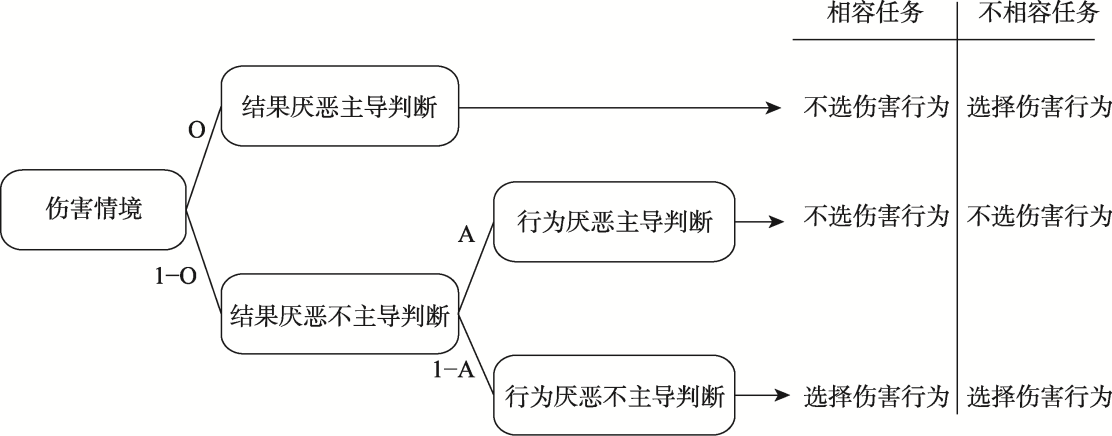
图1 伤害行为厌恶与伤害结果厌恶分离的处理树 注:A, 伤害行为厌恶参数; O, 伤害结果厌恶参数
| 效标 | A参数 | O参数 | 相关差异检验z | 相关差异检验p |
|---|---|---|---|---|
| 伤害行为厌恶效标 | 0.16** | 0.23*** | −0.90 | 0.370 |
| 伤害结果厌恶效标 | 0.08 | 0.23*** | −2.02* | 0.044 |
| 共情关注 | 0.13* | 0.30*** | −2.25* | 0.024 |
| 传统道德判断 | 0.27*** | 0.22*** | 0.61 | 0.544 |
| 道义主义D参数 | 0.29*** | 0.28*** | 0.22 | 0.830 |
| 功利主义U参数 | −0.05 | −0.01 | −0.56 | 0.579 |
| 莱文森精神病态 | −0.27*** | −0.42*** | 2.07* | 0.038 |
| 身体攻击 | −0.22*** | −0.22*** | 0.05 | 0.958 |
| 口头攻击 | −0.09 | −0.13* | 0.47 | 0.638 |
表1 A参数、O参数与效标之间的相关
| 效标 | A参数 | O参数 | 相关差异检验z | 相关差异检验p |
|---|---|---|---|---|
| 伤害行为厌恶效标 | 0.16** | 0.23*** | −0.90 | 0.370 |
| 伤害结果厌恶效标 | 0.08 | 0.23*** | −2.02* | 0.044 |
| 共情关注 | 0.13* | 0.30*** | −2.25* | 0.024 |
| 传统道德判断 | 0.27*** | 0.22*** | 0.61 | 0.544 |
| 道义主义D参数 | 0.29*** | 0.28*** | 0.22 | 0.830 |
| 功利主义U参数 | −0.05 | −0.01 | −0.56 | 0.579 |
| 莱文森精神病态 | −0.27*** | −0.42*** | 2.07* | 0.038 |
| 身体攻击 | −0.22*** | −0.22*** | 0.05 | 0.958 |
| 口头攻击 | −0.09 | −0.13* | 0.47 | 0.638 |
| 变量 | M | SD | 1 | 2 | 3 | 4 | 5 |
|---|---|---|---|---|---|---|---|
| 1. A参数 | 0.57 | 0.16 | − | ||||
| 2. O参数 | 0.23 | 0.32 | 0.09 | − | |||
| 3. 道德推脱 | 1.99 | 0.55 | −0.17*** | −0.32*** | − | ||
| 4. 身体攻击 | 1.84 | 0.63 | −0.16** | −0.32*** | 0.60*** | − | |
| 5. 口头攻击 | 2.60 | 0.73 | −0.05 | −0.13** | 0.32*** | 0.48*** | − |
表2 描述统计及相关分析
| 变量 | M | SD | 1 | 2 | 3 | 4 | 5 |
|---|---|---|---|---|---|---|---|
| 1. A参数 | 0.57 | 0.16 | − | ||||
| 2. O参数 | 0.23 | 0.32 | 0.09 | − | |||
| 3. 道德推脱 | 1.99 | 0.55 | −0.17*** | −0.32*** | − | ||
| 4. 身体攻击 | 1.84 | 0.63 | −0.16** | −0.32*** | 0.60*** | − | |
| 5. 口头攻击 | 2.60 | 0.73 | −0.05 | −0.13** | 0.32*** | 0.48*** | − |
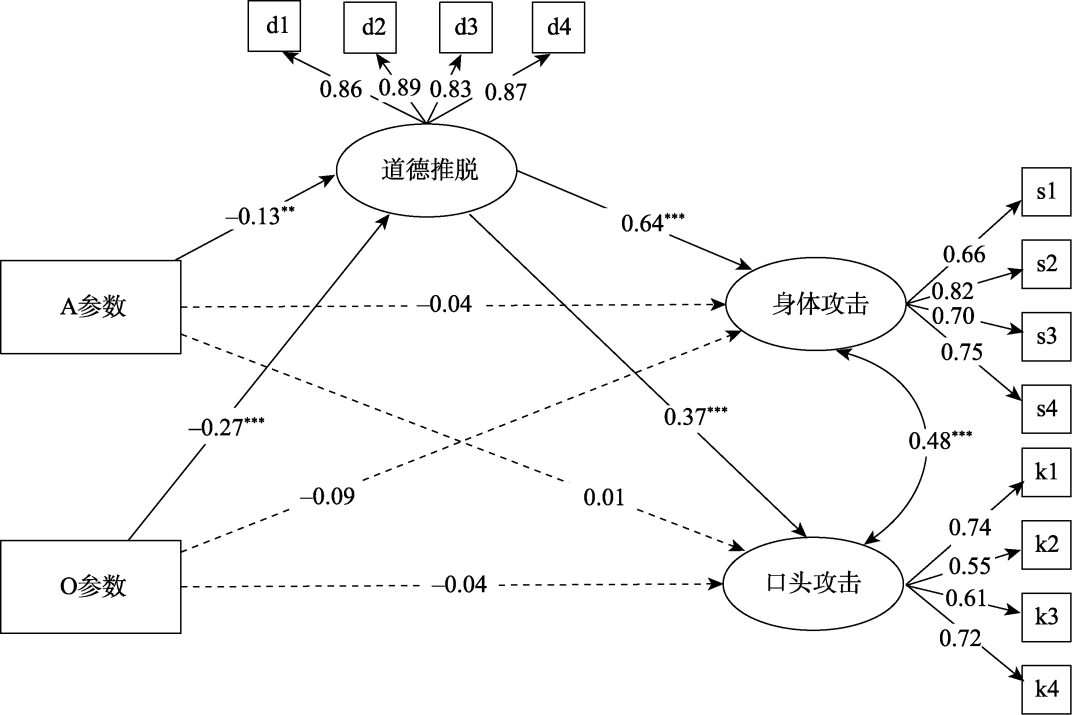
图2 A/O参数、道德推脱与身体/口头攻击的结构模型 注:路径系数为标准化系数, *p < 0.05; **p < 0.01; ***p < 0.001。为了显示美观, 性别和年龄的路径被隐藏, 虚线表明路径不显著。

图3 伤害−获得任务的单个试次示例
| 变量 | M | SD | 1 | 2 | 3 | 4 |
|---|---|---|---|---|---|---|
| 1. A参数 | 0.51 | 0.16 | − | |||
| 2. O参数 | 0.25 | 0.27 | 0.17 | − | ||
| 3. 道德推脱 | 2.00 | 0.58 | −0.02 | −0.21* | − | |
| 4. 攻击行为 | 0.48 | 0.36 | −0.01 | −0.24* | 0.60*** | − |
表3 描述统计及相关分析
| 变量 | M | SD | 1 | 2 | 3 | 4 |
|---|---|---|---|---|---|---|
| 1. A参数 | 0.51 | 0.16 | − | |||
| 2. O参数 | 0.25 | 0.27 | 0.17 | − | ||
| 3. 道德推脱 | 2.00 | 0.58 | −0.02 | −0.21* | − | |
| 4. 攻击行为 | 0.48 | 0.36 | −0.01 | −0.24* | 0.60*** | − |
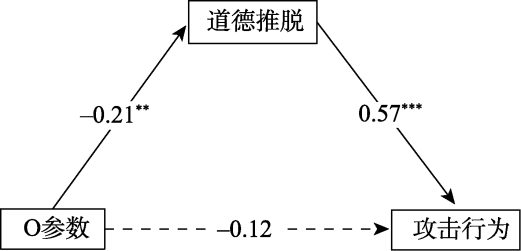
图4 道德推脱在O参数与攻击行为之间的中介作用
注:* p < 0.05, ** p < 0.01, *** p < 0.001。
| 路径 | 效应量 | 95% CI | 效应占比 | |
|---|---|---|---|---|
| 下限 | 上限 | |||
| 总效应: O参数→攻击行为 | −0.23 | −0.39 | −0.06 | 100% |
| 中介效应: O参数→道德推脱→攻击行为 | −0.12 | −0.21 | −0.02 | 50.00% |
| 直接效应: O参数→攻击行为 | −0.12 | −0.26 | 0.03 | 50.00% |
表4 中介效应整体性检验
| 路径 | 效应量 | 95% CI | 效应占比 | |
|---|---|---|---|---|
| 下限 | 上限 | |||
| 总效应: O参数→攻击行为 | −0.23 | −0.39 | −0.06 | 100% |
| 中介效应: O参数→道德推脱→攻击行为 | −0.12 | −0.21 | −0.02 | 50.00% |
| 直接效应: O参数→攻击行为 | −0.12 | −0.26 | 0.03 | 50.00% |
| 序号 | 情境 | 相容条件 | 不相容条件 |
|---|---|---|---|
| 1 | 人质困境 | 1-1:你被一个变态的蒙面歹徒绑到一间木屋, 你发现他还绑了其它人质, 并对这些人质进行折磨和残害。歹徒告诉你, 如果想要活着出去, 你必须做出选择: 选择1:用皮鞭把另一个被蒙住双眼的人质打到惨叫。 选择2:你身上的所有积蓄和重要财物都被歹徒搜走。 | 1-2:你被一个变态的蒙面歹徒绑到密室, 你发现他还绑了其它人质, 并对这些人质实行不同的折磨和恐吓。歹徒告诉你, 如果想要活着出去, 你必须做出选择: 选择1:用锤子在一个非常逼真的仿真假人身上钉10颗钉子, 以恐吓其他人质。 选择2:看着一个浑身是血的人质惨叫不止, 持续20分钟以上。 |
| 2 | 秘密行动 | 2-1:请假想你是中东某秘密组织中的一名成员, 这天你收到上级指示, 要求你严刑拷打一名路人, 让他认罪并受1年的牢狱之灾。假定现在只有以下两种办法, 你会选择: 选择1:亲自用各种刑具拷打路人, 使其痛苦到只能屈打成招。 选择2:你违背上级指令, 因此被关入禁闭室, 在污秽的环境中, 独自生活半个月。 | 2-2:请假想你是中东某秘密组织中的一名成员, 这天你收到上级指示, 要求你严刑拷打一名路人, 让他认罪并受1年的牢狱之灾。假定现在只有两种办法, 你会选择: 选择1:你亲自动手, 掌握好火候, 持续低强度地拷打这名路人几天, 再结合心理战术让这个路人在还没有真正受伤的时候就认罪。 选择2:你让下属动手, 在下属告诉你差不多的时候, 你才走进刑房, 看着这个被折磨得浑身是伤、痛苦得受不了的路人在你面前认罪。 |
| 3 | 穿越身份 | 3-1:假如你穿越到古代, 并且只能从以下两个角色中选取一个, 你会选择: 角色A:你需要经常完成殴打他人的任务, 并看到他人被你打到受伤。 角色B:你每天需要没日没夜地干很多苦力活, 例如打水、洗衣、烧柴、浇花等。 | 3-2:假如你穿越到古代, 并且只能从以下两个角色中选取一个, 你会选择: 角色A:你需要经常在街上演出, 演出内容通常是:用一把可伸缩的道具刀刺向同伴的脖子; 用锤子砸向同伴的胸口等。 角色B:你需要观察和记录受害人的受伤情况和死亡状态, 并看管受害人的尸体。 |
| 4 | 实习警察 | 4-1:假如你是一名正在接受训练的特工, 即将被派到恐怖分子的据点当卧底, 为了检验你是否能胜任卧底任务, 长官决定对你进行最后一次测试, 他给了你两个选择, 让你选择其中一个完成: 选择1:亲自执行枪决任务, 并看着犯人中枪躺在血泊中死去。 选择2:独自在缺乏食物来源和水源的荒野中生活一周。 | 4-2:假如你是一名正在接受训练的特工, 即将被派到恐怖分子的据点当卧底, 为了检验你对敌人不会心慈手软, 长官决定对你进行最后一次测试, 他给了你两个选择, 让你选择其中一个完成: 选择1: 在同行穿着防弹衣的情况下, 对不知情的同行开5枪(他/她不会真正受伤)。 选择2:不动声色地观看5分钟的视频, 视频呈现的是一个手筋脚筋被恐怖分子绞断的无辜者在痛苦呻吟、满地打滚。 |
| 5 | 战场清理 | 5-1:你是负责战场检查的士兵, 你在清理战场时发现有一名敌军士兵还没有咽气, 这时你会: 选择1:补上一枪, 看着他脖颈处流着鲜血, 中弹身亡。 选择2:放过这个敌军士兵, 上级知道后, 罚你背上全班的武器(大约20公斤)行军10公里。 | 5-2:你是负责清理战场的士兵, 上级布置了两个战场清理任务, 要求你必须选择一个去完成, 你会选择: 选择1:对可能潜藏有敌军士兵的山洞、草丛和战壕等地方进行机枪扫射或投掷手雷。 选择2:在浑身是血、支离破碎的敌军士兵尸体上翻找有价值的情报或战利品。 |
| 6 | 表演情境 | 6-1:你是第一次参加试镜的演员, 导演让你从下面两个剧本中选一个来试镜, 你会选择: 剧本1:你非常讨厌小B, 为了表现这种讨厌, 这场戏需要你真的用力打小B, 小B的脸都会被你打肿。 剧本2:你失恋了, 非常痛苦, 为了表现这种痛苦情绪, 这场戏需要你浑身湿透的在雨中奔跑十分钟, 然后扑倒在污泥中。 | 6-2:你是第一次参加试镜的演员, 导演要求你扮演心狠手辣的人, 为了顺利通过试镜, 你会选择: 剧本1:在17层高的楼顶上辱骂你的“竞争对手”, 并毫不犹豫地把他从楼顶推下去(由于吊着威亚, 对方不会受伤)。 剧本2:在大牢中, 面无表情地盯着一名四肢被绞断(化妆十分逼真)、不断哀嚎的“人质”, 要他/她交出藏宝图。 |
| 7 | 关系困境 | 7-1:你的朋友被小A惹到了, 十分生气, 而你与小A没有交集, 朋友想要做一些事来发泄自己的情绪, 这时你会: 选择1:和朋友一起辱骂小A, 看着小A被骂哭。 选择2:陪朋友去KTV唱歌发泄情绪, 听他/她唱一晚上的歌, 并因此错过你期待了3年的同学聚会。 | 7-2:你的朋友被小A惹到了, 十分生气, 而你与小A没有交集, 朋友想要做一些事来发泄自己的情绪, 这时你会: 选择1:和朋友一起用针扎代表小A的布偶娃娃, 并边扎边骂他/她。 选择2:在朋友报复小A后, 你多次看到小A躲在角落痛哭流涕的样子。 |
| 8 | 江湖骗子 | 8-1:假如你被一个谎称会算命的人拦了下来, 他/她说你近期有灾, 让你用666元买下一个护身符, 而事后你发现自己被骗了, 你会: 选择1:你和其他被骗的人一起找到他/她, 并辱骂、殴打他, 让他/她被打的满脸是血、无地自容。 选择2:通过兼职等努力工作的方式, 把自己被骗的钱赚回来。 | 8-2:假如你被一个谎称会算命的人拦了下来, 他/她说你近期有灾, 让你用666元买下一个护身符, 而事后你发现自己被骗了, 你会: 选择1:在他/她看不到你的地方, 对着他/她不停地辱骂, 诅咒他/她, 将自己的怒火发泄出来。 选择2:在听说他/她被其它受害人痛打了之后, 你专门去看他/她被打断了腿、一瘸一拐的走在路上的样子, 以消减怒火。 |
| 9 | 卧底自保 | 9-1:假如你是A组织的一名卧底, 长期潜伏于B组织, 并且有个下线负责保护你, 一天你和下线悄悄正在B组织总部寻找机密资料, 这时B组织的一名保镖似乎尾随着你们, 并且离你们藏身的地方越来越近, 为了不让他举报你, 你会: 选择1:你让下线弄出声响吸引保镖的注意力, 你则从背后用小刀割开他的喉咙, 使其咽喉流血倒地, 不省人事; 选择2:你拿出自己攒了一年的工资来收买保镖, 让他不要说出去。 | 9-2:假如你是A组织的一名卧底, 长期潜伏于B组织, 并且有个下线负责保护你, 一天你和下线悄悄正在B组织总部寻找机密资料, 这时B组织的一名保镖似乎尾随着你们, 并且离你们藏身的地方越来越近, 为了不让他发现你, 你会: 选择1:你让下线弄出声响吸引保镖的注意力, 你则从背后用手掌劈向他的后脑勺, 让他暂时昏迷。 选择2:让下线找机会袭击这个保镖, 自己悄悄离开。之后, 你再和B组织的其他人一起看保镖躺在地上痛苦呻吟的样子。 |
| 10 | 竞争对手 | 10-1:假如你在班上有一个竞争对手, 他/她经常挑衅你, 导致你心情很不好, 你会: 选择1:和几个朋友找到他的社交账号, 在评论区匿名辱骂他/她, 之后的一周你都看到他因此情绪低落、萎靡不振的样子。 选择2:拿出自己所有的零花钱去辅导班学习, 每天辛苦地学习12个小时以上, 以此分散自己的注意力。 | 10-2:假如你在班上有一个竞争对手, 他/她经常挑衅你, 你很想出一口气, 你会: 选择1:在被挑衅之后, 你和朋友把发泄室的一个人偶沙包当作他/她来狠狠地打, 边打边咒骂他/她。 选择2:你不出面, 让朋友帮你出气, 之后你连续好多天都看到他/她鼻青脸肿、精神萎靡地来上课。 |
附录2 伤害行为/结果厌恶分离任务
| 序号 | 情境 | 相容条件 | 不相容条件 |
|---|---|---|---|
| 1 | 人质困境 | 1-1:你被一个变态的蒙面歹徒绑到一间木屋, 你发现他还绑了其它人质, 并对这些人质进行折磨和残害。歹徒告诉你, 如果想要活着出去, 你必须做出选择: 选择1:用皮鞭把另一个被蒙住双眼的人质打到惨叫。 选择2:你身上的所有积蓄和重要财物都被歹徒搜走。 | 1-2:你被一个变态的蒙面歹徒绑到密室, 你发现他还绑了其它人质, 并对这些人质实行不同的折磨和恐吓。歹徒告诉你, 如果想要活着出去, 你必须做出选择: 选择1:用锤子在一个非常逼真的仿真假人身上钉10颗钉子, 以恐吓其他人质。 选择2:看着一个浑身是血的人质惨叫不止, 持续20分钟以上。 |
| 2 | 秘密行动 | 2-1:请假想你是中东某秘密组织中的一名成员, 这天你收到上级指示, 要求你严刑拷打一名路人, 让他认罪并受1年的牢狱之灾。假定现在只有以下两种办法, 你会选择: 选择1:亲自用各种刑具拷打路人, 使其痛苦到只能屈打成招。 选择2:你违背上级指令, 因此被关入禁闭室, 在污秽的环境中, 独自生活半个月。 | 2-2:请假想你是中东某秘密组织中的一名成员, 这天你收到上级指示, 要求你严刑拷打一名路人, 让他认罪并受1年的牢狱之灾。假定现在只有两种办法, 你会选择: 选择1:你亲自动手, 掌握好火候, 持续低强度地拷打这名路人几天, 再结合心理战术让这个路人在还没有真正受伤的时候就认罪。 选择2:你让下属动手, 在下属告诉你差不多的时候, 你才走进刑房, 看着这个被折磨得浑身是伤、痛苦得受不了的路人在你面前认罪。 |
| 3 | 穿越身份 | 3-1:假如你穿越到古代, 并且只能从以下两个角色中选取一个, 你会选择: 角色A:你需要经常完成殴打他人的任务, 并看到他人被你打到受伤。 角色B:你每天需要没日没夜地干很多苦力活, 例如打水、洗衣、烧柴、浇花等。 | 3-2:假如你穿越到古代, 并且只能从以下两个角色中选取一个, 你会选择: 角色A:你需要经常在街上演出, 演出内容通常是:用一把可伸缩的道具刀刺向同伴的脖子; 用锤子砸向同伴的胸口等。 角色B:你需要观察和记录受害人的受伤情况和死亡状态, 并看管受害人的尸体。 |
| 4 | 实习警察 | 4-1:假如你是一名正在接受训练的特工, 即将被派到恐怖分子的据点当卧底, 为了检验你是否能胜任卧底任务, 长官决定对你进行最后一次测试, 他给了你两个选择, 让你选择其中一个完成: 选择1:亲自执行枪决任务, 并看着犯人中枪躺在血泊中死去。 选择2:独自在缺乏食物来源和水源的荒野中生活一周。 | 4-2:假如你是一名正在接受训练的特工, 即将被派到恐怖分子的据点当卧底, 为了检验你对敌人不会心慈手软, 长官决定对你进行最后一次测试, 他给了你两个选择, 让你选择其中一个完成: 选择1: 在同行穿着防弹衣的情况下, 对不知情的同行开5枪(他/她不会真正受伤)。 选择2:不动声色地观看5分钟的视频, 视频呈现的是一个手筋脚筋被恐怖分子绞断的无辜者在痛苦呻吟、满地打滚。 |
| 5 | 战场清理 | 5-1:你是负责战场检查的士兵, 你在清理战场时发现有一名敌军士兵还没有咽气, 这时你会: 选择1:补上一枪, 看着他脖颈处流着鲜血, 中弹身亡。 选择2:放过这个敌军士兵, 上级知道后, 罚你背上全班的武器(大约20公斤)行军10公里。 | 5-2:你是负责清理战场的士兵, 上级布置了两个战场清理任务, 要求你必须选择一个去完成, 你会选择: 选择1:对可能潜藏有敌军士兵的山洞、草丛和战壕等地方进行机枪扫射或投掷手雷。 选择2:在浑身是血、支离破碎的敌军士兵尸体上翻找有价值的情报或战利品。 |
| 6 | 表演情境 | 6-1:你是第一次参加试镜的演员, 导演让你从下面两个剧本中选一个来试镜, 你会选择: 剧本1:你非常讨厌小B, 为了表现这种讨厌, 这场戏需要你真的用力打小B, 小B的脸都会被你打肿。 剧本2:你失恋了, 非常痛苦, 为了表现这种痛苦情绪, 这场戏需要你浑身湿透的在雨中奔跑十分钟, 然后扑倒在污泥中。 | 6-2:你是第一次参加试镜的演员, 导演要求你扮演心狠手辣的人, 为了顺利通过试镜, 你会选择: 剧本1:在17层高的楼顶上辱骂你的“竞争对手”, 并毫不犹豫地把他从楼顶推下去(由于吊着威亚, 对方不会受伤)。 剧本2:在大牢中, 面无表情地盯着一名四肢被绞断(化妆十分逼真)、不断哀嚎的“人质”, 要他/她交出藏宝图。 |
| 7 | 关系困境 | 7-1:你的朋友被小A惹到了, 十分生气, 而你与小A没有交集, 朋友想要做一些事来发泄自己的情绪, 这时你会: 选择1:和朋友一起辱骂小A, 看着小A被骂哭。 选择2:陪朋友去KTV唱歌发泄情绪, 听他/她唱一晚上的歌, 并因此错过你期待了3年的同学聚会。 | 7-2:你的朋友被小A惹到了, 十分生气, 而你与小A没有交集, 朋友想要做一些事来发泄自己的情绪, 这时你会: 选择1:和朋友一起用针扎代表小A的布偶娃娃, 并边扎边骂他/她。 选择2:在朋友报复小A后, 你多次看到小A躲在角落痛哭流涕的样子。 |
| 8 | 江湖骗子 | 8-1:假如你被一个谎称会算命的人拦了下来, 他/她说你近期有灾, 让你用666元买下一个护身符, 而事后你发现自己被骗了, 你会: 选择1:你和其他被骗的人一起找到他/她, 并辱骂、殴打他, 让他/她被打的满脸是血、无地自容。 选择2:通过兼职等努力工作的方式, 把自己被骗的钱赚回来。 | 8-2:假如你被一个谎称会算命的人拦了下来, 他/她说你近期有灾, 让你用666元买下一个护身符, 而事后你发现自己被骗了, 你会: 选择1:在他/她看不到你的地方, 对着他/她不停地辱骂, 诅咒他/她, 将自己的怒火发泄出来。 选择2:在听说他/她被其它受害人痛打了之后, 你专门去看他/她被打断了腿、一瘸一拐的走在路上的样子, 以消减怒火。 |
| 9 | 卧底自保 | 9-1:假如你是A组织的一名卧底, 长期潜伏于B组织, 并且有个下线负责保护你, 一天你和下线悄悄正在B组织总部寻找机密资料, 这时B组织的一名保镖似乎尾随着你们, 并且离你们藏身的地方越来越近, 为了不让他举报你, 你会: 选择1:你让下线弄出声响吸引保镖的注意力, 你则从背后用小刀割开他的喉咙, 使其咽喉流血倒地, 不省人事; 选择2:你拿出自己攒了一年的工资来收买保镖, 让他不要说出去。 | 9-2:假如你是A组织的一名卧底, 长期潜伏于B组织, 并且有个下线负责保护你, 一天你和下线悄悄正在B组织总部寻找机密资料, 这时B组织的一名保镖似乎尾随着你们, 并且离你们藏身的地方越来越近, 为了不让他发现你, 你会: 选择1:你让下线弄出声响吸引保镖的注意力, 你则从背后用手掌劈向他的后脑勺, 让他暂时昏迷。 选择2:让下线找机会袭击这个保镖, 自己悄悄离开。之后, 你再和B组织的其他人一起看保镖躺在地上痛苦呻吟的样子。 |
| 10 | 竞争对手 | 10-1:假如你在班上有一个竞争对手, 他/她经常挑衅你, 导致你心情很不好, 你会: 选择1:和几个朋友找到他的社交账号, 在评论区匿名辱骂他/她, 之后的一周你都看到他因此情绪低落、萎靡不振的样子。 选择2:拿出自己所有的零花钱去辅导班学习, 每天辛苦地学习12个小时以上, 以此分散自己的注意力。 | 10-2:假如你在班上有一个竞争对手, 他/她经常挑衅你, 你很想出一口气, 你会: 选择1:在被挑衅之后, 你和朋友把发泄室的一个人偶沙包当作他/她来狠狠地打, 边打边咒骂他/她。 选择2:你不出面, 让朋友帮你出气, 之后你连续好多天都看到他/她鼻青脸肿、精神萎靡地来上课。 |
| [1] | Almeida, G., Flanagan, B., & Hannikainen, I. (2024). Trait empathy predicts purposivist rule application: Nationally representative survey evidence. SSRN Electronic Journal. Advance online publication. http://dx.doi.org/10.2139/ssrn.4710786 |
| [2] | Ariso, J. M. (2022). Is there an internal link between seeing a human and seeing one to whom moral consideration is due? In C. Eriksen, J. Hermann, N. O'Hara, & N. Pleasants (Eds.), Philosophical Perspectives on Moral Certainty (pp. 212-228). Routledge. |
| [3] | Armstrong, J., Friesdorf, R., & Conway, P. (2018). Clarifying gender differences in moral dilemma judgments: The complementary roles of harm aversion and action aversion. Social Psychological and Personality Science, 10(3), 353-363. |
| [4] |
Bandura, A. (1999). Moral disengagement in the perpetration of inhumanities. Personality and Social Psychology Review, 3(3), 193-209.
doi: 10.1207/s15327957pspr0303_3 pmid: 15661671 |
| [5] | Bandura, A. (2002). Selective moral disengagement in the exercise of moral agency. Journal of Moral Education, 31(2), 101-119. |
| [6] | Bjärehed, M., Thornberg, R., Wänström, L., & Gini, G. (2020). Mechanisms of moral disengagement and their associations with indirect bullying, direct bullying, and pro-aggressive bystander behavior. The Journal of Early Adolescence, 40(1), 28-55. |
| [7] |
Blair, R. J. R. (1995). A cognitive developmental approach to morality: Investigating the psychopath. Cognition, 57(1), 1-29.
doi: 10.1016/0010-0277(95)00676-p pmid: 7587017 |
| [8] |
Blair, R. J. R. (2007). The amygdala and ventromedial prefrontal cortex in morality and psychopathy. Trends in Cognitive Sciences, 11(9), 387-392.
doi: 10.1016/j.tics.2007.07.003 pmid: 17707682 |
| [9] |
Buss, A. H. (1966). Instrumentality of aggression, feedback, and frustration as determinants of physical aggression. Journal of Personality and Social Psychology, 3(2), 153-162.
doi: 10.1037/h0022826 pmid: 5903523 |
| [10] |
Buss, A. H., & Perry, M. (1992). The aggression questionnaire. Journal of Personality and Social Psychology, 63(3), 452-459.
doi: 10.1037//0022-3514.63.3.452 pmid: 1403624 |
| [11] | Caprara, G. V., Fida, R., Vecchione, M., Tramontano, C., & Barbaranelli, C. (2009). Assessing civic moral disengagement: Dimensionality and construct validity. Personality and Individual Differences, 47(5), 504-509. |
| [12] | Carroll, A., McCarthy, M., Houghton, S., Sanders O'Connor, E., & Zadow, C. (2018). Reactive and proactive aggression as meaningful distinctions at the variable and person level in primary school-aged children. Aggressive Behavior, 44(5), 431-441. |
| [13] |
Cen, Y., Su, S., Dong, Y., & Xia, L. X. (2022). Longitudinal effect of self-control on reactive-proactive aggression: Mediating roles of hostile rumination and moral disengagement. Aggressive Behavior, 48(6), 583-594.
doi: 10.1002/ab.22046 pmid: 35853143 |
| [14] | Chowdhury, R., & Fernando, M. (2014). The relationships of empathy, moral identity and cynicism with consumers' ethical beliefs: The mediating role of moral disengagement. Journal of Business Ethics, 124(4), 677-694. |
| [15] | Cohen, J. (1969). Statistical power analysis for the behavioral sciences. New York: Academic Press |
| [16] | Contreras-Huerta, L. S., Lockwood, P. L., Bird, G., Apps, M., & Crockett, M. J. (2022). Prosocial behavior is associated with transdiagnostic markers of affective sensitivity in multiple domains. Emotion, 22(5), 820-835. |
| [17] | Conway, P., Dawtry, R. J., Lam, J., & Gheorghiu, A. I. (2024). Is it fair to kill one to save five? How just world beliefs shape sacrificial moral decision-making. Personality and Social Psychology Bulletin, Advance online publication. http://doi.org/10.1177/01461672241287815 |
| [18] |
Conway, P., & Gawronski, B. (2013). Deontological and utilitarian inclinations in moral decision making: A process dissociation approach. Journal of Personality and Social Psychology, 104(2), 216-235.
doi: 10.1037/a0031021 pmid: 23276267 |
| [19] |
Crick, N. R., & Dodge, K. A. (1996). Social information- processing mechanisms on reactive and proactive aggression. Child Development, 67(3), 993-1002.
pmid: 8706540 |
| [20] |
Crockett, M. J., Clark, L., Hauser, M. D., & Robbins, T. W. (2010). Serotonin selectively influences moral judgment and behavior through effects on harm aversion. Proceedings of the National Academy of Sciences of the United States of America, 107(40), 17433-17438.
doi: 10.1073/pnas.1009396107 pmid: 20876101 |
| [21] | Crockett, M. J., Kurth-Nelson, Z., Siegel, J. Z., Dayan, P., & Dolan, R. J. (2014). Harm to others outweighs harm to self in moral decision making. Proceedings of the National Academy of Sciences, 111(48), 17320-17325. |
| [22] |
Crockett, M. J., Siegel, J. Z., Kurth-nelson, Z., Ousdal, O. T., Story, G. W., Frieband, C.,... Dolan, R. J. (2015). Dissociable effects of serotonin and dopamine on the valuation of harm in moral decision making. Current Biology, 25(14), 1852-1859.
doi: 10.1016/j.cub.2015.05.021 pmid: 26144968 |
| [23] |
Cushman, F. (2013). Action, outcome, and value: A dual-system framework for morality. Personality and Social Psychology Review, 17(3), 273-292.
doi: 10.1177/1088868313495594 pmid: 23861355 |
| [24] |
Cushman, F., Gray, K., Gaffey, A., & Mendes, W. B. (2012). Simulating murder: The aversion to harmful action. Emotion, 12(1), 2-7.
doi: 10.1037/a0025071 pmid: 21910540 |
| [25] |
Cushman, F., Sheketoff, R., Wharton, S., & Carey, S. (2013). The development of intent-based moral judgment. Cognition, 127(1), 6-21.
doi: 10.1016/j.cognition.2012.11.008 pmid: 23318350 |
| [26] | Cushman, F., Young, L., & Greene, J. D. (2010). Our multi-system moral psychology:Towards a consensus view. In J. M. Doris (Ed.), Oxford handbook of moral psychology (pp. 1-20). Oxford University Press. |
| [27] |
Cushman, F., Young, L., & Hauser, M. (2006). The role of conscious reasoning and intuition in moral judgment: Testing three principles of harm. Psychological Science, 17(12), 1082-1089.
pmid: 17201791 |
| [28] | Davis, M. H. (1983). Measuring individual differences in empathy: Evidence for a multidimensional approach. Journal of Personality and Social Psychology, 44(1), 113-126. |
| [29] | Deng, Q., Deng, J., Lai, H., Huang, Y., & Wang, M. (2017). The factor structure and psychometric properties of the Levenson self-report psychopathic scale. Chinese Journal of Clinical Psychology, 25(4), 659-666. |
| [邓俏文, 邓嘉欣, 赖红玉, 黄语嫣, 王孟成. (2017). 莱文森精神病态自评量表的因子结构及心理测量学特性分析. 中国临床心理学杂志, 25(4), 659-661.] | |
| [30] | Diedenhofen, B., & Musch, J. (2015). Cocor: A comprehensive solution for the statistical comparison of correlations. Plos One, 10(4), Article e121945. http://doi.org/10.1371/journal.pone.0121945 |
| [31] | Dou, K., Chen, L. Y., Li, Y. Y., Lin, X. Q., Yuan, X. Q., & Li, J. B. (2024). The longitudinal associations between nonviolent/ violent stressful life events, moral disengagement, and online aggression in Chinese young people through the lens of general aggression model. Psychology of Violence, 14(5), 364-372. |
| [32] | Falla, D., Ortega-Ruiz, R., & Romera, E. M. (2023). Minimizing responsibility in the aggressive dynamics of bullying and its impact on other strategies of moral disengagement: A longitudinal study. Current Psychology, 42(36), 32512-32523. |
| [33] |
Feldmanhall, O., Dalgleish, T., Evans, D., & Mobbs, D. (2015). Empathic concern drives costly altruism. Neuroimage, 105, 347-356.
doi: 10.1016/j.neuroimage.2014.10.043 pmid: 25462694 |
| [34] | Fitouchi, L., Andre, J. B., & Baumard, N. (2022). Moral disciplining: The cognitive and evolutionary foundations of puritanical morality. Behavioral and Brain Sciences, 46, Article e293. http://doi.org/10.1017/S0140525X22002047 |
| [35] | Fung, A. L. (2021). Sex differences in the relationships between forms of peer victimization and reactive and proactive aggression in schoolchildren. International Journal of Environmental Research and Public Health, 18(10), Article 5443 http://doi.org/10.3390/ijerph18105443 |
| [36] | Gawronski, B., & Ng, N. L. (2025). Beyond trolleyology: The CNI model of moral-dilemma responses. Personality and Social Psychology Review, 29(1), 32-80. |
| [37] | Gibson, S., & Ninness, B. (2005). Robust maximum-likelihood estimation of multivariable dynamic systems. Automatica, 41(10), 1667-1682. |
| [38] | Gini, G., Thornberg, R., Bussey, K., Angelini, F., & Pozzoli, T. (2021). Longitudinal links of individual and collective morality with adolescents’ peer aggression. Journal of Youth and Adolescence, 51(3), 524-539. |
| [39] |
Gray, K., Waytz, A., & Young, L. (2012). The moral dyad: A fundamental template unifying moral judgment. Psychological Inquiry, 23(2), 206-215.
doi: 10.1080/1047840X.2012.686247 pmid: 22815620 |
| [40] |
Greene, J. D., Cushman, F. A., Stewart, L. E., Lowenberg, K., Nystrom, L. E., & Cohen, J. D. (2009). Pushing moral buttons: The interaction between personal force and intention in moral judgment. Cognition, 111(3), 364-371.
doi: 10.1016/j.cognition.2009.02.001 pmid: 19375075 |
| [41] | Guo, Y., Li, R., & Xia, L. X. (2024). Effects of relative deprivation on change in displaced aggression and the underlying motivation mechanism: A three-wave cross-lagged analysis. British Journal of Psychology, 115(1), 1-19. |
| [42] | Hou, Y., Li, X., & Xia, L. X. (2024). Common mechanisms underlying the effect of angry rumination on reactive and proactive aggression: A moderated mediation model. Journal of Interpersonal Violence, 39(5-6), 1035-1057. |
| [43] | Hoyle, R. H., & Panter, A. T. (1995). Writing about structural equation models. In R. H. Hoyle (Ed.), Structural equation modeling: Concepts, issues, and applications (pp. 158-176). Thousand Oaks: Sage publications. |
| [44] | Jacoby, L. L. (1991). A process dissociation framework: Separating automatic from intentional uses of memory. Journal of Memory and Language, 30(5), 513-541. |
| [45] |
Khemka, S., Tzovara, A., Gerster, S., Quednow, B. B., & Bach, D. R. (2017). Modeling startle eyeblink electromyogram to assess fear learning. Psychophysiology, 54(2), 204-214.
doi: 10.1111/psyp.12775 pmid: 27753123 |
| [46] |
Levenson, M. R., Kiehl, K. A., & Fitzpatrick, C. M. (1995). Assessing psychopathic attributes in a noninstitutionalized population. Journal of Personality and Social Psychology, 68(1), 151-158.
doi: 10.1037//0022-3514.68.1.151 pmid: 7861311 |
| [47] | Leviston, Z., & Walker, I. (2020). Influence of moral disengagement on responses to climate change. Asian Journal of Social Psychology, 24(2), 144-155. |
| [48] |
Li, R., & Xia, L. (2021). The mediating effect of aggression motivation on the relationship between trait anger and reactive aggression: A longitudinal study. Acta Psychologica Sinica, 53(7), 788-797.
doi: 10.3724/SP.J.1041.2021.00788 |
|
[李芮, 夏凌翔. (2021). 攻击动机对特质愤怒与反应性攻击关系的中介作用:一项纵向研究. 心理学报, 53(7), 788-797.]
doi: 10.3724/SP.J.1041.2021.00788 |
|
| [49] | Li, X., & Xia, L. (2024). A serial cascade effect of cybervictimization and hostile rumination on the within-person change of moral disengagement. Journal of Personality. 92(6), 1726-1743. |
| [50] | Li, Y. (2023). Cognitive and emotional factors in moral decision- making. Journal of Education, Humanities and Social Sciences, 22, 774-779. |
| [51] | Liao, J., Wang, J., Jia, S., Cai, Z., & Liu, H. (2024). Correlation of muscle strength, working memory, and activities of daily living in older adults. Frontiers in Aging Neuroscience, 16, Article1453527. http://doi.org/10.3389/fnagi.2024.1453527 |
| [52] | Little, R. J., & Rubin, D. B. (2002). Statistical analysis with missing data. New York, NY: Wiley. |
| [53] | Martinez, R. M., Chou, S. H., Fan, Y. T., Chen, Y. C., Goh, K. K., & Chen, C. (2024). Negative emotionality down-regulation affects moral choice but not moral judgement of harm: A pharmacological study. Scientific Reports, 14(1), Article 1200. https://doi.org/10.1038/s41598-024-51345-8 |
| [54] | Miller, R., & Cushman, F. (2013). Aversive for me, wrong for you: First-person behavioral aversions underlie the moral condemnation of harm. Social and Personality Psychology Compass, 7(10), 707-718. |
| [55] |
Miller, R. M., Hannikainen, I. A., & Cushman, F. A. (2014). Bad actions or bad outcomes? Differentiating affective contributions to the moral condemnation of harm. Emotion, 14(3), 573-587.
doi: 10.1037/a0035361 pmid: 24512250 |
| [56] | Nocera, T. R., Dahlen, E. R., Poor, A., Strowd, J., Dortch, A., & Van Overloop, E. C. (2022). Moral disengagement mechanisms predict cyber aggression among emerging adults. Cyberpsychology-Journal of Psychosocial Research on Cyberspace, 16(1), 1-18. |
| [57] | Ogunfowora, B. T., Nguyen, V. Q., Steel, P., & Hwang, C. C. (2022). A meta-analytic investigation of the antecedents, theoretical correlates, and consequences of moral disengagement at work. Journal of Applied Psychology, 107(5), 746-775. |
| [58] | Ouvrein, G., De Backer, C. J. S., & Vandebosch, H. (2018). Online celebrity aggression: A combination of low empathy and high moral disengagement? The relationship between empathy and moral disengagement and adolescents' online celebrity aggression. Computers in Human Behavior, 89, 61-69. |
| [59] | Patil, I. (2015). Trait psychopathy and utilitarian moral judgement: The mediating role of action aversion. Journal of Cognitive Psychology, 27(3), 349-366. |
| [60] | Pavailler, N., Gevers, W., & Burle, B. (in press). Temporal metacognition: Direct readout or mental construct? The case of introspective reaction time. Journal of Experimental Psychology: General, Advance online publication. https://doi.org/10.1037/xge0001708 |
| [61] | Pearson, K., & Filon, L. N. G. (1898). Mathematical contributions to the theory of evolution.—IV. On the probable errors of frequency constants and on the influence of random selection on variation and correlation. Philosophical Transactions of the Royal Society of London. Series a, Containing Papers of a Mathematical or Physical Character, 191, 229-311. |
| [62] | Perera, P., Canic, E., & Ludvig, E. A. (2016). Cruel to be kind but not cruel for cash: Harm aversion in the dictator game. Psychonomic Bulletin & Review, 23(3), 893-898. |
| [63] | Quan, F., Yang, R., Zhu, W., Wang, Y., Gong, X., Chen, Y.,... Xia, L. (2019). The relationship between hostile attribution bias and aggression and the mediating effect of anger rumination. Personality and Individual Differences, 139, 228-234. |
| [64] |
Reynolds, C. J., & Conway, P. (2018). Not just bad actions: Affective concern for bad outcomes contributes to moral condemnation of harm in moral dilemmas. Emotion, 18(7), 1009-1023.
doi: 10.1037/emo0000413 pmid: 29389202 |
| [65] | Richard, F. D., Bond, C. F., & Stokes-Zoota, J. J. (2003). One hundred years of social psychology quantitatively described. Review of General Psychology, 7(4), 331-363. |
| [66] | Rong, X., Sun, B., Huang, X., Cai, M., & Li, W. (2010). Reliabilities and validities of Chinese version of interpersonal reactivity index. Chinese Journal of Clinical Psychology, 18(2), 158-160. |
| [戎幸, 孙炳海, 黄小忠, 蔡旻颖, 李伟健. (2010). 人际反应指数量表的信度和效度研究. 中国临床心理学杂志, 18(2), 158-160.] | |
| [67] | Sarlo, M., Lotto, L., Rumiati, R., & Palomba, D. (2014). If it makes you feel bad, don't do it! Egoistic rather than altruistic empathy modulates neural and behavioral responses in moral dilemmas. Physiology and Behavior, 130, 127-134. |
| [68] | Shen, Y., Yuan, L., Xiong, X., & Xin, T. (2023). Empathy and cyberbystander behavior: The role of moral disengagement. Current Psychology 42(21), 18070-18079. |
| [69] | Sonnentag, T. L., Wadian, T. W., & Wolfson, M. J. (2024). The role of moral identity in the salience of the prescriptive and proscriptive systems of moral self-regulation. Ethics & Behavior, 34(6), 425-437. |
| [70] | Su, S., & Xia, L. X. (2024). Neurostructural correlates of harm action/outcome aversion: The role of empathy. Neuroimage, Advance online publication. https://doi.org/10.1016/j.neuroimage.2024.120972. |
| [71] |
Teng, Z., Nie, Q., Guo, C., Zhang, Q., Liu, Y., & Bushman, B. J. (2019). A longitudinal study of link between exposure to violent video games and aggression in Chinese adolescents: The mediating role of moral disengagement. Developmental Psychology, 55(1), 184-195.
doi: 10.1037/dev0000624 pmid: 30335433 |
| [72] | Thornberg, R., Pozzoli, T., & Gini, G. (2022). Defending or remaining passive as a bystander of school bullying in Sweden: The role of moral disengagement and anti-bullying class norms. Journal of Interpersonal Violence, 37(19-20), NP18666-NP18689. |
| [73] | Vaughan, E. P., Speck, J. S., Frick, P. J., Walker, T. M., Robertson, E. L., Ray, J. V.,... Cauffman, E. (2023). Proactive and reactive aggression: Developmental trajectories and longitudinal associations with callous-unemotional traits, impulsivity, and internalizing emotions. Development and Psychopathology, Advance online publication. http://doi.org/10.1017/S0954579423000317 |
| [74] | Vollberg, M. C., & Cikara, M. (2024). Affective prediction errors in persistence and escalation of aggression. Journal of Experimental Psychology: General, 153(6), 1551-1567. |
| [75] | Wagenmakers, E. J., Love, J., Marsman, M., Jamil, T., Ly, A., Verhagen, J.,... Morey, R. D. (2018). Bayesian inference for psychology. Part II: Example applications with JASP. Psychonomic Bulletin & Review, 25(1), 58-76. |
| [76] | Wagenmakers, E. J., Marsman, M., Jamil, T., Ly, A., Verhagen, J., Love, J.,... Morey, R. D. (2018). Bayesian inference for psychology. Part I: Theoretical advantages and practical ramifications. Psychonomic Bulletin & Review, 25(1), 35-57. |
| [77] |
Wagenmakers, E. J., Wetzels, R., Borsboom, D., & van der Maas, H. L. (2011). Why psychologists must change the way they analyze their data: The case of psi: Comment on Bem (2011). Journal of Personality and Social Psychology, 100(3), 426-432.
doi: 10.1037/a0022790 pmid: 21280965 |
| [78] | Wang, X., Lei, L., Yang, J., Gao, L., & Zhao, F. (2017). Moral disengagement as mediator and moderator of the relation between empathy and aggression among Chinese male juvenile delinquents. Child Psychiatry and Human Development, 48(2), 316-326. |
| [79] | Wang, X., Wang, W., Qiao, Y., Gao, L., Yang, J., & Wang, P. (2022). Parental phubbing and adolescents' cyberbullying perpetration: A moderated mediation model of moral disengagement and online disinhibition. Journal of Interpersonal Violence, 37(7-8), NP5344-NP5366. |
| [80] | Wang, X., Yang, J., & Gao, L. (2013). The Chinese version of civic moral disengament scale. Studies of Psychology and Behavior, 11(6), 838-842. |
| [王兴超, 杨继平, 高玲. (2013). 公民道德推脱问卷的中文版修订. 心理与行为研究, 11(6), 838-842.] | |
| [81] |
Wiech, K., Kahane, G., Shackel, N., Farias, M., Savulescu, J., & Tracey, I. (2013). Cold or calculating? Reduced activity in the subgenual cingulate cortex reflects decreased emotional aversion to harming in counterintuitive utilitarian judgment. Cognition, 126(3), 364-372.
doi: 10.1016/j.cognition.2012.11.002 pmid: 23280149 |
| [82] | Wu, Y., & Wen, Z. (2011a). The statistical analysis procedure involving null hypothesis significance testing. Journal of Psychological Science, 34(1), 230-234. |
| [吴艳, 温忠麟. (2011a). 与零假设检验有关的统计分析流程. 心理科学, 34(1), 230-234.] | |
| [83] | Wu, Y., & Wen, Z. (2011b). Item parceling strategies in structural equation modeling. Advances in Psychological Science, 19(12), 1859-1867. |
| [吴艳, 温忠麟. (2011b). 结构方程建模中的题目打包策略. 心理科学进展, 19(12), 1859-1867.] | |
| [84] | Xia, Y., Wehrli, J., Abivardi, A., Hostiuc, M., Kleim, B., & Bach, D. R. (2024). Attenuating human fear memory retention with minocycline: A randomized placebo-controlled trial. Translational Psychiatry, 14(28), 1-8. |
| [85] | Yu, H., Siegel, J. Z., Clithero, J. A., & Crockett, M. J. (2021). How peer influence shapes value computation in moral decision-making. Cognition, 211, Article 104641. https://doi.org/10.1016/j.cognition.2021.104641 |
| [86] | Yu, H., Siegel, J. Z., & Crockett, M. J. (2019). Modeling morality in 3‐D: Decision‐making, judgment, and inference. Topics in Cognitive Science, 11(2), 409-432. |
| [87] | Zapata, J., & Deroy, O. (2023). Ordinary citizens are more severe towards verbal than nonverbal hate-motivated incidents with identical consequences. Scientific Reports, 13(1), Article 7126. https://doi.org/10.1038/s41598-023-33892-8 |
| [88] |
Zhao, H., & Seibert, S. E. (2006). The big five personality dimensions and entrepreneurial status: A meta-analytical review. Journal of Applied Psychology, 91(2), 259-271.
pmid: 16551182 |
| [1] | 林爽, 程塨渌, 刘文, 白学军. 初中生认知控制对替代性攻击行为的影响: 激惹和触发的情境边界条件[J]. 心理学报, 2025, 57(1): 36-57. |
| [2] | 王祥坤, 辛自强, 侯友. 我国大中学生道德推脱水平的变迁及宏观成因[J]. 心理学报, 2024, 56(7): 859-875. |
| [3] | 林小楠, 曹衍淼, 张文新, 纪林芹. 多巴胺系统多基因与青少年攻击行为的U型关系:母亲消极教养的调节作用[J]. 心理学报, 2023, 55(4): 588-599. |
| [4] | 靳娟娟, 邵蕾, 黄潇潇, 张亚利, 俞国良. 社会排斥与攻击的关系:一项元分析[J]. 心理学报, 2023, 55(12): 1979-1996. |
| [5] | 刘宇平, 周冰涛, 杨波. 情绪如何引发暴力犯的攻击?基于情绪调节理论的解释[J]. 心理学报, 2022, 54(3): 270-280. |
| [6] | 程瑞, 卢克龙, 郝宁. 愤怒情绪对恶意创造力的影响及调节策略[J]. 心理学报, 2021, 53(8): 847-860. |
| [7] | 李芮, 夏凌翔. 攻击动机对特质愤怒与反应性攻击关系的中介作用:一项纵向研究[J]. 心理学报, 2021, 53(7): 788-797. |
| [8] | 刘宇平, 李姗珊, 何赟, 王豆豆, 杨波. 消除威胁或无能狂怒?自恋对暴力犯攻击的影响机制[J]. 心理学报, 2021, 53(3): 244-258. |
| [9] | 张丽华, 朱贺. 自恋与攻击性关系的元分析[J]. 心理学报, 2021, 53(11): 1228-1243. |
| [10] | 任志洪, 赵子仪, 余香莲, 赵春晓, 张琳, 林羽中, 张微. 睾酮素与反社会倾向未成年犯的攻击行为:敌意注意偏向的中介和皮质醇的调节作用[J]. 心理学报, 2020, 52(11): 1288-1300. |
| [11] | 黄潇潇, 张宝山, 张媛, 麻雨婷. 元刻板印象对随迁儿童攻击行为的效应及挫折感的中介作用 *[J]. 心理学报, 2019, 51(4): 484-496. |
| [12] | 金童林, 陆桂芝, 张璐, 乌云特娜, 金祥忠. 暴力环境接触对大学生网络攻击行为的影响:反刍思维与网络道德的作用 *[J]. 心理学报, 2018, 50(9): 1051-1060. |
| [13] | 江琦, 侯璐璐, 邱江, 李长燃, 王焕贞. 尾状核-眶部内侧前额叶的功能连接与反应性攻击的关系:基于静息态功能磁共振研究[J]. 心理学报, 2018, 50(6): 655-666. |
| [14] | 王端旭, 曾恺, 郑显伟. 员工非伦理行为如何招致同事攻击:道义公正视角[J]. 心理学报, 2017, 49(6): 829-840. |
| [15] | 侯璐璐, 江琦, 王焕贞, 李长燃. 特质愤怒对攻击行为的影响: 基于综合认知模型的视角[J]. 心理学报, 2017, 49(12): 1548-1558. |
| 阅读次数 | ||||||
|
全文 |
|
|||||
|
摘要 |
|
|||||
