

ISSN 0439-755X
CN 11-1911/B
主办:中国心理学会
中国科学院心理研究所
出版:科学出版社
CN 11-1911/B
主办:中国心理学会
中国科学院心理研究所
出版:科学出版社
心理学报 ›› 2026, Vol. 58 ›› Issue (6): 1132-1142.doi: 10.3724/SP.J.1041.2026.1132 cstr: 32110.14.2026.1132
刘聪1, 刘秋霞1, 祝梦蕊2, 焦鲁1, 王瑞明3( )
)
收稿日期:2025-09-25
发布日期:2026-04-28
出版日期:2026-06-25
通讯作者:
王瑞明, E-mail: wangrm@scnu.edu.cn基金资助:
LIU Cong1, LIU Qiuxia1, ZHU Mengrui2, JIAO Lu1, WANG Ruiming3()
Received:2025-09-25
Online:2026-04-28
Published:2026-06-25
摘要:
虚拟现实(virtual reality, VR)等人工智能技术的快速发展为促进外语词汇习得提供了新方法, 但目前尚未有研究考察VR学习环境如何影响外语词汇产出。本研究结合VR技术与脑电实验, 以传统图词环境为参照, 系统考察VR环境对外语词汇产出的影响及其背后的神经机制。行为结果发现, 在即时测试阶段, VR环境所学词汇的产出正确率高于图词环境, 但两者在延迟阶段没有差异。即时测试阶段的脑电结果发现, 相较图词环境, VR环境诱发更小的P200和LPC成分, 且脑电时频分析发现VR环境下出现更明显的μ波抑制现象, 并伴随着θ波能量减弱。研究结果综合表明, 与图词环境相比, VR环境利用感知觉−运动模拟提高词汇的具象化程度, 进而促进词汇检索与产出, 为具身认知理论提供实证支持。
中图分类号:
刘聪, 刘秋霞, 祝梦蕊, 焦鲁, 王瑞明. (2026). 虚拟现实学习环境对外语词汇产出的影响:来自行为和脑电的证据. 心理学报, 58(6), 1132-1142.
LIU Cong, LIU Qiuxia, ZHU Mengrui, JIAO Lu, WANG Ruiming. (2026). Effects of virtual reality learning contexts on foreign language word production: Behavioral and EEG evidence. Acta Psychologica Sinica, 58(6), 1132-1142.
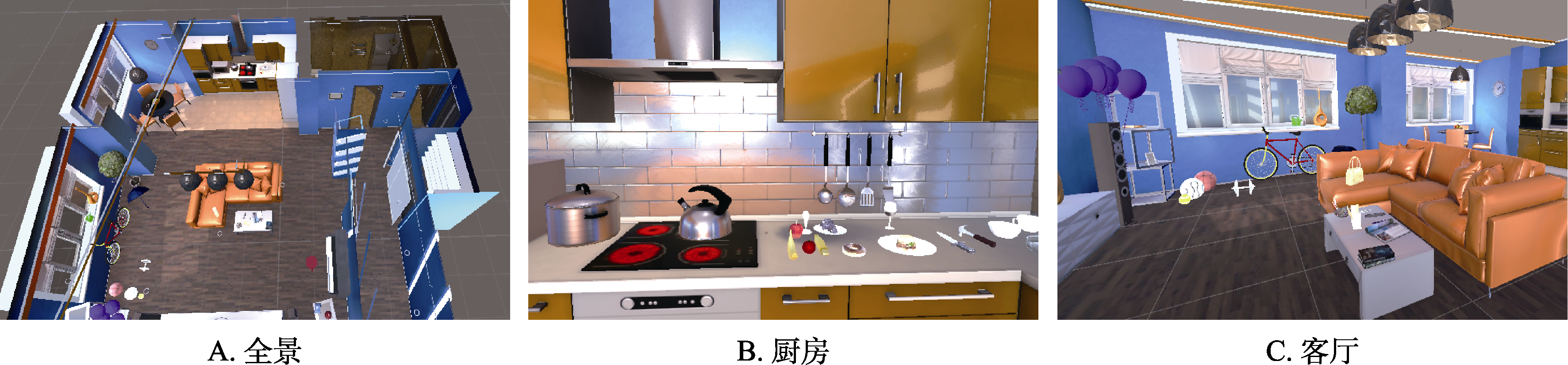
图1 VR学习环境示意图
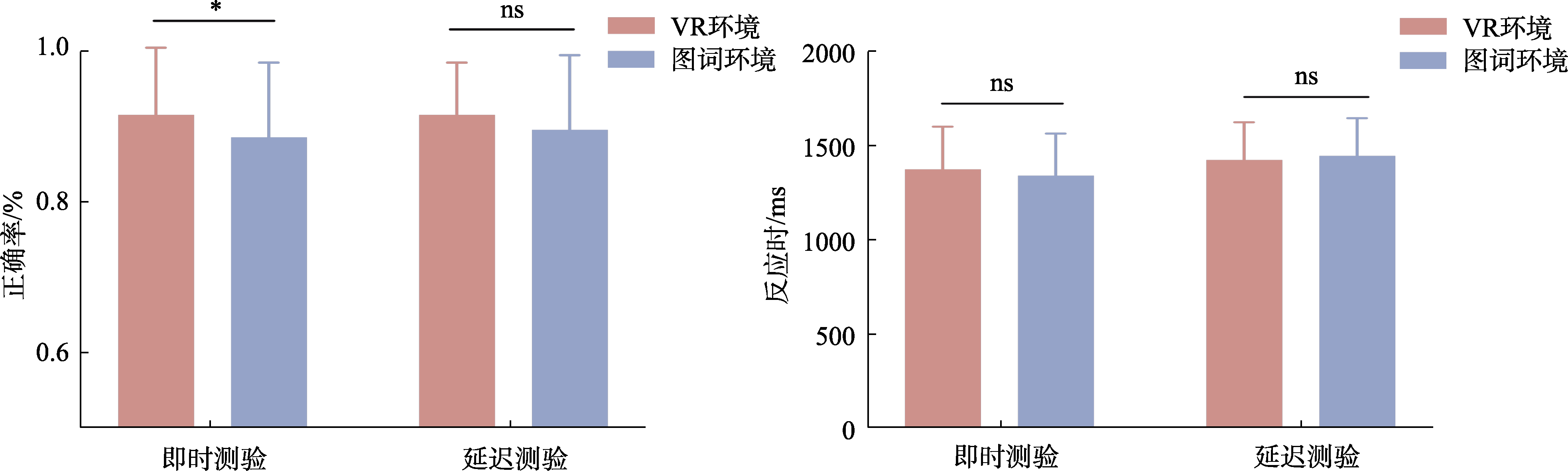
图2 VR和图词环境下所学外语词汇的命名正确率(左图)和反应时(右图) 注:* p < 0.05, ns 表示无显著差异。
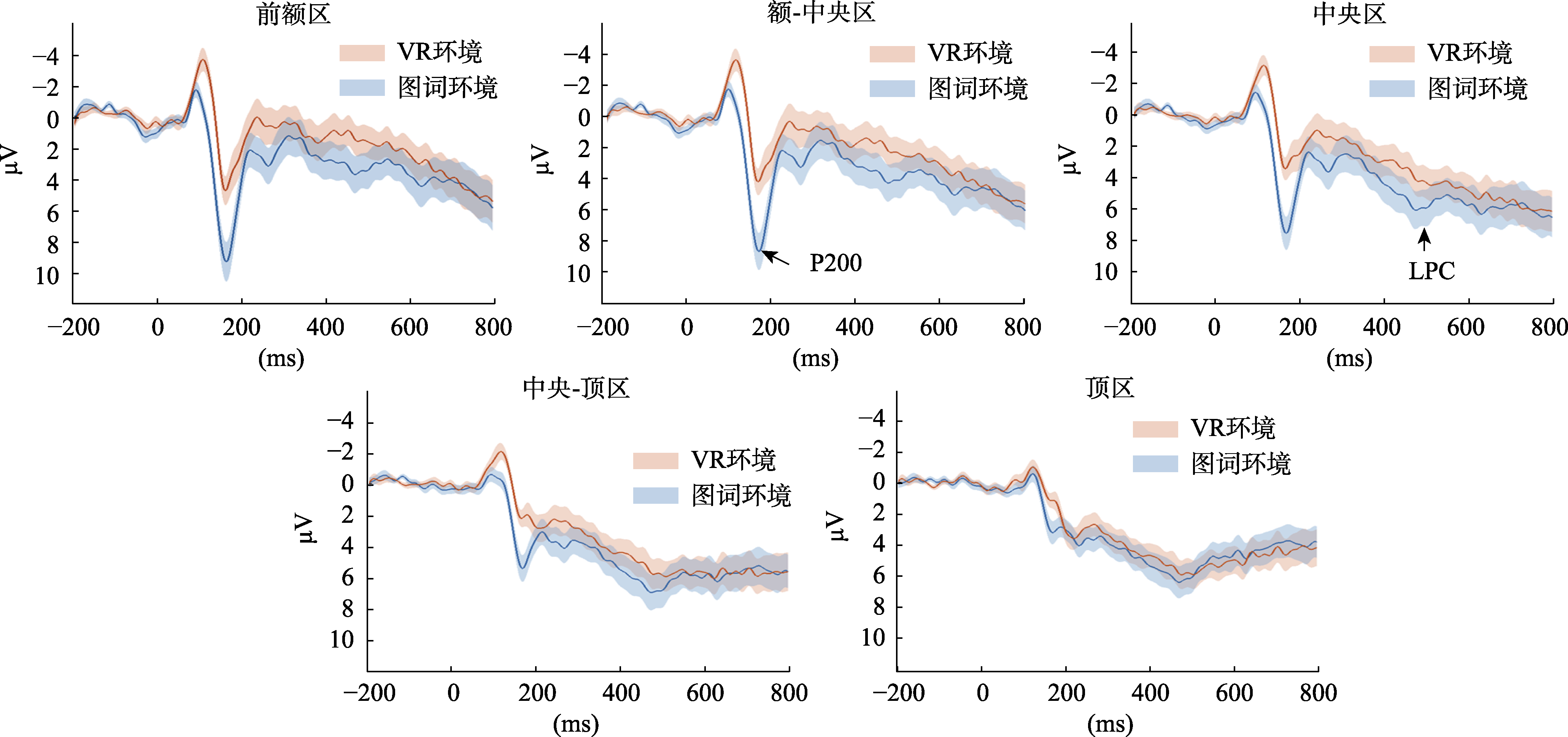
图3 VR和图词环境下词汇命名诱发的P200和LPC波形图

图4 VR和图词环境下词汇命名诱发的μ频段和θ频段频谱图
| [1] |
Barsalou, L. W. (2008). Grounded cognition. Annual Review of Psychology, 59(1), 617-645.
doi: 10.1146/psych.2008.59.issue-1 URL |
| [2] | Bastiaansen, M., Mazaheri, A., & Jensen, O. (2012). Beyond ERPs:Oscillatory neuronal dynamics. In S. J. Luck & E. S. Kappenman (Eds.), The Oxford handbook of event-related potential components (pp. 31-50). Oxford University Press. |
| [3] |
Brunsdon, V. E., Bradford, E. E., & Ferguson, H. J. (2019). Sensorimotor mu rhythm during action observation changes across the lifespan independently from social cognitive processes. Developmental Cognitive Neuroscience, 38, 100659.
doi: 10.1016/j.dcn.2019.100659 URL |
| [4] |
Che, X., Xu, H., Wang, K., Zhang, Q., & Li, S. (2021). Precision requirement of working memory representations influences attentional guidance. Acta Psychologica Sinica, 53(7), 694-713.
doi: 10.3724/SP.J.1041.2021.00694 |
|
[车晓玮, 徐慧云, 王凯旋, 张倩, 李寿欣. (2021). 工作记忆表征精度加工需求对注意引导的影响. 心理学报, 53(7), 694-713.]
doi: 10.3724/SP.J.1041.2021.00694 |
|
| [5] | Essoe, J. K. Y., Reggente, N., Ohno, A. A., Baek, Y. H., Dell'Italia, J., & Rissman, J. (2022). Enhancing learning and retention with distinctive virtual reality environments and mental context reinstatement. NPJ Science of Learning, 7(1), 31. |
| [6] |
Faul, F., Erdfelder, E., Lang, A. G., & Buchner, A. (2007). G* Power 3: A flexible statistical power analysis program for the social, behavioral, and biomedical sciences. Behavior Research Methods, 39(2), 175-191.
doi: 10.3758/BF03193146 URL |
| [7] |
Fernandez, C. B., Litcofsky, K. A., & Van Hell, J. G. (2019). Neural correlates of intra-sentential code-switching in the auditory modality. Journal of Neurolinguistics, 51, 17-41.
doi: 10.1016/j.jneuroling.2018.10.004 |
| [8] |
Fuhrman, O., Eckerling, A., Friedmann, N., Tarrasch, R., & Raz, G. (2021). The moving learner: Object manipulation in virtual reality improves vocabulary learning. Journal of Computer Assisted Learning, 37(3), 672-683.
doi: 10.1111/jcal.v37.3 URL |
| [9] | Gao, Y., Liu, D. J., Huang, Z. Z., & Huang, R. H. (2016). The core factors and challenges of virtual reality technology enhanced learning. Journal of Educational Technology & Research, 37(10), 77-87+103. |
| [高媛, 刘德建, 黄真真, 黄荣怀. (2016). 虚拟现实技术促进学习的核心要素及其挑战. 电化教育研究, 37(10), 77-87+103.] | |
| [10] |
Herweg, N. A., Solomon, E. A., & Kahana, M. J. (2020). Theta oscillations in human memory. Trends in Cognitive Sciences, 24(3), 208-227.
doi: S1364-6613(19)30294-3 pmid: 32029359 |
| [11] |
Hu, C. P., Kong, X., Wagenmakers, E. J., Ly, A., & Peng, K. (2018). The Bayes factor and its implementation in JASP: A practical primer. Advances in Psychological Science, 26(6), 951-965.
doi: 10.3724/SP.J.1042.2018.00951 URL |
|
[胡传鹏, 孔祥祯, Eric-Jan, Wagenmakers, Alexander, Ly, 彭凯平. (2018). 贝叶斯因子及其在JASP中的实现. 心理科学进展, 26(6), 951-965.]
doi: 10.3724/SP.J.1042.2018.00951 |
|
| [12] | Jeffreys, H. (1961). Theory of probability (3rd ed.). Oxford University Press. |
| [13] |
Jiang, Y., Cai, X., & Zhang, Q. (2020). Theta band (4-8 Hz) oscillations reflect syllables processing in Chinese spoken word production. Acta Psychologica Sinica, 52(10), 1199-1211.
doi: 10.3724/SP.J.1041.2020.01199 URL |
|
[蒋宇宸, 蔡笑, 张清芳. (2020). θ频段(4-8 Hz)的活动反映了汉语口语产生中音节信息的加工. 心理学报, 52(10), 1199-1211.]
doi: 10.3724/SP.J.1041.2020.01199 |
|
| [14] |
Jiao, L., Lin, Y., Schwieter, J. W., & Liu, C. (2026). Learning novel words in an immersive virtual-reality context: Tracking lexicalization through behavioral and event- related-potential measures. Language Learning, 76(1), 5-27.
doi: 10.1111/lang.v76.1 URL |
| [15] |
Jiao, L., Schwieter, J. W., & Liu, C. (2025). Comprehension- based language switching in experienced and newly learned languages: Evidence from induced brain oscillations. Journal of Neurolinguistics, 73, 101232.
doi: 10.1016/j.jneuroling.2024.101232 URL |
| [16] |
Jiao, L., Zhu, M., Xu, Z., Zhou, G., Schwieter, J. W., & Liu, C. (2024). An ERP study on novel word learning in an immersive virtual reality context. Bilingualism: Language and Cognition, 27(1), 128-136.
doi: 10.1017/S136672892300038X URL |
| [17] |
Kutas, M., & Federmeier, K. D. (2011). Thirty years and counting: Finding meaning in the N400 component of the event-related brain potential (ERP). Annual Review of Psychology, 62(1), 621-647.
doi: 10.1146/psych.2011.62.issue-1 URL |
| [18] |
Legault, J., Fang, S. Y., Lan, Y. J., & Li, P. (2019). Structural brain changes as a function of second language vocabulary training: Effects of learning context. Brain and Cognition, 134, 90-102.
doi: S0278-2626(17)30458-X pmid: 30429056 |
| [19] | Legault, J., Zhao, J., Chi, Y. A., Chen, W., Klippel, A., & Li, P. (2019). Immersive virtual reality as an effective tool for second language vocabulary learning. Languages, 4(1), 13. |
| [20] |
Lei, D., Liu, Y., & van Hell, J. G. (2022). Novel word learning with verbal definitions and images: Tracking consolidation with behavioral and event-related potential measures. Language Learning, 72(4), 941-979.
doi: 10.1111/lang.v72.4 URL |
| [21] | Li, P., & Jeong, H. (2020). The social brain of language: Grounding second language learning in social interaction. npj Science of Learning, 5(1), 8. |
| [22] |
Lijffijt, M., Lane, S. D., Meier, S. L., Boutros, N. N., Burroughs, S., Steinberg, J. L.,... Swann, A. C. (2009). P50, N100, and P200 sensory gating: Relationships with behavioral inhibition, attention, and working memory. Psychophysiology, 46(5), 1059-1068.
doi: 10.1111/j.1469-8986.2009.00845.x pmid: 19515106 |
| [23] |
Linck, J. A., Kroll, J. F., & Sunderman, G. (2009). Losing access to the native language while immersed in a second language: Evidence for the role of inhibition in second- language learning. Psychological Science, 20(12), 1507-1515.
doi: 10.1111/j.1467-9280.2009.02480.x URL |
| [24] |
Liu, C., de Bruin, A., Jiao, L., Li, Z., & Wang, R. (2021). Second language learning tunes the language control network: A longitudinal fMRI study. Language, Cognition and Neuroscience, 36(4), 462-473.
doi: 10.1080/23273798.2020.1856898 URL |
| [25] |
Liu, C., Feng, J., Schwieter, J. W., Geng, J., & Jiao, L. (2026). Neural correlates of novel word learning in an immersive virtual reality environment. Journal of Neurolinguistics, 78, 101300.
doi: 10.1016/j.jneuroling.2025.101300 URL |
| [26] |
Liu, C., Mao, Y., Wang, X., Schwieter, J. W., & Jiao, L. (2024). Sleep-dependent consolidation effects on foreign language word acquisition in a virtual reality environment. Memory & Cognition, 52(2), 302-311.
doi: 10.3758/s13421-023-01461-z |
| [27] |
Liu, H., Liang, L., Zhang, L., Lu, Y., & Chen, B. (2017). Modulatory role of inhibition during language switching: Evidence from evoked and induced oscillatory activity. International Journal of Bilingualism, 21(1), 57-80.
doi: 10.1177/1367006915600800 URL |
| [28] |
Makransky, G., & Petersen, G. B. (2021). The cognitive affective model of immersive learning (Camil): A theoretical research- based model of learning in immersive virtual reality. Educational Psychology Review, 33(3), 937-958.
doi: 10.1007/s10648-020-09586-2 |
| [29] |
Martin, C. D., Strijkers, K., Santesteban, M., Escera, C., Hartsuiker, R. J., & Costa, A. (2013). The impact of early bilingualism on controlling a language learned late: An ERP study. Frontiers in Psychology, 4, 815.
doi: 10.3389/fpsyg.2013.00815 pmid: 24204355 |
| [30] | Mayer, R. E. (2005). Cognitive theory of multimedia learning. In R. E. Mayer (Ed.), The Cambridge handbook of multimedia learning (2nd ed., pp. 43-71). Cambridge University Press. |
| [31] |
Midgley, K. J., Holcomb, P. J., & Grainger, J. (2009). Masked repetition and translation priming in second language learners: A window on the time-course of form and meaning activation using ERPs. Psychophysiology, 46(3), 551-565.
doi: 10.1111/j.1469-8986.2009.00784.x pmid: 19298629 |
| [32] |
Papin, K., & Kaplan-Rakowski, R. (2024). A study of vocabulary learning using annotated 360° pictures. Computer Assisted Language Learning, 37(5-6), 1108-1135.
doi: 10.1080/09588221.2022.2068613 URL |
| [33] |
Peeters, D. (2018). A standardized set of 3-D objects for virtual reality research and applications. Behavior Research Methods, 50(3), 1047-1054.
doi: 10.3758/s13428-017-0925-3 pmid: 28646401 |
| [34] | Peng, D. L. (2004). General psychology. Beijing Normal University Press. |
| [彭聃龄. (2004). 普通心理学. 北京师范大学出版社.] | |
| [35] |
Ren, W., Yang, T., & Wang, H. (2024). Different effects of linguistic and perceptual symbolic representations on foreign language vocabulary learning: Evidence from behavioral and EEG data. Acta Psychologica Sinica, 56(5), 542-554.
doi: 10.3724/SP.J.1041.2024.00542 |
|
[任维聪, 杨婷, 王汉林. (2024). 语言符号与知觉符号表征对外语词汇习得的影响比较: 来自行为与脑电的实验证据. 心理学报, 56(5), 542-554.]
doi: 10.3724/SP.J.1041.2024.00542 |
|
| [36] |
Rugg, M. D., & Curran, T. (2007). Event-related potentials and recognition memory. Trends in Cognitive Sciences, 11(6), 251-257.
doi: 10.1016/j.tics.2007.04.004 pmid: 17481940 |
| [37] |
Schneider, J. M., Abel, A. D., Momsen, J., Melamed, T. C., & Maguire, M. J. (2021). Neural oscillations reveal differences in the process of word learning among school-aged children from lower socioeconomic status backgrounds. Neurobiology of Language, 2(3), 372-388.
doi: 10.1162/nol_a_00040 pmid: 34447943 |
| [38] |
Shi, R., Xie, J., Yang, M., & Wang, R. (2022). The influence of language and context on sensorimotor simulation of concrete concepts. Acta Psychologica Sinica, 54(6), 583-594.
doi: 10.3724/SP.J.1041.2022.00583 |
|
[石如彬, 谢久书, 杨梦情, 王瑞明. (2022). 语言和情境对具体概念感知运动仿真的影响. 心理学报, 54(6), 583-594.]
doi: 10.3724/SP.J.1041.2022.00583 |
|
| [39] | Sweller, J. (2011). Cognitive load theory. In J. M. Spector & S. P. Lajoie (Eds.), Psychology of learning and motivation (Vol. 55, pp. 37-76). Academic Press. |
| [40] |
Tai, T. Y., Chen, H. H. J., & Todd, G. (2022). The impact of a virtual reality app on adolescent EFL learners' vocabulary learning. Computer Assisted Language Learning, 35(4), 892-917.
doi: 10.1080/09588221.2020.1752735 URL |
| [41] |
Tulving, E., & Thomson, D. M. (1973). Encoding specificity and retrieval processes in episodic memory. Psychological Review, 80(5), 352-373.
doi: 10.1037/h0020071 URL |
| [42] |
Wagenmakers, E. J., Love, J., Marsman, M., Jamil, T., Ly, A., Verhagen, J.,... Morey, R. D. (2018). Bayesian inference for psychology. Part II: Example applications with JASP. Psychonomic Bulletin & Review, 25(1), 58-76.
doi: 10.3758/s13423-017-1323-7 URL |
| [43] | Wallace, M. J. (1982). Teaching vocabulary. London: Heinemann Educational Books. |
| [44] |
Ward, L. M. (2003). Synchronous neural oscillations and cognitive processes. Trends in Cognitive Sciences, 7(12), 553-559.
doi: 10.1016/j.tics.2003.10.012 pmid: 14643372 |
| [45] | Yang, J., & Wang, X. C. (2023). Past, present, and future: Seventy years of bilingual lexical access models. Journal of PLA University of Foreign Languages, 46(02), 1-10+160. |
| [杨静, 王晓婵. (2023). 双语心理词汇通达模型: 70年回顾与展望. 解放军外国语学院学报, 46(02), 1-10+160.] | |
| [46] |
Zappa, A., Bolger, D., Pergandi, J. M., Fargier, R., Mestre, D., & Frenck-Mestre, C. (2024). The neural correlates of embodied L2 learning: Does embodied L2 verb learning affect representation and retention? Neurobiology of Language, 5(2), 360-384.
doi: 10.1162/nol_a_00132 pmid: 38911460 |
| [47] | Zhang, Q., & Yang, Y. (2003). The determiners of picture-naming latency. Acta Psychologica Sinica, 35(4), 447-454. |
| [张清芳, 杨玉芳. (2003). 影响图画命名时间的因素. 心理学报, 35(4), 447-454.] |
| [1] | 张晶晶, 时颖, 邓善文, 李佳斌, 陈庆荣. 诗歌平仄与语义加工的认知神经机制[J]. 心理学报, 2026, 58(3): 437-449. |
| [2] | 代矫剑, 孙明泽, 王东方, 毛新瑞, 郭春彦. 类别和语义距离调节预期对记忆的影响[J]. 心理学报, 2026, 58(1): 1-14. |
| [3] | 吴洁, 车子轩. 多通道类别学习的认知特征与神经机制:EEG与DDM证据[J]. 心理学报, 2025, 57(10): 1715-1728. |
| [4] | 任维聪, 杨婷, 王汉林. 语言符号与知觉符号表征对外语词汇习得的影响比较:来自行为与脑电的实验证据[J]. 心理学报, 2024, 56(5): 542-554. |
| [5] | 胡晓斐, 汪嘉维, 刘涵宇, 宋晓蕾. 听觉刺激对虚拟环境中空间压缩的影响[J]. 心理学报, 2023, 55(1): 1-8. |
| [6] | 柯晓晓, 齐惠紫, 梁家辉, 金欣园, 高婕, 张明霞, 汪亚珉. 中国人整体性思维特征的情境评估法及其应用[J]. 心理学报, 2021, 53(12): 1299-1309. |
| [7] | 刘洁, 李瑾琪, 申超然, 胡小惠, 赵庭浩, 关青, 罗跃嘉. 数学焦虑个体近似数量加工的神经机制:一项EEG研究[J]. 心理学报, 2020, 52(8): 958-970. |
| [8] | 侯璐璐, 陈莅蓉, 周仁来. 经前期综合征与奖赏进程失调——来自脑电的证据[J]. 心理学报, 2020, 52(6): 742-757. |
| [9] | 蒋宇宸, 蔡笑, 张清芳. θ频段(4~8 Hz)的活动反映了汉语口语产生中音节信息的加工[J]. 心理学报, 2020, 52(10): 1199-1211. |
| [10] | 过继成思, 黄建平, 宛小昂. 目标预知对路径整合的影响[J]. 心理学报, 2019, 51(2): 188-195. |
| [11] | 张为威, 黄建平, 宛小昂. 预期对路径整合的影响[J]. 心理学报, 2019, 51(11): 1219-1228. |
| [12] | 卢伟, 黄尔齐, 原晋霞. 基于定量脑电图的音乐和灯光颜色对情绪的影响 *[J]. 心理学报, 2018, 50(8): 880-891. |
| [13] | 袁小钧, 崔晓霞, 曹正操, 阚红, 王晓, 汪亚珉. 虚拟仿真场景中威胁性视觉刺激搜索的注意偏向效应 *[J]. 心理学报, 2018, 50(6): 622-636. |
| [14] | 付超, 张振, 何金洲, 黄四林, 仇剑崟, 王益文. 普遍信任博弈决策的动态过程 ——来自脑电时频分析的证据[J]. 心理学报, 2018, 50(3): 317-326. |
| [15] | 周希;宛小昂;杜頔康;熊异雷;黄蔚欣. 不连续虚拟现实空间中的再定向[J]. 心理学报, 2016, 48(8): 924-932. |
| 阅读次数 | ||||||
|
全文 |
|
|||||
|
摘要 |
|
|||||
