

ISSN 0439-755X
CN 11-1911/B
主办:中国心理学会
中国科学院心理研究所
出版:科学出版社
CN 11-1911/B
主办:中国心理学会
中国科学院心理研究所
出版:科学出版社
心理学报 ›› 2026, Vol. 58 ›› Issue (6): 1042-1058.doi: 10.3724/SP.J.1041.2026.1042 cstr: 32110.14.2026.1042
寇聪超, 李宝林( ), 翟小斐
收稿日期:2025-07-03
发布日期:2026-04-28
出版日期:2026-06-25
通讯作者:
李宝林, E-mail: lblpsy@snnu.edu.cn基金资助:
KOU Congchao, LI Baolin(), ZHAI Xiaofei
Received:2025-07-03
Online:2026-04-28
Published:2026-06-25
摘要:
序列依赖反映了短时程的先前经验对后续感知加工的影响。本研究通过3个实验系统探究了时距复制任务中的序列依赖效应以及任务范式对时距知觉序列依赖跨通道效应的影响。结果发现: 时距复制任务中先前刺激和复制时距能够分别导致排斥性的刺激序列依赖效应和吸引性的反应序列依赖效应; 刺激和反应序列依赖效应在复制任务中表现出一定程度的跨通道性, 在时距二分任务中则具有通道特异性。这些发现揭示了任务范式是影响时距知觉刺激和反应序列依赖跨通道效应的重要因素。这说明时距知觉的刺激序列依赖效应并非完全源于低水平的感知适应, 其涉及高水平的认知加工; 反应序列依赖效应并不是一种简单机械的决策惯性, 其涉及对反应策略的整合利用。
中图分类号:
寇聪超, 李宝林, 翟小斐. (2026). 复制任务促进时距知觉序列依赖跨通道效应. 心理学报, 58(6), 1042-1058.
KOU Congchao, LI Baolin, ZHAI Xiaofei. (2026). The duration reproduction task facilitates cross-modal serial dependence in duration perception. Acta Psychologica Sinica, 58(6), 1042-1058.
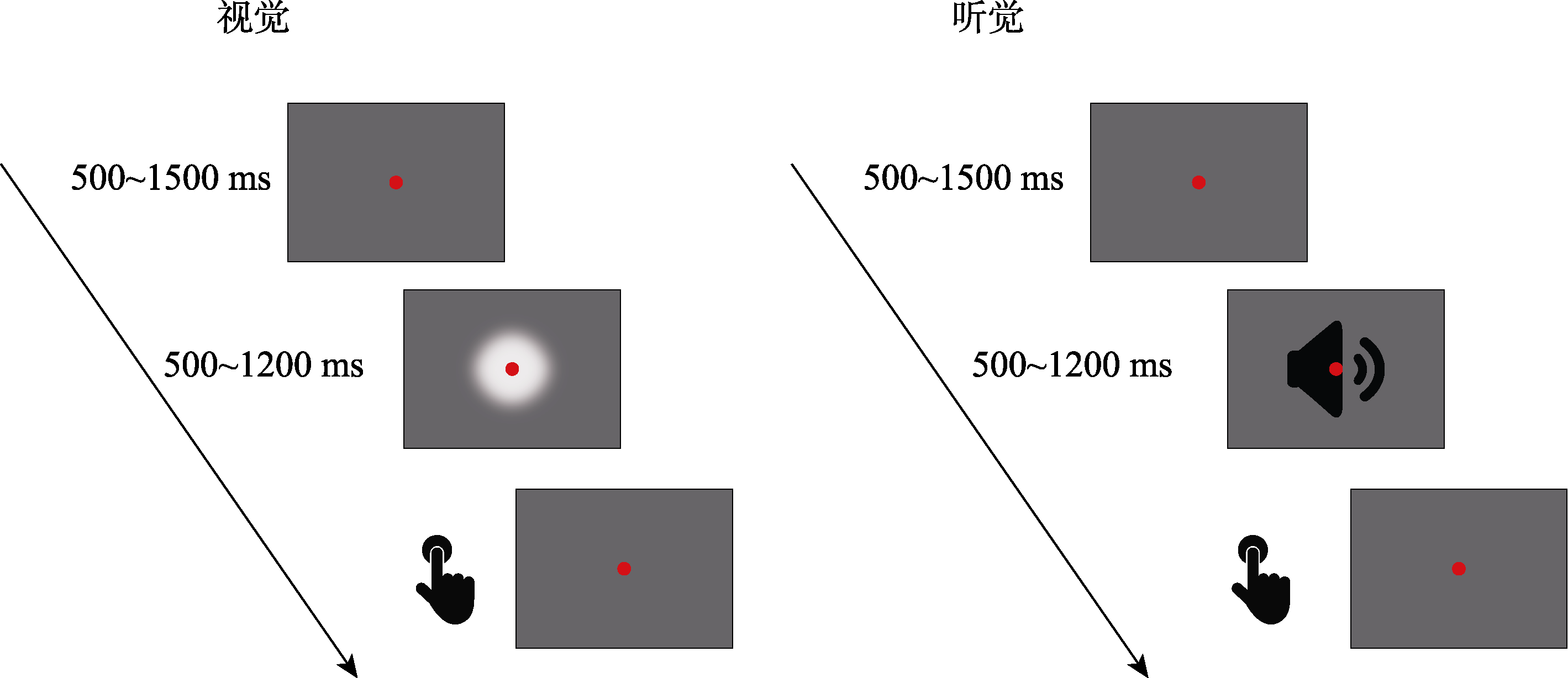
图1 实验1流程图。实验1分为视觉和听觉时距复制任务。每个试次中, 首先呈现500~1500 ms的红色注视点, 要求被试在实验过程中全程注视该点。接着呈现一个500~1200 ms的白色光斑(视觉任务)或白噪音(听觉任务)刺激, 刺激消失后被试需要通过按键的方式复制刺激的呈现时间(使右方向键按下的时间等于刺激的呈现时间)。彩图见电子版, 下同。
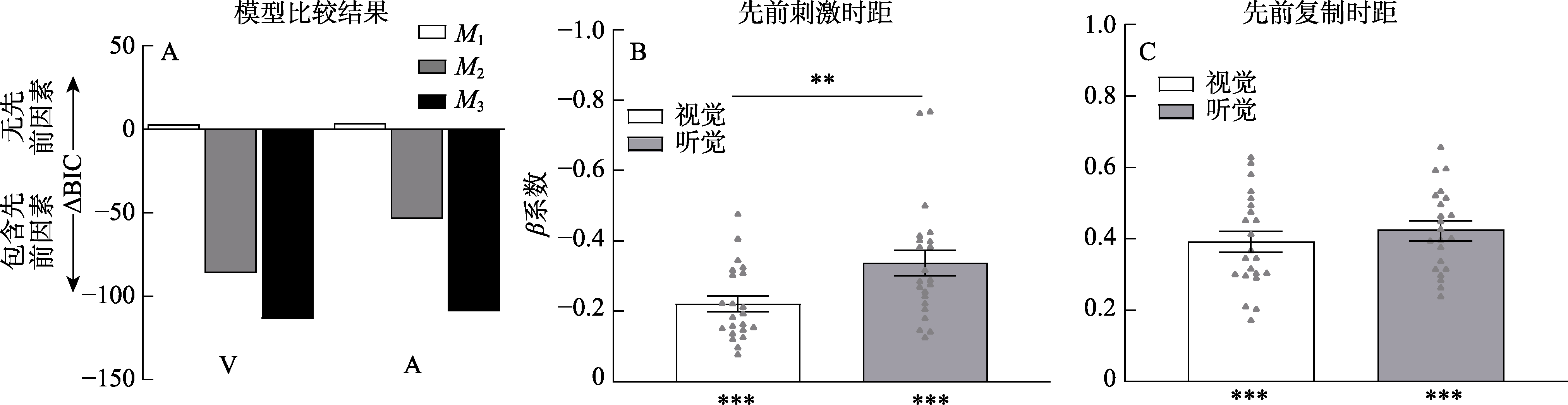
图2 实验1模型分析结果。(A)不同实验条件下模型比较结果。横坐标为不同实验条件, 纵坐标为包含先前因素模型(白色条形代表M1, 深灰色条形代表M2, 黑色条形代表M3)与基线模型(M0)的BIC差值(ΔBIC)。(B)基于先前刺激时距的β系数在不同条件下的大小。(C)基于先前复制时距的β系数在不同条件下的大小。白色空心条形图为视觉刺激, 灰色实心条形图为听觉刺激。灰色三角代表每种条件下每名被试的数据点, 误差线代表标准误差。**p < 0.01, ***p < 0.001。
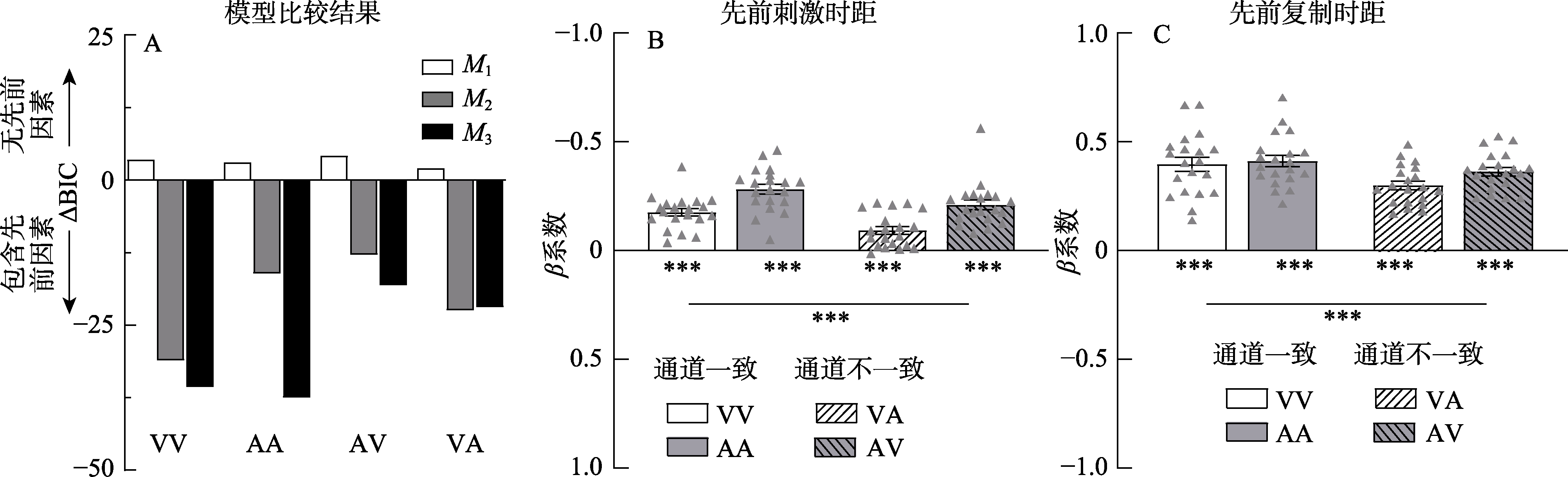
图3 实验2模型分析结果。(A)不同实验条件下模型比较结果。横坐标为不同实验条件, 纵坐标为包含先前因素模型(白色条形代表M1, 深灰色条形代表M2, 黑色条形代表M3)与基线模型(M0)的BIC差值(ΔBIC)。(B)基于先前刺激时距的β系数在不同条件下的大小。(C)基于先前复制时距的β系数在不同条件下的大小。白色空心条形图VV表示先前与当前刺激均为视觉刺激; 灰色实心条形图AA表示先前与当前刺激均为听觉刺激; 右斜浅色条纹条形图VA表示先前刺激为视觉刺激, 当前刺激为听觉刺激; 左斜深色条纹条形图AV表示先前刺激为听觉刺激, 当前刺激为视觉刺激。图中灰色三角代表每种条件下每名被试的数据点, 误差线代表标准误差, ***p < 0.001。
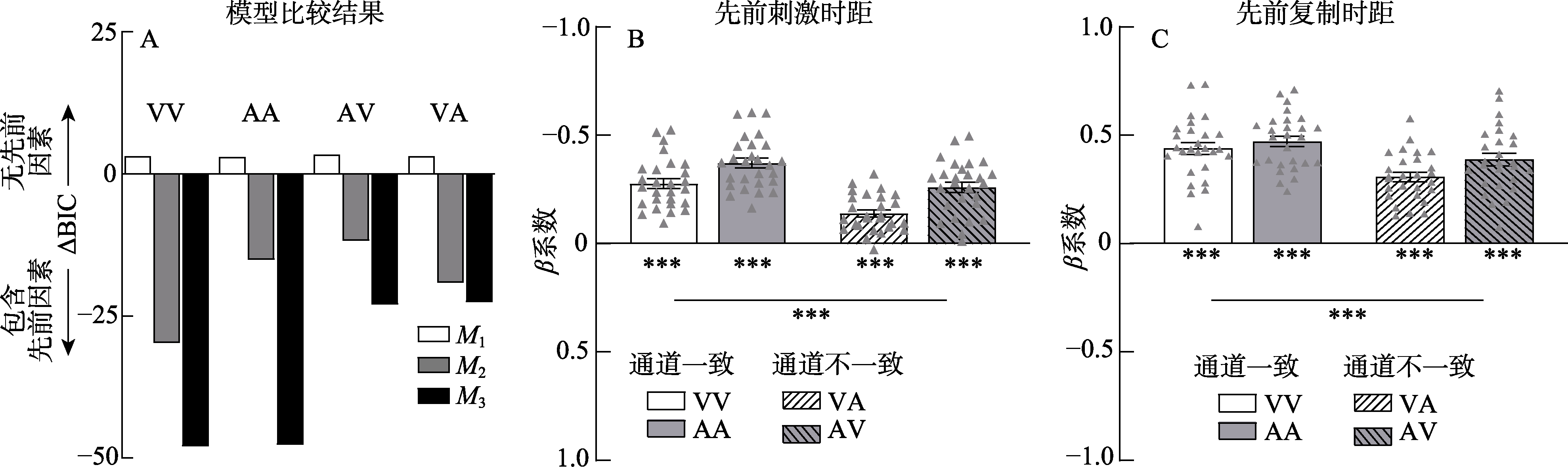
图4 实验3时距复制任务模型分析结果。(A)不同实验条件下模型比较结果。横坐标为不同实验条件, 纵坐标为包含先前因素模型(白色条形代表M1, 深灰色条形代表M2, 黑色条形代表M3)与基线模型(M0)的BIC差值(ΔBIC)。(B)基于先前刺激时距的β系数在不同条件下的大小。(C)基于先前复制时距的β系数在不同条件下的大小。白色空心条形图VV表示先前与当前刺激均为视觉刺激; 灰色实心条形图AA表示先前与当前刺激均为听觉刺激; 右斜浅色条纹条形图VA表示先前刺激为视觉刺激, 当前刺激为听觉刺激; 左斜深色条纹条形图AV表示先前刺激为听觉刺激, 当前刺激为视觉刺激。图中灰色三角代表每种条件下每名被试的数据点, 误差线代表标准误差, ***p < 0.001。
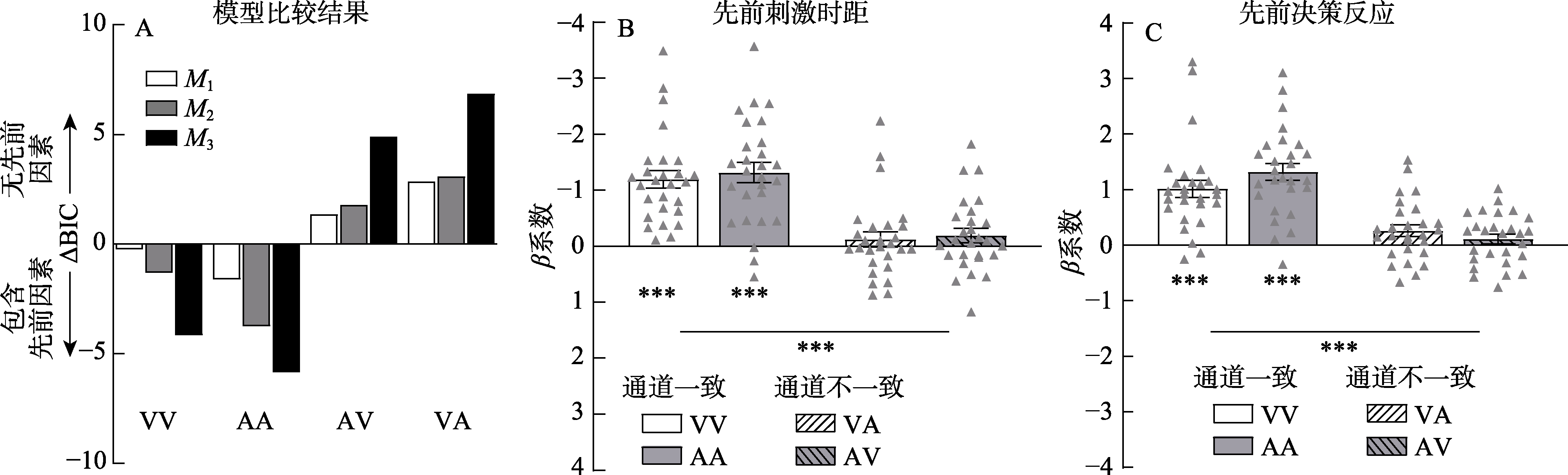
图5 实验3时距二分任务模型分析结果。(A)不同实验条件下模型比较结果。横坐标为不同实验条件, 纵坐标为包含先前因素模型(白色条形代表M1, 深灰色条形代表M2, 黑色条形代表M3)与基线模型(M0)的BIC差值(ΔBIC)。(B)基于先前刺激时距的β系数在不同条件下的大小。(C)基于先前决策反应的β系数在不同条件下的大小。白色空心条形图VV表示先前与当前刺激均为视觉刺激; 灰色实心条形图AA表示先前与当前刺激均为听觉刺激; 右斜浅色条纹条形图VA表示先前刺激为视觉刺激, 当前刺激为听觉刺激; 左斜深色条纹条形图AV表示先前刺激为听觉刺激, 当前刺激为视觉刺激。图中灰色三角代表每种条件下每名被试的数据点, 误差线代表标准误差, ***p < 0.001。
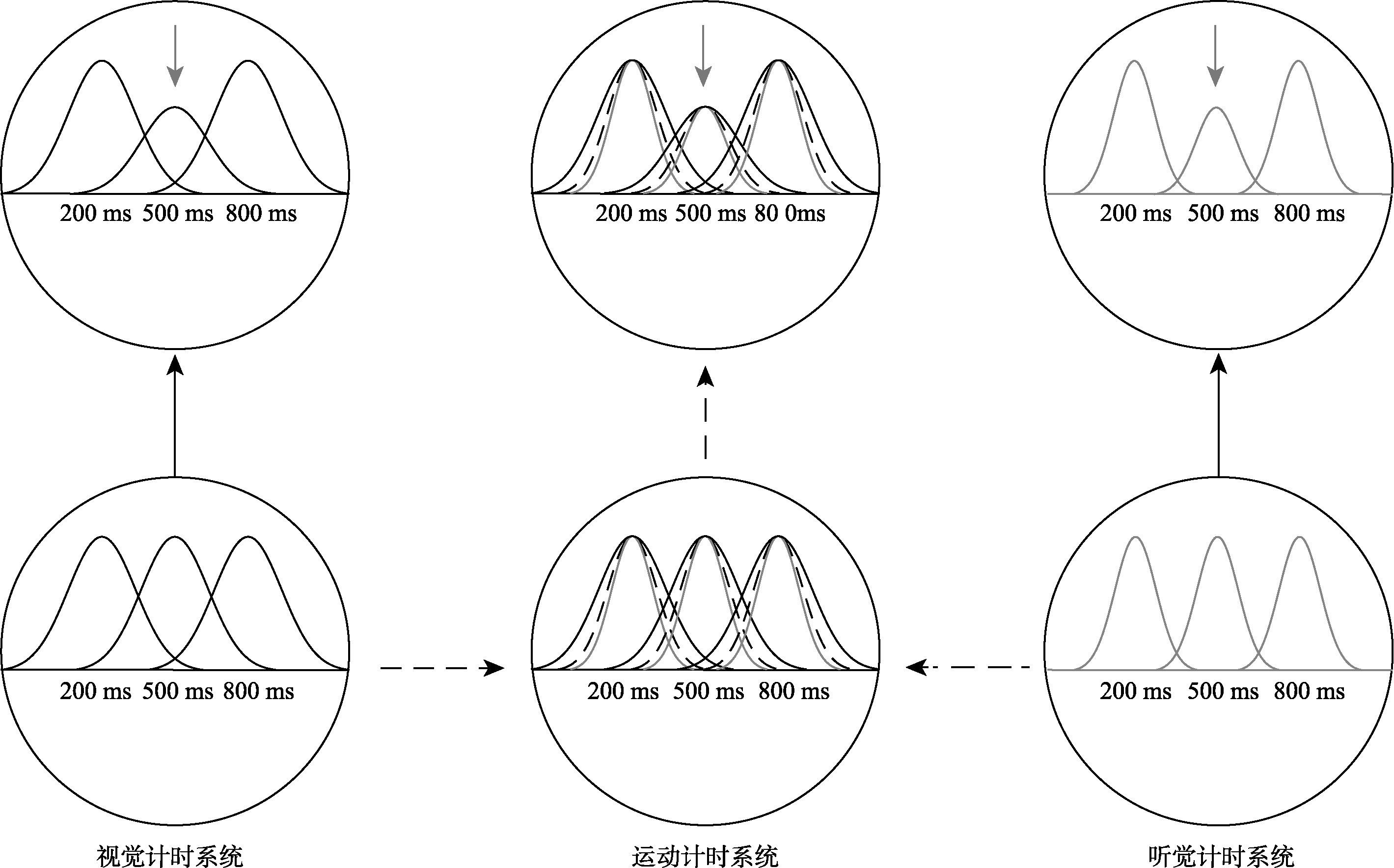
图6 复制任务促进刺激序列依赖跨通道效应的内在机制假设。下图表示时距通道的正常响应, 上图表示通道在适应某一特定时距(如500 ms)后的响应。黑色(高斯)实线表示视觉通道中的调谐曲线, 灰色(高斯)实线表示听觉通道中的调谐曲线, 黑色(高斯)虚线表示视听时距整合到运动计时系统中统一的调谐曲线。黑色实线箭头表示时距二分任务的时距加工通路, 黑色虚线箭头表示时距复制任务的时距加工通路。在时距二分任务中, 视觉和听觉计时系统分别对视觉和听觉刺激时距进行独立表征, 表现为刺激序列依赖效应的通道特异性; 而在时距复制任务中, 运动计时系统能够同时表征视觉和听觉时距信息, 进而促进了刺激序列依赖跨通道效应。
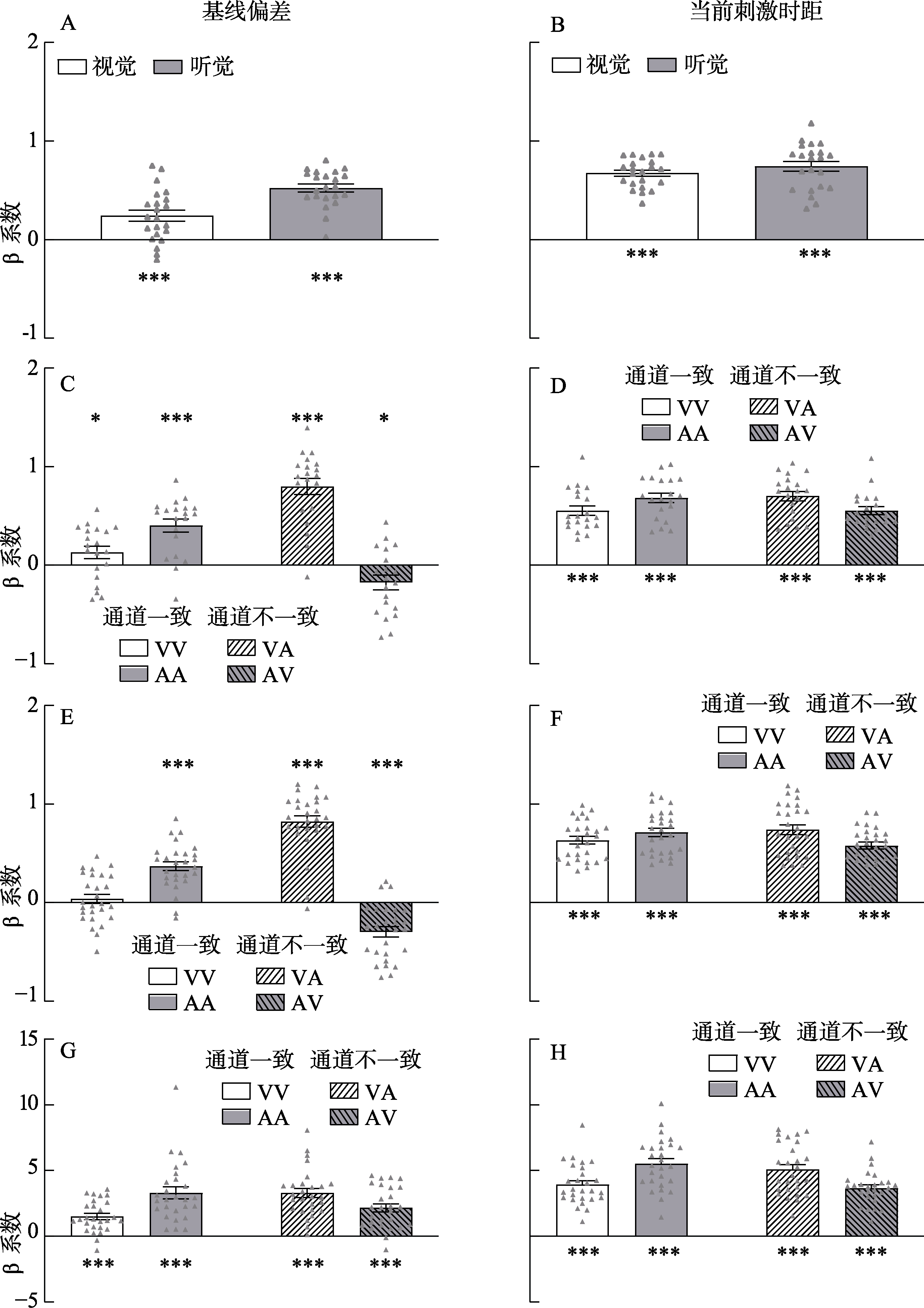
图S1 基于基线偏差与当前刺激时距的β系数(β0和βcurrS)在不同刺激条件下的大小(A、B为实验1结果, C、D为实验2结果, E、F为实验3复制法结果, G、H为实验3二分法结果)。实验1中白色空心条形图为视觉条件, 灰色实心条形图为听觉条件; 实验2和3中白色空心条形图VV表示先前与当前刺激均为视觉刺激; 灰色实心条形图AA表示先前与当前刺激均为听觉刺激; 右斜浅色条纹条形图VA表示先前刺激为视觉刺激, 当前刺激为听觉刺激; 左斜深色条纹条形图AV表示先前刺激为听觉刺激, 当前刺激为视觉刺激。图中灰色三角代表每种条件下每名被试的数据点, 误差线代表标准误差, *p < 0.05, ***p < 0.001。
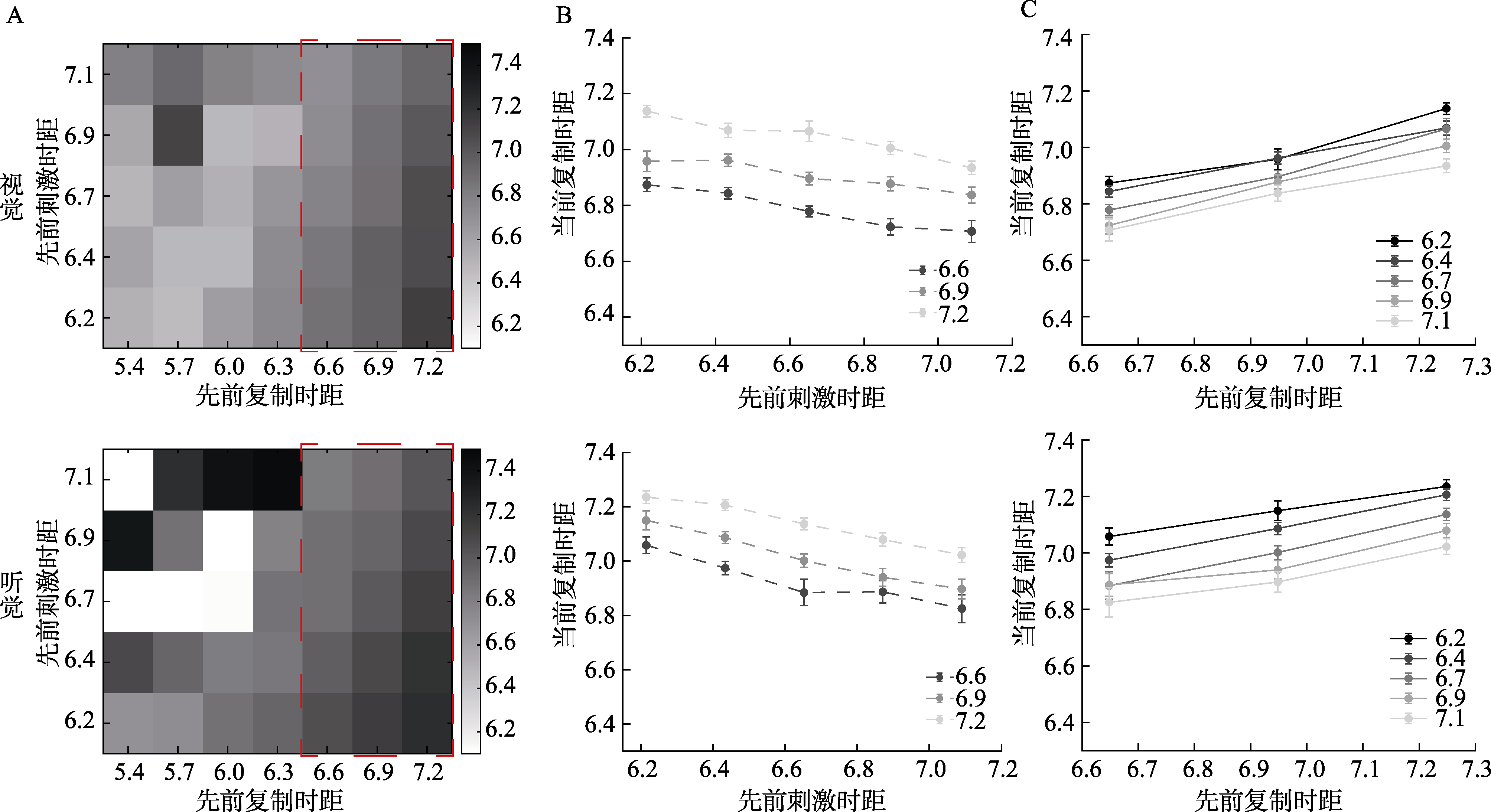
图S2 实验1不同感觉通道下的联合时距复制图。(A)视觉(上图)和听觉(下图)通道的二维复制时距图。横坐标为7个先前复制时距区间, 纵坐标为先前刺激时距, 因变量为被试在该种条件下的当前复制时距, 白色表示较短, 黑色表示较长。(B)固定先前复制时距条件下, 被试当前复制时距随先前刺激时距变化的趋势。(C)固定先前刺激时距条件下, 被试当前复制时距随先前复制时距变化的趋势。B和C图中的数据源于A图中包含试次最多的3个先前复制时距区间(由红色框标注)。图中的刺激和复制时距为对数转换后的值, 误差线表示标准误差。
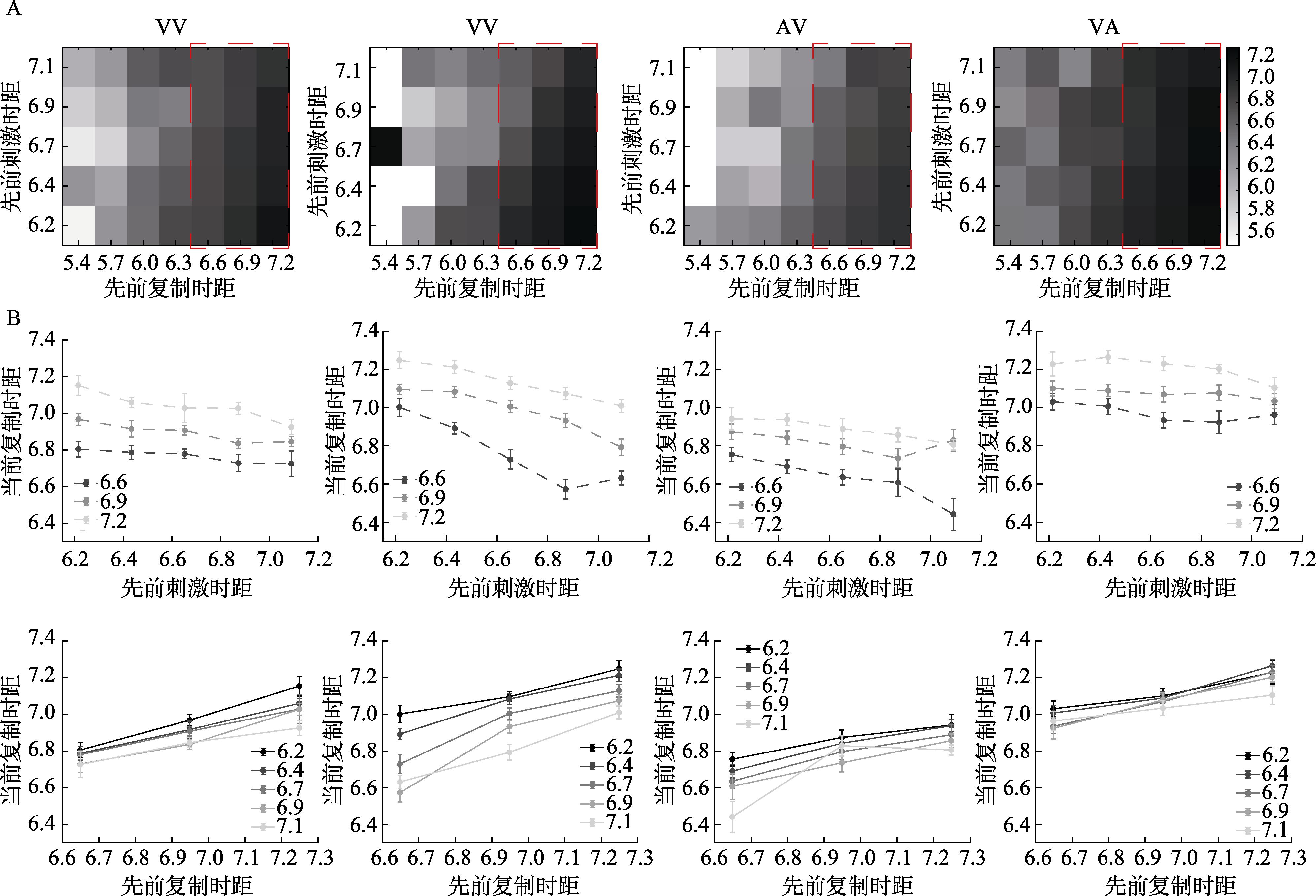
图S3 实验2不同条件下的联合时距复制图。(A) 4种条件(VV: 先前刺激是视觉刺激, 当前刺激也是视觉刺激; AA: 先前刺激是听觉刺激, 当前刺激也是听觉刺激; AV: 先前刺激是听觉刺激, 当前刺激是视觉刺激; VA: 先前刺激是视觉刺激, 当前刺激是听觉刺激)下的二维复制时距图。横坐标为7个先前复制时距区间, 纵坐标为先前刺激时距。因变量为被试在该种条件下当前试次的复制时距, 白色表示较短, 黑色表示较长。B: 固定先前复制时距(上图)和先前刺激时距(下图)条件下, 被试当前复制时距随先前刺激时距(上图)和先前复制时距(下图)变化的趋势。数据源于图A中包含试次最多的3个先前复制时距区间(由红色框标注)。图中的刺激和复制时距为对数转换后的值, 误差线表示标准误差。
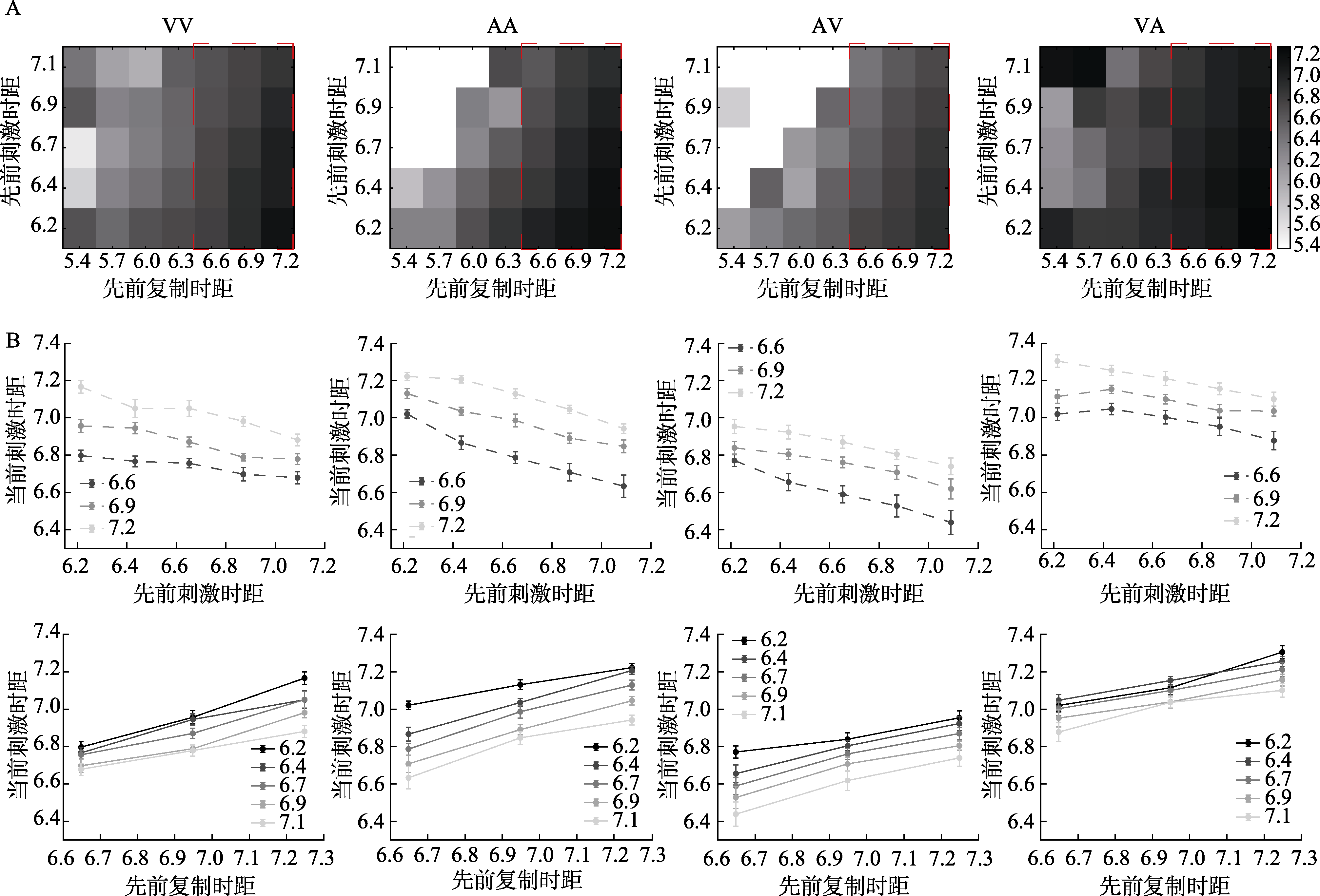
图S4 实验3复制任务中不同条件下的联合时距复制图。A: 4种条件(VV: 先前刺激是视觉刺激, 当前刺激也是视觉刺激; AA: 先前刺激是听觉刺激, 当前刺激也是听觉刺激; AV: 先前刺激是听觉刺激, 当前刺激是视觉刺激; VA: 先前刺激是视觉刺激, 当前刺激是听觉刺激)下的二维复制时距图。横坐标为7个先前复制时距区间, 纵坐标为先前刺激时距, 因变量为被试在该种条件下当前试次的复制时距, 白色表示较短, 黑色表示较长。B: 固定先前复制时距(上图)和先前刺激时距(下图)条件下, 被试当前复制时距随先前刺激时距(上图)和先前复制时距(下图)变化的曲线。数据源于图A中包含试次最多的3个先前复制时距区间(由红色框标注)。图中的刺激和复制时距为对数转换后的值, 误差线表示标准误差。
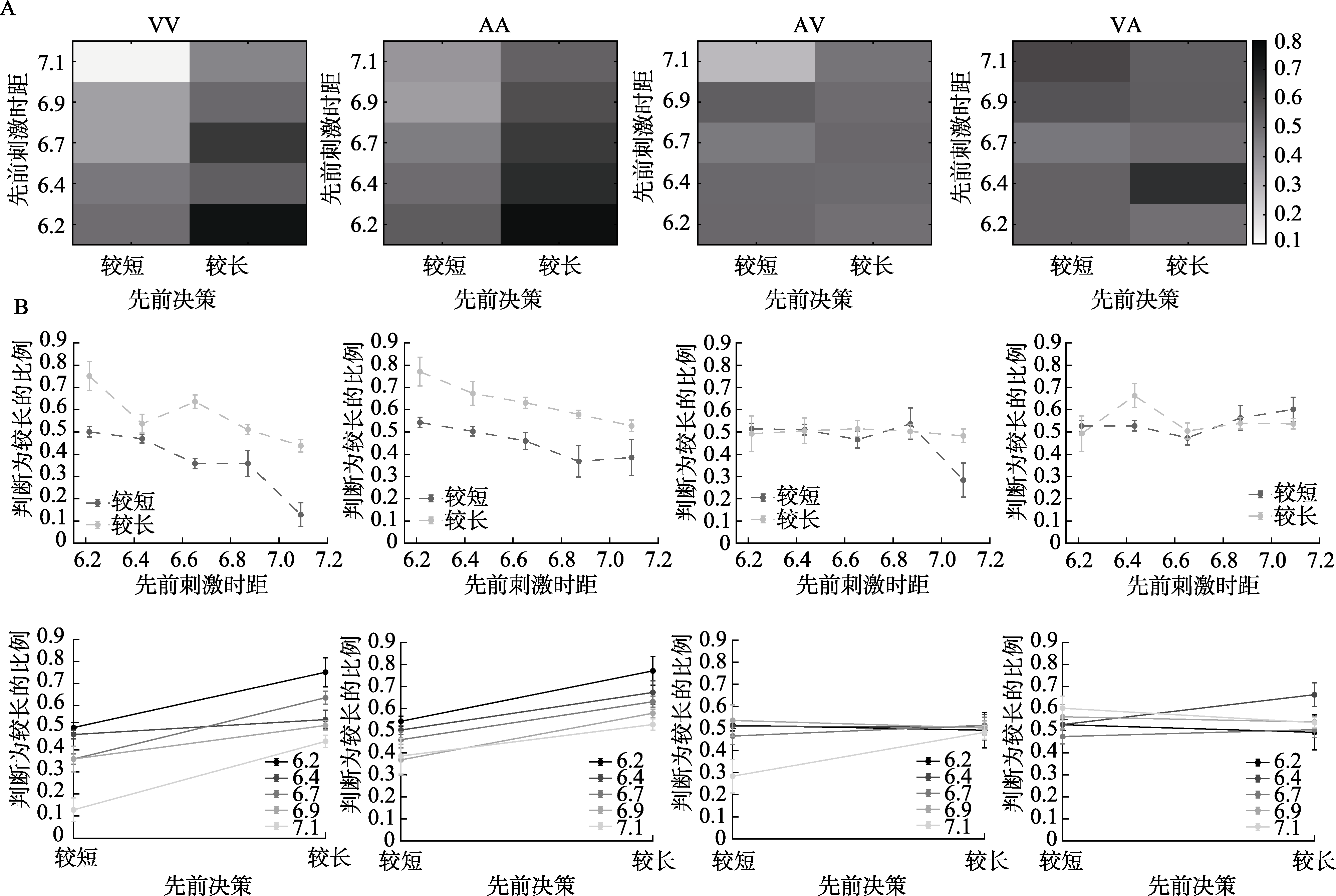
图S5 实验3 二分任务中不同条件下的联合时距决策图。A: 4种条件(VV: 先前刺激是视觉刺激, 当前刺激也是视觉刺激; AA: 先前刺激是听觉刺激, 当前刺激也是听觉刺激; AV: 先前刺激是听觉刺激, 当前刺激是视觉刺激; VA: 先前刺激是视觉刺激, 当前刺激是听觉刺激)下的二维联合决策图。横坐标为先前试次的决策反应, 包括“较长”和“较短”, 纵坐标为先前刺激时距, 因变量为被试在该种条件下当前试次判断为“较长”的比例。白色表示较低, 黑色表示较高。B: 固定先前决策反应(上图)和刺激时距(下图)条件下, 被试当前试次判断为“较长”的比例随着先前刺激时距(上图)和先前决策反应(下图)变化的曲线。数据源于图A中没有空值的所有列。图中的刺激时距为对数转换后的值, 误差线表示标准误差。
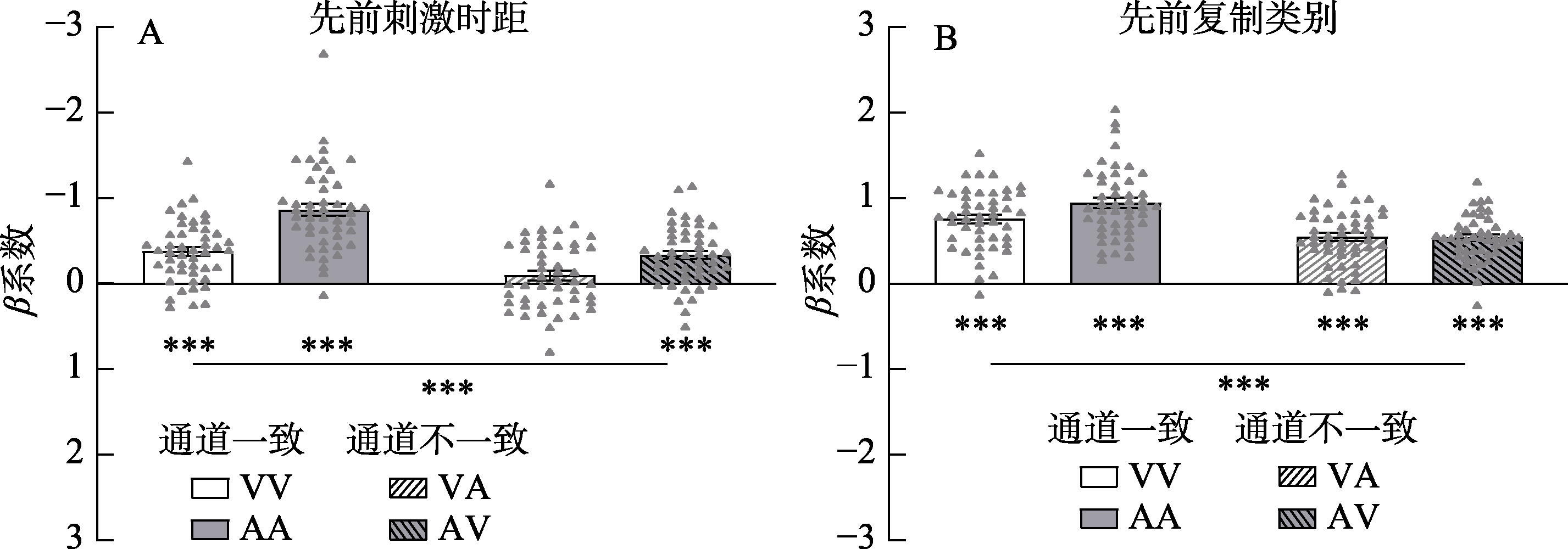
图S6 复制变量转二分变量分析结果。我们采用每个被试总体复制时距中位数作为参考时距, 将复制时距低于该值的试次划分为“较短”, 高于该值的试次划分为“较长”。对实验2和实验3复制任务的数据进行合并, 并将转换后的数据进行与二分任务相同的模型分析。(A)基于先前刺激时距的β系数在不同条件下的大小。(B)基于先前复制类别的β系数在不同条件下的大小。白色空心条形图VV表示先前与当前刺激均为视觉刺激; 灰色实心条形图AA表示先前与当前刺激均为听觉刺激; 右斜浅色条纹条形图VA表示先前刺激为视觉刺激, 当前刺激为听觉刺激; 左斜深色条纹条形图AV表示先前刺激为听觉刺激, 当前刺激为视觉刺激。图中灰色三角代表每种条件下每名被试的数据点, 误差线代表标准误差, ***p < 0.001。
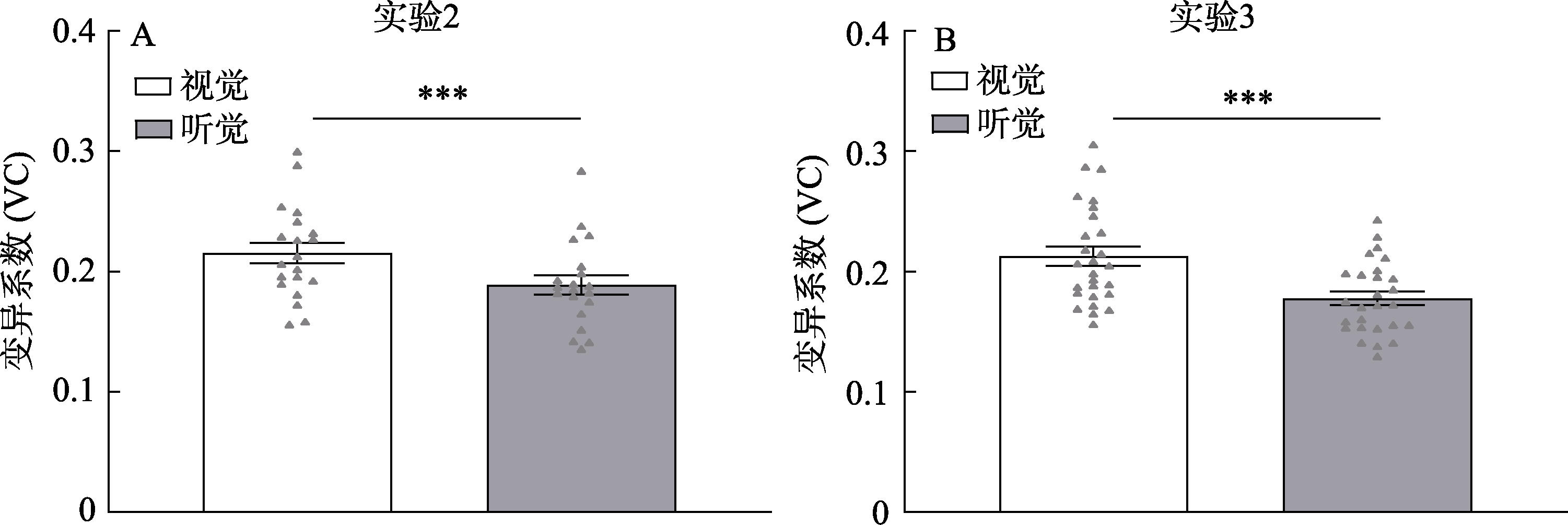
图S7 复制时距变异性分析结果。(A)实验2视觉和听觉通道复制时距变异系数的大小。(B)实验3视觉和听觉通道复制时距变异系数的大小。对于每个实验, 我们首先计算了视觉和听觉条件下每个刺激时距(500 ms, 622 ms, 775 ms, 964 ms, 1200 ms)的变异系数, 随后分别对视觉和听觉通道的5个CV进行平均。之后采用配对样本t检验考察视觉与听觉通道中变异系数之间的差异。结果发现, 个体对视觉时距的感知不确定性与内部噪声更高。因此, 在感知整合中, 视觉时距信息的可靠性要低于听觉时距信息的可靠性, 表现为AV条件的反应序列依赖效应要显著高于VA条件的反应序列依赖效应。图中白色空心条形图为视觉条件, 灰色实心条形图为听觉条件。灰色三角代表每种条件下每名被试的数据点, 误差线代表标准误差, ***p < 0.001。
| [1] |
Akaishi, R., Umeda, K., Nagase, A., & Sakai, K. (2014). Autonomous mechanism of internal choice estimate underlies decision inertia. Neuron, 81(1), 195-206.
doi: 10.1016/j.neuron.2013.10.018 pmid: 24333055 |
| [2] |
Bausenhart, K. M., Dyjas, O., & Ulrich, R. (2014). Temporal reproductions are influenced by an internal reference: Explaining the Vierordt effect. Acta Psychologica, 147, 60-67.
doi: 10.1016/j.actpsy.2013.06.011 pmid: 23896562 |
| [3] | Bosch, E., Fritsche, M., Ehinger, B. V., & de Lange, F. P. (2020). Opposite effects of choice history and evidence history resolve a paradox of sequential choice bias. Journal of Vision, 20(12), 9. |
| [4] |
Brainard, D. H. (1997). The psychophysics toolbox. Spatial Vision, 10(4), 433-436.
pmid: 9176952 |
| [5] |
Brimijoin, W. O., & O’Neill, W. E. (2010). Patterned tone sequences reveal non-linear interactions in auditory spectrotemporal receptive fields in the inferior colliculus. Hearing Research, 267(1-2), 96-110.
doi: 10.1016/j.heares.2010.04.005 pmid: 20430078 |
| [6] |
Bueti, D., Walsh, V., Frith, C., & Rees, G. (2008). Different brain circuits underlie motor and perceptual representations of temporal intervals. Journal of Cognitive Neuroscience, 20(2), 204-214.
doi: 10.1162/jocn.2008.20017 pmid: 18275329 |
| [7] | Burnham, K. P., & Anderson, D. R. (2004). Multimodel inference: Understanding AIC and BIC in model selection. Sociological Methods & Research, 33(2), 261-304. |
| [8] |
Burr, D., Banks, M. S., & Morrone, M. C. (2009). Auditory dominance over vision in the perception of interval duration. Experimental Brain Research, 198(1), 49-57.
doi: 10.1007/s00221-009-1933-z pmid: 19597804 |
| [9] | Burr, D., & Cicchini, G. M. (2014). Vision: Efficient adaptive coding. Current Biology, 24(22), R1096-R1098. |
| [10] |
Chen, K.-M., & Yeh, S.-L. (2009). Asymmetric cross-modal effects in time perception. Acta Psychologica, 130(3), 225-234.
doi: 10.1016/j.actpsy.2008.12.008 URL |
| [11] |
Chen, S., Wang, T., & Bao, Y. (2023). Serial dependence in timing at the perceptual level being modulated by working memory. PsyCh Journal, 12(6), 774-786.
doi: 10.1002/pchj.653 pmid: 37528541 |
| [12] | Cheng, S., Chen, S., Glasauer, S., Keeser, D., & Shi, Z. (2024). Neural mechanisms of sequential dependence in time perception: The impact of prior task and memory processing. Cerebral Cortex, 34(1), bhad453. |
| [13] |
Cheng, S., Chen, S., & Shi, Z. (2024). Opposing sequential biases in direction and time reproduction: Influences of task relevance and working memory. British Journal of Psychology, 115(4), 825-842.
doi: 10.1111/bjop.12728 pmid: 39133516 |
| [14] |
Cheng, S., Chen, S., Yang, X., & Shi, Z. (2024). The impact of task measurements on sequential dependence: A comparison between temporal reproduction and discrimination tasks. Psychological Research, 88(8), 2346-2359.
doi: 10.1007/s00426-024-02023-x pmid: 39190157 |
| [15] |
Cicchini, G. M., Benedetto, A., & Burr, D. C. (2021). Perceptual history propagates down to early levels of sensory analysis. Current Biology, 31(6), 1245-1250.e2.
doi: 10.1016/j.cub.2020.12.004 URL |
| [16] | Cicchini, G. M., Mikellidou, K., & Burr, D. (2017). Serial dependencies act directly on perception. Journal of Vision, 17(14), 6. |
| [17] | Cicchini, G. M., Mikellidou, K., & Burr, D. C. (2018). The functional role of serial dependence. Proceedings of the Royal Society B: Biological Sciences, 285(1890), 20181722. |
| [18] |
Dyjas, O., Bausenhart, K. M., & Ulrich, R. (2012). Trial- by-trial updating of an internal reference in discrimination tasks: Evidence from effects of stimulus order and trial sequence. Attention, Perception, & Psychophysics, 74(8), 1819-1841.
doi: 10.3758/s13414-012-0362-4 URL |
| [19] |
Ernst, M. O., & Banks, M. S. (2002). Humans integrate visual and haptic information in a statistically optimal fashion. Nature, 415(6870), 429-433.
doi: 10.1038/415429a |
| [20] |
Faul, F., Erdfelder, E., Lang, A.-G., & Buchner, A. (2007). G*Power 3: A flexible statistical power analysis program for the social, behavioral, and biomedical sciences. Behavior Research Methods, 39(2), 175-191.
doi: 10.3758/bf03193146 pmid: 17695343 |
| [21] | Feigin, H., Shalom-Sperber, S., Zachor, D. A., & Zaidel, A. (2021). Increased influence of prior choices on perceptual decisions in autism. eLife, 10, e61595. |
| [22] |
Fetsch, C. R., Pouget, A., DeAngelis, G. C., & Angelaki, D. E. (2012). Neural correlates of reliability-based cue weighting during multisensory integration. Nature Neuroscience, 15(1), 146-154.
doi: 10.1038/nn.2983 |
| [23] |
Fischer, J., & Whitney, D. (2014). Serial dependence in visual perception. Nature Neuroscience, 17(5), 738-743.
doi: 10.1038/nn.3689 pmid: 24686785 |
| [24] |
Fornaciai, M., & Park, J. (2019). Serial dependence generalizes across different stimulus formats, but not different sensory modalities. Vision Research, 160, 108-115.
doi: S0042-6989(19)30104-X pmid: 31078663 |
| [25] |
Fritsche, M., Mostert, P., & de Lange, F. P. (2017). Opposite effects of recent history on perception and decision. Current Biology, 27(4), 590-595.
doi: S0960-9822(17)30006-4 pmid: 28162897 |
| [26] | Fulvio, J. M., Green, C. S., & Schrater, P. R. (2014). Task-specific response strategy selection on the basis of recent training experience. PLOS Computational Biology, 10(1), e1003425. |
| [27] |
Goldstone, S., & Lhamon, W. T. (1974). Studies of auditory-visual differences in human time judgment: 1. Sounds are judged longer than lights. Perceptual and Motor Skills, 39(1), 63-82.
pmid: 4415924 |
| [28] | Green, C. S., Kattner, F., Siegel, M. H., Kersten, D., & Schrater, P. R. (2015). Differences in perceptual learning transfer as a function of training task. Journal of Vision, 15(10), 5. |
| [29] |
Heron, J., Aaen-Stockdale, C., Hotchkiss, J., Roach, N. W., McGraw, P. V., & Whitaker, D. (2012). Duration channels mediate human time perception. Proceedings of the Royal Society B: Biological Sciences, 279(1729), 690-698.
doi: 10.1098/rspb.2011.1131 URL |
| [30] | Huang, X. T., Guo, X. Y., & Nie, J. (2003). The relationship between temporal and non-temporal information in cognitive processing. Journal of Psychological Science, 26(5), 770-774. |
| [黄希庭, 郭秀艳, 聂晶. (2003). 认知加工中时间与非时间信息的相互关系. 心理科学, 26(5), 770-774.] | |
| [31] | Huang, X. T., Li, B. Y., & Zhang, Z. J. (2003). The research of the range-synthetic model of temporal cognition. Journal of Southwest China Normal University (Humanities and Social Sciences Edition), 29(2), 5-9. |
| [黄希庭, 李伯约, 张志杰. (2003). 时间认知分段综合模型的探讨. 西南师范大学学报: 人文社会科学版, 29(2), 5-9.] | |
| [32] | Kattner, F., Cox, C. R., & Green, C. S. (2016). Transfer in rule-based category learning depends on the training task. PLOS ONE, 11(10), e0165260. |
| [33] |
Klink, P. C., Montijn, J. S., & van Wezel, R. J. (2011). Crossmodal duration perception involves perceptual grouping, temporal ventriloquism, and variable internal clock rates. Attention, Perception, & Psychophysics, 73(1), 219-236.
doi: 10.3758/s13414-010-0010-9 URL |
| [34] |
Lewis, P. A., & Miall, R. C. (2003). Distinct systems for automatic and cognitively controlled time measurement: Evidence from neuroimaging. Current Opinion in Neurobiology, 13(2), 250-255.
doi: 10.1016/s0959-4388(03)00036-9 pmid: 12744981 |
| [35] |
Leys, C., Ley, C., Klein, O., Bernard, P., & Licata, L. (2013). Detecting outliers: Do not use standard deviation around the mean, use absolute deviation around the median. Journal of Experimental Social Psychology, 49(4), 764-766.
doi: 10.1016/j.jesp.2013.03.013 URL |
| [36] |
Li, B., Chen, L., & Fang, F. (2019). Somatotopic representation of tactile duration: Evidence from tactile duration aftereffect. Behavioural Brain Research, 371, 111954.
doi: 10.1016/j.bbr.2019.111954 URL |
| [37] | Li, B., Wang, B., & Zaidel, A. (2023). Modality-specific sensory and decisional carryover effects in duration perception. BMC Biology, 21(1), 48. |
| [38] |
Li, B., Xiao, L., Yin, H., Liu, P., & Huang, X. (2017). Duration aftereffect depends on the duration of adaptation. Frontiers in Psychology, 8, 491.
doi: 10.3389/fpsyg.2017.00491 pmid: 28424646 |
| [39] |
Li, B., Yuan, X., Chen, Y., Liu, P., & Huang, X. (2015). Visual duration aftereffect is position invariant. Frontiers in Psychology, 6, 1536.
doi: 10.3389/fpsyg.2015.01536 pmid: 26500591 |
| [40] |
Li, B., Yuan, X., & Huang, X. (2015). The aftereffect of perceived duration is contingent on auditory frequency but not visual orientation. Scientific Reports, 5, 10124.
doi: 10.1038/srep10124 pmid: 26054927 |
| [41] | Li, B. L., Zhai, X. F., Wang, B. Y., & Wang, K. (2025). Spatial and ear generalizations of serial dependence in auditory duration perception. Journal of Psychological Science, 48(1), 11-20. |
| [李宝林, 翟小斐, 王碧瑶, 王坤. (2025). 听觉时距知觉序列依赖效应跨空间和双耳位置的迁移特性. 心理科学, 48(1), 11-20.] | |
| [42] | Luo, M., Zhang, H., Fang, F., & Luo, H. (2025). Reactivation of previous decisions repulsively biases sensory encoding but attractively biases decision-making. PLOS Biology, 23(4), e3003150. |
| [43] |
Manassi, M., Liberman, A., Kosovicheva, A., Zhang, K., & Whitney, D. (2018). Serial dependence in position occurs at the time of perception. Psychonomic Bulletin & Review, 25(6), 2245-2253.
doi: 10.3758/s13423-018-1454-5 |
| [44] |
Matthews, W. J., & Meck, W. H. (2016). Temporal cognition: Connecting subjective time to perception, attention, and memory. Psychological Bulletin, 142(8), 865-907.
doi: 10.1037/bul0000045 pmid: 27196725 |
| [45] |
Merchant, H., Harrington, D. L., & Meck, W. H. (2013). Neural basis of the perception and estimation of time. Annual Review of Neuroscience, 36, 313-336.
doi: 10.1146/annurev-neuro-062012-170349 pmid: 23725000 |
| [46] |
Merchant, H., Pérez, O., Zarco, W., & Gámez, J. (2013). Interval tuning in the primate medial premotor cortex as a general timing mechanism. Journal of Neuroscience, 33(21), 9082-9096.
doi: 10.1523/JNEUROSCI.5513-12.2013 pmid: 23699519 |
| [47] | Moon, J., & Kwon, O.-S. (2022). Attractive and repulsive effects of sensory history concurrently shape visual perception. BMC Biology, 20(1), 247. |
| [48] |
Murai, Y., & Whitney, D. (2021). Serial dependence revealed in history-dependent perceptual templates. Current Biology, 31(14), 3185-3191.e3.
doi: 10.1016/j.cub.2021.05.006 URL |
| [49] |
O'Regan, J. K., & Noë, A. (2001). A sensorimotor account of vision and visual consciousness. Behavioral and Brain Sciences, 24(5), 939-973.
pmid: 12239892 |
| [50] | Pascucci, D., Mancuso, G., Santandrea, E., Della Libera, C., Plomp, G., & Chelazzi, L. (2019). Laws of concatenated perception: Vision goes for novelty, decisions for perseverance. PLOS Biology, 17(3), e3000144. |
| [51] | Pascucci, D., Tanrikulu, Ö. D., Ozkirli, A., Houborg, C., Ceylan, G., Zerr, P.,... Kristjánsson, Á. (2023). Serial dependence in visual perception: A review. Journal of Vision, 23(1), 9. |
| [52] |
Pelli, D. G. (1997). The VideoToolbox software for visual psychophysics: Transforming numbers into movies. Spatial Vision, 10(4), 437-442.
pmid: 9176953 |
| [53] |
Penney, T. B., Gibbon, J., & Meck, W. H. (2000). Differential effects of auditory and visual signals on clock speed and temporal memory. Journal of Experimental Psychology: Human Perception and Performance, 26(6), 1770-1787.
doi: 10.1037/0096-1523.26.6.1770 URL |
| [54] | Prinz, W. (1990). A common coding approach to perception and action. In O. Neumann & W. Prinz (Eds.), Relationships between perception and action: Current approaches (pp. 167-201). Springer, Berlin, Heidelberg. |
| [55] | Protopapa, F., Hayashi, M. J., Kulashekhar, S., Van Der Zwaag, W., Battistella, G., Murray, M. M.,... Bueti, D. (2019). Chronotopic maps in human supplementary motor area. PLOS Biology, 17(3), e3000026. |
| [56] |
Roach, N. W., McGraw, P. V., Whitaker, D. J., & Heron, J. (2017). Generalization of prior information for rapid Bayesian time estimation. Proceedings of the National Academy of Sciences, 114(2), 412-417.
doi: 10.1073/pnas.1610706114 URL |
| [57] |
Sadil, P., Cowell, R. A., & Huber, D. E. (2024). The push-pull of serial dependence effects: Attraction to the prior response and repulsion from the prior stimulus. Psychonomic Bulletin & Review, 31(1), 259-273.
doi: 10.3758/s13423-023-02320-3 |
| [58] | Schneider, K. A., & Komlos, M. (2008). Attention biases decisions but does not alter appearance. Journal of Vision, 8(15), 3. |
| [59] |
Schubotz, R. I., Friederici, A. D., & von Cramon, D. Y. (2000). Time perception and motor timing: A common cortical and subcortical basis revealed by fMRI. NeuroImage, 11(1), 1-12.
pmid: 10686112 |
| [60] | Sheehan, T. C., & Serences, J. T. (2022). Attractive serial dependence overcomes repulsive neuronal adaptation. PLOS Biology, 20(9), e3001711. |
| [61] | Urai, A. E., de Gee, J. W., Tsetsos, K., & Donner, T. H. (2019). Choice history biases subsequent evidence accumulation. eLife, 8, e46331. |
| [62] | Van der Burg, E., Toet, A., Brouwer, A.-M., & Van Erp, J. B. F. (2021). Serial dependence of emotion within and between stimulus sensory modalities. Multisensory Research, 1-12. |
| [63] |
Walker, J. T., & Scott, K. J. (1981). Auditory-visual conflicts in the perceived duration of lights, tones, and gaps. Journal of Experimental Psychology: Human Perception and Performance, 7(6), 1327-1339.
doi: 10.1037/0096-1523.7.6.1327 URL |
| [64] |
Wang, B. Y., Chen, C., Hu, X. F., Wang, D., & Li, B. L. (2024). Spatial generalization of serial dependence in visual duration perception. Acta Psychologica Sinica, 56(4), 394-411.
doi: 10.3724/SP.J.1041.2024.00394 |
|
[王碧瑶, 陈晨, 胡晓斐, 王迪, 李宝林. (2024). 视觉时距知觉序列依赖效应的空间迁移性. 心理学报, 56(4), 394-411.]
doi: 10.3724/SP.J.1041.2024.00394 |
|
| [65] | Wearden, J. H., Edwards, H., Fakhri, M., & Percival, A. (1998). Why ''sounds are judged longer than lights'': Application of a model of the internal clock in humans. The Quarterly Journal of Experimental Psychology B: Comparative and Physiological Psychology, 51(2), 97-120. |
| [66] |
Wehrman, J. J., Wearden, J. H., & Sowman, P. (2018). Short-term effects on temporal judgement: Sequential drivers of interval bisection and reproduction. Acta Psychologica, 185, 87-95.
doi: S0001-6918(17)30299-8 pmid: 29432991 |
| [67] |
Wehrman, J. J., Wearden, J., & Sowman, P. (2020). Decisional carryover effects in interval timing: Evidence of a generalized response bias. Attention, Perception & Psychophysics, 82(4), 2147-2164.
doi: 10.3758/s13414-019-01922-1 |
| [68] | Wiener, M., Thompson, J. C., & Coslett, H. B. (2014). Continuous carryover of temporal context dissociates response bias from perceptual influence for duration. PLOS ONE, 9(6), e100803. |
| [69] |
Wiener, M., Turkeltaub, P., & Coslett, H. B. (2010). The image of time: A voxel-wise meta-analysis. NeuroImage, 49(2), 1728-1740.
doi: 10.1016/j.neuroimage.2009.09.064 pmid: 19800975 |
| [70] |
Wilson, M. (2002). Six views of embodied cognition. Psychonomic Bulletin & Review, 9(4), 625-636.
doi: 10.3758/BF03196322 URL |
| [71] | Zhang, H., & Luo, H. (2023). Feature-specific reactivations of past information shift current neural encoding thereby mediating serial bias behaviors. PLOS Biology, 21(3), e3002056. |
| [72] |
Zhou, L., Liu, Y., Jiang, Y., Wang, W., Xu, P., & Zhou, K. (2024). The distinct development of stimulus and response serial dependence. Psychonomic Bulletin & Review, 31(5), 2137-2147.
doi: 10.3758/s13423-024-02474-8 |
| [73] | Zimmermann, E., & Cicchini, G. M. (2020). Temporal context affects interval timing at the perceptual level. Scientific Reports, 10(1), 8767. |
| [1] | 王达, 杨志豪, 梅高兴. 社会性注意的同类别和跨类别序列依赖效应[J]. 心理学报, 2026, 58(7): 1312-1324. |
| [2] | 李亚丹, 谢聪, 张姬毓, 苏佳豪. 不同类型心智游移对创造性思维的差异化预测及其神经机制[J]. 心理学报, 2026, 58(6): 1090-1112. |
| [3] | 张文洁, 龙如意, 李苗青, 范伟, 傅小兰. 情绪效价和反应指向对幼儿助人行为的影响: 来自行为和fNIRS的证据[J]. 心理学报, 2026, 58(6): 1143-1159. |
| [4] | 任梦梦, 李琎, 钟毅平, 杨莉君. 社会规范类型对亲环境行为的影响:道德认同的调节作用及其fNIRS证据[J]. 心理学报, 2026, 58(6): 1197-1212. |
| [5] | 王爱君, 黄杰, 赵丹娜, 李欣, 张明. 刺激相似性对跨通道冲突中感觉主导效应的影响[J]. 心理学报, 2026, 58(4): 571-589. |
| [6] | 唐溢, 赵亚军, 曾清樟, 张智君, 吴圣楠. 单通道和多通道下的统计学习跨通道迁移[J]. 心理学报, 2026, 58(4): 590-602. |
| [7] | 许红慧, 徐怡冉, 杨国春, 南威治, 刘勋. 行为振荡的Theta节律存在于跨通道刺激冲突与反应冲突加工中[J]. 心理学报, 2026, 58(3): 467-479. |
| [8] | 李毕琴, 张美霞, 杨少云, 黄鹏飞, 王爱君, 党君华. 秒内不同时距下自我加工优势效应[J]. 心理学报, 2025, 57(9): 1529-1539. |
| [9] | 王继贤, 刘明慧. 自我信息的无意识整合优势: 来自阈下同异任务范式的证据[J]. 心理学报, 2025, 57(9): 1609-1621. |
| [10] | 陆翔宇, 陈平. 交互式问题解决测验中学习效应的分析:过程数据测量模型的拓展与应用[J]. 心理学报, 2025, 57(9): 1677-1688. |
| [11] | 周衡, 王爱君, 袁祥勇, 蒋毅. 客体类别差异调节视听跨通道冲突中反应水平的感觉主导效应[J]. 心理学报, 2025, 57(6): 1001-1012. |
| [12] | 王强强, 吴彦文, 石文典, 游旭群. 数量和顺序线索对SNARC效应的影响及其作用机制[J]. 心理学报, 2025, 57(5): 749-761. |
| [13] | 纪婷婷, 王嘉, 丁毅. 人们更同情流浪动物还是流浪汉?基于责任归因视角的解释[J]. 心理学报, 2025, 57(5): 838-859. |
| [14] | 史滋福, 夏笔奇, 刘欣, 陈火红, 靳紫阳, 彭玲艺. 时间预测中的任务分解效应:未来边界和思维焦点的作用[J]. 心理学报, 2025, 57(2): 207-217. |
| [15] | 王国轩, 龙立荣, 李绍龙, 孙芳, 望家晴, 黄世英子. 负面绩效反馈下员工绩效改进动机的人机比较[J]. 心理学报, 2025, 57(2): 298-314. |
| 阅读次数 | ||||||
|
全文 |
|
|||||
|
摘要 |
|
|||||
