

ISSN 0439-755X
CN 11-1911/B
主办:中国心理学会
中国科学院心理研究所
出版:科学出版社
CN 11-1911/B
主办:中国心理学会
中国科学院心理研究所
出版:科学出版社
心理学报 ›› 2026, Vol. 58 ›› Issue (2): 323-335.doi: 10.3724/SP.J.1041.2026.0323 cstr: 32110.14.2026.0323
潘运1,2( ), 杨环瑜1,3(), 贾良智1, 朱俊1, 余方文1, 张頔1, 杨平1
收稿日期:2024-07-28
发布日期:2025-12-03
出版日期:2026-02-25
通讯作者:
潘运, E-mail: panyun129@163.com;基金资助:
PAN Yun1,2(), YANG Huanyu1,3(), JIA Liangzhi1, ZHU Jun1, YU Fangwen1, ZHANG Di1, YANG Ping1
Received:2024-07-28
Online:2025-12-03
Published:2026-02-25
摘要:
本研究采用数量估计任务结合fMRI技术, 深入探究内部和外部分组线索分别对数量感知分组化策略的影响, 揭示数量感知分组化策略的神经机制。结果发现,分组条件比未分组条件在左侧顶内沟、角回和额上回等与计算相关的脑区有更显著激活; 外部分组线索比内部分组线索在额中回和颞下回等与拓扑性质相关的脑区表现出更显著激活。结果表明,被试分组条件下更倾向于使用计算相关策略进行数量感知, 且外部分组线索具有拓扑性质, 支持了拓扑知觉理论。
中图分类号:
潘运, 杨环瑜, 贾良智, 朱俊, 余方文, 张頔, 杨平. (2026). 内外部分组线索对数量感知分组化策略的影响: 来自fMRI证据. 心理学报, 58(2), 323-335.
PAN Yun, YANG Huanyu, JIA Liangzhi, ZHU Jun, YU Fangwen, ZHANG Di, YANG Ping. (2026). The influence of intrinsic and extrinsic grouping cues on numerosity perception of groupitizing: Evidence from fMRI. Acta Psychologica Sinica, 58(2), 323-335.

图1 刺激材料示例图 注: A-C: 共同区域、连通性和邻近性刺激材料分布图; D-G: 外部分组线索和内部分组线索刺激材料示意图, 所有分组线索左边是分组条件, 右边是未分组条件(为便于观看, 图中刺激材料没有按实际比例绘制)。彩图见电子版, 下同
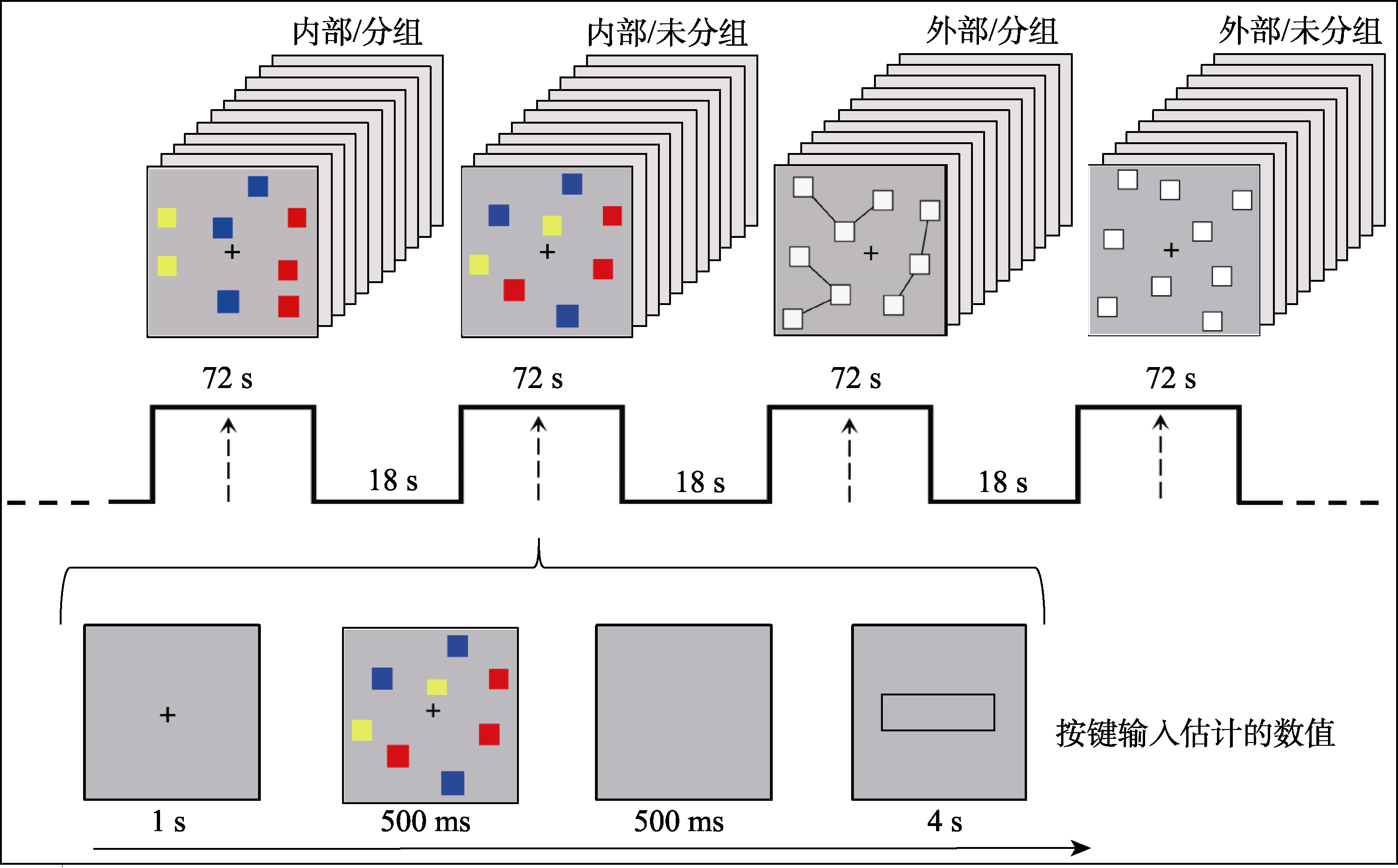
图2 实验流程图
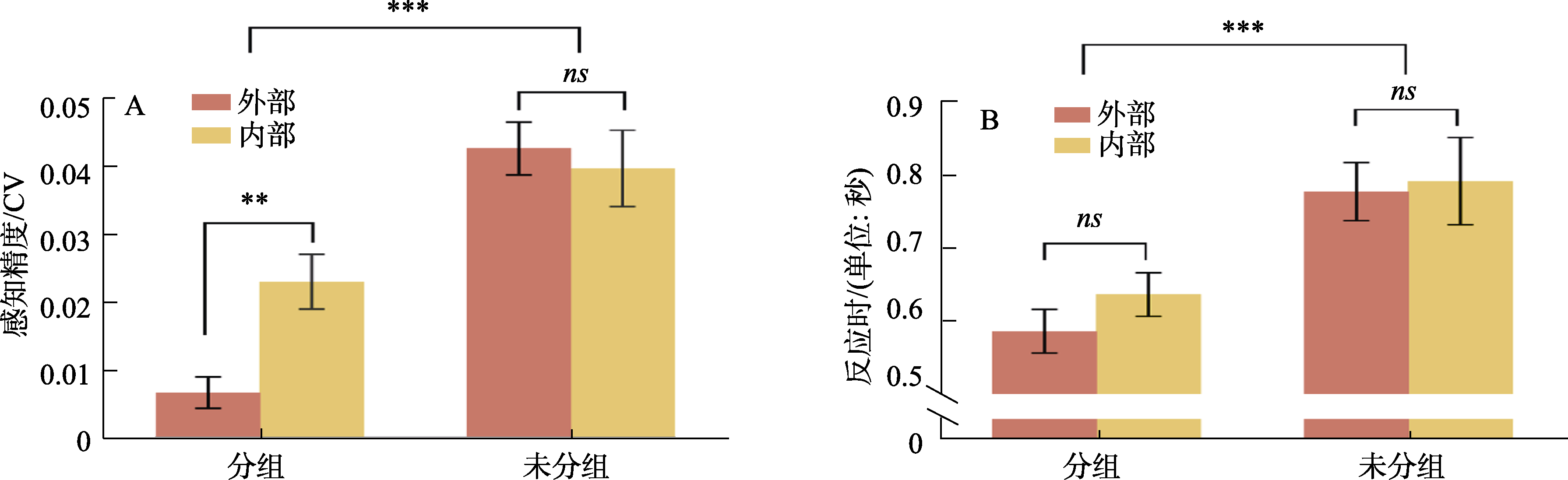
图3 分组条件和分组线索的感知精度(A)和反应时(B)结果示意图 注: ***表示p < 0.001, **表示p < 0.01, *表示p < 0.05, ns表示没有显著差异, 误差棒表示均值的标准误差。
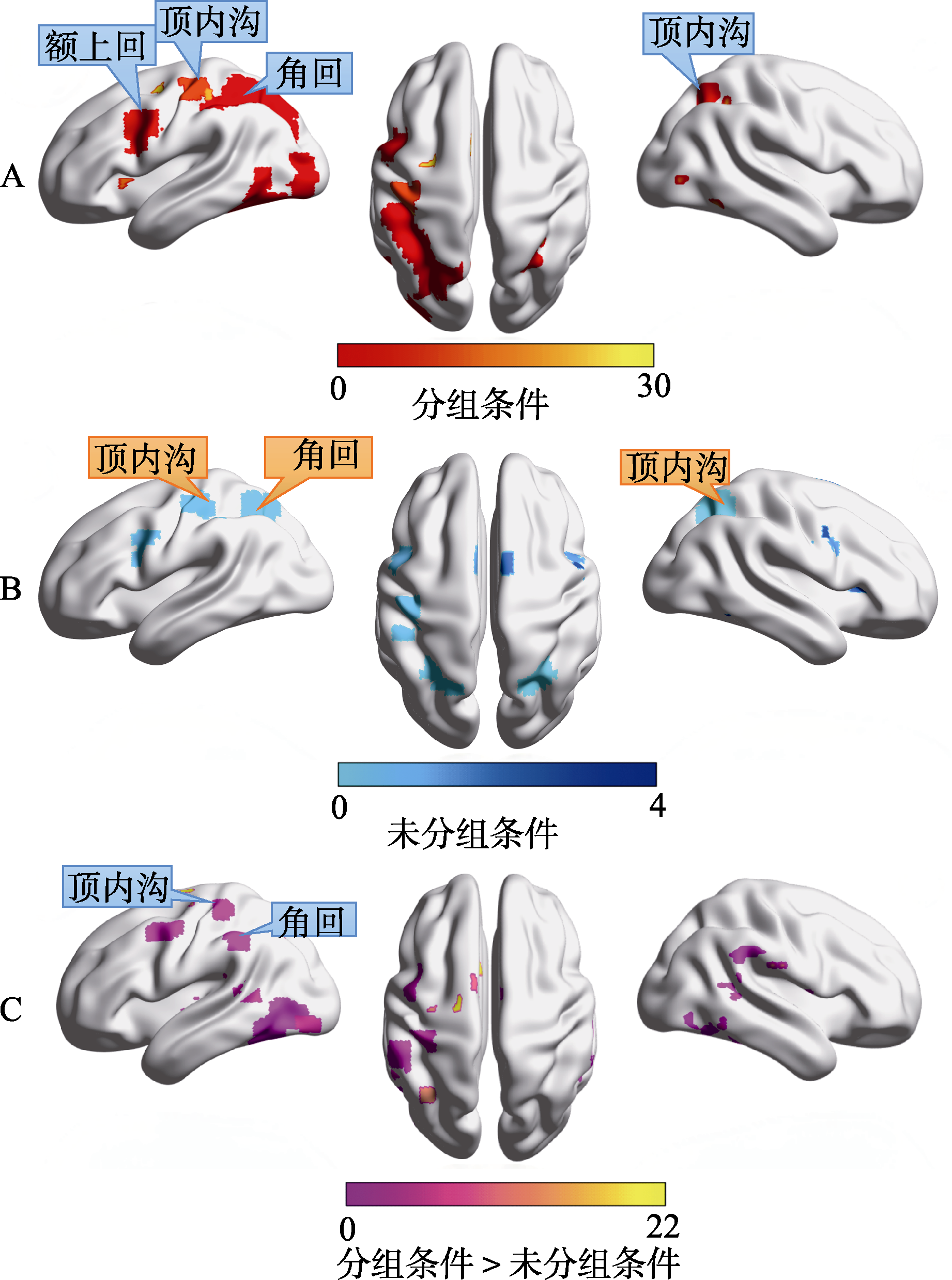
图4 分组和未分组条件的激活脑区及差异脑区
| 激活脑区 | 半球 | 体素数量 | MNI坐标 | t值 | ||
|---|---|---|---|---|---|---|
| x | y | z | ||||
| 分组条件 | ||||||
| 顶内沟/角回/缘上回 | 左 | 707 | −30 | −55 | 42 | 5.76 |
| 颞下回/舌回 | 左 | 408 | −51 | −58 | −10 | 5.64 |
| 额中回 | 左 | 173 | −51 | 8 | 32 | 5.50 |
| 顶内沟 | 右 | 154 | 21 | −58 | 42 | 5.76 |
| 未分组条件 | ||||||
| 顶内沟/角回 | 右 | 128 | 30 | −61 | 54 | 4.53 |
| 顶内沟/角回/顶上小叶 | 左 | 79 | −33 | −55 | 52 | 4.26 |
| 缘上回 | 左 | 40 | −45 | −22 | 52 | 5.26 |
| 额中回 | 左 | 34 | −45 | 5 | 32 | 3.98 |
| 舌回 | 右 | 33 | 9 | −88 | −6 | 4.38 |
| 辅助运动区 | 右 | 24 | −6 | 5 | 56 | 4.18 |
表1 全脑分析中分组条件和未分组条件激活的脑区
| 激活脑区 | 半球 | 体素数量 | MNI坐标 | t值 | ||
|---|---|---|---|---|---|---|
| x | y | z | ||||
| 分组条件 | ||||||
| 顶内沟/角回/缘上回 | 左 | 707 | −30 | −55 | 42 | 5.76 |
| 颞下回/舌回 | 左 | 408 | −51 | −58 | −10 | 5.64 |
| 额中回 | 左 | 173 | −51 | 8 | 32 | 5.50 |
| 顶内沟 | 右 | 154 | 21 | −58 | 42 | 5.76 |
| 未分组条件 | ||||||
| 顶内沟/角回 | 右 | 128 | 30 | −61 | 54 | 4.53 |
| 顶内沟/角回/顶上小叶 | 左 | 79 | −33 | −55 | 52 | 4.26 |
| 缘上回 | 左 | 40 | −45 | −22 | 52 | 5.26 |
| 额中回 | 左 | 34 | −45 | 5 | 32 | 3.98 |
| 舌回 | 右 | 33 | 9 | −88 | −6 | 4.38 |
| 辅助运动区 | 右 | 24 | −6 | 5 | 56 | 4.18 |
| 激活脑区 | 半球 | 体素数量 | MNI坐标 | t值 | ||
|---|---|---|---|---|---|---|
| x | y | z | ||||
| 顶内沟/角回 | 左 | 185 | −36 | −52 | 54 | 6.40 |
| 颞下回 | 左 | 163 | −42 | −58 | −14 | 6.14 |
| 缘上回/角回 | 右 | 87 | 57 | −40 | 30 | 4.79 |
| 缘上回 | 左 | 48 | −51 | −40 | 40 | 4.67 |
| 舌回 | 右 | 38 | 3 | −61 | −8 | 6.03 |
表2 分组条件>未分组条件激活脑区差异
| 激活脑区 | 半球 | 体素数量 | MNI坐标 | t值 | ||
|---|---|---|---|---|---|---|
| x | y | z | ||||
| 顶内沟/角回 | 左 | 185 | −36 | −52 | 54 | 6.40 |
| 颞下回 | 左 | 163 | −42 | −58 | −14 | 6.14 |
| 缘上回/角回 | 右 | 87 | 57 | −40 | 30 | 4.79 |
| 缘上回 | 左 | 48 | −51 | −40 | 40 | 4.67 |
| 舌回 | 右 | 38 | 3 | −61 | −8 | 6.03 |

图5 外部分组线索和内部分组线索的激活脑区及差异脑区
| 激活脑区 | 半球 | 体素数量 | MNI坐标 | t值 | ||
|---|---|---|---|---|---|---|
| x | y | z | ||||
| 外部分组线索 | ||||||
| 额中回/舌回 | 右 | 2297 | 24 | −58 | 42 | 6.30 |
| 顶内沟/角回/缘上回/颞下回 | 左 | 1489 | −21 | −50 | 40 | 6.12 |
| 额中回 | 左 | 510 | −45 | 5 | 30 | 6.05 |
| 中央后回 | 左 | 247 | 48 | 5 | 32 | 5.39 |
| 辅助运动区 | 左 | 192 | −6 | 8 | 54 | 5.10 |
| 岛叶/顶上小叶 | 右 | 124 | 33 | 20 | 6 | 5.65 |
| 内部分组线索 | ||||||
| 顶内沟/缘上回/角回 | 左 | 345 | −36 | −37 | 36 | 5.83 |
| 顶内沟/角回/缘上回 | 右 | 267 | 36 | −55 | 50 | 6.56 |
| 岛叶 | 左 | 170 | −27 | 14 | 14 | 4.80 |
| 额中回/缘上回 | 左 | 134 | −45 | −1 | 32 | 4.83 |
| 辅助运动区 | 左 | 120 | −6 | −1 | 56 | 4.79 |
表3 全脑分析中外部分组线索和内部分组线索激活的脑区
| 激活脑区 | 半球 | 体素数量 | MNI坐标 | t值 | ||
|---|---|---|---|---|---|---|
| x | y | z | ||||
| 外部分组线索 | ||||||
| 额中回/舌回 | 右 | 2297 | 24 | −58 | 42 | 6.30 |
| 顶内沟/角回/缘上回/颞下回 | 左 | 1489 | −21 | −50 | 40 | 6.12 |
| 额中回 | 左 | 510 | −45 | 5 | 30 | 6.05 |
| 中央后回 | 左 | 247 | 48 | 5 | 32 | 5.39 |
| 辅助运动区 | 左 | 192 | −6 | 8 | 54 | 5.10 |
| 岛叶/顶上小叶 | 右 | 124 | 33 | 20 | 6 | 5.65 |
| 内部分组线索 | ||||||
| 顶内沟/缘上回/角回 | 左 | 345 | −36 | −37 | 36 | 5.83 |
| 顶内沟/角回/缘上回 | 右 | 267 | 36 | −55 | 50 | 6.56 |
| 岛叶 | 左 | 170 | −27 | 14 | 14 | 4.80 |
| 额中回/缘上回 | 左 | 134 | −45 | −1 | 32 | 4.83 |
| 辅助运动区 | 左 | 120 | −6 | −1 | 56 | 4.79 |
| 激活脑区 | 半球 | 体素 数量 | MNI坐标 | t值 | ||
|---|---|---|---|---|---|---|
| x | y | z | ||||
| 辅助运动区/额中回/顶内沟 | 左 | 1037 | −30 | 44 | 38 | 5.76 |
| 颞下回 | 左 | 233 | −53 | −23 | −18 | 5.86 |
| 颞下回 | 右 | 221 | 45 | −31 | −8 | 5.94 |
| 舌回 | 左 | 59 | −12 | −85 | −16 | 5.64 |
表4 外部分组线索>内部分组线索激活脑区差异
| 激活脑区 | 半球 | 体素 数量 | MNI坐标 | t值 | ||
|---|---|---|---|---|---|---|
| x | y | z | ||||
| 辅助运动区/额中回/顶内沟 | 左 | 1037 | −30 | 44 | 38 | 5.76 |
| 颞下回 | 左 | 233 | −53 | −23 | −18 | 5.86 |
| 颞下回 | 右 | 221 | 45 | −31 | −8 | 5.94 |
| 舌回 | 左 | 59 | −12 | −85 | −16 | 5.64 |
| 种子点 | 目标区域 | 体素 数量 | MNI坐标 | t值 | ||
|---|---|---|---|---|---|---|
| x | y | z | ||||
| 左侧顶内沟 | 右侧顶内沟 | 265 | 30 | −69 | 36 | 5.85 |
| 右侧角回 | 56 | 42 | −55 | 18 | 5.32 | |
| 右侧额上回 | 102 | 33 | 50 | 11 | 5.28 | |
| 左侧顶内沟 | 89 | −36 | −58 | 50 | 6.99 | |
表5 以左侧顶内沟为种子点的分组条件强于未分组条件功能连接情况
| 种子点 | 目标区域 | 体素 数量 | MNI坐标 | t值 | ||
|---|---|---|---|---|---|---|
| x | y | z | ||||
| 左侧顶内沟 | 右侧顶内沟 | 265 | 30 | −69 | 36 | 5.85 |
| 右侧角回 | 56 | 42 | −55 | 18 | 5.32 | |
| 右侧额上回 | 102 | 33 | 50 | 11 | 5.28 | |
| 左侧顶内沟 | 89 | −36 | −58 | 50 | 6.99 | |
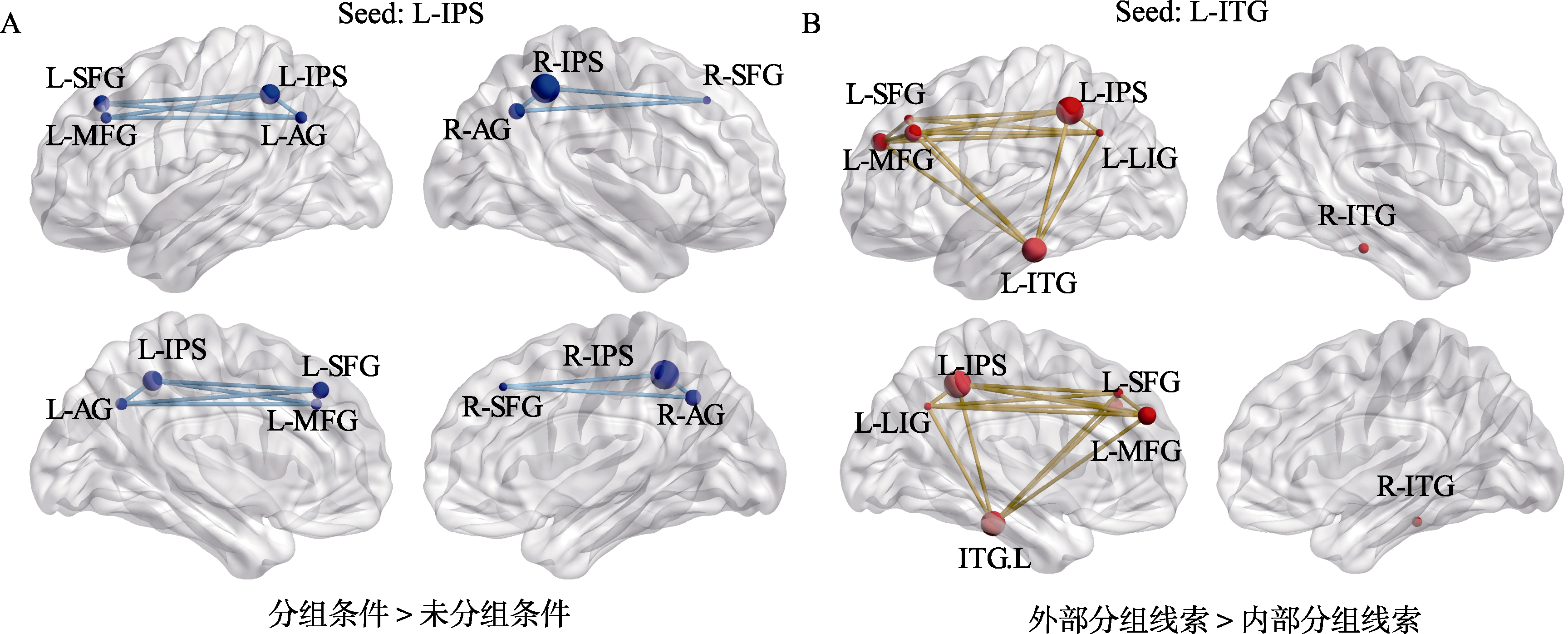
图6 A: 以左侧顶内沟为种子点分组条件减未分组条件的gPPI分析结果; B: 以左侧颞下回为种子点外部分组线索减内部分组线索的gPPI分析结果
| 种子点 | 目标区域 | 体素 数量 | MNI坐标 | t值 | ||
|---|---|---|---|---|---|---|
| x | y | z | ||||
| 左侧颞下回 | 左侧顶内沟 | 132 | −33 | −65 | 32 | 6.35 |
| 左侧舌回 | 169 | −42 | −45 | 18 | 8.52 | |
| 左侧额上回 | 256 | −36 | 43 | 10 | 5.32 | |
| 左侧颞下回 | 152 | −52 | −64 | −18 | 6.35 | |
| 右侧颞下回 | 53 | 54 | −58 | −14 | 5.65 | |
表6 以L-ITG为种子点外部分组线索强于内部分组线索的功能连接情况
| 种子点 | 目标区域 | 体素 数量 | MNI坐标 | t值 | ||
|---|---|---|---|---|---|---|
| x | y | z | ||||
| 左侧颞下回 | 左侧顶内沟 | 132 | −33 | −65 | 32 | 6.35 |
| 左侧舌回 | 169 | −42 | −45 | 18 | 8.52 | |
| 左侧额上回 | 256 | −36 | 43 | 10 | 5.32 | |
| 左侧颞下回 | 152 | −52 | −64 | −18 | 6.35 | |
| 右侧颞下回 | 53 | 54 | −58 | −14 | 5.65 | |
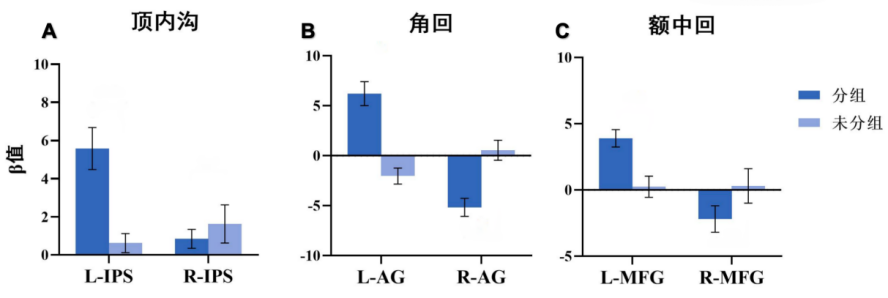
附图1 分组条件ROI分析结果 注: L-IPS表示左侧顶内沟, R-IPS表示右侧顶内沟, L-AG表示左侧角回, R-AG表示右侧角回, L-MFG表示左侧额中回, R-MFG表示右侧额中回。
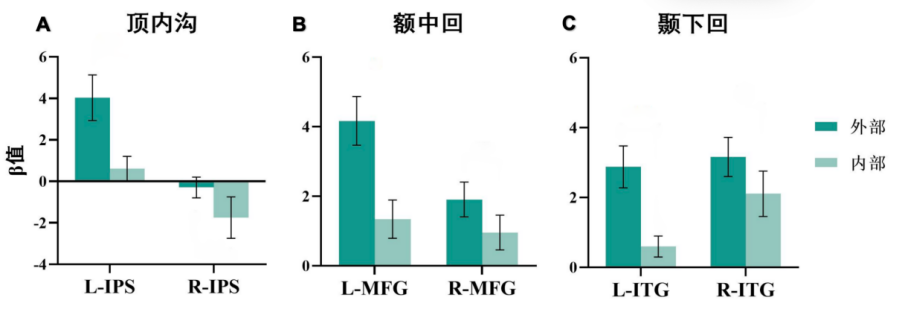
附图2 分组线索下的ROI分析结果 注: *L-IPS表示左侧顶内沟, R-IPS表示右侧顶内沟, L-MFG表示左侧额中回, R-MFG表示右侧额中回, L-ITG表示左侧颞下回, R-ITG表示右侧颞下回。
| [1] |
Anobile G., Castaldi E., Maldonado Moscoso P. A., Arrighi R., & Burr D. (2021). Groupitizing improves estimation of numerosity of auditory sequences. Frontiers in Human Neuroscience, 15, 687321. http://doi.org/10.3389/fnhum.2021.687321
doi: 10.3389/fnhum.2021.687321 URL |
| [2] |
Anobile G., Castaldi E., Moscoso P. A. M., Burr D. C., & Arrighi R. (2020). “Groupitizing”: A strategy for numerosity estimation. Scientific Reports, 10(1), 13436. http://doi.org/10.1038/s41598-020-68.111-1
doi: 10.1038/s41598-020-68111-1 URL |
| [3] |
Arsalidou M., Pawliw-Levac M., Sadeghi M., & Pascual- Leone J. (2018). Brain areas associated with numbers and calculations in children: Meta-analyses of fMRI studies. Developmental Cognitive Neuroscience, 30, 239-250. http://doi.org/10.1016/j.dcn.2017.08.002
doi: S1878-9293(17)30010-5 URL pmid: 28844728 |
| [4] |
Burr D., & Ross J. (2008). A visual sense of number. Current Biology, 18(6), 425-428. http://doi.org/10.1016/j.cub.2008.02.052
doi: 10.1016/j.cub.2008.02.052 URL pmid: 18342507 |
| [5] |
Cai Y., Hofstetter S., Harvey B. M., & Dumoulin S. O. (2022). Attention drives human numerosity-selective responses. Cell Reports, 39(13), 111005. http://doi.org/10.1016/j.celrep.2022.111005
doi: 10.1016/j.celrep.2022.111005 URL |
| [6] |
Cai Y., Hofstetter S., van Dijk J., Zuiderbaan W., van der Zwaag W., Harvey B. M., & Dumoulin S. O. (2021). Topographic numerosity maps cover subitizing and estimation ranges. Nature Communications, 12(1), 3374. http://doi.org/10.1038/s41467-021-23785-7
doi: 10.1038/s41467-021-23785-7 pmid: 34099735 |
| [7] | Cao M., Wang J., Dai Z., Cao X., Jiang L., Fan F., … He Y. (2014). Topological organization of the human brain functional connectome across the lifespan. Developmental Cognitive Neuroscience, 7, 76-93. http://doi.org/10.1016/j.dcn.2013.11.004 |
| [8] |
Caponi C., Maldonado M. P., Castaldi E., Arrighi R., & Grasso P. A. (2023). EEG signature of grouping strategies in numerosity perception. Frontiers in Neuroscience, 17, 1190317. http://doi.org/10.3389/fnins.2023.1190317
doi: 10.3389/fnins.2023.1190317 URL |
| [9] |
Chen L. (1982). Topological structure in visual perception. Science, 218, 699-700. http://doi.org/10.1126/science.7134969
URL pmid: 7134969 |
| [10] | Chen L. (2017). The three cornerstones of cognitive science. Fundamental Research, 31(3), 209-210. |
| [陈霖. (2017). 认知科学的三大基石. 中国科学基金, 31(3), 209-210.] | |
| [11] |
Cicchini G. M., Anobile G., Burr D. C., Marchesini P., & Arrighi R. (2023). The role of non-numerical information in the perception of temporal numerosity. Frontiers in Psychology, 14, 1197064. http://doi.org/10.3389/fpsyg.2023.1197064
doi: 10.3389/fpsyg.2023.1197064 URL |
| [12] |
Ciccione L., & Dehaene S. (2020). Grouping mechanisms in numerosity perception. Open Mind, 4, 102-118. http://doi.org/10.1162/opmi_a_00037
doi: 10.1162/opmi_a_00037 URL |
| [13] |
Czarnecka M., Raczy K., Szewczyk J., Paplinska M., Jednorog K., Marchewka A., … Szwed M. (2023). Overlapping but separate number representations in the intraparietal sulcus-Probing format- and modality- independence in sighted Braille readers. Cortex, 162, 65-80. http://doi.org/10.1016/j.cortex.2023.01.011
doi: 10.1016/j.cortex.2023.01.011 URL pmid: 37003099 |
| [14] |
Dehaene S., & Changeux J. (1993). Development of elementary numerical abilities: A neuronal model. Journal of Cognitive Neuroscience, 5, 390-407. http://doi.org/10.1162/jocn.1993.5.4.390
doi: 10.1162/jocn.1993.5.4.390 URL pmid: 23964915 |
| [15] | Fornaciai M., & Park J. (2018). Early numerosity encoding in visual cortex is not sufficient for the representation of numerical magnitude. Journal of Cognitive Neuroscience, 30(12), 1788-1802. http://doi.org/10.1162/jocn_a_01320 |
| [16] |
Grasso P. A., Anobile G., Arrighi R., Burr D. C., & Cicchini G. M. (2022). Numerosity perception is tuned to salient environmental features. iScience, 25(4), 104104. http://doi.org/https://doi.org/10.1016/j.isci.2022.104104
doi: 10.1016/j.isci.2022.104104 URL |
| [17] | Grotheer M., Herrmann K., & Kovács G. (2016). Neuroimaging evidence of a bilateral representation for visually presented numbers. The Journal of Neuroscience, 36(1), 88-97. http://doi.org/10.1523/JNEUROSCI.2129-15.2016 |
| [18] | Guillaume M., Roy E., Van Rinsveld A., Starkey G., Uncapher M., & Mccandliss B. (2022). Groupitizing reflects conceptual developments in math cognition and inequities in math achievement from childhood through adolescence. Child Development, 94(2), 335-347. http://doi.org/10.1111/cdev.13859 |
| [19] | Harvey B. M., Klein B. P., Petridou N., & Dumoulin S. O. (2013). Topographic representation of numerosity in the human parietal cortex. Science, 341(6150), 1123-1126. http://doi.org/10.1126/science.1239052 |
| [20] | He L., Zhang J., Zhou T., & Chen L. (2009). Connectedness affects dot numerosity judgment: Implications for configural processing. Psychonomic Bulletin & Review, 16(3), 509-517. http://doi.org/10.3758/PBR.16.3.509 |
| [21] | He L., Zhou K., Zhou T., He S., & Chen L. (2015). Topology-defined units in numerosity perception. Proceedings of the National Academy of Sciences of the United States of America, 112(41), E5647-E5655. http://doi.org/10.1073/pnas.1512408112 |
| [22] | He S. (2008). Holes, objects, and the left hemisphere. Proceedings of the National Academy of Sciences of the United States of America, 105(4), 1103-1104. http://doi. org/10.1073/pnas.0710631105 |
| [23] | Kluth T., & Zetzsche C. (2016). Numerosity as a topological invariant. Journal of Vision, 16(3), 30. http://doi.org/10.1167/16.3.30 |
| [24] | Kragel P., Čeko M., Theriault J., Chen D., Satpute A., Wald L., … Wager T. (2021). A human colliculus-pulvinar- amygdala pathway encodes negative emotion. Neuron, 109(15), 2404-2412. http://doi.org/10.1016/j.neuron.2021.06.001 |
| [25] | Lan Z., & Chen L. (1998). An topological perception approach to the study of hemispheric asymmetry. Journal of Psychological Science, (3), .1671-6981.1998.03.004 |
| [兰哲, 陈霖. (1998). 拓扑性质知觉的大脑半球功能不对称性研究. 心理科学, (3), 205-208.] | |
| [26] | Liu W., Zhang Z., & Zhao Y. (2012). Numerosity adaptation effect on the basis of perceived numerosity. Acta Psychologica Sinica, 44(10), 1297-1308. |
| [刘炜, 张智君, 赵亚军. (2012). 基于数量感知的数量适应. 心理学报, 44(10), 1297-1308.] | |
| [27] | Luna D., Villalba-Garcia C., Montoro P. R., & Hinojosa J. A. (2016). Dominance dynamics of competition between intrinsic and extrinsic grouping cues. Acta Psychologica, 170, 146-154. http://doi.org/10.1016/j.actpsy.2016.07.001 |
| [28] | Luna D., & Montoro P. R. (2011). Interactions between intrinsic principles of similarity and proximity and extrinsic principle of common region in visual perception. Perception, 40(12), 1467-1477. http://doi.org/10.1068/p7086 |
| [29] |
Maldonado Moscoso P. A., Castaldi E., Burr D. C., Arrighi R., & Anobile G. (2020). Grouping strategies in number estimation extend the subitizing range. Scientific Reports, 10, 14979. http://doi.org/10.1038/s41598-020-71871-5
doi: 10.1038/s41598-020-71871-5 pmid: 32917941 |
| [30] |
Maldonado M. P., Greenlee M. W., Anobile G., Arrighi R., Burr D. C., & Castaldi E. (2021). Groupitizing modifies neural coding of numerosity. Human Brain Mapping, 43, 915-928. http://doi.org/10.1002/hbm.25694
doi: 10.1002/hbm.25694 URL pmid: 34877718 |
| [31] | Malone S. A., Pritchard V. E., Heron-Delaney M., Burgoyne K., Lervåg A., & Hulme C. (2019). The relationship between numerosity discrimination and arithmetic skill reflects the approximate number system and cannot be explained by inhibitory control. Journal of Experimental Child Psychology, 184, 220-231. http://doi.org/10.1016/j.jecp.2019.02.009 |
| [32] | Montoro P. R., Villalba-García C., Luna D., & Hinojosa J. A. (2017). Common region wins the competition between extrinsic grouping cues: Evidence from a task without explicit attention to grouping. Psychonomic Bulletin & Review, 24(6), 1856-1861. http://doi.org/10.3758/s13423- 017-1254-3 |
| [33] | Palmer S. E. (1992). Common region: A new principle of perceptual grouping. Cognitive Psychology, 24(3), 436- 447. |
| [34] | Palmer S. E., & Beck D. M. (2007). The repetition discrimination task: An objective method for studying perceptual grouping. Perception & Psychophysics, 69(1), 68-78. |
| [35] | Palmer S., & Rock I. (1994). Rethinking perceptual organization: The role of uniform connectedness. Psychonomic Bulletin Review, 1, 29-55. http://doi.org/10.3758/BF03200760 |
| [36] |
Pan Y., Yang H., Li M., Zhang J., & Cui L. (2021). Grouping strategies in numerosity perception between intrinsic and extrinsic grouping cues. Scientific Reports, 11(1), 17605. http://doi.org/10.1038/s41598-021-96944-x
doi: 10.1038/s41598-021-96944-x URL pmid: 34475472 |
| [37] | Pennock I. M. L., Schmidt T. T., Zorbek D., & Blankenburg F. (2021). Representation of visual numerosity information during working memory in humans: An fMRI decoding study. Human Brain Mapping, 42(9), 2778-2789. http://doi.org/10.1002/hbm.25402 |
| [38] | Piazza M., Mechelli A., Butterworth B., & Price C. J. (2002). Are subitizing and counting implemented as separate or functionally overlapping processes? Neuroimage, 15(2), 435-446. http://doi.org/10.1006/nimg.2001.0980 |
| [39] | Piazza M., & Izard V. (2009). How humans count: Numerosity and the parietal cortex. Neuroscientist, 15(3), 261-273. http://doi.org/10.1177/1073858409333073 |
| [40] | Polspoel B., Peters L., Vandermosten M., & De Smedt B. (2017). Strategy over operation: Neural activation in subtraction and multiplication during fact retrieval and procedural strategy use in children. Human Brain Mapping, 38(9), 4657-4670. http://doi.org/10.1002/hbm.23691 |
| [41] | Simon T., & Vaishnavi S. (1996). Subitizing and counting depend on different attentional mechanisms: Evidence from visual enumeration in afterimages. Perception & Psychophysics, 58(6), 915-926. http://doi.org/10.3758/BF03205493 |
| [42] |
Skagenholt M., Skagerlund K., & Träff U. (2021). Neurodevelopmental differences in child and adult number processing: An fMRI-based validation of the triple code model. Developmental Cognitive Neuroscience, 48, 100933. http://doi.org/10.1016/j.dcn.2021.100933
doi: 10.1016/j.dcn.2021.100933 URL |
| [43] | Starkey G. S., & McCandliss B. D. (2014). The emergence of “groupitizing” in children’s numerical cognition. Journal of Experimental Child Psychology, 126, 120-137. http://doi.org/10.1016/j.jecp.2014.03.006 |
| [44] | Tschentscher N., & Hauk O. (2014). How are things adding up? Neural differences between arithmetic operations are due to general problem solving strategies. Neuroimage, 92, 369-380. http://doi.org/10.1016/j.neuroimage.2014.01.061 |
| [45] | Tsouli A., Harvey B. M., Hofstetter S., Cai Y., van der Smagt M. J., Te P. S., & Dumoulin S. O. (2022). The role of neural tuning in quantity perception. Trends in Cognitive Sciences, 26(1), 11-24. http://doi.org/10.1016/j.tics.2021.10.004 |
| [46] | Walsh V. (2003). A theory of magnitude: common cortical metrics of time, space and quantity. Trends in Cognitive Sciences, 7(11), 483-488. https://doi.org/10.1016/j.tics.2003.09.002 |
| [47] | Wang B., Zhou T. G., Zhuo Y., & Chen L. (2007). Global topological dominance in the left hemisphere. Proceedings of the National Academy of Sciences of the United States of America, 104(52), 21014-21019. http://doi.org/10.1073/pnas.0709664104 |
| [48] | Wang L., Li M., Yang T., Wang L., & Zhou X. (2022). Mathematics meets science in the brain. Cerebral Cortex, 32(1), 123-136. http://doi.org/10.1093/cercor/bhab198 |
| [49] | Wang W., Zhou T., Chen L., & Huang Y. (2023). A subcortical magnocellular pathway is responsible for the fast processing of topological properties of objects: A transcranial magnetic stimulation study. Human Brain Mapping, 44(4), 1617-1628. http://doi.org/10.1002/hbm.26162 |
| [50] | Wege T., Trezise K., & Inglis M. (2021). Finding the subitizing in groupitizing: Evidence for parallel subitizing of dots and groups in grouped arrays. Psychonomic Bulletin & Review, 29. http://doi.org/10.3758/s13423-021-02015-7 |
| [51] | Whalen J., Gallistel C. R., & Gelman R. (2016). Nonverbal counting in humans: The psychophysics of number representation. Psychological Science, 10(2), 130-137. http://doi.org/10.1111/1467-9280.00120 |
| [52] | Wurm M. F., Tagliabue C. F., & Mazza V. (2021). Decoding location-specific and location-invariant stages of numerosity processing in subitizing. European Journal of Neuroscience, 54(3), 4971-4984. http://doi.org/10.1111/ejn.15352 |
| [53] | Yeo D., Wilkey E., & Price G. (2017). The search for the number form area: A functional neuroimaging meta- analysis. Neuroscience & Biobehavioral Reviews, 78, 145- 160. http://doi.org/10.1016/j.neubiorev.2017.04.027 |
| [54] | Zhang D., Zhou L., Yang A., Li S., Chang C., Liu J., & Zhou K. (2023). A connectome-based neuromarker of nonverbal number acuity and arithmetic skills. Cerebral Cortex, 33(3), 881-894. http://doi.org/10.1093/cercor/bhac108 |
| [55] | Zhou K., Luo H., Zhou T., Zhuo Y., & Chen L. (2010). Topological change disturbs object continuity in attentive tracking. Proceedings of the National Academy of Sciences, 107(50), 21920-21924. http://doi.org/10.1073/pnas.1010919108 |
| [56] | Zhu Y. (2005). Chen Lin’s theory of topological perception. Journal of Psychological Science, 28(5), 1031-1034. http://10.16719/j.cnki.1671-6981.2005.05.002 |
| [朱滢. (2005). 陈霖的拓扑性质知觉理论. 心理科学, 28(5), 1031-1034.] |
| [1] | 李想, 贾丽娜, 魏士琳, 陈俊涛, 夏尧远, 王芹, 金花. 运动特征对抽象动词具身表征的影响:来自fMRI及EMG的证据[J]. 心理学报, 2024, 56(12): 1718-1733. |
| [2] | 李琳, 张小友, 徐亚奎, 宗博艺, 赵文睿, 赵革, 姚猛, 占竺旋, 尹大志, 范明霞. 太极拳技能学习早期大脑功能的动态变化:基于运动表象的fMRI研究[J]. 心理学报, 2023, 55(8): 1243-1254. |
| [3] | 金花, 贾丽娜, 阴晓娟, 严世振, 魏士琳, 陈俊涛. 错误信息持续影响效应的神经基础[J]. 心理学报, 2022, 54(4): 343-354. |
| [4] | 金花, 梁紫平, 朱子良, 严世振, 林琳, 艾克旦·艾斯卡尔, 尹建忠, 姜云鹏, 田鑫. 整体运动知觉老化伴随颞中回静息态功能改变[J]. 心理学报, 2021, 53(1): 38-54. |
| [5] | 马捷, 窦皓然, 庄茜, 尹冬雪, 雷明, 高超, 张引, 刘强, 赵光. 物体拓扑性质对背景线索效应的影响及其加工机制[J]. 心理学报, 2018, 50(2): 143-157. |
| [6] | 刘炜;张智君;赵亚军. 基于数量感知的数量适应[J]. 心理学报, 2012, 44(10): 1297-1308. |
| [7] | 薛贵, 陈传升,吕忠林,董奇. 脑成像技术及其在决策研究中的应用[J]. 心理学报, 2010, 42(01): 120-137. |
| [8] | Sara Pudas, Jonas Persson, L-G Nilsson &, Lars Nyberg. 工作记忆的保持与操控:腹侧和背侧额叶皮层的特异性功能磁共振成像活动[J]. 心理学报, 2009, 41(11): 1054-1062. |
| [9] | 董奇, 薛贵,金真,曾亚伟. 语言经验对大脑激活的影响:来自第二语言初学者的证据[J]. 心理学报, 2004, 36(04): 448-454. |
| [10] | 刘昌. 人类工作记忆的某些神经影像研究[J]. 心理学报, 2002, 34(06): 82-90. |
| 阅读次数 | ||||||
|
全文 |
|
|||||
|
摘要 |
|
|||||
