

ISSN 0439-755X
CN 11-1911/B
主办:中国心理学会
中国科学院心理研究所
出版:科学出版社
CN 11-1911/B
主办:中国心理学会
中国科学院心理研究所
出版:科学出版社
心理学报 ›› 2026, Vol. 58 ›› Issue (1): 15-38.doi: 10.3724/SP.J.1041.2026.0015 cstr: 32110.14.2026.0015
刘沛菡1, 彭微微2, 王金霞1, 李红1, 雷怡1( )
)
收稿日期:2024-11-09
发布日期:2025-10-28
出版日期:2026-01-25
通讯作者:
雷怡, E-mail: leiyi821@vip.sina.com基金资助:
LIU Peihan1, PENG Weiwei2, WANG Jinxia1, LI Hong1, LEI Yi1()
Received:2024-11-09
Online:2025-10-28
Published:2026-01-25
摘要:
疼痛和奖赏是调节人类感知和行为的两个基本激励因素, 其交互机制对理解动机决策具有重要价值。本研究采用改良版金钱激励延迟任务(Monetary Incentive Delay Task, MID), 结合事件相关电位(Event-related potential, ERP)技术, 考察健康个体在急性疼痛影响下的奖赏加工动态特征, 重点关注对个人奖赏(自我导向)和替代奖赏(他人导向)加工的阶段性调节效应。行为结果显示, 疼痛增强了个体在预期阶段的奖赏动机, 表现为更快的反应时和更多的按键次数, 且该效应随奖赏价值提升呈线性增长。ERP结果显示, 在奖赏预期阶段, 疼痛组诱发更大的cue-P2与cue-P3波幅, 提示其对奖赏线索的情绪加工和对替代奖赏的注意增强; 而在奖赏体验阶段, 疼痛组在替代奖赏条件下表现出更大的FRN和P3波幅, 表明其对社会性奖赏结果反馈的神经响应增强。上述结果共同表明, 疼痛对奖赏加工的影响存在阶段性差异:在动机层面表现为一致增强, 而在情绪体验和神经反应层面则更显著地影响替代奖赏。本研究更加全面深入地探讨了疼痛和奖赏二者相互作用的原因和机制, 进一步说明疼痛对奖赏系统的调控具有“动机趋同−体验分离”的双重特性。
中图分类号:
刘沛菡, 彭微微, 王金霞, 李红, 雷怡. (2026). 急性疼痛对个人与替代奖赏加工的调控效应:来自ERP的证据. 心理学报, 58(1), 15-38.
LIU Peihan, PENG Weiwei, WANG Jinxia, LI Hong, LEI Yi. (2026). Acute pain modulates personal and vicarious reward processing: An ERP study. Acta Psychologica Sinica, 58(1), 15-38.

图1 实验流程
| 变量 | 疼痛组(n = 32) | 对照组(n = 36) | 统计分析 |
|---|---|---|---|
| 年龄 | 19.19 ± 1.45 | 20.03 ± 2.09 | t(66) =1.90, p = 0.06 |
| 性别(男/女) | 12/20 | 12/24 | − |
| 优势手(右/左) | 32/0 | 32/0 | − |
| FQQ | 72.59 ± 9.97 | 74.36 ± 8.64 | t(66) = 0.78, p = 0.44 |
| IOS | 5.5 ± 1.02 | 5.47 ± 1.13 | t(66) = −0.11, p = 0.92 |
| SVO | 1.72 ± 0.52 | 1.67 ± 0.54 | t(66) = −0.41, p = 0.69 |
| BDI | 7.06 ± 6.41 | 9.14 ± 6.46 | t(66) = 1.33, p = 0.19 |
| SPRSQ | 7.81 ± 2.52 | 8.42 ± 2.08 | t(66) = 1.08, p = 0.28 |
| FS-14 | 5.53 ± 3.56 | 6.58 ± 2.99 | t(66) = 1.32, p = 0.19 |
表1 参与者人口学特征及量表统计(M ± SD)
| 变量 | 疼痛组(n = 32) | 对照组(n = 36) | 统计分析 |
|---|---|---|---|
| 年龄 | 19.19 ± 1.45 | 20.03 ± 2.09 | t(66) =1.90, p = 0.06 |
| 性别(男/女) | 12/20 | 12/24 | − |
| 优势手(右/左) | 32/0 | 32/0 | − |
| FQQ | 72.59 ± 9.97 | 74.36 ± 8.64 | t(66) = 0.78, p = 0.44 |
| IOS | 5.5 ± 1.02 | 5.47 ± 1.13 | t(66) = −0.11, p = 0.92 |
| SVO | 1.72 ± 0.52 | 1.67 ± 0.54 | t(66) = −0.41, p = 0.69 |
| BDI | 7.06 ± 6.41 | 9.14 ± 6.46 | t(66) = 1.33, p = 0.19 |
| SPRSQ | 7.81 ± 2.52 | 8.42 ± 2.08 | t(66) = 1.08, p = 0.28 |
| FS-14 | 5.53 ± 3.56 | 6.58 ± 2.99 | t(66) = 1.32, p = 0.19 |
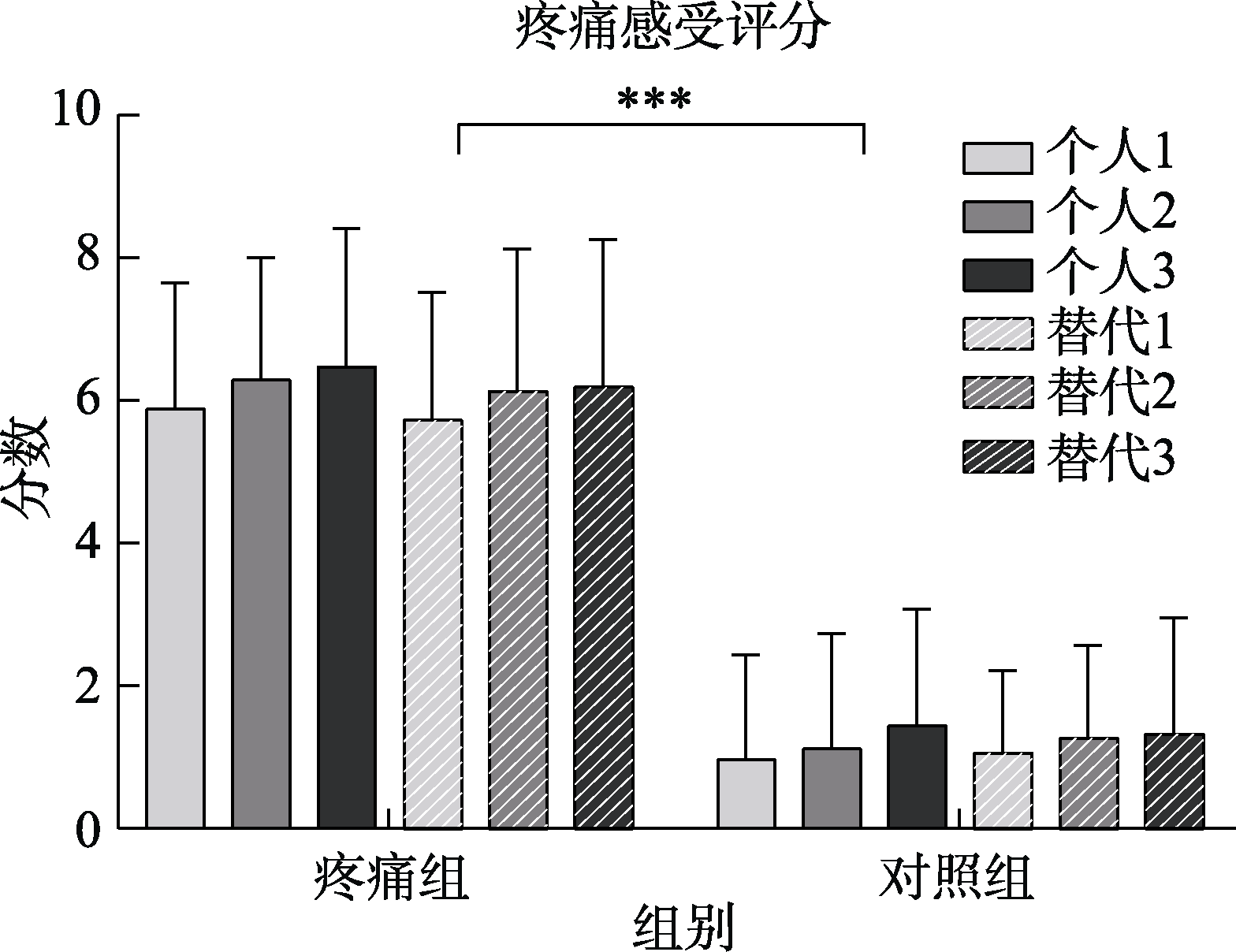
图2 不同时间和奖赏类型下的疼痛感受变化 注:误差线为标准差(SD); * p < 0.05, ** p < 0.01, *** p < 0.001; 下同。
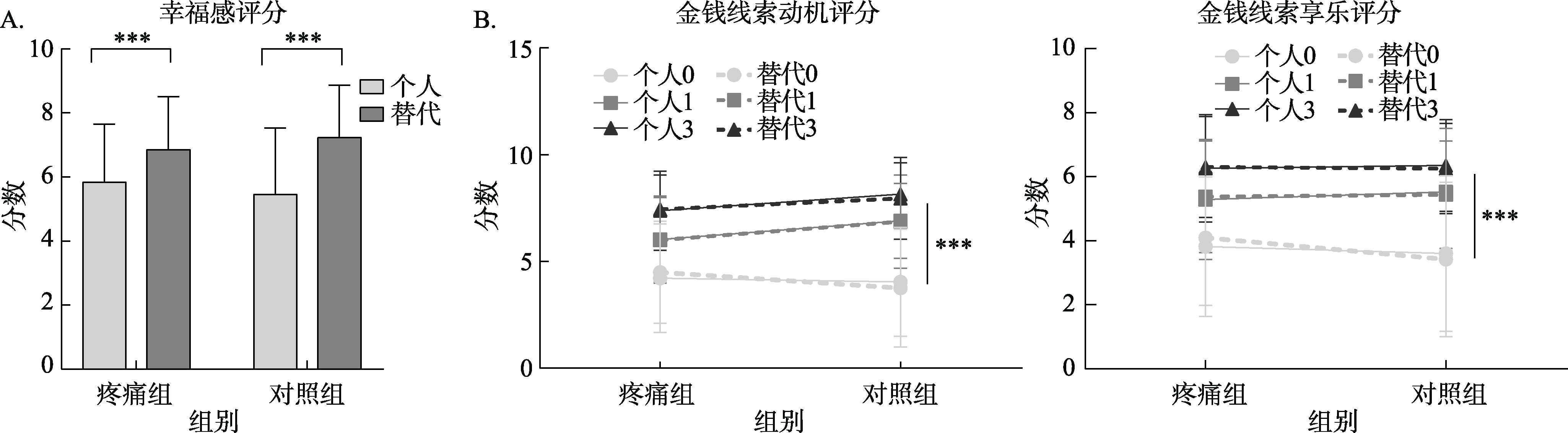
图3 A. 个人奖赏和替代奖赏的幸福感评分; B. 不同奖赏类型和金钱线索的动机与享乐评分
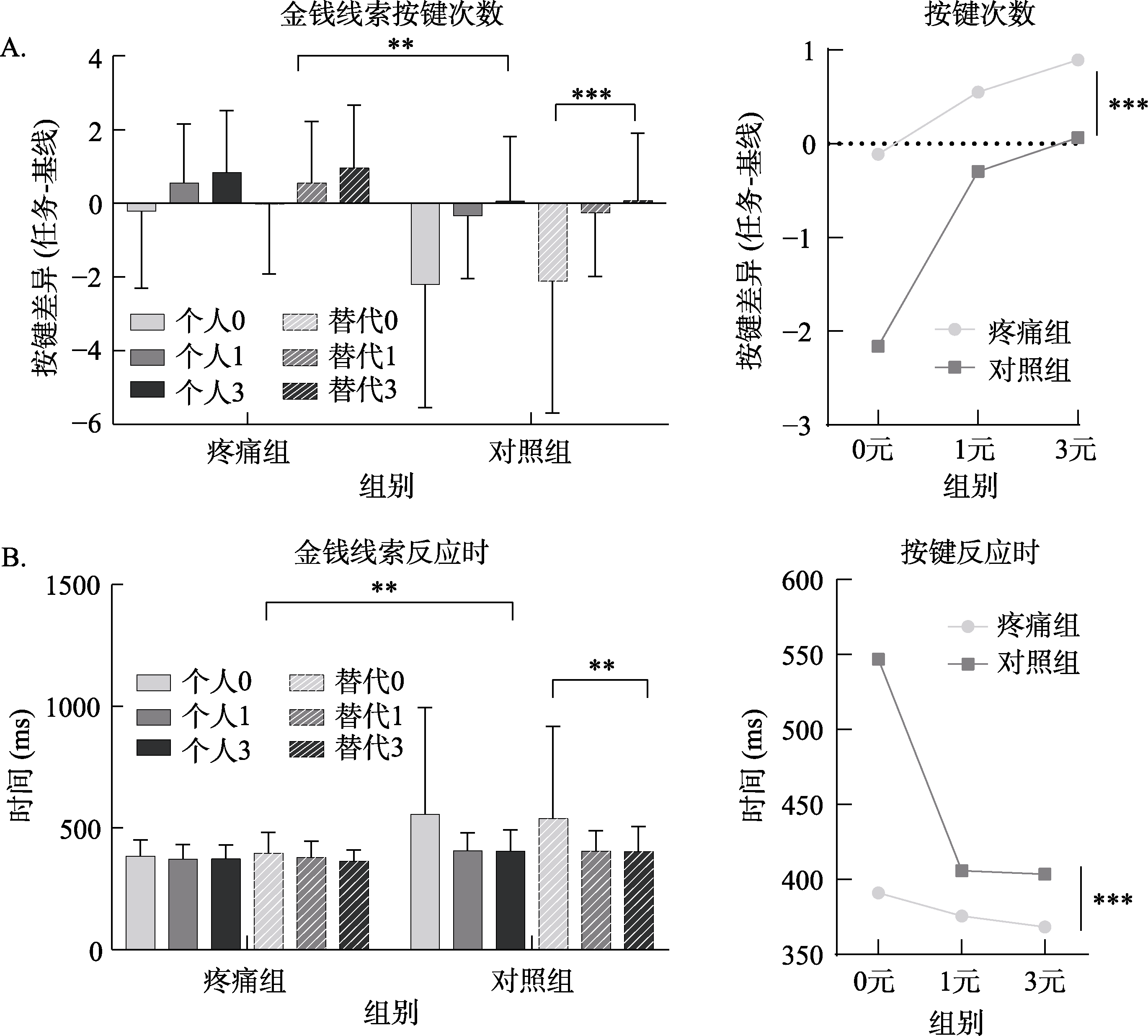
图4 A. 不同奖赏类型和金钱线索的按键次数; B. 不同奖赏类型和金钱线索的按键反应时

图5 奖赏预期阶段cue-P2/CNV波形图、地形图:A. 不同奖赏类型和金钱线索;B. 疼痛组和对照组
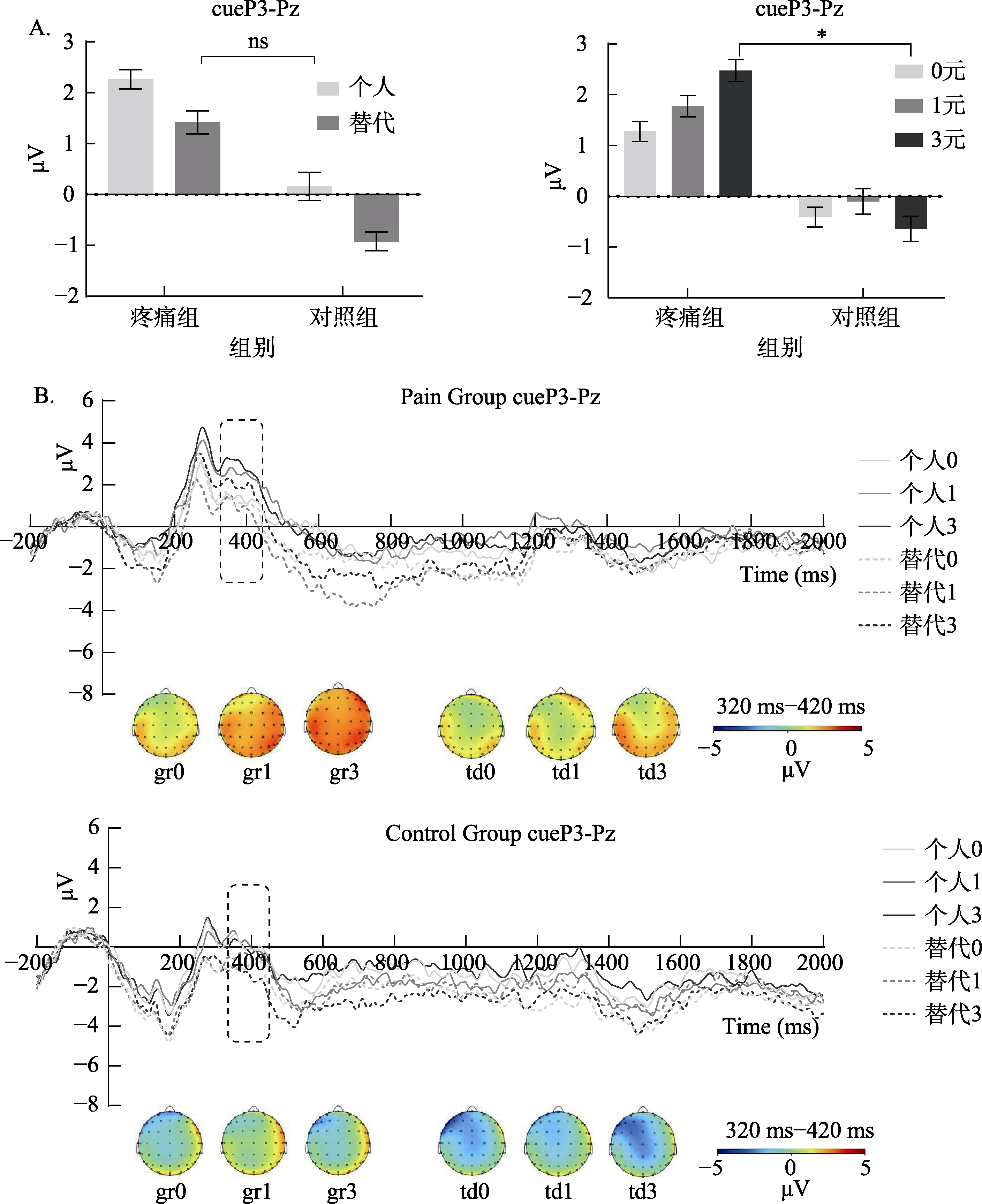
图6 奖赏预期阶段cue-P3波形图、地形图:A. 不同奖赏类型和金钱线索;B. 疼痛组和对照组

图7 奖赏体验阶段FRN波形图、地形图:A. 不同奖赏类型和金钱线索;B. 疼痛组和对照组
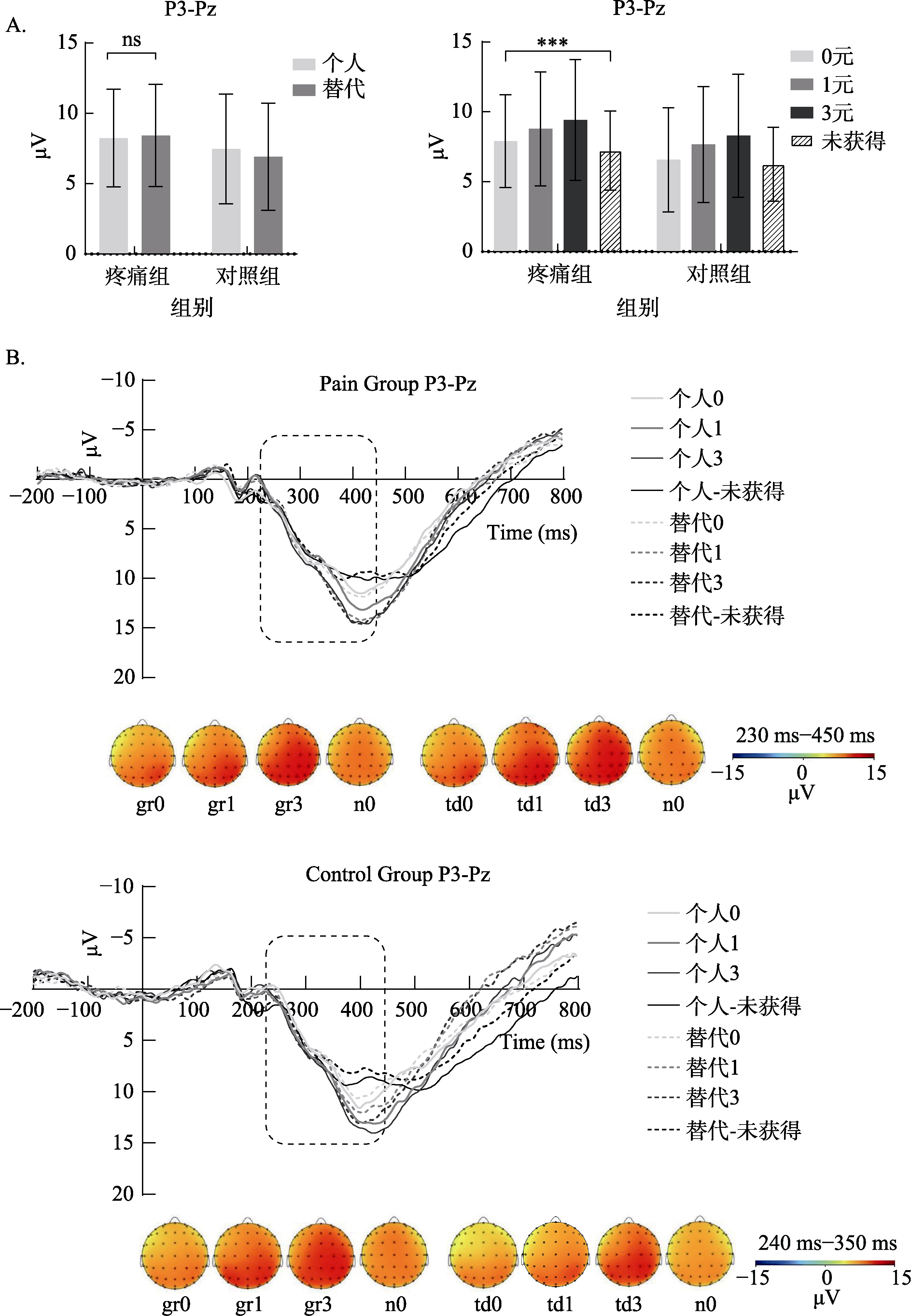
图8 奖赏体验阶段P3波形图、地形图:A.不同奖赏类型和金钱线索;B.疼痛组和对照组
| 变量 | 1 | 2 | 3 | 4 | 5 | 6 | |
|---|---|---|---|---|---|---|---|
| 1. 按键差异 | 相关系数 | 1.000 | −0.44** | 0.01 | 0.13** | 0.04 | 0.02 |
| 显著性 | 0.000 | 0.896 | 0.008 | 0.425 | 0.672 | ||
| 2. 按键反应时 | 相关系数 | 1.000 | −0.03 | −0.05 | 0.09 | 0.01 | |
| 显著性 | 0.490 | 0.370 | 0.088 | 0.861 | |||
| 3. cue-P2 | 相关系数 | 1.000 | 0.33** | 0.03 | −0.04 | ||
| 显著性 | 0.000 | 0.505 | 0.442 | ||||
| 4. cue-P3 | 相关系数 | 1.000 | 0.19** | 0.15** | |||
| 显著性 | 0.000 | 0.002 | |||||
| 5. FRN | 相关系数 | 1.000 | 0.73** | ||||
| 显著性 | 0.000 | ||||||
| 6. P3 | 相关系数 | 1.000 | |||||
| 显著性 |
表2 行为结果与ERP结果相关性
| 变量 | 1 | 2 | 3 | 4 | 5 | 6 | |
|---|---|---|---|---|---|---|---|
| 1. 按键差异 | 相关系数 | 1.000 | −0.44** | 0.01 | 0.13** | 0.04 | 0.02 |
| 显著性 | 0.000 | 0.896 | 0.008 | 0.425 | 0.672 | ||
| 2. 按键反应时 | 相关系数 | 1.000 | −0.03 | −0.05 | 0.09 | 0.01 | |
| 显著性 | 0.490 | 0.370 | 0.088 | 0.861 | |||
| 3. cue-P2 | 相关系数 | 1.000 | 0.33** | 0.03 | −0.04 | ||
| 显著性 | 0.000 | 0.505 | 0.442 | ||||
| 4. cue-P3 | 相关系数 | 1.000 | 0.19** | 0.15** | |||
| 显著性 | 0.000 | 0.002 | |||||
| 5. FRN | 相关系数 | 1.000 | 0.73** | ||||
| 显著性 | 0.000 | ||||||
| 6. P3 | 相关系数 | 1.000 | |||||
| 显著性 |
| [1] |
Acevedo, B. P., Aron, A., Fisher, H. E., & Brown, L. L. (2012). Neural correlates of long-term intense romantic love. Social Cognitive and Affective Neuroscience, 7(2), 145-159. https://doi.org/10.1093/scan/nsq092
doi: 10.1093/scan/nsq092 URL pmid: 21208991 |
| [2] |
Ait Oumeziane, B., Jones, O., & Foti, D. (2019). Neural sensitivity to social and monetary reward in depression: Clarifying general and domain-specific deficits. Frontiers in Behavioral Neuroscience, 13, 199. https://doi.org/10.3389/fnbeh.2019.00199
doi: 10.3389/fnbeh.2019.00199 URL pmid: 31649515 |
| [3] |
Barman, A., Richter, S., Soch, J., Deibele, A., Richter, A., Assmann, A.,... Schott, B. H. (2015). Gender-specific modulation of neural mechanisms underlying social reward processing by Autism Quotient. Social Cognitive and Affective Neuroscience, 10(11), 1537-1547. https://doi.org/10.1093/scan/nsv044
doi: 10.1093/scan/nsv044 URL pmid: 25944965 |
| [4] |
Bartra, O., McGuire, J. T., & Kable, J. W. (2013). The valuation system: A coordinate-based meta-analysis of bold fMRI experiments examining neural correlates of subjective value. Neuroimage, 76, 412-427. https://doi.org/10.1016/j.neuroimage.2013.02.063
doi: 10.1016/j.neuroimage.2013.02.063 URL pmid: 23507394 |
| [5] |
Becerra, L., Breiter, H. C., Wise, R., Gonzalez, R. G., & Borsook, D. (2001). Reward circuitry activation by noxious thermal stimuli. Neuron, 32(5), 927-946. https://doi.org/10.1016/s0896-6273(01)00533-5
doi: 10.1016/s0896-6273(01)00533-5 URL pmid: 11738036 |
| [6] |
Becker, S., Gandhi, W., Chen, Y. J., & Schweinhardt, P. (2017). Subjective utility moderates bidirectional effects of conflicting motivations on pain perception. Scientific Reports, 7(1), 7790. https://doi.org/10.1038/s41598-017-08454-4
doi: 10.1038/s41598-017-08454-4 URL pmid: 28798478 |
| [7] |
Becker, S., Gandhi, W., Elfassy, N. M., & Schweinhardt, P. (2013). The role of dopamine in the perceptual modulation of nociceptive stimuli by monetary wins or losses. The European Journal of Neuroscience, 38(7), 3080-3088. https://doi.org/10.1111/ejn.12303
doi: 10.1111/ejn.2013.38.issue-7 URL |
| [8] |
Becker, S., Gandhi, W., & Schweinhardt, P. (2012). Cerebral interactions of pain and reward and their relevance for chronic pain. Neuroscience Letters, 520(2), 182-187. https://doi.org/10.1016/j.neulet.2012.03.013
doi: 10.1016/j.neulet.2012.03.013 URL pmid: 22440855 |
| [9] |
Becker, S., Löffler, M., & Seymour, B. (2020). Reward enhances pain discrimination in humans. Psychological Science, 31(9), 1191-1199. https://doi.org/10.1177/0956797620939588
doi: 10.1177/0956797620939588 URL pmid: 32818387 |
| [10] |
Berridge, K. C., & Kringelbach, M. L. (2015). Pleasure systems in the brain. Neuron, 86(3), 646-664. https://doi.org/10.1016/j.neuron.2015.02.018
doi: 10.1016/j.neuron.2015.02.018 URL pmid: 25950633 |
| [11] |
Berridge, K. C., & Robinson, T. E. (1998). What is the role of dopamine in reward: Hedonic impact, reward learning, or incentive salience?. Brain Research Reviews, 28(3), 309-369.
doi: 10.1016/S0165-0173(98)00019-8 URL |
| [12] |
Berridge, K. C., & Robinson, T. E. (2003). Parsing reward. Trends in Neurosciences, 26(9), 507-513. https://doi.org/10.1016/S0166-2236(03)00233-9
doi: 10.1016/S0166-2236(03)00233-9 URL pmid: 12948663 |
| [13] |
Berridge, K. C., Robinson, T. E., & Aldridge, J. W. (2009). Dissecting components of reward: ‘Liking’, ‘wanting’, and learning. Current Opinion in Pharmacology, 9(1), 65-73. https://doi.org/10.1016/j.coph.2008.12.014
doi: 10.1016/j.coph.2008.12.014 URL pmid: 19162544 |
| [14] |
Boksem, M. A., Tops, M., Wester, A. E., Meijman, T. F., & Lorist, M. M. (2006). Error-related ERP components and individual differences in punishment and reward sensitivity. Brain Research, 1101(1), 92-101. https://doi.org/10.1016/j.brainres.2006.05.004
URL pmid: 16784728 |
| [15] |
Botvinick, M., & Braver, T. (2015). Motivation and cognitive control: From behavior to neural mechanism. Annual Review of Psychology, 66, 83-113. https://doi.org/10.1146/annurev-psych-010814-015044
doi: 10.1146/annurev-psych-010814-015044 URL pmid: 25251491 |
| [16] |
Braams, B. R., & Crone, E. A. (2017). Peers and parents: A comparison between neural activation when winning for friends and mothers in adolescence. Social Cognitive and Affective Neuroscience, 12(3), 417-426. https://doi.org/10.1093/scan/nsw136
doi: 10.1093/scan/nsw136 URL pmid: 27651540 |
| [17] |
Braams, B. R., Peters, S., Peper, J. S., Güroğlu, B., & Crone, E. A. (2014). Gambling for self, friends, and antagonists: Differential contributions of affective and social brain regions on adolescent reward processing. Neuroimage, 100, 281-289. https://doi.org/10.1016/j.neuroimage.2014.06.020
doi: 10.1016/j.neuroimage.2014.06.020 URL pmid: 24945662 |
| [18] |
Buckner, R. L., & Carroll, D. C. (2007). Self-projection and the brain. Trends in Cognitive Sciences, 11(2), 49-57. https://doi.org/10.1016/j.tics.2006.11.004
doi: 10.1016/j.tics.2006.11.004 URL pmid: 17188554 |
| [19] | Carretié, L. (2014). Exogenous (automatic) attention to emotional stimuli: A review. Cognitive, Affective & Behavioral Neuroscience, 14(4), 1228-1258. https://doi.org/10.3758/s13415-014-0270-2 |
| [20] |
Chen, L. L., Huang, R., & Jia, S. W. (2020). Feedback-related negativity and addiction. Advances in Psychological Science, 28(6), 959-968.
doi: 10.3724/SP.J.1042.2020.00959 |
|
[陈乐乐, 黄蓉, 贾世伟. (2020). 反馈相关负波与成瘾. 心理科学进展, 28(6), 959-968.]
doi: 10.3724/SP.J.1042.2020.00959 |
|
| [21] | Darbor, K. E., Lench, H. C., & Carter-Sowell, A. R. (2016). Do people eat the pain away? The effects of acute physical pain on subsequent consumption of sweet-tasting food. PLOS ONE, 11(11), e0166931. https://doi.org/10.1371/journal.pone.0166931 |
| [22] |
Etkin, A., Egner, T., & Kalisch, R. (2011). Emotional processing in anterior cingulate and medial prefrontal cortex. Trends in Cognitive Sciences, 15(2), 85-93. https://doi.org/10.1016/j.tics.2010.11.004
doi: 10.1016/j.tics.2010.11.004 URL pmid: 21167765 |
| [23] |
Fareri, D. S., Niznikiewicz, M. A., Lee, V. K., & Delgado, M. R. (2012). Social network modulation of reward-related signals. The Journal of Neuroscience, 32(26), 9045-9052. https://doi.org/10.1523/JNEUROSCI.0610-12.2012
doi: 10.1523/JNEUROSCI.0610-12.2012 URL |
| [24] |
Fields, H. (2004). State-dependent opioid control of pain. Nature Reviews Neuroscience, 5(7), 565-575. https://doi.org/10.1038/nrn1431
doi: 10.1038/nrn1431 URL pmid: 15208698 |
| [25] |
Fields, H. (2007). Understanding how opioids contribute to reward and analgesia. Regional Anesthesia and Pain Medicine, 32(3), 242-246. https://doi.org/10.1016/j.rapm.2007.01.001
URL pmid: 17543821 |
| [26] |
Flores, A., Münte, T. F., & Doñamayor, N. (2015). Event- related EEG responses to anticipation and delivery of monetary and social reward. Biological Psychology, 109, 10-19. https://doi.org/10.1016/j.biopsycho.2015.04.005
doi: 10.1016/j.biopsycho.2015.04.005 URL |
| [27] |
Gandhi, W., Becker, S., & Schweinhardt, P. (2013). Pain increases motivational drive to obtain reward, but does not affect associated hedonic responses: A behavioural study in healthy volunteers. European Journal of Pain, 17(7), 1093-1103. https://doi.org/10.1002/j.1532-2149.2012.00281.x
doi: 10.1002/j.1532-2149.2012.00281.x URL pmid: 23349058 |
| [28] |
Goerlich, K. S., Votinov, M., Lammertz, S. E., Winkler, L., Spreckelmeyer, K. N., Habel, U., Gründer, G., & Gossen, A. (2017). Effects of alexithymia and empathy on the neural processing of social and monetary rewards. Brain Structure and Function, 222(5), 2235-2250. https://doi.org/10.1007/s00429-016-1339-1
doi: 10.1007/s00429-016-1339-1 URL |
| [29] | Greimel, E., Bakos, S., Landes, I., Töllner, T., Bartling, J., Kohls, G., & Schulte-Körne, G. (2018). Sex differences in the neural underpinnings of social and monetary incentive processing during adolescence. Cognitive, Affective, & Behavioral Neuroscience, 18(2), 296-312. https://doi.org/10.3758/s13415-018-0570-z |
| [30] |
Gu, R., Jiang, Y., Kiser, S., Black, C. L., Broster, L. S., Luo, Y., & Kelly, T. H. (2017). Impulsive personality dimensions are associated with altered behavioral performance and neural responses in the monetary incentive delay task. Neuropsychologia, 103, 59-68. https://doi.org/10.1016/j.neuropsychologia.2017.07.013
doi: S0028-3932(17)30266-X URL pmid: 28716612 |
| [31] |
Hackel, L. M., Zaki, J., & Van Bavel, J. J. (2017). Social identity shapes social valuation: Evidence from prosocial behavior and vicarious reward. Social Cognitive and Affective Neuroscience, 12(8), 1219-1228. https://doi.org/10.1093/scan/nsx045
doi: 10.1093/scan/nsx045 URL pmid: 28402506 |
| [32] |
Hajcak, G., Moser, J. S., Holroyd, C. B., & Simons, R. F. (2006). The feedback-related negativity reflects the binary evaluation of good versus bad outcomes. Biological Psychology, 71(2), 148-154. https://doi.org/10.1016/j.biopsycho.2005.04.001
doi: 10.1016/j.biopsycho.2005.04.001 URL pmid: 16005561 |
| [33] |
Hare, T. A., Camerer, C. F., Knoepfle, D. T., & Rangel, A. (2010). Value computations in ventral medial prefrontal cortex during charitable decision making incorporate input from regions involved in social cognition. The Journal of Neuroscience, 30(2), 583-590. https://doi.org/10.1523/JNEUROSCI.4089-09.2010
doi: 10.1523/JNEUROSCI.4089-09.2010 URL |
| [34] |
Heydari, S., & Holroyd, C. B. (2016). Reward positivity: Reward prediction error or salience prediction error?. Psychophysiology, 53(8), 1185-1192. https://doi.org/10.1111/psyp.12673
doi: 10.1111/psyp.12673 URL pmid: 27184070 |
| [35] |
Holroyd, C. B., & Coles, M. G. H. (2002). The neural basis of human error processing: Reinforcement learning, dopamine, and the error-related negativity. Psychological Review, 109(4), 679-709. https://doi.org/10.1037/0033-295X.109.4.679
doi: 10.1037/0033-295X.109.4.679 URL pmid: 12374324 |
| [36] |
Holroyd, C. B., Nieuwenhuis, S., Yeung, N., & Cohen, J. D. (2003). Errors in reward prediction are reflected in the event-related brain potential. Neuroreport, 14(18), 2481-2484. https://doi.org/10.1097/00001756-200312190-00037
URL pmid: 14663214 |
| [37] |
Huckins, J. F., Adeyemo, B., Miezin, F. M., Power, J. D., Gordon, E. M., Laumann, T. O.,... Kelley, W. M. (2019). Reward-related regions form a preferentially coupled system at rest. Human Brain Mapping, 40(2), 361-376. https://doi.org/10.1002/hbm.24377
doi: 10.1002/hbm.24377 URL pmid: 30251766 |
| [38] |
Klawohn, J., Burani, K., Bruchnak, A., Santopetro, N., & Hajcak, G. (2021). Reduced neural response to reward and pleasant pictures independently relate to depression. Psychological Medicine, 51(5), 741-749. https://doi.org/10.1017/S0033291719003659
doi: 10.1017/S0033291719003659 URL |
| [39] |
Knutson, B., Fong, G. W., Adams, C. M., Varner, J. L., & Hommer, D. (2001). Dissociation of reward anticipation and outcome with event-related fMRI. Neuroreport, 12(17), 3683-3687. https://doi.org/10.1097/00001756-200112040-00016
URL pmid: 11726774 |
| [40] | Kujawa, A., Hajcak, G., & Klein, D. N. (2019). Reduced reward responsiveness moderates the effect of maternal depression on depressive symptoms in offspring: Evidence across levels of analysis. Journal of Child Psychology and Psychiatry, and Allied Disciplines, 60(1), 82-90. https://doi.org/10.1111/jcpp.12944 |
| [41] |
LaMotte, R. H., Shain, C. N., Simone, D. A., & Tsai, E. F. (1991). Neurogenic hyperalgesia: Psychophysical studies of underlying mechanisms. Journal of Neurophysiology, 66(1), 190-211. https://doi.org/10.1152/jn.1991.66.1.190
URL pmid: 1919666 |
| [42] |
Lasaponara, S., Glicksohn, J., Mauro, F., & Ben-Soussan, T. D. (2019). Contingent negative variation and P3 modulations following mindful movement training. Progress in brain research, 244, 101-114. https://doi.org/10.1016/bs.pbr.2018.10.017
doi: S0079-6123(18)30156-0 URL pmid: 30732833 |
| [43] |
Leknes, S., & Tracey, I. (2008). A common neurobiology for pain and pleasure. Nature Reviews Neuroscience, 9(4), 314-320. https://doi.org/10.1038/nrn2333
doi: 10.1038/nrn2333 URL pmid: 18354400 |
| [44] |
Li, D. Y., Li, P., & Li, H. (2018). The updated theories of feedback-related negativity in the last decade. Advances in Psychological Science, 26(9), 1642-1650.
doi: 10.3724/SP.J.1042.2018.01642 |
|
[李丹阳, 李鹏, 李红. (2018). 反馈负波及其近10年理论解释. 心理科学进展, 26(9), 1642-1650.]
doi: 10.3724/SP.J.1042.2018.01642 |
|
| [45] |
Li, J., Sun, Y., Yang, Z. L., & Zhong, Y. P. (2020). Social value orientation modulates the processing of social rewards for self: Evidence from ERPs study. Acta Psychologica Sinica, 52(6), 786-800.
doi: 10.3724/SP.J.1041.2020.00786 URL |
|
[李琎, 孙宇, 杨子鹿, 钟毅平. (2020). 社会价值取向对自我社会奖赏加工的影响——来自ERPs的证据. 心理学报, 52(6), 786-800.]
doi: 10.3724/SP.J.1041.2020.00786 |
|
| [46] |
Li, Q., Xu, J., & Zheng, Y. (2017). Stimulus-preceding negativity: An electrophysiological index of reward anticipation. Advances in Psychological Science, 25(7), 1114-1121.
doi: 10.3724/SP.J.1042.2017.01114 URL |
|
[李琪, 许晶, 郑亚. (2017). 刺激前负波:奖赏期待的电生理指标. 心理科学进展, 25(7), 1114-1121.]
doi: 10.3724/SP.J.1042.2017.01114 |
|
| [47] |
Li, X., Zhou, X., Zheng, H., & Wang, C. (2023). The modulation of pain in reward processing is reflected by increased P300 and delta oscillation. Brain and Cognition, 168, 105972. https://doi.org/10.1016/j.bandc.2023.105972
doi: 10.1016/j.bandc.2023.105972 URL |
| [48] |
Liu, P. H., Zhang, H. Y., Zhang, X. K., Li, H., & Lei, Y. (2023). Effects of acute versus chronic pain on reward processing and the underlying neural mechanisms involved. Advances in Psychological Science, 31(3), 402-415.
doi: 10.3724/SP.J.1042.2023.00402 |
|
[刘沛菡, 张火垠, 张旭凯, 李红, 雷怡. (2023). 急性疼痛与慢性疼痛对奖赏加工的影响及神经机制. 心理科学进展, 31(3), 402-415.]
doi: 10.3724/SP.J.1042.2023.00402 |
|
| [49] |
Mobbs, D., Yu, R., Meyer, M., Passamonti, L., Seymour, B., Calder, A. J.,... Dalgleish, T. (2009). A key role for similarity in vicarious reward. Science, 324(5929), 900. https://doi.org/10.1126/science.1170539
doi: 10.1126/science.1170539 URL pmid: 19443777 |
| [50] |
Modir, J. G., & Wallace, M. S. (2010). Human experimental pain models 3: Heat/capsaicin sensitization and intradermal capsaicin models. Methods in Molecular Biology, 617, 169-174. https://doi.org/10.1007/978-1-60327-323-7_14
doi: 10.1007/978-1-60327-323-7_14 URL pmid: 20336422 |
| [51] |
Morelli, S. A., Sacchet, M. D., & Zaki, J. (2015). Common and distinct neural correlates of personal and vicarious reward: A quantitative meta-analysis. Neuroimage, 112, 244-253. https://doi.org/10.1016/j.neuroimage.2014.12.056
doi: S1053-8119(14)01061-1 URL pmid: 25554428 |
| [52] |
Nair, A. K., Sasidharan, A., John, J. P., Mehrotra, S., & Kutty, B. M. (2016). Assessing neurocognition via gamified experimental logic: A novel approach to simultaneous acquisition of multiple ERPs. Frontiers in Neuroscience, 10, 1. https://doi.org/10.3389/fnins.2016.00001
doi: 10.3389/fnins.2016.00001 URL pmid: 26858586 |
| [53] |
Navratilova, E., Morimura, K., Xie, J. Y., Atcherley, C. W., Ossipov, M. H., & Porreca, F. (2016). Positive emotions and brain reward circuits in chronic pain. Journal of Comparative Neurology, 524(8), 1646-1652. https://doi.org/10.1002/cne.23968
doi: 10.1002/cne.23968 URL pmid: 26788716 |
| [54] |
Navratilova, E., & Porreca, F. (2014). Reward and motivation in pain and pain relief. Nature Neuroscience, 17(10), 1304-1312. https://doi.org/10.1038/nn.3811
doi: 10.1038/nn.3811 URL pmid: 25254980 |
| [55] |
Nieuwenhuis, S., Aston-Jones, G., & Cohen, J. D. (2005). Decision making, the P3, and the locus coeruleus-norepinephrine system. Psychological Bulletin, 131(4), 510-532. https://doi.org/10.1037/0033-2909.131.4.510
URL pmid: 16060800 |
| [56] |
Peciña, S., Cagniard, B., Berridge, K. C., Aldridge, J. W., & Zhuang, X. (2003). Hyperdopaminergic mutant mice have higher “wanting” but not “liking” for sweet rewards. The Journal of Neuroscience, 23(28), 9395-9402. https://doi.org/10.1523/JNEUROSCI.23-28-09395.2003
doi: 10.1523/JNEUROSCI.23-28-09395.2003 URL |
| [57] | Pedersen, M. L., & Frank, M. J. (2020). Simultaneous hierarchical bayesian parameter estimation for reinforcement learning and drift diffusion models: A tutorial and links to neural data. Computational Brain & Behavior, 3(4), 458-471. https://doi.org/10.1007/s42113-020-00084-w |
| [58] |
Pedersen, M. L., Frank, M. J., & Biele, G. (2017). The drift diffusion model as the choice rule in reinforcement learning. Psychonomic Bulletin & Review, 24(4), 1234-1251. https://doi.org/10.3758/s13423-016-1199-y
doi: 10.3758/s13423-016-1199-y URL |
| [59] |
Pizzagalli, D. A., Holmes, A. J., Dillon, D. G., Goetz, E. L., Birk, J. L., Bogdan, R.,... Fava, M. (2009). Reduced caudate and nucleus accumbens response to rewards in unmedicated individuals with major depressive disorder. American Journal of Psychiatry, 166(6), 702-710. https://doi.org/10.1176/appi.ajp.2008.08081201
doi: 10.1176/appi.ajp.2008.08081201 URL pmid: 19411368 |
| [60] |
Polich, J. (2007). Updating P300: An integrative theory of P3a and P3b. Clinical Neurophysiology, 118(10), 2128-2148. https://doi.org/10.1016/j.clinph.2007.04.019
doi: 10.1016/j.clinph.2007.04.019 URL pmid: 17573239 |
| [61] |
Porreca, F., & Navratilova, E. (2017). Reward, motivation, and emotion of pain and its relief. Pain, 158 (Suppl 1), S43-S49. https://doi.org/10.1097/j.pain.0000000000000798
doi: 10.1097/j.pain.0000000000000798 URL |
| [62] |
Qin, H. F., Huang, R., & Jia, S. W. (2021). Feedback-related negativity: A biomarker for depression. Advances in Psychological Science, 29(3), 404-413.
doi: 10.3724/SP.J.1042.2021.00404 |
|
[秦浩方, 黄蓉, 贾世伟. (2021). 反馈相关负波:一种抑郁症的生物标记物. 心理科学进展, 29(3), 404-413.]
doi: 10.3724/SP.J.1042.2021.00404 |
|
| [63] |
Rainville, P., Duncan, G. H., Price, D. D., Carrier, B., & Bushnell, M. C. (1997). Pain affect encoded in human anterior cingulate but not somatosensory cortex. Science, 277(5328), 968-971. https://doi.org/10.1126/science.277.5328.968
doi: 10.1126/science.277.5328.968 URL pmid: 9252330 |
| [64] |
Rutledge, R. B., Skandali, N., Dayan, P., & Dolan, R. J. (2014). A computational and neural model of momentary subjective well-being. Proceedings of the National Academy of Sciences of the United States of America, 111(33), 12252-12257. https://doi.org/10.1073/pnas.1407535111
doi: 10.1073/pnas.1407535111 URL pmid: 25092308 |
| [65] |
Salcido, C. A., Harris Bozer, A. L., McNabb, C. T., & Fuchs, P. N. (2018). Assessing the aversive nature of pain with an operant approach/avoidance paradigm. Physiology & Behavior, 189, 59-63. https://doi.org/10.1016/j.physbeh.2018.02.053
doi: 10.1016/j.physbeh.2018.02.053 URL |
| [66] |
Sato, A., Yasuda, A., Ohira, H., Miyawaki, K., Nishikawa, M., Kumano, H., & Kuboki, T. (2005). Effects of value and reward magnitude on feedback negativity and P300. Neuroreport, 16(4), 407-411. https://doi.org/10.1097/00001756-200503150-00020
URL pmid: 15729147 |
| [67] |
Schrooten, M. G. S., Wiech, K., & Vlaeyen, J. W. S. (2014). When pain meets … pain-related choice behavior and pain perception in different goal conflict situations. The Journal of Pain, 15(11), 1166-1178. https://doi.org/10.1016/j.jpain.2014.08.011
doi: 10.1016/j.jpain.2014.08.011 URL |
| [68] |
Scott, D. J., Heitzeg, M. M., Koeppe, R. A., Stohler, C. S., & Zubieta, J.-K. (2006). Variations in the human pain stress experience mediated by ventral and dorsal basal ganglia dopamine activity. Journal of Neuroscience, 26(42), 10789-10795. https://doi.org/10.1523/JNEUROSCI.2577-06.2006
doi: 10.1523/JNEUROSCI.2577-06.2006 URL pmid: 17050717 |
| [69] |
Sescousse, G., Redouté, J., & Dreher, J. C. (2010). The architecture of reward value coding in the human orbitofrontal cortex. The Journal of Neuroscience, 30(39), 13095-13104. https://doi.org/10.1523/JNEUROSCI.3501-10.2010
doi: 10.1523/JNEUROSCI.3501-10.2010 URL |
| [70] | Shackman, A. J., Salomons, T. V., Slagter, H. A., Fox, A. S., Winter, J. J., & Davidson, R. J. (2011). The integration of negative affect, pain and cognitive control in the cingulate cortex. Nature Reviews. Neuroscience, 12(3), 154-167. https://doi.org/10.1038/nrn2994 |
| [71] |
Sui, J., & Humphreys, G. W. (2015). The integrative self: How self-reference integrates perception and memory. Trends in Cognitive Sciences, 19(12), 719-728. https://doi.org/10.1016/j.tics.2015.08.015
doi: S1364-6613(15)00206-5 URL pmid: 26447060 |
| [72] |
Taylor, A. M. W., Becker, S., Schweinhardt, P., & Cahill, C. (2016). Mesolimbic dopamine signaling in acute and chronic pain: Implications for motivation, analgesia, and addiction. Pain, 157(6), 1194-1198. https://doi.org/10.1097/j.pain.0000000000000494
doi: 10.1097/j.pain.0000000000000494 URL pmid: 26797678 |
| [73] |
Telzer, E. H., Masten, C. L., Berkman, E. T., Lieberman, M. D., & Fuligni, A. J. (2010). Gaining while giving: An fMRI study of the rewards of family assistance among white and Latino youth. Social Neuroscience, 5(5-6), 508-518. https://doi.org/10.1080/17470911003687913
doi: 10.1080/17470911003687913 URL pmid: 20401808 |
| [74] |
Wager, T. D., Rilling, J. K., Smith, E. E., Sokolik, A., Casey, K. L., Davidson, R. J.,... Cohen, J. D. (2004). Placebo-induced changes in fMRI in the anticipation and experience of pain. Science, 303(5661), 1162-1167. https://doi.org/10.1126/science.1093065
doi: 10.1126/science.1093065 URL pmid: 14976306 |
| [75] |
Wang, C., Bao, C., Gao, J., Gu, Y., & Dong, X. (2020). Pain modulates neural responses to reward in the medial prefrontal cortex. Human Brain Mapping, 41(5), 1372-1381. https://doi.org/10.1002/hbm.24882
doi: 10.1002/hbm.24882 URL pmid: 31785068 |
| [76] |
Wang, C., Gao, J., Ma, Y., Zhu, C., & Dong, X.-W. (2018). Physical pain increases interpersonal trust in females. European Journal of Pain, 22(1), 150-160. https://doi.org/10.1002/ejp.1111
doi: 10.1002/ejp.1111 URL pmid: 28913979 |
| [77] |
Wang, D., Liu, T., & Shi, J. (2020). Neural dynamic responses of monetary and social reward processes in adolescents. Frontiers in Human Neuroscience, 14, 141. https://doi.org/10.3389/fnhum.2020.00141
doi: 10.3389/fnhum.2020.00141 URL pmid: 32372935 |
| [78] |
Wang, Z., Li, Q., Nie, L., & Zheng, Y. (2020). Neural dynamics of monetary and social reward processing in social anhedonia. Social Cognitive and Affective Neuroscience, 15(9), 991-1003. https://doi.org/10.1093/scan/nsaa128
doi: 10.1093/scan/nsaa128 URL pmid: 32945882 |
| [79] |
Wu, Y., & Zhou, X. (2009). The P300 and reward valence, magnitude, and expectancy in outcome evaluation. Brain Research, 1286, 114-122. https://doi.org/10.1016/j.brainres.2009.06.032
doi: 10.1016/j.brainres.2009.06.032 URL pmid: 19539614 |
| [80] |
Yeung, N., & Sanfey, A. G. (2004). Independent coding of reward magnitude and valence in the human brain. The Journal of neuroscience, 24(28), 6258-6264. https://doi.org/10.1523/JNEUROSCI.4537-03.2004
doi: 10.1523/JNEUROSCI.4537-03.2004 URL |
| [81] |
Zaki, J., & Ochsner, K. N. (2012). The neuroscience of empathy: Progress, pitfalls and promise. Nature Neuroscience, 15(5), 675-680. https://doi.org/10.1038/nn.3085
doi: 10.1038/nn.3085 URL pmid: 22504346 |
| [82] |
Zhang, D., Shen, J., Bi, R., Zhang, Y., Zhou, F., Feng, C., & Gu, R. (2022). Differentiating the abnormalities of social and monetary reward processing associated with depressive symptoms. Psychological medicine, 52(11), 2080-2094. https://doi.org/10.1017/S0033291720003967
doi: 10.1017/S0033291720003967 URL |
| [83] |
Zhang, Y., Li, Q., Wang, Z., Liu, X., & Zheng, Y. (2017). Temporal dynamics of reward anticipation in the human brain. Biological Psychology, 128, 89-97. https://doi.org/10.1016/j.biopsycho.2017.07.011
doi: S0301-0511(17)30131-X URL pmid: 28735969 |
| [84] |
Zhu, S., Wang, Y., Gao, S., & Jia, S. (2019). The influence of context condition on outcome evaluation in experimental conditions: Even vs. neutral. International Journal of Psychophysiology, 141, 28-36. https://doi.org/10.1016/j.ijpsycho.2019.05.001
doi: S0167-8760(18)30945-0 URL pmid: 31071359 |
| [85] |
Zubieta, J.-K., Smith, Y. R., Bueller, J. A., Xu, Y., Kilbourn, M. R., Jewett, D. M., Meyer, C. R., & Koeppe, R. A. (2001). Regional mu opioid receptor regulation of sensory and affective dimensions of pain. Science, 293(5528), 311-315. https://doi.org/10.1126/science.1060952
doi: 10.1126/science.1060952 URL pmid: 11452128 |
| [1] | 陈子龙, 季琭妍. 多面孔情绪变异性的自动加工:来自视觉失匹配成分的证据[J]. 心理学报, 2025, 57(9): 1553-1571. |
| [2] | 王俊博, 赵娜, 李子媛, 刘强. 负性面孔的工作记忆离线态存储不影响在线态存储[J]. 心理学报, 2025, 57(8): 1323-1332. |
| [3] | 陈霁雯, 买晓琴, 李富洪. 去抑制的认知神经机制: 一项事件相关电位研究[J]. 心理学报, 2025, 57(5): 762-774. |
| [4] | 蔡文琦, 张向阳, 王小娟, 杨剑峰. 汉语复合词语素意义与整词语义整合加工的时间进程[J]. 心理学报, 2023, 55(8): 1207-1219. |
| [5] | 钟毅平, 牛娜娜, 范伟, 任梦梦, 李梅. 动作自主性与社会距离对主动控制感的影响:来自行为与ERPs的证据[J]. 心理学报, 2023, 55(12): 1932-1948. |
| [6] | 李梅, 李琎, 张冠斐, 钟毅平, 李红. 承诺水平与社会距离对信任投资的影响:来自行为与ERPs的证据[J]. 心理学报, 2023, 55(11): 1859-1871. |
| [7] | 占友龙, 肖啸, 谭千保, 李琎, 钟毅平. 声誉关注与社会距离对伤害困境中道德决策的影响:来自行为与ERPs的证据[J]. 心理学报, 2022, 54(6): 613-627. |
| [8] | 曾红, 郑志灵, 罗晓红, 王鹏飞, 王孟成, 苏得权, 杨文登, 黄海娇, 彭淑娜. 药物成瘾者相关线索反应的自动化用药行为特征及其消退[J]. 心理学报, 2022, 54(10): 1193-1205. |
| [9] | 孙天义, 郝晓晓, 何安明, 王财玉, 许远理, 郭春彦, 周蔚. 神经重用假说的汉语情绪词汇加工证据[J]. 心理学报, 2021, 53(9): 933-943. |
| [10] | 曹敏, 谢和平, 孙丽君, 张冬静, 孔繁昌, 周宗奎. 网络游戏中化身参照的加工优势:来自行为与ERPs的证据[J]. 心理学报, 2021, 53(6): 639-650. |
| [11] | 周文洁, 邓丽群, 丁锦红. 物体颜色对情景记忆的影响[J]. 心理学报, 2021, 53(3): 229-243. |
| [12] | 李琎, 孙宇, 杨子鹿, 钟毅平. 社会价值取向对自我社会奖赏加工的影响——来自ERPs的证据[J]. 心理学报, 2020, 52(6): 786-800. |
| [13] | 郑志灵, 王鹏飞, 苏得权, 郭伟杰, 孙楠, 麻彦坤, 曾红. 不同相关线索下海洛因成瘾者的反应差异及反应抑制特征:来自ERP的证据[J]. 心理学报, 2020, 52(3): 317-328. |
| [14] | 杨玲, 王斌强, 耿银凤, 姚东伟, 曹华, 张建勋, 许琼英. 虚拟和真实金钱奖赏幅度对海洛因戒断者风险决策的影响[J]. 心理学报, 2019, 51(4): 507-516. |
| [15] | 章文佩, 沈群伦, 宋锦涛, 周仁来. 基于事件相关电位(ERPs)和机器学习的考试焦虑诊断 *[J]. 心理学报, 2019, 51(10): 1116-1127. |
| 阅读次数 | ||||||
|
全文 |
|
|||||
|
摘要 |
|
|||||
