

ISSN 0439-755X
CN 11-1911/B
主办:中国心理学会
中国科学院心理研究所
出版:科学出版社
CN 11-1911/B
主办:中国心理学会
中国科学院心理研究所
出版:科学出版社
心理学报 ›› 2025, Vol. 57 ›› Issue (11): 1901-1913.doi: 10.3724/SP.J.1041.2025.1901 cstr: 32110.14.2025.1901
周详( ), 白博仁, 张婧婧(), 刘善柔
收稿日期:2024-01-30
发布日期:2025-09-24
出版日期:2025-11-25
通讯作者:
周详, E-mail: zhouxiang@nankai.edu.cn;作者简介:周详和白博仁为本文共同第一作者。
基金资助:
ZHOU Xiang(), BAI Boren, ZHANG Jingjing(), LIU Shanrou
Received:2024-01-30
Online:2025-09-24
Published:2025-11-25
摘要:
横空出世的生成式人工智能(AI)模糊了AI与人类心智间的界限, 人们会如何化解这种相似性值得关注。基于社会认同理论, 通过4项递进研究, 系统探讨了生成式AI凸显下个体社会创造策略的使用情况, 并考察了人类中心主义的调节作用。结果发现:个体会创造性地定义人类心智与生成式AI的区分方式(研究1), 并运用此种社会创造策略来应对生成式AI凸显(研究2~4)。此外, 人类中心主义会增强生成式AI凸显情境下个体的社会创造策略使用程度(研究3~4)。研究结果揭示了生成式AI凸显情境下个体应用社会创造策略的具体表现形式及其积极意义, 阐明了人类中心主义潜在的建设性作用, 并为智能时代如何借助社会创造策略巧妙推动人类与AI和谐共生提供了新的启发。
中图分类号:
周详, 白博仁, 张婧婧, 刘善柔. (2025). 和而不同:生成式人工智能凸显下人类的社会创造策略. 心理学报, 57(11), 1901-1913.
ZHOU Xiang, BAI Boren, ZHANG Jingjing, LIU Shanrou. (2025). Unity without uniformity: Humans’ social creativity strategy under generative artificial intelligence salience. Acta Psychologica Sinica, 57(11), 1901-1913.
| 心智能力 | 因子1 (感受性维度) | 因子2 (能动性维度) |
|---|---|---|
| 饥饿 | 0.87 | |
| 恐惧 | 0.88 | |
| 疼痛 | 0.90 | |
| 愉悦 | 0.89 | |
| 愤怒 | 0.86 | |
| 欲望 | 0.83 | |
| 个性 | 0.75 | |
| 知觉意识 | 0.87 | |
| 自豪 | 0.50 | 0.49 |
| 尴尬 | 0.54 | 0.52 |
| 开心 | 0.87 | |
| 自我控制 | 0.48 | |
| 道德 | 0.82 | |
| 记忆 | 0.67 | |
| 识别情绪 | 0.59 | |
| 计划 | 0.82 | |
| 交流 | 0.77 | |
| 思考 | 0.84 | |
| 创新 | 0.69 | |
| 经营社会关系 | 0.61 | |
| 自我意识 | 0.83 | |
| 共情 | 0.70 | |
| 直觉 | 0.68 | |
| 探究 | 0.46 | 0.47 |
| 审美 | 0.66 | |
| 管理情绪 | 0.48 | 0.60 |
| 文化信仰 | 0.63 | |
| 幽默 | 0.75 |
表1 探索性因子分析结果
| 心智能力 | 因子1 (感受性维度) | 因子2 (能动性维度) |
|---|---|---|
| 饥饿 | 0.87 | |
| 恐惧 | 0.88 | |
| 疼痛 | 0.90 | |
| 愉悦 | 0.89 | |
| 愤怒 | 0.86 | |
| 欲望 | 0.83 | |
| 个性 | 0.75 | |
| 知觉意识 | 0.87 | |
| 自豪 | 0.50 | 0.49 |
| 尴尬 | 0.54 | 0.52 |
| 开心 | 0.87 | |
| 自我控制 | 0.48 | |
| 道德 | 0.82 | |
| 记忆 | 0.67 | |
| 识别情绪 | 0.59 | |
| 计划 | 0.82 | |
| 交流 | 0.77 | |
| 思考 | 0.84 | |
| 创新 | 0.69 | |
| 经营社会关系 | 0.61 | |
| 自我意识 | 0.83 | |
| 共情 | 0.70 | |
| 直觉 | 0.68 | |
| 探究 | 0.46 | 0.47 |
| 审美 | 0.66 | |
| 管理情绪 | 0.48 | 0.60 |
| 文化信仰 | 0.63 | |
| 幽默 | 0.75 |
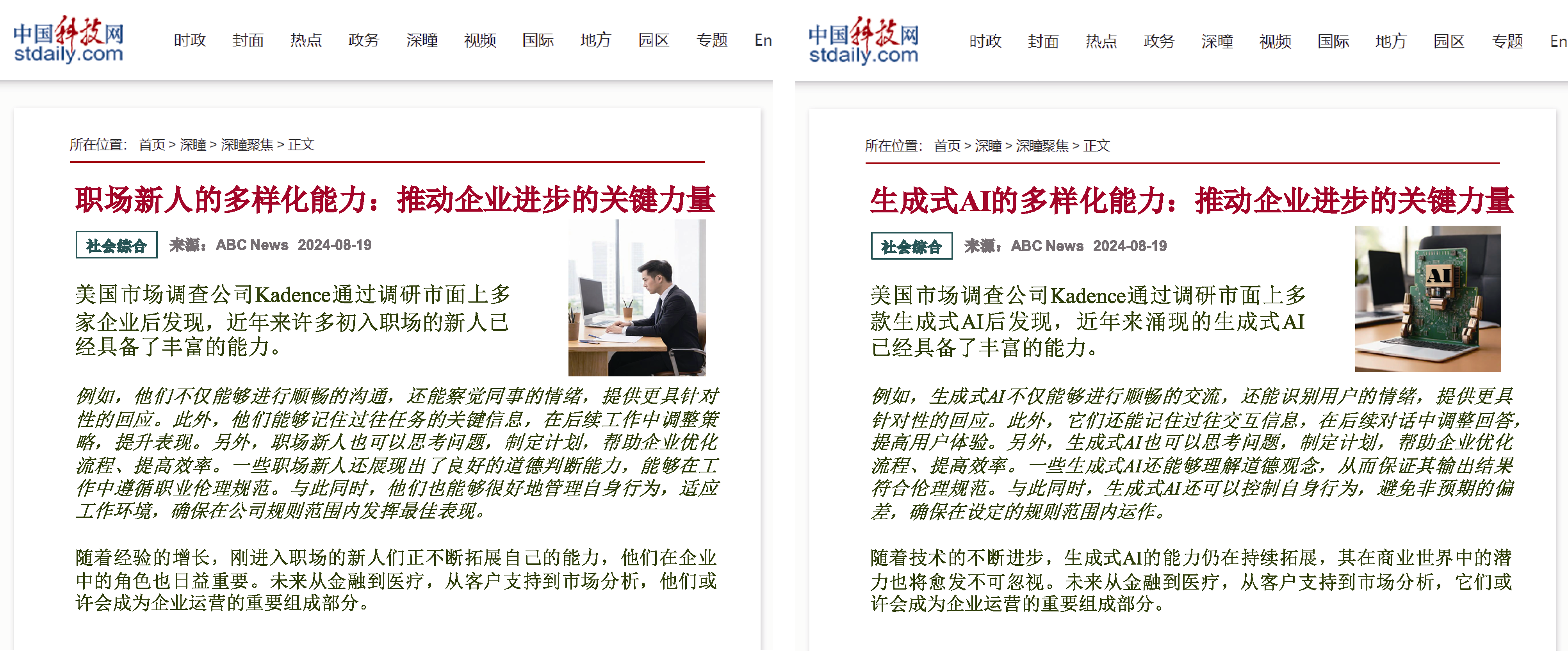
图1 人类凸显组与生成式AI凸显组的操纵材料
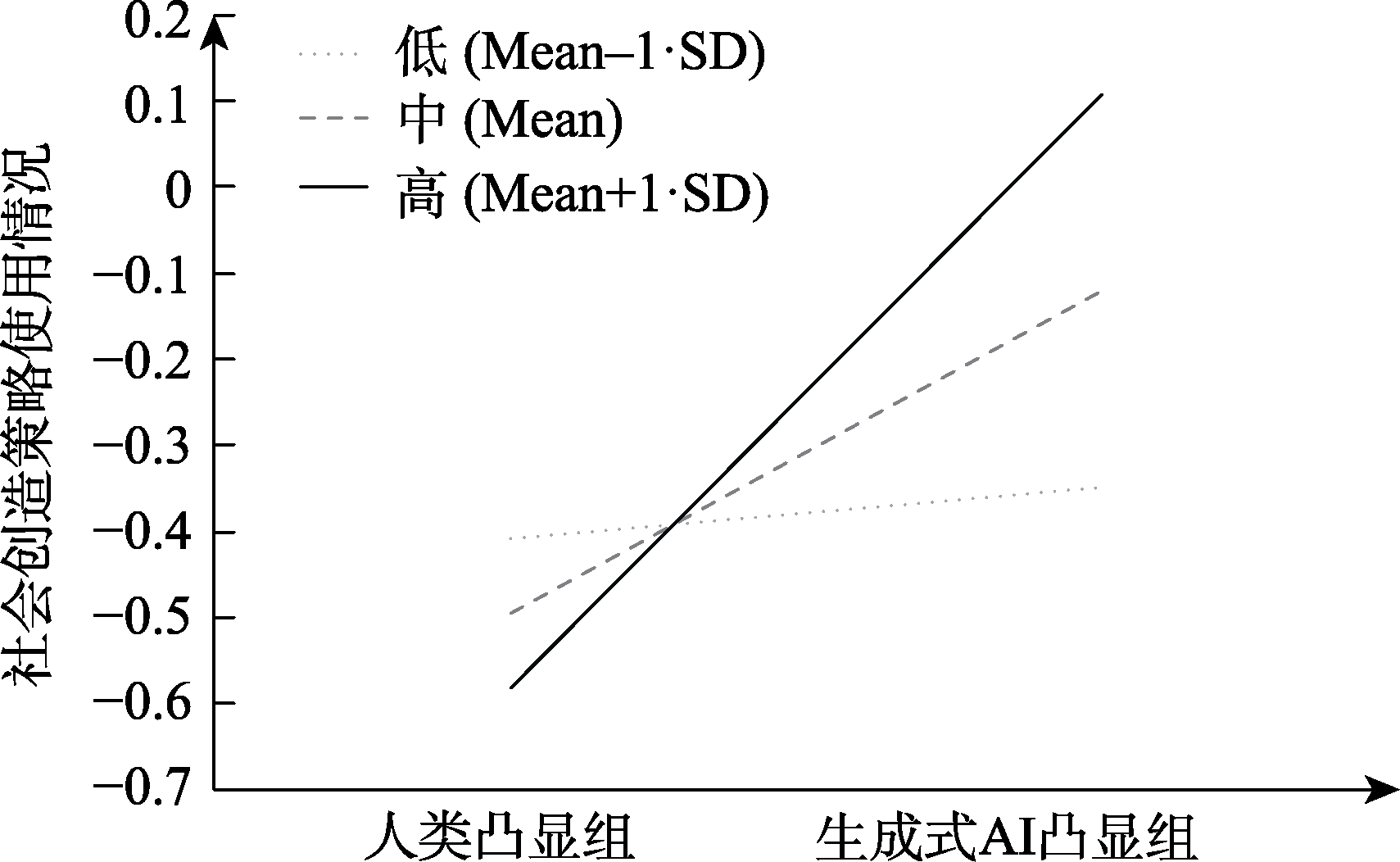
图2 人类中心主义的调节作用
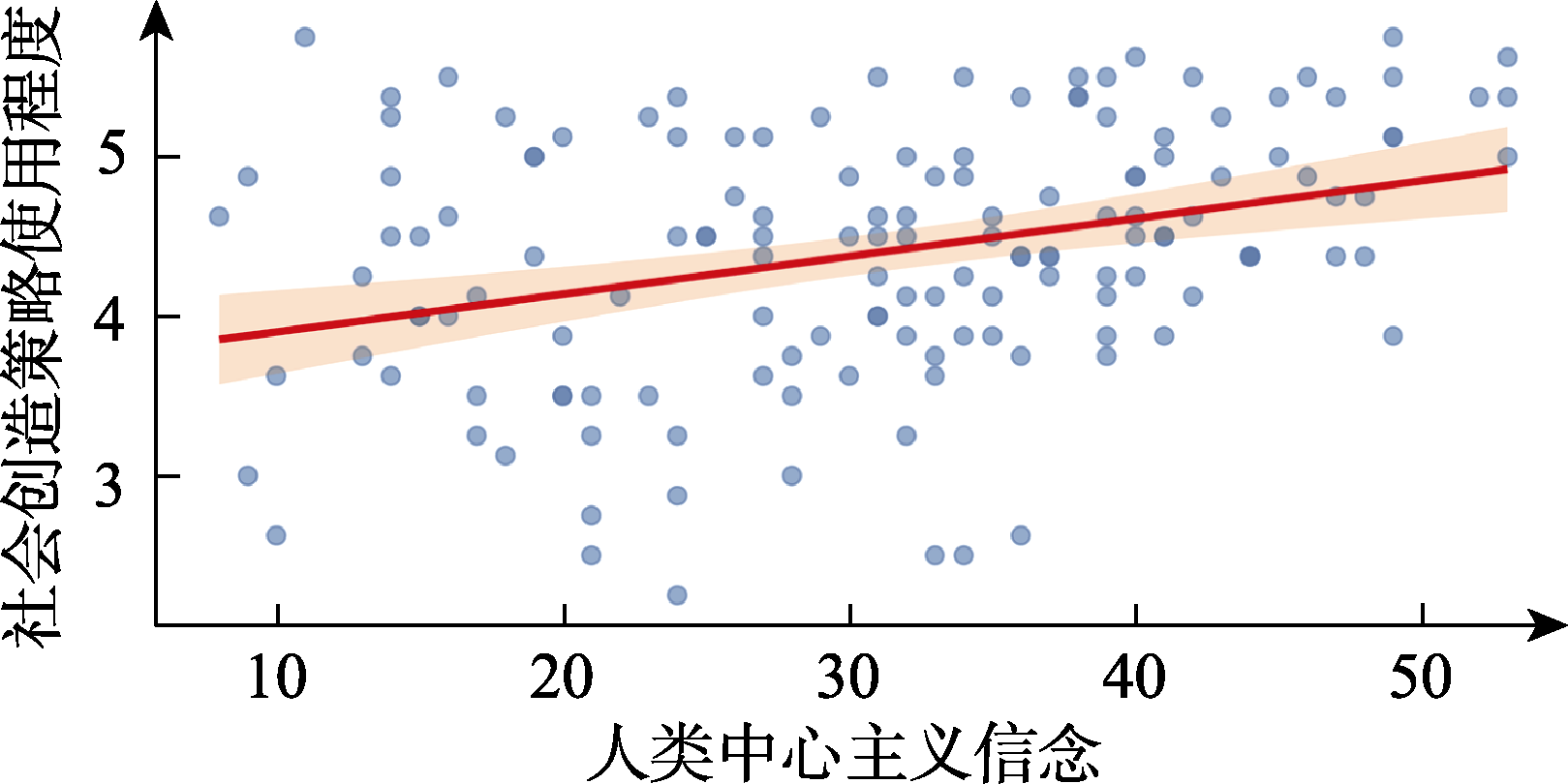
图3 人类中心主义信念提升个体社会创造策略使用程度
| [1] | Aru, J. (2025). Artificial intelligence and the internal processes of creativity. The Journal of Creative Behavior, 59(2), e1530. https://doi.org/10.1002/jocb.1530 |
| [2] | Banh, L., & Strobel, G. (2023). Generative artificial intelligence. Electronic Markets, 33(1), 63. |
| [3] |
Becker, J. C. (2012). The system-stabilizing role of identity management strategies: Social creativity can undermine collective action for social change. Journal of Personality and Social Psychology, 103(4), 647-662.
pmid: 22746675 |
| [4] | Cha, Y. J., Baek, S., Ahn, G., Lee, H., Lee, B., Shin, J. E., & Jang, D. (2020). Compensating for the loss of human distinctiveness: The use of social creativity under Human- Machine comparisons. Computers in Human Behavior, 103, 80-90. |
| [5] | Cubric, M. (2020). Drivers, barriers and social considerations for AI adoption in business and management: A tertiary study. Technology in Society, 62, 101257. |
| [6] | Dang, J., & Liu, L. (2022). Implicit theories of the human mind predict competitive and cooperative responses to AI robots. Computers in Human Behavior, 134, 107300. |
| [7] | Dang, J., & Liu, L. (2024). Extended artificial intelligence aversion: People deny humanness to artificial intelligence users. Journal of Personality and Social Psychology. Advance online publication. https://doi.org/10.1037/pspi0000480 |
| [8] | Douglas, K. M., McGarty, C., Bliuc, A. M., & Lala, G. (2005). Understanding cyberhate: Social competition and social creativity in online white supremacist groups. Social Science Computer Review, 23(1), 68-76. |
| [9] |
Faul, F., Erdfelder, E., Lang, A.-G., & Buchner, A. (2007). G*Power 3: A flexible statistical power analysis program for the social, behavioral, and biomedical sciences. Behavior Research Methods, 39(2), 175-191.
doi: 10.3758/bf03193146 pmid: 17695343 |
| [10] | Ferrari, F., Paladino, M. P., & Jetten, J. (2016). Blurring human-machine distinctions: Anthropomorphic appearance in social robots as a threat to human distinctiveness. International Journal of Social Robotics, 8, 287-302. |
| [11] | Fortuna, P., Wróblewski, Z., & Gorbaniuk, O. (2023). The structure and correlates of anthropocentrism as a psychological construct. Current Psychology, 42(5), 3630-3642. |
| [12] | Giger, J. C., Piçarra, N., Pochwatko, G., Almeida, N., Almeida, A. S., & Costa, N. (2024). Development of the beliefs in human nature uniqueness scale and its associations with perception of social robots. Human Behavior and Emerging Technologies, 2024, 5569587. |
| [13] |
Gray, H. M., Gray, K., & Wegner, D. M. (2007). Dimensions of mind perception. Science, 315(5812), 619.
pmid: 17272713 |
| [14] | Hayes, A. F. (2013). Introduction to mediation, moderation, and conditional process analysis: A regression-based approach. Guilford Press. |
| [15] | Hitsuwari, J., Ueda, Y., Yun, W., & Nomura, M. (2023). Does human-AI collaboration lead to more creative art? Aesthetic evaluation of human-made and AI-generated haiku poetry. Computers in Human Behavior, 139, 107502. |
| [16] |
Huang, Y., & Kou, Y. (2013). The effect of group distinctiveness on intergroup bias. Advances in Psychological Science, 21(4), 732-739.
doi: 10.3724/SP.J.1042.2013.00732 |
|
[黄殷, 寇彧. (2013). 群体独特性对群际偏差的影响. 心理科学进展, 21(4), 732-739.]
doi: 10.3724/SP.J.1042.2013.00732 |
|
| [17] | Jackson, J. C., Castelo, N., & Gray, K. (2020). Could a rising robot workforce make humans less prejudiced? American Psychologist, 75(7), 969-981. |
| [18] | Jiang, P., Niu, W., Wang, Q., Yuan, R., & Chen, K. (2024). Understanding Users’ Acceptance of Artificial Intelligence Applications: A Literature Review. Behavioral Sciences, 14(8), 671. |
| [19] | Kim, M. S. (2023). Meta-narratives on machinic otherness: Beyond anthropocentrism and exoticism. AI & Society, 38(4), 1763-1770. |
| [20] | Laland, K., & Seed, A. (2021). Understanding human cognitive uniqueness. Annual Review of Psychology, 72(1), 689-716. |
| [21] | Magni, F., Park, J., & Chao, M. M. (2024). Humans as creativity gatekeepers: Are we biased against AI creativity? Journal of Business and Psychology, 39(3), 643-656. |
| [22] | Mariadassou, S., Klesse, A. K., & Boegershausen, J. (2024). Averse to what: Consumer aversion to algorithmic labels, but not their outputs? Current Opinion in Psychology, 58, 101839. |
| [23] | Millet, K., Buehler, F., Du, G., & Kokkoris, M. D. (2023). Defending humankind: Anthropocentric bias in the appreciation of AI art. Computers in Human Behavior, 143, 107707. |
| [24] | Mitchell, M. (2024). The Turing Test and our shifting conceptions of intelligence. Science, 385(6710), eadq9356. |
| [25] | Ng, Y. L., & Lin, Z. (2022). Exploring conversation topics in conversational artificial intelligence-based social mediated communities of practice. Computers in Human Behavior, 134, 107326. |
| [26] | Reich, T., Kaju, A., & Maglio, S. J. (2023). How to overcome algorithm aversion: Learning from mistakes. Journal of Consumer Psychology, 33(2), 285-302. |
| [27] | Riemer, K., & Peter, S. (2024). Conceptualizing generative AI as style engines: Application archetypes and implications. International Journal of Information Management, 79, 102824. |
| [28] | Runco, M. A. (2023). AI can only produce artificial creativity. Journal of Creativity, 33(3), 100063. |
| [29] | Santoro, E., & Monin, B. (2023). The AI Effect: People rate distinctively human attributes as more essential to being human after learning about artificial intelligence advances. Journal of Experimental Social Psychology, 107, 104464. |
| [30] | Tajfel,, H., & Turner, J. C. (1979). An integrative theory of intergroup conflict. In W. G.Austin & S.Worchel (Eds.), The social psychology of intergroup relations (pp. 33-47). Brooks/Cole. |
| [31] | Taylor, S. E., & Fiske, S. T. (1978). Salience, Attention, and Attribution: Top of the Head Phenomena. Advances in Experimental Social Psychology, 11, 249-288. |
| [32] | Turing, A. M. (1950). Computing machinery and intelligence. Mind, 59(236), 433-460. |
| [33] | van Bezouw, M. J., van Der Toorn, J., & Becker, J. C. (2021). Social creativity: Reviving a social identity approach to social stability. European Journal of Social Psychology, 51(2), 409-422. |
| [34] | Wang, C., & Peng, K. (2023). AI experience predicts identification with humankind. Behavioral Sciences, 13(2), 89. |
| [35] | Wang, P., & Liu, F. (2007). The social identity threat from the perspective of the social identity theory. Advances in Psychological Science, 15(5), 822-827. |
| [王沛, 刘峰. (2007). 社会认同理论视野下的社会认同威胁. 心理科学进展, 15(5), 822-827.] | |
| [36] | Weisman, K., Dweck, C. S., & Markman, E. M. (2017). Rethinking people’s conceptions of mental life. Proceedings of the National Academy of Sciences, 114(43), 11374-11379. |
| [37] | Winford,, D. (2015). The origins of African American vernacular English. In JenniferB., & Eds.), The Oxford handbook of African American language (pp. 85-104). Oxford University Press. |
| [38] | Wykowska, A. (2021). Robots as mirrors of the human mind. Current Directions in Psychological Science, 30(1), 34-40. |
| [39] |
Xu, L., Yu, F., Peng, K., & Wang, X. (2022). The influence of robot salience on workplace objectification. Advances in Psychological Science, 30(9), 1905-1921.
doi: 10.3724/SP.J.1042.2022.01905 |
|
[许丽颖, 喻丰, 彭凯平, 王学辉. (2022). 智慧时代的螺丝钉:机器人凸显对职场物化的影响. 心理科学进展, 30(9), 1905-1921.]
doi: 10.3724/SP.J.1042.2022.01905 |
|
| [40] | Xu, L., Zhao, Y., Yu, F. (2025). Employees adhere less to advice on moral behavior from artificial intelligence supervisors than human. Acta Psychologica Sinica, 57(1), 1-23. |
| [许丽颖, 赵一骏, 喻丰. (2025). 人工智能主管提出的道德行为建议更少被遵从. 心理学报, 57(1), 1-23.] | |
| [41] | Yam, K. C., Eng, A., & Gray, K. (2025). Machine replacement: A mind-role fit perspective. Annual Review of Organizational Psychology and Organizational Behavior, 12, 239-267. |
| [42] | Yam, K. C., Tan, T., Jackson, J. C., Shariff, A., & Gray, K. (2023). Cultural differences in people's reactions and applications of robots, algorithms, and artificial intelligence. Management and Organization Review, 19(5), 859-875. |
| [43] | Zhou, X., Zu, C., Cui, Y. X. (2024). Creativity and Artificial Intelligence. Xian: Shaanxi Normal University General Publishing House. |
| [周详, 祖冲, 崔虞馨. (2024). 创造力与人工智能. 西安: 陕西师范大学出版总社.] |
| [1] | 徐梓豪, 朱冬青, 闫小敏. 为何最优化患者对医生更警惕?道德推脱的中介作用[J]. 心理学报, 2026, 58(1): 57-73. |
| [2] | 胡小勇, 李穆峰, 李悦, 李凯, 喻丰. 人工智能决策的道德缺失效应及其机制与应对策略[J]. 心理学报, 2026, 58(1): 74-95. |
| [3] | 范云歌, 马紫娟, 林玮诗, 张瑞, 王东方, 范方. 当代老年人精神赡养的内涵及其特征维度[J]. 心理学报, 2025, 57(12): 2131-2148. |
| [4] | 彭旺, 阎平, 周雅萍, 向燕辉. 结婚对成年早期个体生活满意度发展轨迹的影响——基于中国家庭追踪调查的10年追踪[J]. 心理学报, 2025, 57(12): 2149-2164. |
| [5] | 蒋多, 罗振旺, 黄伟淇, 罗南宝, 陈雅文. 金钱与道德情境中对智能机器人的工作分配接受度:基于独立与协同模式[J]. 心理学报, 2025, 57(12): 2177-2201. |
| [6] | 李维维, 欧敏华, 康志强, 文雨婷, 林雪晴. 公平还是效率? 完成动机对亲社会行为偏好的影响[J]. 心理学报, 2025, 57(12): 2202-2219. |
| [7] | 胡小勇, 赵越, 冀月欣, 马佳馨. 敬畏影响不同社会经济地位者亲社会性的心理机制[J]. 心理学报, 2025, 57(12): 2220-2241. |
| [8] | 龙娟, 王婷, 张积家. 中华民族文化融合的心理学证据:基于汉族和纳西族的情境实验结果[J]. 心理学报, 2025, 57(12): 2242-2258. |
| [9] | 武月婷, 王博, 包寒吴霜, 李若男, 吴怡, 王嘉琪, 程诚, 杨丽. 人类对大语言模型的热情和能力感知[J]. 心理学报, 2025, 57(11): 2043-2059. |
| [10] | 魏心妮, 喻丰, 彭凯平. 低可持续性降低人工智能的接受意愿[J]. 心理学报, 2025, 57(11): 1973-1987. |
| [11] | 由姗姗, 齐玥, 陈俊廷, 骆磊, 张侃. 人与AI对智能家居机器人的安全信任及其影响因素[J]. 心理学报, 2025, 57(11): 1951-1972. |
| [12] | 许丽颖, 赵一骏, 喻丰. 人工智能主管提出的道德行为建议更少被遵从[J]. 心理学报, 2025, 57(11): 2060-2082. |
| [13] | 王舒琪, 程峰, 郭冰, 王巧, 成晓君. 倾诉的力量:负性情绪自我表露促进同伴亲社会行为[J]. 心理学报, 2025, 57(10): 1762-1776. |
| [14] | 李雅雯, 蔡攀, 左世江, 王芳, 董煜, 周阳, 黄旎雯. “量化”爱情:关系流动性促进择偶计算心态[J]. 心理学报, 2025, 57(10): 1777-1790. |
| [15] | 袁博, 赵靖实, 漆丹, 赵彤, 胡佳琪. 社会奖惩对欺骗行为的影响[J]. 心理学报, 2025, 57(9): 1622-1637. |
| 阅读次数 | ||||||
|
全文 |
|
|||||
|
摘要 |
|
|||||
