

ISSN 1671-3710
CN 11-4766/R
主办:中国科学院心理研究所
出版:科学出版社
CN 11-4766/R
主办:中国科学院心理研究所
出版:科学出版社
Advances in Psychological Science ›› 2026, Vol. 34 ›› Issue (5): 817-835.doi: 10.3724/SP.J.1042.2026.0817
• Conceptual Framework • Previous Articles Next Articles
YAN Yan, LIU Wumei, MA Zengguang( )
)
Received:2025-09-30
Online:2026-05-15
Published:2026-03-20
Contact:
MA Zengguang
E-mail:xmgyx1496@163.com
CLC Number:
YAN Yan, LIU Wumei, MA Zengguang. The impact of resource scarcity on filial consumption behavior of adult children[J]. Advances in Psychological Science, 2026, 34(5): 817-835.
| 研究分支 | 结果变量 | 作者和年份 | 核心观点和发现 |
|---|---|---|---|
| 分支1:时间和金钱稀缺影响消费者行为一致性结果 | 产品使用创造力 | Mehta和Zhu ( | 资源稀缺(vs.丰富)时会激活消费者的约束心态, 从而使产品功能固着性降低, 增加了消费者的产品使用创造力。 |
| 自我馈赠 | Rifkin等( | 感到资源限制(vs.较少限制)将降低消费者对自我馈赠的兴趣。这种效应发生是因为感到受限会降低预期获得利益的能力, 这一现象在个体整体资源受限、时间受限、金钱受限时均存在。 | |
| 饮食偏好 | Venn和Strazdins ( | 时间和金钱稀缺(vs.富足)都会增加个体的不健康饮食倾向。 | |
| 应对策略 | Fernbach等( | 随着资源约束的增加, 消费者更倾向于采用优先级规划, 而非效率优先计划。 | |
| 亲社会行为 | Wang ( | 资源稀缺对亲社会行为存在双向影响, 取决于决策情境中是否存在浪费担忧, 以及减少浪费所需的资源类型(时间与金钱)。 | |
| 分支2:时间、金钱稀缺影响消费者行为差异性比较 | 慈善捐赠 | Malika等( | 时间或金钱稀缺时, 个体的慈善行为存在不同倾向。个体时间稀缺时倾向人导向捐赠金钱, 倾向物导向则不受影响。反之, 个体金钱稀缺时, 倾向物导向捐赠时间, 倾向人导向不受影响。 |
| 研究分支 | 结果变量 | 作者和年份 | 核心观点和发现 |
|---|---|---|---|
| 分支1:时间和金钱稀缺影响消费者行为一致性结果 | 产品使用创造力 | Mehta和Zhu ( | 资源稀缺(vs.丰富)时会激活消费者的约束心态, 从而使产品功能固着性降低, 增加了消费者的产品使用创造力。 |
| 自我馈赠 | Rifkin等( | 感到资源限制(vs.较少限制)将降低消费者对自我馈赠的兴趣。这种效应发生是因为感到受限会降低预期获得利益的能力, 这一现象在个体整体资源受限、时间受限、金钱受限时均存在。 | |
| 饮食偏好 | Venn和Strazdins ( | 时间和金钱稀缺(vs.富足)都会增加个体的不健康饮食倾向。 | |
| 应对策略 | Fernbach等( | 随着资源约束的增加, 消费者更倾向于采用优先级规划, 而非效率优先计划。 | |
| 亲社会行为 | Wang ( | 资源稀缺对亲社会行为存在双向影响, 取决于决策情境中是否存在浪费担忧, 以及减少浪费所需的资源类型(时间与金钱)。 | |
| 分支2:时间、金钱稀缺影响消费者行为差异性比较 | 慈善捐赠 | Malika等( | 时间或金钱稀缺时, 个体的慈善行为存在不同倾向。个体时间稀缺时倾向人导向捐赠金钱, 倾向物导向则不受影响。反之, 个体金钱稀缺时, 倾向物导向捐赠时间, 倾向人导向不受影响。 |
| 研究分支 | 结果变量 | 作者和年份 | 核心观点和发现 |
|---|---|---|---|
| 分支1:时间稀缺对消费者的个体内后果(包括消费态度、行为等) | 跨期决策 | Zeng等( | 相比对照组, 对时间稀缺性有更强感知的参与者更有可能选择更小和更快的收益。 |
| Sharma等( | 当时间稀缺(富足)时, 偏好更早(较长)的结果。 | ||
| 产品评价 | Lee和Jung ( | 时间稀缺会对消费者的产品评价产生积极影响。 | |
| 冲动购买 | Hao和Huang ( | 时间稀缺会增加消费者的冲动性购买和感知的紧迫性。此外, 时间稀缺对紧迫感的影响取决于产品类型, 紧迫感在时间稀缺性对实用型产品冲动购买的影响中起中介作用。 | |
| Li等( | 时间稀缺与旅行经验的相互作用会影响冲动购买。当游客旅行经验丰富(vs.缺乏), 时间稀缺会增加(vs.减少)其冲动购买行为。 | ||
| 幸福感 | 孙晓敏等( | 时间稀缺对个体幸福感的影响。 | |
| 购买意愿 | Hmurovic等( | 时间稀缺会提升消费者在线下的购买意愿, 但仅当零售商明确提供时间稀缺的正当理由时, 才对线上购买意愿起到促进作用。 | |
| 饮食偏好 | Venn和Strazdins ( | 时间稀缺增加了不健康饮食倾向。 | |
| 认知 | Shah等( | 当人们感知到时间稀缺(vs.富足)时, 他们在完成任务时可能会经历更高水平的认知疲劳。 | |
| 目标追求 | Zhu等( | 时间稀缺(vs.富足)抑制困难目标追求, 因为困难目标需更多时间。 | |
| 分支2:时间稀缺对消费者的社会后果 | 人际关系 (陌生人、熟人、密友) | Jiang等( | 感知时间稀缺增加对他人的物化, 价值取向是时间稀缺影响物化之间的机制。此外, 即便是熟人和密友, 时间稀缺个体对他人的物化倾向影响依然存在, 研究结果突显了时间稀缺对人际关系的重要影响。 |
| 助人行为 | Levine等( | 长期面临时间稀缺的人, 最不可能花时间去帮助他人。 |
| 研究分支 | 结果变量 | 作者和年份 | 核心观点和发现 |
|---|---|---|---|
| 分支1:时间稀缺对消费者的个体内后果(包括消费态度、行为等) | 跨期决策 | Zeng等( | 相比对照组, 对时间稀缺性有更强感知的参与者更有可能选择更小和更快的收益。 |
| Sharma等( | 当时间稀缺(富足)时, 偏好更早(较长)的结果。 | ||
| 产品评价 | Lee和Jung ( | 时间稀缺会对消费者的产品评价产生积极影响。 | |
| 冲动购买 | Hao和Huang ( | 时间稀缺会增加消费者的冲动性购买和感知的紧迫性。此外, 时间稀缺对紧迫感的影响取决于产品类型, 紧迫感在时间稀缺性对实用型产品冲动购买的影响中起中介作用。 | |
| Li等( | 时间稀缺与旅行经验的相互作用会影响冲动购买。当游客旅行经验丰富(vs.缺乏), 时间稀缺会增加(vs.减少)其冲动购买行为。 | ||
| 幸福感 | 孙晓敏等( | 时间稀缺对个体幸福感的影响。 | |
| 购买意愿 | Hmurovic等( | 时间稀缺会提升消费者在线下的购买意愿, 但仅当零售商明确提供时间稀缺的正当理由时, 才对线上购买意愿起到促进作用。 | |
| 饮食偏好 | Venn和Strazdins ( | 时间稀缺增加了不健康饮食倾向。 | |
| 认知 | Shah等( | 当人们感知到时间稀缺(vs.富足)时, 他们在完成任务时可能会经历更高水平的认知疲劳。 | |
| 目标追求 | Zhu等( | 时间稀缺(vs.富足)抑制困难目标追求, 因为困难目标需更多时间。 | |
| 分支2:时间稀缺对消费者的社会后果 | 人际关系 (陌生人、熟人、密友) | Jiang等( | 感知时间稀缺增加对他人的物化, 价值取向是时间稀缺影响物化之间的机制。此外, 即便是熟人和密友, 时间稀缺个体对他人的物化倾向影响依然存在, 研究结果突显了时间稀缺对人际关系的重要影响。 |
| 助人行为 | Levine等( | 长期面临时间稀缺的人, 最不可能花时间去帮助他人。 |
| 研究分支 | 结果变量 | 作者和年份 | 核心观点和发现 |
|---|---|---|---|
| 分支1:金钱稀缺对消费者的个体内后果 | 成本关注 | Zhu等( | 当消费者财务稀缺时, 他们的注意力会被稀缺资源吸引, 更关注金钱以及商品和服务的成本, 这种注意力的隧道效应使消费者忽视其他信息。 |
| 食物选择 | Briers和Laporte ( | 财务资源稀缺(vs.对照组)会促使人们消费更多的高热量食品。 | |
| 主观幸福感 | Layard ( | 对极端贫困者来说, 幸福感会随收入增加而提高, 但最终会达到餍足点, 在餍足点以上收入对幸福感的影响明显减弱。 | |
| 放纵行为 | 徐富明等( | 穷人要比富人或正常收入人群抵制更多的诱惑, 从而耗费更多的自我控制资源, 所以更可能做出暴饮暴食、没节制地花销等非理性行为。 | |
| 风险偏好 | Dohmen等( | 贫困会导致风险规避增加, 贫困者通常比富裕者表现出更多的风险规避行为。 | |
| Cook和Sadeghein ( | 经济稀缺个体在经济决策时冒险程度更高。 | ||
| 执行控制 | Mani等( | 相较富有时(收获后), 个体贫困时(收获前)的流体智力和执行控制力更弱。 | |
| 贴现率 | Carvalho等( | 个体的贫富程度会影响贴现率, 对于收入越低的人, 时间贴现率越高。 | |
| 口碑传播 | Paley等( | 财务约束(vs.对照组)减少了消费者与购买相关的口碑传播。这一效应在消费者报告的讨论购买的频率、意图、愿望以及实际参与口碑传播的决策中均有所体现。 | |
| 财务幸福感 | Netemeyer等( | 金钱稀缺(vs.对照组)降低了消费者的财务幸福感。 | |
| 绿色消费 | Zhang等( | 金钱稀缺(vs.富足)会阻碍消费者选择绿色产品, 这一影响是通过焦虑和自我效能感的感知进行中介, 并受到社会支持的调节。 | |
| 孙瑾等( | 当消费者拥有更少的可支配财务资源时进行环保捐款或购买绿色产品的可能性更低。 | ||
| 产品偏好 | Sharma和Alter ( | 金钱稀缺(vs.对照组)促使消费者寻求稀缺商品。 | |
| Tully等( | 金钱稀缺(vs.对照组)导致消费者更倾向于物质商品而不是体验型产品。 | ||
| 反享乐消费偏好 | Yang和Zhang ( | 财务资源稀缺(vs.富足)导致消费者控制感降低, 进而降低对反享乐消费偏好。 | |
| 多样性寻求 | 樊亚凤和蒋晶( | 资金稀缺会增加消费者的不安全感, 进而降低多样性寻求。 | |
| 分支2:金钱稀缺对消费者的社会后果 | 亲社会行为 | Kraus等( | 低收入消费者的财务稀缺(vs.对照组)导致更高的慷慨和亲社会行为, 因为他们对平等价值观的承诺更强, 但这对上层阶级消费者并不适用。 |
| Holland等( | 生活在社会经济地位较低社区的人不太可能自发地捐金钱帮助他人。 | ||
| 分享行为 | Herzenstein和Small ( | 金钱稀缺(vs.对照组)降低个人与他人尤其是远距离他人分享金钱资源的倾向。 |
| 研究分支 | 结果变量 | 作者和年份 | 核心观点和发现 |
|---|---|---|---|
| 分支1:金钱稀缺对消费者的个体内后果 | 成本关注 | Zhu等( | 当消费者财务稀缺时, 他们的注意力会被稀缺资源吸引, 更关注金钱以及商品和服务的成本, 这种注意力的隧道效应使消费者忽视其他信息。 |
| 食物选择 | Briers和Laporte ( | 财务资源稀缺(vs.对照组)会促使人们消费更多的高热量食品。 | |
| 主观幸福感 | Layard ( | 对极端贫困者来说, 幸福感会随收入增加而提高, 但最终会达到餍足点, 在餍足点以上收入对幸福感的影响明显减弱。 | |
| 放纵行为 | 徐富明等( | 穷人要比富人或正常收入人群抵制更多的诱惑, 从而耗费更多的自我控制资源, 所以更可能做出暴饮暴食、没节制地花销等非理性行为。 | |
| 风险偏好 | Dohmen等( | 贫困会导致风险规避增加, 贫困者通常比富裕者表现出更多的风险规避行为。 | |
| Cook和Sadeghein ( | 经济稀缺个体在经济决策时冒险程度更高。 | ||
| 执行控制 | Mani等( | 相较富有时(收获后), 个体贫困时(收获前)的流体智力和执行控制力更弱。 | |
| 贴现率 | Carvalho等( | 个体的贫富程度会影响贴现率, 对于收入越低的人, 时间贴现率越高。 | |
| 口碑传播 | Paley等( | 财务约束(vs.对照组)减少了消费者与购买相关的口碑传播。这一效应在消费者报告的讨论购买的频率、意图、愿望以及实际参与口碑传播的决策中均有所体现。 | |
| 财务幸福感 | Netemeyer等( | 金钱稀缺(vs.对照组)降低了消费者的财务幸福感。 | |
| 绿色消费 | Zhang等( | 金钱稀缺(vs.富足)会阻碍消费者选择绿色产品, 这一影响是通过焦虑和自我效能感的感知进行中介, 并受到社会支持的调节。 | |
| 孙瑾等( | 当消费者拥有更少的可支配财务资源时进行环保捐款或购买绿色产品的可能性更低。 | ||
| 产品偏好 | Sharma和Alter ( | 金钱稀缺(vs.对照组)促使消费者寻求稀缺商品。 | |
| Tully等( | 金钱稀缺(vs.对照组)导致消费者更倾向于物质商品而不是体验型产品。 | ||
| 反享乐消费偏好 | Yang和Zhang ( | 财务资源稀缺(vs.富足)导致消费者控制感降低, 进而降低对反享乐消费偏好。 | |
| 多样性寻求 | 樊亚凤和蒋晶( | 资金稀缺会增加消费者的不安全感, 进而降低多样性寻求。 | |
| 分支2:金钱稀缺对消费者的社会后果 | 亲社会行为 | Kraus等( | 低收入消费者的财务稀缺(vs.对照组)导致更高的慷慨和亲社会行为, 因为他们对平等价值观的承诺更强, 但这对上层阶级消费者并不适用。 |
| Holland等( | 生活在社会经济地位较低社区的人不太可能自发地捐金钱帮助他人。 | ||
| 分享行为 | Herzenstein和Small ( | 金钱稀缺(vs.对照组)降低个人与他人尤其是远距离他人分享金钱资源的倾向。 |
| 研究分支 | 主题 | 作者和年份 | 核心观点和发现 |
|---|---|---|---|
| 分支1:成年子女孝心消费的影响因素 | 代际医疗决策 | Fan等( | 影响成年子女为父母做出医疗决策的因素有两类:一是环境因素, 包括与医疗机构相关的因素(医疗机构排名、医疗保健机构可及性、等待时间、健康保险政策), 与医疗服务提供者相关的因素(医生的态度、治疗效果、医生的专业职称)。二是人的因素, 包括父母的婚姻状况、成年子女的性别、受教育水平。 |
| Wu等( | 成年子女与父母之间的关系亲密度, 是成年子女为父母做出是否接种肺炎疫苗决策的前因。 | ||
| 分支2:成年子女孝心消费的动机、过程 | 代际支持流动 | Evandrou等 ( | 从社会交换理论出发, 一部分成年子女是出于对父母的感恩进行孝行。从利他理论出发, 也有一部分成年子女出于自己的孝顺义务感而出现对父母的孝行。 |
| 子代−亲代家庭旅游过程 | 符国群等 ( | 驱动当代中国成年子女与父母旅游的主要动机是报答父母。 | |
| 成年子女与父母一起出游 | Wang等( | 在表达孝心的多种方式中, 为父母组织旅游和陪父母度假正成为流行的选择。中国成年子女与父母一起旅行的动机包括健康和康复、新奇和知识、纪念和庆祝、梦想成真、家庭团聚和关系、补偿和奖励、表达孝心、逃避和放松以及寻求快乐。 | |
| 成年子女支持父母出游 | 李志勇和阎珺琪( | 成年子女的多重主观期望(例如, 回报、孝敬、补偿)推动他们支持父母出游, 而成年子女对老年父母的行为支持也会得到父母的认知、情感、关系等反馈。 | |
| 代际送礼 | 林荫等( | 成年子女给父母送礼是在孝道规范下的单方面“感恩”和“回馈”行为, 具有“孝意表达”和“缓解子女焦虑与内疚”的双重功能。 | |
| 分支3:成年子女孝心消费的后效 | 成年子女与父母旅游 | Liu等( | 基于团结−冲突模型的分析发现, 成年子女与父母之间的关系团结程度, 能正向预测其共同旅游的满意度和幸福感。 |
| 研究分支 | 主题 | 作者和年份 | 核心观点和发现 |
|---|---|---|---|
| 分支1:成年子女孝心消费的影响因素 | 代际医疗决策 | Fan等( | 影响成年子女为父母做出医疗决策的因素有两类:一是环境因素, 包括与医疗机构相关的因素(医疗机构排名、医疗保健机构可及性、等待时间、健康保险政策), 与医疗服务提供者相关的因素(医生的态度、治疗效果、医生的专业职称)。二是人的因素, 包括父母的婚姻状况、成年子女的性别、受教育水平。 |
| Wu等( | 成年子女与父母之间的关系亲密度, 是成年子女为父母做出是否接种肺炎疫苗决策的前因。 | ||
| 分支2:成年子女孝心消费的动机、过程 | 代际支持流动 | Evandrou等 ( | 从社会交换理论出发, 一部分成年子女是出于对父母的感恩进行孝行。从利他理论出发, 也有一部分成年子女出于自己的孝顺义务感而出现对父母的孝行。 |
| 子代−亲代家庭旅游过程 | 符国群等 ( | 驱动当代中国成年子女与父母旅游的主要动机是报答父母。 | |
| 成年子女与父母一起出游 | Wang等( | 在表达孝心的多种方式中, 为父母组织旅游和陪父母度假正成为流行的选择。中国成年子女与父母一起旅行的动机包括健康和康复、新奇和知识、纪念和庆祝、梦想成真、家庭团聚和关系、补偿和奖励、表达孝心、逃避和放松以及寻求快乐。 | |
| 成年子女支持父母出游 | 李志勇和阎珺琪( | 成年子女的多重主观期望(例如, 回报、孝敬、补偿)推动他们支持父母出游, 而成年子女对老年父母的行为支持也会得到父母的认知、情感、关系等反馈。 | |
| 代际送礼 | 林荫等( | 成年子女给父母送礼是在孝道规范下的单方面“感恩”和“回馈”行为, 具有“孝意表达”和“缓解子女焦虑与内疚”的双重功能。 | |
| 分支3:成年子女孝心消费的后效 | 成年子女与父母旅游 | Liu等( | 基于团结−冲突模型的分析发现, 成年子女与父母之间的关系团结程度, 能正向预测其共同旅游的满意度和幸福感。 |
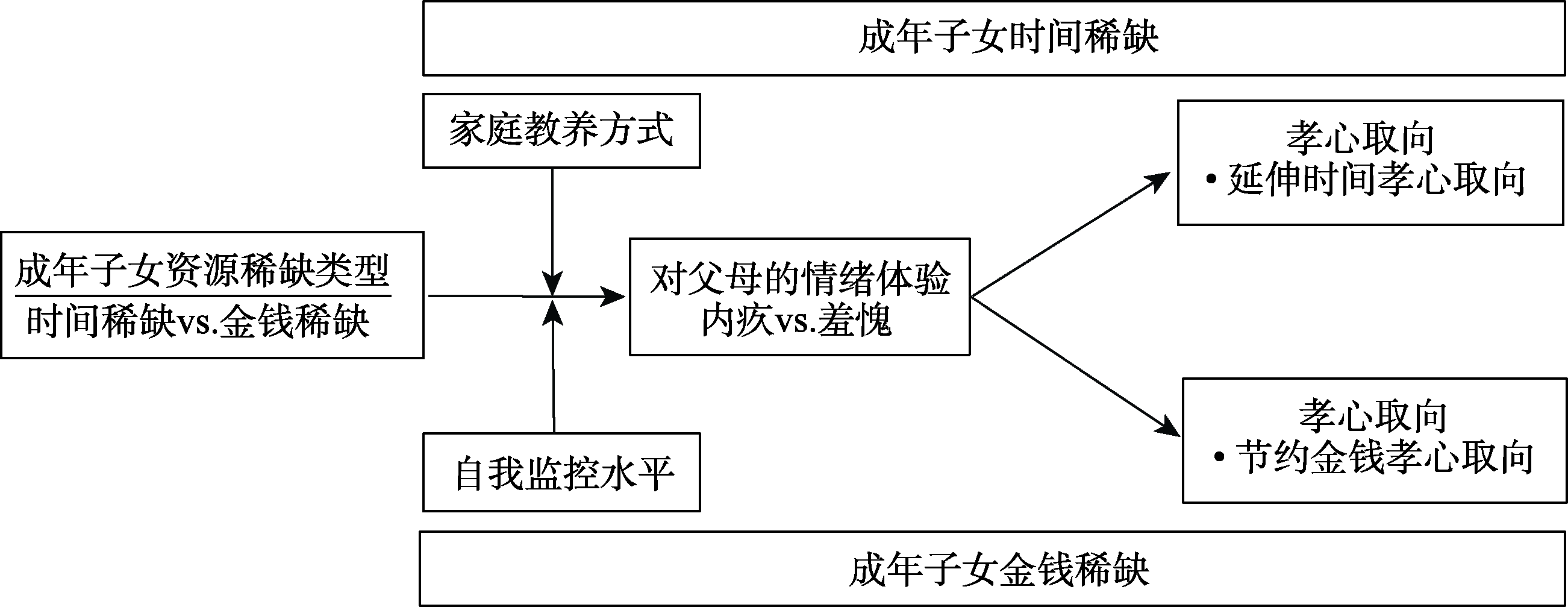
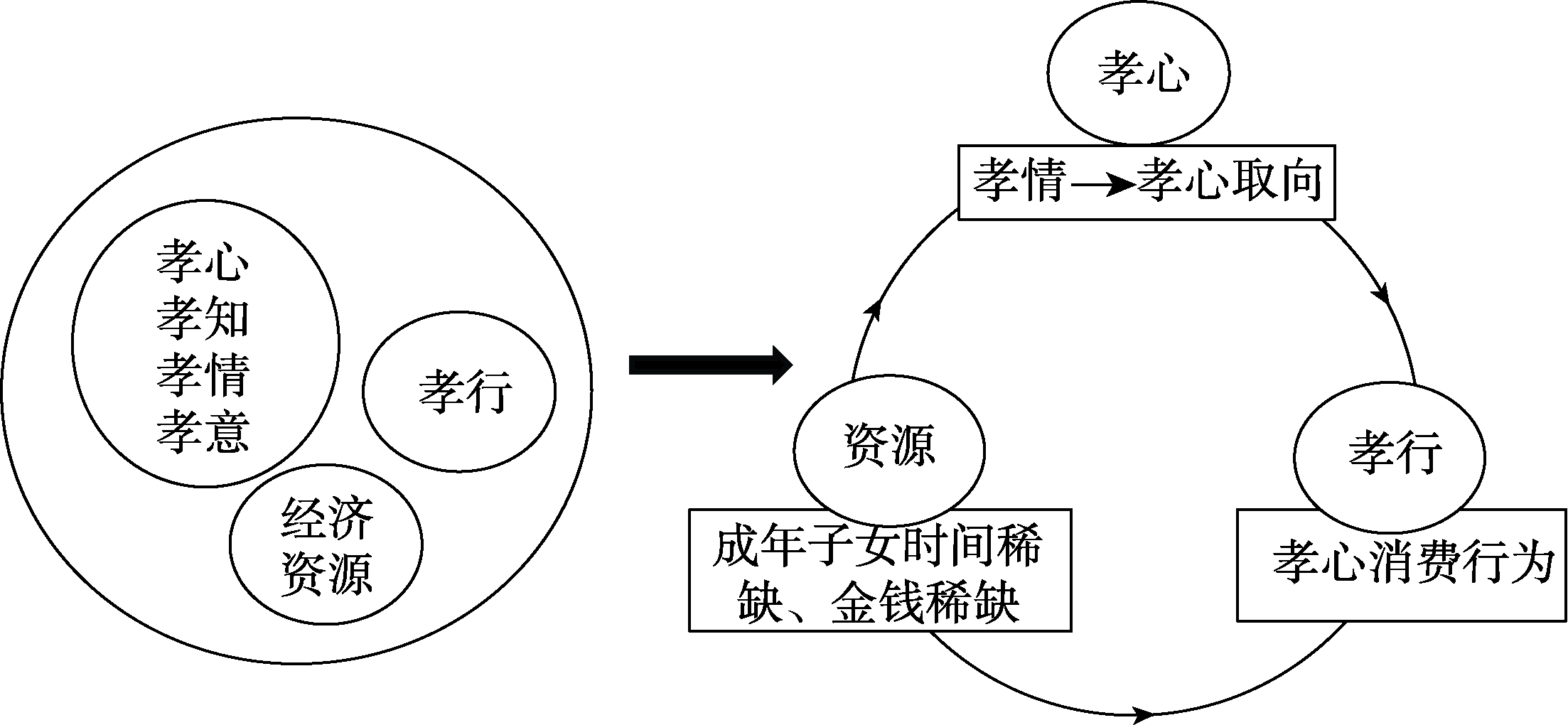
| 理论 基础 | 中介 路径 | 主要文献/观点 | 应对倾向 | ||
|---|---|---|---|---|---|
| 节约资源 | 延伸资源 | ||||
| 已有研究 | 注意力资源理论 | 认知 | 资源稀缺个体会快速识别目标, 忽视某些信息以降低稀缺资源投入(Shah et al., | √ | |
| 资源稀缺促使个体投入额外的努力, 增加参与感更有效的使用资源(Gersick, | √ | ||||
| 自我调节理论 | 行为 | 资源稀缺时个体会做出减少稀缺资源损耗的行为(Cannon et al., | √ | ||
| 资源稀缺时消费者会做出能够获得稀缺资源的行为(Park, | √ | ||||
| 情绪调节理论 | 情绪 | 资源稀缺的消费者追求享乐性的情绪调节策略, 不参与口碑传播(Mauss & Tamir, | √ | ||
| 资源稀缺的消费者谋求工具性的情绪调节策略, 以获取重要信息或达成目标(Salerno & Escoe, | √ | ||||
| 本文 | 稀缺理论 | 动机 | 通过忽视等方式降低对不重要事项资源投入的倾向(Mullainathan & Shafir, | √ | |
| 通过主观努力获取有限资源或借用资源的倾向(Shah et al., | √ | ||||
| 理论 基础 | 中介 路径 | 主要文献/观点 | 应对倾向 | ||
|---|---|---|---|---|---|
| 节约资源 | 延伸资源 | ||||
| 已有研究 | 注意力资源理论 | 认知 | 资源稀缺个体会快速识别目标, 忽视某些信息以降低稀缺资源投入(Shah et al., | √ | |
| 资源稀缺促使个体投入额外的努力, 增加参与感更有效的使用资源(Gersick, | √ | ||||
| 自我调节理论 | 行为 | 资源稀缺时个体会做出减少稀缺资源损耗的行为(Cannon et al., | √ | ||
| 资源稀缺时消费者会做出能够获得稀缺资源的行为(Park, | √ | ||||
| 情绪调节理论 | 情绪 | 资源稀缺的消费者追求享乐性的情绪调节策略, 不参与口碑传播(Mauss & Tamir, | √ | ||
| 资源稀缺的消费者谋求工具性的情绪调节策略, 以获取重要信息或达成目标(Salerno & Escoe, | √ | ||||
| 本文 | 稀缺理论 | 动机 | 通过忽视等方式降低对不重要事项资源投入的倾向(Mullainathan & Shafir, | √ | |
| 通过主观努力获取有限资源或借用资源的倾向(Shah et al., | √ | ||||
| 区别维度 | 情绪类型 | |
|---|---|---|
| 内疚(guilt) | 羞愧(Shame) | |
| 评价对象 | 评价的是特定行为(如, “看我做了多么糟糕的事情”), 保持身份的完整(Giroux et al., | 评价的是整个自我(如, “看我是多么糟糕的人”), 身份完整性受损(Budiarto & Helmi, |
| 引发因素 | 有损他人利益(郝娜, 崔丽莹, | 自我形象受威胁(王煜, 李梦菊, |
| 自我感受 | 自责; 焦虑不安、后悔(郝娜, 崔丽莹, | 无助(王煜, 李梦菊, |
| 关注点 | 一种外向的注意力, 促进他人导向(Giroux et al., | 一种内向注意力, 导致个人痛苦关注, 而忽视人际关系(Tangney & Dearing, |
| 归因方面 | 将负面事件归因为具体的、不稳定的、可控的因素, 如自身的某种具体行为过错(郝娜, 崔丽莹, | 将负面事件归因为整体的、稳定的、不可控的因素, 如自身能力不足(赵富强 等, |
| 行为倾向 | 建设性(王煜, 李梦菊, | 破坏性; 逃避或撤退的行为倾向, 以自我保护为目的的心理退缩; 回避问题倾向(Wietzker et al., |
| 区别维度 | 情绪类型 | |
|---|---|---|
| 内疚(guilt) | 羞愧(Shame) | |
| 评价对象 | 评价的是特定行为(如, “看我做了多么糟糕的事情”), 保持身份的完整(Giroux et al., | 评价的是整个自我(如, “看我是多么糟糕的人”), 身份完整性受损(Budiarto & Helmi, |
| 引发因素 | 有损他人利益(郝娜, 崔丽莹, | 自我形象受威胁(王煜, 李梦菊, |
| 自我感受 | 自责; 焦虑不安、后悔(郝娜, 崔丽莹, | 无助(王煜, 李梦菊, |
| 关注点 | 一种外向的注意力, 促进他人导向(Giroux et al., | 一种内向注意力, 导致个人痛苦关注, 而忽视人际关系(Tangney & Dearing, |
| 归因方面 | 将负面事件归因为具体的、不稳定的、可控的因素, 如自身的某种具体行为过错(郝娜, 崔丽莹, | 将负面事件归因为整体的、稳定的、不可控的因素, 如自身能力不足(赵富强 等, |
| 行为倾向 | 建设性(王煜, 李梦菊, | 破坏性; 逃避或撤退的行为倾向, 以自我保护为目的的心理退缩; 回避问题倾向(Wietzker et al., |
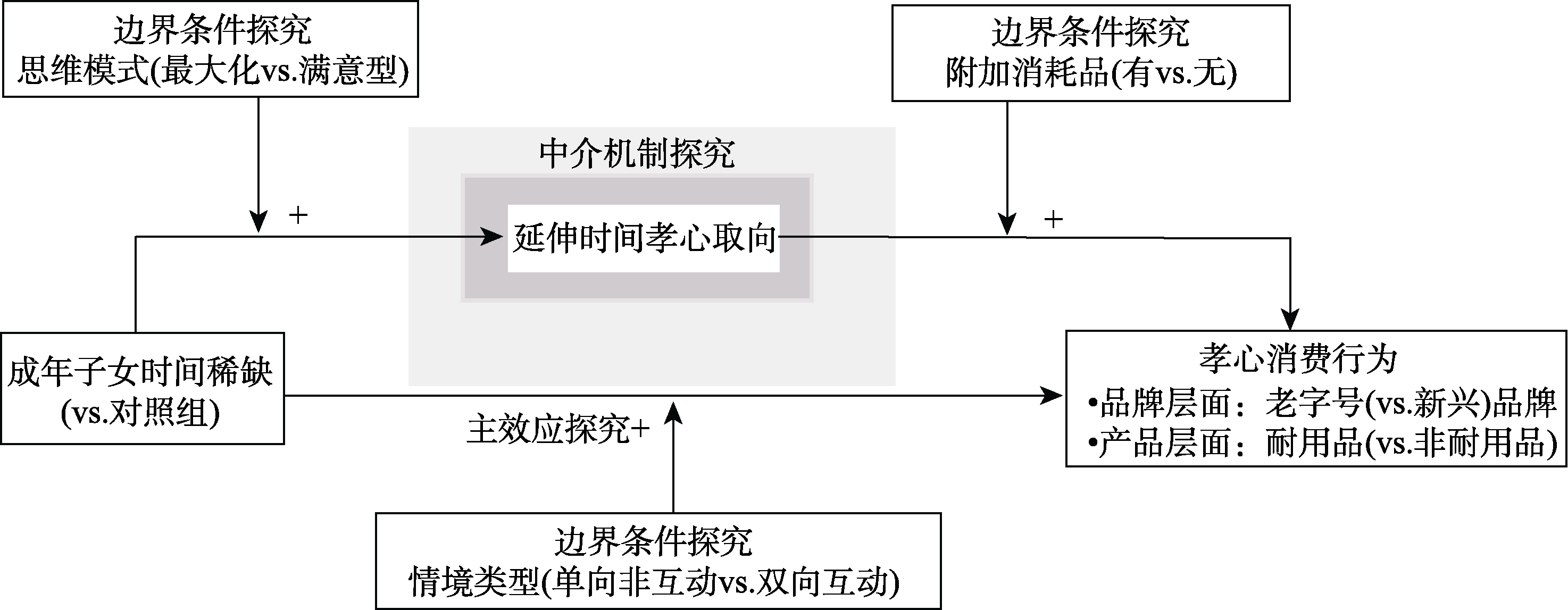
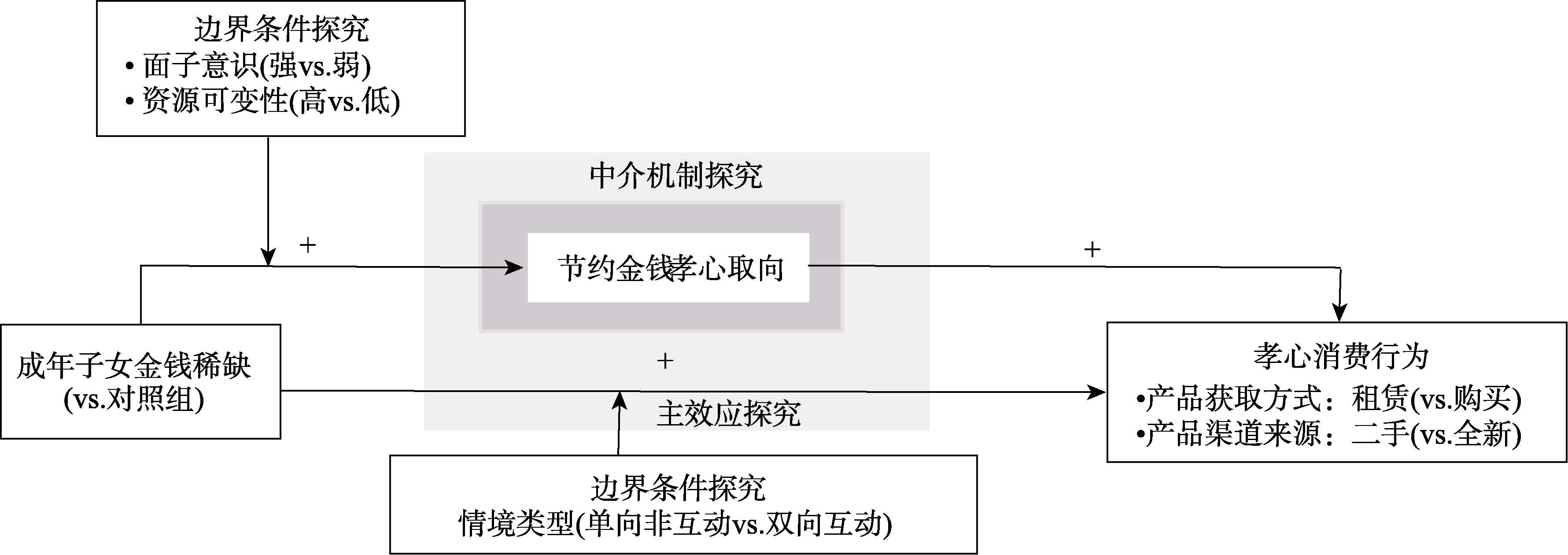
| [1] | 安薪如, 刘楠, 车敬上, 王海侠, 李爱梅. (2021). 资源稀缺对消费行为的双刃剑效应: 研究框架与展望. 外国经济与管理, 43(10), 103-119. |
| [2] | 陈滔, 胡安宁. (2024). 何种孝道可以提升老龄人口福祉?——基于CFPS数据的分析. 人口与发展, 30(2), 39-51. |
| [3] | 樊亚凤, 蒋晶. (2017). 财务约束感对消费者多样化寻求行为的影响及心理机制. 营销科学学报, 13(2), 56-70. |
| [4] | 符国群, 张成虎, 胡家镜. (2020). 基于孝道视角的“子代-亲代”家庭旅游过程分析: 驱动因素, 代际互动和旅游评价. 营销科学学报, 15(2), 1-18. |
| [5] | 国家统计局(编). (2024). 《中华人民共和国2023年国民经济和社会发展统计公报》. https://www.stats.gov.cn/sj/zxfb/202402/t20240228_1947915.html |
| [6] |
郝娜, 崔丽莹. (2022). 补偿他人还是保护自己?内疚与羞耻情绪对合作行为的影响差异. 心理科学进展, 30(7), 1626-1636.
doi: 10.3724/SP.J.1042.2022.01626 |
| [7] | 江光辉, 王颖, 胡浩. (2021). 代际支持视角下成年子女外出与农村留守父母健康关系再审视. 人口与经济, 6, 108-125. |
| [8] | 康娜, 李佳扬, 严燕, 王雪枫, 柳武妹. (2022). 购买还是租赁?调控聚焦视角下消费者产品获取方式的研究综述与展望. 南大商学评论, 3, 183-198. |
| [9] |
雷亮, 王菁煜, 柳武妹. (2020). 稀缺对个体心理和行为的影响: 基于一个更加整合视角下的阐释. 心理科学进展, 28(5), 833-843.
doi: 10.3724/SP.J.1042.2020.00833 |
| [10] |
李西营, 金奕彤, 刘静, 张星宇, 皮忠玲. (2022). 子女越孝顺老年人越幸福吗?老年人孝道期待的作用. 心理学报, 54(11), 1381-1390.
doi: 10.3724/SP.J.1041.2022.01381 |
| [11] | 李志勇, 阎珺琪. (2021). 成年子女支持父母出游的行为机制——基于扎根理论的探索. 旅游学刊, 36(4), 46-57. |
| [12] | 林荫, 符国群, 张丽君. (2023). 中国社会转型背景下子女对父母送礼行为研究——兼论“垂直关系”和“空间距离”对送礼行为的影响. 南开管理评论, 26(6), 140-151. |
| [13] |
孙瑾, 陈晨. (2024). 资源类型对绿色消费的影响: 时间还是金钱更有效? 心理科学进展, 32(1), 39-57.
doi: 10.3724/SP.J.1042.2024.00039 |
| [14] | 孙瑾, 陈晨, 陆娟. (2023). 资源稀缺对消费者绿色产品偏好的影响研究. 外国经济与管理, 45(2), 82-99. |
| [15] |
孙晓敏, 杨舒婷, 孔小杉, 刘臻臻, 马榕梓, 原悦,... 李志航. (2024). 时间贫困内涵及其对幸福感的影响: 稀缺理论视角. 心理科学进展, 32(1), 27-38.
doi: 10.3724/SP.J.1042.2024.00027 |
| [16] | 孙意乔, 高丽, 李树茁. (2019). 农村老年人子女提供日常照料的影响因素研究——基于安徽省农村老年人福利状况调查. 中国农村观察, 1, 81-97. |
| [17] | 孙永健, 陈友华. (2025). 给无价的父母“定价”:老年临终医疗中的经济开支与孝道实践. 广东社会科学, 2, 195-210. |
| [18] | 万岩, 宁天歌, 刘玉茹, 高锦萍. (2021). 二手电商社区对买卖双方交易意愿影响差异研究——社会临场感视角. 北京邮电大学学报(社会科学版), 23(6), 45-54. |
| [19] | 汪凤炎, 郑红. (2015). 中国文化心理学 (第五版). 暨南大学出版社. |
| [20] |
王煜, 李梦菊. (2020). 建设性还是破坏性? 羞愧的双路径模型. 心理科学进展, 28(8), 1325-1336.
doi: 10.3724/SP.J.1042.2020.01325 |
| [21] | 王增文, 张文雅. (2024). 社会行动理论下农村养老秩序的形塑机制与路径选择. 现代经济探讨, 514(10), 104-113. |
| [22] |
魏新东, 张凯丽, 傅绪荣, 汪凤炎. (2023). 荣誉文化与面子文化: 三分框架与本土概念视角下的比较. 心理科学进展, 31(8), 1541-1552.
doi: 10.3724/SP.J.1042.2023.01541 |
| [23] | 肖志文, 周彦青. (2024). 家庭的“断”与“牵”:迁移经历与孝道观念的变迁. 社会学评论, 12(2), 24-43. |
| [24] | 谢云天, 史滋福, 尹霖, 兰洛. (2022). 中国父母教养方式与儿童学业成绩关系的元分析. 心理发展与教育, 38(3), 366-379. |
| [25] |
徐富明, 黄龙, 张慧, 相鹏, 刘腾飞, 李亚红. (2020). 行为贫困陷阱的心理机制与管理对策: 基于认知与动机双视角. 心理科学进展, 28(5), 681-691.
doi: 10.3724/SP.J.1042.2020.00681 |
| [26] |
严燕, 柳武妹, 王雪枫. (2023). 他人和自身着装风格对消费行为的影响: 基于调节定向理论的阐释. 心理科学进展, 31(12), 2419-2440.
doi: 10.3724/SP.J.1042.2023.02419 |
| [27] | 张驰, 施海波, 张崇尚, 吕开宇. (2022). 农村外出子女通讯联系能改善父母精神健康吗. 农业技术经济, 41(1), 97-113. |
| [28] | 张顺, 李诗扬. (2023). 子代社会经济地位与老年父母主观福祉: 代际资源反哺的分析视角. 东南大学学报(哲学社会科学版), 25(4), 106-117+156. |
| [29] | 赵富强, 祝含秋, 陈耘, 王龙栋. (2023). 上司创意拒绝、知识型员工离散情绪与趋避行为——基于情绪认知评价理论视角. 南开管理评论, 26(6), 128-141. |
| [30] |
赵娜, 段羽佳, 张恒星. (2024). 穷大方: 自我建构视角下物质稀缺对慷慨行为的影响. 心理学报, 56(9), 1176-1189.
doi: 10.3724/SP.J.1041.2024.01176 |
| [31] | 钟晓慧, 彭铭刚. (2022). 养老还是养小: 中国家庭照顾赤字下的代际分配. 社会学研究, 37(4), 93-116+228. |
| [32] |
Antonetti P., & Baines P. (2015). Guilt in marketing research: An elicitation-consumption perspective and research agenda. International Journal of Management Reviews, 17(3), 333-355.
doi: 10.1111/ijmr.2015.17.issue-3 URL |
| [33] |
Bartoš V. (2021). Seasonal scarcity and sharing norms. Journal of Economic Behavior & Organization, 185, 303-316.
doi: 10.1016/j.jebo.2021.02.019 URL |
| [34] |
Bolton L. E., & Alba J. W. (2012). When less is more: Consumer aversion to unused utility. Journal of Consumer Psychology, 22(3), 369-383.
doi: 10.1016/j.jcps.2011.09.002 URL |
| [35] |
Bratanova B., Loughnan S., Klein O., Claassen A., & Wood R. (2016). Poverty, inequality, and increased consumption of high calorie food: Experimental evidence for a causal link. Appetite, 100, 162-171.
doi: 10.1016/j.appet.2016.01.028 pmid: 26809142 |
| [36] |
Briers B., & Laporte S. (2013). A wallet full of calories: The effect of financial dissatisfaction on the desire for food energy. Journal of Marketing Research, 50(6), 767-781.
doi: 10.1509/jmr.10.0513 URL |
| [37] |
Budiarto Y., & Helmi A. F. (2021). Shame and self-esteem: A meta-analysis. Europe's Journal of Psychology, 17(2), 131-145.
doi: 10.5964/ejop.2115 pmid: 35136434 |
| [38] |
Cannon C., Goldsmith K., & Roux C. (2019). A self‐regulatory model of resource scarcity. Journal of Consumer Psychology, 29(1), 104-127.
doi: 10.1002/jcpy.2019.29.issue-1 URL |
| [39] |
Cannon C., Goldsmith K., & Roux C. (2024). An integrative theory of resource discrepancies. Journal of Consumer Psychology, 35(1), 81-97.
doi: 10.1002/jcpy.v35.1 URL |
| [40] |
Carvalho L. S., Meier S., & Wang S. W. (2016). Poverty and economic decision-making: Evidence from changes in financial resources at payday. American Economic Review, 106(2), 260-284.
doi: 10.1257/aer.20140481 pmid: 28003681 |
| [41] | Carver, C. S., & Scheier M. F. (2011). Self-regulation of action and affect. In K. D. Vohs, & R. F. Baumeister (Eds.), Handbook of self-regulation: Research, theory, and applications (pp. 3-22). New York, NY: Guilford Press. |
| [42] | Cook L. A., & Sadeghein R. (2018). Effects of perceived scarcity on financial decision making. Journal of Public Policy & Marketing, 37(1), 68-87. |
| [43] |
Dohmen T., Falk A., Fliessbach K., Sunde U., & Weber B. (2011). Relative versus absolute income, joy of winning, and gender: Brain imaging evidence. Journal of Public Economics, 95(3-4), 279-285.
doi: 10.1016/j.jpubeco.2010.11.025 URL |
| [44] |
Durgee J. F., & Colarelli O'Connor G. (1995). An exploration into renting as consumption behavior. Psychology & Marketing, 12(2), 89-104.
doi: 10.1002/mar.v12:2 URL |
| [45] | Evandrou M., Falkingham J., Gomez-Leon M., & Vlachantoni A. (2018). Intergenerational flows of support between parents and adult children in Britain. Ageing & Society, 38(2), 321-351. |
| [46] | Fan B., Song W., Zhang W., & Evans R. (2024). Determinants of online medical decisions for older parents: A discrete choice experiment. SAGE Open, 14(4), 21582440241293115. |
| [47] |
Fernbach P. M., Kan C., & Lynch Jr J. G. (2015). Squeezed: Coping with constraint through efficiency and prioritization. Journal of Consumer Research, 41(5), 1204-1227.
doi: 10.1086/679118 URL |
| [48] |
Flynn F. J., & Schaumberg R. L. (2012). When feeling bad leads to feeling good: Guilt-proneness and affective organizational commitment. Journal of Applied Psychology, 97(1), 124-133.
doi: 10.1037/a0024166 pmid: 21728398 |
| [49] |
George L. K. (2014). Taking time seriously: A call to action in mental health research. Journal of Health and Social Behavior, 55(3), 251-264.
doi: 10.1177/0022146514542434 pmid: 25074048 |
| [50] |
Gersick C. J. (1988). Time and transition in work teams: Toward a new model of group development. Academy of Management Journal, 31(1), 9-41.
doi: 10.2307/256496 URL |
| [51] |
Giroux M., Kim J., Lee J. C., & Park J. (2022). Artificial intelligence and declined guilt: Retailing morality comparison between human and AI. Journal of Business Ethics, 178(4), 1027-1041.
doi: 10.1007/s10551-022-05056-7 |
| [52] |
Gralewski J., & Jankowska D. M. (2020). Do parenting styles matter? Perceived dimensions of parenting styles, creative abilities and creative self-beliefs in adolescents. Thinking Skills and Creativity, 38, 100709.
doi: 10.1016/j.tsc.2020.100709 URL |
| [53] |
Hao S., & Huang L. (2023). How the time-scarcity feature of live-streaming e-commerce affects impulsive buying. The Service Industries Journal, 43(11-12), 875-895.
doi: 10.1080/02642069.2023.2185231 URL |
| [54] |
Hardy C. L., & Van Vugt M. (2006). Nice guys finish first: The competitive altruism hypothesis. Personality and Social Psychology Bulletin, 32(10), 1402-1413.
pmid: 16963610 |
| [55] | Herzenstein, M., & Small D. (2012). Donating in recessionary times: resource scarcity, social distance, and charitable giving. In Z. Gürhan-Canli, C. Otnes, & R. Zhu (Eds.), NA - advances in Consumer Research: vol.40 (pp. 13-17). Association for Consumer Research. |
| [56] |
Hmurovic J., Lamberton C., & Goldsmith K. (2023). Examining the efficacy of time scarcity marketing promotions in online retail. Journal of Marketing Research, 60(2), 299-328.
doi: 10.1177/00222437221118856 URL |
| [57] | Holland J., Silva A. S., & Mace R. (2012). Lost letter measure of variation in altruistic behaviour in 20 neighbourhoods. Plos One, 7(8), e43294. |
| [58] |
Hsieh M. -H., & Yalch R. F. (2020). How a maximizing orientation affects trade-offs between desirability and feasibility: The role of outcome-versus process-focused decision making. Journal of Behavioral Decision Making, 33(1), 39-51.
doi: 10.1002/bdm.v33.1 URL |
| [59] |
Hughes B. T., Ludwig R. M., Robles K. E., & Berkman E. T. (2024). The effect of financial stress on inhibitory control and economic decisions. Journal of Experimental Social Psychology, 113, 104621.
doi: 10.1016/j.jesp.2024.104621 URL |
| [60] |
Huijsmans I., Ma I., Micheli L., Civai C., Stallen M., & Sanfey A. G. (2019). A scarcity mindset alters neural processing underlying consumer decision making. Proceedings of the National Academy of Sciences, 116(24), 11699-11704.
doi: 10.1073/pnas.1818572116 URL |
| [61] |
Jiang X., Zhang N., Sun X., Liu Z., & Wang Y. L. (2024). Being pressed for time leads to treating others as things: Exploring the relationships among time scarcity, agentic and communal orientation and objectification. British Journal of Social Psychology, 63, 1318-1338.
doi: 10.1111/bjso.12729 pmid: 38317579 |
| [62] |
Karau S. J., & Kelly J. R. (1992). The effects of time scarcity and time abundance on group performance quality and interaction process. Journal of Experimental Social Psychology, 28(6), 542-571.
doi: 10.1016/0022-1031(92)90045-L URL |
| [63] |
Kelly J. R., & Loving T. J. (2004). Time pressure and group performance: Exploring underlying processes in the attentional focus model. Journal of Experimental Social Psychology, 40(2), 185-198.
doi: 10.1016/S0022-1031(03)00094-5 URL |
| [64] | Koay K. Y., Cheah C. W., & Lom H. S. (2022). An integrated model of consumers' intention to buy second- hand clothing. International Journal of Retail & Distribution Management, 50(11), 1358-1377. |
| [65] |
Kraus M. W., Piff P. K., Mendoza-Denton R., Rheinschmidt M. L., & Keltner D. (2012). Social class, solipsism, and contextualism: How the rich are different from the poor. Psychological Review, 119(3), 546-572.
doi: 10.1037/a0028756 pmid: 22775498 |
| [66] |
Laidlaw K., Wang D., Coelho C., & Power M. (2010). Attitudes to ageing and expectations for filial piety across Chinese and British cultures: A pilot exploratory evaluation. Aging & Mental Health, 14(3), 283-292.
doi: 10.1080/13607860903483060 URL |
| [67] | Layard R. (2005). Rethinking public economics: The implications of rivalry and habit. Economics and Happiness, 1(1), 147-169. |
| [68] |
Lee G. R., Netzer J. K., & Coward R. T. (1995). Depression among older parents: The role of intergenerational exchange. Journal of Marriage and the Family, 57(3), 823-833.
doi: 10.2307/353935 URL |
| [69] | Lee S. H., & Workman J. (2020). How do face consciousness and public self-consciousness affect consumer decision- making?. Journal of Open Innovation: Technology, Market, and Complexity, 6(4), 144. |
| [70] | Lee S. Y., & Jung S. (2021). Scarcity in time as inconvenience: The role of dispositional reactance in product evaluation. Social Behavior and Personality: An international journal, 49(4), 1-8. |
| [71] |
Levine R. V., Norenzayan A., & Philbrick K. (2001). Cross-cultural differences in helping strangers. Journal of Cross-Cultural Psychology, 32(5), 543-560.
doi: 10.1177/0022022101032005002 URL |
| [72] |
Li X., & Hsee C. K. (2021). The psychology of marginal utility. Journal of Consumer Research, 48(1), 169-188.
doi: 10.1093/jcr/ucaa064 URL |
| [73] |
Li Z., Guan X., & Mei W. (2023). Coupon promotion and its cross-channel effect in omnichannel retailing industry: A time-sensitive strategy. International Journal of Production Economics, 258, 108778.
doi: 10.1016/j.ijpe.2023.108778 URL |
| [74] |
Liu X., Liu C., Zhao Q., & Sun H. (2024). Effect of intergenerational relationships in daily life on travel behaviors of adult children and parents: A comparative study of the two generations’ perspectives. Journal of Hospitality and Tourism Management, 60, 405-415.
doi: 10.1016/j.jhtm.2024.09.003 URL |
| [75] |
Malika M., Ghoshal T., Mathur P., & Maheswaran D. (2024). Does scarcity increase or decrease donation behaviors? An investigation considering resource-specific scarcity and individual person-thing orientation. Journal of the Academy of Marketing Science, 52(2), 426-448.
doi: 10.1007/s11747-023-00938-2 |
| [76] |
Mani A., Mullainathan S., Shafir E., & Zhao J. (2013). Poverty impedes cognitive function. Science, 341(6149), 976-980.
doi: 10.1126/science.1238041 pmid: 23990553 |
| [77] | Mauss I. B., & Tamir M. (2014). Emotion goals: How their content, structure, and operation shape emotion regulation. In J. J. Gross (Ed.), The handbook of emotion regulation (2nd ed., pp. 361-375). New York: Guilford Press. |
| [78] |
Mehta R., & Zhu M. (2016). Creating when you have less: The impact of resource scarcity on product use creativity. Journal of Consumer Research, 42(5), 767-782.
doi: 10.1093/jcr/ucv051 URL |
| [79] |
Miller G. A. (1956). The magical number seven, plus or minus two: Some limits on our capacity for processing information. Psychological Review, 63(2), 81-97.
doi: 10.1037/h0043158 URL |
| [80] |
Mogilner C., & Aaker J. (2009). “The time vs. money effect”: Shifting product attitudes and decisions through personal connection. Journal of Consumer Research, 36(2), 277-291.
doi: 10.1086/597161 URL |
| [81] | Mullainathan S., & Shafir E. (2013). Decision making and policy in contexts of poverty. Behavioral Foundations of Public Policy, 16, 281-300. |
| [82] |
Netemeyer R. G., Warmath D., Fernandes D., & Lynch Jr J. G. (2018). How am I doing? Perceived financial well-being, its potential antecedents, and its relation to overall well-being. Journal of Consumer Research, 45(1), 68-89.
doi: 10.1093/jcr/ucx109 URL |
| [83] |
Oi W. Y. (1971). A Disneyland dilemma: Two-part tariffs for a Mickey Mouse monopoly. The Quarterly Journal of Economics, 85(1), 77-96.
doi: 10.2307/1881841 URL |
| [84] |
Page E. J., Massey A. S., Prado-Romero P. N., & Albadawi S. (2020). The use of self-monitoring and technology to increase physical activity: A review of the literature. Perspectives on Behavior Science, 43(3), 501-514.
doi: 10.1007/s40614-020-00260-0 pmid: 33029577 |
| [85] |
Paley A., Tully S. M., & Sharma E. (2019). Too constrained to converse: The effect of financial constraints on word of mouth. Journal of Consumer Research, 45(5), 889-905.
doi: 10.1093/jcr/ucy040 |
| [86] |
Park H., Lalwani A. K., & Silvera D. H. (2020). The impact of resource scarcity on price-quality judgments. Journal of Consumer Research, 46(6), 1110-1124.
doi: 10.1093/jcr/ucz031 URL |
| [87] | Park J., Kim C., & Park S. (2025). Limited money = Low status? Interactive effects of financial constraints and power distance belief on subjective social status and purchase types. International Journal of Consumer Studies, 49(3), e70074. |
| [88] |
Ran Y., Zhang P., & Xiang L. (2025). Choosing the best together: Joint consumption promotes consumers' maximizing mindset. Psychology & Marketing, 42(8), 1979-1992.
doi: 10.1002/mar.v42.8 URL |
| [89] |
Rifkin J. R., Wight K. G., & Cutright K. M. (2023). No bandwidth to self-gift: How feeling constrained discourages self-gifting. Journal of Consumer Research, 50(2), 343-362.
doi: 10.1093/jcr/ucac053 URL |
| [90] |
Salerno A., & Escoe B. (2020). Resource scarcity increases the value of pride. Journal of the Association for Consumer Research, 5(4), 458-469.
doi: 10.1086/709891 URL |
| [91] | Sennett R. (2008). The craftsman. New Haven, CT: Yale University Press. |
| [92] |
Shah A. K., Mullainathan S., & Shafir E. (2012). Some consequences of having too little. Science, 338(6107), 682-685.
doi: 10.1126/science.1222426 pmid: 23118192 |
| [93] |
Shah A. K., Zhao J., Mullainathan S., & Shafir E. (2018). Money in the mental lives of the poor. Social Cognition, 36(1), 4-19.
doi: 10.1521/soco.2018.36.1.4 URL |
| [94] |
Sharma E., & Alter A. L. (2012). Financial deprivation prompts consumers to seek scarce goods. Journal of Consumer research, 39(3), 545-560.
doi: 10.1086/664038 URL |
| [95] |
Sharma E., Tully S. M., & Wang X. (2023). Scarcity and intertemporal choice. Journal of Personality and Social Psychology, 125(5), 1036-1054.
doi: 10.1037/pspa0000353 pmid: 37707481 |
| [96] |
Shi J., & Wang F. (2019). Three-Dimensional Filial Piety Scale: Development and validation of filial piety among Chinese working adults. Frontiers in Psychology, 10, 2040-2040.
doi: 10.3389/fpsyg.2019.02040 pmid: 31551879 |
| [97] | So J., Yi Y., & Agrawal N. (2024). The hidden power of shame: How feeling ashamed enhances advertisement recall and positive attitude. International Journal of Advertising: The Review of Marketing Communications, 43(5), 777-797. |
| [98] |
Sun J. J., Bellezza S., & Paharia N. (2021). Buy less, buy luxury: Understanding and overcoming product durability neglect for sustainable consumption. Journal of Marketing, 85(3), 28-43.
doi: 10.1177/0022242921993172 URL |
| [99] |
Sun Y. J., & Chen Y. H. (2024). Purchasing piety: Money and filial piety in Chinese family care for the elderly. China: An International Journal, 22(2), 10-28.
doi: 10.56159/chn.2024.a929581 URL |
| [100] | Tangney, J. P., & Dearing R. L. (2002). Gender differences in morality. In R. F. Bornstein & J. M. Masling (Eds.), The psychodynamics of gender and gender role (pp. 251-269). American Psychological Association. |
| [101] |
Thomas K. W., & Pondy L. R. (1977). Toward an" intent" model of conflict management among principal parties. Human Relations, 30(12), 1089-1102.
doi: 10.1177/001872677703001203 URL |
| [102] |
Tully S. M., Hershfield H. E., & Meyvis T. (2015). Seeking lasting enjoyment with limited money: Financial constraints increase preference for material goods over experiences. Journal of Consumer Research, 42 (1), 59-75.
doi: 10.1093/jcr/ucv007 URL |
| [103] |
Venn D., & Strazdins L. (2017). Your money or your time? How both types of scarcity matter to physical activity and healthy eating. Social Science & Medicine, 172, 98-106.
doi: 10.1016/j.socscimed.2016.10.023 URL |
| [104] | Wang L., & Sang B. (2020). The effect of self-regulation of shame on teenagers’ aggression. Studia Psychologica, 62(1), 58-73. |
| [105] |
Wang W., Yi L., Wu M. Y., Pearce P. L., & Huang S. S. (2018). Examining Chinese adult children’s motivations for traveling with their parents. Tourism Management, 69, 422-433.
doi: 10.1016/j.tourman.2018.06.024 URL |
| [106] |
Wang W., Yi Y., Li J., Sun G., & Zhang M. (2022). Lighting up the dark: how the scarcity of childhood resources leads to preferences for bright stimuli. Journal of Business Research, 139, 1155-1164.
doi: 10.1016/j.jbusres.2021.10.058 URL |
| [107] | Wang X. (2021). The Impact of Resources on Consumers’ Behaviors [Unpublished doctorial dissertation]. The Chinese University of Hong Kong. |
| [108] |
Weiner B. (1985). An attributional theory of achievement motivation and emotion. Psychological Review, 92(4), 548-573.
pmid: 3903815 |
| [109] |
Whillans A. V., Dunn E. W., Smeets P., Bekkers R., & Norton M. I. (2017). Buying time promotes happiness. Proceedings of the National Academy of Sciences of the United States of America, 114(32), 8523-8527.
doi: 10.1073/pnas.1706541114 pmid: 28739889 |
| [110] |
Wietzker A., Buysse A., Loeys T., & Brondeel R. (2012). Easing the conscience: Feeling guilty makes people cooperate in divorce negotiations. Journal of Social and Personal Relationships, 29(3), 324-336.
doi: 10.1177/0265407511431180 URL |
| [111] | Wu Q., Zhu H., Zhang R., Li C., Xiao Q., Jin Y.,... Dong X. (2025). Closer adult child-parent relations the stronger the vaccine hesitancy: A cross-sectional study of adult Children’s attitudes toward pneumococcal vaccination of elderly parents and its determinants in Guangzhou, China. Human Vaccines & Immunotherapeutic, 21(1), 2440959. |
| [112] |
Yaffe Y. (2023). Systematic review of the differences between mothers and fathers in parenting styles and practices. Current psychology, 42(19), 16011-16024.
doi: 10.1007/s12144-020-01014-6 |
| [113] |
Yang H., & Zhang K. (2022). How resource scarcity influences the preference for counter hedonic consumption. Journal of Consumer Research, 48(5), 904-919.
doi: 10.1093/jcr/ucab024 URL |
| [114] |
Zeng C., Wu Q., Bi C., & Qi H. (2024). Scarcity makes people short-sighted? Evidence from intertemporal decision-making. PsyCh Journal, 13(3), 429-439.
doi: 10.1002/pchj.714 |
| [115] |
Zhang R., Ma Q., & Guan D. (2023). The impact of financial scarcity on green consumption: Sequential mediating effects of anxiety and self-efficacy. Psychology & Marketing, 40(6), 1162-1178.
doi: 10.1002/mar.v40.6 URL |
| [116] | Zhao, J., & Tomm B. M. (2018). Psychological responses to scarcity. In N. Ntoumanis, C. Thørgersen-Ntoumani, E. Quested, & N. Chatzisarantis (Eds.), Oxford research encyclopedia of psychology (pp. 1-21). Oxford University Press. |
| [117] |
Zhu M., Bagchi R., & Hock S. J. (2019). The mere deadline effect: Why more time might sabotage goal pursuit. Journal of Consumer Research, 45(5), 1068-1084.
doi: 10.1093/jcr/ucy030 |
| [118] | Zhu M., Yang Y., & Hsee C. K. (2018). The mere urgency effect. Journal of Consumer Research, 45(3), 673-690. |
| [1] | HONG Aoran, FENG Ziyu, WANG Yonggui. The influence of optimal distinctiveness of multi-modal sponsored content on influencer marketing effectiveness based on generative AI [J]. Advances in Psychological Science, 2026, 34(5): 836-855. |
| [2] | ZHONG Ke, WANG Zhenbang, YANG Linyun, LI Peimei. Exploring the behavioral intention-outcome inconsistency effect in consumers’ pro-environmental behavior [J]. Advances in Psychological Science, 2026, 34(4): 647-665. |
| [3] | PEI Guanxiong, DONG Bo, JIN Jia, MENG Liang, ZHANG Jialin. Dynamic processing of conversational intelligence features in marketing digital humans and its neural mechanisms [J]. Advances in Psychological Science, 2026, 34(2): 227-238. |
| [4] | HOU Min, ZHANG Peizhen, LI Zhiwen, GU Chunmei, LI Fangzhou. The communication effects of counter-stereotypical advertising: Antecedents, mechanisms, and outcomes [J]. Advances in Psychological Science, 2026, 34(1): 157-174. |
| [5] | XIAO Tingwen, CHEN Feilong, GUAN Biyu. “Letting bygones be bygones” or “holding bygones”: The effect of brand transgression and its psychological mechanisms [J]. Advances in Psychological Science, 2026, 34(1): 175-190. |
| [6] | LU Junyang, DENG Aimin, WEI Junfeng, LONG Qianying. How to turn tourists into long-term visitors? A process-based study on tourist ritual perception and its functioning mechanism [J]. Advances in Psychological Science, 2025, 33(12): 2054-2068. |
| [7] | WANG Yan, JIANG Jing. The impact of minimalist design on sustainable consumption behavior [J]. Advances in Psychological Science, 2025, 33(9): 1541-1557. |
| [8] | LING Bin, LIU Yingkai. Dialect stereotypes in advertising: Effects and theoretical mechanism [J]. Advances in Psychological Science, 2025, 33(8): 1408-1424. |
| [9] | LI Yan, CHEN Wei, WU Ruijuan. Marketing effect of virtual influencers and its mechanisms in the context of AI technology [J]. Advances in Psychological Science, 2025, 33(8): 1425-1442. |
| [10] | DAI Jiatong, YANG Lu. The effect and mechanism of information nudging strategies on reducing food waste behavior among consumers: A research proposal [J]. Advances in Psychological Science, 2025, 33(7): 1155-1169. |
| [11] | DENG Nianqi, TANG Yifan, FAN Xiucheng, JIANG Xinyu. Effects of embodiment on digital empathy in virtual reality-enabled servicescape [J]. Advances in Psychological Science, 2025, 33(7): 1140-1154. |
| [12] | REN Xingyao, WU Huichao, CHEN Feiyan, XU Huanyu, Zhang Wenjing. How can humans and machines collaborate? Investigating the value-creating mechanisms of intelligent data analysis for multiple parties in sales contexts [J]. Advances in Psychological Science, 2025, 33(6): 984-1005. |
| [13] | QIN Huanyu, LIU Zhancheng, XIE Zhipeng, LV Linxiang. Handmade effect on marketing [J]. Advances in Psychological Science, 2025, 33(2): 362-380. |
| [14] | CHAI Minquan, LIU Kexin, JIN Fei. More moral or more social: The self-construction mechanism of green consumption [J]. Advances in Psychological Science, 2024, 32(10): 1726-1735. |
| [15] | CHEN Siyun, XU Huiqi, LI Shiying, NIU Xiaoman, XU Liying. Can frugality nurture virtue? The dual-edged sword effect of frugality on prosocial behavior and its theoretical interpretations [J]. Advances in Psychological Science, 2024, 32(10): 1680-1696. |
| Viewed | ||||||
|
Full text |
|
|||||
|
Abstract |
|
|||||
