

ISSN 1671-3710
CN 11-4766/R
主办:中国科学院心理研究所
出版:科学出版社
CN 11-4766/R
主办:中国科学院心理研究所
出版:科学出版社
心理科学进展 ›› 2026, Vol. 34 ›› Issue (4): 597-607.doi: 10.3724/SP.J.1042.2026.0597 cstr: 32111.14.2026.0597
陈曦梅1,2( ), 李为1, 陈红1,2,3
收稿日期:2025-09-05
出版日期:2026-04-15
发布日期:2026-03-02
通讯作者:
陈曦梅, E-mail: ximeichen@swu.edu.cn基金资助:
CHEN Ximei1,2(), LI Wei1, CHEN Hong1,2,3
Received:2025-09-05
Online:2026-04-15
Published:2026-03-02
摘要:
近30年来我国饮食失调群体数量陡增, 增长率居世界前列, 成为全球因饮食失调死亡人数最高的国家。经济快速发展、社媒广泛传播以及干预效果欠佳共同加剧了中国的饮食失调问题。如何控制饮食失调的发生成为严峻而现实的问题。本研究拟以大脑奖赏系统和抑制控制系统的交互作用为突破口, 基于“结构特征刻画−加工机制解析−预测因子锚定”的递进式研究框架, 开展三个研究。首先, 使用新颖的多特征形态相似性网络分析技术, 探究暴食样饮食失调奖赏与抑制控制网络的结构协变基础; 其次, 采用新编食物奖赏反应抑制双范式, 考察食物奖赏线索对暴食样饮食失调者抑制控制的影响机制; 最后, 采用前瞻性队列设计, 探查能有效预测暴食样饮食失调发生的关键神经指标。本研究力图探明暴食样饮食失调从健康到不健康的动态范围, 并构建症状发生到疾病发展的神经阶段模型, 为饮食失调的精准识别、早期预防及干预治疗提供科学依据, 具有现实性、前沿性和前瞻性。
中图分类号:
陈曦梅, 李为, 陈红. (2026). 基于奖赏−抑制双系统模型饮食失调的神经机制. 心理科学进展 , 34(4), 597-607.
CHEN Ximei, LI Wei, CHEN Hong. (2026). Elucidating the neural mechanisms of eating disorders through the lens of the reward-inhibition dual-system model. Advances in Psychological Science, 34(4), 597-607.
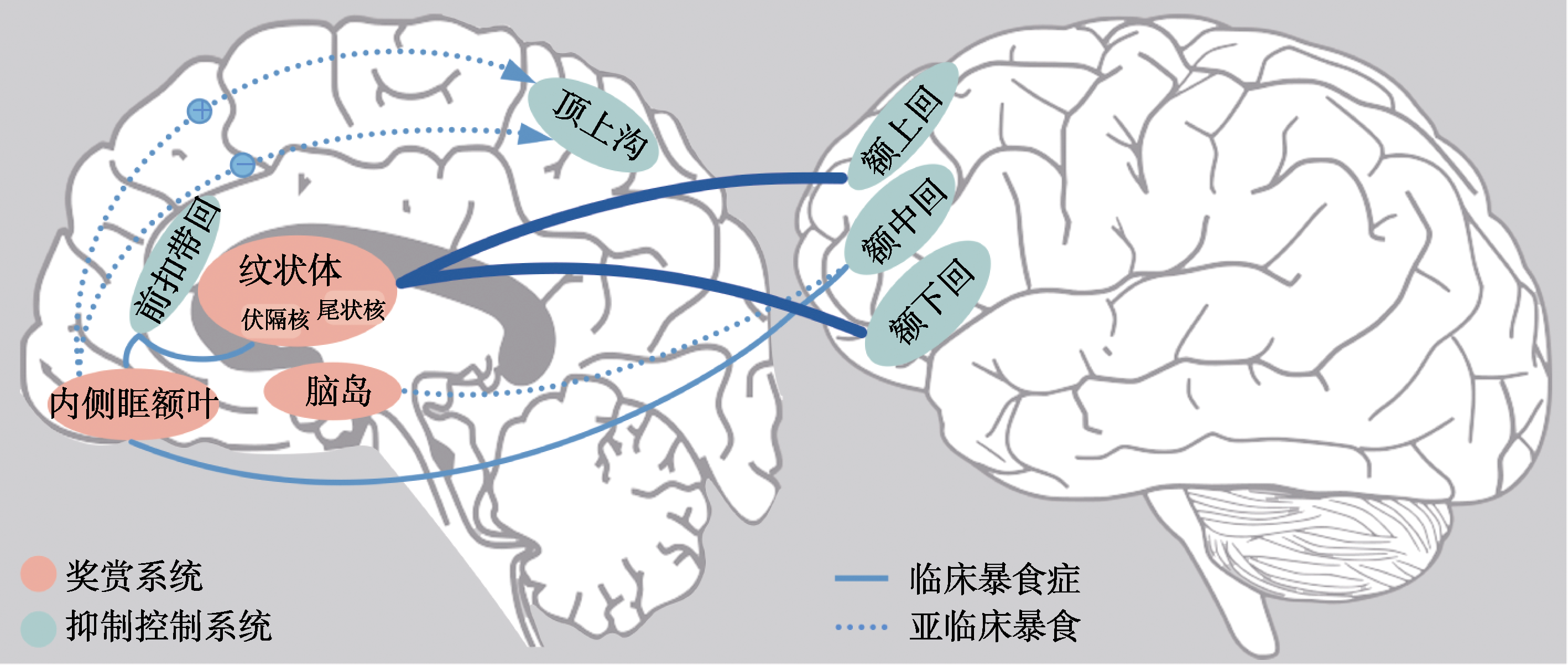
图1 暴食的奖赏与抑制双系统神经模型 注:彩图见电子版; 来源:Chen et al., 2025
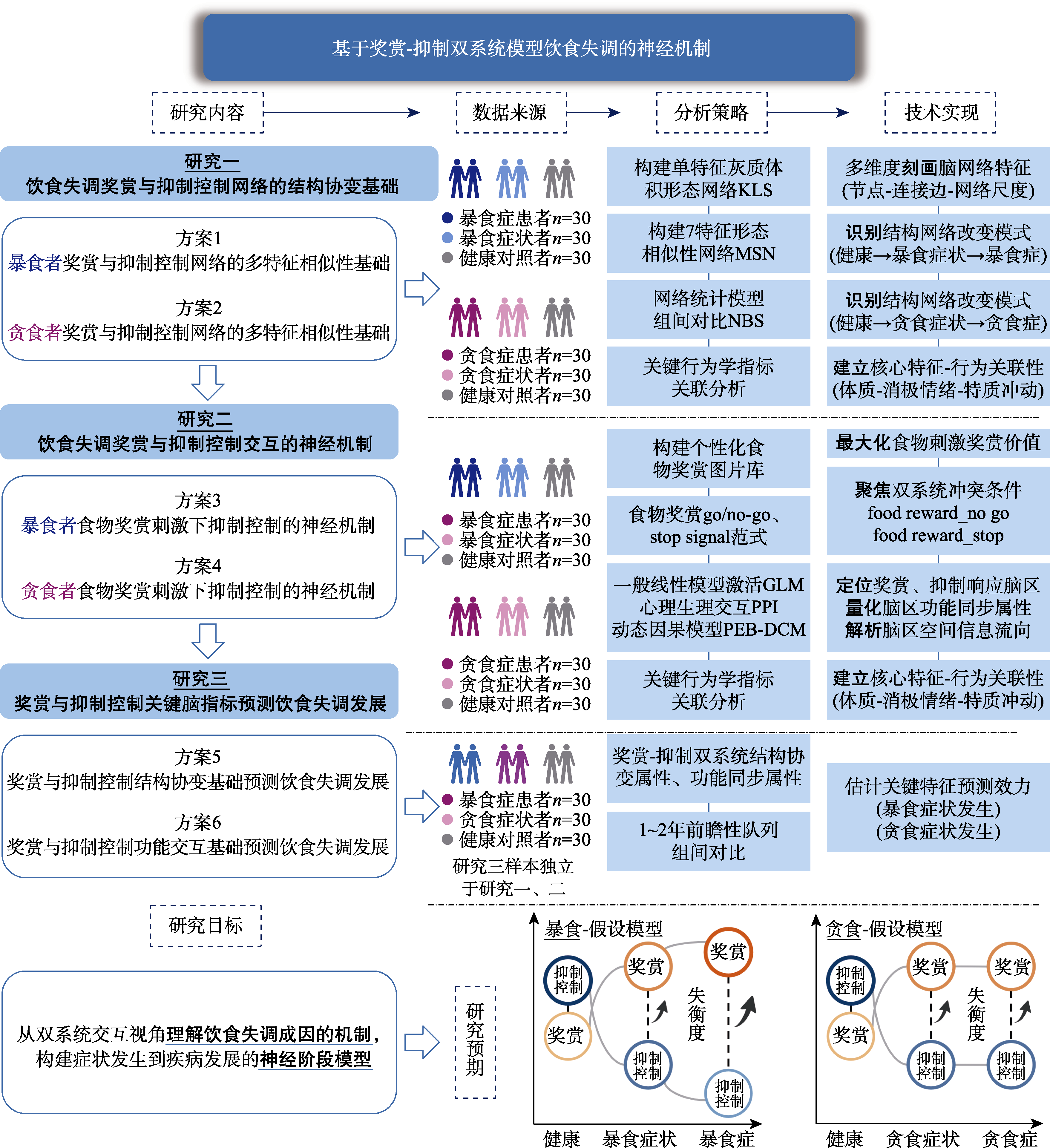
图2 研究框架
| [1] | Abdo, N., Boyd, E., Baboumian, S., Pantazatos, S. P., & Geliebter, A. (2020). Relationship between binge eating and associated eating behaviors with subcortical brain volumes and cortical thickness. Journal of Affective Disorders, 274, 1201-1205. https://doi.org/10.1016/j.jad.2019.10.032 |
| [2] |
Bartholdy, S., O'Daly, O. G., Campbell, I. C., Banaschewski, T., Barker, G., Bokde, A.,... IMAGEN, Consortium. (2019). Neural correlates of failed inhibitory control as an early marker of disordered eating in adolescents. Biological Psychiatry, 85(11), 956-965. https://doi.org/10.1016/j.biopsych.2019.01.027
pmid: 31122340 |
| [3] |
Berner, L. A., Wang, Z., Stefan, M., Lee, S., Huo, Z., Cyr, M., & Marsh, R. (2019). Subcortical shape abnormalities in bulimia nervosa. Biological Psychiatry: Cognitive Neuroscience and Neuroimaging, 4(12), 1070-1079. https://doi.org/10.1016/j.bpsc.2018.12.011
pmid: 30846367 |
| [4] | Berner, L. A., Winter, S. R., Ayaz, H., Shewokis, P. A., Izzetoglu, M., Marsh, R.,... Lowe, M. R. (2023). Altered prefrontal activation during the inhibition of eating responses in women with bulimia nervosa. Psychological Medicine, 53(8), 3580-3590. https://doi.org/10.1017/S0033291722000198 |
| [5] |
Brooks, S. J., Rask-Andersen, M., Benedict, C., & Schiöth, H. B. (2012). A debate on current eating disorder diagnoses in light of neurobiological findings: Is it time for a spectrum model?. BMC Psychiatry, 12, 76. https://doi.org/10.1186/1471-244X-12-76
pmid: 22770364 |
| [6] | Bryson, C., Douglas, D., & Schmidt, U. (2024). Established and emerging treatments for eating disorders. Trends in Molecular Medicine, 30(4), 392-402. https://doi.org/10.1016/j.molmed.2024.02.009 |
| [7] | Chang, P. G. R. Y., Delgadillo, J., & Waller, G. (2021). Early response to psychological treatment for eating disorders: A systematic review and meta-analysis. Clinical Psychology Review, 86, 102032. https://doi.org/10.1016/j.cpr.2021.102032 |
| [8] | Chen, X., Dong, D., Zhou, F., Gao, X., Liu, Y., Wang, J.,... Chen, H. (2022a). Connectome-based prediction of eating disorder-associated symptomatology. Psychological Medicine, 53(12), 5786-5799. https://doi.org/10.1017/S0033291722003026 |
| [9] | Chen, X., Gao, X., Qin, J., Wang, C., Xiao, M., Tian, Y.,... Chen, H. (2021). Resting-state functional network connectivity underlying eating disorder symptoms in healthy young adults. NeuroImage: Clinical, 30, 102671. https://doi.org/10.1016/j.nicl.2021.102671 |
| [10] | Chen, X., Li, W., Liu, Y., Xiao, M., & Chen, H. (2023). Altered effective connectivity between reward and inhibitory control networks in people with binge eating episodes: A spectral dynamic causal modeling study. Appetite, 188, 106763. https://doi.org/10.1016/j.appet.2023.106763 |
| [11] | Chen, X., Li, W., Luo, Y., Liu, Y., Xu, X., Gao, X., & Chen, H. (2025). Functional and effective connectivity between reward and inhibitory control networks underlying subclinical binge eating. The British Journal of Psychiatry, 227(1), 442-455. https://doi.org/10.1192/bjp.2024.212 |
| [12] | Chen, X., Li, W., Qin, J., Gao, X., Liu, Y., Song, S.,... Chen, H. (2022b). Gray matter volume and functional connectivity underlying binge eating in healthy children. Eating and Weight Disorders, 27(8), 3469-3478. https://doi.org/10.1007/s40519-022-01483-7 |
| [13] |
Crone, E. A., & Dahl, R. E. (2012). Understanding adolescence as a period of social-affective engagement and goal flexibility. Nature Reviews Neuroscience, 13(9), 636-650. https://doi.org/10.1038/nrn3313
pmid: 22903221 |
| [14] | Derks, I. P. M., Nas, Z., Harris, H. A., Kininmonth, A. R., Treasure, J., Jansen, P. W., & Llewellyn, C. H. (2024). Early childhood appetitive traits and eating disorder symptoms in adolescence: A 10-year longitudinal follow-up study in the Netherlands and the UK. The Lancet Child & Adolescent Health, 8(4), 270-279. https://doi.org/10.1016/S2352-4642(23)00342-5 |
| [15] |
Ehrlich, S., King, J. A., & Boehm, I. (2019). Editorial: To Eat or Not to Eat: Advancing the neuroscience of hedonic versus controlled eating across weight and eating disorders. Journal of the American Academy of Child and Adolescent Psychiatry, 58(2), 151-153. https://doi.org/10.1016/j.jaac.2018.07.902
pmid: 30738539 |
| [16] | Foerde, K., Schebendach, J. E., Davis, L., Daw, N., Walsh, B. T., Shohamy, D., & Steinglass, J. E. (2022). Restrictive eating across a spectrum from healthy to unhealthy: Behavioral and neural mechanisms. Psychological Medicine, 52(9), 1755-1764. https://doi.org/10.1017/S0033291720003542 |
| [17] |
Frank, G. K. W., Shott, M. E., Stoddard, J., Swindle, S., & Pryor, T. L. (2021). Association of brain reward response with body mass index and ventral striatal-hypothalamic circuitry among young women with eating disorders. JAMA Psychiatry, 78(10), 1123-1133. https://doi.org/10.1001/jamapsychiatry.2021.1580
pmid: 34190963 |
| [18] |
Giel, K. E., Bulik, C. M., Fernandez-Aranda, F., Hay, P., Keski-Rahkonen, A., Schag, K.,... Zipfel, S. (2022). Binge eating disorder. Nature Reviews Disease Primers, 8(1), 16. https://doi.org/10.1038/s41572-022-00344-y
pmid: 35301358 |
| [19] | Global Burden of Disease. (2021). Institute for Health Metrics and Evaluation (IHME). GBD Results. Available from https://vizhub.healthdata.org/gbd-results/ |
| [20] |
Grilo, C. M. (2024). Treatment of eating disorders: Current status, challenges, and future directions. Annual Review of Clinical Psychology, 20(1), 97-123. https://doi.org/10.1146/annurev-clinpsy-080822-043256
pmid: 38211625 |
| [21] |
Hagan, K. E., & Bohon, C. (2021). Subcortical brain volume and cortical thickness in adolescent girls and women with binge eating. The International Journal of Eating Disorders, 54(8), 1527-1536. https://doi.org/10.1002/eat.23563
pmid: 34061404 |
| [22] | Lee, J. E., Kim, S., Park, S., Choi, H., Park, B. Y., & Park, H. (2025). Atypical maturation of the functional connectome hierarchy in autism. Molecular Autism, 16(1), 21. https://doi.org/10.1186/s13229-025-00641-9 |
| [23] | Li, W., Chen, X., Luo, Y., Luo, L., & Chen, H. (2022). Orbitofrontal neural dissociation of healthy and unhealthy food reward sensitivity in normal-weight binge eaters. Psychiatry Research, 316, 114736. https://doi.org/10.1016/j.psychres.2022.114736 |
| [24] | Li, W., Chen, X., Luo, Y., Xiao, M., Liu, Y., & Chen, H. (2024a). Altered connectivity patterns of medial and lateral orbitofrontal cortex underlie the severity of bulimic symptoms. International Journal of Clinical and Health Psychology, 24(1), 100439. https://doi.org/10.1016/j.ijchp.2024.100439 |
| [25] | Li, W., Wang, Y., Wang, J., Wang, M., Liu, J., Chen, Q.,... Tang, L. (2024b). Bulimia nervosa selectively reshapes the structure and intrinsic function of anterior insula subregions associated with cognition-emotion integration. Journal of Affective Disorders, 362, 529-535. https://doi.org/10.1016/j.jad.2024.07.051 |
| [26] | Lowe, C. J., & Bodell, L. P. (2024). Examining neural responses to anticipating or receiving monetary rewards and the development of binge eating in youth. A registered report using data from the Adolescent Brain Cognitive Development (ABCD) study. Developmental Cognitive Neuroscience, 67, 101377. https://doi.org/10.1016/j.dcn.2024.101377 |
| [27] | Lowe, C. J., Morton, J. B., & Reichelt, A. C. (2020). Adolescent obesity and dietary decision making-a brain-health perspective. The Lancet Child & Adolescent Health, 4(5), 388-396. https://doi.org/10.1016/S2352-4642(19)30404-3 |
| [28] | Luo, Y., Pluta, D., Brodrick, B. B., Palka, J. M., McCoy, J., Lohrenz, T.,... McAdams, C. J. (2024). Diminished adaptation, satisfaction, and neural responses to advantageous social signals in anorexia nervosa and bulimia nervosa. Biological Psychiatry: Cognitive Neuroscience and Neuroimaging, 9(3), 305-313. https://doi.org/10.1016/j.bpsc.2023.10.010 |
| [29] | Murray, S. B., Alba, C., Duval, C. J., Nagata, J. M., Cabeen, R. P., Lee, D. J.,... Jann, K. (2022). Aberrant functional connectivity between reward and inhibitory control networks in pre-adolescent binge eating disorder. Psychological Medicine, 53(9), 3869-3878. https://doi.org/10.1017/S0033291722000514 |
| [30] | Murray, S. B., Alba, C., Duval, C. J., Nagata, J. M., Ganson, K. T., & Jann, K. (2023). Sex differences in functional connectivity from reward-based regions in pre-adolescent binge eating disorder. Psychiatry Research, 324, 115186. https://doi.org/10.1016/j.psychres.2023.115186 |
| [31] |
Murray, S. B., Zhang, R., Duval, C. J., Nagata, J. M., & Jann, K. (2024). Task-evoked neural activity during reward anticipation and inhibitory control in preadolescent binge eating disorder. The Journal of Adolescent Health, 74(5), 958-963. https://doi.org/10.1016/j.jadohealth.2023.12.021
pmid: 38340122 |
| [32] |
Oliva, R., Morys, F., Horstmann, A., Castiello, U., & Begliomini, C. (2019). The impulsive brain: Neural underpinnings of binge eating behavior in normal-weight adults. Appetite, 136, 33-49. https://doi.org/10.1016/j.appet.2018.12.043
pmid: 30615922 |
| [33] |
Oliva, R., Morys, F., Horstmann, A., Castiello, U., & Begliomini, C. (2020). Characterizing impulsivity and resting-state functional connectivity in normal-weight binge eaters. The International Journal of Eating Disorders, 53(3), 478-488. https://doi.org/10.1002/eat.23212
pmid: 31868249 |
| [34] |
Reichelt, A. C. (2016). Adolescent maturational transitions in the prefrontal cortex and dopamine signaling as a risk factor for the development of obesity and high fat/high sugar diet induced cognitive deficits. Frontiers in Behavioral Neuroscience, 10, 189. https://doi.org/10.3389/fnbeh.2016.00189
pmid: 27790098 |
| [35] | Santomauro, D. F., Melen, S., Mitchison, D., Vos, T., Whiteford, H., & Ferrari, A. J. (2021). The hidden burden of eating disorders: An extension of estimates from the Global Burden of Disease Study 2019. The Lancet Psychiatry, 8(4), 320-328. https://doi.org/10.1016/S2215-0366(21)00040-7 |
| [36] |
Sebenius, I., Dorfschmidt, L., Seidlitz, J., Alexander-Bloch, A., Morgan, S. E., & Bullmore, E. (2025). Structural MRI of brain similarity networks. Nature Reviews Neuroscience, 26(1), 42-59. https://doi.org/10.1038/s41583-024-00882-2
pmid: 39609622 |
| [37] |
Seidlitz, J., Váša, F., Shinn, M., Romero-Garcia, R., Whitaker, K. J., Vértes, P. E.,... Bullmore, E. T. (2018). Morphometric similarity networks detect microscale cortical organization and predict inter-individual cognitive variation. Neuron, 97(1), 231-247. https://doi.org/10.1016/j.neuron.2017.11.039
pmid: 29276055 |
| [38] |
Smith, K. E., Hsu, E., Mason, T. B., & Luo, S. (2024). Neural and behavioral correlates of binge eating in 9- to 10-year-old children. Journal of the American Academy of Child and Adolescent Psychiatry, 64(4), 475-487. https://doi.org/10.1016/j.jaac.2024.07.925
pmid: 39243851 |
| [39] |
Smith, K. E., Luo, S., & Mason, T. B. (2021). A systematic review of neural correlates of dysregulated eating associated with obesity risk in youth. Neuroscience and Biobehavioral Reviews, 124, 245-266. https://doi.org/10.1016/j.neubiorev.2021.02.013
pmid: 33587960 |
| [40] |
Somerville, L. H., Jones, R. M., & Casey, B. J. (2010). A time of change: Behavioral and neural correlates of adolescent sensitivity to appetitive and aversive environmental cues. Brain and Cognition, 72(1), 124-133. https://doi.org/10.1016/j.bandc.2009.07.003
pmid: 19695759 |
| [41] | Tanofsky-Kraff, M., Schvey, N. A., & Grilo, C. M. (2020). A developmental framework of binge-eating disorder based on pediatric loss of control eating. The American Psychologist, 75(2), 189-203. https://doi.org/10.1037/amp0000592 |
| [42] |
Vrieze, E., & Leenaerts, N. (2023). Neuronal activity and reward processing in relation to binge eating. Current Opinion in Psychiatry, 36(6), 443-448. https://doi.org/10.1097/YCO.0000000000000895
pmid: 37781973 |
| [43] |
Wallace, G. L., Richard, E., Peng, C. S., Knodt, A. R., & Hariri, A. R. (2020). Subclinical eating disorder traits are correlated with cortical thickness in regions associated with food reward and perception. Brain Imaging and Behavior, 14(2), 346-352. https://doi.org/10.1007/s11682-018-0007-x
pmid: 30617787 |
| [44] | Wang, A. R., Kuijper, F. M., Barbosa, D. A. N., Hagan, K. E., Lee, E., Tong, E.,... Halpern, C. H. (2023). Human habit neural circuitry may be perturbed in eating disorders. Science Translational Medicine, 15(689), eabo4919. https://doi.org/10.1126/scitranslmed.abo4919 |
| [45] |
Wang, L., Bi, K., An, J., Li, M., Li, K., Kong, Q. M., Li, X. N., Lu, Q., & Si, T. M. (2019). Abnormal structural brain network and hemisphere-specific changes nervosa. Translational Psychiatry, 9(1), 206. https://doi.org/10.1038/s41398-019-0543-1
pmid: 31455767 |
| [46] | Westwater, M. L., Mancini, F., Gorka, A. X., Shapleske, J., Serfontein, J., Grillon, C.,... Fletcher, P. C. (2021). Prefrontal responses during proactive and reactive inhibition are differentially impacted by stress in anorexia and bulimia nervosa. The Journal of Neuroscience, 41(20), 4487-4499. https://doi.org/10.1523/JNEUROSCI.2853-20.2021 |
| [47] |
Wierenga, C. E., Ely, A., Bischoff-Grethe, A., Bailer, U. F., Simmons, A. N., & Kaye, W. H. (2014). Are extremes of consumption in eating disorders related to an altered balance between reward and inhibition?. Frontiers in Behavioral Neuroscience, 8, 410. https://doi.org/10.3389/fnbeh.2014.00410
pmid: 25538579 |
| [48] |
Zhang, Z., Robinson, L., Jia, T., Quinlan, E. B., Tay, N., Chu, C., … Desrivières, S. (2021). Development of disordered eating behaviors and comorbid depressive symptoms in adolescence: Neural and psychopathological predictors. Biological Psychiatry, 90(12), 853-862. https://doi.org/10.1016/j.biopsych.2020.06.003
pmid: 32778392 |
| [1] | 薛莹琦, 张瑶, 赵海潮, 何清华, 刘佳丽. 路径整合能力老化及其神经机制[J]. 心理科学进展, 2026, 34(5): 890-905. |
| [2] | 申玥, 辛聪, 郑远霞, 刘国雄. 儿童亲社会行为中的声誉管理及其心理机制[J]. 心理科学进展, 2026, 34(4): 726-741. |
| [3] | 郭新宇, 汤煜尧, 张丹丹. 同步TMS-EEG技术在心理学研究中的应用[J]. 心理科学进展, 2026, 34(3): 441-460. |
| [4] | 岳丽明, 刘振南, 高湘萍. 不同类型元认知反思的特异性与协同神经机制:一个整合性理论模型[J]. 心理科学进展, 2026, 34(3): 487-498. |
| [5] | 孙焕翔, 张帆, 李思嘉, 张秀玲, 蒋毅. 化繁为简:视觉集合感知的神经机制[J]. 心理科学进展, 2026, 34(2): 251-270. |
| [6] | 务凯. 东方正念的心理治疗机制与神经基础[J]. 心理科学进展, 2026, 34(2): 331-347. |
| [7] | 庄滨源, 杨静. 自主语言转换中的双语控制机制[J]. 心理科学进展, 2026, 34(1): 97-107. |
| [8] | 彭玉佳, 王愉茜, 鞠芊芊, 刘峰, 徐佳. 贝叶斯框架下社交焦虑的社会认知特性[J]. 心理科学进展, 2025, 33(8): 1267-1274. |
| [9] | 隋雪, 安禹思, 许艺楠, 李雨桐. 快速阅读的眼动特征、认知特点及神经机制[J]. 心理科学进展, 2025, 33(8): 1358-1366. |
| [10] | 何鸿, 张馨月, 石京鸿, 刘强. 转回努力训练对心智游移的影响及其机制探索[J]. 心理科学进展, 2025, 33(7): 1077-1090. |
| [11] | 余凌峰, 张婕, 明先超, 雷怡. 无意识恐惧及其神经机制[J]. 心理科学进展, 2025, 33(7): 1234-1245. |
| [12] | 杨营凯, 夏海硕, 聂号雨. 食物抑制控制训练改变饮食行为的认知神经机制[J]. 心理科学进展, 2025, 33(5): 744-752. |
| [13] | 张雪萌, 刘永, 韩茵, 陈红. 社交媒体互动反馈对食物奖赏加工的影响机制[J]. 心理科学进展, 2025, 33(5): 753-765. |
| [14] | 程晓荣, 仇式明, 定险峰, 范炤. 动作如何影响元认知?——基于认知模型和神经机制的探讨[J]. 心理科学进展, 2025, 33(3): 425-438. |
| [15] | 巩芳颍, 孙逸梵, 贺琴, 石可, 刘伟, 陈宁. 教学互动中师生脑间同步性及其调节因素[J]. 心理科学进展, 2025, 33(3): 452-464. |
| 阅读次数 | ||||||
|
全文 |
|
|||||
|
摘要 |
|
|||||
