

ISSN 1671-3710
CN 11-4766/R
主办:中国科学院心理研究所
出版:科学出版社
CN 11-4766/R
主办:中国科学院心理研究所
出版:科学出版社
心理科学进展 ›› 2026, Vol. 34 ›› Issue (4): 608-625.doi: 10.3724/SP.J.1042.2026.0608 cstr: 32111.14.2026.0608
王海江( ), 邹浩云, 何宇恒
收稿日期:2025-09-25
出版日期:2026-04-15
发布日期:2026-03-02
通讯作者:
王海江, E-mail: wanghaijiang@hust.edu.cn基金资助:
WANG Haijiang(), ZOU Haoyun, HE Yuheng
Received:2025-09-25
Online:2026-04-15
Published:2026-03-02
摘要:
组织社会化研究始于20世纪60年代, 主要关注新员工进入组织的适应过程。近年来日益突出的薪酬倒挂现象, 即新员工的薪酬高于已有员工的情形, 为组织社会化带来了新的挑战。不同于以往仅聚焦新员工适应的研究, 薪酬倒挂背景下的组织社会化需要同时关注新员工和老员工的心理与行为适应过程。因此, 为全面揭示新员工和组织既有成员在应对薪酬差距时的适应机制, 本研究综合社会认同、社会比较、社会信息加工与心理契约等理论视角, 构建了薪酬倒挂影响组织社会化结果的双路径过程模型。预期成果有助于从更加平衡和互动的视角考察新员工的组织融入以及这一过程给组织带来的变化, 为企业在组织社会化、薪酬设计和人才管理方面提供理论与实践指导。
中图分类号:
王海江, 邹浩云, 何宇恒. (2026). 薪酬倒挂与组织社会化:一个多视角整合的框架. 心理科学进展 , 34(4), 608-625.
WANG Haijiang, ZOU Haoyun, HE Yuheng. (2026). Pay inversion and organizational socialization: An integrated multi-theoretical framework. Advances in Psychological Science, 34(4), 608-625.
| 比较维度 | 横向薪酬倒挂 | 纵向薪酬倒挂 |
|---|---|---|
| 薪酬比较对象 | 普通新员工与同岗位老员工 | 明星新员工与上级 |
| 市场因素 | 受市场变化和组织限制影响, 新员工起薪上涨但老员工调薪缓慢 | 受供需关系和竞争战略影响, 给付新员工的薪酬显著高于市场平均水平 |
| 岗位因素 | 新员工与老员工处在相同岗位 | 上级较新员工处在更高的管理岗 |
| 个人因素 | 新员工在资历和KSAs方面都不如老员工 | 新员工虽在资历方面不如上级, 但在KSAs方面潜力突出 |
表1 横向与纵向薪酬倒挂的比较
| 比较维度 | 横向薪酬倒挂 | 纵向薪酬倒挂 |
|---|---|---|
| 薪酬比较对象 | 普通新员工与同岗位老员工 | 明星新员工与上级 |
| 市场因素 | 受市场变化和组织限制影响, 新员工起薪上涨但老员工调薪缓慢 | 受供需关系和竞争战略影响, 给付新员工的薪酬显著高于市场平均水平 |
| 岗位因素 | 新员工与老员工处在相同岗位 | 上级较新员工处在更高的管理岗 |
| 个人因素 | 新员工在资历和KSAs方面都不如老员工 | 新员工虽在资历方面不如上级, 但在KSAs方面潜力突出 |
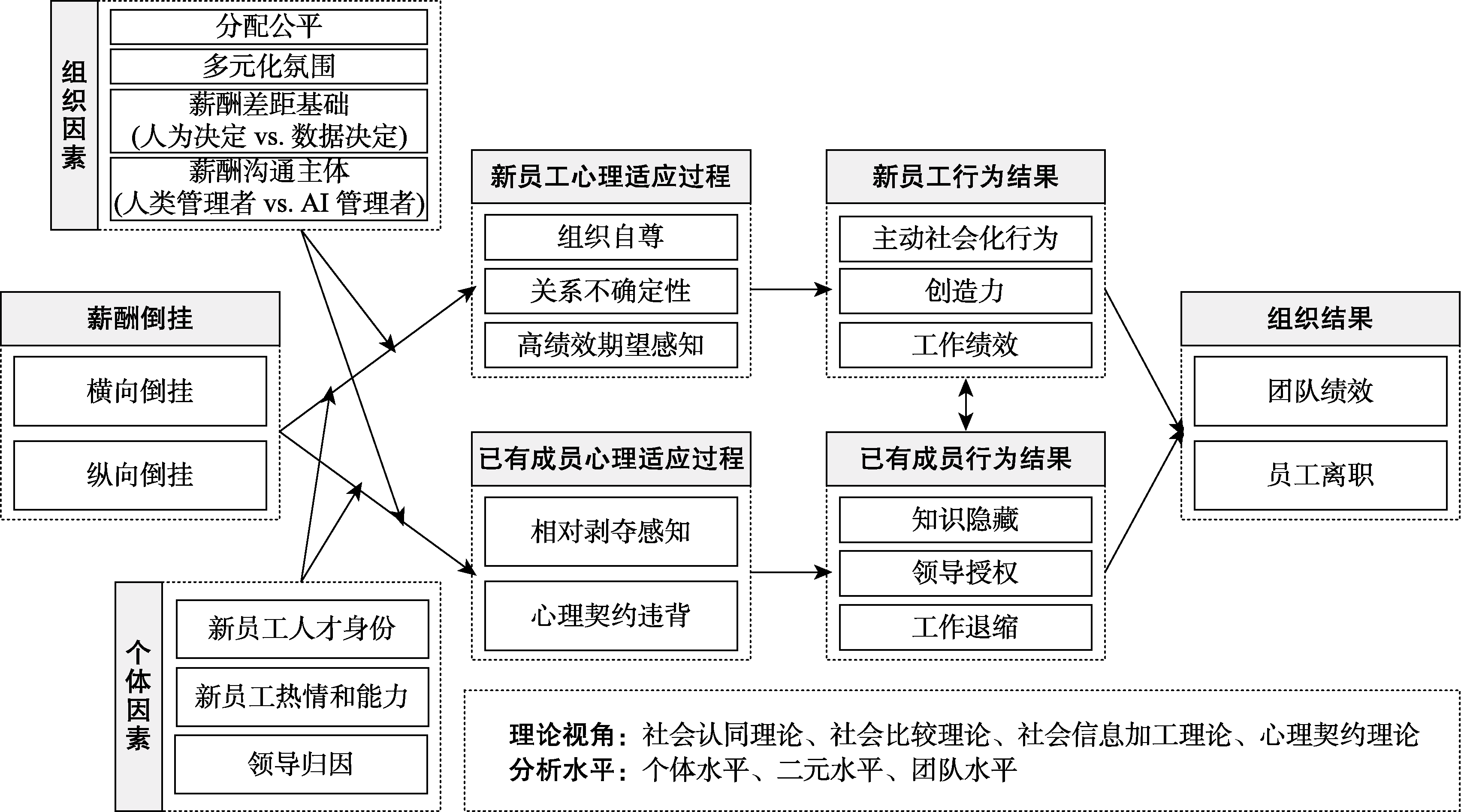
图1 总体研究框架
| [1] | 程德俊. (2004). 不同战略范式下的人力资源管理理论综述与比较. 管理科学, 17(6), 81-86. |
| [2] |
褚福磊, 王蕊, 高中华. (2018). 新员工资质过剩动态变化及作用机制:组织社会化视角. 心理科学进展, 26(12), 2101-2112.
doi: 10.3724/SP.J.1042.2018.02101 |
| [3] | 胡文安, 罗瑾琏, 易明, 钟竞. (2021). “新员工悖论困境”破解:双元领导动态协同过程及化解路径研究. 南开管理评论, 24(4), 51-63. |
| [4] | 孔靓, 李锡元, 章发旺. (2020). 包容型领导对员工主动性行为的影响: 组织自尊与差错管理氛围的中介作用. 管理评论, 32(2), 232-243. |
| [5] | 李娜. (2023-05-22). 华为五倍薪酬再招天才少年让人才像“泥鳅”一样激活队伍. 第一财经日报, A09. |
| [6] | 刘昕. (2025). 人力资源管理数字化转型:内涵、理论基础与实践启示. 社会科学辑刊, (1), 128-137+238. |
| [7] |
汤一鹏, 樊为, 张晓, 王淑红, 熊善阔, 蒲小萍. (2024). 见字如面:虚拟沟通风格对领导力涌现的影响. 心理科学进展, 32(6), 886-907.
doi: 10.3724/SP.J.1042.2024.00886 |
| [8] | 武文, 张明玉, 邬文兵, 张熠华, 李代珩, 曲永政. (2020). 同事信息分享对新员工社会化结果的影响机理探究. 中国软科学, (8), 110-121. |
| [9] | 姚琦, 马华维, 李强. (2007). 对新员工入职期望变化的一项纵向研究. 心理学报, 39(6), 1122-1130. |
| [10] | 张明玉, 刘攀, 武文, 张熠华. (2020). 同事嘲讽式幽默对新员工组织社会化结果的影响研究. 管理评论, 32(9), 182-192. |
| [11] |
张兴贵, 胡献丹, 苏涛. (2023). 高绩效工作系统会降低员工幸福感吗?来自元分析的证据. 心理科学进展, 31(11), 2005-2024.
doi: 10.3724/SP.J.1042.2023.02005 |
| [12] | 赵国祥, 王明辉, 凌文辁. (2007). 企业员工组织社会化内容的结构维度. 心理学报, 39(6), 1102-1110. |
| [13] |
Adams, J. S. (1963). Towards an understanding of inequity. The Journal of Abnormal and Social Psychology, 67(5), 422-436.
doi: 10.1037/h0040968 URL |
| [14] |
Aguinis, H., & O’Boyle Jr, E. (2014). Star performers in twenty-first century organizations. Personnel Psychology, 67(2), 313-350.
doi: 10.1111/peps.2014.67.issue-2 URL |
| [15] |
Ahearne, M., Mathieu, J., & Rapp, A. (2005). To empower or not to empower your sales force? An empirical examination of the influence of leadership empowerment behavior on customer satisfaction and performance. Journal of Applied Psychology, 90(5), 945-955.
pmid: 16162066 |
| [16] |
Ali, M., Qu, Y., Shafique, S., Pham, N. T., & Usman, M. (2022). The role of ethical leadership in enhancing exploitative and explorative learning simultaneously: What does it matter if employees view work as central? Personnel Review, 51(2), 787-804.
doi: 10.1108/PR-12-2019-0708 URL |
| [17] |
Allen, T. D., Eby, L. T., Chao, G. T., & Bauer, T. N. (2017). Taking stock of two relational aspects of organizational life: Tracing the history and shaping the future of socialization and mentoring research. Journal of Applied Psychology, 102(3), 324-337.
doi: 10.1037/apl0000086 pmid: 28125264 |
| [18] |
Allen, T. D., McManus, S. E., & Russell, J. E. A. (1999). Newcomer socialization and stress: Formal peer relationships as a source of support. Journal of Vocational Behavior, 54(3), 453-470.
doi: 10.1006/jvbe.1998.1674 URL |
| [19] |
Ashford, S. J., & Black, J. S. (1996). Proactivity during organizational entry: The role of desire for control. Journal of Applied Psychology, 81(2), 199-214.
doi: 10.1037/0021-9010.81.2.199 URL |
| [20] |
Ashforth, B. E., & Mael, F. (1989). Social identity theory and the organization. Academy of Management Review, 14(1), 20-39.
doi: 10.2307/258189 URL |
| [21] | Ashforth, B. E., Saks, A. M., & Lee, R. T. (1998). Socialization and newcomer adjustment: The role of organizational context. Human Relations, 51(7), 897-926. |
| [22] |
Ashforth, B. E., & Schinoff, B. S. (2016). Identity under construction: How individuals come to define themselves in organizations. Annual Review of Organizational Psychology and Organizational Behavior, 3, 111-137.
doi: 10.1146/orgpsych.2016.3.issue-1 URL |
| [23] |
Ashforth, B. E., Sluss, D. M., & Saks, A. M. (2007). Socialization tactics, proactive behavior, and newcomer learning: Integrating socialization models. Journal of Vocational Behavior, 70(3), 447-462.
doi: 10.1016/j.jvb.2007.02.001 URL |
| [24] |
Bauer, T. N., Bodner, T., Erdogan, B., Truxillo, D. M., & Tucker, J. S. (2007). Newcomer adjustment during organizational socialization: A meta-analytic review of antecedents, outcomes, and methods. Journal of Applied Psychology, 92(3), 707-721.
doi: 10.1037/0021-9010.92.3.707 pmid: 17484552 |
| [25] |
Bauer, T. N., Erdogan, B., Ellis, A. M., Truxillo, D. M., Brady, G. M., & Bodner, T. (2025). New horizons for newcomer organizational socialization: A review, meta- analysis, and future research directions. Journal of Management, 51(1), 344-382.
doi: 10.1177/01492063241277168 URL |
| [26] |
Bauer, T. N., & Green, S. G. (1998). Testing the combined effects of newcomer information seeking and manager behavior on socialization. Journal of Applied Psychology, 83(1), 72-83.
doi: 10.1037/0021-9010.83.1.72 URL |
| [27] |
Bauer, T. N., Perrot, S., Liden, R. C., & Erdogan, B. (2019). Understanding the consequences of newcomer proactive behaviors: The moderating contextual role of servant leadership. Journal of Vocational Behavior, 112, 356-368.
doi: 10.1016/j.jvb.2019.05.001 URL |
| [28] | Bauer, T. N., & Taylor, S. (2001). Toward a globalized conceptualization of organizational socialization. In Handbook of Industrial, Work & Organizational Psychology (Vol. 1, pp. 409-423). SAGE Publications. |
| [29] |
Birtch, T. A., Cai, Z., & Chiang, F. F. T. (2024). Effects of formal mentoring support on newcomer-protégé affective organizational commitment: A self-concept-based perspective. Human Resource Management, 63(2), 225-242.
doi: 10.1002/hrm.v63.2 URL |
| [30] |
Bloom, M. (1999). The performance effects of pay dispersion on individuals and organizations. Academy of Management Journal, 42(1), 25-40.
doi: 10.2307/256872 URL |
| [31] |
Bloom, M., & Michel, J. G. (2002). The relationships among organizational context, pay dispersion, and among managerial turnover. Academy of Management Journal, 45(1), 33-42.
doi: 10.2307/3069283 URL |
| [32] |
Boekhorst, J. A., Basir, N., & Malhotra, S. (2024). Star light, but why not so bright? A process model of how incumbents influence star newcomer performance. Academy of Management Review, 49(1), 56-79.
doi: 10.5465/amr.2020.0519 URL |
| [33] |
Brown, M., Nyberg, A. J., Weller, I., & Strizver, S. D. (2022). Pay information disclosure: Review and recommendations for research spanning the pay secrecy-pay transparency continuum. Journal of Management, 48(6), 1661-1694.
doi: 10.1177/01492063221079249 URL |
| [34] | Business, Insider. (2022). If you’ve stayed put at your company during the Great Resignation, you’re paying a price for your loyalty. https://www.businessinsider.com/great-resignation-pay-gap-new-hires-earning-more-2022-5 |
| [35] |
Buunk, B. P., Zurriaga, R., Gonzalez-Roma, V., & Subirats, M. (2003). Engaging in upward and downward comparisons as a determinant of relative deprivation at work: A longitudinal study. Journal of Vocational Behavior, 62(2), 370-388.
doi: 10.1016/S0001-8791(02)00015-5 URL |
| [36] |
Cadsby, C. B., Song, F., & Tapon, F. (2007). Sorting and incentive effects of pay for performance: An experimental investigation. Academy of Management Journal, 50(2), 387-405.
doi: 10.5465/amj.2007.24634448 URL |
| [37] | Cameron, K. S., & Quinn, R. E. (1999). Diagnosing and changing organizational culture. Prantice Hall. |
| [38] |
Cappelli, P., & Keller, J. R. (2014). Talent management: Conceptual approaches and practical challenges. Annual Review of Organizational Psychology and Organizational Behavior, 1(1), 305-331.
doi: 10.1146/orgpsych.2014.1.issue-1 URL |
| [39] |
Carraher, S. M., Sullivan, S. E., & Crocitto, M. M. (2008). Mentoring across global boundaries: An empirical examination of home-and host-country mentors on expatriate career outcomes. Journal of International Business Studies, 39(8), 1310-1326.
doi: 10.1057/palgrave.jibs.8400407 URL |
| [40] |
Chan, D., & Schmitt, N. (2000). Interindividual differences in intraindividual changes in proactivity during organizational entry: A latent growth modeling approach to understanding newcomer adaptation. Journal of Applied Psychology, 85(2), 190-210.
pmid: 10783536 |
| [41] |
Chao, G. T., O’Leary-Kelly, A. M., Wolf, S., Klein, H. J., & Gardner, P. D. (1994). Organizational socialization: Its content and consequences. Journal of Applied Psychology, 79(5), 730-743.
doi: 10.1037/0021-9010.79.5.730 URL |
| [42] |
Chiu, S. F., & Peng, J. C. (2008). The relationship between psychological contract breach and employee deviance: The moderating role of hostile attributional style. Journal of Vocational Behavior, 73(3), 426-433.
doi: 10.1016/j.jvb.2008.08.006 URL |
| [43] |
Connelly, B. L., Haynes, K. T., Tihanyi, L., Gamache, D. L., & Devers, C. E. (2016). Minding the gap: Antecedents and consequences of top management-to-worker pay dispersion. Journal of Management, 42(4), 862-885.
doi: 10.1177/0149206313503015 URL |
| [44] |
Connelly, C. E., Zweig, D., Webster, J., & Trougakos, J. P. (2012). Knowledge hiding in organizations. Journal of Organizational Behavior, 33(1), 64-88.
doi: 10.1002/job.v33.1 URL |
| [45] |
Cooper, D., Rockmann, K. W., Moteabbed, S., & Thatcher, S. M. B. (2021). Integrator or gremlin? Identity partnerships and team newcomer socialization. Academy of Management Review, 46(1), 128-146.
doi: 10.5465/amr.2018.0014 URL |
| [46] |
Cooper-Thomas, H., Anderson, N., & Cash, M. (2011). Investigating organizational socialization: A fresh look at newcomer adjustment strategies. Personnel Review, 41(1), 41-55.
doi: 10.1108/00483481211189938 URL |
| [47] |
Cullinane, N., & Dundon, T. (2006). The psychological contract: A critical review. International Journal of Management Reviews, 8(2), 113-129.
doi: 10.1111/ijmr.2006.8.issue-2 URL |
| [48] |
De Vos, A., & Freese, C. (2011). Sensemaking during organizational entry: Changes in newcomer information seeking and the relationship with psychological contract fulfilment. Journal of Occupational and Organizational Psychology, 84(2), 288-314.
doi: 10.1111/joop.2011.84.issue-2 URL |
| [49] |
Downes, P. E., & Choi, D. (2014). Employee reactions to pay dispersion: A typology of existing research. Human Resource Management Review, 24(1), 53-66.
doi: 10.1016/j.hrmr.2013.08.009 URL |
| [50] |
Eby, L. T., Butts, M. M., Durley, J., & Ragins, B. R. (2010). Are bad experiences stronger than good ones in mentoring relationships? Evidence from the protégé and mentor perspective. Journal of Vocational Behavior, 77(1), 81-92.
doi: 10.1016/j.jvb.2010.02.010 URL |
| [51] |
Ellis, A. M., Nifadkar, S. S., Bauer, T. N., & Erdogan, B. (2017). Newcomer adjustment: Examining the role of managers’ perception of newcomer proactive behavior during organizational socialization. Journal of Applied Psychology, 102(6), 993-1001.
doi: 10.1037/apl0000201 URL |
| [52] |
Fang, R., Duffy, M. K., & Shaw, J. D. (2011). The organizational socialization process: Review and development of a social capital model. Journal of Management, 37(1), 127-152.
doi: 10.1177/0149206310384630 URL |
| [53] |
Feldman, D. C. (1976). A contingency theory of socialization. Administrative Science Quarterly, 21(3), 433-452.
doi: 10.2307/2391853 URL |
| [54] |
Feldman, D. C. (1981). The multiple socialization of organization members. Academy of Management Review, 6(2), 309-318.
doi: 10.2307/257888 URL |
| [55] |
Feldman, D. C. (1994). Who's socializing whom? The impact of socializing newcomers on insiders, work groups, and organizations. Human Resource Management Review, 4(3), 213-233.
doi: 10.1016/1053-4822(94)90013-2 URL |
| [56] |
Feldman, M. S., & Pentland, B. T. (2003). Reconceptualizing organizational routines as a source of flexibility and change. Administrative Science Quarterly, 48(1), 94-118.
doi: 10.2307/3556620 URL |
| [57] |
Fiske, S. T., Cuddy, A. J., Glick, P., & Xu, J. (2002). A model of (often mixed) stereotype content: Competence and warmth respectively follow from perceived status and competition. Journal of Personality and Social Psychology, 82(6), 878-902.
pmid: 12051578 |
| [58] |
Fredrickson, J. W., Davis-Blake, A., & Sanders, W. G. (2010). Sharing the wealth: Social comparisons and pay dispersion in the CEO's top team. Strategic Management Journal, 31(10), 1031-1053.
doi: 10.1002/smj.v31:10 URL |
| [59] |
Frey, E. L. (2022). “I go here...but I don’t necessarily belong”: The process of transgressor reintegration in organizations. Academy of Management Journal, 65(1), 119-157.
doi: 10.5465/amj.2019.0251 URL |
| [60] |
Gallardo-Gallardo, E., Dries, N., & Gonzalez-Cruz, T. F. (2013). What is the meaning of “talent” in the world of work? Human Resource Management Review, 23(4), 290-300.
doi: 10.1016/j.hrmr.2013.05.002 URL |
| [61] |
Gardner, D. G., Van Dyne, L., & Pierce, J. L. (2004). The effects of pay level on organization-based self-esteem and performance: A field study. Journal of Occupational and Organizational Psychology, 77(3), 307-322.
doi: 10.1348/0963179041752646 URL |
| [62] |
Gardner, W. L., Karam, E. P., Tribble, L. L., & Cogliser, C. C. (2019). The missing link? Implications of internal, external, and relational attribution combinations for leader-member exchange, relationship work, self-work, and conflict. Journal of Organizational Behavior, 40(5), 554-569.
doi: 10.1002/job.v40.5 URL |
| [63] |
Gibbons, F. X., & Buunk, B. P. (1999). Individual differences in social comparison: Development of a scale of social comparison orientation. Journal of Personality and Social Psychology, 76(1), 129-142.
doi: 10.1037//0022-3514.76.1.129 pmid: 9972558 |
| [64] |
Glassman, M., & Mcafee, R. B. (2005). Pay inversion at universities: Is it ethical?. Journal of Business Ethics, 56(4), 325-333.
doi: 10.1007/s10551-004-5004-x URL |
| [65] |
Gross, C., Debus, M. E., Liu, Y., Wang, M., & Kleinmann, M. (2021). I am nice and capable! How and when newcomers’ self-presentation to their supervisors affects socialization outcomes. Journal of Applied Psychology, 106(7), 1067-1079.
doi: 10.1037/apl0000817 URL |
| [66] |
Groysberg, B., Lee, L. E., & Nanda, A. (2008). Can they take it with them? The portability of star knowledge workers' performance. Management Science, 54(7), 1213-1230.
doi: 10.1287/mnsc.1070.0809 URL |
| [67] |
Gupta, A. K., Smith, K. G., & Shalley, C. E. (2006). The interplay between exploration and exploitation. Academy of Management Journal, 49(4), 693-706.
doi: 10.5465/amj.2006.22083026 URL |
| [68] |
Gupta, N., Conroy, S. A., & Delery, J. E. (2012). The many faces of pay variation. Human Resource Management Review, 22(2), 100-115.
doi: 10.1016/j.hrmr.2011.12.001 URL |
| [69] |
Harris, L., Cooper-Thomas, H., Smith, P., & Cheung, G. W. (2022). Influence of relational learning and job autonomy in associations between social capital resources and newcomer adjustment: A moderated mediation study. Career Development International, 27(6/7), 566-583.
doi: 10.1108/CDI-02-2022-0038 URL |
| [70] |
Harris, T. B., Li, N., Boswell, W. R., Zhang, X. A., & Xie, Z. (2014). Getting what’s new from newcomers: Empowering leadership, creativity, and adjustment in the socialization context. Personnel Psychology, 67(3), 567-604.
doi: 10.1111/peps.2014.67.issue-3 URL |
| [71] |
He, W., Long, L., & Kuvaas, B. (2016). Workgroup salary dispersion and turnover intention in China: A contingent examination of individual differences and the dual deprivation path explanation. Human Resource Management, 55(2), 301-320.
doi: 10.1002/hrm.2016.55.issue-2 URL |
| [72] |
Hofhuis, J., van Der Zee, K. I., & Otten, S. (2012). Social identity patterns in culturally diverse organizations: The role of diversity climate. Journal of Applied Social Psychology, 42(4), 964-989.
doi: 10.1111/jasp.2012.42.issue-4 URL |
| [73] |
Hogg, M. A. (2000). Subjective uncertainty reduction through self-categorization: A motivational theory of social identity processes. European Review of Social Psychology, 11(1), 223-255.
doi: 10.1080/14792772043000040 URL |
| [74] |
Hu, Z., Li, J., & Kwan, H. K. (2022). The effects of negative mentoring experiences on mentor creativity: The roles of mentor ego depletion and traditionality. Human Resource Management, 61(1), 39-54.
doi: 10.1002/hrm.v61.1 URL |
| [75] |
Jacobsen, C. B., & Andersen, L. B. (2019). High performance expectations: Concept and causes. International Journal of Public Administration, 42(2), 108-118.
doi: 10.1080/01900692.2017.1405443 URL |
| [76] |
Jokisaari, M., & Nurmi, J. E. (2009). Change in newcomers' supervisor support and socialization outcomes after organizational entry. Academy of Management Journal, 52(3), 527-544.
doi: 10.5465/amj.2009.41330971 URL |
| [77] |
Jones, G. R. (1983). Psychological orientation and the process of organizational socialization: An interactionist perspective. Academy of Management Review, 8(3), 464-474.
doi: 10.2307/257835 URL |
| [78] |
Jones, G. R. (1986). Socialization tactics, self-efficacy, and newcomers’ adjustments to organizations. Academy of Management Journal, 29(2), 262-279.
doi: 10.2307/256188 URL |
| [79] |
Kammeyer-Mueller, J. D., Livingston, B. A., & Liao, H. (2011). Perceived similarity, proactive adjustment, and organizational socialization. Journal of Vocational Behavior, 78(2), 225-236.
doi: 10.1016/j.jvb.2010.09.012 URL |
| [80] |
Kehoe, R. R., Collings, D. G., & Cascio, W. F. (2023). Simply the best? Star performers and high-potential employees: Critical reflections and a path forward for research and practice. Personnel Psychology, 76(2), 585-615.
doi: 10.1111/peps.v76.2 URL |
| [81] |
Kepes, S., Delery, J., & Gupta, N. (2009). Contingencies in the effects of pay range on organizational effectiveness. Personnel Psychology, 62(3), 497-531.
doi: 10.1111/peps.2009.62.issue-3 URL |
| [82] |
Kim, T. Y., Edwards, J. R., & Shapiro, D. L. (2015). Social comparison and distributive justice: East Asia differences. Journal of Business Ethics, 132(2), 401-414.
doi: 10.1007/s10551-014-2326-1 URL |
| [83] |
Klein, H. J., & Weaver, N. A. (2000). The effectiveness of an organizational-level orientation training program in the socialization of new hires. Personnel Psychology, 53(1), 47-66.
doi: 10.1111/peps.2000.53.issue-1 URL |
| [84] |
Koopman, J., Lin, S. H., Lennard, A. C., Matta, F. K., & Johnson, R. E. (2020). My coworkers are treated more fairly than me! A self-regulatory perspective on justice social comparisons. Academy of Management Journal, 63(3), 857-880.
doi: 10.5465/amj.2016.0586 URL |
| [85] |
Lapointe, É., Vandenberghe, C., & Boudrias, J. S. (2013). Psychological contract breach, affective commitment to organization and supervisor, and newcomer adjustment: A three-wave moderated mediation model. Journal of Vocational Behavior, 83(3), 528-538.
doi: 10.1016/j.jvb.2013.07.008 URL |
| [86] |
Lepak, D. P., & Shaw, J. D. (2008). Strategic HRM in North America: Looking to the future. The International Journal of Human Resource Management, 19(8), 1486-1499.
doi: 10.1080/09585190802200272 URL |
| [87] |
Lewis, R. E., & Heckman, R. J. (2006). Talent management: A critical review. Human Resource Management Review, 16(2), 139-154.
doi: 10.1016/j.hrmr.2006.03.001 URL |
| [88] |
Li, C. S., Liao, H., & Han, Y. (2022). I despise but also envy you: A dyadic investigation of perceived overqualification, perceived relative qualification, and knowledge hiding. Personnel Psychology, 75(1), 91-118.
doi: 10.1111/peps.v75.1 URL |
| [89] | Lyle, M. C., Eckardt, R., Corley, K. G., & Lepak, D. P. (2023). Gravity’s pull: The identity-related motives and outcomes of hiring stars. Human Resource Management Review, 33(2), 100932. |
| [90] |
Marasi, S., & Bennett, R. J. (2016). Pay communication: Where do we go from here? Human Resource Management Review, 26(1), 50-58.
doi: 10.1016/j.hrmr.2015.07.002 URL |
| [91] | McNatt, D. B., Glassman, M., & McAfee, R. B. (2007). Pay inversion versus pay for performance: can companies have their cake and eat it too?. Compensation & Benefits Review, 39(2), 27-35. |
| [92] |
Messersmith, J. G., Kim, K. Y., & Patel, P. C. (2018). Pulling in different directions? Exploring the relationship between vertical pay dispersion and high-performance work systems. Human Resource Management, 57(1), 127-143.
doi: 10.1002/hrm.2018.57.issue-1 URL |
| [93] |
Morrison, E. W. (2002). Newcomers’ relationships: The role of social network ties during socialization. Academy of Management Journal, 45(6), 1149-1160.
doi: 10.2307/3069430 URL |
| [94] |
Morrison, E. W., & Robinson, S. L. (1997). When employees feel betrayed: A model of how psychological contract violation develops. Academy of Management Review, 22(1), 226-256.
doi: 10.2307/259230 URL |
| [95] |
Nägele, C., & Neuenschwander, M. P. (2014). Adjustment processes and fit perceptions as predictors of organizational commitment and occupational commitment of young workers. Journal of Vocational Behavior, 85(3), 385-393.
doi: 10.1016/j.jvb.2014.08.011 URL |
| [96] |
Naranjo-Valencia, J. C., Jimenez-Jimenez, D., & Sanz-Valle, R. (2017). Organizational culture and radical innovation: Does innovative behavior mediate this relationship?. Creativity and Innovation Management, 26(4), 407-417.
doi: 10.1111/caim.v26.4 URL |
| [97] |
Nifadkar, S. S., & Bauer, T. N. (2016). Breach of belongingness: Newcomer relationship conflict, information, and task-related outcomes during organizational socialization. Journal of Applied Psychology, 101(1), 1-13.
doi: 10.1037/apl0000035 pmid: 26052711 |
| [98] |
Nifadkar, S. S., & Wu, W. (2022). Newcomers as unwitting victims? Examining department leaders’ denial of information support and team leaders’ resentment during organizational socialization. Journal of Organizational Behavior, 43(1), 52-68.
doi: 10.1002/job.v43.1 URL |
| [99] | Nyberg, A. J., Cragun, O. R., Conroy, S. A., & Weller, I. (2024). Artificial intelligence and pay information disclosure: Changing how pay is communicated. Compensation & Benefits Review, 56(2), 58-75. |
| [100] |
Park, J., & Kim, S. (2017). Pay dispersion and organizational performance in Korea: Curvilinearity and the moderating role of congruence with organizational culture. The International Journal of Human Resource Management, 28(9), 1291-1308.
doi: 10.1080/09585192.2015.1126331 URL |
| [101] |
Pierce, J. L., Gardner, D. G., Cummings, L. L., & Dunham, R. B. (1989). Organization-based self-esteem: Construct definition, measurement, and validation. Academy of Management Journal, 32(3), 622-648.
doi: 10.2307/256437 URL |
| [102] |
Prato, M., & Ferraro, F. (2018). Starstruck: How hiring high-status employees affects incumbents’ performance. Organization Science, 29(5), 755-774.
doi: 10.1287/orsc.2018.1204 URL |
| [103] |
Richard, O. C., Avery, D. R., Luksyte, A., Boncoeur, O. D., & Spitzmueller, C. (2019). Improving organizational newcomers’ creative job performance through creative process engagement: The moderating role of a synergy diversity climate. Personnel Psychology, 72(3), 421-444.
doi: 10.1111/peps.2019.72.issue-3 URL |
| [104] | Richardson, P., & Thomas, S. (2013). Using an equity/ performance matrix to address salary compression/inversion and performance pay issues. Administrative Issues Journal, 3(1), 20-33. |
| [105] |
Saks, A. M., & Ashforth, B. E. (1996). Proactive socialization and behavioral self-management. Journal of Vocational Behavior, 48(3), 301-323.
doi: 10.1006/jvbe.1996.0026 URL |
| [106] |
Salancik, G. R., & Pfeffer, J. (1978). A social information processing approach to job attitudes and task design. Administrative Science Quarterly, 23(2), 224-253.
pmid: 10307892 |
| [107] |
Schein, E. H. (1990). Organizational culture. American Psychologist, 45(2), 109-119.
doi: 10.1037/0003-066X.45.2.109 URL |
| [108] |
Shaw, J. D. (2014). Pay dispersion. Annual Review of Organizational Psychology and Organizational Behavior, 1(1), 521-544.
doi: 10.1146/orgpsych.2014.1.issue-1 URL |
| [109] |
Shaw, J. D. (2015). Pay dispersion, sorting, and organizational performance. Academy of Management Discoveries, 1(2), 165-179.
doi: 10.5465/amd.2014.0045 URL |
| [110] |
Shaw, J. D., & Gupta, N. (2007). Pay system characteristics and quit patterns of good, average, and poor performers. Personnel Psychology, 60(4), 903-928.
doi: 10.1111/peps.2007.60.issue-4 URL |
| [111] |
Shaw, J. D., Gupta, N., & Delery, J. E. (2001). Congruence between technology and compensation systems: Implications for strategy implementation. Strategic Management Journal, 22(4), 379-386.
doi: 10.1002/smj.v22:4 URL |
| [112] |
Smith, H. J., Pettigrew, T. F., Pippin, G. M., & Bialosiewicz, S. (2012). Relative deprivation: A theoretical and meta- analytic review. Personality and Social Psychology Review, 16(3), 203-232.
doi: 10.1177/1088868311430825 URL |
| [113] |
Sons, M., & Niessen, C. (2022). Cross-lagged effects of voluntary job changes and well-being: A continuous time approach. Journal of Applied Psychology, 107(9), 1600-1627.
doi: 10.1037/apl0000940 URL |
| [114] |
Sweeney, P. D., & McFarlin, D. B. (2004). Social comparisons and income satisfaction: A cross-national examination. Journal of Occupational and Organizational Psychology, 77(2), 149-154.
doi: 10.1348/096317904774202117 URL |
| [115] |
Sweeney, P. D., McFarlin, D. B., & Inderrieden, E. J. (1990). Using relative deprivation theory to explain satisfaction with income and pay level: A multistudy examination. Academy of Management Journal, 33(2), 423-436.
doi: 10.2307/256332 URL |
| [116] |
Takeuchi, R., Lepak, D. P., Wang, H., & Takeuchi, K. (2007). An empirical examination of the mechanisms mediating between high-performance work systems and the performance of Japanese organizations. Journal of Applied Psychology, 92(4), 1069-1083.
pmid: 17638466 |
| [117] | Tanjitpiyanond, P., Jetten, J., & Peters, K. (2023). A social identity analysis of how pay inequality divides the workplace. Group Processes & Intergroup Relations, 26(3), 720-737. |
| [118] |
Trevor, C. O., Reilly, G., & Gerhart, B. (2012). Reconsidering pay dispersion's effect on the performance of interdependent work: Reconciling sorting and pay inequality. Academy of Management Journal, 55(3), 585-610.
doi: 10.5465/amj.2006.0127 URL |
| [119] |
Trevor, C. O., & Wazeter, D. L. (2006). A contingent view of reactions to objective pay conditions: Interdependence among pay structure characteristics and pay relative to internal and external referents. Journal of Applied Psychology, 91(6), 1260-1275.
pmid: 17100483 |
| [120] |
Van Knippenberg, D., Giessner, S. R., Sleebos, E., & van Ginkel, W. P. (2021). A motivated information processing perspective on the antecedents of empowering leadership. Journal of Applied Social Psychology, 51(2), 79-89.
doi: 10.1111/jasp.v51.2 URL |
| [121] | Van Maanen, J. E., & Schein, E. H. (1977). Towards a theory of organizational socialization. In B. M. Staw (Ed.), Research in organizational behavior (Vol. 1, pp. 209-264). JAI Press. |
| [122] | Vroom, V. H. (1964). Work and motivation. Wiley. |
| [123] |
Wang, H. J., Li, P., Bauer, T. N., & Erdogan, B. (2024). Patient mistreatment and new nurse adjustment: The role of rumination and work engagement. Human Relations, 77(12), 1755-1783.
doi: 10.1177/00187267231211847 URL |
| [124] |
Wang, M., Kammeyer-Mueller, J., Liu, Y., & Li, Y. (2015). Context, socialization, and newcomer learning. Organizational Psychology Review, 5(1), 3-25.
doi: 10.1177/2041386614528832 URL |
| [125] |
Wanous, J. P. (1977). Organizational entry: Newcomers moving from outside to inside. Psychological Bulletin, 84(4), 601-618.
doi: 10.1037/0033-2909.84.4.601 URL |
| [126] |
Weiner, B. (2010). The development of an attribution-based theory of motivation: A history of ideas. Educational Psychologist, 45(1), 28-36.
doi: 10.1080/00461520903433596 URL |
| [127] |
Weng, Q., Latif, K., Khan, A. K., Tariq, H., Butt, H. P., Obaid, A., & Sarwar, N. (2020). Loaded with knowledge, yet green with envy: Leader-member exchange comparison and coworkers-directed knowledge hiding behavior. Journal of Knowledge Management, 24(7), 1653-1680.
doi: 10.1108/JKM-10-2019-0534 URL |
| [128] |
Wright, P. M., & McMahan, G. C. (1992). Theoretical perspectives for strategic human resource management. Journal of Management, 18(2), 295-320.
doi: 10.1177/014920639201800205 URL |
| [129] |
Wu, W., Wu, S., Du, Q., Zhang, X., Zhang, Y., Xu, H., & Yu, Z. (2023). More Is less? A dynamic perspective on mentors’ task-related information sharing, indegree centrality, and newcomer socialization outcomes. Journal of Organizational Behavior, 44(4), 660-681.
doi: 10.1002/job.v44.4 URL |
| [130] |
Xue, Y., Bradley, J., & Liang, H. (2011). Team climate, empowering leadership, and knowledge sharing. Journal of Knowledge Management, 15(2), 299-312.
doi: 10.1108/13673271111119709 URL |
| [131] |
Zhang, L., & Guler, I. (2020). How to join the club: Patterns of embeddedness and the addition of new members to interorganizational collaborations. Administrative Science Quarterly, 65(1), 112-150.
doi: 10.1177/0001839219834011 URL |
| [132] |
Zhang, L. L., George, E., & Chattopadhyay, P. (2020). Not in my pay grade: The relational benefit of pay grade dissimilarity. Academy of Management Journal, 63(3), 779-801.
doi: 10.5465/amj.2016.1344 URL |
| [133] |
Zhang, X., & Zhou, J. (2014). Empowering leadership, uncertainty avoidance, trust, and employee creativity: Interaction effects and a mediating mechanism. Organizational Behavior and Human Decision Processes, 124(2), 150-164.
doi: 10.1016/j.obhdp.2014.02.002 URL |
| [134] |
Zhao, H. A. O., Wayne, S. J., Glibkowski, B. C., & Bravo, J. (2007). The impact of psychological contract breach on work-related outcomes: A meta-analysis. Personnel Psychology, 60(3), 647-680.
doi: 10.1111/peps.2007.60.issue-3 URL |
| [135] |
Zheng, Y., Zheng, X., Wu, C. H., Yao, X., & Wang, Y. (2021). Newcomers’ relationship-building behavior, mentor information sharing and newcomer adjustment: The moderating effects of perceived mentor and newcomer deep similarity. Journal of Vocational Behavior, 125, 103519.
doi: 10.1016/j.jvb.2020.103519 URL |
| [1] | 吴国滨, 何峰, 张圣琳, 刘炳胜, 苏逸. 回旋镖员工主动再社会化行为内涵、测量、前因及结果:基于资源视角[J]. 心理科学进展, 2025, 33(9): 1498-1513. |
| [2] | 张靓婷, 王斌, 付景涛. 组织社会化视角下员工组织公民行为动态变化趋势及其形成机制[J]. 心理科学进展, 2021, 29(12): 2105-2118. |
| [3] | 张燕红, 李永周, 周勇, 邹琼. 关系资源视角的新员工组织社会化过程机制[J]. 心理科学进展, 2018, 26(4): 584-598. |
| [4] | 褚福磊, 王蕊, 高中华. 新员工资质过剩动态变化及作用机制:组织社会化视角[J]. 心理科学进展, 2018, 26(12): 2101-2112. |
| [5] | 赵晨, 高中华. 组织社会化交互视角下新员工政治自我效能的动态演化及作用机制[J]. 心理科学进展, 2017, 25(9): 1456-1468. |
| [6] | 毛凯贤, 李超平. 新员工主动行为及其在组织社会化中的作用[J]. 心理科学进展, 2015, 23(12): 2167-2176. |
| [7] | 李超平;苏琴;宋照礼. 互动视角的组织社会化动态跟踪研究[J]. 心理科学进展, 2014, 22(3): 409-417. |
| [8] | 严鸣;涂红伟;李骥. 认同理论视角下新员工组织社会化的定义及结构维度[J]. 心理科学进展, 2011, 19(5): 624-632. |
| [9] | 姚琦;乐国安. 组织社会化研究的整合:交互作用视角[J]. 心理科学进展, 2008, 16(4): 590-597. |
| [10] | 王明辉;凌文辁. 员工组织社会化研究的概况[J]. 心理科学进展, 2006, 14(5): 722-728. |
| 阅读次数 | ||||||
|
全文 |
|
|||||
|
摘要 |
|
|||||
