

ISSN 1671-3710
CN 11-4766/R
主办:中国科学院心理研究所
出版:科学出版社
CN 11-4766/R
主办:中国科学院心理研究所
出版:科学出版社
心理科学进展 ›› 2026, Vol. 34 ›› Issue (2): 191-209.doi: 10.3724/SP.J.1042.2026.0191 cstr: 32111.14.2026.0191
• 第二十七届中国科协年会学术论文 • 下一篇
田柳青, 陈彦霖, 林美玲, 陈栋( ), 王亮()
收稿日期:2025-05-12
出版日期:2026-02-15
发布日期:2025-12-15
通讯作者:
陈栋, E-mail: chend@psych.ac.cn基金资助:
TIAN Liuqing, CHEN Yanlin, LIN Meiling, CHEN Dong(), WANG Liang()
Received:2025-05-12
Online:2026-02-15
Published:2025-12-15
摘要:
以记忆障碍为典型症状的阿尔兹海默症和创伤后应激障碍等疾病的治疗是脑机接口研究的关键方向。本文聚焦侵入式脑机接口在情景记忆的空间与情绪信息处理中的应用, 重点阐述如何基于人脑深部脑区局部场电位信号, 结合机器学习算法, 实现对运动状态、环境边界、空间位置及情绪效价等多维度记忆信息的精准解析。基于上述神经特征的调控技术可以实现记忆和情绪的靶向干预。当前技术瓶颈包括个体差异、电极稳定性不足及自适应算法局限。未来需融合动态网络模型与柔性电极技术, 推动临床个性化闭环干预范式的发展。
中图分类号:
田柳青, 陈彦霖, 林美玲, 陈栋, 王亮. (2026). 侵入式脑机接口应用:记忆的解码与调控. 心理科学进展 , 34(2), 191-209.
TIAN Liuqing, CHEN Yanlin, LIN Meiling, CHEN Dong, WANG Liang. (2026). Invasive brain-computer interface applications: Decoding and modulation of memory. Advances in Psychological Science, 34(2), 191-209.
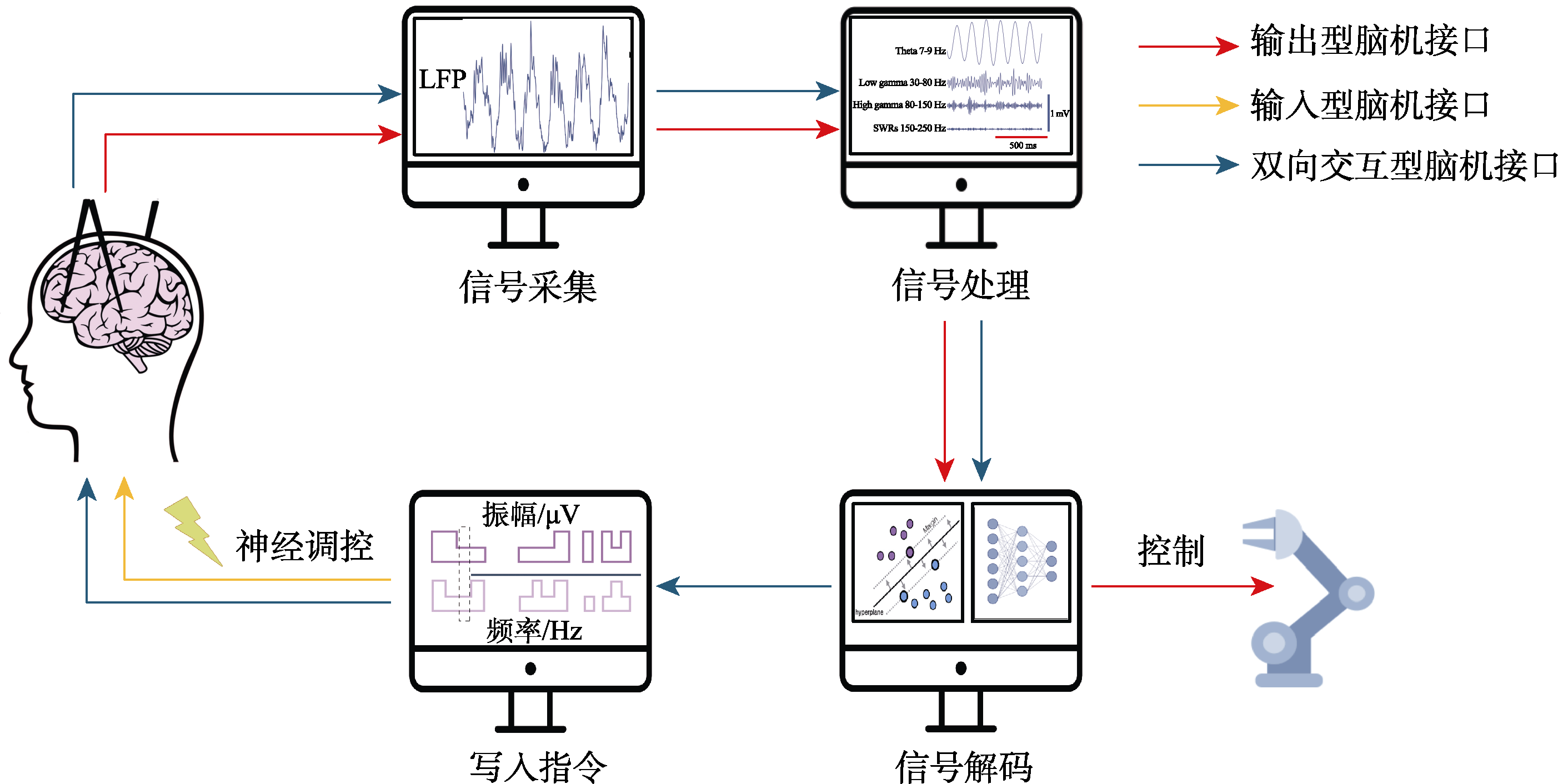
图1 记忆的脑机接口
| 刺激靶点 | 阶段 | 刺激参数 | 刺激时长 | 开闭环 | 测量任务 | 测量指标 | 刺激结果 | 文献 |
|---|---|---|---|---|---|---|---|---|
| 海马/内嗅 | 编码 | 50 Hz / 0.5~1.5 mA | 5 s开/5 s关 | 开环 | 空间导航 (结构场) | 捷径选取率 | 提高记忆 | Suthana et al., |
| 海马/内嗅 | 编码 | 50 Hz / 0.5~3.5 mA | 4.6~5 s开 / 4.6~5 s关 | 开环 | 空间导航 (开放场) | 放置误差 | 损伤记忆 | Jacobs et al., |
| 颞叶功能网络 | 提取 | Theta burst | 2 s (试次 间期) | 开环 | 空间导航 (结构场) | 距离判断 | 损伤记忆 | K. Kim et al., |
| 海马 | 编码 | 50 Hz / 0.5~1.5 mA | 4.6~5 s开 / 4.6~5 s关 | 开环 | 情绪词记忆 | 提取率 | 降低负性词语的记忆 | Qasim et al., |
| 杏仁核 | 编码 | 50 Hz / 0.5 mA | 1 s开 / 5.5~6.5 s关 | 开环 | 图片记忆 | 再认率 | 提高记忆 | Inman et al., |
| 海马−嗅皮层 | 编码 | 40 Hz / 0.01 mA | 10 s | 开环 | 单词记忆 | 提取率 | 同相刺激提高记忆 | Fell et al., |
| 穹窿 | 提取前间息 | 200 Hz / 7 mA | 20 min | 开环 | 视空间记忆 | 提取率 | 提高记忆 | Miller et al., |
| 外侧颞叶 | 编码 | 50 Hz / 0.5~1.5 mA | 4.6 s开 / 4.6 s关 | 开环 | 单词记忆 | 提取率 | 提高记忆 | Kucewicz et al., |
| 外侧颞叶 | 编码 | 10, 25, 50, 100, 200 Hz / 0.5~1.5 mA | 500 ms | 闭环 | 单词记忆 | 提取率 | 提高记忆 | Ezzyat et al., |
| 海马 | 编码 | 20 Hz / 150 μA | 4 s | 闭环 | 视空间工作记忆 | 提取率 | 提高记忆 | Hampson et al., |
| 外侧颞叶 | 静息态 | 0.5 Hz / 0.5~5 mA | 10 s | 闭环 | 无 | 无 | 增强了海马theta节律的神经同步和神经响应幅度 | Kragel et al., |
| 外侧颞叶 | 提取 | 200 Hz / 0.5 mA | 500 ms | 闭环 | 单词记忆 | 提取率 | 提高记忆 | Kahana et al., |
| 前额叶 | 巩固 | 100 Hz / 0.5~1.5 mA | 50 ms | 闭环 | 单词记忆 | 提取率 | 提高记忆 | Geva-Sagiv et al., |
表1 侵入式干预的代表性进展
| 刺激靶点 | 阶段 | 刺激参数 | 刺激时长 | 开闭环 | 测量任务 | 测量指标 | 刺激结果 | 文献 |
|---|---|---|---|---|---|---|---|---|
| 海马/内嗅 | 编码 | 50 Hz / 0.5~1.5 mA | 5 s开/5 s关 | 开环 | 空间导航 (结构场) | 捷径选取率 | 提高记忆 | Suthana et al., |
| 海马/内嗅 | 编码 | 50 Hz / 0.5~3.5 mA | 4.6~5 s开 / 4.6~5 s关 | 开环 | 空间导航 (开放场) | 放置误差 | 损伤记忆 | Jacobs et al., |
| 颞叶功能网络 | 提取 | Theta burst | 2 s (试次 间期) | 开环 | 空间导航 (结构场) | 距离判断 | 损伤记忆 | K. Kim et al., |
| 海马 | 编码 | 50 Hz / 0.5~1.5 mA | 4.6~5 s开 / 4.6~5 s关 | 开环 | 情绪词记忆 | 提取率 | 降低负性词语的记忆 | Qasim et al., |
| 杏仁核 | 编码 | 50 Hz / 0.5 mA | 1 s开 / 5.5~6.5 s关 | 开环 | 图片记忆 | 再认率 | 提高记忆 | Inman et al., |
| 海马−嗅皮层 | 编码 | 40 Hz / 0.01 mA | 10 s | 开环 | 单词记忆 | 提取率 | 同相刺激提高记忆 | Fell et al., |
| 穹窿 | 提取前间息 | 200 Hz / 7 mA | 20 min | 开环 | 视空间记忆 | 提取率 | 提高记忆 | Miller et al., |
| 外侧颞叶 | 编码 | 50 Hz / 0.5~1.5 mA | 4.6 s开 / 4.6 s关 | 开环 | 单词记忆 | 提取率 | 提高记忆 | Kucewicz et al., |
| 外侧颞叶 | 编码 | 10, 25, 50, 100, 200 Hz / 0.5~1.5 mA | 500 ms | 闭环 | 单词记忆 | 提取率 | 提高记忆 | Ezzyat et al., |
| 海马 | 编码 | 20 Hz / 150 μA | 4 s | 闭环 | 视空间工作记忆 | 提取率 | 提高记忆 | Hampson et al., |
| 外侧颞叶 | 静息态 | 0.5 Hz / 0.5~5 mA | 10 s | 闭环 | 无 | 无 | 增强了海马theta节律的神经同步和神经响应幅度 | Kragel et al., |
| 外侧颞叶 | 提取 | 200 Hz / 0.5 mA | 500 ms | 闭环 | 单词记忆 | 提取率 | 提高记忆 | Kahana et al., |
| 前额叶 | 巩固 | 100 Hz / 0.5~1.5 mA | 50 ms | 闭环 | 单词记忆 | 提取率 | 提高记忆 | Geva-Sagiv et al., |
| [1] | 肖松, 程和平, 吴朝晖, 张旭, 王以政, 陈婧,... 王刚. (2024). 脑机接口技术发展现状及未来展望. 科学与社会, 14(3), 2-25. https://doi.org/10.19524/j.cnki.10-1009/g3.2024.03.002 |
| [2] |
Adamantidis A. R., Gutierrez Herrera C., & Gent T. C. (2019). Oscillating circuitries in the sleeping brain. Nature Reviews Neuroscience, 20(12), 746-762. https://doi.org/10.1038/s41583-019-0223-4
doi: 10.1038/s41583-019-0223-4 URL pmid: 31616106 |
| [3] |
Aghajan Z. M., Schuette P., Fields T. A., Tran M. E., Siddiqui S. M., Hasulak N. R., … Suthana N. (2017). Theta oscillations in the human medial temporal lobe during real-world ambulatory movement. Current Biology, 27(24), 3743-3751.e3. https://doi.org/10.1016/j.cub.2017.10.062
doi: S0960-9822(17)31399-4 URL pmid: 29199073 |
| [4] |
Akiki T. J., Jubeir J., Bertrand C., Tozzi L., & Williams L. M. (2025). Neural circuit basis of pathological anxiety. Nature Reviews Neuroscience, 26(1), 5-22. https://doi.org/10.1038/s41583-024-00880-4
doi: 10.1038/s41583-024-00880-4 URL |
| [5] |
Anderson M. C., Crespo-Garcia M., & Subbulakshmi S. (2025). Brain mechanisms underlying the inhibitory control of thought. Nature Reviews Neuroscience, 26(7), 415-437. https://doi.org/10.1038/s41583-025-00929-y
doi: 10.1038/s41583-025-00929-y URL pmid: 40379896 |
| [6] |
Anumanchipalli G. K., Chartier J., & Chang E. F. (2019). Speech synthesis from neural decoding of spoken sentences. Nature, 568(7753), 493-498. https://doi.org/10.1038/s41586-019-1119-1
doi: 10.1038/s41586-019-1119-1 URL |
| [7] |
Bao X., Gjorgieva E., Shanahan L. K., Howard J. D., Kahnt T., & Gottfried J. A. (2019). Grid-like neural representations support olfactory navigation of a two- dimensional odor space. Neuron, 102(5), 1066-1075. https://doi.org/10.1016/j.neuron.2019.03.034
doi: 10.1016/j.neuron.2019.03.034 URL |
| [8] |
Barron H. C., Reeve H. M., Koolschijn R. S., Perestenko P. V., Shpektor A., Nili H., … Dupret D. (2020). Neuronal computation underlying inferential reasoning in humans and mice. Cell, 183(1), 228-243.e21. https://doi.org/10.1016/j.cell.2020.08.035
doi: 10.1016/j.cell.2020.08.035 URL pmid: 32946810 |
| [9] |
Behrens T. E. J., Muller T. H., Whittington J. C. R., Mark S., Baram A. B., Stachenfeld K. L., & Kurth-Nelson Z. (2018). What is a cognitive map? Organizing knowledge for flexible behavior. Neuron, 100(2), 490-509. https://doi.org/10.1016/j.neuron.2018.10.002
doi: S0896-6273(18)30856-0 URL pmid: 30359611 |
| [10] |
Bellmund J. L. S., Gärdenfors P., Moser E. I., & Doeller C. F. (2018). Navigating cognition: Spatial codes for human thinking. Science, 362(6415), eaat6766. https://doi.org/10.1126/science.aat6766
doi: 10.1126/science.aat6766 URL |
| [11] |
Bhattarai B., Lee J. W., & Jung M. W. (2020). Distinct effects of reward and navigation history on hippocampal forward and reverse replays. Proceedings of the National Academy of Sciences, 117(1), 689-697. https://doi.org/10.1073/pnas.1912533117
doi: 10.1073/pnas.1912533117 URL |
| [12] |
Bhaya-Grossman I., & Chang E. F. (2022). Speech computations of the human superior temporal gyrus. Annual Review of Psychology, 73, 79-102. https://doi.org/10.1146/annurev-psych-022321-035256
doi: 10.1146/psych.2022.73.issue-1 URL |
| [13] |
Bicanski A., & Burgess N. (2020). Neuronal vector coding in spatial cognition. Nature Reviews Neuroscience, 21(9), 453-470. https://doi.org/10.1038/s41583-020-0336-9
doi: 10.1038/s41583-020-0336-9 URL pmid: 32764728 |
| [14] |
Bijanzadeh M., Khambhati A. N., Desai M., Wallace D. L., Shafi A., Dawes H. E., Sturm V. E., & Chang E. F. (2022). Decoding naturalistic affective behaviour from spectro-spatial features in multiday human iEEG. Nature Human Behaviour, 6(6), 823-836. https://doi.org/10.1038/s41562-022-01310-0
doi: 10.1038/s41562-022-01310-0 URL pmid: 35273355 |
| [15] |
Boccara C. N., Nardin M., Stella F., O’Neill J., & Csicsvari J. (2019). The entorhinal cognitive map is attracted to goals. Science, 363(6434), 1443-1447. https://doi.org/10.1126/science.aav4837
doi: 10.1126/science.aav4837 URL pmid: 30923221 |
| [16] |
Bocchio M., Nabavi S., & Capogna M. (2017). Synaptic plasticity, engrams, and network oscillations in amygdala circuits for storage and retrieval of emotional memories. Neuron, 94(4), 731-743. https://doi.org/10.1016/j.neuron.2017.03.022
doi: S0896-6273(17)30205-2 URL pmid: 28521127 |
| [17] |
Bohbot V. D., Copara M. S., Gotman J., & Ekstrom A. D. (2017). Low-frequency theta oscillations in the human hippocampus during real-world and virtual navigation. Nature Communications, 8(1), 14415. https://doi.org/10.1038/ncomms14415
doi: 10.1038/ncomms14415 URL |
| [18] |
Bongioanni A., Folloni D., Verhagen L., Sallet J., Klein-Flügge M. C., & Rushworth M. F. S. (2021). Activation and disruption of a neural mechanism for novel choice in monkeys. Nature, 591(7849), 270-274. https://doi.org/10.1038/s41586-020-03115-5
doi: 10.1038/s41586-020-03115-5 URL |
| [19] |
Bowen H. J., Ford J. H., Grady C. L., & Spaniol J. (2020). Frontostriatal functional connectivity supports reward- enhanced memory in older adults. Neurobiology of Aging, 90, 1-12. https://doi.org/10.1016/j.neurobiolaging.2020.02.013
doi: 10.1016/j.neurobiolaging.2020.02.013 URL |
| [20] |
Boyce R., Glasgow S. D., Williams S., & Adamantidis A. (2016). Causal evidence for the role of REM sleep theta rhythm in contextual memory consolidation. Science, 352(6287), 812-816. https://doi.org/10.1126/science.aad5252
doi: 10.1126/science.aad5252 URL pmid: 27174984 |
| [21] |
Brewin C. R., Atwoli L., Bisson J. I., Galea S., Koenen K., & Lewis-Fernández R. (2025). Post-traumatic stress disorder: Evolving conceptualization and evidence, and future research directions. World Psychiatry, 24(1), 52-80. https://doi.org/10.1002/wps.21269
doi: 10.1002/wps.v24.1 URL |
| [22] |
Brodt S., Inostroza M., Niethard N., & Born J. (2023). Sleep — A brain-state serving systems memory consolidation. Neuron, 111(7), 1050-1075. https://doi.org/10.1016/j.neuron.2023.03.005
doi: 10.1016/j.neuron.2023.03.005 URL |
| [23] |
Bromberg-Martin E. S., Matsumoto M., & Hikosaka O. (2010). Dopamine in motivational control: Rewarding, aversive, and alerting. Neuron, 68(5), 815-834. https://doi.org/10.1016/j.neuron.2010.11.022
doi: 10.1016/j.neuron.2010.11.022 URL pmid: 21144997 |
| [24] |
Brown T. I., Gagnon S. A., & Wagner A. D. (2020). Stress disrupts human hippocampal-prefrontal function during prospective spatial navigation and hinders flexible behavior. Current Biology, 30(10), 1821-1833.e8. https://doi.org/10.1016/j.cub.2020.03.006
doi: S0960-9822(20)30342-0 URL pmid: 32243859 |
| [25] |
Bush D., Bisby J. A., Bird C. M., Gollwitzer S., Rodionov R., Diehl B., … Burgess N. (2017). Human hippocampal theta power indicates movement onset and distance travelled. Proceedings of the National Academy of Sciences of the United States of America, 114(46), 12297-12302. https://doi.org/10.1073/pnas.1708716114
doi: 10.1073/pnas.1708716114 URL pmid: 29078334 |
| [26] |
Butler W. N., Hardcastle K., & Giocomo L. M. (2019). Remembered reward locations restructure entorhinal spatial maps. Science, 363(6434), 1447-1452. https://doi.org/10.1126/science.aav5297
doi: 10.1126/science.aav5297 URL pmid: 30923222 |
| [27] |
Buzsáki G., & Moser E. I. (2013). Memory, navigation and theta rhythm in the hippocampal-entorhinal system. Nature Neuroscience, 16(2), 130-138. https://doi.org/10.1038/nn.3304
doi: 10.1038/nn.3304 URL pmid: 23354386 |
| [28] |
Buzsáki G., & Tingley D. (2018). Space and time: The hippocampus as a sequence generator. Trends in Cognitive Sciences, 22(10), 853-869. https://doi.org/10.1016/j.tics.2018.07.006
doi: S1364-6613(18)30166-9 URL pmid: 30266146 |
| [29] |
Cantor J. H., McBain R. K., & Ho P.-C. (2023). Telehealth and in-person mental health service utilization and spending, 2019 to 2022. JAMA Health Forum, 4(8), e232645. https://doi.org/10.1001/jamahealthforum.2023.2645
doi: 10.1001/jamahealthforum.2023.2645 URL |
| [30] |
Chaaya N., Battle A. R., & Johnson L. R. (2018). An update on contextual fear memory mechanisms: Transition between amygdala and hippocampus. Neuroscience & Biobehavioral Reviews, 92, 43-54. https://doi.org/10.1016/j.neubiorev.2018.05.013
doi: 10.1016/j.neubiorev.2018.05.013 URL |
| [31] |
Chang E. F., Raygor K. P., & Berger M. S. (2015). Contemporary model of language organization: An overview for neurosurgeons. Journal of Neurosurgery, 122(2), 250-261. https://doi.org/10.3171/2014.10.JNS132647
doi: 10.3171/2014.10.JNS132647 URL pmid: 25423277 |
| [32] |
Chen D., Axmacher N., & Wang L. (2024). Grid codes underlie multiple cognitive maps in the human brain. Progress in Neurobiology, 233, 102569. https://doi.org/10.1016/j.pneurobio.2024.102569
doi: 10.1016/j.pneurobio.2024.102569 URL |
| [33] |
Chen D., Kunz L., Lv P., Zhang H., Zhou W., Liang S., Axmacher N., & Wang L. (2021). Theta oscillations coordinate grid-like representations between ventromedial prefrontal and entorhinal cortex. Science Advances, 7(44), eabj0200. https://doi.org/10.1126/sciadv.abj0200
doi: 10.1126/sciadv.abj0200 URL |
| [34] |
Chen D., Kunz L., Wang W., Zhang H., Wang W.-X., Schulze-Bonhage A., … Wang L. (2018). Hexadirectional modulation of theta power in human entorhinal cortex during spatial navigation. Current Biology, 28(20), 3310-3315. https://doi.org/10.1016/j.cub.2018.08.029
doi: S0960-9822(18)31113-8 URL pmid: 30318350 |
| [35] |
Chen X., He Q., Kelly J. W., Fiete I. R., & McNamara T. P. (2015). Bias in human path integration is predicted by properties of grid cells. Current Biology, 25(13), 1771-1776. https://doi.org/10.1016/j.cub.2015.05.031
doi: 10.1016/j.cub.2015.05.031 URL pmid: 26073138 |
| [36] |
Cisler J. M., Dunsmoor J. E., Fonzo G. A., & Nemeroff C. B. (2024). Latent-state and model-based learning in PTSD. Trends in Neurosciences, 47(2), 150-162. https://doi.org/10.1016/j.tins.2023.12.002
doi: 10.1016/j.tins.2023.12.002 URL pmid: 38212163 |
| [37] |
Clarke-Williams C. J., Lopes-dos-Santos V., Lefèvre L., Brizee D., Causse A. A., Rothaermel R., … Dupret D. (2024). Coordinating brain-distributed network activities in memory resistant to extinction. Cell, 187(2), 409-427.e19. https://doi.org/10.1016/j.cell.2023.12.018
doi: 10.1016/j.cell.2023.12.018 URL pmid: 38242086 |
| [38] |
Colgin L. L., Denninger T., Fyhn M., Hafting T., Bonnevie T., Jensen O., Moser M.-B., & Moser E. I. (2009). Frequency of gamma oscillations routes flow of information in the hippocampus. Nature, 462(7271), 353-357. https://doi.org/10.1038/nature08573
doi: 10.1038/nature08573 URL |
| [39] |
Convertino L., Bush D., Zheng F., Adams R. A., & Burgess N. (2023). Reduced grid-like theta modulation in schizophrenia. Brain, 146(5), 2191-2198. https://doi.org/10.1093/brain/awac416
doi: 10.1093/brain/awac416 URL |
| [40] |
Coughlan G., Coutrot A., Khondoker M., Minihane A.-M., Spiers H., & Hornberger M. (2019). Toward personalized cognitive diagnostics of at-genetic-risk Alzheimer’s disease. Proceedings of the National Academy of Sciences, 116(19), 9285-9292. https://doi.org/10.1073/pnas.1901600116
doi: 10.1073/pnas.1901600116 URL |
| [41] |
Coughlan G., Laczó J., Hort J., Minihane A.-M., & Hornberger M. (2018). Spatial navigation deficits— Overlooked cognitive marker for preclinical Alzheimer disease? Nature Reviews Neurology, 14(8), 496-506. https://doi.org/10.1038/s41582-018-0031-x
doi: 10.1038/s41582-018-0031-x URL pmid: 29980763 |
| [42] |
Dolan R. J., & Dayan P. (2013). Goals and habits in the brain. Neuron, 80(2), 312-325. https://doi.org/10.1016/j.neuron.2013.09.007
doi: 10.1016/j.neuron.2013.09.007 URL pmid: 24139036 |
| [43] |
Edelman B. J., Zhang S., Schalk G., Brunner P., Müller-Putz G., Guan C., & He B. (2025). Non-invasive brain-computer interfaces: State of the art and trends. IEEE Reviews in Biomedical Engineering, 18, 26-49. https://doi.org/10.1109/RBME.2024.3449790
doi: 10.1109/RBME.2024.3449790 URL |
| [44] |
Eichenbaum H. (2017a). Memory: Organization and control. Annual Review of Psychology, 68(1), 19-45. https://doi.org/10.1146/annurev-psych-010416-044131
doi: 10.1146/psych.2017.68.issue-1 URL |
| [45] |
Eichenbaum H. (2017b). Prefrontal-hippocampal interactions in episodic memory. Nature Reviews Neuroscience, 18(9), 547-558. https://doi.org/10.1038/nrn.2017.74
doi: 10.1038/nrn.2017.74 URL |
| [46] |
Ekstrom A. D., Kahana M. J., Caplan J. B., Fields T. A., Isham E. A., Newman E. L., & Fried I. (2003). Cellular networks underlying human spatial navigation. Nature, 425(6954), 184-188. https://doi.org/10.1038/nature01964
doi: 10.1038/nature01964 URL |
| [47] |
Ezzyat Y., Wanda P. A., Levy D. F., Kadel A., Aka A., Pedisich I., … Kahana M. J. (2018). Closed-loop stimulation of temporal cortex rescues functional networks and improves memory. Nature Communications, 9(1), 365. https://doi.org/10.1038/s41467-017-02753-0
doi: 10.1038/s41467-017-02753-0 URL |
| [48] |
Fanselow M. S., & LeDoux J. E. (1999). Why we think plasticity underlying pavlovian fear conditioning occurs in the basolateral amygdala. Neuron, 23(2), 229-232. https://doi.org/10.1016/S0896-6273(00)80775-8
doi: 10.1016/s0896-6273(00)80775-8 URL pmid: 10399930 |
| [49] |
Fell J., Staresina B. P., Do Lam A. T. A., Widman G., Helmstaedter C., Elger C. E., & Axmacher N. (2013). Memory modulation by weak synchronous deep brain Stimulation: A pilot study. Brain Stimulation, 6(3), 270-273. https://doi.org/10.1016/j.brs.2012.08.001
doi: 10.1016/j.brs.2012.08.001 URL pmid: 22939277 |
| [50] |
Fenster R. J., Lebois L. A. M., Ressler K. J., & Suh J. (2018). Brain circuit dysfunction in post-traumatic stress disorder: From mouse to man. Nature Reviews Neuroscience, 19(9), 535-551. https://doi.org/10.1038/s41583-018-0039-7
doi: 10.1038/s41583-018-0039-7 URL pmid: 30054570 |
| [51] |
Figee M., & Mayberg H. (2021). The future of personalized brain stimulation. Nature Medicine, 27(2), 196-197. https://doi.org/10.1038/s41591-021-01243-7
doi: 10.1038/s41591-021-01243-7 URL pmid: 33526929 |
| [52] |
Fink J., & Exner C. (2019). Does transcranial direct current stimulation (tDCS) improve disgust regulation through imagery rescripting? Frontiers in Human Neuroscience, 13, 192. https://doi.org/10.3389/fnhum.2019.00192
doi: 10.3389/fnhum.2019.00192 URL |
| [53] |
Foster D. J., & Wilson M. A. (2006). Reverse replay of behavioural sequences in hippocampal place cells during the awake state. Nature, 440(7084), 680-683. https://doi.org/10.1038/nature04587
doi: 10.1038/nature04587 URL |
| [54] |
Gale G. D., Anagnostaras S. G., Godsil B. P., Mitchell S., Nozawa T., Sage J. R., Wiltgen B., & Fanselow M. S. (2004). Role of the basolateral amygdala in the storage of fear memories across the adult lifetime of rats. Journal of Neuroscience, 24(15), 3810-3815. https://doi.org/10.1523/JNEUROSCI.4100-03.2004
doi: 10.1523/JNEUROSCI.4100-03.2004 URL pmid: 15084662 |
| [55] |
Gao X., Wang Y., Chen X., & Gao S. (2021). Interface, interaction, and intelligence in generalized brain- computer interfaces. Trends in Cognitive Sciences, 25(8), 671-684. https://doi.org/10.1016/j.tics.2021.04.003
doi: 10.1016/j.tics.2021.04.003 URL |
| [56] |
Geva-Sagiv M., Mankin E. A., Eliashiv D., Epstein S., Cherry N., Kalender G., … Fried I. (2023). Augmenting hippocampal-prefrontal neuronal synchrony during sleep enhances memory consolidation in humans. Nature Neuroscience, 26(6), 1100-1110. https://doi.org/10.1038/s41593-023-01324-5
doi: 10.1038/s41593-023-01324-5 URL pmid: 37264156 |
| [57] |
Girardeau G., Inema I., & Buzsáki G. (2017). Reactivations of emotional memory in the hippocampus-amygdala system during sleep. Nature Neuroscience, 20(11), 1634-1642. https://doi.org/10.1038/nn.4637
doi: 10.1038/nn.4637 URL pmid: 28892057 |
| [58] |
Girardeau G., & Lopes-dos-Santos V. (2021). Brain neural patterns and the memory function of sleep. Science, 374(6567), 560-564. https://doi.org/10.1126/science.abi8370
doi: 10.1126/science.abi8370 URL pmid: 34709916 |
| [59] |
Griffiths B. J., & Jensen O. (2023). Gamma oscillations and episodic memory. Trends in Neurosciences, 46(10), 832-846. https://doi.org/10.1016/j.tins.2023.07.003
doi: 10.1016/j.tins.2023.07.003 URL pmid: 37550159 |
| [60] |
Gruber M. J., Ritchey M., Wang S.-F., Doss M. K., & Ranganath C. (2016). Post-learning hippocampal dynamics promote preferential retention of rewarding events. Neuron, 89(5), 1110-1120. https://doi.org/10.1016/j.neuron.2016.01.017
doi: 10.1016/j.neuron.2016.01.017 URL pmid: 26875624 |
| [61] |
Hampson R. E., Song D., Robinson B. S., Fetterhoff D., Dakos A. S., Roeder B. M., … Deadwyler S. A. (2018). Developing a hippocampal neural prosthetic to facilitate human memory encoding and recall. Journal of Neural Engineering, 15(3), 036014. https://doi.org/10.1088/1741-2552/aaaed7
doi: 10.1088/1741-2552/aaaed7 URL |
| [62] |
Hardcastle K., Ganguli S., & Giocomo L. M. (2015). Environmental boundaries as an error correction mechanism for grid cells. Neuron, 86(3), 827-839. https://doi.org/10.1016/j.neuron.2015.03.039
doi: 10.1016/j.neuron.2015.03.039 URL pmid: 25892299 |
| [63] |
Hassabis D., Chu C., Rees G., Weiskopf N., Molyneux P. D., & Maguire E. A. (2009). Decoding neuronal ensembles in the human hippocampus. Current Biology, 19(7), 546-554. https://doi.org/10.1016/j.cub.2009.02.033
doi: 10.1016/j.cub.2009.02.033 URL pmid: 19285400 |
| [64] |
He Z., Li S., Mo L., Zheng Z., Li Y., Li H., & Zhang D. (2023). The VLPFC-engaged voluntary emotion regulation: Combined TMS-fMRI evidence for the neural circuit of cognitive reappraisal. The Journal of Neuroscience, 43(34), 6046-6060. https://doi.org/10.1523/JNEUROSCI.1337-22.2023
doi: 10.1523/JNEUROSCI.1337-22.2023 URL |
| [65] |
Herweg N. A., Solomon E. A., & Kahana M. J. (2020). Theta oscillations in human memory. Trends in Cognitive Sciences, 24(3), 208-227. https://doi.org/10.1016/j.tics.2019.12.006
doi: S1364-6613(19)30294-3 URL pmid: 32029359 |
| [66] |
Heusser A. C., Poeppel D., Ezzyat Y., & Davachi L. (2016). Episodic sequence memory is supported by a theta-gamma phase code. Nature Neuroscience, 19(10), 1374-1380. https://doi.org/10.1038/nn.4374
doi: 10.1038/nn.4374 URL pmid: 27571010 |
| [67] | Hu P., He Y., Liu X., Ren Z., & Liu S. (2021). Modulating emotion processing using transcranial alternating current stimulation (tACS)-A sham-controlled study in healthy human participants. Annual International Conference of the IEEE Engineering in Medicine & Biology Society (EMBC), Mexico, 2021 43rd, 6667-6670. https://doi.org/10.1109/EMBC46164.2021.9630564 |
| [68] |
Hunt L. T., Daw N. D., Kaanders P., MacIver M. A., Mugan U., Procyk E., … Kolling N. (2021). Formalizing planning and information search in naturalistic decision- making. Nature Neuroscience, 24(8), 1051-1064. https://doi.org/10.1038/s41593-021-00866-w
doi: 10.1038/s41593-021-00866-w URL pmid: 34155400 |
| [69] |
Igarashi K. M. (2023). Entorhinal cortex dysfunction in Alzheimer’s disease. Trends in Neurosciences, 46(2), 124-136. https://doi.org/10.1016/j.tins.2022.11.006
doi: 10.1016/j.tins.2022.11.006 URL |
| [70] |
Ikemoto S. (2010). Brain reward circuitry beyond the mesolimbic dopamine system: A neurobiological theory. Neuroscience & Biobehavioral Reviews, 35(2), 129-150. https://doi.org/10.1016/j.neubiorev.2010.02.001
doi: 10.1016/j.neubiorev.2010.02.001 URL |
| [71] |
Inman C. S., Manns J. R., Bijanki K. R., Bass D. I., Hamann S., Drane D. L., … Willie J. T. (2018). Direct electrical stimulation of the amygdala enhances declarative memory in humans. Proceedings of the National Academy of Sciences of the United States of America, 115(1), 98-103. https://doi.org/10.1073/pnas.1714058114
doi: 10.1073/pnas.1714058114 URL pmid: 29255054 |
| [72] |
Isserles M., Tendler A., Roth Y., Bystritsky A., Blumberger D. M., Ward H., … Ressler K. J. (2021). Deep transcranial magnetic stimulation combined with brief exposure for posttraumatic stress disorder: A prospective multisite randomized trial. Biological Psychiatry, 90(10), 721-728. https://doi.org/10.1016/j.biopsych.2021.04.019
doi: 10.1016/j.biopsych.2021.04.019 URL |
| [73] |
Jackson A. D., Cohen J. L., Phensy A. J., Chang E. F., Dawes H. E., & Sohal V. S. (2024). Amygdala- hippocampus somatostatin interneuron beta-synchrony underlies a cross-species biomarker of emotional state. Neuron, 112(7), 1182-1195.e5. https://doi.org/10.1016/j.neuron.2023.12.017
doi: 10.1016/j.neuron.2023.12.017 URL pmid: 38266646 |
| [74] |
Jacobs J., Miller J., Lee S. A., Coffey T., Watrous A. J., Sperling M. R., … Rizzuto D. S. (2016). Direct electrical stimulation of the human entorhinal region and hippocampus impairs memory. Neuron, 92(5), 983-990. https://doi.org/10.1016/j.neuron.2016.10.062
doi: S0896-6273(16)30836-4 URL pmid: 27930911 |
| [75] |
Jacobs J., Weidemann C. T., Miller J. F., Solway A., Burke J. F., Wei X.-X., … Kahana M. J. (2013). Direct recordings of grid-like neuronal activity in human spatial navigation. Nature Neuroscience, 16(9), 1188-1190. https://doi.org/10.1038/nn.3466
doi: 10.1038/nn.3466 URL pmid: 23912946 |
| [76] | Jin J., Allison B. Z., Kaufmann T., Kübler A., Zhang Y., Wang X., & Cichocki A. (2012). The changing face of p300 BCIs: A comparison of stimulus changes in a p300 BCI involving faces, emotion, and movement. PLoS ONE, 7(11), e49688. https://doi.org/10.1371/journal.pone.0049688 |
| [77] |
Julian J. B., & Doeller C. F. (2021). Remapping and realignment in the human hippocampal formation predict context-dependent spatial behavior. Nature Neuroscience, 24(6), 863-872. https://doi.org/10.1038/s41593-021-00835-3
doi: 10.1038/s41593-021-00835-3 URL pmid: 33859438 |
| [78] | Kahana M. J., Ezzyat Y., Wanda P. A., Solomon E. A., Adamovich-Zeitlin R., Lega B. C., … Diaz-Arrastia R. R. (2023). Biomarker-guided neuromodulation aids memory in traumatic brain injury. Brain Stimulation: Basic, Translational, and Clinical Research in Neuromodulation, 16(4), 1086-1093. https://doi.org/10.1016/j.brs.2023.07.002 |
| [79] |
Killian N. J., Jutras M. J., & Buffalo E. A. (2012). A map of visual space in the primate entorhinal cortex. Nature, 491(7426), 761-764. https://doi.org/10.1038/nature11587
doi: 10.1038/nature11587 URL |
| [80] |
Kim K., Schedlbauer A., Rollo M., Karunakaran S., Ekstrom A. D., & Tandon N. (2018). Network-based brain stimulation selectively impairs spatial retrieval. Brain Stimulation, 11(1), 213-221. https://doi.org/10.1016/j.brs.2017.09.016
doi: S1935-861X(17)30908-7 URL pmid: 29042188 |
| [81] |
Kim S. A., Shin D., Ham H., Kim Y., Gu Y., Kim H. J., … Kim Y. (2025). Physical activity, Alzheimer plasma biomarkers, and cognition. JAMA Network Open, 8(3), e250096. https://doi.org/10.1001/jamanetworkopen.2025.0096
doi: 10.1001/jamanetworkopen.2025.0096 URL |
| [82] |
Kirkby L. A., Luongo F. J., Lee M. B., Nahum M., Van Vleet T. M., Rao V. R., … Sohal V. S. (2018). An amygdala-hippocampus subnetwork that encodes variation in human mood. Cell, 175(6), 1688-1700.e14. https://doi.org/10.1016/j.cell.2018.10.005
doi: S0092-8674(18)31313-8 URL pmid: 30415834 |
| [83] |
Klein-Flügge M. C., Bongioanni A., & Rushworth M. F. S. (2022). Medial and orbital frontal cortex in decision-making and flexible behavior. Neuron, 110(17), 2743-2770. https://doi.org/10.1016/j.neuron.2022.05.022
doi: 10.1016/j.neuron.2022.05.022 URL |
| [84] |
Klinzing J. G., Niethard N., & Born J. (2019). Mechanisms of systems memory consolidation during sleep. Nature Neuroscience, 22(10), 1598-1610. https://doi.org/10.1038/s41593-019-0467-3
doi: 10.1038/s41593-019-0467-3 URL pmid: 31451802 |
| [85] |
Knowlton B. J., & Castel A. D. (2022). Memory and reward-based learning: A value-directed remembering perspective. Annual Review of Psychology, 73(1), 25-52. https://doi.org/10.1146/annurev-psych-032921-050951
doi: 10.1146/psych.2022.73.issue-1 URL |
| [86] |
Knudsen E. B., & Wallis J. D. (2022). Taking stock of value in the orbitofrontal cortex. Nature Reviews Neuroscience, 23(7), 428-438. https://doi.org/10.1038/s41583-022-00589-2
doi: 10.1038/s41583-022-00589-2 URL pmid: 35468999 |
| [87] |
Kragel J. E., Lurie S. M., Issa N. P., Haider H. A., Wu S., Tao J. X., … Voss J. L. (2025). Closed-loop control of theta oscillations enhances human hippocampal network connectivity. Nature Communications, 16(1), 4061. https://doi.org/10.1038/s41467-025-59417-7
doi: 10.1038/s41467-025-59417-7 URL |
| [88] |
Kucewicz M. T., Berry B. M., Miller L. R., Khadjevand F., Ezzyat Y., Stein J. M., … Worrell G. A. (2018). Evidence for verbal memory enhancement with electrical brain stimulation in the lateral temporal cortex. Brain, 141(4), 971-978. https://doi.org/10.1093/brain/awx373
doi: 10.1093/brain/awx373 URL pmid: 29324988 |
| [89] |
Kumar R., Waisberg E., Ong J., & Lee A. G. (2025). The potential power of Neuralink-how brain-machine interfaces can revolutionize medicine. Expert Review of Medical Devices, 22(6), 521-524. https://doi.org/10.1080/17434440.2025.2498457
doi: 10.1080/17434440.2025.2498457 URL |
| [90] |
Kunz L., Maidenbaum S., Chen D., Wang L., Jacobs J., & Axmacher N. (2019). Mesoscopic neural representations in spatial navigation. Trends in Cognitive Sciences, 23(7), 615-630. https://doi.org/10.1016/j.tics.2019.04.011
doi: S1364-6613(19)30103-2 URL pmid: 31130396 |
| [91] |
Lebedev M. A., & Nicolelis M. A. L. (2017). Brain- machine interfaces: From basic science to neuroprostheses and neurorehabilitation. Physiological Reviews, 97(2), 767-837. https://doi.org/10.1152/physrev.00027.2016
doi: 10.1152/physrev.00027.2016 URL |
| [92] |
Lee S. A., Miller J. F., Watrous A. J., Sperling M. R., Sharan A., Worrell G. A., … Jacobs J. (2018). Electrophysiological signatures of spatial boundaries in the human subiculum. The Journal of Neuroscience, 38(13), 3265-3272. https://doi.org/10.1523/JNEUROSCI.3216-17.2018
doi: 10.1523/JNEUROSCI.3216-17.2018 URL |
| [93] |
Lester A. W., Moffat S. D., Wiener J. M., Barnes C. A., & Wolbers T. (2017). The aging navigational system. Neuron, 95(5), 1019-1035. https://doi.org/10.1016/j.neuron.2017.06.037
doi: S0896-6273(17)30561-5 URL pmid: 28858613 |
| [94] |
Lisman J. E., & Jensen O. (2013). The theta-gamma neural code. Neuron, 77(6), 1002-1016. https://doi.org/10.1016/j.neuron.2013.03.007
doi: 10.1016/j.neuron.2013.03.007 URL pmid: 23522038 |
| [95] |
Liu J., Chen D., Xiao X., Zhang H., Zhou W., Liang S., … Wang L. (2023). Multi-scale goal distance representations in human hippocampus during virtual spatial navigation. Current Biology, 33(10), 2024-2033.e3. https://doi.org/10.1016/j.cub.2023.04.033
doi: 10.1016/j.cub.2023.04.033 URL |
| [96] | Lloyd B., & Nieuwenhuis S. (2024). The effect of reward-induced arousal on the success and precision of episodic memory retrieval. Scientific Reports, 14(1), Article 1. https://doi.org/10.1038/s41598-024-52486-6 |
| [97] |
Long X., Deng B., Shen R., Yang L., Chen L., Ran Q., Du X., & Zhang S.-J. (2024). Border cells without theta rhythmicity in the medial prefrontal cortex. Proceedings of the National Academy of Sciences, 121(25), e2321614121. https://doi.org/10.1073/pnas.2321614121
doi: 10.1073/pnas.2321614121 URL |
| [98] |
Luo A. H., Tahsili-Fahadan P., Wise R. A., Lupica C. R., & Aston-Jones G. (2011). Linking context with reward: A functional circuit from hippocampal CA3 to ventral tegmental area. Science, 333(6040), 353-357. https://doi.org/10.1126/science.1204622
doi: 10.1126/science.1204622 URL pmid: 21764750 |
| [99] |
Maidenbaum S., Miller J., Stein J. M., & Jacobs J. (2018). Grid-like hexadirectional modulation of human entorhinal theta oscillations. Proceedings of the National Academy of Sciences, 115(42), 10798-10803. https://doi.org/10.1073/pnas.1805007115
doi: 10.1073/pnas.1805007115 URL |
| [100] |
Maingret N., Girardeau G., Todorova R., Goutierre M., & Zugaro M. (2016). Hippocampo-cortical coupling mediates memory consolidation during sleep. Nature Neuroscience, 19(7), 959-964. https://doi.org/10.1038/nn.4304
doi: 10.1038/nn.4304 URL pmid: 27182818 |
| [101] |
Mankin E. A., & Fried I. (2020). Modulation of human memory by deep brain stimulation of the entorhinal- hippocampal circuitry. Neuron, 106(2), 218-235. https://doi.org/10.1016/j.neuron.2020.02.024
doi: S0896-6273(20)30147-1 URL pmid: 32325058 |
| [102] |
Maoz S. L. L., Stangl M., Topalovic U., Batista D., Hiller S., Aghajan Z. M., … Suthana N. (2023). Dynamic neural representations of memory and space during human ambulatory navigation. Nature Communications, 14(1), 6643. https://doi.org/10.1038/s41467-023-42231-4
doi: 10.1038/s41467-023-42231-4 URL |
| [103] |
Mary A., Dayan J., Leone G., Postel C., Fraisse F., Malle C., … Gagnepain P. (2020). Resilience after trauma: The role of memory suppression. Science, 367(6479), eaay8477. https://doi.org/10.1126/science.aay8477
doi: 10.1126/science.aay8477 URL |
| [104] |
Mathis M. W., Perez Rotondo A., Chang E. F., Tolias A. S., & Mathis A. (2024). Decoding the brain: From neural representations to mechanistic models. Cell, 187(21), 5814-5832. https://doi.org/10.1016/j.cell.2024.08.051
doi: 10.1016/j.cell.2024.08.051 URL pmid: 39423801 |
| [105] |
Mattar M. G., & Daw N. D. (2018). Prioritized memory access explains planning and hippocampal replay. Nature Neuroscience, 21(11), 1609-1617. https://doi.org/10.1038/s41593-018-0232-z
doi: 10.1038/s41593-018-0232-z URL pmid: 30349103 |
| [106] |
Miendlarzewska E. A., Bavelier D., & Schwartz S. (2016). Influence of reward motivation on human declarative memory. Neuroscience & Biobehavioral Reviews, 61, 156-176. https://doi.org/10.1016/j.neubiorev.2015.11.015
doi: 10.1016/j.neubiorev.2015.11.015 URL |
| [107] |
Milad M. R., & Quirk G. J. (2012). Fear extinction as a model for translational neuroscience: Ten years of progress. Annual Review of Psychology, 63, 129-151. https://doi.org/10.1146/annurev.psych.121208.131631
doi: 10.1146/annurev.psych.121208.131631 URL pmid: 22129456 |
| [108] |
Miller J. P., Sweet J. A., Bailey C. M., Munyon C. N., Luders H. O., & Fastenau P. S. (2015). Visual-spatial memory may be enhanced with theta burst deep brain stimulation of the fornix: A preliminary investigation with four cases. Brain, 138(7), 1833-1842. https://doi.org/10.1093/brain/awv095
doi: 10.1093/brain/awv095 URL |
| [109] |
Moon H.-J., Albert L., De Falco E., Tasu C., Gauthier B., Park H.-D., & Blanke O. (2024). Changes in spatial self-consciousness elicit grid cell-like representation in the entorhinal cortex. Proceedings of the National Academy of Sciences, 121(12), e2315758121. https://doi.org/10.1073/pnas.2315758121
doi: 10.1073/pnas.2315758121 URL |
| [110] | Nadasdy Z., Nguyen T. P., Török Á., Shen J. Y., Briggs D. E., Modur P. N., & Buchanan R. J. (2017). Context-dependent spatially periodic activity in the human entorhinal cortex. Proceedings of the National Academy of Sciences, 114(17), E3516-E3525. https://doi.org/10.1073/pnas.1701352114 |
| [111] | Nicolelis M. A. L. (2014). Brain-to-brain interfaces: When reality meets science fiction. Cerebrum: The Dana Forum on Brain Science, 2014, 13. https://www.ncbi.nlm.nih.gov/pmc/articles/PMC4445586/ |
| [112] |
Nitsch A., Garvert M. M., Bellmund J. L. S., Schuck N. W., & Doeller C. F. (2024). Grid-like entorhinal representation of an abstract value space during prospective decision making. Nature Communications, 15(1), 1198. https://doi.org/10.1038/s41467-024-45127-z
doi: 10.1038/s41467-024-45127-z URL |
| [113] | Nitsche M., Koschack J., Pohlers H., Hullemann S., Paulus W., & Happe S. (2012). Effects of frontal transcranial direct current stimulation on emotional state and processing in healthy humans. Frontiers in Psychiatry, 3, 58. https://www.frontiersin.org/articles/10.3389/fpsyt.2012.00058 |
| [114] |
Niv Y. (2019). Learning task-state representations. Nature Neuroscience, 22(10), 1544-1553. https://doi.org/10.1038/s41593-019-0470-8
doi: 10.1038/s41593-019-0470-8 URL pmid: 31551597 |
| [115] |
Nyberg N., Duvelle É., Barry C., & Spiers H. J. (2022). Spatial goal coding in the hippocampal formation. Neuron, 110(3), 394-422. https://doi.org/10.1016/j.neuron.2021.12.012
doi: 10.1016/j.neuron.2021.12.012 URL pmid: 35032426 |
| [116] |
Oganesian L. L., & Shanechi M. M. (2024). Brain- computer interfaces for neuropsychiatric disorders. Nature Reviews Bioengineering, 2(8), 653-670. https://doi.org/10.1038/s44222-024-00177-2
doi: 10.1038/s44222-024-00177-2 URL pmid: 40988938 |
| [117] | Ojemann G. A. (1975). Language and the thalamus: Object naming and recall during and after thalamic stimulation. Brain and Language, 2, 101-120. https://doi.org/10.1016/S0093-934X(75)80057-5 |
| [118] |
Ojemann G. A. (1978). Organization of short-term verbal memory in language areas of human cortex: Evidence from electrical stimulation. Brain and Language, 5(3), 331-340. https://doi.org/10.1016/0093-934X(78)90030-5
URL pmid: 656902 |
| [119] |
Parhizkar S., & Holtzman D. M. (2025). The night’s watch: Exploring how sleep protects against neurodegeneration. Neuron, 113(6), 817-837. https://doi.org/10.1016/j.neuron.2025.02.004
doi: 10.1016/j.neuron.2025.02.004 URL pmid: 40054454 |
| [120] |
Park S. A., Miller D. S., & Boorman E. D. (2021). Inferences on a multidimensional social hierarchy use a grid-like code. Nature Neuroscience, 24(9), 1292-1301. https://doi.org/10.1038/s41593-021-00916-3
doi: 10.1038/s41593-021-00916-3 URL pmid: 34465915 |
| [121] |
Patai E. Z., & Spiers H. J. (2021). The versatile wayfinder: Prefrontal contributions to spatial navigation. Trends in Cognitive Sciences, 25(6), 520-533. https://doi.org/10.1016/j.tics.2021.02.010
doi: 10.1016/j.tics.2021.02.010 URL pmid: 33752958 |
| [122] |
Pronier É., Morici J. F., & Girardeau G. (2023). The role of the hippocampus in the consolidation of emotional memories during sleep. Trends in Neurosciences, 46(11), 912-925. https://doi.org/10.1016/j.tins.2023.08.003
doi: 10.1016/j.tins.2023.08.003 URL pmid: 37714808 |
| [123] |
Qasim S. E., Fried I., & Jacobs J. (2021). Phase precession in the human hippocampus and entorhinal cortex. Cell, 184(12), 3242-3255.e10. https://doi.org/10.1016/j.cell.2021.04.017
doi: 10.1016/j.cell.2021.04.017 URL pmid: 33979655 |
| [124] |
Qasim S. E., Mohan U. R., Stein J. M., & Jacobs J. (2023). Neuronal activity in the human amygdala and hippocampus enhances emotional memory encoding. Nature Human Behaviour, 7(5), 754-764. https://doi.org/10.1038/s41562-022-01502-8
doi: 10.1038/s41562-022-01502-8 URL pmid: 36646837 |
| [125] |
Rowland D. C., Roudi Y., Moser M.-B., & Moser E. I. (2016). Ten years of grid cells. Annual Review of Neuroscience, 39(1), 19-40. https://doi.org/10.1146/annurev-neuro-070815-013824
doi: 10.1146/neuro.2016.39.issue-1 URL |
| [126] |
Rudoler J. H., Bruska J. P., Chang W., Dougherty M. R., Katerman B. S., Halpern D. J., Diamond N. B., & Kahana M. J. (2024). Decoding EEG for optimizing naturalistic memory. Journal of Neuroscience Methods, 410, 110220. https://doi.org/10.1016/j.jneumeth.2024.110220
doi: 10.1016/j.jneumeth.2024.110220 URL |
| [127] |
Rueckemann J. W., Sosa M., Giocomo L. M., & Buffalo E. A. (2021). The grid code for ordered experience. Nature Reviews Neuroscience, 22(10), 637-649. https://doi.org/10.1038/s41583-021-00499-9
doi: 10.1038/s41583-021-00499-9 URL pmid: 34453151 |
| [128] |
Sani O. G., Yang Y., Lee M. B., Dawes H. E., Chang E. F., & Shanechi M. M. (2018). Mood variations decoded from multi-site intracranial human brain activity. Nature Biotechnology, 36(10), 954-961. https://doi.org/10.1038/ nbt.4200
doi: 10.1038/nbt.4200 URL pmid: 30199076 |
| [129] |
Schiller D., Monfils M.-H., Raio C. M., Johnson D. C., LeDoux J. E., & Phelps E. A. (2010). Preventing the return of fear in humans using reconsolidation update mechanisms. Nature, 463(7277), 49-53. https://doi.org/10.1038/nature08637
doi: 10.1038/nature08637 URL |
| [130] |
Seeber M., Stangl M., Vallejo Martelo M., Topalovic U., Hiller S., Halpern C. H., … Suthana N. (2025). Human neural dynamics of real-world and imagined navigation. Nature Human Behaviour, 9(4), 781-793. https://doi.org/10.1038/s41562-025-02119-3
doi: 10.1038/s41562-025-02119-3 URL pmid: 40065137 |
| [131] |
Shanechi M. M. (2019). Brain-machine interfaces from motor to mood. Nature Neuroscience, 22(10), 1554-1564. https://doi.org/10.1038/s41593-019-0488-y
doi: 10.1038/s41593-019-0488-y URL pmid: 31551595 |
| [132] |
Sharp P. B. (2025). Anxiety involves altered planning. Trends in Cognitive Sciences, 29(2), 118-121. https://doi.org/10.1016/j.tics.2024.11.001
doi: 10.1016/j.tics.2024.11.001 URL pmid: 39603910 |
| [133] |
Sheth S. A., Bijanki K. R., Metzger B., Allawala A., Pirtle V., Adkinson J. A., … Pouratian N. (2022). Deep brain stimulation for depression informed by intracranial recordings. Biological Psychiatry, 92(3), 246-251. https://doi.org/10.1016/j.biopsych.2021.11.007
doi: 10.1016/j.biopsych.2021.11.007 URL |
| [134] |
Shigemune Y., Tsukiura T., Nouchi R., Kambara T., & Kawashima R. (2017). Neural mechanisms underlying the reward-related enhancement of motivation when remembering episodic memories with high difficulty. Human Brain Mapping, 38(7), 3428-3443. https://doi.org/10.1002/hbm.23599
doi: 10.1002/hbm.23599 URL pmid: 28374960 |
| [135] |
Shohamy D., & Adcock R. A. (2010). Dopamine and adaptive memory. Trends in Cognitive Sciences, 14(10), 464-472. https://doi.org/10.1016/j.tics.2010.08.002
doi: 10.1016/j.tics.2010.08.002 URL pmid: 20829095 |
| [136] |
Solstad T., Boccara C. N., Kropff E., Moser M.-B., & Moser E. I. (2008). Representation of geometric borders in the entorhinal cortex. Science, 322(5909), 1865-1868. https://doi.org/10.1126/science.1166466
doi: 10.1126/science.1166466 URL pmid: 19095945 |
| [137] |
Sonkusare S., Qiong D., Zhao Y., Liu W., Yang R., Mandali A., … Voon V. (2023). Frequency dependent emotion differentiation and directional coupling in amygdala, orbitofrontal and medial prefrontal cortex network with intracranial recordings. Molecular Psychiatry, 28(4), 1636-1646. https://doi.org/10.1038/s41380-022-01883-2
doi: 10.1038/s41380-022-01883-2 URL |
| [138] |
Sosa M., & Giocomo L. M. (2021). Navigating for reward. Nature Reviews Neuroscience, 22(8), 472-487. https://doi.org/10.1038/s41583-021-00479-z
doi: 10.1038/s41583-021-00479-z URL pmid: 34230644 |
| [139] |
Sosa M., Joo H. R., & Frank L. M. (2020). Dorsal and ventral hippocampal sharp-wave ripples activate distinct nucleus accumbens networks. Neuron, 105(4), 725-741.e8. https://doi.org/10.1016/j.neuron.2019.11.022
doi: S0896-6273(19)31008-6 URL pmid: 31864947 |
| [140] | Sparta D. R., Smithuis J., Stamatakis A. M., Jennings J. H., Kantak P. A., Ung R. L., & Stuber G. D. (2014). Inhibition of projections from the basolateral amygdala to the entorhinal cortex disrupts the acquisition of contextual fear. Frontiers in Behavioral Neuroscience, 8, 129. https://www.frontiersin.org/articles/10.3389/fnbeh.2014.00129 |
| [141] |
Stangl M., Topalovic U., Inman C. S., Hiller S., Villaroman D., Aghajan Z. M., … Suthana N. (2021). Boundary-anchored neural mechanisms of location- encoding for self and others. Nature, 589(7842), 420-425. https://doi.org/10.1038/s41586-020-03073-y
doi: 10.1038/s41586-020-03073-y URL |
| [142] | Suarez-Jimenez B., Bisby J. A., Horner A. J., King J. A., Pine D. S., & Burgess N. (2018). Linked networks for learning and expressing location-specific threat. Proceedings of the National Academy of Sciences, 115(5), E1032-E1040. https://doi.org/10.1073/pnas.1714691115 |
| [143] |
Suthana N., Haneef Z., Stern J., Mukamel R., Behnke E., Knowlton B., & Fried I. (2012). Memory Enhancement and deep-brain stimulation of the entorhinal area. New England Journal of Medicine, 366(6), 502-510. https://doi.org/10.1056/NEJMoa1107212
doi: 10.1056/NEJMoa1107212 URL |
| [144] |
Tomar A., & McHugh T. J. (2022). The impact of stress on the hippocampal spatial code. Trends in Neurosciences, 45(2), 120-132. https://doi.org/10.1016/j.tins.2021.11.005
doi: 10.1016/j.tins.2021.11.005 URL |
| [145] |
Tort A. B. L., Komorowski R. W., Manns J. R., Kopell N. J., & Eichenbaum H. (2009). Theta-gamma coupling increases during the learning of item-context associations. Proceedings of the National Academy of Sciences, 106(49), 20942-20947. https://doi.org/10.1073/pnas.0911331106
doi: 10.1073/pnas.0911331106 URL |
| [146] |
Viejo G., & Peyrache A. (2020). Precise coupling of the thalamic head-direction system to hippocampal ripples. Nature Communications, 11(1), 2524. https://doi.org/10.1038/s41467-020-15842-4
doi: 10.1038/s41467-020-15842-4 URL |
| [147] |
Viganò S., Bayramova R., Doeller C. F., & Bottini R. (2023). Mental search of concepts is supported by egocentric vector representations and restructured grid maps. Nature Communications, 14(1), 8132. https://doi.org/10.1038/s41467-023-43831-w
doi: 10.1038/s41467-023-43831-w URL |
| [148] | Vindhya G., Parveen S., Sowmya P., Babu Ch. M., & Chowdary P. (2024). Neuralink: Reclassifying the limits of human insight. 2024 15th International Conference on Computing Communication and Networking Technologies (ICCCNT), Kamand, India. https://doi.org/10.1109/ICCCNT61001.2024.10724926 |
| [149] |
Wagner I. C., Graichen L. P., Todorova B., Lüttig A., Omer D. B., Stangl M., & Lamm C. (2023). Entorhinal grid-like codes and time-locked network dynamics track others navigating through space. Nature Communications, 14(1), 231. https://doi.org/10.1038/s41467-023-35819-3
doi: 10.1038/s41467-023-35819-3 URL |
| [150] |
Wang M. E., Yuan R. K., Keinath A. T., Álvarez M. M. R., & Muzzio I. A. (2015). Extinction of learned fear induces hippocampal place cell remapping. Journal of Neuroscience, 35(24), 9122-9136. https://doi.org/10.1523/JNEUROSCI.4477-14.2015
doi: 10.1523/JNEUROSCI.4477-14.2015 URL pmid: 26085635 |
| [151] |
Weigand A., Horn A., Caballero R., Cooke D., Stern A. P., Taylor S. F., … Fox M. D. (2018). Prospective validation that subgenual connectivity predicts antidepressant efficacy of transcranial magnetic stimulation sites. Biological Psychiatry, 84(1), 28-37. https://doi.org/10.1016/j.biopsych.2017.10.028
doi: S0006-3223(17)32158-3 URL pmid: 29274805 |
| [152] |
Whittington J. C. R., McCaffary D., Bakermans J. J. W., & Behrens T. E. J. (2022). How to build a cognitive map. Nature Neuroscience, 25(10), 1257-1272. https://doi.org/10.1038/s41593-022-01153-y
doi: 10.1038/s41593-022-01153-y URL pmid: 36163284 |
| [153] |
Wikenheiser A. M., & Redish A. D. (2015). Hippocampal theta sequences reflect current goals. Nature Neuroscience, 18(2), 289-294. https://doi.org/10.1038/nn.3909
doi: 10.1038/nn.3909 URL pmid: 25559082 |
| [154] |
Wise T., Liu Y., Chowdhury F., & Dolan R. J. (2021). Model-based aversive learning in humans is supported by preferential task state reactivation. Science Advances, 7(31), eabf9616. https://doi.org/10.1126/sciadv.abf9616
doi: 10.1126/sciadv.abf9616 URL |
| [155] | Wolpaw J., & Wolpaw E. W. (2012). Brain-computer interfaces: Principles and practice. Oxford University Press. https://doi.org/10.1093/acprof:oso/9780195388855.001.0001 |
| [156] |
Wu C.-T., Haggerty D., Kemere C., & Ji D. (2017). Hippocampal awake replay in fear memory retrieval. Nature Neuroscience, 20(4), 571-580. https://doi.org/10.1038/nn.4507
doi: 10.1038/nn.4507 URL |
| [157] |
Xiao J., Provenza N. R., Asfouri J., Myers J., Mathura R. K., Metzger B., … Sheth S. A. (2023). Decoding depression severity from intracranial neural activity. Biological Psychiatry, 94(6), 445-453. https://doi.org/10.1016/j.biopsych.2023.01.020
doi: 10.1016/j.biopsych.2023.01.020 URL pmid: 36736418 |
| [158] |
Zhang J., Ou J., & Liu Y. (2025). Replay and ripples in humans. Annual Review of Neuroscience, 48, 65-84. https://doi.org/10.1146/annurev-neuro-112723-024516
doi: 10.1146/annurev-neuro-112723-024516 URL |
| [1] | 高可翔, 汤煜尧, 张岳瑶, 张丹丹. 内隐情绪调节的认知神经机制[J]. 心理科学进展, 2026, 34(1): 108-122. |
| [2] | 靳帅, 刘思佳, 李爽, 刘志远, 郭秀艳. 后悔情绪及其调节[J]. 心理科学进展, 2025, 33(12): 2182-2195. |
| [3] | 苑墨桐, 蔡雨霏, 孙宏伟, 李妍妍, 王亮. 幻觉的神经和计算机制[J]. 心理科学进展, 2025, 33(12): 2156-2167. |
| [4] | 陈兆劼, 王国芳. 从读脑到调脑:基于心理学视角的脑机接口神经调控应用与机制[J]. 心理科学进展, 2025, 33(10): 1745-1765. |
| [5] | 王勇丽, 葛胜男, Lancy Lantin Huang, 万勤, 卢海丹. 言语想象的神经机制[J]. 心理科学进展, 2023, 31(4): 608-621. |
| [6] | 冯廷勇, 张碧滢. 拖延行为的认知神经模型及干预[J]. 心理科学进展, 2023, 31(3): 350-359. |
| [7] | 孔祥祯, 张凤翔, 蒲艺. 空间导航的脑网络基础和调控机制[J]. 心理科学进展, 2023, 31(3): 330-337. |
| 阅读次数 | ||||||
|
全文 |
|
|||||
|
摘要 |
|
|||||
