

ISSN 1671-3710
CN 11-4766/R
主办:中国科学院心理研究所
出版:科学出版社
CN 11-4766/R
主办:中国科学院心理研究所
出版:科学出版社
心理科学进展 ›› 2026, Vol. 34 ›› Issue (2): 210-226.doi: 10.3724/SP.J.1042.2026.0210 cstr: 32111.14.2026.0210
冯娇娇1( ), 刘轶1, 刘军2
收稿日期:2025-01-05
出版日期:2026-02-15
发布日期:2025-12-15
通讯作者:
冯娇娇, E-mail: fengjiaojiao2009@163.com基金资助:
FENG Jiaojiao1(), LIU Yi1, LIU Jun2
Received:2025-01-05
Online:2026-02-15
Published:2025-12-15
摘要:
随着人工智能等新技术的快速更新迭代和市场环境的日新月异, 组织和个体的知识面临着前所未有的冲击。组织员工如何在动荡环境中利用知识管理转危为机并促进创新, 成为管理研究的重要议题。本研究将采用扎根理论、文本分析、问卷调查和纵向跟踪的方法, 围绕“动荡环境中个体的知识颠覆”开展三项研究:(1)基于知识管理的动态性和边界性, 厘清知识颠覆的概念内涵和维度类别, 并开发测量工具; (2)揭示动荡环境中员工知识颠覆的形成机理; (3)基于社会自我保护理论和内隐理论, 从自我提升和自我验证的视角, 探究个体知识颠覆的影响机制和影响结果。研究的成果将拓展个体知识管理的理论内涵, 并为员工有效应对动荡环境的知识颠覆提供实践启示。
中图分类号:
冯娇娇, 刘轶, 刘军. (2026). 知识颠覆的概念内涵、形成与影响机制. 心理科学进展 , 34(2), 210-226.
FENG Jiaojiao, LIU Yi, LIU Jun. (2026). The concept connotation, formation and impact mechanism of knowledge disruption. Advances in Psychological Science, 34(2), 210-226.
| 概念 | 驱动方式 | 本质特征 | 变革方式 | 主要价值目标 |
|---|---|---|---|---|
| 知识重构 | 主动规划 | 优化现有知识结构 | 适应性重组 | 提升效率与抗风险力 |
| 知识更新 | 主动学习 | 渐进式迭代旧知识 | 延续性迭代 | 维持竞争力 |
| 知识创新 | 主动创造 | 创造全新知识 | 突破性跃迁 | 拓展认知边界 |
| 知识颠覆 | 被动冲击 | 破坏性替代专业知识 | 系统性失效 | 被动适应新变化 |
表1 知识颠覆与相近概念的对比
| 概念 | 驱动方式 | 本质特征 | 变革方式 | 主要价值目标 |
|---|---|---|---|---|
| 知识重构 | 主动规划 | 优化现有知识结构 | 适应性重组 | 提升效率与抗风险力 |
| 知识更新 | 主动学习 | 渐进式迭代旧知识 | 延续性迭代 | 维持竞争力 |
| 知识创新 | 主动创造 | 创造全新知识 | 突破性跃迁 | 拓展认知边界 |
| 知识颠覆 | 被动冲击 | 破坏性替代专业知识 | 系统性失效 | 被动适应新变化 |
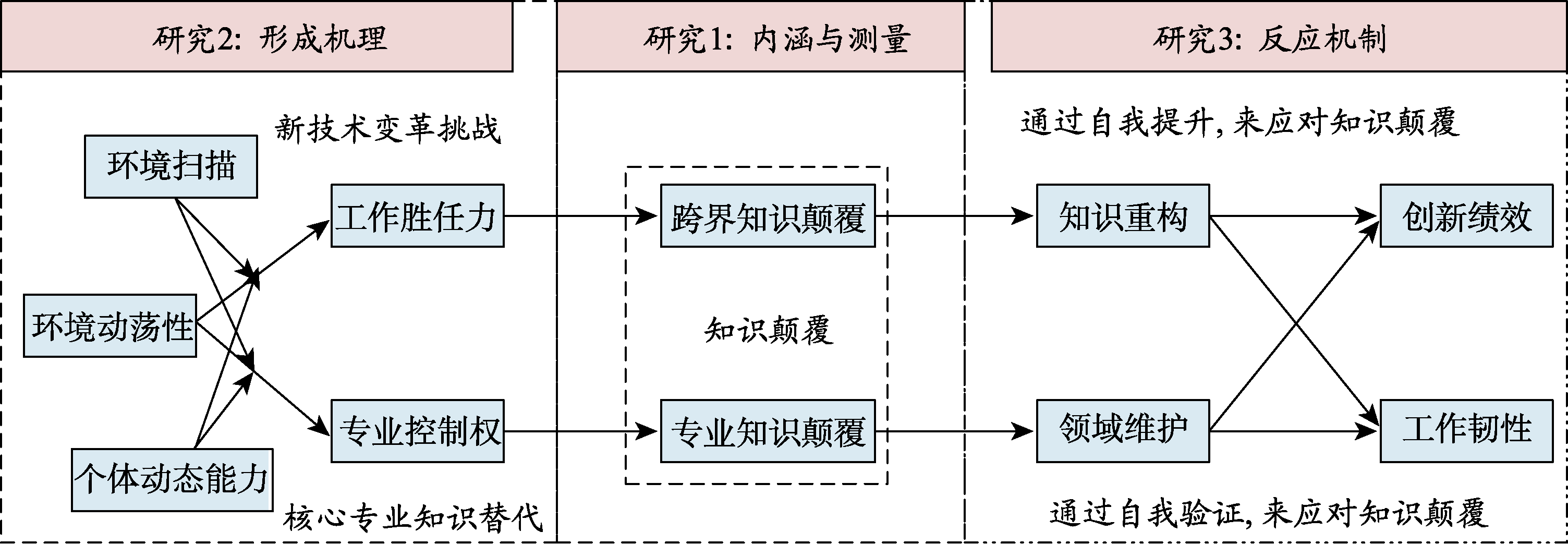
图1 本文整体研究模型
| 维度类型 | 范围 | 知识关系 | 威胁路径 | 知识类型 |
|---|---|---|---|---|
| 跨界知识颠覆 | 跨界领域拓展 | 互补 | 边缘 | 多样性 |
| 专业知识颠覆 | 专业领域深化 | 替代 | 核心 | 异质性 |
表2 跨界知识颠覆与专业知识颠覆的对比
| 维度类型 | 范围 | 知识关系 | 威胁路径 | 知识类型 |
|---|---|---|---|---|
| 跨界知识颠覆 | 跨界领域拓展 | 互补 | 边缘 | 多样性 |
| 专业知识颠覆 | 专业领域深化 | 替代 | 核心 | 异质性 |
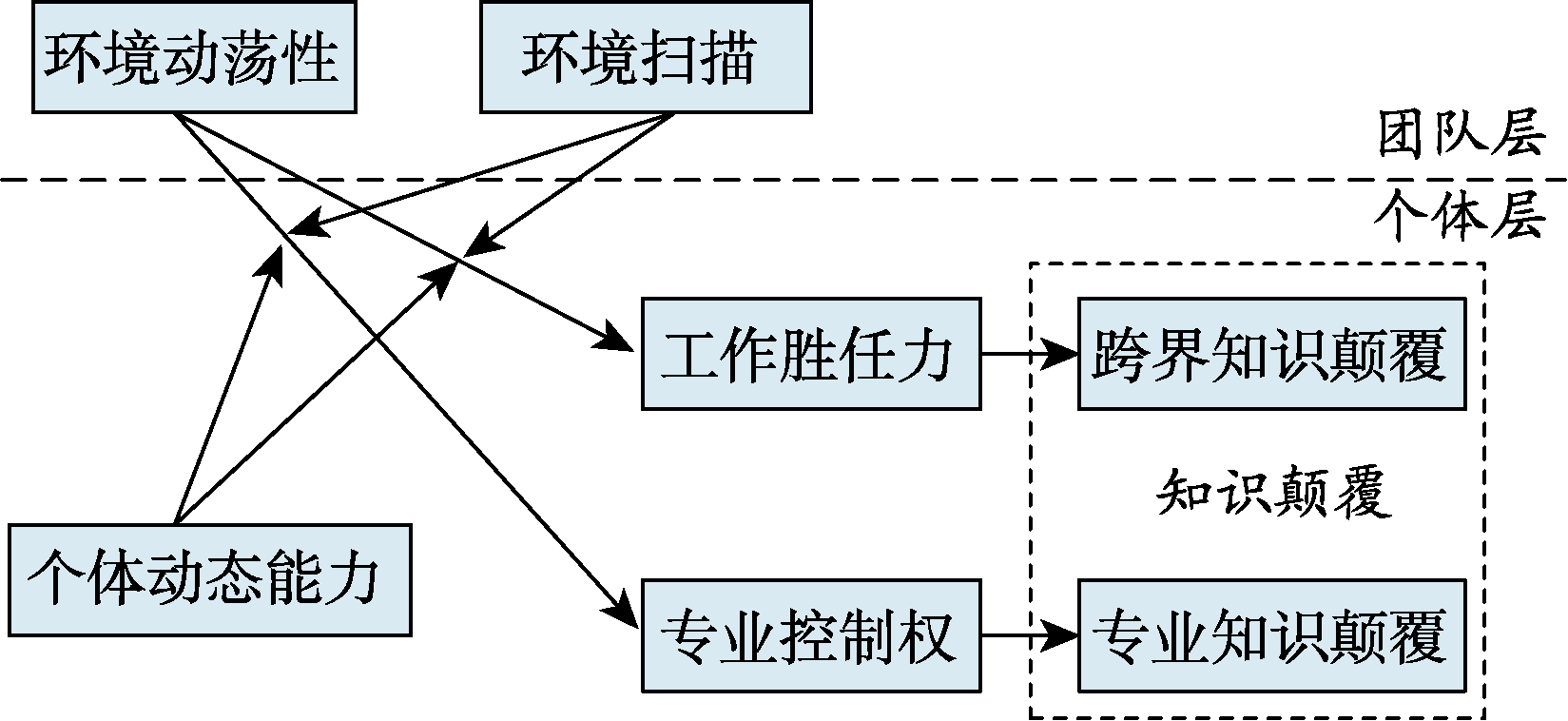
图2 知识颠覆的形成机理模型
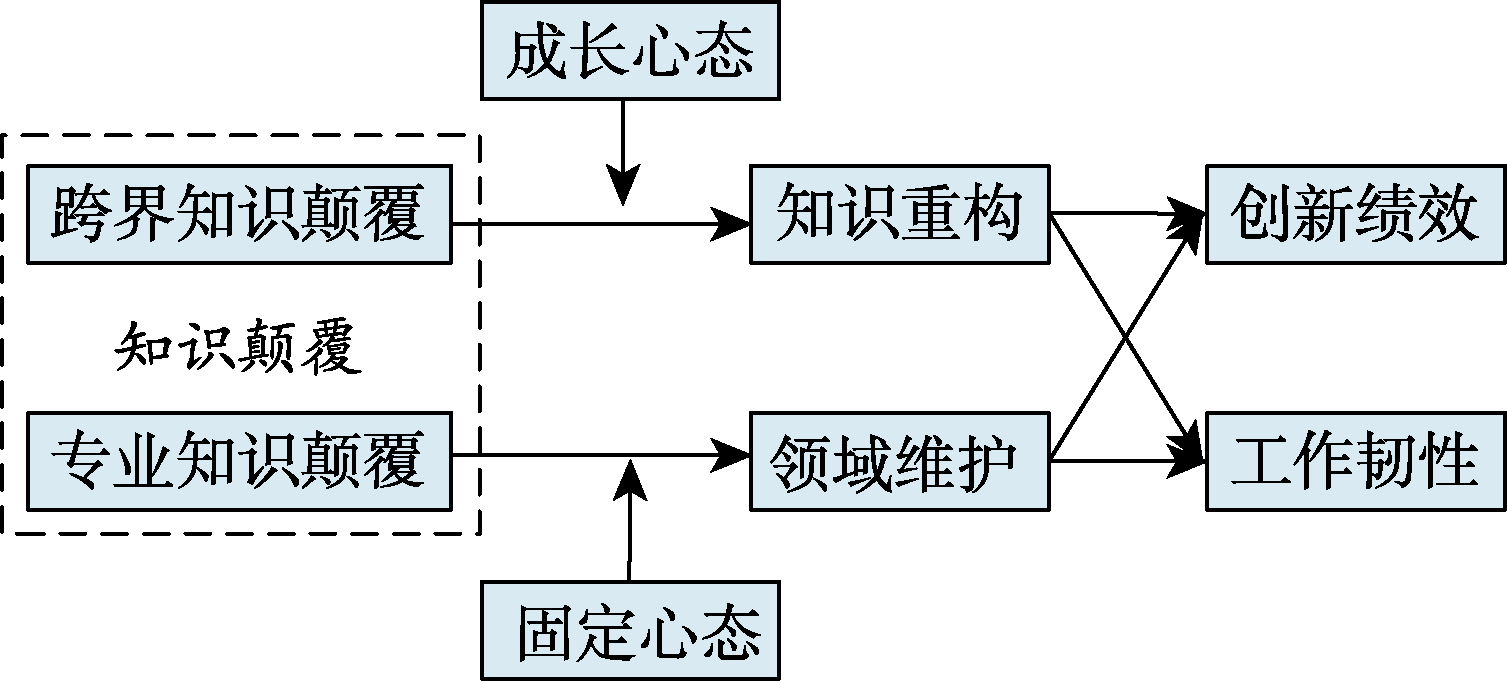
图3 知识颠覆的反应机制模型
| [1] | 曹红军, 赵剑波. (2008). 动态能力如何影响企业绩效——基于中国企业的实证研究. 南开管理评论, 11(6), 54-65. |
| [2] | 曹洲涛, 杨瑞. (2014). 知识领地行为视角下个体知识向组织知识转移的研究. 科学学与科学技术管理, 35(10), 35-42. |
| [3] | 杜俊义, 冯罡. (2020). 技术创新动态能力理论研究综述. 科技管理研究, 40(6), 1-6. |
| [4] | 郭凯明, 王钰冰, 龚六堂. (2023). 劳动供给转变, 有为政府作用与人工智能时代开启. 管理世界, 39(6), 1-15. |
| [5] | 胡汉辉, 潘安成. (2006). 组织知识转移与学习能力的系统研究. 管理科学学报, 9(3), 81-87. |
| [6] | 黄韵瑾, 张荣华. (2020). 内隐理念: 回顾与展望. 心理学进展, 10(7), 943-949. |
| [7] | 蒋兰. (2005). 高层管理者对环境不确定性认知及其结果研究 [博士学位论文]. 电子科技大学, 成都. |
| [8] |
姜荣萍, 何亦名. (2014). 知识心理所有权对知识隐藏的影响机制研究——基于智力型组织的实证调研. 科技进步与对策, 31(14), 128-133.
doi: 10.6049/kjjbydc.2014020587 |
| [9] | 李海, 朱金强, 张勉, 孙琦, 范思敏. (2016). 如何激励多样化的知识员工?——基于一个分类框架和差异激励模型. 科学学与科学技术管理, 37(10), 164-180. |
| [10] | 李纪琛, 刘海建, 李润芝. (2023). 知识异质性对企业创新绩效的影响研究——基于社会关系的调节作用. 华东经济管理, 37(5), 42-51. |
| [11] | 刘欢, 安立仁. (2021). 期望收益, 知识权力感知对员工知识隐藏行为影响研究. 科学决策, 11, 81-89. |
| [12] | 刘璇, 陈晋, 陈梅梅. (2021). 知识多样性及任务依赖性对团队绩效的影响. 系统管理学报, 30(5), 961-970. |
| [13] |
陆欣欣, 涂乙冬. (2018). 分享还是不分享: 社会困境视角下知识分享. 心理科学进展, 26(11), 2057-2067.
doi: 10.3724/SP.J.1042.2018.02057 |
| [14] | 马鹤丹. (2018). 基于区域创新网络的企业知识创新研究. 人民论坛·学术前沿, (5), 92-95. |
| [15] | 欧锦文, 王安生, 叶文平. (2021). 持续性绩效期望落差与OFDI——基于威胁刚性理论视角. 南方经济, 40(12), 112-129. |
| [16] | 饶湖广. (2019). 创新合作伙伴资源异质性与创新绩效的关系研究 [硕士学位论文]. 杭州电子科技大学. |
| [17] | 芮正云, 马喜芳. (2022). 反思性知识重构, 企业即兴能力及其创新效应. 科研管理, 43(9), 176-184. |
| [18] | 汤超颖, 张悦强, 高嘉欣. (2022). 外部异质知识获取与研发团队突破性创造力. 科学学研究, 40(9), 1621-1629. |
| [19] | 王建军, 曹宁, 叶明海. (2020). 多维知识搜寻, 知识重构与企业持续创新——IT 治理的调节作用. 软科学, 34(9), 85-89. |
| [20] |
王娟茹, 李苹. (2020). 外部知识搜索对制造企业技术创新的影响——知识协奏能力的中介作用与创新意愿的调节作用. 科技进步与对策, 37(3), 81-87.
doi: 10.6049/kjjbydc.2019060052 |
| [21] | 王林辉, 钱圆圆, 周慧琳, 董直庆. (2023). 人工智能技术冲击和中国职业变迁方向. 管理世界, 39(11), 74-95. |
| [22] | 王思梦, 雷家骕, 邵云飞. (2023). 外部搜索, 吸收能力与企业突破性创新绩效——环境动荡性的调节作用. 系统工程, 41(2), 35-48. |
| [23] |
王志成, 赵曙明, 杨杰. (2020). 多层次知识隐藏行为的形成与后果: 基于地位竞争的视角. 心理科学进展, 28(6), 893-903.
doi: 10.3724/SP.J.1042.2020.00893 |
| [24] | 王重鸣. (2000). 管理心理学. 人民教育出版社. |
| [25] | 魏江, 王铜安. (2006). 个体、群组、组织间知识转移影响因素的实证研究. 科学学研究, 24(1), 91-97. |
| [26] | 吴晓波, 程心仪, 刘潭飞, 吴东. (2022). 知识耦合与企业技术追赶: 环境动荡性的调节作用. 科学学与科学技术管理, 43(9), 71-88. |
| [27] | 徐宁, 徐鹏, 吴创. (2014). 技术创新动态能力建构及其价值创造效应——来自中小上市公司的经验证据. 科学学与科学技术管理, 35(8), 125-134. |
| [28] |
姚艳虹, 张翠平. (2019). 知识域耦合, 知识创新能力与企业创新绩效——环境不确定性和战略柔性的调节作用. 科技进步与对策, 36(23), 76-84.
doi: 10.6049/kjjbydc.2018110580 |
| [29] | 野中郁次郎, 竹内弘高. (2006). 创造知识的企业. 北京知识产权出版社. |
| [30] | 章长城. (2021). 跨界搜寻, 组织知识重构与创新绩效——组织合法性的调节作用. 井冈山大学学报: 社会科学版, 42(5), 85-91. |
| [31] | 赵红丹, 刘微微. (2020). 知识隐藏: 基于知识图谱的研究述评. 外国经济与管理, 42(5), 121-138. |
| [32] | 赵健宇, 付程, 袭希. (2020). 知识嵌入性, 知识流动与战略联盟结构升级的关系研究. 管理评论, 32(1), 91-106. |
| [33] | 郑江波, 亢姝婧. (2023). 基于知识冗余异质性的研发团队成员协调配置模型. 系统工程学报, 38(1), 131-144. |
| [34] | 朱云鹃, 陈金标. (2023). 跨界搜寻策略, 知识异质度与企业技术创新绩效. 南京审计大学学报, 20(4), 42-50. |
| [35] | 左美云. (2004). 企业信息化主体间的六类知识转移. 计算机系统应用, 8, 72-74. |
| [36] | Abbott A. (1988). The system of professions: An essay on the division of expert labor. University of Chicago Press. |
| [37] |
Alavi M., & Leidner D. E. (2001). Knowledge management and knowledge management systems: Conceptual foundations and research issues. Management Information Systems Quarterly, 25(1), 107-136.
doi: 10.2307/3250961 URL |
| [38] | Albright K. S. (2004). Environmental scanning: Radar for success. Information Management Journal, 38, 38-45. |
| [39] | Ambrosini V., & Bowman C. (2009). Dynamic Capabilities: An exploration of how firms renew their resource base. British Journal of Management, 20(S1), S9-S24. |
| [40] | Amidon Rogers D. M. (1993). Knowledge innovation system: The common language. Journal of Technology Studies, 19(2), 2-8. |
| [41] |
Anderson E. G., & Lewis K. (2014). A dynamic model of individual and collective learning amid disruption. Organization Science, 25(2), 356-376.
doi: 10.1287/orsc.2013.0854 URL |
| [42] |
Anteby M. (2010). Markets, morals, and practices of trade: Jurisdictional disputes in the U.S. commerce in cadavers. Administrative Science Quarterly, 55(4), 606-638.
doi: 10.2189/asqu.2010.55.4.606 URL |
| [43] |
Arora A., Belenzon S., & Sheer L. (2021). Knowledge spillovers and corporate investment in scientific research. American Economic Review, 111(3), 871-898.
doi: 10.1257/aer.20171742 URL |
| [44] | Asrar-ul-Haq M., & Anwar S. (2016). A systematic review of knowledge management and knowledge sharing: Trends, issues, and challenges. Cogent Business & Management, 3(1), 1127744. |
| [45] |
Barley S. R. (1990). The alignment of technology and structure through roles and networks. Administrative Science Quarterly, 35(1), 61-103.
pmid: 10106582 |
| [46] |
Baumeister R. F., Smart L., & Boden J. M. (1996). Relation of threatened egotism to violence and aggression: The dark side of high self-esteem. Psychological Review, 103(1), 5-33.
doi: 10.1037/0033-295x.103.1.5 pmid: 8650299 |
| [47] | Beal R. M. (2000). Competing effectively: Environmental scanning, competitive strategy, and organizational performance in small manufacturing firms. Journal of Small Business Management, 38(1), 27-47. |
| [48] |
Bechky B. A. (2020). Evaluative spillovers from technological change: The effects of “DNA envy” on occupational practices in forensic science. Administrative Science Quarterly, 65(3), 606-643.
doi: 10.1177/0001839219855329 URL |
| [49] |
Benner M. J., & Tushman M. L. (2015). Reflections on the 2013 Decade Award — “Exploitation, exploration, and process management: The productivity dilemma revisited” ten years later. Academy of Management Review, 40(4), 497-514.
doi: 10.5465/amr.2015.0042 URL |
| [50] |
Bontis N. (1998). Intellectual capital: An exploratory study that develops measures and models. Management Decision, 36(2), 63-76.
doi: 10.1108/00251749810204142 URL |
| [51] | Boyatzis R. E. (1982). The competent manager: A model for effective performance. John Wiley & Sons. |
| [52] |
Bucher R., & Strauss A. (1961). Professions in process. American Journal of Sociology, 66(4), 325-334.
doi: 10.1086/222898 URL |
| [53] |
Calantone R., Garcia R., & Dröge C. (2003). The effects of environmental turbulence on new product development strategy planning. Journal of Product Innovation Management, 20(2), 90-103.
doi: 10.1111/jpim.2003.20.issue-2 URL |
| [54] |
Chase W. G., & Simon H. A. (1973). Perception in chess. Cognitive Psychology, 4(1), 55-81.
doi: 10.1016/0010-0285(73)90004-2 URL |
| [55] |
Cohen W. M., & Levinthal D. A. (1990). Absorptive capacity: A new perspective on learning and innovation. Administrative Science Quarterly, 35(1), 128-152.
doi: 10.2307/2393553 URL |
| [56] |
Compagni A., Cappellaro G., & Nigam A. (2024). Responding to professional knowledge disruptions of unmitigable uncertainty: The role of emotions, practices, and moral duty among COVID-19 physicians. Academy of Management Journal, 67(3), 829-861.
doi: 10.5465/amj.2022.0697 URL |
| [57] |
Currie G., Lockett A., Finn R., Martin G., & Waring J. (2012). Institutional work to maintain professional power: Recreating the model of medical professionalism. Organization Studies, 33(7), 937-962.
doi: 10.1177/0170840612445116 URL |
| [58] |
Damanpour F. (1991). Organizational innovation: A meta-analysis of effects of determinants and moderators. Academy of Management Journal, 34(3), 555-590.
doi: 10.2307/256406 URL |
| [59] |
Darban M., Kwak D.-H. A., Deng S. L., Srite M., & Lee S. (2016). Antecedents and consequences of perceived knowledge update in the context of an ERP simulation game: A multi-level perspective. Computers & Education, 103, 87-98.
doi: 10.1016/j.compedu.2016.09.011 URL |
| [60] |
Deng H., Duan S. X., & Wibowo S. (2023). Digital technology driven knowledge sharing for job performance. Journal of Knowledge Management, 27(2), 404-425.
doi: 10.1108/JKM-08-2021-0637 URL |
| [61] |
Dickerson S. S., Gruenewald T. L., & Kemeny M. E. (2004). When the social self is threatened: Shame, physiology, and health. Journal of Personality, 72(6), 1191-1216.
doi: 10.1111/j.1467-6494.2004.00295.x pmid: 15509281 |
| [62] |
Dickerson S. S., & Kemeny M. E. (2004). Acute stressors and cortisol responses: A theoretical integration and synthesis of laboratory research. Psychological Bulletin, 130(3), 355-391.
doi: 10.1037/0033-2909.130.3.355 pmid: 15122924 |
| [63] | Douglas H. (2008). Creating knowledge: A review of research methods in three societal change approaches. Journal of Nonprofit & Public Sector Marketing, 20(2), 141-163. |
| [64] |
Dweck C. S., & Leggett E. L. (1988). A social-cognitive approach to motivation and personality. Psychological Review, 95(2), 256-273.
doi: 10.1037/0033-295X.95.2.256 URL |
| [65] |
Eisenhardt K. M., & Bourgeois L. J. (1988). Politics of strategic decision making in high-velocity environments: Toward a midrange theory. Academy of Management Journal, 31(4), 737-770.
doi: 10.2307/256337 URL |
| [66] |
Eisenhardt K. M., & Martin J. A. (2000). Dynamic capabilities: What are they? Strategic Management Journal, 21(10-11), 1105-1121.
doi: 10.1002/(ISSN)1097-0266 URL |
| [67] | Elenkov D. S. (1997). Differences and similarities in managerial values between U.S. and Russian managers: An empirical study. International Studies of Management & Organization, 27(1), 85-106. |
| [68] |
Ethel A., & Chun W. C. (1993). Environmental scanning by CEOs in two Canadian industries. Journal of the American Society for Information Science, 44(4), 194-203.
doi: 10.1002/(ISSN)1097-4571 URL |
| [69] |
Evans J. (2021). How professionals construct moral authority: Expanding boundaries of expert authority in stem cell science. Administrative Science Quarterly, 66(4), 989-1036.
doi: 10.1177/00018392211011441 URL |
| [70] |
Feng J., & Wang C. (2019). Does abusive supervision always promote employees to hide knowledge? From both reactance and COR perspectives. Journal of Knowledge Management, 23(7), 1455-1474.
doi: 10.1108/JKM-12-2018-0737 URL |
| [71] | Freidson E. (2001). Professionalism, the third logic: On the practice of knowledge. University of Chicago Press. |
| [72] |
Frishammar J., & Hörte S. Å. (2005). Managing external information in manufacturing firms: The impact on innovation performance. Journal of Product Innovation Management, 22(3), 251-266.
doi: 10.1111/jpim.2005.22.issue-3 URL |
| [73] |
Goodrick E., & Reay T. (2011). Constellations of institutional logics: Changes in the professional work of pharmacists. Work and Occupations, 38(3), 372-416.
doi: 10.1177/0730888411406824 URL |
| [74] | Helfat C. E. (2007). Dynamic capabilities: Understanding strategic change in organizations. Blackwell Publishing. |
| [75] |
Issac A. C., Bednall T. C., Baral R., Magliocca P., & Dhir A. (2023). The effects of expert power and referent power on knowledge sharing and knowledge hiding. Journal of Knowledge Management, 27(2), 383-403.
doi: 10.1108/JKM-10-2021-0750 URL |
| [76] |
Jaworski B. J., & Kohli A. K. (1993). Market orientation: Antecedents and consequences. Journal of Marketing, 57(3), 53-70.
doi: 10.1177/002224299305700304 URL |
| [77] |
Kaur V. (2023). Knowledge-based dynamic capabilities: A scientometric analysis of marriage between knowledge management and dynamic capabilities. Journal of Knowledge Management, 27(4), 919-952.
doi: 10.1108/JKM-02-2022-0112 URL |
| [78] | Kemeny M. E., Gruenewald T. L., & Dickerson S. S. (2004). Shame as the emotional response to threat to the social self: Implications for behavior, physiology, and health. Psychological Inquiry, 15(2), 153-160. |
| [79] |
Kogut B., & Zander U. (1992). Knowledge of the firm, combinative capabilities, and the replication of technology. Organization Science, 3(3), 383-397.
doi: 10.1287/orsc.3.3.383 URL |
| [80] | Kohli A. K., & Jaworski B. J. (1990). Market orientation: The construct, research propositions, and managerial implications. Journal of Marketing, 54(2), 1-18. |
| [81] |
Lamont M., & Molnár V. (2002). The study of boundaries in the social sciences. Annual Review of Sociology, 28(1), 167-195.
doi: 10.1146/soc.2002.28.issue-1 URL |
| [82] | Larson M. S. (1977). The rise of professionalism: A sociological analysis. Oakland: University of California Press. |
| [83] |
Laursen K., Masciarelli F., & Prencipe A. (2012). Regions matter: How localized social capital affects innovation and external knowledge acquisition. Organization Science, 23(1), 177-193.
doi: 10.1287/orsc.1110.0650 URL |
| [84] |
Lee C., Lee K., & Pennings J. M. (2001). Internal capabilities, external networks, and performance: A study on technology-based ventures. Strategic Management Journal, 22(6-7), 615-640.
doi: 10.1002/smj.v22:6/7 URL |
| [85] |
Liebeskind J. P., Oliver A. L., Zucker L., & Brewer M. (1996). Social networks, learning, and flexibility: Sourcing scientific knowledge in new biotechnology firms. Organization Science, 7(4), 428-443.
doi: 10.1287/orsc.7.4.428 URL |
| [86] |
Lifshitz-Assaf H. (2017). Dismantling knowledge boundaries at NASA: The critical role of professional identity in open innovation. Administrative Science Quarterly, 63(4), 746-782.
doi: 10.1177/0001839217747876 URL |
| [87] |
Lockett A., Currie G., Finn R., Martin G., & Waring J. (2014). The influence of social position on sensemaking about organizational change. Academy of Management Journal, 57(4), 1102-1129.
doi: 10.5465/amj.2011.0055 URL |
| [88] |
Martin G. P., Currie G., & Finn R. (2009). Reconfiguring or reproducing intra-professional boundaries? Specialist expertise, generalist knowledge and the ‘modernization’ of the medical workforce. Social Science & Medicine, 68(7), 1191-1198.
doi: 10.1016/j.socscimed.2009.01.006 URL |
| [89] |
Maslow A. H. (1943). A theory of human motivation. Psychological Review, 50(4), 370-396.
doi: 10.1037/h0054346 URL |
| [90] |
McClelland D. C. (1973). Testing for competence rather than for “intelligence”. American Psychologist, 28(1), 1-14.
doi: 10.1037/h0034092 pmid: 4684069 |
| [91] | Mirabile R. J. (1997). Everything you wanted to know about competency modeling. Training and Development, 23, 30-33. |
| [92] |
Nelson A. J., & Irwin J. (2014). “Defining what we do—All over again”: Occupational identity, technological change, and the librarian/internet-search relationship. Academy of Management Journal, 57(3), 892-928.
doi: 10.5465/amj.2012.0201 URL |
| [93] |
Nigam A., & Dokko G. (2019). Career resourcing and the process of professional emergence. Academy of Management Journal, 62(4), 1052-1084.
doi: 10.5465/amj.2015.0038 |
| [94] |
Peng H. (2013). Why and when do people hide knowledge? Journal of Knowledge Management, 17(3), 398-415.
doi: 10.1108/JKM-12-2012-0380 URL |
| [95] |
Phelps C., Heidl R., & Wadhwa A. (2012). Knowledge, networks, and knowledge networks: A review and research agenda. Journal of Management, 38(4), 1115-1166.
doi: 10.1177/0149206311432640 URL |
| [96] |
Polidoro Jr F. (2013). The competitive implications of certifications: The effects of scientific and regulatory certifications on entries into new technical fields. Academy of Management Journal, 56(2), 597-627.
doi: 10.5465/amj.2011.0459 URL |
| [97] |
Prieto I. M., Revilla E., & Rodríguez-Prado B. (2009). Building dynamic capabilities in product development: How do contextual antecedents matter? Scandinavian Journal of Management, 25(3), 313-326.
doi: 10.1016/j.scaman.2009.05.005 URL |
| [98] |
Quintas P., Lefrere P., & Jones G. (1997). Knowledge management: A strategic agenda. Long Range Planning, 30(3), 385-391.
doi: 10.1016/S0024-6301(97)90252-1 URL |
| [99] |
Schilling M. A., & Phelps C. C. (2007). Interfirm collaboration networks: The impact of large-scale network structure on firm innovation. Management Science, 53(7), 1113-1126.
doi: 10.1287/mnsc.1060.0624 URL |
| [100] |
Shrauger J. S., & Schohn M. (1995). Self-confidence in college students: Conceptualization, measurement, and behavioral implications. Assessment, 2(3), 255-278.
doi: 10.1177/1073191195002003006 URL |
| [101] | Spencer L. M., & Spencer P. S. M. (2008). Competence at work: Models for superior performance. John Wiley & Sons. |
| [102] |
Staw B. M., Sandelands L. E., & Dutton J. E. (1981). Threat rigidity effects in organizational behavior: A multilevel analysis. Administrative Science Quarterly, 26(4), 501-524.
doi: 10.2307/2392337 URL |
| [103] |
Swann W. B., Jr., & Read S. J. (1981). Self-verification processes: How we sustain our self-conceptions. Journal of Experimental Social Psychology, 17(4), 351-372.
doi: 10.1016/0022-1031(81)90043-3 URL |
| [104] |
Teece D. J. (2007). Explicating dynamic capabilities: The nature and microfoundations of (sustainable) enterprise performance. Strategic Management Journal, 28(13), 1319-1350.
doi: 10.1002/smj.v28:13 URL |
| [105] | Teece D. J., & Pisano G. P. (1994). The dynamic capabilities of firms: An introduction. Industrial and Corporate Change, 3, 537-556. |
| [106] |
Ten Brummelhuis L. L., & Bakker A. B. (2012). A resource perspective on the work-home interface: The work-home resources model. American Psychologist, 67(7), 545-556.
doi: 10.1037/a0027974 pmid: 22506688 |
| [107] |
Todorova G., & Durisin B. (2007). Absorptive capacity: Valuing a reconceptualization. Academy of Management Review, 32(3), 774-786.
doi: 10.5465/amr.2007.25275513 URL |
| [108] |
Tripsas M. (1997). Unraveling the process of creative destruction: Complementary assets and incumbent survival in the typesetter industry. Strategic Management Journal, 18(S1), 119-142.
doi: 10.1002/(ISSN)1097-0266 URL |
| [109] |
Tushman M. L., & Anderson P. (1986). Technological discontinuities and organizational environments. Administrative Science Quarterly, 31(3), 439-465.
doi: 10.2307/2392832 URL |
| [110] |
Velu C. (2015). Knowledge management capabilities of lead firms in innovation ecosystems. AMS Review, 5(3-4), 123-141.
doi: 10.1007/s13162-015-0068-6 URL |
| [111] |
Wang S., & Noe R. A. (2010). Knowledge sharing: A review and directions for future research. Human Resource Management Review, 20(2), 115-131.
doi: 10.1016/j.hrmr.2009.10.001 URL |
| [112] |
Waring J., & Currie G. (2009). Managing expert knowledge: Organizational challenges and managerial futures for the UK medical profession. Organization Studies, 30(7), 755-778.
doi: 10.1177/0170840609104819 URL |
| [113] |
Ye J., Hao B., & Patel P. C. (2016). Orchestrating heterogeneous knowledge: The effects of internal and external knowledge heterogeneity on innovation performance. IEEE Transactions on Engineering Management, 63(2), 165-176.
doi: 10.1109/TEM.2016.2541863 URL |
| [114] | Zan A., Yao Y., & Chen H. (2024). Knowledge search and firm innovation: The roles of knowledge inertia and knowledge integration capability. Technology Analysis & Strategic Management, 36(6), 1150-1165. |
| [115] |
Zhang R., Wang J., & Hao J. X. (2020). How does knowledge heterogeneity affect transactive memory system in innovation? Evidence from a field study. Journal of Knowledge Management, 24(8), 1965-1985.
doi: 10.1108/JKM-01-2020-0008 URL |
| [116] |
Zhang S., & Wang W. (2012). Inter-firm networks, organizational learning and knowledge updating: An empirical study. Physics Procedia, 24, 1238-1242.
doi: 10.1016/j.phpro.2012.02.185 URL |
| [117] |
Zollo M., & Winter S. G. (2002). Deliberate learning and the evolution of dynamic capabilities. Organization Science, 13(3), 339-351.
doi: 10.1287/orsc.13.3.339.2780 URL |
| [1] | 朱艳丽;席思思;吴艳红. 自传体叙事中的自我欺骗:个体的自我认同策略[J]. 心理科学进展, 2016, 24(12): 1917-1925. |
| [2] | 代涛涛;佐斌;徐富明;索玉贤. 过分自信的进化模型[J]. 心理科学进展, 2014, 22(4): 693-701. |
| [3] | 刘肖岑;桑标;窦东徽. 自我提升的利与弊:理论、实证及应用[J]. 心理科学进展, 2011, 19(6): 883-895. |
| [4] | 韩立丰;王重鸣. 自我验证与人际一致性:团队多样性利用的新视角[J]. 心理科学进展, 2011, 19(1): 73-84. |
| [5] | 王轶楠. 有关自我增强跨文化普遍性的争论[J]. 心理科学进展, 2005, 13(6): 822-827. |
| [6] | 董妍,俞国良. 自我提升的研究现状与展望[J]. 心理科学进展, 2005, 13(2): 178-185. |
| [7] | 辜美惜. Swann自我验证理论及实证研究简介[J]. 心理科学进展, 2004, 12(3): 423-428. |
| [8] | 李艳梅;付建斌. 自我增强与自我验证[J]. 心理科学进展, 1996, 4(3): 24-29. |
| 阅读次数 | ||||||
|
全文 |
|
|||||
|
摘要 |
|
|||||
