
ISSN 1671-3710
CN 11-4766/R
主办:中国科学院心理研究所
出版:科学出版社
CN 11-4766/R
主办:中国科学院心理研究所
出版:科学出版社
心理科学进展 ›› 2021, Vol. 29 ›› Issue (6): 967-977.doi: 10.3724/SP.J.1042.2021.00967 cstr: 32111.14.2021.00967
彭坚, 曹兵兵( )
)
收稿日期:2020-05-27
出版日期:2021-06-15
发布日期:2021-04-25
基金资助:
PENG Jian, CAO Bingbing()
Received:2020-05-27
Online:2021-06-15
Published:2021-04-25
摘要:
主动工作行为, 作为推动组织与时俱进、健康发展的重要保障, 已成为组织行为研究领域的热点主题。然而, 以往研究在探索追随者主动工作行为的上行影响时, 却出现了悖论: 一些研究发现主动工作行为能激发领导者的积极评价, 另一些研究却指出主动工作行为会招致领导者的负面对待。为解释此矛盾现象, 基于内隐追随理论建构了一个主动工作行为的上行影响模型。该理论模型指出, 领导者的内隐追随信念决定了追随者主动工作行为究竟引发领导者的何种反应。先介绍领导者主动型内隐追随的概念与测量, 然后论证追随者主动工作行为与领导者主动型内隐追随的契合程度对领导者的影响, 在此基础上提出领导者核心情绪(高兴、紧张、沮丧与满足)的中介作用。文章为后续主动工作行为实证研究提供了一个理论分析框架。
中图分类号:
彭坚, 曹兵兵. (2021). 追随者主动工作行为的上行影响:内隐追随视角. 心理科学进展 , 29(6), 967-977.
PENG Jian, CAO Bingbing. (2021). The bottom-up effect of followers' proactive work behavior: An implicit followership perspective. Advances in Psychological Science, 29(6), 967-977.
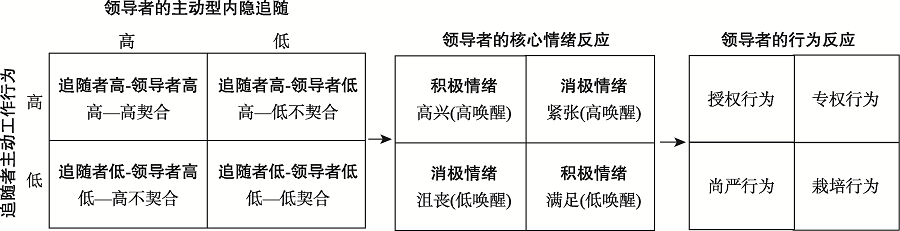
图1 基于内隐追随的主动工作行为上行影响模型
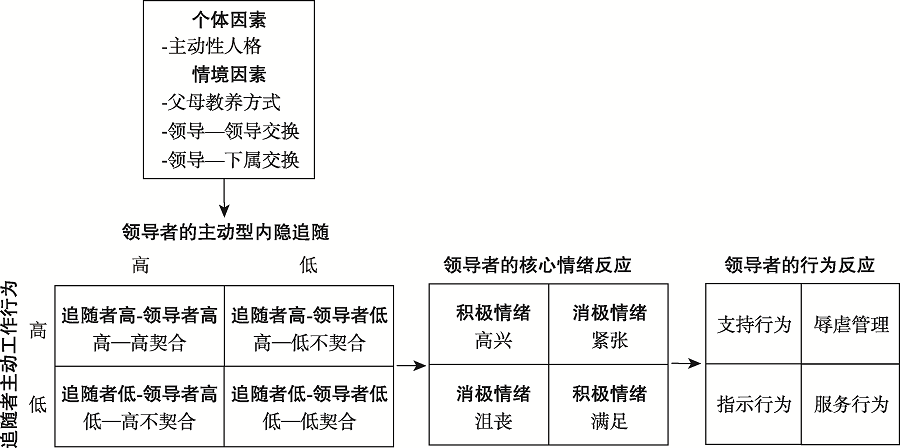
图2 理论模型拓展
| [1] | 曹元坤, 祝振兵. (2015). 内隐追随理论: 概念, 测量, 前因及后果. 心理科学进展, 23(2), 280-288. |
| [2] | 陈鹏宇, 孙剑, 贾铖. (2020). 越级指挥的代价: 高管越级指挥对中层领导多重交换关系的影响. 中国人力资源开发, 37(3), 43-57. |
| [3] | 段锦云, 凌斌. (2011). 中国背景下员工建言行为结构及中庸思维对其的影响. 心理学报, 43(10), 1185-1197. |
| [4] | 刘超, 刘军, 陈星汶, 李巧, 朱丽. (2020). 本土组织情境下上下级匹配模型的构建与探讨. 中国人力资源开发, 37(3), 58-77. |
| [5] | 刘德鹏, 贾良定, 尤树洋, 赵广军. (2020). 下属更加偏爱与自己相似的上级吗? 中国情境下同乡与同龄的差异化作用. 中国人力资源开发, 37(2), 34-52. |
| [6] | 彭坚, 王霄. (2015). 追随力认知图式: 概念解析与整合模型. 心理科学, 38(4), 822-827. |
| [7] | 彭坚, 王震. (2018). 做上司的“意中人”:负担还是赋能?追随原型-特质匹配的双刃剑效应. 心理学报, 50(2), 216-225. |
| [8] | 隋杨, 王辉, 岳旖旎, Fred Luthans. (2012). 变革型领导对员工绩效和满意度的影响: 心理资本的中介作用及程序公平的调节作用. 心理学报, 44(9), 1217-1230. |
| [9] | 陶厚永, 曹伟. (2019). 基于对偶心理定位的领导-追随行为模式及其实证研究. 珞珈管理评论, 21(1), 91-108. |
| [10] | 陶厚永, 李薇, 陈建安, 李玲. (2014). 领导-追随行为互动研究: 对偶心理定位的视角. 中国工业经济, (12), 104-117. |
| [11] | 周婉茹, 周丽芳, 郑伯埙, 任金刚. (2010). 专权与尚严之辨: 再探威权领导的内涵与恩威并济的效果. 本土心理学研究, 34, 223-284. |
| [12] | 周琰喆, 李原. (2020). 基于人格特质视角的员工建言行为研究: 回顾与展望. 中国人力资源开发, 37(10), 33-51. |
| [13] | Bai, Y., Dong, Z., Liu, H., & Liu, S. (2017). We may be different, but I can help you: The effects of leaders' political skills on leader-follower power distance value incongruence and withdrawal behavior. Journal of Leadership & Organizational Studies, 24(2), 216-229. |
| [14] |
Benson, A. J., Hardy, J., & Eys, M. (2016). Contextualizing leaders' interpretations of proactive followership. Journal of Organizational Behavior, 37(7), 949-966.
doi: 10.1002/job.2077 URL |
| [15] |
Burris, E. R. (2012). The risks and rewards of speaking up: Managerial responses to employee voice. Academy of Management Journal, 55(4), 851-875.
doi: 10.5465/amj.2010.0562 URL |
| [16] |
Carsten, M. K., Uhl-Bien, M., West, B. J., Patera, J. L., & McGregor, R. (2010). Exploring social constructions of followership: A qualitative study. Leadership Quarterly, 21(3), 543-562.
doi: 10.1016/j.leaqua.2010.03.015 URL |
| [17] | Chaleff, I. (1995). The courageous follower: Standing up to and for our leaders. San Francisco, Calif: Berrett-Koehler Publications. |
| [18] |
Crant, J. M. (2000). Proactive behavior in organizations. Journal of Management, 26(3), 435-462.
doi: 10.1177/014920630002600304 URL |
| [19] |
de Vos, A., de Clippeleer, I., & Dewilde, T. (2009). Proactive career behaviours and career success during the early career. Journal of Occupational and Organizational Psychology, 82(4), 761-777.
doi: 10.1348/096317909X471013 URL |
| [20] |
Eisenberger, R., Stinglhamber, F., Vandenberghe, C., Sucharski, I. L., & Rhoades, L. (2002). Perceived supervisor support: Contributions to perceived organizational support and employee retention. Journal of Applied Psychology, 87(3), 565-573.
pmid: 12090614 |
| [21] |
Epitropaki, O., Sy, T., Martin, R., Tram-Quon, S., & Topakas, A. (2013). Implicit leadership and followership theories “in the wild”: Taking stock of information-processing approaches to leadership and followership in organizational settings. The Leadership Quarterly, 24(6), 858-881.
doi: 10.1016/j.leaqua.2013.10.005 URL |
| [22] |
Festinger, L. (1954). A theory of social comparison processes. Human Relations, 7(2), 117-140.
doi: 10.1177/001872675400700202 URL |
| [23] |
Flanagan, J. C. (1954). The critical incident technique. Psychological Bulletin, 51(4), 327-358.
doi: 10.1037/h0061470 URL |
| [24] | Frese, M., & Fay, D. (2001). Personal initiative: An active performance concept for work in the 21st century. In B. Staw & R. Sutton (Eds.), Research in organizational behavior (Vol. 23, pp.133-187). Oxford: Elsevier Science Ltd. |
| [25] |
Fuller, B., Marler, L. E., Hester, K., & Otondo, R. F. (2015). Leader reactions to follower proactive behavior: Giving credit when credit is due. Human Relations, 68(6), 879-898.
doi: 10.1177/0018726714548235 URL |
| [26] |
Gong, Y., Cheung, S.-Y., Wang, M., & Huang, J.-C. (2012). Unfolding the proactive process for creativity: Integration of the employee proactivity, information exchange, and psychological safety perspectives. Journal of Management, 38(5), 1611-1633.
doi: 10.1177/0149206310380250 URL |
| [27] |
Grant, A. M., Parker, S., & Collins, C. (2009). Getting credit for proactive behavior: Supervisor reactions depend on what you value and how you feel. Personnel Psychology, 62(1), 31-55.
doi: 10.1111/peps.2009.62.issue-1 URL |
| [28] | Greenleaf, R. K. (1977). Servant leadership: A journey into the nature of legitimate power and greatness. New York, NY: Paulist Press. |
| [29] |
Hakimi, N., van Knippenberg, D., & Giessner, S. (2010). Leader empowering behaviour: The leader's perspective. British Journal of Management, 21(3), 701-716.
doi: 10.1111/j.1467-8551.2010.00703.x URL |
| [30] |
House, R. J. (1996). Path-goal theory of leadership: Lessons, legacy, and a reformulated theory. Leadership Quarterly, 7(3), 323-352.
doi: 10.1016/S1048-9843(96)90024-7 URL |
| [31] | Junker, N. M., Stegmann, S., Braun, S., & Dick, R. V. (2016). The ideal and the counter-ideal follower — Advancing implicit followership theories. Leadership & Organization Development Journal, 37(8), 1205-1222. |
| [32] |
Keller T. (1999). Images of the familiar: Individual differences and implicit leadership theories. The Leadership Quarterly, 10(4), 589-607.
doi: 10.1016/S1048-9843(99)00033-8 URL |
| [33] | Kelley, R. E. (1988). In praise of followers. Harvard Business Review, 66(6), 142-148. |
| [34] |
Khan, A. K., Moss, S., Quratulain, S., & Hameed, I. (2016). When and how subordinate performance leads to abusive supervision: A social dominance perspective. Journal of Management, 44(7), 2801-2826.
doi: 10.1177/0149206316653930 URL |
| [35] | Leach, D. J., Wall, T. D., & Jackson, P. R. (2011). The effect of empowerment on job knowledge: An empirical test involving operators of complex technology. Journal of Occupational & Organizational Psychology, 76(1), 27-52. |
| [36] | Liden, R. C., & Graen, G. (1980). Generalizability of the vertical dyad linkage model of leadership. Academy of Management Journal, 23(3), 451-465. |
| [37] |
Liden, R. C., Wayne, S. J., & Stilwell, D. (1993). A longitudinal study on the early development of leader-member exchanges. Journal of Applied Psychology, 78(4), 662-674.
doi: 10.1037/0021-9010.78.4.662 URL |
| [38] |
Mawritz, M. B., Greenbaum, R. L., Butts, M. M., & Graham, K.A (2017). I just can't control myself: A self-regulation perspective on the abuse of deviant employees. Academy of Management Journal, 60(4), 1482-1503.
doi: 10.5465/amj.2014.0409 URL |
| [39] |
Parker, S. K., & Collins, C. G. (2010). Taking stock: Integrating and differentiating multiple proactive behaviors. Journal of Management, 36(3), 633-662.
doi: 10.1177/0149206308321554 URL |
| [40] |
Parker, S. K., Williams, H. M., & Turner, N. (2006). Modeling the antecedents of proactive behavior at work. Journal of Applied Psychology, 91(3), 636-652.
doi: 10.1037/0021-9010.91.3.636 URL |
| [41] |
Russell, J. A. (2003). Core affect and the psychological construction of emotion. Psychological Review, 110(1), 145-172.
pmid: 12529060 |
| [42] | Sun, J., Li, W.-D., Li, Y., Liden, R. C., Li, S., & Zhang, X. (2020). Unintended consequences of being proactive? Linking proactive personality to coworker envy, helping, and undermining, and the moderating role of prosocial motivation. Journal of Applied Psychology. http://dx.doi.org/10.1037/apl0000494 |
| [43] |
Sun, S., & van Emmerik, H. I. (2015). Are proactive personalities always beneficial? Political skill as a moderator. Journal of Applied Psychology, 100(3), 966-975.
doi: 10.1037/a0037833 URL |
| [44] |
Sy, T. (2010). What do you think of followers? Examining the content, structure, and consequences of implicit followership theories. Organizational Behavior and Human Decision Processes, 113(2), 73-84.
doi: 10.1016/j.obhdp.2010.06.001 URL |
| [45] | Tepper, B. J. (2000). Consequences of abusive supervision. Academy of Management Journal, 43(2), 178-190. |
| [46] |
Tepper, B. J., Dimotakis, N., Lambert, L. S., Koopman, J., Matta, F. K., Park, H. M., & Goo, W. (2018). Examining follower responses to transformational leadership from a dynamic, person-environment fit perspective. Academy of Management Journal, 61(4), 1343-1368.
doi: 10.5465/amj.2014.0163 URL |
| [47] |
van Gils, S., van Quaquebeke, N., & van Knippenberg, D. (2010). The X-factor: On the relevance of implicit leadership and followership theories for leader-member exchange agreement. European Journal of Work and Organizational Psychology, 19(3), 333-363.
doi: 10.1080/13594320902978458 URL |
| [48] | Wang, X., & Peng, J. (2016). The effect of implicit-explicit followership congruence on benevolent leadership: Evidence from Chinese family firms. Frontiers in Psychology, 7, 812. |
| [49] |
Wei, X., Zhang, Z.-X., & Chen, X.-P. (2015). I will speak up if my voice is socially desirable: A moderated mediating process of promotive versus prohibitive voice. Journal of Applied Psychology, 100(5), 1641-1652.
doi: 10.1037/a0039046 URL |
| [50] | Weiss, H. M., & Cropanzano, R. (1996). Affective events theory: A theoretical discussion of the structure, causes and consequences of affective experiences at work. In B. M. Straw & L. L. Cummings (Eds.), Research on organizational behavior (Vol 18, pp.1-74). US: Elsevier Science/JAI Press. |
| [51] |
Whiteley, P., Sy, T., & Johnson, S. K. (2012). Leaders' conceptions of followers: Implications for naturally occurring Pygmalion effects. The Leadership Quarterly, 23(5), 822-834.
doi: 10.1016/j.leaqua.2012.03.006 URL |
| [52] |
Zhang, W., Hui, W., & Pearce, C. L. (2014). Consideration for future consequences as an antecedent of transformational leadership behavior: The moderating effects of perceived dynamic work environment. The Leadership Quarterly, 25(2), 329-343.
doi: 10.1016/j.leaqua.2013.09.002 URL |
| [53] |
Zhang, Y., Waldman, D. A., Han, Y.-L., & Li, X.-B. (2014). Paradoxical leader behaviors in people management: Antecedents and consequences. Academy of Management Journal, 58(2), 538-566.
doi: 10.5465/amj.2012.0995 URL |
| [54] |
Zhang, Z., Wang, M., & Shi, J. (2012). Leader-follower congruence in proactive personality and work outcomes: The mediating role of leader-member exchange. Academy of Management Journal, 55(1), 111-130.
doi: 10.5465/amj.2009.0865 URL |
| [1] | 高伟, 李艳萍, 黄悦媛, 袁加锦. 目标与情境转换对情绪调节灵活性的作用机制[J]. 心理科学进展, 2025, 33(2): 202-211. |
| [2] | 方霞, 潘之禾. 动态序列情境对面部表情知觉的影响和作用机制[J]. 心理科学进展, 2025, 33(1): 1-10. |
| [3] | 贾云丞, 程刚, 丁芳媛, 陈加, 龙女, 陈玉荣, 林楠. 对中性婴儿面孔注意偏向与表情不确定性的关系[J]. 心理科学进展, 2024, 32(9): 1393-1407. |
| [4] | 梁淑静, 杨光勇. 穷则思变, 富则思安? 金钱稀缺与富足感知对个体风险决策的影响[J]. 心理科学进展, 2024, 32(8): 1233-1249. |
| [5] | 常茜芮, 何蔚祺. 网络游戏成瘾者的情绪加工异常[J]. 心理科学进展, 2024, 32(7): 1152-1163. |
| [6] | 李俊朋, 周临舒, 江俊, 王丹妮, 蒋存梅. 音乐对亲社会行为的影响及其作用机制[J]. 心理科学进展, 2024, 32(7): 1179-1194. |
| [7] | 詹紫薇, 王梦梦, 索涛, 蒋艳菊. “一个连续过程”与“三个阶段”:抑郁青少年情绪失调的原因探析[J]. 心理科学进展, 2024, 32(6): 928-938. |
| [8] | 冯攀, 赵恒越, 姜雨矇, 张悦彤, 冯廷勇. 催产素影响条件化恐惧情绪加工的认知机制及神经基础[J]. 心理科学进展, 2024, 32(4): 557-567. |
| [9] | 周琦玮, 李倩, 梁爽. 员工对企业数字化转型的反应研究: 基于压力的理论视角[J]. 心理科学进展, 2024, 32(4): 594-615. |
| [10] | 岳佳莹, 刘欣怡, 张孟可, 陈旭. 母亲的依恋风格影响对婴儿敏感性的认知过程[J]. 心理科学进展, 2024, 32(4): 627-638. |
| [11] | 车强燕, 孙韵琳, 靳佳, 朱春燕, 汪凯, 叶榕, 余凤琼. 神经反馈增强积极情绪在抑郁症治疗中的应用[J]. 心理科学进展, 2024, 32(2): 342-363. |
| [12] | 吴朝毅, 王振. 抑郁症情绪失调的动态特征:情绪动力学的视角[J]. 心理科学进展, 2024, 32(2): 364-385. |
| [13] | 白新文, 齐舒婷, 王琢钧, 任思羽, 孙文. 夙敌之争影响决策者创新识别的双刃剑效应及其认知深度和广度机制[J]. 心理科学进展, 2024, 32(12): 1961-1979. |
| [14] | 莫李澄, 李奇, 张丹丹. 婴儿对情绪信息的加工:认知发展特征及脑机制[J]. 心理科学进展, 2024, 32(12): 2100-2108. |
| [15] | 陆敏婕, 王苏宜, 陈晓媛. 网络极端情绪表达和传播的文化差异:辩证思维的影响[J]. 心理科学进展, 2024, 32(11): 1757-1767. |
| 阅读次数 | ||||||
|
全文 |
|
|||||
|
摘要 |
|
|||||
