

ISSN 1671-3710
CN 11-4766/R
主办:中国科学院心理研究所
出版:科学出版社
CN 11-4766/R
主办:中国科学院心理研究所
出版:科学出版社
心理科学进展 ›› 2026, Vol. 34 ›› Issue (6): 919-931.doi: 10.3724/SP.J.1042.2026.0919 cstr: 32111.14.2026.0919
• 研究构想 • 下一篇
宋方兴1( ), 冯广1, 鲍敏2,3()
收稿日期:2025-12-22
出版日期:2026-06-15
发布日期:2026-04-17
通讯作者:
宋方兴, E-mail: songfangxing@ahmu.edu.cn;基金资助:
SONG Fangxing1(), FENG Guang1, BAO Min2,3()
Received:2025-12-22
Online:2026-06-15
Published:2026-04-17
摘要:
眼优势可塑性是大脑可塑性领域研究的热门问题。短时程单眼剥夺研究发现成人仍具有眼优势可塑性。目前, 如何有效地重塑成人眼优势仍是亟待解决的问题, 这与成年弱视的治疗密切相关。奖赏能够调节大脑可塑性, 奖赏与训练的结合能够提升学习效率、促进神经康复。然而, 奖赏是否能与短时程单眼剥夺相结合以促进成人眼优势的重塑目前尚不清楚, 其作用机制尚不明确。本研究拟采用行为与脑电从知觉和神经眼优势两个层面揭示奖赏增强单眼剥夺效应的现象; 结合行为、fMRI和TMS技术阐明奖赏增强单眼剥夺效应的机制; 对比有无奖赏的短时程单眼剥夺范式, 验证引入奖赏的单眼剥夺对成年弱视的矫正效果。研究结果有助于丰富我们对大脑可塑性的认识, 推动成人眼优势重塑和弱视矫正的方法学创新。
中图分类号:
宋方兴, 冯广, 鲍敏. (2026). 奖赏对短时程单眼剥夺效应的影响及机制. 心理科学进展 , 34(6), 919-931.
SONG Fangxing, FENG Guang, BAO Min. (2026). The impact and mechanism of reward on short-term monocular deprivation effect. Advances in Psychological Science, 34(6), 919-931.
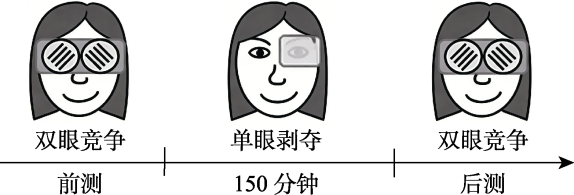
图1 短时程单眼剥夺实验流程图
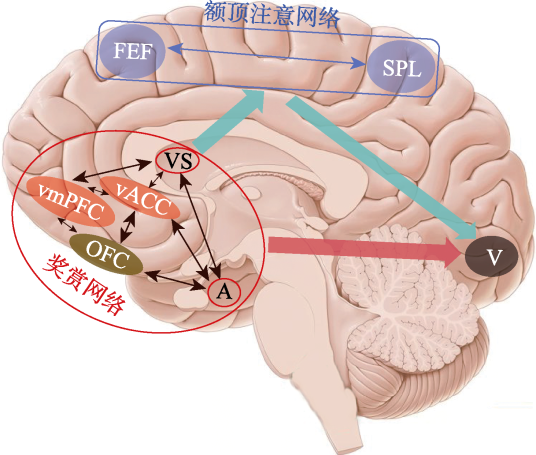
图2 奖赏调节短时程单眼剥夺效应的双通路模型图。我们假设, 奖赏能够通过两条路径来调节短时程单眼剥夺效应:一方面, 奖赏可以通过调控注意来调节单眼剥夺效应(绿色箭头所示); 另一方面, 奖赏或许可以不依赖于注意直接对单眼剥夺效应进行调节(红色箭头所示)。图中显示了奖赏与注意的神经基础:其中, 奖赏加工网络包含腹内侧前额叶皮层(ventromedial prefrontal cortex, vmPFC)、眶额叶皮层(orbitofrontal cortex, OFC)和腹侧前扣带回皮层(ventral anterior cingulate cortex, vACC)为主的皮层区域以及腹侧纹状体(ventral striatum, VS)和杏仁核(amygdala, A)等皮下区域; 而负责加工自上而下注意的额顶注意网络主要由额叶眼动区(FEF)和顶上小叶(SPL)等脑区组成。V代表视觉皮层。彩图见电子版。
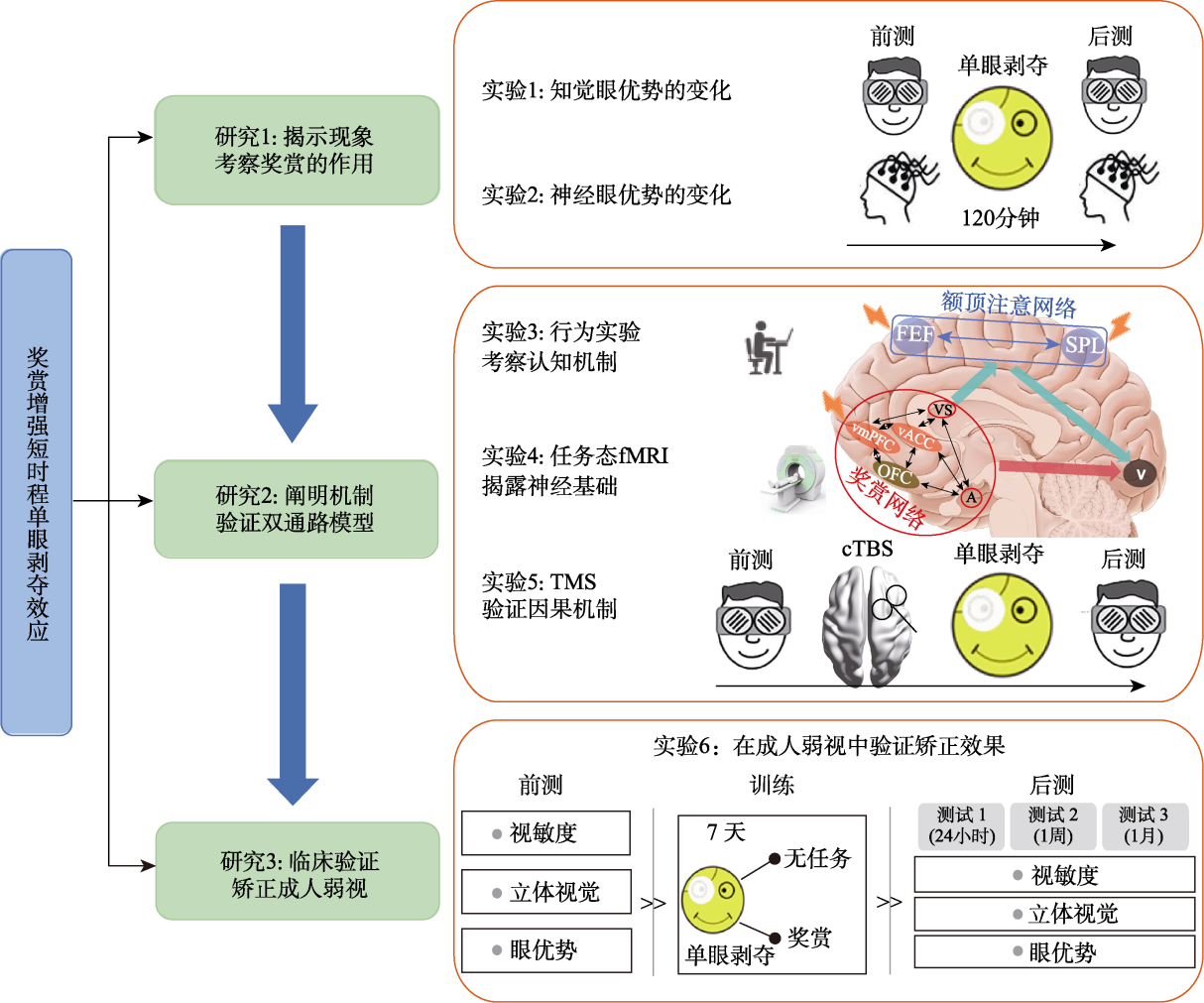
图3 研究总体框架图
| [1] |
宋方兴, 王珏, 鲍敏. (2023). 从不平衡的视觉输入到不平衡的视觉注意:探寻短时程眼优势可塑性的神经机制. 心理科学进展, 31(10), 1873-1882. https://doi.org/10.3724/SP.J.1042.2023.01873
doi: 10.3724/SP.J.1042.2023.01873 URL |
| [2] | 王宴庆, 陈安涛, 胡学平, 尹首航. (2019). 奖赏通过增强信号监测提升认知控制. 心理学报, 51(01), 48-57. https://doi.org/10.3724/SP.J.1041.2019.00048 |
| [3] | 周星, 郝爽, 赵立立, 何蔚祺. (2023). 奖赏学习对非目标情绪面孔注意捕获的影响. 心理科学, 46(06), 1298-1304. https://doi.org/10.16719/j.cnki.1671-6981.20230603 |
| [4] |
Acquafredda, M., Kurzawski, J. W., Biagi, L., Tosetti, M., Morrone, M. C., & Binda, P. (2025). The pulvinar regulates plasticity in human visual cortex. Science Advances, 11(48), eadw9988. https://doi.org/10.1126/sciadv.adw9988
doi: 10.1126/sciadv.adw9988 URL |
| [5] |
Anderson, B. A. (2017). Reward processing in the value-driven attention network: Reward signals tracking cue identity and location. Social Cognitive Affective Neuroscience, 12(3), 461-467. https://doi.org/10.1093/scan/nsw141
doi: 10.1093/scan/nsw141 URL |
| [6] |
Anderson, B. A., Kim, H., Kim, A. J., Liao, M. R., Mrkonja, L., Clement, A., & Grégoire, L. (2021). The past, present, and future of selection history. Neuroscience & Biobehavioral Reviews, 130, 326-350. https://doi.org/10.1016/j.neubiorev.2021.09.004
doi: 10.1016/j.neubiorev.2021.09.004 URL |
| [7] |
Anderson, B. A., Laurent, P. A., & Yantis, S. (2011). Value- driven attentional capture. Proceedings of the National Academy of Sciences, 108(25), 10367-10371. https://doi.org/10.1073/pnas.1104047108
doi: 10.1073/pnas.1104047108 URL |
| [8] |
Axelrod, C. J., Gordon, S. P., & Carlson, B. A. (2023). Integrating neuroplasticity and evolution. Current Biology, 33(8), R288-293. https://doi.org/10.1016/j.cub.2023.03.002
doi: 10.1016/j.cub.2023.03.002 URL |
| [9] |
Bai, J., Dong, X., He, S., & Bao, M. (2017). Monocular deprivation of Fourier phase information boosts the deprived eye's dominance during interocular competition but not interocular phase combination. Neuroscience, 352, 122-130. https://doi.org/10.1016/j.neuroscience.2017.03.053
doi: S0306-4522(17)30228-2 URL pmid: 28391010 |
| [10] |
Baldwin, A. S., Finn, A. E., Green, H. M., Gant, N., & Hess, R. F. (2022). Exercise does not enhance short-term deprivation-induced ocular dominance plasticity: Evidence from dichoptic surround suppression. Vision Research, 201, 108123. https://doi.org/10.1016/j.visres.2022.108123
doi: 10.1016/j.visres.2022.108123 URL |
| [11] | Bangerter, A. (1953). Aus der Praxis-Für die Praxis. Ophthalmologica, 125(4-5), 398-405. |
| [12] |
Baroncelli, L., Bonaccorsi, J., Milanese, M., Bonifacino, T., Giribaldi, F., Manno, I., ... Sale, A. (2012). Enriched experience and recovery from amblyopia in adult rats: Impact of motor, social and sensory components. Neuropharmacology, 62(7), 2388-2397.
doi: 10.1016/j.neuropharm.2012.02.010 pmid: 22532989 |
| [13] |
Baroncelli, L., Sale, A., Viegi, A., Vetencourt, J. F. M., De Pasquale, R., Baldini, S., & Maffei, L. (2010). Experience- dependent reactivation of ocular dominance plasticity in the adult visual cortex. Experimental Neurology, 226(1), 100-109.
doi: 10.1016/j.expneurol.2010.08.009 pmid: 20713044 |
| [14] |
Binda, P., Kurzawski, J. W., Lunghi, C., Biagi, L., Tosetti, M., & Morrone, M. C. (2018). Response to short-term deprivation of the human adult visual cortex measured with 7T BOLD. eLife, 7, e40014. https://doi.org/10.7554/eLife.40014
doi: 10.7554/eLife.40014 URL |
| [15] | Binda, P., & Lunghi, C. (2017). Short-term monocular deprivation enhances physiological pupillary oscillations. Neural Plasticity, (1), 6724631. https://doi.org/10.1155/2017/6724631 |
| [16] |
Boytsova, Y. A., & Danko, S. (2010). EEG differences between resting states with eyes open and closed in darkness. Human Physiology, 36(3), 367-369. https://doi.org/10.1134/S0362119710030199
doi: 10.1134/S0362119710030199 URL |
| [17] |
Castaldi, E., Lunghi, C., & Morrone, M. C. (2020). Neuroplasticity in adult human visual cortex. Neuroscience & Biobehavioral Reviews, 112, 542-552. https://doi.org/10.1016/j.neubiorev.2020.02.028
doi: 10.1016/j.neubiorev.2020.02.028 URL |
| [18] |
Cazzoli, D., Wurtz, P., Müri, R. M., Hess, C. W., & Nyffeler, T. (2009). Interhemispheric balance of overt attention: A theta burst stimulation study. European Journal of Neuroscience, 29(6), 1271-1276. https://doi.org/10.1111/j.1460-9568.2009.06665.x
doi: 10.1111/j.1460-9568.2009.06665.x URL pmid: 19302162 |
| [19] |
Chelazzi, L., Perlato, A., Santandrea, E., & Della Libera, C. (2013). Rewards teach visual selective attention. Vision Research, 85, 58-72.
doi: 10.1016/j.visres.2012.12.005 pmid: 23262054 |
| [20] | Chen, X., Chen, S., Kong, D., Wei, J., Mao, Y., Lin, W., ... Zhou, J. (2020). Action video gaming does not influence short-term ocular dominance plasticity in visually normal adults. Eneuro, 7(3), https://doi.org/10.1523/eneuro.0006-20.2020 |
| [21] |
Chen, Y., Chen, S., Zhang, X., Zhang, S., Jia, K., Anderson, B. A., & Gong, M. (2023). Reward history modulates attention based on feature relationship. Journal of Experimental Psychology: General, 152(7), 1937-1950. https://doi.org/10.1037/xge0001384
doi: 10.1037/xge0001384 URL |
| [22] |
Chen, Y., Gao, Y., He, Z., Sun, Z., Mao, Y., Hess, R. F., Zhang, P., & Zhou, J. (2023). Internal neural states influence the short-term effect of monocular deprivation in human adults. elife, 12, e83815. https://doi.org/10.7554/eLife.83815
doi: 10.7554/eLife.83815 URL |
| [23] |
Chen, Z., & Cai, Y. (2025). An anti-Hebbian model for binocular visual plasticity and its attentional modulation. Communications Biology, 8(1), 418. https://doi.org/10.1038/s42003-025-07833-2
doi: 10.1038/s42003-025-07833-2 URL |
| [24] |
Cheng, P. X., Rich, A. N., & Le Pelley, M. E. (2021). Reward rapidly enhances visual perception. Psychological Science, 32(12), 1994-2004. https://doi.org/10.1177/09567976211021843
doi: 10.1177/09567976211021843 URL |
| [25] |
Daniele, G., Lunghi, C., Dardano, A., Binda, P., Ceccarini, G., Santini, F., ... Del Prato, S. (2021). Bariatric surgery restores visual cortical plasticity in nondiabetic subjects with obesity. International Journal of Obesity, 45(8), 1821-1829. https://doi.org/10.1038/s41366-021-00851-0
doi: 10.1038/s41366-021-00851-0 URL pmid: 34002040 |
| [26] |
Dong, X., Zhang, M., Dong, B., Jiang, Y., & Bao, M. (2022). Reward produces learning of a consciously inaccessible feature. British Journal of Psychology, 113(1), 49-67. https://doi.org/10.1111/bjop.12518
doi: 10.1111/bjop.v113.1 URL |
| [27] |
Etzel, J. A., Cole, M. W., Zacks, J. M., Kay, K. N., & Braver, T. S. (2016). Reward motivation enhances task coding in frontoparietal cortex. Cerebral Cortex, 26(4), 1647-1659. https://doi.org/10.1093/cercor/bhu327
doi: 10.1093/cercor/bhu327 URL |
| [28] |
Federici, A., Bernardi, G., Senna, I., Fantoni, M., Ernst, M. O., Ricciardi, E., & Bottari, D. (2023). Crossmodal plasticity following short-term monocular deprivation. Neuroimage, 274, 120141. https://doi.org/10.1016/j.neuroimage.2023.120141
doi: 10.1016/j.neuroimage.2023.120141 URL |
| [29] | Finn, A. E., Baldwin, A. S., Reynaud, A., & Hess, R. F. (2019). Visual plasticity and exercise revisited: No evidence for a “cycling lane”. Journal of Vision, 19(6), 21. https://doi.org/10.1167/19.6.21 |
| [30] |
Goldsworthy, M. R., Pitcher, J. B., & Ridding, M. C. (2012). The application of spaced theta burst protocols induces long-lasting neuroplastic changes in the human motor cortex. European Journal of Neuroscience, 35(1), 125-134. https://doi.org/10.1111/j.1460-9568.2011.07924.x
doi: 10.1111/j.1460-9568.2011.07924.x URL pmid: 22118241 |
| [31] |
Grignolio, D., Acunzo, D. J., & Hickey, C. (2024). Object- based attention is accentuated by object reward association. Journal of Experimental Psychology: Human Perception and Performance, 50(3), 280-294. https://doi.org/10.1037/xhp0001177
doi: 10.1037/xhp0001177 URL pmid: 38421775 |
| [32] |
Holmes, J. M., & Clarke, M. P. (2006). Amblyopia. The Lancet, 367(9519), 1343-1351. https://doi.org/10.1016/S0140-6736(06)68581-4
doi: 10.1016/S0140-6736(06)68581-4 URL |
| [33] | Johnson, B., P., & Cohen, L. G. (2022). Reward and plasticity:Implications for neurorehabilitation. In A. Quartarone, M. F. Ghilardi, & F. Boller (Eds.), Handbook of clinical neurology (Vol. 184, pp. 331-340). Elsevier. https://doi.org/10.1016/b978-0-12-819410-2.00018-7 |
| [34] |
Kurzawski, J. W., Lunghi, C., Biagi, L., Tosetti, M., Morrone, M. C., & Binda, P. (2022). Short-term plasticity in the human visual thalamus. elife, 11, e74565. https://doi.org/10.7554/eLife.74565
doi: 10.7554/eLife.74565 URL |
| [35] |
Levi, D. M. (2020). Rethinking amblyopia 2020. Vision Research, 176, 118-129. https://doi.org/10.1016/j.visres.2020.07.014
doi: S0042-6989(20)30134-6 URL pmid: 32866759 |
| [36] |
Lunghi, C., Berchicci, M., Morrone, M. C., & Di Russo, F. (2015). Short-term monocular deprivation alters early components of visual evoked potentials. The Journal of Physiology, 593(19), 4361-4372. https://doi.org/10.1113/JP270950
doi: 10.1113/JP270950 URL pmid: 26119530 |
| [37] |
Lunghi, C., Burr, D. C., & Morrone, C. (2011). Brief periods of monocular deprivation disrupt ocular balance in human adult visual cortex. Current Biology, 21(14), R538-539. https://doi.org/10.1016/j.cub.2011.06.004
doi: 10.1016/j.cub.2011.06.004 URL |
| [38] |
Lunghi, C., Daniele, G., Binda, P., Dardano, A., Ceccarini, G., Santini, F., Del Prato, S., & Morrone, M. C. (2019). Altered visual plasticity in morbidly obese subjects. iScience, 22, 206-213. https://doi.org/10.1016/j.isci.2019.11.027
doi: S2589-0042(19)30477-8 URL pmid: 31785558 |
| [39] |
Lunghi, C., Emir, U. E., Morrone, M. C., & Bridge, H. (2015). Short-term monocular deprivation alters GABA in the adult human visual cortex. Current Biology, 25(11), 1496-1501. https://doi.org/10.1016/j.cub.2015.04.021
doi: 10.1016/j.cub.2015.04.021 URL pmid: 26004760 |
| [40] |
Lunghi, C., & Pooresmaeili, A. (2023). Learned value modulates the access to visual awareness during continuous flash suppression. Scientific Reports, 13(1), 756. https://doi.org/10.1038/s41598-023-28004-5
doi: 10.1038/s41598-023-28004-5 URL pmid: 36641499 |
| [41] |
Lunghi, C., & Sale, A. (2015). A cycling lane for brain rewiring. Current Biology, 25(23), R1122-1123. https://doi.org/10.1016/j.cub.2015.10.026
doi: 10.1016/j.cub.2015.10.026 URL |
| [42] |
Lunghi, C., Sframeli, A. T., Lepri, A., Lepri, M., Lisi, D., Sale, A., & Morrone, M. C. (2019). A new counterintuitive training for adult amblyopia. Annals of Clinical and Translational Neurology, 6(2), 274-284. https://doi.org/10.1002/acn3.698
doi: 10.1002/acn3.698 URL pmid: 30847360 |
| [43] |
Lyu, L., He, S., Jiang, Y., Engel, S. A., & Bao, M. (2020). Natural-scene-based steady-state visual evoked potentials reveal effects of short-term monocular deprivation. Neuroscience, 435, 10-21. https://doi.org/10.1016/j.neuroscience.2020.03.039
doi: S0306-4522(20)30198-6 URL pmid: 32229234 |
| [44] |
McConaghy, J. R., & McGuirk, R. (2019). Amblyopia: Detection and treatment. American Family Physician, 100(12), 745-750.
pmid: 31845774 |
| [45] |
Menicucci, D., Lunghi, C., Zaccaro, A., Morrone, M. C., & Gemignani, A. (2022). Mutual interaction between visual homeostatic plasticity and sleep in adult humans. elife, 11, e70633. https://doi.org/10.7554/eLife.70633
doi: 10.7554/eLife.70633 URL |
| [46] |
Min, S. H., Wang, Z., Chen, M. T., Hu, R., Gong, L., He, Z., ... Zhou, J. (2023). Metaplasticity: Dark exposure boosts local excitability and visual plasticity in adult human cortex. The Journal of Physiology, 601(18), 4105-4120. https://doi.org/10.1113/jp284040
doi: 10.1113/JP284040 URL pmid: 37573529 |
| [47] |
Mitchell, D. E., MacNeill, K., Crowder, N. A., Holman, K., & Duffy, K. R. (2016). Recovery of visual functions in amblyopic animals following brief exposure to total darkness. The Journal of Physiology, 594(1), 149-167. https://doi.org/10.1113/jp270981
doi: 10.1113/tjp.2016.594.issue-1 URL |
| [48] |
Mitchell, D. E., & Maurer, D. (2022). Critical periods in vision revisited. Annual Review of Vision Science, 8, 291-321. https://doi.org/10.1146/annurev-vision-090721-110411
doi: 10.1146/annurev-vision-090721-110411 URL pmid: 35385674 |
| [49] |
Nyffeler, T., Wurtz, P., Lüscher, H. R., Hess, C. W., Senn, W., Pflugshaupt, T., ... Müri, R. M. (2006). Extending lifetime of plastic changes in the human brain. European Journal of Neuroscience, 24(10), 2961-2966. https://doi.org/10.1111/j.1460-9568.2006.05154.x
URL pmid: 17156218 |
| [50] |
Porac, C., & Coren, S. (1976). The dominant eye. Psychological Bulletin, 83(5), 880-897. https://doi.org/10.1037/0033-2909.83.5.880
URL pmid: 794902 |
| [51] |
Said, C. P., & Heeger, D. J. (2013). A model of binocular rivalry and cross-orientation suppression. PLoS Computational Biology, 9(3), e1002991. http://doi.org/10.1371/journal.pcbi.1002991
doi: 10.1371/journal.pcbi.1002991 URL |
| [52] |
Sale, A., Vetencourt, J. F. M., Medini, P., Cenni, M. C., Baroncelli, L., De Pasquale, R., & Maffei, L. (2007). Environmental enrichment in adulthood promotes amblyopia recovery through a reduction of intracortical inhibition. Nature Neuroscience, 10(6), 679-681. http://doi.org/10.1038/nn1899
doi: 10.1038/nn1899 URL pmid: 17468749 |
| [53] |
Shuler, M. G., & Bear, M. F. (2006). Reward timing in the primary visual cortex. Science, 311(5767), 1606-1609. https://doi.org/10.1126/science.1123513
doi: 10.1126/science.1123513 URL pmid: 16543459 |
| [54] |
Song, F., Dong, X., Zhao, J., Wang, J., Sang, X., He, X., & Bao, M. (2024). Causal role of the frontal eye field in attention-induced ocular dominance plasticity. elife, 12, RP93213. https://doi.org/10.7554/eLife.93213
doi: 10.7554/eLife.93213.3 URL |
| [55] |
Song, F., Lyu, L., & Bao, M. (2024). Adaptation of ocular opponency neurons mediates attention-induced ocular dominance plasticity. Neuroscience Bulletin, 40(3), 339-349. https://doi.org/10.1007/s12264-023-01103-z
doi: 10.1007/s12264-023-01103-z URL |
| [56] |
Song, F., Lyu, L., Zhao, J., & Bao, M. (2023). The role of eye-specific attention in ocular dominance plasticity. Cerebral Cortex, 33(4), 983-996. https://doi.org/10.1093/cercor/bhac116
doi: 10.1093/cercor/bhac116 URL |
| [57] |
Song, F., Zhou, S., Gao, Y., Hu, S., Kong, F., & Zhao, J. (2020). Different temporal dynamics of object-based attentional allocation for reward and non-reward objects. Journal of Vision, 20(9), 17-17. https://doi.org/10.1167/jov.20.9.17
doi: 10.1167/jov.20.9.17 URL pmid: 32976595 |
| [58] |
Song, F., Zhou, S., Gao, Y., Hu, S., Zhang, T., Kong, F., & Zhao, J. (2021). Are you looking at me? Impact of eye contact on object-based attention. Journal of Experimental Psychology: Human Perception and Performance, 47(6), 765-773. https://doi.org/10.1037/xhp0000913
doi: 10.1037/xhp0000913 URL pmid: 33856854 |
| [59] |
Vakhrushev, R., & Pooresmaeili, A. (2024). Interaction of spatial attention and the associated reward value of audiovisual objects. Cortex, 179, 271-285. https://doi.org/10.1016/j.cortex.2024.07.013
doi: 10.1016/j.cortex.2024.07.013 URL pmid: 39216288 |
| [60] |
Wang, J., He, X., & Bao, M. (2025). Attention enhances short-term monocular deprivation effect. PsyCh Journal, 14(1), 84-93. https://doi.org/10.1002/pchj.806
doi: 10.1002/pchj.806 URL |
| [61] |
Wang, L., Chang, W., Krebs, R. M., Boehler, C. N., Theeuwes, J., & Zhou, X. (2019). Neural dynamics of reward-induced response activation and inhibition. Cerebral Cortex, 29(9), 3961-3976. https://doi.org/10.1093/cercor/bhy275
doi: 10.1093/cercor/bhy275 URL |
| [62] |
Wang, M., McGraw, P., & Ledgeway, T. (2021). Attentional eye selection modulates sensory eye dominance. Vision Research, 188, 10-25. https://doi.org/10.1016/j.visres.2021.06.006
doi: 10.1016/j.visres.2021.06.006 URL pmid: 34280813 |
| [63] |
Wang, Y., Yao, Z., He, Z., Zhou, J., & Hess, R. F. (2017). The cortical mechanisms underlying ocular dominance plasticity in adults are not orientationally selective. Neuroscience, 367, 121-126. https://doi.org/10.1016/j.neuroscience.2017.10.030
doi: S0306-4522(17)30758-3 URL pmid: 29111362 |
| [64] |
Wei, P., & Ji, L. (2021). Reward expectation modulates N2pc for target selection: Electrophysiological evidence. Psychophysiology, 58(8), e13837. https://doi.org/10.1111/psyp.13837
doi: 10.1111/psyp.v58.8 URL |
| [65] |
Wiesel, T. N., & Hubel, D. H. (1963). Single-cell responses in striate cortex of kittens deprived of vision in one eye. Journal of Neurophysiology, 26(6), 1003-1017. https://doi.org/10.1152/jn.1963.26.6.1003
doi: 10.1152/jn.1963.26.6.1003 URL |
| [66] |
Yao, Z., He, Z., Wang, Y., Lu, F., Qu, J., Zhou, J., & Hess, R. F. (2017). Absolute not relative interocular luminance modulates sensory eye dominance plasticity in adults. Neuroscience, 367, 127-133. https://doi.org/10.1016/j.neuroscience.2017.10.029
doi: S0306-4522(17)30757-1 URL pmid: 29111363 |
| [67] |
Zhang, P., Hou, F., Yan, F. F., Xi, J., Lin, B. R., Zhao, J., ... Huang, C. B. (2018). High reward enhances perceptual learning. Journal of Vision, 18(8), 11. https://doi.org/10.1167/18.8.11
doi: 10.1167/18.8.11 URL pmid: 30372760 |
| [68] |
Zhao, J., Song, F., Zhou, S., Hu, S., Liu, D., Wang, Y., & Kong, F. (2020). The impact of monetary stimuli on object- based attention. British Journal of Psychology, 111(3), 460-472. https://doi.org/10.1111/bjop.12418
doi: 10.1111/bjop.v111.3 URL |
| [69] |
Zhou, J., Baker, D. H., Simard, M., Saint-Amour, D., & Hess, R. F. (2015). Short-term monocular patching boosts the patched eye's response in visual cortex. Restorative Neurology and Neuroscience, 33(3), 381-387. https://doi.org/10.3233/RNN-140472
doi: 10.3233/RNN-140472 URL pmid: 26410580 |
| [70] | Zhou, J., He, Z., Wu, Y., Chen, Y., Chen, X., Liang, Y., ... Hess, R. F. (2019). Inverse occlusion: A binocularly motivated treatment for amblyopia. Neural Plasticity, 2019(1), 5157628. https://doi.org/10.1155/2019/5157628 |
| [71] |
Zhou, J., Reynaud, A., & Hess, R. F. (2014). Real-time modulation of perceptual eye dominance in humans. Proceedings of the Royal Society B-Biological Sciences, 281(1795), 20141717. https://doi.org/10.1098/rspb.2014.1717
doi: 10.1098/rspb.2014.1717 URL |
| [72] | Zhou, J., Reynaud, A., & Hess, R. F. (2017). Aerobic exercise effects on ocular dominance plasticity with a phase combination task in human adults. Neural Plasticity, 2017(1), 4780876. https://doi.org/10.1155/2017/4780876 |
| [73] |
Zhou, J., Thompson, B., & Hess, R. F. (2013). A new form of rapid binocular plasticity in adult with amblyopia. Scientific Reports, 3(1), 2638. https://doi.org/10.1038/srep02638
doi: 10.1038/srep02638 URL |
| [1] | 胡艾新, 马滢, 呼雨欣, 庹敏, 曾烁, 王庭照. 视觉工作记忆中内部注意选择优势是如何产生的? 基于回溯线索范式视角[J]. 心理科学进展, 2026, 34(7): 1189-1207. |
| [2] | 寇彧, 丁越, 杨小钧, 查一畅. 亲社会行为智慧干预框架的构建[J]. 心理科学进展, 2026, 47(5): 1456-1467. |
| [3] | 李东伟, 祁梦迪, 唐书凝, 陈路遥, 崔新. 中文自然阅读情境下儿童副中央凹注意编码的神经发育基础[J]. 心理科学进展, 2026, 34(4): 571-582. |
| [4] | 陈曦梅, 李为, 陈红. 基于奖赏−抑制双系统模型饮食失调的神经机制[J]. 心理科学进展, 2026, 34(4): 597-607. |
| [5] | 任维聪, 范俊龙, 张志杰. 抑郁个体注意偏向的双重特征:一项三水平元分析[J]. 心理科学进展, 2026, 34(4): 666-686. |
| [6] | 李沛祺, 张毓, 田梦雨. 感觉通道与经验剥夺对阅读神经基础的影响——来自盲文触觉阅读的证据[J]. 心理科学进展, 2026, 34(2): 271-282. |
| [7] | 孙逸梵, 贺琴, 张畅, 陈宁. 音乐聆听促进认知加工? 既往争议与注意网络理论视角的新解释[J]. 心理科学进展, 2026, 34(2): 283-298. |
| [8] | 邢炼淄, 陈玉洁, 苗程菓, 张阳. 蓝斑−去甲肾上腺素系统在注意中的作用机制[J]. 心理科学进展, 2026, 34(2): 313-330. |
| [9] | 陈艺林, 谭青松, 龚梦园. 基于特征关系的注意选择机制[J]. 心理科学进展, 2025, 33(9): 1592-1603. |
| [10] | 王一峰, 唐雨竹, 肖坤辰, 荆秀娟. 持续性注意低频波动的机制与干预[J]. 心理科学进展, 2025, 33(7): 1091-1103. |
| [11] | 尹华站, 肖春花. 时距认知与疼痛的双向关系及其思考[J]. 心理科学进展, 2025, 33(6): 1047-1056. |
| [12] | 张雪萌, 刘永, 韩茵, 陈红. 社交媒体互动反馈对食物奖赏加工的影响机制[J]. 心理科学进展, 2025, 33(5): 753-765. |
| [13] | 陈兆劼, 王国芳. 从读脑到调脑:基于心理学视角的脑机接口神经调控应用与机制[J]. 心理科学进展, 2025, 33(10): 1745-1765. |
| [14] | 贾云丞, 程刚, 丁芳媛, 陈加, 龙女, 陈玉荣, 林楠. 对中性婴儿面孔注意偏向与表情不确定性的关系[J]. 心理科学进展, 2024, 32(9): 1393-1407. |
| [15] | 陈雁, 李晶. 人际同步对孤独症儿童合作行为的影响及干预促进[J]. 心理科学进展, 2024, 32(4): 639-653. |
| 阅读次数 | ||||||
|
全文 |
|
|||||
|
摘要 |
|
|||||
