

ISSN 1671-3710
CN 11-4766/R
主办:中国科学院心理研究所
出版:科学出版社
CN 11-4766/R
主办:中国科学院心理研究所
出版:科学出版社
心理科学进展 ›› 2026, Vol. 34 ›› Issue (6): 932-952.doi: 10.3724/SP.J.1042.2026.0932 cstr: 32111.14.2026.0932
李纯青, 郝日艳( ), 刘伟
), 刘伟
收稿日期:2025-09-08
出版日期:2026-06-15
发布日期:2026-04-17
通讯作者:
郝日艳, E-mail: haoriyan@stumail.nwu.edu.cn基金资助:
LI Chunqing, HAO Riyan(), LIU Wei
Received:2025-09-08
Online:2026-06-15
Published:2026-04-17
摘要:
随着数字化与智能化技术的迅速发展, 人机协同构成的营销与体验生态发生了深刻变化。不同于以人为中心的传统客户体验, 人机共生体验(Human-machine Symbiosis Experience, HSX)作为新兴互动模式, 强调人与机器的相互作用及其所涌现的能力, 具有提升用户体验、优化企业决策与促进社会福利的潜力, 在推动经济发展与改善民生中意义重大。因此, 在万物互联、实时交互的数字生态中, 如何创造更高的用户价值成为亟需解决的问题。围绕HSX的动态过程, 本研究拟分三个层面展开探讨:研究1聚焦概念与测量, 系统梳理HSX的内涵、维度与结构特征, 开发相应测量工具; 研究2关注形成机理, 从智商与情商双维度协同的视角揭示HSX的涌现机制与演化规律, 并提出阶段性演化模型; 研究3着眼于作用机制与效果, 实证检验HSX在积极与消极结果上的双螺旋效应, 并探讨其边界条件。研究将不仅为企业开展基于HSX的营销战略和智能应用提供实践启示, 也为政府推进“人工智能+”行动和数字生态治理提供重要的理论支撑。
中图分类号:
李纯青, 郝日艳, 刘伟. (2026). 人机共生体验的形成机制与作用效果. 心理科学进展 , 34(6), 932-952.
LI Chunqing, HAO Riyan, LIU Wei. (2026). The formation mechanism and effectiveness of the human-machine symbiotic experience. Advances in Psychological Science, 34(6), 932-952.
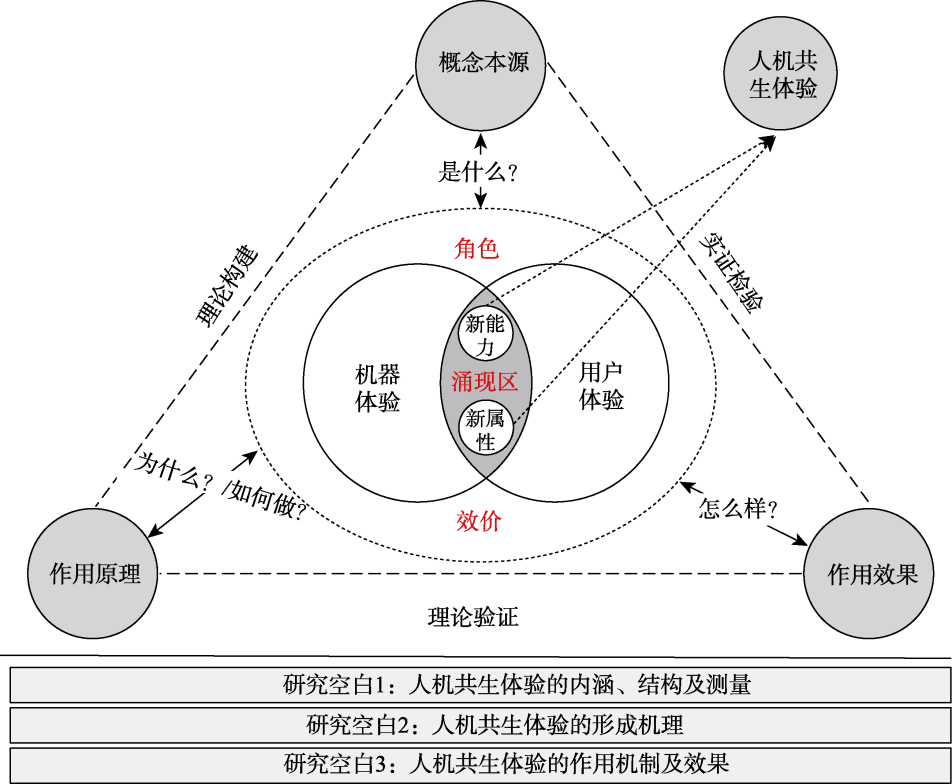
图1 人机共生体验的研究空白和整合框架
| 来源 | 定义 | 情景 |
|---|---|---|
| 机器人(Robots) | ||
| Jörling et al., | 信息技术是一种物理的体现, 通过高度自主地执行物理和非物理任务来提供定制服务 | 自主产品(汽车、加热器和割草机) |
| Tsai et al., | 为实现人类工作自动化而创造的人造工人 | 各种情景(概念) |
| Winfield | 一种能够感知环境并有目的地在环境中或环境中采取行动的人工设备; 一种具体的人工智能; 或一种能够自主完成有用工作的机器 | 各种情景(概念) |
| 人−机团队(Human−Robot Team/s) | ||
| Hoffman & Breazeal, | 人和机器人在任务上协作, 共享相同的工作空间和对象 | 太空任务 |
| Breazeal et al., | 人类和机器人维持并共同致力于共同的任务目标 | 各种情景 |
| Gombolay et al., | 研究人员将有效的机器人队友定义为允许人类在飞行中选择自己的动作和动作时机, 动态预测和适应这些决定, 并支持人类感觉自然的流体互动 | 工业制造 |
| Mirowska & Arsenyan | 将人工智能(AI)代理与人类团队成员结合以完成任务 | 各种情景 |
| 人机协作(Cobots) | ||
| Pauliková et al., | Cobot =与人工操作员协同工作的机器人设备; 在一个共同的工作空间中与人类共存, 并与他们一起执行所需的任务 | 工业制造 |
| Javaid et al., | 协作机器人一词通常被称为Cobot, 指的是机器人和人类之间的伙伴关系 | 工业制造 |
| Djuric et al., | Cobot (来自协作和机器人)是一种旨在在共享工作空间中与人类进行物理交互的机器人 | 工业制造 |
| Liu, Wang et al., | 协作机器人(Cobots)是与人类共享工作场所, 无需安全隔离, 辅助完成各类任务, 适配中小企业小批量生产的机器人 | 工业制造 |
| Bassi et al., | 人类与协作机器人(Cobots)在共享工作空间中, 共同开展任务并结合体力或认知努力的协作形式 | 工业制造 |
表1 机器人、人−机团队和人机协作的说明性定义
| 来源 | 定义 | 情景 |
|---|---|---|
| 机器人(Robots) | ||
| Jörling et al., | 信息技术是一种物理的体现, 通过高度自主地执行物理和非物理任务来提供定制服务 | 自主产品(汽车、加热器和割草机) |
| Tsai et al., | 为实现人类工作自动化而创造的人造工人 | 各种情景(概念) |
| Winfield | 一种能够感知环境并有目的地在环境中或环境中采取行动的人工设备; 一种具体的人工智能; 或一种能够自主完成有用工作的机器 | 各种情景(概念) |
| 人−机团队(Human−Robot Team/s) | ||
| Hoffman & Breazeal, | 人和机器人在任务上协作, 共享相同的工作空间和对象 | 太空任务 |
| Breazeal et al., | 人类和机器人维持并共同致力于共同的任务目标 | 各种情景 |
| Gombolay et al., | 研究人员将有效的机器人队友定义为允许人类在飞行中选择自己的动作和动作时机, 动态预测和适应这些决定, 并支持人类感觉自然的流体互动 | 工业制造 |
| Mirowska & Arsenyan | 将人工智能(AI)代理与人类团队成员结合以完成任务 | 各种情景 |
| 人机协作(Cobots) | ||
| Pauliková et al., | Cobot =与人工操作员协同工作的机器人设备; 在一个共同的工作空间中与人类共存, 并与他们一起执行所需的任务 | 工业制造 |
| Javaid et al., | 协作机器人一词通常被称为Cobot, 指的是机器人和人类之间的伙伴关系 | 工业制造 |
| Djuric et al., | Cobot (来自协作和机器人)是一种旨在在共享工作空间中与人类进行物理交互的机器人 | 工业制造 |
| Liu, Wang et al., | 协作机器人(Cobots)是与人类共享工作场所, 无需安全隔离, 辅助完成各类任务, 适配中小企业小批量生产的机器人 | 工业制造 |
| Bassi et al., | 人类与协作机器人(Cobots)在共享工作空间中, 共同开展任务并结合体力或认知努力的协作形式 | 工业制造 |
| 概念 | 定义 | 适用情境 | 侧重点 | 来源 |
|---|---|---|---|---|
| 客户体验 | 用户在与产品、服务或品牌互动过程中形成的整体感知与评价 | 任何涉及产品、服务或品牌的互动情境 | 侧重用户的整体感知、满意度、期望与实际体验的差距 | Becker & Jaakkola, |
| 客户AI体验 | 用户与AI系统之间的互动及体验, 关注AI如何满足客户的需求和提供价值 | AI在客户服务中的应用, 主要用于提高服务效率和质量 | 聚焦AI技术在满足用户需求中的功能性与效果 | Puntoni et al., Li, Hao et al., |
| AI支持的客户体验 | 通过AI技术支持的客户体验, 通常是AI为客户提供个性化服务、推荐等功能 | AI驱动的个性化服务、推荐或客户交互平台 | 侧重技术功能的应用和服务质量, 提升效率 | Ameen et al., |
| 智能体验共创 | 用户与智能技术共同创造的体验过程, 用户在其中提供反馈或数据, 技术根据这些信息优化服务 | 用户与智能技术共同参与创造的体验, 强调反馈机制 | 聚焦于用户参与、数据反馈与技术的共同创造过程 | Roy et al., |
| 在线客户体验 | 用户在在线环境中与品牌、产品或服务互动的体验, 通常通过网站或应用程序进行 | 在线平台上, 如电商网站、在线服务平台的客户互动 | 强调虚拟平台中的交互便利性和效率, 通常不涉及深层次情感互动 | Bleier et al., |
| 智能客户体验 | 用户与智能产品、服务或系统的互动, 通常包含AI或自动化技术 | 智能产品或系统的互动环境, 如智能家居、智能客服等 | 聚焦AI或自动化技术如何提升用户体验, 技术驱动的功能性和便利性 | 任丽娜, |
| 技术服务体验 | 用户在接受技术支持和服务过程中所获得的体验, 通常包括技术故障排除、帮助和咨询等服务 | 技术支持环境, 如客户服务热线、技术维护、问题解决场景 | 关注技术支持和问题解决的效率, 功能性服务 | Prentice &Nguyen, |
| 人机协作体验 | 指人类与机器在任务层面进行合作, 人类与机器各自发挥专长, 在共同完成任务的过程中保持独立性, 强调功能性的互补性 | 主要适用于生产、工作场景以及任务导向的应用, 如自动化生产线、智能助手等 | 强调任务分工、合作效率与功能互补 | Crook, |
| 人机共生体验 | 人类与机器在深度协同与进化过程中产生的新属性和新能力 | 适用于情感交互较强的场景, 如智能家居、服务机器人、智能医疗助手等, 强调机器的学习与人类的共同演化 | 强调情感融合、认知互动、共同进化与相互依赖 | 本文提出 |
表2 人机共生体验与其他相似概念的区别与联系
| 概念 | 定义 | 适用情境 | 侧重点 | 来源 |
|---|---|---|---|---|
| 客户体验 | 用户在与产品、服务或品牌互动过程中形成的整体感知与评价 | 任何涉及产品、服务或品牌的互动情境 | 侧重用户的整体感知、满意度、期望与实际体验的差距 | Becker & Jaakkola, |
| 客户AI体验 | 用户与AI系统之间的互动及体验, 关注AI如何满足客户的需求和提供价值 | AI在客户服务中的应用, 主要用于提高服务效率和质量 | 聚焦AI技术在满足用户需求中的功能性与效果 | Puntoni et al., Li, Hao et al., |
| AI支持的客户体验 | 通过AI技术支持的客户体验, 通常是AI为客户提供个性化服务、推荐等功能 | AI驱动的个性化服务、推荐或客户交互平台 | 侧重技术功能的应用和服务质量, 提升效率 | Ameen et al., |
| 智能体验共创 | 用户与智能技术共同创造的体验过程, 用户在其中提供反馈或数据, 技术根据这些信息优化服务 | 用户与智能技术共同参与创造的体验, 强调反馈机制 | 聚焦于用户参与、数据反馈与技术的共同创造过程 | Roy et al., |
| 在线客户体验 | 用户在在线环境中与品牌、产品或服务互动的体验, 通常通过网站或应用程序进行 | 在线平台上, 如电商网站、在线服务平台的客户互动 | 强调虚拟平台中的交互便利性和效率, 通常不涉及深层次情感互动 | Bleier et al., |
| 智能客户体验 | 用户与智能产品、服务或系统的互动, 通常包含AI或自动化技术 | 智能产品或系统的互动环境, 如智能家居、智能客服等 | 聚焦AI或自动化技术如何提升用户体验, 技术驱动的功能性和便利性 | 任丽娜, |
| 技术服务体验 | 用户在接受技术支持和服务过程中所获得的体验, 通常包括技术故障排除、帮助和咨询等服务 | 技术支持环境, 如客户服务热线、技术维护、问题解决场景 | 关注技术支持和问题解决的效率, 功能性服务 | Prentice &Nguyen, |
| 人机协作体验 | 指人类与机器在任务层面进行合作, 人类与机器各自发挥专长, 在共同完成任务的过程中保持独立性, 强调功能性的互补性 | 主要适用于生产、工作场景以及任务导向的应用, 如自动化生产线、智能助手等 | 强调任务分工、合作效率与功能互补 | Crook, |
| 人机共生体验 | 人类与机器在深度协同与进化过程中产生的新属性和新能力 | 适用于情感交互较强的场景, 如智能家居、服务机器人、智能医疗助手等, 强调机器的学习与人类的共同演化 | 强调情感融合、认知互动、共同进化与相互依赖 | 本文提出 |
| 对比维度 | 人的体验 | 机器人的体验 | 人机组合的体验 |
|---|---|---|---|
| 主要文献 | Becker & Jaakkola, | 陈多闻, 汪姿君, | 邓士昌 等, |
| 体验定义 | 人的体验涉及个体的主观、内部响应(感觉、情感和认知)以及行为反应等, 由品牌或市场等刺激引发 | 机器人的体验指的是智能对象(如机器人)在与人类或其他对象互动时所展现出的属性、能力和表达角色 | 人机组合的体验是指在人机环境中, 人类与智能对象(如智能家居设备)互动时产生的体验, 这种体验是双方互动的结果 |
| 体验主体 | 人类个体 | 机器人/智能对象 | 人类与机器人的组合 |
| 体验来源 | 感官、知觉、情感、认知、社会互动 | 多模态数据捕获、算法逻辑映射与动态参数优化(Functional Agency/功能主体) | 人类与机器人的互动及其产生的新属性和能力 |
| 体验性质 | 基于意识和情感的主观体验 | 机器侧体验是系统在预设算法框架下对环境变化的响应记录, 是基于规则和逻辑的响应 | 结合了人类主观性和机器人响应性的复合体验 |
表3 人、机器和人机组合体验的区别与联系
| 对比维度 | 人的体验 | 机器人的体验 | 人机组合的体验 |
|---|---|---|---|
| 主要文献 | Becker & Jaakkola, | 陈多闻, 汪姿君, | 邓士昌 等, |
| 体验定义 | 人的体验涉及个体的主观、内部响应(感觉、情感和认知)以及行为反应等, 由品牌或市场等刺激引发 | 机器人的体验指的是智能对象(如机器人)在与人类或其他对象互动时所展现出的属性、能力和表达角色 | 人机组合的体验是指在人机环境中, 人类与智能对象(如智能家居设备)互动时产生的体验, 这种体验是双方互动的结果 |
| 体验主体 | 人类个体 | 机器人/智能对象 | 人类与机器人的组合 |
| 体验来源 | 感官、知觉、情感、认知、社会互动 | 多模态数据捕获、算法逻辑映射与动态参数优化(Functional Agency/功能主体) | 人类与机器人的互动及其产生的新属性和能力 |
| 体验性质 | 基于意识和情感的主观体验 | 机器侧体验是系统在预设算法框架下对环境变化的响应记录, 是基于规则和逻辑的响应 | 结合了人类主观性和机器人响应性的复合体验 |
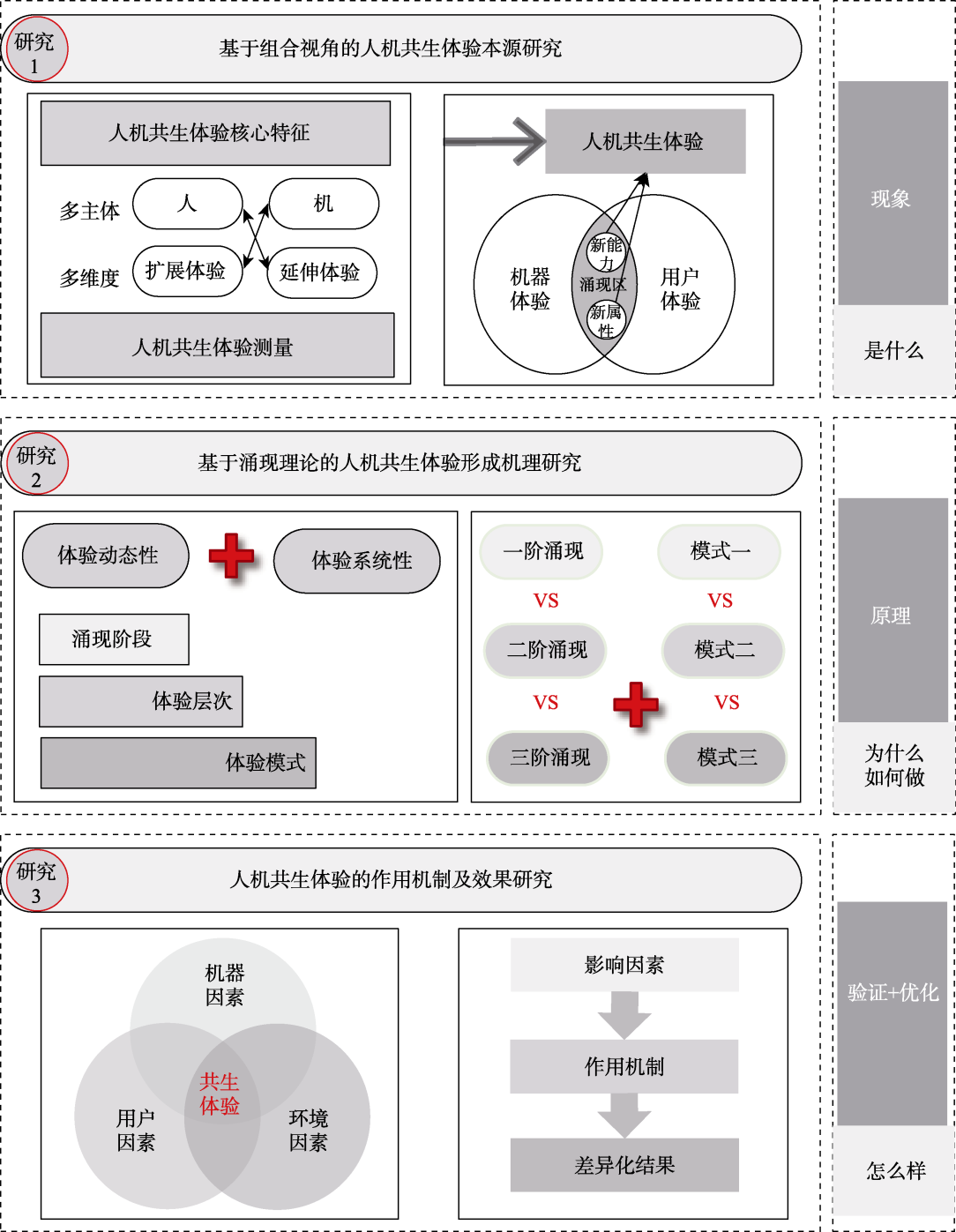
图2 人机共生体验的形成机理及作用效果研究框架
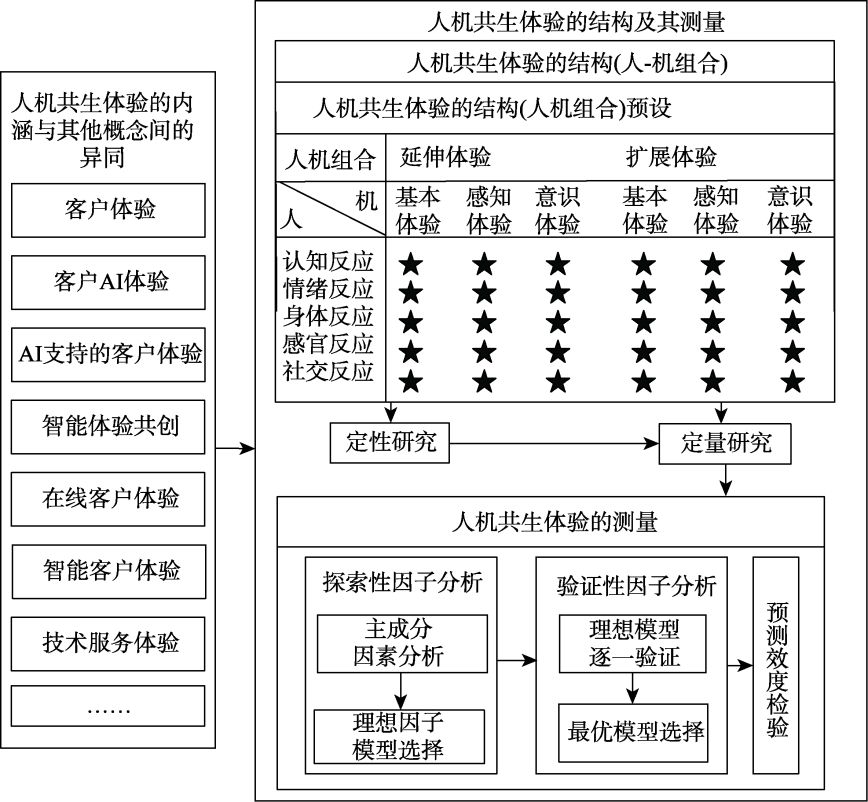
图3 基于组合视角的人机共生体验(HSX)本源研究
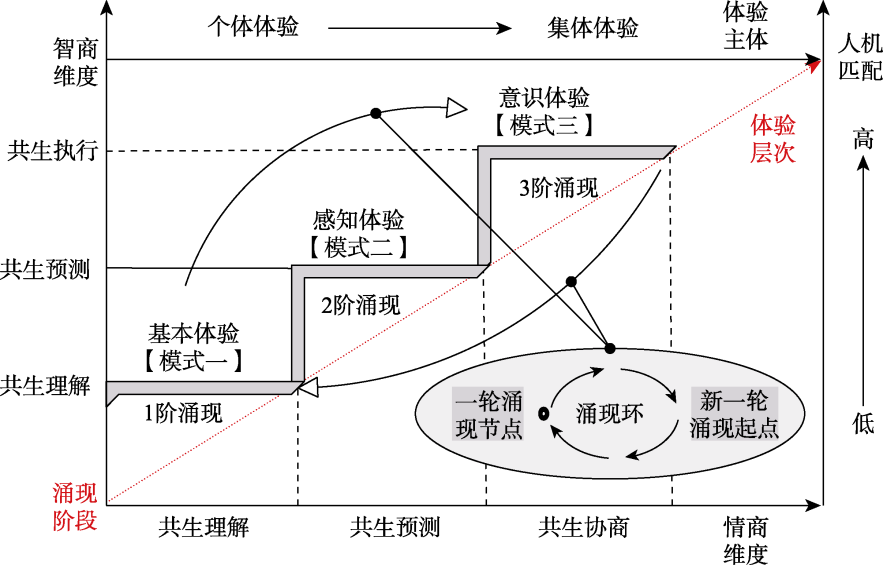
图4 人机共生体验的形成机理
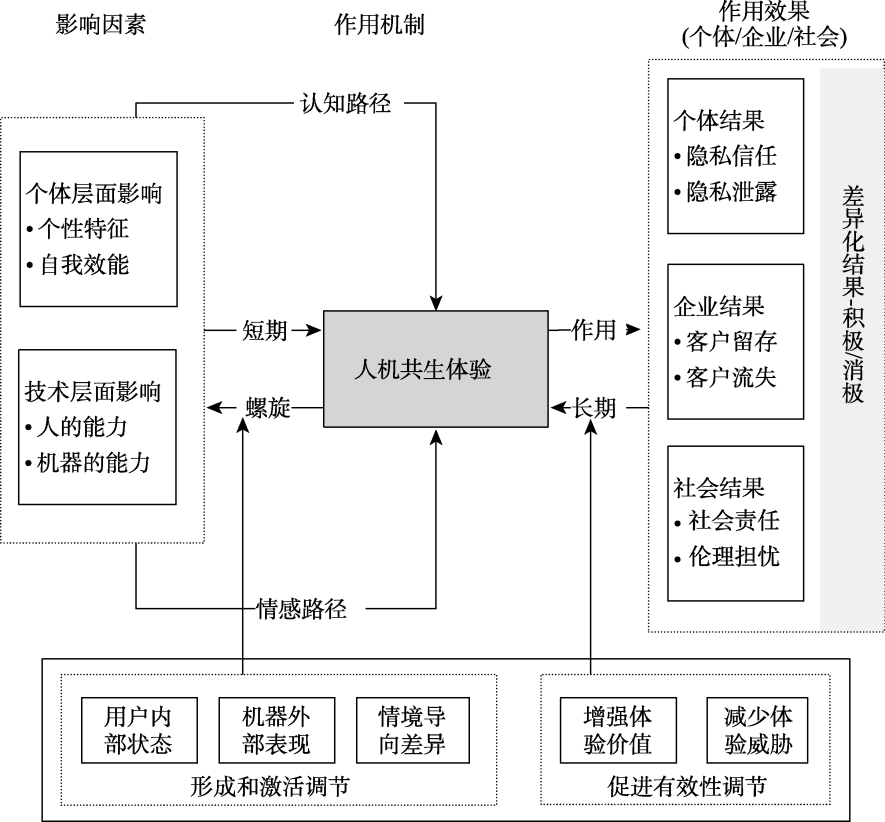
图5 人机共生体验的作用机制及效果
| [1] | 陈多闻, 汪姿君. (2023). 人工共情何以可能?——当代新兴人工共情技术形成原因的理论探赜. 科学技术哲学研究, 40(3), 93-99. |
| [2] |
邓士昌, 许祺, 张晶晶, 李象千. (2022). 基于心灵知觉理论的AI服务用户接受机制及使用促进策略. 心理科学进展, 30(4), 723-737.
doi: 10.3724/SP.J.1042.2022.00723 |
| [3] | 牟宇鹏, 丁刚, 张辉. (2019). 人工智能的拟人化特征对用户体验的影响. 经济与管理, 33(4), 51-57. |
| [4] | 任丽娜. (2021). 人工智能技术刺激对智能顾客体验的影响——技术准备的调节作用 [博士学位论文]. 华北水利水电大学. |
| [5] | 沈鹏熠, 万德敏, 许基南. (2021). 在线零售情境下人机交互感知如何影响消费者幸福感——基于自主性的视角. 南开管理评论, 24(6), 26-40. |
| [6] | 滕乐法, 吴媛媛, 李峰. (2020). 越沉浸越好吗?——品牌体验中消费者沉浸程度的双重影响研究. 管理世界, 36(6), 153-167+251. |
| [7] | 谢莹, 李佳钰, 李纯青, 贺艳婷, 张洁丽. (2021). 新兴技术驱动的多元繁荣的内涵、结构和理论框架研究. 预测, 40(6), 31-38. |
| [8] | 许晖, 王泽鹏, 杨金东. (2024). 从人机冲突走向人机融合:知识编排视角下制造型企业的人机关系重塑. 中国工业经济, (4), 170-188. |
| [9] | 张小军. (2023). 关于“人工智人”的认知人类学思考. 人民论坛·学术前沿, (24), 67-79. |
| [10] |
Ameen, N., Tarhini, A., Reppel, A., & Anand, A. (2021). Customer experiences in the age of artificial intelligence. Computers in Human Behavior, 114, 106548.
doi: 10.1016/j.chb.2020.106548 URL |
| [11] |
Arthur, W. B. (1999). Complexity and the economy. Science, 284(5411), 107-109.
doi: 10.1126/science.284.5411.107 URL |
| [12] |
Balaji, M. S., Jiang, Y., & Zhang, X. (2025). Robots in service: How robot capabilities and personalities drive customer value co-creation and satisfaction. International Journal of Contemporary Hospitality Management, 37(3), 1016-1035.
doi: 10.1108/IJCHM-01-2024-0112 URL |
| [13] |
Bankins, S., Ocampo, A. C., Marrone, M., Restubog, S. L. D., & Woo, S. E. (2024). A multilevel review of artificial intelligence in organizations: Implications for organizational behavior research and practice. Journal of Organizational Behavior, 45(2), 159-182.
doi: 10.1002/job.v45.2 URL |
| [14] |
Barile, S., & Polese, F. (2010). Linking the viable system and many-to-many network approaches to service dominant logic and service science. International Journal of Quality and Service Sciences, 2(1), 23-44.
doi: 10.1108/17566691011026586 URL |
| [15] |
Bassi, G., Orso, V., Salcuni, S., & Gamberini, L. (2025). Understanding workers’ well-being and cognitive load in human-cobot collaboration: Systematic review. Journal of Medical Internet Research, 27, e75658.
doi: 10.2196/75658 URL |
| [16] |
Becker, L., Karpen, I. O., Kleinaltenkamp, M., Jaakkola, E., Helkkula, A., & Nuutinen, M. (2023). Actor experience: Bridging individual and collective-level theorizing. Journal of Business Research, 158, 113658.
doi: 10.1016/j.jbusres.2023.113658 URL |
| [17] |
Becker, L. C., & Jaakkola, E. (2020). Customer experience: Fundamental premises and implications for research. Journal of the Academy of Marketing Science, 48(4), 630-648.
doi: 10.1007/s11747-019-00718-x |
| [18] |
Bleier, A., Harmeling, C. M., & Palmatier, R. W. (2019). Creating effective online customer experiences. Journal of Marketing, 83(2), 98-119.
doi: 10.1177/0022242918809930 |
| [19] | Bogost, I. (2012). Alien phenomenology, or what it’s like to be a thing. University of Minnesota Press. |
| [20] | Brakus, J. J., Schmitt, B. H., & Zarantonello, L. (2009). Brand experience: What is it? How is it measured? Does it affect loyalty? Journal of Marketing, 73(3), 52-68. |
| [21] | Breazeal, C., Gray, J., Hoffman, G., & Berlin, M. (2004). Social robots: Beyond tools to partners. In IEEE International Workshop on Robot & Human Interactive Communication (pp. 551-556). IEEE. |
| [22] | Bryant, L. R. (2011). The democracy of objects. Open Humanities Press. |
| [23] | Capra, F., & Luisi, L. (2014). The systems view of life: A unifying vision. Cambridge University Press. |
| [24] |
Chandler, J. D., & Lusch, R. F. (2015). Service systems: A broadened framework and research agenda on value propositions, engagement, and service experience. Journal of Service Research, 18(1), 6-22.
doi: 10.1177/1094670514537709 URL |
| [25] |
Chen, G., Ployhart, R. E., Thomas, H. C., Anderson, N., & Bliese, P. D. (2011). The power of momentum: A new model of dynamic relationships between job satisfaction change and turnover intentions. Academy of Management Journal, 54(1), 159-181.
doi: 10.5465/amj.2011.59215089 URL |
| [26] | Cova, B. (2021). The new frontier of consumer experiences: Escape through pain. Academy of Marketing Science Review, 11(1-2), 60-69. |
| [27] | Crook, C. (2018). Computers and the Collaborative Experience of Learning (1994). Routledge. |
| [28] | Dang, J., & Liu, L. (2024). Extended artificial intelligence aversion: People deny humanness to artificial intelligence users. Journal of Personality and Social Psychology. Advance online publication. https://doi.org/10.1037/pspi0000480 |
| [29] |
De Keyser, A., & Kunz, W. H. (2022). Living and working with service robots: A TCCM analysis and considerations for future research. Journal of Service Management, 33(2), 165-196.
doi: 10.1108/JOSM-12-2021-0488 URL |
| [30] |
De Keyser, A., Verleye, K., Lemon, K. N., Keiningham, T. L., & Klaus, P. (2020). Moving the customer experience field forward: Introducing the touchpoints, context, qualities (TCQ) nomenclature. Journal of Service Research, 23(4), 433-455.
doi: 10.1177/1094670520928390 URL |
| [31] | DeLanda, M. (2011). Philosophy and simulation: The emergence of synthetic reason. London: Continuum. |
| [32] | DeLanda, M. (2016). Assemblage theory. Edinburgh University Press. |
| [33] |
Dietvorst, B. J., Simmons, J. P., & Massey, C. (2015). Algorithm aversion: People erroneously avoid algorithms after seeing them err. Journal of Experimental Psychology: General, 144(1), 114-126.
doi: 10.1037/xge0000033 URL |
| [34] |
Djuric, A. M., Urbanic, R. J., & Rickli, J. L. (2016). A framework for collaborative robot (CoBot) integration in advanced manufacturing systems. SAE International Journal of Materials and Manufacturing, 9(2), 457-464.
doi: 10.4271/V125-5EJ-02 URL |
| [35] | Edelman, D. C., & Singer, M. (2015). Competing on customer journeys. Harvard Business Review, 93(11), 88-100. |
| [36] |
Faraj, S., von Krogh, G., Monteiro, E., & Lakhani, K. R. (2016). Special section introduction—Online community as space for knowledge flows. Information Systems Research, 27(4), 668-684.
doi: 10.1287/isre.2016.0682 URL |
| [37] |
Gombolay, M. C., Gutierrez, R. A., Clarke, S. G., Sturla, G. F., & Shah, J. A. (2015). Decision-making authority, team efficiency and human worker satisfaction in mixed human-robot teams. Autonomous Robots, 39(3), 293-312.
doi: 10.1007/s10514-015-9457-9 URL |
| [38] | Grandey, A. A., & Morris, K. (2023). Robots are changing the face of customer service. Harvard Business Review, 23. |
| [39] |
Gray, K., Knobe, J., Sheskin, M., Bloom, P., & Barrett, L. F. (2011). More than a body: Mind perception and the nature of objectification. Journal of Personality and Social Psychology, 101(6), 1207-1220.
doi: 10.1037/a0025883 pmid: 22059848 |
| [40] |
Gray, K., & Wegner, D. M. (2012). Feeling robots and human zombies: Mind perception and the uncanny valley. Cognition, 125(1), 125-130.
doi: 10.1016/j.cognition.2012.06.007 pmid: 22784682 |
| [41] |
Grewal, D., Satornino, C. B., Davenport, T., & Guha, A. (2025). How generative AI is shaping the future of marketing. Journal of the Academy of Marketing Science, 53(3), 702-722.
doi: 10.1007/s11747-024-01064-3 |
| [42] |
Hoffman, D. L., & Novak, T. P. (2018). Consumer and object experience in the internet of things: An assemblage theory approach. Journal of Consumer Research, 44(6), 1178-1204.
doi: 10.1093/jcr/ucx105 URL |
| [43] | Hoffman, G., & Breazeal, C. (2004, September). Collaboration in human-robot teams. In AIAA 1st Intelligent Systems Technical Conference (p. 6434). AlAA. https://doi.org/10.2514/6.2004-6434 |
| [44] |
Hollebeek, L. D., Kumar, V., Srivastava, R. K., & Clark, M. K. (2023). Moving the stakeholder journey forward. Journal of the Academy of Marketing Science, 51(1), 23-49.
doi: 10.1007/s11747-022-00878-3 |
| [45] |
Huang, M. H., & Rust, R. T. (2021). A strategic framework for artificial intelligence in marketing. Journal of the Academy of Marketing Science, 49(1), 30-50.
doi: 10.1007/s11747-020-00749-9 |
| [46] |
Inga, J., Ruess, M., Robens, J. H., Nelius, T., Rothfuß, S., Kille, S., & Kiesel, A. (2023). Human-machine symbiosis: A multivariate perspective for physically coupled human-machine systems. International Journal of Human-Computer Studies, 170, 102926.
doi: 10.1016/j.ijhcs.2022.102926 URL |
| [47] |
Jarrahi, M. H. (2018). Artificial intelligence and the future of work: Human-AI symbiosis in organizational decision making. Business Horizons, 61(4), 577-586.
doi: 10.1016/j.bushor.2018.03.007 URL |
| [48] |
Järvelä, S., Zhao, G., Nguyen, A., & Chen, H. (2025). Hybrid intelligence: Human-AI coevolution and learning. British Journal of Educational Technology, 56(2), 455-468.
doi: 10.1111/bjet.v56.2 URL |
| [49] |
Javaid, M., Haleem, A., Singh, R. P., Rab, S., & Suman, R. (2022). Significant applications of cobots in the field of manufacturing. Cognitive Robotics, 2, 222-233.
doi: 10.1016/j.cogr.2022.10.001 URL |
| [50] |
Jitpaiboon, T., Dobrzykowski, D. D., Ragu-Nathan, T. S., & Vonderembse, M. A. (2013). Unpacking IT use and integration for mass customisation: A service-dominant logic view. International Journal of Production Research, 51(8), 2527-2547.
doi: 10.1080/00207543.2012.720727 URL |
| [51] |
Jörling, M., Böhm, R., & Paluch, S. (2019). Service robots: Drivers of perceived responsibility for service outcomes. Journal of Service Research, 22(4), 404-420.
doi: 10.1177/1094670519842334 |
| [52] | Kahneman, D. (2011). Thinking, fast and slow. Straus and Giroux. |
| [53] |
Köbis, N., Rahwan, Z., Rilla, R., Supriyatno, B. I., Bersch, C., Ajaj, T., & Rahwan, I. (2025). Delegation to artificial intelligence can increase dishonest behaviour. Nature, 646(8083), 126-134.
doi: 10.1038/s41586-025-09505-x |
| [54] |
Kraemer, T., Weiger, W. H., Matthias, M. H. J., & Maik, H. (2020). Toward a theory of spirals: The dynamic relationship between organizational pride and customer- oriented behavior. Journal of the Academy of Marketing Science, 48, 1095-1115.
doi: 10.1007/s11747-019-00715-0 |
| [55] | Kumar, V., Kotler, P., Gupta, S., & Rajan, B. (2025). Generative AI in marketing: Promises, perils, and public policy implications. Journal of Public Policy & Marketing, 44(3), 309-331. |
| [56] | Latour, B. (1987). Science in action: How to follow scientists and engineers through society. Harvard University Press. |
| [57] | Latour, B. (1996). On actor-network theory: A few clarifications. Soziale Welt, 47(4), 369-381. http://www.jstor.org/stable/40878163 |
| [58] |
Law, R., Ye, H., & Lei, S. S. I. (2025). Ethical artificial intelligence (AI): Principles and practices. International Journal of Contemporary Hospitality Management, 37(1), 279-295.
doi: 10.1108/IJCHM-04-2024-0482 URL |
| [59] |
Lemon, K. N., & Verhoef, P. C. (2016). Understanding customer experience throughout the customer journey. Journal of Marketing, 80(6), 69-96.
doi: 10.1509/jm.15.0420 URL |
| [60] |
Li, C., Hao, R., Li, N., & Zhang, C. (2025). Measuring customer experience in ai contexts: A scale development. Journal of Theoretical and Applied Electronic Commerce Research, 20(1), 31.
doi: 10.3390/jtaer20010031 URL |
| [61] |
Li, Z., Cheng, S., Sun, X., Ren, X., Wang, Y., & Zhang, M. L. (2025). Tuning into urban birdsong: Enhancing nature connectedness with an AI-powered wearable. Scientific Reports, 15(1), 1219.
doi: 10.1038/s41598-024-81576-8 |
| [62] |
Liu, L., Guo, F., Zou, Z., & Duffy, V. G. (2024). Application, development and future opportunities of collaborative robots (cobots) in manufacturing: A literature review. International Journal of Human-Computer Interaction, 40(4), 915-932.
doi: 10.1080/10447318.2022.2041907 URL |
| [63] |
Liu, X., Wang, L., Liu, X., & Zhai, X. (2024). The impact of privacy violations on subsequent consumer preferences for anthropomorphized products. Journal of Business Research, 174, 114505.
doi: 10.1016/j.jbusres.2024.114505 URL |
| [64] |
Liu, Y., & Wang, X. (2025). Can service robots recover themselves? The effect of service recovery agents and robot service failure types on customer response. International Journal of Hospitality Management, 124, 103951.
doi: 10.1016/j.ijhm.2024.103951 URL |
| [65] |
Liu-Thompkins, Y., Okazaki, S., & Li, H. (2022). Artificial empathy in marketing interactions: Bridging the human-AI gap in affective and social customer experience. Journal of the Academy of Marketing Science, 50(6), 1198-1218.
doi: 10.1007/s11747-022-00892-5 |
| [66] |
Lu, V. N., Wirtz, J., Kunz, W. H., Paluch, S., Gruber, T., Martins, A., & Patterson, P. G. (2020). Service robots, customers and service employees: What can we learn from the academic literature and where are the gaps? Journal of Service Theory and Practice, 30(3), 361-391.
doi: 10.1108/JSTP-04-2019-0088 URL |
| [67] |
Madhavaram, S., & Appan, R. (2024). AI for marketing: Enabler? Engager? Ersatz? AMS Review, 14(3), 258-277.
doi: 10.1007/s13162-024-00293-7 |
| [68] |
Mahadevan, D., & Shainesh, G. (2024). Conceptualizing customer experience in multi-actor platforms. AMS Review, 14(1), 83-103.
doi: 10.1007/s13162-023-00272-4 |
| [69] |
Marion, T. J., Meyer, M. H., & Barczak, G. (2015). The influence of digital design and IT on modular product architecture. Journal of Product Innovation Management, 32(1), 98-110.
doi: 10.1111/jpim.2015.32.issue-1 URL |
| [70] | McLaughlin, B., P. (2008). Emergence and supervenience. In M. A. Bedau & P. Humphreys (Eds.), Emergence: Contemporary readings in philosophy and science (pp. 81-98). MA: MIT Press. |
| [71] |
Metcalfe, J., & Mischel, W. (1999). A hot/cool-system analysis of delay of gratification: Dynamics of willpower. Psychological Review, 106(1), 3-19.
doi: 10.1037/0033-295x.106.1.3 pmid: 10197361 |
| [72] | Mirowska, A., & Arsenyan, J. (2025). The A(I) Team: Effects of human-likeness and conformity to gender stereotypes on initial trust and willingness to work with an AI teammate. Journal of Organizational Behavior. https://doi.org/10.1002/job.70009 |
| [73] |
Novak, T. P., & Hoffman, D. L. (2019). Relationship journeys in the internet of things: A new framework for understanding interactions between consumers and smart objects. Journal of the Academy of Marketing Science, 47(2), 216-237.
doi: 10.1007/s11747-018-0608-3 |
| [74] |
Novak, T. P., & Hoffman, D. L. (2023). Automation assemblages in the internet of things: Discovering qualitative practices at the boundaries of quantitative change. Journal of Consumer Research, 49(5), 811-837.
doi: 10.1093/jcr/ucac014 URL |
| [75] |
Pauliková, A., Babeľová, Z. G., & Ubárová, M. (2021). Analysis of the impact of human-cobot collaborative manufacturing implementation on the occupational health and safety and the quality requirements. International Journal of Environmental Research and Public Health, 18(4), 1927.
doi: 10.3390/ijerph18041927 URL |
| [76] | Pine II, B. J., & Gilmore, J. H. (2019). The experience economy: Competing for customer time, attention, and money. MA: Harvard Business Press. |
| [77] |
Prentice, C., & Nguyen, M. (2020). Engaging and retaining customers with AI and employee service. Journal of Retailing and Consumer Services, 56, 102186.
doi: 10.1016/j.jretconser.2020.102186 URL |
| [78] |
Puntoni, S., Reczek, R. W., Giesler, M., & Botti, S. (2021). Consumers and artificial intelligence: An experiential perspective. Journal of Marketing, 85(1), 131-151.
doi: 10.1177/0022242920953847 URL |
| [79] |
Qin, X., Zhou, X., Chen, C., Wu, D., Zhou, H., Dong, X., & Lu, J. G. (2025). AI aversion or appreciation? A capability-personalization framework and a meta-analytic review. Psychological Bulletin, 151(5), 580-599.
doi: 10.1037/bul0000477 pmid: 40489180 |
| [80] |
Rahwan, I., Cebrian, M., Obradovich, N., Bongard, J., Bonnefon, J.-F., Breazeal, C., & Wellman, M. (2019). Machine behaviour. Nature, 568(7753), 477-486.
doi: 10.1038/s41586-019-1138-y |
| [81] |
Rapp, A., Di Lodovico, C., & Di Caro, L. (2025). How do people react to ChatGPT's unpredictable behavior? Anthropomorphism, uncanniness, and fear of AI: A qualitative study on individuals’ perceptions and understandings of LLMs’ nonsensical hallucinations. International Journal of Human-Computer Studies, 198, 103471.
doi: 10.1016/j.ijhcs.2025.103471 URL |
| [82] |
Rasoulian, S., Grégoire, Y., Legoux, R., & Sénécal, S. (2023). The effects of service crises and recovery resources on market reactions: An event study analysis on data breach announcements. Journal of Service Research, 26(1), 44-63.
doi: 10.1177/10946705211036944 URL |
| [83] | Roy, S. K., Singh, G., Hope, M., Nguyen, B., & Harrigan, P. (2022). The rise of smart consumers: Role of smart servicescape and smart consumer experience co-creation. In The role of smart technologies in decision making (pp. 114-147). Routledge. |
| [84] |
Shanks, I., Scott, M. L., Mende, M., van Doorn, J., & Grewal, D. (2025). Cobotic service teams and power dynamics: Understanding and mitigating unintended consequences of human-robot collaboration in healthcare services. Journal of the Academy of Marketing Science, 53(2), 463-489.
doi: 10.1007/s11747-024-01004-1 |
| [85] |
Thompson, C. J., Locander, W. B., & Pollio, H. R. (1989). Putting consumer experience back into consumer research: The philosophy and method of existential-phenomenology. Journal of Consumer Research, 16(2), 133-146.
doi: 10.1086/jcr.1989.16.issue-2 URL |
| [86] | Tononi, G., & Koch, C. (2015). Consciousness: Here, there and everywhere? Philosophical Transactions of the Royal Society B: Biological Sciences, 370(1668), 20140167. |
| [87] | Tsai, C.-Y., Marshall, J. D., Choudhury, A., Serban, A., Hou, Y.-Y., Jung, M. F., Dionne, S. D., & Yammarino, F. J. (2022). Human-robot collaboration: A multilevel and integrated leadership framework. The Leadership Quarterly, 33(1), 101594. |
| [88] | Tuzov, V., & Lin, F. (2024). Two paths of balancing technology and ethics: A comparative study on AI governance in China and Germany. Telecommunications Policy, 48(10), 102850. |
| [89] |
Vaccaro, M., Almaatouq, A., & Malone, T. (2024). When combinations of humans and AI are useful: A systematic review and meta-analysis. Nature Human Behaviour, 8(12), 2293-2303.
doi: 10.1038/s41562-024-02024-1 pmid: 39468277 |
| [90] |
Vargo, S. L., & Lusch, R. F. (2016). Institutions and axioms: An extension and update of service-dominant logic. Journal of the Academy of Marketing Science, 44(1), 5-23.
doi: 10.1007/s11747-015-0456-3 URL |
| [91] |
Vargo, S. L., Peters, L., Kjellberg, H., Koskela-Huotari, K., Nenonen, S., Polese, F., & Vaughan, C. (2023). Emergence in marketing: An institutional and ecosystem framework. Journal of the Academy of Marketing Science, 51(1), 2-22.
doi: 10.1007/s11747-022-00849-8 |
| [92] |
Verhoef, P. C., Lemon, K. N., Parasuraman, A., Roggeveen, A., Tsiros, M., & Schlesinger, L. A. (2009). Customer experience creation: Determinants, dynamics and management strategies. Journal of Retailing, 85(1), 31-41.
doi: 10.1016/j.jretai.2008.11.001 URL |
| [93] |
Wang, L., Gao, R., Váncza, J., Krüger, J., Wang, X. V., Makris, S., & Chryssolouris, G. (2019). Symbiotic human-robot collaborative assembly. CIRP Annals, 68(2), 701-726.
doi: 10.1016/j.cirp.2019.05.002 URL |
| [94] | Winfield, A. (2012). Robotics: A very short introduction. UK: OUP Oxford. |
| [95] |
Wolter, J. S., & Cronin, J. J. (2016). Re-conceptualizing cognitive and affective customer-company identification: The role of self-motives and different customer-based outcomes. Journal of the Academy of Marketing Science, 44(3), 397-413.
doi: 10.1007/s11747-014-0421-6 URL |
| [96] |
Yin, Y., Jia, N., & Wakslak, C. J. (2024). AI can help people feel heard, but an AI label diminishes this impact. Proceedings of the National Academy of Sciences, 121(14), e2319112121.
doi: 10.1073/pnas.2319112121 URL |
| [97] | Zhou, E. B., Lee, D., & Gu, B. (2025). Who expands the human creative frontier with generative AI: Hive minds or masterminds? Science Advances, 11(36), eadu5800. |
| [1] | 刘笑辰, 邓凌霏, 吴羡娇, 吴宁. 从“负能”到“赋能”:AIGC“污染”的作用机理及干预策略[J]. 心理科学进展, 2026, 34(7): 1109-1126. |
| [2] | 舒跃育, 李春江, 任笑笑, 谢霞, 张银霞, 宋欢. 人工智能在心理传记学中的应用可能、挑战与启示[J]. 心理科学进展, 2026, 34(7): 1284-1298. |
| [3] | 唐伟, 钟文瑞, 雷震, 张丹丹. 人工智能代理对道德决策的影响[J]. 心理科学进展, 2026, 34(6): 1084-1096. |
| [4] | 陈慧, 丰超. 当员工遇见AI:员工-AI协作的构念测量、前因组态与影响机制[J]. 心理科学进展, 2026, 47(5): 1309-1329. |
| [5] | 田雪涛, 周文杰, 骆方, 乔志宏, 丰怡. 生成式大语言模型赋能心理测量学:优势、挑战与应用[J]. 心理科学进展, 2026, 34(3): 404-423. |
| [6] | 宋一晓, 曾铭灼, 苏涛. 机会抑或威胁? 人与AI协作系统对员工工作效能影响的元分析[J]. 心理科学进展, 2026, 34(3): 461-486. |
| [7] | 武靖宇, 金鑫. 算法介导下的情感趋同:生成式人工智能情感传染机制[J]. 心理科学进展, 2026, 34(1): 123-133. |
| [8] | 李研, 陈维, 武瑞娟. AI技术背景下虚拟影响者营销效应及其作用机制[J]. 心理科学进展, 2025, 33(8): 1425-1442. |
| [9] | 宗树伟, 杨付, 龙立荣, 韩翼. 促进还是抑制?生成式人工智能建议采纳对创造力的双刃剑效应[J]. 心理科学进展, 2025, 33(6): 905-915. |
| [10] | 解煜彬, 周荣刚. 新型人机关系下的人机双向信任[J]. 心理科学进展, 2025, 33(6): 916-932. |
| [11] | 谭美丽, 殷向洲, 张光磊, 熊普臻. 工作场所人工智能角色划分:对员工心理与行为的影响及应对策略[J]. 心理科学进展, 2025, 33(6): 933-947. |
| [12] | 项典典, 尹雨乐, 葛梦琦, 王子涵. 自建IP还是合作IP:虚拟影响者代言人选择策略对消费者融入的影响[J]. 心理科学进展, 2025, 33(6): 965-983. |
| [13] | 罗莉娟, 王康, 胡金淼, 徐四华. 当人工智能面对人类情感:服务机器人情感表达对用户体验的影响机制[J]. 心理科学进展, 2025, 33(6): 1006-1026. |
| [14] | 彭晨明, 屈奕帆, 郭晓凌, 陈增祥. 人工智能服务对消费者道德行为的双刃剑效应[J]. 心理科学进展, 2025, 33(2): 236-255. |
| [15] | 杜传晨, 郑远霞, 郭倩倩, 刘国雄. 大语言模型的人工心理理论: 证据、界定与挑战[J]. 心理科学进展, 2025, 33(12): 2027-2042. |
| 阅读次数 | ||||||
|
全文 |
|
|||||
|
摘要 |
|
|||||
