

ISSN 1671-3710
CN 11-4766/R
主办:中国科学院心理研究所
出版:科学出版社
CN 11-4766/R
主办:中国科学院心理研究所
出版:科学出版社
心理科学进展 ›› 2026, Vol. 34 ›› Issue (6): 953-970.doi: 10.3724/SP.J.1042.2026.0953 cstr: 32111.14.2026.0953
杨建锋1, 吕欣1, 明晓东1, 谢鹏2( )
)
收稿日期:2025-11-27
出版日期:2026-06-15
发布日期:2026-04-17
通讯作者:
谢鹏, E-mail: pengxie07@163.com基金资助:
YANG Jianfeng1, LV Xin1, MING Xiaodong1, XIE Peng2()
Received:2025-11-27
Online:2026-06-15
Published:2026-04-17
摘要:
在人工智能蓬勃发展、经济增速放缓以及数字互联的共同影响下, 多任务处理已成为职场普遍现象。以往研究探索了多任务处理对个体自身任务行为的影响机制, 却忽视了多任务处理对个体本人及其重要他人(如同事)的社会行为(如组织公民行为)的影响。为此, 本研究将分两个步骤来系统探讨多任务处理对社会行为的影响机制: 首先, 基于过程导向视角构建多任务处理的维度结构, 并开发具有良好信效度的测量工具(研究1); 其次, 分别探讨多任务处理对个体本人及其重要他人社会行为的影响机制(研究2与研究3)。通过上述三项研究, 本研究期望拓展多任务处理的后效研究边界及其受众范围, 从而为组织管理实践提供更具深度与时效性的理论启示。
中图分类号:
杨建锋, 吕欣, 明晓东, 谢鹏. (2026). 从“做事”到“做人”: 工作场所多任务处理对社会行为的影响机制. 心理科学进展 , 34(6), 953-970.
YANG Jianfeng, LV Xin, MING Xiaodong, XIE Peng. (2026). From tasks to people: How workplace multitasking shapes social behavior. Advances in Psychological Science, 34(6), 953-970.
| 来源 | 题项数量 | 例题 |
|---|---|---|
| König等( | 4 | 在工作时间内, 我同时处理多件事情。 |
| Kapadia和Melwani ( | 3 | 我感觉自己在进行多任务处理。 |
| Xie等( | 4 | 我的工作要求我一次处理不止一件事情。 |
| Pierro等( | 9 | 我的工作要求我同时处理多项任务。 |
| Baethge和Rigotti ( | 4 | 在过去的半小时里, 我不得不记住几件事情。 |
表1 多任务处理感知测量的常见量表
| 来源 | 题项数量 | 例题 |
|---|---|---|
| König等( | 4 | 在工作时间内, 我同时处理多件事情。 |
| Kapadia和Melwani ( | 3 | 我感觉自己在进行多任务处理。 |
| Xie等( | 4 | 我的工作要求我一次处理不止一件事情。 |
| Pierro等( | 9 | 我的工作要求我同时处理多项任务。 |
| Baethge和Rigotti ( | 4 | 在过去的半小时里, 我不得不记住几件事情。 |
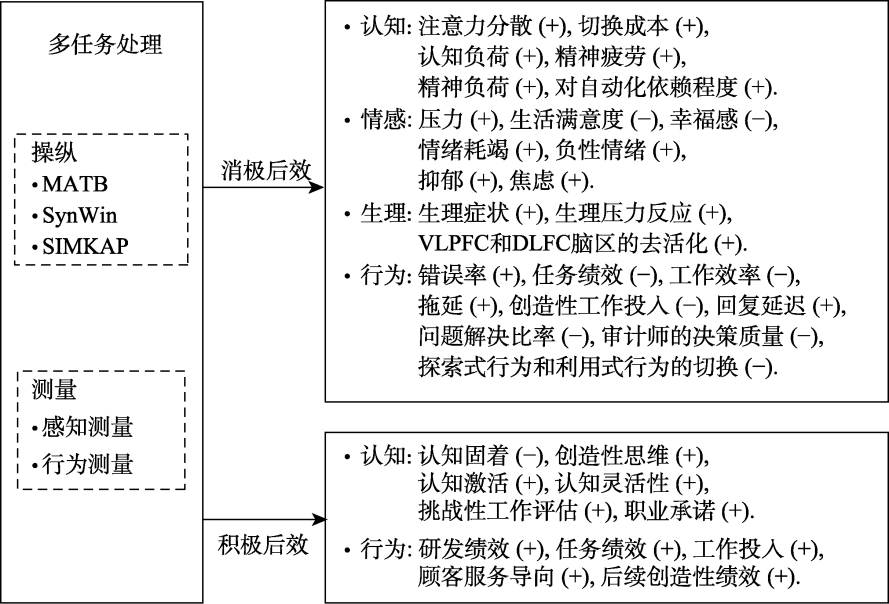
图1 以往研究的主要成果
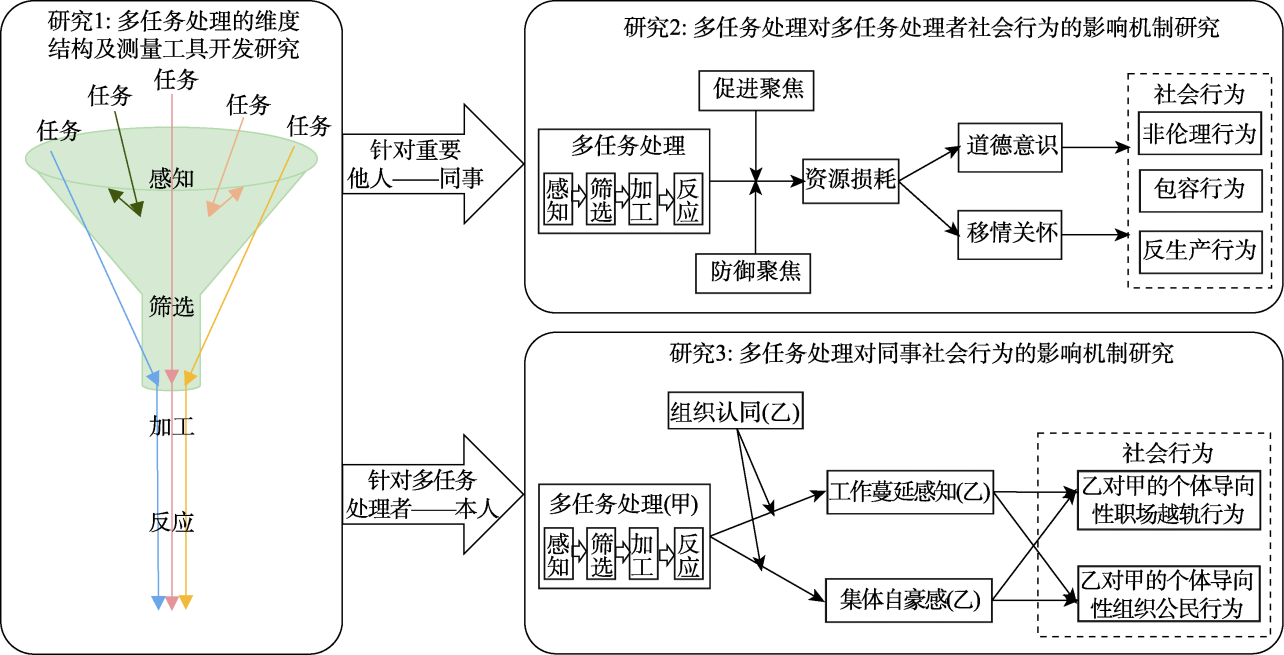
图2 基于资源保存理论的多任务处理的维度结构及其对社会行为的影响机制
| [1] | 丁雪, 张骁, 杨忠. (2017). “一心多用”研究: 理论梳理及未来展望. 经济管理, 39(5), 177-192. |
| [2] | 郭芮巧, 刘岩. (2022). 数字时代的注意困境: 媒体多任务的视角. 应用心理学, 28(5), 402-412. |
| [3] | 季正, 徐世勇. (2023). 多任务处理与员工主动行为: 工作意义感、悖论思维与挑战性评估的作用. 中国人力资源开发, 40(4), 35-48. |
| [4] | 焦昕婷, 赵慧军, 门贺. (2024). 多任务处理一定会导致拖延吗?——基于调节焦点理论的视角. 经济与管理研究, 45(6), 131-144. |
| [5] |
李子颖, 李佳璟, 蒋家丽, 雷秀雅, 孟泽龙. (2023). 媒体多任务与创造力的关系: 基于多视角的解释. 心理科学进展, 31(7), 1195-1205.
doi: 10.3724/SP.J.1042.2023.01195 |
| [6] |
廖化化, 黄蕾, 胡斌. (2022). 资源保存理论在组织行为学中的应用: 演变与挑战. 心理科学进展, 30(2), 449-463.
doi: 10.3724/SP.J.1042.2022.00449 |
| [7] |
刘新燕, 伍海兰, 涂菊, 王璐. (2024). 一心多用的双刃剑效应: 多任务对亲社会行为的影响. 心理学报, 56(12), 1800-1820.
doi: 10.3724/SP.J.1041.2024.01800 |
| [8] | 吴小玥, 成善泠. (2020). 多任务处理要求对个人任务绩效的影响研究——基于挑战性-阻碍性评估的中介作用. 人力资源管理评论, 2, 44-58. |
| [9] |
杨建锋, 谢鹏, 王丹阳, 乔小涛. (2022). 多任务处理对员工创造力的双刃剑效应: 成就导向与认知评估的作用. 科技进步与对策, 39(9), 142-150.
doi: 10.6049/kjjbydc.2021020181 |
| [10] |
周详, 张婧婧, 白博仁, 翟宏堃, 崔虞馨, 祖冲. (2024). “三心二意”胜过“一心一意”: 媒体多任务提升低工作记忆容量者创造力. 心理学报, 56(8), 1031-1046.
doi: 10.3724/SP.J.1041.2024.01031 |
| [11] | Aagaard, J. (2019). Multitasking as distraction: A conceptual analysis of media multitasking research. Theory & Psychology, 29(1), 87-99. |
| [12] |
Avanzi, L., Schuh, S. C., Fraccaroli, F., & van Dick, R. (2015). Why does organizational identification relate to reduced employee burnout? The mediating influence of social support and collective efficacy. Work & Stress, 29(1), 1-10.
doi: 10.1080/02678373.2015.1004225 URL |
| [13] |
Bachmann, O., Grunschel, C., & Fries, S. (2019). Multitasking and feeling good? Autonomy of additional activities predicts affect. Journal of Happiness Studies, 20, 899-918.
doi: 10.1007/s10902-018-9973-3 |
| [14] |
Baethge, A., & Rigotti, T. (2015). Three-way interactions among interruptions/multitasking demands, occupational age, and alertness: A diary study. Work, Aging and Retirement, 1(4), 393-410.
doi: 10.1093/workar/wav014 URL |
| [15] |
Barron, L. G., & Rose, M. R. (2017). Multitasking as a predictor of pilot performance: Validity beyond serial single- task assessments. Military Psychology, 29(4), 316-326.
doi: 10.1037/mil0000168 URL |
| [16] |
Bauer, J. A., & Spector, P. E. (2015). Discrete negative emotions and counterproductive work behavior. Human Performance, 28(4), 307-331.
doi: 10.1080/08959285.2015.1021040 URL |
| [17] |
Becker, L., Kaltenegger, H. C., Nowak, D., Weigl, M., & Rohleder, N. (2022). Physiological stress in response to multitasking and work interruptions: Study protocol. PLOS One, 17(2), e0263785.
doi: 10.1371/journal.pone.0263785 URL |
| [18] |
Bergeron, D. M. (2007). The potential paradox of organizational citizenship behavior: Good citizens at what cost? Academy of Management Review, 32(4), 1078-1095.
doi: 10.5465/amr.2007.26585791 URL |
| [19] |
Biondi, F. N., Cacanindin, A., Douglas, C., & Cort, J. (2021). Overloaded and at work: Investigating the effect of cognitive workload on assembly task performance. Human Factors, 63(5), 813-820.
doi: 10.1177/0018720820929928 URL |
| [20] | Blank, C., Zaman, S., Wesley, A., Tsiamyrtzis, P., Da Cunha Silva, D. R., Gutierrez-Osuna, R., Mark, G., & Pavlidis, I. (2020). Emotional footprints of email interruptions. In Proceedings of the 2020 CHI Conference on Human Factors in Computing Systems (pp. 1-12). Association for Computing Machinery. |
| [21] |
Boiral, O., & Paillé, P. (2012). Organizational citizenship behaviour for the environment: Measurement and validation. Journal of Business Ethics, 109(4), 431-445.
doi: 10.1007/s10551-011-1138-9 URL |
| [22] |
Bolton, L. R., Harvey, R. D., Grawitch, M. J., & Barber, L. K. (2012). Counterproductive work behaviours in response to emotional exhaustion: A moderated mediational approach. Stress and Health, 28(3), 222-233.
doi: 10.1002/smi.v28.3 URL |
| [23] | Bratfisch, O., & Hagman, E. (2011). Manual simultaneous capacity/multi-tasking (SIMKAP). Schuhfried GmbH. |
| [24] |
Brown, R. (2000). Social identity theory: Past achievements, current problems and future challenges. European Journal of Social Psychology, 30(6), 745-778.
doi: 10.1002/1099-0992(200011/12)30:6<>1.0.CO;2-U URL |
| [25] |
Cameron, C. D., Hutcherson, C. A., Ferguson, A. M., Scheffer, J. A., Hadjiandreou, E., & Inzlicht, M. (2019). Empathy is hard work: People choose to avoid empathy because of its cognitive costs. Journal of Experimental Psychology: General, 148(6), 962-976.
doi: 10.1037/xge0000595 URL |
| [26] | Campbell, D. J. (2000). The proactive employee: Managing workplace initiative. Academy of Management Perspectives, 14(3), 52-66. |
| [27] |
Cao, S., & Liu, Y. (2013). Effects of concurrent tasks on diagnostic decision making: An experimental investigation. IIE Transactions on Healthcare Systems Engineering, 3(4), 254-262.
doi: 10.1080/19488300.2013.858378 URL |
| [28] |
Chen, C., Chipao, B. T., & Miao, Q. (2022). Work redesign in development perspective: An empirical study of multitasking among civil servants in Malawi. Australian Journal of Public Administration, 82(2), 210-227.
doi: 10.1111/aupa.v82.2 URL |
| [29] | Chen, Y. T., & Dultra-De-Lima, R. G. (2021). Multitasking in project management: When does it pay off? In 2021 1st International Conference on Cyber Management and Engineering (CyMaEn) (pp. 1-3). IEEE. |
| [30] |
Chughtai, A. A., & Buckley, F. (2010). Assessing the effects of organizational identification on in‐role job performance and learning behaviour: The mediating role of learning goal orientation. Personnel Review, 39(2), 242-258.
doi: 10.1108/00483481011017444 URL |
| [31] |
Cohen, T. R., & Morse, L. (2014). Moral character: What it is and what it does. Research in Organizational Behavior, 34, 43-61.
doi: 10.1016/j.riob.2014.08.003 URL |
| [32] | Comstock Jr, J. R., & Arnegard, R. J. (1992). The multi-attribute task battery for human operator workload and strategic behavior research. NASA Langley Research Center. |
| [33] | Crews, D., & Russ, M. (2012). The impact of multitasking on human and organizational efficiency. Leadership & Organizational Management Journal, (3), 54-68. |
| [34] |
Crowe, E., & Higgins, E. T. (1997). Regulatory focus and strategic inclinations: Promotion and prevention in decision-making. Organizational Behavior and Human Decision Processes, 69(2), 117-132.
doi: 10.1006/obhd.1996.2675 URL |
| [35] | Cui, W. -W., Tao, T., Fan, C. -L., Wang, L. -G., & Gao, W. -B. (2023). Media multitasking, ego depletion, and employee depression: Self-control as a moderator. Social Behavior and Personality: An International Journal, 51(1), e12094. |
| [36] |
Darawong, C. (2018). Dynamic capabilities of new product development teams in performing radical innovation projects. International Journal of Innovation Science, 10(3), 333-349.
doi: 10.1108/IJIS-07-2017-0060 URL |
| [37] |
Davis, M. H. (1983). Measuring individual differences in empathy: Evidence for a multidimensional approach. Journal of Personality and Social Psychology, 44(1), 113-126.
doi: 10.1037/0022-3514.44.1.113 URL |
| [38] |
De Bruin, R., & Barber, L. K. (2019). Social judgments of electronic multitasking in the workplace: The role of contextual and individual factors. Computers in Human Behavior, 94, 110-121.
doi: 10.1016/j.chb.2019.01.014 URL |
| [39] |
De Bruin, R., & Barber, L. K. (2022). Is electronic multitasking always viewed as a counterproductive meeting behavior? Understanding the nature of the secondary task. Psychological Reports, 125(1), 422-447.
doi: 10.1177/0033294120973946 URL |
| [40] |
Detert, J. R., Treviño, L. K., & Sweitzer, V. L. (2008). Moral disengagement in ethical decision making: A study of antecedents and outcomes. Journal of Applied Psychology, 93(2), 374-391.
doi: 10.1037/0021-9010.93.2.374 pmid: 18361639 |
| [41] |
Dutton, J. E., Dukerich, J. M., & Harquail, C. V. (1994). Organizational images and member identification. Administrative Science Quarterly, 39(2), 239-263.
doi: 10.2307/2393235 URL |
| [42] |
Dwivedi, Y. K., Hughes, L., Ismagilova, E., Aarts, G., Coombs, C., Crick, T., & Williams, M. D. (2021). Artificial Intelligence (AI): Multidisciplinary perspectives on emerging challenges, opportunities, and agenda for research, practice and policy. International Journal of Information Management, 57, 101994.
doi: 10.1016/j.ijinfomgt.2019.08.002 URL |
| [43] |
Eisenberg, N. (2000). Emotion, regulation, and moral development. Annual Review of Psychology, 51(1), 665-697.
doi: 10.1146/psych.2000.51.issue-1 URL |
| [44] |
Eisenberg, N., Eggum, N. D., & Di Giunta, L. (2010). Empathy-related responding: Associations with prosocial behavior, aggression, and intergroup relations. Social Issues and Policy Review, 4(1), 143-180.
doi: 10.1111/j.1751-2409.2010.01020.x pmid: 21221410 |
| [45] |
Eisenberg, N., & Miller, P. A. (1987). The relation of empathy to prosocial and related behaviors. Psychological Bulletin, 101(1), 91-119.
pmid: 3562705 |
| [46] |
Elsmore, T. F. (1994). SYNWORK1: A PC-based tool for assessment of performance in a simulated work environment. Behavior Research Methods, Instruments, & Computers, 26(4), 421-426.
doi: 10.3758/BF03204659 URL |
| [47] |
Erkutlu, H., & Chafra, J. (2013). Effects of trust and psychological contract violation on authentic leadership and organizational deviance. Management Research Review, 36(9), 828-848.
doi: 10.1108/MRR-06-2012-0136 URL |
| [48] |
Farmer, S. M., Van Dyne, L., & Kamdar, D. (2015). The contextualized self: How team-member exchange leads to coworker identification and helping OCB. Journal of Applied Psychology, 100(2), 583-595.
doi: 10.1037/a0037660 pmid: 25111250 |
| [49] |
Fasbender, U., Rivkin, W., & Gerpott, F. H. (2024). Good for you, bad for me? The daily dynamics of perspective taking and well-being in coworker dyads. Journal of Occupational Health Psychology, 29(1), 1-13.
doi: 10.1037/ocp0000367 URL |
| [50] |
Fehr, R., Heng, Y. T., Wang, Y., & Guo, Y. (2024). They do not deserve your thanks! Witness reactions to leader-directed expressions of gratitude. Journal of Applied Psychology, 110(2), 197-219.
doi: 10.1037/apl0001228 pmid: 39146043 |
| [51] |
Fichter, R. (2018). Do the right thing! Developing ethical behavior in financial institutions. Journal of Business Ethics, 151(1), 69-84.
doi: 10.1007/s10551-016-3275-7 URL |
| [52] |
Fredrickson, B. L. (2001). The role of positive emotions in positive psychology: The broaden-and-build theory of positive emotions. American Psychologist, 56(3), 218-226.
doi: 10.1037//0003-066x.56.3.218 pmid: 11315248 |
| [53] |
Frenkel, S. J., & Yu, C. (2011). Managing coworker assistance through organizational identification. Human Performance, 24(5), 387-404.
doi: 10.1080/08959285.2011.614301 URL |
| [54] |
Gamache, D. L., McNamara, G., Mannor, M. J., & Johnson, R. E. (2015). Motivated to acquire? The impact of CEO regulatory focus on firm acquisitions. Academy of Management Journal, 58(4), 1261-1282.
doi: 10.5465/amj.2013.0377 URL |
| [55] | Ghazanfar, M. R., & Jumani, S. (2021). Family issues, multitasking and job stress: An evidence from Azad Jammu and Kashmir Universities. Multicultural Education, 7(4), 361-369. |
| [56] |
Glynn, M. A., Kazanjian, R., & Drazin, R. (2010). Fostering innovation in complex product development settings: The role of team member identity and interteam interdependence. Journal of Product Innovation Management, 27(7), 1082-1095.
doi: 10.1111/jpim.2010.27.issue-7 URL |
| [57] |
Goes, P. B., Ilk, N., Lin, M., & Zhao, J. L. (2018). When more is less: Field evidence on unintended consequences of multitasking. Management Science, 64(7), 3033-3054.
doi: 10.1287/mnsc.2017.2763 URL |
| [58] |
Gok, K., Sumanth, J. J., Bommer, W. H., Demirtas, O., Arslan, A., Eberhard, J., Ozdemir, A. I., & Yigit, A. (2017). You may not reap what you sow: How employees’ moral awareness minimizes ethical leadership’s positive impact on workplace deviance. Journal of Business Ethics, 146(2), 257-277.
doi: 10.1007/s10551-017-3655-7 URL |
| [59] |
Gouldner, A. W. (1960). The norm of reciprocity: A preliminary statement. American Sociological Review, 25(2), 161-178.
doi: 10.2307/2092623 URL |
| [60] |
Greenwald, A. G. (1972). On doing two things at once: Time sharing as a function of ideomotor compatibility. Journal of Experimental Psychology, 94(1), 52-57.
pmid: 5032213 |
| [61] |
Grillon, C., Quispe-Escudero, D., Mathur, A., & Ernst, M. (2015). Mental fatigue impairs emotion regulation. Emotion, 15(3), 383-389.
doi: 10.1037/emo0000058 pmid: 25706833 |
| [62] |
Grönlund, A., & Öun, I. (2010). Rethinking work-family conflict: Dual-earner policies, role conflict and role expansion in Western Europe. Journal of European Social Policy, 20(3), 179-195.
doi: 10.1177/0958928710364431 URL |
| [63] |
Guglielmo, S. (2015). Moral judgment as information processing: An integrative review. Frontiers in Psychology, 6, 1637.
doi: 10.3389/fpsyg.2015.01637 pmid: 26579022 |
| [64] |
Haslam, S. A., Jetten, J., & Waghorn, C. (2009). Social identification, stress and citizenship in teams: A five‐phase longitudinal study. Stress and Health, 25(1), 21-30.
doi: 10.1002/smi.v25:1 URL |
| [65] |
Hendy, H. M., Can, S. H., & Black, P. (2019). Workplace deviance as a possible “maladaptive coping” behavior displayed in association with workplace stressors. Deviant Behavior, 40(7), 791-798.
doi: 10.1080/01639625.2018.1441684 URL |
| [66] | Higgins, E. T. (1998). Promotion and prevention: Regulatory focus as a motivational principle. Advances in Experimental Social Psychology, 30, 1-46. |
| [67] |
Higgins, E. T. (1997). Beyond pleasure and pain. American Psychologist, 52(12), 1280-1300.
doi: 10.1037/0003-066X.52.12.1280 URL pmid: 9414606 |
| [68] |
Hinkin, T. R. (1998). A brief tutorial on the development of measures for use in survey questionnaires. Organizational Research Methods, 1(1), 104-121.
doi: 10.1177/109442819800100106 URL |
| [69] |
Hobfoll, S. E. (1989). Conservation of resources: A new attempt at conceptualizing stress. American Psychologist, 44(3), 513-524.
doi: 10.1037//0003-066x.44.3.513 pmid: 2648906 |
| [70] |
Hobfoll, S. E. (2001). The influence of culture, community, and the nested-self in the stress process: Advancing conservation of resources theory. Applied Psychology, 50(3), 337-421.
doi: 10.1111/apps.2001.50.issue-3 URL |
| [71] |
Hobfoll, S. E. (2002). Social and psychological resources and adaptation. Review of General Psychology, 6(4), 307-324.
doi: 10.1037/1089-2680.6.4.307 URL |
| [72] |
Hobfoll, S. E., Halbesleben, J., Neveu, J. -P., & Westman, M. (2018). Conservation of resources in the organizational context: The reality of resources and their consequences. Annual Review of Organizational Psychology and Organizational Behavior, 5, 103-128.
doi: 10.1146/orgpsych.2018.5.issue-1 URL |
| [73] |
Hofmann, W., Meindl, P., Mooijman, M., & Graham, J. (2018). Morality and self-control: How they are intertwined and where they differ. Current Directions in Psychological Science, 27(4), 286-291.
doi: 10.1177/0963721418759317 URL |
| [74] |
Huang, J., Pugh, Z. H., Kim, S., & Nam, C. S. (2024). Brain dynamics of mental workload in a multitasking context: Evidence from dynamic causal modeling. Computers in Human Behavior, 152, 108043.
doi: 10.1016/j.chb.2023.108043 URL |
| [75] |
Janssen, O. (2000). Job demands, perceptions of effort‐reward fairness and innovative work behaviour. Journal of Occupational and Organizational Psychology, 73(3), 287-302.
doi: 10.1348/096317900167038 URL |
| [76] |
Junco, R., & Cotten, S. R. (2011). Perceived academic effects of instant messaging use. Computers & Education, 56(2), 370-378.
doi: 10.1016/j.compedu.2010.08.020 URL |
| [77] | Kahneman, D. (1973). Attention and Effort. Prentice-Hall. |
| [78] |
Kapadia, C. (2016). Doing more in less time: How multitasking increases creativity. Academy of Management Proceedings, 2016(1), 17543.
doi: 10.5465/ambpp.2016.304 URL |
| [79] |
Kapadia, C., & Melwani, S. (2021). More tasks, more ideas: The positive spillover effects of multitasking on subsequent creativity. Journal of Applied Psychology, 106(4), 542-559.
doi: 10.1037/apl0000506 URL |
| [80] |
Kirchberg, D. M., Roe, R. A., & Van Eerde, W. (2015). Polychronicity and multitasking: A diary study at work. Human Performance, 28(2), 112-136.
doi: 10.1080/08959285.2014.976706 URL |
| [81] |
Klonek, F. E., Volery, T., & Parker, S. K. (2021). Managing the paradox: Individual ambidexterity, paradoxical leadership and multitasking in entrepreneurs across firm life cycle stages. International Small Business Journal, 39(1), 40-63.
doi: 10.1177/0266242620943371 URL |
| [82] |
Koch, I., Poljac, E., Müller, H., & Kiesel, A. (2018). Cognitive structure, flexibility, and plasticity in human multitasking— An integrative review of dual-task and task-switching research. Psychological Bulletin, 144(6), 557-583.
doi: 10.1037/bul0000144 URL |
| [83] |
König, C. J., Oberacher, L., & Kleinmann, M. (2010). Personal and situational determinants of multitasking at work. Journal of Personnel Psychology, 9(2), 99-103.
doi: 10.1027/1866-5888/a000008 URL |
| [84] |
König, C. J., & Waller, M. J. (2010). Time for reflection: A critical examination of polychronicity. Human Performance, 23(2), 173-190.
doi: 10.1080/08959281003621703 URL |
| [85] |
Koopmann, J., Johnson, R. E., Wang, M., Lanaj, K., Wang, G., & Shi, J. (2019). A self-regulation perspective on how and when regulatory focus differentially relates to citizenship behaviors. Journal of Applied Psychology, 104(5), 629-641.
doi: 10.1037/apl0000366 pmid: 30550300 |
| [86] | Koopmann, J., Lanaj, K., Bono, J., & Campana, K. (2016). Daily shifts in regulatory focus: The influence of work events and implications for employee well-being. Journal of Organizational Behavior, 37(8), 1293-1316. |
| [87] |
Kudesia, R. S., Pandey, A., & Reina, C. S. (2022). Doing more with less: Interactive effects of cognitive resources and mindfulness training in coping with mental fatigue from multitasking. Journal of Management, 48(2), 410-439.
doi: 10.1177/0149206320964570 URL |
| [88] |
Lanaj, K., Chang, C. -H., & Johnson, R. E. (2012). Regulatory focus and work-related outcomes: A review and meta-analysis. Psychological Bulletin, 138(5), 998-1034.
doi: 10.1037/a0027723 pmid: 22468880 |
| [89] |
Lebowitz, M. S., & Dovidio, J. F. (2015). Implications of emotion regulation strategies for empathic concern, social attitudes, and helping behavior. Emotion, 15(2), 187-194.
doi: 10.1037/a0038820 pmid: 25706828 |
| [90] |
Lee, E. -S., Park, T. -Y., & Koo, B. (2015). Identifying organizational identification as a basis for attitudes and behaviors: A meta-analytic review. Psychological Bulletin, 141(5), 1049-1080.
doi: 10.1037/bul0000012 URL |
| [91] |
Lee, K., & Allen, N. J. (2002). Organizational citizenship behavior and workplace deviance: The role of affect and cognitions. Journal of Applied Psychology, 87(1), 131-142.
doi: 10.1037/0021-9010.87.1.131 pmid: 11916207 |
| [92] |
Leroy, S. (2009). Why is it so hard to do my work? The challenge of attention residue when switching between work tasks. Organizational Behavior and Human Decision Processes, 109(2), 168-181.
doi: 10.1016/j.obhdp.2009.04.002 URL |
| [93] |
Leroy, S., Schmidt, A. M., & Madjar, N. (2021). Working from home during COVID-19: A study of the interruption landscape. Journal of Applied Psychology, 106(10), 1448-1465.
doi: 10.1037/apl0000972 pmid: 34855421 |
| [94] |
Lin, S. -H. J., Poulton, E. C., Tu, M. -H., & Xu, M. (2022). The consequences of empathic concern for the actors themselves: Understanding empathic concern through conservation of resources and work-home resources perspectives. Journal of Applied Psychology, 107(10), 1843-1863.
doi: 10.1037/apl0000984 URL |
| [95] |
Liu, J., Cho, S., Yang, S., & Xue, C. (2021). How and when does multitasking affect customer orientation of hotel employees? Journal of Hospitality and Tourism Management, 47, 335-342.
doi: 10.1016/j.jhtm.2021.04.009 URL |
| [96] |
Lu, J. G., Akinola, M., & Mason, M. F. (2017). “Switching on” creativity: Task switching can increase creativity by reducing cognitive fixation. Organizational Behavior and Human Decision Processes, 139, 63-75.
doi: 10.1016/j.obhdp.2017.01.005 URL |
| [97] |
Madore, K. P., Khazenzon, A. M., Backes, C. W., Jiang, J., Uncapher, M. R., Norcia, A. M., & Wagner, A. D. (2020). Memory failure predicted by attention lapsing and media multitasking. Nature, 587(7832), 87-91.
doi: 10.1038/s41586-020-2870-z |
| [98] |
Mael, F., & Ashforth, B. E. (1992). Alumni and their alma mater: A partial test of the reformulated model of organizational identification. Journal of Organizational Behavior, 13(2), 103-123.
doi: 10.1002/job.v13:2 URL |
| [99] | Mark, G. (2015). Multitasking in the Digital Age. Morgan & Claypool. |
| [100] | Mark, G., Iqbal, S., Czerwinski, M., & Johns, P. (2015). Focused, aroused, but so distractible: Temporal perspectives on multitasking and communications. In Proceedings of the 18th ACM Conference on Computer Supported Cooperative Work & Social Computing (pp. 903-916). Association for Computing Machinery. |
| [101] | Mark, G., Iqbal, S. T., Czerwinski, M., Johns, P., & Sano, A. (2016). Neurotics can't focus: An in situ study of online multitasking in the workplace. In Proceedings of the 2016 CHI Conference on Human Factors in Computing Systems (pp. 1739-1744). Association for Computing Machinery. |
| [102] |
Martinez, L. F., & Jaeger, D. S. (2016). Ethical decision making in counterfeit purchase situations: The influence of moral awareness and moral emotions on moral judgment and purchase intentions. Journal of Consumer Marketing, 33(3), 213-223.
doi: 10.1108/JCM-04-2015-1394 URL |
| [103] |
Martinko, M. J., Gundlach, M. J., & Douglas, S. C. (2002). Toward an integrative theory of counterproductive workplace behavior: A causal reasoning perspective. International Journal of Selection and Assessment, 10(1-2), 36-50.
doi: 10.1111/ijsa.2002.10.issue-1-2 URL |
| [104] |
McCarthy, J. M., Trougakos, J. P., & Cheng, B. H. (2016). Are anxious workers less productive workers? It depends on the quality of social exchange. Journal of Applied Psychology, 101(2), 279-291.
doi: 10.1037/apl0000044 pmid: 26375962 |
| [105] |
Mischel, W., & Shoda, Y. (1995). A cognitive-affective system theory of personality: Reconceptualizing situations, dispositions, dynamics, and invariance in personality structure. Psychological Review, 102(2), 246-268.
doi: 10.1037/0033-295x.102.2.246 pmid: 7740090 |
| [106] |
Mischel, W., & Shoda, Y. (1998). Reconciling processing dynamics and personality dispositions. Annual Review of Psychology, 49, 229-258.
pmid: 9496625 |
| [107] |
Modi, H. N., Singh, H., Darzi, A., & Leff, D. R. (2020). Multitasking and time pressure in the operating room: Impact on surgeons' brain function. Annals of Surgery, 272(4), 648-657.
doi: 10.1097/SLA.0000000000004208 pmid: 32657937 |
| [108] |
Mueller, K., Hattrup, K., Spiess, S. -O., & Lin-Hi, N. (2012). The effects of corporate social responsibility on employees' affective commitment: A cross-cultural investigation. Journal of Applied Psychology, 97(6), 1186-1200.
doi: 10.1037/a0030204 pmid: 23067337 |
| [109] |
Mullis, C. E., & Hatfield, R. C. (2018). The effects of multitasking on auditors’ judgment quality. Contemporary Accounting Research, 35(1), 314-333.
doi: 10.1111/care.2018.35.issue-1 URL |
| [110] |
Muraven, M., & Baumeister, R. F. (2000). Self-regulation and depletion of limited resources: Does self-control resemble a muscle? Psychological Bulletin, 126(2), 247-259.
doi: 10.1037/0033-2909.126.2.247 pmid: 10748642 |
| [111] |
Neal, A., Ballard, T., & Vancouver, J. B. (2017). Dynamic self-regulation and multiple-goal pursuit. Annual Review of Organizational Psychology and Organizational Behavior, 4(1), 401-423.
doi: 10.1146/orgpsych.2017.4.issue-1 URL |
| [112] |
Nguyen, D. T., & Fussell, S. R. (2016). Effects of conversational involvement cues on understanding and emotions in instant messaging conversations. Journal of Language and Social Psychology, 35(1), 28-55.
doi: 10.1177/0261927X15571538 URL |
| [113] |
Nguyen, M. H., Büchi, M., & Geber, S. (2024). Everyday disconnection experiences: Exploring people’s understanding of digital well-being and management of digital media use. New Media & Society, 26(6), 3657-3678.
doi: 10.1177/14614448221105428 URL |
| [114] |
Organ, D. W. (1997). Organizational citizenship behavior: It's construct clean-up time. Human Performance, 10(2), 85-97.
doi: 10.1207/s15327043hup1002_2 URL |
| [115] |
Paakkanen, M. A., Martela, F., & Pessi, A. B. (2021). Responding to positive emotions at work-The four steps and potential benefits of a validating response to coworkers’ positive experiences. Frontiers in Psychology, 12, 668160.
doi: 10.3389/fpsyg.2021.668160 URL |
| [116] |
Pashler, H. (1994). Dual-task interference in simple tasks: Data and theory. Psychological Bulletin, 116(2), 220-244.
doi: 10.1037/0033-2909.116.2.220 pmid: 7972591 |
| [117] |
Peifer, C., & Zipp, G. (2019). All at once? The effects of multitasking behavior on flow and subjective performance. European Journal of Work and Organizational Psychology, 28(5), 682-690.
doi: 10.1080/1359432X.2019.1647168 URL |
| [118] |
Pierro, A., Giacomantonio, M., Pica, G., Kruglanski, A. W., & Higgins, E. T. (2013). Locomotion and the preference for multi-tasking: Implications for well-being. Motivation and Emotion, 37, 213-223.
doi: 10.1007/s11031-012-9300-y URL |
| [119] |
Pohling, R., Bzdok, D., Eigenstetter, M., Stumpf, S., & Strobel, A. (2016). What is ethical competence? The role of empathy, personal values, and the five-factor model of personality in ethical decision-making. Journal of Business Ethics, 137, 449-474.
doi: 10.1007/s10551-015-2569-5 URL |
| [120] |
Randel, A. E., Galvin, B. M., Shore, L. M., Ehrhart, K. H., Chung, B. G., Dean, M. A., & Kedharnath, U. (2018). Inclusive leadership: Realizing positive outcomes through belongingness and being valued for uniqueness. Human Resource Management Review, 28(2), 190-203.
doi: 10.1016/j.hrmr.2017.07.002 URL |
| [121] | Rest, J. (1986). Moral development: Advances in research and theory. Praeger. |
| [122] |
Reynolds, S. J. (2006). Moral awareness and ethical predispositions: Investigating the role of individual differences in the recognition of moral issues. Journal of Applied Psychology, 91(1), 233-243.
pmid: 16435953 |
| [123] |
Robinson, S. L., & Bennett, R. J. (1995). A typology of deviant workplace behaviors: A multidimensional scaling study. Academy of Management Journal, 38(2), 555-572.
doi: 10.2307/256693 URL |
| [124] |
Salancik, G. R., & Pfeffer, J. (1978). A social information processing approach to job attitudes and task design. Administrative Science Quarterly, 23(2), 224-253.
pmid: 10307892 |
| [125] |
Salvucci, D. D., & Taatgen, N. A. (2008). Threaded cognition: An integrated theory of concurrent multitasking. Psychological Review, 115(1), 101-130.
doi: 10.1037/0033-295X.115.1.101 pmid: 18211187 |
| [126] |
Sanderson, K. R., Bruk‐Lee, V., Viswesvaran, C., Gutierrez, S., & Kantrowitz, T. (2013). Multitasking: Do preference and ability interact to predict performance at work? Journal of Occupational and Organizational Psychology, 86(4), 556-563.
doi: 10.1111/joop.2013.86.issue-4 URL |
| [127] | Schmitt, D., R. (1998). Social behavior. In K. A. Lattal & M. Perone (Eds.), Handbook of research methods in human operant behavior (pp. 471-505). Springer. |
| [128] |
Sherf, E. N., Venkataramani, V., & Gajendran, R. S. (2019). Too busy to be fair? The effect of workload and rewards on managers’ justice rule adherence. Academy of Management Journal, 62(2), 469-502.
doi: 10.5465/amj.2016.1061 |
| [129] |
Shore, L. M., Randel, A. E., Chung, B. G., Dean, M. A., Holcombe Ehrhart, K., & Singh, G. (2011). Inclusion and diversity in work groups: A review and model for future research. Journal of Management, 37(4), 1262-1289.
doi: 10.1177/0149206310385943 URL |
| [130] | Sullivan, G. B. (2014). Understanding collective pride and group identity. Routledge. |
| [131] |
Szumowska, E., Poplawska-Boruc, A., & Kossowska, M. (2018). How many things do you (like to) do at once? The relationship between need for closure and multitasking preference and behavior. Personality and Individual Differences, 134, 222-231.
doi: 10.1016/j.paid.2018.06.023 URL |
| [132] | Tajfel, H., & Turner, J. (1979). An integrative theory of group conflict. In W. G. Austin & S. Worchel (Eds.), The social psychology of intergroup relations (pp. 33-47). Belmont, CA: Wadsworth. |
| [133] |
Trent, J. D., & Barron, L. G. (2021). Multitasking as a predictor of simulated unmanned aircraft mission performance: Incremental validity beyond cognitive ability. Military Psychology, 33(3), 128-135.
doi: 10.1080/08995605.2021.1897450 URL |
| [134] |
Treviño, L. K., Den Nieuwenboer, N. A., & Kish-Gephart, J. J. (2014). (Un)ethical behavior in organizations. Annual Review of Psychology, 65(1), 635-660.
doi: 10.1146/psych.2014.65.issue-1 URL |
| [135] |
Trougakos, J. P., Beal, D. J., Cheng, B. H., Hideg, I., & Zweig, D. (2015). Too drained to help: A resource depletion perspective on daily interpersonal citizenship behaviors. Journal of Applied Psychology, 100(1), 227-236.
doi: 10.1037/a0038082 pmid: 25314365 |
| [136] |
Twyman, N. W., Proudfoot, J. G., Cameron, A. -F., Case, E., Burgoon, J. K., & Twitchell, D. P. (2020). Too busy to be manipulated: How multitasking with technology improves deception detection in collaborative teamwork. Journal of Management Information Systems, 37(2), 377-395.
doi: 10.1080/07421222.2020.1759938 URL |
| [137] |
Vaid, S., & Honig, B. (2020). The influence of investors’ opinions of human capital and multitasking on firm performance: A knowledge management perspective. Journal of Knowledge Management, 24(7), 1585-1603.
doi: 10.1108/JKM-01-2020-0075 URL |
| [138] | Van Dyne, L., & Ellis, J. B. (2004). Job creep:A reactance theory perspective on organizational citizenship behavior as over-fulfillment of obligations. In J. A. M. Coyle-Shapiro, L. M. Shore, M. S. Taylor, & L. E. Tetrick (Eds.), The employment relationship: Examining psychological and contextual perspectives (pp. 181-205). Oxford University Press. |
| [139] |
Van Lange, P. A. (2008). Does empathy trigger only altruistic motivation? How about selflessness or justice? Emotion, 8(6), 766-774.
doi: 10.1037/a0013967 pmid: 19102587 |
| [140] | van Leeuwen, E., van Dijk, W., & Kaynak, Ü. (2013). Of saints and sinners: How appeals to collective pride and guilt affect outgroup helping. Group Processes & Intergroup Relations, 16(6), 781-796. |
| [141] |
Vveinhardt, J., & Sroka, W. (2022). What determines employee procrastination and multitasking in the workplace: Personal qualities or mismanagement? Journal of Business Economics and Management, 23(3), 532-550.
doi: 10.3846/jbem.2022.16178 URL |
| [142] |
Walter, S. R., Raban, M. Z., Dunsmuir, W. T., Douglas, H. E., & Westbrook, J. I. (2017). Emergency doctors' strategies to manage competing workload demands in an interruptive environment: An observational workflow time study. Applied Ergonomics, 58, 454-460.
doi: S0003-6870(16)30151-X pmid: 27633242 |
| [143] | Welford, A. T. (1952). The psychological refractory period and the timing of high-speed performancea—A review and a theory. British Journal of Psychology, 43(1), 2-19. |
| [144] | Westbrook, J. I., Raban, M. Z., Walter, S. R., & Douglas, H. (2018). Task errors by emergency physicians are associated with interruptions, multitasking, fatigue and working memory capacity: A prospective, direct observation study. BMJ Quality & Safety, 27(8), 655-663. |
| [145] |
Westman, M. (2001). Stress and strain crossover. Human Relations, 54(6), 717-751.
doi: 10.1177/0018726701546002 URL |
| [146] |
Wetherell, M. A., & Carter, K. (2014). The multitasking framework: The effects of increasing workload on acute psychobiological stress reactivity. Stress and Health, 30(2), 103-109.
doi: 10.1002/smi.v30.2 URL |
| [147] |
Winterheld, H. A., & Simpson, J. A. (2016). Regulatory focus and the interpersonal dynamics of romantic partners’ personal goal discussions. Journal of Personality, 84(3), 277-290.
doi: 10.1111/jopy.12158 pmid: 25546320 |
| [148] | Woods, W. K. (2014). Multitasking in the workplace: A person-job fit perspective. [Doctoral dissertation, Purdue University]. ProQuest Dissertations and Theses Global. |
| [149] |
Xie, J. L., Elangovan, A., Hu, J., & Hrabluik, C. (2019). Charting new terrain in work design: A study of hybrid work characteristics. Applied Psychology, 68(3), 479-512.
doi: 10.1111/apps.v68.3 URL |
| [150] |
Xie, P., Yang, J., & Tian, F. (2025). Lost in tasks: How workplace multitasking shapes employee moral awareness and service sabotage behavior. Journal of Service Theory and Practice, 35(3), 420-439.
doi: 10.1108/JSTP-05-2024-0129 URL |
| [151] | Yang, J., Xie, P., Lv, X., & Ming, X. (2025). Workplace multitasking: A systematic review on theories, definitions, antecedents, consequences, and a future research agenda. European Review of Applied Psychology. Advance online publication. |
| [152] |
Yang, J., Xie, P., & Ming, X. (2023). The influence of multitasking on creative work involvement: A conservation of resources perspective. Journal of Managerial Psychology, 38(5), 305-318.
doi: 10.1108/JMP-05-2022-0248 URL |
| [153] |
Yang, J., Xie, P., Tang, H., Hou, Y., & Ming, X. (2025). Linking multitasking to creative process engagement through psychological detachment: Temporal leadership as a moderator. The Journal of Creative Behavior, 59(2), e70015.
doi: 10.1002/jocb.v59.2 URL |
| [154] |
Zaman, S., Wesley, A., Silva, D. R. D. C., Buddharaju, P., Akbar, F., Gao, G., & Pavlidis, I. (2019). Stress and productivity patterns of interrupted, synergistic, and antagonistic office activities. Scientific Data, 6, 264.
doi: 10.1038/s41597-019-0249-5 pmid: 31704939 |
| [155] |
Zhang, Z., & Jia, X. (2023). No time for ethics: How and when time pressure leads to abusive supervisory behavior. Journal of Business Ethics, 188(4), 807-825.
doi: 10.1007/s10551-023-05510-0 |
| [1] | 寇彧, 丁越, 杨小钧, 查一畅. 亲社会行为智慧干预框架的构建[J]. 心理科学进展, 2026, 47(5): 1456-1467. |
| [2] | 申玥, 辛聪, 郑远霞, 刘国雄. 儿童亲社会行为中的声誉管理及其心理机制[J]. 心理科学进展, 2026, 34(4): 726-741. |
| [3] | 范伟, 程颖. 悲伤与亲社会行为关系的三水平元分析[J]. 心理科学进展, 2026, 34(1): 83-96. |
| [4] | 沈殷琪, 蔡怡, 吴继霞. 第三方干预对亲社会行为的影响:一项三水平元分析[J]. 心理科学进展, 2025, 33(12): 2121-2137. |
| [5] | 刘楠, 邱钰婷, 董志强, 李爱梅. 抚育动机何以促进亲社会行为?基于进化适应性的认知−能量机制及助推[J]. 心理科学进展, 2025, 33(11): 1854-1869. |
| [6] | 李俊朋, 周临舒, 江俊, 王丹妮, 蒋存梅. 音乐对亲社会行为的影响及其作用机制[J]. 心理科学进展, 2024, 32(7): 1179-1194. |
| [7] | 诸彦含, 贺彬, 孙蕾. 状态权力感对亲社会行为的影响:一项三水平元分析[J]. 心理科学进展, 2024, 32(11): 1786-1799. |
| [8] | 陈斯允, 徐惠琪, 李诗颖, 牛小曼, 许丽颖. 俭以养德?节俭对亲社会行为的双刃剑效应及其理论解释[J]. 心理科学进展, 2024, 32(10): 1680-1696. |
| [9] | 许销冰, 程兰萍, 孙洪杰. 时间拟人化倾向及其对亲社会行为的影响[J]. 心理科学进展, 2023, 31(9): 1569-1582. |
| [10] | 郭英, 田鑫, 胡东, 白书琳, 周蜀溪. 羞愧对亲社会行为影响的三水平元分析[J]. 心理科学进展, 2023, 31(3): 371-385. |
| [11] | 徐少卿, 刘兴华, 张会平, 李波, 唐信峰, 渠改萍, 鲍玉琴, 赵俊萍, 符仲芳. 正念在考试焦虑干预中的应用:基于NIH阶段模型的视角[J]. 心理科学进展, 2023, 31(12): 2380-2392. |
| [12] | 陈志俊, 纪顺洪, 张辉华. 自下而上提升组织绩效的主动尝试:基于动态过程视角的工作重塑[J]. 心理科学进展, 2023, 31(10): 1814-1827. |
| [13] | 张琳琳, 魏坤琳, 李晶. 儿童的人际运动同步[J]. 心理科学进展, 2022, 30(3): 623-634. |
| [14] | 刘萍, 张荣伟, 李丹. 自我超越价值观对持久幸福感的作用及机制[J]. 心理科学进展, 2022, 30(3): 660-669. |
| [15] | 林爽, 刘文, 王薇薇, 张雪. 成熟对青春期型反社会行为的影响[J]. 心理科学进展, 2021, 29(6): 1042-1055. |
| 阅读次数 | ||||||
|
全文 |
|
|||||
|
摘要 |
|
|||||
