

ISSN 1671-3710
CN 11-4766/R
主办:中国科学院心理研究所
出版:科学出版社
CN 11-4766/R
主办:中国科学院心理研究所
出版:科学出版社
心理科学进展 ›› 2026, Vol. 34 ›› Issue (2): 331-347.doi: 10.3724/SP.J.1042.2026.0331 cstr: 32111.14.2026.0331
务凯( )
)
收稿日期:2025-05-26
出版日期:2026-02-15
发布日期:2025-12-15
通讯作者:
务凯, E-mail: wk@henu.edu.cn基金资助:
WU Kai()
Received:2025-05-26
Online:2026-02-15
Published:2025-12-15
摘要:
西方正念起源于南传佛教, 经世俗化改造后在心理咨询与治疗中得到广泛应用, 但其个体化与工具化倾向常被批评忽视佛教传统的伦理与解脱目标。相比之下, 东方正念以汉传佛教核心教义为根基, 并融汇儒道思想, 为心理干预提供了独特的理论与文化资源。基于“戒定慧”三学的实践框架在情绪调节与心理健康促进方面展现出积极效应。文化神经科学研究揭示了慈悲、专注、情绪调节与智慧洞察的多条通路, 以及神经−内分泌−免疫系统的整合效应。整体而言, 东方正念既体现了对正念本义的回归与深化, 也为中国化心理治疗体系的建构提供了重要支点。未来需通过高质量实证验证与干预方案的标准化设计, 以推动其在临床与社会应用中的科学化和规范化发展, 并进一步彰显东方正念作为“治疗−神经−文化连续谱”的独特价值。
中图分类号:
务凯. (2026). 东方正念的心理治疗机制与神经基础. 心理科学进展 , 34(2), 331-347.
WU Kai. (2026). The psychotherapeutic mechanisms and neural basis of Eastern mindfulness. Advances in Psychological Science, 34(2), 331-347.
| 四大支柱 | 心理学转译 | 核心疗愈机制 |
|---|---|---|
| 空性 | 认知解构与去实体化:思想、情绪、自我概念皆为瞬息变动的心理事件 | 打破对心理建构的执着, 减少过度认同, 根本性消解痛苦(超越西方认知重评的层次) |
| 佛性 | 内在资源与潜能:每个人本具清净觉悟潜能, 疗愈如拭尘显镜 | 提供内在信心与转化可能, 强调自我超越, 契合积极心理学与人本主义 |
| 菩萨行 | 动机转化:从“自我关怀”转向“利他责任”, 以菩提心驱动改变 | 建立生命意义感与联结感, 增强心理韧性与坚持力, 促进亲社会转化 |
| 不二法门 | 非二元觉察:超越好坏、成败、生死等对立, 以整体觉照经验 | 化解内在冲突与分裂, 实现经验整合, 达到深层心理平衡与和谐 |
表1 东方正念“四大支柱”的心理学转译与核心机制
| 四大支柱 | 心理学转译 | 核心疗愈机制 |
|---|---|---|
| 空性 | 认知解构与去实体化:思想、情绪、自我概念皆为瞬息变动的心理事件 | 打破对心理建构的执着, 减少过度认同, 根本性消解痛苦(超越西方认知重评的层次) |
| 佛性 | 内在资源与潜能:每个人本具清净觉悟潜能, 疗愈如拭尘显镜 | 提供内在信心与转化可能, 强调自我超越, 契合积极心理学与人本主义 |
| 菩萨行 | 动机转化:从“自我关怀”转向“利他责任”, 以菩提心驱动改变 | 建立生命意义感与联结感, 增强心理韧性与坚持力, 促进亲社会转化 |
| 不二法门 | 非二元觉察:超越好坏、成败、生死等对立, 以整体觉照经验 | 化解内在冲突与分裂, 实现经验整合, 达到深层心理平衡与和谐 |
| 三学维度 | 心理学转译 | 功能与核心机制 | 与其他环节关系 |
|---|---|---|---|
| 戒(行为规范) | 伦理化自我规训:规范言行, 避免伤害与欺骗 | 减少悔恨、内疚、恐惧等情绪, 为心理稳定提供“安全容器” | 奠定实践基石, 为“定”创造外部与内心的安宁环境 |
| 定(专注训练) | 注意力与情绪调控:数息观、慈心观等 | 培养专注力与情绪稳定, 使心智清晰敏锐 | 枢纽环节, 将“戒”的外部安宁转化为心理稳定, 为“慧”的生起做准备 |
| 慧(般若智慧) | 元认知洞察:洞察无常、空性、无我 | 打破“我执”, 实现根本性自我转化; 获得智慧性平衡 | 最终目标, 依托“戒”“定”而生, 又反过来指导和深化前两者 |
表2 东方正念“戒定慧”三学整合模型
| 三学维度 | 心理学转译 | 功能与核心机制 | 与其他环节关系 |
|---|---|---|---|
| 戒(行为规范) | 伦理化自我规训:规范言行, 避免伤害与欺骗 | 减少悔恨、内疚、恐惧等情绪, 为心理稳定提供“安全容器” | 奠定实践基石, 为“定”创造外部与内心的安宁环境 |
| 定(专注训练) | 注意力与情绪调控:数息观、慈心观等 | 培养专注力与情绪稳定, 使心智清晰敏锐 | 枢纽环节, 将“戒”的外部安宁转化为心理稳定, 为“慧”的生起做准备 |
| 慧(般若智慧) | 元认知洞察:洞察无常、空性、无我 | 打破“我执”, 实现根本性自我转化; 获得智慧性平衡 | 最终目标, 依托“戒”“定”而生, 又反过来指导和深化前两者 |
| 维度 | 西方正念(以MBSR/MBCT为代表) | 东方正念(以汉传佛教为核心, 融合儒道思想) |
|---|---|---|
| 主要来源 | 南传上座部佛教的禅修技术, 特别是四念处。 | 汉传佛教的哲学与实践, 并与儒家、道家思想深度融合。 |
| 核心目标 | 减轻压力、调节情绪、缓解症状、提升个体幸福感。 | 烦恼断除、智慧生起、慈悲圆满、最终解脱。 |
| 关键实践 | 标准化的、结构化的练习, 如身体扫描、坐禅、正念瑜伽, 强调“非评判性觉察”技巧。 | 遵循“戒定慧”三学增上的整体结构; 方法多样, 包括禅坐(默照、话头)、念佛、持咒、生活禅等, 强调定慧等持、解行并重。 |
| “自我”观 | 在现有的“自我”框架内运作, 旨在建立一个更健康、更具韧性的“小我”。 | 从根本上解构“自我”, 通过体悟“无我”与“空性”, 旨在超越“我执”, 趋向与万物一体的“大我”或“无我”境界。 |
| 伦理框架 | 伦理维度被弱化或移除, 强调技术的价值中立性, 可能导致“脆弱干预”和不良反应风险。 | 伦理(戒)是修行的基石和安全容器, 菩萨行的利他主义是核心动机, 伦理与实践不可分割。 |
| 文化背景 | 植根于西方个体主义、科学主义和实用主义文化, 强调个人成长与自我实现。 | 植根于东亚集体主义与关系导向文化, 与儒家的社会责任、家庭伦理及道家的自然和谐观高度契合。 |
| 终极关怀 | 倾向于回避或工具化处理存在性议题, 聚焦于功能性改善。 | 直面并转化根本性的存在之苦, 提供一种深刻的意义框架与解脱路径。 |
| 潜在风险 | 风险常被忽视, 可能因去脉络化而引发不良反应。 | 承认“禅病”, 并在传统师徒制与伦理框架内提供应对策略。 |
表3 东西方正念核心差异一览表
| 维度 | 西方正念(以MBSR/MBCT为代表) | 东方正念(以汉传佛教为核心, 融合儒道思想) |
|---|---|---|
| 主要来源 | 南传上座部佛教的禅修技术, 特别是四念处。 | 汉传佛教的哲学与实践, 并与儒家、道家思想深度融合。 |
| 核心目标 | 减轻压力、调节情绪、缓解症状、提升个体幸福感。 | 烦恼断除、智慧生起、慈悲圆满、最终解脱。 |
| 关键实践 | 标准化的、结构化的练习, 如身体扫描、坐禅、正念瑜伽, 强调“非评判性觉察”技巧。 | 遵循“戒定慧”三学增上的整体结构; 方法多样, 包括禅坐(默照、话头)、念佛、持咒、生活禅等, 强调定慧等持、解行并重。 |
| “自我”观 | 在现有的“自我”框架内运作, 旨在建立一个更健康、更具韧性的“小我”。 | 从根本上解构“自我”, 通过体悟“无我”与“空性”, 旨在超越“我执”, 趋向与万物一体的“大我”或“无我”境界。 |
| 伦理框架 | 伦理维度被弱化或移除, 强调技术的价值中立性, 可能导致“脆弱干预”和不良反应风险。 | 伦理(戒)是修行的基石和安全容器, 菩萨行的利他主义是核心动机, 伦理与实践不可分割。 |
| 文化背景 | 植根于西方个体主义、科学主义和实用主义文化, 强调个人成长与自我实现。 | 植根于东亚集体主义与关系导向文化, 与儒家的社会责任、家庭伦理及道家的自然和谐观高度契合。 |
| 终极关怀 | 倾向于回避或工具化处理存在性议题, 聚焦于功能性改善。 | 直面并转化根本性的存在之苦, 提供一种深刻的意义框架与解脱路径。 |
| 潜在风险 | 风险常被忽视, 可能因去脉络化而引发不良反应。 | 承认“禅病”, 并在传统师徒制与伦理框架内提供应对策略。 |
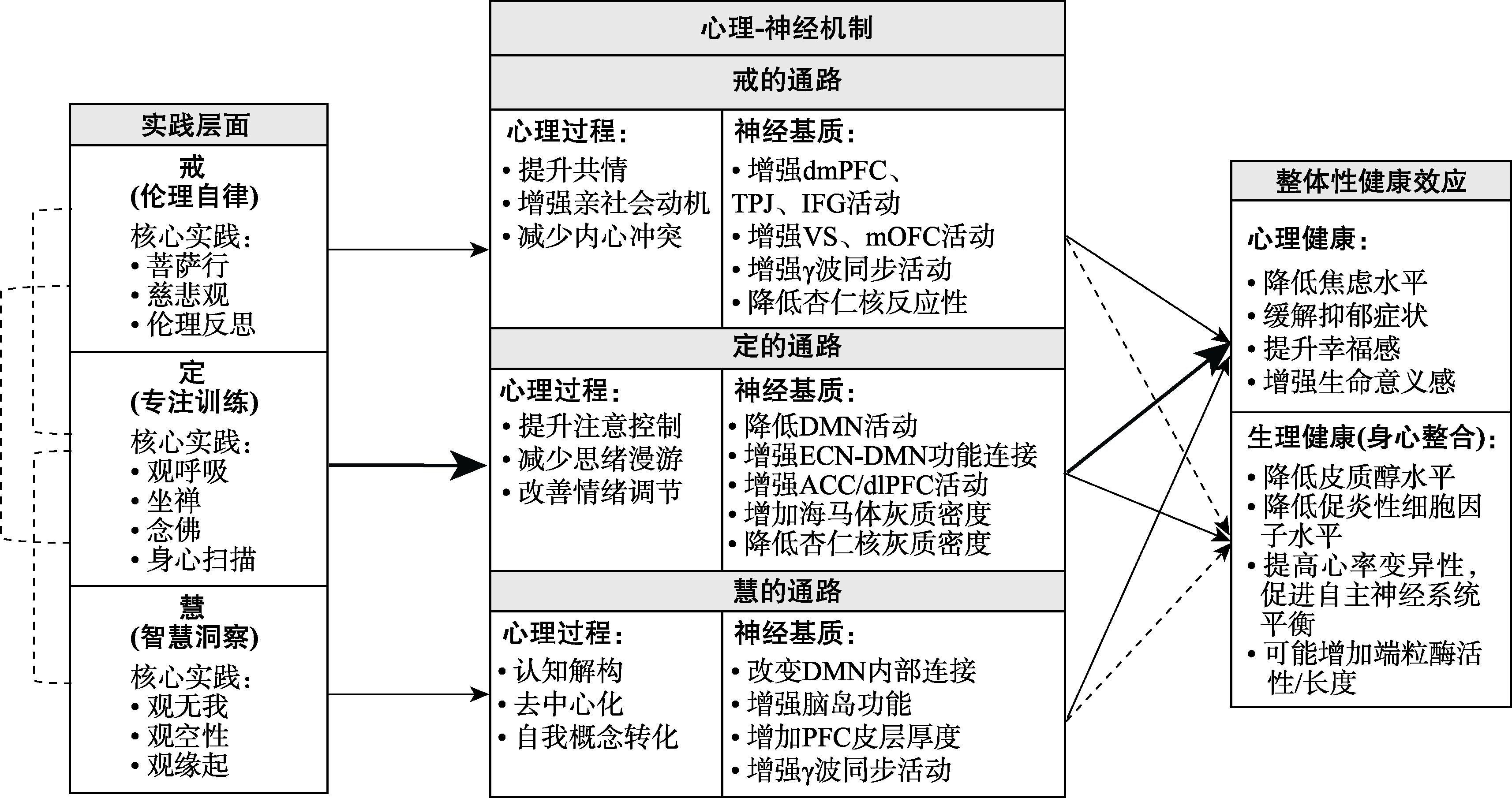
图1 东方正念的心理−神经−生理机制整合框架 注:从左至右的箭头表示因果路径, 并用不同标识区分证据等级, 粗实线表示高证据等级(元分析/大量RCT支持)、细实线表示中等证据等级(初步实验证据/较多横断面研究)、虚线表示初步证据等级(理论推导/个案研究); “戒定慧”之间用虚线连接, 表示三者次第增上、圆融一体; 所有通路最终汇集到整体性健康效应, 体现框架的整合性。
| [1] | 陈兵. (2006). 佛陀的智慧. 上海古籍出版社. |
| [2] | 胡奇强. (2019). 佛教般若的内涵及其对现代人心理健康的启示. 宗教心理学, 5, 103-108. |
| [3] |
彭彦琴, 史瑞琪. (2025). 正念发展的伦理转向:基于智慧的超越性道德. 心理科学进展, 33(6), 1057-1066.
doi: 10.3724/SP.J.1042.2025.1057 |
| [4] |
孙莎莎, 李小兵. (2022). 冥想的安全性. 心理科学进展, 30(11), 2570-2585.
doi: 10.3724/SP.J.1042.2022.02570 |
| [5] | 乌多拉. (2007a). 南传佛教禅法中的观呼吸法. 宗教学研究, (1), 187-189. |
| [6] | 乌多拉. (2007b). 四念处观法 [博士学位论文]. 四川大学. |
| [7] | 朱天助. (2016). 正念与因果的关系——从现代心理学角度分析. 宗教研究, (2), 98-105. |
| [8] |
Abdul Manan H., Mir I. A., Humayra S., Tee R. Y., & Vasu D. T. (2024). Effect of mindfulness-based interventions on anxiety, depression, and stress in patients with coronary artery disease: A systematic review and meta-analysis of randomized controlled trials. Frontiers in Psychology, 15, 1435243.
doi: 10.3389/fpsyg.2024.1435243 URL |
| [9] |
Asadollah F., Varzeshnejad M., Sabery M., Nikfarid L., & Hashemi F. (2023). The impact of loving-kindness meditation on compassion fatigue of nurses working in the neonatal intensive care unit: A randomized clinical trial study. Holistic Nursing Practice, 37(4), 215-222.
doi: 10.1097/HNP.0000000000000590 pmid: 37335149 |
| [10] |
Badanta B., González-Cano-Caballero M., Suárez-Reina P., Lucchetti G., & de Diego-Cordero R. (2022). How does confucianism influence health behaviors, health outcomes and medical decisions? A scoping review. Journal of Religion and Health, 61(4), 2679-2725.
doi: 10.1007/s10943-022-01506-8 |
| [11] |
Baghdadi G., Hadaeghi F., & Kamarajan C. (2025). Multimodal approaches to investigating neural dynamics in cognition and related clinical conditions: Integrating EEG, MEG, and fMRI data. Frontiers in Systems Neuroscience, 19, 1495018.
doi: 10.3389/fnsys.2025.1495018 URL |
| [12] | Bellinger K., & Carone S. (2021). Creativity in supervision using the integrated developmental model of supervision. Journal of Counselor Preparation and Supervision, 14(4), Article 2. |
| [13] |
Berkovich-Ohana A., Brown W. K., Gallagher S., Barendregt H., Bauer P., Giommi F., … Amaro A. (2024). Pattern theory of selflessness: How meditation may transform the self-pattern. Mindfulness, 15(8), 2114-2140.
doi: 10.1007/s12671-024-02418-2 |
| [14] |
Berry D. R., Hoerr J. P., Cesko S., Alayoubi A., Carpio K., Zirzow H.,... Beaver V. (2020). Does mindfulness training without explicit ethics-based instruction promote prosocial behaviors? A meta-analysis. Personality and Social Psychology Bulletin, 46(8), 1247-1269.
doi: 10.1177/0146167219900418 pmid: 31971095 |
| [15] | Binda D. D., Greco C. M., & Morone N. E. (2022). What are adverse events in mindfulness meditation? Global Advances in Health and Medicine, 11, Article 2164957X221096640. |
| [16] | Braboszcz C., Cahn B. R., Levy J., Fernandez M., & Delorme A. (2017). Increased gamma brainwave amplitude compared to control in three different meditation traditions. PLoS One, 12(1), e0170647 |
| [17] | Braun E. (2014). Meditation en masse: How colonialism sparked the global vipassana movement. Tricycle, 23(3), 56-61. |
| [18] |
Brewer J. A., Worhunsky P. D., Gray J. R., Tang Y. Y., Weber J., & Kober H. (2011). Meditation experience is associated with differences in default mode network activity and connectivity. Proceedings of the National Academy of Sciences, 108(50), 20254-20259.
doi: 10.1073/pnas.1112029108 URL |
| [19] |
Britton W. B., Lindahl J. R., Cooper D. J., Canby N. K., & Palitsky R. (2021). Defining and measuring meditation- related adverse effects in mindfulness-based programs. Clinical Psychological Science, 9(6), 1185-1204.
doi: 10.1177/2167702621996340 URL |
| [20] | Brown K. W., Berry D., Eichel K., Beloborodova P., Rahrig H., & Britton W. B. (2022). Comparing impacts of meditation training in focused attention, open monitoring, and mindfulness‐based cognitive therapy on emotion reactivity and regulation: Neural and subjective evidence from a dismantling study. Psychophysiology, 59(7), e14024. |
| [21] |
Cahn B. R., Delorme A., & Polich J. (2010). Occipital gamma activation during Vipassana meditation. Cognitive Processing, 11(1), 39-56.
doi: 10.1007/s10339-009-0352-1 pmid: 20013298 |
| [22] |
Cahn B. R., & Polich J. (2006). Meditation states and traits: EEG, ERP, and neuroimaging studies. Psychological Bulletin, 132(2), 180-211.
doi: 10.1037/0033-2909.132.2.180 pmid: 16536641 |
| [23] |
Carrero I., Martínez de Ibarreta C., Valor C., & Merino A. (2023). Does loving-kindness meditation elicit empathic emotions? The moderating role of self-discrepancy and self-esteem on guilt. Applied Psychology: Health and Well-Being, 15(3), 919-937.
doi: 10.1111/aphw.v15.3 URL |
| [24] | Chan D. C. C., Luk L. H. F., You L. L. L., Zhang D., Ngai W. B., & Wong S. Y. S. (2025). Evaluating an online four-session loving-kindness and compassion meditation training on improving psychological well-being among healthcare professionals in Hong Kong: A pilot randomised controlled study. Cogent Psychology, 12(1), 2510737. |
| [25] | Chan S. H., Chan W. W., Chao J. Y., & Chan P. K. (2020). A randomized controlled trial on the comparative effectiveness of mindfulness-based cognitive therapy and health qigong-based cognitive therapy among Chinese people with depression and anxiety disorders. BMC Psychiatry, 20(1), 590. |
| [26] | Chandran V., Bermúdez M. L., Koka M., Chandran B., Pawale D., Vishnubhotla R.,... Sadhasivam S. (2021). Large-scale genomic study reveals robust activation of the immune system following advanced Inner Engineering meditation retreat. Proceedings of the National Academy of Sciences, 118(51), e2110455118. |
| [27] |
Chang C., & Chen J. E. (2021). Multimodal EEG-fMRI: Advancing insight into large-scale human brain dynamics. Current Opinion in Biomedical Engineering, 18, 100279.
doi: 10.1016/j.cobme.2021.100279 URL |
| [28] |
Chen K. W., Berger C. C., Manheimer E., Forde D., Magidson J., Dachman L., & Lejuez C. W. (2012). Meditative therapies for reducing anxiety: A systematic review and meta-analysis of randomized controlled trials. Depression and Anxiety, 29(7), 545-562.
doi: 10.1002/da.21964 pmid: 22700446 |
| [29] |
Cheng F. K., & Tse S. (2014). The use of Chinese Buddhist theories in counselling, psychotherapy, psychology, and mental health research: An integrative review. International Journal for the Advancement of Counselling, 36(3), 229-242.
doi: 10.1007/s10447-013-9202-z URL |
| [30] | Darnbush A. (2023). Emotion recognition in individuals with social anxiety: Loving-kindness as an intervention [Unpublished master’s thesis]. University of Tennessee at Chattanooga. |
| [31] |
De Filippi E., Escrichs A., Càmara E., Garrido C., Marins T., Sanchez-Fibla M.,... Deco G. (2022). Meditation-induced effects on whole-brain structural and effective connectivity. Brain Structure and Function, 227(6), 2087-2102.
doi: 10.1007/s00429-022-02496-9 |
| [32] |
Deacon B. J., Fawzy T. I., Lickel J. J., & Wolitzky-Taylor K. B. (2011). Cognitive defusion versus cognitive restructuring in the treatment of negative self-referential thoughts: An investigation of process and outcome. Journal of Cognitive Psychotherapy, 25(3), 218-232.
doi: 10.1891/0889-8391.25.3.218 URL |
| [33] |
Delgado D., Meindl J. N., Al-Nasser T., & Ivy J. W. (2024). When cultural awareness reveals conflicting cultural values: A pragmatic approach. Behavior Analysis in Practice, 17(1), 13-25.
doi: 10.1007/s40617-023-00826-9 pmid: 38405277 |
| [34] |
Denkhaus R., & Bös M. (2012). How cultural is ‘cultural neuroscience’? Some comments on an emerging research paradigm. BioSocieties, 7(4), 433-458.
doi: 10.1057/biosoc.2012.30 URL |
| [35] | Do Le Anh Thi B. (2021). An effective way of cultivating the mind based on wise attention (Yoniso-manasikāra): A case study of international meditation group [Unpublished doctoral dissertation]. Mahachulalongkornrajavidyalaya University. |
| [36] | Dor-Ziderman Y., Schweitzer Y., Nave O., Trautwein F. -M., Fulder S., Lutz A., Goldstein A., & Berkovich- Ohana A. (2025). Training the embodied self in its impermanence: Meditators evidence neurophysiological markers of death acceptance. Neuroscience of Consciousness, (1), niaf002. |
| [37] |
Farias M., Maraldi E., Wallenkampf K. C., & Lucchetti G. (2020). Adverse events in meditation practices and meditation-based therapies: A systematic review. Acta Psychiatrica Scandinavica, 142(5), 374-393.
doi: 10.1111/acps.v142.5 URL |
| [38] |
Garcia-Campayo J., Del Hoyo Y. L., & Navarro-Gil M. (2021). Contemplative sciences: A future beyond mindfulness. World Journal of Psychiatry, 11(4), 87-93.
doi: 10.5498/wjp.v11.i4.87 pmid: 33889534 |
| [39] |
Garland E. L., Farb N. A., Goldin P. R., & Fredrickson B. L. (2015). The mindfulness-to-meaning theory: Extensions, applications, and challenges at the attention-appraisal- emotion interface. Psychological Inquiry, 26(4), 377-387.
doi: 10.1080/1047840X.2015.1092493 URL |
| [40] |
Gloster A. T., Walder N., Levin M. E., Twohig M. P., & Karekla M. (2020). The empirical status of acceptance and commitment therapy: A review of meta-analyses. Journal of Contextual Behavioral Science, 18, 181-192.
doi: 10.1016/j.jcbs.2020.09.009 URL |
| [41] |
Goldberg S. B., & Davidson R. J. (2024). Contemplative science comes of age: Looking backward and forward 20 years after Baer (2003). Clinical Psychology: Science and Practice, 31(1), 39-41.
doi: 10.1037/cps0000186 pmid: 38524254 |
| [42] |
Greenfield P. M. (2000). Three approaches to the psychology of culture: Where do they come from? Where can they go? Asian Journal of Social Psychology, 3(3), 223-240.
doi: 10.1111/ajsp.2000.3.issue-3 URL |
| [43] | Hariyanto. (2025). Buddhist epistemology and critical thinking: Ethical, cognitive, and pedagogical insights for interdisciplinary education. Human Arenas, Advance online publication. https://doi.org/10.1007/s42087-025-00508-8 |
| [44] |
Hasenkamp W., & Barsalou L. W. (2012). Effects of meditation experience on functional connectivity of distributed brain networks. Frontiers in Human Neuroscience, 6, 38.
doi: 10.3389/fnhum.2012.00038 pmid: 22403536 |
| [45] |
Hayes S. C., Luoma J. B., Bond F. W., Masuda A., & Lillis J. (2006). Acceptance and commitment therapy: Model, processes and outcomes. Behaviour Research and Therapy, 44(1), 1-25.
doi: 10.1016/j.brat.2005.06.006 pmid: 16300724 |
| [46] |
Hofmann S. G., & Gómez A. F. (2017). Mindfulness-based interventions for anxiety and depression. Psychiatric Clinics of North America, 40(4), 739-749.
doi: 10.1016/j.psc.2017.08.008 |
| [47] |
Hölzel B. K., Carmody J., Vangel M., Congleton C., Yerramsetti S. M., Gard T., & Lazar S. W. (2011). Mindfulness practice leads to increases in regional brain gray matter density. Psychiatry Research: Neuroimaging, 191(1), 36-43.
doi: 10.1016/j.pscychresns.2010.08.006 URL |
| [48] |
Hu Z., Wen Y., Wang Y., Lin Y., Shi J., Yu Z.,... Wang Y. (2022). Effectiveness of mindfulness-based interventions on empathy: A meta-analysis. Frontiers in Psychology, 13, 992575.
doi: 10.3389/fpsyg.2022.992575 URL |
| [49] |
Husgafvel V. (2016). On the Buddhist roots of contemporary non-religious mindfulness practice: Moving beyond sectarian and essentialist approaches. Temenos - Nordic Journal for the Study of Religion, 52(1), 87-126.
doi: 10.33356/temenos.55371 URL |
| [50] |
Husgafvel V. (2018). The ‘universal dharma foundation’of mindfulness-based stress reduction: Non-duality and mahāyāna buddhist influences in the work of jon kabat-zinn. Contemporary Buddhism, 19(2), 275-326.
doi: 10.1080/14639947.2018.1572329 URL |
| [51] |
IJntema R. C., Schaufeli W. B., & Burger Y. D. (2023). Resilience mechanisms at work: The psychological immunity-psychological elasticity (PI-PE) model of psychological resilience. Current Psychology, 42(6), 4719-4731.
doi: 10.1007/s12144-021-01813-5 |
| [52] | Jahnke R., Larkey L., Rogers C., Etnier J., & Lin F. (2010). A comprehensive review of health benefits of qigong and tai chi. American Journal of Health Promotion, 24(6), e1-e25. |
| [53] | Jones C. B. (2019). Chinese Pure Land Buddhism: A history of doctrine, ritual, and practice. University of Hawai'i Press. |
| [54] |
Kabat-Zinn J. (2011). Some reflections on the origins of MBSR, skillful means, and the trouble with maps. Contemporary Buddhism, 12(1), 281-306.
doi: 10.1080/14639947.2011.564844 URL |
| [55] |
Karjalainen M., Islam G., & Holm M. (2021). Scientization, instrumentalization, and commodification of mindfulness in a professional services firm. Organization, 28(3), 483-509.
doi: 10.1177/1350508419883388 URL |
| [56] |
Kashdan T. B., & Rottenberg J. (2010). Psychological flexibility as a fundamental aspect of health. Clinical Psychology Review, 30(7), 865-878.
doi: 10.1016/j.cpr.2010.03.001 pmid: 21151705 |
| [57] |
Klein R. J., Jacobson N. C., & Robinson M. D. (2023). A psychological flexibility perspective on well-being: Emotional reactivity, adaptive choices, and daily experiences. Emotion, 23(4), 911-924.
doi: 10.1037/emo0001159 URL |
| [58] |
Klimecki O. M., Leiberg S., Lamm C., & Singer T. (2013). Functional neural plasticity and associated changes in positive affect after compassion training. Cerebral Cortex, 23(7), 1552-1561.
doi: 10.1093/cercor/bhs142 URL |
| [59] | Kolev V., Beshkov K., Malinowski P., Raffone A., & Yordanova J. (2025). Distinct patterns of directed brain connectivity in focused attention, open monitoring and loving kindness meditation: An EEG Granger causality study with long-term meditators. BioRxiv. https://doi.org/10.1101/2025.07.01.662572 |
| [60] | Kreplin U., Farias M., & Brazil I. A. (2018). The limited prosocial effects of meditation: A systematic review and meta-analysis. Scientific Reports, 8(1), 2403. |
| [61] |
Lee M. S., Huh H. J., Kim B. G., Ryu H., Lee H. S., Kim J. M., & Chung H. T. (2002). Effects of Qi-training on heart rate variability. The American Journal of Chinese Medicine, 30(4), 463-470.
doi: 10.1142/S0192415X02000491 URL |
| [62] |
Leggett W. (2022). Can mindfulness really change the world? The political character of meditative practices. Critical Policy Studies, 16(3), 261-278.
doi: 10.1080/19460171.2021.1932541 URL |
| [63] |
Levin M. E., Haeger J., An W., & Twohig M. P. (2018). Comparing cognitive defusion and cognitive restructuring delivered through a mobile app for individuals high in self-criticism. Cognitive Therapy and Research, 42(6), 844-855.
doi: 10.1007/s10608-018-9944-3 |
| [64] | Li S., Zhong N., & Guo Q. (2024). How does dispositional mindfulness foster prosocial behavior? A cross-cultural study of empathy’s mediating role and cultural moderation. Frontiers in Psychology, 15, Article 1451138. |
| [65] | Lindahl J. R., & Britton W. B. (2019). 'I have this feeling of not really being here': Buddhist meditation and changes in sense of self. Journal of Consciousness Studies, 26(7-8), 157-183. |
| [66] | Lippelt D. P., Hommel B., & Colzato L. S. (2014). Focused attention, open monitoring and loving kindness meditation: Effects on attention, conflict monitoring, and creativity-A review. Frontiers in Psychology, 5, 1083. |
| [67] | Liu Y., Chen C., Du H., Xue M., & Zhu N. (2024). Impact of Baduanjin exercise combined with rational emotive behavior therapy on sleep and mood in patients with poststroke depression: A randomized controlled trial. Medicine, 103(19), e38180. |
| [68] |
Lomas T. (2017). Recontextualizing mindfulness: Theravada Buddhist perspectives on the ethical and spiritual dimensions of awareness. Psychology of Religion and Spirituality, 9(2), 209-219.
doi: 10.1037/rel0000080 URL |
| [69] |
Luberto C. M., Shinday N., Song R., Philpotts L. L., Park E. R., Fricchione G. L., & Yeh G. Y. (2018). A systematic review and meta-analysis of the effects of meditation on empathy, compassion, and prosocial behaviors. Mindfulness, 9(3), 708-724.
doi: 10.1007/s12671-017-0841-8 pmid: 30100929 |
| [70] | Lutz A., Brefczynski-Lewis J., Johnstone T., & Davidson R. J. (2008). Regulation of the neural circuitry of emotion by compassion meditation: Effects of meditative expertise. PloS One, 3(3), e1897. |
| [71] |
Lynch J. M., & Troy A. S. (2021). The role of nonduality in the relationship between flow states and well-being. Mindfulness, 12(7), 1639-1652.
doi: 10.1007/s12671-021-01627-3 |
| [72] | Maercker A., & Zoellner T. (2004). The Janus face of self-perceived growth: Toward a two-component model of posttraumatic growth. Psychological Inquiry, 15(1), 41-48. |
| [73] |
Mascaro N., Rilling J. K., Negi L. T., & Raison C. L. (2013). Compassion meditation enhances empathic accuracy and related neural activity. Social Cognitive and Affective Neuroscience, 8(1), 48-55.
doi: 10.1093/scan/nss095 pmid: 22956676 |
| [74] |
Millard L. A., Wan M. W., Smith D. M., & Wittkowski A. (2023). The effectiveness of compassion focused therapy with clinical populations: A systematic review and meta-analysis. Journal of Affective Disorders, 326, 168-192.
doi: 10.1016/j.jad.2023.01.010 pmid: 36649790 |
| [75] | Miyakawa M. (2024). Critique of modern instrumental mindfulness as neoliberal narcissism [Unpublished doctoral dissertation]. Simon Fraser University. |
| [76] | Pandey M. P. (2023). Effects of Vipassanā meditation on personal and professional life [Unpublished doctoral dissertation]. Lumbini Buddhist University. |
| [77] |
Prevost A. M., George M., & Fourie M. M. (2025). A kind mind: Effects of compassion-based meditation on prosocial intergroup outcomes in a South African pilot sample. Frontiers in Psychology, 16, 1450549.
doi: 10.3389/fpsyg.2025.1450549 URL |
| [78] | Purser R. E. (2021). McMindfulness: How mindfulness became the new capitalist spirituality. Journal of Global Buddhism, 22(1), 251-258. |
| [79] |
Purser R. E., & Milillo J. (2015). Mindfulness revisited: A Buddhist-based conceptualization. Journal of Management Inquiry, 24(1), 3-24.
doi: 10.1177/1056492614532315 URL |
| [80] | Rodrigues F. M., Junkes L., Appolinario J., & Nardi A. E. (2024). Mindfulness-based cognitive therapy for treatment-resistant depression: A protocol for systematic review and meta-analysis. PLoS One, 19(10), e0306227. |
| [81] |
Rosenkranz M. A., Davidson R. J., MacCoon D. G., Sheridan J. F., Kalin N. H., & Lutz A. (2013). A comparison of mindfulness-based stress reduction and an active control in modulation of neurogenic inflammation. Brain, Behavior, and Immunity, 27, 174-184.
doi: 10.1016/j.bbi.2012.10.013 pmid: 23092711 |
| [82] |
Sahdra B., Ciarrochi J., & Parker P. (2016). Nonattachment and mindfulness: Related but distinct constructs. Psychological Assessment, 28(7), 819-829.
doi: 10.1037/pas0000264 pmid: 27078180 |
| [83] |
Santosa G. N. P. E., Jawi I. M., Bakta I. M., Sutirta Yasa I. W. P., Wirawan I. M. A., Lesmana C. B. J.,... Brahmantya I. B. Y. (2024). The effect of meditation on telomerase and stem cell. International Journal of Research in Medical Sciences, 12(9), 3491-3499.
doi: 10.18203/2320-6012.ijrms20242638 URL |
| [84] |
Shao D., Zhang H., Cui N., Sun J., Li J., & Cao F. (2021). The efficacy and mechanisms of a guided self-help intervention based on mindfulness in patients with breast cancer: A randomized controlled trial. Cancer, 127(9), 1377-1386.
doi: 10.1002/cncr.33381 pmid: 33332582 |
| [85] | Sharp J. E., & Rhinehart A. J. (2018). Infusing mindfulness and character strengths in supervision to promote beginning supervisee development. Journal of Counselor Practice, 9(1), 64-80. |
| [86] |
Shonin E., Van Gordon W., & Griffiths M. D. (2014). The emerging role of Buddhism in clinical psychology: Toward effective integration. Psychology of Religion and Spirituality, 6(2), 123-137.
doi: 10.1037/a0035859 URL |
| [87] |
Singleton O., Hölzel B. K., Vangel M., Brach N., Carmody J., & Lazar S. W. (2014). Change in brainstem gray matter concentration following a mindfulness-based intervention is correlated with improvement in psychological well-being. Frontiers in Human Neuroscience, 8, 33.
doi: 10.3389/fnhum.2014.00033 pmid: 24600370 |
| [88] |
Starkey C. (2024). British Buddhism, secular mindfulness, and the politics of sustainability. Religion, 54(2), 179-202.
doi: 10.1080/0048721X.2023.2222694 URL |
| [89] | Stuart D. M., & Goenka S. N. (2020). SN Goenka: Emissary of insight.(Vol 5). Shambhala Publications. |
| [90] |
Sys S., Van Gordon W., & Gilbert P. (2024). A qualitative comparison of secular and Buddhist-informed mental health practitioners’ perceptions of non-attachment. Mindfulness, 15(2), 345-358.
doi: 10.1007/s12671-023-02291-5 |
| [91] |
Taylor V. A., Daneault V., Grant J., Scavone G., Breton E., Roffe-Vidal S.,... Beauregard M. (2013). Impact of meditation training on the default mode network during a restful state. Social Cognitive and Affective Neuroscience, 8(1), 4-14.
doi: 10.1093/scan/nsr087 pmid: 22446298 |
| [92] |
Thakur M., Patil Y., Philip S. T., Hamdule T., Thimmapuram J., Vyas N., & Thakur K. (2023). Impact of Heartfulness meditation practice on anxiety, perceived stress, well-being, and telomere length. Frontiers in Psychology, 14, 1158760.
doi: 10.3389/fpsyg.2023.1158760 URL |
| [93] | Thériault R., Masson R., & Dandeneau S. (2025). Is the mind more powerful than the heart? A randomized controlled trial of two loving-kindness interventions. PsyArXiv. https://osf.io/preprints/psyarxiv/x4p9v_v2 |
| [94] |
Triplett K. N., Tedeschi R. G., Cann A., Calhoun L. G., & Reeve C. L. (2012). Posttraumatic growth, meaning in life, and life satisfaction in response to trauma. Psychological Trauma: Theory, Research, Practice, and Policy, 4 (4), 400-410.
doi: 10.1037/a0024204 URL |
| [95] |
Van Dam N. T., & Galante J. (2023). Underestimating harm in mindfulness-based stress reduction. Psychological Medicine, 53(1), 292-294.
doi: 10.1017/S003329172000447X URL |
| [96] | Vangkonevilay N. (2023). Fundamentals of insight meditation. Buddho, 2(4), 23-36. |
| [97] | Vranceanu A. M., Kronish I. M., Plys E., Syme M., Yu F., & Gaugler J. E. (2025). The NIH stage model for behavioral interventions in aging: Development, maturation, impact, and opportunities for advancement. The Gerontologist, 65(7), gnaf123. |
| [98] |
Vu H. X. (2024). A comprehensive review on the correlation between Buddhism and psychology. The American Journal of Interdisciplinary Innovations and Research, 6(1), 24-32.
doi: 10.37547/tajiir URL |
| [99] | Wang Y., Ser W. H., & Lim C. B. (2024). The construction and characteristics of Chinese beliefs in ghosts and deities within the context of the integration of the three teachings. International Journal of Academic Research in Business and Social Sciences, 14(5), 1676-1690. |
| [100] | Westerhoff J. (2009). Nagarjuna's Madhyamaka: A philosophical introduction. Oxford University Press. |
| [101] | Wongpakaran N., Pooriwarangkakul P., Suwannachot N., Mirnics Z., Kövi Z., & Wongpakaran T. (2022). Moderating role of observing the five precepts of buddhism on neuroticism, perceived stress, and depressive symptoms. PLoS One, 17(11), e0277351. |
| [102] |
Ye J., Fang J., Yang S., Xiang Q., & Ahorsu D. K. (2025). Effects of Baduanjin exercise on depression severity and heart rate variability in adults with major depressive disorder: A pilot randomized controlled trial. Psychology Research and Behavior Management, 18, 505-514.
doi: 10.2147/PRBM.S499936 pmid: 40060106 |
| [103] |
Yoon S. I., Park H. Y., Park C., Pyun J., Yoo J. H., Song G. J.,... & Kim J. W. (2025). Effectiveness of mindfulness and qigong training for self-healing in patients with hwabyung and depressive disorder: A randomized controlled trial. Frontiers in Psychiatry, 16, 1508937.
doi: 10.3389/fpsyt.2025.1508937 URL |
| [104] |
Young K. S., van der Velden A. M., Craske M. G., Pallesen K. J., Fjorback L., Roepstorff A., & Parsons C. E. (2018). The impact of mindfulness-based interventions on brain activity: A systematic review of functional magnetic resonance imaging studies. Neuroscience & Biobehavioral Reviews, 84, 424-433.
doi: 10.1016/j.neubiorev.2017.08.003 URL |
| [105] | Yü C. -f. (1981). The renewal of Buddhism in China: Chu-hung and the late Ming synthesis. Columbia University Press. |
| [106] |
Zhang D., Lee E. K., Mak E. C., Ho C. Y., & Wong S. Y. (2021). Mindfulness-based interventions: An overall review. British Medical Bulletin, 138(1), 41-57.
doi: 10.1093/bmb/ldab005 pmid: 33884400 |
| [107] | Zhang Y., & Jiang X. (2023). The effect of Baduanjin exercise on the physical and mental health of college students: A randomized controlled trial. Medicine, 102(34), e34897. |
| [108] | Ziporyn B. (2004). Being and ambiguity: Philosophical experiments with Tiantai Buddhism. Open Court. |
| [1] | 郭新宇, 汤煜尧, 张丹丹. 同步TMS-EEG技术在心理学研究中的应用[J]. 心理科学进展, 2026, 34(3): 441-460. |
| [2] | 岳丽明, 刘振南, 高湘萍. 不同类型元认知反思的特异性与协同神经机制:一个整合性理论模型[J]. 心理科学进展, 2026, 34(3): 487-498. |
| [3] | 孙焕翔, 张帆, 李思嘉, 张秀玲, 蒋毅. 化繁为简:视觉集合感知的神经机制[J]. 心理科学进展, 2026, 34(2): 251-270. |
| [4] | 彭玉佳, 王愉茜, 鞠芊芊, 刘峰, 徐佳. 贝叶斯框架下社交焦虑的社会认知特性[J]. 心理科学进展, 2025, 33(8): 1267-1274. |
| [5] | 隋雪, 安禹思, 许艺楠, 李雨桐. 快速阅读的眼动特征、认知特点及神经机制[J]. 心理科学进展, 2025, 33(8): 1358-1366. |
| [6] | 何鸿, 张馨月, 石京鸿, 刘强. 转回努力训练对心智游移的影响及其机制探索[J]. 心理科学进展, 2025, 33(7): 1077-1090. |
| [7] | 余凌峰, 张婕, 明先超, 雷怡. 无意识恐惧及其神经机制[J]. 心理科学进展, 2025, 33(7): 1234-1245. |
| [8] | 彭彦琴, 史瑞琪. 正念发展的伦理转向:基于智慧的超越性道德[J]. 心理科学进展, 2025, 33(6): 1057-1066. |
| [9] | 张静, 孟煜, 张蒙, 陈慧雅. 员工正念对工作绩效的作用效果及机制:基于元分析的证据[J]. 心理科学进展, 2025, 33(4): 647-672. |
| [10] | 程晓荣, 仇式明, 定险峰, 范炤. 动作如何影响元认知?——基于认知模型和神经机制的探讨[J]. 心理科学进展, 2025, 33(3): 425-438. |
| [11] | 巩芳颍, 孙逸梵, 贺琴, 石可, 刘伟, 陈宁. 教学互动中师生脑间同步性及其调节因素[J]. 心理科学进展, 2025, 33(3): 452-464. |
| [12] | 夏熠, 张婕, 张火垠, 雷怡, 窦皓然. 焦虑个体趋避冲突失调的认知神经机制[J]. 心理科学进展, 2025, 33(3): 477-493. |
| [13] | 靳帅, 刘思佳, 李爽, 刘志远, 郭秀艳. 后悔情绪及其调节[J]. 心理科学进展, 2025, 33(12): 2182-2195. |
| [14] | 刘凯航, 朴忠淑, 田英, 王丽岩, 王洪彪. 从动作模仿到预测加工:运动感染的动态神经机制与实践应用图景[J]. 心理科学进展, 2025, 33(11): 1942-1956. |
| [15] | 蔡嘉琳, 陈彩琦. 认知脱离综合征的特征:与注意缺陷多动障碍等障碍的比较[J]. 心理科学进展, 2025, 33(11): 1967-1982. |
| 阅读次数 | ||||||
|
全文 |
|
|||||
|
摘要 |
|
|||||
