

ISSN 1671-3710
CN 11-4766/R
主办:中国科学院心理研究所
出版:科学出版社
CN 11-4766/R
主办:中国科学院心理研究所
出版:科学出版社
心理科学进展 ›› 2025, Vol. 33 ›› Issue (6): 933-947.doi: 10.3724/SP.J.1042.2025.0933 cstr: 32111.14.2025.0933
谭美丽, 殷向洲, 张光磊, 熊普臻( )
)
收稿日期:2023-04-23
出版日期:2025-06-15
发布日期:2025-04-09
通讯作者:
熊普臻, E-mail: bear_pz@whut.edu.cn基金资助:
TAN Meili, YIN Xiangzhou, ZHANG Guanglei, XIONG Puzhen()
Received:2023-04-23
Online:2025-06-15
Published:2025-04-09
摘要:
人工智能在工作场所中扮演的角色日益多元, 但现有研究对人工智能角色的系统划分和对员工心理和行为影响的系统性探讨仍然较为有限。基于人工智能在工作场所的实践应用, 本研究结合相关理论文献, 从员工视角将人工智能划分为“对手”、“助手”、“同事”和“领导”四类角色, 并基于“替代−辅助−增强−管理”视角, 分析不同人工智能角色对员工心理与行为的影响。进一步地, 提出企业层面和个体层面的管理与适应策略, 并对未来研究方向进行展望。本研究丰富了工作场所人工智能角色分类和对员工影响的理论讨论, 也为组织和个体更有效地适应人工智能的不同角色应用提供了实践启示。
中图分类号:
谭美丽, 殷向洲, 张光磊, 熊普臻. (2025). 工作场所人工智能角色划分:对员工心理与行为的影响及应对策略. 心理科学进展 , 33(6), 933-947.
TAN Meili, YIN Xiangzhou, ZHANG Guanglei, XIONG Puzhen. (2025). Workplace artificial intelligence role classification: Impacts on employee psychology and behavior and coping strategies. Advances in Psychological Science, 33(6), 933-947.
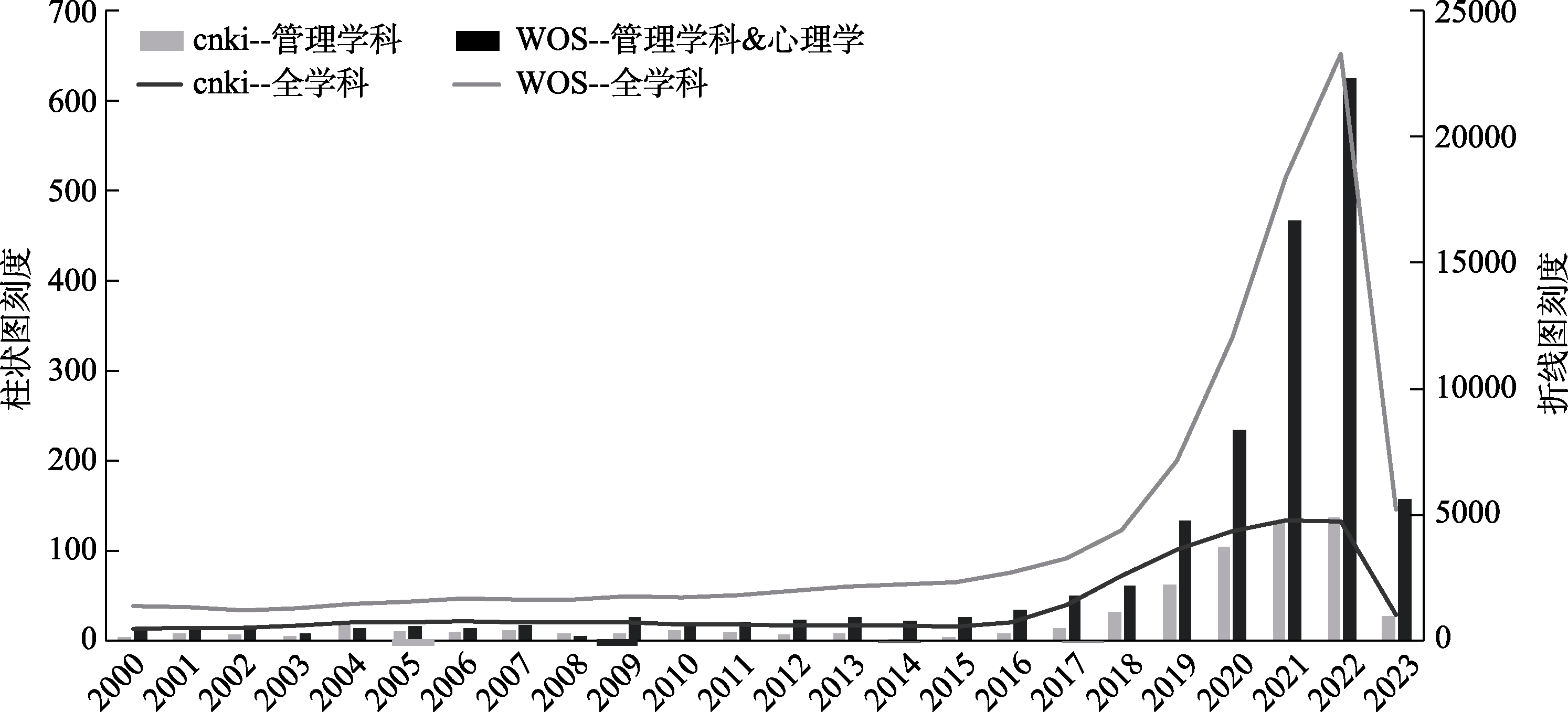
图1 CNKI和WOS人工智能主题发文量趋势图(截至2024年4月30日)
| 人工智能角色 | 概述 | 发展阶段 | 技术举例 |
|---|---|---|---|
| 弱人工智能ANI | 能在有限的功能集内表现出类似人类或更高水平认知的系统, 只能解决特定领域的单一问题并无意识 | 较为成熟, 且广泛应用 | 生成式人工智能图象识别 |
| 强人工智能AGI | 可在所有领域复制类似人类或更高水平的认知, 具备意识与人类难以区分 | 初步探索, 暂未应用 | — |
| 超人工智能ASI | 几乎在所有领域都强于人类大脑 | 暂未探索 | — |
表1 人工智能的不同形态
| 人工智能角色 | 概述 | 发展阶段 | 技术举例 |
|---|---|---|---|
| 弱人工智能ANI | 能在有限的功能集内表现出类似人类或更高水平认知的系统, 只能解决特定领域的单一问题并无意识 | 较为成熟, 且广泛应用 | 生成式人工智能图象识别 |
| 强人工智能AGI | 可在所有领域复制类似人类或更高水平的认知, 具备意识与人类难以区分 | 初步探索, 暂未应用 | — |
| 超人工智能ASI | 几乎在所有领域都强于人类大脑 | 暂未探索 | — |
| 人工智能工作特征 | 人工智能形式示例 | 文献观点示例 | 关注焦点 | 人工智能角色 |
|---|---|---|---|---|
| 替代员工完成部分重复性、体力性任务 | 使用智能机器人进行快递分拣 | ①提出在人工智能发展背景下的技术型工作不安全感, 包含工作替代不安全感维度(涂艳 等, | 人工智能 | 对手 |
| 辅助员工完成结构化、基础性任务 | 使用个人数字助理进行会议预定 | ①人工智能被视为协助完成工作的工具, 充当“助手”角色(尹萌, 牛雄鹰, | 二元关系 | 助手 |
| 增强员工技能以完成复杂任务 | 借助数据分析和预测工具进行可视化分析 | ①人工智能在与员工的互动中被视为“同事” (穆鑫岩 等, | 二元关系 | 同事 |
| 管理员工任务分配与执行监管职能 | 外卖平台使用算法系统派单给骑手 | ①雇主使用算法控制员工(Kellogg et al., | 员工 | 领导 |
表2 工作场所中人工智能角色梳理与观点示例
| 人工智能工作特征 | 人工智能形式示例 | 文献观点示例 | 关注焦点 | 人工智能角色 |
|---|---|---|---|---|
| 替代员工完成部分重复性、体力性任务 | 使用智能机器人进行快递分拣 | ①提出在人工智能发展背景下的技术型工作不安全感, 包含工作替代不安全感维度(涂艳 等, | 人工智能 | 对手 |
| 辅助员工完成结构化、基础性任务 | 使用个人数字助理进行会议预定 | ①人工智能被视为协助完成工作的工具, 充当“助手”角色(尹萌, 牛雄鹰, | 二元关系 | 助手 |
| 增强员工技能以完成复杂任务 | 借助数据分析和预测工具进行可视化分析 | ①人工智能在与员工的互动中被视为“同事” (穆鑫岩 等, | 二元关系 | 同事 |
| 管理员工任务分配与执行监管职能 | 外卖平台使用算法系统派单给骑手 | ①雇主使用算法控制员工(Kellogg et al., | 员工 | 领导 |
| 来源(时间) | 观点概要 |
|---|---|
| Allen et al. ( | 尽管人们认为先进的人工智能将取代大多数职位, 但是他们认为自己的职位不太会受到威胁 |
| Einola & Khoreva ( | 尽管人工智能被描绘成人类的新竞争对手, 但在可预见的未来, 其不一定会接管目前由人类完成的任务 |
| Frey & Osborne ( | 根据研究, 美国大概有47% 的工作面临被人工智能替代的风险 |
| Song et al. ( | 在人际互动和沟通质量方面, 消费者仍偏好人类工作人员而非聊天机器人 |
| The World Economic Forum ( | 《2020未来就业报告》预测, 到2025年, 机器可能会取代8, 500万个工作岗位, 但同样也会创造9, 700万个新岗位, 推动经济增长 |
表3 对于人工智能是否会替代员工的部分观点整理
| 来源(时间) | 观点概要 |
|---|---|
| Allen et al. ( | 尽管人们认为先进的人工智能将取代大多数职位, 但是他们认为自己的职位不太会受到威胁 |
| Einola & Khoreva ( | 尽管人工智能被描绘成人类的新竞争对手, 但在可预见的未来, 其不一定会接管目前由人类完成的任务 |
| Frey & Osborne ( | 根据研究, 美国大概有47% 的工作面临被人工智能替代的风险 |
| Song et al. ( | 在人际互动和沟通质量方面, 消费者仍偏好人类工作人员而非聊天机器人 |
| The World Economic Forum ( | 《2020未来就业报告》预测, 到2025年, 机器可能会取代8, 500万个工作岗位, 但同样也会创造9, 700万个新岗位, 推动经济增长 |
| 发挥作用 | 观点 | 情境示例 |
|---|---|---|
| 算法管理 | 积极视角 | 更高的工作自主性和灵活性; 任务分配逻辑更公平 |
| 消极视角 | 被监管产生不适感; 因算法偏见利益受损 | |
| 算法决策 | 欣赏算法 | 非专业人士缺乏算法知识; 需要处理逻辑推理或难度较大的问题 |
| 厌恶算法 | 算法出错更易失信于使用者; 涉及个体喜好的主观领域; 希望保持对决策的控制 |
表4 对算法使用的对立观点梳理
| 发挥作用 | 观点 | 情境示例 |
|---|---|---|
| 算法管理 | 积极视角 | 更高的工作自主性和灵活性; 任务分配逻辑更公平 |
| 消极视角 | 被监管产生不适感; 因算法偏见利益受损 | |
| 算法决策 | 欣赏算法 | 非专业人士缺乏算法知识; 需要处理逻辑推理或难度较大的问题 |
| 厌恶算法 | 算法出错更易失信于使用者; 涉及个体喜好的主观领域; 希望保持对决策的控制 |
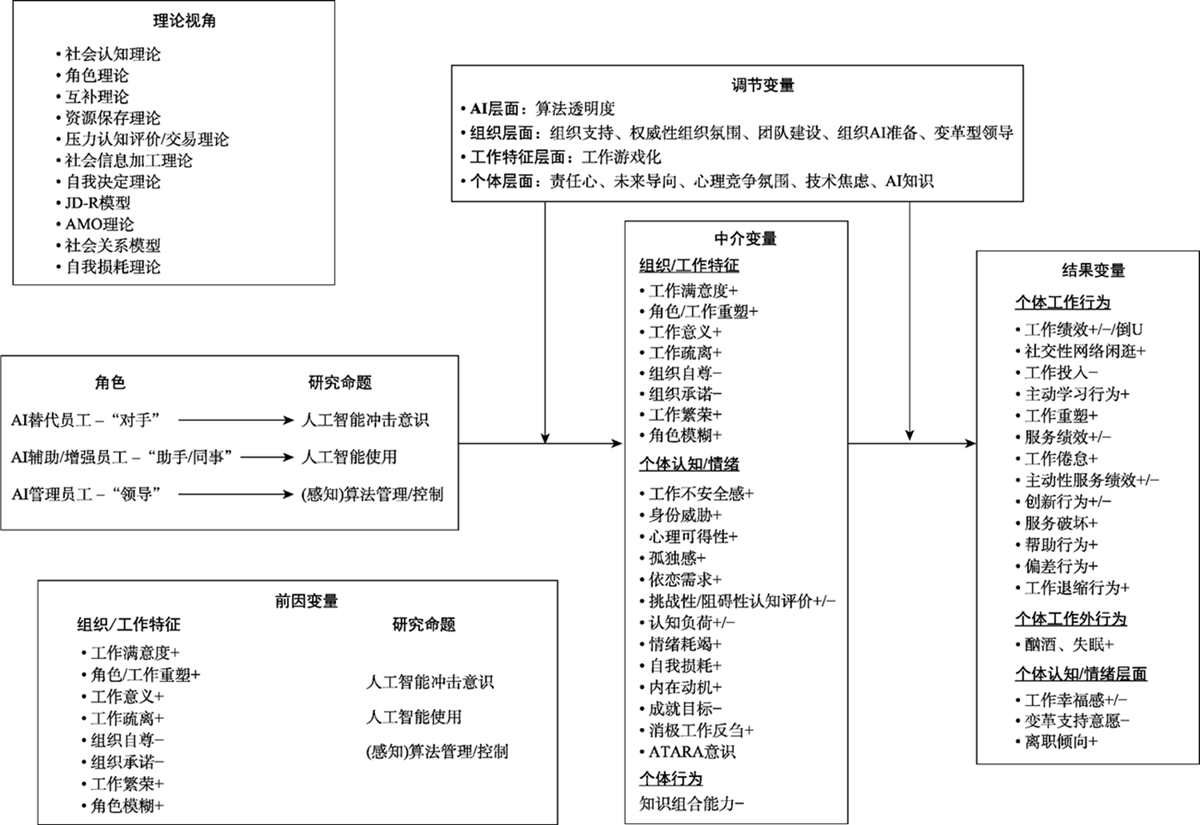
图2 人工智能不同角色对员工心理与行为影响梳理图(基于中国样本)
| [1] | 陈春花, 朱丽. (2017). 数字化时代的战略思维与组织能力. 中外管理, (12), 88-90. |
| [2] | 陈文晶, 康彩璐, 杨玥, 万岩. (2022). 人工智能潜在替代风险与员工职业能力发展: 基于员工不安全感视角. 中国人力资源开发, 39(1), 84-97. |
| [3] | 陈志芳, 卫瑶. (2023). AI狂飙的这一年, 我们的工作被取代了多少? 澎湃网 https://m.thepaper.cn/newsDetail_forward_25440475 |
| [4] | 贾开, 蒋余浩. (2017). 人工智能治理的三个基本问题: 技术逻辑、风险挑战与公共政策选择. 中国行政管理, (10), 40-45. |
| [5] | 李平, 杨政银. (2018). 人机融合智能: 人工智能3.0. 清华管理评论, (7), 73-82. |
| [6] | 李晓光, 石智雷, 郭小弦. (2023). 传播焦虑还是提供支持? ——虚拟空间社会网络的“双刃剑”效应. 新闻与传播研究, 30(6), 50-66+127. |
| [7] | 李燕萍, 陶娜娜. (2022). 员工人工智能技术采纳多层动态影响模型: 一个文献综述. 中国人力资源开发, 39(1), 35-56. |
| [8] | 李玉鑑. (2024). 认知相对论——通向强人工智能之路. 电子与信息学报, (2), 408-427. |
| [9] | 刘欣, 谢礼珊. (2025). 是喜还是忧?服务机器人角色对员工幸福感的双路径影响机制——基于服务接待业人机互动情境的定性和定量研究. 南开管理评论, 28(3), 124-135. |
| [10] | 罗文豪, 霍伟伟, 赵宜萱, 王震. (2022). 人工智能驱动的组织与人力资源管理变革: 实践洞察与研究方向. 中国人力资源开发, 39(1), 4-16. |
| [11] | 马银琦, 黄恒, 毋磊, 黄丹. (2024). “技术赋能”还是“工具依赖”: 生成式人工智能对研究生科研创新力的影响研究. 电化教育研究, (12), 58-66. |
| [12] | 穆鑫岩, 毛日佑, 王婕. (2023). “温度”或“效率”?人工智能使用对员工工作行为的双刃剑效应研究. 中国人力资源开发, 40(9), 6-21. |
| [13] | 潘庸鲁. (2017). 人工智能介入司法领域的价值与定位. 探索与争鸣, (10), 101-106. |
| [14] | 孙忠娟, 谢伟, 舒曾宣. (2021). 企业数字化创新实现的跨层机制模型. 科技管理研究, (23), 205-212. |
| [15] |
涂艳, 蒿坡, 龙立荣. (2023). 工作替代还是工作转型?技术型工作不安全感的内涵、影响后果及来源. 心理科学进展, 31(8), 1359-1373.
doi: 10.3724/SP.J.1042.2023.01359 |
| [16] | 王磊, 曲卫平, 李敬兆. (2013). 基于人工智能搜索和数据依赖分析的程序并行化. 现代电子技术, (6), 1-3. |
| [17] | 王振源, 姚明辉. (2022). 工作场所人机协作对员工影响的研究述评. 外国经济与管理, 44(9), 86-102. |
| [18] | 谢小云, 左玉涵, 胡琼晶. (2021). 数字化时代的人力资源管理:基于人与技术交互的视角. 管理世界, 37(1), 200-216+13. |
| [19] | 徐广路, 王皓天. (2022). 技术冲击意识对员工变革支持意愿的影响研究——以人工智能发展为背景. 华东经济管理, 36(6), 119-128. |
| [20] |
尹萌, 牛雄鹰. (2024). 与AI“共舞”:系统化视角下的AI-员工协作. 心理科学进展, 32(1), 162-176.
doi: 10.3724/SP.J.1042.2024.00162 |
| [21] | 玉胜贤, 刘敏, 刘善仕, 刘婷婷. (2024). 平台算法控制对零工工作者离职倾向的影响机制研究. 管理学报, 21(8), 1152-1162. |
| [22] | 詹小慧, 赵李晶. (2024). “赋能”抑或“负担”?数字劳动平台算法管理对劳动者工作绩效的双刃剑效应. 软科学, (7), 101-106 |
| [23] | 张光磊, 孟宇嫣, 龙立荣, 贺伟. (2024). 人工智能危机, 企业的“危”在哪里. 清华管理评论, (6), 103-111. |
| 张光磊, 孟宇嫣, 龙立荣, 贺伟. (2024). 人工智能危机, 企业的“危”在哪里. 清华管理评论, (6), 103-111. | |
| [24] | 张恒, 高中华, 李慧玲. (2023). 增益还是损耗: 人工智能技术应用对员工创新行为的“双刃剑”效应. 科技进步与对策, 40(18), 1-11. |
| [25] | 张娟. (2024). 生成式AI嵌入数字政府建设的审思与展望——基于强人工智能视域. 财经问题研究, (7), 36-47. |
| [26] | 张兰霞, 李佳敏, 毛孟雨. (2024). 零工工作者感知算法控制对工作投入的影响机制研究——基于认知和情感的双路径模型. 商业经济与管理, (3), 47-58. |
| [27] | 张亦佳. (2023). 强人工智能设备面临的伦理困境与风险. 江苏社会科学, (2), 58-67. |
| [28] | 邹勇, 周艳榕, 黄启新. (2023). 人工智能技术冲击下的员工主动学习行为. 科技管理研究, 43(17), 180-187. |
| [29] | Allen R. A., White G. R. T., Clement C. E., Alexander P., & Samuel A. (2022). Servants and masters: An activity theory investigation of human‐AI roles in the performance of work. Strategic Change, 31(6), 581-590. |
| [30] | Anderson S. E., Coffey B. S., & Byerly R. T. (2002). Formal organizational initiatives and informal workplace practices: Links to work-family conflict and job-related outcomes. Journal of Management, 28(6), 787-810. |
| [31] | Arias-Pérez J., & Vélez-Jaramillo J. (2022). Understanding knowledge hiding under technological turbulence caused by artificial intelligence and robotics. Journal of Knowledge Management, 26(6), 1476-1491. |
| [32] | Bai B., Dai H., Zhang D. J., Zhang F., & Hu H. (2022). The impacts of algorithmic work assignment on fairness perceptions and productivity: Evidence from field experiments. Manufacturing & Service Operations Management, 24(6), 3060-3078. |
| [33] | Bankins S., Ocampo A. C., Marrone M., Restubog S. L. D., & Woo S. E. (2024). A multilevel review of artificial intelligence in organizations: Implications for organizational behavior research and practice. Journal of Organizational Behavior, 45(2), 159-182. |
| [34] | Bory P., Natale S., & Katzenbach C. (2024). Strong and weak AI narratives: An analytical framework. AI & Society. https://doi.org/10.1007/s00146-024-02087-8 |
| [35] | Bostrom N. (2014). Superintelligence: Paths, dangers, strategies. New York: Oxford University Press. |
| [36] | Brachman R. J. (2006). AI more than the sum of its parts. AI Magazine, 27(4), 19-34. |
| [37] | Brachten F., Brünker F., Frick N. R., Ross B., & Stieglitz S. (2020). On the ability of virtual agents to decrease cognitive load: An experimental study. Information Systems and e-Business Management, 18, 187-207. |
| [38] | Cascio W. F., & Montealegre R. (2016). How technology is changing work and organizations. Annual Review of Organizational Psychology and Organizational Behavior, 3(1), 349-375. |
| [39] | Chamberlain R., Mullin C., Scheerlinck B., & Wagemans J. (2018). Putting the art in artificial: Aesthetic responses to computer-generated art. Psychology of Aesthetics, Creativity, and the Arts, 12(2), 177. |
| [40] | Cheatham B., Javanmardian K., & Samandari H. (2019). Confronting the risks of artificial intelligence. McKinsey Quarterly, 2(38), 1-9. |
| [41] | Claggett J. L., & Karahanna E. (2018). Unpacking the structure of coordination mechanisms and the role of relational coordination in an era of digitally mediated work processes. Academy of Management Review, 43(4), 704-722. |
| [42] | Dengler K., & Gundert S. (2021). Digital transformation and subjective job insecurity in Germany. European Sociological Review, 37(5), 799-817. |
| [43] | Dietvorst B. J., Simmons J. P., & Massey C. (2015). Algorithm aversion: People erroneously avoid algorithms after seeing them err. Journal of Experimental Psychology: General, 144(1), 114-126. |
| [44] |
Dittes S., Richter S., Richter A., & Smolnik S. (2019). Toward the workplace of the future: How organizations can facilitate digital work. Business Horizons, 62(5), 649-661.
doi: 10.1016/j.bushor.2019.05.004 |
| [45] | Donnelly R., & Johns J. (2021). Recontextualising remote working and its HRM in the digital economy: An integrated framework for theory and practice. The International Journal of Human Resource Management, 32(1), 84-105. |
| [46] | Duan Y., Edwards J. S., & Dwivedi Y. K. (2019). Artificial intelligence for decision making in the era of Big Data - Evolution, challenges and research agenda. International Journal of Information Management, 48(2), 63-71. |
| [47] |
Duggan J., Sherman U., Carbery R., & McDonnell A. (2020). Algorithmic management and app‐work in the gig economy: A research agenda for employment relations and HRM. Human Resource Management Journal, 30(1), 114-132.
doi: 10.1111/1748-8583.12258 |
| [48] | Dwivedi Y. K., Hughes L., Ismagilova E., Aarts G., Coombs C., Crick T.,... Williams M. D. (2021). Artificial intelligence (AI): Multidisciplinary perspectives on emerging challenges, opportunities, and agenda for research, practice and policy. International Journal of Information Management, 57(1), 101994. |
| [49] | Einola K., & Khoreva V. (2023). Best friend or broken tool? Exploring the co-existence of humans and artificial intelligence in the workplace ecosystem. Human Resource Management, 62(1), 117-135. |
| [50] | Frey C. B., & Osborne M. A. (2017). The future of employment: How susceptible are jobs to computerisation?. Technological Forecasting and Social Change, 114, 254-280. |
| [51] | Giroux M., Kim J., Lee J. C., & Park J. (2022). Artificial intelligence and declined guilt: Retailing morality comparison between human and AI. Journal of Business Ethics, 178(4), 1027-1041. |
| [52] | Glikson E., & Woolley A. W. (2020). Human trust in artificial intelligence: Review of empirical research. Academy of Management Annals, 14(2), 627-660. |
| [53] | Gratch J., & Fast N. J. (2022). The power to harm: AI assistants pave the way to unethical behavior. Current Opinion in Psychology, 47, 101382. |
| [54] | He C., Teng R., & Song J. (2023). Linking employees' challenge-hindrance appraisals toward AI to service performance: The influences of job crafting, job insecurity and AI knowledge. International Journal of Contemporary Hospitality Management, 36(3), 975-994. |
| [55] | Heaven W. D. (2020). This startup is using AI to give workers a “productivity score”. MIT Technology Review. |
| [56] | Hornung O., & Smolnik S. (2022). AI invading the workplace: Negative emotions towards the organizational use of personal virtual assistants. Electronic Markets, 32, 123-138. |
| [57] | Huang M. H., & Rust R. T. (2018). Artificial intelligence in service. Journal of Service Research, 21(2), 155-172. |
| [58] | Huang Y., & Gursoy D. (2024). How does AI technology integration affect employees' proactive service behaviors? A transactional theory of stress perspective. Journal of Retailing and Consumer Services, 77, 103700. |
| [59] | Jaiswal A., Arun C. J., & Varma A. (2022). Rebooting employees: Upskilling for artificial intelligence in multinational corporations. The International Journal of Human Resource Management, 33(6), 1179-1208. |
| [60] | Janssen M., Hartog M., Matheus R., Yi Ding A., & Kuk G. (2022). Will algorithms blind people? The effect of explainable AI and decision-makers' experience on AI-supported decision-making in government. Social Science Computer Review, 40(2), 478-493. |
| [61] | Jarrahi M. H., Askay D., Eshraghi A., & Smith P. (2023). Artificial intelligence and knowledge management: A partnership between human and AI. Business Horizons, 66(1), 87-99. |
| [62] | Jia N., Luo X., Fang Z., & Liao C. (2024). When and how artificial intelligence augments employee creativity. Academy of Management Journal, 67(1), 5-32. |
| [63] | Kamoonpuri S. Z., & Sengar A. (2023). Hi, May AI help you? An analysis of the barriers impeding the implementation and use of artificial intelligence-enabled virtual assistants in retail. Journal of Retailing and Consumer Services, 72(2), 103258. |
| [64] | Kaplan A., & Haenlein M. (2019). Siri, Siri, in my hand: Who's the fairest in the land? On the interpretations, illustrations, and implications of artificial intelligence. Business Horizons, 62(1), 15-25. |
| [65] | Kellogg K. C., Valentine M. A., & Christin A. (2020). Algorithms at work: The new contested terrain of control. Academy of Management Annals, 14(1), 366-410. |
| [66] | Kensbock J. M., & Stöckmann C. (2021). “Big brother is watching you”: Surveillance via technology undermines employees' learning and voice behavior during digital transformation. Journal of Business Economics, 91(4), 565-594. |
| [67] | Köchling A., & Wehner M. C. (2020). Discriminated by an algorithm: A systematic review of discrimination and fairness by algorithmic decision-making in the context of HR recruitment and HR development. Business Research, 13(3), 795-848. |
| [68] | Kohl K., & Swartz J. (2019). Building industry 4.0 talent. Thriving in Digital Workspaces: Emerging Issues for Research and Practice, 10(1), 15-39. |
| [69] | Kolbjørnsrud V., Amico R., & Thomas R. J. (2017). Partnering with AI: How organizations can win over skeptical managers. Strategy & Leadership, 45(1), 37-43. |
| [70] | Kong H., Yuan Y., Baruch Y., Bu N., Jiang X., & Wang K. (2021). Influences of artificial intelligence (AI) awareness on career competency and job burnout. International Journal of Contemporary Hospitality Management, 33(2), 717-734. |
| [71] | Larson L., & DeChurch L. A. (2020). Leading teams in the digital age: Four perspectives on technology and what they mean for leading teams. The Leadership Quarterly, 31(1), 101377. |
| [72] | Lee D. J., & Joseph Sirgy M. (2019). Work-life balance in the digital workplace: The impact of schedule flexibility and telecommuting on work-life balance and overall life satisfaction. Thriving in Digital Workspaces: Emerging Issues for Research and Practice, 10(1), 355-384. |
| [73] | Lei X., & Rau P. L. P. (2021). Effect of relative status on responsibility attributions in human-robot collaboration: Mediating role of sense of responsibility and moderating role of power distance orientation. Computers in Human Behavior, 122, 106820. |
| [74] | Leonardi P., & Contractor N. (2018). Better people analytics. Harvard Business Review, 96(6), 70-81. |
| [75] | Leonardi P. M. (2011). When flexible routines meet flexible technologies: Affordance, constraint, and the imbrication of human and material agencies. MIS Quarterly, 35(1), 147-167. |
| [76] | Li D., Liu M., Zhao Y., Li Y., Zhang T., Zhang W.,...& Lv B,. (2024). Why Does Algorithmic Management Undermine Employee Creativity?: A Perspective Focused on AMO Theory. Journal of Organizational and End User Computing (JOEUC), 36(1), 1-16. |
| [77] | Liang X., Guo G., Shu L., Gong Q., & Luo P. (2022). Investigating the double-edged sword effect of AI awareness on employee's service innovative behavior. Tourism Management, 92, 104564. |
| [78] | Lingmont D. N., & Alexiou A. (2020). The contingent effect of job automating technology awareness on perceived job insecurity: Exploring the moderating role of organizational culture. Technological Forecasting and Social Change, 161, 120302. |
| [79] |
Logg J. M., Minson J. A., & Moore D. A. (2019). Algorithm appreciation: People prefer algorithmic to human judgment. Organizational Behavior and Human Decision Processes, 151, 90-103.
doi: 10.1016/j.obhdp.2018.12.005 |
| [80] | Loureiro S. M. C., Bilro R. G., & Neto D. (2022). Working with AI: Can stress bring happiness?. Service Business, 17(1), 33-255. |
| [81] | Ma C., & Ye J. (2022). Linking artificial intelligence to service sabotage. The Service Industries Journal, 42(13-14), 1054-1074. |
| [82] | Maedche A., Legner C., Benlian A., Berger B., Gimpel H., Hess T.,... Söllner M. (2019). AI-based digital assistants: Opportunities, threats, and research perspectives. Business & Information Systems Engineering, 61(4), 535-544. |
| [83] | Man Tang P., Koopman J., McClean S. T., Zhang J. H., Li C. H., De Cremer D.,... Ng C. T. S. (2022). When conscientious employees meet intelligent machines: An integrative approach inspired by complementarity theory and role theory. Academy of Management Journal, 65(3), 1019-1054. |
| [84] | Marr B. (2018). The amazing ways how Unilever uses artificial intelligence to recruit & train thousands of employees. Forbes. https://www.forbes.com/sites/bernardmarr/2018/12/14/the-amazingways-how-unilever-uses-artificial-intelligence-to-recruit-train-thousands-of-employees/?sh=23d2eabb6274 |
| [85] | Mirbabaie M., Brünker F., Möllmann N. R., & Stieglitz S. (2022). The rise of artificial intelligence-understanding the AI identity threat at the workplace. Electronic Markets, 32, 73-99. |
| [86] | Möhlmannn M., Alves de Lima Salge C., & Marabelli M. (2023). Algorithm sensemaking: How platform workers make sense of algorithmic management. Journal of the Association for Information Systems, 24(1), 35-64. |
| [87] | Murray A. (2015). The new industrial revolution (and our giga-good fortune). Fortune, 171(6), 6. |
| [88] | Murray A., Rhymer J. E. N., & Sirmon D. G. (2021). Humans and technology: Forms of conjoined agency in organizations. Academy of Management Review, 46(3), 552-571. |
| [89] | OECD. (2019). Scoping the OECD AI principles: Deliberations of the expert group on artificial intelligence at the OECD (AIGO). OECD Digital Economy Papers, No.291, OECD Publishing. https://doi.org/10.1787/d62f618a-en |
| [90] | Orlikowski W. J. (2000). Using technology and constituting structures: A practice lens for studying technology in organizations. Organization Science, 11(4), 404-428. |
| [91] | Poba-Nzaou P., Galani M., Uwizeyemungu S., & Ceric A. (2021). The impacts of artificial intelligence (AI) on jobs: An industry perspective. Strategic HR Review, 20(2), 60-65. |
| [92] | Renz S., Kalimeris J., Hofreiter S., & Spörrle M. (2024). Me, myself and AI: How gender, personality and emotions determine willingness to use Strong AI for self-improvement. Technological Forecasting and Social Change, 209, 123760. |
| [93] |
Salanova M., Llorens S., & Cifre E. (2013). The dark side of technologies: Technostress among users of information and communication technologies. International Journal of Psychology, 48(3), 422-436.
doi: 10.1080/00207594.2012.680460 pmid: 22731610 |
| [94] | Searle J. R. (1980). Minds, brains, and programs. Behavioral and Brain Sciences, 3(3), 417-424. |
| [95] | Sergeeva A. V., Faraj S., & Huysman M. (2020). Losing touch: An embodiment perspective on coordination in robotic surgery. Organization Science, 31(5), 1248-1271. |
| [96] |
Shah N. R. (2019). Health care in 2030: Will artificial intelligence replace physicians?. Annals of Internal Medicine, 170(6), 407-408.
doi: 10.7326/M19-0344 pmid: 30802901 |
| [97] | Song M., Xing X., Duan Y., Cohen J., & Mou J. (2022). Will artificial intelligence replace human customer service? The impact of communication quality and privacy risks on adoption intention. Journal of Retailing and Consumer Services, 66, 102900. |
| [98] |
Tang P. M., Koopman J., Mai K. M., De Cremer D., Zhang J. H., Reynders P.,... Chen I. (2023). No person is an island: Unpacking the work and after-work consequences of interacting with artificial intelligence. Journal of Applied Psychology, 108(11), 1766-1789.
doi: 10.1037/apl0001103 pmid: 37307359 |
| [99] | Tang P. M., Koopman J., McClean S. T., Zhang J. H., Li C. H., De Cremer D.,... Ng C. T. S. (2022). When conscientious employees meet intelligent machines: An integrative approach inspired by complementarity theory and role theory. Academy of Management Journal, 65(3), 1019-1054. |
| [100] | Tang P. M., Koopman J., Yam K. C., De Cremer D., Zhang J. H., & Reynders P. (2023). The self-regulatory consequences of dependence on intelligent machines at work: Evidence from field and experimental studies. Human Resource Management, 62(5), 721-744. |
| [101] | Teng R., Zhou S., Zheng W., & Ma C. (2024). Artificial intelligence (AI) awareness and work withdrawal: Evaluating chained mediation through negative work-related rumination and emotional exhaustion. International Journal of Contemporary Hospitality Management, 36(7), 2311-2326. |
| [102] | The World Economic Forum. (2020). The future of jobs report 2020. Retrieved March 14, 2023, from http://hdl.voced.edu.au/10707/555914 |
| [103] | Tong S., Jia N., Luo X., & Fang Z. (2021). The Janus face of artificial intelligence feedback: Deployment versus disclosure effects on employee performance. Strategic Management Journal, 42(9), 1600-1631. |
| [104] | Tsai C. Y., Marshall J. D., Choudhury A., Serban A., Hou Y. T. Y., Jung M. F.,... Yammarino F. J. (2022). Human-robot collaboration: A multilevel and integrated leadership framework. The Leadership Quarterly, 33(1), 101594. |
| [105] | Vorobeva D., El Fassi Y., Costa Pinto D., Hildebrand D., Herter M. M., & Mattila A. S. (2022). Thinking skills don't protect service workers from replacement by artificial intelligence. Journal of Service Research, 25(4), 601-613. |
| [106] | Vuksanović Herceg I., Kuč V., Mijušković V. M., & Herceg T. (2020). Challenges and driving forces for industry 4.0 implementation. Sustainability, 12(10), 4208. |
| [107] | Wang P. X, Kim S., & Kim M. (2023). Robot anthropomorphism and job insecurity: The role of social comparison. Journal of Business Research, 164, 114003. |
| [108] | Wang B., Liu Y., & Parker S. K. (2020). How does the use of information communication technology affect individuals? A work design perspective. Academy of Management Annals, 14(2), 695-725. |
| [109] | Wang Y., Wang Z., & Li J. (2024). Does algorithmic control facilitate platform workers' deviant behavior toward customers? The ego depletion perspective. Computers in Human Behavior, 156, 108242. |
| [110] |
Yam K. C., Tang P. M., Jackson J. C., Su R., & Gray K. (2022). The rise of robots increases job insecurity and maladaptive workplace behaviors: Multimethod evidence. Journal of Applied Psychology, 108(5), 850-870.
doi: 10.1037/apl0001045 pmid: 36222634 |
| [111] | Yin M., Jiang S., & Niu X. (2024). Can AI really help? The double-edged sword effect of AI assistant on employees' innovation behavior. Computers in Human Behavior, 150, 107987. |
| [112] | Yue B., & Li H. (2023). The impact of human-AI collaboration types on consumer evaluation and usage intention: A perspective of responsibility attribution. Frontiers in Psychology, 14(2), 1277861. |
| [113] | Zhang D., Mishra S., Brynjolfsson E., Etchemendy J., Ganguli D., Grosz B., Perrault R. (2021). The AI Index 2021 Annual Report. Retrieved March 14, 2023, from https://aiindex.stanford.edu/ai-index-report-2021/ |
| [114] | Zhang X., & Jin H. (2023). How does smart technology, artificial intelligence, automation, robotics, and algorithms (STAARA) awareness affect hotel employees' career perceptions? A disruptive innovation theory perspective. Journal of Hospitality Marketing & Management, 32(2), 264-283. |
| [115] | Zhao J., Hu E., Han M., Jiang K., & Shan H. (2023). That honey, my arsenic: The influence of advanced technologies on service employees' organizational deviance. Journal of Retailing and Consumer Services, 75, 103490. |
| [1] | 李研, 陈维, 武瑞娟. AI技术背景下虚拟影响者营销效应及其作用机制[J]. 心理科学进展, 2025, 33(8): 1425-1442. |
| [2] | 宗树伟, 杨付, 龙立荣, 韩翼. 促进还是抑制?生成式人工智能建议采纳对创造力的双刃剑效应[J]. 心理科学进展, 2025, 33(6): 905-915. |
| [3] | 解煜彬, 周荣刚. 新型人机关系下的人机双向信任[J]. 心理科学进展, 2025, 33(6): 916-932. |
| [4] | 项典典, 尹雨乐, 葛梦琦, 王子涵. 自建IP还是合作IP:虚拟影响者代言人选择策略对消费者融入的影响[J]. 心理科学进展, 2025, 33(6): 965-983. |
| [5] | 罗莉娟, 王康, 胡金淼, 徐四华. 当人工智能面对人类情感:服务机器人情感表达对用户体验的影响机制[J]. 心理科学进展, 2025, 33(6): 1006-1026. |
| [6] | 彭晨明, 屈奕帆, 郭晓凌, 陈增祥. 人工智能服务对消费者道德行为的双刃剑效应[J]. 心理科学进展, 2025, 33(2): 236-255. |
| [7] | 翁智刚, 陈潇潇, 张小妹, 张琚. 面向新型人机关系的社会临场感[J]. 心理科学进展, 2025, 33(1): 146-162. |
| [8] | 吴波, 张傲杰, 曹菲. 专业设计、用户设计还是AI设计?设计源效应的心理机制[J]. 心理科学进展, 2024, 32(6): 995-1009. |
| [9] | 侯悍超, 倪士光, 林书亚, 王蒲生. 当AI学习共情:心理学视角下共情计算的主题、场景与优化[J]. 心理科学进展, 2024, 32(5): 845-858. |
| [10] | 舒丽芳, 王魁, 吴月燕, 陈斯允. 人工智能指导对消费者长期目标追求的多阶段影响机制[J]. 心理科学进展, 2024, 32(3): 451-464. |
| [11] | 王红丽, 李振, 周梦楠, 陈政任. 赋能或去能:人工智能对创造性人格的影响[J]. 心理科学进展, 2024, 32(12): 1990-2004. |
| [12] | 王永跃, 黄飘飘, 金杨华, 白新文, 岳峰凯, 张范颖, 郭子浩. 人工智能背景下制造业知识型员工技术空心化: 内涵、生成及影响机制[J]. 心理科学进展, 2024, 32(12): 2005-2017. |
| [13] | 蒋建武, 龙晗寰, 胡洁宇. 工作场所人工智能应用对员工影响的元分析[J]. 心理科学进展, 2024, 32(10): 1621-1639. |
| [14] | 尹萌, 牛雄鹰. 与AI“共舞”:系统化视角下的AI−员工协作[J]. 心理科学进展, 2024, 32(1): 162-176. |
| [15] | 涂艳, 蒿坡, 龙立荣. 工作替代还是工作转型?技术型工作不安全感的内涵、影响后果及来源[J]. 心理科学进展, 2023, 31(8): 1359-1373. |
| 阅读次数 | ||||||
|
全文 |
|
|||||
|
摘要 |
|
|||||
