

ISSN 1671-3710
CN 11-4766/R
主办:中国科学院心理研究所
出版:科学出版社
CN 11-4766/R
主办:中国科学院心理研究所
出版:科学出版社
心理科学进展 ›› 2025, Vol. 33 ›› Issue (6): 916-932.doi: 10.3724/SP.J.1042.2025.0916 cstr: 32111.14.2025.0916
解煜彬1,2, 周荣刚1,3,4( )
)
收稿日期:2024-10-12
出版日期:2025-06-15
发布日期:2025-04-09
通讯作者:
周荣刚, E-mail: zhrg@buaa.edu.cn基金资助:
XIE Yubin1,2, ZHOU Ronggang1,3,4()
Received:2024-10-12
Online:2025-06-15
Published:2025-04-09
摘要:
随着人工智能技术的迅猛发展, 人类与机器的互动频率不断增加, 互动方式也日益复杂。传统的人机信任模型多聚焦于单向信任, 即人类对机器的信任。然而, 随着智能系统逐渐具备自主性和决策能力, 人机信任的双向性逐渐成为研究的核心议题。本研究在回顾近年来人机信任理论模型的基础上, 提出了基于倾向信任、感知信任和行为信任的人机双向信任理论结构模型, 特别强调了“感知信任”作为人机互信的交互渠道的重要作用。此外, 本文系统梳理了人机信任测量与计算建模方法的最新进展, 重点探讨了机器对人类信任的测量方法及其实践意义, 并提出了未来研究方向, 以期为人机协作领域的理论发展和技术应用提供新的视角和指导框架。
中图分类号:
解煜彬, 周荣刚. (2025). 新型人机关系下的人机双向信任. 心理科学进展 , 33(6), 916-932.
XIE Yubin, ZHOU Ronggang. (2025). The bidirectional trust in the context of new human-machine relationships. Advances in Psychological Science, 33(6), 916-932.
| 要点 | 详情 |
|---|---|
| 检索时间 | 1952~2024年 |
| 数据来源 | (1) Web of Science核心集合, SCI & SSCI数据库 |
| (2) 中国知网数据库 | |
| 关键词范围 | “信任(Trust)”、“人际信任(Interpersonal Trust)”、“团队信任(Trust in Team)”、“人机信任(Human-Machine Trust)”、“人机互信(Human-Machine Mutual Trust)”、“人工智能信任(AI Trust)”、“机器人信任(Robot Trust)”、“算法信任(Trust in Algorithm)”、“信任倾向(Propensity to Trust)”、“自动化信任(Trust in automation 或 Automation Trust)”、“信任建模(Trust Modelling)” |
| 筛选依据 | (1) 将研究方向限定为心理学、管理学、社会学、计算机科学的相关方向。 |
| (2) 选用英文或中文撰写的研究论文、会议论文和评论性文章, 排除了书籍及书籍章节。 | |
| (3) 限定学科领域, 删除无关与重复文献。 | |
| (4) 进一步筛查人机信任研究相关的重点期刊后, 逐个阅读文章标题、摘要, 对引用的重要研究进行整理和筛选。 | |
| 筛选结果 | 134篇相关文献 |
表1 检索流程与规则
| 要点 | 详情 |
|---|---|
| 检索时间 | 1952~2024年 |
| 数据来源 | (1) Web of Science核心集合, SCI & SSCI数据库 |
| (2) 中国知网数据库 | |
| 关键词范围 | “信任(Trust)”、“人际信任(Interpersonal Trust)”、“团队信任(Trust in Team)”、“人机信任(Human-Machine Trust)”、“人机互信(Human-Machine Mutual Trust)”、“人工智能信任(AI Trust)”、“机器人信任(Robot Trust)”、“算法信任(Trust in Algorithm)”、“信任倾向(Propensity to Trust)”、“自动化信任(Trust in automation 或 Automation Trust)”、“信任建模(Trust Modelling)” |
| 筛选依据 | (1) 将研究方向限定为心理学、管理学、社会学、计算机科学的相关方向。 |
| (2) 选用英文或中文撰写的研究论文、会议论文和评论性文章, 排除了书籍及书籍章节。 | |
| (3) 限定学科领域, 删除无关与重复文献。 | |
| (4) 进一步筛查人机信任研究相关的重点期刊后, 逐个阅读文章标题、摘要, 对引用的重要研究进行整理和筛选。 | |
| 筛选结果 | 134篇相关文献 |
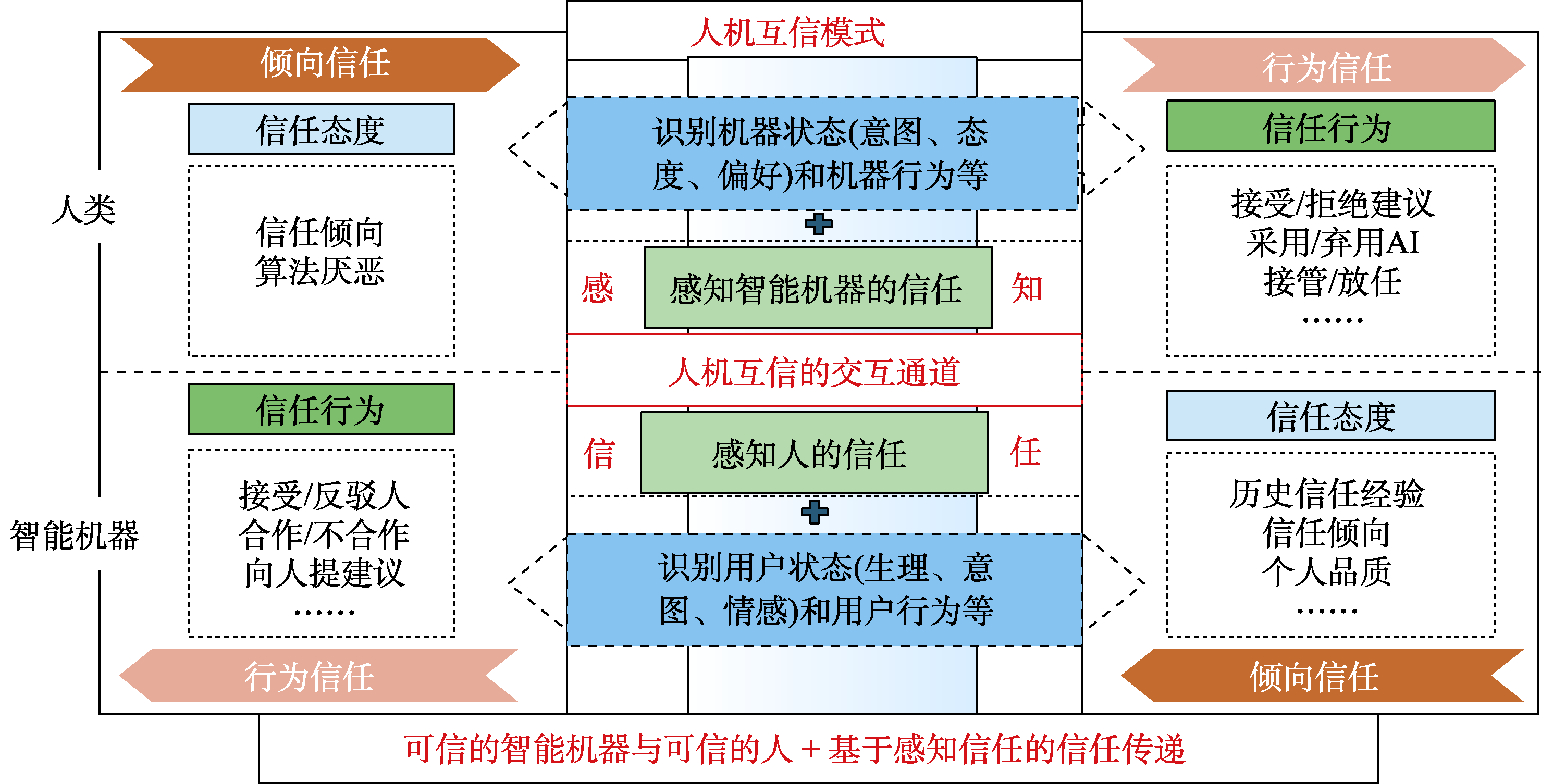
图1 人机双向信任的理论模型
| 研究 | 方法 | 建模数据 | 信任 动态性 | 应用场景 |
|---|---|---|---|---|
| Sadrfaridpour et al. ( | 机器学习 | 初始信任、机器人表现、人类表现 | 动态模型 | 机器人人机协作 |
| Bonneviot et al. ( | 机器学习 | 行人行为、情绪水平 | 动态模型 | 行人与车辆 |
| Li & Lee ( | 效用模型 | 情景结构、战略行为、目标 | 动态模型 | 一般人机交互 |
| Kamaraj et al. ( | 机器学习 | 驾驶风格、速度、油门刹车等控制数据 | 静态模型 | 自动驾驶 |
| Kamaraj et al. ( | 机器学习 | 个人特质:驾驶风格、风险寻求; 行为数据:油门、刹车控制等 | 静态模型 | 自动驾驶 |
| Hu et al. ( | 机器学习 | 驾驶员性格、历史经验、对系统感知 | 静态模型 | 自动驾驶 |
| Li et al. ( | 效用模型 | 能力、信任信念 | 动态模型 | 一般人机交互 |
| Li et al. ( | 机器学习 | 信任词汇、语音语调、响度 | 静态模型 | 语音对话 |
| Yi et al. ( | 机器学习 | 皮肤电、心电图、接管行为 | 动态模型 | 自动驾驶 |
表2 典型人机信任的综合计算度量模型
| 研究 | 方法 | 建模数据 | 信任 动态性 | 应用场景 |
|---|---|---|---|---|
| Sadrfaridpour et al. ( | 机器学习 | 初始信任、机器人表现、人类表现 | 动态模型 | 机器人人机协作 |
| Bonneviot et al. ( | 机器学习 | 行人行为、情绪水平 | 动态模型 | 行人与车辆 |
| Li & Lee ( | 效用模型 | 情景结构、战略行为、目标 | 动态模型 | 一般人机交互 |
| Kamaraj et al. ( | 机器学习 | 驾驶风格、速度、油门刹车等控制数据 | 静态模型 | 自动驾驶 |
| Kamaraj et al. ( | 机器学习 | 个人特质:驾驶风格、风险寻求; 行为数据:油门、刹车控制等 | 静态模型 | 自动驾驶 |
| Hu et al. ( | 机器学习 | 驾驶员性格、历史经验、对系统感知 | 静态模型 | 自动驾驶 |
| Li et al. ( | 效用模型 | 能力、信任信念 | 动态模型 | 一般人机交互 |
| Li et al. ( | 机器学习 | 信任词汇、语音语调、响度 | 静态模型 | 语音对话 |
| Yi et al. ( | 机器学习 | 皮肤电、心电图、接管行为 | 动态模型 | 自动驾驶 |
| [1] | 陈龙. (2020). “数字控制”下的劳动秩序——外卖骑手的劳动控制研究. 社会学研究, 35(6), 113-135+244. |
| [2] |
高在峰, 李文敏, 梁佳文, 潘晗希, 许为, 沈模卫. (2021). 自动驾驶车中的人机信任. 心理科学进展, 29(12), 2172-2183
doi: 10.3724/SP.J.1042.2021.02172 |
| [3] | 罗映宇, 朱国玮, 钱无忌, 吴月燕, 黄静, 杨智. (2023). 人工智能时代的算法厌恶:研究框架与未来展望. 管理世界, 39(10), 205-227 |
| [4] |
齐玥, 陈俊廷, 秦邵天, 杜峰. (2024). 通用人工智能时代的人与AI信任. 心理科学进展, 32(12), 2124-2136.
doi: 10.3724/SP.J.1042.2024.02124 |
| [5] |
许为, 高在峰, 葛列众. (2024). 智能时代人因科学研究的新范式取向及重点. 心理学报, 56(3), 363-382.
doi: 10.3724/SP.J.1041.2024.00363 |
| [6] |
许为, 葛列众. (2020). 智能时代的工程心理学. 心理科学进展, 28(9), 1409-1425.
doi: 10.3724/SP.J.1042.2020.01409 |
| [7] | Adnan N., Nordin S. M., bin Bahruddin M. A., & Ali M. (2018). How trust can drive forward the user acceptance to the technology? In-vehicle technology for autonomous vehicle. Transportation Research Part A: Policy and Practice, 118, 819-836. |
| [8] | Agreste S., De Meo P., Ferrara E., Piccolo S., & Provetti A. (2015). Trust networks: Topology, dynamics, and measurements. IEEE Internet Computing, 19(6), 26-35. |
| [9] | Alhaji B., Büttner S., Sanjay Kumar S., & Prilla M. (2024). Trust dynamics in human interaction with an industrial robot. Behaviour & Information Technology, 44(2), 266-288. https://doi.org/10.1080/0144929X.2024.2316284 |
| [10] | Allen R., & Choudhury P. (2022). Algorithm-augmented work and domain experience: The countervailing forces of ability and aversion. Organization Science, 33(1), 149-169. |
| [11] | Alsaid A., Li M., Chiou E. K., & Lee J. D. (2023). Measuring trust: A text analysis approach to compare, contrast, and select trust questionnaires. Frontiers in Psychology, 14, 1192020. |
| [12] | Ambady N., & Weisbuch M. (2010). Nonverbal behavior.In Fiske S. T., Gilbert D. T., Lindzey G. (Eds.),Handbook of social psychology (pp. 464-497). Hoboken, NJ: John Wiley & Sons. https://doi.org/10.1002/9780470561119.socpsy001013 |
| [13] | Avetisyan L., Ayoub J., Yang X. J., & Zhou F. (2024). Building contextualized trust profiles in conditionally automated driving. IEEE Transactions on Human-Machine Systems, 54(6), 658-667. |
| [14] | Azevedo-Sa H., Yang X. J., Robert L. P., & Tilbury D. M. (2021). A unified bi-directional model for natural and artificial trust in human-robot collaboration. IEEE Robotics and Automation Letters, 6(3), 5913-5920. |
| [15] | Babashahi L., Barbosa C. E., Lima Y., Lyra A., Salazar H., Argôlo M.,... Souza J. M. D. (2024). AI in the workplace: A systematic review of skill transformation in the industry. Administrative Sciences, 14(6), 127. |
| [16] | Baer M. D., Dhensa-Kahlon R. K., Colquitt J. A., Rodell J. B., Outlaw R., & Long D. M. (2015). Uneasy lies the head that bears the trust: The effects of feeling trusted on emotional exhaustion. Academy of Management Journal, 58(6), 1637-1657. |
| [17] | Baer M. D., Frank E. L., Matta F. K., Luciano M. M., & Wellman N. (2021). Undertrusted, overtrusted, or just right? The fairness of (in) congruence between trust wanted and trust received. Academy of Management Journal, 64(1), 180-206. |
| [18] | Basu C., & Singhal M. (2016, March). Trust dynamics in human autonomous vehicle interaction:A review of trust models. In 2016 AAAI Spring Symposium Series-Technical Report (pp. 85-91). Palo Alto, CA: AAAI Press. |
| [19] | Berg J., Dickhaut J., & McCabe K. (1995). Trust, reciprocity, and social history. Games and Economic Behavior, 10(1), 122-142. |
| [20] | Bonneviot F., Coeugnet S., & Brangier E. (2021). Pedestrians-automated vehicles interaction:Toward a specific trust model. In Black, N. L., Neumann, W. P., & Noy, I. (Eds.), Proceedings of the 21st Congress of the International Ergonomics Association (IEA 2021) (Vol. 221, pp. 568-574). Springer, Cham. |
| [21] | Caldwell S., Sweetser P., O'donnell N., Knight M. J., Aitchison M., Gedeon T.,... Conroy D. (2022). An agile new research framework for hybrid human-AI teaming: Trust, transparency, and transferability. ACM Transactions on Interactive Intelligent System, 12(3), 1-36. |
| [22] |
Castelo N., Bos M. W., & Lehmann D. R. (2019). Task-dependent algorithm aversion. Journal of Marketing Research, 56(5), 809-825.
doi: 10.1177/0022243719851788 |
| [23] |
Chancey E. T., Bliss J. P., Yamani Y., & Handley H. A. (2017). Trust and the compliance-reliance paradigm: The effects of risk, error bias, and reliability on trust and dependence. Human Factors, 59(3), 333-345.
doi: 10.1177/0018720816682648 pmid: 28430544 |
| [24] | Choi J. K., & Ji Y. G. (2015). Investigating the importance of trust on adopting an autonomous vehicle. International Journal of Human-Computer Interaction, 31(10), 692-702. |
| [25] | Chung H., Holder T., Shah J., & Yang X. J. (2024). Developing a team classification scheme for human-agent teaming. Proceedings of the Human Factors and Ergonomics Society Annual Meeting, 68(1), 1394-1399. https://doi.org/10.1177/10711813241260387 |
| [26] |
Cuzzolin F., Morelli A., Cirstea B., & Sahakian B. J. (2020). Knowing me, knowing you: Theory of mind in AI. Psychological Medicine, 50(7), 1057-1061.
doi: 10.1017/S0033291720000835 pmid: 32375908 |
| [27] |
de Visser E. J., Pak R., & Shaw T. H. (2018). From 'automation' to 'autonomy': The importance of trust repair in human-machine interaction. Ergonomics, 61(10), 1409-1427.
doi: 10.1080/00140139.2018.1457725 pmid: 29578376 |
| [28] | Dietvorst B. J., Simmons J. P., & Massey C. (2015). Algorithm aversion: People erroneously avoid algorithms after seeing them err. Journal of Experimental Psychology: General, 144(1), 114-126. |
| [29] | Dietvorst B. J., Simmons J. P., & Massey C. (2018). Overcoming algorithm aversion: People will use imperfect algorithms if they can (even slightly) modify them. Management Science, 64(3), 1155-1170. |
| [30] | Ding Y., & Liang Z. (2018). Structural optimization and measurement of Chinese employees' perception of being trusted. In Striełkowski, W., Black, J. M., Butterfield, S. A., Chang, C. -C., Cheng, J., Dumanig, F. P., Al-Mabuk, R., Urban, M., & Webb, S. (Eds.), Proceedings of the 2018 2nd International Conference on Management, Education and Social Science (ICMESS 2018) (pp. 1392-1395). Atlantis Press. |
| [31] | Dong Y., Hu Z., Uchimura K., & Murayama N. (2010). Driver inattention monitoring system for intelligent vehicles: A review. IEEE Transactions on Intelligent Transportation Systems, 12(2), 596-614. |
| [32] | Earle T. C., & Siegrist M. (2006). Morality information, performance information, and the distinction between trust and confidence. Journal of Applied Social Psychology, 36(2), 383-416. |
| [33] |
Ebnali M., Hulme K., Ebnali-Heidari A., & Mazloumi A. (2019). How does training effect users' attitudes and skills needed for highly automated driving. Transportation Research Part F: Traffic Psychology and Behaviour, 66, 184-195.
doi: 10.1016/j.trf.2019.09.001 |
| [34] | Feng F., Bao S., Sayer J., & LeBlanc D. (2016). Spectral power analysis of drivers' gas pedal control during steady-state car-following on freeways. Proceedings of the Human Factors and Ergonomics Society Annual Meeting, 60(1), 729-733. |
| [35] | Fernández A., Usamentiaga R., Carús J. L., & Casado R. (2016). Driver distraction using visual-based sensors and algorithms. Sensors, 16(11), 1805. |
| [36] | Garcia D., Kreutzer C., Badillo-Urquiola K., & Mouloua M. (2015). Measuring trust of autonomous vehicles:A development and validation study. In Stephanidis, C. (Ed.), HCI International 2015-Posters' Extended Abstracts (Vol. 529, pp. 610-615). Springer, Cham. HCI International 2015-Posters' Extended Abstracts(Vol. 529, pp. 610-615) Springer, Cham. |
| [37] | Gebru B., Zeleke L., Blankson D., Nabil M., Nateghi S., Homaifar A., & Tunstel E. (2022). A review on human- machine trust evaluation: Human-centric and machine- centric perspectives. IEEE Transactions on Human-Machine Systems, 52(5), 952-962. |
| [38] | Georganta E., & Ulfert A. S. (2024). Would you trust an AI team member? Team trust in human-AI teams. Journal of Occupational and Organizational Psychology, 97, 1212-1241. |
| [39] | Gillespie N. (2012). Measuring trust in organizational contexts:An overview of survey-based measures. In Lyon, F., Möllering, G., & Saunders, M. (Eds.), Handbook of research methods on trust(pp. 175-188).Edward Elgar Publishing. |
| [40] | Gunning D., Vorm E., Wang Y., & Turek M. (2021). DARPA's explainable AI (XAI) program: A retrospective. Applied AI Letters, 2(4), e61. https://doi.org/10.1002/ail2.61 |
| [41] |
Hancock P. A., Billings D. R., Schaefer K. E., Chen J. Y., De Visser E. J., & Parasuraman R. (2011). A meta-analysis of factors affecting trust in human-robot interaction. Human Factors, 53(5), 517-527.
pmid: 22046724 |
| [42] | He X., Nie X., Zhou R., Yang J., & Wu R. (2023). The risk-taking behavioural intentions of pilots in adverse weather conditions: An application of the theory of planned behaviour. Ergonomics, 66(8), 1043-1056. |
| [43] | Hieronymi P. (2008). The reasons of trust. Australasian Journal of Philosophy, 86(2), 213-236. |
| [44] |
Hoff K. A., & Bashir M. (2015). Trust in automation: Integrating empirical evidence on factors that influence trust. Human Factors, 57(3), 407-434.
doi: 10.1177/0018720814547570 pmid: 25875432 |
| [45] | Hoffman R. R., Johnson M., Bradshaw J. M., & Underbrink A. (2013). Trust in automation. IEEE Intelligent Systems, 28(1), 84-88. |
| [46] | Holthausen B. E., Wintersberger P., Walker B. N., & Riener A. (2020). Situational Trust Scale for Automated Driving (STS-AD): Development and initial validation. In Proceedings of the 12th International Conference on Automotive User Interfaces and Interactive Vehicular Applications, AutomotiveUI 2020(pp.40-47). New York, NY: ACM. https://doi.org/10.1145/3409120.3410637 |
| [47] | Hu C., Huang S., Zhou Y., Ge S., Yi B., Zhang X., & Wu X. (2024). Dynamic and quantitative trust modeling and real-time estimation in human-machine co-driving process. Transportation Research Part F: Traffic Psychology and Behaviour, 106, 306-327. |
| [48] | Inga J., Ruess M., Robens J. H., Nelius T., Rothfuß S., Kille S.,... Kiesel A. (2023). Human-machine symbiosis: A multivariate perspective for physically coupled human- machine systems. International Journal of Human-Computer Studies, 170, 102926. |
| [49] | Jarrahi M. H. (2018). Artificial intelligence and the future of work: Human-AI symbiosis in organizational decision making. Business Horizons, 61(4), 577-586. |
| [50] | Jian J. Y., Bisantz A. M., & Drury C. G. (2000). Foundations for an empirically determined scale of trust in automated systems. International Journal of Cognitive Ergonomics, 4(1), 53-71. |
| [51] | Johnson T., & Obradovich N. (2022). Measuring an artificial intelligence agent's trust in humans using machine incentives. arXiv preprint. https://doi.org/10.48550/arXiv.2212.13371 |
| [52] | Jorge C. C., Jonker C. M., & Tielman M. L. (2024). How should an AI trust its human teammates? Exploring possible cues of artificial trust. ACM Transactions on Interactive Intelligent Systems, 14(1), 1-26. |
| [53] | Jorge C. C., Tielman M. L., & Jonker C. M. (2022a). Artificial trust as a tool in human-AI teams. In 2022 17th ACM/IEEE International Conference on Human-Robot Interaction (HRI) (pp. 1155-1157). IEEE. https://doi.org/10.1109/HRI53351.2022.9889652 |
| [54] | Jorge C. C., Tielman M. L., & Jonker C. M. (2022b). Assessing artificial trust in human-agent teams: A conceptual model. In Proceedings of the 22nd ACM International Conference on Intelligent Virtual Agents (IVA '22) (Article 24, pp. 1-3). Association for Computing Machinery. https://doi.org/10.1145/3514197.3549696 |
| [55] | Kamaraj A. V., Lee J., Domeyer J. E., Liu S. Y., & Lee J. D. (2024). Comparing subjective similarity of automated driving styles to objective distance-based similarity. Human Factors, 66(5), 1545-1563. |
| [56] | Kamaraj A. V., Lee J., Parker J. I., Domeyer J. E., Liu S. Y., & Lee J. D. (2023). Bimodal trust:High and low trust in vehicle automation influence response to automation errors. Proceedings of the Human Factors and Ergonomics Society Annual Meeting, 67(1), 1144-1149. https://doi.org/10.1177/21695067231196244 |
| [57] | Kaplan A. D., Kessler T. T., Brill J. C., & Hancock P. A. (2023). Trust in artificial intelligence: Meta-analytic findings. Human Factors, 65(2), 337-359. |
| [58] | Kaur D., Uslu S., Durresi A., Mohler G., & Carter J. G. (2020). Trust-based human-machine collaboration mechanism for predicting crimes. In Barolli, L., Amato, F., Moscato, F., Enokido, T., & Takizawa, M. (Eds.), Advanced information networking and applications. AINA 2020 (Vol. 1151). Springer, Cham. |
| [59] | Khastgir S., Birrell S., Dhadyalla G., & Jennings P. (2017). Calibrating trust to increase the use of automated systems in a vehicle. In Stanton, N., Landry, S., Di Bucchianico, G., & Vallicelli, A. (Eds.), Advances in human aspects of transportation (Vol. 484). Springer, Cham. |
| [60] | Kintz J. R., Banerjee N. T., Zhang J. Y., Anderson A. P., & Clark T. K. (2023). Estimation of subjectively reported trust, mental workload, and situation awareness using unobtrusive measures. Human Factors, 65(6), 1142-1160. |
| [61] | Kobayashi G., Quilici-Gonzalez M. E., Broens M. C., & Quilici-Gonzalez J. A. (2016). The ethical impact of the internet of things in social relationships: Technological mediation and mutual trust. IEEE Consumer Electronics Magazine, 5(3), 85-89. |
| [62] | Kohn S. C., De Visser E. J., Wiese E., Lee Y. C., & Shaw T. H. (2021). Measurement of trust in automation: A narrative review and reference guide. Frontiers in Psychology, 12, 604977. https://doi.org/10.3389/fpsyg.2021.604977 https://doi.org/10.3389/fpsyg.2021.604977 |
| [63] | Kramer R. M. (1999). Trust and distrust in organizations: Emerging perspectives, enduring questions. Annual Review of Psychology, 50(1), 569-598. |
| [64] | Lau D. C., & Lam L. W. (2008). Effects of trusting and being trusted on team citizenship behaviours in chain stores. Asian Journal of Social Psychology, 11(2), 141-149. |
| [65] | Lau D. C., Lam L. W., & Wen S. S. (2014). Examining the effects of feeling trusted by supervisors in the workplace: A self‐evaluative perspective. Journal of Organizational Behavior, 35(1), 112-127. |
| [66] | Lee J. D., Liu S. Y., Domeyer J., & DinparastDjadid A. (2021). Assessing drivers' trust of automated vehicle driving styles with a two-part mixed model of intervention tendency and magnitude. Human Factors, 63(2), 197-209. |
| [67] |
Lee J. D., & See K. A. (2004). Trust in automation: Designing for appropriate reliance. Human Factors, 46(1), 50-80.
doi: 10.1518/hfes.46.1.50_30392 pmid: 15151155 |
| [68] | Lee J. J., Knox B., & Breazeal C. (2013, March). Modeling the dynamics of nonverbal behavior on interpersonal trust for human-robot interactions. In Trust and autonomous systems: Papers from the 2013 AAAI Spring Symposium (pp. 46-47), AAAI, San Francisco, USA. |
| [69] | Li M., & Lee J. D. (2022). Modeling goal alignment in human-AI teaming:A dynamic game theory approach. Proceedings of the Human Factors and Ergonomics Society Annual Meeting, 66(1), 1538-1542. https://doi.org/10.1177/1071181322661047 |
| [70] | Li M., Erickson I. M., Cross E. V., & Lee J. D. (2024a). It's not only what you say, but also how you say it: Machine learning approach to estimate trust from conversation. Human Factors, 66(6), 1724-1741. |
| [71] | Li M., Kamaraj A. V., & Lee J. D. (2024b). Modeling trust dimensions and dynamics in human-agent conversation: A trajectory epistemic network analysis approach. International Journal of Human-Computer Interaction, 40(14), 3571-3582. |
| [72] | Lu Z., Happee R., Cabrall C. D., Kyriakidis M., & De Winter J. C. (2016). Human factors of transitions in automated driving: A general framework and literature survey. Transportation Research Part F: Traffic Psychology and Behaviour, 43, 183-198. |
| [73] | Lyons J. B., Wynne K. T., Mahoney S., & Roebke M. A. (2019). Trust and human-machine teaming:A qualitative study. In Lawless, W., Mittu, R., Sofge, D., Moskowitz, I. S., & Russell, S. (Eds.), Artificial intelligence for the Internet of everything (pp. 101-116). Academic Press. |
| [74] | Madsen M., & Gregor S. (2000, December). Measuring human-computer trust. In Proceedings of the 11th Australasian Conference on Information Systems (Vol.53, pp.6-8), Brisbane, Australia. |
| [75] | Mahmud H., Islam A. N., Ahmed S. I., & Smolander K. (2022). What influences algorithmic decision-making? A systematic literature review on algorithm aversion. Technological Forecasting and Social Change, 175, 121390. |
| [76] | Mathavara K., & Ramachandran G. (2022). Role of human factors in preventing aviation accidents:An insight. In Z. A. Ali & D. Cvetković. (Eds.), Aeronautics-New advances (pp. 1-26). IntechOpen. https://doi.org/10.5772/intechopen.106899 |
| [77] | Mayer R. C., Davis J. H., & Schoorman F. D. (1995). An integrative model of organizational trust. Academy of Management Review, 20(3), 709-734. |
| [78] |
McNeese N. J., Demir M., Cooke N. J., & Myers C. (2018). Teaming with a synthetic teammate: Insights into human-autonomy teaming. Human Factors, 60(2), 262-273.
doi: 10.1177/0018720817743223 pmid: 29185818 |
| [79] | Merritt S. M. (2011). Affective processes in human- automation interactions. Human Factors, 53(4), 356-370. |
| [80] |
Merritt S. M., Heimbaugh H., LaChapell J., & Lee D. (2013). I trust it, but I don't know why: Effects of implicit attitudes toward automation on trust in an automated system. Human Factors, 55(3), 520-534.
pmid: 23829027 |
| [81] | Merritt S. M., & Ilgen D. R. (2008). Not all trust is created equal: Dispositional and history-based trust in human- automation interactions. Human Factors, 50(2), 194-210. |
| [82] |
Merritt S. M., Lee D., Unnerstall J. L., & Huber K. (2015). Are well-calibrated users effective users? Associations between calibration of trust and performance on an automation-aided task. Human Factors, 57(1), 34-47.
pmid: 25790569 |
| [83] | Michelaraki E., Katrakazas C., Kaiser S., Brijs T., & Yannis G. (2023). Real-time monitoring of driver distraction: State-of-the-art and future insights. Accident Analysis & Prevention, 192, 107241. |
| [84] | Möhlmann M., Zalmanson L., Henfridsson O., & Gregory R. W. (2021). Algorithmic management of work on online labor platforms: When matching meets control. MIS Quarterly, 45(4), 1999-2022. |
| [85] | Montag C., Kraus J., Baumann M., & Rozgonjuk D. (2023). The propensity to trust in (automated) technology mediates the links between technology self-efficacy and fear and acceptance of artificial intelligence. Computers in Human Behavior Reports, 11, 100315. |
| [86] | Mueller F. F., Lopes P., Strohmeier P., Ju W., Seim C., Weigel M.,... Maes P. (2020). Next steps for human-computer integration. In Proceedings of the 2020 CHI Conference on Human Factors in Computing Systems (CHI '20) (pp.1-15). Association for Computing Machinery. |
| [87] | Muir B. M. (1987). Trust between humans and machines, and the design of decision aids. International Journal of Man-Machine Studies, 27(5-6), 527-539. |
| [88] | Murphy R. R. (2024). What will robots think of us? Science Robotics, 9(86), eadn6096. https://doi.org/10.1126/scirobotics.adn6096 |
| [89] | Murphy R., & Woods D. D. (2009). Beyond Asimov: The three laws of responsible robotics. IEEE Intelligent Systems, 24(4), 14-20. |
| [90] | Nies H. (2009). Key elements in effective partnership working. In Glasby, J., & Dickinson, H. (Eds.), International perspectives on health and social care: Partnership working in action (pp. 56-67). Wiley- Blackwell. |
| [91] | Olson D. M., & Xu Y. (2021). Building Trust over time in human-agent relationships. In Proceedings of the 9th International Conference on Human-Agent Interaction (pp.193-201). Association for Computing Machinery. https://doi.org/10.1145/3472307.3484178 |
| [92] | Pakdamanian E., Sheng S., Baee S., Heo S., Kraus S., & Feng L. (2021). Deeptake:Prediction of driver takeover behavior using multimodal data. In Proceedings of the 2021 CHI Conference on Human Factors in Computing Systems (CHI '21) (Article 103, pp. 1-14). Association for Computing Machinery. https://doi.org/10.1145/3411764.3445563 |
| [93] | Parnell K. J., Wynne R. A., Griffin T. G., Plant K. L., & Stanton N. A. (2021). Generating design requirements for flight deck applications: Applying the perceptual cycle model to engine failures on take-off. International Journal of Human-Computer Interaction, 37(7), 611-629. |
| [94] | Payre W., Cestac J., Dang N. T., Vienne F., & Delhomme P. (2017). Impact of training and in-vehicle task performance on manual control recovery in an automated car. Transportation Research Part F: Traffic Psychology and Behaviour, 46, 216-227. |
| [95] | Pitardi V., & Marriott H. R. (2021). Alexa, she's not human but… Unveiling the drivers of consumers' trust in voice‐based artificial intelligence. Psychology & Marketing, 38(4), 626-642. |
| [96] | Prahl A., Leung R. K. H., & Chua A. N. S. (2022). Fight for flight: The narratives of human versus machine following two aviation tragedies. Human-Machine Communication, 4, 27-44. |
| [97] | Qu Y., Hu H., Liu J., Zhang Z., Li Y., & Ge X. (2023). Driver state monitoring technology for conditionally automated vehicles: Review and future prospects. IEEE Transactions on Instrumentation and Measurement, 72, Article 3000920. |
| [98] | Regli C., & Annighoefer B. (2022). An anthropomorphic approach to establish an additional layer of trustworthiness of an AI pilot. In Software Engineering 2022 Workshops (pp.160-180). Gesellschaft für Informatik e.V. https://doi.org/10.18420/se2022-ws-17 |
| [99] | Reich T., Kaju A., & Maglio S. J. (2023). How to overcome algorithm aversion: Learning from mistakes. Journal of Consumer Psychology, 33(2), 285-302. |
| [100] |
Rotter J. B. (1967). A new scale for the measurement of interpersonal trust. Journal of Personality, 35(4), 651-665.
doi: 10.1111/j.1467-6494.1967.tb01454.x pmid: 4865583 |
| [101] | Sadrfaridpour B., Saeidi H., Burke J., Madathil K., & Wang Y. (2016). Modeling and control of trust in human-robot collaborative manufacturing. In Mittu, R., Sofge, D., Wagner, A., & Lawless, W. (Eds.), Robust intelligence and trust in autonomous systems(pp.115-141). Springer. |
| [102] |
Salamon S. D., & Robinson S. L. (2008). Trust that binds: The impact of collective felt trust on organizational performance. Journal of Applied Psychology, 93(3), 593-601.
doi: 10.1037/0021-9010.93.3.593 pmid: 18457488 |
| [103] |
Schaefer K. E., Chen J. Y., Szalma J. L., & Hancock P. A. (2016). A meta-analysis of factors influencing the development of trust in automation: Implications for understanding autonomy in future systems. Human Factors, 58(3), 377-400.
doi: 10.1177/0018720816634228 pmid: 27005902 |
| [104] | Seet M., Harvy J., Bose R., Dragomir A., Bezerianos A., & Thakor N. (2020). Differential impact of autonomous vehicle malfunctions on human trust. IEEE Transactions on Intelligent Transportation Systems, 23(1), 548-557. |
| [105] | Shariff A., Bonnefon J. F., & Rahwan I. (2021). How safe is safe enough? Psychological mechanisms underlying extreme safety demands for self-driving cars. Transportation Research Part C: Emerging Technologies, 126, 103069. |
| [106] | Shi Z., O'Connell A., Li Z., Liu S., Ayissi J., Hoffman G.,... Matarić M. J. (2024). Build your own robot friend: An open-source learning module for accessible and engaging AI education. In Proceedings of the Thirty-Eighth AAAI Conference on Artificial Intelligence, Thirty-Sixth Conference on Innovative Applications of Artificial Intelligence, and Fourteenth Symposium on Educational Advances in Artificial Intelligence (AAAI'24/ IAAI'24/EAAI'24) (Article 2636, pp. 1-9). AAAI Press. https://doi.org/10.1609/aaai.v38i21.30359 |
| [107] | Simons T., Leroy H., & Nishii L. (2022). Revisiting behavioral integrity: Progress and new directions after 20 years. Annual Review of Organizational Psychology and Organizational Behavior, 9(1), 365-389. |
| [108] | Simpson J. A. (2007). Psychological foundations of trust. Current Directions in Psychological Science, 16(5), 264-268. |
| [109] | Strauch C., Mühl K., Patro K., Grabmaier C., Reithinger S., Baumann M., & Huckauf A. (2019). Real autonomous driving from a passenger's perspective: Two experimental investigations using gaze behaviour and trust ratings in field and simulator. Transportation Research Part F: Traffic Psychology and Behavior, 66, 15-28. |
| [110] | Sycara K., & Lewis M. (2004). Integrating intelligent agents into human teams. Proceedings of the Human Factors and Ergonomics Society Annual Meeting, 46, 413-417. |
| [111] | Techer F., Ojeda L., Barat D., Marteau J. Y., Rampillon F., Feron S., & Dogan E. (2019). Anger and highly automated driving in urban areas: The role of time pressure. Transportation Research Part F: Traffic Psychology and Behaviour, 64, 353-360. |
| [112] | Uggirala A., Gramopadhye A. K., Melloy B. J., & Toler J. E. (2004). Measurement of trust in complex and dynamic systems using a quantitative approach. International Journal of Industrial Ergonomics, 34(3), 175-186. |
| [113] | Ulfert A. S., Georganta E., Centeio Jorge C., Mehrotra S., & Tielman M. (2024). Shaping a multidisciplinary understanding of team trust in human-AI teams: A theoretical framework. European Journal of Work and Organizational Psychology, 33(2), 158-171. |
| [114] | Walliser J. C., de Visser E. J., Wiese E., & Shaw T. H. (2019). Team structure and team building improve human- machine teaming with autonomous agents. Journal of Cognitive Engineering and Decision Making, 13(4), 258-278. |
| [115] |
Walmsley S., & Gilbey A. (2017). Debiasing visual pilots' weather-related decision making. Applied Ergonomics, 65, 200-208.
doi: S0003-6870(17)30152-7 pmid: 28802440 |
| [116] | Wang J., & Moulden A. (2021). AI Trust Score: A user-centered approach to building, designing, and measuring the success of intelligent workplace features.In Extended Abstracts of the 2021 CHI Conference on Human Factors in Computing Systems (Article 54, pp.1-7). Association for Computing Machinery. https://doi.org/10.1145/3411763.3443452 |
| [117] | Waytz A., Heafner J., & Epley N. (2014). The mind in the machine: Anthropomorphism increases trust in an autonomous vehicle. Journal of Experimental Social Psychology, 52, 113-117. |
| [118] | Wiggins M. W., Azar D., Hawken J., Loveday T., & Newman D. (2014). Cue-utilisation typologies and pilots' pre-flight and in-flight weather decision-making. Safety Science, 65, 118-124. |
| [119] | Wong J. H., Chiou E. K., Gutzwiller R. S., Cook M. B., & Fallon C. K. (2024). Human-artificial intelligence teaming for the U.S. Navy:Developing a holistic research roadmap. Proceedings of the Human Factors and Ergonomics Society Annual Meeting, 68(1), 380-385. https://doi.org/10.1177/10711813241260352 |
| [120] | Xie Y., Liu Y., Zhou R., Zhi X., & Chan A. H. (2024). Wait or Pass? Promoting intersection's cooperation via identifying vehicle's social behavior. Accident Analysis & Prevention, 206, 107724. |
| [121] | Xie Y., Zhou R., Chan A. H. S., Xiong D.(2025). Do you trust me? Measuring people's perception of being trusted by AI in a human-agent team. International Journal of Human-Computer Interaction. https://doi.org/10.1080/10447318.2025.2468783 |
| [122] | Xie Y., Zhou R., Chan A. H. S., Jin M., & Qu M. (2023). Motivation to interaction media: The impact of automation trust and self-determination theory on intention to use the new interaction technology in autonomous vehicles. Frontiers in Psychology, 14, 1078438. |
| [123] | Yang C., Zhu Y., & Chen Y. (2021). A review of human- machine cooperation in the robotics domain. IEEE Transactions on Human-Machine Systems, 52(1), 12-25. |
| [124] | Yi B., Cao H., Song X., Wang J., Zhao S., Guo W., & Cao D. (2024). How can the trust-change direction be measured and identified during takeover transitions in conditionally automated driving? Using physiological responses and takeover-related factors. Human Factors, 66(4), 1276-1301. |
| [125] | Yu B., Bao S., Zhang Y., Sullivan J., & Flannagan M. (2021). Measurement and prediction of driver trust in automated vehicle technologies: An application of hand position transition probability matrix. Transportation Research Part C: Emerging Technologies, 124, 102957. |
| [126] | Yu K., Berkovsky S., Conway D., Taib R., Zhou J., & Chen F. (2018). Do I trust a machine? Differences in user trust based on system performance. In J. Zhou & F. Chen (Eds.), Human and machine learning (pp. 161-172). Springer. |
| [127] | Yuan L., Gao X., Zheng Z., Edmonds M., Wu Y. N., Rossano F.,... Zhu S. C. (2022). In situ bidirectional human-robot value alignment. Science Robotics, 7(68), eabm4183. https://doi.org/10.1126/scirobotics.abm4183 |
| [128] | Zhang T., Tao D., Qu X., Zhang X., Lin R., & Zhang W. (2019). The roles of initial trust and perceived risk in public's acceptance of automated vehicles. Transportation Research Part C: Emerging Technologies, 98, 207-220. |
| [129] | Zhang T., Yang J., Chen M., Li Z., Zang J., & Qu X. (2024). EEG-based assessment of driver trust in automated vehicles. Expert Systems with Applications, 246, 123196. |
| [130] | Zhou L., Paul S., Demirkan H., Yuan L., Spohrer J., Zhou M., & Basu J. (2021). Intelligence augmentation: Towards building human-machine symbiotic relationship. AIS Transactions on Human-Computer Interaction, 13(2), 243-264. |
| [1] | 李研, 陈维, 武瑞娟. AI技术背景下虚拟影响者营销效应及其作用机制[J]. 心理科学进展, 2025, 33(8): 1425-1442. |
| [2] | 宗树伟, 杨付, 龙立荣, 韩翼. 促进还是抑制?生成式人工智能建议采纳对创造力的双刃剑效应[J]. 心理科学进展, 2025, 33(6): 905-915. |
| [3] | 谭美丽, 殷向洲, 张光磊, 熊普臻. 工作场所人工智能角色划分:对员工心理与行为的影响及应对策略[J]. 心理科学进展, 2025, 33(6): 933-947. |
| [4] | 席猛, 刘玥玥, 李鑫, 李佳鑫, 史家臻. 算法人力资源管理下的员工算法应对行为与工作绩效[J]. 心理科学进展, 2025, 33(6): 948-964. |
| [5] | 项典典, 尹雨乐, 葛梦琦, 王子涵. 自建IP还是合作IP:虚拟影响者代言人选择策略对消费者融入的影响[J]. 心理科学进展, 2025, 33(6): 965-983. |
| [6] | 罗莉娟, 王康, 胡金淼, 徐四华. 当人工智能面对人类情感:服务机器人情感表达对用户体验的影响机制[J]. 心理科学进展, 2025, 33(6): 1006-1026. |
| [7] | 黄晗静, 饶培伦. 老年用户与智能系统的多层次人机共融理论探索[J]. 心理科学进展, 2025, 33(2): 223-235. |
| [8] | 彭晨明, 屈奕帆, 郭晓凌, 陈增祥. 人工智能服务对消费者道德行为的双刃剑效应[J]. 心理科学进展, 2025, 33(2): 236-255. |
| [9] | 翁智刚, 陈潇潇, 张小妹, 张琚. 面向新型人机关系的社会临场感[J]. 心理科学进展, 2025, 33(1): 146-162. |
| [10] | 吴波, 张傲杰, 曹菲. 专业设计、用户设计还是AI设计?设计源效应的心理机制[J]. 心理科学进展, 2024, 32(6): 995-1009. |
| [11] | 侯悍超, 倪士光, 林书亚, 王蒲生. 当AI学习共情:心理学视角下共情计算的主题、场景与优化[J]. 心理科学进展, 2024, 32(5): 845-858. |
| [12] | 舒丽芳, 王魁, 吴月燕, 陈斯允. 人工智能指导对消费者长期目标追求的多阶段影响机制[J]. 心理科学进展, 2024, 32(3): 451-464. |
| [13] | 黄心语, 李晔. 人机信任校准的双途径:信任抑制与信任提升[J]. 心理科学进展, 2024, 32(3): 527-542. |
| [14] | 郑远霞, 刘国雄, 辛聪, 程黎. 以貌取人:儿童基于面孔的信任判断[J]. 心理科学进展, 2024, 32(2): 300-317. |
| [15] | 王红丽, 李振, 周梦楠, 陈政任. 赋能或去能:人工智能对创造性人格的影响[J]. 心理科学进展, 2024, 32(12): 1990-2004. |
| 阅读次数 | ||||||
|
全文 |
|
|||||
|
摘要 |
|
|||||
