

ISSN 1671-3710
CN 11-4766/R
主办:中国科学院心理研究所
出版:科学出版社
CN 11-4766/R
主办:中国科学院心理研究所
出版:科学出版社
心理科学进展 ›› 2025, Vol. 33 ›› Issue (10): 1821-1836.doi: 10.3724/SP.J.1042.2025.1821 cstr: 32111.14.2025.1821
• 研究前沿 • 上一篇
何承林1,2, 舒跃育1( ), 郑剑虹3(), 黄泽娇1, 宋欢1
收稿日期:2024-12-24
出版日期:2025-10-15
发布日期:2025-08-18
通讯作者:
舒跃育, E-mail: shuyueyu@nwnu.edu.cn基金资助:
HE Chenglin1,2, SHU Yueyu1(), ZHENG Jianhong3(), HUANG Zejiao1, SONG Huan1
Received:2024-12-24
Online:2025-10-15
Published:2025-08-18
摘要:
心理传记学关注于非凡人物的研究, 其转向普通个体的生命历程则有赖于心理传记疗法的开创和实践。心理传记疗法的理论核心是基于舒尔茨提出的“原型情景”概念, 即个体生命故事中的关键情景和冲突可以解释其当下心理问题, 并成为治疗的关键切入点。然而, “原型情景”概念在理论上仍较为模糊, 如原型情景内涵、特点及识别等问题需进一步澄清。本研究提出了“原型情景”作为心理传记学与心理传记疗法的理论契合历经生成、激活、作用三个阶段, 具有非唯一性、重复性与象征性、情感凝聚性、可迭代性、可建构性。研究进一步提出了原型情景提取的洋葱模型, 阐释了“原型情景”在理解与干预个体心理问题中的应用。
中图分类号:
何承林, 舒跃育, 郑剑虹, 黄泽娇, 宋欢. (2025). 原型情景:心理传记疗法实践的关键理论节点. 心理科学进展 , 33(10), 1821-1836.
HE Chenglin, SHU Yueyu, ZHENG Jianhong, HUANG Zejiao, SONG Huan. (2025). Prototypical scene: Critical theoretical nodes in psychobiographical therapeutic praxis. Advances in Psychological Science, 33(10), 1821-1836.

图1 原型情景三阶段形成机制
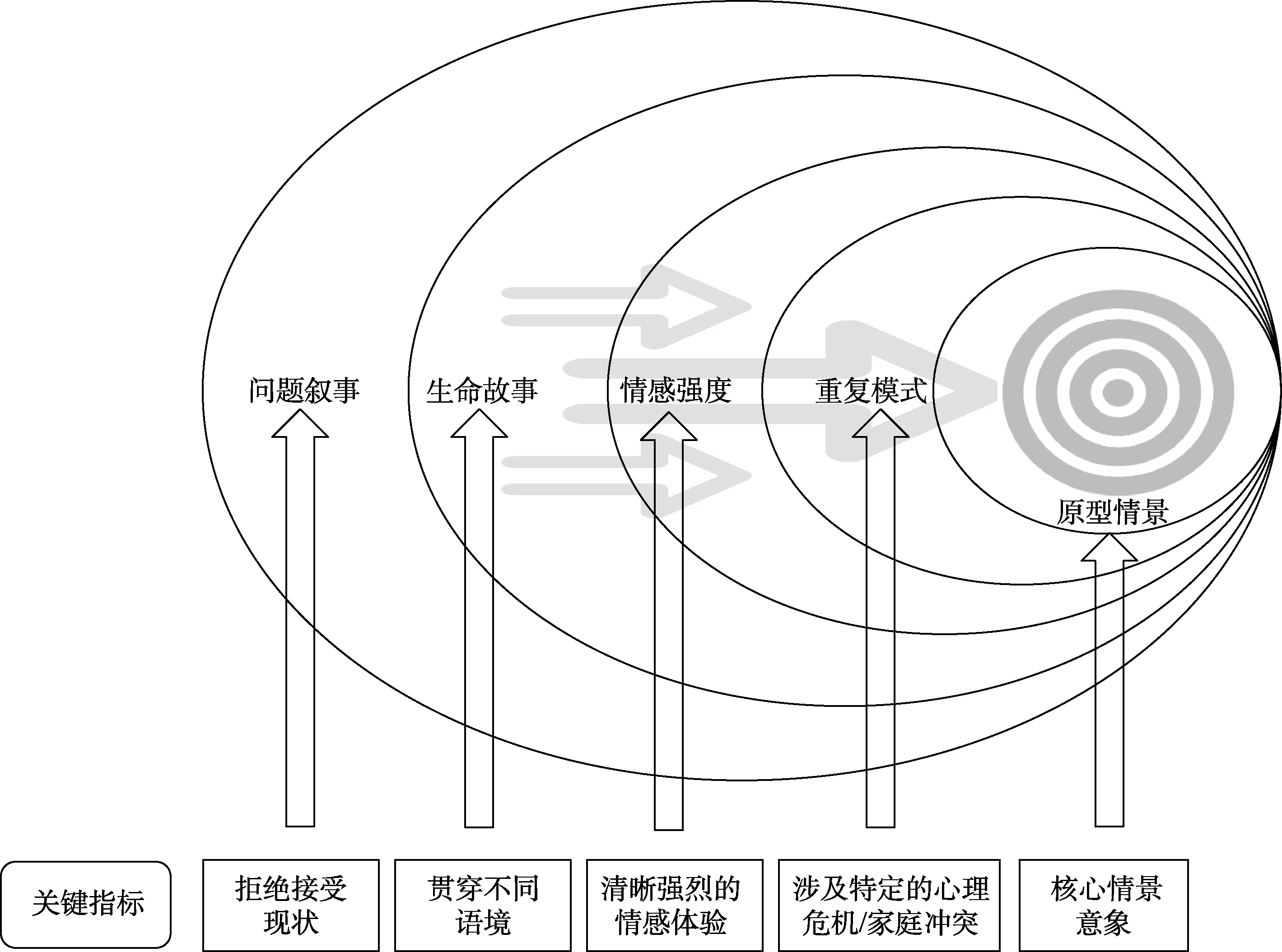
图2 原型情景对应的关键指标及其提取的洋葱模型
| [1] | Burger J. M. (2020). 人格心理学 (第8版, 陈会昌译). 北京: 中国轻工业出版社. (原著出版于2011年) |
| [2] | Frankl V. E. (2003). 追寻生命的意义 (何忠强, 杨凤池译). 北京: 新华出版社. (原著出版于1984年) |
| [3] | McWilliams N. (2015). 精神分析诊断: 理解人格结构 (鲁小华等 译).北京: 中国轻工业出版社. (原著出版于2011年) |
| [4] | Schultz W. T. (2011). 心理传记学手册 (郑剑虹等 译).广州: 暨南大学出版社 . (原著出版于2005年) |
| [5] | 布鲁纳, J.(2020). 自我的叙事创造 (吴继霞等 译). 见 L. E. 安格斯, J. 麦克劳德(编), 叙事与心理治疗手册: 实践、理论与研究 北京: 北京师范大学出版社. (原著出版于2004年) |
| [6] |
陈伟, 李俊娇, 林小裔, 张晓霞, 郑希付. (2020). 行为干预情绪记忆再巩固: 从实验室到临床转化. 心理科学进展, 28(2), 240-251.
doi: 10.3724/SP.J.1042.2020.00240 |
| [7] | 程素萍, 陈雨秋. (2020). 心理传记疗法在心理咨询课程中的应用初探. 心理咨询理论与实践, 2(2), 59-69. |
| [8] | 德里达, J.(2004). 多重立场 (余碧平译). 北京: 生活.读书.新知三联书店.(原著出版于1972年) |
| [9] |
宫火良, 杨迪, 张方屹. (2019). 提问类型对自传体记忆概括化的影响. 心理学报, 51(12), 1318-1329.
doi: 10.3724/SP.J.1041.2019.01318 |
| [10] | 韩卓. (2021). 文化人类学视角下的荣格原型理论. 沈阳大学学报(社会科学版), 23(4), 453-457. |
| [11] | 何承林, 郑剑虹. (2016). 叙事认同研究进展. 中国临床心理学杂志, 24(2), 376-380. |
| [12] | 何承林, 郑剑虹. (2022). 心理传记疗法在创伤后应激障碍治疗中的运用. 心理传记与质性心理学, 10, 127-140. |
| [13] | 何承林, 郑剑虹. (2023). 心理传记疗法的操作程序解析. 心理传记与质性心理学, 12, 105-141. |
| [14] | 何吴明, 郑剑虹. (2019). 心理学质性研究:历史、现状和展望. 心理科学, 42(4), 1017-1023. |
| [15] | 赫尔曼, L., 维瓦克, B.(2020). 叙事分析手册 (徐强, 徐月, 王妙迪译). 北京 : 中国人民大学出版社. (原著出版于2005年) |
| [16] | 洪治纲. (2017). 余华评传. 北京: 作家出版社. |
| [17] |
侯悍超, 倪士光, 林书亚, 王蒲生. (2024). 当AI学习共情:心理学视角下共情计算的主题、场景与优化. 心理科学进展, 32(5), 845-858.
doi: 10.3724/SP.J.1042.2024.00845 |
| [18] | 利科, P..(2023). 情节与历史叙事: 时间与叙事卷一 (崔伟锋译). 上海: 上海人民出版社 . (原著出版于1983年) |
| [19] |
林加彬, 李力红. (2015). 自传体推理: 自我同一性形成的思维加工. 心理科学进展, 23(7), 1160-1168.
doi: 10.3724/SP.J.1042.2015.01160 |
| [20] | 刘擎. (2021). 刘擎西方现代思想讲义: 来一场观念的探险. 北京: 新星出版社. |
| [21] | 马一波, 钟华. (2006). 叙事心理学. 上海: 上海教育出版社. |
| [22] | 米切尔, S.A., 布莱克, M.J.(2007). 弗洛伊德及其后继者: 现代精神分析思想史 (陈祉妍, 黄峥, 沈东郁译). 北京 : 商务印书馆. (原著出版于1995年) |
| [23] | 荣格, C.G.(2014a). 情结与阴影 (李北容, 吴于群, 杨丽筠译). 见申荷永(总策划), 高岚(主编), 荣格文集 (第7卷). 长春: 长春出版社. |
| [24] | 荣格, C.G.(2014b). 原型与原型意象(蔡成后等 译). 见申荷永(总策划), 高岚(主编), 荣格文集 (第2卷). 长春: 长春出版社. |
| [25] | 萨宾,T. R.(2020) 叙事心理学: 人类行为的故事性 (何吴明, 舒跃育, 李继波译). 北京: 北京师范大学出版社 . (原著出版于1985年) |
| [26] | 申荷永. (2001). 中国文化心理学心要. 北京: 人民出版社. |
| [27] | 申荷永. (2004). 荣格与分析心理学. 广州: 广东高等教育出版社. |
| [28] | 舒跃育, 靳佳丽, 李嘉明. (2022). “社会认知论”对心理学的理论贡献. 心理研究, 15(1), 20-26. |
| [29] | 舒跃育, 王雪婵, 郑剑虹, 石莹波, 汪李玲, 袁彦. (2021). 作为分支学科的心理传记学:当前困境与应对. 心理科学, 44(3), 761-767. |
| [30] | 舒跃育, 杨玲. (2008). “典型情景”在心理传记资料分析中的应用. 北京教育学院学报(自然科学版), (3), 15-19. |
| [31] | 苏瑞锐, 樊富珉. (2021). 存在积极心理学研究概述. 心理咨询理论与实践, 3(4), 252-258. |
| [32] | 杨莉娟. (2020). 解读荣格的情结理论. 产业与科技论坛, 19(17), 95-96. |
| [33] | 亚隆, I. D., 莱兹克兹, M.(2022). 团体心理治疗: 理论与实践(第6版) (蒋娟, 李鸣译). 北京: 中国轻工业出版社. (原著出版于2020年) |
| [34] | 尤娜, 杨广学. (2006). 象征与叙事: 现象学心理治疗. 济南: 山东人民出版社. |
| [35] | 郑剑虹. (2023-10-12). 心理传记疗法关注完整生命故事. 中国社会科学报. 第A06版. |
| [36] | 郑剑虹. (2012). 心理传记法. 见张志杰(主编), 心理学研究方法 (pp. 83-90). 北京: 开明出版社. |
| [37] | 郑剑虹, 何承林. (2015). 心理传记疗法: 理论与实践. 生命叙事与心理传记学, 3, 71-99. |
| [38] | 郑剑虹, 黄希庭. (2013). 国际心理传记学研究述评. 心理科学, 36(6), 1491-1497. |
| [39] |
Ahlquist L. R., & Yarns B. C. (2022). Eliciting emotional expressions in psychodynamic psychotherapies using telehealth: A clinical review and single case study using emotional awareness and expression therapy. Psychoanalytic Psychotherapy, 36(2), 124-140.
doi: 10.1080/02668734.2022.2037691 pmid: 36711048 |
| [40] | Allen A. P., Doyle C., Doyle C. M., Monaghan C., Fitzpatrick N., & Roche R. A. (2021). What we talk about when we talk about the past:Discursive psychological analysis of autobiographical reminiscence in older Irish adults. In: Mayer, C. H., Fouché, P. J., Van Niekerk, R. (Eds), Psychobiographical illustrations on meaning and identity in sociocultural contexts. sociocultural psychology of the lifecourse. Palgrave Macmillan, Cham. https://doi.org/10.1007/978-3-030-81238-6_15 |
| [41] | Amin M. M., Cambria E., & Schuller B. W. (2023). Will affective computing emerge from foundation models and general artificial intelligence? A first evaluation of ChatGPT. IEEE Intelligent Systems, 38(2), 15-23. |
| [42] | Attig T. (2011). How we grieve: Relearning the world . Oxford University Press, USA. |
| [43] | Beaudoin M. N. (2022). Agency and choice in the face of trauma: A narrative therapy map. Journal of Systemic Therapies, 41(4), 64-66. |
| [44] |
Biedermann S. V., Demirakca T., Sartorius A., Auer M. K., Ende G., & Berna F. (2017). Autobiographical memory deficits in patients with depression follow a temporal distribution. Psychiatry Research, 257, 193-196.
doi: S0165-1781(17)30568-1 pmid: 28768208 |
| [45] | Bouizegarene N., Ramstead M. J., Constant A., Friston K. J., & Kirmayer L. J. (2024). Narrative as active inference: An integrative account of cognitive and social functions in adaptation. Frontiers in Psychology, 15, 1345480. |
| [46] | Brewin C. R. (2011). The nature and significance of memory disturbance in posttraumatic stress disorder. Annual Review of Clinical Psychology, 7(1), 203-227. |
| [47] | Brown R., & Kulik J. (1977). Flashbulb memories. Cognition, 5(1), 73-99. |
| [48] | Burnell B. (2013). The life of Beyers Naudé: A psychobiographical study [Unpublished doctoral dissertation]. University of the Free State, Bloemfontein. |
| [49] | Chakhssi F., Kraiss J. T., Sommers-Spijkerman M., & Bohlmeijer E. T. (2018). The effect of positive psychology interventions on well-being and distress in clinical samples with psychiatric or somatic disorders: A systematic review and meta-analysis. BMC Psychiatry, 18(211), 1-17. |
| [50] |
Cohen-Mansfield J., Shmotkin D., Eyal N., Reichental Y., & Hazan H. (2010). A comparison of three types of autobiographical memories in old-old age: First memories, pivotal memories and traumatic memories. Gerontology, 56(6), 564-573.
doi: 10.1159/000295113 pmid: 20215727 |
| [51] | Conway M. A. (2005). Memory and the self. Journal of Memory and Language, 53(4), 594-628. |
| [52] | Conway M. A., Singer J. A., & Tagini A. (2004). The self and autobiographical memory: Correspondence and coherence. Social Cognition, 22(5), 491-529. |
| [53] | Ergen İ., & Gülgöz S. (2023). Emotional closure in autobiographical memories: Phenomenology and involuntary remembering. Memory, 31(4), 560-572. |
| [54] | Fang J., & Dong Y. (2022). Autobiographical memory disturbance in depression. Psychology, Health & Medicine, 27(7), 1618-1626. |
| [55] |
Fivush R. (2019). Sociocultural developmental approaches to autobiographical memory. Applied Cognitive Psychology, 33(4), 489-497.
doi: 10.1002/acp.3512 |
| [56] | Frank A. (2009). The constant fire: Beyond the science vs. religion debate . University of California Press. |
| [57] | Frank A. J., & Wilson E. A. (2020). A Silvan Tomkins handbook: Foundations for affect theory. University of Minnesota Press. |
| [58] | Greco F. A., & Deutsch C. K. (2017). Carl Gustav Jung and the psychobiology of schizophrenia. Brain, 140(1), 1. |
| [59] | Habermas, T., & Köber C. (2015). Autobiographical reasoning in life narratives. In K. C. McLean & M. Syed (Eds.), The Oxford handbook of identity development (pp. 149-165). Oxford University Press. |
| [60] | Haehner P., Schaefer B., Brickau D., Kaiser T., & Luhmann M. (2024). The perception of major life events across the life course. Plos One, 19(12), e0314011. |
| [61] | Hallford D. J., Rusanov D., Yeow J. J. E., & Barry T. J. (2021). Overgeneral and specific autobiographical memory predict the course of depression: An updated meta- analysis. Psychological Medicine, 51(6), 909-926. |
| [62] | Hillman J. (2004). Archetypal psychology. Spring Publications, Inc. |
| [63] | Hoerni U., & Fischer T. (2018). The art of CG Jung. W. W. Norton & Company. |
| [64] |
Holland A. C., & Kensinger E. A. (2010). Emotion and autobiographical memory. Physics of Life Reviews, 7(1), 88-131.
doi: 10.1016/j.plrev.2010.01.006 pmid: 20374933 |
| [65] | Jacobi J. (2020). Complex/archetype/symbol in the psychology of CG Jung . Princeton University Press. |
| [66] | Kensinger E. A., & Ford J. H. (2020). Retrieval of emotional events from memory. Annual Review of Psychology, 71 (1), 251-272. |
| [67] | Lahousen T., Unterrainer H. F., & Kapfhammer H. P. (2019). Psychobiology of attachment style and trauma: Some general remarks from a clinical perspective. Frontiers in Psychology, 10, 914. |
| [68] | Lohnas, L. J., & Healey M. K. (2021). The role of context in episodic memory:Behavior and neurophysiology. In K. D. Federmeier & L. Sahakyan (Eds.), Psychology of learning and motivation (Vol. 75, pp. 157-199). Academic Press. |
| [69] | Mayer, C.-H., Fouché P. J. P., & Niekerk R. V. (2021a). Epilog:Reflections on the futures of psychobiography. In C-H. Mayer, P. J. P. Fouché & R. V. Niekerk (Eds.), Psychobiographical illustrations on meaning and identity in sociocultural contexts (pp. 345-355). Springer Nature Switzerland AG. |
| [70] | Mayer, C.-H., Fouché P. J.P., & Niekerk R. V. (2021b). Editorial: Psychobiographical illustrations on meaning and identity in sociocultural contexts. In C-H. Mayer, P. J. P. Fouché & R. V. Niekerk (Eds.) Psychobiographical illustrations on meaning and identity in sociocultural contexts (pp. 1-19). Springer Nature Switzerland AG. |
| [71] | McAdams D. (1988). Power, intimacy and life story: Personological inquiries into identity . The Guilford Press. |
| [72] | McAdams D. P. (2001). The psychology of life stories. Review of General Psychology, 5(2), 100-122. |
| [73] | McAdams, D. P. (2008). Personal narratives and the life story.In R. W. R. O. P. John & L. A. Pervin (Eds.), Handbook of personality: Theory and research (pp. 242-262). Guilford Press. |
| [74] | McAdams, D. P., & Manczak E. (2015). Personality and the life story. In M. Mikulincer, P. R. Shaver, M. L. Cooper, & R. J. Larsen (Eds.), APA handbook of personality and social psychology, Vol. 4. Personality processes and individual differences (pp. 425-446). American Psychological Association. |
| [75] | McAdams D. P., & McLean K. C. (2013). Narrative identity. Current Directions in Psychological Science, 22(3), 233-238. |
| [76] | Mullen R. F. (2021). Broadening the parameters of the psychobiography: The character motivations of the ‘ordinary’extraordinary. Psychobiographical Illustrations on Meaning and Identity in Sociocultural Contexts, 285-301. |
| [77] | Murphy M. L. (2016). How the use of redemption versus contamination sequences in the telling of life stories is associated with health related outcomes in midlife adults [Unpublished doctoral dissertation]. Northwestern University, Evanston. |
| [78] | Pasupathi M., & Billitteri J. (2015). Being and becoming through being heard: Listener effects on stories and selves. International Journal of Listening, 29(2), 67-84. |
| [79] |
Pasupathi M., & Hoyt T. (2010). Silence and the shaping of memory: How distracted listeners affect speakers' subsequent recall of a computer game experience. Memory, 18(2), 159-169.
doi: 10.1080/09658210902992917 pmid: 20391180 |
| [80] |
Peluso P. R., & Freund R. R. (2018). Therapist and client emotional expression and psychotherapy outcomes: A meta-analysis. Psychotherapy, 55(4), 461-472.
doi: 10.1037/pst0000165 pmid: 30335458 |
| [81] | Pillemer D. B. (2000). Momentous events, vivid memories. Harvard University Press. |
| [82] | Ponterotto J. G. (2014). The art and craft of psychobiography. Counseling Today, 56(9), 54-62. |
| [83] |
Rabeyron T., & Loose T. (2015). Anomalous experiences, trauma, and symbolization processes at the frontiers between psychoanalysis and cognitive neurosciences. Frontiers in Psychology, 6, 1926.
doi: 10.3389/fpsyg.2015.01926 pmid: 26732646 |
| [84] | Raes F., Griffith J. W., Craeynest M., Williams J. M. G., Hermans D., Barry T. J., & Hallford D. J. (2023). Overgeneralization as a predictor of the course of depression over time: The role of negative overgeneralization to the self, negative overgeneralization across situations, and overgeneral autobiographical memory. Cognitive Therapy and Research, 47(4), 598-613. |
| [85] | Samuelson K. W., Dixon K., Jordan J. T., Powers T., Sonderman S., & Brickman S. (2022). Mental health and resilience during the coronavirus pandemic: A machine learning approach. Journal of Clinical Psychology, 78(5), 821-846. |
| [86] | Schnell T., & Krampe H. (2020). Meaning in life and self- control buffer stress in times of COVID-19: Moderating and mediating effects with regard to mental distress. Frontiers in Psychiatry, 11, 1-16. |
| [87] | Seok B. J., Jeon S., Lee J., Cho S.-J., & Kim S. J. (2020). Effects of early trauma and recent stressors on depression, anxiety, and anger. Frontiers in Psychology, 11, 1218. |
| [88] | Sheldon S., Williams K., Harrington S., & Otto A. R. (2020). Emotional cue effects on accessing and elaborating upon autobiographical memories. Cognition, 198, 104217. |
| [89] |
Singer J. A. (2004). Narrative identity and meaning making across the adult lifespan: An introduction. Journal of Personality, 72(3), 437-459.
doi: 10.1111/j.0022-3506.2004.00268.x pmid: 15102034 |
| [90] |
Singer J. A., Blagov P., Berry M., & Oost K. M. (2013). Self-defining memories, scripts, and the life story: Narrative identity in personality and psychotherapy. Journal of Personality, 81(6), 569-582.
doi: 10.1111/jopy.12005 pmid: 22925032 |
| [91] | Tomkins S. S. (2008). Affect imagery consciousness: The complete edition. Springer Publishing Company. |
| [92] | Vanderveren E., Bogaerts A., Claes L., Luyckx K., & Hermans D. (2021). Narrative coherence of turning point memories: Associations with psychological well-being, identity functioning, and personality disorder symptoms. Frontiers in Psychology, 12, 623903-623903. |
| [93] |
Veglia F., & Di Fini G. (2017). Life themes and interpersonal motivational systems in the narrative self- construction. Frontiers in Psychology, 8, 1897.
doi: 10.3389/fpsyg.2017.01897 pmid: 29163279 |
| [94] | Von Spreckelsen P., Wessel I., Glashouwer K. A., & De Jong P. J. (2022). Escaping from revulsion—Disgust and escape in response to body-relevant autobiographical memories. Memory, 30(2), 104-116. |
| [95] | Wei Y., & Chen S. (2021). Narrative exposure therapy for posttraumatic stress disorder: A meta-analysis of randomized controlled trials. Psychological Trauma: Theory, Research, Practice, and Policy, 13(8), 877-884. |
| [96] | White M., & Epston D. (1990). Narrative means to therapeutic ends. New York: WW Norton & Company. |
| [97] | Widom C. S., Czaja S. J., Kozakowski S. S., & Chauhan P. (2018). Does adult attachment style mediate the relationship between childhood maltreatment and mental and physical health outcomes? Child Abuse & Neglect, 76, 533-545. |
| [98] | Young K., & Saver J. L. (2010). The neurology of narrative. InK. Young (Ed.) Imagining minds: The neuro-aesthetics of austen, eliot, and hardy (pp. 185-194). Ohio State University Press. |
| [99] |
Young K. D., Siegle G. J., Bodurka J., & Drevets W. C. (2016). Amygdala activity during autobiographical memory recall in depressed and vulnerable individuals: Association with symptom severity and autobiographical overgenerality. American Journal of Psychiatry, 173 (1), 78-89.
doi: 10.1176/appi.ajp.2015.15010119 pmid: 26541813 |
| [1] | 朱霖, 李睿, 任志洪. 重大公共卫生事件中心理援助热线的挑战与应对[J]. 心理科学进展, 2025, 33(7): 1246-1256. |
| [2] | 文思雁, 于旭晨, 金磊, 宫俊如, 张晓函, 孙敬林, 张杉, 吕厚超. 儿童青少年家庭功能障碍与心理健康关系的三水平元分析[J]. 心理科学进展, 2024, 32(5): 771-789. |
| [3] | 徐荣华, 丁毅, 张跃, 郭永玉. 系统合理信念维护心理健康:缓和作用与拓展[J]. 心理科学进展, 2024, 32(2): 386-397. |
| [4] | 李小保, 于旭晨, 吕厚超. 平衡时间洞察力与心理健康的关系:作用机制与理论框架[J]. 心理科学进展, 2024, 32(1): 138-150. |
| [5] | 王鲁晓, 辛自强. 债务的心理和行为后果及其机制[J]. 心理科学进展, 2024, 32(1): 177-188. |
| [6] | 薛秋, 尹可丽. 集体仪式的替代品:世俗中的同步动作及其机制[J]. 心理科学进展, 2023, 31(7): 1303-1317. |
| [7] | 黄潇潇, 张亚利, 俞国良. 2010~2020中国内地小学生心理健康问题检出率的元分析[J]. 心理科学进展, 2022, 30(5): 953-964. |
| [8] | 张亚利, 靳娟娟, 俞国良. 2010~2020中国内地初中生心理健康问题检出率的元分析[J]. 心理科学进展, 2022, 30(5): 965-977. |
| [9] | 于晓琪, 张亚利, 俞国良. 2010~2020中国内地高中生心理健康问题检出率的元分析[J]. 心理科学进展, 2022, 30(5): 978-990. |
| [10] | 陈雨濛, 张亚利, 俞国良. 2010~2020中国内地大学生心理健康问题检出率的元分析[J]. 心理科学进展, 2022, 30(5): 991-1004. |
| [11] | 杨雪, 朱旭. 情感触摸对心理健康的影响及应用[J]. 心理科学进展, 2022, 30(12): 2789-2798. |
| [12] | 邱小燕, 葛艳莹, 胡超. 表达性写作应用于社会灾难时期心理救援的理论探讨[J]. 心理科学进展, 2022, 30(12): 2799-2808. |
| [13] | 靳宇倡, 张政, 郑佩璇, 安俊秀. 远程心理健康服务:应用、优势及挑战[J]. 心理科学进展, 2022, 30(1): 141-156. |
| [14] | 姜力铭, 田雪涛, 任萍, 骆方. 人工智能辅助下的心理健康新型测评[J]. 心理科学进展, 2022, 30(1): 157-167. |
| [15] | 张珊珊, 王婧怡, 李昱汝. 情绪自旋及其心理健康功能[J]. 心理科学进展, 2021, 29(8): 1430-1437. |
| 阅读次数 | ||||||
|
全文 |
|
|||||
|
摘要 |
|
|||||
