

ISSN 1671-3710
CN 11-4766/R
主办:中国科学院心理研究所
出版:科学出版社
CN 11-4766/R
主办:中国科学院心理研究所
出版:科学出版社
心理科学进展 ›› 2022, Vol. 30 ›› Issue (5): 978-990.doi: 10.3724/SP.J.1042.2022.00978 cstr: 32111.14.2022.00978
于晓琪1, 张亚利1, 俞国良2( )
)
收稿日期:2021-08-25
出版日期:2022-05-15
发布日期:2022-03-24
基金资助:
YU Xiaoqi1, ZHANG Yali1, YU Guoliang2()
Received:2021-08-25
Online:2022-05-15
Published:2022-03-24
摘要:
我国高中生心理健康问题的检出率亟需关注, 许多研究对此进行了探究, 但结果并不一致。为明确近10年来我国高中生心理健康问题的检出状况及其影响因素, 对检索后获得的252项研究进行了元分析。结果发现: 检出率由高到低依次是抑郁(28.0%)、焦虑(26.3%)、睡眠问题(23.0%)、自我伤害(22.8%)、自杀意念(17.1%)、躯体化(9.8%)、自杀计划(6.9%)、自杀企图(未遂) (2.9%)。我国高中生心理健康问题检出率受出版年代、测量工具、检出标准、检出时间、年级和区域影响。未来应着力编制标准化测评工具、构建心理健康教育长效机制并对高年级、欠发达地区高中生的心理健康问题予以重点关注。
于晓琪, 张亚利, 俞国良. (2022). 2010~2020中国内地高中生心理健康问题检出率的元分析. 心理科学进展 , 30(5), 978-990.
YU Xiaoqi, ZHANG Yali, YU Guoliang. (2022). Prevalence of mental health problems among senior high school students in mainland of China from 2010 to 2020: A meta-analysis. Advances in Psychological Science, 30(5), 978-990.
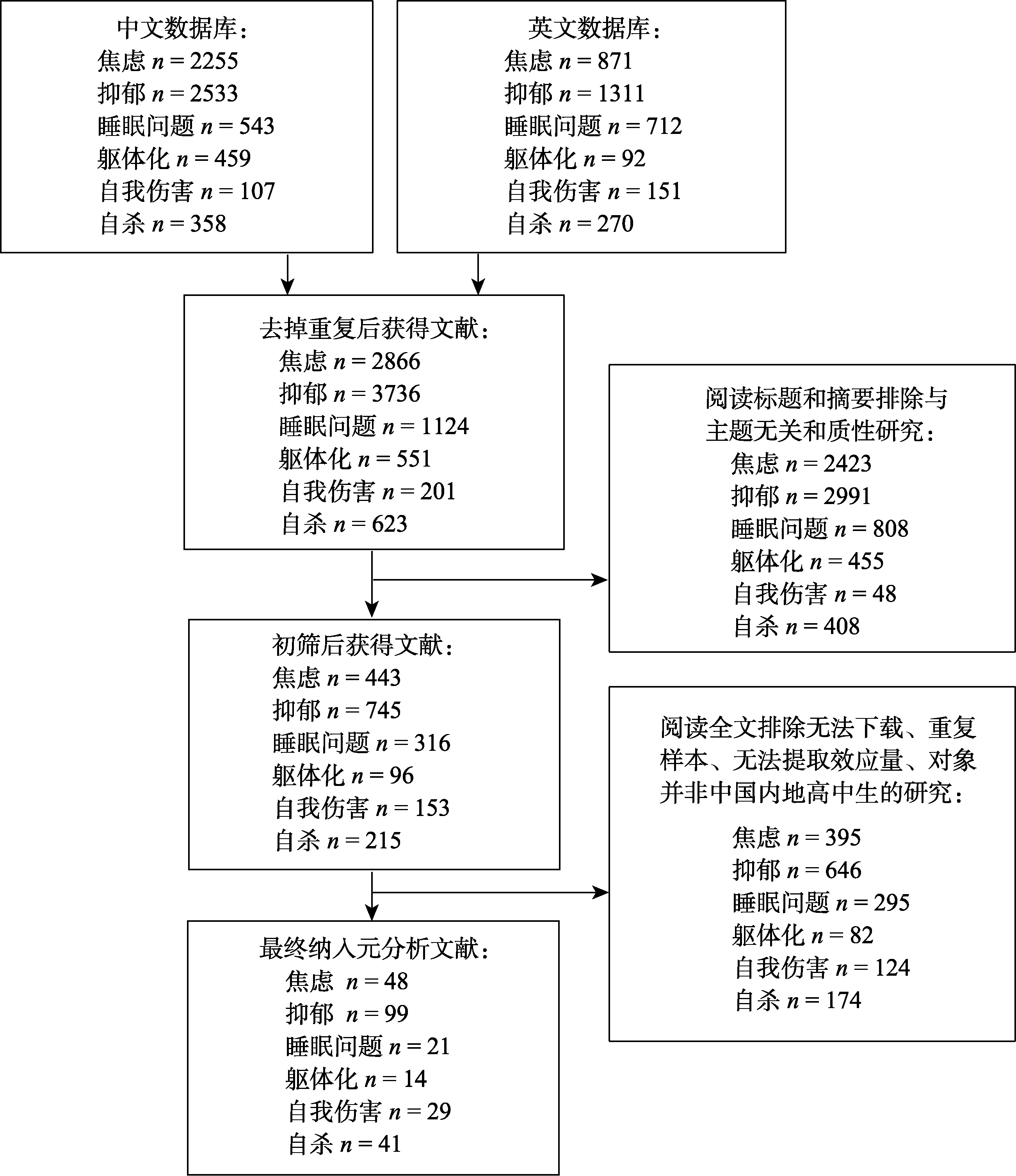
图1 文献纳入流程
| 心理健康问题种类 | k | 被试数 | 效应值及95%的置信区间 | 异质性检验 | |||
|---|---|---|---|---|---|---|---|
| 检出率 | 下限 | 上限 | I2 | p | |||
| 焦虑 | 48 | 50613 | 0.263 | 0.22 | 0.31 | 99.17 | < 0.001 |
| 抑郁 | 99 | 217806 | 0.280 | 0.25 | 0.31 | 99.49 | < 0.001 |
| 睡眠问题 | 21 | 91528 | 0.230 | 0.21 | 0.26 | 98.61 | < 0.001 |
| 躯体化 | 14 | 14349 | 0.098 | 0.06 | 0.15 | 99.58 | < 0.001 |
| 自我伤害 | 29 | 149028 | 0.228 | 0.19 | 0.27 | 99.61 | < 0.001 |
| 自杀意念 | 21 | 191906 | 0.171 | 0.16 | 0.19 | 98.22 | < 0.001 |
| 自杀计划 | 7 | 39775 | 0.069 | 0.06 | 0.09 | 96.85 | < 0.001 |
| 自杀企图(未遂) | 13 | 158416 | 0.029 | 0.025 | 0.033 | 91.78 | < 0.001 |
表1 高中生心理健康问题的检出率
| 心理健康问题种类 | k | 被试数 | 效应值及95%的置信区间 | 异质性检验 | |||
|---|---|---|---|---|---|---|---|
| 检出率 | 下限 | 上限 | I2 | p | |||
| 焦虑 | 48 | 50613 | 0.263 | 0.22 | 0.31 | 99.17 | < 0.001 |
| 抑郁 | 99 | 217806 | 0.280 | 0.25 | 0.31 | 99.49 | < 0.001 |
| 睡眠问题 | 21 | 91528 | 0.230 | 0.21 | 0.26 | 98.61 | < 0.001 |
| 躯体化 | 14 | 14349 | 0.098 | 0.06 | 0.15 | 99.58 | < 0.001 |
| 自我伤害 | 29 | 149028 | 0.228 | 0.19 | 0.27 | 99.61 | < 0.001 |
| 自杀意念 | 21 | 191906 | 0.171 | 0.16 | 0.19 | 98.22 | < 0.001 |
| 自杀计划 | 7 | 39775 | 0.069 | 0.06 | 0.09 | 96.85 | < 0.001 |
| 自杀企图(未遂) | 13 | 158416 | 0.029 | 0.025 | 0.033 | 91.78 | < 0.001 |
| 调节变量 | 异质性检验 | 类别 | k | 检出率 | 95% CI | |||
|---|---|---|---|---|---|---|---|---|
| QB | df | p | 下限 | 上限 | ||||
| 测量工具+检出标准 | 26.47 | 4 | < 0.001 | MSSMHS≥2 | 9 | 0.409 | 0.31 | 0.52 |
| SAS>50 | 5 | 0.377 | 0.25 | 0.52 | ||||
| SAS≥50 | 11 | 0.226 | 0.16 | 0.30 | ||||
| SCL≥2 | 7 | 0.229 | 0.15 | 0.33 | ||||
| SCL≥3 | 3 | 0.077 | 0.04 | 0.16 | ||||
| 检出时间 | 10.30 | 2 | 0.01 | 1周 | 32 | 0.219 | 0.18 | 0.27 |
| 3个月 | 6 | 0.337 | 0.22 | 0.48 | ||||
| 近来 | 10 | 0.388 | 0.28 | 0.50 | ||||
| 年级 | 0.05 | 2 | 0.97 | 高一 | 10 | 0.306 | 0.22 | 0.41 |
| 高二 | 9 | 0.301 | 0.21 | 0.41 | ||||
| 高三 | 10 | 0.317 | 0.23 | 0.42 | ||||
| 性别 | 0.65 | 1 | 0.42 | 男生 | 11 | 0.262 | 0.17 | 0.38 |
| 女生 | 14 | 0.327 | 0.23 | 0.44 | ||||
| 生源地 | 0.29 | 1 | 0.59 | 城镇 | 4 | 0.191 | 0.11 | 0.32 |
| 农村 | 8 | 0.230 | 0.15 | 0.33 | ||||
| 区域 | 3.13 | 2 | 0.21 | 东北 | - | - | - | - |
| 东部 | 15 | 0.275 | 0.20 | 0.37 | ||||
| 中部 | 14 | 0.204 | 0.14 | 0.28 | ||||
| 西部 | 16 | 0.300 | 0.22 | 0.39 | ||||
表2 焦虑检出率的调节效应分析
| 调节变量 | 异质性检验 | 类别 | k | 检出率 | 95% CI | |||
|---|---|---|---|---|---|---|---|---|
| QB | df | p | 下限 | 上限 | ||||
| 测量工具+检出标准 | 26.47 | 4 | < 0.001 | MSSMHS≥2 | 9 | 0.409 | 0.31 | 0.52 |
| SAS>50 | 5 | 0.377 | 0.25 | 0.52 | ||||
| SAS≥50 | 11 | 0.226 | 0.16 | 0.30 | ||||
| SCL≥2 | 7 | 0.229 | 0.15 | 0.33 | ||||
| SCL≥3 | 3 | 0.077 | 0.04 | 0.16 | ||||
| 检出时间 | 10.30 | 2 | 0.01 | 1周 | 32 | 0.219 | 0.18 | 0.27 |
| 3个月 | 6 | 0.337 | 0.22 | 0.48 | ||||
| 近来 | 10 | 0.388 | 0.28 | 0.50 | ||||
| 年级 | 0.05 | 2 | 0.97 | 高一 | 10 | 0.306 | 0.22 | 0.41 |
| 高二 | 9 | 0.301 | 0.21 | 0.41 | ||||
| 高三 | 10 | 0.317 | 0.23 | 0.42 | ||||
| 性别 | 0.65 | 1 | 0.42 | 男生 | 11 | 0.262 | 0.17 | 0.38 |
| 女生 | 14 | 0.327 | 0.23 | 0.44 | ||||
| 生源地 | 0.29 | 1 | 0.59 | 城镇 | 4 | 0.191 | 0.11 | 0.32 |
| 农村 | 8 | 0.230 | 0.15 | 0.33 | ||||
| 区域 | 3.13 | 2 | 0.21 | 东北 | - | - | - | - |
| 东部 | 15 | 0.275 | 0.20 | 0.37 | ||||
| 中部 | 14 | 0.204 | 0.14 | 0.28 | ||||
| 西部 | 16 | 0.300 | 0.22 | 0.39 | ||||
| 调节变量 | 异质性检验 | 类别 | k | 检出率 | 95% CI | |||
|---|---|---|---|---|---|---|---|---|
| QB | df | p | 下限 | 上限 | ||||
| 测量工具+检出标准 | 97.69 | 8 | < 0.001 | CDI≥19 | 7 | 0.220 | 0.17 | 0.29 |
| CESD≥16 | 7 | 0.331 | 0.26 | 0.41 | ||||
| CESD≥20 | 7 | 0.270 | 0.21 | 0.35 | ||||
| DSRSC≥15 | 3 | 0.267 | 0.18 | 0.39 | ||||
| MSSMHS≥2 | 7 | 0.405 | 0.32 | 0.49 | ||||
| SCL≥2 | 15 | 0.224 | 0.18 | 0.27 | ||||
| SCL≥3 | 4 | 0.052 | 0.03 | 0.08 | ||||
| SDS≥50 | 16 | 0.380 | 0.33 | 0.44 | ||||
| SDS≥53 | 5 | 0.423 | 0.33 | 0.53 | ||||
| 检出时间 | 1.87 | 2 | 0.39 | 1周 | 77 | 0.273 | 0.24 | 0.31 |
| 2周 | 14 | 0.294 | 0.22 | 0.38 | ||||
| 近来 | 6 | 0.366 | 0.24 | 0.52 | ||||
| 年级 | 2.21 | 2 | 0.33 | 高一 | 26 | 0.283 | 0.24 | 0.33 |
| 高二 | 18 | 0.321 | 0.27 | 0.38 | ||||
| 高三 | 13 | 0.336 | 0.27 | 0.41 | ||||
| 性别 | 0.33 | 1 | 0.56 | 男生 | 15 | 0.246 | 0.16 | 0.36 |
| 女生 | 17 | 0.288 | 0.20 | 0.40 | ||||
| 独生与否 | 0.34 | 1 | 0.56 | 独生 | 3 | 0.456 | 0.37 | 0.55 |
| 非独生 | 3 | 0.495 | 0.40 | 0.59 | ||||
| 生源地 | 0.04 | 1 | 0.83 | 城镇 | 5 | 0.371 | 0.25 | 0.52 |
| 农村 | 8 | 0.390 | 0.29 | 0.51 | ||||
| 区域 | 5.80 | 3 | 0.12 | 东北 | 6 | 0.346 | 0.24 | 0.47 |
| 东部 | 31 | 0.262 | 0.22 | 0.31 | ||||
| 中部 | 27 | 0.259 | 0.22 | 0.31 | ||||
| 西部 | 28 | 0.327 | 0.28 | 0.38 | ||||
表3 抑郁检出率的调节效应分析
| 调节变量 | 异质性检验 | 类别 | k | 检出率 | 95% CI | |||
|---|---|---|---|---|---|---|---|---|
| QB | df | p | 下限 | 上限 | ||||
| 测量工具+检出标准 | 97.69 | 8 | < 0.001 | CDI≥19 | 7 | 0.220 | 0.17 | 0.29 |
| CESD≥16 | 7 | 0.331 | 0.26 | 0.41 | ||||
| CESD≥20 | 7 | 0.270 | 0.21 | 0.35 | ||||
| DSRSC≥15 | 3 | 0.267 | 0.18 | 0.39 | ||||
| MSSMHS≥2 | 7 | 0.405 | 0.32 | 0.49 | ||||
| SCL≥2 | 15 | 0.224 | 0.18 | 0.27 | ||||
| SCL≥3 | 4 | 0.052 | 0.03 | 0.08 | ||||
| SDS≥50 | 16 | 0.380 | 0.33 | 0.44 | ||||
| SDS≥53 | 5 | 0.423 | 0.33 | 0.53 | ||||
| 检出时间 | 1.87 | 2 | 0.39 | 1周 | 77 | 0.273 | 0.24 | 0.31 |
| 2周 | 14 | 0.294 | 0.22 | 0.38 | ||||
| 近来 | 6 | 0.366 | 0.24 | 0.52 | ||||
| 年级 | 2.21 | 2 | 0.33 | 高一 | 26 | 0.283 | 0.24 | 0.33 |
| 高二 | 18 | 0.321 | 0.27 | 0.38 | ||||
| 高三 | 13 | 0.336 | 0.27 | 0.41 | ||||
| 性别 | 0.33 | 1 | 0.56 | 男生 | 15 | 0.246 | 0.16 | 0.36 |
| 女生 | 17 | 0.288 | 0.20 | 0.40 | ||||
| 独生与否 | 0.34 | 1 | 0.56 | 独生 | 3 | 0.456 | 0.37 | 0.55 |
| 非独生 | 3 | 0.495 | 0.40 | 0.59 | ||||
| 生源地 | 0.04 | 1 | 0.83 | 城镇 | 5 | 0.371 | 0.25 | 0.52 |
| 农村 | 8 | 0.390 | 0.29 | 0.51 | ||||
| 区域 | 5.80 | 3 | 0.12 | 东北 | 6 | 0.346 | 0.24 | 0.47 |
| 东部 | 31 | 0.262 | 0.22 | 0.31 | ||||
| 中部 | 27 | 0.259 | 0.22 | 0.31 | ||||
| 西部 | 28 | 0.327 | 0.28 | 0.38 | ||||
| 调节变量 | 异质性检验 | 类别 | k | 检出率 | 95% CI | |||
|---|---|---|---|---|---|---|---|---|
| QB | df | p | 下限 | 上限 | ||||
| 年级 | 6.90 | 2 | 0.03 | 高一 | 3 | 0.122 | 0.06 | 0.23 |
| 高二 | 3 | 0.253 | 0.14 | 0.41 | ||||
| 高三 | 3 | 0.366 | 0.22 | 0.54 | ||||
| 性别 | 0.16 | 1 | 0.69 | 男生 | 4 | 0.263 | 0.20 | 0.33 |
| 女生 | 4 | 0.245 | 0.19 | 0.31 | ||||
| 区域 | 0.93 | 2 | 0.63 | 东北 | 4 | 0.198 | 0.13 | 0.29 |
| 东部 | 6 | 0.251 | 0.18 | 0.33 | ||||
| 中部 | 7 | 0.220 | 0.16 | 0.29 | ||||
| 西部 | - | - | - | - | ||||
表4 睡眠问题检出率的调节效应分析
| 调节变量 | 异质性检验 | 类别 | k | 检出率 | 95% CI | |||
|---|---|---|---|---|---|---|---|---|
| QB | df | p | 下限 | 上限 | ||||
| 年级 | 6.90 | 2 | 0.03 | 高一 | 3 | 0.122 | 0.06 | 0.23 |
| 高二 | 3 | 0.253 | 0.14 | 0.41 | ||||
| 高三 | 3 | 0.366 | 0.22 | 0.54 | ||||
| 性别 | 0.16 | 1 | 0.69 | 男生 | 4 | 0.263 | 0.20 | 0.33 |
| 女生 | 4 | 0.245 | 0.19 | 0.31 | ||||
| 区域 | 0.93 | 2 | 0.63 | 东北 | 4 | 0.198 | 0.13 | 0.29 |
| 东部 | 6 | 0.251 | 0.18 | 0.33 | ||||
| 中部 | 7 | 0.220 | 0.16 | 0.29 | ||||
| 西部 | - | - | - | - | ||||
| 调节变量 | 异质性检验 | 类别 | k | 检出率 | 95% CI | |||
|---|---|---|---|---|---|---|---|---|
| QB | df | p | 下限 | 上限 | ||||
| 区域 | 4.73 | 2 | 0.09 | 东北 | - | - | - | - |
| 东部 | 4 | 0.215 | 0.09 | 0.42 | ||||
| 中部 | 5 | 0.070 | 0.03 | 0.15 | ||||
| 西部 | 3 | 0.064 | 0.02 | 0.18 | ||||
表5 躯体化检出率的调节效应分析
| 调节变量 | 异质性检验 | 类别 | k | 检出率 | 95% CI | |||
|---|---|---|---|---|---|---|---|---|
| QB | df | p | 下限 | 上限 | ||||
| 区域 | 4.73 | 2 | 0.09 | 东北 | - | - | - | - |
| 东部 | 4 | 0.215 | 0.09 | 0.42 | ||||
| 中部 | 5 | 0.070 | 0.03 | 0.15 | ||||
| 西部 | 3 | 0.064 | 0.02 | 0.18 | ||||
| 调节变量 | 异质性检验 | 类别 | k | 检出率 | 95% CI | |||
|---|---|---|---|---|---|---|---|---|
| QB | df | p | 下限 | 上限 | ||||
| 年级 | 0.03 | 1 | 0.86 | 高一 | 3 | 0.303 | 0.15 | 0.53 |
| 高二 | 3 | 0.329 | 0.16 | 0.56 | ||||
| 高三 | - | - | - | - | ||||
| 性别 | 0.03 | 1 | 0.86 | 男生 | 9 | 0.237 | 0.19 | 0.29 |
| 女生 | 10 | 0.243 | 0.20 | 0.30 | ||||
| 区域 | 6.01 | 1 | 0.01 | 东北 | - | - | - | - |
| 东部 | 10 | 0.168 | 0.12 | 0.23 | ||||
| 中部 | 9 | 0.293 | 0.22 | 0.39 | ||||
| 西部 | - | - | - | - | ||||
表6 自我伤害检出率的调节效应分析
| 调节变量 | 异质性检验 | 类别 | k | 检出率 | 95% CI | |||
|---|---|---|---|---|---|---|---|---|
| QB | df | p | 下限 | 上限 | ||||
| 年级 | 0.03 | 1 | 0.86 | 高一 | 3 | 0.303 | 0.15 | 0.53 |
| 高二 | 3 | 0.329 | 0.16 | 0.56 | ||||
| 高三 | - | - | - | - | ||||
| 性别 | 0.03 | 1 | 0.86 | 男生 | 9 | 0.237 | 0.19 | 0.29 |
| 女生 | 10 | 0.243 | 0.20 | 0.30 | ||||
| 区域 | 6.01 | 1 | 0.01 | 东北 | - | - | - | - |
| 东部 | 10 | 0.168 | 0.12 | 0.23 | ||||
| 中部 | 9 | 0.293 | 0.22 | 0.39 | ||||
| 西部 | - | - | - | - | ||||
| 自杀类别 | 调节变量 | 异质性检验 | 类别 | k | 检出率 | 95% CI | |||
|---|---|---|---|---|---|---|---|---|---|
| QB | df | p | 下限 | 上限 | |||||
| 自杀意念 | 年级 | 0.44 | 1 | 0.51 | 高一 | 5 | 0.174 | 0.14 | 0.21 |
| 高二 | 4 | 0.158 | 0.13 | 0.20 | |||||
| 高三 | - | - | - | - | |||||
| 性别 | 2.84 | 1 | 0.09 | 男生 | 6 | 0.146 | 0.12 | 0.18 | |
| 女生 | 6 | 0.184 | 0.15 | 0.22 | |||||
| 自杀企图 (未遂) | 年级 | 0.31 | 1 | 0.58 | 高一 | 3 | 0.040 | 0.03 | 0.06 |
| 高二 | 3 | 0.034 | 0.02 | 0.05 | |||||
| 高三 | - | - | - | - | |||||
表7 自杀检出率的调节效应分析
| 自杀类别 | 调节变量 | 异质性检验 | 类别 | k | 检出率 | 95% CI | |||
|---|---|---|---|---|---|---|---|---|---|
| QB | df | p | 下限 | 上限 | |||||
| 自杀意念 | 年级 | 0.44 | 1 | 0.51 | 高一 | 5 | 0.174 | 0.14 | 0.21 |
| 高二 | 4 | 0.158 | 0.13 | 0.20 | |||||
| 高三 | - | - | - | - | |||||
| 性别 | 2.84 | 1 | 0.09 | 男生 | 6 | 0.146 | 0.12 | 0.18 | |
| 女生 | 6 | 0.184 | 0.15 | 0.22 | |||||
| 自杀企图 (未遂) | 年级 | 0.31 | 1 | 0.58 | 高一 | 3 | 0.040 | 0.03 | 0.06 |
| 高二 | 3 | 0.034 | 0.02 | 0.05 | |||||
| 高三 | - | - | - | - | |||||
| [1] | 范会勇, 张进辅.(2005). 过去十年中学生SCL-90调查结果的元分析. 心理科学, 28(6), 1424-1426. |
| [2] | 傅小兰, 张侃, 陈雪峰, 陈祉妍.(2021). 心理健康蓝皮书: 中国国民心理健康发展报告(2019-2020). 北京: 社会科学文献出版社. |
| [3] | 韩阿珠, 徐耿, 苏普玉.(2017). 中国大陆中学生非自杀性自我伤害流行特征的meta分析. 中国学校卫生, 38(11), 1665-1670. |
| [4] | 刘福荣, 宋晓琴, 尚小平, 吴梦凡, 隋美丽, 董一超, 刘新奎.(2020). 中学生抑郁症状检出率的meta分析. 中国心理卫生杂志, 34(2), 123-128. |
| [5] | 李唯博, 陈倩, 叶小舟, 王礼桂.(2017). 武汉市高中生学业压力及心理健康状况的调查分析. 中国社会医学杂志, 34(2), 153-156. |
| [6] | 毛新雅, 魏向东.(2017). 务工经历与返乡农民工收入--以中西部7省(市)为例的研究. 社会科学, 9, 66-76. |
| [7] | 潘珍, 毛绍菊, 唐寒梅, 傅燕艳, 孙玮璇, 廖志林, … 黄鹏.(2016). 中国大学生非自杀性自伤检出率的Meta分析. 中国学校卫生, 37(6), 878-881. |
| [8] | 茹福霞, 黄秀萍, 詹文韵, 饶裕莲, 陈小龙, 胡旺, 黄鹏.(2019). 中国大陆大学生自杀计划检出率Meta分析. 中国学校卫生, 40(1), 42-45. |
| [9] | 王鉴, 刘念, 陶莉.(2020). 父母冲突影响青少年焦虑和抑郁: 自尊的中介作用. 中国健康心理学杂志, 28(11), 1714-1718. |
| [10] | 王极盛, 李焰, 赫尔实.(1997). 中国中学生心理健康量表的编制及其标准化. 社会心理科学, 46(4), 15-20. |
| [11] | 俞国良, 李建良, 王勍.(2018). 生态系统理论与青少年心理健康教育. 教育研究, 39(3), 110-117. |
| [12] | 俞国良, 李天然, 王勍.(2016). 高中生心理健康的横断历史研究. 教育研究, 37(10), 113-122. |
| [13] | 俞国良, 王浩.(2020). 文化潮流与社会转型: 影响我国青少年心理健康状况的重要因素及现实策略. 西南民族大学学报(人文社科版), 41(9), 213-219. |
| [14] | 于丽霞, 凌霄, 江光荣.(2013). 自我伤害青少年的冲动性. 心理学报, 45(3), 320-335. |
| [15] | 张亚利, 李森, 俞国良.(2021). 社交媒体使用与错失焦虑的关系: 一项元分析. 心理学报, 53(3), 273-290. |
| [16] | 张子珍.(2010). 中国经济区域划分演变及评价. 高等财经教育研究, 13(2), 89-92. |
| [17] |
Abdollahi A., Carlbring P., Vaez E., & Ghahfarokh S. A.(2018). Perfectionism and test anxiety among high-school students: The moderating role of academic hardiness. Current Psychology, 37(3), 632-639.
doi: 10.1007/s12144-016-9550-z URL |
| [18] | Achenbach T. M.(1966). The classification of children’s psychiatric symptoms: A factor-analytic study. Psychological Monographs: General and Applied, 80(7), 1-37. |
| [19] | Ahmadi T. A.(2013). Stress and anxiety in adolescence. European Online Journal of Natural and Social Sciences, 2(3), 359-365. |
| [20] |
Baxter A. J., Scott K. M., Vos T., & Whiteford H. A.(2013). Global prevalence of anxiety disorders: A systematic review and meta-regression. Psychological Medicine, 43(5), 897- 910.
doi: 10.1017/S003329171200147X pmid: 22781489 |
| [21] | Birleson P.(1981). The validity of depressive disorder in childhood and the development of a self-rating scale: A research report. Journal of Child Psychology and Psychiatry, 22(1), 73-88. |
| [22] |
Blankenstein N. E., Telzer E. H., Do K. T., Duijvenvoorde A., & Crone E. A.(2020). Behavioral and neural pathways supporting the development of prosocial and risk-taking behavior across adolescence. Child Development, 91(3), 665-681.
doi: 10.1111/cdev.13292 pmid: 31452199 |
| [23] |
Bonvanie I. J., Janssens K., Rosmalen J., & Oldehinkel A. J.(2016). Life events and functional somatic symptoms: A population study in older adolescents. British Journal of Psychology, 108(2), 318-333.
doi: 10.1111/bjop.12198 URL |
| [24] |
Bratu S.(2019). Psychological and contextual risk factors related to problematic smartphone use: Depression and anxiety symptom severity. Analysis and Metaphysics, 18, 64-70.
doi: 10.22381/AM1820199 URL |
| [25] |
Brière F. N., Janosz M., Fallu J. S., & Morizot J.(2015). Adolescent trajectories of depressive symptoms: Codevelopment of behavioral and academic problems. Journal of Adolescent Health, 57(3), 313-319.
doi: 10.1016/j.jadohealth.2015.05.012 URL |
| [26] | Brofenbrenner U., & Morris P. A.(2006). The bioecological model of human development. In R. M. Lerner & W. Damon (Eds.), Handbook of child psychology: Theoretical models of human development(pp. 793-828). Hoboken, New Jersey, US: John Wiley & Sons Inc. |
| [27] | Card N. A.(2012). Applied meta-analysis for social science research. New York: Guilford Press. |
| [28] |
Chapman A. L., Specht M. W., Cellucci T.(2015). Borderline personality disorder and deliberate self-harm: Does experiential avoidance play a role? Suicide and Life- Threatening Behavior, 35(4), 388-399.
doi: 10.1521/suli.2005.35.4.388 URL |
| [29] | Chen M. Y., Wang E. K., & Jeng Y. J.(2006). Adequate sleep among adolescents is positively associated with health status and health-related behaviors. BMC Public Health, 6(1), Article 59. https://doi.org/10.1186/1471-2458-6-59 |
| [30] |
Crockett L. J., & Beal S. J., (2012). The life course in the making: Gender and the development of adolescents’ expected timing of adult role transitions. Developmental Psychology, 48(6), 1727-1738.
doi: 10.1037/a0027538 pmid: 22448985 |
| [31] | Derogatis L. R.(1977). SCL-90-R: Administration, scoring, and procedures manual. Baltimore: Clinical Psychometric Research. |
| [32] |
Do H. N., Onyango B., Prakash R., Tran B. X., Nguyen Q. N., Nguyen L. H., … Ho R. C. M.(2020). Susceptibility and perceptions of excessive internet use impact on health among Vietnamese youths. Addictive Behaviors, 101, 105898. https://doi.org/10.1016/j.addbeh.2019.01.043
doi: 10.1016/j.addbeh.2019.01.043 URL |
| [33] |
Duan C., Chen C., Ouyang Z., Duan C., & Hou X.(2021). Association of stress and functional gastrointestinal disorders in high school graduates. Journal of Affective Disorders, 292, 305-310.
doi: 10.1016/j.jad.2021.05.072 URL |
| [34] |
Elhai J. D., Levine J. C., Dvorak R. D., & Hall B. J.(2017). Problematic smartphone use: A conceptual overview and systematic review of relations with anxiety and depression psychopathology. Journal of Affective Disorders, 207, 251-259.
doi: S0165-0327(16)30319-6 pmid: 27736736 |
| [35] | Erikson E. H.(1959). Identity and the life cycle. Psychological Issues, 1, 18-164. |
| [36] |
Essau C. A., Torre-Luque A., Lewinsohn P. M., & Rohde P.(2020). Patterns, predictors, and outcome of the trajectories of depressive symptoms from adolescence to adulthood. Depression and Anxiety, 37(6), 565-575.
doi: 10.1002/da.23034 URL |
| [37] |
Falbo T., & Hooper S. Y.(2015). China’s only children and psychopathology: A quantitative synthesis. American Journal of Orthopsychiatry, 85, 259-274.
doi: 10.1037/ort0000058 URL |
| [38] |
Finan L. J., Ohannessian M. C., & Gordon M. S.(2018). Trajectories of depressive symptoms from adolescence to emerging adulthood: The influence of parents, peers, and siblings. Developmental Psychology, 54(8), 1555-1567.
doi: 10.1037/dev0000543 URL |
| [39] |
Gaete J., Rojas-Barahona C. A., Olivares E., & Araya R.(2016). Brief report: Association between psychological sense of school membership and mental health among early adolescents. Journal of Adolescence, 50, 1-5. https://doi.org/10.1016/j.adolescence.2016.04.002
doi: 10.1016/j.adolescence.2016.04.002 URL |
| [40] |
Geng Y., Gu J., Wang J., & Zhang R.(2021). Smartphone addiction and depression, anxiety: The role of bedtime procrastination and self-control. Journal of Affective Disorders, 293, 415-421.
doi: 10.1016/j.jad.2021.06.062 URL |
| [41] | Guo X., Meng Z., Huang G., Fan J., Zhou W., Ling W., … Su L.(2016). Meta-analysis of the prevalence of anxiety disorders in mainland China from 2000 to 2015. Scientific Reports, 16(6), 1-15. https://doi.org/10.1038/srep28033 |
| [42] |
Huedo-Medina T. B., Sánchez-Meca J., Marín-Martínez F., & Botella J.(2006). Assessing heterogeneity in meta- analysis: Q statistic or I2 index? Psychological Methods, 11(2), 193-206.
pmid: 16784338 |
| [43] |
Hu J., Dong Y., Chen X., Liu Y., Ma D., Liu X., … He W.(2015). Prevalence of suicide attempts among Chinese adolescents: A meta-analysis of cross-sectional studies. Comprehensive Psychiatry, 61, 78-89.
doi: 10.1016/j.comppsych.2015.05.001 URL |
| [44] | Jackson K. M., Rogers M. L., & Sartor C. E.(2016). Parental divorce and initiation of alcohol use in early adolescence. Journal of Addictive Behaviors, 30(4), 450-461. |
| [45] | Kovacs M.(1992). Children’s Depression Inventory (CDI). New York: Multi-health Systems, Inc. |
| [46] |
Kulakow S., Raufelder D., & Hoferichter F.(2021). School- related pressure and parental support as predictors of change in student stress levels from early to middle adolescence. Journal of Adolescence, 87, 38-51.
doi: 10.1016/j.adolescence.2020.12.008 pmid: 33453550 |
| [47] |
Lan G., Hong L., Xue G., Zhou J., & Zhang W. H.(2016). Associations between depression risk, bullying and current smoking among Chinese adolescents: Modulated by gender. Psychiatry Research, 237, 282-289.
doi: 10.1016/j.psychres.2016.01.027 pmid: 26833280 |
| [48] |
Li J. Y., Li J., Liang J. H., Qian S., Jia R. X., Wang Y. Q., & Xu Y.(2019). Depressive symptoms among children and adolescents in China: A systematic review and meta- analysis. Medical Science Monitor, 25, 7459-7470.
doi: 10.12659/MSM.916774 pmid: 31586039 |
| [49] | Li L., Wang Y. Y., Wang S. B., Zhang L., Li L., Xu D. D., … Xiang Y. T.(2018). Prevalence of sleep disturbances in Chinese university students: A comprehensive meta- analysis. Journal of Sleep Research, 27(3), Article e12648. https://doi.org/10.1111/jsr.12648 |
| [50] | Li Z. Z., Li Y. M., Lei X. Y., Zhang D., Liu L., Tang S. Y. & Chen L.(2014). Prevalence of suicidal ideation in Chinese college students: A meta-analysis. PLoS One, 9(10), Article e104368. https://doi.org/10.1371/journal.pone.0104368 |
| [51] |
Masselink M., Roekel E. V., & Oldehinkel A. J.(2018). Self-esteem in early adolescence as predictor of depressive symptoms in late adolescence and early adulthood: The mediating role of motivational and social factors. Journal of Youth and Adolescence, 47(5), 932-946.
doi: 10.1007/s10964-017-0727-z pmid: 28785953 |
| [52] |
Mastro S., Zimmer-Gembeck M. J., Webb H. J., Farrell L., & Waters A.(2016). Young adolescents’ appearance anxiety and body dysmorphic symptoms: Social problems, self- perceptions and comorbidities. Journal of Obsessive- Compulsive and Related Disorders, 8, 50-55.
doi: 10.1016/j.jocrd.2015.12.001 URL |
| [53] |
Morese R., & Longobardi C.(2020). Suicidal ideation in adolescence: A perspective view on the role of the ventromedial prefrontal cortex. Frontiers in Psychology, 11, 713-717.
doi: 10.3389/fpsyg.2020.00713 URL |
| [54] |
Price R. B., Rosen D., Siegle G. J., Ladouceur C. D., Tang K., Allen K. B., … Silk J. S.(2016). From anxious youth to depressed adolescents: Prospective prediction of 2-year depression symptoms via attentional bias measures. Journal of Abnormal Psychology, 125(2), 267-278.
doi: 10.1037/abn0000127 URL |
| [55] |
Radloff L. S.(1977). The CES-D scale: A self-report depression scale for research in the general population. Applied Psychological Measurement, 1(3), 385-401.
doi: 10.1177/014662167700100306 URL |
| [56] |
Raufelder D., Regner N., & Wood M. A.(2018). Test anxiety and learned helplessness is moderated by student perceptions of teacher motivational support. Educational Psychology, 38(1), 54-74.
doi: 10.1080/01443410.2017.1304532 URL |
| [57] | Rothstein H. R., Sutton A. J., & Borenstein M.(2005). Publication bias in meta-analysis: Prevention, assessment and adjustments. Chichester: John Wiley & Sons Ltd. |
| [58] |
Schuler M. S., Gilman S. E., Burns R. M., Roth E., & Breslau J.(2021). Associations between depression subtype and functional impairment and treatment utilization in a national sample of adolescents. Journal of Affective Disorders, 287, 26-33.
doi: 10.1016/j.jad.2021.03.018 pmid: 33765539 |
| [59] | Sun J., Dunne M. P., & Hou X. Y.(2012). Academic stress among adolescents in China. Australasian Epidemiology, 19(1), 9-12. |
| [60] |
Tang X. F., Tang S. Q., Ren Z. H., & Wong D. F. K.(2019). Prevalence of depressive symptoms among adolescents in secondary school in mainland China: A systematic review and meta-analysis. Journal of Affective Disorders, 245, 498-507.
doi: 10.1016/j.jad.2018.11.043 URL |
| [61] |
Tan Y. F., Chen Y., Lu Y. G. & Li L. P.(2016). Exploring associations between problematic internet use, depressive symptoms and sleep disturbance among southern Chinese adolescents. International Journal of Environmental Research and Public Health, 13(3), 313-325.
doi: 10.3390/ijerph13030313 URL |
| [62] |
Tu K. M., Erath S. A., & El-Sheikh M.(2016). Coping responses moderate prospective associations between marital conflict and youth adjustment. Journal of Family Psychology, 30(5), 523-532.
doi: 10.1037/fam0000169 URL |
| [63] |
Vannucci A., & Ohannessian M. C.(2017). Self-competence and depressive symptom trajectories during adolescence. Journal of Abnormal Child Psychology, 46(2), 1-21. https://doi.org/10.1007/s10802-017-0340-3
doi: 10.1007/s10802-017-0376-4 URL |
| [64] | Wang J.(2021). Chinese parental academic socialization prior to college entrance examination: Insights from urban and rural areas. Journal of Family Studies, 3, 1-18. https://doi.org/10.1080/13229400.2021.1934 |
| [65] |
Wang L., Feng Z., Yang G., Yang Y., Wang K., Dai Q., … Xia F.(2016). Depressive symptoms among children and adolescents in western China: An epidemiological survey of prevalence and correlates. Psychiatry Research, 246, 267-274.
doi: 10.1016/j.psychres.2016.09.050 URL |
| [66] |
Xu X., Dai D. Y., Liu M., & Deng C.(2019). Parental psychological control and academic functioning in Chinese high school students: A short-term longitudinal study. British Journal of Developmental Psychology, 38(1), 90- 107.
doi: 10.1111/bjdp.12308 URL |
| [67] | Yang L. S., Zhang Z. H., Sun L., Sun Y. H. & Ye D. Q.(2015). Prevalence of suicide attempts among college students in China: A meta-analysis. Plos One, 10, Article e0116303. https://doi.org/10.1371/journal.pone.01163 |
| [68] | Zhang S. C., Yang R., Li D. L., Wan Y. H., & Fang J.(2019). Association of health literacy and sleep problems with mental health of Chinese students in combined junior and senior high school. PLoS One, 14(6), Article e0217685. https://doi.org/10.1371/journal.pone.02176 |
| [69] |
Zou S., Wu X., Huang B., & Liu C.(2020). Double-edged effect of coparenting on Chinese adolescents’ emotional instability: An inconsistent mediation model. Journal of Child and Family Studies, 29(5), 1413-1423.
doi: 10.1007/s10826-019-01628-w URL |
| [70] |
Zung W. W.(1965). A self-rating depression scale. Archives of General Psychiatry, 12(1), 63-70.
doi: 10.1001/archpsyc.1965.01720310065008 URL |
| [71] |
Zung W. W.(1971). A rating instrument for anxiety disorders. Psychosomatics, 12(6), 371-379.
pmid: 5172928 |
| [1] | 卫旭华, 焦文颖. 权力接近−抑制行为理论:基于元分析的理论拓展[J]. 心理科学进展, 2025, 33(2): 274-290. |
| [2] | 赵子卿, 余锦婷, 陈嘉彦, 王芸茹, 黄佳, 陈楚侨. 精神病临床高危人群的症状和功能改变:一项系统综述和三水平元分析[J]. 心理科学进展, 2025, 33(1): 42-61. |
| [3] | 苏涛, 曾浩文, 钟晓琳, 马文聪, 陈修德. 祸福相依:自恋型领导对下属效能双面效应的元分析[J]. 心理科学进展, 2024, 32(9): 1463-1487. |
| [4] | 唐甜, 王雨, 巩芳颍, 石可, 李喜, 刘伟, 陈宁. 家庭教养方式与中国青少年积极发展的关系:系列元分析[J]. 心理科学进展, 2024, 32(8): 1302-1314. |
| [5] | 孟现鑫, 颜晨, 俞德霖, 高树玲, 傅小兰. 童年创伤与网络成瘾关系的三水平元分析[J]. 心理科学进展, 2024, 32(7): 1087-1103. |
| [6] | 吴佳桧, 傅海伦. 成就目标定向与学业成绩关系的元分析:自我效能感、学习投入的中介作用[J]. 心理科学进展, 2024, 32(7): 1104-1125. |
| [7] | 文思雁, 于旭晨, 金磊, 宫俊如, 张晓函, 孙敬林, 张杉, 吕厚超. 儿童青少年家庭功能障碍与心理健康关系的三水平元分析[J]. 心理科学进展, 2024, 32(5): 771-789. |
| [8] | 袁悦, 吴志明, 谢秋实. 时间压力对个体工作结果的作用效果: 基于元分析的证据[J]. 心理科学进展, 2024, 32(3): 465-485. |
| [9] | 尹奎, 迟志康, 董念念, 李培凯, 赵景. 团队反思与团队资源开发、利用及团队结果的关系:一项元分析[J]. 心理科学进展, 2024, 32(2): 228-245. |
| [10] | 孟现鑫, 陈怡静, 王馨怡, 袁加锦, 俞德霖. 学校联结与抑郁的关系:一项三水平元分析[J]. 心理科学进展, 2024, 32(2): 246-263. |
| [11] | 徐荣华, 丁毅, 张跃, 郭永玉. 系统合理信念维护心理健康:缓和作用与拓展[J]. 心理科学进展, 2024, 32(2): 386-397. |
| [12] | 韩志伟, 程延园, 任志帅, 王丹阳, 李国静. 工作连通行为与工作−生活冲突的元分析:基于工作−家庭资源模型的视角[J]. 心理科学进展, 2024, 32(12): 2031-2049. |
| [13] | 诸彦含, 贺彬, 孙蕾. 状态权力感对亲社会行为的影响:一项三水平元分析[J]. 心理科学进展, 2024, 32(11): 1786-1799. |
| [14] | 蒋建武, 龙晗寰, 胡洁宇. 工作场所人工智能应用对员工影响的元分析[J]. 心理科学进展, 2024, 32(10): 1621-1639. |
| [15] | 刘红艳, 周泳含, 陈艳霞. 次优食品营销干预策略的有效性探究:来自元分析的证据[J]. 心理科学进展, 2024, 32(10): 1640-1658. |
| 阅读次数 | ||||||
|
全文 |
|
|||||
|
摘要 |
|
|||||
