

ISSN 1671-3710
CN 11-4766/R
主办:中国科学院心理研究所
出版:科学出版社
CN 11-4766/R
主办:中国科学院心理研究所
出版:科学出版社
心理科学进展 ›› 2018, Vol. 26 ›› Issue (6): 966-974.doi: 10.3724/SP.J.1042.2018.00966 cstr: 32111.14.2018.00966
李政汉1,2, 杨国春1,2, 南威治3, 李琦1,2, 刘勋1,2( )
)
收稿日期:2017-07-21
出版日期:2018-06-10
发布日期:2018-04-28
基金资助:
LI Zhenghan1,2, YANG Guochun1,2, NAN Weizhi3, LI Qi1,2, LIU Xun1,2()
Received:2017-07-21
Online:2018-06-10
Published:2018-04-28
摘要:
认知控制在冲突解决过程中起到重要的调节作用。相关理论大多结合任务相关刺激的加工增强和任务无关刺激的加工抑制进行解释, 但近年来受到实证研究的挑战。综述了冲突解决中增强和抑制两种调节机制的争论和相应的实证证据, 同时指出认知控制的调节机制可能受到冲突情境和个体自身等因素的影响。未来的研究应更多关注认知控制调节机制的影响因素, 加强认知加工策略和认知训练的探究, 为认知功能受损群体的干预提供依据。
中图分类号:
李政汉, 杨国春, 南威治, 李琦, 刘勋. (2018). 冲突解决过程中认知控制的注意调节机制 *. 心理科学进展 , 26(6), 966-974.
LI Zhenghan, YANG Guochun, NAN Weizhi, LI Qi, LIU Xun. (2018). Attentional regulation mechanisms of cognitive control in conflict resolution. Advances in Psychological Science, 26(6), 966-974.
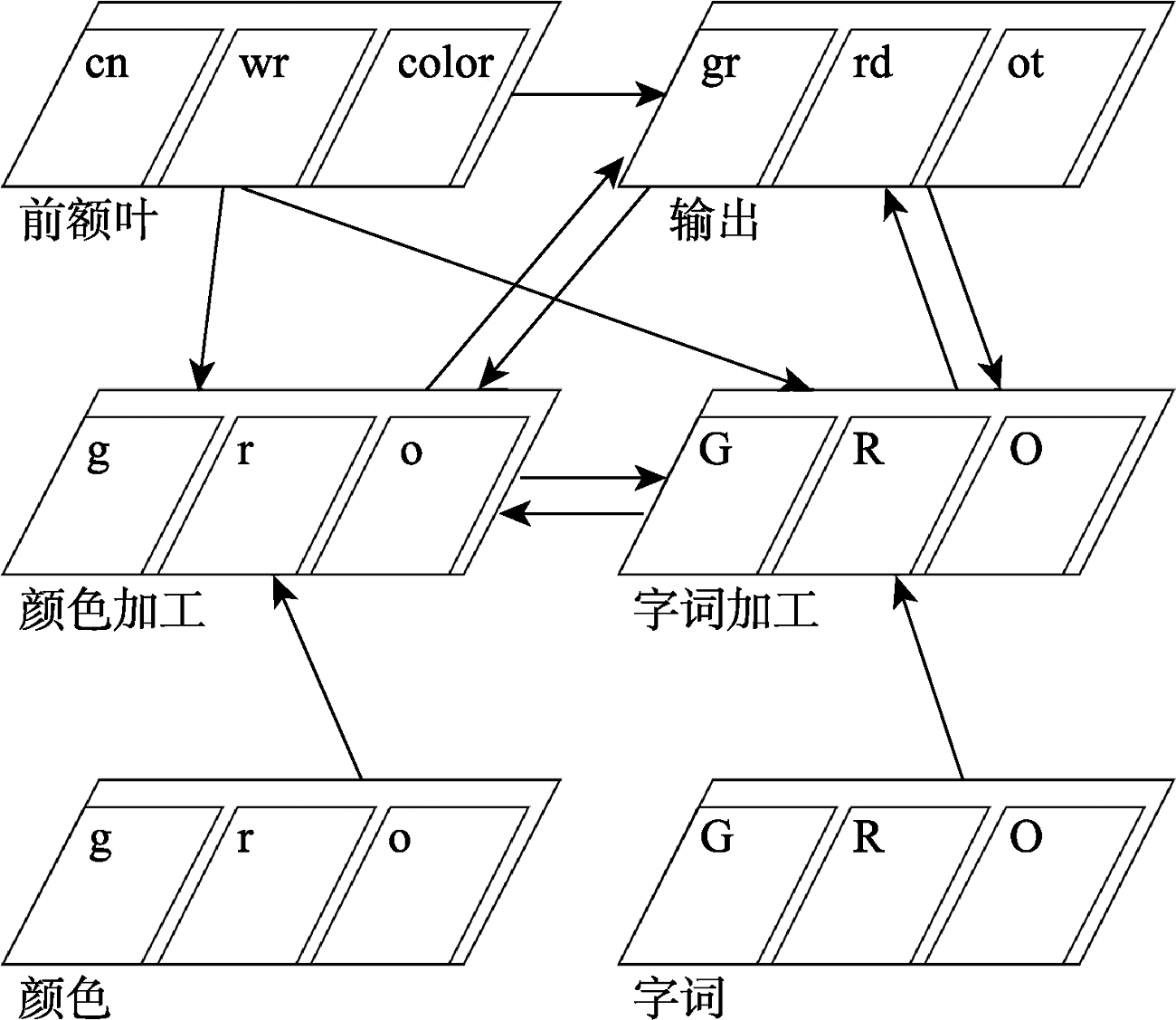
图1 色-词加工的神经网络模型(改自: Herd et al., 2006) 注:g:绿色; r:红色; o:其他颜色; G:字词“绿”; R:字词“红”; O:其他字词; gr:对“绿”反应; rd:对“红”反应; ot:对其他内容反应; cn:颜色命名任务; wr:词汇阅读任务; c:颜色任务单元。
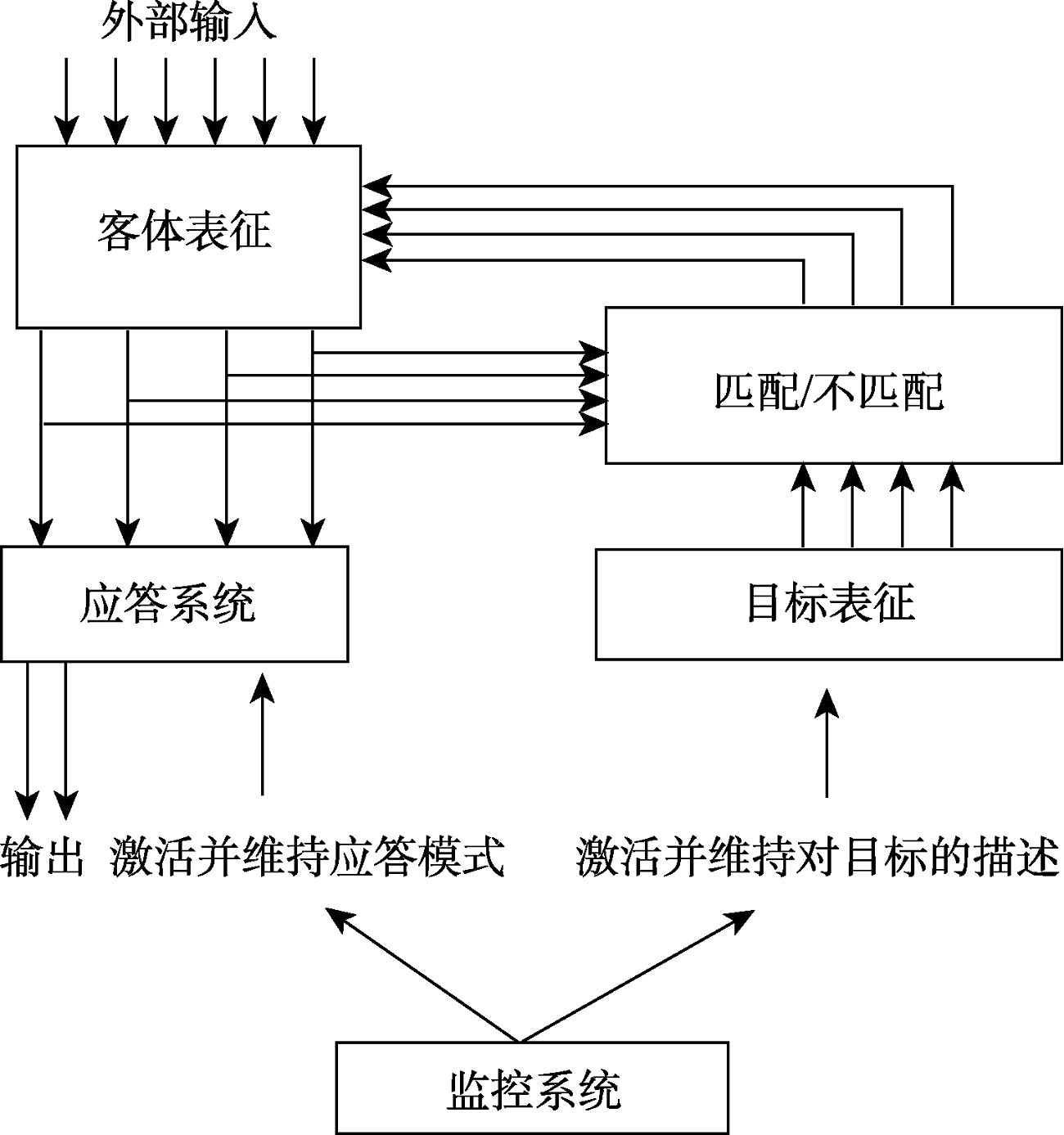
图2 HT选择性注意模型(改自: Houghton & Tipper, 1996)
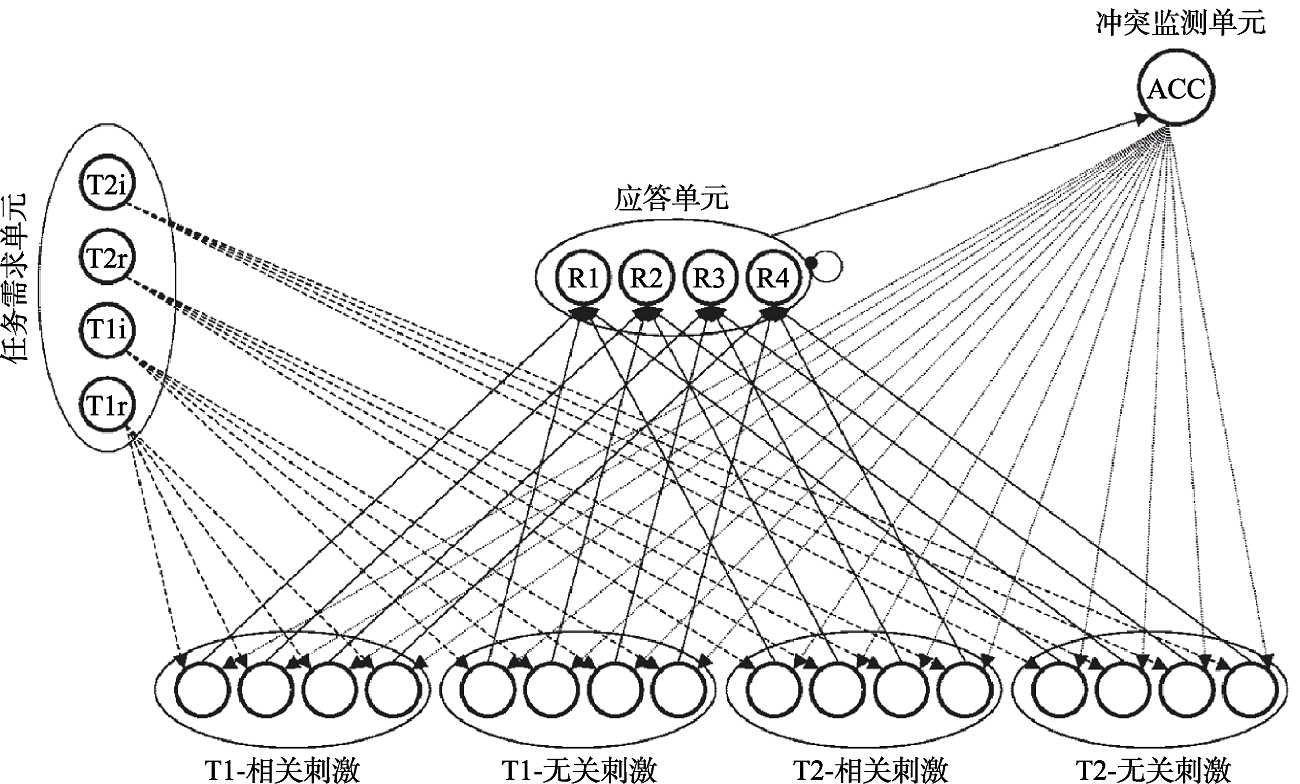
图3 学习模型 (改自: Verguts & Notebaert, 2008)注:T1:第一个任务; T2:第二个任务; T1r:第一个任务中的任务相关刺激特征; T1i:第一个任务中的任务无关刺激特征; T2r:第二个任务中的任务相关刺激特征; T2i:第二个任务中的任务无关刺激特征; R1-R4:不同的应答单元; ACC:前扣带皮层
| [1] |
刘培朵, 杨文静, 田夏, 陈安涛 . ( 2012). 冲突适应效应研究述评. 心理科学进展, 20( 4), 532-541.
doi: 10.3724/SP.J.1042.2012.00532 URL |
| [2] | 刘勋, 南威治, 王凯, 李琦 . ( 2013). 认知控制的模块化组织. 心理科学进展, 21( 12), 2091-2102. |
| [3] |
Abel S., Dressel K., Weiller C., & Huber W . ( 2012). Enhancement and suppression in a lexical interference fMRI-paradigm. Brain & Behavior, 2( 2), 109-127.
doi: 10.1002/brb3.31 URL pmid: 22574280 |
| [4] |
Baldauf, D., & Desimone, R. ( 2014). Neural mechanisms of object-based attention. Science, 344, 424-427.
doi: 10.1126/science.1247003 URL pmid: 24763592 |
| [5] |
Banich M. T., Milham M. P., Jacobson B. L., Webb A., Wszalek T., Cohen N. J., & Kramer A. F . ( 2001). Attentional selection and the processing of task-irrelevant information: Insights from fMRI examinations of the Stroop task. Progress in Brain Research, 134, 459-470.
doi: 10.1016/S0079-6123(01)34030-X URL |
| [6] |
Biehl S. C., Ehlis A. C., Müller L. D., Niklaus A., Pauli P., & Herrmann M. J . ( 2013). The impact of task relevance and degree of distraction on stimulus processing. BMC Neuroscience, 14, 107.
doi: 10.1186/1471-2202-14-107 URL pmid: 24079268 |
| [7] |
Botvinick, M., & Braver, T. (2015). Motivation and cognitive control: From behavior to neural mechanism. Annual Review of Psychology, 66, 83-113.
doi: 10.1146/annurev-psych-010814-015044 URL pmid: 25251491 |
| [8] |
Botvinick M. M., Braver T. S., Barch D. M., Carter C. S., & Cohen J. D . ( 2001). Conflict monitoring and cognitive control. Psychological Review, 108( 3), 624-652.
doi: 10.1037//0033-295X.108.3.624 URL pmid: 11488380 |
| [9] |
Burt, J. S . ( 2002). Why do non-color words interfere with color naming? Journal of Experimental Psychology: Human Perception and Performance, 28( 5), 1019-1038.
doi: 10.1037/0096-1523.28.5.1019 URL pmid: 12421053 |
| [10] |
Chao, H. F . ( 2011). Active inhibition of a distractor word: The distractor precue benefit in the Stroop color-naming task. Journal of Experimental Psychology: Human Perception and Performance, 37( 3), 799-812.
doi: 10.1037/a0022191 URL pmid: 21480743 |
| [11] |
Chechko N., Kellermann T., Schneider F., & Habel U . ( 2014). Conflict adaptation in emotional task underlies the amplification of target. Emotion, 14( 2), 321-330.
doi: 10.1037/a0035208 URL pmid: 24377682 |
| [12] |
Chun J. W., Park H. J., Kim D. J., Kim E., & Kim J. J . ( 2017). Contribution of fronto-striatal regions to emotional valence and repetition under cognitive conflict. Brain Research, 1666, 48-57.
doi: 10.1016/j.brainres.2017.04.018 URL |
| [13] |
Clouter A., Wilson R., Allen S., Klein R. M., & Eskes G. A . ( 2015). The influence of verbal and spatial working memory load on the time course of the Simon effect. Journal of Experimental Psychology: Human Perception and Performance, 41( 2), 342-355.
doi: 10.1037/a0038715 URL pmid: 25621577 |
| [14] |
Cohen J. D., Dunbar K., & McClelland J. L . ( 1990). On the control of automatic processes - a parallel distributed- processing account of the Stroop effect. Psychological Review, 97( 3), 332-361.
doi: 10.1037//0033-295X.97.3.332 URL pmid: 2200075 |
| [15] |
Cole M. W., Ito T., Bassett D. S., & Schultz D. H . ( 2016). Activity flow over resting-state networks shapes cognitive task activations. Nature Neuroscience, 19( 12), 1718-1726.
doi: 10.1038/nn.4406 URL pmid: 27723746 |
| [16] |
Cole M. W., Repovš G., & Anticevic A . ( 2014). The frontoparietal control system: A central role in mental health. Neuroscientist, 20( 6), 652-664.
doi: 10.1177/1073858414525995 URL |
| [17] |
Cole M. W., Reynolds J. R., Power J. D., Repovs G., Anticevic A., & Braver T. S . ( 2013). Multi-task connectivity reveals flexible hubs for adaptive task control. Nature Neuroscience, 16( 9), 1348-1355.
doi: 10.1038/nn.3470 URL pmid: 3758404 |
| [18] |
Corbetta M., Miezin F. M., Dobmeyer S., Shulman G. L., & Petersen S. E . ( 1991). Selective and divided attention during visual discriminations of shape, color, and speed: Functional anatomy by positron emission tomography. Journal of Neuroscience, 11( 8), 2383-2402.
doi: 10.1523/JNEUROSCI.11-08-02383.1991 URL |
| [19] |
Egner, T., & Hirsch, J. (2005). Cognitive control mechanisms resolve conflict through cortical amplification of task-relevant information. Nature Neuroscience, 8( 12), 1784-1790.
doi: 10.1038/nn1594 URL pmid: 16286928 |
| [20] |
Fan, J. (2014). An information theory account of cognitive control. Frontiers in Human Neuroscience, 8, 680.
doi: 10.3389/fnhum.2014.00680 URL pmid: 4151034 |
| [21] |
Fenske, M. J., & Eastwood, J. D . ( 2003). Modulation of focused attention by faces expressing emotion: Evidence from Flanker tasks. Emotion, 3( 4), 327-343.
doi: 10.1037/1528-3542.3.4.327 URL |
| [22] |
Fox E., Russo R., Bowles R., & Dutton K . ( 2001). Do threatening stimuli draw or hold visual attention in subclinical anxiety? Journal of Experimental Psychology- General, 130( 4), 681-700.
doi: 10.1037/0096-3445.130.4.681 URL pmid: 11757875 |
| [23] |
Frings C., Wentura D., & Wühr P . ( 2012). On the fate of distractor representations. Journal of Experimental Psychology: Human Perception and Performance, 38( 3), 570-575.
doi: 10.1037/a0027781 URL pmid: 22428679 |
| [24] |
Frings, C., & Wühr, P. (2014). Top-down deactivation of interference from irrelevant spatial or verbal stimulus features. Attention Perception & Psychophysics, 76( 8), 2360-2374.
doi: 10.3758/s13414-014-0728-x URL pmid: 24980154 |
| [25] |
Gajewski, P. D., & Falkenstein, M. (2012). Training-induced improvement of response selection and error detection in aging assessed by task switching: Effects of cognitive, physical, and relaxation training. Frontiers in Human Neuroscience, 6, 130.
doi: 10.3389/fnhum.2012.00130 URL pmid: 3349932 |
| [26] | Gorfein, D. S., & MacLeod, C. M . ( 2007). Inhibition in cognition. Washington, DC: American Psychological Association. |
| [27] |
Gregoriou G. G., Gotts S. J., Zhou H. H., & Desimone R . ( 2009). High-frequency, long-range coupling between prefrontal and visual cortex during attention. Science, 324, 1207-1210.
doi: 10.1126/science.1171402 URL pmid: 2849291650773022967381 |
| [28] |
Harris, K. D., & Mrsic-Flogel, T. D . ( 2013). Cortical connectivity and sensory coding. Nature, 503( 7474), 51-58.
doi: 10.1038/nature12654 URL pmid: 24201278 |
| [29] |
Herd S. A., Banich M. T., & O'Reilly R. C . ( 2006). Neural mechanisms of cognitive control: An integrative model of stroop task performance and fMRI data. Journal of Cognitive Neuroscience, 18( 1), 22-32.
doi: 10.1162/089892906775250012 URL pmid: 16417680 |
| [30] |
Houghton, G., & Tipper, S. P . ( 1996). Inhibitory mechanisms of neural and cognitive control: Applications to selective attention and sequential action. Brain and Cognition, 30( 1), 20-43.
doi: 10.1006/brcg.1996.0003 URL pmid: 8811979 |
| [31] |
Kalanthroff E., Avnit A., Henik A., Davelaar E. J., & Usher M . ( 2015). Stroop proactive control and task conflict are modulated by concurrent working memory load. Psychonomic Bulletin & Review, 22( 3), 869-875.
doi: 10.3758/s13423-014-0735-x URL pmid: 25257710 |
| [32] |
Kim S. Y., Kim M. S., & Chun M. M . ( 2005). Concurrent working memory load can reduce distraction. Proceedings of the National Academy of Sciences of the United States of America, 102( 45), 16524-16529.
doi: 10.1073/pnas.0505454102 URL pmid: 16258067 |
| [33] |
Koster E. H. W., Hoorelbeke K., Onraedt T., Owens M., & Derakshan N . ( 2017). Cognitive control interventions for depression: A systematic review of findings from training studies. Clinical Psychology Review, 53, 79-92.
doi: 10.1016/j.cpr.2017.02.002 URL pmid: 28273486 |
| [34] |
Li Q., Nan W. Z., Wang K., & Liu X . ( 2014). Independent processing of stimulus-stimulus and stimulus-response conflicts. PLoS One, 9( 2), e89249.
doi: 10.1371/journal.pone.0089249 URL pmid: 3928426 |
| [35] |
Luna B., Marek S., Larsen B., Tervo-Clemmens B., & Chahal R . ( 2015). An integrative model of the maturation of cognitive control. Annual Review of Neuroscience, 38, 151-170.
doi: 10.1146/annurev-neuro-071714-034054 URL pmid: 26154978 |
| [36] |
Manza P., Hu S., Chao H. H., Zhang S., Leung H. C., & Li, C. S. R. (2016). A dual but asymmetric role of the dorsal anterior cingulate cortex in response inhibition and switching from a non-salient to salient action. Neuroimage, 134, 466-474.
doi: 10.1016/j.neuroimage.2016.04.055 URL pmid: 27126003 |
| [37] |
Martiny-Huenger T., Gollwitzer P. M., & Oettingen G . ( 2014). Distractor devaluation in a flanker task: Object-specific effects without distractor recognition memory. Journal of Experimental Psychology: Human Perception and Performance, 40( 2), 613-625.
doi: 10.1037/a0034130 URL pmid: 24016067 |
| [38] |
McClure, S. M., & Bickel, W. K . ( 2014). A dual-systems perspective on addiction: Contributions from neuroimaging and cognitive training. Annals of the New York Academy of Sciences, 1327, 62-78.
doi: 10.1111/nyas.12561 URL pmid: 4285342 |
| [39] | Miller G. A., Galanter E., & Pribram K. H . ( 1960). Plans and the structure of behavior. New York, NY, US: Henry Holt and Company. |
| [40] |
Minamoto T., Shipstead Z., Osaka N., & Engle R. W . ( 2015). Low cognitive load strengthens distractor interference while high load attenuates when cognitive load and distractor possess similar visual characteristics. Attention, Perception, & Psychophysics, 77( 5), 1659-1673.
doi: 10.3758/s13414-015-0866-9 URL pmid: 25813738 |
| [41] |
Mishra J., de Villers-Sidani E., Merzenich M., & Gazzaley A . ( 2014). Adaptive training diminishes distractibility in aging across species. Neuron, 84( 5), 1091-1103.
doi: 10.1016/j.neuron.2014.10.034 URL pmid: 4264379 |
| [42] |
Möller M., Mayr S., & Buchner A . ( 2013). Target localization among concurrent sound sources: No evidence for the inhibition of previous distractor responses. Attention, Perception, & Psychophysics, 75( 1), 132-144.
doi: 10.3758/s13414-012-0380-2 URL pmid: 23077027 |
| [43] |
Motter J. N., Pimontel M. A., Rindskopf D., Devanand D. P., Doraiswamy P. M., & Sneed J. R . ( 2016). Computerized cognitive training and functional recovery in major depressive disorder: A meta-analysis. Journal of Affective Disorders, 189, 184-191.
doi: 10.1016/j.jad.2015.09.022 URL pmid: 26437233 |
| [44] |
Navalyal, G. U., & Gavas, R. D . ( 2014). A dynamic attention assessment and enhancement tool using computer graphics. Human-centric Computing and Information Sciences, 4( 1), 11.
doi: 10.1186/s13673-014-0011-0 URL |
| [45] |
Noonan M. P., Adamian N., Pike A., Printzlau F., Crittenden B. M., & Stokes M. G . ( 2016). Distinct mechanisms for distractor suppression and target facilitation. Journal of Neuroscience, 36( 6), 1797-1807.
doi: 10.1523/JNEUROSCI.2133-15.2016 URL pmid: 26865606 |
| [46] |
Notebaert, W., & Verguts, T. (2008). Cognitive control acts locally. Cognition, 106( 2), 1071-1080.
doi: 10.1016/j.cognition.2007.04.011 URL |
| [47] |
Olivers, C. N. L., & Humphreys, G. W . ( 2002). When visual marking meets the attentional blink: More evidence for top-down, limited-capacity inhibition. Journal of Experimental Psychology: Human Perception and Performance, 28( 1), 22-42.
doi: 10.1037/0096-1523.28.1.22 URL |
| [48] |
Owens M., Koster E. H. W., & Derakshan N . ( 2013). Improving attention control in dysphoria through cognitive training: Transfer effects on working memory capacity and filtering efficiency. Psychophysiology, 50( 3), 297-307.
doi: 10.1111/psyp.12010 URL pmid: 23350956 |
| [49] |
Padmala, S., & Pessoa, L. (2011). Reward reduces conflict by enhancing attentional control and biasing visual cortical processing. Journal of Cognitive Neuroscience, 23( 11), 3419-3432.
doi: 10.1162/jocn_a_00011 URL pmid: 21452938 |
| [50] |
Pardo J. V., Pardo P. J., Janer K. W., & Raichle M. E . ( 1990). The anterior cingulate cortex mediates processing selection in the Stroop attentional conflict paradigm. Proceedings of the National Academy of Sciences of the United States of America, 87( 1), 256-259.
doi: 10.1073/pnas.87.1.256 URL pmid: 2296583 |
| [51] |
Polk T. A., Drake R. M., Jonides J. J., Smith M. R., & Smith E. E . ( 2008). Attention enhances the neural processing of relevant features and suppresses the processing of irrelevant features in humans: A functional magnetic resonance imaging study of the stroop task. Journal of Neuroscience, 28( 51), 13786-13792.
doi: 10.1523/JNEUROSCI.1026-08.2008 URL pmid: 19091969 |
| [52] | Posner, M., & Snyder, C. (1975). Attention and cognitive control. In R. L. Solso (Ed.), Information processing and cognition: Loyola symposium. Hillsdale, New Jersey: Erlbaum. |
| [53] |
Posner, M. I., & Dehaene, S. (1994). Attentional networks. Trends in Neurosciences, 17( 2), 75-79.
doi: 10.1016/0166-2236(94)90078-7 URL |
| [54] |
Purmann, S., & Pollmann, S. (2015). Adaptation to recent conflict in the classical color-word Stroop-task mainly involves facilitation of processing of task-relevant information. Frontiers in Human Neuroscience, 9, 88.
doi: 10.3389/fnhum.2015.00088 URL pmid: 4347451 |
| [55] |
Reisenauer, R., & Dreisbach, G. (2014). The shielding function of task rules in the context of task switching. Quarterly Journal of Experimental Psychology, 67( 2), 358-376.
doi: 10.1080/17470218.2013.808678 URL pmid: 23805948 |
| [56] |
Schrobsdorff H., Ihrke M., Behrendt J., Hasselhorn M., & Herrmann J. M . ( 2012). Inhibition in the dynamics of selective attention: An integrative model for negative priming. Frontiers in Psychology, 3, 491.
doi: 10.3389/fpsyg.2012.00491 URL pmid: 3498964 |
| [57] |
Shenhav A., Botvinick M. M., & Cohen J. D . ( 2013). The expected value of control: An integrative theory of anterior cingulate cortex function. Neuron, 79( 2), 217-240.
doi: 10.1016/j.neuron.2013.07.007 URL pmid: 23889930 |
| [58] |
Soutschek A., Stelzel C., Paschke L., Walter H., & Schubert T . ( 2015). Dissociable effects of motivation and expectancy on conflict processing: An fMRI Study. Journal of Cognitive Neuroscience, 27( 2), 409-423.
doi: 10.1162/jocn_a_00712 URL pmid: 25203271 |
| [59] |
Stout, D. (2010). The evolution of cognitive control. Topics in Cognitive Science, 2( 4), 614-630.
doi: 10.1111/j.1756-8765.2009.01078.x URL pmid: 25164046 |
| [60] |
Stroop, J. R . ( 1935). Studies of interference in serial verbal reactions. Journal of Experimental Psychology, 18, 643-662.
doi: 10.1037/0096-3445.121.1.15 URL |
| [61] |
Verguts, T., & Notebaert, W. (2008). Hebbian learning of cognitive control: Dealing with specific and nonspecific adaptation. Psychological Review, 115( 2), 518-525.
doi: 10.1037/0033-295X.115.2.518 URL pmid: 18426302 |
| [62] |
Weissman D. H., Gopalakrishnan A., Hazlett C. J., & Woldorff M. G . ( 2005). Dorsal anterior cingulate cortex resolves conflict from distracting stimuli by boosting attention toward relevant events. Cerebral Cortex, 15( 2), 229-237.
doi: 10.1093/cercor/bhh125 URL pmid: 15238434 |
| [63] |
Wendt M., Luna-Rodriguez A., & Jacobsen T . ( 2012). Conflict-Induced perceptual filtering. Journal of Experimental Psychology: Human Perception and Performance, 38( 3), 675-686.
doi: 10.1037/a0025902 URL |
| [64] |
Wingfield, A. (2016). Evolution of models of working memory and cognitive resources. Ear and Hearing, 37, 35S-43S.
doi: 10.1097/AUD.0000000000000310 URL pmid: 27355768 |
| [65] |
Zhang L. W., Ding C., Li H., Zhang Q. L., & Chen A. T . ( 2013). The influence of attentional control on stimulus processing is category specific in Stroop tasks: Attentional control. Psychological Research, 77( 5), 599-610.
doi: 10.1007/s00426-012-0457-5 URL pmid: 23080057 |
| [1] | 卫旭华, 焦文颖. 权力接近−抑制行为理论:基于元分析的理论拓展[J]. 心理科学进展, 2025, 33(2): 274-290. |
| [2] | 贾云丞, 程刚, 丁芳媛, 陈加, 龙女, 陈玉荣, 林楠. 对中性婴儿面孔注意偏向与表情不确定性的关系[J]. 心理科学进展, 2024, 32(9): 1393-1407. |
| [3] | 黄景, 刘丽聪, 李明钰, 龙奕名, 李小俚. 基于眼动信号来源的认知老化差异性[J]. 心理科学进展, 2024, 32(9): 1408-1415. |
| [4] | 陈雁, 李晶. 人际同步对孤独症儿童合作行为的影响及干预促进[J]. 心理科学进展, 2024, 32(4): 639-653. |
| [5] | 黄心语, 李晔. 人机信任校准的双途径:信任抑制与信任提升[J]. 心理科学进展, 2024, 32(3): 527-542. |
| [6] | 刘一鸣, 罗浩诚, 傅世敏. 视觉意识是离散还是连续模式?基于注意瞬脱的整合性视角[J]. 心理科学进展, 2024, 32(2): 264-275. |
| [7] | 杨伟平, 李睿智, 李胜楠, 林金飞, 任艳娜. 视听知觉训练对老年人认知能力的促进及其机制[J]. 心理科学进展, 2024, 32(2): 318-329. |
| [8] | 张湘一, 吴一琳. 视觉注意对决策的影响及其作用机制[J]. 心理科学进展, 2024, 32(11): 1829-1843. |
| [9] | 孙猛, 刘泽军, 贾茜, 尚晨阳, 张钦. 情绪T2对抗注意瞬脱:理解情绪优先加工的窗口[J]. 心理科学进展, 2024, 32(1): 58-74. |
| [10] | 张子霄, 何生, 张杰栋. 注意转移中的知觉抑制[J]. 心理科学进展, 2023, 31(suppl.): 18-18. |
| [11] | 周攀, 刘小燕, 李天添, 王玲. 与位置相关的价值统计学习对注意的影响[J]. 心理科学进展, 2023, 31(suppl.): 51-51. |
| [12] | 吴美君, 张琪. 不同SOA下外源性线索引发的主动抑制机制[J]. 心理科学进展, 2023, 31(suppl.): 54-54. |
| [13] | 赵佳旭, 鲍敏. 基于伪装原理研究无意识视觉运动加工的方法[J]. 心理科学进展, 2023, 31(suppl.): 64-64. |
| [14] | 吴小钱, 张溢翀, 邓芷晴, 高洁, 朱福英, 陈娟. 辐辏眼动距离线索在眼动准备阶段对物体大小表征的影响[J]. 心理科学进展, 2023, 31(suppl.): 70-70. |
| [15] | 裴英名, 任衍具. 与工作记忆保持项目语义相关的干扰对搜索固定与变化目标的影响[J]. 心理科学进展, 2023, 31(suppl.): 75-75. |
| 阅读次数 | ||||||
|
全文 |
|
|||||
|
摘要 |
|
|||||
