

ISSN 0439-755X
CN 11-1911/B
主办:中国心理学会
中国科学院心理研究所
出版:科学出版社
CN 11-1911/B
主办:中国心理学会
中国科学院心理研究所
出版:科学出版社
心理学报 ›› 2024, Vol. 56 ›› Issue (11): 1619-1633.doi: 10.3724/SP.J.1041.2024.01619 cstr: 32110.14.2024.01619
郭小军1, 焦玉月1, 柏小云1, 罗照盛2( ), 李弘1
收稿日期:2023-12-19
发布日期:2024-09-05
出版日期:2024-11-25
通讯作者:
罗照盛, E-mail: luozs@126.com基金资助:
GUO Xiaojun1, JIAO Yuyue1, BAI Xiaoyun1, LUO Zhaosheng2(), LI Hong1
Received:2023-12-19
Online:2024-09-05
Published:2024-11-25
摘要:
混合效应模型(Mixed-Effects Model, MEM)将被试和刺激项目同时作为随机变量, 有效地分析实验效应和相关的被试(或刺激项目)差异, 从而避免了传统方差分析的随机效应固定化问题。基于此, 文中构建了混合MEM、独立MEM和速度MEM三个联合模型, 并与反应和反应时数据的分开建模(即分开MEM)进行比较。在IAT实验数据分析中, 分开MEM的模型拟合与参数估计均不如独立MEM, 而混合MEM的模型拟合优于独立MEM和速度MEM。模拟结果显示, 分开MEM参数估计的相对偏差普遍大于独立MEM, 且具有较高的第I类错误率; 而混合MEM比其他联合模型能更好地识别不同模拟情景的参数, 并且具有较佳的第I类错误率和统计检验力。因此, 在心理实验中, 联合建模方法比分开建模具有更大优势。
中图分类号:
郭小军, 焦玉月, 柏小云, 罗照盛, 李弘. (2024). 心理实验数据的联合建模:反应与反应时的混合影响. 心理学报, 56(11), 1619-1633.
GUO Xiaojun, JIAO Yuyue, BAI Xiaoyun, LUO Zhaosheng, LI Hong. (2024). Joint modeling of psychological experimental data: Mixed effects of reaction and reaction time. Acta Psychologica Sinica, 56(11), 1619-1633.
| 反应时数据 | 反应数据 | ||||
|---|---|---|---|---|---|
| 模型 | AIC | BIC | 模型 | AIC | BIC |
| LMEM-S01I01 | 3456.1 | 3511.8 | GLMEM-S01I01 | 1206.9 | 1256.5 |
| LMEM-S0I01 | 3668.0 | 3711.3 | GLMEM-S0I01 | 1245.9 | 1283.1 |
| LMEM-S01I0 | 3452.3 | 3495.6 | GLMEM-S01I0 | 1202.9 | 1240.1 |
| LMEM-S0I0 | 3664.0 | 3695.0 | GLMEM-S0I0 | 1242.5 | 1267.2 |
表1 IAT实验不同随机效应结构比较
| 反应时数据 | 反应数据 | ||||
|---|---|---|---|---|---|
| 模型 | AIC | BIC | 模型 | AIC | BIC |
| LMEM-S01I01 | 3456.1 | 3511.8 | GLMEM-S01I01 | 1206.9 | 1256.5 |
| LMEM-S0I01 | 3668.0 | 3711.3 | GLMEM-S0I01 | 1245.9 | 1283.1 |
| LMEM-S01I0 | 3452.3 | 3495.6 | GLMEM-S01I0 | 1202.9 | 1240.1 |
| LMEM-S0I0 | 3664.0 | 3695.0 | GLMEM-S0I0 | 1242.5 | 1267.2 |
| 模型 | 模型拟合指数 | |
|---|---|---|
| WAIC | LOO | |
| 混合MEM | 50684.6 | 50684.9 |
| 速度MEM | 50920.3 | 50921.3 |
| 独立MEM | 54696.6 | 54697.9 |
| 分开MEM | 54697.2 | 54698.5 |
表2 IAT实验不同模型拟合比较
| 模型 | 模型拟合指数 | |
|---|---|---|
| WAIC | LOO | |
| 混合MEM | 50684.6 | 50684.9 |
| 速度MEM | 50920.3 | 50921.3 |
| 独立MEM | 54696.6 | 54697.9 |
| 分开MEM | 54697.2 | 54698.5 |
| 数据 | 参数 | 混合MEM | 速度MEM | 独立MEM | 分开MEM | |
|---|---|---|---|---|---|---|
| 反应时 | 固定效应 | 656(24.59) | 660(25.86) | 643(24.54) | 643(24.54) | |
| 150(33.24) | 159(36.83) | 139(31.52) | 140(32.52) | |||
| 随机效应 | 163(16.52) | 173(17.25) | 165(16.73) | 164(16.76) | ||
| 207(22.35) | 237(25.22) | 199(21.86) | 202(22.80) | |||
| 13(9.07) | 18(10.49) | 16(10.35) | 16(9.93) | |||
| 375(4.62) | 384(4.78) | 403(4.79) | 403(4.79) | |||
| 反应 | 固定效应 | 5.67(0.33) | —— | 3.58(0.17) | 3.59(0.18) | |
| −1.56(0.54) | —— | −0.87(0.29) | −0.82(0.30) | |||
| 随机效应 | 0.87(0.15) | —— | 0.80(0.15) | 0.84(0.15) | ||
| 1.22(0.14) | —— | 1.23(0.24) | 1.28(0.25) | |||
| 0.28(0.21) | —— | 0.22(0.14) | 0.23(0.13) | |||
表3 不同模型的固定与随机效应参数的均值(标准误)
| 数据 | 参数 | 混合MEM | 速度MEM | 独立MEM | 分开MEM | |
|---|---|---|---|---|---|---|
| 反应时 | 固定效应 | 656(24.59) | 660(25.86) | 643(24.54) | 643(24.54) | |
| 150(33.24) | 159(36.83) | 139(31.52) | 140(32.52) | |||
| 随机效应 | 163(16.52) | 173(17.25) | 165(16.73) | 164(16.76) | ||
| 207(22.35) | 237(25.22) | 199(21.86) | 202(22.80) | |||
| 13(9.07) | 18(10.49) | 16(10.35) | 16(9.93) | |||
| 375(4.62) | 384(4.78) | 403(4.79) | 403(4.79) | |||
| 反应 | 固定效应 | 5.67(0.33) | —— | 3.58(0.17) | 3.59(0.18) | |
| −1.56(0.54) | —— | −0.87(0.29) | −0.82(0.30) | |||
| 随机效应 | 0.87(0.15) | —— | 0.80(0.15) | 0.84(0.15) | ||
| 1.22(0.14) | —— | 1.23(0.24) | 1.28(0.25) | |||
| 0.28(0.21) | —— | 0.22(0.14) | 0.23(0.13) | |||
| 参数类别 | 参数 | 混合MEM | 速度MEM | 独立MEM | 分开MEM |
|---|---|---|---|---|---|
| 被试 | 0.38[−0.32,0.85] | —— | 0.67[0.28,0.93] | 0.75[0.36,0.97] | |
| −0.32[−0.73,0.22] | —— | −0.12[−0.43,0.22] | |||
| −0.53[−0.87,−0.01] | —— | −0.40[−0.68,−0.05] | |||
| −0.33[−0.78,0.26] | —— | −0.27[−0.60,0.10] | |||
| −0.50[−0.88,0.11] | —— | −0.46[−0.76,−0.10] | |||
| 0.59[0.36,0.77] | 0.68[0.49,0.83] | 0.62[0.39,0.79] | 0.64[0.42,0.81] | ||
| 刺激项目 | −0.03[−0.82,0.79] | —— | −0.12[−0.84,0.74] |
表4 不同模型随机效应的相关矩阵估计值与置信区间
| 参数类别 | 参数 | 混合MEM | 速度MEM | 独立MEM | 分开MEM |
|---|---|---|---|---|---|
| 被试 | 0.38[−0.32,0.85] | —— | 0.67[0.28,0.93] | 0.75[0.36,0.97] | |
| −0.32[−0.73,0.22] | —— | −0.12[−0.43,0.22] | |||
| −0.53[−0.87,−0.01] | —— | −0.40[−0.68,−0.05] | |||
| −0.33[−0.78,0.26] | —— | −0.27[−0.60,0.10] | |||
| −0.50[−0.88,0.11] | —— | −0.46[−0.76,−0.10] | |||
| 0.59[0.36,0.77] | 0.68[0.49,0.83] | 0.62[0.39,0.79] | 0.64[0.42,0.81] | ||
| 刺激项目 | −0.03[−0.82,0.79] | —— | −0.12[−0.84,0.74] |
| 模拟 条件 | |||||||
|---|---|---|---|---|---|---|---|
| d = 0 | d = 0.5 | ||||||
| C1 | 700 | 0 | 139 | 100 | 50 | 50 | 250 |
| C2 | 700 | 0 | 163 | 200 | 50 | 50 | 250 |
| C3 | 700 | 0 | 156 | 100 | 150 | 50 | 250 |
| C4 | 700 | 0 | 145 | 100 | 50 | 100 | 250 |
表5 LMEM模拟条件设置
| 模拟 条件 | |||||||
|---|---|---|---|---|---|---|---|
| d = 0 | d = 0.5 | ||||||
| C1 | 700 | 0 | 139 | 100 | 50 | 50 | 250 |
| C2 | 700 | 0 | 163 | 200 | 50 | 50 | 250 |
| C3 | 700 | 0 | 156 | 100 | 150 | 50 | 250 |
| C4 | 700 | 0 | 145 | 100 | 50 | 100 | 250 |
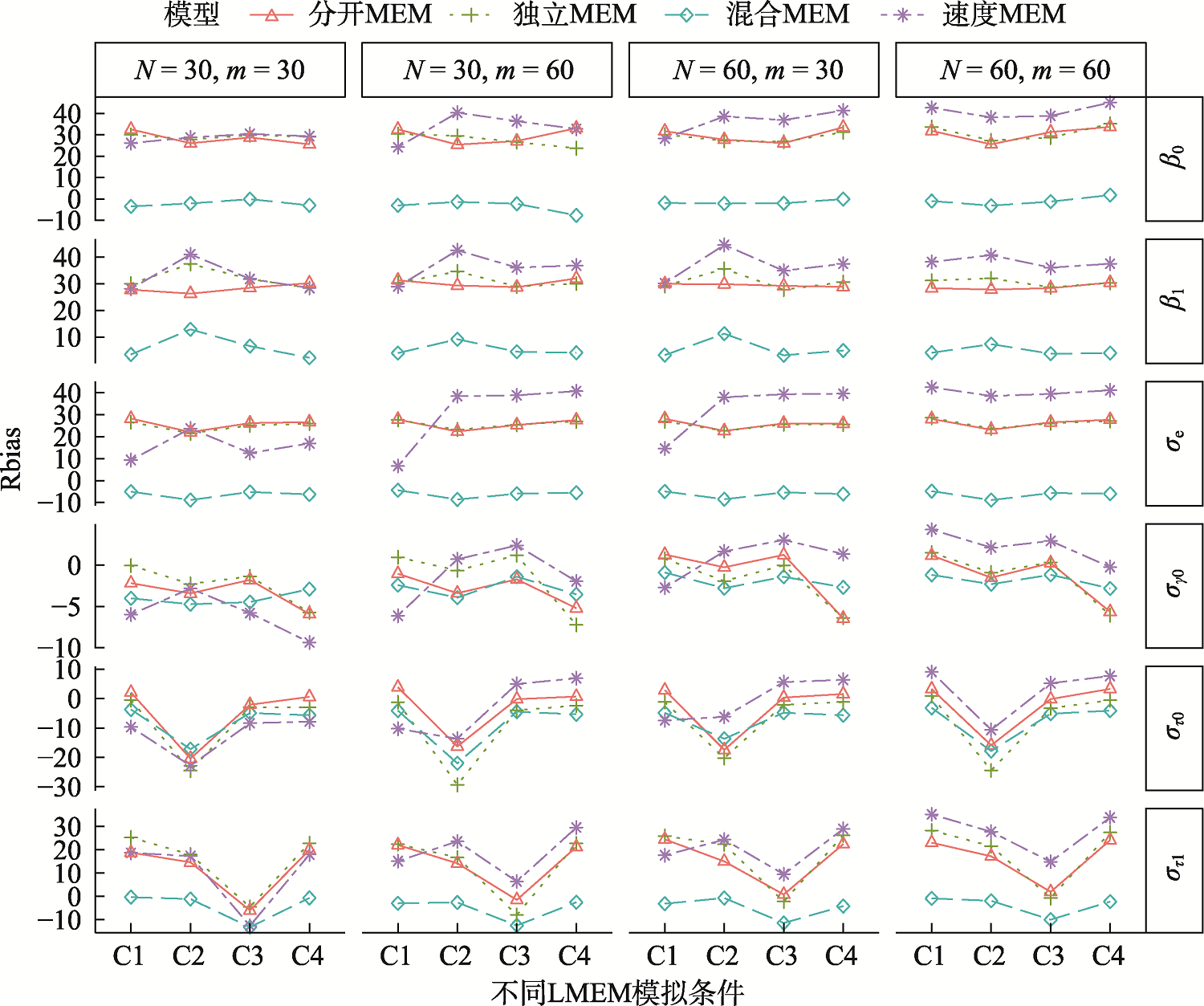
图1 不同模型的LMEM参数估计
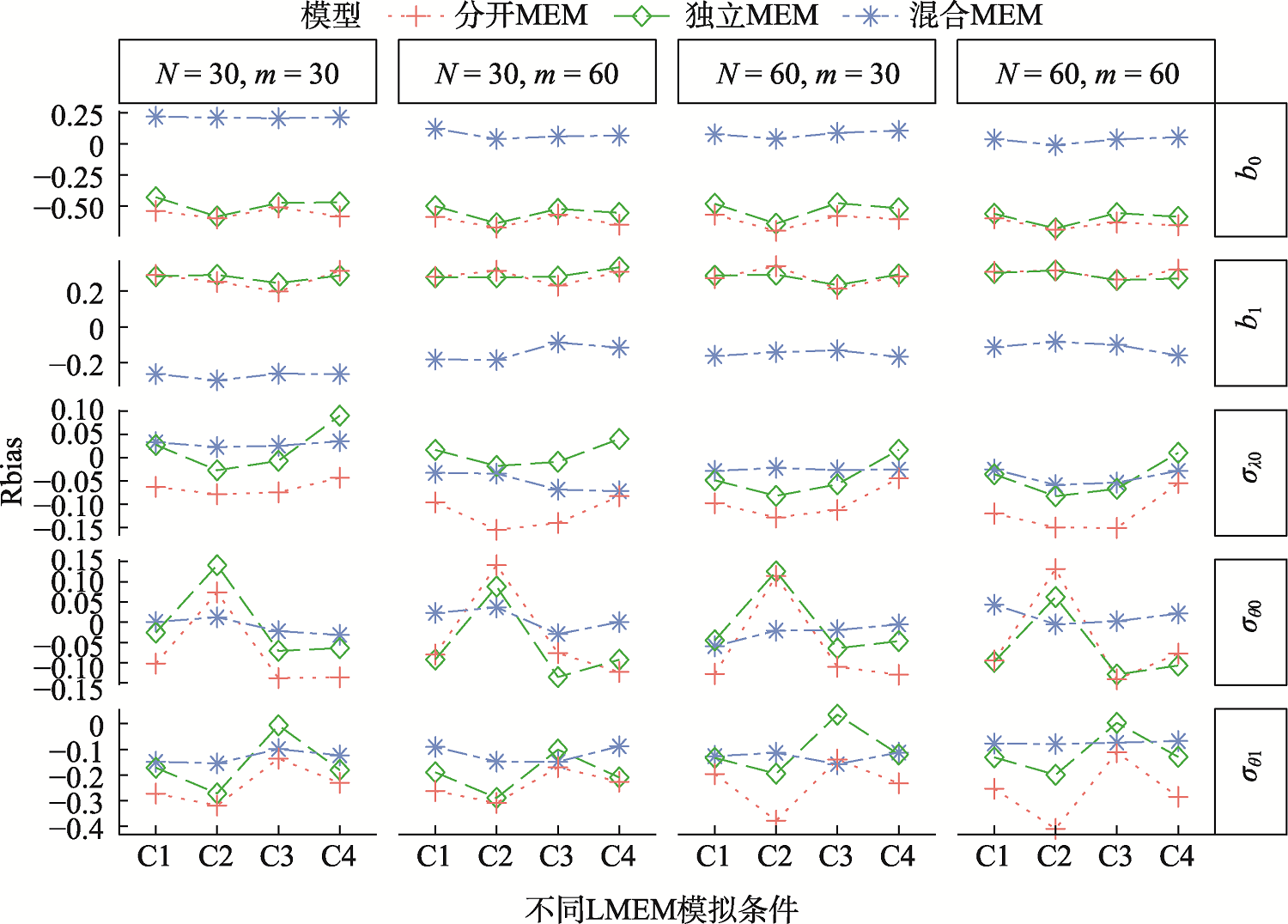
图2 不同模型GLMEM的参数估计
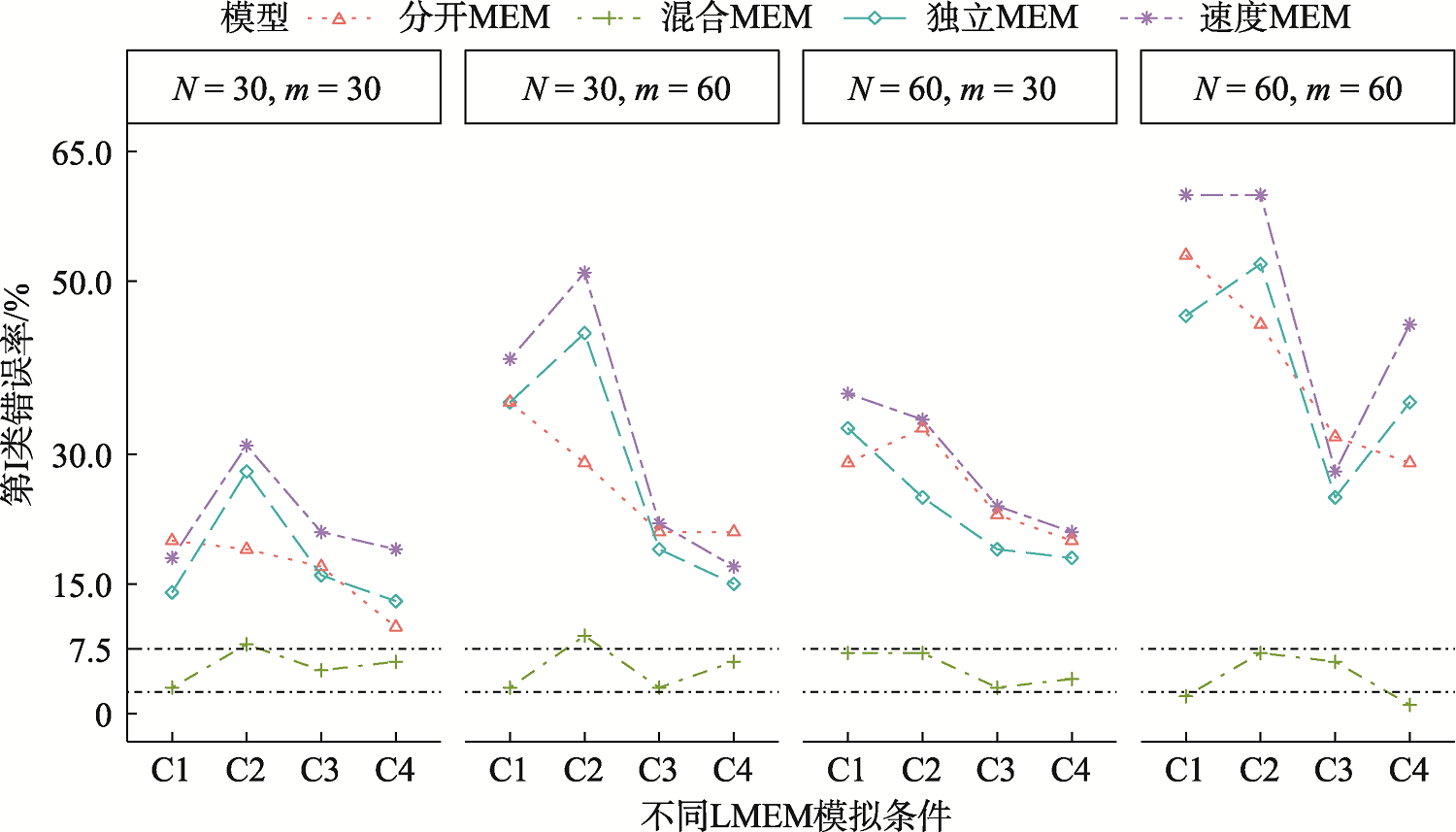
图3 不同模型的第I类错误率
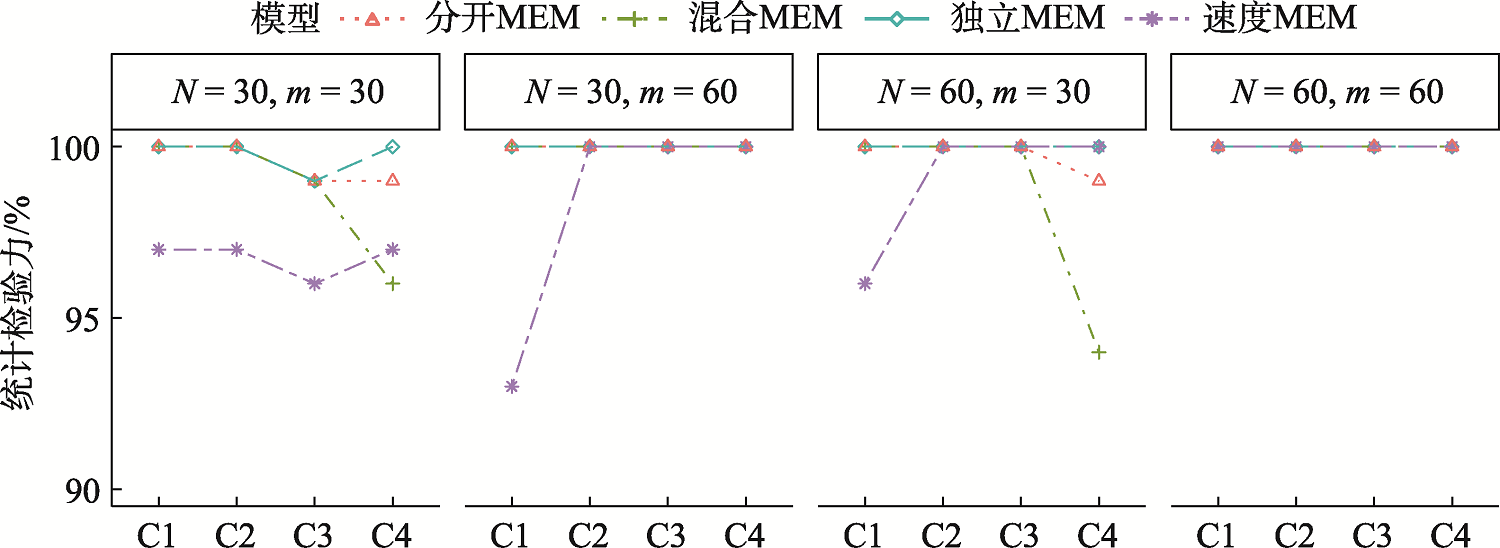
图4 不同模型的统计检验力
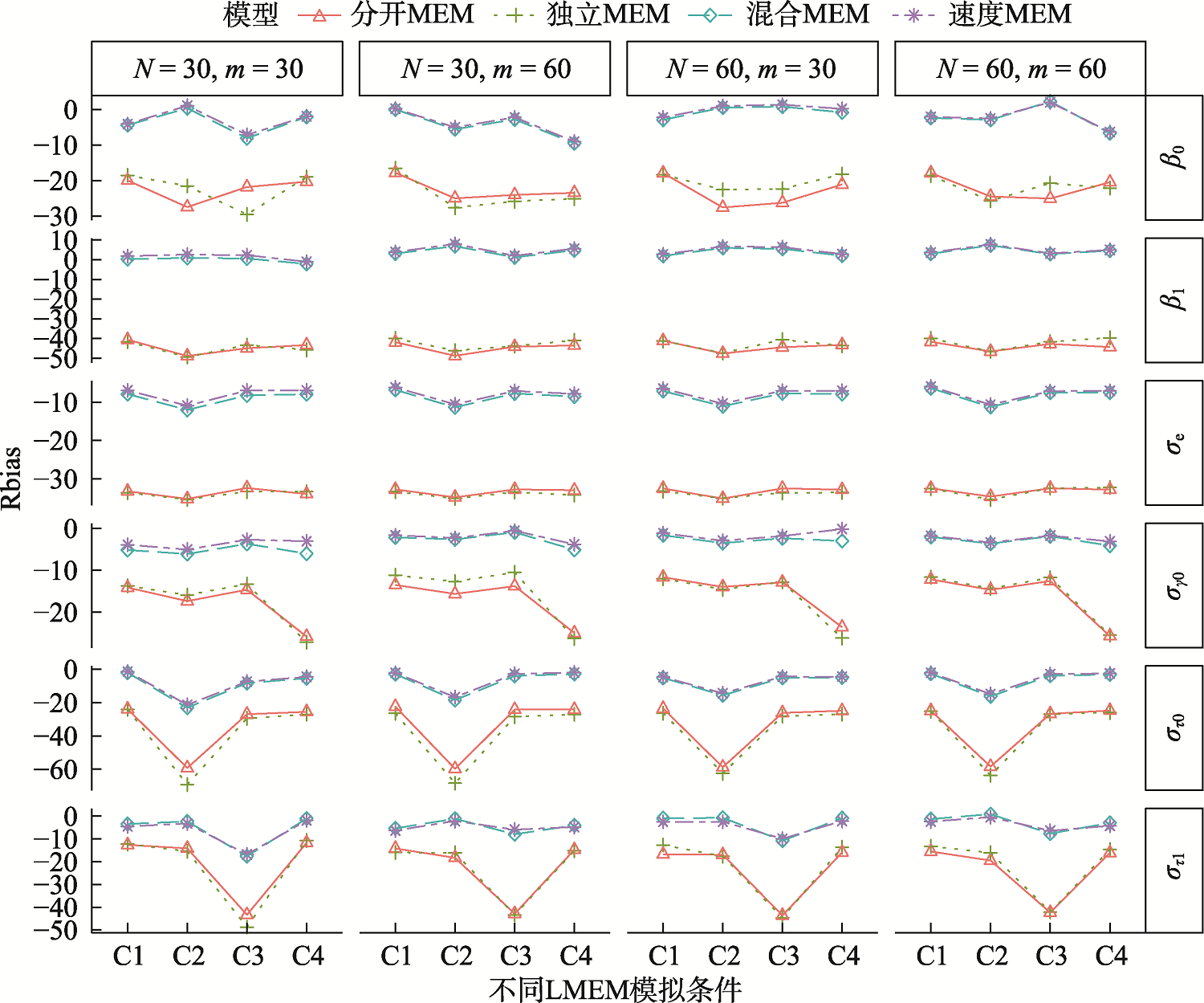
图5 不同模型的LMEM参数估计

图6 不同模型的第I类错误率
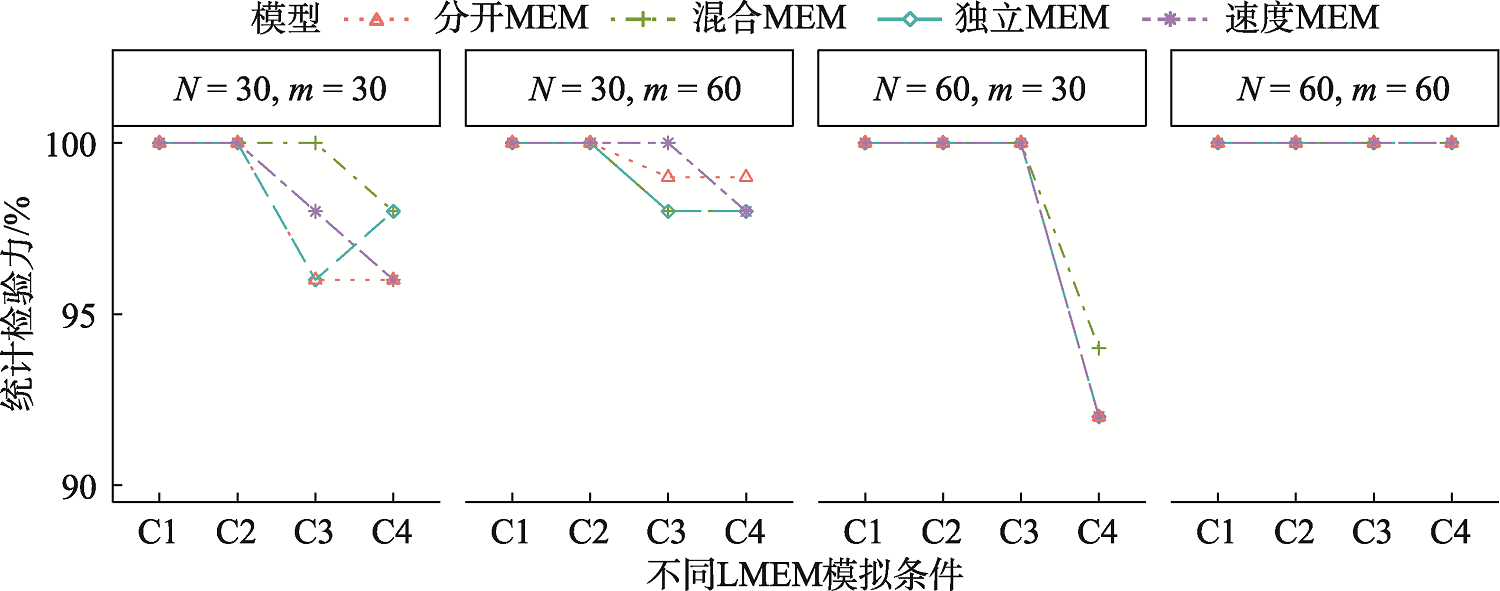
图7 不同模型的统计检验力
| 模块 | 试次 | 作用 | 按d键 | 按k键 | 刺激材料 |
|---|---|---|---|---|---|
| 1 | 12 | 练习 | 褒义词 | 贬义词 | 褒义词:机灵、奖赏、顺心 贬义词:昏庸、祸乱、软弱 |
| 2 | 12 | 练习 | 彩色 | 非彩色 | 彩色:正方形红色块、正方形黄色块 非彩色:正方形黑色块、正方形灰色块 |
| 3 | 12 | 练习 | 褒义词+彩色 | 贬义词+非彩色 | 褒义词+彩色:红色或黄色+机灵、奖赏、顺心 贬义词+非彩色:黑色或灰色+昏庸、祸乱、软弱 |
| 4 | 36 | 测试 | 褒义词+彩色 | 贬义词+非彩色 | 褒义词+彩色:红色或黄色+爱心、宝贵、博学、幸运、坚强、大度、出色、淳厚、慈祥、漂亮、健康、和谐、生机、和平、温和、朴素、优雅、老练(18个) 贬义词+非彩色:黑色或灰色+ 阴谋、灾祸、非法、邪恶、哀伤、外遇、屈从、懒散、惨败、可恨、草率、谗言、歹毒、丑陋、吹嘘、粗鲁、呆板、倒霉(18个) |
| 5 | 12 | 练习 | 非彩色 | 彩色 | 彩色:正方形红色块、正方形黄色块 非彩色:正方形黑色块、正方形灰色块 |
| 6 | 12 | 练习 | 褒义词+非彩色 | 贬义词+彩色 | 褒义词+非彩色:黑色或灰色+机灵、奖赏、顺心 贬义词+彩色:红色或黄色+昏庸、祸乱、软弱 |
| 7 | 36 | 测试 | 褒义词+非彩色 | 贬义词+彩色 | 褒义词+非彩色:黑色或灰色+爱心、宝贵、博学、幸运、坚强、大度、出色、淳厚、慈祥、漂亮、健康、和谐、生机、和平、温和、朴素、优雅、老练(18个) 贬义词+彩色:红色或黄色+阴谋、灾祸、非法、邪恶、哀伤、外遇、屈从、懒散、惨败、可恨、草率、谗言、歹毒、丑陋、吹嘘、粗鲁、呆板、倒霉(18个) |
| 模块 | 试次 | 作用 | 按d键 | 按k键 | 刺激材料 |
|---|---|---|---|---|---|
| 1 | 12 | 练习 | 褒义词 | 贬义词 | 褒义词:机灵、奖赏、顺心 贬义词:昏庸、祸乱、软弱 |
| 2 | 12 | 练习 | 彩色 | 非彩色 | 彩色:正方形红色块、正方形黄色块 非彩色:正方形黑色块、正方形灰色块 |
| 3 | 12 | 练习 | 褒义词+彩色 | 贬义词+非彩色 | 褒义词+彩色:红色或黄色+机灵、奖赏、顺心 贬义词+非彩色:黑色或灰色+昏庸、祸乱、软弱 |
| 4 | 36 | 测试 | 褒义词+彩色 | 贬义词+非彩色 | 褒义词+彩色:红色或黄色+爱心、宝贵、博学、幸运、坚强、大度、出色、淳厚、慈祥、漂亮、健康、和谐、生机、和平、温和、朴素、优雅、老练(18个) 贬义词+非彩色:黑色或灰色+ 阴谋、灾祸、非法、邪恶、哀伤、外遇、屈从、懒散、惨败、可恨、草率、谗言、歹毒、丑陋、吹嘘、粗鲁、呆板、倒霉(18个) |
| 5 | 12 | 练习 | 非彩色 | 彩色 | 彩色:正方形红色块、正方形黄色块 非彩色:正方形黑色块、正方形灰色块 |
| 6 | 12 | 练习 | 褒义词+非彩色 | 贬义词+彩色 | 褒义词+非彩色:黑色或灰色+机灵、奖赏、顺心 贬义词+彩色:红色或黄色+昏庸、祸乱、软弱 |
| 7 | 36 | 测试 | 褒义词+非彩色 | 贬义词+彩色 | 褒义词+非彩色:黑色或灰色+爱心、宝贵、博学、幸运、坚强、大度、出色、淳厚、慈祥、漂亮、健康、和谐、生机、和平、温和、朴素、优雅、老练(18个) 贬义词+彩色:红色或黄色+阴谋、灾祸、非法、邪恶、哀伤、外遇、屈从、懒散、惨败、可恨、草率、谗言、歹毒、丑陋、吹嘘、粗鲁、呆板、倒霉(18个) |
| [1] | Ames, A. J., & Au, C. H. (2018). Using stan for item response theory models. Measurement: Interdisciplinary Research and Perspectives, 16(2), 129-134. |
| [2] | Baayen, R. H., Davidson, D. J., & Bates, D. M. (2008). Mixed-effects modeling with crossed random effects for subjects and items. Journal of Memory and Language, 59(4), 390-412. |
| [3] | Barr, D. J., Levy, R., Scheepers, C., & Tily, H. J. (2013). Random effects structure for confirmatory hypothesis testing: Keep it maximal. Journal of Memory and Language, 68(3), 255-278. |
| [4] | Bolsinova, M., & Tijmstra, J. (2018). Improving precision of ability estimation: Getting more from response times. British Journal of Mathematical and Statistical Psychology, 71(1), 13-38. |
| [5] | Brooks, S. P., & Gelman, A. (1998). General methods for monitoring convergence of iterative simulations. Journal of Computational and Graphical Statistics, 7(4), 434-455. |
| [6] |
Brown, S. D., & Heathcote, A. (2008). The simplest complete model of choice response time: Linear ballistic accumulation. Cognitive Psychology, 57(3), 153-178.
doi: 10.1016/j.cogpsych.2007.12.002 pmid: 18243170 |
| [7] | Brown, V. A. (2021). An introduction to linear mixed-effects modeling in R. Advances in Methods and Practices in Psychological Science, 4(1), 1-19. |
| [8] | Brysbaert, M., & Stevens, M. (2018). Power analysis and effect size in mixed effects models: A tutorial. Journal of Cognition, 1(1), 1-20. |
| [9] | Bunji, K., & Okada, K. (2020). Joint modeling of the two-alternative multidimensional forced-choice personality measurement and its response time by a thurstonian D- diffusion item response model. Behavior Research Methods, 52(3), 1091-1107. |
| [10] | DeBruine, L. M., & Barr, D. J. (2021). Understanding mixed- effects models through data simulation. Advances in Methods and Practices in Psychological Science, 4(1), 1-15. |
| [11] | Dixon, P. (2008). Models of accuracy in repeated-measures designs. Journal of Memory and Language, 59(4), 447-456. |
| [12] | Gelman, A., Lee, D., & Guo, J. (2015). Stan: A probabilistic programming language for bayesian inference and optimization. Journal of Educational and Behavioral Statistics, 40(5), 530-543. |
| [13] |
Guo, X., Bai, X., & Luo, Z. (2024). Modeling the dependence between response and response time: A bifactor model approach. Acta Psychologica Sinica, 56(3), 352-364.
doi: 10.3724/SP.J.1041.2024.00352 |
|
[郭小军, 柏小云, 罗照盛. (2024). 作答时间与反应依赖关系建模:基于双因子模型视角. 心理学报, 56(3), 352-362.]
doi: 10.3724/SP.J.1041.2024.00352 |
|
| [14] | Guo, X., Jiao, Y., Huang, Z., & Liu, T. (2022). Joint modeling of response accuracy and time in between-item multidimensional tests based on bi-factor model. Frontiers in Psychology, 13, 763959. |
| [15] | Hoffman, M. D., & Gelman, A. (2014). The no-U-turn sampler: Adaptively setting path lengths in hamiltonian monte carlo. Journal of Machine Learning Research, 15(1), 1593-1623. |
| [16] |
Hoijtink, H., Mulder, J., van Lissa, C., & Gu, X. (2019). A tutorial on testing hypotheses using the bayes factor. Psychological Methods, 24(5), 539-556.
doi: 10.1037/met0000201 pmid: 30742472 |
| [17] | Hu, C. -P., Kong, X. -Z., Wagenmakers, E. -J., Ly, A., & Peng, K. (2018). The bayes factor and its implementation in JASP: A practical primer. Advances in Psychological Science, 26(6), 951-965. |
|
[胡传鹏, 孔祥祯, Eric-Jan, Wagenmakers, Alexander, Ly, 彭凯平. (2018). 贝叶斯因子及其在JASP中的实现. 心理科学进展, 26(6), 951-965.]
doi: 10.3724/SP.J.1042.2018.00951 |
|
| [18] |
Jaeger, T. F. (2008). Categorical data analysis: Away from ANOVAs (transformation or not) and towards logit mixed models. Journal of Memory and Language, 59(4), 434-446.
doi: 10.1016/j.jml.2007.11.007 pmid: 19884961 |
| [19] |
Judd, C. M., Westfall, J., & Kenny, D. A. (2012). Treating stimuli as a random factor in social psychology: A new and comprehensive solution to a pervasive but largely ignored problem. Journal of Personality and Social Psychology, 103(1), 54-69.
doi: 10.1037/a0028347 pmid: 22612667 |
| [20] | Judd, C. M., Westfall, J., & Kenny, D. A. (2017). Experiments with more than one random factor: Designs, analytic models, and statistical power. Annual Review of Psychology, 68(1), 601-625. |
| [21] | Klein Entink, R. H., van der Linden, W. J., & Fox, J. -P. (2009). A box-cox normal model for response times. British Journal of Mathematical and Statistical Psychology, 62(3), 621-640. |
| [22] |
Kumle, L., Võ, M. L., & Draschkow, D. (2021). Estimating power in (generalized) linear mixed models: An open introduction and tutorial in R. Behavior Research Methods, 53(6), 2528-2543.
doi: 10.3758/s13428-021-01546-0 pmid: 33954914 |
| [23] | Kuznetsova, A., Brockhoff, P. B., & Christensen, R. H. B. (2017). lmerTest package: Tests in linear mixed effects models. Journal of Statistical Software, 82(13), 1-26. |
| [24] | Lee, W. Y. (2018). Generalized linear mixed effect models with crossed random effects for experimental designs having non-repeated items: Model specification and selection. Vanderbilt University, Nashville. |
| [25] |
Lee, Y. H., & Ying, Z. (2015). A mixture cure-rate model for responses and response times in time-limit tests. Psychometrika, 80(3), 748-775.
doi: 10.1007/s11336-014-9419-8 pmid: 25280442 |
| [26] | Liang, K., Tu, D., & Cai, Y. (2023). Using process data to improve classification accuracy of cognitive diagnosis model. Multivariate Behavioral Research, 58(5), 969-987. |
| [27] |
Liu, Y., Xu, L., Liu, H., Han, Y., You, X., & Wan, Z. (2024). Confidence interval width contours: Sample size planning for linear mixed-effects models. Acta Psychologica Sinica, 56(1), 124-138.
doi: 10.3724/SP.J.1041.2024.00124 |
|
[刘玥, 徐雷, 刘红云, 韩雨婷, 游晓锋, 万志林. (2024). 置信区间宽度等高线图在线性混合效应模型样本量规划中的应用. 心理学报, 56(1), 124-138.]
doi: 10.3724/SP.J.1041.2024.00124 |
|
| [28] | Loeys, T., Rosseel, Y., & Baten, K. (2011). A joint modeling approach for reaction time and accuracy in psycholinguistic experiments. Psychometrika, 76(3), 487-503. |
| [29] | Luo, Y., & Al-Harbi, K. (2017). Performances of LOO and WAIC as IRT model selection methods. Psychological Test and Assessment Modeling, 59(2), 183-205. |
| [30] | Ma, Z., Jia, J., & Wu, S. (2022). On the analysis of reaction time data through the use of mixed-effects models: Principles and practices. Foreign Language Learning Theory and Practice, 1, 35-46 |
| [马拯, 贾锦萱, 吴诗玉. (2022). 混合效应模型框架下反应时数据的分析: 原理和实践. 外语教学理论与实践, 1, 35-46.] | |
| [31] |
Man, K., Harring, J. R., Jiao, H., & Zhan, P. (2019). Joint modeling of compensatory multidimensional item responses and response times. Applied Psychological Measurement, 43(8), 639-654.
doi: 10.1177/0146621618824853 pmid: 31551641 |
| [32] | Martínez-Huertas, J. Á., Olmos, R., & Ferrer, E. (2022). Model selection and model averaging for mixed-effects models with crossed random effects for subjects and items. Multivariate Behavioral Research, 57(4), 603-619. |
| [33] | Matuschek, H., Kliegl, R., Vasishth, S., Baayen, H., & Bates, D. (2017). Balancing type I error and power in linear mixed models. Journal of Memory and Language, 94, 305-315. |
| [34] | Meteyard, L., & Davies, R. A. I. (2020). Best practice guidance for linear mixed-effects models in psychological science. Journal of Memory and Language, 112, 1-22. |
| [35] |
Miller, R., Scherbaum, S., Heck, D. W., Goschke, T., & Enge, S. (2018). On the relation between the (censored) shifted wald and the wiener distribution as measurement models for choice response times. Applied Psychological Measurement, 42(2), 116-135.
doi: 10.1177/0146621617710465 pmid: 29881116 |
| [36] | Park, J., Cardwell, R. L., & Yu, H. (2020). Specifying the random effect structure in linear mixed effect models for analyzing psycholinguistic data. Methodology, 16(2), 92-111. |
| [37] | Ranger, J. (2013). Modeling responses and response times in personality tests with rating scales. Psychological Test and Assessment Modeling, 55(4), 361-382. |
| [38] | Ranger, J., & Kuhn, J. -T. (2012). A flexible latent trait model for response times in tests. Psychometrika, 77(1), 31-47. |
| [39] | Ranger, J., Kuhn, J., & Gaviria, J. L. (2015). A race model for responses and response times in tests. Psychometrika, 80(2), 791-810. |
| [40] |
Rietveld, T., & Van Hout, R. (2007). Analysis of variance for repeated measures designs with word materials as a nested random or fixed factor. Behavior Research Methods, 39(4), 735-747.
pmid: 18183886 |
| [41] | Rouder, J. N., Province, J. M., Morey, R. D., Gomez, P., & Heathcote, A. (2015). The lognormal race: A cognitive- process model of choice and latency with desirable psychometric properties. Psychometrika, 80(2), 491-513. |
| [42] | Sorensen, T., Hohenstein, S., & Vasishth, S. (2016). Bayesian linear mixed models using Stan: A tutorial for psychologists, linguists, and cognitive scientists. The Quantitative Methods for Psychology, 12(3), 175-200. |
| [43] | Suh, H. (2010). A study of bayesian estimation and comparison of response time models in item response theory. Unpublished doctoral dissertation. University of Kansas, Lawrence, KS. |
| [44] | van der Linden, W. J. (2007). A hierarchical framework for modeling speed and accuracy on test items. Psychometrika, 72(3), 287-308. |
| [45] |
van der Maas, H. L. J., Molenaar, D., Maris, G., Kievit, R. A., & Borsboom, D. (2011). Cognitive psychology meets psychometric theory: On the relation between process models for decision making and latent variable models for individual differences. Psychological Review, 118(2), 339-356.
doi: 10.1037/a0022749 pmid: 21401290 |
| [46] | Vehtari, A., Gelman, A., & Gabry, J. (2017). Practical bayesian model evaluation using leave-one-out cross-validation and WAIC. Statistics and Computing, 27, 1413-1432. |
| [47] | Visalli, A., Montefinese, M., Viviani, G., Finos, L., Vallesi, A., & Ambrosini, E. (2024). lmeEEG: Mass linear mixed- effects modeling of EEG data with crossed random effects. Journal of Neuroscience Methods, 401, 109991. |
| [48] |
Wen, Z., Tang, D., & Gu, H. . (2019). A general simulation comparison of the predictive validity between bifactor and high-order factor models. Acta Psychologica Sinica, 51(3), 383-391.
doi: 10.3724/SP.J.1041.2019.00383 |
|
[温忠麟, 汤丹丹, 顾红磊. (2019). 预测视角下双因子模型与高阶因子模型的一般性模拟比较. 心理学报, 51(3), 383-391.]
doi: 10.3724/SP.J.1041.2019.00383 |
|
| [49] |
Zhan, P. (2022). Joint-cross-loading multimodal cognitive diagnostic modeling incorporating visual fixation counts. Acta Psychologica Sinica, 54(11), 1416-1423.
doi: 10.3724/SP.J.1041.2022.01416 |
|
[詹沛达. (2022). 引入眼动注视点的联合-交叉负载多模态认知诊断建模. 心理学报, 54(11), 1416-1423.]
doi: 10.3724/SP.J.1041.2022.01416 |
| [1] | 杨子健, 赵小淋, 郭凯格, 罗家豪, 杜腾飞, 张雅洁, 胡月琴, 杨娟. 睡眠效率相关的皮质醇觉醒反应的变异性及其与特质焦虑和心理弹性的关系[J]. 心理学报, 2025, 57(1): 84-99. |
| [2] | 叶巍岭, 徐苏, 周欣悦. 不同道德情境下叠音品牌名称对消费者道德反应的影响——心智知觉理论的视角[J]. 心理学报, 2024, 56(5): 650-669. |
| [3] | 郭小军, 柏小云, 罗照盛. 作答时间与反应依赖关系建模:基于双因子模型视角[J]. 心理学报, 2024, 56(3): 352-362. |
| [4] | 赵文博, 曹宇琪, 徐木子, 杨春亮, 罗良. 学习判断对虚假记忆的反应性效应[J]. 心理学报, 2024, 56(12): 1691-1705. |
| [5] | 王铖铖, 赵宇飞, 盛缨莹, 赵庆柏, 肖梦施, 韩磊. 数字SNARC效应的发生阶段[J]. 心理学报, 2024, 56(12): 1706-1717. |
| [6] | 刘玥, 徐雷, 刘红云, 韩雨婷, 游晓锋, 万志林. 置信区间宽度等高线图在线性混合效应模型样本量规划中的应用[J]. 心理学报, 2024, 56(1): 124-138. |
| [7] | 田亚淑, 詹沛达, 王立君. 联合作答精度和作答时间的概率态认知诊断模型[J]. 心理学报, 2023, 55(9): 1573-1586. |
| [8] | 付颜斌, 陈琦鹏, 詹沛达. 问题解决任务中行动序列的二分类建模:单/两参数行动序列模型[J]. 心理学报, 2023, 55(8): 1383-1396. |
| [9] | 黄馨茹, 李健, 倪荫梅. 行为可见增加利他偏好及其社会规范机制[J]. 心理学报, 2023, 55(3): 481-495. |
| [10] | 童昊, 喻晓锋, 秦春影, 彭亚风, 钟小缘. 多级计分测验中基于残差统计量的被试拟合研究[J]. 心理学报, 2022, 54(9): 1122-1136. |
| [11] | 陈莉, 石晓柯, 李维娜, 胡妍. 基于不同冲突水平的认知控制对性别刻板印象表达的影响[J]. 心理学报, 2022, 54(6): 628-645. |
| [12] | 刘玥, 刘红云, 游晓锋, 杨建芹. 用于处理不努力作答的标准化残差系列方法和混合多层模型法的比较[J]. 心理学报, 2022, 54(4): 411-425. |
| [13] | 曾红, 郑志灵, 罗晓红, 王鹏飞, 王孟成, 苏得权, 杨文登, 黄海娇, 彭淑娜. 药物成瘾者相关线索反应的自动化用药行为特征及其消退[J]. 心理学报, 2022, 54(10): 1193-1205. |
| [14] | 任赫, 陈平. 两种新的多维计算机化分类测验终止规则[J]. 心理学报, 2021, 53(9): 1044-1058. |
| [15] | 杨群, 张积家, 范丛慧. 维吾尔族与汉族的大学生在汉语歧义词消解中的语境促进效应及反应抑制效应[J]. 心理学报, 2021, 53(7): 746-757. |
| 阅读次数 | ||||||
|
全文 |
|
|||||
|
摘要 |
|
|||||
