

ISSN 0439-755X
CN 11-1911/B
主办:中国心理学会
中国科学院心理研究所
出版:科学出版社
CN 11-1911/B
主办:中国心理学会
中国科学院心理研究所
出版:科学出版社
心理学报 ›› 2026, Vol. 58 ›› Issue (7): 1428-1443.doi: 10.3724/SP.J.1041.2026.1428 cstr: 32110.14.2026.1428
刘永芳( ), 孙月, 练金晶
收稿日期:2025-03-02
发布日期:2026-05-15
出版日期:2026-07-25
通讯作者:
刘永芳, E-mail: yfliu@psy.ecnu.edu.cn基金资助:
LIU Yongfang(), SUN Yue, LIAN Jinjing
Received:2025-03-02
Online:2026-05-15
Published:2026-07-25
摘要:
针对互动对象决策时长对人际感知及社会困境中合作行为影响的争议, 通过剥离行为结果信息, 考察纯决策时长信号的作用机制:预实验确定快慢决策的适当时限; 实验1采用“直接感知+间接提示”范式操纵决策时长, 考察其是否及如何影响感知真诚; 实验2a采用相同范式操纵决策时长, 考察其是否通过感知真诚和合作预期影响社会困境中的合作行为, 实验2b和2c则分别仅采用“直接感知”或“间接提示”方式, 考察此两种弱化决策时长操纵条件下实验2a结果的稳健性, 并排除感知能力的替代解释; 实验3探讨个体的社会价值取向是否及如何调节决策时长效应。结果发现:快决策使人感知更真诚而不影响感知能力, 且通过感知真诚的独立中介及其与合作预期的链式中介双重路径诱发更多合作行为。该效应适用于亲社会个体, 而不适用于亲自我个体。这些结果不仅证实了互动对象决策时长的独立社会信号意义, 而且揭示了其对社会困境中合作行为的“双路径−两阶段”作用机制和边界条件, 为消解决策时长人际效应的理论争议提供了新证据, 也对现实社会困境中通过缩短响应时间传递真诚以优化合作策略具有实践启示意义。
中图分类号:
刘永芳, 孙月, 练金晶. (2026). 快速=真诚:社会困境中的互动对象决策时长效应. 心理学报, 58(7), 1428-1443.
LIU Yongfang, SUN Yue, LIAN Jinjing. (2026). Fast = Sincere: The effect of interactive partner decision time in social dilemmas. Acta Psychologica Sinica, 58(7), 1428-1443.
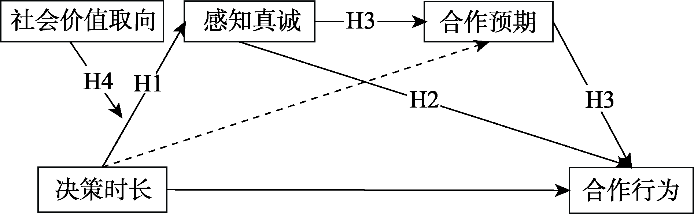
图1 理论模型
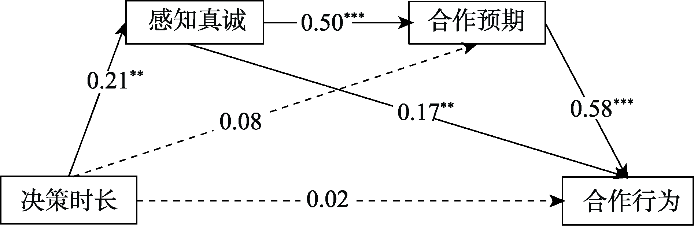
图2 决策时长影响公共物品博弈中合作行为的中介模型 注: 路径系数为标准化路径系数。虚线表示路径系数不显著。**p < 0.01, ***p < 0.001。
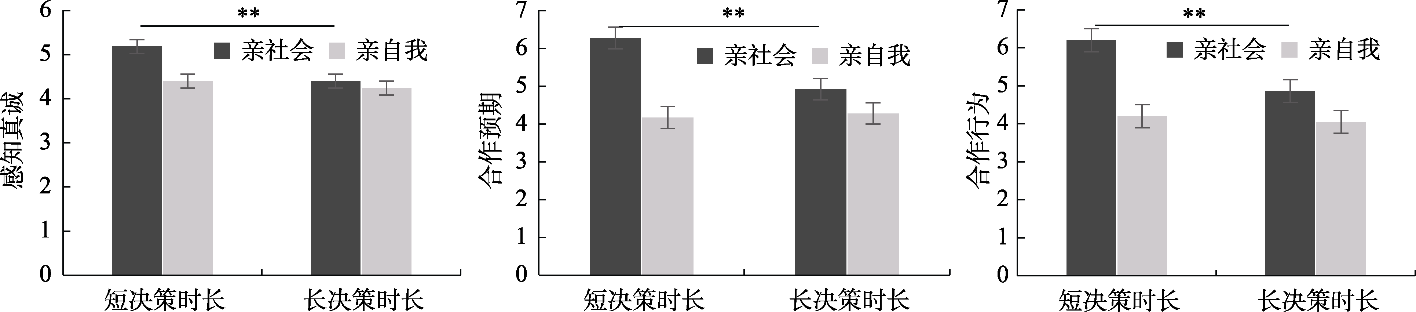
图3 决策时长与社会价值取向影响感知真诚、合作预期和合作行为的交互作用图 注: **p < 0.01。误差线表示标准误。
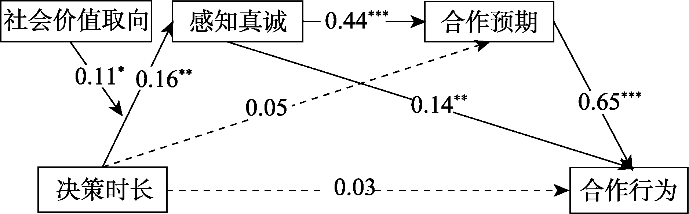
图4 有调节的中介模型 注: 路径系数为标准化路径系数。虚线表示路径系数不显著。*p < 0.05, **p < 0.01, ***p < 0.001
| 变量 | 感知真诚 | 合作预期 | 合作行为 | |||||||||
|---|---|---|---|---|---|---|---|---|---|---|---|---|
| β | t | LLCI | ULCI | β | t | LLCI | ULCI | β | t | LLCI | ULCI | |
| 实验1 | ||||||||||||
| 性别 | 0.12 | 1.53 | −0.09 | 0.73 | ---- | ---- | ---- | ---- | ---- | ---- | ---- | ---- |
| 年龄 | −0.07 | −0.84 | −0.04 | 0.02 | ---- | ---- | ---- | ---- | ---- | ---- | ---- | ---- |
| 教育程度 | 0.09 | 1.19 | −0.16 | 0.64 | ---- | ---- | ---- | ---- | ---- | ---- | ---- | ---- |
| 实验2a | ||||||||||||
| 性别 | 0.09 | 1.15 | −0.18 | 0.69 | −0.05 | −0.66 | −0.95 | 0.47 | −0.04 | −0.46 | −0.99 | 0.62 |
| 年龄 | 0.14 | 1.83 | −0.002 | 0.05 | −0.03 | −0.41 | −0.05 | 0.03 | 0.04 | 0.53 | −0.04 | 0.06 |
| 教育程度 | −0.003 | −0.03 | −0.35 | 0.34 | −0.04 | −0.56 | −0.72 | 0.40 | −0.005 | −0.07 | −0.65 | 0.61 |
| 实验2b | ||||||||||||
| 性别 | −0.04 | −0.61 | −0.44 | 0.23 | −0.08 | −1.13 | −0.94 | 0.25 | −0.08 | −1.13 | −1.18 | 0.32 |
| 年龄 | −0.001 | −0.02 | −0.02 | 0.02 | −0.01 | −0.11 | −0.04 | 0.04 | 0.02 | 0.23 | −0.04 | 0.05 |
| 教育程度 | 0.07 | 0.93 | −0.19 | 0.54 | 0.11 | 1.49 | −0.16 | 1.13 | 0.02 | 0.29 | −0.69 | 0.93 |
| 实验2c | ||||||||||||
| 性别 | 0.08 | 1.03 | −0.20 | 0.63 | −0.003 | −0.05 | −0.76 | 0.73 | −0.06 | −0.73 | −1.02 | 0.47 |
| 年龄 | 0.05 | 0.64 | −0.02 | 0.04 | 0.04 | 0.52 | −0.04 | 0.07 | 0.09 | 1.25 | −0.02 | 0.08 |
| 教育程度 | 0.05 | 0.64 | −0.26 | 0.50 | 0.04 | 0.57 | −0.49 | 0.88 | 0.002 | 0.02 | −0.68 | 0.70 |
| 实验3 | ||||||||||||
| 性别 | 0.02 | 0.27 | −0.28 | 0.37 | −0.04 | −0.70 | −0.82 | 0.39 | −0.05 | −0.98 | −0.96 | 0.32 |
| 年龄 | −0.07 | −1.28 | −0.04 | 0.01 | 0.02 | 0.40 | −0.03 | 0.05 | −0.05 | −0.93 | −0.06 | 0.02 |
| 教育程度 | −0.04 | −0.70 | −0.40 | 0.19 | −0.02 | −0.41 | −0.67 | 0.43 | −0.05 | −0.97 | −0.86 | 0.29 |
附录1 人口统计学变量对主要因变量的回归分析结果
| 变量 | 感知真诚 | 合作预期 | 合作行为 | |||||||||
|---|---|---|---|---|---|---|---|---|---|---|---|---|
| β | t | LLCI | ULCI | β | t | LLCI | ULCI | β | t | LLCI | ULCI | |
| 实验1 | ||||||||||||
| 性别 | 0.12 | 1.53 | −0.09 | 0.73 | ---- | ---- | ---- | ---- | ---- | ---- | ---- | ---- |
| 年龄 | −0.07 | −0.84 | −0.04 | 0.02 | ---- | ---- | ---- | ---- | ---- | ---- | ---- | ---- |
| 教育程度 | 0.09 | 1.19 | −0.16 | 0.64 | ---- | ---- | ---- | ---- | ---- | ---- | ---- | ---- |
| 实验2a | ||||||||||||
| 性别 | 0.09 | 1.15 | −0.18 | 0.69 | −0.05 | −0.66 | −0.95 | 0.47 | −0.04 | −0.46 | −0.99 | 0.62 |
| 年龄 | 0.14 | 1.83 | −0.002 | 0.05 | −0.03 | −0.41 | −0.05 | 0.03 | 0.04 | 0.53 | −0.04 | 0.06 |
| 教育程度 | −0.003 | −0.03 | −0.35 | 0.34 | −0.04 | −0.56 | −0.72 | 0.40 | −0.005 | −0.07 | −0.65 | 0.61 |
| 实验2b | ||||||||||||
| 性别 | −0.04 | −0.61 | −0.44 | 0.23 | −0.08 | −1.13 | −0.94 | 0.25 | −0.08 | −1.13 | −1.18 | 0.32 |
| 年龄 | −0.001 | −0.02 | −0.02 | 0.02 | −0.01 | −0.11 | −0.04 | 0.04 | 0.02 | 0.23 | −0.04 | 0.05 |
| 教育程度 | 0.07 | 0.93 | −0.19 | 0.54 | 0.11 | 1.49 | −0.16 | 1.13 | 0.02 | 0.29 | −0.69 | 0.93 |
| 实验2c | ||||||||||||
| 性别 | 0.08 | 1.03 | −0.20 | 0.63 | −0.003 | −0.05 | −0.76 | 0.73 | −0.06 | −0.73 | −1.02 | 0.47 |
| 年龄 | 0.05 | 0.64 | −0.02 | 0.04 | 0.04 | 0.52 | −0.04 | 0.07 | 0.09 | 1.25 | −0.02 | 0.08 |
| 教育程度 | 0.05 | 0.64 | −0.26 | 0.50 | 0.04 | 0.57 | −0.49 | 0.88 | 0.002 | 0.02 | −0.68 | 0.70 |
| 实验3 | ||||||||||||
| 性别 | 0.02 | 0.27 | −0.28 | 0.37 | −0.04 | −0.70 | −0.82 | 0.39 | −0.05 | −0.98 | −0.96 | 0.32 |
| 年龄 | −0.07 | −1.28 | −0.04 | 0.01 | 0.02 | 0.40 | −0.03 | 0.05 | −0.05 | −0.93 | −0.06 | 0.02 |
| 教育程度 | −0.04 | −0.70 | −0.40 | 0.19 | −0.02 | −0.41 | −0.67 | 0.43 | −0.05 | −0.97 | −0.86 | 0.29 |
| [1] | Baumard, N., Andre, J. B., & Sperber, D. (2013). A mutualistic approach to morality: The evolution of fairness by partner choice. Behavioral and Brain Sciences, 36(1), 59-78. https://doi.org/10.1017/S0140525X11002202 |
| [2] | Capraro, V. (2013). A model of human cooperation in social dilemmas. Plos One, 8(8), e72427. https://doi.org/10.1371/journal.pone.0072427 |
| [3] | Centorrino, S., Djemaï, E., Hopfensitz, A., Milinski, M., & Seabright, P. (2015). Honest signaling in trust interactions: Smiles rated as genuine induce trust and signal higher earning opportunities. Evolution and Human Behavior, 36(1), 8-16. https://doi.org/10.1016/j.evolhumbehav.2014.08.001 |
| [4] | Chen, F., & Krajbich, I. (2018). Biased sequential sampling underlies the effects of time pressure and delay in social decision making. Nature Communications, 9, 3557. https:// doi.org/10.1038/s41467-018-05994-9 |
| [5] | Christ, S. E., Van Essen, D. C., Watson, J. M., Brubaker, L. E., & McDermott, K. B. (2009). The contributions of prefrontal cortex and executive control to deception: Evidence from activation likelihood estimate meta-analyses. Cerebral Cortex, 19(7), 1557-1566. https://doi.org/10.1093/cercor/bhn189 |
| [6] | Critcher, C. R., Inbar, Y., & Pizarro, D. A. (2012). How quick decisions illuminate moral character. Social Psychological and Personality Science, 4(3), 308-315. https://doi.org/10.1177/1948550612457688 |
| [7] | Declerck, C. H., & Bogaert, S. (2008). Social value orientation: Related to empathy and the ability to read the mind in the eyes. The Journal of Social Psychology, 148(6), 711-726. https://doi.org/10.3200/SOCP.148.6.711-726 |
| [8] | De Freitas, J., & Hafri, A. (2024). Moral thin-slicing: Forming moral impressions from a brief glance. Journal of Experimental Social Psychology, 112, 104588. https:// doi.org/10.1016/j.jesp.2023.104588 |
| [9] | Demmers, J., Weihrauch, A. N., & Thompson, F. H. M. (2022). Your data are (not) my data: The role of social value orientation in sharing data about others. Journal of Consumer Psychology, 32(3), 500-508. https://doi.org/10.1002/jcpy.1255 |
| [10] | Dhaliwal, N. A., Martin, J. W., Barclay, P., & Young, L. L. (2022). Signaling benefits of partner choice decisions. Journal of Experimental Psychology: General, 151(6), 1446-1472. https://doi.org/10.1037/xge0001137 |
| [11] | Efendić, E., van de Calseyde, P. P. F. M., & Evans, A. M. 2020). Slow response times undermine trust in algorithmic (but not human) predictions. Organizational Behavior and Human Decision Processes, 157, 103-114. https://doi.org/10.1016/j.obhdp.2020.01.008 |
| [12] | Eisenbruch, A. B., & Krasnow, M. M. (2022). Why warmth matters more than competence: A new evolutionary approach. Perspectives on Psychological Science, 17(6), 1604-1623. https://doi.org/10.1177/17456916211071087 |
| [13] | Evans, A. M., Dillon, K. D., & Rand, D. G. (2015). Fast but not intuitive, slow but not reflective: Decision conflict drives reaction times in social dilemmas. Journal of Experimental Psychology: General, 144(5), 951-966. https://doi.org/10.1037/xge0000107 |
| [14] | Evans, A. M., & Rand, D. G. (2019). Cooperation and decision time. Current Opinion in Psychology, 26, 67-71. https://doi.org/10.1016/j.copsyc.2018.05.007 |
| [15] | Evans, A. M., & van de Calseyde, P. P. F. M. (2017). The effects of observed decision time on expectations of extremity and cooperation. Journal of Experimental Social Psychology, 68, 50-59. https://doi.org/10.1016/j.jesp.2016.05.009 |
| [16] | Faul, F., Erdfelder, E., Lang, A. G., & Buchner, A. (2007). G*power 3: A flexible statistical power analysis program for the social, behavioral, and biomedical sciences. Behavior Research Methods, 39(2), 175-191. https://doi.org/10.3758/BF03193146 |
| [17] | Fiske, S. T., Cuddy, A. J., & Glick, P. (2007). Universal dimensions of social cognition: Warmth and competence. Trends in Cognitive Sciences, 11(2), 77-83. https://doi.org/10.1016/j.tics.2006.11.005 |
| [18] | Fiske, S. T., Cuddy, A. J., Glick, P., & Xu, J. (2002). A model of (often mixed) stereotype content: Competence and warmth respectively follow from perceived status and competition. Journal of Personality and Social Psychology, 82(6), 878-902. https://doi.org/10.1037/0022-3514.82.6.878 |
| [19] | Goodwin, G. P., Piazza, J., & Rozin, P. (2014). Moral character predominates in person perception and evaluation. Journal of Personality and Social Psychology, 106(1), 148-168. https://doi.org/10.1037/A0034726 |
| [20] | Hackel, L. M., & Zaki, J. (2018). Propagation of economic inequality through reciprocity and reputation. Psychological Science, 29(4), 604-613. https://doi.org/10.1177/0956797617741720 |
| [21] | Hayes, A. F. (2018). Introduction to mediation, moderation, and conditional process analysis: A regression-based approach (2nd ed.). New York: Guilford Press. |
| [22] | Hu, X., Xu, Z., & Mai, X. (2017). Social value orientation modulates the processing of outcome evaluation involving others. Social Cognitive and Affective Neuroscience, 12(11), 1730-1739. https://doi.org/10.1093/scan/nsx102 |
| [23] | Iwai, T., & Tavares, G. M. (2024). When prosocial motives matter most: The interactive effects of social value orientation, message framing, and helping costs on helping behavior. Journal of Behavioral Decision Making, 37(2), e2384. https://doi.org/10.1002/bdm.2384 |
| [24] | Johnson, H. H., Bluhm, D., Hannah, S., Avolio, B., & Lester, P. (2023). Authentic leadership’s impact on follower psychological capital and performance through organizational identification and role clarity. Human Performance, 36(5), 219-248. https://doi.org/10.1080/08959285.2023.2261002 |
| [25] | Jordan, J. J., Hoffman, M., Nowak, M. A., & Rand, D. G. (2016). Uncalculating cooperation is used to signal trustworthiness. Proceedings of the National Academy of Sciences of the United States of America, 113(31), 8658-8663. https://doi.org/10.1073/pnas.1601280113 |
| [26] | Kahneman, D. (2011). Thinking, fast and slow. New York: Farrar, Straus and Giroux. |
| [27] | Kang, P., Anand, K., Feldman, P., & Schweitzer, M. E. (2020). Insincere negotiation: Using the negotiation process to pursue non-agreement motives. Journal of Experimental Social Psychology, 89, 103981. https://doi.org/10.1016/j.jesp.2020.103981 |
| [28] | Kernis, M. H., & Goldman, B. M. (2006). A multicomponent conceptualization of authenticity: Theory and research. Advances in Experimental Social Psychology, 38, 283-357. https://doi.org/10.1016/S0065-2601(06)38006-9 |
| [29] | Krajbich, I., Bartling, B., Hare, T., & Fehr, E. (2015). Rethinking fast and slow based on a critique of reaction- time reverse inference. Nature Communications, 6, 7455. https://doi.org/10.1038/ncomms8455 |
| [30] | Krueger, J. I. (2013). Social projection as a source of cooperation. Current Directions in Psychological Science, 22(4), 289-294. https://doi.org/10.1177/0963721413481352 |
| [31] | Kupor, D. M., Tormala, Z. L., Norton, M. I., & Rucker, D. D. (2014). Thought calibration: How thinking just the right amount increases one’s influence and appeal. Social Psychological and Personality Science, 5(3), 263-270. https://doi.org/10.1177/1948550613499940 |
| [32] | Li, J., Sun, Y., Yang, Z. L., & Zhong, Y. P. (2020). Social value orientation modulates the processing of social rewards for self: Evidence from ERPs study. Acta Psychologica Sinica, 52(6), 786-800. https://doi.org/10.3724/SP.J.1041.2020.00786 |
| [李琎, 孙宇, 杨子鹿, 钟毅平. (2020). 社会价值取向对自我社会奖赏加工的影响—来自ERPs的证据. 心理学报, 52(6), 786-800.] | |
| [33] | Liviatan, I., Trope, Y., & Liberman, N. (2008). Interpersonal similarity as a social distance dimension: Implications for perception of others’ action. Journal of Experimental Social Psychology, 44(5), 1256-1269. https://doi.org/10.1016/j.jesp.2008.04.007 |
| [34] | McEllin, L., Felber, A., & Michael, J. (2023). Action planning and execution cues influence economic partner choice. Cognition, 241, 105632. https://doi.org/10.1016/j.cognition.2023.105632 |
| [35] | Meyer, D. E., & Schvaneveldt, R. W. (1976). Meaning, memory structure, and mental processes. Science, 192(4234), 27-33. https://doi.org/10.1126/science.1257753 |
| [36] | Molenmaker, W. E., Lelieveld, G. J., De Kwaadsteniet, E. W., & Van Dijk, E. (2022). Applying a logic of appropriateness to understand behavioral differences between common resource dilemmas and public good dilemmas. Journal of Behavioral Decision Making, 35(1), e2243. https://doi.org/10.1002/bdm.2243 |
| [37] | Moore, C., Lee, S. Y., Kim, K., & Cable, D. M. (2017). The advantage of being oneself: The role of applicant self-verification in organizational hiring decisions. Journal of Applied Psychology, 102(11), 1493-1513. https://doi.org/10.1037/APL0000223 |
| [38] | Pletzer, J. L., Balliet, D., Joireman, J., Kuhlman, D. M., Voelpel, S. C., & Van Lange, P. A. M. (2018). Social value orientation, expectations, and cooperation in social dilemmas: A meta-analysis. European Journal of Personality, 32(1), 62-83. https://doi.org/10.1002/per.2139 |
| [39] | Pruitt, D. G., & Kimmel, M. J. (1977). Twenty years of experimental gaming: Critique, synthesis, and suggestions for the future. Annual Review of Psychology, 28, 363-392. https://doi.org/10.1146/annurev.ps.28.020177.002051 |
| [40] | Rand, D. G., Greene, J. D., & Nowak, M. A. (2012). Spontaneous giving and calculated greed. Nature, 489, 427-430. http://doi.org/10.1038/nature11467 |
| [41] | Rand, D. G. (2016). Cooperation, fast and slow: Meta-analytic evidence for a theory of social heuristics and self-interested deliberation. Psychological Science, 27(9), 1192-1206. http://doi.org/10.1177/0956797616654455 |
| [42] | Scopelliti, I., Min, H. L., McCormick, E., Kassam, K. S., & Morewedge, C. K. (2017). Individual differences in correspondence bias: Measurement, consequences, and correction of biased interpersonal attributions. Management Science, 64(4), 1477-1973. https://doi.org/10.1287/mnsc.2016.2668 |
| [43] | Spence, S. A., Farrow, T., F. D., Herford, A. E., Wilkinson, I. D., Zheng, Y., & Woodruff, P. W. R. (2001). Behavioural and functional anatomical correlates of deception in humans. NeuroReport, 12(13), 2849-2853. https://doi.org/10.1097/00001756-200109170-00019 |
| [44] | Sutton, A. (2020). Living the good life: A meta-analysis of authenticity, well-being and engagement. Personality and Individual Differences, 153, 109645. https://doi.org/10.1016/j.paid.2019.109645 |
| [45] | Tang, Y., Ren, Z., Pu, X., & Han, W. (2021). The effect of interpersonal authenticity on coworker interactions within work team. Advances in Psychological Science, 29(4), 597-609. https://doi.org/10.3724/SP.J.1042.2021.00597 |
| [汤一鹏, 任芷宇, 蒲小萍, 韩韦. (2021). 人际真诚在同事互动及团队工作中的作用. 心理科学进展, 29(4), 597-609.] | |
| [46] | Tastemirova, A., Schneider, J., Kruse, L. C., Heinzle, S., & vom Brocke, J. (2022). Microexpressions in digital humans: Perceived affect, sincerity, and trustworthiness. Electron Markets, 32, 1603-1620. https://doi.org/10.1007/s12525-022-00563-x |
| [47] | Trifonova, I. V., McCall, C., Fysh, M. C., Bindemann, M., & Burton, A. M. (2024). First impressions from faces in dynamic approach-avoidance contexts. Journal of Experimental Psychology: Human Perception and Performance, 50(6), 570-586. https://doi.org/10.1037/xhp0001197 |
| [48] | Van de Calseyde, P. P. F. M., Keren, G., & Zeelenberg, M. (2014). Decision time as information in judgment and choice. Organizational Behavior and Human Decision Processes, 125(2), 113-122. https://doi.org/10.1016/j.obhdp.2014.07.001 |
| [49] | Van Den, B. W., van Dijk, E., Westenberg, M., Rombouts, S. A. R. B., & Crone, E. A. (2009). What motivates repayment? Neural correlates of reciprocity in the trust game. Social Cognitive and Affective Neuroscience, 4(3), 294-304. https://doi.org/10.1093/scan/nsp009 |
| [50] | Van Lange, P. A. M. (1999). The pursuit of joint outcomes and equality in outcomes: An integrative model of social value orientation. Journal of Personality and Social Psychology, 77(2), 337-349. https://doi.org/10.1037/0022-3514.77.2.337 |
| [51] | Van Lange, P. A. M., Agnew, C. R., Harinck, F., & Steemers, G. E. M. (1997). From game theory to real life: How social value orientation affects willingness to sacrifice in ongoing close relationships. Journal of Personality and Social Psychology, 73(6), 1330-1344. https://doi.org/10.1037/0022-3514.73.6.1330 |
| [52] | Van Lange, P. A. M., Joireman, J., Parks, C. D., & Van Dijk, E. (2013). The psychology of social dilemmas: A review. Organizational Behavior and Human Decision Processes, 120(2), 125-141. http://dx.doi.org/10.1016/j.obhdp.2012.11.003 |
| [53] | Wang, D., & Ziano, I. (2022). Faster responders are perceived as more extraverted. Journal of Experimental Psychology: General, 151(12), 3177-3197. https://doi.org/10.1037/xge0001254 |
| [54] | Wang, Y., Kuhlman, D. M., Roberts, K., Yuan, B., Zhang, Z., Zhang, W., & Simons, R. F. (2017). Social value orientation modulates the FRN and P300 in the chicken game. Biological Psychology, 127, 89-98. https://doi.org/10.1016/j.biopsycho.2017.04.012 |
| [55] | Witkin, H. A., Moore, C. A., Goodenough, D. R., & Cox, P. W. (1977). Field-dependent and field-independent cognitive styles and their educational implications. Review of Educational Research, 47(1), 1-64. |
| [56] | Zhang, H., Chen, K., Schlegel, R. J., Hicks, J. A., & Chen, C. (2019). The authentic moral self: Dynamic interplay between perceived authenticity and moral behaviors in the workplace. Collabra-Psychology, 5(1), 48. https://doi.org/10.1525/collabra.260 |
| [57] | Zhang, Y., Yu, Z., & Mai, X. (2020). The influence of social value orientation on self-other risk decision-making and its mechanisms. Acta Psychologica Sinica, 52(7), 895-908. https://doi.org/10.3724/SP.J.1041.2020.00895 |
| [张银玲, 虞祯, 买晓琴. (2020). 社会价值取向对自我-他人风险决策的影响及其机制. 心理学报, 52(7), 895-908.] | |
| [58] | Ziano, I., & Wang, D. (2021). Slow lies: Response delays promote perceptions of insincerity. Journal of Personality and Social Psychology, 120(6), 1457-1479. https://doi.org/10.1037/pspa0000250 |
| [1] | 杨灿, 李子萱, 毕重增. 对象中庸与社会善念对合作行为的影响[J]. 心理学报, 2025, 57(9): 1649-1660. |
| [2] | 何宁, 王紫祎, 林嘉浩, 李梦, 游旭群. 叙述性信息对狭隘合作行为的影响机制[J]. 心理学报, 2025, 57(4): 513-525. |
| [3] | 苑明亮, 伍俊辉, 金淑娴, 林靓, 寇彧, Paul A. M. Van Lange. 中国社会陌生人之间合作行为的变迁:基于社会困境研究的元分析(1999~2019)[J]. 心理学报, 2024, 56(9): 1159-1175. |
| [4] | 崔丽莹, 卜炜玮, 高权丽, 吴琴, 黄瑶, 韩宪国, 罗俊龙. 歧视知觉对初中生的合作倾向与行为的影响[J]. 心理学报, 2022, 54(3): 259-269. |
| [5] | 熊承清, 许佳颖, 马丹阳, 刘永芳. 囚徒困境博弈中对手面部表情对合作行为的影响及其作用机制[J]. 心理学报, 2021, 53(8): 919-932. |
| [6] | 窦凯, 刘耀中, 王玉洁, 聂衍刚. “乐”于合作:感知社会善念诱导合作行为的情绪机制[J]. 心理学报, 2018, 50(1): 101-114. |
| [7] | 陈思静;何铨;马剑虹. 第三方惩罚对合作行为的影响:基于社会规范激活的解释[J]. 心理学报, 2015, 47(3): 389-405. |
| [8] | 刘长江,郝芳. 不对称社会困境中社会价值取向对合作的影响[J]. 心理学报, 2011, 43(04): 432-441. |
| [9] | 王沛,陈莉. 惩罚和社会价值取向对公共物品两难中人际信任与合作行为的影响[J]. 心理学报, 2011, 43(01): 52-64. |
| [10] | 严进,王重鸣 . 群体任务中合作行为的跨阶段演变[J]. 心理学报, 2003, 35(04): 499-503. |
| [11] | 严进,王重鸣. 两难情景下任务结构与价值取向的效用特征转换[J]. 心理学报, 2002, 34(05): 87-91. |
| [12] | 严进,王重鸣. 两难对策中价值取向对群体合作行为的影响[J]. 心理学报, 2000, 32(3): 332-336. |
| 阅读次数 | ||||||
|
全文 |
|
|||||
|
摘要 |
|
|||||
