

ISSN 0439-755X
CN 11-1911/B
主办:中国心理学会
中国科学院心理研究所
出版:科学出版社
CN 11-1911/B
主办:中国心理学会
中国科学院心理研究所
出版:科学出版社
心理学报 ›› 2026, Vol. 58 ›› Issue (7): 1279-1296.doi: 10.3724/SP.J.1041.2026.1279 cstr: 32110.14.2026.1279
孙一飞1,2, 李秀兰1,2, 杜峰3,4, 齐玥1,2( )
)
收稿日期:2025-05-10
发布日期:2026-05-15
出版日期:2026-07-25
通讯作者:
齐玥, E-mail: qiy@ruc.edu.cn基金资助:
SUN Yifei1,2, LI Xiulan1,2, DU Feng3,4, QI Yue1,2()
Received:2025-05-10
Online:2026-05-15
Published:2026-07-25
摘要:
过往研究主要关注公众对自动驾驶系统的信任不足, 但普通消费者的过度信任同样可能导致系统误用, 进而增加使用风险。本文通过三项研究系统探索了从业背景对初始信任的影响, 聚焦于比较和校准普通消费者的信任水平, 使其更接近作为专家的从业者。研究1发现, 非从业者表现出过度信任倾向, 并且隐私风险感知和从业背景对初始信任的影响存在交互作用。研究2通过操纵隐私风险水平发现从业者与非从业者存在差异化反应, 风险水平提升显著增强了非从业者的隐私风险感知, 并降低其初始信任; 而从业者的初始信任较少受到风险变化的影响。研究3进一步揭示了非从业者对隐私风险信息的非对称反应:在低风险情境下, 尽管隐私风险感知显著提升, 初始信任无显著变化; 而在高风险情境下, 隐私风险感知显著增加, 初始信任显著下降。这些结果揭示了从业背景与隐私风险感知对自动驾驶初始信任的交互作用, 凸显了从业者与非从业者在初始信任形成中的差异, 并提示自动驾驶系统的设计者应采用更具针对性的信任校准策略以应对从业者与非从业者的差异化反应。
中图分类号:
孙一飞, 李秀兰, 杜峰, 齐玥. (2026). 隐私风险感知对自动驾驶汽车初始信任的影响:从业者与非从业者的差异化反应. 心理学报, 58(7), 1279-1296.
SUN Yifei, LI Xiulan, DU Feng, QI Yue. (2026). The impact of privacy risk perception on initial trust in autonomous vehicle: Differential responses of professionals and non-professionals. Acta Psychologica Sinica, 58(7), 1279-1296.
| 基本信息 | 分类标准 | 从业者(N = 165) | 非从业者(N = 524) | ||
|---|---|---|---|---|---|
| 人数 | 比例(%) | 人数 | 比例(%) | ||
| 性别 | 男 | 138 | 20.0 | 226 | 32.8 |
| 女 | 27 | 3.9 | 298 | 43.3 | |
| 年龄段 | 18-30岁 | 69 | 10.0 | 251 | 36.4 |
| 31-40岁 | 75 | 10.9 | 211 | 30.6 | |
| 41-50岁 | 19 | 2.8 | 44 | 6.4 | |
| 51岁及以上 | 2 | 0.3 | 18 | 2.6 | |
| 学历 | 专科 | 2 | 0.3 | 40 | 5.8 |
| 本科 | 80 | 11.6 | 420 | 61.0 | |
| 硕士及以上 | 83 | 12.0 | 64 | 9.3 | |
| 1年及以下 | 16 | 2.3 | 27 | 3.9 | |
| 驾龄 | 1-3年 | 30 | 4.4 | 126 | 18.3 |
| 4-6年 | 40 | 5.8 | 188 | 27.3 | |
| 7-9年 | 36 | 5.2 | 106 | 15.4 | |
| 10年及以上 | 43 | 6.2 | 77 | 11.2 | |
附表2 研究1中被试的人口学信息(N = 689)
| 基本信息 | 分类标准 | 从业者(N = 165) | 非从业者(N = 524) | ||
|---|---|---|---|---|---|
| 人数 | 比例(%) | 人数 | 比例(%) | ||
| 性别 | 男 | 138 | 20.0 | 226 | 32.8 |
| 女 | 27 | 3.9 | 298 | 43.3 | |
| 年龄段 | 18-30岁 | 69 | 10.0 | 251 | 36.4 |
| 31-40岁 | 75 | 10.9 | 211 | 30.6 | |
| 41-50岁 | 19 | 2.8 | 44 | 6.4 | |
| 51岁及以上 | 2 | 0.3 | 18 | 2.6 | |
| 学历 | 专科 | 2 | 0.3 | 40 | 5.8 |
| 本科 | 80 | 11.6 | 420 | 61.0 | |
| 硕士及以上 | 83 | 12.0 | 64 | 9.3 | |
| 1年及以下 | 16 | 2.3 | 27 | 3.9 | |
| 驾龄 | 1-3年 | 30 | 4.4 | 126 | 18.3 |
| 4-6年 | 40 | 5.8 | 188 | 27.3 | |
| 7-9年 | 36 | 5.2 | 106 | 15.4 | |
| 10年及以上 | 43 | 6.2 | 77 | 11.2 | |
| 变量 | 项目 | 内容 |
|---|---|---|
| 感知有用性 | 问题1 | 自动驾驶汽车能够有效地满足我的驾驶需求 |
| 问题2 | 在使用自动驾驶汽车时, 我能在车内同时做其它事情, 例如吃东西、看电影、使用手机等。 | |
| 问题3 | 使用自动驾驶汽车可以降低事故率。 | |
| 问题4 | 使用自动驾驶汽车可以缓解我的驾驶压力。 | |
| 问题5 | 当我驾驶状态不好(例如疲劳驾驶、酒驾等)时, 自动驾驶汽车很有用。 | |
| 感知缺陷 | 问题1 | 自动驾驶汽车的驾驶表现相对保守, 速度较慢。 |
| 问题2 | 我担心自动驾驶系统出现故障, 维修难度较高。 | |
| 安全风险感知 | 问题1 | 我担心自动驾驶汽车技术的整体安全性。 |
| 问题2 | 我担心自动驾驶汽车的故障可能导致事故。 | |
| 隐私风险感知 | 问题1 | 我担心自动驾驶汽车收集太多我的个人信息。 |
| 问题2 | 我担心自动驾驶汽车未经我授权就把我的个人信息用于其他目的。 | |
| 问题3 | 我担心自动驾驶汽车未经我授权就把我的个人信息共享给其他机构。 | |
| 社会影响 | 问题1 | 意见对我很重要的人也将会喜欢自动驾驶汽车。 |
| 问题2 | 总的来说, 我喜欢的人会鼓励我使用自动驾驶汽车。 | |
| 问题3 | 如果我的朋友或家人使用自动驾驶汽车, 我更有可能使用它。 | |
| 初始信任 | 问题1 | 自动驾驶汽车是可靠的。 |
| 问题2 | 自动驾驶汽车是可信赖的。 | |
| 问题3 | 总的来说, 我可以相信自动驾驶汽车。 |
附表1 问卷项目表
| 变量 | 项目 | 内容 |
|---|---|---|
| 感知有用性 | 问题1 | 自动驾驶汽车能够有效地满足我的驾驶需求 |
| 问题2 | 在使用自动驾驶汽车时, 我能在车内同时做其它事情, 例如吃东西、看电影、使用手机等。 | |
| 问题3 | 使用自动驾驶汽车可以降低事故率。 | |
| 问题4 | 使用自动驾驶汽车可以缓解我的驾驶压力。 | |
| 问题5 | 当我驾驶状态不好(例如疲劳驾驶、酒驾等)时, 自动驾驶汽车很有用。 | |
| 感知缺陷 | 问题1 | 自动驾驶汽车的驾驶表现相对保守, 速度较慢。 |
| 问题2 | 我担心自动驾驶系统出现故障, 维修难度较高。 | |
| 安全风险感知 | 问题1 | 我担心自动驾驶汽车技术的整体安全性。 |
| 问题2 | 我担心自动驾驶汽车的故障可能导致事故。 | |
| 隐私风险感知 | 问题1 | 我担心自动驾驶汽车收集太多我的个人信息。 |
| 问题2 | 我担心自动驾驶汽车未经我授权就把我的个人信息用于其他目的。 | |
| 问题3 | 我担心自动驾驶汽车未经我授权就把我的个人信息共享给其他机构。 | |
| 社会影响 | 问题1 | 意见对我很重要的人也将会喜欢自动驾驶汽车。 |
| 问题2 | 总的来说, 我喜欢的人会鼓励我使用自动驾驶汽车。 | |
| 问题3 | 如果我的朋友或家人使用自动驾驶汽车, 我更有可能使用它。 | |
| 初始信任 | 问题1 | 自动驾驶汽车是可靠的。 |
| 问题2 | 自动驾驶汽车是可信赖的。 | |
| 问题3 | 总的来说, 我可以相信自动驾驶汽车。 |
| 从业背景 | M | SD | 1 | 2 | 3 | 4 | 5 | 6 | |
|---|---|---|---|---|---|---|---|---|---|
| 从业者组 (N = 165) | 1 初始信任 | 3.14 | 1.00 | — | |||||
| 2 感知有用性 | 3.51 | 0.96 | 0.50*** | — | |||||
| 3 感知缺陷 | 3.70 | 0.87 | −0.23** | −0.10 | — | ||||
| 4 安全风险感知 | 3.98 | 1.03 | −0.47*** | −0.17* | 0.31*** | — | |||
| 5 隐私风险感知 | 3.88 | 1.19 | −0.36*** | −0.10 | 0.41*** | 0.51*** | — | ||
| 6 社会影响 | 3.34 | 0.97 | 0.70*** | 0.51*** | −0.13 | −0.37*** | −0.18* | — | |
| 非从业者组 (N = 524) | 1 初始信任 | 4.04 | 0.74 | — | |||||
| 2 感知有用性 | 4.08 | 0.56 | 0.61*** | — | |||||
| 3 感知缺陷 | 2.84 | 0.98 | −0.50*** | −0.38*** | — | ||||
| 4 安全风险感知 | 2.69 | 1.20 | −0.69*** | −0.49*** | 0.70*** | — | |||
| 5 隐私风险感知 | 2.44 | 1.21 | −0.49*** | −0.34*** | 0.67*** | 0.71*** | — | ||
| 6 社会影响 | 4.09 | 0.72 | 0.79*** | 0.57*** | −0.46*** | −0.62*** | −0.38*** | — |
表1 研究1中各变量的描述统计及相关分析结果
| 从业背景 | M | SD | 1 | 2 | 3 | 4 | 5 | 6 | |
|---|---|---|---|---|---|---|---|---|---|
| 从业者组 (N = 165) | 1 初始信任 | 3.14 | 1.00 | — | |||||
| 2 感知有用性 | 3.51 | 0.96 | 0.50*** | — | |||||
| 3 感知缺陷 | 3.70 | 0.87 | −0.23** | −0.10 | — | ||||
| 4 安全风险感知 | 3.98 | 1.03 | −0.47*** | −0.17* | 0.31*** | — | |||
| 5 隐私风险感知 | 3.88 | 1.19 | −0.36*** | −0.10 | 0.41*** | 0.51*** | — | ||
| 6 社会影响 | 3.34 | 0.97 | 0.70*** | 0.51*** | −0.13 | −0.37*** | −0.18* | — | |
| 非从业者组 (N = 524) | 1 初始信任 | 4.04 | 0.74 | — | |||||
| 2 感知有用性 | 4.08 | 0.56 | 0.61*** | — | |||||
| 3 感知缺陷 | 2.84 | 0.98 | −0.50*** | −0.38*** | — | ||||
| 4 安全风险感知 | 2.69 | 1.20 | −0.69*** | −0.49*** | 0.70*** | — | |||
| 5 隐私风险感知 | 2.44 | 1.21 | −0.49*** | −0.34*** | 0.67*** | 0.71*** | — | ||
| 6 社会影响 | 4.09 | 0.72 | 0.79*** | 0.57*** | −0.46*** | −0.62*** | −0.38*** | — |
| 预测变量 | β | t | p |
|---|---|---|---|
| 性别(男) | −0.03 | −1.31 | 0.191 |
| 年龄(18至30岁) | 0.12 | 1.82 | 0.069 |
| 年龄(30至40岁) | 0.17 | 1.84 | 0.066 |
| 年龄(40至50岁) | 0.06 | 1.53 | 0.126 |
| 学历(专科) | −0.01 | −0.12 | 0.902 |
| 学历(本科) | 0.03 | 1.12 | 0.261 |
| 驾龄(1年及以内) | −0.01 | −0.03 | 0.979 |
| 驾龄(1至3年) | 0.02 | 0.54 | 0.590 |
| 驾龄(4至6年) | −0.01 | 0.40 | 0.691 |
| 驾龄(7至9年) | 0.04 | 1.24 | 0.216 |
| 从业背景 | 0.01 | 1.45 | 0.148 |
| 感知有用性 | 0.18 | 4.93 | <0.001 |
| 感知缺陷 | −0.01 | −0.46 | 0.643 |
| 安全风险感知 | −0.22 | −4.94 | <0.001 |
| 隐私风险感知 | −0.10 | −1.58 | 0.114 |
| 社会影响 | 0.51 | 13.42 | <0.001 |
| 从业背景×感知有用性 | −0.01 | −0.33 | 0.738 |
| 从业背景×感知缺陷 | −0.03 | −1.11 | 0.267 |
| 从业背景×安全风险感知 | 0.01 | 0.27 | 0.785 |
| 从业背景×隐私风险感知 | −0.06 | −2.07 | 0.038 |
| 从业背景×社会影响 | −0.01 | −0.05 | 0.959 |
表2 研究1中从业者组与非从业者组的回归分析结果
| 预测变量 | β | t | p |
|---|---|---|---|
| 性别(男) | −0.03 | −1.31 | 0.191 |
| 年龄(18至30岁) | 0.12 | 1.82 | 0.069 |
| 年龄(30至40岁) | 0.17 | 1.84 | 0.066 |
| 年龄(40至50岁) | 0.06 | 1.53 | 0.126 |
| 学历(专科) | −0.01 | −0.12 | 0.902 |
| 学历(本科) | 0.03 | 1.12 | 0.261 |
| 驾龄(1年及以内) | −0.01 | −0.03 | 0.979 |
| 驾龄(1至3年) | 0.02 | 0.54 | 0.590 |
| 驾龄(4至6年) | −0.01 | 0.40 | 0.691 |
| 驾龄(7至9年) | 0.04 | 1.24 | 0.216 |
| 从业背景 | 0.01 | 1.45 | 0.148 |
| 感知有用性 | 0.18 | 4.93 | <0.001 |
| 感知缺陷 | −0.01 | −0.46 | 0.643 |
| 安全风险感知 | −0.22 | −4.94 | <0.001 |
| 隐私风险感知 | −0.10 | −1.58 | 0.114 |
| 社会影响 | 0.51 | 13.42 | <0.001 |
| 从业背景×感知有用性 | −0.01 | −0.33 | 0.738 |
| 从业背景×感知缺陷 | −0.03 | −1.11 | 0.267 |
| 从业背景×安全风险感知 | 0.01 | 0.27 | 0.785 |
| 从业背景×隐私风险感知 | −0.06 | −2.07 | 0.038 |
| 从业背景×社会影响 | −0.01 | −0.05 | 0.959 |
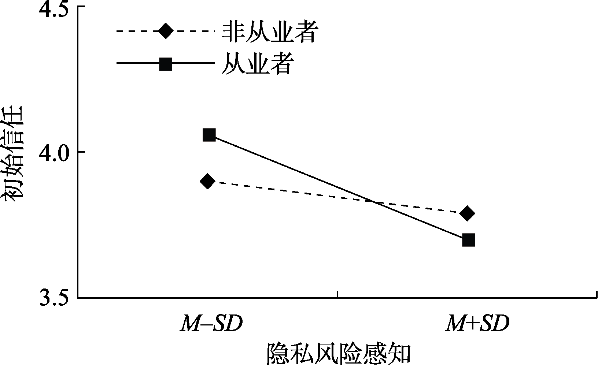
图1 研究1中简单斜率检验:隐私风险感知和从业背景的交互作用
| 基本信息 | 分类标准 | 从业者(N = 165) | 非从业者(N = 524) | ||
|---|---|---|---|---|---|
| 人数 | 比例(%) | 人数 | 比例(%) | ||
| 性别 | 男 | 78 | 42.6 | 42 | 23.0 |
| 女 | 12 | 6.6 | 51 | 27.9 | |
| 年龄段 | 18-30岁 | 14 | 7.7 | 44 | 24.0 |
| 31-40岁 | 38 | 20.8 | 39 | 21.3 | |
| 41-50岁 | 34 | 18.6 | 9 | 4.9 | |
| 51岁及以上 | 4 | 2.2 | 1 | 0.5 | |
| 学历 | 专科 | 2 | 1.1 | 5 | 2.7 |
| 本科 | 38 | 20.8 | 80 | 43.7 | |
| 硕士及以上 | 50 | 27.3 | 8 | 4.4 | |
| 1年及以下 | 1 | 0.5 | 6 | 3.3 | |
| 驾龄 | 1-3年 | 8 | 4.4 | 13 | 7.1 |
| 4-6年 | 12 | 6.6 | 41 | 22.4 | |
| 7-9年 | 14 | 7.7 | 25 | 13.7 | |
| 10年及以上 | 55 | 30.1 | 8 | 4.4 | |
附表3 研究2中被试的人口学信息(N = 183)
| 基本信息 | 分类标准 | 从业者(N = 165) | 非从业者(N = 524) | ||
|---|---|---|---|---|---|
| 人数 | 比例(%) | 人数 | 比例(%) | ||
| 性别 | 男 | 78 | 42.6 | 42 | 23.0 |
| 女 | 12 | 6.6 | 51 | 27.9 | |
| 年龄段 | 18-30岁 | 14 | 7.7 | 44 | 24.0 |
| 31-40岁 | 38 | 20.8 | 39 | 21.3 | |
| 41-50岁 | 34 | 18.6 | 9 | 4.9 | |
| 51岁及以上 | 4 | 2.2 | 1 | 0.5 | |
| 学历 | 专科 | 2 | 1.1 | 5 | 2.7 |
| 本科 | 38 | 20.8 | 80 | 43.7 | |
| 硕士及以上 | 50 | 27.3 | 8 | 4.4 | |
| 1年及以下 | 1 | 0.5 | 6 | 3.3 | |
| 驾龄 | 1-3年 | 8 | 4.4 | 13 | 7.1 |
| 4-6年 | 12 | 6.6 | 41 | 22.4 | |
| 7-9年 | 14 | 7.7 | 25 | 13.7 | |
| 10年及以上 | 55 | 30.1 | 8 | 4.4 | |
| 因变量 | 从业者 | 非从业者 | |||
|---|---|---|---|---|---|
| 低风险 | 高风险 | 低风险 | 高风险 | ||
| 隐私风险感知 | M | 4.14 | 4.41 | 2.00 | 4.31 |
| SD | 1.06 | 0.86 | 1.01 | 0.79 | |
| 初始信任 | M | 3.07 | 2.87 | 4.31 | 1.99 |
| SD | 0.92 | 0.88 | 0.53 | 0.87 | |
表3 研究2中各变量的描述统计
| 因变量 | 从业者 | 非从业者 | |||
|---|---|---|---|---|---|
| 低风险 | 高风险 | 低风险 | 高风险 | ||
| 隐私风险感知 | M | 4.14 | 4.41 | 2.00 | 4.31 |
| SD | 1.06 | 0.86 | 1.01 | 0.79 | |
| 初始信任 | M | 3.07 | 2.87 | 4.31 | 1.99 |
| SD | 0.92 | 0.88 | 0.53 | 0.87 | |
| 预测变量 | β | 95% CI下限 | 95% CI上限 | df | t | p |
|---|---|---|---|---|---|---|
| 性别(女−男) | 0.07 | −0.17 | 0.32 | 168 | 0.59 | 0.556 |
| 年龄(30至40岁−18至30岁) | −0.25 | −0.54 | 0.05 | 168 | −1.65 | 0.101 |
| 年龄(40至50岁−18至30岁) | −0.11 | −0.53 | 0.30 | 169 | −0.53 | 0.595 |
| 年龄(50及以上−18至30岁) | 0.09 | −0.63 | 0.81 | 173 | 0.24 | 0.814 |
| 学历(本科−专科) | −0.68 | −1.21 | −0.14 | 168 | −2.46 | 0.015 |
| 学历(研究生及以上−专科) | −0.63 | −1.21 | −0.05 | 168 | −2.14 | 0.033 |
| 驾龄(1至3年−1年及以内) | −0.24 | −0.84 | 0.36 | 168 | −0.79 | 0.433 |
| 驾龄(4至6年−1至3年) | −0.44 | −0.99 | 0.11 | 168 | −1.56 | 0.120 |
| 驾龄(7至9年−1年及以内) | −0.38 | −0.97 | 0.22 | 168 | −1.24 | 0.218 |
| 驾龄(10年及以上−1年及以内) | −0.19 | −0.83 | 0.45 | 168 | −0.59 | 0.558 |
| 从业背景(从业者−非从业者) | 0.34 | 0.05 | 0.64 | 180 | 2.33 | 0.021 |
| 隐私风险感知 | −0.93 | −0.97 | −0.87 | 197 | −35.98 | <0.001 |
| 从业背景(从业者−非从业者)×隐私风险感知 | 0.73 | 0.61 | 0.86 | 342 | 11.42 | <0.001 |
表4 研究2中线性混合效应模型固定效应结果
| 预测变量 | β | 95% CI下限 | 95% CI上限 | df | t | p |
|---|---|---|---|---|---|---|
| 性别(女−男) | 0.07 | −0.17 | 0.32 | 168 | 0.59 | 0.556 |
| 年龄(30至40岁−18至30岁) | −0.25 | −0.54 | 0.05 | 168 | −1.65 | 0.101 |
| 年龄(40至50岁−18至30岁) | −0.11 | −0.53 | 0.30 | 169 | −0.53 | 0.595 |
| 年龄(50及以上−18至30岁) | 0.09 | −0.63 | 0.81 | 173 | 0.24 | 0.814 |
| 学历(本科−专科) | −0.68 | −1.21 | −0.14 | 168 | −2.46 | 0.015 |
| 学历(研究生及以上−专科) | −0.63 | −1.21 | −0.05 | 168 | −2.14 | 0.033 |
| 驾龄(1至3年−1年及以内) | −0.24 | −0.84 | 0.36 | 168 | −0.79 | 0.433 |
| 驾龄(4至6年−1至3年) | −0.44 | −0.99 | 0.11 | 168 | −1.56 | 0.120 |
| 驾龄(7至9年−1年及以内) | −0.38 | −0.97 | 0.22 | 168 | −1.24 | 0.218 |
| 驾龄(10年及以上−1年及以内) | −0.19 | −0.83 | 0.45 | 168 | −0.59 | 0.558 |
| 从业背景(从业者−非从业者) | 0.34 | 0.05 | 0.64 | 180 | 2.33 | 0.021 |
| 隐私风险感知 | −0.93 | −0.97 | −0.87 | 197 | −35.98 | <0.001 |
| 从业背景(从业者−非从业者)×隐私风险感知 | 0.73 | 0.61 | 0.86 | 342 | 11.42 | <0.001 |
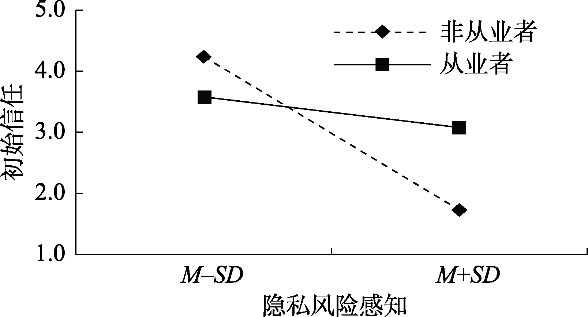
图2 研究2中简单斜率检验:隐私风险感知和从业背景的交互作用
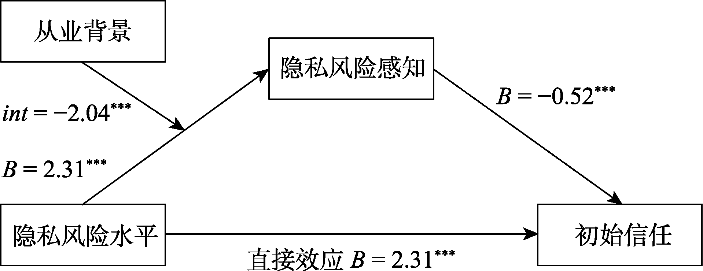
图3 隐私风险水平对初始信任的影响:隐私风险感知的部分中介及从业背景的调节作用
| 从业背景 | 间接 效应值 | Boot 标准误 | Boot CI 下限 | Boot CI 上限 |
|---|---|---|---|---|
| 0 (非从业者) | −1.20 | 0.11 | −1.42 | −0.98 |
| 1 (从业者) | −0.14 | 0.07 | −0.28 | 0.01 |
| 有调节的中介效应 | 1.06 | 0.14 | 0.80 | 1.33 |
表5 在从业背景不同水平上隐私风险感知的部分中介效应
| 从业背景 | 间接 效应值 | Boot 标准误 | Boot CI 下限 | Boot CI 上限 |
|---|---|---|---|---|
| 0 (非从业者) | −1.20 | 0.11 | −1.42 | −0.98 |
| 1 (从业者) | −0.14 | 0.07 | −0.28 | 0.01 |
| 有调节的中介效应 | 1.06 | 0.14 | 0.80 | 1.33 |
| 基本信息 | 分类标准 | 人数 | 比例(%) |
|---|---|---|---|
| 性别 | 男 | 58 | 37.4 |
| 女 | 97 | 62.6 | |
| 年龄段 | 18-30岁 | 64 | 41.3 |
| 31-40岁 | 70 | 45.2 | |
| 41-50岁 | 15 | 9.7 | |
| 51岁及以上 | 6 | 3.9 | |
| 学历 | 专科 | 13 | 8.4 |
| 本科 | 119 | 76.8 | |
| 硕士及以上 | 23 | 14.8 | |
| 1年及以下 | 4 | 2.6 | |
| 驾龄 | 1-3年 | 23 | 14.8 |
| 4-6年 | 56 | 36.1 | |
| 7-9年 | 45 | 29.0 | |
| 10年及以上 | 27 | 17.4 |
附表4 研究3中非从业者被试的人口学信息(N = 155)
| 基本信息 | 分类标准 | 人数 | 比例(%) |
|---|---|---|---|
| 性别 | 男 | 58 | 37.4 |
| 女 | 97 | 62.6 | |
| 年龄段 | 18-30岁 | 64 | 41.3 |
| 31-40岁 | 70 | 45.2 | |
| 41-50岁 | 15 | 9.7 | |
| 51岁及以上 | 6 | 3.9 | |
| 学历 | 专科 | 13 | 8.4 |
| 本科 | 119 | 76.8 | |
| 硕士及以上 | 23 | 14.8 | |
| 1年及以下 | 4 | 2.6 | |
| 驾龄 | 1-3年 | 23 | 14.8 |
| 4-6年 | 56 | 36.1 | |
| 7-9年 | 45 | 29.0 | |
| 10年及以上 | 27 | 17.4 |
| 因变量 | 控制组 | 低风险 | 高风险 | |
|---|---|---|---|---|
| 隐私风险感知 | M | 2.05 | 1.83 | 4.40 |
| SD | 1.02 | 0.80 | 0.55 | |
| 初始信任 | M | 4.33 | 4.40 | 1.90 |
| SD | 0.45 | 0.43 | 0.60 |
表6 研究3中各变量的描述统计
| 因变量 | 控制组 | 低风险 | 高风险 | |
|---|---|---|---|---|
| 隐私风险感知 | M | 2.05 | 1.83 | 4.40 |
| SD | 1.02 | 0.80 | 0.55 | |
| 初始信任 | M | 4.33 | 4.40 | 1.90 |
| SD | 0.45 | 0.43 | 0.60 |
| 预测变量 | β | 95% CI下限 | 95% CI上限 | df | t | p |
|---|---|---|---|---|---|---|
| 性别(男−女) | 0.05 | −0.06 | 0.15 | 138 | 0.86 | 0.392 |
| 年龄(30至40岁−18至30岁) | 0.13 | −0.01 | 0.26 | 138 | 1.78 | 0.079 |
| 年龄(40至50岁−18至30岁) | 0.02 | −0.20 | 0.25 | 138 | 0.20 | 0.839 |
| 年龄(50及以上−18至30岁) | 0.32 | <0.01 | 0.64 | 138 | 2.00 | 0.048 |
| 学历(本科−专科) | −0.08 | −0.26 | 0.09 | 141 | −0.95 | 0.345 |
| 学历(研究生及以上−专科) | −0.12 | −0.32 | 0.09 | 138 | −1.11 | 0.271 |
| 驾龄(1至3年−1年及以内) | 0.29 | −0.03 | 0.61 | 142 | 1.77 | 0.079 |
| 驾龄(4至6年−1至3年) | 0.07 | −0.25 | 0.38 | 145 | 0.41 | 0.680 |
| 驾龄(7至9年−1年及以内) | −0.03 | −0.37 | 0.31 | 146 | −0.17 | 0.863 |
| 驾龄(10年及以上−1年及以内) | −0.01 | −0.38 | 0.36 | 147 | −0.05 | 0.957 |
| 风险情境(低风险−控制) | −0.01 | −0.09 | 0.08 | 305 | −0.07 | 0.942 |
| 风险情境(高风险−控制) | −1.65 | −1.80 | −1.50 | 431 | −21.85 | <0.001 |
| 隐私风险感知 | −0.33 | −0.39 | −0.28 | 451 | −12.75 | <0.001 |
表7 研究3中线性混合效应模型固定效应结果
| 预测变量 | β | 95% CI下限 | 95% CI上限 | df | t | p |
|---|---|---|---|---|---|---|
| 性别(男−女) | 0.05 | −0.06 | 0.15 | 138 | 0.86 | 0.392 |
| 年龄(30至40岁−18至30岁) | 0.13 | −0.01 | 0.26 | 138 | 1.78 | 0.079 |
| 年龄(40至50岁−18至30岁) | 0.02 | −0.20 | 0.25 | 138 | 0.20 | 0.839 |
| 年龄(50及以上−18至30岁) | 0.32 | <0.01 | 0.64 | 138 | 2.00 | 0.048 |
| 学历(本科−专科) | −0.08 | −0.26 | 0.09 | 141 | −0.95 | 0.345 |
| 学历(研究生及以上−专科) | −0.12 | −0.32 | 0.09 | 138 | −1.11 | 0.271 |
| 驾龄(1至3年−1年及以内) | 0.29 | −0.03 | 0.61 | 142 | 1.77 | 0.079 |
| 驾龄(4至6年−1至3年) | 0.07 | −0.25 | 0.38 | 145 | 0.41 | 0.680 |
| 驾龄(7至9年−1年及以内) | −0.03 | −0.37 | 0.31 | 146 | −0.17 | 0.863 |
| 驾龄(10年及以上−1年及以内) | −0.01 | −0.38 | 0.36 | 147 | −0.05 | 0.957 |
| 风险情境(低风险−控制) | −0.01 | −0.09 | 0.08 | 305 | −0.07 | 0.942 |
| 风险情境(高风险−控制) | −1.65 | −1.80 | −1.50 | 431 | −21.85 | <0.001 |
| 隐私风险感知 | −0.33 | −0.39 | −0.28 | 451 | −12.75 | <0.001 |
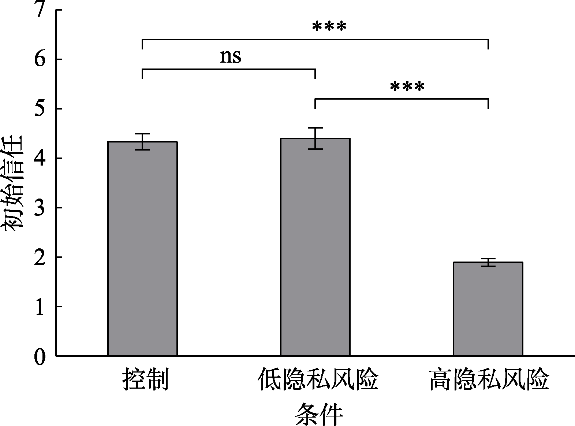
图4 研究3中不同条件下初始信任的变化情况
注:* p < 0.05, ** p < 0.01, *** p < 0.001。误差棒为M ± 1 SE
| [1] | Abraham, H., Lee, C., Brady, S., Fitzgerald, C., Mehler, B., Reimer, B., & Coughlin, J. F. (2017). Autonomous vehicles and alternatives to driving: Trust, preferences, and effects of age. Transportation Research Board 96th Annual Meeting. |
| [2] | Ahmed, S. S., Pantangi, S. S., Eker, U., Fountas, G., Still, S. E., & Anastasopoulos, P. Ch. (2020). Analysis of safety benefits and security concerns from the use of autonomous vehicles: A grouped random parameters bivariate probit approach with heterogeneity in means. Analytic Methods in Accident Research, 28, 100134. |
| [3] | Balfe, N., Sharples, S., & Wilson, J. R. (2018). Understanding is key: An analysis of factors pertaining to trust in a real- world automation system. Human Factors, 60(4), 477-495. |
| [4] | Beggiato, M., & Krems, J. F. (2013). The evolution of mental model, trust and acceptance of adaptive cruise control in relation to initial information. Transportation Research Part F: Traffic Psychology and Behaviour, 18, 47-57. |
| [5] | Biassoni, F., Ruscio, D., & Ciceri, R. (2016). Limitations and automation. The role of information about device-specific features in ADAS acceptability. Safety Science, 85, 179-186. |
| [6] | Booth, S., Tompkin, J., Pfister, H., Waldo, J., Gajos, K., & Nagpal, R. (2017). Piggybacking robots: Human-robot overtrust in university dormitory security. Proceedings of the 2017 ACM/IEEE International Conference on Human- Robot Interaction (pp.426-434). Association for Computing Machinery, New York, NY, United States. |
| [7] | Carlson, M. S., Desai, M., Drury, J. L., Kwak, H., & Yanco, H. A. (2014). Identifying factors that influence trust in automated cars and medical diagnosis systems. In 2014 AAAI Spring Symposium Series on The Intersection of Robust Intelligence and Trust in Autonomous Systems. Association for the Advancement of Artificial Intelligence, Washington, D.C., United States. |
| [8] | Celmer, N., Branaghan, R., & Chiou, E. (2018). Trust in branded autonomous vehicles & performance expectations: A theoretical framework. Proceedings of the Human Factors and Ergonomics Society Annual Meeting, 62(1), 1761-1765. |
| [9] | Choi, J. K., & Ji, Y. G. (2015). Investigating the importance of trust on adopting an autonomous vehicle. International Journal of Human-Computer Interaction, 31(10), 692-702. |
| [10] | Christensen, A. B. H., Dam, C. R., Rasle, C., Bauer, J. E., Mohamed, R. A., & Jensen, L. C. (2019). Reducing overtrust in failing robotic systems. 2019 14th ACM/IEEE International Conference on Human-Robot Interaction (HRI) (pp.542-543). IEEE. |
| [11] | Davis, F., Bagozzi, R., & Warshaw, P. (1989). User acceptance of computer technology: A comparison of 2 theoretical- models. Management Science, 35(8), 982-1003. |
| [12] | Deloitte, China. (2019). Consumers pump the brakes on autonomous vehicle adoption | Deloitte China | Newsroom. Deloitte. https://www2.deloitte.com/cn/en/pages/about-deloitte/articles/pr-consumers-pump-the-brakes-on-autonomous-vehicle-adoption.html |
| [13] | Dirsehan, T., & Can, C. (2020). Examination of trust and sustainability concerns in autonomous vehicle adoption. Technology in Society, 63, 101361. |
| [14] | Faul, F., Erdfelder, E., Lang, A.-G., & Buchner, A. (2007). G*Power 3: A flexible statistical power analysis program for the social, behavioral, and biomedical sciences. Behavior Research Methods, 39(2), 175-191. |
| [15] | Fishbein, M., & Ajzen, I. (1975). Belief, attitude, intention and behaviour: An introduction to theory and research (Vol. 27). Addison-Wesley. |
| [16] | Gao, Z., Li, W., Liang, J., Pan, H., Xu, W., & Shen, M. (2021). Trust in automated vehicles. Advances in Psychological Science, 29(12), 2172-2183. |
| [高在峰, 李文敏, 梁佳文, 潘晗希, 许为, 沈模卫. (2021). 自动驾驶车中的人机信任. 心理科学进展, 29(12), 2172-2183.] | |
| [17] | Glikson, E., & Woolley, A. W. (2020). Human trust in artificial intelligence: Review of empirical research. Academy of Management Annals, 14(2), 627-660. |
| [18] | Gopinath, K., & Narayanamurthy, G. (2022). Early bird catches the worm! Meta-analysis of autonomous vehicles adoption - Moderating role of automation level, ownership and culture. International Journal of Information Management, 66, 102536. |
| [19] | Ha, T., Kim, S., Seo, D., & Lee, S. (2020). Effects of explanation types and perceived risk on trust in autonomous vehicles. Transportation Research Part F: Traffic Psychology and Behaviour, 73, 271-280. |
| [20] | Hoff, K. A., & Bashir, M. (2015). Trust in automation: Integrating empirical evidence on factors that influence trust. Human Factors, 57(3), 407-434. |
| [21] | Hu, Y., Xiao, J., & Liu, Q. (2025). Privacy protection from the perspective of risk perception: A meta-analysis study. Journal of Intelligence, 44(1), 198-206. |
| [胡雅萍, 肖江艳, 刘千里. (2025). 风险感知视角下个人隐私安全保护——一项元分析研究. 情报杂志, 44(1), 198-206.] | |
| [22] | Huang, X., & Li, Y. (2024). Trust dampening and trust promoting: A dual-pathway of trust calibration in human- robot interaction. Advances in Psychological Science, 32(3), 527-542. |
| [黄心语, 李晔. (2024). 人机信任校准的双途径:信任抑制与信任提升. 心理科学进展, 32(3), 527-542.] | |
| [23] | Jin, M., Lu, G., Chen, F., & Shi, X. (2020). How driving experience affect trust in automation from level 3 automated vehicles? An experimental analysis. 2020 IEEE 23rd International Conference on Intelligent Transportation Systems (ITSC), 1-6. IEEE. |
| [24] | Kahl, B. (2021). Human biases preventing the widespread adoption of self-driving cars. ArXiv, abs/2104.01022. |
| [25] | Kraus, J., Scholz, D., Stiegemeier, D., & Baumann, M. (2020). The more you know: Trust dynamics and calibration in highly automated driving and the effects of take-overs, system malfunction, and system transparency. Human Factors, 62(5), 718-736. |
| [26] | Kyriakidis, M., Happee, R., & J. C., F. (2015). Public opinion on automated driving: Results of an international questionnaire among 5000 respondents. Transportation Research Part F: Traffic Psychology and Behaviour, 32, 127-140. |
| [27] | Lee, J. D., & See, K. A. (2004). Trust in automation: Designing for appropriate reliance. Human Factors, 46(1), 50-80. |
| [28] | Lee, J., & Lee, K. (2022). Polite speech strategies and their impact on drivers’ trust in autonomous vehicles. Computers in Human Behavior, 127, 107015. |
| [29] | Lyons, J. B., & Guznov, S. Y. (2019). Individual differences in human-machine trust: A multi-study look at the perfect automation schema. Theoretical Issues in Ergonomics Science, 20(4), 440-458. |
| [30] | Ma, Y., Li, S., Qin, S., & Qi, Y. (2020). Factors affecting trust in the autonomous vehicle: A survey of primary school students and parent perceptions. Proceedings - 2020 IEEE 19th International Conference on Trust, Security and Privacy in Computing and Communications, TrustCom 2020, 2020-2027. IEEE. |
| [31] | Madigan, R., Louw, T., Wilbrink, M., Schieben, A., & Merat, N. (2017). What influences the decision to use automated public transport? Using UTAUT to understand public acceptance of automated road transport systems. Transportation Research Part F: Traffic Psychology and Behaviour, 50, 55-64. |
| [32] | Merritt, S. M., & Ilgen, D. R. (2008). Not all trust is created equal: Dispositional and history-based trust in human- automation interactions. Human Factors, 50(2), 194-210. |
| [33] | Narayanan, S., Chaniotakis, E., & Antoniou, C. (2020). Shared autonomous vehicle services: A comprehensive review. Transportation Research Part C: Emerging Technologies, 111, 255-293. |
| [34] | Onnasch, L., Hoesterey, S., & Fahrner, V. (2023). To (dis)agree with automation: Effects of automation levels on trust attitude and trust behavior in high-risk situations. Proceedings of the Human Factors and Ergonomics Society Annual Meeting, 67(1), 1393-1399. |
| [35] | On-Road Automated Driving (Orad) Committee. (2023). J3016 (WIP) Taxonomy and Definitions for Terms Related to Driving Automation Systems for On-Road Motor Vehicles. SAE International. https://www.sae.org/standards/content/j3016/ |
| [36] | Osswald, S., Wurhofer, D., Trösterer, S., Beck, E., & Tscheligi, M. (2012). Predicting information technology usage in the car: Towards a car technology acceptance model. Proceedings of the 4th International Conference on Automotive User Interfaces and Interactive Vehicular Applications (pp.51- 58). Association for Computing Machinery, New York, NY, United States. |
| [37] | Podsakoff, P. M., MacKenzie, S. B., Lee, J.-Y., & Podsakoff, N. P. (2003). Common method biases in behavioral research: A critical review of the literature and recommended remedies. Journal of Applied Psychology, 88(5), 879-903. |
| [38] | Podsakoff, P. M., & Organ, D. W. (1986). Self-reports in organizational research: Problems and prospects. Journal of Management, 12(4), 531-544. |
| [39] | Pop, V. L., Shrewsbury, A., & Durso, F. T. (2015). Individual differences in the calibration of trust in automation. Human Factors, 57(4), 545-556. |
| [40] | PricewaterhouseCoopers. (2023). Digital Auto Report 2023. PricewaterhouseCoopers. https://www.strategyand.pwc.com/tr/tr/pdf/digital-auto-report-2023.pdf |
| [41] | Pype, P., Daalderop, G., Schulz-Kamm, E., Walters, E., & von Grafenstein, M. (2017). Privacy and security in autonomous vehicles. In D. Watzenig & M. Horn (Eds), Automated driving: Safer and more efficient future driving (pp. 17-27). Springer International Publishing. |
| [42] | Qi, Y., Chen, J., Qin, S., & Du, F. (2024). Human-AI mutual trust in the era of artificial general intelligence. Advances in Psychological Science, 32(12), 2124-2136. |
| [齐玥, 陈俊廷, 秦邵天, 杜峰. (2024). 通用人工智能时代的人与AI信任. 心理科学进展, 32(12), 2124-2136.] | |
| [43] | Qin, S., Li, C., & Qi, Y. (2024). Trust transfer in autonomous vehicles: The role of warm brand image amid automation failure. In D. Harris & W.-C. Li (Eds), Engineering psychology and cognitive ergonomics (pp. 123-140). Springer Nature Switzerland. |
| [44] | Rieger, T., Roesler, E., & Manzey, D. (2021). The imperfect automation schema—Evidence for increased trust in human support agents. Proceedings of the Human Factors and Ergonomics Society Annual Meeting, 65(1), 1020-1020. |
| [45] | Robinette, P., Howard, A. M., & Wagner, A. R. (2017). Effect of robot performance on human-robot trust in time-critical situations. IEEE Transactions on Human-Machine Systems, 47(4), 425-436. |
| [46] | Rupp, M. A., Michaelis, J. R., McConnell, D. S., & Smither, J. A. (2018). The role of individual differences on perceptions of wearable fitness device trust, usability, and motivational impact. Applied Ergonomics, 70, 77-87. |
| [47] | Sheridan, T. B. (2019). Individual differences in attributes of trust in automation: Measurement and application to system design. Frontiers in Psychology, 10, 1117. |
| [48] | Tan, H., Zhao, X., & Yang, J. (2022). Exploring the influence of anxiety, pleasure and subjective knowledge on public acceptance of fully autonomous vehicles. Computers in Human Behavior, 131, 107187. |
| [49] | Tao, D., Yuan, J., Shao, F., Li, D., Zhou, Q., & Qu, X. (2018). Factors affecting consumer acceptance of an online health information portal among young internet users. CIN: Computers, Informatics, Nursing, 36(11), 530-539. |
| [50] | Walker, G. H., Stanton, N. A., & Salmon, P. (2016). Trust in vehicle technology. International Journal of Vehicle Design, 70(2), 157-182. |
| [51] | Wang, K., Wu, J., Sun, Y., Chen, J., Pu, Y., & Qi, Y. (2024). Trust in human and virtual live streamers: The role of integrity and social presence. International Journal of Human-Computer Interaction, 40(23), 8274-8294. |
| [52] | Waung, M., McAuslan, P., & Lakshmanan, S. (2021). Trust and intention to use autonomous vehicles: Manufacturer focus and passenger control. Transportation Research Part F: Traffic Psychology and Behaviour, 80, 328-340. |
| [53] | Wen, Z.L., & Ye, B.J. (2014). Different methods for testing moderated mediation models: Competitors or backups? Acta Psychologica Sinica, 46(5), 714-726. |
| [温忠麟, 叶宝娟. (2014). 有调节的中介模型检验方法: 竞争还是替补? 心理学报, 46(5), 714-726.] | |
| [54] | Wintersberger, P., Noah, B. E., Kraus, J., McCall, R., Mirnig, A. G., Kunze, A., Thakkar, S., & Walker, B. N. (2018). Second workshop on trust in the age of automated driving. Adjunct Proceedings of the 10th International Conference on Automotive User Interfaces and Interactive Vehicular Applications (pp. 56-64). Association for Computing Machinery, New York, NY, United States. |
| [55] | Wu, M., Wang, N., & Yuen, K. F. (2023). Deep versus superficial anthropomorphism: Exploring their effects on human trust in shared autonomous vehicles. Computers in Human Behavior, 141, 107614. |
| [56] | Xu, W., & Ge, L. (2020). Engineering psychology in the era of artificial intelligence. Advances in Psychological Science, 28(9), 1409-1425. |
| [许为, 葛列众. (2020). 智能时代的工程心理学. 心理科学进展, 28(9), 1409-1425.] | |
| [57] | You, S., Qi, Y., Chen, J., Luo, L., & Zhang, K. (2025). Safety trust in intelligent domestic robots: Human and AI perspectives on trust and relevant influencing factors. Acta Psychologica Sinica, 57(11), 1951-1972. |
| [由姗姗, 齐玥, 陈俊廷, 骆磊, 张侃. (2025). 人与AI对智能家居机器人的安全信任及其影响因素. 心理学报, 57(11), 1951-1972.] | |
| [58] | Yuen, K. F., Wong, Y. D., Ma, F., & Wang, X. (2020). The determinants of public acceptance of autonomous vehicles: An innovation diffusion perspective. Journal of Cleaner Production, 270, 121904. |
| [59] | Zhang, T., Tao, D., Qu, X., Zhang, X., Lin, R., & Zhang, W. (2019). The roles of initial trust and perceived risk in public’s acceptance of automated vehicles. Transportation Research Part C: Emerging Technologies, 98, 207-220. |
| [60] | Zhang, T., Tao, D., Qu, X., Zhang, X., Zeng, J., Zhu, H., & Zhu, H. (2020). Automated vehicle acceptance in China: Social influence and initial trust are key determinants. Transportation Research Part C: Emerging Technologies, 112, 220-233. |
| [61] | Zhu, A., Yang, S., Chen, Y., & Xing, C. (2022). A moral decision-making study of autonomous vehicles: Expertise predicts a preference for algorithms in dilemmas. Personality and Individual Differences, 186, 111356. |
| [62] | Zmud, J., Sener, I., & Wagner, J. (2016). Consumer Acceptance and Travel Behavior Impacts of Automated Vehicles. |
| [1] | 崔勋绚, 乔紫藤, 刘宁. 拟人化对人工智能的感知热情−能力及人智合作意愿的影响[J]. 心理学报, 2026, 58(7): 1254-1278. |
| [2] | 刘永芳, 孙月, 练金晶. 快速=真诚:社会困境中的互动对象决策时长效应[J]. 心理学报, 2026, 58(7): 1428-1443. |
| [3] | 黎耀奇, 陈政任, 江秋敏, 林美珍. 人生得意须尽欢:时间观对个体消费倾向的影响[J]. 心理学报, 2026, 58(7): 1444-1458. |
| [4] | 穆英琦, 徐鹏慧, 吴怡君, 戚玥, 娄艳, 于晓. “双减”背景父母教育卷入的变化轨迹对小学生学习投入和学习成绩的差异性影响[J]. 心理学报, 2026, 58(6): 1183-1196. |
| [5] | 任梦梦, 李琎, 钟毅平, 杨莉君. 社会规范类型对亲环境行为的影响:道德认同的调节作用及其fNIRS证据[J]. 心理学报, 2026, 58(6): 1197-1212. |
| [6] | 周蕾, 李立统, 梁竹苑, 李纾, 惠青山, 张磊. 风险决策和跨期决策的过程比较: 基于概率和时间的等量转换范式[J]. 心理学报, 2026, 58(6): 1213-1236. |
| [7] | 蒋家丽, 章鹏, 樊利芳, 刘颖, 卢柳柳, 白学军. 由“俭”入“奢”与由“奢”入“俭”:稀缺感知顺序与童年稀缺经历对抑制控制的影响[J]. 心理学报, 2026, 58(5): 903-917. |
| [8] | 王祯, 左果果, 管健. 强调努力悖论:强调努力阻碍对STEM领域的追求[J]. 心理学报, 2026, 58(5): 918-934. |
| [9] | 孙思捷, 赵欢欢, 皮乔, 张和云. 超越“多多益善”: 利他程度对道德评价的影响及调节机制[J]. 心理学报, 2026, 58(5): 935-960. |
| [10] | 雷蜀豫, 傅莹, 杜建刚, 覃琪惠. 辛辣食物增强心理权力感:证据和心理后果[J]. 心理学报, 2026, 58(5): 961-975. |
| [11] | 王天鸿, 谢晓非. 众人拾柴火焰高:群体利他促进利他炫耀[J]. 心理学报, 2026, 58(5): 976-994. |
| [12] | 马家涛, 李纾, 何贵兵. 损失领域跨时间段决策的框架效应将影响债务置换决策偏好[J]. 心理学报, 2026, 58(4): 651-666. |
| [13] | 杨阳, 曹俊, 李潇林, 俄怡然, 谭羽荃, 贾亦心. 敬畏和共同内群体认同:感知资源稀缺性的调节[J]. 心理学报, 2026, 58(4): 667-682. |
| [14] | 占小军, 吴可盈, 王涛, 马君, 祝养浩, 周雯珺. 位居次席: 备选对员工主动担责和时间窃取行为的影响机制[J]. 心理学报, 2026, 58(4): 683-697. |
| [15] | 陈斯允, 程梅子, 熊继伟, 房心怡, 吴来安. “林间慢板”:音乐节奏如何影响个体的亲环境行为[J]. 心理学报, 2026, 58(4): 698-724. |
| 阅读次数 | ||||||
|
全文 |
|
|||||
|
摘要 |
|
|||||
