

ISSN 0439-755X
CN 11-1911/B
主办:中国心理学会
中国科学院心理研究所
出版:科学出版社
CN 11-1911/B
主办:中国心理学会
中国科学院心理研究所
出版:科学出版社
心理学报 ›› 2026, Vol. 58 ›› Issue (5): 840-852.doi: 10.3724/SP.J.1041.2026.0840 cstr: 32110.14.2026.0840
李思瑾1,2, 汤煜尧1, 李奇1, 王庭栋1, 张丹丹1( )
)
收稿日期:2025-04-06
发布日期:2026-03-04
出版日期:2026-05-25
通讯作者:
张丹丹, E-mail: zhangdd05@gmail.com作者简介:并列第一作者:李思瑾, 汤煜尧
基金资助:
LI Sijin1,2, TANG Yuyao1, LI Qi1, WANG Tingdong1, ZHANG Dandan1()
Received:2025-04-06
Online:2026-03-04
Published:2026-05-25
摘要:
来自朋友或陌生人的情绪调节帮助是个体应对突发事件的重要资源, 但陌生人提供的帮助往往不及朋友有效。人际距离是如何影响调节者的调节过程的?被调节者的情绪表露能否弥补由人际距离较远带来的负面影响?本研究通过两项实验考察人际距离与情绪表露在人际情绪调节中的作用。实验1发现, 调节者为朋友(而不是陌生人)选择更多情境适应性调节策略。实验2进一步测量调节者的瞳孔直径变化以揭示其认知资源卷入程度, 发现人际距离对调节者的情绪识别、策略选择和策略产出三个阶段均有影响, 而被调节者的情绪表露可显著降低上述人际距离的负面效应, 从而优化陌生人之间的人际情绪调节过程。本研究不但支持和扩展了社会调节环模型, 还为优化人际情绪调节过程和提升社会互动质量提供了实践指导。
中图分类号:
李思瑾, 汤煜尧, 李奇, 王庭栋, 张丹丹. (2026). 知人知面, 还需知情:人际距离和情绪表露对人际情绪调节的影响. 心理学报, 58(5), 840-852.
LI Sijin, TANG Yuyao, LI Qi, WANG Tingdong, ZHANG Dandan. (2026). Make your emotions heard: How emotion sharing boosts interpersonal emotion regulation across various interpersonal distances. Acta Psychologica Sinica, 58(5), 840-852.
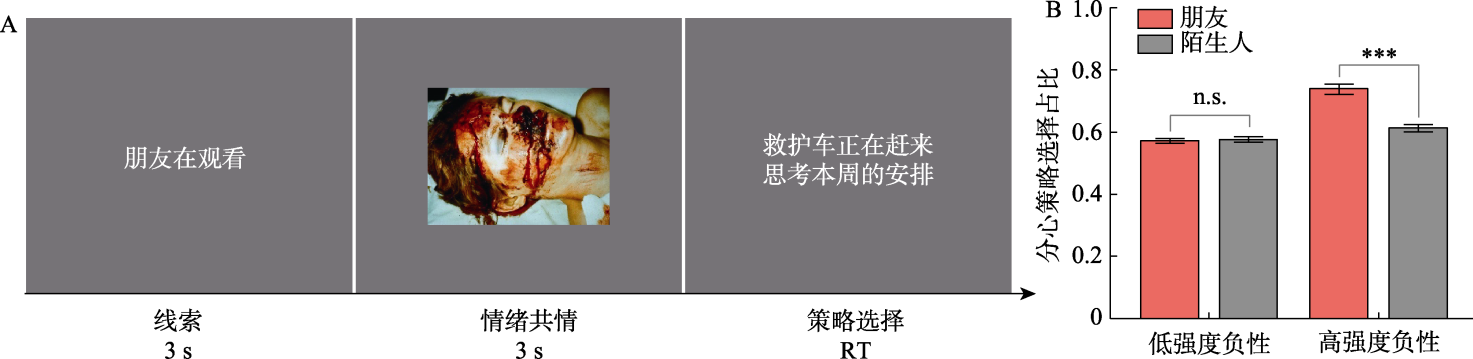
图1 实验1的流程及主要结果。A, 单个试次流程图。实验中, 被试分别设想好友或陌生人正在观看负性情绪图片。图片呈现后, 被试可在不限时间的情况下, 从认知重评(例如, 救护车正在赶来)或者分心(例如, 思考本周的安排)两种情绪调节策略中选择其一, 帮助观看负性图片的人物改善情绪体验。RT表示反应时。B, 分心策略选择占比。分数越高, 表示越倾向于选择分心策略调节朋友/陌生人的负性情绪。图中的误差条代表标准误, *** p < 0.001, n.s. 表示无显著差异。

图2 实验2中单个试次流程图。以“表露”条件为例, 情绪识别阶段向被试展示了被调节者观看完图片后的负性情绪强度评分(实际上是程序预设值)。之后被试选择一种策略, 并口述具体的调节方案。每完成约5个试次后, 被试需要在9点评分量表上报告策略产出的难度, 1表示非常简单, 9表示非常困难。
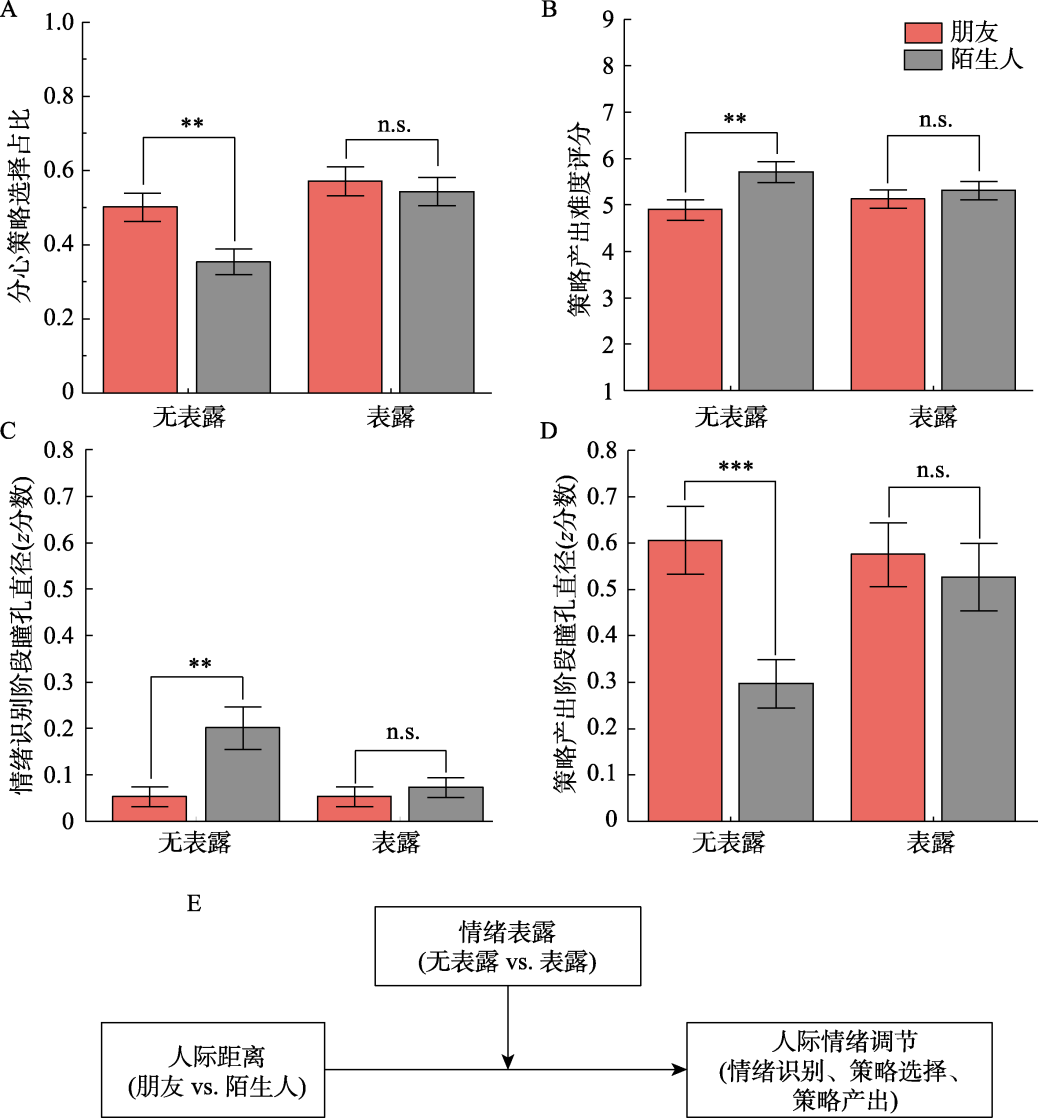
图3 主观评分及瞳孔直径结果。A, 分心策略选择占比。分数越高表示被试越倾向于选择分心策略来调节朋友/陌生人的负性情绪。B, 策略产出难度评分。分数越高表示难度越大。C, 情绪识别阶段的瞳孔直径变化。D, 策略产出阶段的瞳孔直径变化。E, 情绪表露调节人际距离对人际情绪调节的影响。人际距离(0-朋友, 1-陌生人)和情绪表露(0-无表露, 1-表露)均为分类变量, 人际情绪调节的指标均为连续变量。** p < 0.01, *** p < 0.001, n.s. 表示未发现显著差异。
| IAPS编号 | 人际距离 | 负性情绪强度 | 分心策略 | 重评策略 |
|---|---|---|---|---|
| 1321 | 1 | 1 | 数数它的牙齿 | 狗熊在打哈欠 |
| 2752 | 1 | 1 | 观察后面的小狗摆件 | 和三五好友相聚小酌 |
| 6561 | 1 | 1 | 关注女孩儿的配饰 | 双方在争论中磨合 |
| 6571 | 1 | 1 | 视线放在驾驶员的牛仔外套上 | 他们在练习如何应对持枪抢劫 |
| 9560 | 1 | 1 | 想想这幅场景的配色 | 动物协会已开展救治 |
| 1050 | 1 | 2 | 观察皮肤的颜色和纹路 | 通人性的它在配合拍照 |
| 2800 | 1 | 2 | 回忆昨天晚上的经历 | 迅速得到妈妈的安抚 |
| 3051 | 1 | 2 | 思考本周的安排 | 救护车正在赶来 |
| 3061 | 1 | 2 | 畅想元旦假期的计划 | 逼真的刑侦影视道具 |
| 3071 | 1 | 2 | 想象操场散步的场景 | 他走得快没那么痛苦 |
| 1931 | 2 | 1 | 观察大鲨鱼的体型结构 | 这是水族馆不会有危险 |
| 2751 | 2 | 1 | 推测司机的年龄 | 司机在喝汽泡水 |
| 6312 | 2 | 1 | 目光放在前排座椅上 | 他想带妹妹离开此处 |
| 6838 | 2 | 1 | 数一数场景中的人数 | 被拐卖的女孩获救了 |
| 9561 | 2 | 1 | 判断小猫的品种 | 小猫会得到治疗 |
| 3030 | 2 | 2 | 聚焦于女孩的棕色卷发 | 现代医疗可帮助她恢复 |
| 3060 | 2 | 2 | 思考洗漱的流程 | 好在保住了性命 |
| 3062 | 2 | 2 | 想一想回家途中的风景 | 罕见病症受到重点关注 |
| 6570 | 2 | 2 | 关注点可以放在左侧耳部 | 悬疑作家在构思故事情节 |
| 9921 | 2 | 2 | 注意力放在氧气瓶上 | 消防员及时赶到现场 |
附表 实验1刺激材料及策略
| IAPS编号 | 人际距离 | 负性情绪强度 | 分心策略 | 重评策略 |
|---|---|---|---|---|
| 1321 | 1 | 1 | 数数它的牙齿 | 狗熊在打哈欠 |
| 2752 | 1 | 1 | 观察后面的小狗摆件 | 和三五好友相聚小酌 |
| 6561 | 1 | 1 | 关注女孩儿的配饰 | 双方在争论中磨合 |
| 6571 | 1 | 1 | 视线放在驾驶员的牛仔外套上 | 他们在练习如何应对持枪抢劫 |
| 9560 | 1 | 1 | 想想这幅场景的配色 | 动物协会已开展救治 |
| 1050 | 1 | 2 | 观察皮肤的颜色和纹路 | 通人性的它在配合拍照 |
| 2800 | 1 | 2 | 回忆昨天晚上的经历 | 迅速得到妈妈的安抚 |
| 3051 | 1 | 2 | 思考本周的安排 | 救护车正在赶来 |
| 3061 | 1 | 2 | 畅想元旦假期的计划 | 逼真的刑侦影视道具 |
| 3071 | 1 | 2 | 想象操场散步的场景 | 他走得快没那么痛苦 |
| 1931 | 2 | 1 | 观察大鲨鱼的体型结构 | 这是水族馆不会有危险 |
| 2751 | 2 | 1 | 推测司机的年龄 | 司机在喝汽泡水 |
| 6312 | 2 | 1 | 目光放在前排座椅上 | 他想带妹妹离开此处 |
| 6838 | 2 | 1 | 数一数场景中的人数 | 被拐卖的女孩获救了 |
| 9561 | 2 | 1 | 判断小猫的品种 | 小猫会得到治疗 |
| 3030 | 2 | 2 | 聚焦于女孩的棕色卷发 | 现代医疗可帮助她恢复 |
| 3060 | 2 | 2 | 思考洗漱的流程 | 好在保住了性命 |
| 3062 | 2 | 2 | 想一想回家途中的风景 | 罕见病症受到重点关注 |
| 6570 | 2 | 2 | 关注点可以放在左侧耳部 | 悬疑作家在构思故事情节 |
| 9921 | 2 | 2 | 注意力放在氧气瓶上 | 消防员及时赶到现场 |
| [1] |
Aron, A., Aron, E. N., & Smollan, D. (1992). Inclusion of other in the self scale and the structure of interpersonal closeness. Journal of Personality and Social Psychology, 63, 596-612. https://doi.org/10.1037/0022-3514.63.4.596
doi: 10.1037/0022-3514.63.4.596 URL |
| [2] | Bates, D., Maechler, M., Bolker, B., Walker, S. (2014). lme4: Linear mixed effects models using Eigen and S4. R Package Version 1.0-6. http://CRAN.R-project.org/package=lme4 |
| [3] |
Bo, K., Kraynak, T. E., Kwon, M., Sun, M., Gianaros, P. J., & Wager, T. D. (2024). A systems identification approach using Bayes factors to deconstruct the brain bases of emotion regulation. Nature Neuroscience, 27(5), 975-987. https://doi.org/10.1038/s41593-024-01605-7
doi: 10.1038/s41593-024-01605-7 URL |
| [4] |
Brudner, E. G., Fareri, D. S., Shehata, S. G., & Delgado, M. R. (2023). Social feedback promotes positive social sharing, trust, and closeness. Emotion, 23(6), 1536-1548. https://doi.org/10.1037/emo0001182
doi: 10.1037/emo0001182 URL |
| [5] |
Cameron, L. D., & Overall, N. C. (2018). Suppression and expression as distinct emotion-regulation processes in daily interactions: Longitudinal and meta-analyses. Emotion, 18(4), 465-480. https://doi.org/10.1037/emo0000334
doi: 10.1037/emo0000334 URL pmid: 28569538 |
| [6] |
Castellotti, S., Castaldi, E., Blini, E., & Arrighi, R. (2025). Pupil size as a biomarker of cognitive (dys)functions: Toward a physiologically informed screening of mental states. Acta Psychologica, 253, 104720. https://doi.org/10.1016/j.actpsy.2025.104720
doi: 10.1016/j.actpsy.2025.104720 URL |
| [7] |
Cheng, Y., Chen, C., Lin, C.-P., Chou, K.-H., & Decety, J. (2010). Love hurts: An fMRI study. NeuroImage, 51(2), 923-929. https://doi.org/10.1016/j.neuroimage.2010.02.047
doi: 10.1016/j.neuroimage.2010.02.047 URL pmid: 20188182 |
| [8] |
Chervonsky, E., & Hunt, C. (2017). Suppression and expression of emotion in social and interpersonal outcomes: A meta-analysis. Emotion, 17(4), 669-683. https://doi.org/10.1037/emo0000270
doi: 10.1037/emo0000270 URL pmid: 28080085 |
| [9] |
Clark, M. S., & Lemay, E. P. (2024). When emotion expression will (and will not) enhance listening and responsiveness. Current Opinion in Psychology, 55, 101695. https://doi.org/10.1016/j.copsyc.2023.101695
doi: 10.1016/j.copsyc.2023.101695 URL |
| [10] |
Dong, W., Yu, W., Xie, H., Zhang, D. (2024). Neurocognitive basis underlying interpersonal emotion regulation. Advances in Psychological Science, 32(1), 131-137.
doi: 10.3724/SP.J.1042.2024.00131 |
|
[董婉欣, 于文汶, 谢慧, 张丹丹. (2024). 人际情绪调节的认知神经基础. 心理科学进展, 32(1), 131-137.]
doi: 10.3724/SP.J.1042.2024.00131 |
|
| [11] |
Double, K. S., MacCann, C., Kunst, H., & Pinkus, R. T. (2024). Regulating others’ emotions: An exploratory study of everyday extrinsic emotion regulation in university students. Personality and Individual Differences, 226, 112687. https://doi.org/10.1016/j.paid.2024.112687
doi: 10.1016/j.paid.2024.112687 URL |
| [12] |
Gao, K., Wong, A. B., Li, S., Zhang, Y., & Zhang, D. (2024). The ventromedial prefrontal cortex plays an important role in implicit emotion regulation: A focality‐optimized multichannel tDCS study in anxiety individuals. Human Brain Mapping, 45(13), e26812. https://doi.org/10.1002/hbm.26812
doi: 10.1002/hbm.v45.13 URL |
| [13] |
Graham, S. M., Huang, J. Y., Clark, M. S., & Helgeson, V. S. (2008). The positives of negative emotions: Willingness to express negative emotions promotes relationships. Personality and Social Psychology Bulletin, 34(3), 394-406. https://doi.org/10.1177/0146167207311281
doi: 10.1177/0146167207311281 URL pmid: 18272807 |
| [14] |
Grujic, N., Polania, R., & Burdakov, D. (2024). Neurobehavioral meaning of pupil size. Neuron, 112(20), 3381-3395. https://doi.org/10.1016/j.neuron.2024.05.029
doi: 10.1016/j.neuron.2024.05.029 URL |
| [15] |
Guendelman, S., Bayer, M., Prehn, K., & Dziobek, I. (2022). Regulating negative emotions of others reduces own stress: Neurobiological correlates and the role of individual differences in empathy. NeuroImage, 254, 119134. https://doi.org/10.1016/j.neuroimage.2022.119134
doi: 10.1016/j.neuroimage.2022.119134 URL |
| [16] |
He, Z., Ao, X., Muhlert, N., Elliott, R., & Zhang, D. (2022). Neural substrates of expectancy violation associated with social feedback in individuals with subthreshold depression. Psychological Medicine, 52(11), 2043-2051. https://doi.org/10.1017/S0033291720003864
doi: 10.1017/S0033291720003864 URL |
| [17] |
Hershman, R., Henik, A., & Cohen, N. (2018). A novel blink detection method based on pupillometry noise. Behavior Research Methods, 50(1), 107-114. https://doi.org/10.3758/s13428-017-1008-1
doi: 10.3758/s13428-017-1008-1 URL pmid: 29340968 |
| [18] |
Hodges, S. D., & Kezer, M. (2021). It is hard to read minds without words: Cues to use to achieve empathic accuracy. Journal of Intelligence, 9(2), 27. https://doi.org/10.3390/jintelligence9020027
doi: 10.3390/jintelligence9020027 URL |
| [19] |
Hogervorst, M. A., Brouwer, A. M., & van Erp, J. B. (2014). Combining and comparing EEG, peripheral physiology and eye-related measures for the assessment of mental workload. Frontiers in Neuroscience, 8, 322. https://doi.org/10.3389/fnins.2014.00322
doi: 10.3389/fnins.2014.00322 URL pmid: 25352774 |
| [20] |
Hsu, D. T., Sanford, B. J., Meyers, K. K., Love, T. M., Hazlett, K. E., Walker, S. J., ... Zubieta, J. K. (2015). It still hurts: Altered endogenous opioid activity in the brain during social rejection and acceptance in major depressive disorder. Molecular Psychiatry, 20(2), 193-200. https://doi.org/10.1038/mp.2014.185
doi: 10.1038/mp.2014.185 URL pmid: 25600108 |
| [21] |
Kinley, I., & Levy, Y. (2022). PuPl: An open-source tool for processing pupillometry data. Behavior Research Methods, 54(4), 2046-2069. https://doi.org/10.3758/s13428-021-01717-z
doi: 10.3758/s13428-021-01717-z URL |
| [22] | Lang, P. J., Bradley, M. M., & Cuthbert, B. N. (2005). International affective picture system (IAPS): Digitized photographs, instruction manual, and affective ratings (Tech. Rep. No. A-6). Gainesville: University of Florida, Center for Research in Psychophysiology. |
| [23] |
Lange, J., Heerdink, M. W., & van Kleef, G. A. (2022). Reading emotions, reading people: Emotion perception and inferences drawn from perceived emotions. Current Opinion in Psychology, 43, 85-90. https://doi.org/10.1016/j.copsyc.2021.06.008
doi: 10.1016/j.copsyc.2021.06.008 URL |
| [24] |
Li, J., Sun, Y., Li, M., Li, H., Fan, W., & Zhong, Y. (2020). Social distance modulates prosocial behaviors in the gain and loss contexts: An event-related potential (ERP) study. International Journal of Psychophysiology, 150, 83-91. https://doi.org/10.1016/j.ijpsycho.2020.02.003
doi: S0167-8760(20)30033-7 URL pmid: 32035872 |
| [25] |
Li, S., Chen, J., Gao, K., Xu, F., & Zhang, D. (2023). Excitatory brain stimulation over the left dorsolateral prefrontal cortex enhances voluntary distraction in depressed patients. Psychological Medicine, 53(14), 6646-6655. https://doi.org/10.1017/S0033291723000028
doi: 10.1017/S0033291723000028 URL |
| [26] |
Li, S., Cheng, S., Shangguan, C., Su, X., & Li, X. (2023). Forgive or complain: Interpersonal distance modulates reactive attitudes and neural responses toward wrongdoers. Biological Psychology, 183, 108653. https://doi.org/10.1016/j.biopsycho.2023.108653
doi: 10.1016/j.biopsycho.2023.108653 URL |
| [27] |
Li, S., Xie, H., Zheng, Z., Chen, W., Xu, F., Hu, X., & Zhang, D. (2022). The causal role of the bilateral ventrolateral prefrontal cortices on emotion regulation of social feedback. Human Brain Mapping, 43(9), 2898-2910. https://doi.org/10.1002/hbm.25824
doi: 10.1002/hbm.25824 URL pmid: 35261115 |
| [28] | Lin, C., Lin, X., Lian, W., Zhang, W., & Peng, W. (2024). Brains in sync, friends in empathy: Interbrain neural mechanisms underlying the impact of interpersonal closeness on mutual empathy. Proceedings. Biological Sciences, 291(2032), 20241326. https://doi.org/10.1098/rspb.2024.1326 |
| [29] |
Liu, D. Y., Strube, M. J., & Thompson, R. J. (2021). Interpersonal emotion regulation: An experience sampling study. Affective Science, 2(3), 273-288. https://doi.org/10.1007/s42761-021-00044-y
doi: 10.1007/s42761-021-00044-y URL pmid: 36059902 |
| [30] |
Liu, Z., Lu, K., Hao, N., & Wang, Y. (2023). Cognitive reappraisal and expressive suppression evoke distinct neural connections during interpersonal emotion regulation. The Journal of Neuroscience, 43(49), 8456-8471. https://doi.org/10.1523/JNEUROSCI.0954-23.2023
doi: 10.1523/JNEUROSCI.0954-23.2023 URL |
| [31] |
MacCann, C., Double, K. S., Olderbak, S., Austin, E. J., Pinkus, R. T., Walker, S. A., Kunst, H., & Niven, K. (2025). What do we do to help others feel better? The eight strategies of the regulating others' emotions scale (ROES). Emotion, 25(2), 410-429. https://doi.org/10.1037/emo0001459
doi: 10.1037/emo0001459 URL pmid: 39928487 |
| [32] |
Maister, L., & Tsakiris, M. (2016). Intimate imitation: Automatic motor imitation in romantic relationships. Cognition, 152, 108-113. https://doi.org/10.1016/j.cognition.2016.03.018
doi: S0010-0277(16)30073-7 URL pmid: 27045464 |
| [33] | Ma-Kellams, C., & Blascovich, J. (2012). Inferring the emotions of friends versus strangers: The role of culture and self-construal. Personality & Social Psychology Bulletin, 38(7), 933-945. https://doi.org/10.1177/0146167212440291 |
| [34] | Matthews, M., Webb, T. L., Shafir, R., Snow, M., & Sheppes, G. (2021). Identifying the determinants of emotion regulation choice: A systematic review with meta-analysis. Cognition & Emotion, 35(6), 1056-1084. https://doi.org/10.1080/02699931.2021.1945538 |
| [35] |
Matthews, M., Webb, T. L., & Sheppes, G. (2022). Do people choose the same strategies to regulate other people’s emotions as they choose to regulate their own? Emotion, 22(8), 1723-1738. https://doi.org/10.1037/emo0001008
doi: 10.1037/emo0001008 URL |
| [36] |
Meyer, M. L., Masten, C. L., Ma, Y., Wang, C., Shi, Z., Eisenberger, N. I., & Han, S. (2013). Empathy for the social suffering of friends and strangers recruits distinct patterns of brain activation. Social Cognitive and Affective Neuroscience, 8(4), 446-454. https://doi.org/10.1093/scan/nss019
doi: 10.1093/scan/nss019 URL pmid: 22355182 |
| [37] |
Morawetz, C., Berboth, S., & Bode, S. (2021). With a little help from my friends: The effect of social proximity on emotion regulation-related brain activity. NeuroImage, 230, 117817. https://doi.org/10.1016/j.neuroimage.2021.117817
doi: 10.1016/j.neuroimage.2021.117817 URL |
| [38] |
Overall, N. C., Clark, M. S., Fletcher, G., J. O., Peters, B. J., & Chang, V. T. (2020). Does expressing emotions enhance perceptual accuracy of negative emotions during relationship interactions? Emotion, 20(3), 353-367. https://doi.org/10.1037/emo0000653
doi: 10.1037/emo0000653 URL pmid: 31368745 |
| [39] |
Pauw, L. S., Sauter, D. A., Van Kleef, G. A., & Fischer, A. H. (2019). Stop crying! The impact of situational demands on interpersonal emotion regulation. Cognition and Emotion, 33(8), 1587-1598. https://doi.org/10.1080/02699931.2019.1585330
doi: 10.1080/02699931.2019.1585330 URL |
| [40] |
Preston, S. D., & de Waal, F. B. M.(2002). Empathy: Its ultimate and proximate bases. The Behavioral and Brain Sciences, 25(1), 1-20. https://doi.org/10.1017/s0140525x02000018
doi: 10.1017/S0140525X02000018 URL |
| [41] |
Reeck, C., Ames, D. R., & Ochsner, K. N. (2016). The social regulation of emotion: An integrative, cross-disciplinary model. Trends in Cognitive Sciences, 20(1), 47-63. https://doi.org/10.1016/j.tics.2015.09.003
doi: S1364-6613(15)00227-2 URL pmid: 26564248 |
| [42] | Saulin, A., Baumgartner, T., Gianotti, L. R., Hofmann, W., & Knoch, D. (2019). Frequency of helping friends and helping strangers is explained by different neural signatures. Cognitive, Affective, & Behavioral Neuroscience, 19(1), 177-186. |
| [43] | Schreuders, E., Klapwijk, E. T., Will, G.-J., & Güroğlu, B. (2018). Friend versus foe: Neural correlates of prosocial decisions for liked and disliked peers. Cognitive, Affective & Behavioral Neuroscience, 18(1), 127-142. https://doi.org/10.3758/s13415-017-0557-1 |
| [44] |
Shafir, R., Thiruchselvam, R., Suri, G., Gross, J. J., & Sheppes, G. (2016). Neural processing of emotional-intensity predicts emotion regulation choice. Social Cognitive and Affective Neuroscience, 11(12), 1863-1871. https://doi.org/10.1093/scan/nsw114
doi: 10.1093/scan/nsw114 URL pmid: 27522091 |
| [45] |
Sheppes, G., Scheibe, S., Suri, G., & Gross, J. J. (2011). Emotion-regulation choice. Psychological Science, 22(11), 1391-1396. https://doi.org/10.1177/0956797611418350
doi: 10.1177/0956797611418350 URL pmid: 21960251 |
| [46] |
Sheppes, G., Scheibe, S., Suri, G., Radu, P., Blechert, J., & Gross, J. J. (2014). Emotion regulation choice: A conceptual framework and supporting evidence. Journal of Experimental Psychology: General, 143(1), 163-181. https://doi.org/10.1037/a0030831
doi: 10.1037/a0030831 URL |
| [47] |
Sinaceur, M., Kopelman, S., Vasiljevic, D., & Haag, C. (2015). Weep and get more: When and why sadness expression is effective in negotiations. Journal of Applied Psychology, 100(6), 1847-1871. https://doi.org/10.1037/a0038783
doi: 10.1037/a0038783 URL pmid: 26030298 |
| [48] |
Sprecher, S., Treger, S., Wondra, J. D., Hilaire, N., & Wallpe, K. (2013). Taking turns: Reciprocal self-disclosure promotes liking in initial interactions. Journal of Experimental Social Psychology, 49(5), 860-866. https://doi.org/10.1016/j.jesp.2013.03.017
doi: 10.1016/j.jesp.2013.03.017 URL |
| [49] |
Stolk, A., Noordzij, M. L., Verhagen, L., Volman, I., Schoffelen, J.-M., Oostenveld, R., Hagoort, P., & Toni, I. (2014). Cerebral coherence between communicators marks the emergence of meaning. Proceedings of the National Academy of Sciences of the United States of America, 111(51), 18183-18188. https://doi.org/10.1073/pnas.1414886111
doi: 10.1073/pnas.1414886111 URL pmid: 25489093 |
| [50] |
Sweijen, S. W., van de Groep, S., Te Brinke, L. W., Fuligni, A. J., & Crone, E. A. (2023). Neural mechanisms underlying trust to friends, community members, and unknown peers in adolescence. Journal of Cognitive Neuroscience, 35(12), 1936-1959. https://doi.org/10.1162/jocn_a_02055
doi: 10.1162/jocn_a_02055 URL |
| [51] |
Tanna, V. J., & MacCann, C. (2023). I know you so I will regulate you: Closeness but not target’s emotion type affects all stages of extrinsic emotion regulation. Emotion, 23(5), 1501-1505. https://doi.org/10.1037/emo0001073
doi: 10.1037/emo0001073 URL |
| [52] |
Tekin, S., Sager, M., Bushey, A., Deng, Y., & Uluğ, Ö. M. (2021). How do people support each other in emergencies? A qualitative exploration of altruistic and prosocial behaviours during the COVID‐ 19 pandemic. Analyses of Social Issues and Public Policy, 21(1), 1113-1140. https://doi.org/10.1111/asap.12277
doi: 10.1111/asap.v21.1 URL |
| [53] |
Van Bockstaele, B., Atticciati, L., Hiekkaranta, A. P., Larsen, H., & Verschuere, B. (2020). Choose change: Situation modification, distraction, and reappraisal in mild versus intense negative situations. Motivation and Emotion, 44(4), 583-596. https://doi.org/10.1007/s11031-019-09811-8
doi: 10.1007/s11031-019-09811-8 URL |
| [54] |
van der, Wel, P., & 2018). Pupil dilation as an index of effort in cognitive control tasks: A review. Psychonomic Bulletin & Review, 25(6), 2005-2015. https://doi.org/10.3758/s13423-018-1432-y
doi: 10.3758/s13423-018-1432-y URL |
| [55] |
Warnick, B. J., Davis, B. C., Allison, T. H., & Anglin, A. H. (2021). Express yourself: Facial expression of happiness, anger, fear, and sadness in funding pitches. Journal of Business Venturing, 36(4), 106109. https://doi.org/10.1016/j.jbusvent.2021.106109
doi: 10.1016/j.jbusvent.2021.106109 URL |
| [56] |
Wheatley, T., Boncz, A., Toni, I., & Stolk, A. (2019). Beyond the isolated brain: The promise and challenge of interacting minds. Neuron, 103(2), 186-188. https://doi.org/10.1016/j.neuron.2019.05.009
doi: S0896-6273(19)30434-9 URL pmid: 31319048 |
| [57] |
Xu, X., Zuo, X., Wang, X., & Han, S. (2009). Do you feel my pain? Racial group membership modulates empathic neural responses. The Journal of Neuroscience, 29(26), 8525-8529. https://doi.org/10.1523/JNEUROSCI.2418-09.2009
doi: 10.1523/JNEUROSCI.2418-09.2009 URL |
| [58] | Yang, Y., Zhao, J., Zhang, H., Bi, T., Tian, J., Li, Q., & Guo, C. (2024). The mutual influences between working memory and empathy for pain: The role of social distance. Social Cognitive and Affective Neuroscience, 19(1), nsae061. https://doi.org/10.1093/scan/nsae061 |
| [59] |
Yu, W., Li, Y., Cao, X., Mo, L., Chen, Y., & Zhang, D. (2023). The role of ventrolateral prefrontal cortex on voluntary emotion regulation of social pain. Human Brain Mapping, 44(13), 4710-4721. https://doi.org/10.1002/hbm.26411
doi: 10.1002/hbm.v44.13 URL |
| [60] |
Yuan, M. L., Wu, J. H., Jin, S. X., Lin, J., Kou, Y., & Van Lange, P. A. M.(2024). The changes in cooperation among strangers in China: A cross-temporal meta-analysis of social dilemmas (1999-2019). Acta Psychologica Sinica, 56(9), 1159-1175.
doi: 10.3724/SP.J.1041.2024.01159 URL |
|
[苑明亮, 伍俊辉, 金淑娴, 林靓, 寇彧, Paul, A. M. Van Lange.(2024). 中国社会陌生人之间合作行为的变迁:基于社会困境研究的元分析(1999-2019). 心理学报, 56(9), 1159-1175.]
doi: 10.3724/SP.J.1041.2024.01159 |
|
| [61] |
Zaki, J., & Williams, W. C. (2013). Interpersonal emotion regulation. Emotion, 13(5), 803-810. https://doi.org/10.1037/a0033839
doi: 10.1037/a0033839 URL pmid: 24098929 |
| [62] |
Zhao, J., Mo, L., Bi, R., He, Z., Chen, Y., Xu, F., Xie, H., & Zhang, D. (2021). The VLPFC versus the DLPFC in downregulating social pain using reappraisal and distraction strategies. The Journal of Neuroscience, 41(6), 1331-1339. https://doi.org/10.1523/JNEUROSCI.1906-20.2020
doi: 10.1523/JNEUROSCI.1906-20.2020 URL |
| [1] | 何从莲, 袁加锦. 情绪动机对人际情绪调节策略选择的影响:来自行为与超扫描的实验证据[J]. 心理学报, 2025, 57(9): 1589-1608. |
| [2] | 姚雨佳, 颜之悦, 林慧慧, 陈静全, 宣雨阳. 人际距离和策略创造性对人际情绪调节的影响[J]. 心理学报, 2025, 57(1): 125-134. |
| [3] | 宋娟; 郭丰波; 张振; 原胜; 金花; 王益文. 人际距离影响疼痛共情:朋友启动效应[J]. 心理学报, 2016, 48(7): 833-844. |
| [4] | 杨帅;黄希庭;陈有国;傅于玲;刘孟超. 人际距离调节自我-他人的神经表征:来自oFRN的证据[J]. 心理学报, 2014, 46(5): 666-676. |
| [5] | 卢家楣,孙俊才,刘伟. 诱发负性情绪时人际情绪调节与个体情绪调节对前瞻记忆的影响 [J]. 心理学报, 2008, 40(12): 1258-1265. |
| 阅读次数 | ||||||
|
全文 |
|
|||||
|
摘要 |
|
|||||
