

ISSN 0439-755X
CN 11-1911/B
主办:中国心理学会
中国科学院心理研究所
出版:科学出版社
CN 11-1911/B
主办:中国心理学会
中国科学院心理研究所
出版:科学出版社
心理学报 ›› 2026, Vol. 58 ›› Issue (4): 603-617.doi: 10.3724/SP.J.1041.2026.0603 cstr: 32110.14.2026.0603
吴瑕1,2,3, 李依薇1, 孙晓雅1, 陈瀛4, 姜云鹏1,2,3, 陈岩5,1( )
)
收稿日期:2025-02-22
发布日期:2026-01-16
出版日期:2026-04-25
通讯作者:
陈岩, E-mail: yanchen10222022@163.com基金资助:
WU Xia1,2,3, LI Yiwei1, SUN Xiaoya1, CHEN Ying4, JIANG Yunpeng1,2,3, CHEN Yan5,1()
Received:2025-02-22
Online:2026-01-16
Published:2026-04-25
摘要:
类别注意选择(CAS)是大脑通过抽象类别表征优化信息筛选的核心过程, 但其受认知控制和显著性加工的协同机制尚不明确。本研究结合多数函数任务(MFT, 通过符号类别比例操纵认知负载:低负载3:0, 高负载2:1)与Oddball范式(通过刺激概率操纵显著水平:标准刺激80%, 新异刺激20%), 并区分目标相关性(任务相关改变类别概率; 任务无关改变颜色概率), 系统地考察了认知控制与显著性加工对CAS的行为与神经调控机制。行为结果显示:高认知负载显著降低CAS效率, 新异刺激的干扰效应仅在任务相关时显著。三者的交互作用表明, 仅任务相关时, 高负载下新异刺激的干扰效应显著大于低负载; fMRI结果显示, 高认知负载激活背侧注意网络(DLPFC、SPL), 新异刺激则激活了腹侧注意网络(rTPJ、AIC); 联合激活分析显示, 两者在认知控制网络(SPL、ACC、AIC)存在共同激活; 多体素模式分析(MVPA)发现, 右侧顶枕结合区(rPOJ)和额眼区(FEF)对认知负载与显著性加工的解码精度达86.83%, 表明其可以协同双通路信息以动态分配资源。总的来说, 认知控制与显著性加工分别通过背侧与腹侧网络消耗资源; 当两者并存时, 认知控制网络通过冲突解析与资源再分配决定CAS效率。本研究在类别层面揭示了认知控制与显著性加工的分工与协同机制, 提出动态路径模型, 为完善注意双通路模型提供了新的神经实证支撑。
中图分类号:
吴瑕, 李依薇, 孙晓雅, 陈瀛, 姜云鹏, 陈岩. (2026). 认知控制与显著性加工在类别注意选择中的分工与协同机制——来自fMRI的证据. 心理学报, 58(4), 603-617.
WU Xia, LI Yiwei, SUN Xiaoya, CHEN Ying, JIANG Yunpeng, CHEN Yan. (2026). Functional division and synergy of cognitive control and salience processing in category-based attentional selection: Evidence from fMRI. Acta Psychologica Sinica, 58(4), 603-617.
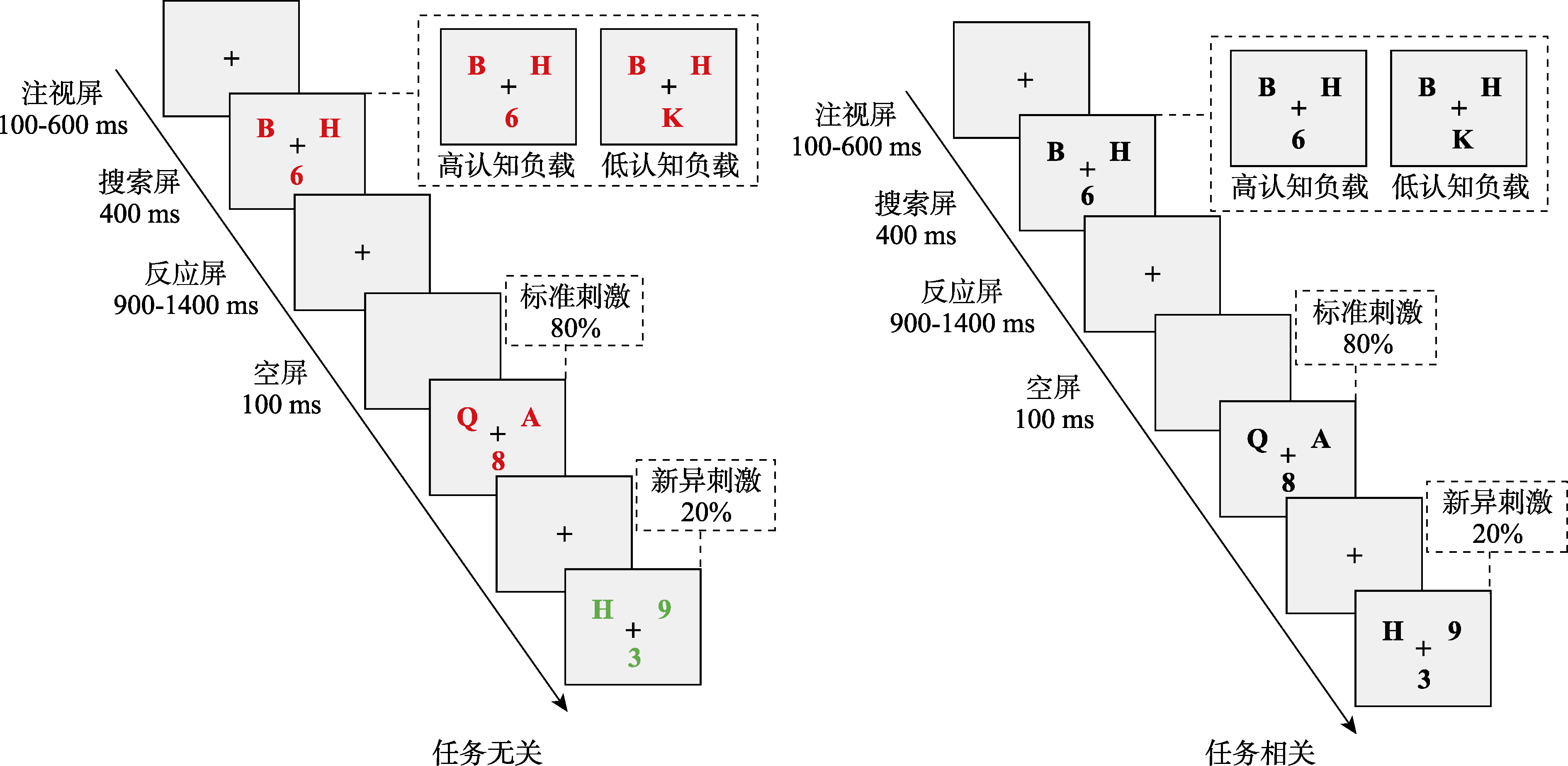
图1 实验设计示意图 注:认知负载(低负载vs高负载)是通过改变三个符号所属的大多数类别来操纵的(3:0 vs 2:1)。刺激显著水平(标准刺激 vs 新异刺激)是通过改变刺激出现的频率来操纵的(标准刺激80%, 新异刺激20%)。显著相关性(相关、无关)是通过符合当前任务目标的选择规则来操纵:任务相关条件下, 显著性通过改变任务相关的多数符号类别的比例来实现; 任务无关条件下, 显著性通过改变任务无关的刺激颜色比例来实现。彩图见电子版, 下同。
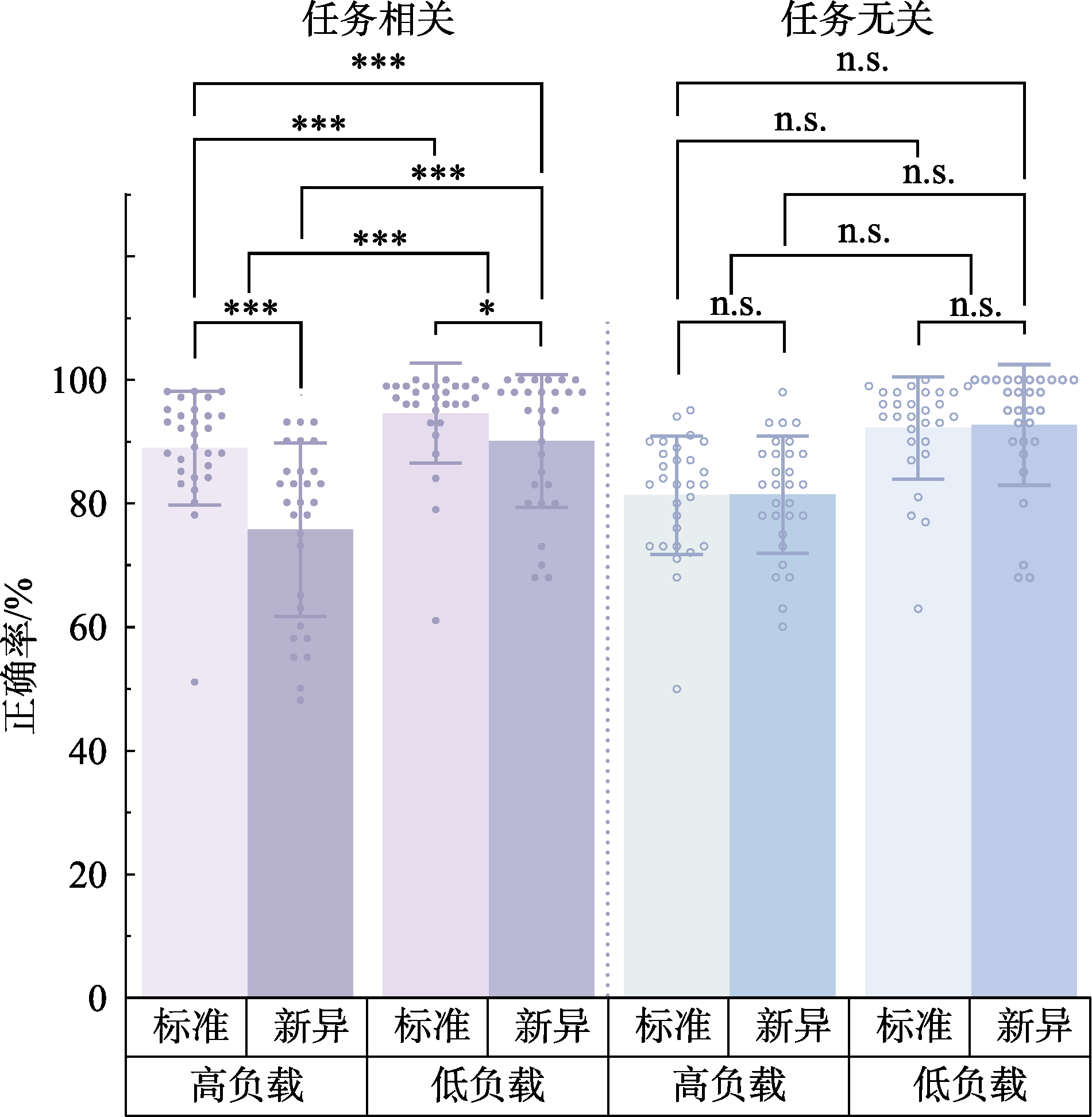
图2 不同认知负载、显著水平与显著相关性条件的正确率(%)结果 注:***表示 p < 0.001, *表示 p < 0.05, ns 代表 p ≥ 0.05, 下同
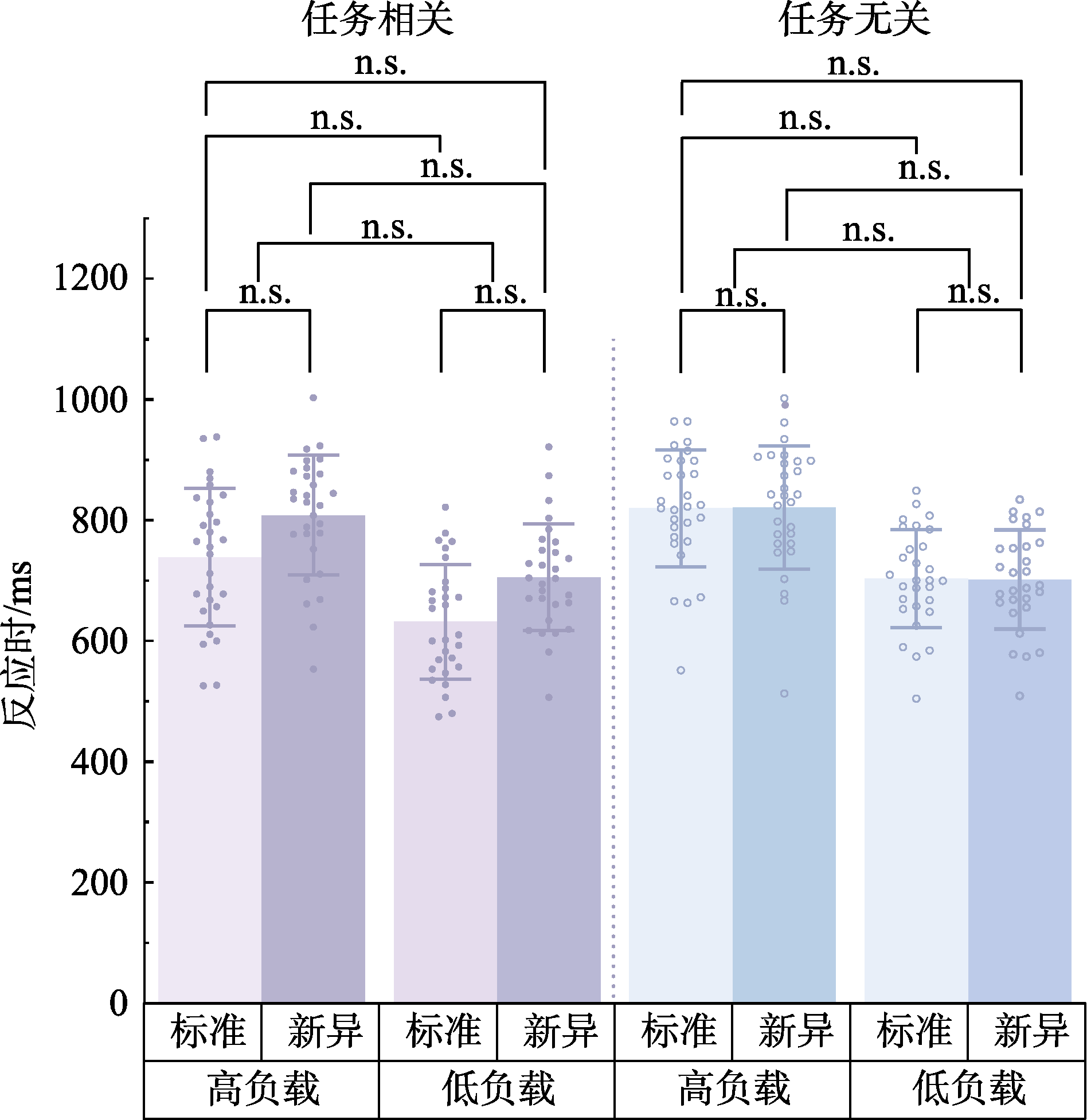
图3 不同认知负载、显著水平与显著相关性条件的反应时(ms)结果
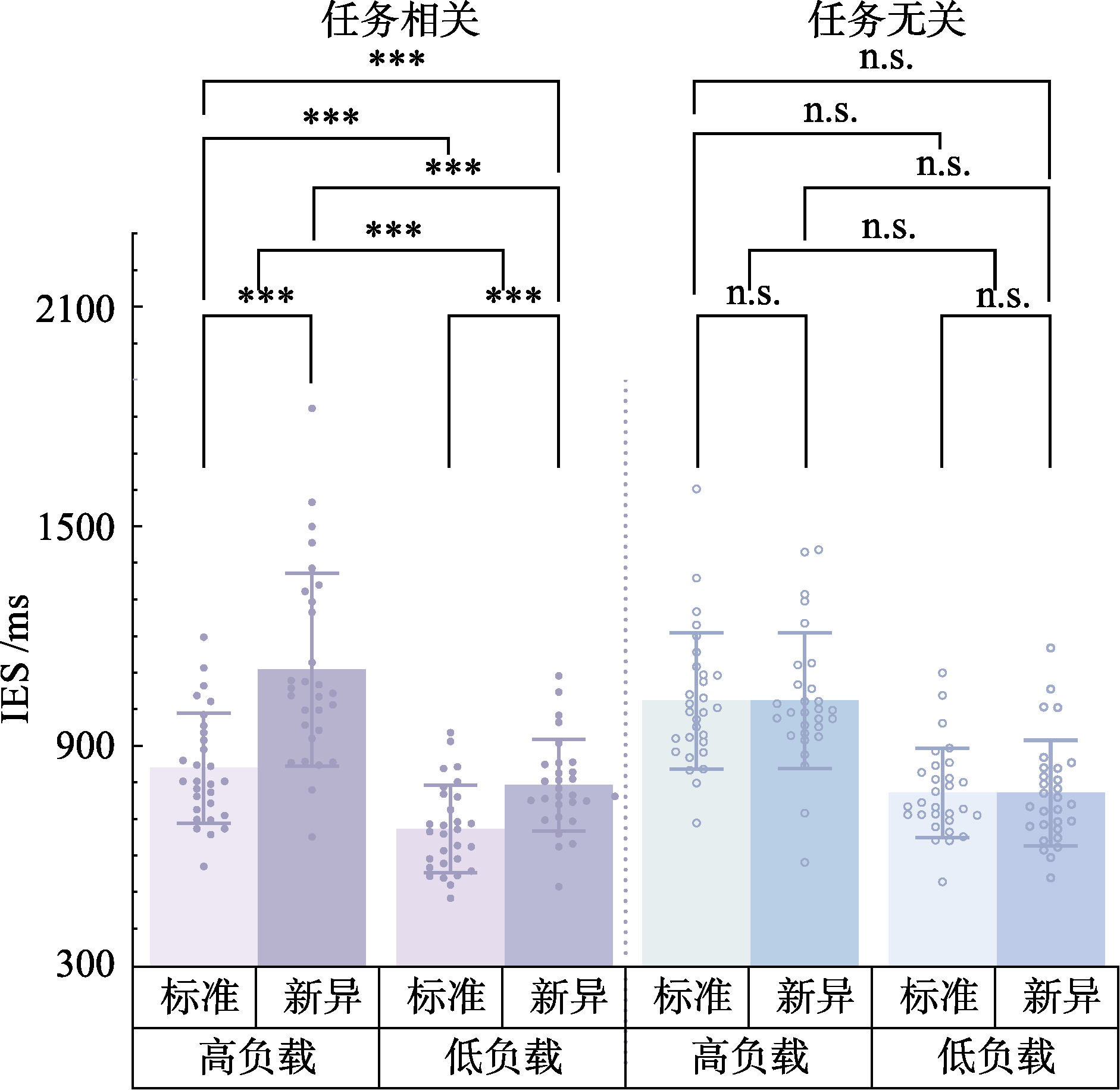
图4 不同认知负载、显著水平与显著相关性条件的IES (ms)结果
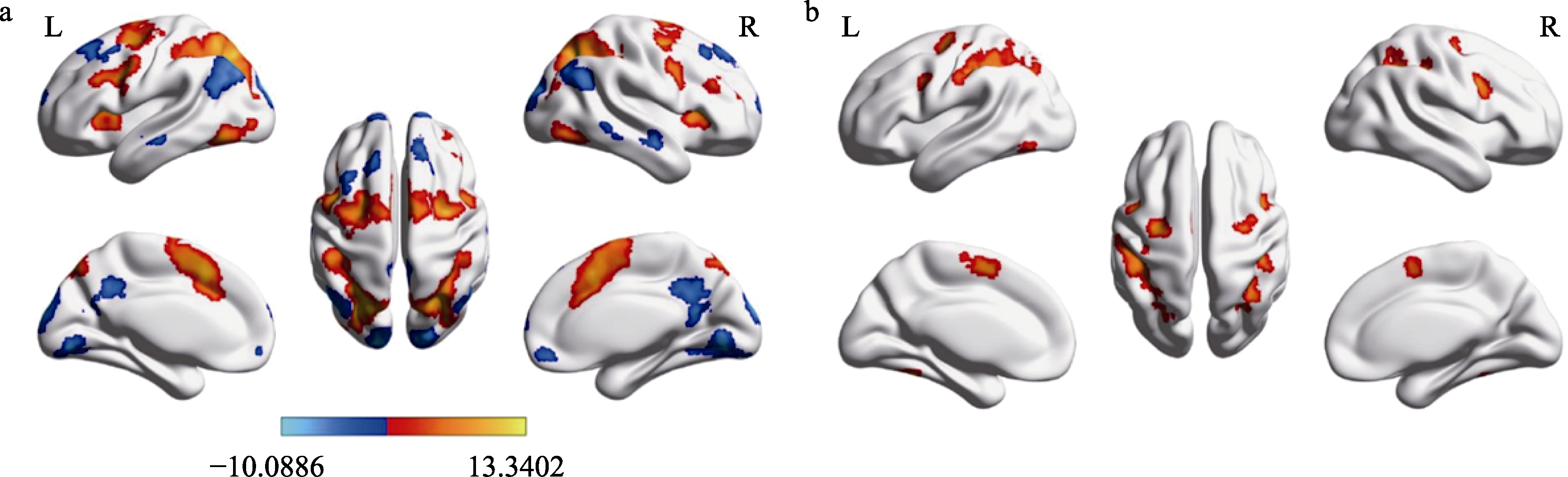
图5 认知负载和显著水平的主效应。(a)与认知负载相关的脑区(高负载 > 低负载); (b)与显著水平相关的脑区(新异刺激 > 标准刺激)。红色表示激活量增加的体素。蓝色表示激活量减少的体素。
| 对比条件 | 脑区 | 左/右 | BA | 峰值坐标(MNI) | k | t | ||
|---|---|---|---|---|---|---|---|---|
| x | y | z | ||||||
| 高负载 > 低负载 | 顶上回 | 左 | 7 | −24 | −72 | 48 | 164980 | 13.34 |
| 顶上回 | 右 | 7 | 24 | −72 | 52 | 3935 | 11.77 | |
| 小脑脚 Ⅰ | 左 | −34 | −70 | −28 | 1690 | 8.77 | ||
| 脑岛 | 左 | 45 | −32 | 22 | 10 | 1647 | 8.17 | |
| 脑岛 | 右 | 45 | 32 | 18 | 12 | 1004 | 10.15 | |
| 丘脑 | 右 | 16 | −14 | 18 | 637 | 6.61 | ||
| 额中回 | 左 | 10 | −30 | 50 | 20 | 219 | 5.4 | |
| 距状裂 | 右 | 17 | 16 | −70 | 10 | 84 | 4.22 | |
| 距状裂 | 左 | 17 | −14 | −74 | 10 | 67 | 3.81 | |
| 高负载 < 低负载 | 楔叶 | 右 | 18 | 16 | −94 | 12 | 4110 | 10.09 |
| 额上回 | 右 | 8 | 22 | 44 | 48 | 2714 | 7.09 | |
| 舌回 | 右 | 18 | 10 | −74 | −2 | 1661 | 9.09 | |
| 角回 | 左 | 39 | −44 | −76 | 46 | 1569 | 8.3 | |
| 顶下回 | 右 | 39 | 58 | −60 | 42 | 1563 | 7.03 | |
| 内侧额上回 | 右 | 10 | 14 | 64 | 12 | 1411 | 6.27 | |
| 颞中回 | 左 | 21 | −60 | −16 | −12 | 492 | 5.78 | |
| 海马旁回 | 左 | 36 | −28 | −26 | −18 | 208 | 4.65 | |
| 三角部额下回 | 左 | 45 | −48 | 32 | 2 | 105 | 4.36 | |
| 小脑脚 Ⅱ | 右 | 20 | −82 | −38 | 100 | 4.87 | ||
| 小脑脚 Ⅱ | 左 | −42 | −72 | −36 | 89 | 4.01 | ||
| 小脑 Ⅸ | 左 | −8 | −50 | −42 | 70 | 4.26 | ||
| 新异刺激 > 标准刺激 | 中央前回 | 左 | 6 | −32 | −8 | 60 | 9549 | 8.9 |
| 小脑 Ⅵ | 左 | −32 | −50 | −22 | 4251 | 8.21 | ||
| 角回 | 右 | 39 | 36 | −56 | 40 | 2419 | 7.85 | |
| 脑岛 | 右 | 45 | 34 | 20 | 10 | 363 | 4.43 | |
| 丘脑 | 左 | −12 | −24 | 8 | 224 | 4.94 | ||
| 脑岛 | 左 | 13 | −28 | 22 | 8 | 197 | 4.51 | |
| 尾状核 | 右 | 48 | 12 | 6 | 12 | 178 | 4.67 | |
| 尾状核 | 左 | 48 | −14 | 8 | 14 | 173 | 5.19 | |
| 小脑 ⅦB | 左 | −28 | −76 | −50 | 115 | 4.86 | ||
表1 认知负载和显著水平的主效应脑激活区域(FDR, p < 0.05, k ≥ 46)
| 对比条件 | 脑区 | 左/右 | BA | 峰值坐标(MNI) | k | t | ||
|---|---|---|---|---|---|---|---|---|
| x | y | z | ||||||
| 高负载 > 低负载 | 顶上回 | 左 | 7 | −24 | −72 | 48 | 164980 | 13.34 |
| 顶上回 | 右 | 7 | 24 | −72 | 52 | 3935 | 11.77 | |
| 小脑脚 Ⅰ | 左 | −34 | −70 | −28 | 1690 | 8.77 | ||
| 脑岛 | 左 | 45 | −32 | 22 | 10 | 1647 | 8.17 | |
| 脑岛 | 右 | 45 | 32 | 18 | 12 | 1004 | 10.15 | |
| 丘脑 | 右 | 16 | −14 | 18 | 637 | 6.61 | ||
| 额中回 | 左 | 10 | −30 | 50 | 20 | 219 | 5.4 | |
| 距状裂 | 右 | 17 | 16 | −70 | 10 | 84 | 4.22 | |
| 距状裂 | 左 | 17 | −14 | −74 | 10 | 67 | 3.81 | |
| 高负载 < 低负载 | 楔叶 | 右 | 18 | 16 | −94 | 12 | 4110 | 10.09 |
| 额上回 | 右 | 8 | 22 | 44 | 48 | 2714 | 7.09 | |
| 舌回 | 右 | 18 | 10 | −74 | −2 | 1661 | 9.09 | |
| 角回 | 左 | 39 | −44 | −76 | 46 | 1569 | 8.3 | |
| 顶下回 | 右 | 39 | 58 | −60 | 42 | 1563 | 7.03 | |
| 内侧额上回 | 右 | 10 | 14 | 64 | 12 | 1411 | 6.27 | |
| 颞中回 | 左 | 21 | −60 | −16 | −12 | 492 | 5.78 | |
| 海马旁回 | 左 | 36 | −28 | −26 | −18 | 208 | 4.65 | |
| 三角部额下回 | 左 | 45 | −48 | 32 | 2 | 105 | 4.36 | |
| 小脑脚 Ⅱ | 右 | 20 | −82 | −38 | 100 | 4.87 | ||
| 小脑脚 Ⅱ | 左 | −42 | −72 | −36 | 89 | 4.01 | ||
| 小脑 Ⅸ | 左 | −8 | −50 | −42 | 70 | 4.26 | ||
| 新异刺激 > 标准刺激 | 中央前回 | 左 | 6 | −32 | −8 | 60 | 9549 | 8.9 |
| 小脑 Ⅵ | 左 | −32 | −50 | −22 | 4251 | 8.21 | ||
| 角回 | 右 | 39 | 36 | −56 | 40 | 2419 | 7.85 | |
| 脑岛 | 右 | 45 | 34 | 20 | 10 | 363 | 4.43 | |
| 丘脑 | 左 | −12 | −24 | 8 | 224 | 4.94 | ||
| 脑岛 | 左 | 13 | −28 | 22 | 8 | 197 | 4.51 | |
| 尾状核 | 右 | 48 | 12 | 6 | 12 | 178 | 4.67 | |
| 尾状核 | 左 | 48 | −14 | 8 | 14 | 173 | 5.19 | |
| 小脑 ⅦB | 左 | −28 | −76 | −50 | 115 | 4.86 | ||
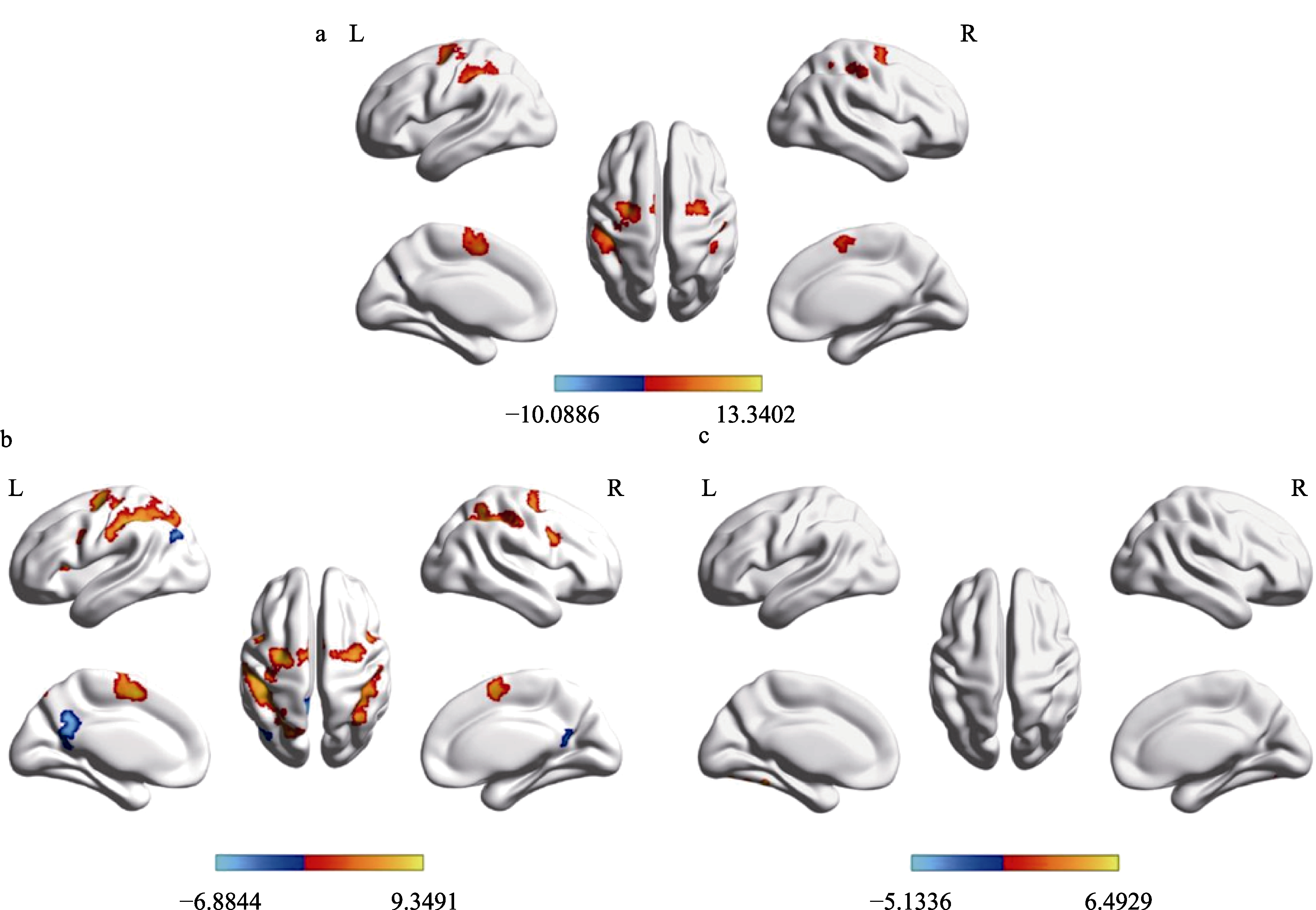
图6 显著水平 × 显著相关性的交互作用。(a)交互作用相关的脑区, (新异刺激−标准刺激)任务相关 > (新异刺激−标准刺激)任务无关。(b)简单效应分析, 任务相关时, 不同显著水平对比激活的脑区(新异刺激任务相关 > 标准刺激任务相关)。(c)简单效应分析, 任务无关时, 不同显著水平对比激活的脑区(新异刺激任务无关 > 标准刺激任务无关)。红色表示激活量增加的体素。蓝色表示激活量减少的体素。
| 对比条件 | 脑区 | 左/右 | BA | 峰值坐标(MNI) | k | t | |||
|---|---|---|---|---|---|---|---|---|---|
| x | y | z | |||||||
| 显著水平 × 显著相关性 | 中央后回 | 左 | 1 | −50 | −34 | 54 | 6179 | 8.71 | |
| 顶上回 | 右 | 7 | 44 | −46 | 58 | 1476 | 6.59 | ||
| 小脑 Ⅷ | 右 | 20 | −62 | −52 | 415 | 7.92 | |||
| 小脑 Ⅵ | 右 | 30 | −52 | −30 | 396 | 7.96 | |||
| 中央前回 | 右 | 6 | 58 | 10 | 30 | 242 | 5.63 | ||
| 中央前回 | 左 | 6 | −60 | 6 | 26 | 186 | 4.69 | ||
| 脑岛 | 右 | 13 | 36 | 22 | 0 | 157 | 4.9 | ||
| 小脑蚓体 | 右 | 4 | −66 | −10 | 130 | 5.51 | |||
| 脑岛 | 左 | 45 | −32 | 20 | 8 | 112 | 5.33 | ||
| 小脑 Ⅵ | 左 | −24 | −58 | −24 | 97 | 4.75 | |||
| 小脑蚓体 | 左 | −2 | −32 | −2 | 68 | 4.67 | |||
| 小脑 Ⅷ | 左 | −26 | −62 | −54 | 55 | 6.28 | |||
| 任务相关 | 新异刺激 > 标准刺激 | 中央前回 | 左 | 6 | −28 | −12 | 52 | 127300 | 9.35 |
| 小脑 Ⅵ | 右 | 24 | −58 | −26 | 4829 | 8.88 | |||
| 顶下回 | 右 | 40 | 46 | −40 | 54 | 3680 | 8.84 | ||
| 岛盖部额下回 | 左 | 6 | −48 | 8 | 30 | 966 | 6.93 | ||
| 尾状核 | 右 | 14 | 8 | 12 | 675 | 5.52 | |||
| 脑岛 | 左 | 13 | −30 | 22 | 8 | 340 | 6.02 | ||
| 丘脑 | 左 | −12 | −22 | 8 | 334 | 5.63 | |||
| 小脑 ⅦB | 左 | −26 | −76 | −50 | 333 | 5.64 | |||
| 豆状核 | 左 | −22 | 2 | 8 | 178 | 5.03 | |||
| 新异刺激 < 标准刺激 | 后扣带回 | 左 | 23 | −4 | −50 | 32 | 1184 | 6.88 | |
| 前扣带与旁扣带回 | 左 | 10 | −14 | 46 | −4 | 389 | 5.43 | ||
| 枕中回 | 左 | 39 | −42 | −76 | 34 | 311 | 5.94 | ||
| 楔前叶 | 右 | 23 | 14 | −54 | 20 | 310 | 5.38 | ||
| 额上回 | 左 | 8 | −18 | 34 | 46 | 284 | 5.49 | ||
| 枕中回 | 右 | 19 | 48 | −78 | 26 | 114 | 6.61 | ||
| 梭状回 | 左 | 37 | −30 | −38 | −16 | 109 | 5.59 | ||
| 中央盖沟 | 左 | 40 | −28 | −40 | 24 | 84 | 6.26 | ||
| 颞中回 | 左 | 21 | −62 | −6 | −14 | 76 | 5.95 | ||
| 眶部额下回 | 左 | 45 | −54 | 30 | −2 | 72 | 4.53 | ||
| 小脑脚 Ⅱ | 右 | 24 | −78 | −38 | 59 | 4.95 | |||
| 任务无关 | 新异刺激 > 标准刺激 | 梭状回 | 左 | 37 | −30 | −44 | −20 | 175 | 6.49 |
| 舌回 | 右 | 19 | 32 | −84 | −18 | 49 | 5.32 | ||
表2 显著水平和显著相关性的交互作用及简单效应分析(无矫正, p < 0.001, k ≥ 46)
| 对比条件 | 脑区 | 左/右 | BA | 峰值坐标(MNI) | k | t | |||
|---|---|---|---|---|---|---|---|---|---|
| x | y | z | |||||||
| 显著水平 × 显著相关性 | 中央后回 | 左 | 1 | −50 | −34 | 54 | 6179 | 8.71 | |
| 顶上回 | 右 | 7 | 44 | −46 | 58 | 1476 | 6.59 | ||
| 小脑 Ⅷ | 右 | 20 | −62 | −52 | 415 | 7.92 | |||
| 小脑 Ⅵ | 右 | 30 | −52 | −30 | 396 | 7.96 | |||
| 中央前回 | 右 | 6 | 58 | 10 | 30 | 242 | 5.63 | ||
| 中央前回 | 左 | 6 | −60 | 6 | 26 | 186 | 4.69 | ||
| 脑岛 | 右 | 13 | 36 | 22 | 0 | 157 | 4.9 | ||
| 小脑蚓体 | 右 | 4 | −66 | −10 | 130 | 5.51 | |||
| 脑岛 | 左 | 45 | −32 | 20 | 8 | 112 | 5.33 | ||
| 小脑 Ⅵ | 左 | −24 | −58 | −24 | 97 | 4.75 | |||
| 小脑蚓体 | 左 | −2 | −32 | −2 | 68 | 4.67 | |||
| 小脑 Ⅷ | 左 | −26 | −62 | −54 | 55 | 6.28 | |||
| 任务相关 | 新异刺激 > 标准刺激 | 中央前回 | 左 | 6 | −28 | −12 | 52 | 127300 | 9.35 |
| 小脑 Ⅵ | 右 | 24 | −58 | −26 | 4829 | 8.88 | |||
| 顶下回 | 右 | 40 | 46 | −40 | 54 | 3680 | 8.84 | ||
| 岛盖部额下回 | 左 | 6 | −48 | 8 | 30 | 966 | 6.93 | ||
| 尾状核 | 右 | 14 | 8 | 12 | 675 | 5.52 | |||
| 脑岛 | 左 | 13 | −30 | 22 | 8 | 340 | 6.02 | ||
| 丘脑 | 左 | −12 | −22 | 8 | 334 | 5.63 | |||
| 小脑 ⅦB | 左 | −26 | −76 | −50 | 333 | 5.64 | |||
| 豆状核 | 左 | −22 | 2 | 8 | 178 | 5.03 | |||
| 新异刺激 < 标准刺激 | 后扣带回 | 左 | 23 | −4 | −50 | 32 | 1184 | 6.88 | |
| 前扣带与旁扣带回 | 左 | 10 | −14 | 46 | −4 | 389 | 5.43 | ||
| 枕中回 | 左 | 39 | −42 | −76 | 34 | 311 | 5.94 | ||
| 楔前叶 | 右 | 23 | 14 | −54 | 20 | 310 | 5.38 | ||
| 额上回 | 左 | 8 | −18 | 34 | 46 | 284 | 5.49 | ||
| 枕中回 | 右 | 19 | 48 | −78 | 26 | 114 | 6.61 | ||
| 梭状回 | 左 | 37 | −30 | −38 | −16 | 109 | 5.59 | ||
| 中央盖沟 | 左 | 40 | −28 | −40 | 24 | 84 | 6.26 | ||
| 颞中回 | 左 | 21 | −62 | −6 | −14 | 76 | 5.95 | ||
| 眶部额下回 | 左 | 45 | −54 | 30 | −2 | 72 | 4.53 | ||
| 小脑脚 Ⅱ | 右 | 24 | −78 | −38 | 59 | 4.95 | |||
| 任务无关 | 新异刺激 > 标准刺激 | 梭状回 | 左 | 37 | −30 | −44 | −20 | 175 | 6.49 |
| 舌回 | 右 | 19 | 32 | −84 | −18 | 49 | 5.32 | ||
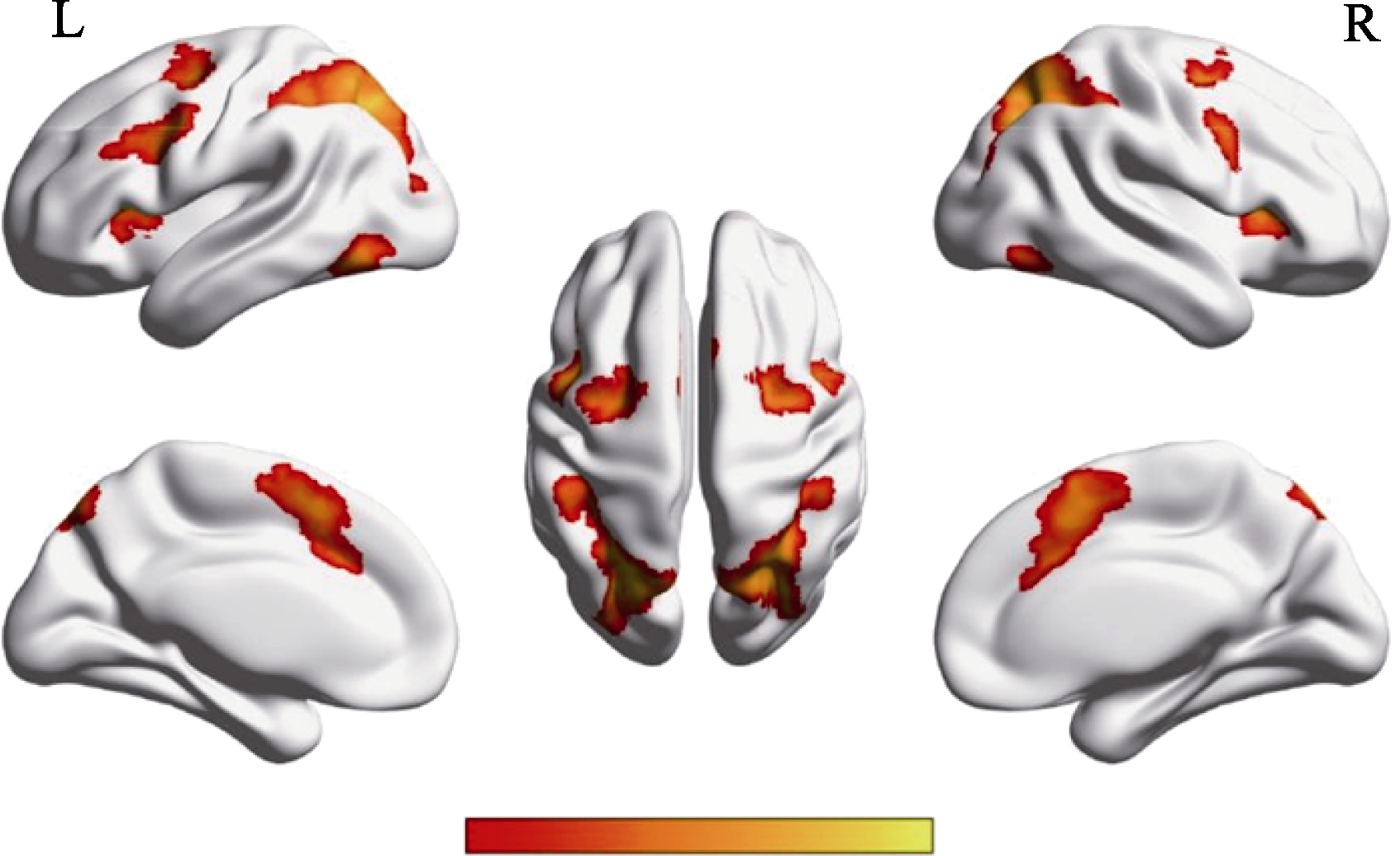
图7 认知控制和显著性加工的共同激活脑区。红色表示激活量增加的体素。
| 脑区 | 左/右 | BA | 峰值坐标(MNI) | k | t | ||
|---|---|---|---|---|---|---|---|
| x | y | z | |||||
| 顶上回 | 左 | 7 | −28 | −68 | 48 | 101210 | 17.47 |
| 小脑 Ⅵ | 右 | 26 | −66 | −26 | 3181 | 9.60 | |
| 角回 | 右 | 39 | 32 | −60 | 46 | 2966 | 12.47 |
| 中央前回 | 右 | 6 | 34 | −4 | 50 | 2058 | 10.52 |
| 枕下回 | 左 | 37 | −46 | −66 | −12 | 1451 | 10.33 |
| 脑岛 | 左 | 13 | −32 | 20 | 12 | 639 | 10.51 |
| 脑岛 | 右 | 13 | 32 | 20 | 8 | 522 | 7.60 |
| 丘脑 | 左 | −10 | −18 | 8 | 423 | 5.03 | |
| 尾状核 | 右 | 48 | 16 | −4 | 18 | 162 | 5.31 |
| 小脑 Ⅷ | 左 | −24 | −72 | −50 | 159 | 9.17 | |
表3 认知控制和显著性加工的共同激活脑区(FDR, p < 0.05, k ≥ 46)
| 脑区 | 左/右 | BA | 峰值坐标(MNI) | k | t | ||
|---|---|---|---|---|---|---|---|
| x | y | z | |||||
| 顶上回 | 左 | 7 | −28 | −68 | 48 | 101210 | 17.47 |
| 小脑 Ⅵ | 右 | 26 | −66 | −26 | 3181 | 9.60 | |
| 角回 | 右 | 39 | 32 | −60 | 46 | 2966 | 12.47 |
| 中央前回 | 右 | 6 | 34 | −4 | 50 | 2058 | 10.52 |
| 枕下回 | 左 | 37 | −46 | −66 | −12 | 1451 | 10.33 |
| 脑岛 | 左 | 13 | −32 | 20 | 12 | 639 | 10.51 |
| 脑岛 | 右 | 13 | 32 | 20 | 8 | 522 | 7.60 |
| 丘脑 | 左 | −10 | −18 | 8 | 423 | 5.03 | |
| 尾状核 | 右 | 48 | 16 | −4 | 18 | 162 | 5.31 |
| 小脑 Ⅷ | 左 | −24 | −72 | −50 | 159 | 9.17 | |
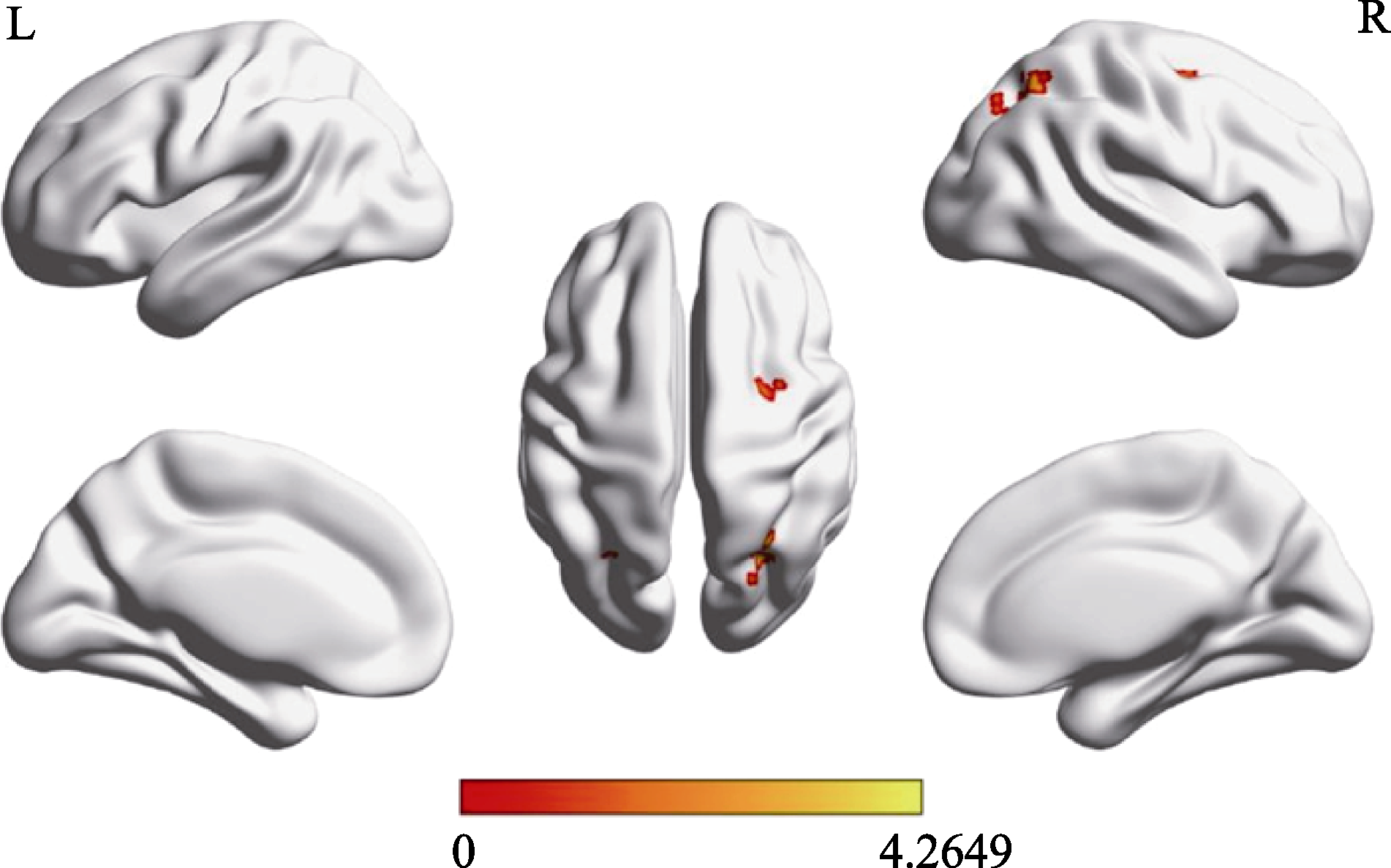
图8 对认知控制和显著性加工进行区分的MVPA结果。红色表示在解码中贡献显著的脑区。
| 脑区 | 左/右 | BA | 峰值坐标(MNI) | k | t | ||
|---|---|---|---|---|---|---|---|
| x | y | z | |||||
| 顶枕联合区 | 右 | 7 | 22 | −64 | 42 | 183 | 3.94 |
| 中央前回/FEF | 右 | 6 | 30 | −6 | 46 | 87 | 3.51 |
表4 对认知控制和显著性加工进行区分的脑区(无矫正, p < 0.005, k ≥ 46)
| 脑区 | 左/右 | BA | 峰值坐标(MNI) | k | t | ||
|---|---|---|---|---|---|---|---|
| x | y | z | |||||
| 顶枕联合区 | 右 | 7 | 22 | −64 | 42 | 183 | 3.94 |
| 中央前回/FEF | 右 | 6 | 30 | −6 | 46 | 87 | 3.51 |
| [1] |
Arcizet F., Mirpour K., & Bisley J. W. (2011). A pure salience response in posterior parietal cortex. Cerebral Cortex, 21(11), 2498-2506.
doi: 10.1093/cercor/bhr035 URL |
| [2] |
Awh E., Belopolsky A. V., & Theeuwes J. (2012). Top-down versus bottom-up attentional control: A failed theoretical dichotomy. Trends in cognitive sciences, 16(8), 437-443.
doi: 10.1016/j.tics.2012.06.010 pmid: 22795563 |
| [3] | Bekinschtein T. A., Dehaene S., Rohaut B., Tadel F., Cohen L., & Naccache L. (2009). Neural signature of the conscious processing of auditory regularities. Proceedings of the National Academy of Sciences, 106(5), 1672-1677. |
| [4] | Bouvier B., Susini P., Marquis-Favre C., Misdariis N. (2023). Revealing the stimulus-driven component of attention through modulations of auditory salience by timbre attributes. Scientific Reports, 13(1), 6842. |
| [5] |
Brass M., & von Cramon D. Y. (2004). Selection for cognitive control: A functional magnetic resonance imaging study on the selection of task-relevant information. Journal of Neuroscience, 24(40), 8847-8852.
doi: 10.1523/JNEUROSCI.2513-04.2004 pmid: 15470151 |
| [6] |
Bressler S. L., & Menon V. (2010). Large-scale brain networks in cognition: Emerging methods and principles. Trends in Cognitive Sciences, 14(6), 277-290.
doi: 10.1016/j.tics.2010.04.004 pmid: 20493761 |
| [7] | Broschard M. B., Turner B. M., Tranel D., & Freeman J. H. (2024). Dissociable roles of the dorsolateral and ventromedial prefrontal cortex in human categorization. Journal of Neuroscience, 44(34), e2343232024. |
| [8] |
Campbell J. I. D., & Thompson V. A. (2012). MorePower 6.0 for ANOVA with relational confidence intervals and Bayesian analysis. Behavior Research Methods, 44(4), 1255-1265.
doi: 10.3758/s13428-012-0186-0 pmid: 22437511 |
| [9] | Chapman A. F., & Störmer V. S. (2022). Feature similarity is non-linearly related to attentional selection: Evidence from visual search and sustained attention tasks. Journal of Vision, 22(8), 4. |
| [10] |
Chen Q., Weidner R., Weiss P. H., Marshall J. C., & Fink G. R. (2012). Neural interaction between spatial domain and spatial reference frame in parietal-occipital junction. Journal of Cognitive Neuroscience, 24(11), 2223-2236.
pmid: 22721375 |
| [11] |
Collignon O., Vandewalle G., Voss P., Albouy G., Charbonneau G., Lassonde M., & Lepore F. (2011). Functional specialization for auditory-spatial processing in the occipital cortex of congenitally blind humans. Proceedings of the National Academy of Sciences, 108(11), 4435-4440.
doi: 10.1073/pnas.1013928108 URL |
| [12] |
Corbetta M., Kincade J. M., & Shulman G. L. (2002). Neural systems for visual orienting and their relationships to spatial working memory. Journal of Cognitive Neuroscience, 14(3), 508-523.
doi: 10.1162/089892902317362029 pmid: 11970810 |
| [13] |
Corbetta M., Patel G., & Shulman G. L. (2008). The reorienting system of the human brain: From environment to theory of mind. Neuron, 58(3), 306-324.
doi: 10.1016/j.neuron.2008.04.017 pmid: 18466742 |
| [14] |
Desimone R., & Duncan J. (1995). Neural mechanisms of selective visual attention. Annual Review of Neuroscience, 18(1), 193-222.
doi: 10.1146/neuro.1995.18.issue-1 URL |
| [15] |
De Fockert J., Rees G., Frith C., & Lavie N. (2004). Neural correlates of attentional capture in visual search. Journal of Cognitive Neuroscience, 16(5), 751-759.
pmid: 15200703 |
| [16] |
Fan J. (2014). An information theory account of cognitive control. Frontiers in Human Neuroscience, 8, 680.
doi: 10.3389/fnhum.2014.00680 pmid: 25228875 |
| [17] | Fan J., Guise K. G., Liu X., & Wang H. (2008). Searching for the majority: Algorithms of voluntary control. PLOS ONE, 3(10), e3522. |
| [18] |
Fecteau J. H., & Munoz D. P. (2006). Salience, relevance, and firing: A priority map for target selection. Trends in Cognitive Sciences, 10(8), 382-390.
pmid: 16843702 |
| [19] |
Ferrera V. P., Yanike M., & Cassanello C. (2009). Frontal eye field neurons signal changes in decision criteria. Nature Neuroscience, 12(11), 1458-1462.
doi: 10.1038/nn.2434 pmid: 19855389 |
| [20] |
Freedman D. J., Riesenhuber M., Poggio T., & Miller E. K. (2003). A comparison of primate prefrontal and inferior temporal cortices during visual categorization. Journal of Neuroscience, 23(12), 5235-5246.
pmid: 12832548 |
| [21] |
Garrido M. I., Kilner J. M., Stephan K. E., & Friston K. J. (2009). The mismatch negativity: A review of underlying mechanisms. Clinical Neurophysiology, 120(3), 453-463.
doi: 10.1016/j.clinph.2008.11.029 pmid: 19181570 |
| [22] |
Geng J. J., & Mangun G. R. (2011). Right temporoparietal junction activation by a salient contextual cue facilitates target discrimination. Neuroimage, 54(1), 594-601.
doi: 10.1016/j.neuroimage.2010.08.025 pmid: 20728548 |
| [23] |
Harsay H. A., Spaan M., Wijnen J. G., & Ridderinkhof K. R. (2012). Error awareness and salience processing in the oddball task: Shared neural mechanisms. Frontiers in Human Neuroscience, 6, 246.
doi: 10.3389/fnhum.2012.00246 pmid: 22969714 |
| [24] |
Haxby J. V., Gobbini M. I., Furey M. L., Ishai A., Schouten J. L., & Pietrini P. (2001). Distributed and overlapping representations of faces and objects in ventral temporal cortex. Science, 293(5539), 2425-2430.
doi: 10.1126/science.1063736 pmid: 11577229 |
| [25] |
Itti L., & Koch C. (2001). Computational modelling of visual attention. Nature Reviews Neuroscience, 2(3), 194-203.
pmid: 11256080 |
| [26] |
Katsuki F., & Constantinidis C. (2014). Bottom-up and top-down attention: Different processes and overlapping neural systems. The Neuroscientist, 20(5), 509-521.
doi: 10.1177/1073858413514136 URL |
| [27] |
Keller A. S., Jagadeesh A. V., Bugatus L., Williams L. M., & Grill-Spector K. (2022). Attention enhances category representations across the brain with strengthened residual correlations to ventral temporal cortex. Neuroimage, 249, 118900.
doi: 10.1016/j.neuroimage.2022.118900 URL |
| [28] |
Kim H. (2014). Involvement of the dorsal and ventral attention networks in oddball stimulus processing: A meta‐analysis. Human Brain Mapping, 35(5), 2265-2284.
doi: 10.1002/hbm.v35.5 URL |
| [29] | Kroner A., Senden M., & Goebel R. (2023). Neural correlates of high-level visual saliency models. bioRxiv, 2023-07. |
| [30] |
Kucyi A., Hodaie M., & Davis K. D. (2012). Lateralization in intrinsic functional connectivity of the temporoparietal junction with salience-and attention-related brain networks. Journal of Neurophysiology, 108(12), 3382-3392.
doi: 10.1152/jn.00674.2012 URL |
| [31] |
Kumaran D., Summerfield J. J., Hassabis D., & Maguire E. A. (2009). Tracking the emergence of conceptual knowledge during human decision making. Neuron, 63(6), 889-901.
doi: 10.1016/j.neuron.2009.07.030 pmid: 19778516 |
| [32] |
Lavie N. (2005). Distracted and confused?: Selective attention under load. Trends in Cognitive Sciences, 9(2), 75-82.
doi: 10.1016/j.tics.2004.12.004 pmid: 15668100 |
| [33] | Lerebourg M., de Lange F. P., & Peelen M. V. (2024). Attentional guidance through object associations in visual cortex. Science Advances, 10(41), eado6226. |
| [34] |
Li L., Gratton C., Yao D., & Knight R. T. (2010). Role of frontal and parietal cortices in the control of bottom-up and top-down attention in humans. Brain Research, 1344, 173-184.
doi: 10.1016/j.brainres.2010.05.016 pmid: 20470762 |
| [35] |
Logothetis N. K. (2008). What we can do and what we cannot do with fMRI. Nature, 453(7197), 869-878.
doi: 10.1038/nature06976 |
| [36] | Macé M. J.-M., Joubert O. R., Nespoulous J.-L., & Fabre- Thorpe M. (2009). The time-course of visual categorizations: You spot the animal faster than the bird. PLoS One, 4(6), e5927. |
| [37] |
Miao Z., Wang J., Wang Y., Jiang Y., Chen Y., & Wu X. (2023). The time course of category-based attentional template pre-activation depends on the category framework. Neuropsychologia, 189, 108667.
doi: 10.1016/j.neuropsychologia.2023.108667 URL |
| [38] |
Mo C., He D., & Fang F. (2018). Attention priority map of face images in human early visual cortex. Journal of Neuroscience, 38(1), 149-157.
doi: 10.1523/JNEUROSCI.1206-17.2017 pmid: 29133433 |
| [39] |
Näätänen R., Kujala T., & Winkler I. (2011). Auditory processing that leads to conscious perception: A unique window to central auditory processing opened by the mismatch negativity and related responses. Psychophysiology, 48(1), 4-22.
doi: 10.1111/j.1469-8986.2010.01114.x pmid: 20880261 |
| [40] |
Noudoost B., & Moore T. (2011). Control of visual cortical signals by prefrontal dopamine. Nature, 474(7351), 372-375.
doi: 10.1038/nature09995 |
| [41] |
Oxner M., Martinovic J., Forschack N., Lempe R., Gundlach C., & Müller M. (2023). Global enhancement of target color-not proactive suppression-explains attentional deployment during visual search. Journal of Experimental Psychology: General, 152(6), 1705-1722.
doi: 10.1037/xge0001350 URL |
| [42] |
Peelen M. V., & Kastner S. (2014). Attention in the real world: Toward understanding its neural basis. Trends in Cognitive Sciences, 18(5), 242-250.
doi: 10.1016/j.tics.2014.02.004 pmid: 24630872 |
| [43] | Reeder R. R., & Peelen M. V. (2013). The contents of the search template for category-level search in natural scenes. Journal of Vision, 13(3), 1-13. |
| [44] |
Rosch E., Mervis C. B., Gray W. D., Johnson D. M., & Boyes-Braem P. (1976). Basic objects in natural categories. Cognitive Psychology, 8(3), 382-439.
doi: 10.1016/0010-0285(76)90013-X URL |
| [45] | Talairach J., Tournoux P., & Rayport M. (1988). Co-planar stereotaxic atlas of the human brain: 3-dimensional proportional system - An approach to cerebral imaging. Thieme Medical Publishers. |
| [46] |
Thayer D. D., Bahle B., & Hollingworth A. (2022). Guidance of attention from visual working memory is feature-based, not object-based: Implications for models of feature binding. Journal of Experimental Psychology: General, 151(5), 1018-1034.
doi: 10.1037/xge0001116 URL |
| [47] |
Theeuwes J. (2010). Top-down and bottom-up control of visual selection. Acta Psychologica, 135(2), 77-99.
doi: 10.1016/j.actpsy.2010.02.006 pmid: 20507828 |
| [48] | Townsend J. T., & Ashby F. G. (1983). Stochastic modeling of elementary psychological processes. Cambridge University Press. |
| [49] |
Wang H., Liu X., & Fan J. (2011). Cognitive control in majority search: A computational modeling approach. Frontiers in Human Neuroscience, 5, 16.
doi: 10.3389/fnhum.2011.00016 pmid: 21369357 |
| [50] |
Wang M., Yu B., Luo C., Fogelson N., Zhang J., Jin Z., & Li L. (2020). Evaluating the causal contribution of fronto-parietal cortices to the control of the bottom-up and top-down visual attention using fMRI-guided TMS. Cortex, 126, 200-212.
doi: S0010-9452(20)30029-0 pmid: 32088408 |
| [51] |
Wu Q., Chang C.-F., Xi S., Huang I.-W., Liu Z., Juan C.-H.,... Fan J. (2015). A critical role of temporoparietal junction in the integration of top-down and bottom-up attentional control. Human Brain Mapping, 36(11), 4317-4333.
doi: 10.1002/hbm.22919 pmid: 26308973 |
| [52] |
Wu T., Chen C., Spagna A., Wu X., Mackie M.-A., Russell-Giller S., … Fan J. (2020). The functional anatomy of cognitive control: A domain-general brain network for uncertainty processing. Journal of Comparative Neurology, 528(8), 1265-1292.
doi: 10.1002/cne.24804 pmid: 31674015 |
| [53] | Wu T., Dufford A. J., Mackie M.-A., Egan L. J., & Fan J. (2016). The capacity of cognitive control estimated from a perceptual decision making task. Scientific Reports, 6(1), 34025. |
| [54] |
Wu T., Spagna A., Chen C., Schulz K. P., Hof P. R., & Fan J. (2020). Supramodal mechanisms of the cognitive control network in uncertainty processing. Cerebral Cortex, 30(12), 6336-6349.
doi: 10.1093/cercor/bhaa189 URL |
| [55] | Wu X., & Fu S. (2017). The different roles of category and feature specific attentional control settings on attentional enhancement and inhibition. Attention, Perception, & Psychophysics, 79, 1968-1978. |
| [56] |
Wu X., Liu X., & Fu S. (2016). Feature and category specific attentional control settings are differently affected by attentional engagement in contingent attentional capture. Biological Psychology, 118, 8-16.
doi: 10.1016/j.biopsycho.2016.04.065 URL |
| [57] |
Wyble B., Folk C., & Potter M. C. (2013). Contingent attentional capture by conceptually relevant images. Journal of Experimental Psychology: Human Perception and Performance, 39(3), 861-871.
doi: 10.1037/a0030517 pmid: 23163786 |
| [58] |
Yang H., & Zelinsky G. J. (2009). Visual search is guided to categorically-defined targets. Vision Research, 49(16), 2095-2103.
doi: 10.1016/j.visres.2009.05.017 pmid: 19500615 |
| [59] | Zhang L., Bai L., Guo Z., Gao J., Wu J., Huang J., & Liu Z. (2024). Abnormal functional connectivity of the occipital thalamus with the superior occipital gyrus is associated with mild cognitive impairment in elderly individuals with primary insomnia. Brain and Behavior, 14(2), e3411. |
| [1] | 王爱君, 黄杰, 赵丹娜, 李欣, 张明. 刺激相似性对跨通道冲突中感觉主导效应的影响*[J]. 心理学报, 2026, 58(4): 571-589. |
| [2] | 陈霁雯, 买晓琴, 李富洪. 去抑制的认知神经机制: 一项事件相关电位研究[J]. 心理学报, 2025, 57(5): 762-774. |
| [3] | 林爽, 程塨渌, 刘文, 白学军. 初中生认知控制对替代性攻击行为的影响: 激惹和触发的情境边界条件[J]. 心理学报, 2025, 57(1): 36-57. |
| [4] | 潘玥安, 姜云鹏, 郭茂杰, 吴瑕. 不确定性和预期有效性对运动方向感知决策的影响[J]. 心理学报, 2022, 54(6): 595-603. |
| [5] | 陈莉, 石晓柯, 李维娜, 胡妍. 基于不同冲突水平的认知控制对性别刻板印象表达的影响[J]. 心理学报, 2022, 54(6): 628-645. |
| [6] | 李建花, 解佳佳, 庄锦英. 生理周期对情景记忆的影响[J]. 心理学报, 2022, 54(5): 466-480. |
| [7] | 吴建校, 曹碧华, 陈云, 李子夏, 李富洪. 认知控制的层级性:来自任务切换的脑电证据*[J]. 心理学报, 2022, 54(10): 1167-1180. |
| [8] | 张孟可, 李晴, 尹首航, 陈安涛. 冲突水平的变化诱发冲突适应[J]. 心理学报, 2021, 53(2): 128-138. |
| [9] | 黄月胜, 张豹, 范兴华, 黄杰. 无关工作记忆表征的负性情绪信息能否捕获视觉注意?一项眼动研究[J]. 心理学报, 2021, 53(1): 26-37. |
| [10] | 孙岩, 吕娇娇, 兰帆, 张丽娜. 自我关注重评和情境关注重评情绪调节策略及对随后认知控制的影响[J]. 心理学报, 2020, 52(12): 1393-1406. |
| [11] | 崔诣晨, 王沛, 崔亚娟. 知觉冲突印象形成的认知控制策略:以刻板化信息与反刻板化信息为例 *[J]. 心理学报, 2019, 51(10): 1157-1170. |
| [12] | 王宴庆, 陈安涛, 胡学平, 尹首航. 奖赏通过增强信号监测提升认知控制[J]. 心理学报, 2019, 51(1): 48-57. |
| [13] | 胡岑楼;张豹;黄赛. 无关长时记忆表征能否引导视觉注意选择?[J]. 心理学报, 2017, 49(5): 590-601. |
| [14] | 张豹;胡岑楼;黄赛. 认知控制在工作记忆表征引导注意中的作用:来自眼动的证据[J]. 心理学报, 2016, 48(9): 1105-1118. |
| [15] | 刘聪;焦鲁;孙逊;王瑞明. 语言转换对非熟练双语者不同认知控制成分的即时影响[J]. 心理学报, 2016, 48(5): 472-481. |
| 阅读次数 | ||||||
|
全文 |
|
|||||
|
摘要 |
|
|||||
