

ISSN 0439-755X
CN 11-1911/B
主办:中国心理学会
中国科学院心理研究所
出版:科学出版社
CN 11-1911/B
主办:中国心理学会
中国科学院心理研究所
出版:科学出版社
心理学报 ›› 2026, Vol. 58 ›› Issue (2): 247-263.doi: 10.3724/SP.J.1041.2026.0247 cstr: 32110.14.2026.0247
• “社会治理视角下经济处境的心理影响及其干预策略”专栏 • 上一篇 下一篇
茆家焱1, 杨沈龙2( ), 田彩玉3
收稿日期:2024-12-30
发布日期:2025-12-03
出版日期:2026-02-25
通讯作者:
杨沈龙, E-mail: yangsl@mail.xjtu.edu.cn基金资助:
MAO Jia-Yan1, YANG Shen-Long2(), TIAN Cai-Yu3
Received:2024-12-30
Online:2025-12-03
Published:2026-02-25
摘要:
以往研究发现经济不平等可以使个体更渴求财富与地位, 但是这种需求能否转化为个体现实的努力行动还有待揭示。本研究通过6个子研究发现了经济不平等引发的心理后效的冲突性, 即一方面促进财富地位渴求, 但另一方面则激发了躺平倾向。研究1和研究2基于相关法, 显示经济不平等可以预测这种冲突的后效, 而且发现它预测财富地位渴求是基于地位焦虑的中介作用, 它预测躺平倾向是基于控制感的中介作用。研究3和研究4 (包括4a和4b)则通过实验法, 为上述两个后效及其中介机制提供了因果的证据。考虑到躺平倾向的消极性, 研究5进一步探索潜在的调节变量, 并发现社会流动感知可以调节经济不平等通过控制感预测躺平倾向的中介关系。研究不仅延伸了过往该领域的发现, 同时揭示了经济不平等引发的冲突性后果及其作用机制, 还为缓解感知不平等的消极结果提供了新的视角, 对于激发个人努力、促进畅通的社会流动有一定的启示。
中图分类号:
茆家焱, 杨沈龙, 田彩玉. (2026). 想成功又想躺平:经济不平等引发的冲突后效及其作用机制. 心理学报, 58(2), 247-263.
MAO Jia-Yan, YANG Shen-Long, TIAN Cai-Yu. (2026). Desire for success but “lying flat”: The conflicting consequences of economic inequality and its mechanisms. Acta Psychologica Sinica, 58(2), 247-263.
| 变量 | M | SD | 1 | 2 | 3 |
|---|---|---|---|---|---|
| 1. 经济不平等 | 4.59 | 0.96 | 1 | ||
| 2. 财富地位渴求 | 5.25 | 1.22 | 0.26*** | 1 | |
| 3. 躺平倾向 | 2.08 | 0.95 | 0.14* | −0.06 | 1 |
| 4. 主观SES | 5.56 | 1.18 | −0.15* | 0.00 | −0.81 |
表1 研究1描述性统计和相关分析结果(N = 217)
| 变量 | M | SD | 1 | 2 | 3 |
|---|---|---|---|---|---|
| 1. 经济不平等 | 4.59 | 0.96 | 1 | ||
| 2. 财富地位渴求 | 5.25 | 1.22 | 0.26*** | 1 | |
| 3. 躺平倾向 | 2.08 | 0.95 | 0.14* | −0.06 | 1 |
| 4. 主观SES | 5.56 | 1.18 | −0.15* | 0.00 | −0.81 |
| 变量 | M | SD | 1 | 2 | 3 | 4 |
|---|---|---|---|---|---|---|
| 1. 经济不平等 | 4.89 | 1.02 | 1 | |||
| 2. 地位焦虑 | 4.02 | 1.57 | 0.33*** | 1 | ||
| 3. 控制感 | 4.75 | 1.14 | −0.44*** | −0.53*** | 1 | |
| 4. 财富地位渴求 | 5.83 | 0.76 | 0.12** | 0.37*** | −0.03 | 1 |
| 5. 躺平倾向 | 2.08 | 0.77 | 0.16*** | 0.17*** | −0.45*** | −0.22*** |
表2 研究2描述性统计和相关分析结果(N = 600)
| 变量 | M | SD | 1 | 2 | 3 | 4 |
|---|---|---|---|---|---|---|
| 1. 经济不平等 | 4.89 | 1.02 | 1 | |||
| 2. 地位焦虑 | 4.02 | 1.57 | 0.33*** | 1 | ||
| 3. 控制感 | 4.75 | 1.14 | −0.44*** | −0.53*** | 1 | |
| 4. 财富地位渴求 | 5.83 | 0.76 | 0.12** | 0.37*** | −0.03 | 1 |
| 5. 躺平倾向 | 2.08 | 0.77 | 0.16*** | 0.17*** | −0.45*** | −0.22*** |
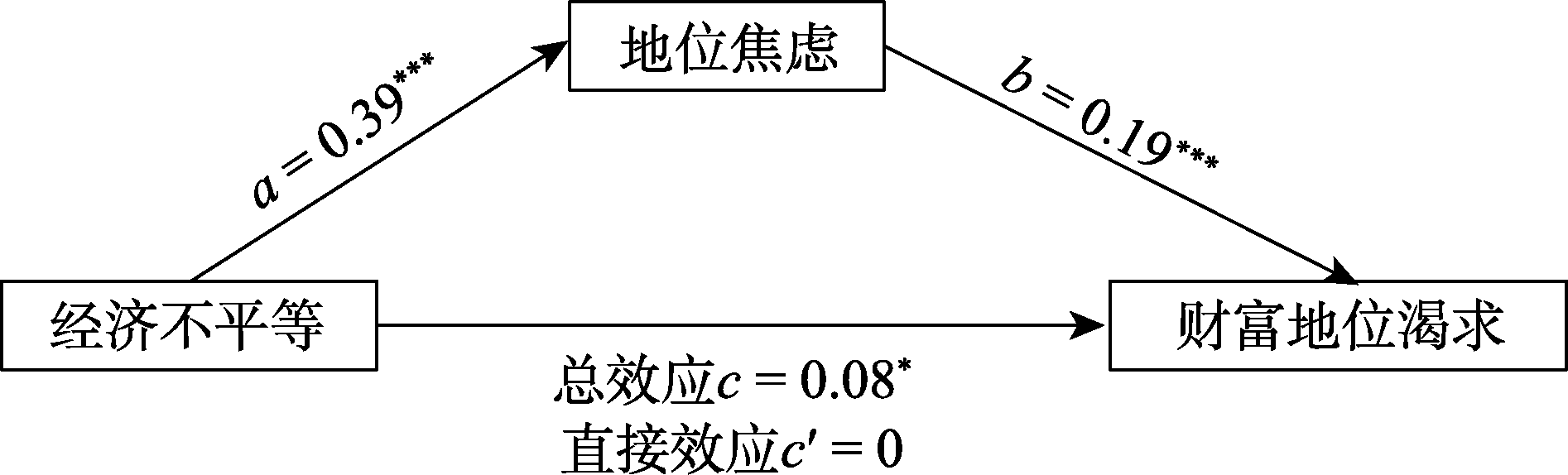
图1 研究2中地位焦虑的中介作用(N = 600)
注:*p < 0.05, **p < 0.01, ***p < 0.001。
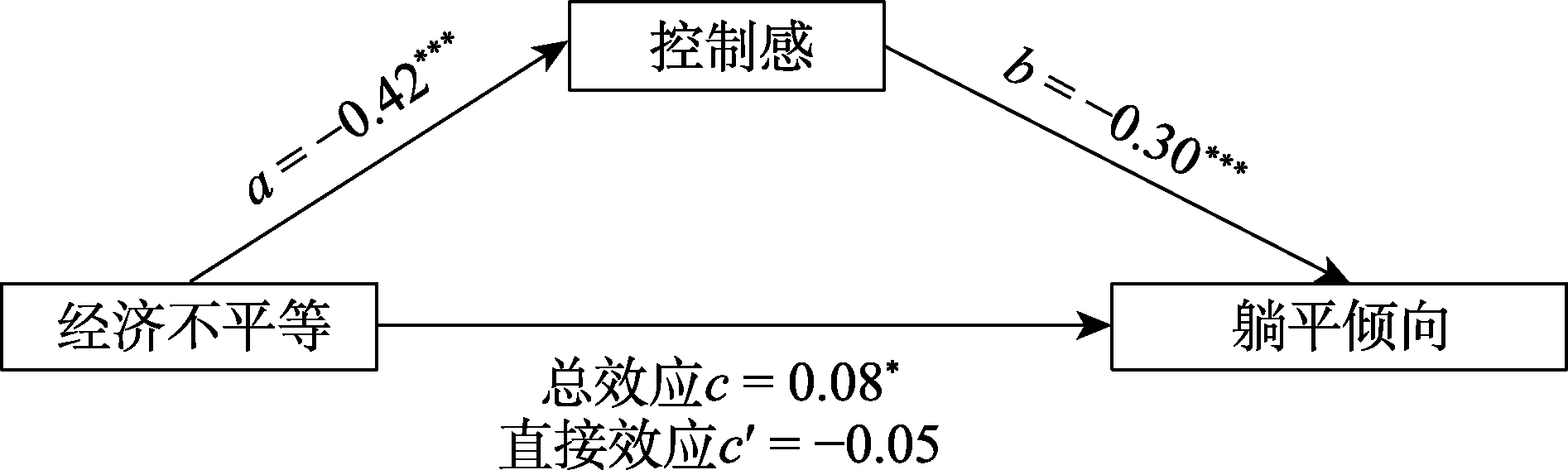
图2 研究2中控制感的中介作用(N = 600)
注:*p < 0.05, **p < 0.01, ***p < 0.001。
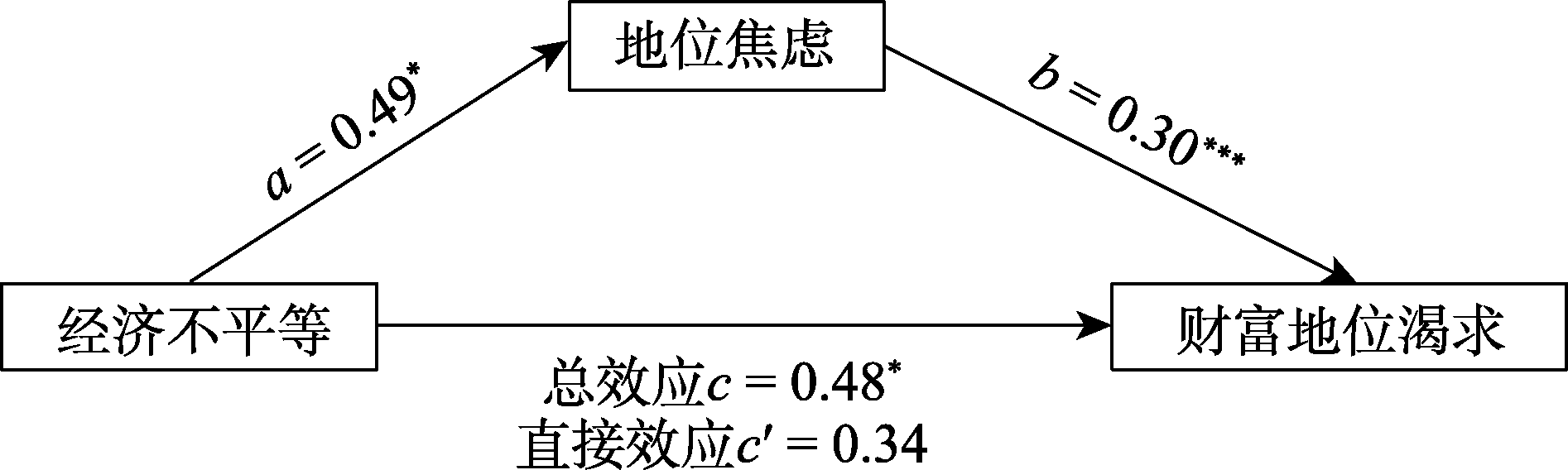
图3 研究3中地位焦虑的中介作用(N = 116)
注: *p < 0.05, **p < 0.01, ***p < 0.001。
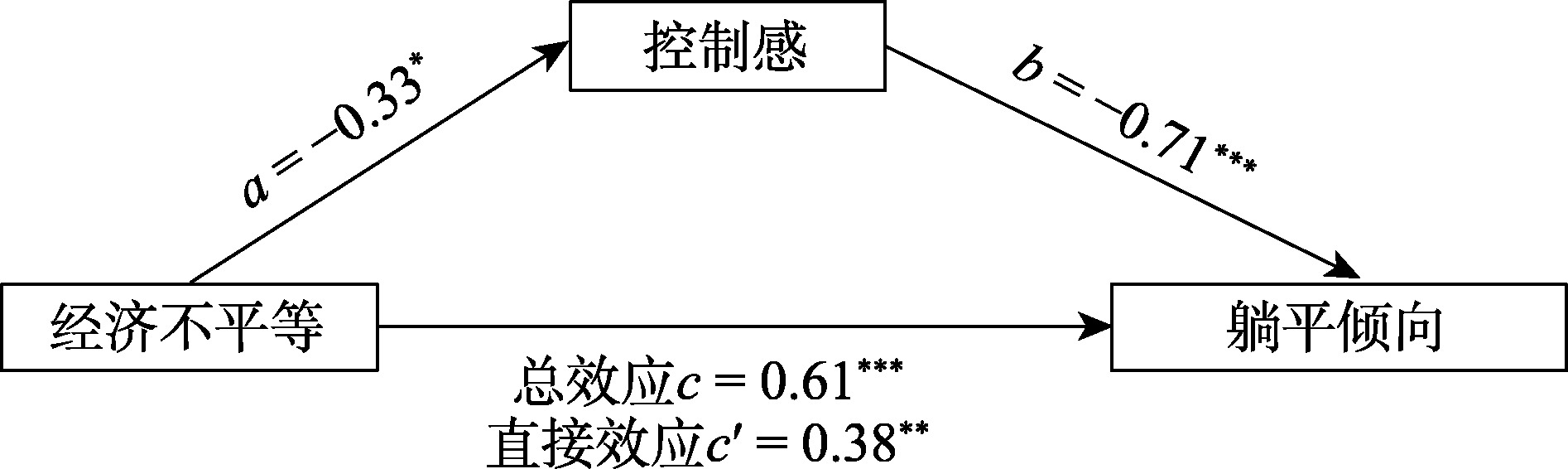
图4 研究4a中控制感的中介作用(N = 148)
注: *p < 0.05, **p < 0.01, ***p < 0.001。
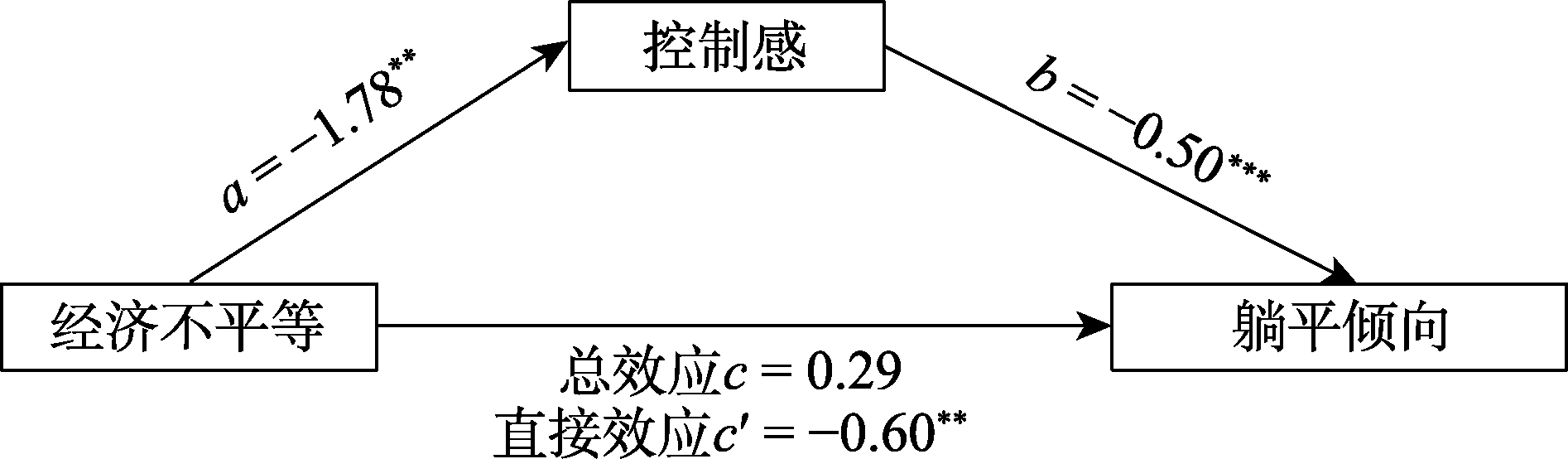
图5 研究4b中控制感的中介作用(N = 250)
注: *p < 0.05, **p < 0.01, ***p < 0.001。
| 预测变量 | 回归方程1(躺平倾向) | 回归方程2(控制感) | 回归方程3(躺平倾向) | |||||||||
|---|---|---|---|---|---|---|---|---|---|---|---|---|
| B | SE | t | 95% CI | B | SE | t | 95% CI | B | SE | t | 95% CI | |
| 经济不平等 | 0.19 | 0.05 | 3.81*** | [0.09, 0.29] | −0.32 | 0.06 | −5.43*** | [−0.43, −0.20] | 0.03 | 0.04 | 0.74 | [−0.05, 0.11] |
| 社会流动感知 | −0.29 | 0.10 | −3.04** | [−0.49, −0.10] | 0.54 | 0.11 | 4.73*** | [0.32, 0.77] | −0.03 | 0.08 | −0.31 | [−0.19, 0.14] |
| 控制感 | −0.50 | 0.04 | −12.34*** | [−0.58, −0.42] | ||||||||
| 交互项 | −0.10 | 0.10 | −1.06 | [−0.29, 0.09] | 0.23 | 0.11 | 1.97* | [0.00, 0.45] | 0.01 | 0.08 | 0.12 | [−0.15, 0.16] |
| R2 | 0.18 | 0.32 | 0.46 | |||||||||
| F | 8.99*** | 19.19*** | 30.97*** | |||||||||
表3 有调节的中介模型检验(N = 300)
| 预测变量 | 回归方程1(躺平倾向) | 回归方程2(控制感) | 回归方程3(躺平倾向) | |||||||||
|---|---|---|---|---|---|---|---|---|---|---|---|---|
| B | SE | t | 95% CI | B | SE | t | 95% CI | B | SE | t | 95% CI | |
| 经济不平等 | 0.19 | 0.05 | 3.81*** | [0.09, 0.29] | −0.32 | 0.06 | −5.43*** | [−0.43, −0.20] | 0.03 | 0.04 | 0.74 | [−0.05, 0.11] |
| 社会流动感知 | −0.29 | 0.10 | −3.04** | [−0.49, −0.10] | 0.54 | 0.11 | 4.73*** | [0.32, 0.77] | −0.03 | 0.08 | −0.31 | [−0.19, 0.14] |
| 控制感 | −0.50 | 0.04 | −12.34*** | [−0.58, −0.42] | ||||||||
| 交互项 | −0.10 | 0.10 | −1.06 | [−0.29, 0.09] | 0.23 | 0.11 | 1.97* | [0.00, 0.45] | 0.01 | 0.08 | 0.12 | [−0.15, 0.16] |
| R2 | 0.18 | 0.32 | 0.46 | |||||||||
| F | 8.99*** | 19.19*** | 30.97*** | |||||||||
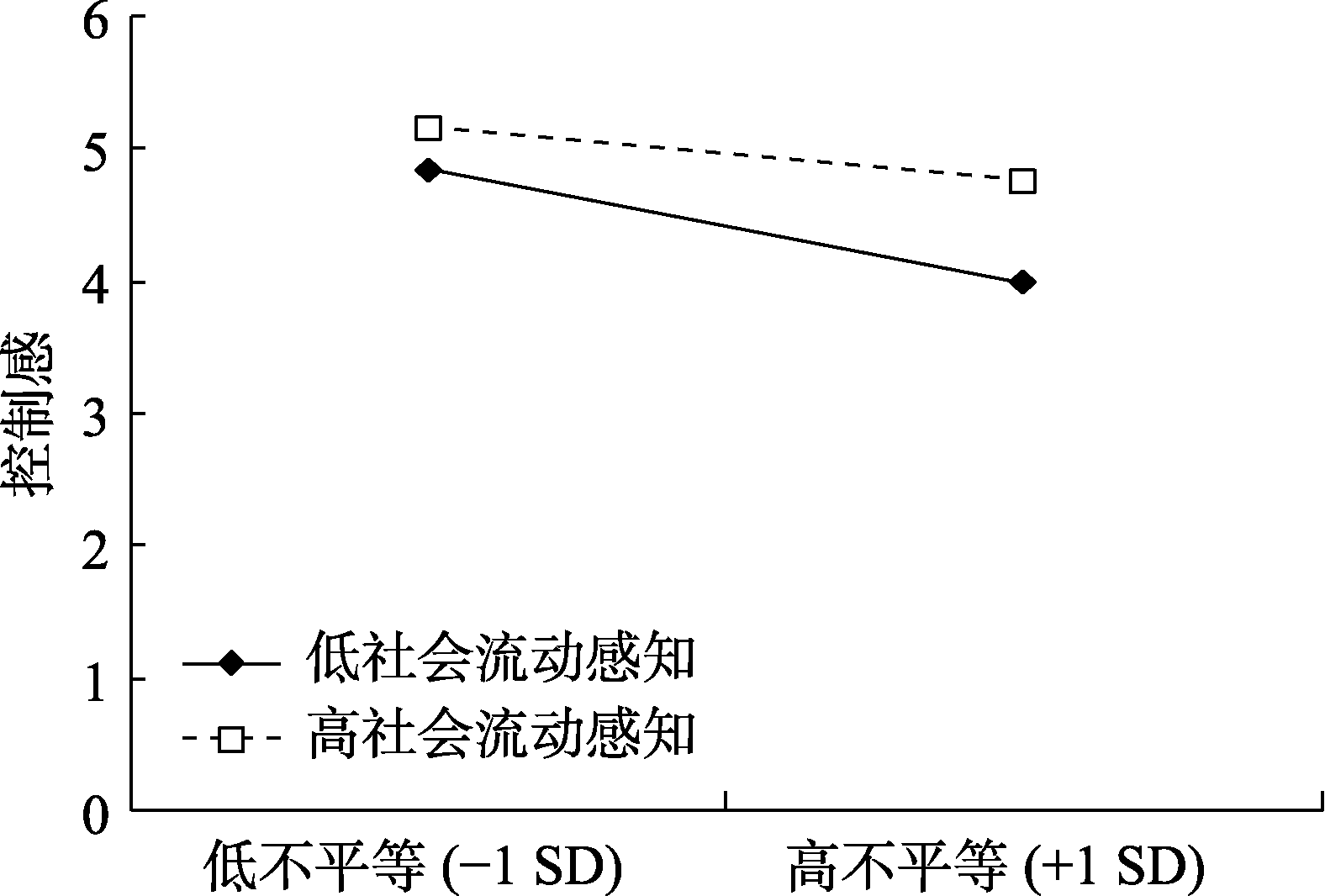
图6 研究5简单效应分析(N = 300) 注:高不平等:+1 SD;低不平等:−1 SD。
| [1] | Bowles S., & Park Y. (2005). Emulation, inequality, and work hours: Was Thorsten Veblen right? The Economic Journal, 115(507), F397-F412. |
| [2] |
Casara B. G. S., Suitner C., & Jetten J. (2022). The impact of economic inequality on conspiracy beliefs. Journal of Experimental Social Psychology, 98, 104245.
doi: 10.1016/j.jesp.2021.104245 URL |
| [3] | Dai X. (2022). From “Neets” to “lying Flat”: Global traceability, causes and response experiences. Youth Exploration, (3), 101-112. |
| [戴西伦. (2022). 从“尼特族”到“躺平”: 全球溯源、成因及应对经验. 青年探索, (3), 101-112.] | |
| [4] |
Davidai S. (2018). Why do Americans believe in economic mobility? Economic inequality, external attributions of wealth and poverty, and the belief in economic mobility. Journal of Experimental Social Psychology, 79, 138-148.
doi: 10.1016/j.jesp.2018.07.012 URL |
| [5] |
Day M. V., & Fiske S. T. (2017). Movin’on up? How perceptions of social mobility affect our willingness to defend the system. Social Psychological and Personality Science, 8(3), 267-274.
doi: 10.1177/1948550616678454 URL |
| [6] |
Du H., Huang Y., Ma L., Chen X., Chi P., & King R. B. (2023). Subjective economic inequality is associated with lower well-being through more upward comparison and lower trust. Applied Psychology: Health and Well-being, 16(1), 25-41.
doi: 10.1111/aphw.v16.1 URL |
| [7] |
Fritsche I., Moya M., Bukowski M., Jugert P., de Lemus S., Decker O., ... Navarro-Carrillo G. (2017). The great recession and group-based control: Converting personal helplessness into social class in-group trust and collective action. Journal of Social Issues, 73(1), 117-137.
doi: 10.1111/josi.2017.73.issue-1 URL |
| [8] |
Fu A., Zhang Z., Zheng J., Yue T., Lin Z., Wu N., & Huang X. (2020). Qualitative research on the endogenous power mechanism for poverty elimination. Acta Psychologica Sinica, 52(1), 66-80.
doi: 10.3724/SP.J.1041.2020.00066 |
|
[傅安国, 张再生, 郑剑虹, 岳童, 林肇宏, 吴娜, 黄希庭. (2020). 脱贫内生动力机制的质性探究. 心理学报, 52(1), 66-80.]
doi: 10.3724/SP.J.1041.2020.00066 |
|
| [9] | Hayes A. F. (2013). Introduction to mediation, moderation, and conditional process analysis: A regression based approach. The Guilford Press. |
| [10] |
Jetten J., Mols F., & Steffens N. K. (2021). Prosperous but fearful of falling: The wealth paradox, collective angst, and opposition to immigration. Personality and Social Psychology Bulletin, 47(5), 766-780.
doi: 10.1177/0146167220944112 URL |
| [11] |
Jetten J., Peters K., Álvarez B., Casara B. G. S., Dare M., Kirkland K., … Mols F. (2022). Consequences of economic inequality for the social and political vitality of society: A social identity analysis. Political Psychology, 42(S1), 241-266.
doi: 10.1111/pops.v42.s1 URL |
| [12] |
Jetten J., Wang Z., Steffens N. K., Mols F., Peters K., & Verkuyten M. (2017). A social identity analysis of responses to economic inequality. Current Opinion in Psychology, 18, 1-5.
doi: S2352-250X(17)30076-3 pmid: 29221504 |
| [13] |
Kakkar H., & Sivanathan N. (2017). When the appeal of a dominant leader is greater than a prestige leader. Proceedings of the National Academy of Sciences, 114(26), 6734-6739.
doi: 10.1073/pnas.1617711114 URL |
| [14] |
Kraus M. W., Park J. W., & Tan J. J. X. (2017). Signs of social class: The experience of economic inequality in everyday life. Perspectives on Psychological Science, 12(3), 422-435.
doi: 10.1177/1745691616673192 pmid: 28544871 |
| [15] |
Kraus M. W., & Tan J. J. X. (2015). Americans overestimate social class mobility. Journal of Experimental Social Psychology, 58, 101-111.
doi: 10.1016/j.jesp.2015.01.005 URL |
| [16] |
Krieger T., & Meierrieks D. (2019). Income inequality, redistribution and domestic terrorism. World Development, 116, 125-136.
doi: 10.1016/j.worlddev.2018.12.008 |
| [17] |
Lachman M. E., & Weaver S. L. (1998). The sense of control as a moderator of social class differences in health and well-being. Journal of Personality and Social Psychology, 74(3), 763-773.
doi: 10.1037//0022-3514.74.3.763 pmid: 9523418 |
| [18] |
Landau M. J., Kay A. C., & Whitson J. A. (2015). Compensatory control and the appeal of a structured world. Psychological Bulletin, 141(3), 694-722.
doi: 10.1037/a0038703 pmid: 25688696 |
| [19] | Li J. (2014). Study on the tendency of attribution on the gap between the rich and the poor in different social strata. World Publishing Corporation. |
| [李静. (2014). 不同社会阶层对贫富差距的心理归因研究. 世界图书出版公司.] | |
| [20] | Lu H., Hou J., Huang A., Wang J., & Kong F. (2023). Development and validation of the “Lying Flat” Tendency Scale for the youth. Behavioral Sciences, 13(11), 915. |
| [21] |
Maier S. F., & Seligman M. E. (2016). Learned helplessness at fifty: Insights from neuroscience. Psychological Review, 123(4), 349-367.
doi: 10.1037/rev0000033 pmid: 27337390 |
| [22] | Melita D., Velandia-Morales A., Iruela-Toros D., Willis G. B., & Rodríguez-Bailón R. (2020). Spanish version of the Status Anxiety Scale (Versión española de la Escala de Ansiedad por el Estatus). International Journal of Social Psychology, 35(2), 342-369. |
| [23] | Mols F., & Jetten J. (2017). The wealth paradox: Economic prosperity and the hardening of attitudes. Cambridge University Press. |
| [24] |
Payne B. K., Brown-Iannuzzi J. L., & Hannay J. W. (2017). Economic inequality increases risk taking. Proceedings of the National Academy of Sciences, 114(18), 4643-4648.
doi: 10.1073/pnas.1616453114 URL |
| [25] |
Rao T., Yang S., Yu F., Xu B., & Wei J. (2022). Perception of class mobility moderates the relationship between social class and prosocial behaviour. Asian Journal of Social Psychology, 25(1), 88-102.
doi: 10.1111/ajsp.v25.1 URL |
| [26] |
Sánchez-Rodríguez Á., Willis G. B., Jetten J., & Rodríguez-Bailón R. (2019). Economic inequality enhances inferences that the normative climate is individualistic and competitive. European Journal of Social Psychology, 49(6), 1114-1127.
doi: 10.1002/ejsp.v49.6 URL |
| [27] |
Schmalor A., & Heine S. J. (2022). The construct of subjective economic inequality. Social Psychological and Personality Science, 13(1), 210-219.
doi: 10.1177/1948550621996867 pmid: 34900092 |
| [28] |
Seligman M. E. P., & Maier S. F. (1967). Failure to escape traumatic shock. Journal of Experimental Psychology, 74(1), 1-9.
pmid: 6032570 |
| [29] |
Smith H. J., Pettigrew T. F., Pippin G. M., & Bialosiewicz S. (2012). Relative deprivation: A theoretical and meta-analytic review. Personality and Social Psychology Review, 16(3), 203-232.
doi: 10.1177/1088868311430825 pmid: 22194251 |
| [30] |
Sprong S., Jetten J., Wang Z., Peters K., Mols F., Verkuyten M., … Wohl M. J. A. (2019). “Our country needs a strong leader right now”: Economic inequality enhances the wish for a strong leader. Psychological Science, 30(11), 1625-1637.
doi: 10.1177/0956797619875472 URL |
| [31] | Tajfel H., & Turner J. C. (1979). An integrative theory of intergroup conflict. In W. G. Austin & S. Worchel (Eds.), The social psychology of intergroup relations (pp. 33-48). Brooks/Cole. |
| [32] |
To C., Wiwad D., & Kouchaki M. (2023). Economic inequality reduces sense of control and increases the acceptability of self-interested unethical behavior. Journal of Experimental Psychology: General, 152(10), 2747-2774.
doi: 10.1037/xge0001423 URL |
| [33] | Turner J. C., Hogg M. A., Oakes P. J., Reicher S. D., & Wetherell M. S. (1987). Rediscovering the social group: A self-categorization theory. Basil Blackwell. |
| [34] |
Turner J. C., Oakes P. J., Haslam S. A., & McGarty C. (1994). Self and collective: Cognition and social context. Personality and Social Psychology Bulletin, 20(5), 454-463.
doi: 10.1177/0146167294205002 URL |
| [35] |
Walasek L., & Brown G. D. A. (2015). Income inequality and status seeking: Searching for positional goods in unequal U.S. states. Psychological Science, 26(4), 527-533.
doi: 10.1177/0956797614567511 pmid: 25792131 |
| [36] | Walasek L., & Brown G. D. A. (2019). Income inequality and social status:The social rank and material rank hypotheses. In J. Jetten & K. Peters (Eds.), The social psychology of inequality (pp. 235-248). Springer. |
| [37] |
Wang W., Yi Y., Luo Z., & Li J. (2024). “Rat race” or “Lying flat”? The effect of competition stress on psychological compensation. Advances in Psychological Science, 32(7), 1057-1072.
doi: 10.3724/SP.J.1042.2024.01057 |
|
[王汪帅, 易颜熙, 罗芷薇, 厉杰. (2024). 内卷还是躺平?竞争压力如何影响心理补偿. 心理科学进展, 32(7), 1057-1072.]
doi: 10.3724/SP.J.1042.2024.01057 |
|
| [38] |
Wang Z., Jetten J., & Steffens N. K. (2020). The more you have, the more you want? Higher social class predicts a greater desire for wealth and status. European Journal of Social Psychology, 50(2), 360-375.
doi: 10.1002/ejsp.v50.2 URL |
| [39] |
Wang Z., Jetten J., & Steffens N. K. (2023). Restless in an unequal world: Economic inequality fuels the desire for wealth and status. Personality and Social Psychology Bulletin, 49(6), 871-890.
doi: 10.1177/01461672221083747 URL |
| [40] | Wei J., Yi C., & Zhou X. (2025). College students’academic contingent self-worth and academic involution behaviors: Analyses based on latent growth modeling. Psychological Development and Education, 41(5), 692-700. |
| [魏军, 羿聪, 周溪亭. (2025). 大学生基于学业表现的自我价值感与学业内卷行为的关联: 基于潜变量增长模型分析. 心理发展与教育, 41(5), 692-700.] | |
| [41] | Wilkinson R. G., & Pickett K. E. (2009). Income inequality and social dysfunction. Annual Review of Sociology, 35(1), 493-511. |
| [42] | Wilkinson R., & Pickett K. (2018). The inner level: How more equal societies reduce stress, restore sanity and improve everyone’s well-being. Penguin Books. |
| [43] | Wu Y., & Sun W. (2024). “Low desire to lay flat” of youths: Global picture, influencing factors and guidance strategies. Contemporary Youth Research, (1), 9-25. |
| [吴瑛, 孙蔚航. (2024). 青年“低欲望躺平”:全球图景、影响因素与引导策略. 当代青年研究, (1), 9-25.] | |
| [44] | Xiong Y. (2022). The phenomenon of “Lying Flat” on the internet and the cultivation of young people’s spirit of struggle. China Youth Study, (2), 14-21. |
| [熊钰. (2022). 网络“躺平”现象与青年奋斗精神培育. 中国青年研究, (2), 14-21.] | |
| [45] |
Yang Z., & Xin Z. (2020). Income inequality and interpersonal trust in China. Asian Journal of Social Psychology, 23(3), 253-263.
doi: 10.1111/ajsp.12399 |
| [46] | Ye W. (2023). "Involution" and "Lying Flat": The youth psychological dilemma under social change. Beijing Youth Research, (3), 28-35. |
| [叶文璐. (2023). “内卷”与“躺平”:社会变迁下的青年心态困境. 北京青年研究, (3), 28-35.] | |
| [47] |
Zeng Z. X., Tian C. Y., Mao J. Y., van Prooijen J. W., Zhang Y., Yang S. L., ... Guo Y. Y. (2024). How does economic inequality shape conspiracy theories? Empirical evidence from China. British Journal of Social Psychology, 63(2), 477-498.
doi: 10.1111/bjso.v63.2 URL |
| [48] |
Zhang W., Pan C., Yao S., Zhu J., Ling D., Yang H., ... Mu Y. (2024). “Neijuan” in China: The psychological concept and its characteristic dimensions. Acta Psychologica Sinica, 56(1), 107-123.
doi: 10.3724/SP.J.1041.2024.00107 URL |
|
[张雯, 潘超, 姚诗铭, 朱佳佳, 凌东, 杨涵淳,... 穆妍. (2024). 中国社会中“内卷”现象的个体心理内涵及其特征维度. 心理学报, 56(1), 107-123.]
doi: 10.3724/SP.J.1041.2024.00107 |
|
| [49] | Zhang Y., Guo Y., & Ding Y. (2020). The effect of economic inequality on perception of class mobility. Journal of Psychological Science, 43(5), 1197-1203. |
| [张跃, 郭永玉, 丁毅. (2020). 经济不平等对阶层流动感知的影响及其机制. 心理科学, 43(5), 1197-1203.] | |
| [50] | Zhang Z., Yi L., & Huang L. (2022). The Lack of meaning and spiritual crisis behind the “lying down” of young people. Philosophical Analysis, 13(1), 89-101+198. |
| [张自慧, 依力亚, 黄利金. (2022). 青年“躺平”背后的意义缺失与精神危机. 哲学分析, 13(1), 89-101+198.] | |
| [51] |
Zink C. F., Tong Y., Chen Q., Bassett D. S., Stein J. L., & Meyer-Lindenberg A. (2008). Know your place: Neural processing of social hierarchy in humans. Neuron, 58(2), 273-283.
doi: 10.1016/j.neuron.2008.01.025 pmid: 18439411 |
| [1] | 钟毅平, 牛娜娜, 范伟, 任梦梦, 李梅. 动作自主性与社会距离对主动控制感的影响:来自行为与ERPs的证据[J]. 心理学报, 2023, 55(12): 1932-1948. |
| [2] | 黄昕杰, 张弛, 万华根, 张灵聪. 情绪效价可预测性对时间捆绑效应的影响[J]. 心理学报, 2023, 55(1): 36-44. |
| [3] | 尹可丽, 兰淼森, 李慧, 赵子文. 仪式动作、象征意义和积极情绪增强控制感:双路径机制[J]. 心理学报, 2022, 54(1): 54-65. |
| [4] | 杨沈龙;郭永玉;胡小勇; 舒首立;李静. 低阶层者的系统合理化水平更高吗? ——基于社会认知视角的考察[J]. 心理学报, 2016, 48(11): 1467-1478. |
| [5] | 柳武妹;王海忠;何浏. 人之将尽, 消费国货?死亡信息的暴露增加国货选择的现象、中介和边界条件解析[J]. 心理学报, 2014, 46(11): 1748-1759. |
| 阅读次数 | ||||||
|
全文 |
|
|||||
|
摘要 |
|
|||||
