

ISSN 0439-755X
CN 11-1911/B
主办:中国心理学会
中国科学院心理研究所
出版:科学出版社
心理学报 ›› 2026, Vol. 58 ›› Issue (11): 2337-2354.doi: 10.3724/SP.J.1041.2026.2337 cstr: 32110.14.2026.2337
徐梦思1,2( ), 吴诗艳1, 徐彦熙1, 王振宏1()
收稿日期:2025-09-01
发布日期:2026-09-10
出版日期:2026-11-25
通讯作者:
徐梦思, E-mail: xumengsi119@126.com;基金资助:
XU Mengsi1,2(), WU Shiyan1, XU Yanxi1, WANG Zhenhong1()
Received:2025-09-01
Online:2026-09-10
Published:2026-11-25
摘要:
通过两个实验考察海洛因成瘾者的外源驱动性抑制(即根据外部线索抑制冲动行为)和内生意图性抑制(即根据内部决策抑制冲动行为)特征。实验1要求成瘾组和控制组完成包含标准刺激、偏差刺激和自由选择刺激的自由双选择Oddball任务并记录行为数据。结果发现, 成瘾组在自由选择任务中表现出更大的反应时延迟。实验2进一步采用脑电技术考察其时程动态特征。结果发现, 在迫选任务中, 成瘾组表现出更小的正确率代价和更小的P3差异波幅; 在自由选择任务中, 成瘾组表现出更低的抑制率, 且优势反应与非优势反应之间未出现显著的晚期慢波差异。结果表明, 海洛因成瘾者可能表现出更强的外源驱动性抑制能力以及更弱的内生意图性抑制能力。脑电结果进一步提示, 其在外源驱动性抑制中可能表现出较强的行为抑制执行相关加工, 而在内生意图性抑制中可能表现出较弱的结果评估相关加工。研究拓展了成瘾领域的研究视野, 对现有成瘾理论形成了有益补充, 并为戒毒干预实践提供了新的思路与方向。
中图分类号:
徐梦思, 吴诗艳, 徐彦熙, 王振宏. (2026). 海洛因成瘾者的外源驱动性抑制和内生意图性抑制特征. 心理学报, 58(11), 2337-2354.
XU Mengsi, WU Shiyan, XU Yanxi, WANG Zhenhong. (2026). Enhanced reactive inhibition but impaired intentional inhibition in individuals with heroin use disorder. Acta Psychologica Sinica, 58(11), 2337-2354.
| 变量 | 成瘾组 | 控制组 |
|---|---|---|
| 实验1 | ||
| 年龄 a | 49.94 (1.44) | 44.66 (1.94) |
| 受教育程度 b | 2.18 (0.10) | 2.53 (0.14) |
| 戒断前吸烟量(支/天)a | 20.06 (1.71) | 6.88 (1.32) |
| 戒断前酒精摄入量(毫升/周)a | 468.97 (101.59) | 103.13 (59.61) |
| 戒断前海洛因使用量(克/天) | 0.71 (0.10) | NA |
| 目前戒断时间(月) | 13.38 (1.04) | NA |
| 实验2 | ||
| 年龄 | 45.27 (1.77) | 45.80 (2.19) |
| 受教育程度 b | 2.08 (0.12) | 2.43 (0.14) |
| 戒断前吸烟量(支/天) a | 12.75 (1.59) | 8.11 (1.43) |
| 戒断前酒精摄入量(毫升/周) | 170.88 (75.18) | 95.00 (29.88) |
| 戒断前海洛因使用量(克/天) | 0.48 (0.09) | NA |
| 目前戒断时间(月) | 11.42 (1.09) | NA |
| BIF得分 | 17.00 (0.81) | 16.43 (0.77) |
表1 实验1和实验2中成瘾组和控制组的人口学变量特征
| 变量 | 成瘾组 | 控制组 |
|---|---|---|
| 实验1 | ||
| 年龄 a | 49.94 (1.44) | 44.66 (1.94) |
| 受教育程度 b | 2.18 (0.10) | 2.53 (0.14) |
| 戒断前吸烟量(支/天)a | 20.06 (1.71) | 6.88 (1.32) |
| 戒断前酒精摄入量(毫升/周)a | 468.97 (101.59) | 103.13 (59.61) |
| 戒断前海洛因使用量(克/天) | 0.71 (0.10) | NA |
| 目前戒断时间(月) | 13.38 (1.04) | NA |
| 实验2 | ||
| 年龄 | 45.27 (1.77) | 45.80 (2.19) |
| 受教育程度 b | 2.08 (0.12) | 2.43 (0.14) |
| 戒断前吸烟量(支/天) a | 12.75 (1.59) | 8.11 (1.43) |
| 戒断前酒精摄入量(毫升/周) | 170.88 (75.18) | 95.00 (29.88) |
| 戒断前海洛因使用量(克/天) | 0.48 (0.09) | NA |
| 目前戒断时间(月) | 11.42 (1.09) | NA |
| BIF得分 | 17.00 (0.81) | 16.43 (0.77) |
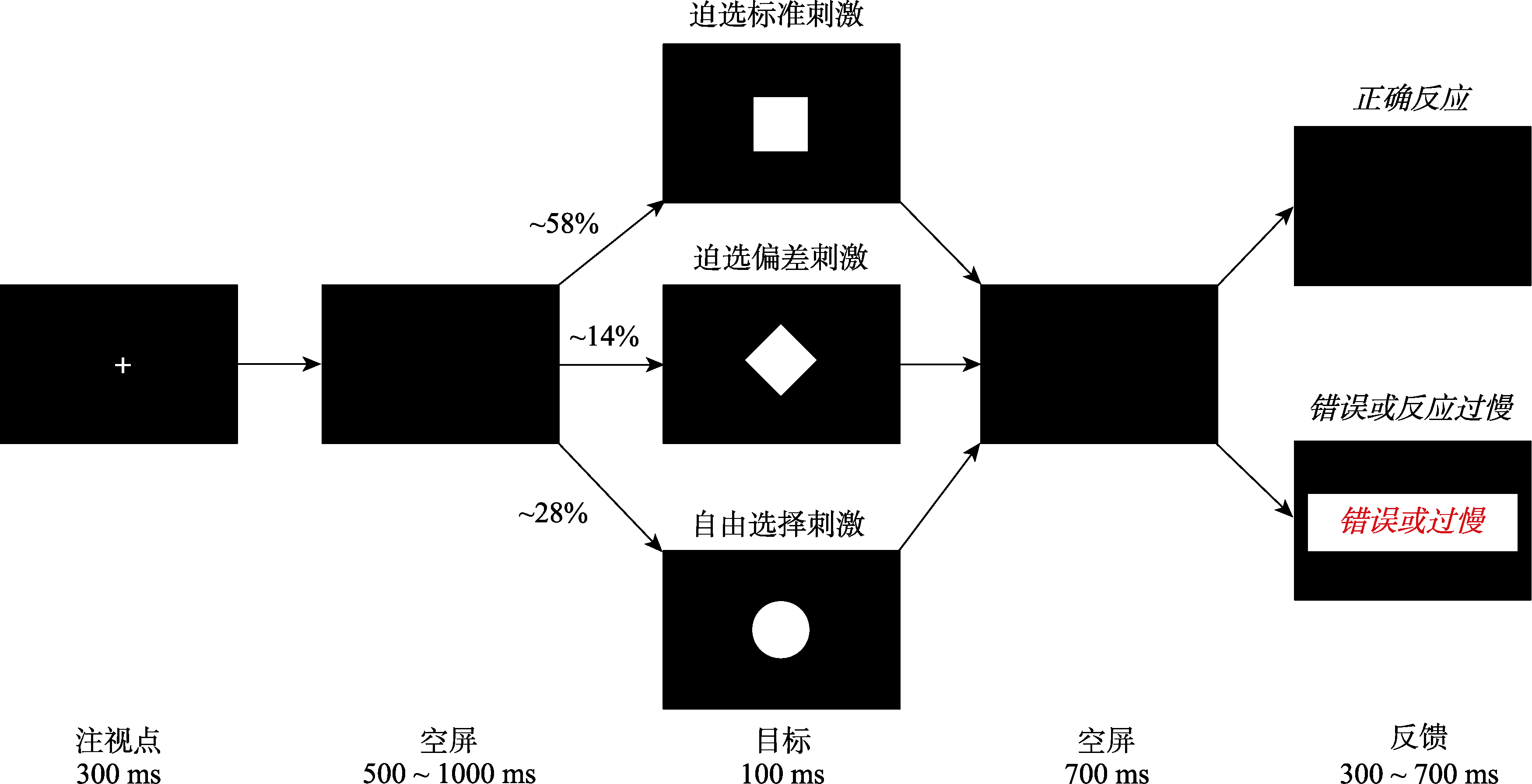
图1 实验流程示意图
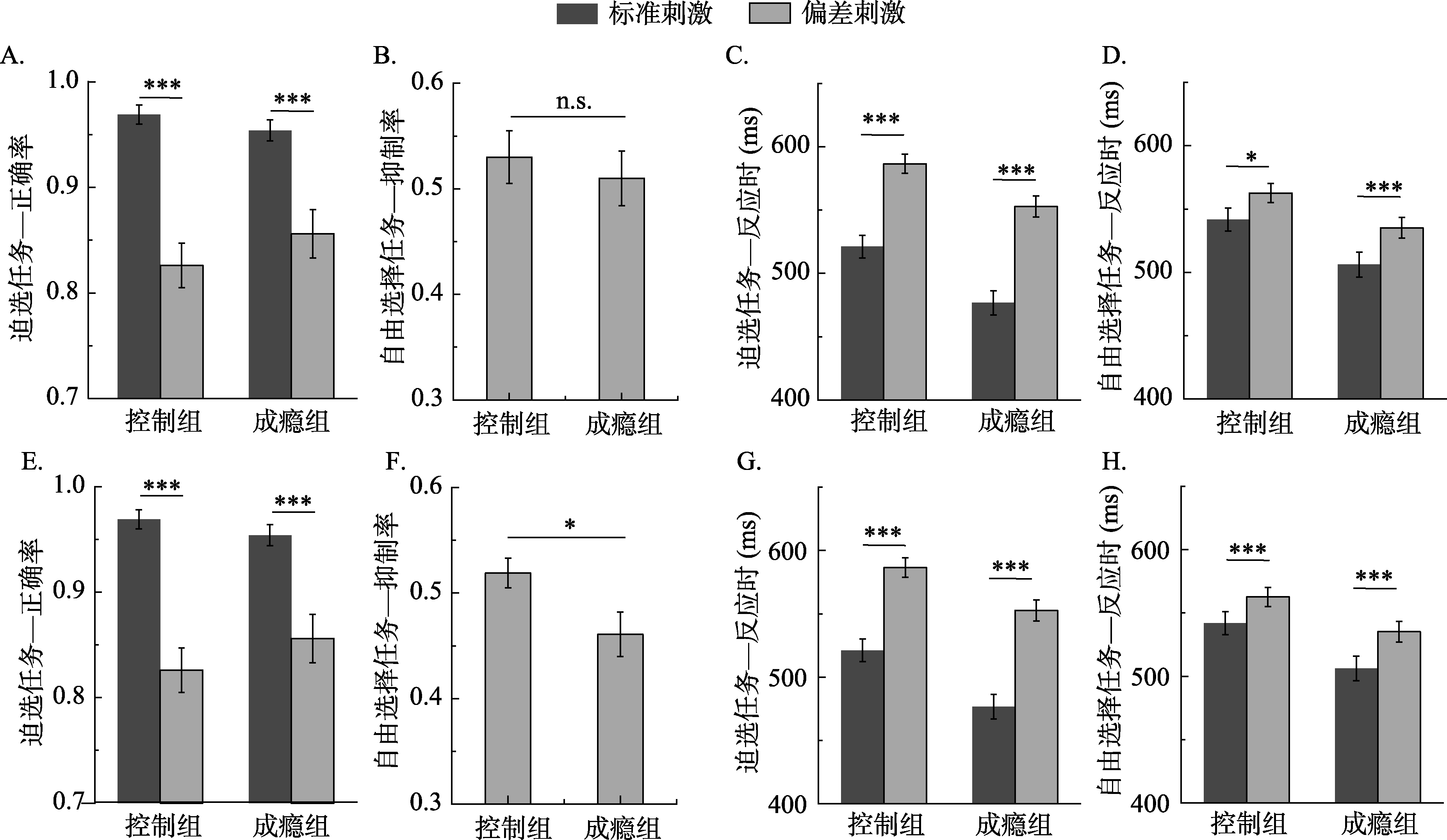
图2 实验1 (A, B, C, D)和实验2 (E, F, G, H)的行为结果。误差线为平均数的标准误。* p < 0.05, ** p < 0.01, *** p < 0.001, n.s. p > 0.05, 下同。
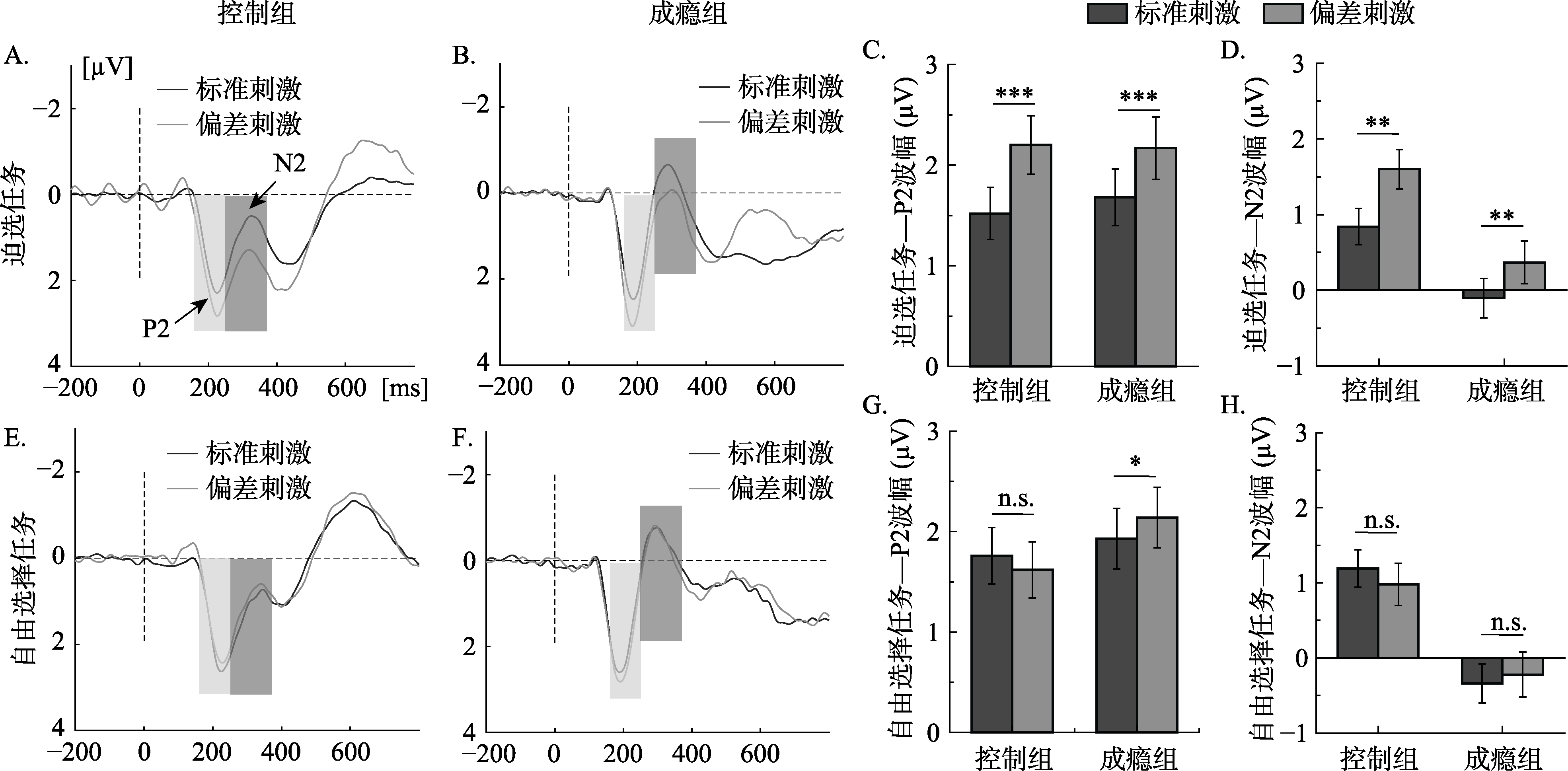
图3 P2和N2结果。成瘾组和控制组在迫选任务(A, B, C, D)和自由选择任务(E, F, G, H)中的总平均波形以及P2和N2平均波幅。误差线为平均数的标准误, 灰色矩形为分析的时间窗口。
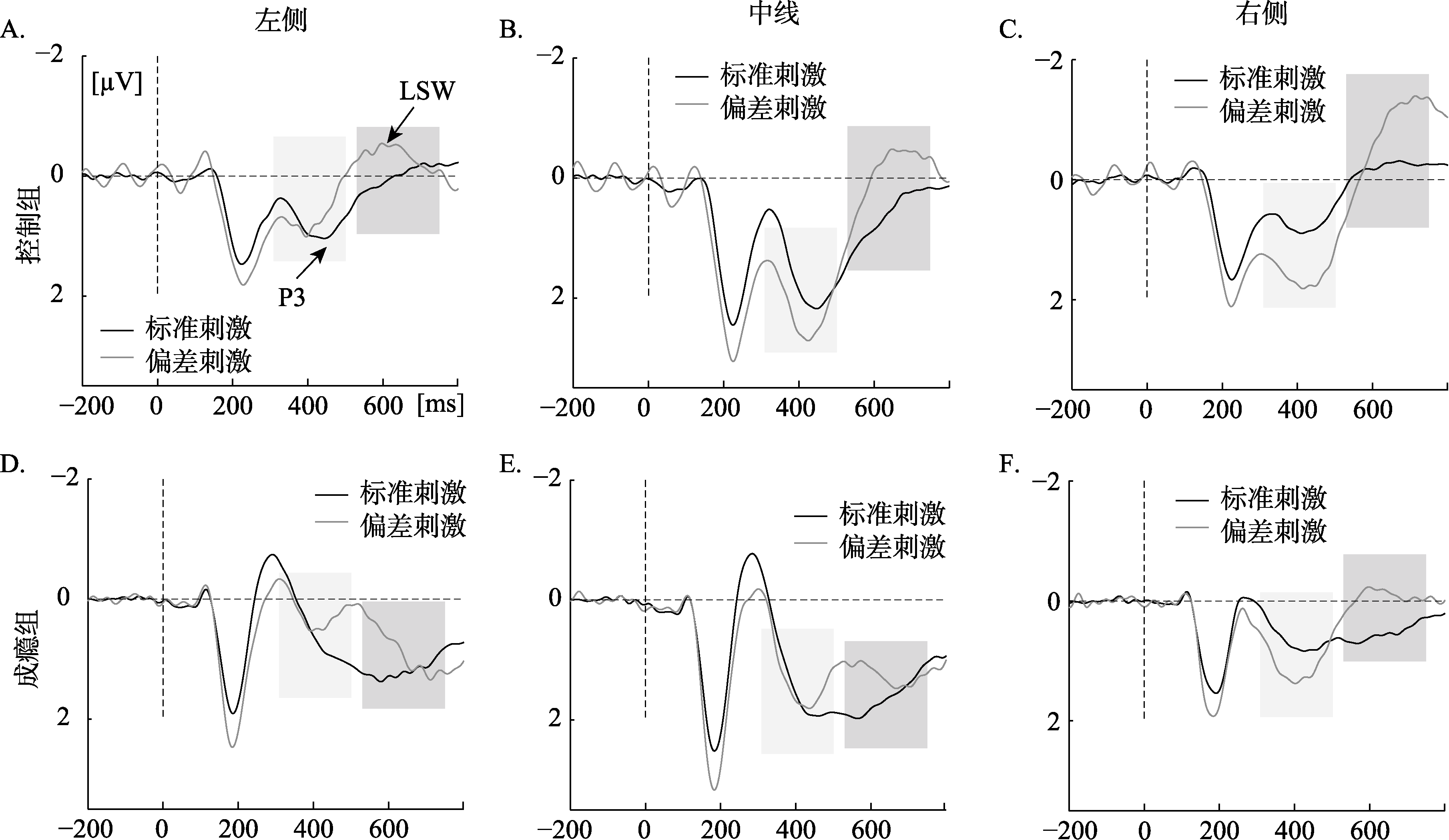
图4 成瘾组和控制组在迫选任务中的总平均波形(左侧感兴趣区:A, D; 中线感兴趣区:B, E; 右侧感兴趣区:C, F), 灰色矩形为分析的时间窗口。
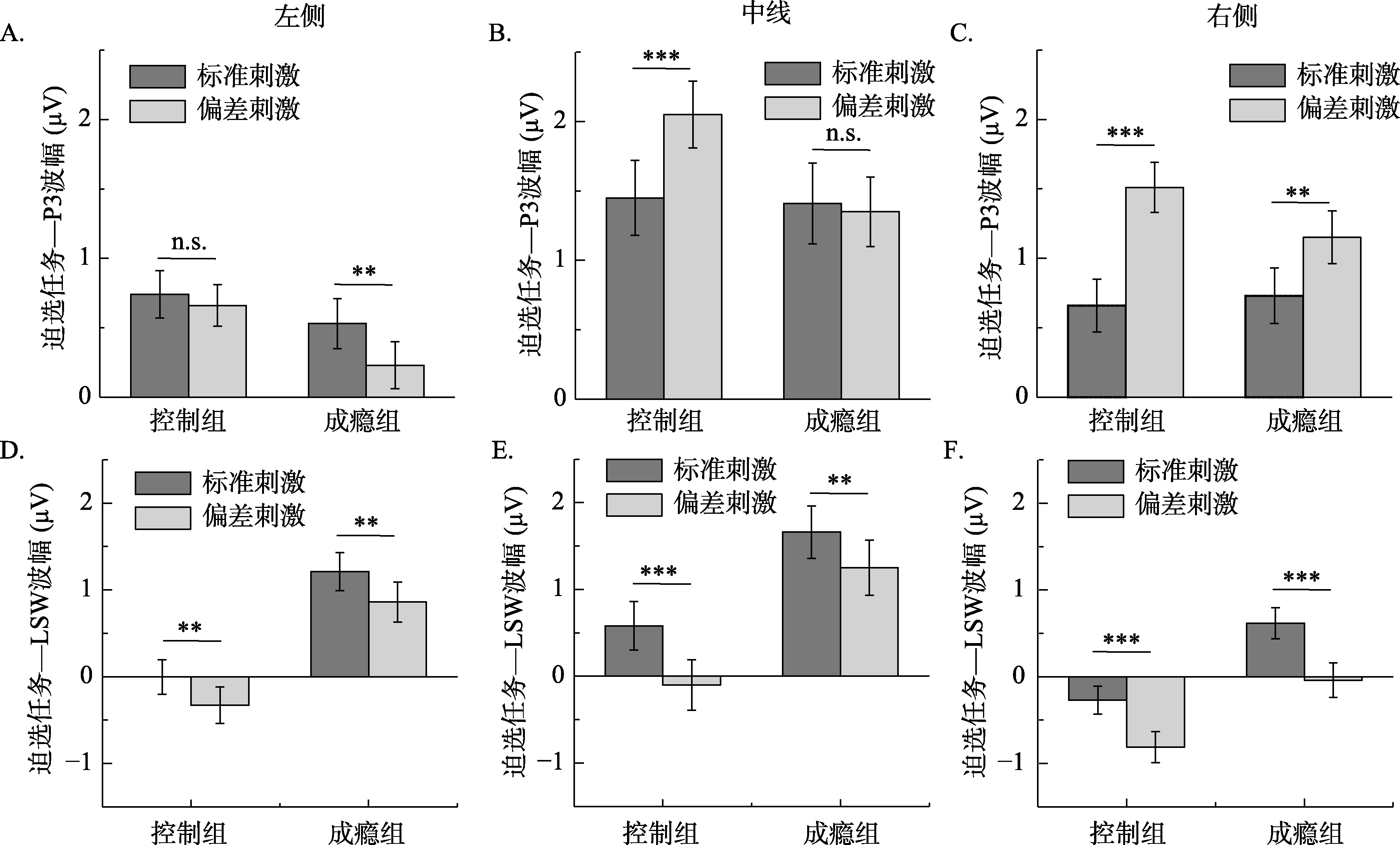
图5 成瘾组和控制组在迫选任务中的P3和LSW平均波幅(左侧感兴趣区:A, D; 中线感兴趣区:B, E; 右侧感兴趣区:C, F)。误差线为平均数的标准误。
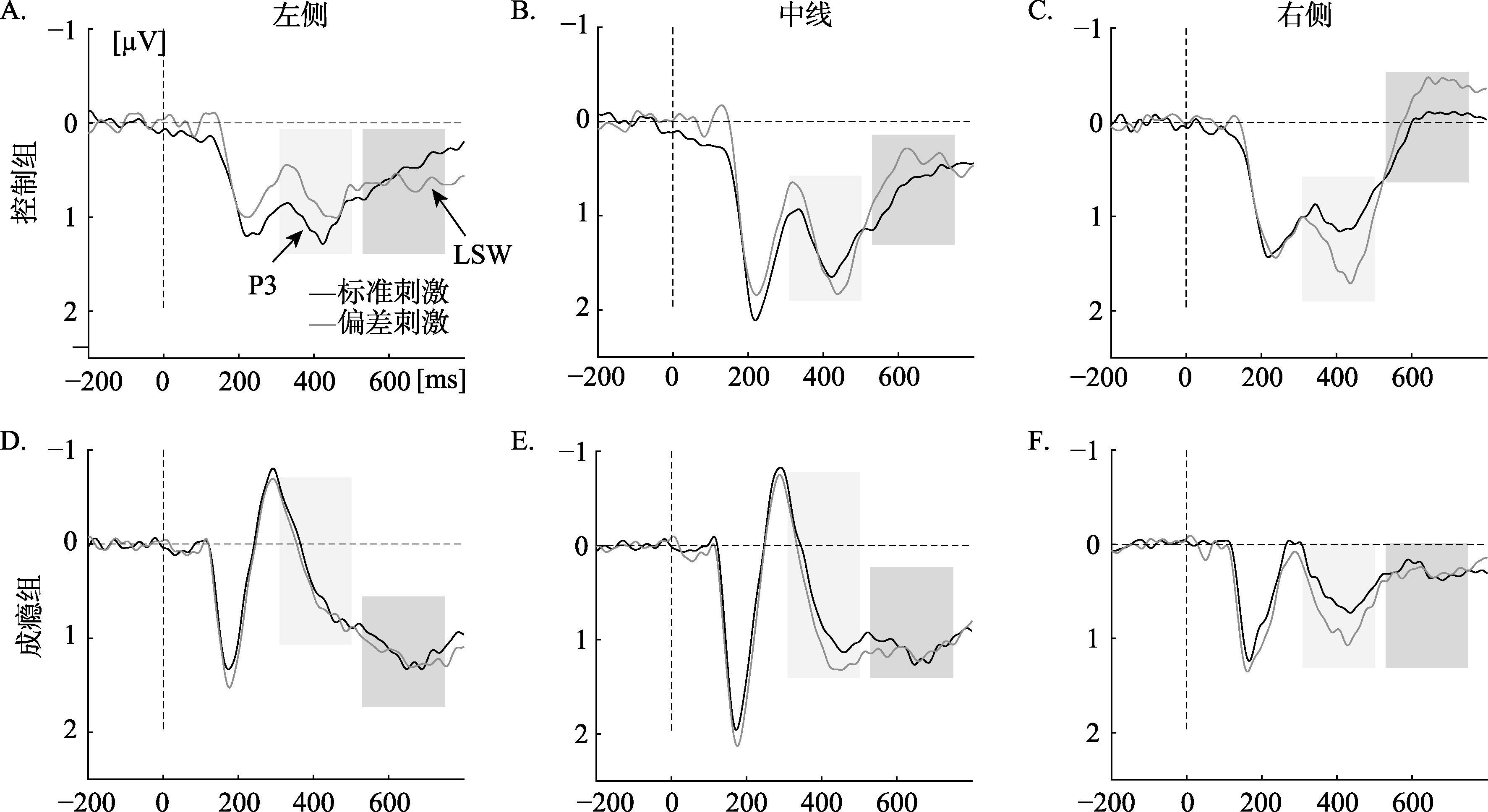
图6 成瘾组和控制组在自由选择任务中的总平均波形(左侧感兴趣区:A, D; 中线感兴趣区:B, E; 右侧感兴趣区:C, F), 灰色矩形为分析的时间窗口。
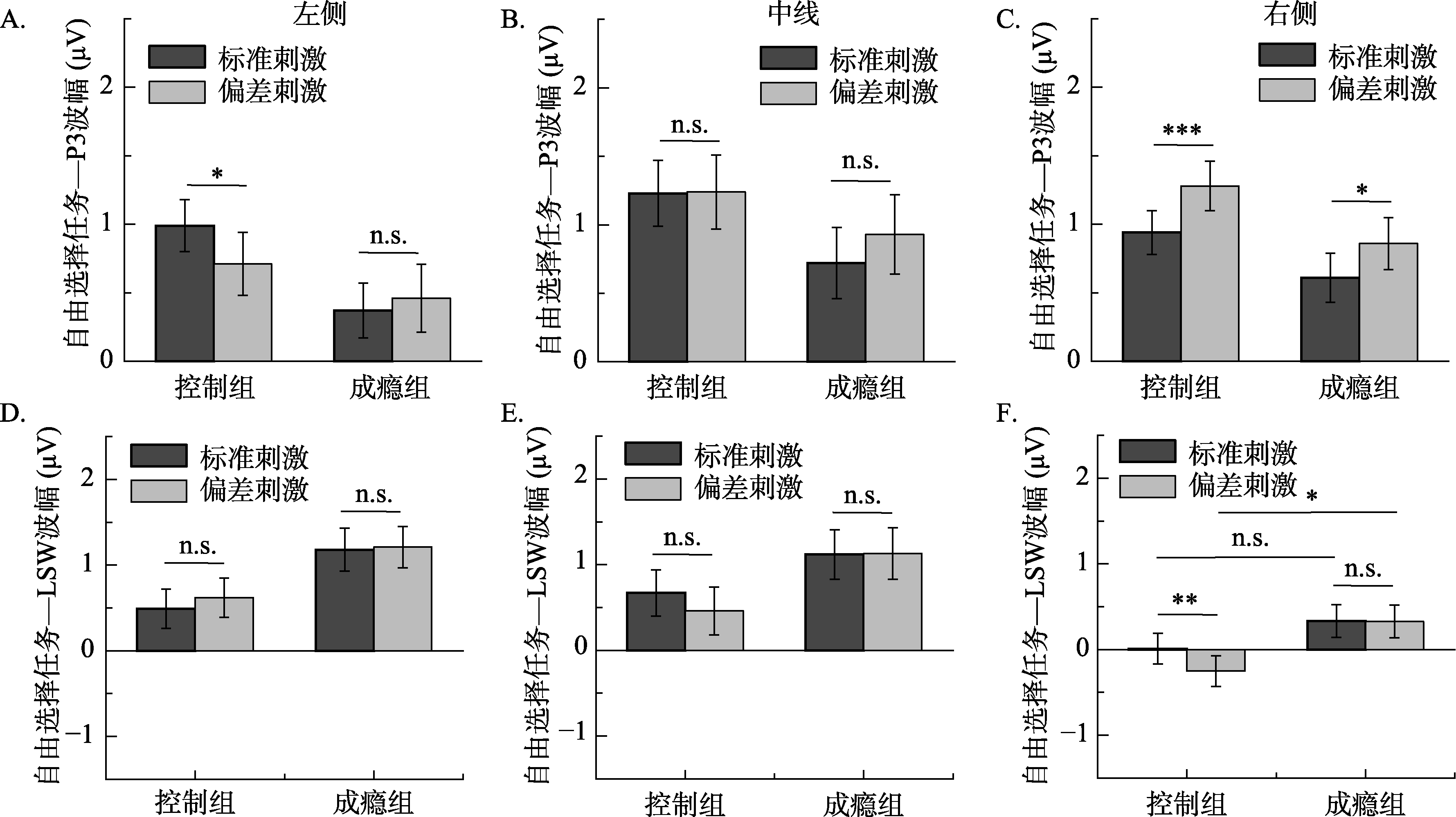
图7 成瘾组和控制组在自由选择任务中的P3和LSW平均波幅(左侧感兴趣区:A, D; 中线感兴趣区:B, E; 右侧感兴趣区:C, F)。误差线为平均数的标准误。
| 组别 | 左侧P3 | 中线P3 | 右侧P3 | 左侧LSW | 中线LSW | 右侧LSW |
|---|---|---|---|---|---|---|
| 外源驱动性抑制−控制组 | ||||||
| 正确率代价 | 0.16 | 0.01 | 0.03 | −0.06 | −0.05 | 0.07 |
| 反应时延迟 | −0.07 | −0.23 | −0.09 | −0.24 | −0.30 | −0.19 |
| 外源驱动性抑制−成瘾组 | ||||||
| 正确率代价 | 0.13 | 0.26 | −0.10 | 0.30 | 0.49 | 0.45 |
| 反应时延迟 | 0.14 | −0.12 | −0.33 | −0.17 | 0.09 | 0.14 |
| 内生意图性抑制−控制组 | ||||||
| 抑制率 | −0.29 | 0.01 | 0.34 | 0.11 | 0.12 | 0.12 |
| 反应时延迟 | 0.38 | 0.26 | 0.03 | 0.27 | 0.17 | 0.14 |
| 内生意图性抑制−成瘾组 | ||||||
| 抑制率 | −0.04 | 0.03 | −0.01 | −0.45 | −0.42 | −0.33 |
| 反应时延迟 | −0.17 | −0.30 | −0.32 | 0.14 | 0.18 | 0.08 |
表2 实验2中行为抑制的行为指标和脑电指标间的相关系数
| 组别 | 左侧P3 | 中线P3 | 右侧P3 | 左侧LSW | 中线LSW | 右侧LSW |
|---|---|---|---|---|---|---|
| 外源驱动性抑制−控制组 | ||||||
| 正确率代价 | 0.16 | 0.01 | 0.03 | −0.06 | −0.05 | 0.07 |
| 反应时延迟 | −0.07 | −0.23 | −0.09 | −0.24 | −0.30 | −0.19 |
| 外源驱动性抑制−成瘾组 | ||||||
| 正确率代价 | 0.13 | 0.26 | −0.10 | 0.30 | 0.49 | 0.45 |
| 反应时延迟 | 0.14 | −0.12 | −0.33 | −0.17 | 0.09 | 0.14 |
| 内生意图性抑制−控制组 | ||||||
| 抑制率 | −0.29 | 0.01 | 0.34 | 0.11 | 0.12 | 0.12 |
| 反应时延迟 | 0.38 | 0.26 | 0.03 | 0.27 | 0.17 | 0.14 |
| 内生意图性抑制−成瘾组 | ||||||
| 抑制率 | −0.04 | 0.03 | −0.01 | −0.45 | −0.42 | −0.33 |
| 反应时延迟 | −0.17 | −0.30 | −0.32 | 0.14 | 0.18 | 0.08 |

图S1 迫选任务中, 控制组和成瘾组在标准刺激和偏差刺激呈现后, 以100 ms为间隔记录的地形图。前三行为控制组对标准刺激、偏差刺激以及偏差与标准刺激之间差异的地形图。后三行为成瘾组对标准刺激、偏差刺激以及偏差与标准刺激之间差异的地形图。

图S2 自由选择任务中, 控制组和成瘾组在标准刺激和偏差刺激呈现后, 以100 ms为间隔记录的地形图。前三行为控制组对标准刺激、偏差刺激以及偏差与标准刺激之间差异的地形图。后三行为成瘾组对标准刺激、偏差刺激以及偏差与标准刺激之间差异的地形图。
| ERP成分 | 任务类型 | 电极点 | 刺激类型 | 组平均水平基线标准差 | 被试水平基线标准差 | ||
|---|---|---|---|---|---|---|---|
| 控制组 | 成瘾组 | 控制组M (SE) | 成瘾组M (SE) | ||||
| P2-N2成分 | 迫选任务 | 标准刺激 | 0.04 | 0.04 | 0.20 (0.02) | 0.16 (0.01) | |
| 偏差刺激 | 0.15 | 0.07 | 0.44 (0.12) | 0.30 (0.02) | |||
| 自由选择任务 | 标准刺激 | 0.06 | 0.07 | 0.30 (0.03) | 0.25 (0.02) | ||
| 偏差刺激 | 0.05 | 0.04 | 0.34 (0.05) | 0.32 (0.03) | |||
| P3-LSW成分 | 迫选任务 | 左侧 | 标准刺激 | 0.03 | 0.03 | 0.16 (0.02) | 0.14 (0.01) |
| 偏差刺激 | 0.12 | 0.05 | 0.37 (0.09) | 0.26 (0.02) | |||
| 中线 | 标准刺激 | 0.04 | 0.04 | 0.22 (0.02) | 0.16 (0.01) | ||
| 偏差刺激 | 0.16 | 0.07 | 0.46 (0.12) | 0.29 (0.02) | |||
| 右侧 | 标准刺激 | 0.04 | 0.03 | 0.17 (0.02) | 0.12 (0.01) | ||
| 偏差刺激 | 0.14 | 0.06 | 0.37 (0.09) | 0.26 (0.02) | |||
| P3-LSW成分 | 自由选择任务 | 左侧 | 标准刺激 | 0.06 | 0.04 | 0.24 (0.02) | 0.20 (0.02) |
| 偏差刺激 | 0.07 | 0.04 | 0.30 (0.04) | 0.23 (0.02) | |||
| 中线 | 标准刺激 | 0.07 | 0.03 | 0.27 (0.02) | 0.20 (0.02) | ||
| 偏差刺激 | 0.06 | 0.04 | 0.29 (0.04) | 0.21 (0.02) | |||
| 右侧 | 标准刺激 | 0.05 | 0.04 | 0.23 (0.02) | 0.20 (0.03) | ||
| 偏差刺激 | 0.06 | 0.04 | 0.25 (0.03) | 0.21 (0.02) | |||
表S1 实验2成瘾组和控制组刺激前基线期电压标准差
| ERP成分 | 任务类型 | 电极点 | 刺激类型 | 组平均水平基线标准差 | 被试水平基线标准差 | ||
|---|---|---|---|---|---|---|---|
| 控制组 | 成瘾组 | 控制组M (SE) | 成瘾组M (SE) | ||||
| P2-N2成分 | 迫选任务 | 标准刺激 | 0.04 | 0.04 | 0.20 (0.02) | 0.16 (0.01) | |
| 偏差刺激 | 0.15 | 0.07 | 0.44 (0.12) | 0.30 (0.02) | |||
| 自由选择任务 | 标准刺激 | 0.06 | 0.07 | 0.30 (0.03) | 0.25 (0.02) | ||
| 偏差刺激 | 0.05 | 0.04 | 0.34 (0.05) | 0.32 (0.03) | |||
| P3-LSW成分 | 迫选任务 | 左侧 | 标准刺激 | 0.03 | 0.03 | 0.16 (0.02) | 0.14 (0.01) |
| 偏差刺激 | 0.12 | 0.05 | 0.37 (0.09) | 0.26 (0.02) | |||
| 中线 | 标准刺激 | 0.04 | 0.04 | 0.22 (0.02) | 0.16 (0.01) | ||
| 偏差刺激 | 0.16 | 0.07 | 0.46 (0.12) | 0.29 (0.02) | |||
| 右侧 | 标准刺激 | 0.04 | 0.03 | 0.17 (0.02) | 0.12 (0.01) | ||
| 偏差刺激 | 0.14 | 0.06 | 0.37 (0.09) | 0.26 (0.02) | |||
| P3-LSW成分 | 自由选择任务 | 左侧 | 标准刺激 | 0.06 | 0.04 | 0.24 (0.02) | 0.20 (0.02) |
| 偏差刺激 | 0.07 | 0.04 | 0.30 (0.04) | 0.23 (0.02) | |||
| 中线 | 标准刺激 | 0.07 | 0.03 | 0.27 (0.02) | 0.20 (0.02) | ||
| 偏差刺激 | 0.06 | 0.04 | 0.29 (0.04) | 0.21 (0.02) | |||
| 右侧 | 标准刺激 | 0.05 | 0.04 | 0.23 (0.02) | 0.20 (0.03) | ||
| 偏差刺激 | 0.06 | 0.04 | 0.25 (0.03) | 0.21 (0.02) | |||
| 任务类型 | 刺激类型 | 控制组M (SE) | 成瘾组M (SE) |
|---|---|---|---|
| 迫选任务 | 标准刺激 | 371.90 (3.78) | 362.00 (8.65) |
| 偏差刺激 | 79.37 (1.61) | 81.27 (2.82) | |
| 自由选择任务 | 标准刺激 | 96.97 (2.60) | 102.19 (4.21) |
| 偏差刺激 | 94.30 (2.54) | 84.27 (4.32) |
表S2 实验2成瘾组和控制组在ERP分析中不同条件下的有效试次数量
| 任务类型 | 刺激类型 | 控制组M (SE) | 成瘾组M (SE) |
|---|---|---|---|
| 迫选任务 | 标准刺激 | 371.90 (3.78) | 362.00 (8.65) |
| 偏差刺激 | 79.37 (1.61) | 81.27 (2.82) | |
| 自由选择任务 | 标准刺激 | 96.97 (2.60) | 102.19 (4.21) |
| 偏差刺激 | 94.30 (2.54) | 84.27 (4.32) |
| [1] | Abdul Rahman A., Carroll D. J., Espy K. A., & Wiebe S. A. (2017). Neural correlates of response inhibition in early childhood: Evidence from a Go/No-Go task. Developmental Neuropsychology, 42(5), 336-350. |
| [2] | Bach P., Frischknecht U., Reinhard I., Bekier N., Demirakca T., Ende G.,... Hermann D. (2021). Impaired working memory performance in opioid-dependent patients is related to reduced insula gray matter volume: A voxel- based morphometric study. European Archives of Psychiatry and Clinical Neuroscience, 271(5), 813-822. |
| [3] | Baumeister R. F., & Nadal A. C. (2017). Addiction: Motivation, action control, and habits of pleasure. Motivation Science, 3(3), 179-195. |
| [4] | Bjork J. M., Keyser-Marcus L., Vassileva J., Ramey T., Houghton D. C., & Moeller F. G. (2022). Attentional function and inhibitory control in different substance use disorders. Psychiatry Research, 313, 114591. |
| [5] | Boudewyn M. A., Erickson M. A., Winsler K., Ragland J. D., Yonelinas A., Frank M.,... Luck S. J. (2023). Managing EEG studies: How to prepare and what to do once data collection has begun. Psychophysiology, 60(11), e14365. |
| [6] | Brand M., Wegmann E., Stark R., Müller A., Wölfling K., Robbins T. W., & Potenza M. N. (2019). The Interaction of Person-Affect-Cognition-Execution (I-PACE) model for addictive behaviors: Update, generalization to addictive behaviors beyond internet-use disorders, and specification of the process character of addictive behaviors. Neuroscience & Biobehavioral Reviews, 104, 1-10. |
| [7] | Bruyneel S. D., & Dewitte S. (2012). Engaging in self- regulation results in low-level construals. European Journal of Social Psychology, 42(6), 763-769. |
| [8] | Ceceli A. O., King S. G., McClain N., Alia-Klein N., & Goldstein R. Z. (2023). The neural signature of impaired inhibitory control in individuals with heroin use disorder. Journal of Neuroscience, 43(1), 173-182. |
| [9] | Chen T., Zhong N., Du J., Li Z., Zhao Y., Sun H.,... Zhao M. (2019). Polydrug use patterns and their impact on relapse among heroin‐dependent patients in Shanghai, China. Addiction, 114(2), 259-267. |
| [10] | Christensen E., Brydevall M., Albertella L., Samarawickrama S. K., Yücel M., & Lee R. S. C. (2023). Neurocognitive predictors of addiction-related outcomes: A systematic review of longitudinal studies. Neuroscience & Biobehavioral Reviews, 152, 105295. |
| [11] | Dousset C., Chenut C., Kajosch H., Kornreich C., & Campanella S. (2022). Comparison of neural correlates of reactive inhibition in cocaine, heroin, and polydrug users through a contextual Go/No-Go task using event-related potentials. Biology, 11(7), 1029. |
| [12] | Fascher M., Nowaczynski S., Spindler C., Strobach T., & Muehlhan M. (2024). Neural underpinnings of response inhibition in substance use disorders: Weak meta-analytic evidence for a widely used construct. Psychopharmacology, 241(1), 1-17. |
| [13] | Faul F., Erdfelder E., Lang A.-G., & Buchner A. (2007). G*Power 3: A flexible statistical power analysis program for the social, behavioral, and biomedical sciences. Behavior Research Methods, 39(2), 175-191. |
| [14] | Ficarella S. C., & Battelli L. (2017). The critical role of the dorsal fronto-median cortex in voluntary action inhibition: A TMS study. Brain Stimulation, 10(3), 596-603. |
| [15] | Filevich E., Kühn S., & Haggard P. (2012). Intentional inhibition in human action: The power of ‘no’. Neuroscience & Biobehavioral Reviews, 36(4), 1107-1118. |
| [16] | Garavan H., Brennan K. L., Hester R., & Whelan R. (2013). The neurobiology of successful abstinence. Current Opinion in Neurobiology, 23(4), 668-674. |
| [17] | Hadar L., Trope Y., & Ben-David B. M. (2021). Aging impairs inhibitory control over incidental cues: A construal-level perspective. Psychological Science, 32(9), 1442-1451. |
| [18] | He Q., Huang X., Turel O., Schulte M., Huang D., Thames A.,... Hser Y.-I. (2018). Presumed structural and functional neural recovery after long-term abstinence from cocaine in male military veterans. Progress in Neuropsychopharmacology & Biological Psychiatry, 84, 18-29. |
| [19] | Herman A. M. (2023). Interoception within the context of impulsivity and addiction. Current Addiction Reports, 10(2), 97-106. |
| [20] | Huster R. J., Enriquez-Geppert S., Lavallee C. F., Falkenstein M., & Herrmann C. S. (2013). Electroencephalography of response inhibition tasks: Functional networks and cognitive contributions. International Journal of Psychophysiology, 87(3), 217-233. |
| [21] | Joireman J., Shaffer M. J., Balliet D., & Strathman A. (2012). Promotion orientation explains why future-oriented people exercise and eat healthy: Evidence from the two- factor consideration of future consequences-14 scale. Personality and Social Psychology Bulletin, 38(10), 1272-1287. |
| [22] | Kang T., Zhang Y., Zhao J., Li X., Jiang H., Niu X.,... Yuan T.-F. (2024). Characterizing impulsivity in individuals with heroin use disorder. International Journal of Mental Health and Addiction, 22(3), 1530-1545. |
| [23] | Kemp R. (2020). Addiction as temporal disruption: Interoception, self, meaning. Phenomenology and the Cognitive Sciences, 19(2), 305-319. |
| [24] | Lee A. Y., Keller P. A., & Sternthal B. (2010). Value from regulatory construal fit: The persuasive impact of fit between consumer goals and message concreteness. Journal of Consumer Research, 36(5), 735-747. |
| [25] | Lipszyc J., & Schachar R. (2010). Inhibitory control and psychopathology: A meta-analysis of studies using the stop signal task. Journal of the International Neuropsychological Society, 16(6), 1064-1076. |
| [26] | Liu W., Tian Y., Yan X., & Yang J. (2021). Impulse inhibition ability with methamphetamine dependents varies at different abstinence stages. Frontiers in Psychiatry, 12, 626535. |
| [27] | Liu Y., van den Wildenberg W. P. M., de Graaf Y., Ames S. L., Baldacchino A., Bø R.,... Wiers R. W. (2019). Is (poly-) substance use associated with impaired inhibitory control? A mega-analysis controlling for confounders. Neuroscience & Biobehavioral Reviews, 105, 288-304. |
| [28] | Luck S. J., Stewart A. X., Simmons A. M., & Rhemtulla M. (2021). Standardized measurement error: A universal metric of data quality for averaged event-related potentials. Psychophysiology, 58(6), e13793. |
| [29] | Lynn M. T., Muhle-Karbe P. S., & Brass M. (2014). Controlling the self: The role of the dorsal frontomedian cortex in intentional inhibition. Neuropsychologia, 65, 247-254. |
| [30] | Morie K. P., Garavan H., Bell R. P., De Sanctis P., Krakowski M. I., & Foxe J. J. (2014). Intact inhibitory control processes in abstinent drug abusers (II): A high- density electrical mapping study in former cocaine and heroin addicts. Neuropharmacology, 82, 151-160. |
| [31] | Parkinson J., & Haggard P. (2015). Choosing to stop: Responses evoked by externally triggered and internally generated inhibition identify a neural mechanism of will. Journal of Cognitive Neuroscience, 27(10), 1948-1956. |
| [32] | Psederska E., & Vassileva J. (2023). Neurocognitive impulsivity in opiate users at different lengths of abstinence. International Journal of Environmental Research and Public Health, 20(2), 1236. |
| [33] | Rush C. R., Strickland J. C., Pike E., Studts C. R., & Stoops W. W. (2020). Inhibitory-control training for cocaine use disorder and contingency management for clinic attendance: A randomized pilot study of feasibility, acceptability and initial efficacy. Drug and Alcohol Dependence, 207, 107803. |
| [34] | Schenkel E. J., Schöneck R., Wiers R. W., Veling H., Becker E. S., Lindenmeyer J., & Rinck M. (2023). Does selective inhibition training reduce relapse rates when added to standard treatment of alcohol use disorder? A randomized controlled trial. Alcohol: Clinical and Experimental Research, 47(5), 963-974. |
| [35] | Schmidt, A., Walter M., & Borgwardt S. (2016). Impaired cognition control and inferior frontal cortex modulation in heroin addiction. In V. R. Preedy(Ed.), Neuropathology of drug addictions and substance misuse: Volume 1: Foundations of understanding, tobacco, alcohol, cannabinoids, opioids and emerging addictions (pp. 1037-1047). Academic Press. |
| [36] | Smith J. L. (2005). An investigation of the effect of preparation on response execution and inhibition in the go/nogo task (Unpublished doctorial dissertation). University of Wollongong. |
| [37] | Smith J. L., Mattick R. P., Jamadar S. D., & Iredale J. M. (2014). Deficits in behavioural inhibition in substance abuse and addiction: A meta-analysis. Drug and Alcohol Dependence, 145, 1-33. |
| [38] | Stevens L., Goudriaan A. E., Verdejo-Garcia A., Dom G., Roeyers H., & Vanderplasschen W. (2015). Impulsive choice predicts short-term relapse in substance-dependent individuals attending an in-patient detoxification programme. Psychological Medicine, 45(10), 2083-2093. |
| [39] | Vallacher R. R., & Wegner D. M. (1989). Levels of personal agency: Individual variation in action identification. Journal of Personality and Social Psychology, 57(4), 660-671. |
| [40] | van Beek J., Handgraaf M. J. J., & Antonides G. (2017). Time orientation and construal level: Effects on eating and exercising behaviour and preferences. International Journal of Consumer Studies, 41(1), 54-60. |
| [41] | Verdejo-García A., Lubman D. I., Schwerk A., Roffel K., Vilar-López R., MacKenzie T., & Yücel M. (2012). Effect of craving induction on inhibitory control in opiate dependence. Psychopharmacology, 219(2), 519-526. |
| [42] | Whelan R. (2008). Effective analysis of reaction time data. The Psychological Record, 58(3), 475-482. |
| [43] | Wollman S. C., Hauson A. O., Hall M. G., Connors E. J., Allen K. E., Stern M. J.,... Flora-Tostado C. (2019). Neuropsychological functioning in opioid use disorder: A research synthesis and meta-analysis. The American Journal of Drug and Alcohol Abuse, 45(1), 11-25. |
| [44] | Xu M., Fan L., Li Z., Qi S., & Yang D. (2020). Neural signatures of reactive and intentional inhibitions: An ERP study. Current Psychology, 39(5), 1485-1495. |
| [45] | Xu M., Wen J., Li Z., Wang Z., & Zhang J. (2024). Behavioral impulse and time pressure jointly influence intentional inhibition: Evidence from the Free Two-Choice Oddball task. Psychological Research, 88(3), 936-949. |
| [46] | Xu M., Xu Y., Wen J., Sun Y., Lu D., & Li Z. (2024). The impact of construal level on behavioral inhibition: Evidences from behavioral and ERP studies. Personality and Individual Differences, 230, 112783. |
| [47] | Xu M. S., Li Z. A., Zhang J. H., & Wang Z. H. (2024). Temporal characteristics of the three stages of intentional inhibition. Journal of Psychological Science, 47(6), 1293-1304. |
| [徐梦思, 李志爱, 张俊华, 王振宏. (2024). 内生意图性抑制的三阶段时程动态特征. 心理科学, 47(6), 1293-1304.] | |
| [48] | Yang L. Z., Chen J. H., Wang S. X., Shen Y., & Sun Y. (2017). Intentional inhibition: A new approach to self- control. Advances in Psychological Science, 25(10), 1631-1641. |
| [杨丽珠, 陈靖涵, 王素霞, 沈悦, 孙岩. (2017). 内生意图性抑制:自我控制研究的新视角. 心理科学进展, 25(10), 1631-1641.] | |
| [49] | Yuan J., He Y., Zhang Q., Chen A., & Li H. (2008). Gender differences in behavioral inhibitory control: ERP evidence from a two-choice oddball task. Psychophysiology, 45(6), 986-993. |
| [50] | Yuan J., Xu M., Yang J., & Li H. (2017). The application of the two-choice oddball paradigm to the research of behavioral inhibitory control. Scientia Sinica Vitae, 47(10), 1065-1073. |
| [袁加锦, 徐萌萌, 杨洁敏, 李红. (2017). 双选择Oddball范式在行为抑制控制研究中的应用. 中国科学:生命科学, 47(10), 1065-1073.] | |
| [51] | Zhang Y., Ou H., Yuan T.-F., & Sun J. (2021). Electrophysiological indexes for impaired response inhibition and salience attribution in substance (stimulants and depressants) use disorders: A meta-analysis. International Journal of Psychophysiology, 170, 133-155. |
| [52] | Zheng Z. L., Wang P. F., Su D. Q., Guo W. J., Sun N., Ma Y. K., & Zeng H. (2020). Differences in brain reactivity in relation to different types of drug-associated cues and disinhibition among heroin addicts: An ERP study. Acta Psychologica Sinica, 52(3), 317-328. |
| [郑志灵, 王鹏飞, 苏得权, 郭伟杰, 孙楠, 麻彦坤, 曾红. (2020). 不同相关线索下海洛因成瘾者的反应差异及反应抑制特征:来自ERP的证据. 心理学报, 52(3), 317-328.] | |
| [53] | Zilverstand, A., & Goldstein R. Z. (2020). Dual models of drug addiction:The impaired response inhibition and salience attribution model. In A. Verdejo-Garcia(Ed.), Cognition and addiction: A researcher’s guide from mechanisms towards interventions (pp. 17-23). Academic Press. |
| [1] | 杨景童, 姜英杰, 龙翼婷. 社会价值取向对互惠合作中来源记忆的影响[J]. 心理学报, 2026, 58(7): 1325-1342. |
| [2] | 姚昭, 李甜甜, 朱湘茹. 具身体验对二语抽象概念空间隐喻的梯度调节: 来自ERP的证据[J]. 心理学报, 2026, 58(7): 1357-1369. |
| [3] | 靳婷婷, 钱昱夫, 范昕茹, 王倩, 任桂琴, 李卫君. 汉语语义双关与谐音双关笑话加工的神经机制[J]. 心理学报, 2026, 58(12): 2456-2473. |
| [4] | 孙萌, 蒙锦秋, 袁加锦. 负性社会反馈对吸烟者行为抑制的影响:系列行为与事件相关电位证据[J]. 心理学报, 2026, 58(12): 2547-2567. |
| [5] | 刘沛菡, 彭微微, 王金霞, 李红, 雷怡. 急性疼痛对个人与替代奖赏加工的调控效应:来自ERP的证据[J]. 心理学报, 2026, 58(1): 15-38. |
| [6] | 陈子龙, 季琭妍. 多面孔情绪变异性的自动加工:来自视觉失匹配成分的证据[J]. 心理学报, 2025, 57(9): 1553-1571. |
| [7] | 王俊博, 赵娜, 李子媛, 刘强. 负性面孔的工作记忆离线态存储不影响在线态存储[J]. 心理学报, 2025, 57(8): 1323-1332. |
| [8] | 陈霁雯, 买晓琴, 李富洪. 去抑制的认知神经机制: 一项事件相关电位研究[J]. 心理学报, 2025, 57(5): 762-774. |
| [9] | 蔡文琦, 张向阳, 王小娟, 杨剑峰. 汉语复合词语素意义与整词语义整合加工的时间进程[J]. 心理学报, 2023, 55(8): 1207-1219. |
| [10] | 钟毅平, 牛娜娜, 范伟, 任梦梦, 李梅. 动作自主性与社会距离对主动控制感的影响:来自行为与ERPs的证据[J]. 心理学报, 2023, 55(12): 1932-1948. |
| [11] | 李梅, 李琎, 张冠斐, 钟毅平, 李红. 承诺水平与社会距离对信任投资的影响:来自行为与ERPs的证据[J]. 心理学报, 2023, 55(11): 1859-1871. |
| [12] | 占友龙, 肖啸, 谭千保, 李琎, 钟毅平. 声誉关注与社会距离对伤害困境中道德决策的影响:来自行为与ERPs的证据[J]. 心理学报, 2022, 54(6): 613-627. |
| [13] | 曾红, 郑志灵, 罗晓红, 王鹏飞, 王孟成, 苏得权, 杨文登, 黄海娇, 彭淑娜. 药物成瘾者相关线索反应的自动化用药行为特征及其消退[J]. 心理学报, 2022, 54(10): 1193-1205. |
| [14] | 孙天义, 郝晓晓, 何安明, 王财玉, 许远理, 郭春彦, 周蔚. 神经重用假说的汉语情绪词汇加工证据[J]. 心理学报, 2021, 53(9): 933-943. |
| [15] | 蔡惠燕, 苗心, 王鹏飞, 林志为, 王孟成, 杨文登, 麻彦坤, 曾红. 长期戒断海洛因成瘾者冲动性相关脑区的结构及功能特征[J]. 心理学报, 2021, 53(8): 861-874. |
| 阅读次数 | ||||||
|
全文 |
|
|||||
|
摘要 |
|
|||||
