

ISSN 0439-755X
CN 11-1911/B
主办:中国心理学会
中国科学院心理研究所
出版:科学出版社
CN 11-1911/B
主办:中国心理学会
中国科学院心理研究所
出版:科学出版社
心理学报 ›› 2025, Vol. 57 ›› Issue (9): 1609-1621.doi: 10.3724/SP.J.1041.2025.1609 cstr: 32110.14.2025.1609
王继贤1, 刘明慧1,2( )
)
收稿日期:2024-11-26
发布日期:2025-06-26
出版日期:2025-09-25
通讯作者:
刘明慧, E-mail: liumh827@126.com基金资助:
WANG Jixian1, LIU Minghui1,2()
Received:2024-11-26
Online:2025-06-26
Published:2025-09-25
摘要:
以往研究已证明自我信息存在整合优势, 但这种自我优势能否在无意识情境下发生尚不清楚。研究结合近来发展的阈下同异任务范式与知觉匹配任务范式, 通过3个实验系统考察自我信息的无意识整合优势及其受空间整合窗口(spatial integration window, SIW)和整合水平的调控情况。实验1通过操纵SIW, 发现中性几何图形只能在1.53° SIW上发生无意识整合。实验2利用知觉匹配任务将中性图形与社会信息连接后发现, 相比于其他信息, 自我信息仅在4.02° SIW上出现无意识整合优势。相较之下, 1.53° SIW上所有条件均发生无意识整合但彼此之间无差异, 而6.51° SIW上均未发生。实验3进一步发现这种自我优势并不依赖于感知特征的相似性, 能够同时在知觉表征水平和语义表征水平上发生。上述结果支持整合窗口假说, 提示自我信息的无意识整合优势受到SIW的限制, 并且能够同时发生在信息加工的早期感知阶段和晚期概念阶段, 这为进一步探索自我优势效应的意识边界提供了新的依据与启示。
中图分类号:
王继贤, 刘明慧. (2025). 自我信息的无意识整合优势: 来自阈下同异任务范式的证据. 心理学报, 57(9), 1609-1621.
WANG Jixian, LIU Minghui. (2025). The unconscious integration advantage of self-related information: Evidence from the subliminal same−different task paradigm. Acta Psychologica Sinica, 57(9), 1609-1621.

图1 同异判断任务单个试次的流程图
| SIW | 正方形边长 |
|---|---|
| 1.53 | 0.51 |
| 4.02 | 0.79 |
| 6.51 | 1.02 |
表1 SIW与正方形边长大小(°)
| SIW | 正方形边长 |
|---|---|
| 1.53 | 0.51 |
| 4.02 | 0.79 |
| 6.51 | 1.02 |
| SIW | 一致性 | |
|---|---|---|
| 一致 | 不一致 | |
| 1.53° | 504.64 ± 50.86 | 519.63 ± 47.84 |
| 4.02° | 518.09 ± 48.99 | 516.29 ± 44.91 |
| 6.51° | 522.43 ± 59.21 | 523.05 ± 53.85 |
表2 实验1各处理条件的平均反应时(ms) (M ± SD)
| SIW | 一致性 | |
|---|---|---|
| 一致 | 不一致 | |
| 1.53° | 504.64 ± 50.86 | 519.63 ± 47.84 |
| 4.02° | 518.09 ± 48.99 | 516.29 ± 44.91 |
| 6.51° | 522.43 ± 59.21 | 523.05 ± 53.85 |
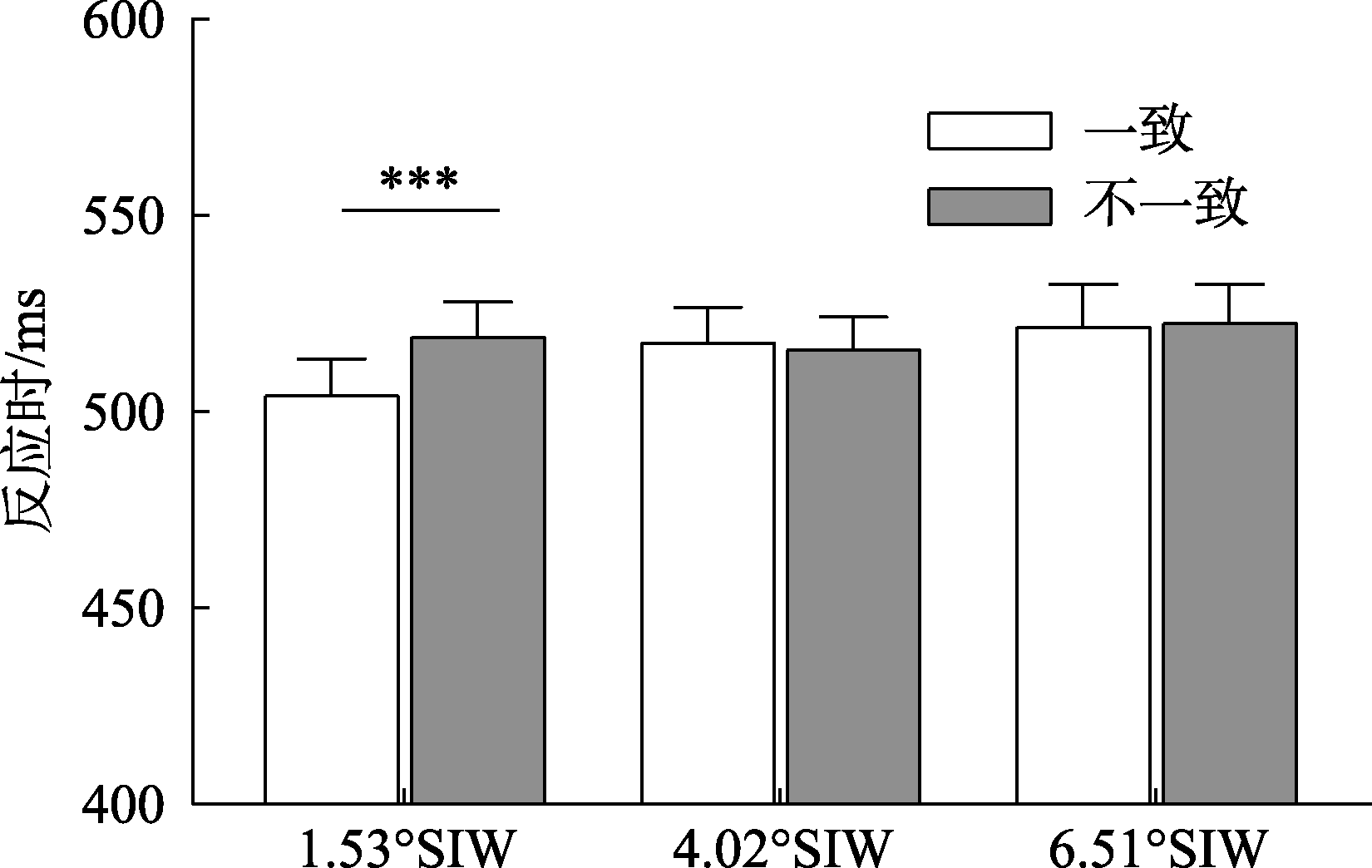
图2 实验1同异判断任务反应时结果条形图 注:*** p < 0.001, 误差棒长度代表1个标准误
| 知觉匹配任务 | 阈下同异任务 | ||
|---|---|---|---|
| 同异关系 | 图形匹配 | ||
| 自我 | 相同 | ||
| 不同 | |||
| 朋友 | 相同 | ||
| 不同 | |||
| 无信息 | 相同 | ||
| 不同 | |||
表3 实验2图形匹配情况(例)
| 知觉匹配任务 | 阈下同异任务 | ||
|---|---|---|---|
| 同异关系 | 图形匹配 | ||
| 自我 | 相同 | ||
| 不同 | |||
| 朋友 | 相同 | ||
| 不同 | |||
| 无信息 | 相同 | ||
| 不同 | |||
| SIW | 一致性 | 社会信息 | ||
|---|---|---|---|---|
| 自我 | 朋友 | 无信息 | ||
| 1.53° | 一致 | 531.16 ± 44.30 | 525.22 ± 46.71 | 519.47 ± 47.29 |
| 不一致 | 545.38 ± 47.28 | 538.47 ± 48.33 | 542.59 ± 44.72 | |
| 4.02° | 一致 | 532.28 ± 44.90 | 536.72 ± 47.38 | 540.41 ± 46.07 |
| 不一致 | 552.56 ± 49.83 | 544.81 ± 47.44 | 536.09 ± 47.20 | |
| 6.51° | 一致 | 538.03 ± 41.76 | 530.84 ± 39.85 | 533.38 ± 41.82 |
| 不一致 | 535.72 ± 48.70 | 540.81 ± 36.43 | 528.50 ± 38.83 | |
表4 实验2各处理条件的平均反应时(ms) (M ± SD)
| SIW | 一致性 | 社会信息 | ||
|---|---|---|---|---|
| 自我 | 朋友 | 无信息 | ||
| 1.53° | 一致 | 531.16 ± 44.30 | 525.22 ± 46.71 | 519.47 ± 47.29 |
| 不一致 | 545.38 ± 47.28 | 538.47 ± 48.33 | 542.59 ± 44.72 | |
| 4.02° | 一致 | 532.28 ± 44.90 | 536.72 ± 47.38 | 540.41 ± 46.07 |
| 不一致 | 552.56 ± 49.83 | 544.81 ± 47.44 | 536.09 ± 47.20 | |
| 6.51° | 一致 | 538.03 ± 41.76 | 530.84 ± 39.85 | 533.38 ± 41.82 |
| 不一致 | 535.72 ± 48.70 | 540.81 ± 36.43 | 528.50 ± 38.83 | |
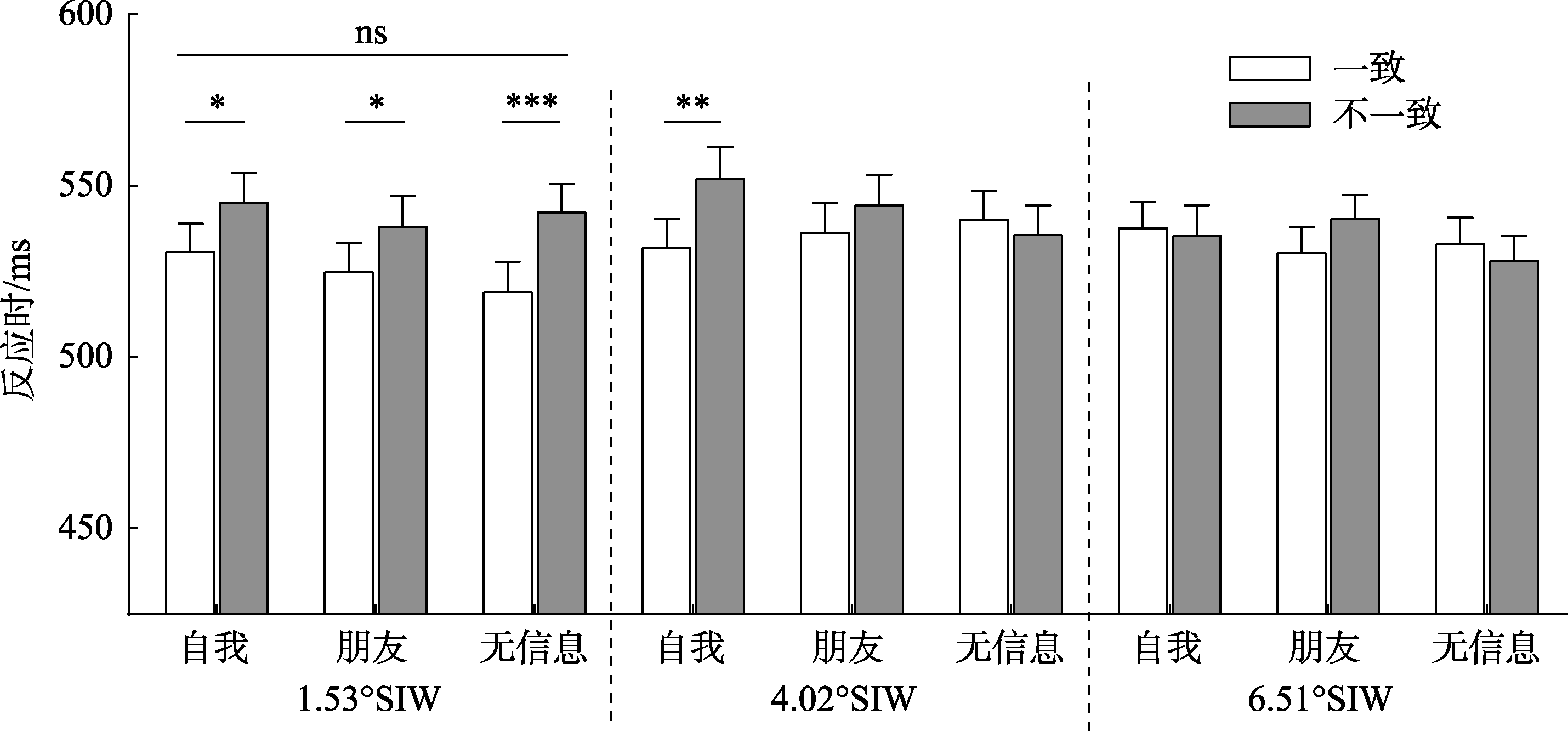
图3 实验2同异判断任务反应时结果条形图 注:*p < 0.05, **p < 0.01, ***p < 0.001, ns代表交互作用不显著, 误差棒长度代表1个标准误
| 知觉匹配任务 | 阈下同异任务 | |||
|---|---|---|---|---|
| 整合水平 | 图形匹配 | |||
| 自我 | 知觉表征 | |||
| 语义表征 | ||||
| 朋友 | 知觉表征 | |||
| 语义表征 | ||||
| 填充材料 | 知觉和语义相似性 均不同 | |||
表5 实验3图形匹配情况(例)
| 知觉匹配任务 | 阈下同异任务 | |||
|---|---|---|---|---|
| 整合水平 | 图形匹配 | |||
| 自我 | 知觉表征 | |||
| 语义表征 | ||||
| 朋友 | 知觉表征 | |||
| 语义表征 | ||||
| 填充材料 | 知觉和语义相似性 均不同 | |||
| 整合水平 | 社会信息 | 一致性 | |
|---|---|---|---|
| 一致 | 不一致 | ||
| 知觉表征水平 | 自我 | 504.82 ± 47.22 | 538.35 ± 53.96 |
| 朋友 | 510.34 ± 55.91 | 531.21 ± 58.48 | |
| 语义表征水平 | 自我 | 509.86 ± 48.05 | 538.95 ± 56.24 |
| 朋友 | 513.15 ± 48.73 | 536.19 ± 62.21 | |
表6 实验3各处理条件的平均反应时(ms) (M ± SD)
| 整合水平 | 社会信息 | 一致性 | |
|---|---|---|---|
| 一致 | 不一致 | ||
| 知觉表征水平 | 自我 | 504.82 ± 47.22 | 538.35 ± 53.96 |
| 朋友 | 510.34 ± 55.91 | 531.21 ± 58.48 | |
| 语义表征水平 | 自我 | 509.86 ± 48.05 | 538.95 ± 56.24 |
| 朋友 | 513.15 ± 48.73 | 536.19 ± 62.21 | |
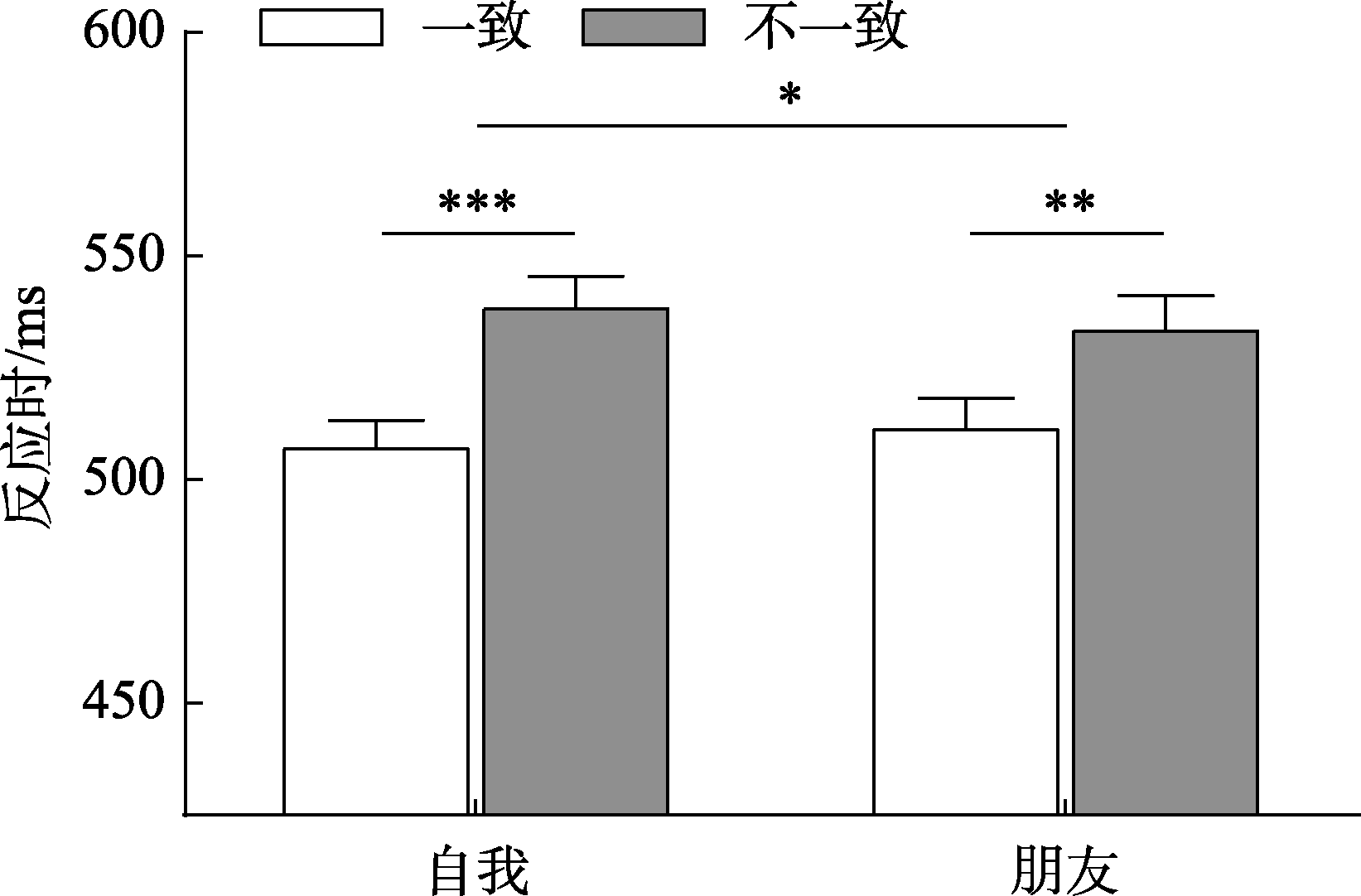
图4 实验3同异判断任务反应时结果条形图 注:*p < 0.05, **p < 0.01, ***p < 0.001, 误差棒长度代表1个标准误
| [1] | Alexopoulos, T., Muller, D., Ric, F., & Marendaz, C. (2012). I, me, mine: Automatic attentional capture by self‐related stimuli. European Journal of Social Psychology, 42(6), 770-779. |
| [2] | Bai, W., Liu, A., & Liu, M. (2021). Self-related processing in adult survivors of childhood psychological maltreatment. Journal of Psychological Science, 44(2), 473-480. |
| [白卫明, 刘爱书, 刘明慧. (2021). 儿童期遭受心理虐待个体的自我加工特点. 心理科学, 44(2), 473-480.] | |
| [3] |
Bengtsson, S. L., Dolan, R. J., & Passingham, R. E. (2011). Priming for self-esteem influences the monitoring of one's own performance. Social Cognitive and Affective Neuroscience, 6(4), 417-425.
doi: 10.1093/scan/nsq048 pmid: 20551143 |
| [4] | Biafora, M., & Schmidt, T. (2020). Induced dissociations: Opposite time courses of priming and masking induced by custom-made mask-contrast functions. Attention, Perception, & Psychophysics, 82(3), 1333-1354. |
| [5] |
Biderman, N., & Mudrik, L. (2018). Evidence for implicit— but not unconscious—processing of object-scene relations. Psychological Science, 29(2), 266-277.
doi: 10.1177/0956797617735745 pmid: 29283750 |
| [6] | Bola, M., Paź, M., Doradzińska, Ł., & Nowicka, A. (2021). The self‐face captures attention without consciousness: Evidence from the N2pc ERP component analysis. Psychophysiology, 58(4), e13759. |
| [7] | Cho, S., & He, S. (2019). Size-invariant but location-specific object-viewpoint adaptation in the absence of awareness. Cognition, 192, 104035. |
| [8] | Dehaene, S., Changeux, J.-P., & Naccache, L. (2011). The global neuronal workspace model of conscious access:From neuronal architectures to clinical applications. In S.Dehaene, & Y.Christen, (Characterizing consciousness: From cognition to the clinic? (Eds.), pp.55-84). Springer, Berlin, Heidelberg. |
| [9] |
Dixon, M. L., Fox, K. C., & Christoff, K. (2014). A framework for understanding the relationship between externally and internally directed cognition. Neuropsychologia, 62, 321-330.
doi: 10.1016/j.neuropsychologia.2014.05.024 pmid: 24912071 |
| [10] | Doradzińska, Ł., Wójcik, M. J., Paź, M., Nowicka, M. M., Nowicka, A., & Bola, M. (2020). Unconscious perception of one's own name modulates amplitude of the P3B ERP component. Neuropsychologia, 147, 107564. |
| [11] |
Geng, H., Zhang, S., Li, Q., Tao, R., & Xu, S. (2012). Dissociations of subliminal and supraliminal self-face from other-face processing: Behavioral and ERP evidence. Neuropsychologia, 50(12), 2933-2942.
doi: 10.1016/j.neuropsychologia.2012.07.040 pmid: 22898645 |
| [12] | Hirschhorn, R., Kahane, O., Gur-Arie, I., Faivre, N., & Mudrik, L. (2021). Windows of integration hypothesis revisited. Frontiers in Human Neuroscience, 14, 617187. |
| [13] | Hu, C.-P., Lan, Y., Macrae, C. N., & Sui, J. (2020). Good me bad me: Prioritization of the good-self during perceptual decision-making. Collabra: Psychology, 6(1), 20. |
| [14] | Kaida, K., & Abe, T. (2018). Attentional lapses are reduced by repeated stimuli having own-name during a monotonous task. PloS One, 13(3), e0194065. |
| [15] |
Kiefer, M., Adams, S. C., & Zovko, M. (2012). Attentional sensitization of unconscious visual processing: Top-down influences on masked priming. Advances in Cognitive Psychology, 8(1), 50-61.
doi: 10.2478/v10053-008-0102-4 pmid: 22419966 |
| [16] | Kiefer, M., & Martens, U. (2010). Attentional sensitization of unconscious cognition: Task sets modulate subsequent masked semantic priming. Journal of Experimental Psychology: General, 139(3), 464-489. |
| [17] |
Lamme, V. A., & Roelfsema, P. R. (2000). The distinct modes of vision offered by feedforward and recurrent processing. Trends in Neurosciences, 23(11), 571-579.
doi: 10.1016/s0166-2236(00)01657-x pmid: 11074267 |
| [18] | Lee, N. A., Martin, D., & Sui, J. (2023). Accentuate the positive: Evidence that context dependent self-reference drives self-bias. Cognition, 240, 105600. |
| [19] | Lin, S.-H., & Yeh, Y.-Y. (2014). Attentional load and the consciousness of one’s own name. Consciousness and Cognition, 26, 197-203. |
| [20] |
Lin, Z., & Murray, S. O. (2014). Unconscious processing of an abstract concept. Psychological Science, 25(1), 296-298.
doi: 10.1177/0956797613504964 pmid: 24285433 |
| [21] | Liu, C., Sun, Z., Jou, J., Cui, Q., Zhao, G., Qiu, J., & Tu, S. (2016). Unconscious processing of facial emotional valence relation: Behavioral evidence of integration between subliminally perceived stimuli. PloS One, 11(9), e0162689. |
| [22] | Liu, M., & Sui, J. (2016). The interaction between social saliency and perceptual saliency. Quarterly Journal of Experimental Psychology, 69(12), 2419-2430. |
| [23] |
Liu, M., Zhang, M., & Sui, J. (2014). Self-related information modulates global advantage effect in visual selection. Acta Psychologica Sinica, 46(3), 312-320.
doi: 10.3724/SP.J.1041.2014.00312 |
| [刘明慧, 张明, 隋洁. (2014). 自我信息对知觉选择中整体优先性的调控作用. 心理学报, 46(3), 312-320.] | |
| [24] | Liu, R., Wang, L., & Jiang, Y. (2016). Recent progress in the study of consciousness and multisensory integration. Chinese Science Bulletin, 61(1), 2-11. |
| [刘睿, 王莉, 蒋毅. (2016). 意识与多感觉信息整合的最新研究进展. 科学通报, 61(1), 2-11.] | |
| [25] |
Macrae, C. N., Visokomogilski, A., Golubickis, M., Cunningham, W. A., & Sahraie, A. (2017). Self-relevance prioritizes access to visual awareness. Journal of Experimental Psychology: Human Perception and Performance, 43(3), 438-443.
doi: 10.1037/xhp0000361 pmid: 28240929 |
| [26] |
Mashour, G. A., Roelfsema, P., Changeux, J.-P., & Dehaene, S. (2020). Conscious processing and the global neuronal workspace hypothesis. Neuron, 105(5), 776-798.
doi: S0896-6273(20)30052-0 pmid: 32135090 |
| [27] | Moray, N. (1959). Attention in dichotic listening: Affective cues and the influence of instructions. Quarterly journal of Experimental Psychology, 11(1), 56-60. |
| [28] |
Mudrik, L., Breska, A., Lamy, D., & Deouell, L. Y. (2011). Integration without awareness: Expanding the limits of unconscious processing. Psychological Science, 22(6), 764-770.
doi: 10.1177/0956797611408736 pmid: 21555524 |
| [29] |
Mudrik, L., Faivre, N., & Koch, C. (2014). Information integration without awareness. Trends in Cognitive Sciences, 18(9), 488-496.
doi: 10.1016/j.tics.2014.04.009 pmid: 24933626 |
| [30] |
Mudrik, L., & Koch, C. (2013). Differential processing of invisible congruent and incongruent scenes: A case for unconscious integration. Journal of Vision, 13(13), 24-24.
doi: 10.1167/13.13.24 pmid: 24273226 |
| [31] | Payne, B., Lavan, N., Knight, S., & McGettigan, C. (2021). Perceptual prioritization of self‐associated voices. British Journal of Psychology, 112(3), 585-610. |
| [32] | Pfister, R., Pohl, C., Kiesel, A., & Kunde, W. (2012). Your unconscious knows your name. PloS One, 7(3), e32402. |
| [33] | Qin, P., Lai, Q., & Meng, M. (2024). The Self-prioritization Effect in Conscious Access. Journal of South China normal University (Social Science Edition), (1), 56-74. |
| [秦鹏民, 赖芊途, 孟明. (2024). 自我相关刺激的意识通达优先性. 华南师范大学学报(社会科学版), (1), 56-74.] | |
| [34] |
Rubianes, M., Drijvers, L., Muñoz, F., Jiménez-Ortega, L., Almeida-Rivera, T., Sánchez-García, J., … Martín -Loeches, M. (2024). The self-reference effect can modulate language syntactic processing even without explicit awareness: An electroencephalography study. Journal of Cognitive Neuroscience, 36(3), 460-474.
doi: 10.1162/jocn_a_02104 pmid: 38165746 |
| [35] |
Silverstein, B. H., Snodgrass, M., Shevrin, H., & Kushwaha, R. (2015). P3b, consciousness, and complex unconscious processing. Cortex, 73, 216-227.
doi: 10.1016/j.cortex.2015.09.004 pmid: 26474391 |
| [36] |
Sui, J., He, X., & Humphreys, G. W. (2012). Perceptual effects of social salience: Evidence from self-prioritization effects on perceptual matching. Journal of Experimental Psychology: Human Perception and Performance, 38(5), 1105-1117.
pmid: 22963229 |
| [37] | Sui, J., & Humphreys, G. W. (2013). The boundaries of self face perception: Response time distributions, perceptual categories, and decision weighting. Visual Cognition, 21(4), 415-445. |
| [38] | Sui, J., & Humphreys, G. W. (2015). More of me! Distinguishing self and reward bias using redundancy gains. Attention, Perception, & Psychophysics, 77(8), 2549-2561. |
| [39] | Sui, J., & Humphreys, G. W. (2017). The ubiquitous self:What the properties of self‐bias tell us about the self. Annals of the New York Academy of Sciences, 1396(1), 222-235. |
| [40] |
Sui, J., & Rotshtein, P. (2019). Self-prioritization and the attentional systems. Current Opinion in Psychology, 29, 148-152.
doi: S2352-250X(18)30198-2 pmid: 30913475 |
| [41] | Tu, S., Martens, U., Zhao, G., Pan, W., Wang, T., Qiu, J., & Zhang, Q. (2013). Subliminal faces with different valence: Unconscious mismatch detection indicates interactions between unconscious processing. World Journal of Neuroscience, 3(4), 298-306. |
| [42] | Tu, S., Wan, S., Jou, J., Ma, Y., Zhao, G., & Pan, W. (2020). Can unconscious sequential integration of semantic information occur when the prime Chinese characters are displayed from left to right? Attention, Perception, & Psychophysics, 82, 1221-1229. |
| [43] | Tu, S., Zhu, S., Liang, Q., Jou, J., Wan, S., Zhao, G., … Qiu, J. (2020). Unconscious integration of sequentially presented subliminal arrow pointing directions. Australian Journal of Psychology, 72(1), 82-92. |
| [44] |
Van den Bussche, E., Notebaert, K., & Reynvoet, B. (2009). Masked primes can be genuinely semantically processed: A picture prime study. Experimental Psychology, 56(5), 295-300.
doi: 10.1027/1618-3169.56.5.295 pmid: 19447745 |
| [45] | Van Opstal, F. (2021). The same-different task as a tool to study unconscious processing. Current Opinion in Behavioral Sciences, 37, 35-40. |
| [46] | Van Opstal, F., & Rooyakkers, M. (2022). Unconscious information integration: A replication and the role of spatial window in masking experiments. Cognition, 225, 105113. |
| [47] | Wang, D., Tang, L., Liang, Q., Jou, J., Ma, Y., Pan, W., & Tu, S. (2017). Unconscious integration of pointing relation between two masked arrows. Visual Cognition, 25(9-10), 928-939. |
| [48] | Wang, L., Wang, A., Qi, Y., Fan, Y., & Zhang, M. (2019). The mental representation of the self in the implicit association test: The role of the other. Journal of Psychological Science, 42(3), 633-638. |
| [王凌云, 王爱君, 齐宇欣, 范丫, 张明. (2019). 内隐联想测验中他人重要性对自我心理表征的影响. 心理科学, 42(3), 633-638.] | |
| [49] | Wen, Z., & Yu, R. (2023a). Perceptual and semantic same- different processing under subliminal conditions. Consciousness and Cognition, 111, 103523. |
| [50] | Wen, Z., & Yu, R. (2023b). Unconscious integration: Current evidence for integrative processing under subliminal conditions. British Journal of Psychology, 114(2), 430-456. |
| [51] | Woźniak, M., & Knoblich, G. (2022). Self-prioritization depends on assumed task-relevance of self-association. Psychological Research, 86(5), 1599-1614. |
| [1] | 尹华站, 刘鹏玉, 张丽. 自我意识情绪非言语行为表达图片系统的初步编制和评定及其在研究中的运用[J]. 心理学报, 2025, 57(10): 1745-1761. |
| [2] | 杨鑫超, 陈燕铃, 郑俊猛, 张荣祥, 牟晓, 徐强. 工作记忆负荷对社交焦虑个体注意偏向的调节作用: 来自稳态视觉诱发电位的证据[J]. 心理学报, 2025, 57(10): 1729-1744. |
| [3] | 吴洁, 车子轩. 多通道类别学习的认知特征与神经机制:EEG与DDM证据[J]. 心理学报, 2025, 57(10): 1715-1728. |
| [4] | 周临舒, 张雨青, 蔡丹超. 音乐训练促进音高与时间维度在听觉工作记忆中的交互[J]. 心理学报, 2025, 57(10): 1701-1714. |
| [5] | 冯俊业, 王哲, 孙宇浩. 面孔身份匹配的多图像优势依赖面孔表征的形成[J]. 心理学报, 2025, 57(10): 1689-1700. |
| [6] | 杨明川, 李贤卓, 梁丹丹. 语言与音乐经验存在双向迁移: 基于普通话母语音乐人的范畴感知[J]. 心理学报, 2025, 57(9): 1499-1511. |
| [7] | 向颖, 贺斐, 冯琳琳, 龙梦灵, 白学军, 梁菲菲. 中文阅读伴随词汇学习:高效与低效组的认知加工策略比较[J]. 心理学报, 2025, 57(9): 1512-1528. |
| [8] | 秦奎元, 刘煜, 刘赛芳, 王朔, 刘鹏, 游旭群, 李苑. 阻断范式中时间结构线索对预测运动的影响[J]. 心理学报, 2025, 57(9): 1540-1552. |
| [9] | 陈子龙, 季琭妍. 多面孔情绪变异性的自动加工:来自视觉失匹配成分的证据[J]. 心理学报, 2025, 57(9): 1553-1571. |
| [10] | 何从莲, 袁加锦. 情绪动机对人际情绪调节策略选择的影响:来自行为与超扫描的实验证据[J]. 心理学报, 2025, 57(9): 1589-1608. |
| [11] | 李馨, 张美, 顾俊娟, 王永胜, 梁菲菲. 双字词识别中首、尾词素位置概率对位置编码灵活程度的影响[J]. 心理学报, 2025, 57(8): 1309-1322. |
| [12] | 王俊博, 赵娜, 李子媛, 刘强. 负性面孔的工作记忆离线态存储不影响在线态存储[J]. 心理学报, 2025, 57(8): 1323-1332. |
| [13] | 汪俊, 郑峥. 联合行动情境对个体时间知觉的影响[J]. 心理学报, 2025, 57(7): 1170-1186. |
| [14] | 王慧媛, 高玉林, 张明. 意义关联的同位置成本现象: 基于非靶特征及可能靶子位置的抑制[J]. 心理学报, 2025, 57(7): 1154-1169. |
| [15] | 陈杰, 蔡佳慧, 兰雅迪, 李雯婕. 生物运动信息对听障个体注意网络功能的影响[J]. 心理学报, 2025, 57(7): 1139-1153. |
| 阅读次数 | ||||||
|
全文 |
|
|||||
|
摘要 |
|
|||||
