

ISSN 0439-755X
CN 11-1911/B
主办:中国心理学会
中国科学院心理研究所
出版:科学出版社
CN 11-1911/B
主办:中国心理学会
中国科学院心理研究所
出版:科学出版社
心理学报 ›› 2025, Vol. 57 ›› Issue (10): 1745-1761.doi: 10.3724/SP.J.1041.2025.1745 cstr: 32110.14.2025.1745
尹华站1,2,3( ), 刘鹏玉1,2(), 张丽1,2
收稿日期:2024-10-23
发布日期:2025-08-15
出版日期:2025-10-25
通讯作者:
刘鹏玉, E-mail: Liupengyupsy@163.com;基金资助:
YIN Huazhan1,2,3(), LIU Pengyu1,2(), ZHANG Li1,2
Received:2024-10-23
Online:2025-08-15
Published:2025-10-25
摘要:
本研究拟初步编制一套具有多维度、标准化的自我意识情绪非言语行为表达图片系统, 然后采用该图片系统探讨自我意识情绪对时距知觉的影响。研究1首先招募20名表演者(男、女表演者各半, 平均年龄19.35 ± 1.39岁)进行非言语行为表达图片拍摄, 共生成479张图片, 然后招募103名大学生(男生48名, 女生55名, 平均年龄18.53 ± 0.70岁)对479张图片进行情绪类别和维度评定(愉悦度、唤醒度、优势度)。 结果表明:(1)共生成389张图片, 包括中性36张, 羞耻124张, 自豪107张, 尴尬122张; (2)发现了新的手部动作, 如手扯衣角(羞耻)、单手挠头(尴尬)、单手举过头顶(自豪)。(3)本图片系统内部一致性系数较高; (4)相较中性图片, 自豪具有高愉悦度、高唤醒、高优势度; 羞耻具有低愉悦度、高唤醒、低优势度; 尴尬具有低愉悦度、高唤醒、低优势度。这说明本图片系统可靠性较高, 可作为后续研究的自我意识情绪诱发材料。为了给研究1的图片库提供应用场景, 研究2招募正式实验112名被试(男生56名, 女生56名, 平均年龄为18.71 ± 0.94岁), 采用时距复制任务探讨羞耻、自豪、尴尬及中性情绪非言语行为表达图片对时距知觉的影响。 结果表明,相比中性, 会短估羞耻和自豪情绪非言语行为表达图片的时距, 尴尬情绪非言语行为表达图片没有显著的时距知觉扭曲, 这些结果在标量计时模型框架内进行了解释。
中图分类号:
尹华站, 刘鹏玉, 张丽. (2025). 自我意识情绪非言语行为表达图片系统的初步编制和评定及其在研究中的运用. 心理学报, 57(10), 1745-1761.
YIN Huazhan, LIU Pengyu, ZHANG Li. (2025). Preliminary development and evaluation of the Chinese self-conscious emotions nonverbal behavior expression stimulus set, and its application in research. Acta Psychologica Sinica, 57(10), 1745-1761.
| 部位 | 非言语行为表达特征线索 | |||||
|---|---|---|---|---|---|---|
| 眉 | 眉上扬(71.9) | 皱眉(0) | 眉下垂(0.7) | 眉舒展(27.4) | ||
| 眼 | 眼睁大(54.1) | 两眼微眯(17.8) | 两眼大小不变(27.4) | |||
| 双眼注视方向 | 双眼注视上方(35.6) | 双目平视(60) | 双眼注视下方(3) | |||
| 嘴 | 口紧抿(0.7) | 嘴角上扬(86.7) | 嘴角下垂(0.7) | 口放松(11.9) | ||
| 下巴 | 下巴前挺(46.7) | 下巴后缩(5.9) | 下巴放松(45.2) | |||
| 两颊 | 微笑(65.9) | 轻微的压抑的笑(8.9) | 面部无笑容(1.5) | 大笑(23) | ||
| 头 | 头后仰(30.4) | 头直立(66.7) | 低头(1.5) | |||
| 躯干 | 身体蜷缩(0) | 身体直立(41.5) | 身体舒展(57.8) | |||
| 手臂 | 双手交叉胸前(13.3) | 双手垂直放于两侧(45.9) | 双手叉腰(17.8) | 双手举过头部(8.9) | 双手交叉下垂(3.7) | 手触摸脸部(4.4) |
表1 自豪非言语行为表达特征线索及其比值(%)
| 部位 | 非言语行为表达特征线索 | |||||
|---|---|---|---|---|---|---|
| 眉 | 眉上扬(71.9) | 皱眉(0) | 眉下垂(0.7) | 眉舒展(27.4) | ||
| 眼 | 眼睁大(54.1) | 两眼微眯(17.8) | 两眼大小不变(27.4) | |||
| 双眼注视方向 | 双眼注视上方(35.6) | 双目平视(60) | 双眼注视下方(3) | |||
| 嘴 | 口紧抿(0.7) | 嘴角上扬(86.7) | 嘴角下垂(0.7) | 口放松(11.9) | ||
| 下巴 | 下巴前挺(46.7) | 下巴后缩(5.9) | 下巴放松(45.2) | |||
| 两颊 | 微笑(65.9) | 轻微的压抑的笑(8.9) | 面部无笑容(1.5) | 大笑(23) | ||
| 头 | 头后仰(30.4) | 头直立(66.7) | 低头(1.5) | |||
| 躯干 | 身体蜷缩(0) | 身体直立(41.5) | 身体舒展(57.8) | |||
| 手臂 | 双手交叉胸前(13.3) | 双手垂直放于两侧(45.9) | 双手叉腰(17.8) | 双手举过头部(8.9) | 双手交叉下垂(3.7) | 手触摸脸部(4.4) |
| 部位 | 非言语行为表达特征线索 | |||||
|---|---|---|---|---|---|---|
| 眉 | 眉上扬(1.5) | 皱眉(35.6) | 眉下垂(60) | 眉舒展(3) | ||
| 眼 | 眼睁大(4.4) | 两眼微眯(60.7) | 两眼大小不变(33.3) | |||
| 双眼注视方向 | 双眼注视上方(3) | 双目平视(5.2) | 双眼注视下方(91.1) | |||
| 嘴 | 口紧抿(69.6) | 嘴角上扬(0.7) | 嘴角下垂(26.7) | 口放松(3) | ||
| 下巴 | 下巴前挺(7.4) | 下巴后缩(78.5) | 下巴放松(11.9) | |||
| 两颊 | 微笑(2.2) | 轻微的压抑的笑(28.9) | 面部无笑容(57.8) | 大笑(0) | ||
| 头 | 头后仰(1.5) | 头直立(5.9) | 低头(92.6) | |||
| 躯干 | 身体蜷缩(75.6) | 身体直立(18.5) | 身体舒展(5.2) | |||
| 手臂 | 双手交叉胸前(5.2) | 双手垂直放于两侧(30.4) | 双手叉腰(0.7) | 双手举过头部(1.5) | 双手交叉下垂(27.4) | 手触摸脸部(27.4) |
表2 羞耻非言语行为表达特征线索及其比值(%)
| 部位 | 非言语行为表达特征线索 | |||||
|---|---|---|---|---|---|---|
| 眉 | 眉上扬(1.5) | 皱眉(35.6) | 眉下垂(60) | 眉舒展(3) | ||
| 眼 | 眼睁大(4.4) | 两眼微眯(60.7) | 两眼大小不变(33.3) | |||
| 双眼注视方向 | 双眼注视上方(3) | 双目平视(5.2) | 双眼注视下方(91.1) | |||
| 嘴 | 口紧抿(69.6) | 嘴角上扬(0.7) | 嘴角下垂(26.7) | 口放松(3) | ||
| 下巴 | 下巴前挺(7.4) | 下巴后缩(78.5) | 下巴放松(11.9) | |||
| 两颊 | 微笑(2.2) | 轻微的压抑的笑(28.9) | 面部无笑容(57.8) | 大笑(0) | ||
| 头 | 头后仰(1.5) | 头直立(5.9) | 低头(92.6) | |||
| 躯干 | 身体蜷缩(75.6) | 身体直立(18.5) | 身体舒展(5.2) | |||
| 手臂 | 双手交叉胸前(5.2) | 双手垂直放于两侧(30.4) | 双手叉腰(0.7) | 双手举过头部(1.5) | 双手交叉下垂(27.4) | 手触摸脸部(27.4) |
| 部位 | 非言语行为表达特征线索 | |||||
|---|---|---|---|---|---|---|
| 眉 | 眉上扬(23.7) | 皱眉(39.3) | 眉下垂(20) | 眉舒展(12.6) | ||
| 眼 | 眼睁大(24.4) | 两眼微眯(55.6) | 两眼大小不变(18.5) | |||
| 双眼注视方向 | 双眼注视上方(15.6) | 双目平视(10.4) | 双眼注视下方(65.9) | |||
| 嘴 | 口紧抿(71.1) | 嘴角上扬(13.3) | 嘴角下垂(8.9) | 口放松(5.9) | ||
| 下巴 | 下巴前挺(17) | 下巴后缩(53.3) | 下巴放松(25.9) | |||
| 两颊 | 微笑(11.1) | 轻微的压抑的笑(69.6) | 面部无笑容(8.1) | 大笑(6.7) | ||
| 头 | 头后仰(9.6) | 头直立(20.7) | 低头(66.7) | |||
| 躯干 | 身体蜷缩(41.5) | 身体直立(42.2) | 身体舒展(11.9) | |||
| 手臂 | 双手交叉胸前(4.4) | 双手垂直放于两侧(26.7) | 双手叉腰(0) | 双手举过头部(4.4) | 双手交叉下垂(17) | 手触摸脸部(38.5) |
表3 尴尬非言语行为表达特征线索及其比值(%)
| 部位 | 非言语行为表达特征线索 | |||||
|---|---|---|---|---|---|---|
| 眉 | 眉上扬(23.7) | 皱眉(39.3) | 眉下垂(20) | 眉舒展(12.6) | ||
| 眼 | 眼睁大(24.4) | 两眼微眯(55.6) | 两眼大小不变(18.5) | |||
| 双眼注视方向 | 双眼注视上方(15.6) | 双目平视(10.4) | 双眼注视下方(65.9) | |||
| 嘴 | 口紧抿(71.1) | 嘴角上扬(13.3) | 嘴角下垂(8.9) | 口放松(5.9) | ||
| 下巴 | 下巴前挺(17) | 下巴后缩(53.3) | 下巴放松(25.9) | |||
| 两颊 | 微笑(11.1) | 轻微的压抑的笑(69.6) | 面部无笑容(8.1) | 大笑(6.7) | ||
| 头 | 头后仰(9.6) | 头直立(20.7) | 低头(66.7) | |||
| 躯干 | 身体蜷缩(41.5) | 身体直立(42.2) | 身体舒展(11.9) | |||
| 手臂 | 双手交叉胸前(4.4) | 双手垂直放于两侧(26.7) | 双手叉腰(0) | 双手举过头部(4.4) | 双手交叉下垂(17) | 手触摸脸部(38.5) |

图1 实验材料举例, A−D分别代表自豪、尴尬、羞耻、中性非言语行为表达图片, 所有图片用水平和垂直两条参考线固定人在图片中的位置。
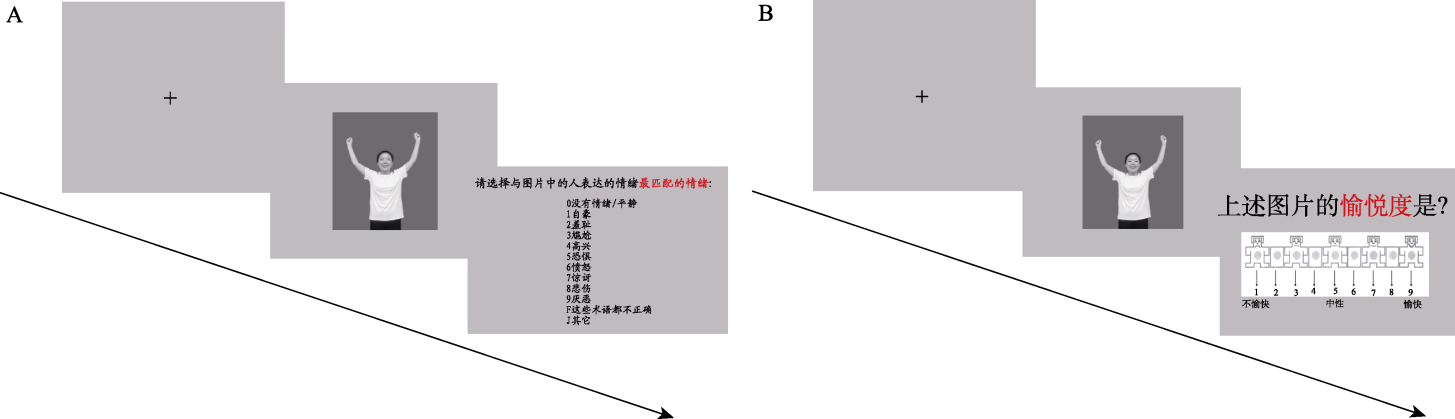
图2 评定流程图, A为情绪类别评定, B为愉悦度评定
| 情绪 | 手部动作 | n (图片数) | 平均识别百分比 |
|---|---|---|---|
| 中性 | 总 | 36 | 0.96 ± 0.04 |
| 羞耻 | 双手交叉下垂(前) | 43 | 0.67 ± 0.09 |
| 双手交叉下垂(后) | 29 | 0.67 ± 0.08 | |
| 双手垂直放于两侧 | 29 | 0.63 ± 0.06 | |
| 手扯衣角 | 23 | 0.70 ± 0.08 | |
| 总 | 124 | 0.67 ± 0.08 | |
| 自豪 | 双手举过头顶 | 26 | 0.78 ± 0.05 |
| 双手交叉胸前 | 26 | 0.71 ± 0.12 | |
| 双手叉腰 | 25 | 0.68 ± 0.11 | |
| 单手举起 | 21 | 0.71 ± 0.10 | |
| 其它 | 9 | 0.73 ± 0.12 | |
| 总 | 107 | 0.72 ± 0.10 | |
| 尴尬 | 左手触摸脸部 | 44 | 0.63 ± 0.11 |
| 右手触摸脸部 | 34 | 0.68 ± 0.11 | |
| 双手垂直放于两侧 | 5 | 0.45 ± 0.04 | |
| 单手挠头 | 36 | 0.77 ± 0.08 | |
| 其它 | 3 | 0.54 ± 0.11 | |
| 总 | 122 | 0.68 ± 0.13 |
表4 四种情绪图片在手部动作上的平均识别百分比
| 情绪 | 手部动作 | n (图片数) | 平均识别百分比 |
|---|---|---|---|
| 中性 | 总 | 36 | 0.96 ± 0.04 |
| 羞耻 | 双手交叉下垂(前) | 43 | 0.67 ± 0.09 |
| 双手交叉下垂(后) | 29 | 0.67 ± 0.08 | |
| 双手垂直放于两侧 | 29 | 0.63 ± 0.06 | |
| 手扯衣角 | 23 | 0.70 ± 0.08 | |
| 总 | 124 | 0.67 ± 0.08 | |
| 自豪 | 双手举过头顶 | 26 | 0.78 ± 0.05 |
| 双手交叉胸前 | 26 | 0.71 ± 0.12 | |
| 双手叉腰 | 25 | 0.68 ± 0.11 | |
| 单手举起 | 21 | 0.71 ± 0.10 | |
| 其它 | 9 | 0.73 ± 0.12 | |
| 总 | 107 | 0.72 ± 0.10 | |
| 尴尬 | 左手触摸脸部 | 44 | 0.63 ± 0.11 |
| 右手触摸脸部 | 34 | 0.68 ± 0.11 | |
| 双手垂直放于两侧 | 5 | 0.45 ± 0.04 | |
| 单手挠头 | 36 | 0.77 ± 0.08 | |
| 其它 | 3 | 0.54 ± 0.11 | |
| 总 | 122 | 0.68 ± 0.13 |
| 维度 | 中性 | 尴尬 | 羞耻 | 自豪 |
|---|---|---|---|---|
| 愉悦度 | 4.94 ± 0.08 | 4.67 ± 0.70 | 2.95 ± 0.27 | 7.11 ± 0.65 |
| 唤醒度 | 1.75 ± 0.12 | 5.70 ± 0.17 | 5.90 ± 0.27 | 6.66 ± 0.45 |
| 优势度 | 4.83 ± 0.07 | 4.17 ± 0.42 | 3.24 ± 0.18 | 6.87 ± 0.41 |
表5 自我意识情绪的维度评分的描述统计结果(M ± SD)
| 维度 | 中性 | 尴尬 | 羞耻 | 自豪 |
|---|---|---|---|---|
| 愉悦度 | 4.94 ± 0.08 | 4.67 ± 0.70 | 2.95 ± 0.27 | 7.11 ± 0.65 |
| 唤醒度 | 1.75 ± 0.12 | 5.70 ± 0.17 | 5.90 ± 0.27 | 6.66 ± 0.45 |
| 优势度 | 4.83 ± 0.07 | 4.17 ± 0.42 | 3.24 ± 0.18 | 6.87 ± 0.41 |
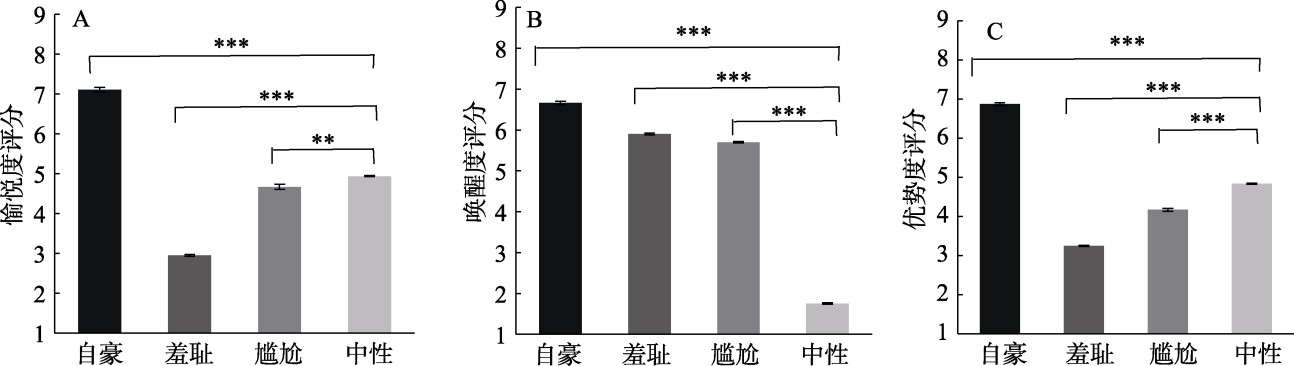
图3 三种情绪图片与中性图片在愉悦度(A)、唤醒度(B)、优势度(C)评分上的比较结果注:误差线为SE。**表示p < 0.01, ***表示p < 0.001。
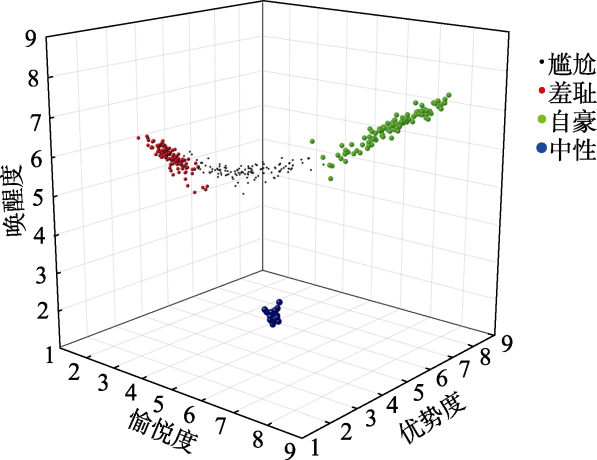
图4 389张图片在愉悦度、唤醒度、优势度三个维度上两两间评分均数分布散点图
| 情绪 | 愉悦度 | 唤醒度 | 优势度 |
|---|---|---|---|
| 中性 | 0.758 | 0.971 | 0.978 |
| 羞耻 | 0.990 | 0.997 | 0.993 |
| 自豪 | 0.981 | 0.995 | 0.989 |
| 尴尬 | 0.981 | 0.997 | 0.987 |
表6 四类情绪在每一维度上的Cronbach’s α系数
| 情绪 | 愉悦度 | 唤醒度 | 优势度 |
|---|---|---|---|
| 中性 | 0.758 | 0.971 | 0.978 |
| 羞耻 | 0.990 | 0.997 | 0.993 |
| 自豪 | 0.981 | 0.995 | 0.989 |
| 尴尬 | 0.981 | 0.997 | 0.987 |
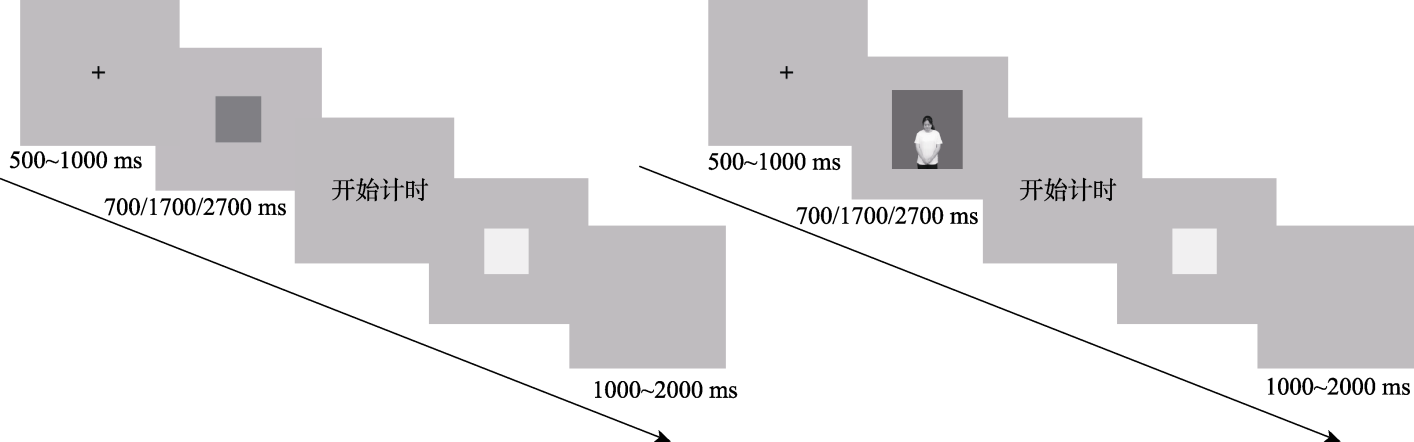
图5 时距复制任务实验流程图, 左为练习阶段, 右为正式实验阶段(以羞耻图片为例)
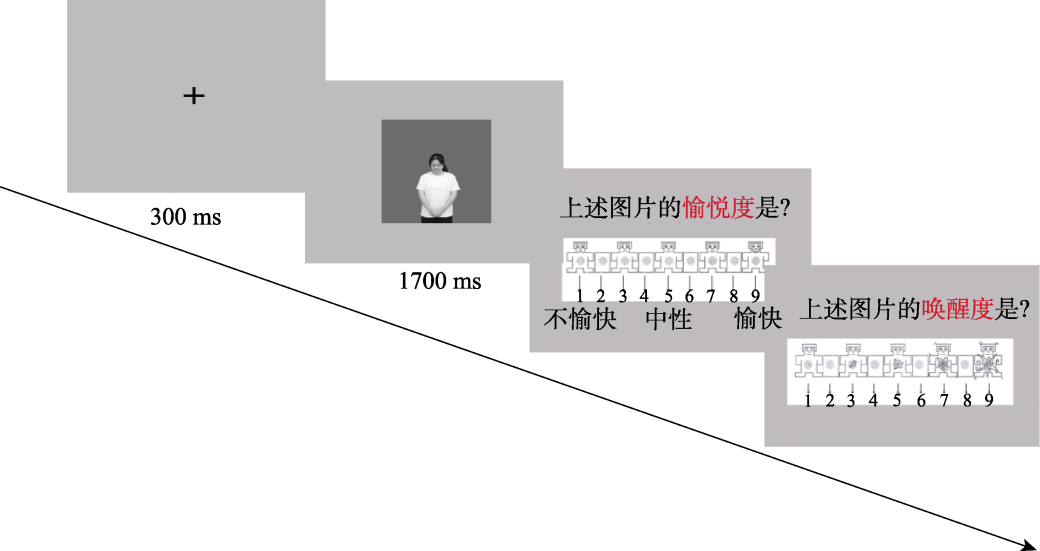
图6 图片评定任务实验流程图(以羞耻图片为例)
| 情绪维度 | 中性 | 尴尬 | 羞耻 | 自豪 |
|---|---|---|---|---|
| 愉悦度 | 4.83 ± 0.40 | 4.71 ± 1.07 | 3.08 ± 0.84 | 6.36 ± 0.58 |
| 唤醒度 | 1.94 ± 0.75 | 4.70 ± 1.17 | 5.24 ± 1.11 | 5.79 ± 0.78 |
表7 被试对不同自我意识情绪图片愉悦度和唤醒度评定得分(M ± SD)
| 情绪维度 | 中性 | 尴尬 | 羞耻 | 自豪 |
|---|---|---|---|---|
| 愉悦度 | 4.83 ± 0.40 | 4.71 ± 1.07 | 3.08 ± 0.84 | 6.36 ± 0.58 |
| 唤醒度 | 1.94 ± 0.75 | 4.70 ± 1.17 | 5.24 ± 1.11 | 5.79 ± 0.78 |
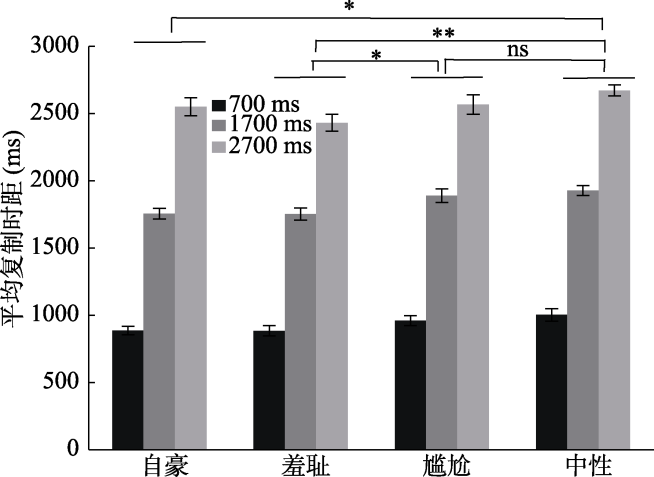
图7 不同情绪下700 ms、1700 ms、2700 ms条件下的平均复制时距, 误差线为SE
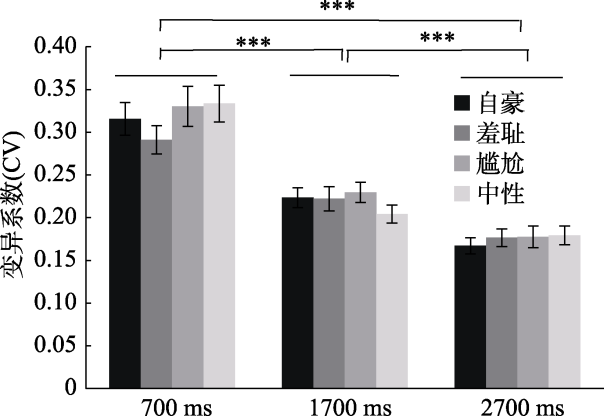
图8 不同情绪下700 ms、1700 ms、2700 ms的变异系数, 误差线为SE
| [1] | Angrilli, A., Cherubini, P., Pavese, A., & Manfredini, S. (1997). The influence of affective factors on time perception. Perception & Psychophysics, 59(6), 972-982. |
| [2] | Bai, L., Ma, H., Huang, Y. X., & Luo, Y. Y. (2005). The development of native Chinese affective picture system-A pretest in 46 college students. Chinese Mental Health Journal, 19(11), 4-7. |
| [白露, 马慧, 黄宇霞, 罗跃嘉. (2005). 中国情绪图片系统的编制——在46名中国大学生中的试用. 中国心理卫生杂志, 19(11), 4-7.] | |
| [3] | Beaupré, M. G., Cheung, N., & Hess, U. (2000). The Montreal set of facial displays of emotion [Slides]. (Available from Ursula Hess, Department of Psychology, University of Quebec at Montreal, P.O. Box 8888, Station “Centre-ville,” Montreal,, Quebec H3C 3P8.). |
| [4] | Bi, X. Y. (2021). An ERP study of the effect of self-conscious emotion on executive function [Unpublished master's thesis]. Yunnan Normal University. |
| [毕晓燕. (2021). 自我意识情绪对执行功能影响的ERP研究(硕士学位论文). 云南师范大学.] | |
| [5] |
Bi, X. Y., Ma, X., & Tao, Y. (2022). The consistency of the influence of pride and shame on cognitive flexibility: Evidence from ERP. Neuroscience, 487, 1-7.
doi: 10.1016/j.neuroscience.2021.12.021 pmid: 35031399 |
| [6] | Buechner, V. L., Maier, M. A., Lichtenfeld, S., & Elliot, A. J. (2015). Emotion expression and color: Their joint influence on perceived attractiveness and social position. Current Psychology, 34(2), 422-433. |
| [7] | Buhusi, C. V., & Meck, W. H. (2009). Relative time sharing: New findings and an extension of the resource allocation model of temporal processing. Philosophical Transactions of the Royal Society B: Biological Sciences, 364(1525), 1875-1885. |
| [8] |
Caldara, R., Deiber, M. P., Andrey, C., Michel, C. M., Thut, G., & Hauert, C. A. (2004). Actual and mental motor preparation and execution: A spatiotemporal ERP study. Experimental Brain Research, 159(3), 389-399.
doi: 10.1007/s00221-004-2101-0 pmid: 15480592 |
| [9] | Carretié, L., Tapia, M., López-Martín, S., & Albert, J. (2019). EmoMadrid: An emotional pictures database for affect research. Motivation and Emotion, 43(6), 929-939. |
| [10] | Chen, J., Zhang, Y., & Zhao, G. (2021). The Qingdao preschooler facial expression set: Acquisition and validation of Chinese children’s facial emotion stimuli. Frontiers in Psychology, 11, 554821. https://doi.org/10.3389/fpsyg.2020.554821 |
| [11] |
Cheng, J. T. (2020). Dominance, prestige, and the role of leveling in human social hierarchy and equality. Current Opinion in Psychology, 33, 238-244.
doi: S2352-250X(19)30183-6 pmid: 31794955 |
| [12] | Chung, J. M., & Robins, R. W. (2015). Exploring cultural differences in the recognition of the self-conscious emotions. PLOS ONE, 10(8), e136411. https://doi.org/10.1371/journal.pone.0136411 |
| [13] | Coundouris, S. P., Henry, J. D., & Lehn, A. C. (2022). Moving beyond basic emotions in Parkinson’s disease. British Journal of Clinical Psychology, 61(3), 647-665. |
| [14] | Cui, X., Tian, Y., Zhang, L., Chen, Y., Bai, Y., Li, D., ... Yin, H. (2022). The role of valence, arousal, stimulus type, and temporal paradigm in the effect of emotion on time perception: A meta-analysis. Psychonomic Bulletin & Review, 30(1), 1-21. |
| [15] |
DaSilva, E. B., Crager, K., & Puce, A. (2016). On dissociating the neural time course of the processing of positive emotions. Neuropsychologia, 83, 123-137.
doi: S0028-3932(15)30241-4 pmid: 26686550 |
| [16] |
de Gelder, B. (2006). Towards the neurobiology of emotional body language. Nature Reviews Neuroscience, 7(3), 242-249.
pmid: 16495945 |
| [17] | Dean Robbins, B., & Parlavecchio, H. (2006). The unwanted exposure of the self: A phenomenological study of embarrassment. The Humanistic Psychologist, 34(4), 321-345. |
| [18] | Droit-Volet, S., Brunot, S., & Niedenthal, P. (2004). Brief report perception of the duration of emotional events. Cognition and Emotion, 18(6), 849-858. |
| [19] |
Droit-Volet, S., Lamotte, M., & Izaute, M. (2015). The conscious awareness of time distortions regulates the effect of emotion on the perception of time. Consciousness and Cognition, 38, 155-164.
doi: 10.1016/j.concog.2015.02.021 pmid: 25890486 |
| [20] |
Faul, F., Erdfelder, E., Lang, A.-G., & Buchner, A. (2007). G*Power 3: A flexible statistical power analysis program for the social, behavioral, and biomedical sciences. Behavior Research Methods, 39(2), 175-191.
doi: 10.3758/bf03193146 pmid: 17695343 |
| [21] | Feng, X. H., & Zhang, X. K. (2007). Self-conscious emotions: Advanced emotions of human. Advances in Psychological Science, 15(6), 878-884. |
| [冯晓杭, 张向葵. (2007). 自我意识情绪: 人类高级情绪. 心理科学进展, 15(6), 878-884.] | |
| [22] | Fessler, D. (2007). From appeasement to conformity:Evolutionary and cultural perspectives on shame, competition, and cooperation. In J. L. Tracy, R. W. Robins, & J. P. Tangney (Eds.), The self-conscious emotions theory and research (pp. 174-193). Guilford Press. |
| [23] | Fraisse, P. (1984). Perception and estimation of time. Annual Review of Psychology, 35(1), 1-36. |
| [24] |
Frank, M. G., & Stennett, J. (2001). The forced-choice paradigm and the perception of facial expressions of emotion. Journal of Personality and Social Psychology, 80(1), 75-85.
pmid: 11195893 |
| [25] | Fredrickson, B. L., & Branigan, C. (2005). Positive emotions broaden the scope of attention and thought-action repertoires. Cognition & Emotion, 19(3), 313-332. |
| [26] | Gibbon, J., Church, R. M., & Meck, W. H. (1984). Scalar timing in memory. Annals of the New York Academy of Sciences, 423(1), 52-77. |
| [27] | Gil, S., & Droit-Volet, S. (2011a). “Time flies in the presence of angry faces”… depending on the temporal task used! Acta Psychologica, 136(3), 354-362. |
| [28] | Gil, S., & Droit-Volet, S. (2011b). Time perception in response to ashamed faces in children and adults. Scandinavian Journal of Psychology, 52(2), 138-145. |
| [29] | Gil, S., & Droit-Volet, S. (2012). Emotional time distortions: The fundamental role of arousal. Cognition and Emotion, 26(5), 847-862. |
| [30] | Giuliani, N. R., Flournoy, J. C., Ivie, E. J., Von Hippel, A., & Pfeifer, J. H. (2017). Presentation and validation of the DuckEES child and adolescent dynamic facial expressions stimulus set. International Journal of Methods in Psychiatric Research, 26, e1553. https://doi.org/10.1002/mpr.1553 |
| [31] | Gong, X., Huang, Y. X., Wang, Y., & Luo, Y. J. (2011). Revision of the Chinese facial affective picture system. Chinese Mental Health Journal, 25(1), 40-46. |
| [龚栩, 黄宇霞, 王妍, 罗跃嘉. (2011). 中国面孔表情图片系统的修订. 中国心理卫生杂志, 25(1), 40-46.] | |
| [32] |
Grommet, E. K., Droit-Volet, S., Gil, S., Hemmes, N. S., Baker, A. H., & Brown, B. L. (2011). Time estimation of fear cues in human observers. Behavioural Processes, 86(1), 88-93.
doi: 10.1016/j.beproc.2010.10.003 pmid: 20971168 |
| [33] |
Grommet, E. K., Hemmes, N. S., & Brown, B. L. (2019). The role of clock and memory processes in the timing of fear cues by humans in the temporal bisection task. Behavioural Processes, 164, 217-229.
doi: S0376-6357(19)30006-3 pmid: 31102605 |
| [34] | Grondin, S., Laflamme, V., Bienvenue, P., Labonté, K., & Roy, M. (2015). Sex effect in the temporal perception of faces expressing anger and shame. International Journal of Comparative Psychology, 28(1), 1-12. |
| [35] | Halmesvaara, O., Harjunen, V. J., Aulbach, M. B., & Ravaja, N. (2020). How bodily expressions of emotion after norm violation influence perceivers’ moral judgments and prevent social exclusion: A socio-functional approach to nonverbal shame display. PLOS ONE, 15(4), e232298. https://doi.org/10.1371/journal.pone.0232298 |
| [36] |
Hastings, M. E., Tangney, J. P., & Stuewig, J. (2008). Psychopathy and identification of facial expressions of emotion. Personality and Individual Differences, 44(7), 1474-1483.
doi: 10.1016/j.paid.2008.01.004 pmid: 21547246 |
| [37] | Huang, X. T., Li, B. Y., & Zhang, Z. J. (2003). The research of the range-synthetic model of temporal cognition. Journal of Southwest China Normal University (Humanities and Social Sciences Edition), 29(2), 5-9. |
| [黄希庭, 李伯约, 张志杰. (2003). 时间认知分段综合模型的探讨. 西南师范大学学报(人文社会科学版), 29(2), 5-9.] | |
| [38] | Julle-Danière, E. C. C. (2019). The expression, experience, and social consequences of guilt: A cross-cultural study [Unpublished doctorial dissertation]. University of Portsmouth. |
| [39] | Keltner, D., & Harker, L. A. (1998). The forms and functions of the nonverbal signal of shame. In P. Gilbert, & B. Andrews (Eds.), Shame: Interpersonal behavior, psychopathology, and culture (pp. 78-98). Oxford: Oxford University Press. |
| [40] | Labroo, A. A., & Rucker, D. D. (2010). The orientation- matching hypothesis: An emotion-specificity approach to affect regulation. Journal of Marketing Research, 47(5), 955-966. |
| [41] |
Lake, J. I., Labar, K. S., & Meck, W. H. (2016). Emotional modulation of interval timing and time perception. Neuroscience and Biobehavioral Reviews, 64, 403-420.
doi: 10.1016/j.neubiorev.2016.03.003 pmid: 26972824 |
| [42] | Lang, P. J. (1980). Behavioral treatment and bio-behavioral assessment:Computer applications. In J. H. Johnson, J. B. Sidowski, & T. A. Willims (Eds.), Technology in mental health care delivery systems (pp. 119-137). Ablex. |
| [43] | Lang, P. J., Bradley, M. M., & Cuthbert, B. N. (1997). International affective picture system (IAPS): Technical manual and affective ratings. NIMH Center for the Study of Emotion and Attention. |
| [44] | Langer, J., Wapner, S., & Werner, H. (1961). The effect of danger upon the experience of time. The American Journal of Psychology, 74, 94-97. |
| [45] |
Lewis, M., Sullivan, M. W., Stanger, C., & Weiss, M. (1989). Self development and self-conscious emotions. Child Development, 60(1), 146-156.
pmid: 2702864 |
| [46] | Li, W. L., & Qian, M. Y. (1995). Revision of the State-Trait Anxiety Inventory with sample of Chinese college students. Acta Scientiarum Naturalium Universitatis Pekinensis, 31(1), 108-112. |
| [李文利, 钱铭怡. (1995). 状态特质焦虑量表中国大学生常模修订. 北京大学学报(自然科学版), 31(1), 108-112.] | |
| [47] | Liu, C., Lai, W., Yu, G., & Chen, C. (2014). The individual and collective facets of pride in Chinese college students. Basic and Applied Social Psychology, 36(2), 176-189. |
| [48] | Lui, M. A., Penney, T. B., & Schirmer, A. (2011). Emotion effects on timing: Attention versus pacemaker accounts. Plos One, 6(7), e21829. https://doi.org/10.1371/journal.pone.0021829 |
| [49] | Maire, H., & Agnoletti, M. F. (2020). Expressing embarrassment (or not): Which effects on produced impression on others and on attributed social value? European Review of Applied Psychology, 70(4), 100525. |
| [50] | Mauss, I. B., & Robinson, M. D. (2009). Measures of emotion: A review. Cognition and emotion, 23(2), 209-237. |
| [51] | Mercadante, E., Witkower, Z., & Tracy, J. L. (2021). The psychological structure, social consequences, function, and expression of pride experiences. Current Opinion in Behavioral Sciences, 39, 130-135. |
| [52] |
Meuwissen, A. S., Anderson, J. E., & Zelazo, P. D. (2017). The creation and validation of the developmental emotional faces stimulus set. Behavior Research Methods, 49(3), 960-966.
doi: 10.3758/s13428-016-0756-7 pmid: 27325165 |
| [53] | Mioni, G., Grondin, S., & Stablum, F. (2021). Do I dislike what you dislike? Investigating the effect of disgust on time processing. Psychological Research, 85(7), 2742-2754. |
| [54] | Mioni, G., Meligrana, L., Grondin, S., Perini, F., Bartolomei, L., & Stablum, F. (2016). Effects of emotional facial expression on time perception in patients with Parkinson’s disease. Journal of the International Neuropsychological Society, 22(9), 890-899. |
| [55] | Mioni, G., Stablum, F., McClintock, S. M., & Grondin, S. (2014). Different methods for reproducing time, different results. Attention, Perception, & Psychophysics, 76(3), 675-681. |
| [56] |
Mioni, G., Stablum, F., Prunetti, E., & Grondin, S. (2016). Time perception in anxious and depressed patients: A comparison between time reproduction and time production tasks. Journal of Affective Disorders, 196, 154-163.
doi: 10.1016/j.jad.2016.02.047 pmid: 26922144 |
| [57] |
Niedenthal, P. M. (2007). Embodying emotion. Science, 316(5827), 1002-1005.
doi: 10.1126/science.1136930 pmid: 17510358 |
| [58] | Niedenthal, P. M., & Maringer, M. (2009). Embodied emotion considered. Emotion Review, 1(2), 122-128. |
| [59] | Osgood, C. E., Suci, G. J., & Tannenbaum, P. H. (1957). The measurement of meaning (No. 47). University of Illinois Press. |
| [60] |
Piretti, L., Pappaianni, E., Lunardelli, A., Zorzenon, I., Ukmar, M., Pesavento, V., ... Grecucci, A. (2020). The role of amygdala in self-conscious emotions in a patient with acquired bilateral damage. Frontiers in Neuroscience, 14, 677. https://doi.org/10.3389/fnins.2020.00677
doi: 10.3389/fnins.2020.00677 URL pmid: 32733192 |
| [61] | Qian, M. Y., Andrews, B., Zhu, R. C., & Wang, A. M. (2000). The development of shame scale of Chinese college students. Chinese Mental Health Journal, 14(4), 217-221. |
| [钱铭怡, Andrews, Bernice, 朱荣春, 王爱民. (2000). 大学生羞耻量表的修订. 中国心理卫生杂志, 14(4), 217-221.] | |
| [62] | Rattat, A., & Droit-Volet, S. (2012). What is the best and easiest method of preventing counting in different temporal tasks? Behavior Research Methods, 44(1), 67-80. |
| [63] | Romani-Sponchiado, A., Sanvicente-Vieira, B., Mottin, C., Hertzog-Fonini, D., & Arteche, A. (2015). Child emotions picture set (CEPS): Development of a database of children's emotional expressions. Psychology & Neuroscience, 8(4), 467-478. |
| [64] | Saito, T., Motoki, K., Nouchi, R., Kawashima, R., & Sugiura, M. (2019). Does incidental pride increase competency evaluation of others who appear careless? Discrete positive emotions and impression formation. PLoS One, 14(8), e220883. https://doi.org/10.1371/journal.pone.0220883 |
| [65] |
Schindler, K., Van Gool, L., & de Gelder, B. (2008). Recognizing emotions expressed by body pose: A biologically inspired neural model. Neural Networks, 21(9), 1238-1246.
doi: 10.1016/j.neunet.2008.05.003 pmid: 18585892 |
| [66] | Schmader, T., & Lickel, B. (2006). The approach and avoidance function of guilt and shame emotions: Comparing reactions to self-caused and other-caused wrongdoing. Motivation and Emotion, 30(1), 42-55. |
| [67] | Schmitz, T. W., De Rosa, E., & Anderson, A. K. (2009). Opposing Influences of affective state valence on visual cortical encoding. The Journal of Neuroscience, 29(22), 7199-7207. |
| [68] |
Shariff, A. F., Tracy, J. L., & Markusoff, J. L. (2012). (Implicitly) Judging a book by its cover: The power of pride and shame expressions in shaping judgments of social status. Personality and Social Psychology Bulletin, 38(9), 1178-1193.
doi: 10.1177/0146167212446834 pmid: 22611053 |
| [69] | Silver, M., Sabini, J., & Parrott, W. G. (1987). Embarrassment: A dramaturgic account. Journal for the Theory of Social Behaviour, 17(1), 47-61. |
| [70] |
Simon-Thomas, E. R., Godzik, J., Castle, E., Antonenko, O., Ponz, A., Kogan, A., & Keltner, D. J. (2012). An fMRI study of caring vs self-focus during induced compassion and pride. Social Cognitive and Affective Neuroscience, 7(6), 635-648.
doi: 10.1093/scan/nsr045 pmid: 21896494 |
| [71] | Takahashi, H., Matsuura, M., Koeda, M., Yahata, N., Suhara, T., Kato, M., & Okubo, Y. (2008). Brain activations during judgments of positive self-conscious emotion and positive basic emotion: Pride and joy. Cerebral Cortex, 18(4), 898-903. |
| [72] |
Thoenes, S., & Oberfeld, D. (2017). Meta-analysis of time perception and temporal processing in schizophrenia: Differential effects on precision and accuracy. Clinical Psychology Review, 54, 44-64.
doi: S0272-7358(16)30270-7 pmid: 28391027 |
| [73] | Toso, A., Fassihi, A., Paz, L., Pulecchi, F., & Diamond, M. E. (2021). A sensory integration account for time perception. Plos Computational Biology, 17(1), e1008668. |
| [74] |
Tracy, J. L., & Matsumoto, D. (2008). The spontaneous expression of pride and shame: Evidence for biologically innate nonverbal displays. Proceedings of the National Academy of Sciences of the United States of America, 105(33), 11655-11660.
doi: 10.1073/pnas.0802686105 pmid: 18695237 |
| [75] | Tracy, J. L., & Robins, R. W. (2004). Putting the self into self-conscious emotions: A theoretical model. Psychological Inquiry, 15(2), 103-125. |
| [76] |
Tracy, J. L., & Robins, R. W. (2007). The prototypical pride expression: Development of a nonverbal behavior coding system. Emotion, 7(4), 789-801.
pmid: 18039048 |
| [77] |
Tracy, J. L., Robins, R. W., & Schriber, R. A. (2009). Development of a FACS-verified set of basic and self-conscious emotion expressions. Emotion, 9(4), 554-559.
doi: 10.1037/a0015766 pmid: 19653779 |
| [78] |
van der Schalk, J., Hawk, S. T., Fischer, A. H., & Doosje, B. (2011). Moving faces, looking places: Validation of the Amsterdam Dynamic Facial Expression Set (ADFES). Emotion, 11(4), 907-920.
doi: 10.1037/a0023853 pmid: 21859206 |
| [79] | Wang, Y., & Luo, Y. J. (2005). Standardization and assessment of college students' facial expression of emotion. Chinese Journal of Clinical Psychology, 13(4), 396-398. |
| [王妍, 罗跃嘉. (2005). 大学生面孔表情材料的标准化及其评定. 中国临床心理学杂志, 13(4), 396-398.] | |
| [80] | Wearden, J. H., Parry, A., & Stamp, L. (2002). Is subjective shortening in human memory unique to time representations? Quarterly Journal of Experimental Psychology, 55(1), 1-25. |
| [81] |
Wicker, B., Keysers, C., Plailly, J., Royet, J., Gallese, V., & Rizzolatti, G. (2003). Both of us disgusted in my insula: The common neural basis of seeing and feeling disgust. Neuron, 40(3), 655-664.
doi: 10.1016/s0896-6273(03)00679-2 pmid: 14642287 |
| [82] |
Witkower, Z., Mercadante, E. J., & Tracy, J. L. (2020). How affect shapes status: Distinct emotional experiences and expressions facilitate social hierarchy navigation. Current Opinion in Psychology, 33, 18-22.
doi: S2352-250X(19)30049-1 pmid: 31336192 |
| [83] | Yang, L. Z., Jiang, Y., & Zhang, L. H. (2012). Development of a nonverbal behavior expression coding system for children’s pride. Psychological Development and Education, 28(3), 231-238. |
| [杨丽珠, 姜月, 张丽华. (2012). 幼儿自豪的非言语行为表达编码系统编制. 心理发展与教育, 28(3), 231-238.] | |
| [84] | Yang, S., & Bai, X. J. (2015). The recognition cues of self-conscious emotion for college students of different nationalities: Evidence from eye moments. Studies of Psychology and Behavior, 13(3), 289-295. |
| [杨素, 白学军. (2015). 不同民族大学生自我意识情绪识别线索的眼动研究. 心理与行为研究, 13(3), 289-295.] | |
| [85] | Yin, H. Z., Li, D., Chen, Y. Y., & Huang, X. T. (2016). The characteristic of 1-6 s duration cognition segmentation. Acta Psychologica Sinica, 48(9), 1119-1129. |
| [尹华站, 李丹, 陈盈羽, 黄希庭. (2016). 1-6秒时距认知分段性特征. 心理学报, 48(9), 1119-1129.] | |
| [86] | Yin, H. Z., Zhang, L., & Li, D. (2023). The influence of emotion on time perception: The perspective of non-embodied emotion view and embodied emotion view. Journal of Psychological Science, 46(2), 491-499. |
| [尹华站, 张丽, 李丹. (2023). 基于情绪产生离身观和具身观的时距知觉情绪效应. 心理科学, 46(2), 491-499.] | |
| [87] |
Yin, H. Z., Zhang, L., Liu, P. Y., & Li, D. (2023). How the dimension of negative emotional motivation influences time perception: The mediating role of attention control and attention bias. Acta Psychologica Sinica, 55(12), 1917-1931.
doi: 10.3724/SP.J.1041.2023.01917 |
|
[尹华站, 张丽, 刘鹏玉, 李丹. (2023). 负性情绪的动机维度对时距知觉的影响:注意控制和注意偏向的中介作用. 心理学报, 55(12), 1917-1931.]
doi: 10.3724/SP.J.1041.2023.01917 |
| [1] | 江红艳, 张婧, 孙配贞, 江贤锦. 感性还是理性?文化衍生的权力感对广告诉求偏好的影响[J]. 心理学报, 2022, 54(6): 684-702. |
| [2] | 程瑞, 卢克龙, 郝宁. 愤怒情绪对恶意创造力的影响及调节策略[J]. 心理学报, 2021, 53(8): 847-860. |
| [3] | 宋晓蕾, 贾筱倩, 赵媛, 郭晶晶. 情绪对联合行动中共同表征能力的影响机制[J]. 心理学报, 2020, 52(3): 269-282. |
| [4] | 刘笛;王海忠. 基于人性本真性的拟人化广告的负面情绪与态度 ——愧疚感的中介作用[J]. 心理学报, 2017, 49(1): 128-137. |
| [5] | 王婷婷;王瑞明;王靖;吴小文;莫雷;杨力. 红色和蓝色对中国汉族大学生情绪的启动效应[J]. 心理学报, 2014, 46(6): 777-790. |
| [6] | 吕勇,张伟娜,沈德立. 不同愉悦度面孔阈下情绪启动效应:来自ERP的证据[J]. 心理学报, 2010, 42(09): 929-938. |
| [7] | 王海宝,张达人,余永强. 情绪记忆增强效应的时间依赖性[J]. 心理学报, 2009, 41(10): 932-938. |
| 阅读次数 | ||||||
|
全文 |
|
|||||
|
摘要 |
|
|||||
