

ISSN 0439-755X
CN 11-1911/B
主办:中国心理学会
中国科学院心理研究所
出版:科学出版社
CN 11-1911/B
主办:中国心理学会
中国科学院心理研究所
出版:科学出版社
心理学报 ›› 2025, Vol. 57 ›› Issue (9): 1622-1637.doi: 10.3724/SP.J.1041.2025.1622 cstr: 32110.14.2025.1622
袁博( ), 赵靖实, 漆丹, 赵彤, 胡佳琪
收稿日期:2023-11-22
发布日期:2025-06-26
出版日期:2025-09-25
通讯作者:
袁博, E-mail: yuanbopsy@gmail.com基金资助:
YUAN Bo(), ZHAO Jingshi, QI Dan, ZHAO Tong, HU Jiaqi
Received:2023-11-22
Online:2025-06-26
Published:2025-09-25
摘要:
欺骗是指通过言语或非言语方式向他人提供错误信息或隐瞒相关信息的行为, 奖励和惩罚是影响欺骗行为的关键因素。然而, 以往研究主要关注金钱奖惩, 对于社会奖惩如何影响欺骗行为目前尚不清楚。本研究通过3项实验, 探讨了社会奖惩对欺骗行为的影响及其中介与调节机制。实验1采用信号博弈任务考察社会奖惩能否对欺骗行为产生影响。结果发现,与金钱奖惩类似, 社会奖惩能够减少欺骗行为, 且社会惩罚比社会奖励的效果更好。采用漂移扩散模型分析发现, 社会奖惩与金钱奖惩条件下漂移率v显著小于无奖惩条件, 表明社会奖惩与金钱奖惩促使个体更倾向于累积选择不欺骗的证据。实验2和3采用相同的实验任务, 进一步考察了声誉关注在社会奖惩影响欺骗行为中的中介作用, 以及社会价值取向的调节作用。结果发现,声誉关注在社会奖惩对欺骗行为的影响中起中介作用, 社会价值取向调节社会奖惩通过声誉关注影响欺骗行为的中介过程。上述结果表明, 社会奖惩能够作为抑制欺骗行为的有效手段。
中图分类号:
袁博, 赵靖实, 漆丹, 赵彤, 胡佳琪. (2025). 社会奖惩对欺骗行为的影响. 心理学报, 57(9), 1622-1637.
YUAN Bo, ZHAO Jingshi, QI Dan, ZHAO Tong, HU Jiaqi. (2025). The influence of social reward and punishment on deception. Acta Psychologica Sinica, 57(9), 1622-1637.
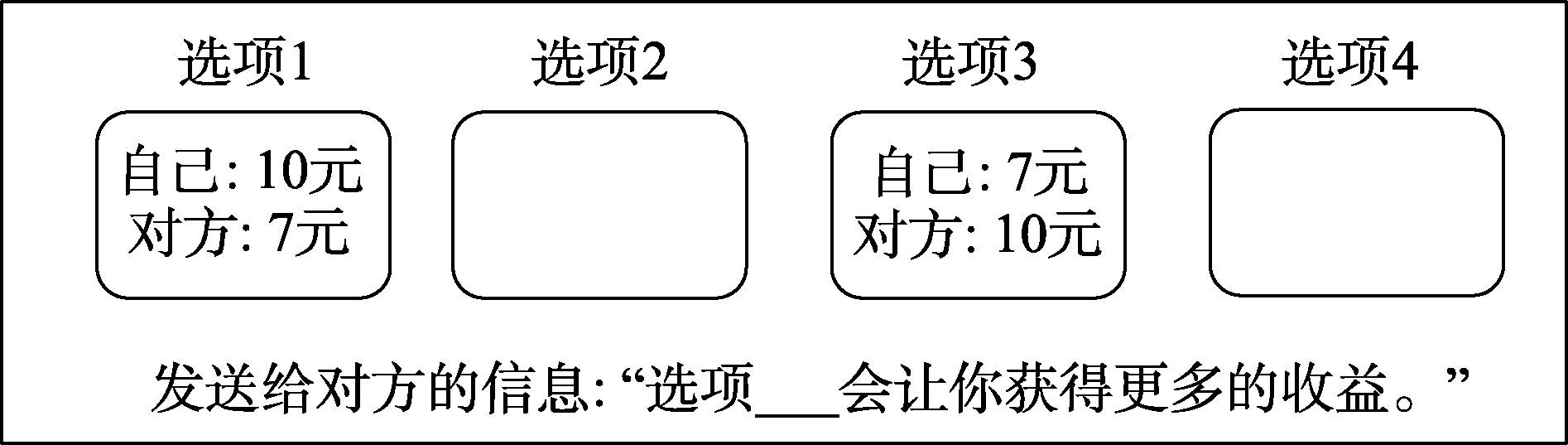
图1 信号博弈任务示意图
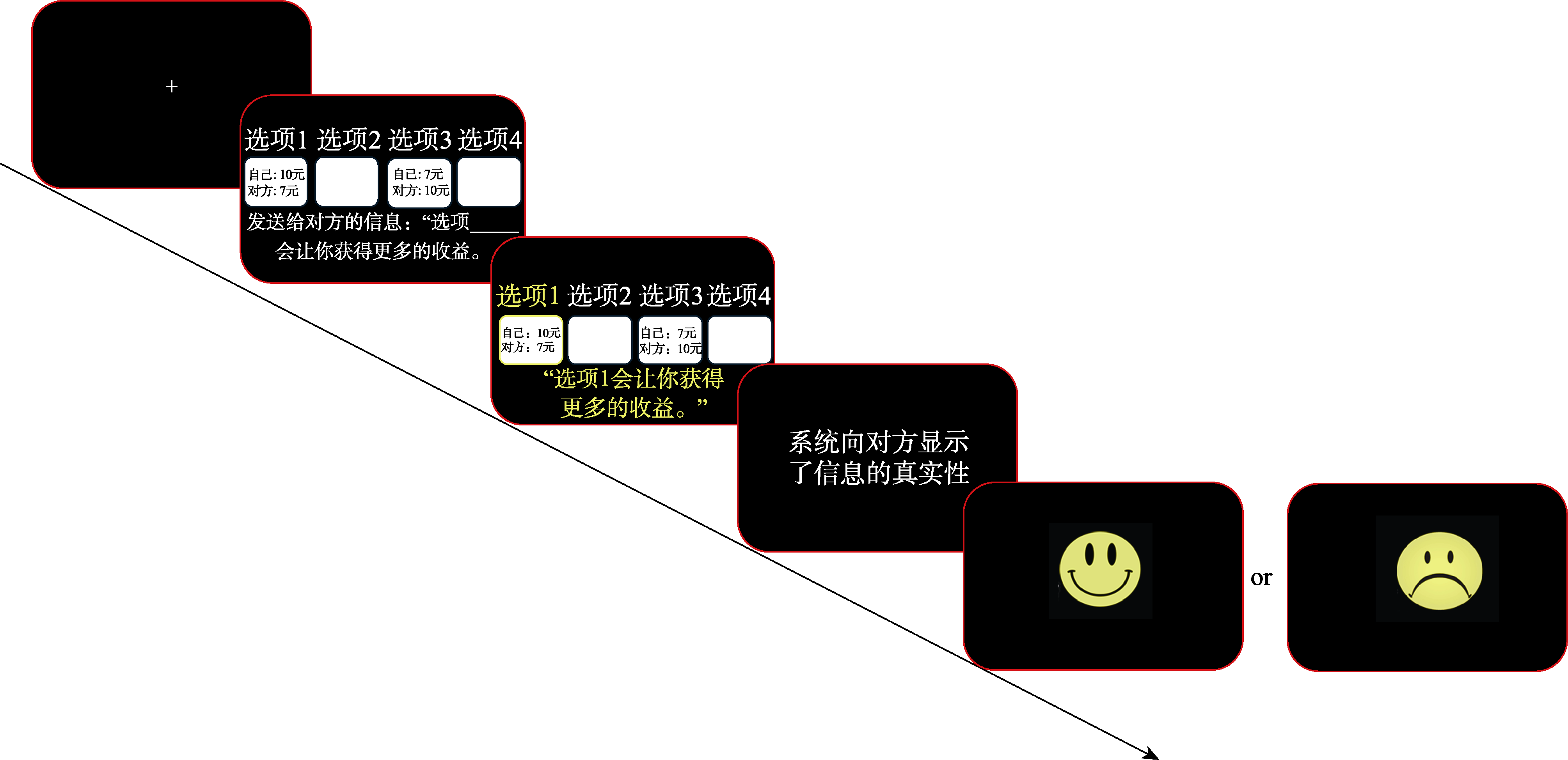
图2 实验1任务流程图
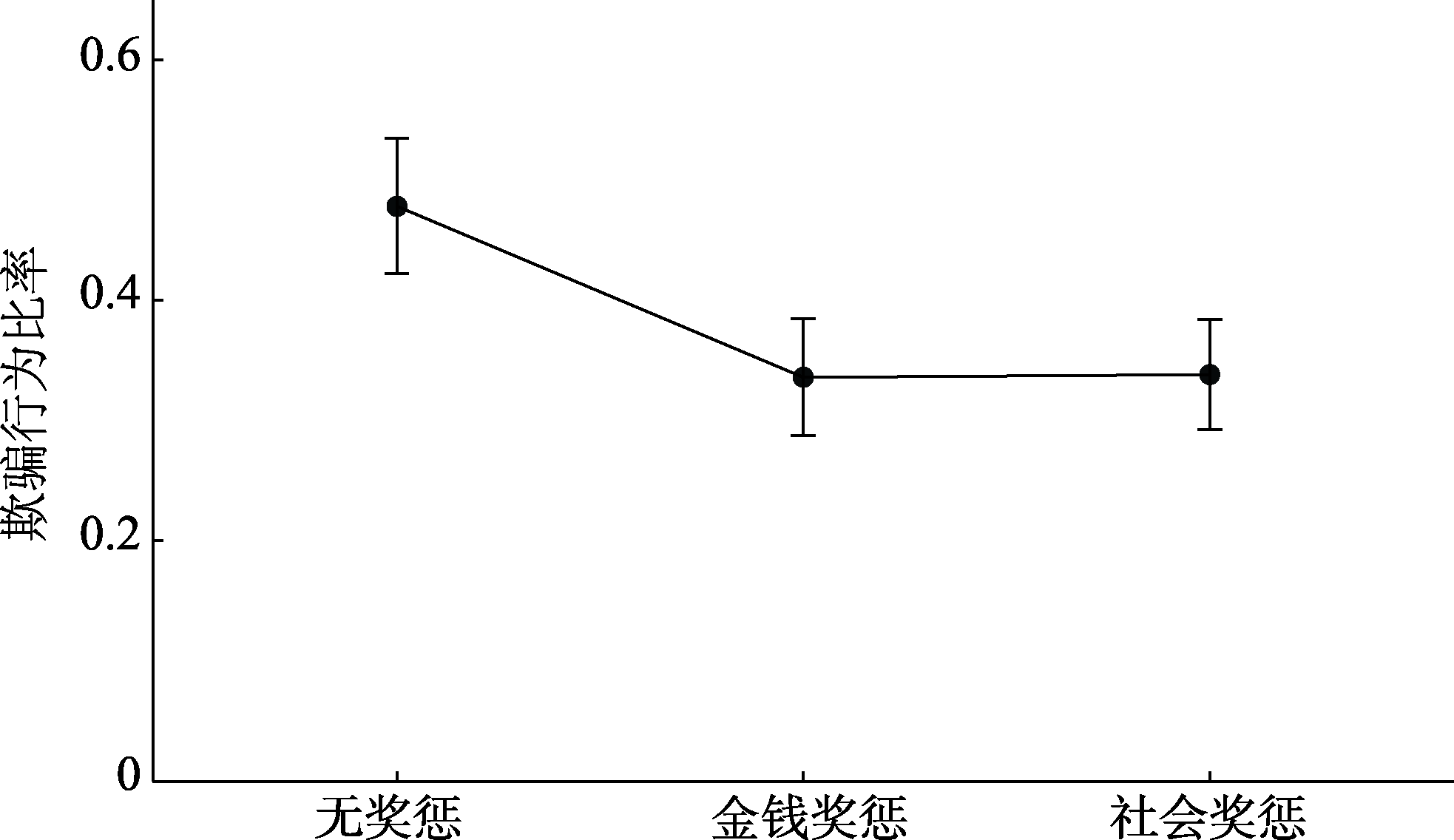
图3 不同奖惩类型条件下的欺骗率。误差线代表标准误。
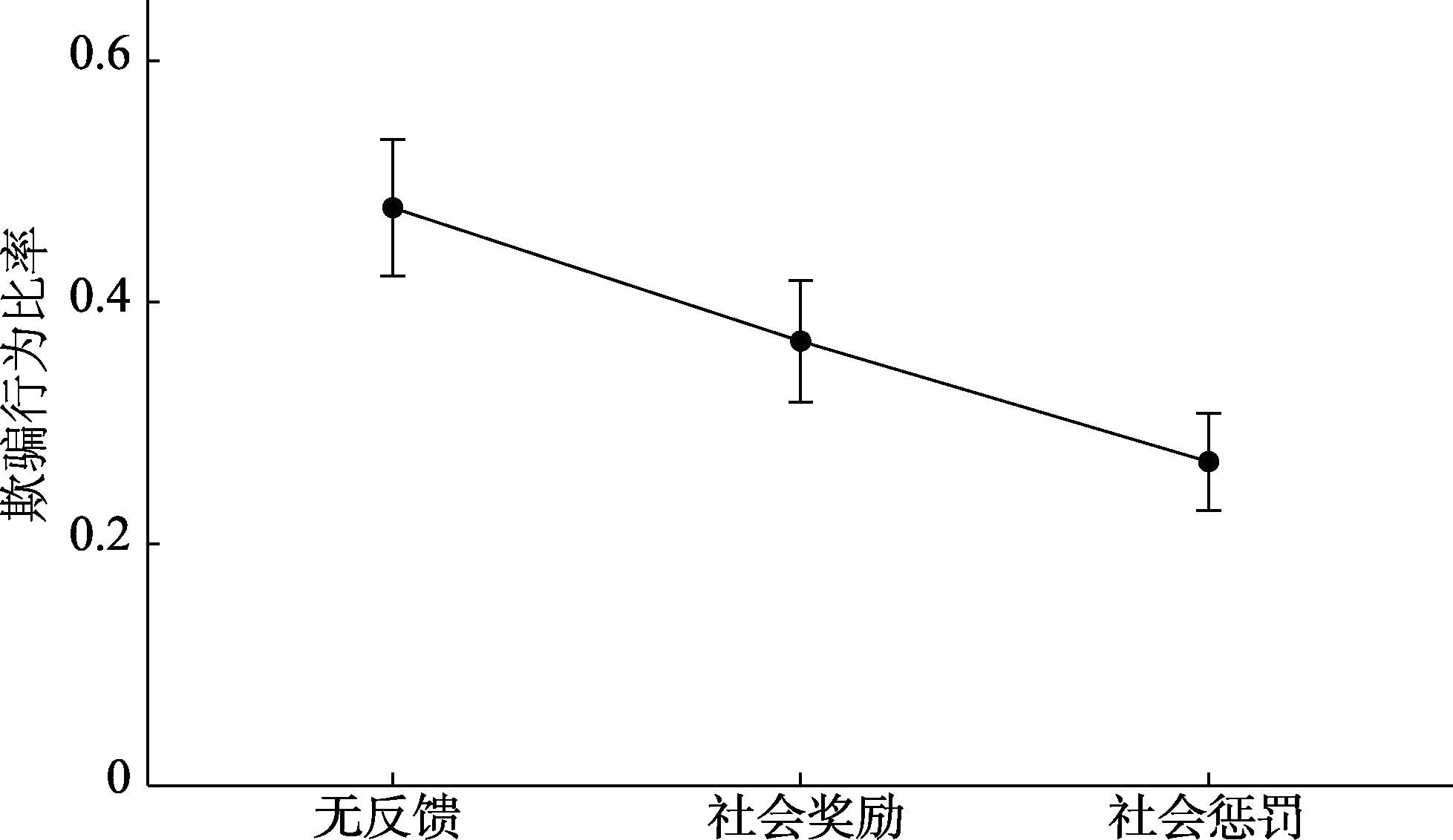
图4 被试收到社会奖惩反馈后, 下一个试次中的欺骗比率与无反馈条件下的欺骗比率。

图5 左边一列为DDM的4个参数在不同奖惩条件下的后验概率密度分布。从上往下依次为漂移率v、边界高度α、起始点偏差z以及非决策时间τ。图中橙色线代表无奖惩条件, 绿色线代表社会奖惩条件、蓝色线代表金钱奖惩条件。右边一列为相应模型参数的后验痕迹图(posterior traces plot)。彩图见电子版, 下同。
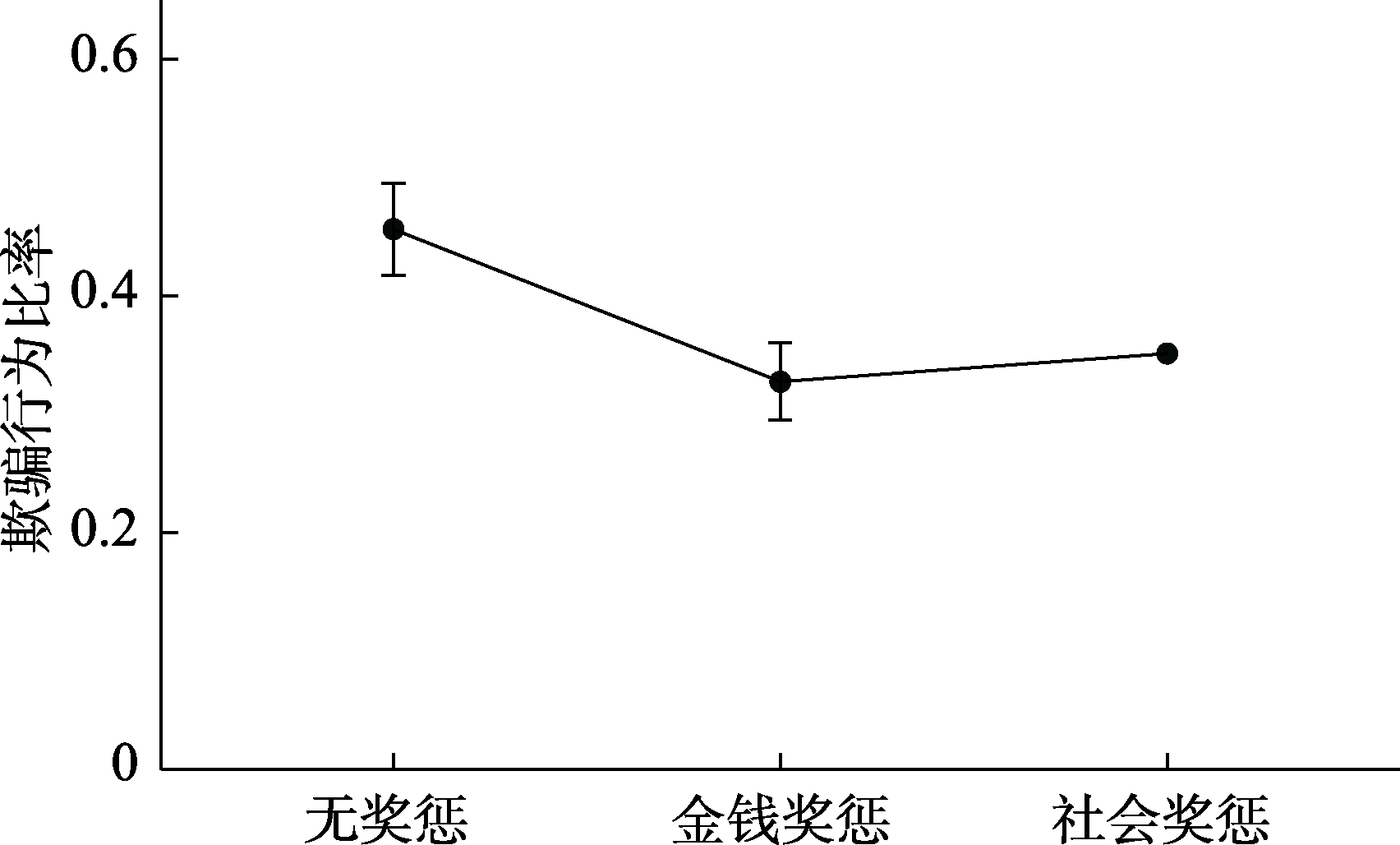
图6 不同类型的奖惩对欺骗行为的影响
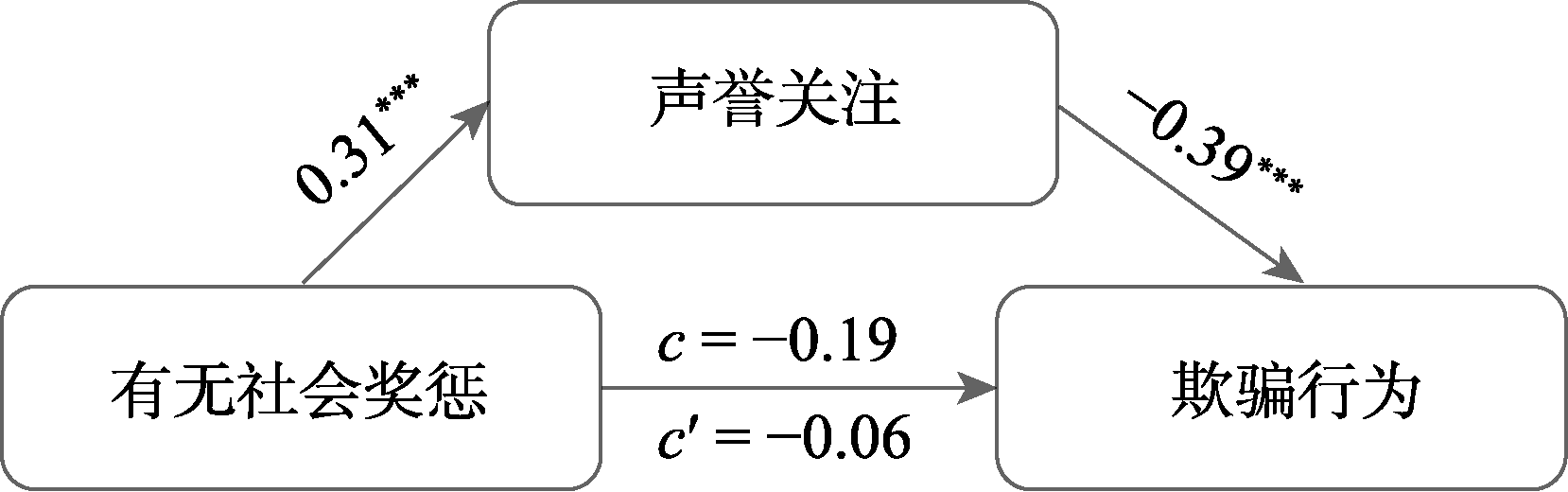
图7 社会奖惩中介效应路径图
注: *** p < 0.001, 下同。
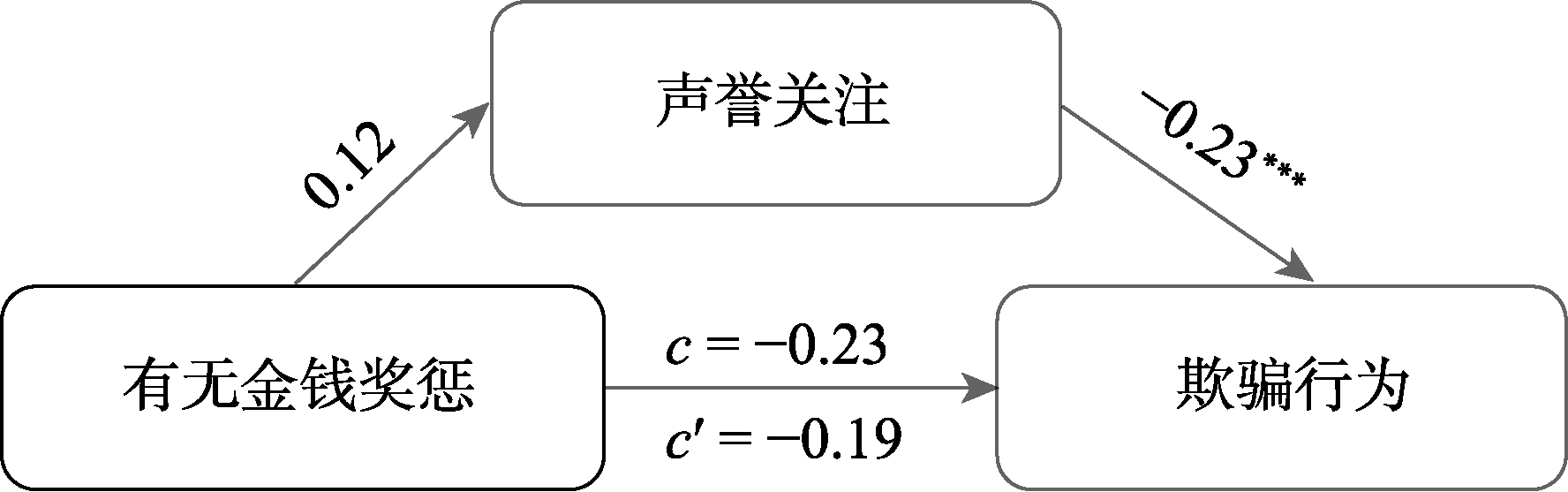
图8 金钱奖惩中介效应路径图

图9 左边一列为DDM的4个参数在不同奖惩条件下的后验概率密度分布。从上往下依次为漂移率v、边界高度α、起始点偏差z以及非决策时间τ。图中橙色线代表无奖惩条件, 绿色线代表社会奖惩条件、蓝色线代表金钱奖惩条件。右边一列为相应模型参数的后验痕迹图(posterior traces plot)。

图10 亲自我取向与亲社会取向个体在不同奖惩类型条件下的欺骗率。图中红色的实心圆点代表该条件下的均值, 每个半透明的圆点代表每个被试的欺骗率, 两侧对称的形状表示欺骗率的概率分布。
| 结果变量 | 预测变量 | 整体拟合指标 | 回归系数显著性 | ||
|---|---|---|---|---|---|
| R2 | F | β | t | ||
| 声誉关注 | 0.10 | 13.64*** | |||
| 社会奖惩 | 0.88 | 4.50*** | |||
| 社会价值取向 | 0.82 | 3.99*** | |||
| 社会奖惩×社会价值取向 | 0.90 | 2.18* | |||
| 欺骗行为 | 0.27 | 35.82*** | |||
| 声誉关注 | −0.06 | −7.79*** | |||
| 社会奖惩 | −0.05 | −1.83 | |||
| 社会价值取向 | −0.20 | −6.48*** | |||
| 社会奖惩×社会价值取向 | −0.03 | −0.45 | |||
表1 社会价值取向的调节效应分析结果
| 结果变量 | 预测变量 | 整体拟合指标 | 回归系数显著性 | ||
|---|---|---|---|---|---|
| R2 | F | β | t | ||
| 声誉关注 | 0.10 | 13.64*** | |||
| 社会奖惩 | 0.88 | 4.50*** | |||
| 社会价值取向 | 0.82 | 3.99*** | |||
| 社会奖惩×社会价值取向 | 0.90 | 2.18* | |||
| 欺骗行为 | 0.27 | 35.82*** | |||
| 声誉关注 | −0.06 | −7.79*** | |||
| 社会奖惩 | −0.05 | −1.83 | |||
| 社会价值取向 | −0.20 | −6.48*** | |||
| 社会奖惩×社会价值取向 | −0.03 | −0.45 | |||

图11 左边一列为DDM的4个参数在不同奖惩条件下的后验概率密度分布。从上往下依次为漂移率v、边界高度α、起始点偏差z以及非决策时间τ。图中橙色线代表无奖惩条件, 绿色线代表社会奖惩条件、蓝色线代表金钱奖惩条件。右边一列为相应模型参数的后验痕迹图(posterior traces plot)。

| 效应 | df | F | p | ηp2 |
|---|---|---|---|---|
| 社会价值取向 | 1, 191 | 30.99 | < 0.001 | 0.14 |
| 奖惩类型 | 2, 58 | 40.66 | < 0.001 | 0.183 |
| 社会价值取向×奖惩类型 | 2, 382 | 5.44 | 0.005 | 0.03 |
附表1 实验3社会价值取向*奖惩类型混合设计方差分析结果
| 效应 | df | F | p | ηp2 |
|---|---|---|---|---|
| 社会价值取向 | 1, 191 | 30.99 | < 0.001 | 0.14 |
| 奖惩类型 | 2, 58 | 40.66 | < 0.001 | 0.183 |
| 社会价值取向×奖惩类型 | 2, 382 | 5.44 | 0.005 | 0.03 |
| 社会价值取向 | 社会奖惩 | 金钱奖惩 | 无奖惩 |
|---|---|---|---|
| 亲自我取向 | 0.60 ± 0.32 | 0.46 ± 0.34 | 0.65 ± 0.31 |
| 亲社会取向 | 0.32 ± 0.27 | 0.30 ± 0.26 | 0.45 ± 0.32 |
附表2 实验3社会价值取向在奖惩类型上的描述性统计(M ± SD)
| 社会价值取向 | 社会奖惩 | 金钱奖惩 | 无奖惩 |
|---|---|---|---|
| 亲自我取向 | 0.60 ± 0.32 | 0.46 ± 0.34 | 0.65 ± 0.31 |
| 亲社会取向 | 0.32 ± 0.27 | 0.30 ± 0.26 | 0.45 ± 0.32 |
| [21] |
Eisenberger, N. I., Lieberman, M. D., & Williams, K. D. (2003). Does rejection hurt? An fMRI study of social exclusion. Science, 302(5643), 290-292.
doi: 10.1126/science.1089134 pmid: 14551436 |
| [22] | Ellingsen, T., & Johannesson, M. (2008). Pride and Prejudice: The human side of incentive theory. American Economic Review, 98(3), 990-1008. |
| [23] |
Feinberg, M., Willer, R., & Schultz, M. (2014). Gossip and ostracism promote cooperation in groups. Psychological Science, 25(3), 656-664.
doi: 10.1177/0956797613510184 pmid: 24463551 |
| [24] | Fischer, B., & Herbert, C. (2021). Emoji as affective symbols: Affective judgments of emoji, emoticons, and human faces varying in emotional content. Frontiers in Psychology, 12, 645173. |
| [25] |
Flynn, F. J., Reagans, R. E., Amanatullah, E. T., & Ames, D. R. (2006). Helping one's way to the top: Self-monitors achieve status by helping others and knowing who helps whom. Journal of Personality and Social Psychology, 91(6), 1123-1137.
pmid: 17144769 |
| [26] | Frey, B. S., & Jegen, R. (2001). Motivation crowding theory. Journal of Economic Surveys, 15(5), 589-611. |
| [27] | Gächter, S., & Herrmann, B. (2009). Reciprocity, culture and human cooperation: Previous insights and a new cross- cultural experiment. Philosophical Transactions of the Royal Society B: Biological Sciences, 364(1518), 791-806. |
| [28] |
Gino, F., & Pierce, L. (2009). Dishonesty in the name of equity. Psychological Science, 20(9), 1153-1160.
doi: 10.1111/j.1467-9280.2009.02421.x pmid: 19674386 |
| [29] |
Gintis, H. (2000). Strong reciprocity and human sociality. Journal of Theoretical Biology, 206(2), 169-179.
pmid: 10966755 |
| [30] | Gneezy, U. (2005). Deception: The role of consequences. American Economic Review, 95(1), 384-394. |
| [31] |
Greene, J. D., Morelli, S. A., Lowenberg, K., Nystrom, L. E., & Cohen, J. D. (2008). Cognitive load selectively interferes with utilitarian moral judgment. Cognition, 107(3), 1144-1154.
pmid: 18158145 |
| [32] | Grosch, K., & Rau, H. A. (2017). Gender differences in honesty: The role of social value orientation. Journal of Economic Psychology, 62, 258-267. |
| [33] |
Guala, F. (2012). Reciprocity: Weak or strong? What punishment experiments do (and do not) demonstrate. Behavioral and Brain Sciences, 35(1), 1-15.
doi: 10.1017/S0140525X11000069 pmid: 22289303 |
| [34] | Hand, C. J., Kennedy, A., Filik, R., Pitchford, M., & Robus, C. M. (2023). Emoji identification and emoji effects on sentence emotionality in ASD-diagnosed adults and neurotypical controls. Journal of Autism and Developmental Disorders, 53(6), 2514-2528. |
| [35] |
Hardy, C. L., & Van Vugt, M. (2006). Nice guys finish first: The competitive altruism hypothesis. Personality and Social Psychology Bulletin, 32(10), 1402-1413.
pmid: 16963610 |
| [36] | Jin, Y. C., Deng, C. L., Wu, P., Lin, X., Zheng, P. X., & An, J. X. (2022). Emoji image symbol’s social function and application. Advances in Psychological Science, 30(5), 1062-1077. |
|
[靳宇倡, 邓成龙, 吴平, 林茜, 郑佩璇, 安俊秀. (2022). Emoji图像符号的社交功能及应用. 心理科学进展, 30(5), 1062-1077.]
doi: 10.3724/SP.J.1042.2022.01062 |
|
| [37] | Jones, E. E., & Pittman, T. S. (1982). Toward a general theory of strategic self-presentation. Psychological Perspectives on the Self, 1(1), 231-262. |
| [38] | Karlan, D., & Mcconnell, M. A. (2014). Hey look at me: The effect of giving circles on giving. Journal of Economic Behavior & Organization, 106, 402-412. |
| [39] | Kaushik, M., Singh, V., & Chakravarty, S. (2022). Experimental evidence of the effect of financial incentives and detection on dishonesty. Scientific Reports, 12(1), 2680. |
| [40] |
Kaye, L. K., Malone, S. A., & Wall, H. J. (2017). Emojis: Insights, affordances, and possibilities for psychological science. Trends in Cognitive Sciences, 21(2), 66-68.
doi: S1364-6613(16)30178-4 pmid: 28107838 |
| [41] | Kaye, L. K., Wall, H. J., & Malone, S. A. (2016). “Turn that frown upside-down”: A contextual account of emoticon usage on different virtual platforms. Computers in Human Behavior, 60, 463-467. |
| [42] |
Kim, J., & Jeong, B. (2020). Expecting social punishment facilitates control over a decision under uncertainty by recruiting medial prefrontal cortex. Social Cognitive and Affective Neuroscience, 15(11), 1260-1270.
doi: 10.1093/scan/nsaa145 pmid: 33104801 |
| [43] |
Kohls, G., Perino, M. T., Taylor, J. M., Madva, E. N., Cayless, S. J., Troiani, V., … Schultz, R. T. (2013). The nucleus accumbens is involved in both the pursuit of social reward and the avoidance of social punishment. Neuropsychologia, 51(11), 2062-2069.
doi: 10.1016/j.neuropsychologia.2013.07.020 pmid: 23911778 |
| [1] | Allingham, M. G., & Sandmo, A. (1972). Income tax evasion: A theoretical analysis. Journal of Public Economics, 1(3-4), 323-338. |
| [2] | Balliet, D., Parks, C., & Joireman, J. (2009). Social value orientation and cooperation in social dilemmas: A meta- analysis. Group Processes & Intergroup Relations, 12(4), 533-547. |
| [3] |
Balliet, D., & Van Lange, P. A. (2013). Trust, conflict, and cooperation: A meta-analysis. Psychological Bulletin, 139(5), 1090-1112.
doi: 10.1037/a0030939 pmid: 23231532 |
| [4] | Baumeister, R. F., Bratslavsky, E., Finkenauer, C., & Vohs, K. D. (2001). Bad is stronger than good. Review of General Psychology, 5(4), 323-370. |
| [5] | Becker, G. S. (1968). Crime and punishment: An economic approach. Journal of Political Economy, 76(2), 169-217. |
| [6] | Behnk, S., Barreda-Tarrazona, I., & Garcia-Gallego, A. (2018). Punishing liars-How monitoring affects honesty and trust. PLoS One, 13(10), e0205420. |
| [7] | Berman, J. Z., Levine, E. E., Barasch, A., & Small, D. A. (2015). The Braggart's dilemma: On the social rewards and penalties of advertising prosocial behavior. Journal of Marketing Research, 52(1), 90-104. |
| [8] | Beston, P. (2019). The effect of social rewards and punishments on learning and cooperative decision-making [Unpublished master’s thesis]. Bangor University, United Kingdom. |
| [9] | Boutet, I., LeBlanc, M., Chamberland, J. A., & Collin, C. A. (2021). Emojis influence emotional communication, social attributions, and information processing. Computers in Human Behavior, 119, 106722. |
| [10] | Brady, W. J., Wills, J. A., Jost, J. T., Tucker, J. A., & Van Bavel, J. J. (2017). Emotion shapes the diffusion of moralized content in social networks. Proceedings of the National Academy of Sciences, 114(28), 7313-7318. |
| [11] |
Cameron, C. D., & Payne, B. K. (2011). Escaping affect: How motivated emotion regulation creates insensitivity to mass suffering. Journal of Personality and Social Psychology, 100(1), 1-15.
doi: 10.1037/a0021643 pmid: 21219076 |
| [12] | Carr, Z. M., Solbu, A., & Frank, M. G. (2019). Why methods matter:Approaches to the study of deception and considerations for the future. In T.Docan-Morgan (Ed.), The Palgrave Handbook of deceptive communication (pp. 267-286). Palgrave Macmillan, Cham. |
| [13] | Cherbonnier, A., & Michinov, N. (2021). The recognition of emotions beyond facial expressions: Comparing emoticons specifically designed to convey basic emotions with other modes of expression. Computers in Human Behavior, 118, 106689. |
| [14] | Cinyabuguma, M., Page, T., & Putterman, L. (2005). Cooperation under the threat of expulsion in a public goods experiment. Journal of Public Economics, 89(8), 1421-1435. |
| [15] | De Cremer, D., & Tyler, T. R. (2005). Managing group behavior:The interplay between procedural justice, sense of self, and cooperation. In M. P.Zanna (Ed.), Advances in experimental social psychology, (Vol. 37, pp. 151-218). Elsevier Academic Press. |
| [16] | De Cremer, D., & Van Lange, P. A. (2001). Why prosocials exhibit greater cooperation than proselfs: The roles of social responsibility and reciprocity. European Journal of Personality, 15(S1), S5-S18. |
| [17] |
Debey, E., Ridderinkhof, R. K., De Houwer, J., De Schryver, M., & Verschuere, B. (2015). Suppressing the truth as a mechanism of deception: Delta plots reveal the role of response inhibition in lying. Consciousness and Cognition, 37, 148-159.
doi: 10.1016/j.concog.2015.09.005 pmid: 26397036 |
| [18] | Deci, E. L. (1971). Effects of externally mediated rewards on intrinsic motivation. Journal of Personality and Social Psychology, 18(1), 105-115. |
| [19] |
Deci, E. L., Koestner, R., & Ryan, R. M. (1999). A meta-analytic review of experiments examining the effects of extrinsic rewards on intrinsic motivation. Psychological Bulletin, 125(6), 627-668.
doi: 10.1037/0033-2909.125.6.627 pmid: 10589297 |
| [20] |
Depaulo, B. M., Lindsay, J. J., Malone, B. E., Muhlenbruck, L., Charlton, K., & Cooper, H. (2003). Cues to deception. Psychological Bulletin, 129(1), 74-118.
pmid: 12555795 |
| [44] |
Kringelbach, M. L., & Rolls, E. T. (2003). Neural correlates of rapid reversal learning in a simple model of human social interaction. NeuroImage, 20(2), 1371-1383.
pmid: 14568506 |
| [45] |
Kujawa, A., Proudfit, G. H., Kessel, E. M., Dyson, M., Olino, T., & Klein, D. N. (2015). Neural reactivity to monetary rewards and losses in childhood: Longitudinal and concurrent associations with observed and self-reported positive emotionality. Biological Psychology, 104, 41-47.
doi: 10.1016/j.biopsycho.2014.11.008 pmid: 25433097 |
| [46] | Leary, M. R., & Kowalski, R. M. (1990). Impression management: A literature review and two-component model. Psychological Bulletin, 107(1), 34-47. |
| [47] | Leimar, O., & Hammerstein, P. (2001). Evolution of cooperation through indirect reciprocity. Proceedings of the Royal Society of London. Series B: Biological Sciences, 268(1468), 745-753. |
| [48] | Li, J., Sun, Y., Yang, Z. L., & Zhong, Y. P. (2020). Social value orientation modulates the processing of social rewards for self: Evidence from ERPs study. Acta Psychologica Sinica, 52(6), 786-800. |
|
[李琎, 孙宇, 杨子鹿, 钟毅平. (2020). 社会价值取向对自我社会奖赏加工的影响——来自ERPs的证据. 心理学报, 52(6), 786-800.]
doi: 10.3724/SP.J.1041.2020.00786 |
|
| [49] | Li, S. J., Tang, Y. Y., & Zhang, D. D. (2024). Neural mechanism of monetary and social reward processing in healthy and depressed populations. Journal of Psychological Science, 47(6), 1317-1327. |
| [李思瑾, 汤煜尧, 张丹丹. (2024). 健康和抑郁人群金钱和社会奖赏加工的神经机制. 心理科学, 47(6), 1317-1327.] | |
| [50] | Liu, C. J., & Hao, F. (2011). Social value orientation and cooperation in asymmetric social dilemmas. Acta Psychologica Sinica, 43(4), 432-441. |
| [刘长江, 郝芳. (2011). 不对称社会困境中社会价值取向对合作的影响. 心理学报, 43(4), 432-441.] | |
| [51] | Lv, F. Y., Tan, J. B., Xu, P. F., Xiong, X. L., Jin, Z. H., & Gao, D. G. (2021). The social reward and the neurocognitive mechanism of social reward processing. Chinese Journal of Applied Psychology, 27(3), 189-203. |
| [吕房艳, 谭敬斌, 徐鹏飞, 熊希灵, 金泽慧, 高定国. (2021). 社会性奖赏及其作用的神经机制. 应用心理学, 27(3), 189-203.] | |
| [52] |
Matyjek, M., Meliss, S., Dziobek, I., & Murayama, K. (2020). A multidimensional view on social and non-social rewards. Frontiers in Psychiatry, 11, 818.
doi: 10.3389/fpsyt.2020.00818 pmid: 32973574 |
| [53] | Mazar, N., Amir, O., & Ariely, D. (2008). The dishonesty of honest people: A theory of self-concept maintenance. Journal of Marketing Research, 45(6), 633-644. |
| [54] | Mazar, N., & Ariely, D. (2006). Dishonesty in everyday life and its policy implications. Journal of Public Policy & Marketing, 25(1), 117-126. |
| [55] | Milinski, M., Semmann, D., & Krambeck, H. J. (2002). Reputation helps solve the ‘tragedy of the commons’. Nature, 415(6870), 424-426. |
| [56] | Milinski, M., Semmann, D., Krambeck, H. J., & Marotzke, J. (2006). Stabilizing the Earth's climate is not a losing game: Supporting evidence from public goods experiments. Proceedings of the National Academy of Sciences, 103(11), 3994-3998. |
| [57] | Mulder, L. B., van Dijk, E., de Cremer, D., & Wilke, H. A. M. (2006). Undermining trust and cooperation: The paradox of sanctioning systems in social dilemmas. Journal of Experimental Social Psychology, 42(2), 147-162. |
| [58] | Murphy, R. O., Ackermann, K. A., & Handgraaf, M. (2011). Measuring social value orientation. Judgment and Decision Making, 6(8), 771-781. |
| 59] | Nagin, D. S., & Pogarsky, G. (2003). An experimental investigation of deterrence: Cheating, self-serving bias, and impulsivity. Criminology, 41(1), 167-194. |
| [60] | Nowak, M. A., & Sigmund, K. (2005). Evolution of indirect reciprocity. Nature, 437(7063), 1291-1298. |
| [61] | Peirce, J. W. (2009). Generating stimuli for neuroscience using PsychoPy. Frontiers in Neuroinformatics, 2, 343. |
| [62] |
Pfeiffer, T., Tran, L., Krumme, C., & Rand, D. G. (2012). The value of reputation. Journal of the Royal Society Interface, 9(76), 2791-2797.
pmid: 22718993 |
| [63] | Ramirez-Marin, J. Y., & Shafa, S. (2018). Social rewards: The basis for collaboration in honor cultures. Cross Cultural & Strategic Management, 25(1), 53-69. |
| [64] |
Ratcliff, R., & McKoon, G. (2008). The diffusion decision model: Theory and data for two-choice decision tasks. Neural Computation, 20(4), 873-922.
doi: 10.1162/neco.2008.12-06-420 pmid: 18085991 |
| [65] | Romano, A., Balliet, D., Yamagishi, T., & Liu, J. H. (2017). Parochial trust and cooperation across 17 societies. Proceedings of the National Academy of Sciences, 114(48), 12702-12707. |
| [66] | Rosenbaum, S. M., Billinger, S., & Stieglitz, N. (2014). Let’s be honest: A review of experimental evidence of honesty and truth-telling. Journal of Economic Psychology, 45, 181-196. |
| [67] | Rozin, P., & Royzman, E. B. (2001). Negativity bias, negativity dominance, and contagion. Personality and Social Psychology Review, 5(4), 296-320. |
| [68] |
Russell, Y. I., Call, J., & Dunbar, R. I. M. (2008). Image scoring in great apes. Behavioural Processes, 78(1), 108-111.
pmid: 18068313 |
| [69] |
Ryan, R. M., & Deci, E. L. (2000). Self-determination theory and the facilitation of intrinsic motivation, social development, and well-being. American Psychologist, 55(1), 68-78.
doi: 10.1037//0003-066x.55.1.68 pmid: 11392867 |
| [70] |
Shenhav, A., Botvinick, M. M., & Cohen, J. D. (2013). The expected value of control: An integrative theory of anterior cingulate cortex function. Neuron, 79(2), 217-240.
doi: 10.1016/j.neuron.2013.07.007 pmid: 23889930 |
| [71] |
Shore, D. M., & Heerey, E. A. (2011). The value of genuine and polite smiles. Emotion, 11(1), 169-174.
doi: 10.1037/a0022601 pmid: 21401236 |
| [72] | Simpson, B., & Willer, R. (2008). Altruism and indirect reciprocity: The interaction of person and situation in prosocial behavior. Social Psychology Quarterly, 71(1), 37-52. |
| [73] |
Somerville, L. H., Jones, R. M., Ruberry, E. J., Dyke, J. P., Glover, G., & Casey, B. J. (2013). The medial prefrontal cortex and the emergence of self-conscious emotion in adolescence. Psychological Science, 24(8), 1554-1562.
doi: 10.1177/0956797613475633 pmid: 23804962 |
| [74] | Sommerfeld, R. D., Krambeck, H. J., Semmann, D., & Milinski, M. (2007). Gossip as an alternative for direct observation in games of indirect reciprocity. Proceedings of the National Academy of Sciences, 104(44), 17435-17440. |
| [75] | Sperber, D., & Baumard, N. (2012). Moral reputation: An evolutionary and cognitive perspective. Mind & Language, 27(5), 495-518. |
| [76] |
Spreckelmeyer, K. N., Krach, S., Kohls, G., Rademacher, L., Irmak, A., Konrad, K., ... Gründer, G. (2009). Anticipation of monetary and social reward differently activates mesolimbic brain structures in men and women. Social Cognitive and Affective Neuroscience, 4(2), 158-165.
doi: 10.1093/scan/nsn051 pmid: 19174537 |
| [77] | Steinel, W. (2015). Social value orientation and deception: Are proselfs liars? Current Opinion in Psychology, 6, 211-215. |
| [78] | Tamir, D. I., & Mitchell, J. P. (2012). Disclosing information about the self is intrinsically rewarding. Proceedings of the National Academy of Sciences, 109(21), 8038-8043. |
| [79] | Tamir, D. I., Zaki, J., & Mitchell, J. P. (2015). Informing others is associated with behavioral and neural signatures of value. Journal of Experimental Psychology: General, 144(6), 1114-1123. |
| [80] | Trivers, R. L. (1971). The evolution of reciprocal altruism. The Quarterly Review of Biology, 46(1), 35-57. |
| [81] |
Vabba, A., Porciello, G., Panasiti, M. S., & Aglioti, S. M. (2022). Interoceptive influences on the production of self-serving lies in reputation risk conditions. International Journal of Psychophysiology, 177, 34-42.
doi: 10.1016/j.ijpsycho.2022.04.001 pmid: 35413427 |
| [82] | Van Kleef, G. A. (2009). How emotions regulate social life: The emotions as social information (EASI) model. Current Directions in Psychological Science, 18(3), 184-188. |
| [83] | Van Lange, P. A. (1999). The pursuit of joint outcomes and equality in outcomes: An integrative model of social value orientation. Journal of Personality and Social Psychology, 77(2), 337-349. |
| [84] | Walther, J. B. (1992). Interpersonal effects in computer-mediated interaction: A relational perspective. Human Communication Research, 19(1), 52-90. |
| [85] | Wang, D., Liu, T., & Shi, J. (2017). Development of monetary and social reward processes. Scientific Reports, 7(1), 11128. |
| [86] |
Wang, Z., Li, Q., Nie, L., & Zheng, Y. (2020). Neural dynamics of monetary and social reward processing in social anhedonia. Social Cognitive and Affective Neuroscience, 15(9), 991-1003.
doi: 10.1093/scan/nsaa128 pmid: 32945882 |
| [87] | Wu, J., Balliet, D., & van Lange, P. A. M. (2016). Reputation management: Why and how gossip enhances generosity. Evolution & Human Behavior, 37(3), 193-201. |
| [88] |
Yuan, B., Wang, X. P., Yin, J., & Li, W. Q. (2023). The role of cross-situational stimulus generalization in the formation of trust towards face: A perspective based on direct and observational learning. Acta Psychologica Sinica, 55(7), 1099-1114.
doi: 10.3724/SP.J.1041.2023.01099 |
|
[袁博, 王晓萍, 尹军, 李伟强. (2023). 跨情境的刺激泛化在面孔信任形成中的作用: 基于直接互动与观察学习的视角. 心理学报, 55(7), 1099-1114.]
doi: 10.3724/SP.J.1041.2023.01099 |
|
| [89] |
Zhang, Y. H., Li, H., & Wu, Y. (2020). The application of computational modelling in the studies of moral cognition. Advances in Psychological Science, 28(7), 1042-1055.
doi: 10.3724/SP.J.1042.2020.01042 |
|
[张银花, 李红, 吴寅. (2020). 计算模型在道德认知研究中的应用. 心理科学进展, 28(7), 1042-1055.]
doi: 10.3724/SP.J.1042.2020.01042 |
|
| [90] | Zhang, Z., Zhang, F., Yuan, S., Guo, F. B., & Wang, Y. W. (2015). Psychometric analysis of the SVO slider measure in Chinese cultural context. Studies of Psychology and Behavio, 13(3), 404-409. |
| [张振, 张帆, 原胜, 郭丰波, 王益文. (2015). 社会价值取向滑块测验中文版的测量学分析. 心理与行为研究, 13(3), 404-409.] | |
| [91] |
Zhu, L., Jenkins, A. C., Set, E., Scabini, D., Knight, R. T., Chiu, P. H., King-Casas, B., & Hsu, M. (2014). Damage to dorsolateral prefrontal cortex affects tradeoffs between honesty and self-interest. Nature Neuroscience, 17(10), 1319-1321.
doi: 10.1038/nn.3798 pmid: 25174003 |
| [1] | 李毕琴, 张美霞, 杨少云, 黄鹏飞, 王爱君, 党君华. 秒内不同时距下自我加工优势效应[J]. 心理学报, 2025, 57(9): 1529-1539. |
| [2] | 范伟, 杨颖, 郭希亚, 林卓铭, 钟毅平. 不道德行为中道德标准对自我欺骗的影响: 来自ERP的证据[J]. 心理学报, 2025, 57(8): 1414-1436. |
| [3] | 吴洁, 车子轩. 多通道类别学习的认知特征与神经机制:EEG与DDM证据[J]. 心理学报, 2025, 57(10): 1715-1728. |
| [4] | 陈沛琪, 张银玲, 胡馨木, 王静, 买晓琴. 10~12岁儿童社会价值取向对第三方利他行为的影响:情绪的作用[J]. 心理学报, 2023, 55(8): 1255-1269. |
| [5] | 张萱, 刘萍萍. 熟悉度促进人们与垃圾分类中的志愿者合作及其作用机制[J]. 心理学报, 2023, 55(8): 1358-1371. |
| [6] | 袁博, 王晓萍, 尹军, 李伟强. 跨情境的刺激泛化在面孔信任形成中的作用:基于直接互动与观察学习的视角[J]. 心理学报, 2023, 55(7): 1099-1114. |
| [7] | 占友龙, 肖啸, 谭千保, 李琎, 钟毅平. 声誉关注与社会距离对伤害困境中道德决策的影响:来自行为与ERPs的证据[J]. 心理学报, 2022, 54(6): 613-627. |
| [8] | 范伟, 任梦梦, 张文洁, 钟毅平. 反馈对自我欺骗的影响:来自ERP的证据[J]. 心理学报, 2022, 54(5): 481-496. |
| [9] | 张银玲, 虞祯, 买晓琴. 社会价值取向对自我-他人风险决策的影响及其机制[J]. 心理学报, 2020, 52(7): 895-908. |
| [10] | 李琎, 孙宇, 杨子鹿, 钟毅平. 社会价值取向对自我社会奖赏加工的影响——来自ERPs的证据[J]. 心理学报, 2020, 52(6): 786-800. |
| [11] | 范伟, 任梦梦, 肖俊泽, 简增郸, 杜晓明, 傅小兰. 羞耻情绪对欺骗行为的影响:自我控制的作用[J]. 心理学报, 2019, 51(9): 992-1006. |
| [12] | 钟罗金, 汝涛涛, 范梦, 莫雷. 认认知模糊程度和动机强度对有意识和无意识自我欺骗的影响[J]. 心理学报, 2019, 51(12): 1330-1340. |
| [13] | 崔丽莹, 何幸, 罗俊龙, 黄晓娇, 曹玮佳, 陈晓梅. 道德与关系惩罚对初中生公共物品困境中合作行为的影响[J]. 心理学报, 2017, 49(10): 1322-1333. |
| [14] | 范伟; 钟毅平; 李慧云; 孟楚熠; 游畅; 傅小兰. 欺骗判断与欺骗行为中自我控制的影响[J]. 心理学报, 2016, 48(7): 845-856. |
| [15] | 傅鑫媛;陆智远;寇彧. 陌生他人在场及其行为对个体道德伪善的影响[J]. 心理学报, 2015, 47(8): 1058-1066. |
| 阅读次数 | ||||||
|
全文 |
|
|||||
|
摘要 |
|
|||||
