

ISSN 0439-755X
CN 11-1911/B
主办:中国心理学会
中国科学院心理研究所
出版:科学出版社
CN 11-1911/B
主办:中国心理学会
中国科学院心理研究所
出版:科学出版社
心理学报 ›› 2025, Vol. 57 ›› Issue (3): 463-478.doi: 10.3724/SP.J.1041.2025.0463 cstr: 32110.14.2025.0463
高学德( ), 马号云
收稿日期:2024-03-11
发布日期:2025-01-24
出版日期:2025-03-25
通讯作者:
高学德, E-mail: gaoxd@lzu.edu.cn基金资助:
GAO Xuede(), MA Haoyun
Received:2024-03-11
Online:2025-01-24
Published:2025-03-25
摘要:
利用中国综合社会调查数据(2003~2021), 描述分析了中国民众普遍信任的动态变迁趋势及其影响因素。研究发现, 普遍信任随个体年龄的增长呈现出“U”型曲线趋势(年龄效应), 且随不同测量时期总体上呈现为上升趋势(时期效应), 同时, 普遍信任随不同世代呈倒“U”型趋势(世代效应):自1925世代起逐步上升, 于1940世代由负转正, 随后1945世代至1970世代间进入相对稳定的平台时期, 1975世代后开始迅速下降, 1990世代落到建国后的最低值, 此后缓慢回升。研究还发现, 亲属关系和收入差距对普遍信任的变迁产生显著的负向影响, 而市场化系数、人口流动率、社会组织数量、平均受教育年限和政府信任指数等变量则对普遍信任的变迁产生正向影响。论文将普遍信任的历时性变迁特征嵌入到近百年来中国社会发展的不同阶段以及由此而生成的不同信任模式中加以解释, 研究结果丰富了学术界对我国民众普遍信任变迁趋势的描述及其理论解释。
中图分类号:
高学德, 马号云. (2025). 中国民众普遍信任的动态变迁——基于年龄−时期−世代效应的分析. 心理学报, 57(3), 463-478.
GAO Xuede, MA Haoyun. (2025). Changing trends of Chinese people's generalized trust: A dynamic analysis of the age-period-cohort effect. Acta Psychologica Sinica, 57(3), 463-478.
| 建国前 (传统社会) | 建国后到改革 开放初期 | 改革开放后 | |
|---|---|---|---|
| 信任模式 | 关系信任 | 单位信任 | 制度信任 |
| 信任来源 | 传统和习俗 | 庇护和分配 | 契约和制度 |
| 信任支点 | 家本位 | 国本位 | 社会本位 |
| 信任环境 | 时空稳固 | 时空确定 | 时空不确定 |
| 关系性质 | 熟人关系 | 同志关系 | 生人关系 |
| 心理基础 | 情感 | 认同 | 认知 |
| 风险水平 | 低 | 低 | 高 |
| 人口流动性 | 低 | 低 | 高 |
| 普遍信任 | 较低 | 较高 | 较低 |
表1 不同社会发展阶段的信任模式及特点
| 建国前 (传统社会) | 建国后到改革 开放初期 | 改革开放后 | |
|---|---|---|---|
| 信任模式 | 关系信任 | 单位信任 | 制度信任 |
| 信任来源 | 传统和习俗 | 庇护和分配 | 契约和制度 |
| 信任支点 | 家本位 | 国本位 | 社会本位 |
| 信任环境 | 时空稳固 | 时空确定 | 时空不确定 |
| 关系性质 | 熟人关系 | 同志关系 | 生人关系 |
| 心理基础 | 情感 | 认同 | 认知 |
| 风险水平 | 低 | 低 | 高 |
| 人口流动性 | 低 | 低 | 高 |
| 普遍信任 | 较低 | 较高 | 较低 |
| 变量 | 编码 | 频数/频率 | 变量 | 编码 | 频数(频率) | ||
|---|---|---|---|---|---|---|---|
| 调查年份 | 2003 | 5866 | (6.15%) | 世代平均受教育年限 | 均值(标准差) | 9.7718 | (1.5997) |
| 2005 | 10262 | (10.76%) | 世代出生人口规模 | 均值(标准差) | 10.1712 | (2.5055) | |
| 2010 | 11759 | (12.33%) | 世代亲属关系 | 均值(标准差) | 2.4157 | (0.0905) | |
| 2012 | 11758 | (12.33%) | 性别 | 男 | 45752 | (48.00%) | |
| 2013 | 11423 | (11.98%) | 女 | 49596 | (52.00%) | ||
| 2015 | 10927 | (11.46%) | 民族 | 汉族 | 87985 | (92.30%) | |
| 2017 | 12533 | (13.14%) | 少数民族 | 7363 | (7.70%) | ||
| 2018 | 12741 | (13.36%) | 政治面貌 | 党员 | 11095 | (11.60%) | |
| 2021 | 8079 | (8.47%) | 非党员 | 84253 | (88.40%) | ||
| 年龄 | 均值(标准差) | 48.92 | (16.440) | 婚姻状况 | 已婚 | 74682 | (78.30%) |
| 市场化系数 | 均值(标准差) | 7.3697 | (0.7987) | 未婚及其他 | 20666 | (21.70%) | |
| 人口流动率 | 均值(标准差) | 19.00% | (4.9867) | 户籍 | 城市户口 | 47144 | (49.40%) |
| 社会组织数量 | 均值(标准差) | 5.7480 | (0.1564) | 农村户口 | 48204 | (50.60%) | |
| 政府信任指数 | 均值(标准差) | 77.31 | (7.5404) | 教育程度 | 高等教育 | 16170 | (17.00%) |
| 基尼系数 | 均值(标准差) | 0.4724 | (0.0070) | 非高等教育 | 79113 | (83.00%) | |
| 时期平均受教育年限 | 均值(标准差) | 9.8508 | (0.6382) | 亲属关系 | 高亲属关系 | 34514 | (36.20%) |
| 时期亲属关系 | 均值(标准差) | 2.4169 | (0.5303) | 低亲属关系 | 60803 | (63.80%) | |
表2 基本变量的描述统计
| 变量 | 编码 | 频数/频率 | 变量 | 编码 | 频数(频率) | ||
|---|---|---|---|---|---|---|---|
| 调查年份 | 2003 | 5866 | (6.15%) | 世代平均受教育年限 | 均值(标准差) | 9.7718 | (1.5997) |
| 2005 | 10262 | (10.76%) | 世代出生人口规模 | 均值(标准差) | 10.1712 | (2.5055) | |
| 2010 | 11759 | (12.33%) | 世代亲属关系 | 均值(标准差) | 2.4157 | (0.0905) | |
| 2012 | 11758 | (12.33%) | 性别 | 男 | 45752 | (48.00%) | |
| 2013 | 11423 | (11.98%) | 女 | 49596 | (52.00%) | ||
| 2015 | 10927 | (11.46%) | 民族 | 汉族 | 87985 | (92.30%) | |
| 2017 | 12533 | (13.14%) | 少数民族 | 7363 | (7.70%) | ||
| 2018 | 12741 | (13.36%) | 政治面貌 | 党员 | 11095 | (11.60%) | |
| 2021 | 8079 | (8.47%) | 非党员 | 84253 | (88.40%) | ||
| 年龄 | 均值(标准差) | 48.92 | (16.440) | 婚姻状况 | 已婚 | 74682 | (78.30%) |
| 市场化系数 | 均值(标准差) | 7.3697 | (0.7987) | 未婚及其他 | 20666 | (21.70%) | |
| 人口流动率 | 均值(标准差) | 19.00% | (4.9867) | 户籍 | 城市户口 | 47144 | (49.40%) |
| 社会组织数量 | 均值(标准差) | 5.7480 | (0.1564) | 农村户口 | 48204 | (50.60%) | |
| 政府信任指数 | 均值(标准差) | 77.31 | (7.5404) | 教育程度 | 高等教育 | 16170 | (17.00%) |
| 基尼系数 | 均值(标准差) | 0.4724 | (0.0070) | 非高等教育 | 79113 | (83.00%) | |
| 时期平均受教育年限 | 均值(标准差) | 9.8508 | (0.6382) | 亲属关系 | 高亲属关系 | 34514 | (36.20%) |
| 时期亲属关系 | 均值(标准差) | 2.4169 | (0.5303) | 低亲属关系 | 60803 | (63.80%) | |
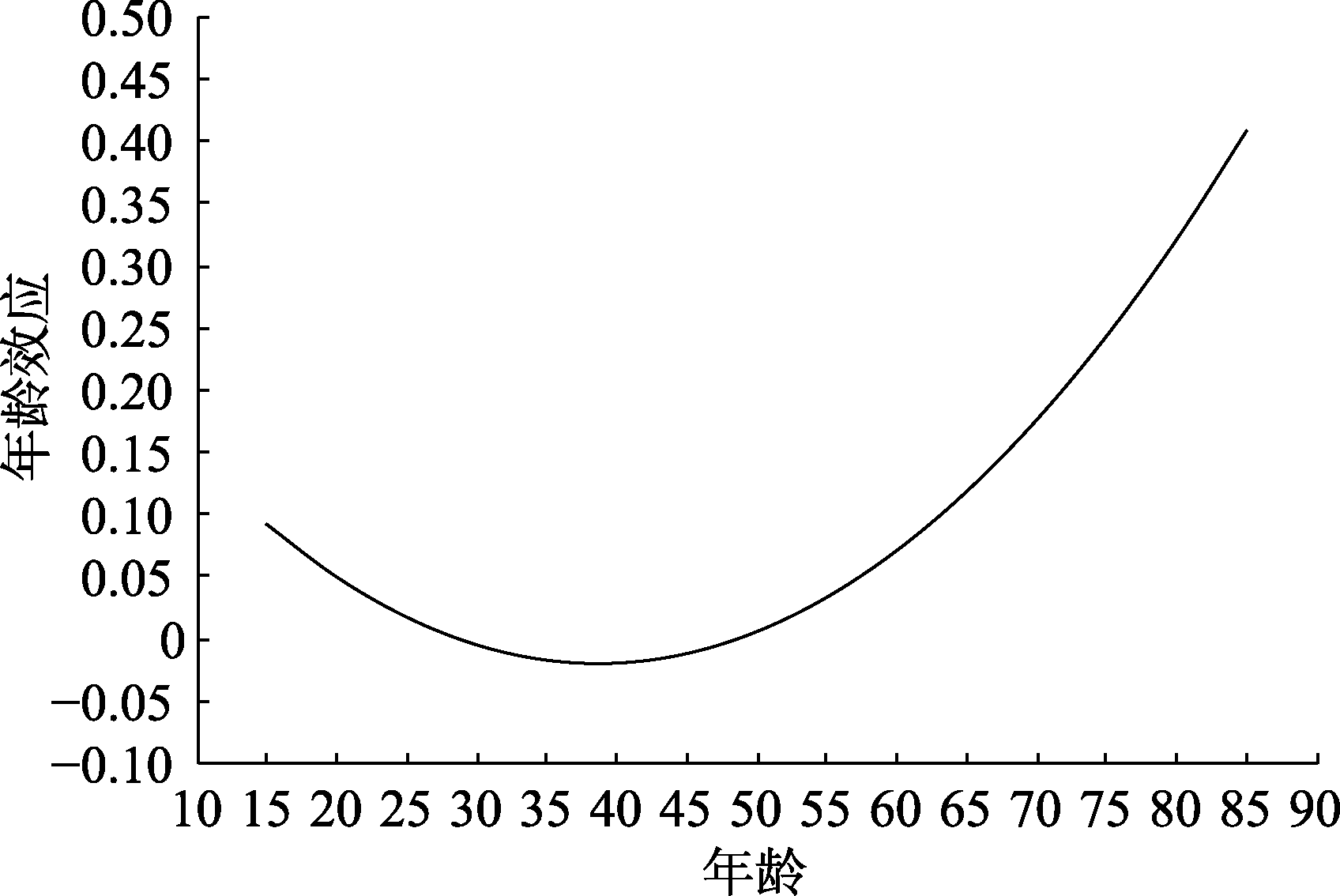
图1 年龄主效应
| 解释变量 | 基础模型 | 模型1 | 模型2 | 模型3 | 模型4 | |
|---|---|---|---|---|---|---|
| 截距 | 3.0442*** | −15.9680 | 3.0102*** | 2.9983*** | 3.0816*** | |
| 年龄 | 0.0041*** | 0.0000 | 0.0022*** | 0.0056*** | 0.0063*** | |
| 年龄平方 | 0.0002*** | 0.0002*** | 0.0002*** | 0.0002*** | 0.0001* | |
| 性别 | 0.0236*** | 0.0237*** | 0.0193** | 0.0245*** | 0.0240*** | |
| 政治面貌 | 0.1209*** | 0.1209*** | 0.1516*** | 0.0979*** | 0.1212*** | |
| 民族 | −0.0400** | −0.0397** | −0.0287* | −0.0455*** | −0.0402*** | |
| 婚姻状况 | 0.0390*** | 0.0394*** | 0.0463*** | 0.0561*** | 0.0379*** | |
| 时期协变量 | ||||||
| 时期亲属关系 | −1.3748*** | |||||
| 市场化系数 | −0.4419* | |||||
| 社会组织数量 | 6.8659 + | |||||
| 人口流动率 | 0.0173 | |||||
| 时期平均受教育年限 | −1.4894 | |||||
| 基尼系数 | 2.6006 | |||||
| 政府信任指数 | 0.0054 | |||||
| 世代协变量 | ||||||
| 世代平均受教育年限 | −0.0722*** | |||||
| 世代亲属关系 | −0.2223** | |||||
| 出生人口规模 | 0.0155** | |||||
| 户籍类型 | 0.0918** | |||||
| 教育程度 | 0.0489 | |||||
| 亲属关系 | −0.0588 | |||||
| 年龄交互项 | ||||||
| 年龄×户籍 | 0.0048*** | |||||
| 年龄平方×户籍 | −0.0001** | |||||
| 年龄×教育 | −0.0051*** | |||||
| 年龄平方×教育 | 0.0000 | |||||
| 年龄×亲属 | −0.0034** | |||||
| 年龄平方×亲属 | 0.0003*** | |||||
| 时期方差 | ||||||
| 截距 | 0.4214* | 0.0039 | 0.4176* | 0.0042* | 0.4992* | |
| 户籍类型 | 0.0033* | |||||
| 教育程度 | 0.0047* | |||||
| 亲属关系 | 0.0072* | |||||
| 世代方差 | ||||||
| 截距 | 0.0070* | 0.0016* | 0.0027+ | 0.0118* | 0.0023* | |
| 户籍类型 | 0.0021* | |||||
| 教育程度 | 0.0017 | |||||
| 亲属关系 | 0.0117* | |||||
| BIC | 267929.3 | 267893.3 | 267564.3 | 267709.5 | 267809.7 | |
表3 年龄−时期−世代多层次随机效应模型分析结果
| 解释变量 | 基础模型 | 模型1 | 模型2 | 模型3 | 模型4 | |
|---|---|---|---|---|---|---|
| 截距 | 3.0442*** | −15.9680 | 3.0102*** | 2.9983*** | 3.0816*** | |
| 年龄 | 0.0041*** | 0.0000 | 0.0022*** | 0.0056*** | 0.0063*** | |
| 年龄平方 | 0.0002*** | 0.0002*** | 0.0002*** | 0.0002*** | 0.0001* | |
| 性别 | 0.0236*** | 0.0237*** | 0.0193** | 0.0245*** | 0.0240*** | |
| 政治面貌 | 0.1209*** | 0.1209*** | 0.1516*** | 0.0979*** | 0.1212*** | |
| 民族 | −0.0400** | −0.0397** | −0.0287* | −0.0455*** | −0.0402*** | |
| 婚姻状况 | 0.0390*** | 0.0394*** | 0.0463*** | 0.0561*** | 0.0379*** | |
| 时期协变量 | ||||||
| 时期亲属关系 | −1.3748*** | |||||
| 市场化系数 | −0.4419* | |||||
| 社会组织数量 | 6.8659 + | |||||
| 人口流动率 | 0.0173 | |||||
| 时期平均受教育年限 | −1.4894 | |||||
| 基尼系数 | 2.6006 | |||||
| 政府信任指数 | 0.0054 | |||||
| 世代协变量 | ||||||
| 世代平均受教育年限 | −0.0722*** | |||||
| 世代亲属关系 | −0.2223** | |||||
| 出生人口规模 | 0.0155** | |||||
| 户籍类型 | 0.0918** | |||||
| 教育程度 | 0.0489 | |||||
| 亲属关系 | −0.0588 | |||||
| 年龄交互项 | ||||||
| 年龄×户籍 | 0.0048*** | |||||
| 年龄平方×户籍 | −0.0001** | |||||
| 年龄×教育 | −0.0051*** | |||||
| 年龄平方×教育 | 0.0000 | |||||
| 年龄×亲属 | −0.0034** | |||||
| 年龄平方×亲属 | 0.0003*** | |||||
| 时期方差 | ||||||
| 截距 | 0.4214* | 0.0039 | 0.4176* | 0.0042* | 0.4992* | |
| 户籍类型 | 0.0033* | |||||
| 教育程度 | 0.0047* | |||||
| 亲属关系 | 0.0072* | |||||
| 世代方差 | ||||||
| 截距 | 0.0070* | 0.0016* | 0.0027+ | 0.0118* | 0.0023* | |
| 户籍类型 | 0.0021* | |||||
| 教育程度 | 0.0017 | |||||
| 亲属关系 | 0.0117* | |||||
| BIC | 267929.3 | 267893.3 | 267564.3 | 267709.5 | 267809.7 | |
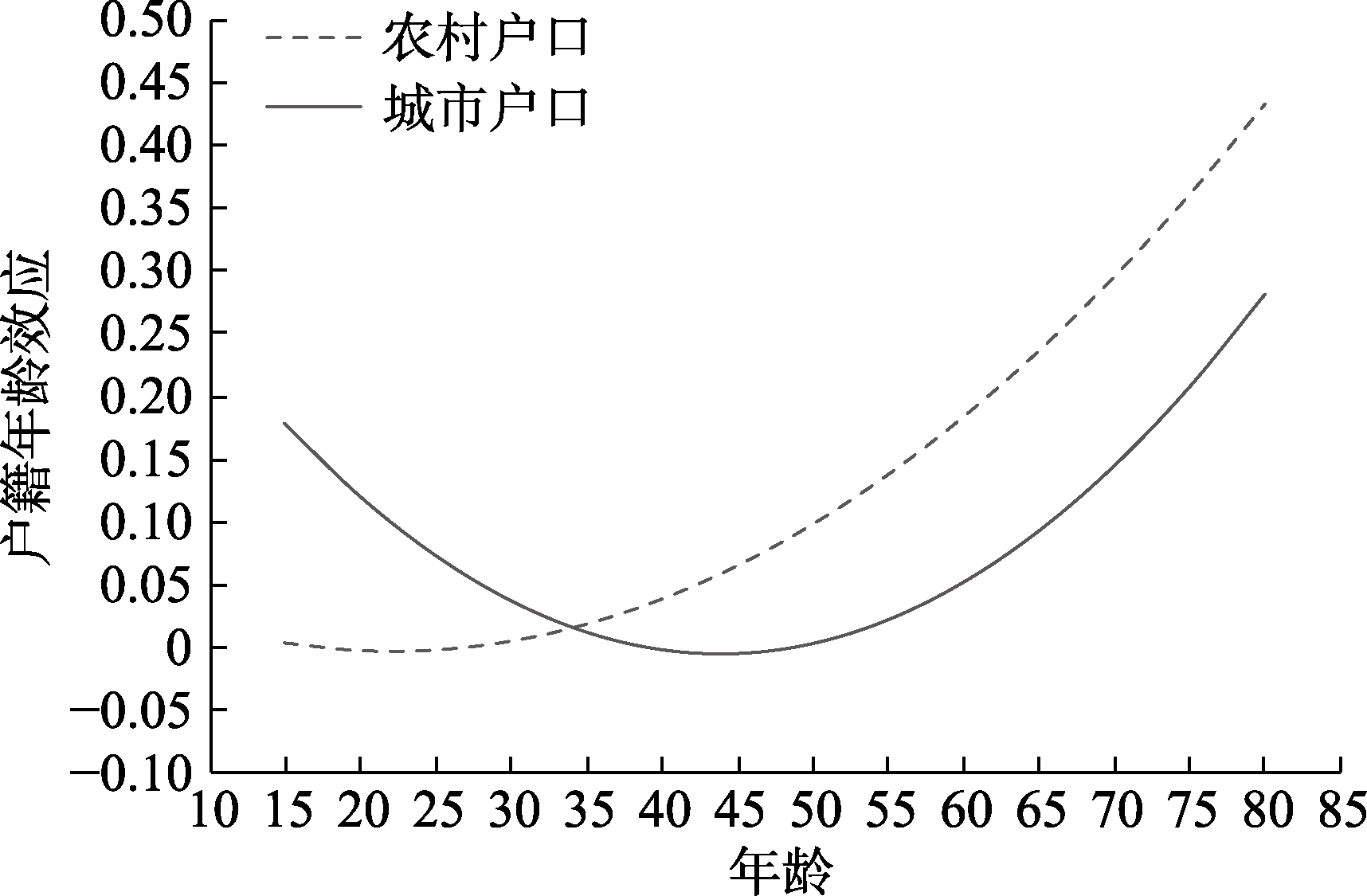
图2 年龄效应的户籍差异
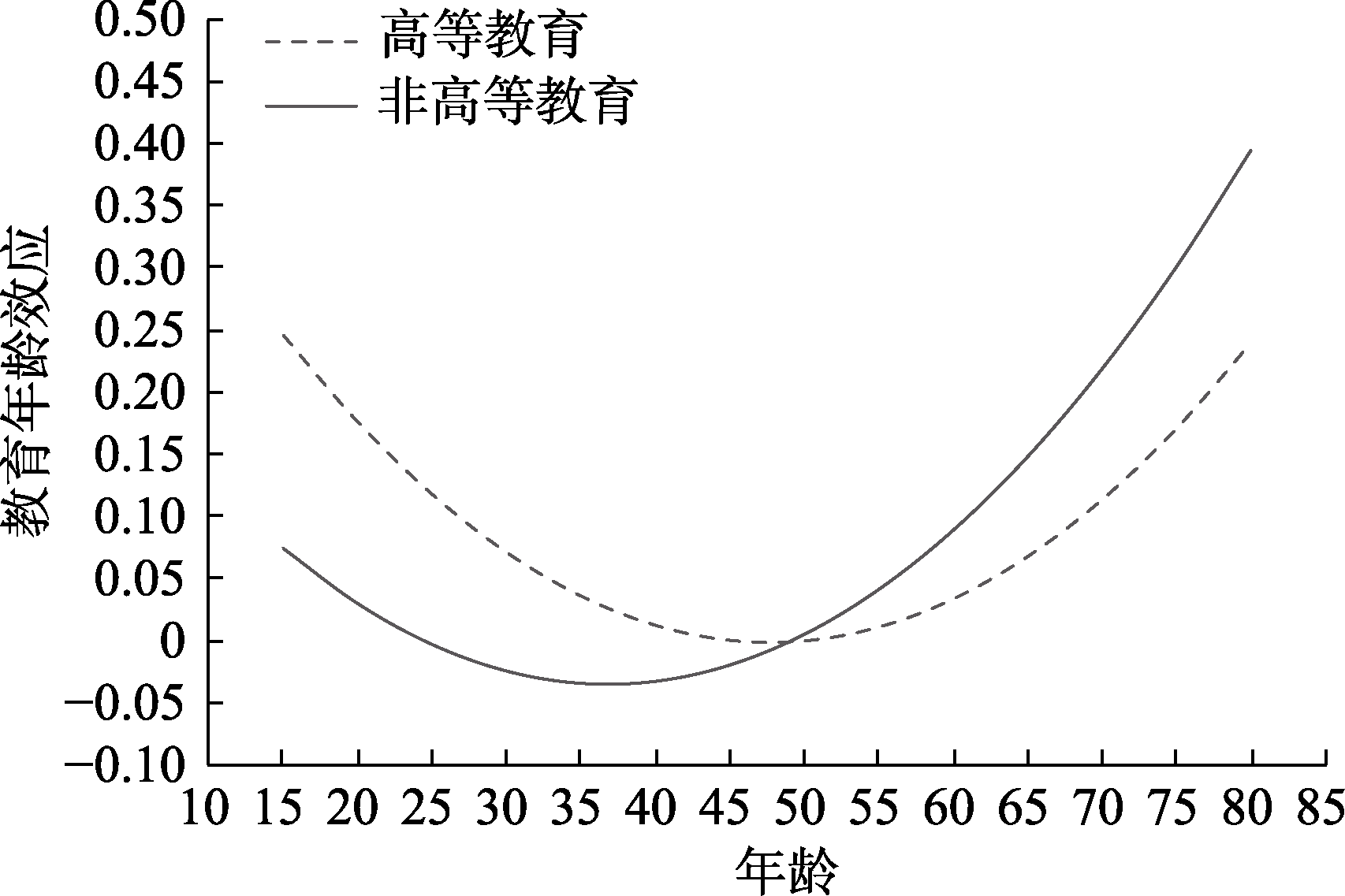
图3 年龄效应的教育水平差异
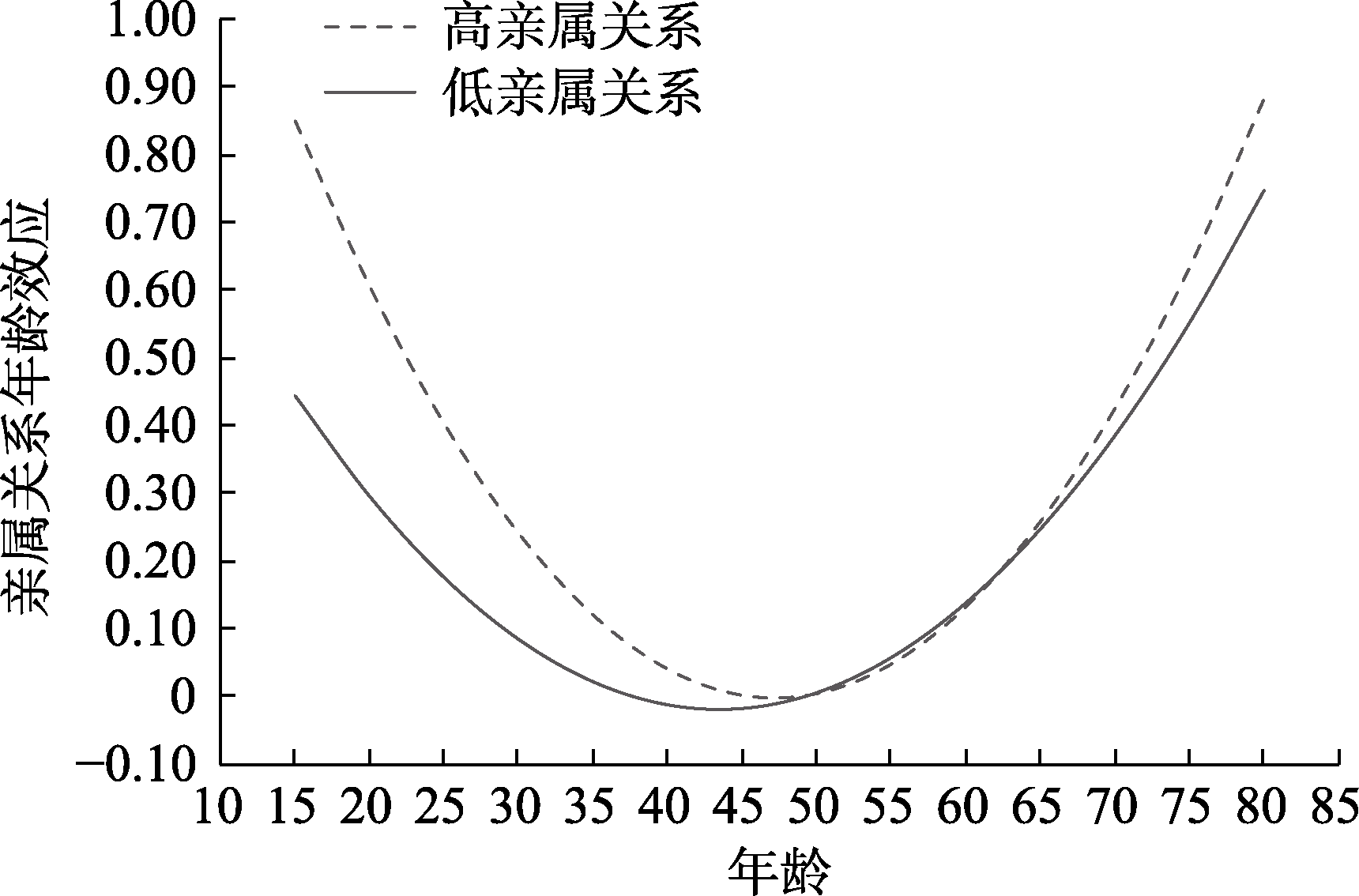
图4 年龄效应的亲属关系差异 注:图1纵坐标轴“年龄效应”表示不同年龄对普遍信任水平的固定效应回归系数(β1与β2之和)。图2~4进一步分别纳入了户籍、教育水平、亲属关系等控制变量对普遍信任水平的固定效应(${{\gamma }_{9}}$)及它们与年龄交互项的回归系数(β7与β8之和)。
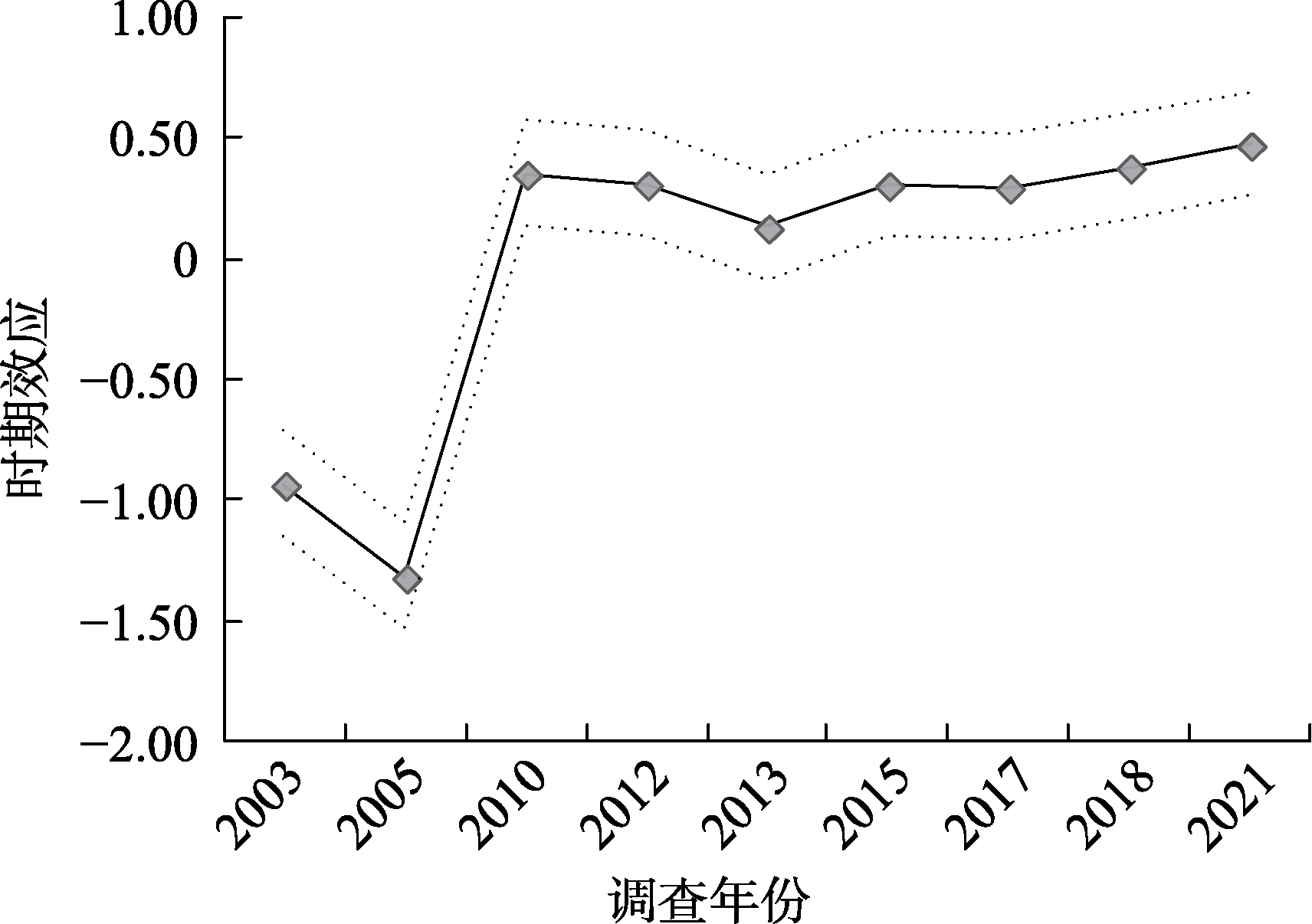
图5 时期主效应
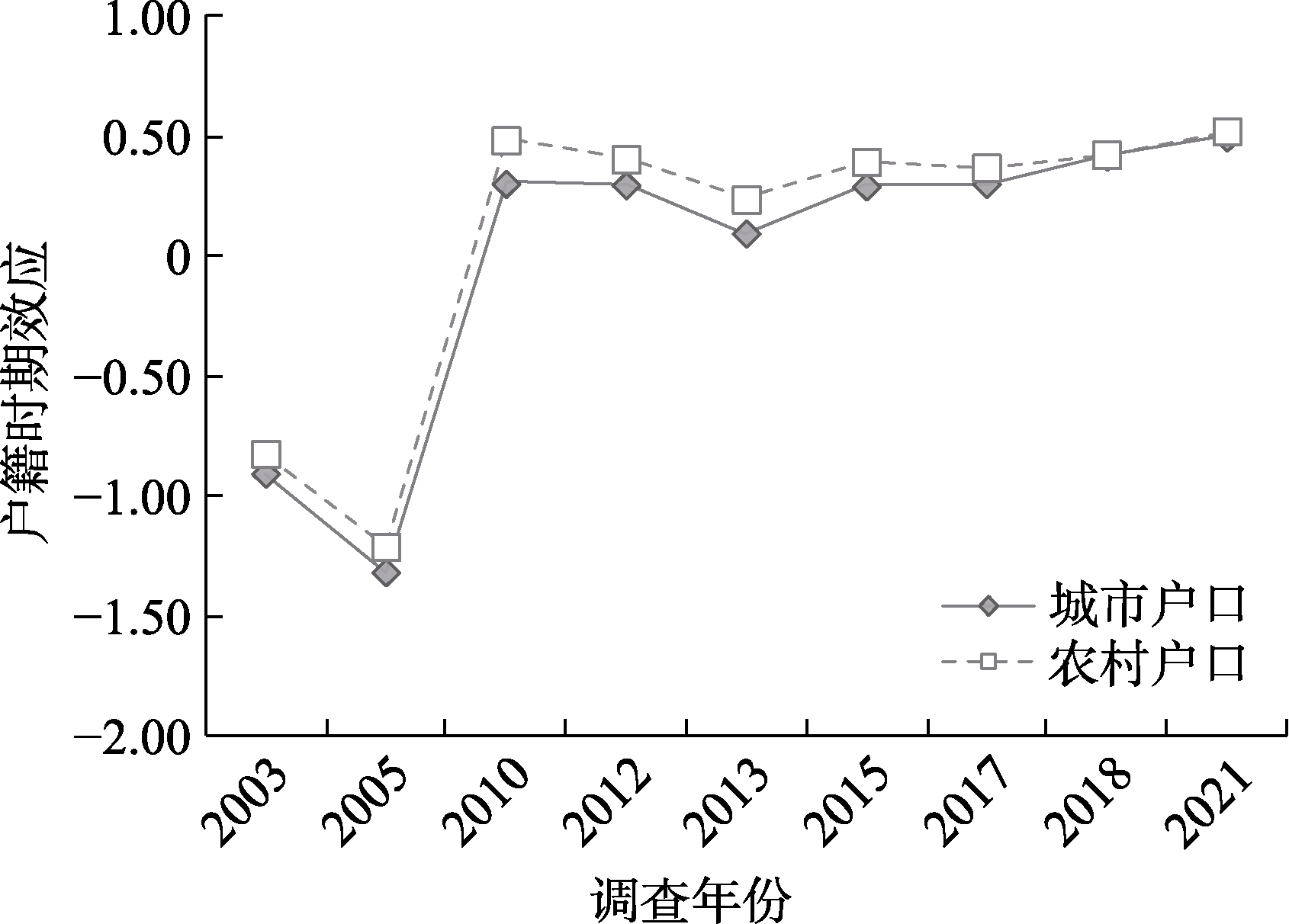
图6 时期效应的户籍差异
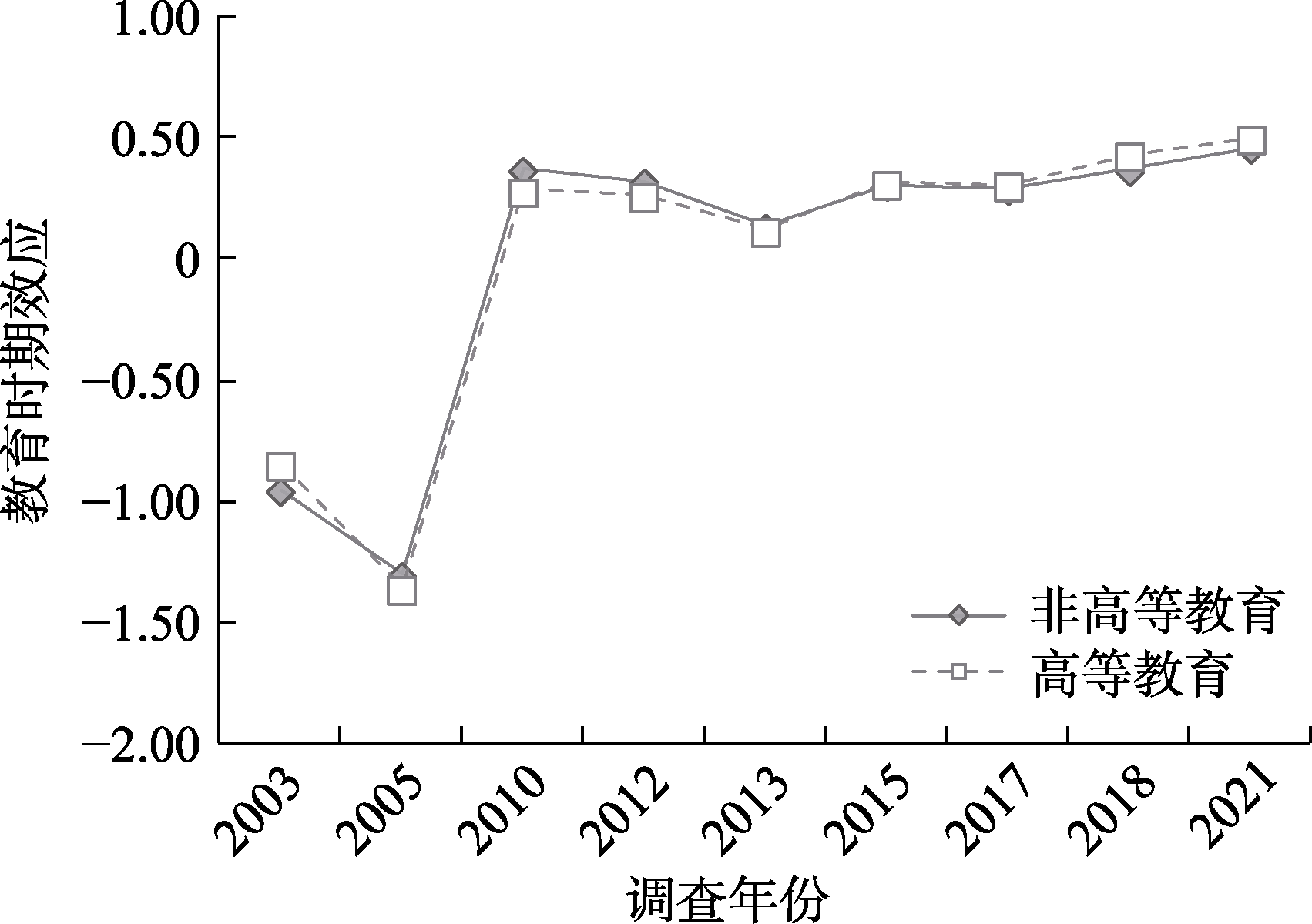
图7 时期效应的教育水平差异
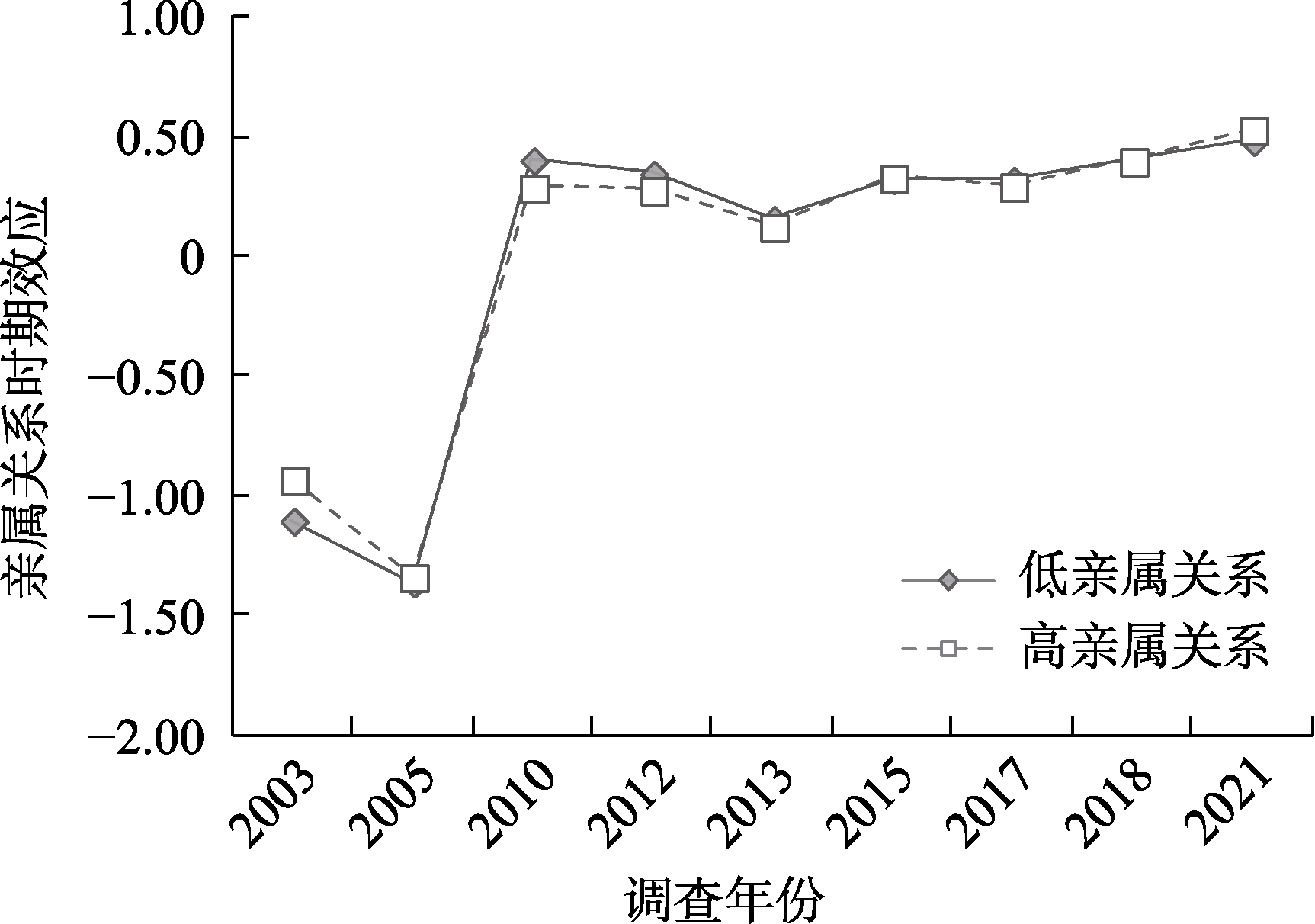
图8 时期效应的亲属关系差异 注:图5纵坐标轴“时期效应”表示不同调查年份对普遍信任水平的随机效应系数(${{\text{u}}_{0\text{j}}}$)。图6~8进一步分别纳入了户籍、教育水平、亲属关系等群体变量的固定效应(${{\gamma }_{9}}$)及它们对普遍信任水平的时期随机效应系数(${{\text{u}}_{9\text{j}}}$)。
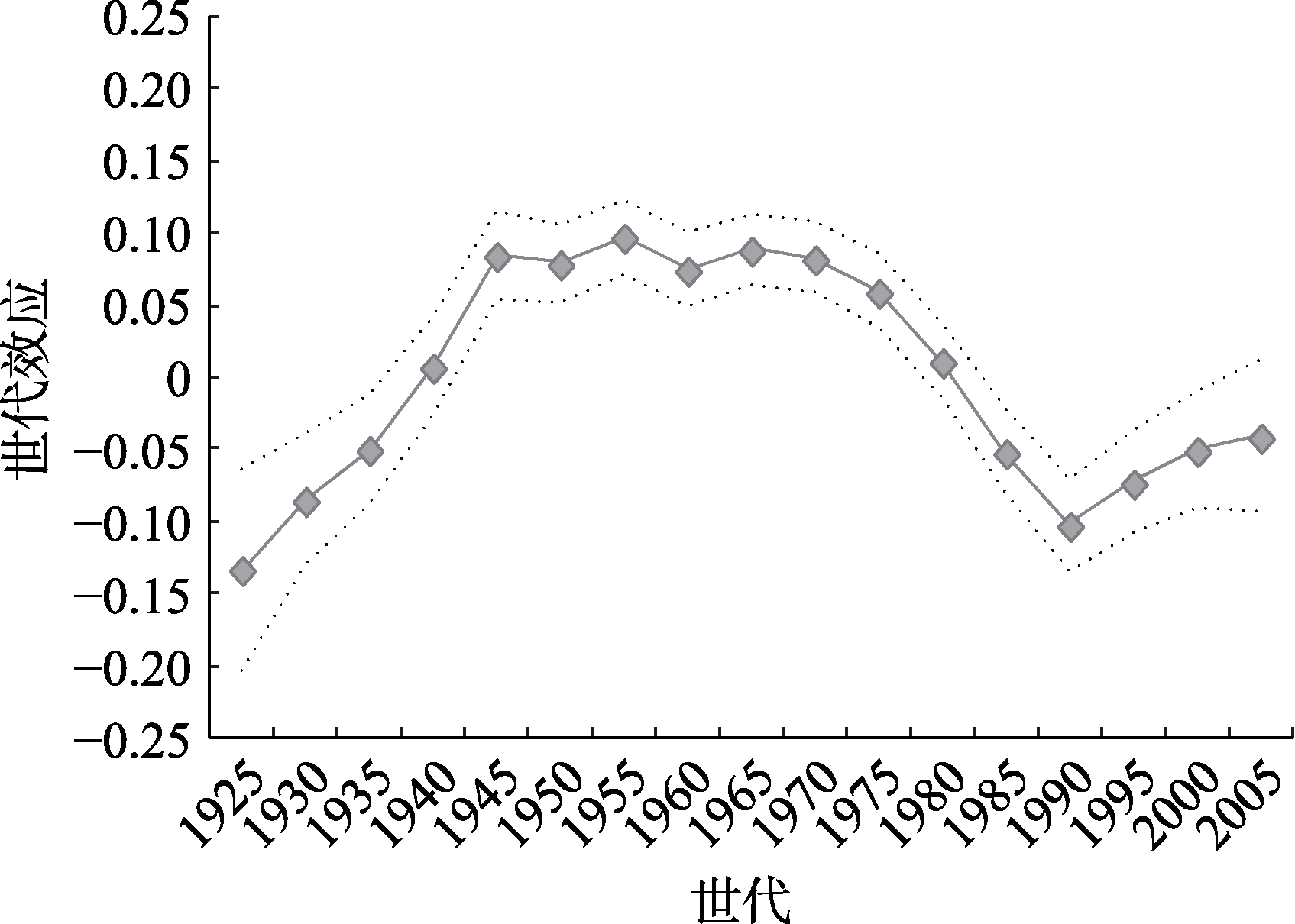
图9 世代主效应
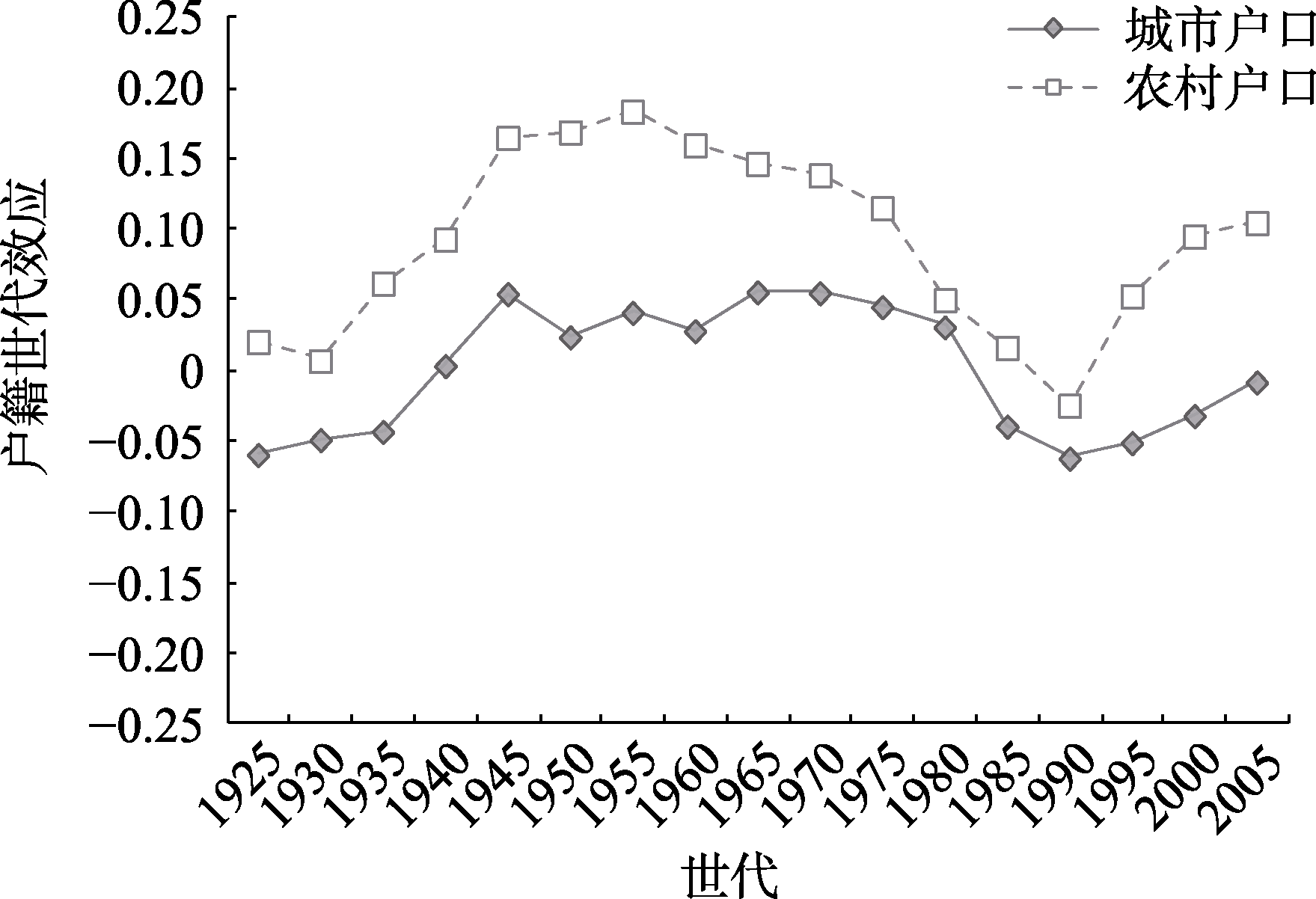
图10 世代效应的户籍差异
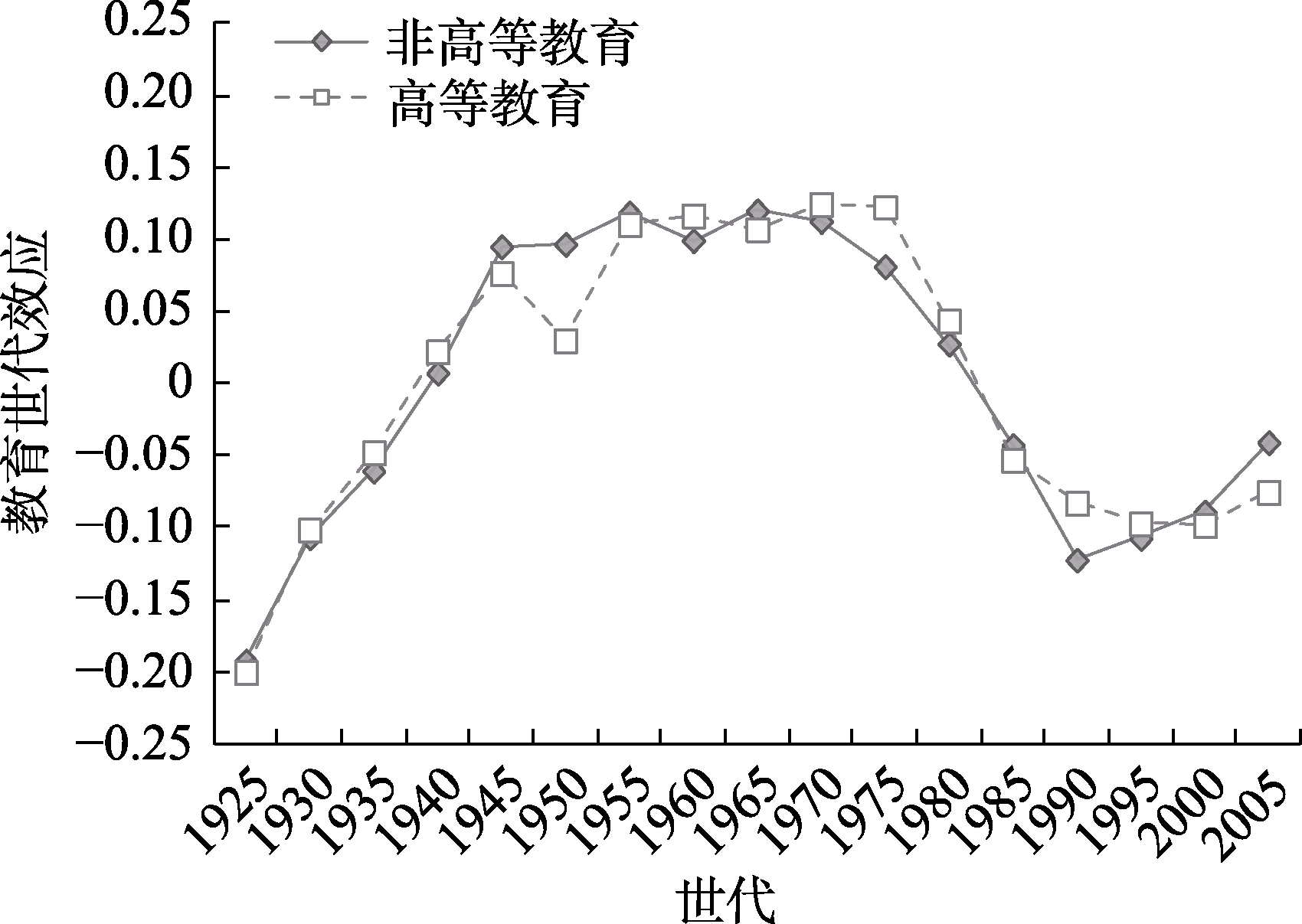
图11 世代效应的教育水平差异
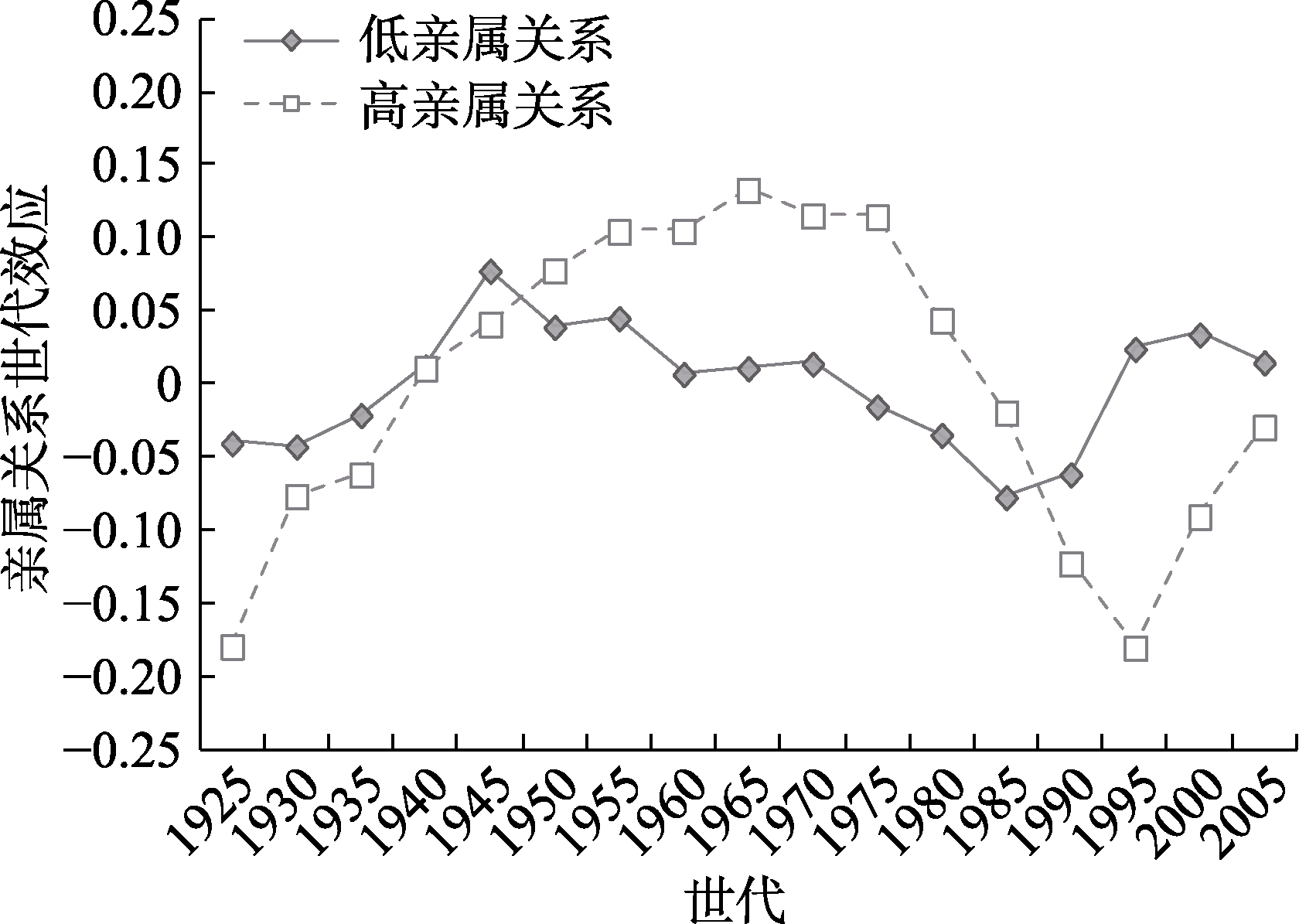
图12 世代效应的亲属关系差异 注:图9纵坐标轴“世代效应”表示不同世代对普遍信任水平的随机效应系数(${{\text{v}}_{0\text{k}}}$)。图10~12进一步分别纳入了户籍、教育水平、亲属关系等群体变量的固定效应(${{\gamma }_{9}}$)及它们对普遍信任水平的世代随机效应系数(${{\text{v}}_{9\text{k}}}$)。
| 宏观变量 | 变量系数 | 模型方差 | 方差变化 | |
|---|---|---|---|---|
| 时期协变量 | ||||
| 基础模型 | 0.4214 | |||
| 市场化系数 | 0.5279** | 0.1898 | 54.96% | |
| 人口流动率 | 0.0882*** | 0.1411 | 66.52% | |
| 社会组织数量 | 2.9720*** | 0.1476 | 64.97% | |
| 时期亲属关系 | −1.0571*** | 0.0045 | 98.93% | |
| 时期平均受教育年限 | 0.7740*** | 0.0978 | 76.78% | |
| 政府信任指数 | 0.0622*** | 0.1537 | 63.53% | |
| 基尼系数 | −60.1118** | 0.2376 | 43.62% | |
| 世代协变量 | ||||
| 基础模型 | 0.0070 | |||
| 世代平均受教育年限 | −0.0722*** | 0.0020 | 72.12% | |
| 出生人口规模 | 0.0155** | 0.0041 | 41.67% | |
| 世代亲属关系 | −0.2223* | 0.0070 | 0.21% | |
表4 单个宏观变量加入模型的主要分析结果
| 宏观变量 | 变量系数 | 模型方差 | 方差变化 | |
|---|---|---|---|---|
| 时期协变量 | ||||
| 基础模型 | 0.4214 | |||
| 市场化系数 | 0.5279** | 0.1898 | 54.96% | |
| 人口流动率 | 0.0882*** | 0.1411 | 66.52% | |
| 社会组织数量 | 2.9720*** | 0.1476 | 64.97% | |
| 时期亲属关系 | −1.0571*** | 0.0045 | 98.93% | |
| 时期平均受教育年限 | 0.7740*** | 0.0978 | 76.78% | |
| 政府信任指数 | 0.0622*** | 0.1537 | 63.53% | |
| 基尼系数 | −60.1118** | 0.2376 | 43.62% | |
| 世代协变量 | ||||
| 基础模型 | 0.0070 | |||
| 世代平均受教育年限 | −0.0722*** | 0.0020 | 72.12% | |
| 出生人口规模 | 0.0155** | 0.0041 | 41.67% | |
| 世代亲属关系 | −0.2223* | 0.0070 | 0.21% | |
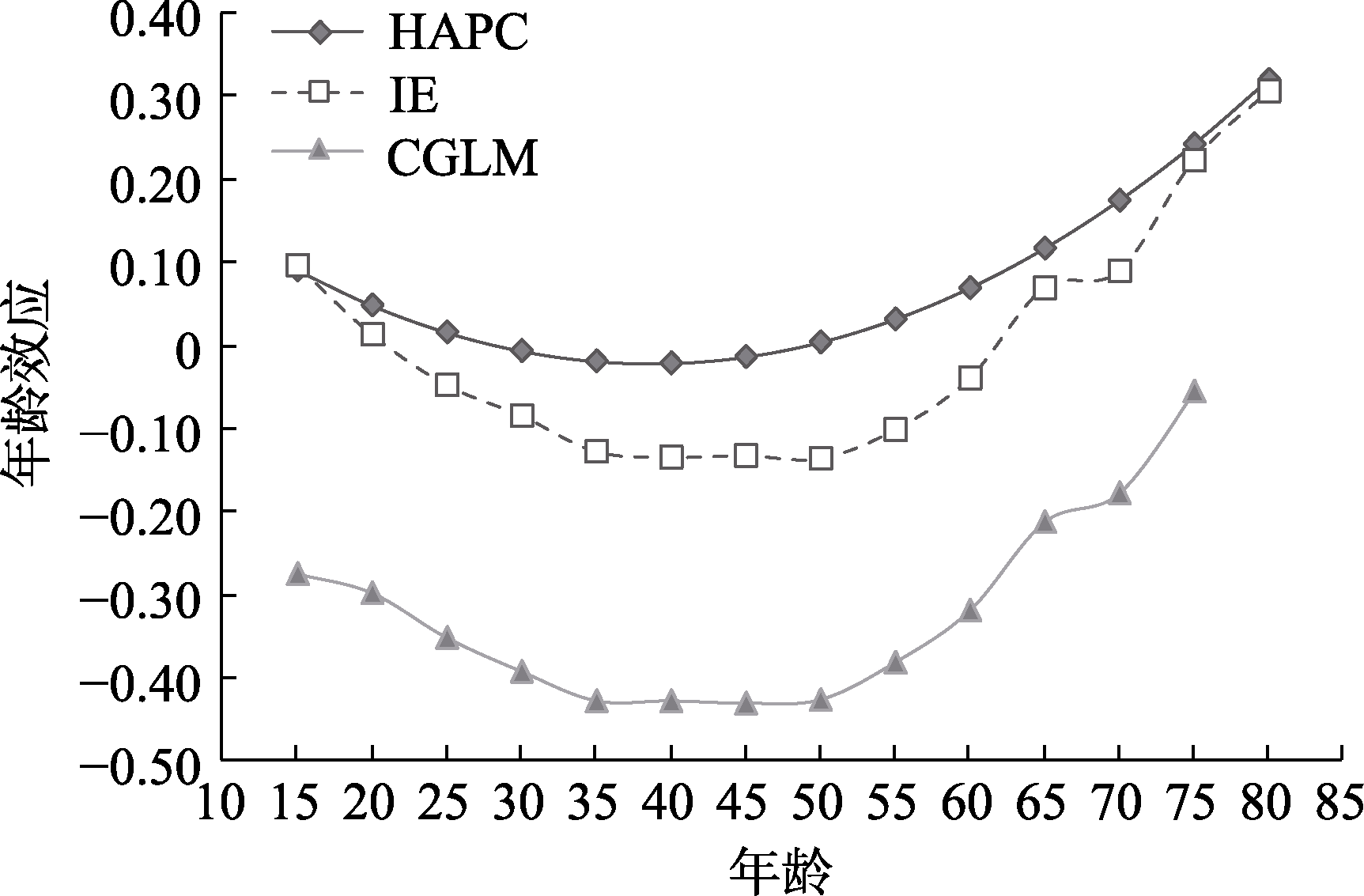
附图1 年龄效应比较
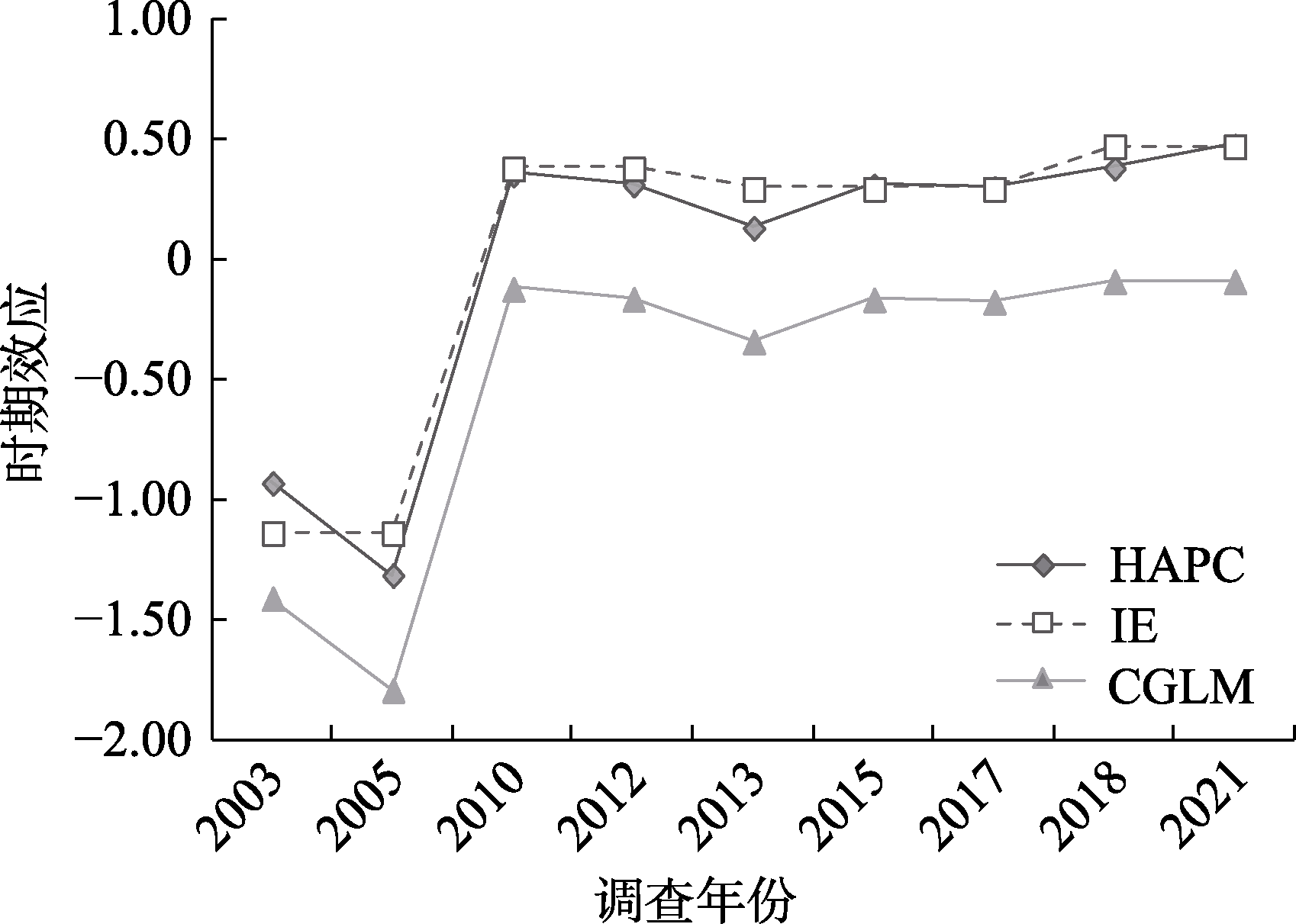
附图2 时期效应比较
| 解释变量 | HAPC | IE | CGLM | 解释变量 | HAPC | IE | CGLM | ||
|---|---|---|---|---|---|---|---|---|---|
| 截距 | 3.0442*** | 2.9691*** | 3.8079*** | 2013 | 0.1303 | 0.2929 | −0.3429 | ||
| 性别 | 0.0236*** | 0.0181** | 0.0235*** | 2005 | −0.0409 | −0.1616 | (omitted) | ||
| 政治面貌 | 0.1209*** | 0.1083*** | 0.1218*** | 2015 | 0.3061 | 0.2929 | −0.1675 | ||
| 民族 | −0.040** | −0.0334** | −0.0395** | 2017 | 0.2958 | 0.2929 | −0.1777 | ||
| 婚姻状况 | 0.0390*** | 0.0391*** | 0.0391*** | 2018 | 0.3793 | 0.4697 | −0.0924 | ||
| 年龄效应 | 2021 | 0.4720 | 0.4697 | (omitted) | |||||
| 15 | 0.0913 | 0.0967 | −0.2741 | 世代效应 | |||||
| 20 | 0.0489 | 0.0137 | −0.2972 | 1925 | −0.1325 | −0.4654 | −0.2790 | ||
| 25 | 0.0165 | −0.0471 | −0.3509 | 1930 | −0.0847 | −0.0802 | −0.0035 | ||
| 30 | −0.0059 | −0.0840 | −0.3916 | 1935 | −0.0495 | −0.0034 | 0.0386 | ||
| 35 | −0.0183 | −0.1270 | −0.4271 | 1940 | 0.0075 | 0.0678 | 0.0883 | ||
| 40 | −0.0207 | −0.1341 | −0.4271 | 1945 | 0.0846 | 0.1575 | 0.1707 | ||
| 45 | −0.0131 | −0.1321 | −0.4299 | 1950 | 0.0788 | 0.1584 | 0.1776 | ||
| 50 | 0.0045 | −0.1355 | −0.4257 | 1955 | 0.0974 | 0.1924 | 0.2173 | ||
| 55 | 0.0321 | −0.1010 | −0.3807 | 1960 | 0.0746 | 0.1835 | 0.2125 | ||
| 60 | 0.0697 | −0.0389 | −0.3181 | 1965 | 0.0884 | 0.1836 | 0.2271 | ||
| 65 | 0.1173 | 0.0698 | −0.2116 | 1970 | 0.0823 | 0.1561 | 0.2141 | ||
| 70 | 0.1749 | 0.0899 | −0.1769 | 1975 | 0.0592 | 0.1090 | 0.1779 | ||
| 75 | 0.2425 | 0.2231 | −0.0546 | 1980 | 0.0112 | 0.0291 | 0.1171 | ||
| 80 | 0.3201 | 0.3064 | (omitted) | 1985 | −0.0517 | −0.0676 | 0.0367 | ||
| 时期效应 | 1990 | −0.1019 | −0.1481 | −0.0308 | |||||
| 2003 | −0.9314 | −1.1389 | −1.4104 | 1995 | −0.0727 | −0.1544 | −0.0151 | ||
| 2005 | −1.3143 | −1.1389 | −1.7925 | 2000 | −0.0501 | −0.1567 | (omitted) | ||
| 2010 | 0.3523 | 0.3764 | −0.1236 | 2005 | −0.0409 | −0.1616 | (omitted) | ||
| 2012 | 0.3099 | 0.3764 | −0.1650 | ||||||
附表1 基础模型的HAPC、IE、CGLM方法分析结果对比
| 解释变量 | HAPC | IE | CGLM | 解释变量 | HAPC | IE | CGLM | ||
|---|---|---|---|---|---|---|---|---|---|
| 截距 | 3.0442*** | 2.9691*** | 3.8079*** | 2013 | 0.1303 | 0.2929 | −0.3429 | ||
| 性别 | 0.0236*** | 0.0181** | 0.0235*** | 2005 | −0.0409 | −0.1616 | (omitted) | ||
| 政治面貌 | 0.1209*** | 0.1083*** | 0.1218*** | 2015 | 0.3061 | 0.2929 | −0.1675 | ||
| 民族 | −0.040** | −0.0334** | −0.0395** | 2017 | 0.2958 | 0.2929 | −0.1777 | ||
| 婚姻状况 | 0.0390*** | 0.0391*** | 0.0391*** | 2018 | 0.3793 | 0.4697 | −0.0924 | ||
| 年龄效应 | 2021 | 0.4720 | 0.4697 | (omitted) | |||||
| 15 | 0.0913 | 0.0967 | −0.2741 | 世代效应 | |||||
| 20 | 0.0489 | 0.0137 | −0.2972 | 1925 | −0.1325 | −0.4654 | −0.2790 | ||
| 25 | 0.0165 | −0.0471 | −0.3509 | 1930 | −0.0847 | −0.0802 | −0.0035 | ||
| 30 | −0.0059 | −0.0840 | −0.3916 | 1935 | −0.0495 | −0.0034 | 0.0386 | ||
| 35 | −0.0183 | −0.1270 | −0.4271 | 1940 | 0.0075 | 0.0678 | 0.0883 | ||
| 40 | −0.0207 | −0.1341 | −0.4271 | 1945 | 0.0846 | 0.1575 | 0.1707 | ||
| 45 | −0.0131 | −0.1321 | −0.4299 | 1950 | 0.0788 | 0.1584 | 0.1776 | ||
| 50 | 0.0045 | −0.1355 | −0.4257 | 1955 | 0.0974 | 0.1924 | 0.2173 | ||
| 55 | 0.0321 | −0.1010 | −0.3807 | 1960 | 0.0746 | 0.1835 | 0.2125 | ||
| 60 | 0.0697 | −0.0389 | −0.3181 | 1965 | 0.0884 | 0.1836 | 0.2271 | ||
| 65 | 0.1173 | 0.0698 | −0.2116 | 1970 | 0.0823 | 0.1561 | 0.2141 | ||
| 70 | 0.1749 | 0.0899 | −0.1769 | 1975 | 0.0592 | 0.1090 | 0.1779 | ||
| 75 | 0.2425 | 0.2231 | −0.0546 | 1980 | 0.0112 | 0.0291 | 0.1171 | ||
| 80 | 0.3201 | 0.3064 | (omitted) | 1985 | −0.0517 | −0.0676 | 0.0367 | ||
| 时期效应 | 1990 | −0.1019 | −0.1481 | −0.0308 | |||||
| 2003 | −0.9314 | −1.1389 | −1.4104 | 1995 | −0.0727 | −0.1544 | −0.0151 | ||
| 2005 | −1.3143 | −1.1389 | −1.7925 | 2000 | −0.0501 | −0.1567 | (omitted) | ||
| 2010 | 0.3523 | 0.3764 | −0.1236 | 2005 | −0.0409 | −0.1616 | (omitted) | ||
| 2012 | 0.3099 | 0.3764 | −0.1650 | ||||||
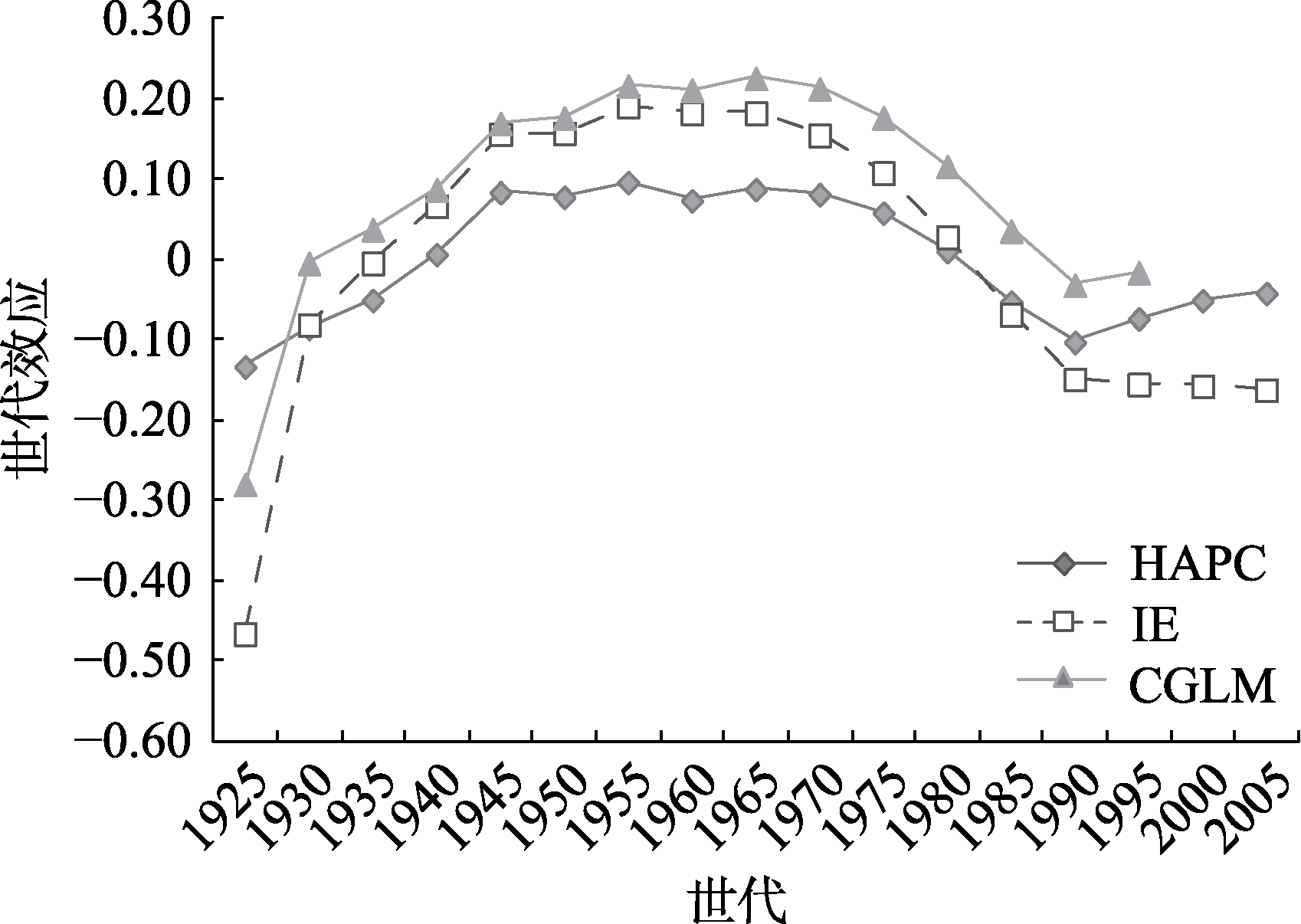
附图3 世代效应比较
| [1] | Alesina, A., & Ferrara, E. l. (2002). Who trusts others? Journal of Public Economics, 85(2), 207-234. |
| [2] | Ao, D., Zou, Y. C., & Gao, X. (2013). An analysis of the within-regional and cross-regional variations in the generalized trust of urban residents: The resource factor theory. Chinese Journal of Sociology, 33(6), 161-179. |
| [敖丹, 邹宇春, 高翔. (2013). 城镇居民普遍信任的区域间及区域内差异分析——基于“资源因素论”视角. 社会, 33(6), 161-179.] | |
| [3] |
Balliet, D., & Van Lange, P. A. M. (2013). Trust, conflict, and cooperation: A meta-analysis. Psychological Bulletin, 139(5), 1090-1112.
doi: 10.1037/a0030939 pmid: 23231532 |
| [4] | Barber, B. (1983). The logic and limits of trust. New Jersey: Rutgers University Press. |
| [5] | Bjørnskov, C. (2007). Determinants of generalized trust: A cross-country comparison. Public Choice, 130(1), 1-21. |
| [6] | Brehm, J., & Rahn, W. (1997). Individual-level evidence for the causes and consequences of social capital. American Journal of Political Science, 41(3), 999-1023. |
| [7] |
Cai, H. J., Huang, Z. H., Lin, L., Zhang, M. Y., Wang, X. O., Zhu, H. J., ... Jing, Y. M. (2020). The psychological change of the Chinese people over the past half century: A literature review. Advances in Psychological Science, 28(10), 1599-1688.
doi: 10.3724/SP.J.1042.2020.01599 |
|
[蔡华俭, 黄梓航, 林莉, 张明杨, 王潇欧, 朱慧珺, ... 敬一鸣. (2020). 半个多世纪来中国人的心理与行为变化——心理学视野下的研究. 心理科学进展, 28(10), 1599-1688.]
doi: 10.3724/SP.J.1042.2020.01599 |
|
| [8] | Cai, W. P. (2017). The impact of higher education on social trust and the evolution of its mechanism of action. Hubei Social Sciences, (2), 167-173. |
| [蔡蔚萍. (2017). 高等教育对社会信任的影响及其作用机制变迁. 湖北社会科学, (2), 167-173.] | |
| [9] | Chen, M. Q. (2023-09-12) Consolidate the mentality foundation of Chinese modernized society. Chinese Social Sciences Today. |
| [陈满琪. (2023-09-12) 夯实中国式现代化社会心态基础. 中国社会科学报.] | |
| [10] |
Clark, A. K. & Eisenstein, M. A. (2013). Interpersonal trust: An age-period-cohort analysis revisited. Social Science Research, 42(2), 361-375.
doi: 10.1016/j.ssresearch.2012.09.006 pmid: 23347482 |
| [11] | Delhey, J., & Newton, K., & Welzel, C. (2011). How general is trust in “most people”? Solving the radius of trust problem. American Sociological Review, 76(5), 786-807. |
| [12] | Dincer, O. C. & Uslaner, E. M. (2010). Trust and growth, Public Choice, 142(1-2), 59-67. |
| [13] | Ding, C. M., Zhang, L., & Wang, C. (2020). Income disparity and social trust under the background of transition. Review of Economy and Management, 36(2), 15-25. |
| [丁从明, 张亮, 王聪. (2020). 转型背景下的收入差距与社会信任. 经济与管理评论, 36(2), 15-25.] | |
| [14] | Erikson, E. H. (1950). Childhood and society. New York: W. W. Norton & Company. |
| [15] | Freitag, M., & Traunmüller, R. (2009). Spheres of trust: An empirical analysis of the foundations of particularised and generalised trust. European Journal of Political Research, 48(6), 782-803. |
| [16] | Hamamura, T., & Xu, Y. (2015). Changes in Chinese culture as examined through changes in personal pronoun usage. Journal of Cross-Cultural Psychology, 46(7), 930-941. |
| [17] | Han, Y. C. (2021a). The internet use, communication perimeter and generational difference in general trust. Journal of Shenzhen University (Humanities & Social Sciences), 38(6), 114-124. |
| [韩彦超. (2021a). 互联网使用、交往半径与一般信任的世代效应. 深圳大学学报(人文社会科学版), 38(6), 114-124.] | |
| [18] | Han, Y. C. (2021b). Population mobility and change of trust during the transition period (2005-2015). Journal of Southeast University (Philosophy and Social Science), 23(3), 108-116+148. |
| [韩彦超. (2021b). 转型期人口流动与信任变迁(2005—2015). 东南大学学报(哲学社会科学版), 23(3), 108-116+148.] | |
| [19] |
Hu, A. (2015). A loosening tray of sand? Age, period, and cohort effects on generalized trust in Reform-Era China, 1990-2007. Social Science Research, 51, 233-246.
doi: 10.1016/j.ssresearch.2014.09.008 pmid: 25769864 |
| [20] | Hu, A. N., & Zhou, Y. (2013). Revisiting the negative effects of confucian culture on general trust: An examination based on the 2007 China resident survey data. Sociological Studies, (2), 1-23. |
| [胡安宁, 周怡. (2013). 再议儒家文化对一般信任的负效应——一项基于2007年中国居民调查数据的考察. 社会学研究, (2), 1-23.] | |
| [21] | Hu, K., & Hu, R. (2008). The compositional differences of social capital between rural and urban areas. Journal of Xiamen University (Arts & Social Sciences), (6), 64-70.). |
| [胡康, 胡荣. (2008). 城乡居民社会资本构成的差异. 厦门大学学报(哲学社会科学版), (6), 64-70.] | |
| [22] |
Huang, J., Brink, H. M., Groot, W. (2011). College education and social trust: An evidence-based study on the causal mechanisms. Social Indicators Research, 104(2), 287-310.
pmid: 21980217 |
| [23] | Huang, J., Deng, Y. H. (2012). Higher education and social trust: A study based on Chinese and British survey data. Social Sciences in China, (11), 98-111+205-206. |
| [黄健, 邓燕华. (2012). 高等教育与社会信任: 基于中英调查数据的研究. 中国社会科学, (11), 98-111+205-206.] | |
| [24] | Inglehart, R., & Wayne, E. B. (2000). Modernization, cultural change, and the persistence of traditional values. American Sociological Review, 65(1), 19-51. |
| [25] | Jie, A. H. (2000). The unit: A type of special social life scope. Journal of Zhejiang University (Humanities and Social Sciences, (5), 73-80. |
| [揭爱花. (2000). 单位:一种特殊的社会生活空间. 浙江大学学报(社会科学版), (5), 73-80.] | |
| [26] | Jing, Y., Cai, H., Bond, M. H., Li, Y., Stivers, A. W., & Tan, Q. (2021). Levels of interpersonal trust across different types of environment: The micro-macro interplay between relational distance and human ecology. Journal of Experimental Psychology: General, 150(7), 1438-1457. |
| [27] | Li, L. L., & Wang, P. (2018). Changing social attitudes in China in transition (2005-2015). Social Sciences in China, (3), 83-101. |
| [李路路, 王鹏. (2018). 转型中国的社会态度变迁 (2005-2015). 中国社会科学, (3), 83-101.] | |
| [28] | Li, T. Y., & Fung, H. H. (2013). Age differences in trust: An investigation across 38 countries. The Journals of Gerontology, Series B: Psychological Sciences and Social Sciences, 68( 3), 347-355. |
| [29] | Li, X. G., & Guo, X. X. (2022). Dynamics of social capital in Urban China, 1999 to 2014: An age-period-cohort analysis. Social Networks, 68(10), 394-406. |
| [30] | Lin, J., Li, W., Guo, Z., & Kou, Y. (2023). When and why does economic inequality predict prosocial behaviour? Examining the role of interpersonal trust among different targets. European Journal of Social Psychology. 54(1), 136-153. https://doi.org/10.1002/ejsp.3007. |
| [31] | Lin, K., Liu, X. Q., & Mao, H. (2010). Social trust and social quality: The analysis and assessment on the data of social quality survey in Zhejiang province. The Journal of Jiangsu Administration Institute, (4), 61-67. |
| [林卡, 柳晓青, 茅慧. (2010). 社会信任和社会质量:浙江社会质量调查的数据分析与评估. 江苏行政学院学报, (4), 61-67.] | |
| [32] | Luhmann, N. (1979). Trust and power. New Jersey: John Wiley & Sons, Inc. |
| [33] | Lv, F., & Mei, L. (2016). Reconstruction of social foundational order in the post-Danwei era. Academia Bimestris (4), 76-81. |
| [吕方, 梅琳. (2016). “后单位时代”的“社会基础秩序”重建. 学海, (4), 76-81.] | |
| [34] | Mark, E. W. (2004). Democracy and trust (Wu Hui, Trans.). Beijing: Huaxia Press. (Original work published 1999) |
| [马克·E·沃伦. (2004). 民主与信任 (吴辉译). 北京: 华夏出版社.] | |
| [35] | Mayer, R. C., Davis, J. H., & Schoorman, F. D. (1995). An integrative model of organizational trust. Academy of Management Review, 20(3), 709-734. |
| [36] | Morselli, D., & Glaeser, S. (2018). Economic conditions and social trust climates in Europe over ten years: An ecological analysis of change. Journal of Trust Research, 8(1), 68-86. |
| [37] | Paxton, P. (1999). Is social capital declining in the United States? A multiple indicator assessment. American Journal of Sociology, 105(1), 88-127. |
| [38] | Pletzer, J. L., Balliet, D., Joireman, J., Kuhlman, D. M., Voelpel, S. C., & Van Lange, P. A. M. (2018). Social value orientation, expectations, and cooperation in social dilemmas: A meta-analysis. European Journal of Personality, 32(1), 62-83. |
| [39] | Putnam, R. D. (1995a). Bowling alone: America’s declining social capital. Journal of Democracy, 6(1), 223-234. |
| [40] | Putnam, R. D. (1995b). Tuning in, tuning out: The strange disappearance of social capital in America. PS: Political Science and Politics, 28(4), 664-683. |
| [41] | Putnam, R. D. (2001). Civic disengagement in contemporary America. Government and Opposition, 36(2), 135-156. |
| [42] | Robinson, R. V., & Jackson, E. F. (2001). Is trust in others declining in America? An age-period-cohort analysis. Social Science Research, 30(1), 117-145. |
| [43] | Romano, A., Sutter, M., Liu, J. H., Yamagishi, T., & Balliet, D. (2021). National parochialism is ubiquitous across 42 nations around the world. Nature Communications, 12(1), 4456. |
| [44] | Rothstein, B., & Dietlind, S. (2003). Social capital, impartiality and the welfare state:An institutional approach. In M.Hooghe & D.Stolle (Eds.), Generating social capital: Civil society and institutions in comparative perspective. NewYork: Palgrave MacMillan. |
| [45] |
Rotter, J. B. (1967). A new scale for the measurement of interpersonal trust. Journal of Personality, 35(4), 651-665.
doi: 10.1111/j.1467-6494.1967.tb01454.x pmid: 4865583 |
| [46] | Shen, G. J., & Zhang, C. C. (2016). Income inequality, social stratification and social trust. Comparative Economic & Social Systems, (1), 121-136. |
| [申广军, 张川川. (2016). 收入差距、社会分化与社会信任. 经济社会体制比较, (1), 121-136.] | |
| [47] | Smith, T. W. (1997). Factors relating to misanthropy in contemporary American society. Social Science Research, 26(2), 170-196. |
| [48] |
Thomson, R., Yuki, M., Talhelm, T., Schug, J., Kito, M., Ayanian, A. H., ... Visserman, M. L. (2018). Relational mobility predicts social behaviors in 39 countries and is tied to historical farming and threat. Proceedings of the National Academy of Sciences of the United States of America, 115(29), 7521-7526.
doi: 10.1073/pnas.1713191115 pmid: 29959208 |
| [49] | Tian, Y. P., & Lv, F. (2009). The end of danwei society and its social risks. Jilin University Journal Social Science Edition, 49(6), 17-23. |
| [田毅鹏, 吕方. (2009). 单位社会的终结及其社会风险. 吉林大学社会科学学报, 49(6), 17-23.] | |
| [50] |
Trzesniewski, K. H., & Donnellan, M. B. (2010). Rethinking “generation me”: A study of cohort effects from 1976-2006. Perspectives on Psychological Science, 5(1), 58-75.
doi: 10.1177/1745691609356789 pmid: 26162063 |
| [51] |
Twenge, J. M., Campbell, W. K., & Carter, N. T. (2014). Declines in trust in others and confidence in institutions among American adults and late adolescents, 1972-2012. Psychological Science, 25(10), 1914-1923.
doi: 10.1177/0956797614545133 pmid: 25205784 |
| [52] | Uslaner, E. M. (2002). The moral foundations of trust. Cambridge: Cambridge University Press. |
| [53] | Vogel, E. F. (1965). From friendship to comradeship: The change in personal relations in communist China. The China Quarterly, 21, 46-66. |
| [54] | Welzel, C. (2014). Evolution, empowerment and emancipation: How societies climb the freedom ladder. World Development, 64, 33-51. |
| [55] | Xie, Y., & Zhou, X. (2014). Income inequality in today’s China. Proceedings of the National Academy of Sciences, 111(19), 6928-6933. |
| [56] | Xin, Z., & Xin, S. (2017). Marketization process predicts trust decline in China. Journal of Economic Psychology, 62, 120-129. |
| [57] |
Xin, Z. Q. (2019). Marketization and interpersonal trust decline in China. Advances in Psychological Science, 27(12), 1951-1966.
doi: 10.3724/SP.J.1042.2019.01951 |
|
[辛自强. (2019). 市场化与人际信任变迁. 心理科学进展, 27(12), 1951-1966.]
doi: 10.3724/SP.J.1042.2019.01951 |
|
| [58] | Xu, Q., Wang, J. S., & Wu, Y. X. (2022). Theory-driven or method-driven? New approaches to age-period-cohort analysis. Sociological Studies, 37(6), 36-58. |
| [许琪, 王金水, 吴愈晓. (2022). 理论驱动还是方法驱动?——年龄—时期—世代分析的最新进展. 社会学研究, 37(6), 36-58.] | |
| [59] | Yang, H., & Huang, Y. T. (2022). How can general trust be possible in market economy:A study on the trust in home service industry. Journal of East China University of Science and Technology (Social Science Edition), 37(1), 54-65. |
| [杨慧, 黄钰婷. (2022). 市场经济条件下的普遍信任何以可能?——以家政服务业中的信任生成与演化为例. 华东理工大学学报(社会科学版), 37(1), 54-65.] | |
| [60] | Yang, M., Meng, T. G., & Fang, R. (2011). Social trust in a changing society: Stock and change from 1990 to 2010. Journal of Peking University (Philosophy and Social Sciences), 48(6), 100-109. |
| [杨明, 孟天广, 方然. (2011). 变迁社会中的社会信任:存量与变化——1990—2010年. 北京大学学报(哲学社会科学版), 48(6), 100-109.] | |
| [61] | Yang, Y., & Land, K. C. (2013). Age-period-cohort analysis: New models, methods, and empirical applications. New York: Chapman and Hall/CRC. |
| [62] | Yu, G. L., & Wang, H. (2016). Social transformation: Social psychology analysis on the lack of public sense of security. Sociological Review of China, 4(3), 11-20. |
| [俞国良, 王浩. (2016). 社会转型:国民安全感的社会心理学分析. 社会学评论, 4(3), 11-20.] | |
| [63] | Yu, H. B. (2017). On the change of Chinese peasants’ interpersonal trust and its determinants: Analysis of the data from five waves survey (2002-2015) in 40 villages of Jiangxi province. Journal of Central China Normal University (Humanities and Social Sciences), 56(5), 1-10. |
| [余泓波. (2017). 变动中的差序:农民人际信任变迁及其影响因素——基于2002-2015年江西40村五波问卷调查数据的分析. 华中师范大学学报(人文社会科学版), 56(5), 1-10.] | |
| [64] | Yuan, M., Spadaro, G., Jin, S., Wu, J. H., Kou, Y., Paul, A. M. V. L., & Balliet, D. (2022). Did cooperation among strangers decline in the United States? A cross-temporal meta-analysis of social dilemmas (1956-2017). Psychological Bulletin, 148(3-4), 129-157. |
| [65] | Yuan, M. L., Wu, J. H., Jing, S. X., Lin, J., Kou, Y., & Van Lange, P. A. M. (2024). The changes in cooperation among strangers in China: A cross-temporal meta-analysis of social dilemmas (1999-2019). Acta Psychologica Sinica, 56(9), 1159-1175. |
|
[苑明亮, 伍俊辉, 金淑娴, 林靓, 寇彧, Van Lange, P. A. M. 2024). 中国社会陌生人之间合作行为的变迁:基于社会困境研究的元分析(1999-2019). 心理学报, 56(9), 1159-1175.]
doi: 10.3724/SP.J.1041.2024.01159 |
|
| [66] | Zhai, X. W. (2008). Trust and risk society: Western theories and Chinese issues. Social Science Research, (4). 123-128. |
| [翟学伟. (2008). 信任与风险社会——西方理论与中国问题. 社会科学研究, (4), 123-128.] | |
| [67] | Zhai, X. W. (2013). How to understand the relationship between confucian culture and trust. Journal of Social Sciences, (6), 70-76. |
| [翟学伟. (2013). 也谈儒家文化与信任的关系——与《再议儒家文化对一般信任的负效应》一文的商榷. 社会科学, (6), 70-76.] | |
| [68] | Zhai, X. W. (2017). Chinese social credit: Theoretical, empirical, and policy research. Beijing: China Social Sciences Press. |
| [翟学伟. (2017). 中国社会信用:理论、实证与对策研究. 北京: 中国社会科学出版社.] | |
| [69] | Zhai, X. W. (2023). Relational dimension theory and its explanatory power. Open Times, (1), 90-94. |
| [翟学伟. (2023). 关系向度理论及其解释力. 开放时代, (1), 90-94.] | |
| [70] | Zhao, C., & Dong, C. (2019). Democracy promotionand social trust improvement: An empirical analysis of the “unexpected” effect of farmers’cooperatives. China Rural Survey, (6), 45-58. |
| [赵昶, 董翀. (2019). 民主增进与社会信任提升:对农民合作社“意外性”作用的实证分析. 中国农村观察, (6), 45-58.] | |
| [71] | Zhao, W. L., & Feng, Y. (2011, July). Regional comparison of trust among urban residents in China. Presented at the 2010 Annual Meeting of the Chinese Sociological Society, Harbin, China. |
| [ 赵文龙, 冯渊. (2011, 7月). 中国城市居民信任的区域比较. 中国社会学会2010年会, 哈尔滨, 中国.] | |
| [72] | Zhong, X. J., & Su, P. T. (2022). The transformation and symbiosis of trust: The logic of community order construction in community governance: An analysis of trust network change of urban locksmith. Chongqing Social Sciences, (12), 66-84. |
| [钟兴菊, 苏沛涛. (2022). 信任转化与共生:社区治理共同体秩序构建的逻辑——基于城市锁匠的信任网络变迁分析. 重庆社会科学, (12), 66-84.] |
| [1] | 苑明亮, 伍俊辉, 金淑娴, 林靓, 寇彧, Paul A. M. Van Lange. 中国社会陌生人之间合作行为的变迁:基于社会困境研究的元分析(1999~2019)[J]. 心理学报, 2024, 56(9): 1159-1175. |
| [2] | 傅根跃, 李康. 社会变迁中心理与行为的稳定性:以谦虚效应为例[J]. 心理学报, 2024, 56(7): 994-998. |
| [3] | 陈欣银. 中国社会变迁与人的发展:多元建构观点和相关研究[J]. 心理学报, 2024, 56(7): 977-993. |
| [4] | 张良, 张文新. 过去20年城乡高中生的教育效用与教育志向:基于三个出生队列的历史比较研究[J]. 心理学报, 2024, 56(7): 926-937. |
| [5] | 王祥坤, 辛自强, 侯友. 我国大中学生道德推脱水平的变迁及宏观成因[J]. 心理学报, 2024, 56(7): 859-875. |
| [6] | 王俊秀, 刘洋洋. “均”与“寡”阶段性变动下中国居民公平感的变迁[J]. 心理学报, 2023, 55(3): 406-420. |
| [7] | 刘文鑫, 杨玲, 舒跃育. 二战之后美国心理学科学主义范式的形成与巩固——基于社会性格的分析[J]. 心理学报, 2023, 55(10): 1729-1744. |
| [8] | 辛素飞, 梁鑫, 盛靓, 赵智睿. 我国内地教师主观幸福感的变迁(2002~2019):横断历史研究的视角[J]. 心理学报, 2021, 53(8): 875-889. |
| [9] | 付超, 张振, 何金洲, 黄四林, 仇剑崟, 王益文. 普遍信任博弈决策的动态过程 ——来自脑电时频分析的证据[J]. 心理学报, 2018, 50(3): 317-326. |
| [10] | 陈斌斌,李丹,陈欣银,陈峰. 作为社会和文化情境的同伴圈子对儿童社会能力发展的影响[J]. 心理学报, 2011, 43(01): 74-91. |
| 阅读次数 | ||||||
|
全文 |
|
|||||
|
摘要 |
|
|||||
