

ISSN 1671-3710
CN 11-4766/R
主办:中国科学院心理研究所
出版:科学出版社
CN 11-4766/R
主办:中国科学院心理研究所
出版:科学出版社
Advances in Psychological Science ›› 2026, Vol. 34 ›› Issue (8): 1386-1409.doi: 10.3724/SP.J.1042.2026.1386
• Meta-Analysis • Previous Articles Next Articles
ZHANG Xiaoyan, SU Fangguo( )
)
Received:2025-10-22
Online:2026-08-15
Published:2026-06-03
Contact:
SU Fangguo
E-mail:sufg999@163.com
CLC Number:
ZHANG Xiaoyan, SU Fangguo. The influence of socially responsible human resource management on employee work outcomes: A meta-analysis[J]. Advances in Psychological Science, 2026, 34(8): 1386-1409.
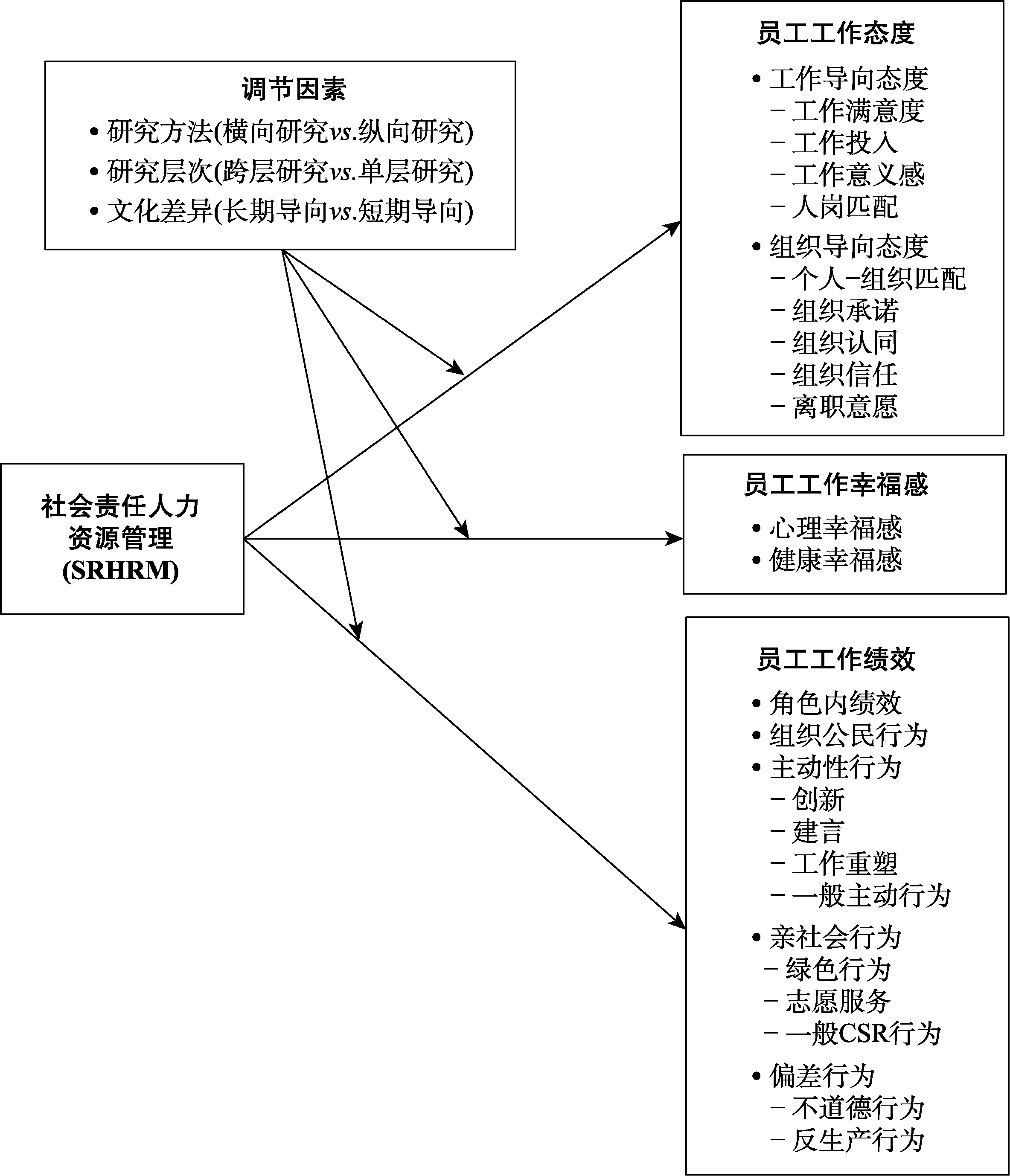
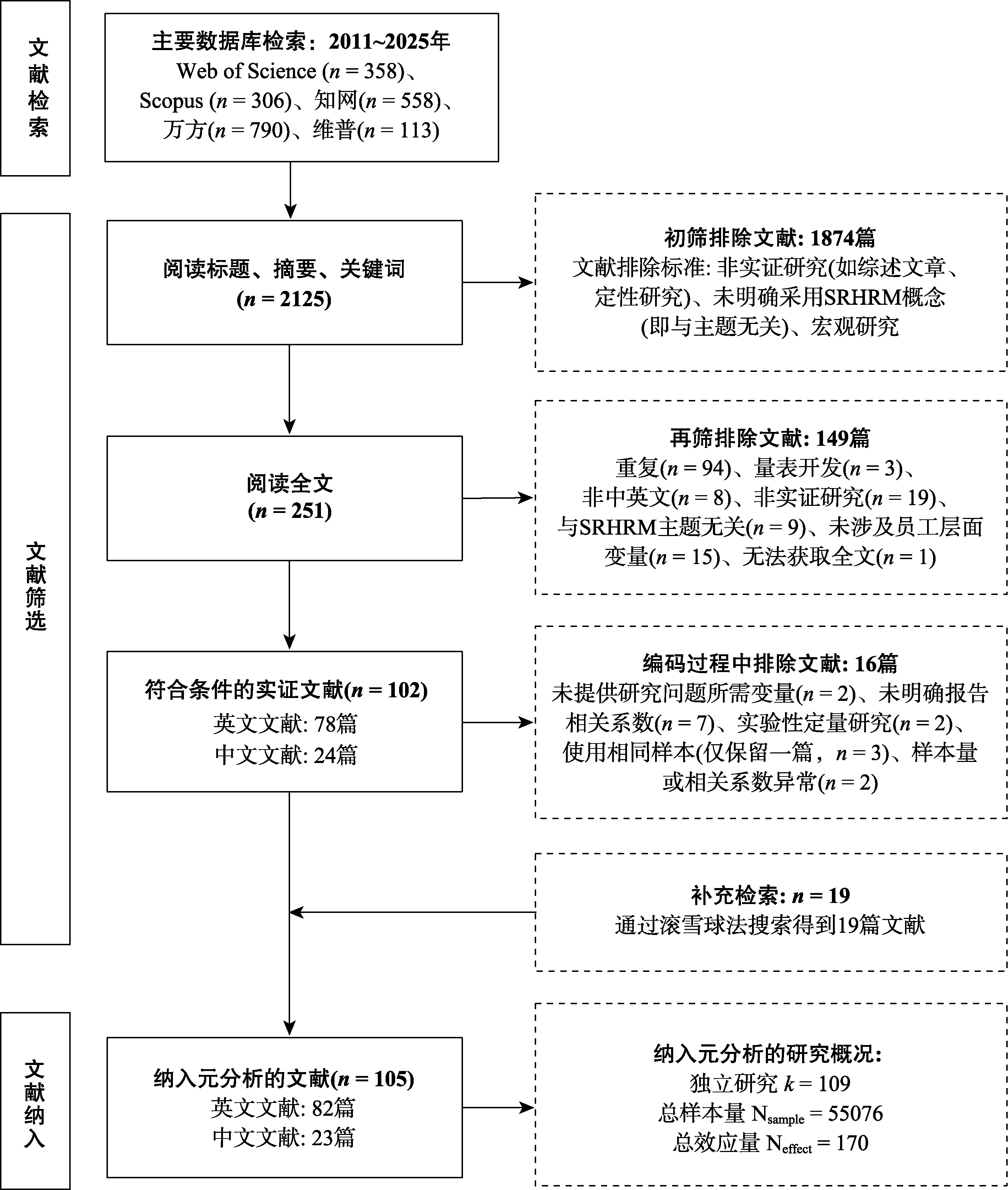
| 文献来源 | 研究方法 | 研究层次 | 国家范围 |
|---|---|---|---|
| 期刊论文 (k = 91) | 横向调查研究 (k = 52) | 跨层研究 (k = 17) | 中国 (k = 60) |
| 会议论文 (k = 3) | 纵向调查研究 (k = 55) | 单层研究 (k = 92) | 非中国 (k = 45) |
| 学位论文 (k = 14) | 未报告 (k = 2) | 未报告 (k = 4) | |
| 书籍章节 (k = 1) |
| 文献来源 | 研究方法 | 研究层次 | 国家范围 |
|---|---|---|---|
| 期刊论文 (k = 91) | 横向调查研究 (k = 52) | 跨层研究 (k = 17) | 中国 (k = 60) |
| 会议论文 (k = 3) | 纵向调查研究 (k = 55) | 单层研究 (k = 92) | 非中国 (k = 45) |
| 学位论文 (k = 14) | 未报告 (k = 2) | 未报告 (k = 4) | |
| 书籍章节 (k = 1) |
| 变量 | k | N | SDρ | 95% CI | 80%CV | Q | I2 | Nfs-0.05 | 5k + 10 | |||
|---|---|---|---|---|---|---|---|---|---|---|---|---|
| 工作态度层面结果 | ||||||||||||
| • 工作导向态度 | 18 | 7675 | 0.27 | 0.31 | 0.39 | [0.11, 0.50] | [-0.21, 0.83] | 975.07*** | 98.26 | 5811 | 100 | |
| 工作满意度 | 3 | 1376 | 0.35 | 0.41 | 0.07 | [0.20, 0.63] | [0.27, 0.55] | 6.60* | 69.71 | 210 | 25 | |
| 工作投入 | 9 | 3182 | 0.41 | 0.46 | 0.11 | [0.37, 0.55] | [0.31, 0.61] | 43.54*** | 81.63 | 1981 | 55 | |
| 工作意义感 | 3 | 1317 | 0.41 | 0.47 | 0.09 | [0.22, 0.73] | [0.30, 0.65] | 11.34** | 82.37 | 281 | 25 | |
| 人岗匹配 | 3 | 1800 | -0.14 | -0.21 | 0.64 | [-1.80, 1.39] | [-1.42, 1.00] | 407.29*** | 99.51 | 0 | 25 | |
| • 组织导向态度 | 36 | 15237 | 0.44 | 0.51 | 0.16 | [0.45, 0.56] | [0.29, 0.72] | 498.36*** | 92.98 | 47253 | 190 | |
| 个人-组织匹配 | 5 | 2287 | 0.39 | 0.46 | 0.15 | [0.27, 0.64] | [0.23, 0.68] | 36.06*** | 88.91 | 699 | 35 | |
| 组织承诺 | 7 | 2681 | 0.51 | 0.61 | 0.17 | [0.45, 0.76] | [0.37, 0.84] | 106.63*** | 94.37 | 2125 | 45 | |
| 组织认同 | 12 | 5401 | 0.43 | 0.49 | 0.13 | [0.40, 0.58] | [0.31, 0.67] | 108.82*** | 89.89 | 5019 | 70 | |
| 组织信任 | 8 | 3166 | 0.51 | 0.54 | 0.15 | [0.41, 0.66] | [0.33, 0.74] | 127.58*** | 94.51 | 3029 | 50 | |
| 离职意愿 | 5 | 1979 | -0.32 | -0.38 | 0.22 | [-0.66, -0.09] | [-0.72, -0.03] | 59.38*** | 93.26 | 467 | 35 | |
| 工作幸福感层面结果 | ||||||||||||
| • 心理幸福感 | 13 | 18325 | 0.50 | 0.55 | 0.07 | [0.51, 0.60] | [0.46, 0.65] | 133.01*** | 90.98 | 11009 | 75 | |
| • 健康幸福感 | 9 | 3361 | 0.05 | 0.05 | 0.36 | [-0.22, 0.33] | [-0.44, 0.55] | 285.09*** | 97.19 | 11 | 55 | |
| 变量 | k | N | SDρ | 95% CI | 80%CV | Q | I2 | Nfs-0.05 | 5k + 10 | |||
|---|---|---|---|---|---|---|---|---|---|---|---|---|
| 工作态度层面结果 | ||||||||||||
| • 工作导向态度 | 18 | 7675 | 0.27 | 0.31 | 0.39 | [0.11, 0.50] | [-0.21, 0.83] | 975.07*** | 98.26 | 5811 | 100 | |
| 工作满意度 | 3 | 1376 | 0.35 | 0.41 | 0.07 | [0.20, 0.63] | [0.27, 0.55] | 6.60* | 69.71 | 210 | 25 | |
| 工作投入 | 9 | 3182 | 0.41 | 0.46 | 0.11 | [0.37, 0.55] | [0.31, 0.61] | 43.54*** | 81.63 | 1981 | 55 | |
| 工作意义感 | 3 | 1317 | 0.41 | 0.47 | 0.09 | [0.22, 0.73] | [0.30, 0.65] | 11.34** | 82.37 | 281 | 25 | |
| 人岗匹配 | 3 | 1800 | -0.14 | -0.21 | 0.64 | [-1.80, 1.39] | [-1.42, 1.00] | 407.29*** | 99.51 | 0 | 25 | |
| • 组织导向态度 | 36 | 15237 | 0.44 | 0.51 | 0.16 | [0.45, 0.56] | [0.29, 0.72] | 498.36*** | 92.98 | 47253 | 190 | |
| 个人-组织匹配 | 5 | 2287 | 0.39 | 0.46 | 0.15 | [0.27, 0.64] | [0.23, 0.68] | 36.06*** | 88.91 | 699 | 35 | |
| 组织承诺 | 7 | 2681 | 0.51 | 0.61 | 0.17 | [0.45, 0.76] | [0.37, 0.84] | 106.63*** | 94.37 | 2125 | 45 | |
| 组织认同 | 12 | 5401 | 0.43 | 0.49 | 0.13 | [0.40, 0.58] | [0.31, 0.67] | 108.82*** | 89.89 | 5019 | 70 | |
| 组织信任 | 8 | 3166 | 0.51 | 0.54 | 0.15 | [0.41, 0.66] | [0.33, 0.74] | 127.58*** | 94.51 | 3029 | 50 | |
| 离职意愿 | 5 | 1979 | -0.32 | -0.38 | 0.22 | [-0.66, -0.09] | [-0.72, -0.03] | 59.38*** | 93.26 | 467 | 35 | |
| 工作幸福感层面结果 | ||||||||||||
| • 心理幸福感 | 13 | 18325 | 0.50 | 0.55 | 0.07 | [0.51, 0.60] | [0.46, 0.65] | 133.01*** | 90.98 | 11009 | 75 | |
| • 健康幸福感 | 9 | 3361 | 0.05 | 0.05 | 0.36 | [-0.22, 0.33] | [-0.44, 0.55] | 285.09*** | 97.19 | 11 | 55 | |
| 变量 | k | N | SDρ | 95% CI | 80% CV | Q | I2 | Nfs-0.05 | 5k + 10 | |||
|---|---|---|---|---|---|---|---|---|---|---|---|---|
| 工作绩效层面结果 | ||||||||||||
| • 角色内绩效 | 16 | 6944 | 0.38 | 0.42 | 0.25 | [0.29, 0.56] | [0.09, 0.76] | 470.44*** | 96.81 | 6729 | 90 | |
| • 组织公民行为 | 11 | 5475 | 0.47 | 0.54 | 0.15 | [0.44, 0.64] | [0.33, 0.74] | 147.77*** | 93.23 | 5474 | 65 | |
| • 主动性行为 | 19 | 7646 | 0.39 | 0.45 | 0.13 | [0.38, 0.52] | [0.28, 0.63] | 137.46*** | 86.91 | 9688 | 105 | |
| 创新 | 6 | 1927 | 0.46 | 0.52 | 0.05 | [0.45, 0.60] | [0.44, 0.60] | 8.13 | 38.50 | 1049 | 40 | |
| 建言 | 5 | 1651 | 0.48 | 0.57 | 0.13 | [0.40, 0.73] | [0.37, 0.76] | 21.27*** | 81.20 | 831 | 35 | |
| 工作重塑 | 3 | 2283 | 0.29 | 0.34 | 0.15 | [-0.04, 0.72] | [0.06, 0.62] | 23.87*** | 91.62 | 238 | 25 | |
| 一般主动行为 | 5 | 1785 | 0.36 | 0.40 | 0.10 | [0.26, 0.54] | [0.24, 0.56] | 17.51** | 77.16 | 463 | 35 | |
| • 亲社会行为 | 30 | 10403 | 0.41 | 0.46 | 0.19 | [0.38, 0.53] | [0.20, 0.71] | 440.77*** | 93.42 | 22339 | 160 | |
| 绿色行为 | 16 | 5401 | 0.46 | 0.51 | 0.20 | [0.40, 0.62] | [0.25, 0.78] | 265.90*** | 94.36 | 8294 | 90 | |
| 志愿服务 | 7 | 2359 | 0.29 | 0.33 | 0.19 | [0.14, 0.51] | [0.05, 0.61] | 52.69*** | 88.61 | 498 | 45 | |
| 一般CSR行为 | 7 | 2643 | 0.40 | 0.46 | 0.16 | [0.32, 0.61] | [0.24, 0.69] | 66.94*** | 91.04 | 1285 | 45 | |
| • 偏差行为 | 17 | 6332 | -0.23 | -0.26 | 0.19 | [-0.36, -0.16] | [-0.50, -0.01] | 186.90*** | 91.44 | 2155 | 95 | |
| 不道德行为 | 10 | 4201 | -0.28 | -0.32 | 0.17 | [-0.45, -0.19] | [-0.56, -0.08] | 107.54*** | 91.63 | 1387 | 60 | |
| 反生产行为 | 7 | 2131 | -0.13 | -0.14 | 0.16 | [-0.29, 0.02] | [-0.37, 0.09] | 45.49*** | 86.81 | 79 | 45 | |
| 变量 | k | N | SDρ | 95% CI | 80% CV | Q | I2 | Nfs-0.05 | 5k + 10 | |||
|---|---|---|---|---|---|---|---|---|---|---|---|---|
| 工作绩效层面结果 | ||||||||||||
| • 角色内绩效 | 16 | 6944 | 0.38 | 0.42 | 0.25 | [0.29, 0.56] | [0.09, 0.76] | 470.44*** | 96.81 | 6729 | 90 | |
| • 组织公民行为 | 11 | 5475 | 0.47 | 0.54 | 0.15 | [0.44, 0.64] | [0.33, 0.74] | 147.77*** | 93.23 | 5474 | 65 | |
| • 主动性行为 | 19 | 7646 | 0.39 | 0.45 | 0.13 | [0.38, 0.52] | [0.28, 0.63] | 137.46*** | 86.91 | 9688 | 105 | |
| 创新 | 6 | 1927 | 0.46 | 0.52 | 0.05 | [0.45, 0.60] | [0.44, 0.60] | 8.13 | 38.50 | 1049 | 40 | |
| 建言 | 5 | 1651 | 0.48 | 0.57 | 0.13 | [0.40, 0.73] | [0.37, 0.76] | 21.27*** | 81.20 | 831 | 35 | |
| 工作重塑 | 3 | 2283 | 0.29 | 0.34 | 0.15 | [-0.04, 0.72] | [0.06, 0.62] | 23.87*** | 91.62 | 238 | 25 | |
| 一般主动行为 | 5 | 1785 | 0.36 | 0.40 | 0.10 | [0.26, 0.54] | [0.24, 0.56] | 17.51** | 77.16 | 463 | 35 | |
| • 亲社会行为 | 30 | 10403 | 0.41 | 0.46 | 0.19 | [0.38, 0.53] | [0.20, 0.71] | 440.77*** | 93.42 | 22339 | 160 | |
| 绿色行为 | 16 | 5401 | 0.46 | 0.51 | 0.20 | [0.40, 0.62] | [0.25, 0.78] | 265.90*** | 94.36 | 8294 | 90 | |
| 志愿服务 | 7 | 2359 | 0.29 | 0.33 | 0.19 | [0.14, 0.51] | [0.05, 0.61] | 52.69*** | 88.61 | 498 | 45 | |
| 一般CSR行为 | 7 | 2643 | 0.40 | 0.46 | 0.16 | [0.32, 0.61] | [0.24, 0.69] | 66.94*** | 91.04 | 1285 | 45 | |
| • 偏差行为 | 17 | 6332 | -0.23 | -0.26 | 0.19 | [-0.36, -0.16] | [-0.50, -0.01] | 186.90*** | 91.44 | 2155 | 95 | |
| 不道德行为 | 10 | 4201 | -0.28 | -0.32 | 0.17 | [-0.45, -0.19] | [-0.56, -0.08] | 107.54*** | 91.63 | 1387 | 60 | |
| 反生产行为 | 7 | 2131 | -0.13 | -0.14 | 0.16 | [-0.29, 0.02] | [-0.37, 0.09] | 45.49*** | 86.81 | 79 | 45 | |
| 变量关系 | k | N | 95% CI | 逐一剔除( | Δ | 逐一剔除(95% CI) | 结论 | |
|---|---|---|---|---|---|---|---|---|
| SRHRM—工作导向态度 | 18 | 7675 | 0.31 | [0.11, 0.50] | 0.29~0.47 | 0.17 | 不包含0 | 一致 |
| SRHRM—组织导向态度 | 36 | 15237 | 0.51 | [0.45, 0.56] | 0.49~0.52 | 0.03 | 不包含0 | 一致 |
| SRHRM—心理幸福感 | 13 | 18325 | 0.55 | [0.51, 0.60] | 0.52~0.56 | 0.04 | 不包含0 | 一致 |
| SRHRM—健康幸福感 | 9 | 3361 | 0.05 | [-0.22, 0.33] | -0.03~0.12 | 0.15 | 包含0 | 一致 |
| SRHRM—角色内绩效 | 16 | 6944 | 0.42 | [0.29, 0.56] | 0.40~0.45 | 0.05 | 不包含0 | 一致 |
| SRHRM—组织公民行为 | 11 | 5475 | 0.54 | [0.44, 0.64] | 0.51~0.56 | 0.05 | 不包含0 | 一致 |
| SRHRM—主动性行为 | 19 | 7646 | 0.45 | [0.38, 0.52] | 0.44~0.48 | 0.04 | 不包含0 | 一致 |
| SRHRM—亲社会行为 | 30 | 10403 | 0.46 | [0.38, 0.53] | 0.44~0.47 | 0.03 | 不包含0 | 一致 |
| SRHRM—偏差行为 | 17 | 6332 | -0.26 | [-0.36, -0.16] | -0.28~-0.24 | 0.04 | 不包含0 | 一致 |
| 变量关系 | k | N | 95% CI | 逐一剔除( | Δ | 逐一剔除(95% CI) | 结论 | |
|---|---|---|---|---|---|---|---|---|
| SRHRM—工作导向态度 | 18 | 7675 | 0.31 | [0.11, 0.50] | 0.29~0.47 | 0.17 | 不包含0 | 一致 |
| SRHRM—组织导向态度 | 36 | 15237 | 0.51 | [0.45, 0.56] | 0.49~0.52 | 0.03 | 不包含0 | 一致 |
| SRHRM—心理幸福感 | 13 | 18325 | 0.55 | [0.51, 0.60] | 0.52~0.56 | 0.04 | 不包含0 | 一致 |
| SRHRM—健康幸福感 | 9 | 3361 | 0.05 | [-0.22, 0.33] | -0.03~0.12 | 0.15 | 包含0 | 一致 |
| SRHRM—角色内绩效 | 16 | 6944 | 0.42 | [0.29, 0.56] | 0.40~0.45 | 0.05 | 不包含0 | 一致 |
| SRHRM—组织公民行为 | 11 | 5475 | 0.54 | [0.44, 0.64] | 0.51~0.56 | 0.05 | 不包含0 | 一致 |
| SRHRM—主动性行为 | 19 | 7646 | 0.45 | [0.38, 0.52] | 0.44~0.48 | 0.04 | 不包含0 | 一致 |
| SRHRM—亲社会行为 | 30 | 10403 | 0.46 | [0.38, 0.53] | 0.44~0.47 | 0.03 | 不包含0 | 一致 |
| SRHRM—偏差行为 | 17 | 6332 | -0.26 | [-0.36, -0.16] | -0.28~-0.24 | 0.04 | 不包含0 | 一致 |
| 变量 | k | N | SDρ | 95% CI | 80% CV | z | |||
|---|---|---|---|---|---|---|---|---|---|
| 工作导向态度 | |||||||||
| 纵向研究 | 6 | 2759 | 0.41 | 0.48 | 0.06 | [0.40, 0.56] | [0.38, 0.57] | 2.08* | |
| 横向研究 | 12 | 4916 | 0.19 | 0.21 | 0.46 | [-0.09, 0.50] | [-0.43, 0.84] | ||
| 单层研究 | 15 | 4970 | 0.42 | 0.48 | 0.11 | [0.41, 0.54] | [0.33, 0.62] | 0.06 | |
| 跨层研究 | 3 | 2705 | 0.001 | -0.03 | 0.60 | [-1.52, 1.46] | [-1.16, 1.10] | ||
| 短期导向 | 9 | 3546 | 0.42 | 0.48 | 0.06 | [0.42, 0.53] | [0.39, 0.56] | 2.07* | |
| 长期导向 | 8 | 3840 | 0.12 | 0.13 | 0.51 | [-0.30, 0.56] | [-0.59, 0.85] | ||
| 组织导向态度 | |||||||||
| 纵向研究 | 10 | 3180 | 0.43 | 0.49 | 0.16 | [0.37, 0.61] | [0.27, 0.72] | -0.31 | |
| 横向研究 | 25 | 11637 | 0.45 | 0.51 | 0.17 | [0.44, 0.58] | [0.29, 0.73] | ||
| 单层研究 | 29 | 10837 | 0.46 | 0.52 | 0.17 | [0.45, 0.59] | [0.30, 0.75] | 1.04 | |
| 跨层研究 | 7 | 4400 | 0.41 | 0.46 | 0.13 | [0.34, 0.58] | [0.27, 0.65] | ||
| 短期导向 | 14 | 5101 | 0.48 | 0.54 | 0.14 | [0.45, 0.62] | [0.35, 0.73] | 0.82 | |
| 长期导向 | 21 | 9874 | 0.42 | 0.49 | 0.17 | [0.41, 0.57] | [0.27, 0.72] | ||
| 变量 | k | N | SDρ | 95% CI | 80% CV | z | |||
|---|---|---|---|---|---|---|---|---|---|
| 工作导向态度 | |||||||||
| 纵向研究 | 6 | 2759 | 0.41 | 0.48 | 0.06 | [0.40, 0.56] | [0.38, 0.57] | 2.08* | |
| 横向研究 | 12 | 4916 | 0.19 | 0.21 | 0.46 | [-0.09, 0.50] | [-0.43, 0.84] | ||
| 单层研究 | 15 | 4970 | 0.42 | 0.48 | 0.11 | [0.41, 0.54] | [0.33, 0.62] | 0.06 | |
| 跨层研究 | 3 | 2705 | 0.001 | -0.03 | 0.60 | [-1.52, 1.46] | [-1.16, 1.10] | ||
| 短期导向 | 9 | 3546 | 0.42 | 0.48 | 0.06 | [0.42, 0.53] | [0.39, 0.56] | 2.07* | |
| 长期导向 | 8 | 3840 | 0.12 | 0.13 | 0.51 | [-0.30, 0.56] | [-0.59, 0.85] | ||
| 组织导向态度 | |||||||||
| 纵向研究 | 10 | 3180 | 0.43 | 0.49 | 0.16 | [0.37, 0.61] | [0.27, 0.72] | -0.31 | |
| 横向研究 | 25 | 11637 | 0.45 | 0.51 | 0.17 | [0.44, 0.58] | [0.29, 0.73] | ||
| 单层研究 | 29 | 10837 | 0.46 | 0.52 | 0.17 | [0.45, 0.59] | [0.30, 0.75] | 1.04 | |
| 跨层研究 | 7 | 4400 | 0.41 | 0.46 | 0.13 | [0.34, 0.58] | [0.27, 0.65] | ||
| 短期导向 | 14 | 5101 | 0.48 | 0.54 | 0.14 | [0.45, 0.62] | [0.35, 0.73] | 0.82 | |
| 长期导向 | 21 | 9874 | 0.42 | 0.49 | 0.17 | [0.41, 0.57] | [0.27, 0.72] | ||
| 变量 | k | N | SDρ | 95% CI | 80% CV | z | |||
|---|---|---|---|---|---|---|---|---|---|
| 心理幸福感 | |||||||||
| 纵向研究 | 9 | 2850 | 0.42 | 0.50 | 0.10 | [0.41, 0.59] | [0.35, 0.65] | -1.28 | |
| 横向研究 | 4 | 15475 | 0.51 | 0.56 | 0.06 | [0.46, 0.66] | [0.46, 0.66] | ||
| 单层研究† | 12 | 17851 | 0.50 | 0.56 | 0.06 | [0.52, 0.60] | [0.47, 0.64] | / | |
| 短期导向 | 4 | 1204 | 0.48 | 0.58 | 0.17 | [0.30, 0.86] | [0.30, 0.86] | 1.29 | |
| 长期导向 | 7 | 2304 | 0.39 | 0.45 | 0.12 | [0.33, 0.57] | [0.27, 0.62] | ||
| 健康幸福感 | |||||||||
| 纵向研究 | 7 | 2649 | 0.09 | 0.10 | 0.39 | [-0.26, 0.47] | [-0.46, 0.66] | 1.20 | |
| 横向研究 | 2 | 712 | -0.10 | -0.10 | 0.14 | [-1.45, 1.25] | [-0.53, 0.33] | ||
| 单层研究 | 7 | 1972 | -0.10 | -0.15 | 0.35 | [-0.48, 0.18] | [-0.65, 0.35] | -2.46* | |
| 跨层研究 | 2 | 1389 | 0.26 | 0.32 | 0.00 | [0.13, 0.52] | [0.32, 0.32] | ||
| 短期导向 | 3 | 1749 | 0.12 | 0.12 | 0.42 | [-0.92, 1.17] | [-0.67, 0.91] | 0.46 | |
| 长期导向 | 6 | 1612 | -0.03 | -0.07 | 0.34 | [-0.44, 0.30] | [-0.58, 0.44] | ||
| 变量 | k | N | SDρ | 95% CI | 80% CV | z | |||
|---|---|---|---|---|---|---|---|---|---|
| 心理幸福感 | |||||||||
| 纵向研究 | 9 | 2850 | 0.42 | 0.50 | 0.10 | [0.41, 0.59] | [0.35, 0.65] | -1.28 | |
| 横向研究 | 4 | 15475 | 0.51 | 0.56 | 0.06 | [0.46, 0.66] | [0.46, 0.66] | ||
| 单层研究† | 12 | 17851 | 0.50 | 0.56 | 0.06 | [0.52, 0.60] | [0.47, 0.64] | / | |
| 短期导向 | 4 | 1204 | 0.48 | 0.58 | 0.17 | [0.30, 0.86] | [0.30, 0.86] | 1.29 | |
| 长期导向 | 7 | 2304 | 0.39 | 0.45 | 0.12 | [0.33, 0.57] | [0.27, 0.62] | ||
| 健康幸福感 | |||||||||
| 纵向研究 | 7 | 2649 | 0.09 | 0.10 | 0.39 | [-0.26, 0.47] | [-0.46, 0.66] | 1.20 | |
| 横向研究 | 2 | 712 | -0.10 | -0.10 | 0.14 | [-1.45, 1.25] | [-0.53, 0.33] | ||
| 单层研究 | 7 | 1972 | -0.10 | -0.15 | 0.35 | [-0.48, 0.18] | [-0.65, 0.35] | -2.46* | |
| 跨层研究 | 2 | 1389 | 0.26 | 0.32 | 0.00 | [0.13, 0.52] | [0.32, 0.32] | ||
| 短期导向 | 3 | 1749 | 0.12 | 0.12 | 0.42 | [-0.92, 1.17] | [-0.67, 0.91] | 0.46 | |
| 长期导向 | 6 | 1612 | -0.03 | -0.07 | 0.34 | [-0.44, 0.30] | [-0.58, 0.44] | ||
| 变量 | k | N | SDρ | 95% CI | 80% CV | z | |||
|---|---|---|---|---|---|---|---|---|---|
| 角色内绩效 | |||||||||
| 纵向研究 | 6 | 2500 | 0.38 | 0.46 | 0.26 | [0.19, 0.74] | [0.08, 0.84] | 0.39 | |
| 横向研究 | 9 | 4060 | 0.38 | 0.41 | 0.27 | [0.20, 0.61] | [0.03, 0.78] | ||
| 单层研究 | 11 | 3629 | 0.41 | 0.45 | 0.32 | [0.23, 0.66] | [0.01, 0.88] | 0.31 | |
| 跨层研究 | 5 | 3315 | 0.35 | 0.41 | 0.17 | [0.20, 0.62] | [0.15, 0.66] | ||
| 短期导向 | 7 | 2578 | 0.53 | 0.59 | 0.15 | [0.44, 0.73] | [0.37, 0.80] | 2.28* | |
| 长期导向 | 9 | 4366 | 0.29 | 0.34 | 0.25 | [0.14, 0.53] | [-0.01, 0.69] | ||
| 组织公民行为 | |||||||||
| 横向研究† | 9 | 4830 | 0.49 | 0.57 | 0.14 | [0.46, 0.68] | [0.38, 0.76] | / | |
| 单层研究 | 9 | 3536 | 0.45 | 0.52 | 0.18 | [0.38, 0.66] | [0.27, 0.77] | -0.57 | |
| 跨层研究 | 2 | 1939 | 0.50 | 0.56 | 0.06 | [-0.01, 1.12] | [0.38, 0.73] | ||
| 短期导向 | 3 | 1098 | 0.51 | 0.63 | 0.26 | [-0.03, 1.29] | [0.13, 1.12] | 0.63 | |
| 长期导向 | 8 | 4377 | 0.46 | 0.52 | 0.11 | [0.42, 0.62] | [0.36, 0.69] | ||
| 主动性行为 | |||||||||
| 纵向研究 | 12 | 5363 | 0.39 | 0.46 | 0.14 | [0.36, 0.55] | [0.26, 0.65] | 0.52 | |
| 横向研究 | 7 | 2283 | 0.38 | 0.42 | 0.10 | [0.32, 0.53] | [0.28, 0.57] | ||
| 单层研究 | 13 | 4352 | 0.45 | 0.52 | 0.09 | [0.45, 0.58] | [0.39, 0.64] | 2.44* | |
| 跨层研究 | 6 | 3294 | 0.31 | 0.37 | 0.15 | [0.21, 0.52] | [0.15, 0.58] | ||
| 短期导向 | 5 | 2979 | 0.34 | 0.39 | 0.15 | [0.20, 0.58] | [0.16, 0.62] | -1.28 | |
| 长期导向 | 13 | 4378 | 0.43 | 0.49 | 0.11 | [0.42, 0.56] | [0.34, 0.64] | ||
| 亲社会行为 | |||||||||
| 纵向研究 | 18 | 6371 | 0.40 | 0.45 | 0.22 | [0.34, 0.57] | [0.16, 0.75] | -0.28 | |
| 横向研究 | 11 | 3648 | 0.43 | 0.47 | 0.17 | [0.36, 0.59] | [0.24, 0.70] | ||
| 单层研究 | 26 | 8728 | 0.43 | 0.47 | 0.20 | [0.39, 0.56] | [0.22, 0.73] | 0.99 | |
| 跨层研究 | 4 | 1675 | 0.31 | 0.38 | 0.18 | [0.08, 0.68] | [0.08, 0.68] | ||
| 短期导向 | 9 | 3014 | 0.53 | 0.59 | 0.16 | [0.46, 0.72] | [0.36, 0.82] | 2.76** | |
| 长期导向 | 21 | 7389 | 0.36 | 0.41 | 0.18 | [0.32, 0.49] | [0.16, 0.65] | ||
| 偏差行为 | |||||||||
| 纵向研究 | 11 | 3487 | -0.30 | -0.34 | 0.17 | [-0.46, -0.22] | [-0.57, -0.11] | -1.81 | |
| 横向研究 | 5 | 2425 | -0.16 | -0.17 | 0.16 | [-0.39, 0.04] | [-0.43, 0.08] | ||
| 单层研究 | 14 | 4138 | -0.21 | -0.24 | 0.21 | [-0.36, -0.11] | [-0.52, 0.05] | 0.57 | |
| 跨层研究 | 3 | 2194 | -0.26 | -0.29 | 0.13 | [-0.64, 0.05] | [-0.55, -0.04] | ||
| 短期导向 | 5 | 2007 | -0.27 | -0.29 | 0.20 | [-0.55, -0.03] | [-0.61, 0.02] | -0.29 | |
| 长期导向 | 11 | 4063 | -0.23 | -0.27 | 0.16 | [-0.38, -0.15] | [-0.49, -0.04] | ||
| 变量 | k | N | SDρ | 95% CI | 80% CV | z | |||
|---|---|---|---|---|---|---|---|---|---|
| 角色内绩效 | |||||||||
| 纵向研究 | 6 | 2500 | 0.38 | 0.46 | 0.26 | [0.19, 0.74] | [0.08, 0.84] | 0.39 | |
| 横向研究 | 9 | 4060 | 0.38 | 0.41 | 0.27 | [0.20, 0.61] | [0.03, 0.78] | ||
| 单层研究 | 11 | 3629 | 0.41 | 0.45 | 0.32 | [0.23, 0.66] | [0.01, 0.88] | 0.31 | |
| 跨层研究 | 5 | 3315 | 0.35 | 0.41 | 0.17 | [0.20, 0.62] | [0.15, 0.66] | ||
| 短期导向 | 7 | 2578 | 0.53 | 0.59 | 0.15 | [0.44, 0.73] | [0.37, 0.80] | 2.28* | |
| 长期导向 | 9 | 4366 | 0.29 | 0.34 | 0.25 | [0.14, 0.53] | [-0.01, 0.69] | ||
| 组织公民行为 | |||||||||
| 横向研究† | 9 | 4830 | 0.49 | 0.57 | 0.14 | [0.46, 0.68] | [0.38, 0.76] | / | |
| 单层研究 | 9 | 3536 | 0.45 | 0.52 | 0.18 | [0.38, 0.66] | [0.27, 0.77] | -0.57 | |
| 跨层研究 | 2 | 1939 | 0.50 | 0.56 | 0.06 | [-0.01, 1.12] | [0.38, 0.73] | ||
| 短期导向 | 3 | 1098 | 0.51 | 0.63 | 0.26 | [-0.03, 1.29] | [0.13, 1.12] | 0.63 | |
| 长期导向 | 8 | 4377 | 0.46 | 0.52 | 0.11 | [0.42, 0.62] | [0.36, 0.69] | ||
| 主动性行为 | |||||||||
| 纵向研究 | 12 | 5363 | 0.39 | 0.46 | 0.14 | [0.36, 0.55] | [0.26, 0.65] | 0.52 | |
| 横向研究 | 7 | 2283 | 0.38 | 0.42 | 0.10 | [0.32, 0.53] | [0.28, 0.57] | ||
| 单层研究 | 13 | 4352 | 0.45 | 0.52 | 0.09 | [0.45, 0.58] | [0.39, 0.64] | 2.44* | |
| 跨层研究 | 6 | 3294 | 0.31 | 0.37 | 0.15 | [0.21, 0.52] | [0.15, 0.58] | ||
| 短期导向 | 5 | 2979 | 0.34 | 0.39 | 0.15 | [0.20, 0.58] | [0.16, 0.62] | -1.28 | |
| 长期导向 | 13 | 4378 | 0.43 | 0.49 | 0.11 | [0.42, 0.56] | [0.34, 0.64] | ||
| 亲社会行为 | |||||||||
| 纵向研究 | 18 | 6371 | 0.40 | 0.45 | 0.22 | [0.34, 0.57] | [0.16, 0.75] | -0.28 | |
| 横向研究 | 11 | 3648 | 0.43 | 0.47 | 0.17 | [0.36, 0.59] | [0.24, 0.70] | ||
| 单层研究 | 26 | 8728 | 0.43 | 0.47 | 0.20 | [0.39, 0.56] | [0.22, 0.73] | 0.99 | |
| 跨层研究 | 4 | 1675 | 0.31 | 0.38 | 0.18 | [0.08, 0.68] | [0.08, 0.68] | ||
| 短期导向 | 9 | 3014 | 0.53 | 0.59 | 0.16 | [0.46, 0.72] | [0.36, 0.82] | 2.76** | |
| 长期导向 | 21 | 7389 | 0.36 | 0.41 | 0.18 | [0.32, 0.49] | [0.16, 0.65] | ||
| 偏差行为 | |||||||||
| 纵向研究 | 11 | 3487 | -0.30 | -0.34 | 0.17 | [-0.46, -0.22] | [-0.57, -0.11] | -1.81 | |
| 横向研究 | 5 | 2425 | -0.16 | -0.17 | 0.16 | [-0.39, 0.04] | [-0.43, 0.08] | ||
| 单层研究 | 14 | 4138 | -0.21 | -0.24 | 0.21 | [-0.36, -0.11] | [-0.52, 0.05] | 0.57 | |
| 跨层研究 | 3 | 2194 | -0.26 | -0.29 | 0.13 | [-0.64, 0.05] | [-0.55, -0.04] | ||
| 短期导向 | 5 | 2007 | -0.27 | -0.29 | 0.20 | [-0.55, -0.03] | [-0.61, 0.02] | -0.29 | |
| 长期导向 | 11 | 4063 | -0.23 | -0.27 | 0.16 | [-0.38, -0.15] | [-0.49, -0.04] | ||
| 变量 | 1 | 2 | 3 | 4 | 5 |
|---|---|---|---|---|---|
| 1. SRHRM | |||||
| 2. 社会交换质量 | 0.58 | ||||
| (k, N) | (17, 7146) | ||||
| 3. 组织认同 | 0.48 | 0.41 | |||
| (k, N) | (10, 4710) | (3, 1594) | |||
| 4. 角色内绩效 | 0.44 | 0.52 | 0.54 | ||
| (k, N) | (16, 6944) | (3, 1419) | (5, 3030) | ||
| 5. 组织公民行为 | 0.54 | 0.49 | 0.69 | 0.48 | |
| (k, N) | (11, 5475) | (4, 1855) | (3, 1594) | (3, 2273) | |
| 6. 主动性行为 | 0.46 | 0.52 | 0.44a | 0.29b | 0.57b |
| (k, N) | (19, 7646) | (2, 772) | (11, 3453) | (16, 10565) | (27, 5186) |
| 变量 | 1 | 2 | 3 | 4 | 5 |
|---|---|---|---|---|---|
| 1. SRHRM | |||||
| 2. 社会交换质量 | 0.58 | ||||
| (k, N) | (17, 7146) | ||||
| 3. 组织认同 | 0.48 | 0.41 | |||
| (k, N) | (10, 4710) | (3, 1594) | |||
| 4. 角色内绩效 | 0.44 | 0.52 | 0.54 | ||
| (k, N) | (16, 6944) | (3, 1419) | (5, 3030) | ||
| 5. 组织公民行为 | 0.54 | 0.49 | 0.69 | 0.48 | |
| (k, N) | (11, 5475) | (4, 1855) | (3, 1594) | (3, 2273) | |
| 6. 主动性行为 | 0.46 | 0.52 | 0.44a | 0.29b | 0.57b |
| (k, N) | (19, 7646) | (2, 772) | (11, 3453) | (16, 10565) | (27, 5186) |
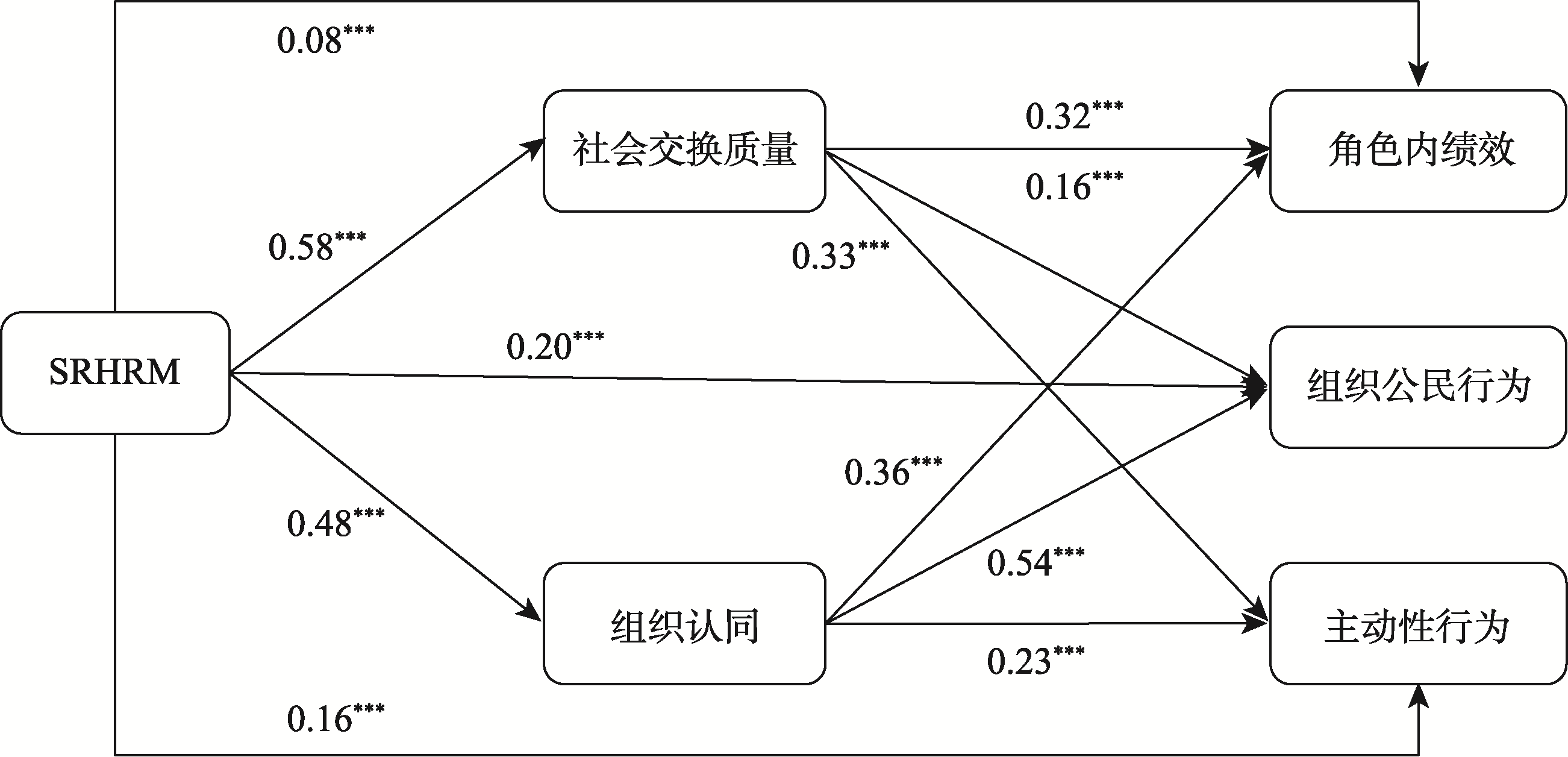
| 自变量 | 中介变量 | 因变量 | 间接效应 | 标准误 | 95% CI |
|---|---|---|---|---|---|
| SRHRM | 社会交换质量 | 角色内绩效 | 0.19*** | 0.01 | [0.16, 0.21] |
| 组织公民行为 | 0.09*** | 0.01 | [0.07, 0.11] | ||
| 主动性行为 | 0.19*** | 0.01 | [0.17, 0.22] | ||
| SRHRM | 组织认同 | 角色内绩效 | 0.17*** | 0.01 | [0.15, 0.20] |
| 组织公民行为 | 0.25*** | 0.01 | [0.23, 0.28] | ||
| 主动性行为 | 0.11*** | 0.01 | [0.09, 0.13] | ||
| 角色内绩效路径的间接效应差异 | 0.01 | 0.02 | [-0.02, 0.05] | ||
| 组织公民行为路径的间接效应差异 | -0.17*** | 0.02 | [-0.20, -0.13] | ||
| 主动性行为路径的间接效应差异 | 0.09*** | 0.02 | [0.05, 0.12] | ||
| 自变量 | 中介变量 | 因变量 | 间接效应 | 标准误 | 95% CI |
|---|---|---|---|---|---|
| SRHRM | 社会交换质量 | 角色内绩效 | 0.19*** | 0.01 | [0.16, 0.21] |
| 组织公民行为 | 0.09*** | 0.01 | [0.07, 0.11] | ||
| 主动性行为 | 0.19*** | 0.01 | [0.17, 0.22] | ||
| SRHRM | 组织认同 | 角色内绩效 | 0.17*** | 0.01 | [0.15, 0.20] |
| 组织公民行为 | 0.25*** | 0.01 | [0.23, 0.28] | ||
| 主动性行为 | 0.11*** | 0.01 | [0.09, 0.13] | ||
| 角色内绩效路径的间接效应差异 | 0.01 | 0.02 | [-0.02, 0.05] | ||
| 组织公民行为路径的间接效应差异 | -0.17*** | 0.02 | [-0.20, -0.13] | ||
| 主动性行为路径的间接效应差异 | 0.09*** | 0.02 | [0.05, 0.12] | ||
| *标识纳入元分析的文献 | |
| [1] | * 蔡元. (2020). 社会责任型人力资源管理对员工亲组织非伦理行为的影响研究 [硕士学位论文]. 南京财经大学. |
| [2] | * 陈晓暾, 袁生娜. (2020). 社会责任型人力资源管理对员工前瞻行为的影响: 一个跨层次被调节的中介模型. 领导科学, (16), 86-90. |
| [3] | * 程垦, 林英晖. (2019). 组织认同一定会促进亲组织非伦理行为吗? 社会责任型人力资源管理的作用. 心理科学, 42(3), 688-694. |
| [4] | * 洪欣慧. (2021). 社会责任型人力资源管理对员工绩效的影响研究 [硕士学位论文]. 北方工业大学. |
| [5] | 吉尔特·霍夫斯泰德, 格特·扬·霍夫斯泰德, 迈克尔·明科夫. (2019). 文化与组织:心理软件的力量 (第三版; 张炜, 王烁, 译). 电子工业出版社. |
| [6] |
蒋建武, 龙晗寰, 胡洁宇. (2024). 工作场所人工智能应用对员工影响的元分析. 心理科学进展, 32(10), 1621-1639.
doi: 10.3724/SP.J.1042.2024.01621 |
| [7] | * 李雅馨. (2021). 社会责任型人力资源管理对员工双元绩效影响研究——被调节的中介效应 [硕士学位论文]. 甘肃政法大学. |
| [8] |
林新奇, 栾宇翔, 赵锴, 赵国龙. (2022). 领导风格与员工创新绩效关系的元分析: 基于自我决定视角. 心理科学进展, 30(4), 781-801.
doi: 10.3724/SP.J.1042.2022.00781 |
| [9] | * 刘金行. (2023). 社会责任型人力资源管理对亲组织非伦理行为的影响 [硕士学位论文]. 青岛大学. |
| [10] | * 刘琳. (2022). 社会责任型人力资源管理对员工越轨创新行为的影响研究 [硕士学位论文]. 三峡大学. |
| [11] | * 刘玥. (2019). 道德型领导对员工亲组织非伦理行为的作用机制研究 [硕士学位论文]. 湖北工业大学. |
| [12] |
* 罗元大, 曹元坤, 戴枫有, 张青. (2026). 容错一定对创新有利吗?组织容错感对员工责任式创新的作用机理. 科技进步与对策, 43(2), 130-140.
doi: 10.6049/kjjbydc.2024020446 |
| [13] | 马鸿佳, 肖彬, 王春蕾. (2023). 大数据能力影响因素及效用: 基于元分析的研究. 南开管理评论, 26(2), 143-153+165. |
| [14] | 马鸿佳, 王春蕾. (2025). 数字化能力总是有益的吗? 数字化能力与企业绩效关系的元分析. 南开管理评论, 28(6), 4-15. |
| [15] | * 冉梦丽. (2021). 社会责任导向人力资源管理对员工组织公民行为的影响研究 [硕士学位论文]. 北方工业大学. |
| [16] | * 尚嘉悦. (2024). 社会责任型人力资源管理对员工组织公民行为的影响机制研究 [硕士学位论文]. 南京理工大学. |
| [17] | * 邵丹萍. (2019). 社会责任型人力资源管理对绩效影响研究 [博士学位论文]. 华中科技大学. |
| [18] |
苏涛, 曾浩文, 钟晓琳, 马文聪, 陈修德. (2024). 祸福相依: 自恋型领导对下属效能双面效应的元分析. 心理科学进展, 32(9), 1463-1487.
doi: 10.3724/SP.J.1042.2024.01463 |
| [19] | * 田虹, 姜春源. (2020). 社会责任型人力资源管理对员工创新行为影响的研究——基于劳动关系视角下的链式中介作用. 广东财经大学学报, 35(6), 42-50. |
| [20] | * 田虹, 姜春源. (2021). 社会责任型人力资源管理对旅游企业员工亲环境行为的影响研究. 旅游学刊, 36(11), 133-144. |
| [21] | 田虹, 刘雨湉. (2026). 数字化转型的合法性困境: 企业社会责任“象征承诺”与“实质履行”的代理冲突. 研究与发展管理, 38(1), 52-63. |
| [22] | * 涂乙冬, 范亚军, 梅茂娇, 贺伟, 王烁砾. (2025). 社会责任型人力资源管理如何影响员工亲社会行为. 管理学报, 22(2), 261-273. |
| [23] |
王佳燕, 蓝媛美, 李超平. (2022). 二元工作压力与员工创新关系的元分析. 心理科学进展, 30(4), 761-780.
doi: 10.3724/SP.J.1042.2022.00761 |
| [24] | * 王娟, 张喆, 贾明. (2019). 基于社会责任的人力资源管理实践与反生产行为: 一个被调节的中介模型. 管理工程学报, 33(4), 19-27. |
| [25] | 卫旭华. (2021). 组织与管理研究中的元分析方法. 科学出版社. |
| [26] | 翁若宇, 宁博, 陈秋平. (2025). 企业“表里不一”与创新折损: 内外部社会责任差异的视角. 外国经济与管理, 47(1), 121-136. |
| [27] | * 熊阳钰. (2024). 企业社会责任型人力资源管理对员工自愿环保行为的影响研究. [硕士学位论文]. 南京财经大学. |
| [28] | * 闫明玉. (2024). 社会责任型人力资源管理对员工知识隐藏行为的影响研究. [硕士学位论文]. 山东大学. |
| [29] | * 袁生娜. (2022). 社会责任型人力资源管理对员工建设性越轨行为的影响研究. [硕士学位论文]. 陕西科技大学. |
| [30] |
袁悦, 吴志明, 谢秋实. (2024). 时间压力对个体工作结果的作用效果: 基于元分析的证据. 心理科学进展, 32(3), 465-485.
doi: 10.3724/SP.J.1042.2024.00465 |
| [31] | * 张桂平, 刘玥. (2019). 社会责任型人力资源管理对员工主动服务行为的影响机制研究. 中国人力资源开发, 36(5), 6-21. |
| [32] | 张佳蕾, 赵曙明. (2024). 高绩效工作系统对员工创新行为的跨层次影响研究: 包容型领导的作用. 科学学与科学技术管理, 45(7), 167-182. |
| [33] |
张静, 孟煜, 张蒙, 陈慧雅. (2025). 员工正念对工作绩效的作用效果及机制: 基于元分析的证据. 心理科学进展, 33(4), 647-672.
doi: 10.3724/SP.J.1042.2025.0647 |
| [34] | 张军伟, 龙立荣. (2017). 不同层次高绩效工作系统的差距效应: 一个被调节的中介模型. 南开管理评论, 20(2), 180-190. |
| [35] |
张兴贵, 胡献丹, 苏涛. (2023). 高绩效工作系统会降低员工幸福感吗? 来自元分析的证据. 心理科学进展, 31(11), 2005-2024.
doi: 10.3724/SP.J.1042.2023.02005 |
| [36] | * 赵红丹, 陈元华. (2022). 社会责任型人力资源管理如何降低员工亲组织非伦理行为: 道德效力和伦理型领导的作用. 管理工程学报, 36(6), 57-67. |
| [37] | * 赵红丹, 陈元华, 郑伟波. (2019). 社会责任导向的人力资源管理感知与员工建言行为: 基于社会交换理论. 中国人力资源开发, 36(9), 91-104. |
| [38] | * 赵莉, 刘平青, 刘园园, 许爽. (2022). 社会责任导向人力资源管理对员工主动行为影响的跨层次研究. 管理现代化, 42(6), 77-84. |
| [39] | 朱斌. (2015). 自私的慈善家——家族涉入与企业社会责任行为. 社会学研究, 30(2), 74-97+243. |
| [40] |
* Abbas, M., Ali, S., Hayat, Q., Saif, N., & Hussain, M. M. (2024). Socially responsible human resource management and employees’ entrepreneurial behaviour: Social exchange perspective. International Journal of Entrepreneurial Venturing, 16(3), 317-336.
doi: 10.1504/IJEV.2024.142396 URL |
| [41] |
* Abdelmotaleb, M., & Saha, S. K. (2020). Socially responsible human resources management, perceived organizational morality, and employee well-being. Public Organization Review, 20(2), 385-399.
doi: 10.1007/s11115-019-00447-3 |
| [42] | * Abouraia, M. K., Galal, H. M., & Al Morsy, R. M. (2024). The relationship between socially responsible HRM and environmental citizenship behaviors for industrial companies in Egypt:The mediating role of moral reflectiveness. In M.Shelley, & O. T.Ozturk (Eds.), Proceedings of international conference on research in education and science (pp. 2481-2514). ISTES. |
| [43] |
Afshin, O., & Cinzia, D. Z. (2022). Socially responsible human resource management: A systematic literature review and research agenda. Sustainability, 14(4), 2116.
doi: 10.3390/su14042116 URL |
| [44] | * Aftab, U. M., Akter, R., Al-Amin, M., Rahman, M. S., & Ferdausy, S. (2020). How do socially responsible human resource management and voluntary green behavior influence organizational competitiveness? Studies in Business and Economics, 15(2), 243-255. |
| [45] |
Aggarwal, P., & Singh, R. K. (2022). Synthesizing the affinity between employees' internal-external CSR perceptions and work outcomes: A meta-analytic investigation. Business Ethics, the Environment & Responsibility, 31(4), 1053-1101.
doi: 10.1111/beer.v31.4 URL |
| [46] |
* Al Mamun, A., Uddin, M. A., Rana, T., Biswas, S. R., & Dey, M. (2024). Socially responsible human resource management for sustainable performance in a moderated mediation mechanism. Sustainable Futures, 8, 100362.
doi: 10.1016/j.sftr.2024.100362 URL |
| [47] |
* Altuniji, A. S., Bani-Melhem, S., Mohd-Shamsudin, F., & Usman, M. (2025). Shaping a socially responsible workforce through srhrm practices: Investigating the mediating role of work meaningfulness and the moderating effect of servant leadership. Corporate Social Responsibility and Environmental Management, 32(3), 3891-3904.
doi: 10.1002/csr.v32.3 URL |
| [48] | * Alturaysi, M. A. (2025). Socially responsible human resource practices and extra role socially responsible behavior: A mechanism of pro-social motivation and Islamic work ethics. Management & Sustainability: An Arab Review. https://doi.org/10.1108/MSAR-07-2024-0065 |
| [49] |
Barrena-Martinez, J., López-Fernández, M., & Romero-Fernández, P. M. (2019). The link between socially responsible human resource management and intellectual capital. Corporate Social Responsibility and Environmental Management, 26(1), 71-81.
doi: 10.1002/csr.1658 |
| [50] |
Bolino, M. C., & Grant, A. M. (2016). The bright side of being prosocial at work, and the dark side, too: A review and agenda for research on other-oriented motives, behavior, and impact in organizations. The Academy of Management Annals, 10(1), 599-670.
doi: 10.5465/19416520.2016.1153260 URL |
| [51] |
Borman, W. C., & Motowidlo, S. J. (1997). Task performance and contextual performance: The meaning for personnel selection research. Human Performance, 10(2), 99-109.
doi: 10.1207/s15327043hup1002_3 URL |
| [52] |
Chiaburu, D. S., Oh, I. -S., Berry, C. M., Li, N., & Gardner, R. G. (2011). The five-factor model of personality traits and organizational citizenship behaviors: A meta-analysis. Journal of Applied Psychology, 96(6), 1140-1166.
doi: 10.1037/a0024004 pmid: 21688883 |
| [53] |
Chiaburu, D. S., Smith, T. A., Wang, J. X., & Zimmerman, R. D. (2014). Relative importance of leader influences for subordinates’ proactive behaviors, prosocial behaviors, and task performance. Journal of Personnel Psychology, 13(2), 70-86.
doi: 10.1027/1866-5888/a000105 URL |
| [54] |
Choi, J. J., Kim, J., & Shenkar, O. (2022). Temporal orientation and corporate social responsibility: Global evidence. Journal of Management Studies, 60(1), 82-119.
doi: 10.1111/joms.v60.1 URL |
| [55] |
Colquitt, J. A., Scott, B. A., Rodell, J. B., Long, D. M., Zapata, C. P., Conlon, D. E., & Wesson, M. J. (2013). Justice at the millennium, a decade later: A meta-analytic test of social exchange and affect-based perspectives. Journal of Applied Psychology, 98(2), 199-236.
doi: 10.1037/a0031757 pmid: 23458336 |
| [56] |
Dahlke, J. A., & Wiernik, B. M. (2019). Psychmeta: An R package for psychometric meta-analysis. Applied Psychological Measurement, 43(5), 415-416.
doi: 10.1177/0146621618795933 pmid: 31235986 |
| [57] | * Dias, R. d. A. C. R. (2022). The effect of internal ethical context on subjective well-being: The sequential mediation role of socially responsible human resources management and ethical leadership [Unpublished master's thesis]. University Institute of Lisbon. |
| [58] |
* Dong, W., & Zhong, L. (2021). Responsible leadership fuels innovative behavior: The mediating roles of socially responsible human resource management and organizational pride. Frontiers in Psychology, 12, 787833.
doi: 10.3389/fpsyg.2021.787833 URL |
| [59] |
Elias, A., Sanders, K., & Hu, J. (2023). The sustainable human resource practices and employee outcomes link: An HR process lens. Sustainability, 15(13), 10124.
doi: 10.3390/su151310124 URL |
| [60] | * Eser, H., & Tüzün, I. K. (2022). Socially responsible human resource management and turnover intention relations: Does employer brand matter? International Journal of Contemporary Economics and Administrative Sciences, 12(1), 505-525. |
| [61] | * Estifo, Z. G., Fan, L., & Faraz, N. A. (2019). Exploring the link between socially responsible HRM and affective commitment of employees in Ethiopian context. European Journal of Business and Management, 11(9), 124-134. |
| [62] |
* Gahlawat, N., & Kundu, S. C. (2018). Exploring the connection between socially responsible HRM and citizenship behavior of employees in Indian context. Journal of Indian Business Research, 13(1), 78-91.
doi: 10.1108/JIBR-01-2018-0014 URL |
| [63] |
Grant, A. M., Christianson, M. K., & Price, R. H. (2007). Happiness, health, or relationships? Managerial practices and employee well-being tradeoffs. Academy of Management Perspectives, 21(3), 51-63.
doi: 10.5465/amp.2007.26421238 URL |
| [64] | Gu, M., Li Tan, J. H., Amin, M., Mostafiz, M. I., & Yeoh, K. K. (2022). Revisiting the moderating role of culture between job characteristics and job satisfaction: A multilevel analysis of 33 countries. Employee Relations, 44(1), 70-93. |
| [65] |
* Guo, H., Yan, A., & Chen, S. (2024). A study on the mechanism of corporate social responsibility-oriented human resource managements impact on employees CSR- specific performance. Journal of Applied Economics and Policy Studies, 13(1), 77-88.
doi: 10.54254/2977-5701/13/2024129 URL |
| [66] |
* He, J., & Kim, H. (2021). The effect of socially responsible HRM on organizational citizenship behavior for the environment: A proactive motivation model. Sustainability, 13(14), 7958.
doi: 10.3390/su13147958 URL |
| [67] |
* He, J., Mao, Y., Morrison, A. M., & Coca-Stefaniak, J. A. (2021). On being warm and friendly: The effect of socially responsible human resource management on employee fears of the threats of COVID-19. International Journal of Contemporary Hospitality Management, 33(1), 346-366.
doi: 10.1108/IJCHM-04-2020-0300 URL |
| [68] |
Hong, Y. -H., Ford, M. T., & Jong, J. (2024). Employee benefit availability, use, and subjective evaluation: A meta-analysis of relationships with perceived organizational support, affective organizational commitment, withdrawal, job satisfaction, and well-being. Journal of Applied Psychology, 109(12), 1921-1947.
doi: 10.1037/apl0001202 URL |
| [69] |
* Houri, M., Chaarani, H. E. L., & Beydoun, A. R. (2024). The impact of socially responsible HRM practices on nurse performance. Nurture, 18(4), 887-900.
doi: 10.55951/nurture.v18i4.903 URL |
| [70] |
* Iqbal, K., Shen, J., & Deng, X. (2024). When does CSR-facilitation human resource management motivate employee job engagement? The contextual effect of job insecurity. Human Resource Management Journal, 34(4), 1063-1079.
doi: 10.1111/hrmj.v34.4 URL |
| [71] | * Iqbal, K., Zahid, M. S., & Arif, M. (2019). How does socially responsible human resource management influence employee well-being? In N.Capaldi, S. O.Idowu, R.Schmidpeter, & M.Brueckner (Eds.), Responsible business in uncertain times and for a sustainable future: CSR, sustainability, ethics & governance (pp. 207-218). Springer. |
| [72] |
* Jia, X., Liao, S., Van der Heijden, B. I., & Guo, Z. (2019). The effect of socially responsible human resource management (SRHRM) on frontline employees’ knowledge sharing. International Journal of Contemporary Hospitality Management, 31(9), 3646-3663.
doi: 10.1108/IJCHM-09-2018-0769 URL |
| [73] |
Judge, T. A., & Kammeyer-Mueller, J. D. (2012). Job attitudes. Annual Review of Psychology, 63(1), 341-367.
doi: 10.1146/psych.2012.63.issue-1 URL |
| [74] |
Kucharska, W., & Kowalczyk, R. (2018). How to achieve sustainability?—Employee’s point of view on company’s culture and CSR practice. Corporate Social Responsibility and Environmental Management, 26(2), 453-467.
doi: 10.1002/csr.v26.2 URL |
| [75] | * Kundu, S. C., & Gahlawat, N. (2015). Socially responsible HR practices and employees’ intention to quit: The mediating role of job satisfaction. Human Resource Development International, 18(4), 387-406. |
| [76] |
Kundu, S. C., & Gahlawat, N. (2016). Effects of socially responsible HR practices on employees’ work attitudes. International Journal of Human Resources Development and Management, 16(3-4), 140-160.
doi: 10.1504/IJHRDM.2016.078194 URL |
| [77] |
* Lai, C. H. Y., Koay, K. Y., Fujimoto, Y., Lim, V. K. G., & Ong, D. (2026). Understanding the effects of socially responsible human resource management on cyberloafing: A moderation and mediation model. Management Decision, 64(4), 1580-1598.
doi: 10.1108/MD URL |
| [78] |
* Lechuga Sancho, M. P., Martínez-Martínez, D., Larran Jorge, M., & Herrera Madueño, J. (2018). Understanding the link between socially responsible human resource management and competitive performance in SMEs. Personnel Review, 47(6), 1211-1243.
doi: 10.1108/PR-05-2017-0165 URL |
| [79] |
* Lee, B. Y., Kim, T. Y., Kim, S., Liu, Z., & Wang, Y. (2023). Socially responsible human resource management and employee performance: The roles of perceived external prestige and employee human resource attributions. Human Resource Management Journal, 33(4), 828-845.
doi: 10.1111/hrmj.v33.4 URL |
| [80] |
Liao, H., Toya, K., Lepak, D. P., & Hong, Y. (2009). Do They see eye to eye? Management and employee perspectives of high-performance work systems and influence processes on service quality. Journal of Applied Psychology, 94(2), 371-391.
doi: 10.1037/a0013504 pmid: 19271796 |
| [81] |
* Liao, Z., Cheng, J., & Chen, Q. (2022). Socially responsible human resource management and employee ethical voice: Roles of employee ethical self-efficacy and organizational identification. Corporate Social Responsibility and Environmental Management, 29(4), 820-829.
doi: 10.1002/csr.v29.4 URL |
| [82] | Lin-Hi, N., Rothenhöfer, L., & Blumberg, I. (2019). The relevance of socially responsible blue-collar human resource management: An experimental investigation in a Chinese factory. Employee Relations: The International Journal, 41(6), 1256-1272. |
| [83] | * Liu, N., & Na-Nan, K. (2023). The influence of socially responsible human resource management on employee performance in Chinese medical manufacturing enterprises. The Journal of Modern Project Management, 11(3), 23-37. |
| [84] |
* Liu, W., Li, X., & Guo, X. (2024). How and when socially responsible human resource management affects employee voluntary green behavior-evidence from the healthcare sector. Journal of Cleaner Production, 451, 142044.
doi: 10.1016/j.jclepro.2024.142044 URL |
| [85] |
López-Fernández, M., Romero-Fernández, P. M., & Aust, I. (2018). Socially responsible human resource management and employee perception: The influence of manager and line managers. Sustainability, 10(12), 4614.
doi: 10.3390/su10124614 URL |
| [86] |
* Luu, T. T. (2021). Socially responsible human resource practices and hospitality employee outcomes. International Journal of Contemporary Hospitality Management, 33(3), 757-789.
doi: 10.1108/IJCHM-02-2020-0164 URL |
| [87] |
* Luu, T. T. (2023). Reducing unethical pro-organizational behavior in the hospitality sector through socially responsible human resource practices and responsible leadership. Journal of Sustainable Tourism, 31(3), 706-734.
doi: 10.1080/09669582.2021.2000994 URL |
| [88] |
* Luu, T. T., Rowley, C., Masli, E., Le, V., & Luong, T. P. N. (2021). Nurturing service-oriented organizational citizenship behavior among tourism employees through leader humility. Journal of Hospitality and Tourism Management, 46, 456-467.
doi: 10.1016/j.jhtm.2021.02.001 URL |
| [89] |
* Luu, T. T., Vu, T. N., Rowley, C., & Luong, T. P. N. (2022). Nurturing mutual gains in the public sector: The roles of socially responsible human resource practices, employee use of normative public values, and job crafting. Public Management Review, 24(7), 1124-1154.
doi: 10.1080/14719037.2021.1886315 URL |
| [90] |
* Lv, B., Xiao, J., Zhou, Y., Men, C., Li, F., & Chen, H. (2025). Serving as an ethical signal: Understanding how and when socially responsible human resource management inhibits time theft. Journal of Business Ethics, 200(2), 287-305.
doi: 10.1007/s10551-024-05895-6 |
| [91] |
Maneethai, D., Beiza, A., Torres, F. J., & Madera, J. M. (2024). The impact of corporate social responsibility on employee outcomes in the hospitality industry: A multi-motive and cross-cultural meta-analysis. Journal of Hospitality and Tourism Management, 61, 45-56.
doi: 10.1016/j.jhtm.2024.09.010 URL |
| [92] |
* Men, C., Yan, M., Lv, B., & Liu, B. (2024). When morality matters: Impact of socially responsible human resource management on unethical behavior. Asia Pacific Journal of Human Resources, 62(3), e12415.
doi: 10.1111/aphr.v62.3 URL |
| [93] |
* Mughal, B., & Khan, M. M. (2022). Impact of socially responsible human resource management practices on citizenship behaviors of nurses with mediating role of job engagement: A study of public sector hospitals in Pakistan. Journal of Public Value and Administrative Insight, 5(2), 380-394.
doi: 10.31580/jpvai.v5i2.2538 URL |
| [94] | * Newman, A., Miao, Q., Hofman, P. S., & Zhu, C. J. (2016). The impact of socially responsible human resource management on employees’ organizational citizenship behaviour: The mediating role of organizational identification. International Journal of Human Resource Management, 27(4), 440-455. |
| [95] |
Ng, T. W. H. (2015). The incremental validity of organizational commitment, organizational trust, and organizational identification. Journal of Vocational Behavior, 88, 154-163.
doi: 10.1016/j.jvb.2015.03.003 URL |
| [96] |
Ng, T. W. H. (2025). Perceived general obligation: A meta- analysis. Journal of Applied Psychology, 110(8), 1105-1134.
doi: 10.1037/apl0001269 URL |
| [97] |
* Nguyen, C. M., Chau, T. L. D., Pham, B. T., & Dang, N. T. M. (2026). A moderated mediation model of the relationship between socially responsible human resource management and employee workplace green behaviour. Asia-Pacific Journal of Business Administration, 18(1), 1-13.
doi: 10.1108/APJBA URL |
| [98] |
* Nguyen, C. M., Pham, B. T., & Chau, T. L. D. (2025). Unpacking the unintended consequences of socially responsible human resource management: A role stress perspective. International Journal of Organizational Analysis, 33(7), 1633-1645.
doi: 10.1108/IJOA-03-2024-4404 URL |
| [99] |
* Nguyen, C. M., Thai, N. P., Le, N. T., & Nguyen, D. T. P. (2025). Reducing unethical pro-organizational behavior by implementing socially responsible human resource management: The mediating role of perceived external prestige. Journal of Asia Business Studies, 19(5), 1236-1251.
doi: 10.1108/JABS URL |
| [100] |
* Nguyen, T. L. P., & Nguyen, T. T. H. (2025). The link between socially responsible human resource management and eco-helping behavior in aviation industry—A moderated mediation model. International Journal of Law and Management, 67(1), 1-15.
doi: 10.1108/IJLMA-09-2023-0220 URL |
| [101] | * Nguyen, T. L. P., Nguyen, T. T. H., & Ključnikov, A. (2023). The influence of socially responsible human resource management on green behaviours in the aviation industry. Journal of Competitiveness, 15(2), 188-206. |
| [102] |
* Nie, D., Lämsä, A. M., & Pucetaite, R. (2018). Effects of responsible human resource management practices on female employees’ turnover intentions. Business Ethics: A European Review, 27(1), 29-41.
doi: 10.1111/beer.2018.27.issue-1 URL |
| [103] | * ÖZkan, O. S., & ÜZÜM, B. (2023). Comprehending the relationship between socially responsible human resources management and individual performance from the corporate social responsibility perspective through automotive industry employees. Third Sector Social Economic Review, 58(3), 1702-1717. |
| [104] |
* Pham, N. T., Lu, J., Ogbonnaya, C., Tuan, T. H., Degbey, W. Y., & Laker, B. (2026). A more ethical workplace? How and why perceived socially responsible human resource management makes a difference. Journal of Management Studies, 63(3), 930-960.
doi: 10.1111/joms.v63.3 URL |
| [105] |
* Pham, N. T., Tuan, T. H., Le, T. D., Nguyen, P. N. D., Usman, M., & Ferreira, G. T. C. (2023). Socially responsible human resources management and employee retention: The roles of shared value, relationship satisfaction, and servant leadership. Journal of Cleaner Production, 414, 137704.
doi: 10.1016/j.jclepro.2023.137704 URL |
| [106] |
* Phuong, N. H. Q., Giang, P. X., Khanh, V. H., Chan, T. H. P., & Minh, N. N. (2025). Employee performance and socially responsible HR management: The mediating effects of organizational trust and work motivation. International Journal of Innovative Research and Scientific Studies, 8(3), 4941-4950.
doi: 10.53894/ijirss.v8i3.7640 URL |
| [107] |
* Pimenta, S., Duarte, A. P., & Simões, E. (2024). How socially responsible human resource management fosters work engagement: The role of perceived organizational support and affective organizational commitment. Social Responsibility Journal, 20(2), 326-343.
doi: 10.1108/SRJ-10-2022-0442 URL |
| [108] | * Pinto, L., Rawshdeh, Z., Allui, A., & AlMagoushi, N. (2024). The effect of perceived socially responsible HRM practices on employee’s attitudes and the moderator role of ethical leadership in Saudi Arabia. In B.Alareeni & A.Hamdan (Eds.), Navigating the technological tide: The evolution and challenges of business model innovation: Vol. 1082: Lecture notes in networks and systems (pp. 45-55). Springer, Cham. |
| [109] |
Podsakoff, P. M., MacKenzie, S. B., Lee, J. Y., & Podsakoff, N. P. (2003). Common method biases in behavioral research: A critical review of the literature and recommended remedies. Journal of Applied Psychology, 88(5), 879-903.
doi: 10.1037/0021-9010.88.5.879 pmid: 14516251 |
| [110] | Priyadharsan, S., & Vinoja, T. (2022). Influence of socially responsible human resource management on employee outcomes. In Proceedings of 1st international conference on management and entrepreneurship (ICOME 2022): Business management: Innovation, challenges and resilience (pp. 508-528). Faculty of Management Studies, The Open University of Sri Lanka. |
| [111] | * Rawshdeh, Z. A., Makhbul, Z. K. M., & Alam, S. S. (2019). The mediating role of person-organization fit in the relationship between socially responsible-hrm practices and employee engagement. Humanities & Social Sciences Reviews, 7(5), 434-441. |
| [112] |
* Rawshdeh, Z. A., Makhbul, Z. K. M., Rawshdeh, M., & Sinniah, S. (2023). Perceived socially responsible-HRM on talent retention: The mediating effect of trust and motivation and the moderating effect of other-regarding value orientation. Frontiers in Psychology, 13, 1087065.
doi: 10.3389/fpsyg.2022.1087065 URL |
| [113] | * Rawshdeh, Z. A., Makhbul, Z. K. M., Shah, N. U., & Susanto, P. (2019). Impact of perceived socially responsible-HRM practices on employee deviance behavior. International Journal of Business and Management Science, 9(3), 447-466. |
| [114] |
Robinson, S. L., & Bennett, R. J. (1995). A typology of deviant workplace behaviors: A multidimensional-scaling study. Academy of Management Journal, 38(2), 555-572.
doi: 10.2307/256693 URL |
| [115] |
* Rubel, M. R. B., Kee, D. M. H., Yusliza, M. Y., & Rimi, N. N. (2023). Socially responsible HRM and hotel employees' environmental performance: The mediating roles of green knowledge sharing and environmental commitment. International Journal of Contemporary Hospitality Management, 35(7), 2645-2664.
doi: 10.1108/IJCHM-01-2022-0098 URL |
| [116] |
* Sarwar, F., Almasradi, R. B., & Abbas, S. M. (2025). Pathways to environmental responsibility: Unveiling the synergy of leadership, ethics and HRM practices. Social Responsibility Journal, 21(10), 2318-2335.
doi: 10.1108/SRJ URL |
| [117] |
* Shao, D., Ji, Y., & Zhou, R. (2026). Fostering constructive deviance with socially responsible human resource management: Effects of role breadth self-efficacy and person-job fit. Journal of Hospitality and Tourism Insights, 9(3), 1027-1044.
doi: 10.1108/JHTI URL |
| [118] |
* Shao, D., & Peng, Y. (2023). Impact of socially responsible human resource management (SRHRM) on hotel employee outcomes using the role theory. Journal of Hospitality and Tourism Insights, 6(4), 1535-1551.
doi: 10.1108/JHTI-08-2021-0224 URL |
| [119] |
Shao, D., Peng, Y., & Ji, Y. (2023). Exploring the effect of socially responsible human resource management on employee resilience: The role of basic psychological needs and collectivism. Business Ethics the Environment & Responsibility, 32(3), 910-924.
doi: 10.1111/beer.v32.3 URL |
| [120] |
* Shao, D., Zhou, E., & Gao, P. (2019). Influence of perceived socially responsible human resource management on task performance and social performance. Sustainability, 11(11), 3195.
doi: 10.3390/su11113195 URL |
| [121] |
Shao, D., Zhou, E., Gao, P., Long, L., & Xiong, J. (2019). Double-edged effects of socially responsible human resource management on employee task performance and organizational citizenship behavior: Mediating by role ambiguity and moderating by prosocial motivation. Sustainability, 11(8), 2271.
doi: 10.3390/su11082271 URL |
| [122] | Shen, J. (2011). Developing the concept of socially responsible international human resource management. International Journal of Human Resource Management, 22(6), 1351-1363. |
| [123] |
* Shen, J., & Benson, J. (2016). When CSR is a social norm: How socially responsible human resource management affects employee work behavior. Journal of Management, 42(6), 1723-1746.
doi: 10.1177/0149206314522300 URL |
| [124] |
* Shen, J., Kang, H., & Dowling, P. J. (2018). Conditional altruism: Effects of HRM practices on the willingness of host-country nationals to help expatriates. Human Resource Management, 57(1), 355-364.
doi: 10.1002/hrm.2018.57.issue-1 URL |
| [125] |
* Shen, J., & Zhang, H. (2019). Socially responsible human resource management and employee support for external CSR: Roles of organizational CSR climate and perceived CSR directed toward employees. Journal of Business Ethics, 156(3), 875-888.
doi: 10.1007/s10551-017-3544-0 |
| [126] | * Shen, J., & Zhu, C. J. (2011). Effects of socially responsible human resource management on employee organizational commitment. International Journal of Human Resource Management, 22(15), 3020-3035. |
| [127] |
Shore, L. M., Newton, L. A., & Thornton, G. C. (1990). Job and organizational attitudes in relation to employee behavioral intentions. Journal of Organizational Behavior, 11(1), 57-67.
doi: 10.1002/job.v11:1 URL |
| [128] | * Sibhatu, H. B., Debela, K. L., & Kero, C. A. (2025). Effect of socially responsible human resource management practices on organizational sustainability mediated by employee engagement: Evidence from Ethiopian manufacturing industries. Horn of Africa Journal of Business and Economics, 8(1), 178-201. |
| [129] |
* Silva, V. H., & Duarte, A. P. (2025). The role of work engagement and psychological safety in how socially responsible human resources management affects employee voice behaviour. International Journal of Organizational Analysis, 33(8), 2704-2728.
doi: 10.1108/IJOA URL |
| [130] |
* Sobhani, F. A., Haque, A., & Rahman, S. (2021). Socially responsible HRM, employee attitude, and bank reputation: The rise of CSR in Bangladesh. Sustainability, 13(5), 2753.
doi: 10.3390/su13052753 URL |
| [131] |
Somuah, C. O., Mensah, H. K., Okyere, G. A., Gyimah, P., & Kamil, N. M. (2025). A systematic review on socially responsible human resource management: Implications for social value creation. Corporate Social Responsibility and Environmental Management, 32(4), 5102-5118.
doi: 10.1002/csr.v32.4 URL |
| [132] |
Stinglhamber, F., Nguyen, N., Ohana, M., Lagios, C., Demoulin, S., & Maurage, P. (2022). For whom and why organizational dehumanization is linked to deviant behaviours. Journal of Occupational and Organizational Psychology, 96(1), 203-229.
doi: 10.1111/joop.v96.1 URL |
| [133] | * Tripathi, S., & Sinha, D. J. (2021). CSR-HRM nexus: Impact of socially responsible human resource management on external CSR intended for CPSE’s employees. International Journal of Mechanical Engineering, 6(3), 4137-4148. |
| [134] | * Tu, Y., Fan, Y., Wang, S., Chen, S., & He, W. (2025). Bad supervisors destroy good practices: Abusive supervision undermines the effect of socially responsible human resource management on employees’ volunteering. Asia Pacific Journal of Management. https://doi.org/10.1007/s10490-025-10034-4 |
| [135] | Türker, D. (2015). Contrasting instrumental views on corporate social responsibility:Short-term versus long-term profit orientation approach. In M.Özşahin (Ed.), Procedia-social and behavioral sciences: Vol. 207: 11th International Strategic Management Conference (pp.568-576). Elsevier. |
| [136] |
Van De Voorde, K., Paauwe, J. & Van Veldhoven, M. (2011). Employee well-being and the HRM-organizational performance relationship: A review of quantitative studies. International Journal of Management Reviews, 14(4), 391-407.
doi: 10.1111/ijmr.2012.14.issue-4 URL |
| [137] |
van Hooft, E. A. J., Kammeyer-Mueller, J. D., Wanberg, C. R., Kanfer, R., & Basbug, G. (2021). Job search and employment success: A quantitative review and future research agenda. Journal of Applied Psychology, 106(5), 674-713.
doi: 10.1037/apl0000675 URL |
| [138] | Viechtbauer, W. (2010). Conducting meta-analyses in R with the metafor package. Journal of Statistical Software, 36(3), 1-48. |
| [139] |
Viswesvaran, C., & Ones, D. S. (1995). Theory testing: Combining psychometric meta-analysis and structural equations modeling. Personnel Psychology, 48(4), 865-885.
doi: 10.1111/peps.1995.48.issue-4 URL |
| [140] | * Vithya, C., Thevanes, N., & Arulrajah, A. A. (2022). Socially responsible HRM practices and organizational citizenship behavior of employees in a Sri Lankan manufacturing firm. The IUP Journal of Organizational Behavior, 21(4), 25-45. |
| [141] |
* Vu, T. V. (2022). Perceived socially responsible HRM, employee organizational identification, and job performance: The moderating effect of perceived organizational response to a global crisis. Heliyon, 8(11), e11563.
doi: 10.1016/j.heliyon.2022.e11563 URL |
| [142] |
* Vu, T. V. (2024). How perceived socially responsible HRM and job insecurity influence employee voice behavior: Does psychological availability matter? Social Responsibility Journal, 20(7), 1345-1363.
doi: 10.1108/SRJ-10-2023-0539 URL |
| [143] |
* Waheed, A., Hussain, S., Waheed, S., Huang, J., & Ismail, M. (2025). Harmony in Chinese higher education institutions: The Nexus of socially responsible HRM, organizational citizenship behavior, psychological contract, and ethical empowerment. Acta Psychologica, 261, 105834.
doi: 10.1016/j.actpsy.2025.105834 URL |
| [144] |
Walker, V., & Nickson, D. (2024). Socially irresponsible HRM: Findings from the UK hotel sector. Journal of Business Ethics, 197(3), 581-595.
doi: 10.1007/s10551-024-05761-5 |
| [145] |
* Wang, J., Zhang, Z., & Jia, M. (2023a). Redemption from SRHRM under COVID-19: How business threat due to COVID-19 affects employee insomnia via hope and workplace anxiety. Journal of Occupational and Organizational Psychology, 96(2), 429-456.
doi: 10.1111/joop.v96.2 URL |
| [146] |
* Wang, J., Zhang, Z., & Jia, M. (2023b). Doing good or looking good: How socially responsible human resource management practices influence employees' CSR-specific performance. Journal of Managerial Psychology, 38(3), 225-244.
doi: 10.1108/JMP-08-2022-0423 URL |
| [147] | * Wang, Y., Wang, J., & Wang, Z. (2025). Socially responsible human resource management and employee voluntary behaviors in hotels: The moderating effect of role conflict. Tourism and Hospitality Research. https://doi.org/10.1177/14673584251384010 |
| [148] |
* Wojtczuk-Turek, A., Edgar, F., Podgorodnichenko, N., Turek, D., Järlström, M., Jurek, P., ... Okay-Somerville, B. (2025). The contingency effects of five sustainable development goals (big five SDGs): A cross-national study of socially responsible HRM and well-being. Sustainable Development, 33(5), 7557-7574.
doi: 10.1002/sd.v33.5 URL |
| [149] |
Xu, S., Jia, J., Wang, Y., Shah, P. P., Xie, L., & Wu, T. (2026). Fueling employees’ initiative: A meta-analysis of the motivational antecedents of proactive work behavior. Journal of Organizational Behavior, 47(3), 399-419.
doi: 10.1002/job.v47.3 URL |
| [150] | * Xu, T., Wang, Z., & Song, Y. (2025). Serving for social benefits: Socially responsible human resource management drives civil servants’ public service motivation and volunteering. International Journal of Public Sector Management. https://doi.org/10.1108/IJPSM-10-2024-0321 |
| [151] | * Ye, W., & Li, Z. (2024). The impact of socially responsible human resource management on employees’ environmental citizenship behavior: The role of psychological safety and contingent reward leadership. Sage Open, 14(2), 21582440241254272. |
| [152] |
* Zhang, Z., Hu, Y., & Wang, J. (2025). Blessing or curse? Role of socially responsible human resource management in employee resilience. Journal of Business Ethics, 198(1), 177-197.
doi: 10.1007/s10551-024-05782-0 |
| [153] |
* Zhang, Z., Wang, J., & Jia, M. (2022). Multilevel examination of how and when socially responsible human resource management improves the well-being of employees. Journal of Business Ethics, 176(1), 55-71.
doi: 10.1007/s10551-020-04700-4 |
| [154] |
* Zhao, H., Chen, Y., & Liu, W. (2023). Socially responsible human resource management and employee moral voice: Based on the self-determination theory. Journal of Business Ethics, 183(3), 929-946.
doi: 10.1007/s10551-022-05082-5 |
| [155] | * Zhao, H., Chen, Y., Xu, Y., & Zhou, Q. (2022). Socially responsible human resource management and employees’ turnover intention: The effect of psychological contract violation and moral identity. Journal of Management & Organization, 31(3), 1283-1300. |
| [156] |
* Zhao, H., & Zhou, Q. (2021). Socially responsible human resource management and hotel employee organizational citizenship behavior for the environment: A social cognitive perspective. International Journal of Hospitality Management, 95, 102749.
doi: 10.1016/j.ijhm.2020.102749 URL |
| [157] |
* Zhao, H., Zhou, Q., He, P., & Jiang, C. (2021). How and when does socially responsible HRM affect employees’ organizational citizenship behaviors toward the environment? Journal of Business Ethics, 169(2), 371-385.
doi: 10.1007/s10551-019-04285-7 |
| [158] | * Zhao, X., Chutipattana, N., & Mohd-Shamsudin, F. (2024). Socially responsible human resource management and employee innovation performance: The roles of person- organization fit, work engagement and individualism orientation. Cogent Business & Management, 11(1), 2424483. |
| [159] | * Zhou, Q., & Zheng, X. (2024). Socially responsible human resource management and employee green behavior at work: The role of learning goal orientation and moral identity. International Journal of Human Resource Management, 35(1), 1-35. |
| [1] | WANG Dan, CHEN Wenfeng, WANG Hui, FU Yujia, LIU Junye, LIU Zhengkui. The shared neural mechanisms of emotional contagion and bodily self-representation [J]. Advances in Psychological Science, 2026, 34(8): 1351-1370. |
| [2] | SONG Haojie, YIN Qian, ZHANG Qiang, YANG Yansui. Longitudinal changes and social causes of older adults’ ageing attitudes in China [J]. Advances in Psychological Science, 2026, 34(8): 1371-1385. |
| [3] | XU Jie, HUANG Yinghang, GAI Xiaosong. The relationship between family factors and children’s executive function: A series of meta-analyses [J]. Advances in Psychological Science, 2026, 34(7): 1170-1188. |
| [4] | HUANG Chuanbin, WANG Yang, DING Yi, GUO Yongyu. The effects of belief in a just world on third-party punishment: A three-level meta-analysis [J]. Advances in Psychological Science, 2026, 34(6): 992-1009. |
| [5] | REN Weicong, FAN Junlong, ZHANG Zhijie. Dual characteristics of attentional bias in depression: A three-level meta-analysis [J]. Advances in Psychological Science, 2026, 34(4): 666-686. |
| [6] | LYU Yanqi, WEI Qingwang. Holding balance brings harmony: A three-level meta-analysis of the relationship between Zhongyong thinking and mental health [J]. Advances in Psychological Science, 2026, 34(4): 687-709. |
| [7] | WAN Qianyi, WEN Siqing, MA Zaoming, HU Bo. A Bayesian meta-analysis of the association between AI literacy and self-efficacy [J]. Advances in Psychological Science, 2026, 34(10): 1779-1794. |
| [8] | ZHANG Nan, LI Xukui. A meta-analysis of the irrelevant speech effect in complex language processing tasks [J]. Advances in Psychological Science, 2026, 34(1): 60-82. |
| [9] | FAN Wei, CHENG Ying. The relationship between sadness and prosocial behavior: A three-level meta-analysis [J]. Advances in Psychological Science, 2026, 34(1): 83-96. |
| [10] | SUN Luwen, ZHOU Yue, JIANG Zhongqing. The functional brain networks of intergroup empathy bias: A meta-analysis based on fMRI studies [J]. Advances in Psychological Science, 2025, 33(8): 1306-1320. |
| [11] | ZHANG Lu, WANG Ziqian, ZHANG Qingfang. Cognitive mechanisms underlying the age of acquisition effects: Insights from a three-level meta-analysis [J]. Advances in Psychological Science, 2025, 33(7): 1199-1220. |
| [12] | LI Ying, ZHAI Yihui, HAO Shoubin, DAI Yaxing, MA Xiaobo, LI Tiantian, WANG Yue. Embodiment effect in second language and its influences: Evidence based on meta-analysis [J]. Advances in Psychological Science, 2025, 33(7): 1221-1233. |
| [13] | XUE Xiaoran, CUI Wei, ZHANG Li. A three-level meta-analysis of gender differences in spatial navigation ability [J]. Advances in Psychological Science, 2025, 33(5): 843-862. |
| [14] | ZHANG Tingyu, LIN Jiajia, SUN Cuicui. Meta-analysis of the relationship between social exclusion and creativity [J]. Advances in Psychological Science, 2025, 33(4): 632-646. |
| [15] | WEI Xuhua, JIAO Wenying. The behavioral theory of approach-inhibition of power: Theoretical expansion based on a meta-analysis [J]. Advances in Psychological Science, 2025, 33(2): 274-290. |
| Viewed | ||||||
|
Full text |
|
|||||
|
Abstract |
|
|||||
