

ISSN 1671-3710
CN 11-4766/R
主办:中国科学院心理研究所
出版:科学出版社
CN 11-4766/R
主办:中国科学院心理研究所
出版:科学出版社
Advances in Psychological Science ›› 2026, Vol. 34 ›› Issue (9): 1606-1628.doi: 10.3724/SP.J.1042.2026.1606
• Research Method • Previous Articles Next Articles
LUO Haocheng1, DU Wei2, WEI Lianting1, ZHOU Xiaolin1, GAO Xiaoxue1( )
)
Received:2025-08-04
Online:2026-09-15
Published:2026-07-20
Contact:
GAO Xiaoxue
E-mail:xxgao@psy.ecnu.edu.cn
CLC Number:
LUO Haocheng, DU Wei, WEI Lianting, ZHOU Xiaolin, GAO Xiaoxue. A cognitive-computational framework for studying help-seeking decision-making[J]. Advances in Psychological Science, 2026, 34(9): 1606-1628.
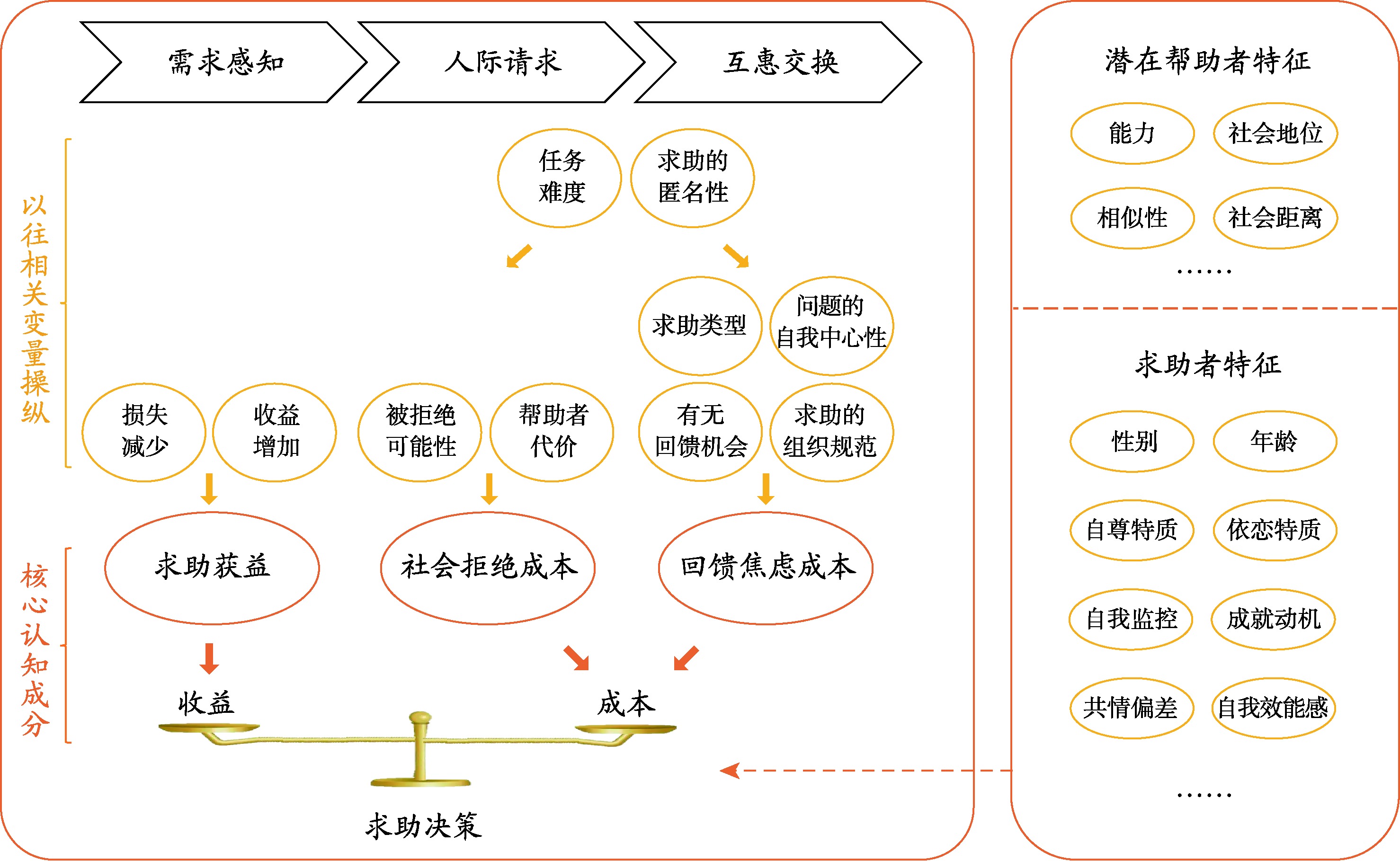
| 核心认知成分 | 理论名称 | 理论解释 | 参考文献 |
|---|---|---|---|
| 人际请求阶段社会拒绝+互惠交换阶段回馈焦虑 | 阻抗理论 (The Theory of Psychological Reactance) | 个体有最大化自身自由的基本动机。求助行为会通过两种方式限制该自由:在人际请求阶段, 求助请求可能被拒绝; 在互惠交换阶段, 接受帮助后需承担回馈义务。这些对自由的威胁会引发阻抗, 从而驱动个体规避求助。 | (Brehm, |
| 人际请求阶段社会拒绝 | 归因理论 (Attribution Theory) | 个体的求助选择取决于他们如何归因自身求助需求的内外性或常态性。相比于对求助需求做出外部归因或常态归因, 当个体进行内部归因或非常态归因时, 个体很可能会从求助的事实中推断自己不足或无能, 担心被他人拒绝或负面评价, 进而影响自尊或声誉, 阻碍求助。 | (Jones & Davis, Kelley & Michela, |
| 互惠交换阶段回馈焦虑 | 互惠、公平与负债感理论 (Theories of Reciprocity, Equity, and Indebtedness) | 接受帮助会使个体产生回馈义务、不对等感和心理负债。为恢复声誉、自尊与心理平衡, 接受帮助后的个体需要做出回馈; 若无法回馈, 则会进一步导致焦虑、不公平厌恶或负债感等负面体验。 | (Adams, |
| 需求感知阶段求助获益+人际请求阶段社会拒绝+互惠交换阶段回馈焦虑 | 自我支持-自我威胁理论 (Self-support and Self-threat Theory) | 接受帮助具有双重性:它既是带来实际获益的自我支持, 也代表对他人依赖的自我威胁。自我威胁的方面在于, 个体在人际请求阶段可能面临社会拒绝, 在互惠交换阶段则可能因无法回馈而感到回馈焦虑。为规避这两种威胁, 个体可能选择不求助。 | (Fisher et al., Nadler, |
| 需求感知阶段求助获益+人际请求阶段社会拒绝+互惠交换阶段回馈焦虑 | 威胁-控制理论 (Threat-control Theory) | 该理论认为个体不仅会预期求助所带来的自我支持(获益)和自我威胁(社会拒绝和回馈焦虑), 还会根据求助后实际体验到的自我支持和自我威胁, 调整并改变其后续的求助决策。 | (Bierhoff, |
| 核心认知成分 | 理论名称 | 理论解释 | 参考文献 |
|---|---|---|---|
| 人际请求阶段社会拒绝+互惠交换阶段回馈焦虑 | 阻抗理论 (The Theory of Psychological Reactance) | 个体有最大化自身自由的基本动机。求助行为会通过两种方式限制该自由:在人际请求阶段, 求助请求可能被拒绝; 在互惠交换阶段, 接受帮助后需承担回馈义务。这些对自由的威胁会引发阻抗, 从而驱动个体规避求助。 | (Brehm, |
| 人际请求阶段社会拒绝 | 归因理论 (Attribution Theory) | 个体的求助选择取决于他们如何归因自身求助需求的内外性或常态性。相比于对求助需求做出外部归因或常态归因, 当个体进行内部归因或非常态归因时, 个体很可能会从求助的事实中推断自己不足或无能, 担心被他人拒绝或负面评价, 进而影响自尊或声誉, 阻碍求助。 | (Jones & Davis, Kelley & Michela, |
| 互惠交换阶段回馈焦虑 | 互惠、公平与负债感理论 (Theories of Reciprocity, Equity, and Indebtedness) | 接受帮助会使个体产生回馈义务、不对等感和心理负债。为恢复声誉、自尊与心理平衡, 接受帮助后的个体需要做出回馈; 若无法回馈, 则会进一步导致焦虑、不公平厌恶或负债感等负面体验。 | (Adams, |
| 需求感知阶段求助获益+人际请求阶段社会拒绝+互惠交换阶段回馈焦虑 | 自我支持-自我威胁理论 (Self-support and Self-threat Theory) | 接受帮助具有双重性:它既是带来实际获益的自我支持, 也代表对他人依赖的自我威胁。自我威胁的方面在于, 个体在人际请求阶段可能面临社会拒绝, 在互惠交换阶段则可能因无法回馈而感到回馈焦虑。为规避这两种威胁, 个体可能选择不求助。 | (Fisher et al., Nadler, |
| 需求感知阶段求助获益+人际请求阶段社会拒绝+互惠交换阶段回馈焦虑 | 威胁-控制理论 (Threat-control Theory) | 该理论认为个体不仅会预期求助所带来的自我支持(获益)和自我威胁(社会拒绝和回馈焦虑), 还会根据求助后实际体验到的自我支持和自我威胁, 调整并改变其后续的求助决策。 | (Bierhoff, |
| 核心认知成分 | 因素操纵 | 影响方式及其解释 | 参考文献 |
|---|---|---|---|
| 需求感知阶段求助获益 | 求助获益 | 收益增加和损失减少促进个体求助行为。 | (DePaulo & Fisher, |
| 人际请求阶段社会拒绝 | 被拒绝 可能性 | 求助被拒绝的可能性越大, 个体预期求助所带来的社会拒绝成本越大, 越不倾向于求助。 | (Flynn & Lake, |
| 任务难度 | 当任务难度较大时, 求助行为往往能提升施助者对求助者能力的积极评价, 同时减少对求助者形象的自我威胁; 这一过程可能通过降低个体感知到的社会拒绝成本, 从而促进求助行为的发生。 | (Brooks et al., | |
| 互惠交换阶段回馈焦虑 | 有无 回馈机会 | 求助行为会带来社会成本, 包括声誉损失和自尊威胁。当个体预期无法回馈时, 会产生负债感、焦虑、压力等负面感受。这种无法回馈的预期显著降低了求助意愿。因此, 求助后可回馈概率越低, 个体体验的回馈焦虑越大, 越不倾向于求助。 | (Gao et al., Greenberg & Shapiro |
| 求助的 组织规范 | 若个体当前所在环境或组织中所有或多数成员认为求助是常见、可被接受的事情, 则会降低个体遭受负面评价的风险, 即自我呈现的风险降低, 这可能使个体对互惠违反的预期及相应的回馈焦虑降低, 更倾向于求助。 | (Cleavenger et al., Cleavenger & Munyon | |
| 问题的 自我中心性 | 问题的自我中心性是指个体需要求助的原因在多大程度上来自于自我相关的维度。问题的自我中心性越低, 自我威胁的风险越低, 个体因求助而损失的声誉和自尊越少, 可能导致预期的回馈焦虑也越少, 越倾向于求助。 | (Nadler, | |
| 求助类型 | 自主型(“求渔”)比依赖型(“求鱼”)求助对声誉和自尊的影响更小, 可能导致个体回馈焦虑更少, 更倾向于求助。 | (Nadler, | |
| 人际请求阶段社会拒绝 + 互惠交换阶段回馈焦虑 | 帮助者 代价 | 当潜在帮助者为陌生人时, 其提供帮助所需付出的代价越大, 个体预期被拒绝的可能性和感到的负债感程度可能越大, 越不倾向于求助。 | (DePaulo & Fisher, |
| 求助的 匿名性 | 匿名求助可以减少因求助带来的负面评价风险, 降低对个体自尊的威胁。这使个体即使在违反互惠规范的情况下, 也可能避免潜在的声誉和自尊损失, 从而减轻其回馈焦虑; 同时匿名求助可以降低潜在社会拒绝所带来的声誉和自尊损失, 降低社会拒绝成本。相比于实名求助, 个体在匿名情境下更倾向于求助。 | (Cleavenger & Munyon | |
| 潜在帮助者 特征 | 能力 | 个体更可能向具有高能力(如具备专业知识)的潜在帮助者求助, 以期能够更有效地减少不确定性(如面临复杂问题时决策或解决方案的模糊性与风险)。 | (Hofmann et al., |
| 社会地位 | 研究结果存在争议。Lee ( | (Lee, | |
| 吸引力 | 当互动对象未被预设为帮助者时, 个体若向更具吸引力的互动对象求助, 会预期更高的被拒概率以及更严重的声誉损失和自尊降低, 因而倾向于避免求助。反之, 当对方身份被明确指定为帮助者时, 吸引力对求助决策的影响会减弱。 | (Stokes & Bickman, | |
| 与求助者的 相似性 | 当个体认为所需求助的任务与自我密切相关时, 个体与潜在帮助者越相似, 求助所带来的自我威胁越大, 因此, 个体越不倾向于求助。 | (Nadler, | |
| 与求助者的 社会距离 | 个体与潜在帮助者的社会关系越亲近, 两者之间的互惠关系越长远, 个体受到负债感的影响越小, 求助被拒绝的概率越小。因此, 个体更可能向亲近的潜在帮助者求助。 | (Shapiro, | |
| 求助者特征 | 性别 | 求助所引起的潜在自尊威胁使得男性或从事男性化职业的个体更不倾向于求助。 | (Cox et al., |
| 年龄 | 随着年龄增长, 个体逐渐意识到求助的代价, 如求助会被认为是无能的体现, 导致求助概率降低。对于老年人来说, 一旦其感知到公众污名, 会很大程度上抑制求助。 | (Mackenzie et al., | |
| 依恋特质 | 安全型依恋的幼儿在面临困难时, 相比于不安全型(回避型和矛盾型)幼儿, 表现出更明显的有效求助行为倾向, 即在真正需要帮助的时候求助, 且能够合理利用支持解决问题。 | (Matas et al., | |
| 自尊特质 | 高自尊个体预期求助对自尊的损害更大, 相比于有机会回馈条件, 他们在没有机会回馈时求助更少; 而低自尊个体的求助行为却不受回馈机会的影响。 | (Nadler, | |
| 成就动机 | 高成就动机个体更倾向于避免求助, 因为求助行为会削弱他们通过自身努力获得成就感的价值。 | (Tessler & Schwartz, | |
| 自我监控 倾向 | 自我监控是指个体根据外部情境适时调整自己行为的能力。研究表明, 在众人面前, 自我监控度高的个体希望自己表现得慷慨好施, 以此获得更高的公众评价和社会地位。因此他们会通过减少求助来塑造其高地位形象。 | (Flynn et al., | |
| 共情偏差 | 个体会系统性地低估潜在帮助者答应其求助请求的可能性, 低估他人为帮助而付出的努力, 因而规避求助。 | (Flynn & Lake, Newark et al., | |
| 自我 效能感 | 个体的自我效能感越强, 越不倾向于求助。 | 王铭, |
| 核心认知成分 | 因素操纵 | 影响方式及其解释 | 参考文献 |
|---|---|---|---|
| 需求感知阶段求助获益 | 求助获益 | 收益增加和损失减少促进个体求助行为。 | (DePaulo & Fisher, |
| 人际请求阶段社会拒绝 | 被拒绝 可能性 | 求助被拒绝的可能性越大, 个体预期求助所带来的社会拒绝成本越大, 越不倾向于求助。 | (Flynn & Lake, |
| 任务难度 | 当任务难度较大时, 求助行为往往能提升施助者对求助者能力的积极评价, 同时减少对求助者形象的自我威胁; 这一过程可能通过降低个体感知到的社会拒绝成本, 从而促进求助行为的发生。 | (Brooks et al., | |
| 互惠交换阶段回馈焦虑 | 有无 回馈机会 | 求助行为会带来社会成本, 包括声誉损失和自尊威胁。当个体预期无法回馈时, 会产生负债感、焦虑、压力等负面感受。这种无法回馈的预期显著降低了求助意愿。因此, 求助后可回馈概率越低, 个体体验的回馈焦虑越大, 越不倾向于求助。 | (Gao et al., Greenberg & Shapiro |
| 求助的 组织规范 | 若个体当前所在环境或组织中所有或多数成员认为求助是常见、可被接受的事情, 则会降低个体遭受负面评价的风险, 即自我呈现的风险降低, 这可能使个体对互惠违反的预期及相应的回馈焦虑降低, 更倾向于求助。 | (Cleavenger et al., Cleavenger & Munyon | |
| 问题的 自我中心性 | 问题的自我中心性是指个体需要求助的原因在多大程度上来自于自我相关的维度。问题的自我中心性越低, 自我威胁的风险越低, 个体因求助而损失的声誉和自尊越少, 可能导致预期的回馈焦虑也越少, 越倾向于求助。 | (Nadler, | |
| 求助类型 | 自主型(“求渔”)比依赖型(“求鱼”)求助对声誉和自尊的影响更小, 可能导致个体回馈焦虑更少, 更倾向于求助。 | (Nadler, | |
| 人际请求阶段社会拒绝 + 互惠交换阶段回馈焦虑 | 帮助者 代价 | 当潜在帮助者为陌生人时, 其提供帮助所需付出的代价越大, 个体预期被拒绝的可能性和感到的负债感程度可能越大, 越不倾向于求助。 | (DePaulo & Fisher, |
| 求助的 匿名性 | 匿名求助可以减少因求助带来的负面评价风险, 降低对个体自尊的威胁。这使个体即使在违反互惠规范的情况下, 也可能避免潜在的声誉和自尊损失, 从而减轻其回馈焦虑; 同时匿名求助可以降低潜在社会拒绝所带来的声誉和自尊损失, 降低社会拒绝成本。相比于实名求助, 个体在匿名情境下更倾向于求助。 | (Cleavenger & Munyon | |
| 潜在帮助者 特征 | 能力 | 个体更可能向具有高能力(如具备专业知识)的潜在帮助者求助, 以期能够更有效地减少不确定性(如面临复杂问题时决策或解决方案的模糊性与风险)。 | (Hofmann et al., |
| 社会地位 | 研究结果存在争议。Lee ( | (Lee, | |
| 吸引力 | 当互动对象未被预设为帮助者时, 个体若向更具吸引力的互动对象求助, 会预期更高的被拒概率以及更严重的声誉损失和自尊降低, 因而倾向于避免求助。反之, 当对方身份被明确指定为帮助者时, 吸引力对求助决策的影响会减弱。 | (Stokes & Bickman, | |
| 与求助者的 相似性 | 当个体认为所需求助的任务与自我密切相关时, 个体与潜在帮助者越相似, 求助所带来的自我威胁越大, 因此, 个体越不倾向于求助。 | (Nadler, | |
| 与求助者的 社会距离 | 个体与潜在帮助者的社会关系越亲近, 两者之间的互惠关系越长远, 个体受到负债感的影响越小, 求助被拒绝的概率越小。因此, 个体更可能向亲近的潜在帮助者求助。 | (Shapiro, | |
| 求助者特征 | 性别 | 求助所引起的潜在自尊威胁使得男性或从事男性化职业的个体更不倾向于求助。 | (Cox et al., |
| 年龄 | 随着年龄增长, 个体逐渐意识到求助的代价, 如求助会被认为是无能的体现, 导致求助概率降低。对于老年人来说, 一旦其感知到公众污名, 会很大程度上抑制求助。 | (Mackenzie et al., | |
| 依恋特质 | 安全型依恋的幼儿在面临困难时, 相比于不安全型(回避型和矛盾型)幼儿, 表现出更明显的有效求助行为倾向, 即在真正需要帮助的时候求助, 且能够合理利用支持解决问题。 | (Matas et al., | |
| 自尊特质 | 高自尊个体预期求助对自尊的损害更大, 相比于有机会回馈条件, 他们在没有机会回馈时求助更少; 而低自尊个体的求助行为却不受回馈机会的影响。 | (Nadler, | |
| 成就动机 | 高成就动机个体更倾向于避免求助, 因为求助行为会削弱他们通过自身努力获得成就感的价值。 | (Tessler & Schwartz, | |
| 自我监控 倾向 | 自我监控是指个体根据外部情境适时调整自己行为的能力。研究表明, 在众人面前, 自我监控度高的个体希望自己表现得慷慨好施, 以此获得更高的公众评价和社会地位。因此他们会通过减少求助来塑造其高地位形象。 | (Flynn et al., | |
| 共情偏差 | 个体会系统性地低估潜在帮助者答应其求助请求的可能性, 低估他人为帮助而付出的努力, 因而规避求助。 | (Flynn & Lake, Newark et al., | |
| 自我 效能感 | 个体的自我效能感越强, 越不倾向于求助。 | 王铭, |
| 决策 框架 | 决策阶段 | 模型类型 | 基本思想 | 主要参考文献 |
|---|---|---|---|---|
| 理性 决策 | 决策产生—— 价值计算 | 收益−成本价值计算 | 表征不同收益、成本因素的预期价值, 并进行权衡和整合, 从而形成选项主观价值, 最终通过价值比较做出选择。其特点是基于当前主观价值进行综合比较, 以实现效用最大化。 | (Hu et al., |
| 决策动态 调整—— 社会学习 | 强化学习 (价值驱动) | 通过预期误差驱动学习, 即根据每次求助的实际结果与预期价值之间的差异, 更新相应选项的未来预期价值, 进而调整后续决策。其特点是动态、试错式学习, 强调内部价值更新(价值驱动)。 | (Olsson et al., | |
| 开采−探索(价值−信息双驱动) | 个体面对多个潜在选项时, 可能采用开采−探索(价值−信息双驱动)策略。开采策略(价值驱动)对应于由强化历史塑造的奖励寻求过程, 即个体根据过去的奖惩反馈更新选项价值, 并倾向于选择当前价值较高的选项; 探索策略(信息驱动)则对应于由选择历史塑造的信息寻求过程, 即个体倾向于尝试较少或较久未被选择的选项, 以获得更多信息。其特点是同时刻画价值驱动的开采策略与信息驱动的探索策略, 强调多选项决策中收益获取与信息寻求之间的权衡。 | (Ligneul, | ||
| 有限理性启发式决策 | 决策产生 | 单因子决策 | 不依赖价值整合, 而是仅基于单一关键线索(如“最友善的人”)做出决策, 或通过序列搜索逐一考察线索, 并在满足某一判断标准后作出选择。其特点是认知节省、依赖显著线索, 而非进行全局最优的价值整合。 | (Gigerenzer & Gaissmaier, |
| 平等性 | 对不同线索赋予相同权重, 平等对待所有可用信息, 或均等尝试所有选项(如求助所有对象)。其特点是避免偏好偏差、简化信息处理。 | (Gigerenzer et al., | ||
| 满意化 | 不追求最优选项, 而是设定一个可接受的“期望水平”, 选择第一个达到该水平的选项。其特点是目标为“足够好”而非“最好”。 | (Simon, | ||
| 社会化启 发式 | 不依赖价值计算, 决策基于社会输入, 如模仿他人、依赖群体智慧或口碑。其特点是外部导向、降低个人认知负担。 | (Hertwig et al., | ||
| 决策动态调整 | 赢留−输移 | 不进行价值迭代更新, 仅根据上一次结果进行直接的决策调整。成功则重复同一选择, 失败则切换。其特点是简单试错、无长期学习。 | (Worthy et al., | |
| 理性决策与有限理性启发式决策间的转换 | 决策产生& 决策动态调整 | 复合双系统模型 | 面对不同的决策情境, 大脑会动态调整“理性”与“有限理性启发式”这两个系统的相对权重, 从而使决策者能在“理性”与“有限理性启发式”策略之间灵活切换。 | 2011) |
| 互动双方特征的调节 | 上述各决策阶段 | 调节上述各模型的关键参数 | 互动双方的特征可能影响决策产生与动态调整过程中的理性加工和有限理性加工, 并调节个体在理性策略与有限理性启发式策略之间的转换, 从而导致决策偏好的个体差异。这些差异最终可体现在相关模型的关键参数上。 | (Gigerenzer, Stanovich, |
| 决策 框架 | 决策阶段 | 模型类型 | 基本思想 | 主要参考文献 |
|---|---|---|---|---|
| 理性 决策 | 决策产生—— 价值计算 | 收益−成本价值计算 | 表征不同收益、成本因素的预期价值, 并进行权衡和整合, 从而形成选项主观价值, 最终通过价值比较做出选择。其特点是基于当前主观价值进行综合比较, 以实现效用最大化。 | (Hu et al., |
| 决策动态 调整—— 社会学习 | 强化学习 (价值驱动) | 通过预期误差驱动学习, 即根据每次求助的实际结果与预期价值之间的差异, 更新相应选项的未来预期价值, 进而调整后续决策。其特点是动态、试错式学习, 强调内部价值更新(价值驱动)。 | (Olsson et al., | |
| 开采−探索(价值−信息双驱动) | 个体面对多个潜在选项时, 可能采用开采−探索(价值−信息双驱动)策略。开采策略(价值驱动)对应于由强化历史塑造的奖励寻求过程, 即个体根据过去的奖惩反馈更新选项价值, 并倾向于选择当前价值较高的选项; 探索策略(信息驱动)则对应于由选择历史塑造的信息寻求过程, 即个体倾向于尝试较少或较久未被选择的选项, 以获得更多信息。其特点是同时刻画价值驱动的开采策略与信息驱动的探索策略, 强调多选项决策中收益获取与信息寻求之间的权衡。 | (Ligneul, | ||
| 有限理性启发式决策 | 决策产生 | 单因子决策 | 不依赖价值整合, 而是仅基于单一关键线索(如“最友善的人”)做出决策, 或通过序列搜索逐一考察线索, 并在满足某一判断标准后作出选择。其特点是认知节省、依赖显著线索, 而非进行全局最优的价值整合。 | (Gigerenzer & Gaissmaier, |
| 平等性 | 对不同线索赋予相同权重, 平等对待所有可用信息, 或均等尝试所有选项(如求助所有对象)。其特点是避免偏好偏差、简化信息处理。 | (Gigerenzer et al., | ||
| 满意化 | 不追求最优选项, 而是设定一个可接受的“期望水平”, 选择第一个达到该水平的选项。其特点是目标为“足够好”而非“最好”。 | (Simon, | ||
| 社会化启 发式 | 不依赖价值计算, 决策基于社会输入, 如模仿他人、依赖群体智慧或口碑。其特点是外部导向、降低个人认知负担。 | (Hertwig et al., | ||
| 决策动态调整 | 赢留−输移 | 不进行价值迭代更新, 仅根据上一次结果进行直接的决策调整。成功则重复同一选择, 失败则切换。其特点是简单试错、无长期学习。 | (Worthy et al., | |
| 理性决策与有限理性启发式决策间的转换 | 决策产生& 决策动态调整 | 复合双系统模型 | 面对不同的决策情境, 大脑会动态调整“理性”与“有限理性启发式”这两个系统的相对权重, 从而使决策者能在“理性”与“有限理性启发式”策略之间灵活切换。 | 2011) |
| 互动双方特征的调节 | 上述各决策阶段 | 调节上述各模型的关键参数 | 互动双方的特征可能影响决策产生与动态调整过程中的理性加工和有限理性加工, 并调节个体在理性策略与有限理性启发式策略之间的转换, 从而导致决策偏好的个体差异。这些差异最终可体现在相关模型的关键参数上。 | (Gigerenzer, Stanovich, |
| [1] | 江光荣, 王铭. (2003). 大学生心理求助行为研究. 中国临床心理学杂志, 11(3), 180-184. |
| [2] | Adams, J. S. (1965). Inequity in social exchange. In L. Berkowitz (Ed.), Advances in experimental social psychology (Vol. 2, pp. 267-299). New York: Academic Press. |
| [3] |
Anvari, F., Alsalti, T., Oehler, L. A., Hussey, I., Elson, M., & Arslan, R. C. (2025). Defragmenting psychology. Nature Human Behaviour, 9(5), 836-839.
doi: 10.1038/s41562-025-02138-0 pmid: 40102675 |
| [4] | Bang, D., Moran, R., Daw, N. D., & Fleming, S. M. (2022). Neurocomputational mechanisms of confidence in self and others. Nature Communications, 13(1), 4238. |
| [5] | Bierhoff, H. -W. (2002). Prosocial behavior. Psychology Press. |
| [6] | Brehm, J. W. (1966). A theory of psychological reactance. Academic Press. |
| [7] | Brehm, J. W. (1989). Psychological reactance: Theory and applications. Advances in Consumer Research, 16(1), 72-75. |
| [8] |
Brooks, A. W., Gino, F., & Schweitzer, M. E. (2015). Smart people ask for (my) advice: Seeking advice boosts perceptions of competence. Management Science, 61(6), 1421-1435.
doi: 10.1287/mnsc.2014.2054 URL |
| [9] |
Carnevale, J. B., Huang, L., Vincent, L. C., Farmer, S., & Wang, L. (2021). Better to give than to receive (or seek) help? The interpersonal dynamics of maintaining a reputation for creativity. Organizational Behavior and Human Decision Processes, 167, 144-156.
doi: 10.1016/j.obhdp.2021.08.006 URL |
| [10] |
Cassidy, J. (2000). Adult romantic attachments: A developmental perspective on individual differences. Review of General Psychology, 4(2), 111-131.
doi: 10.1037/1089-2680.4.2.111 URL |
| [11] |
Cleavenger, D., Gardner, W. L., & Mhatre, K. (2007). Help-seeking: Testing the effects of task interdependence and normativeness on employees’ propensity to seek help. Journal of Business and Psychology, 21(3), 331-359.
doi: 10.1007/s10869-006-9032-7 URL |
| [12] |
Cleavenger, D. J., & Munyon, T. P. (2015). Overcoming the help-seeker’s dilemma: How computer-mediated systems encourage employee help-seeking initiation. Organization Studies, 36(2), 221-240.
doi: 10.1177/0170840614556920 URL |
| [13] |
Clement, S., Schauman, O., Graham, T., Maggioni, F., Evans- Lacko, S., Bezborodovs, N., … Thornicroft, G. (2015). What is the impact of mental health-related stigma on help- seeking? A systematic review of quantitative and qualitative studies. Psychological Medicine, 45(1), 11-27.
doi: 10.1017/S0033291714000129 pmid: 24569086 |
| [14] |
Cohen, J. D., Daw, N., Engelhardt, B., Hasson, U., Li, K., Niv, Y., … Willke, T. L. (2017). Computational approaches to fMRI analysis. Nature Neuroscience, 20(3), 304-313.
doi: 10.1038/nn.4499 pmid: 28230848 |
| [15] |
Cox, J. A., Trapp, M. M., & McLean, S. (2025). Gender differences in adolescents’ help-seeking behaviours and intentions for psychosocial problems in led outdoor activities. Journal of Adventure Education and Outdoor Learning, 25(3), 668-678.
doi: 10.1080/14729679.2024.2353171 URL |
| [16] |
Crocker, J., Canevello, A., & Brown, A. A. (2017). Social motivation: Costs and benefits of selfishness and otherishness. Annual Review of Psychology, 68, 299-325.
doi: 10.1146/annurev-psych-010416-044145 pmid: 27362501 |
| [17] |
Crockett, M. J. (2016). How formal models can illuminate mechanisms of moral judgment and decision making. Current Directions in Psychological Science, 25(2), 85-90.
doi: 10.1177/0963721415624012 URL |
| [18] |
Cushman, F. (2024). Computational social psychology. Annual Review of Psychology, 75, 625-652.
doi: 10.1146/psych.2024.75.issue-1 URL |
| [19] |
Davidai, S. (2025). Going at it alone: Zero-sum beliefs inhibit help-seeking. Journal of Experimental Social Psychology, 117, 104714.
doi: 10.1016/j.jesp.2024.104714 URL |
| [20] |
Davison, K., Malmberg, L. -E., & Sylva, K. (2023). Academic help-seeking interactions in the classroom: A microlongitudinal study. British Journal of Educational Psychology, 93(1), 33-55.
doi: 10.1111/bjep.v93.1 URL |
| [21] |
Daw, N. D., Niv, Y., & Dayan, P. (2005). Uncertainty-based competition between prefrontal and dorsolateral striatal systems for behavioral control. Nature Neuroscience, 8(12), 1704-1711.
doi: 10.1038/nn1560 pmid: 16286932 |
| [22] |
DePaulo, B. M., & Fisher, J. D. (1980). The costs of asking for help. Basic and Applied Social Psychology, 1(1), 23-35.
doi: 10.1207/s15324834basp0101_3 URL |
| [23] | Doll, C. M., Michel, C., Rosen, M., Osman, N., Schimmelmann, B. G., & Schultze-Lutter, F. (2021). Predictors of help-seeking behaviour in people with mental health problems: A 3-year prospective community study. BMC Psychiatry, 21(1), 432. |
| [24] |
Fan, Y. -H., & Lin, T. -J. (2023). Identifying university students’ online academic help-seeking patterns and their role in Internet self-efficacy. The Internet and Higher Education, 56, 100893.
doi: 10.1016/j.iheduc.2022.100893 URL |
| [25] |
Feher da Silva, C., Lombardi, G., Edelson, M., & Hare, T. A. (2023). Rethinking model-based and model-free influences on mental effort and striatal prediction errors. Nature Human Behaviour, 7(6), 956-969.
doi: 10.1038/s41562-023-01573-1 pmid: 37012365 |
| [26] |
Fehr, E., & Fischbacher, U. (2003). The nature of human altruism. Nature, 425(6960), 785-791.
doi: 10.1038/nature02043 |
| [27] |
Fisher, J. D., Nadler, A., & Whitcher-Alagna, S. (1982). Recipient reactions to aid. Psychological Bulletin, 91(1), 27-54.
doi: 10.1037/0033-2909.91.1.27 URL |
| [28] |
Flynn, F., & Lake, V. (2008). If you need help, just ask: Underestimating compliance with direct requests for help. Journal of Personality and Social Psychology, 95(1), 128-143.
doi: 10.1037/0022-3514.95.1.128 pmid: 18605856 |
| [29] |
Flynn, F. J., Reagans, R. E., Amanatullah, E. T., & Ames, D. R. (2006). Helping one's way to the top: Self-monitors achieve status by helping others and knowing who helps whom. Journal of Personality and Social Psychology, 91(6), 1123-1137.
pmid: 17144769 |
| [30] |
Fong, C. J., Gonzales, C., Hill-Troglin Cox, C., & Shinn, H. B. (2023). Academic help-seeking and achievement of postsecondary students: A meta-analytic investigation. Journal of Educational Psychology, 115(1), 1-21.
doi: 10.1037/edu0000725 URL |
| [31] | Fornari, L., Ioumpa, K., Nostro, A. D., Evans, N. J., De Angelis, L., Speer, S. P. H., … Gazzola, V. (2023). Neuro-computational mechanisms and individual biases in action-outcome learning under moral conflict. Nature Communications, 14(1), 1218. |
| [32] |
Friedman, A., Carmeli, A., & Dutton, J. E. (2018). When does respectful engagement with one's supervisor foster help-seeking behaviors and performance? Journal of Vocational Behavior, 104, 184-198.
doi: 10.1016/j.jvb.2017.11.007 URL |
| [33] | Frolichs, K. M. M., Rosenblau, G., & Korn, C. W. (2022). Incorporating social knowledge structures into computational models. Nature Communications, 13(1), 6205. |
| [34] | Gao, X., Jolly, E., Yu, H., Liu, H., Zhou, X., & Chang, L. J. (2024). The psychological, computational, and neural foundations of indebtedness. Nature Communications, 15(1), 68. |
| [35] | Gao, X., Yu, H., Sáez, I., Blue, P. R., Zhu, L., Hsu, M., & Zhou, X. (2018). Distinguishing neural correlates of context- dependent advantageous- and disadvantageous-inequity aversion. Proceedings of the National Academy of Sciences, 115(33), 7680-7689. |
| [36] | García-Arch, J., Korn, C. W., & Fuentemilla, L. (2025). Self- utility distance as a computational approach to understanding self-concept clarity. Communications Psychology, 3(1), 50. |
| [37] | Gigerenzer, G. (2002). Rationality:Why social context matters. In Adaptive thinking: Rationality in the real world (pp.201-210). Oxford University Press. |
| [38] |
Gigerenzer, G., & Gaissmaier, W. (2011). Heuristic decision making. Annual Review of Psychology, 62, 451-482.
doi: 10.1146/annurev-psych-120709-145346 pmid: 21126183 |
| [39] |
Gigerenzer, G., Reb, J., & Luan, S. (2022). Smart heuristics for individuals, teams, and organizations. Annual Review of Organizational Psychology and Organizational Behavior, 9, 171-198.
doi: 10.1146/orgpsych.2022.9.issue-1 URL |
| [40] |
Gouldner, A. W. (1960). The norm of reciprocity: A preliminary statement. American Sociological Review, 25(2), 161-178.
doi: 10.2307/2092623 URL |
| [41] | Greenberg, M., S. (1980). A theory of indebtedness. In K. J. Gergen, M. S. Greenberg, & R. H. Willis (Eds.), Social exchange: Advances in theory and research (pp. 3-26). Springer. |
| [42] |
Greenberg, M. S., & Shapiro, S. P. (1971). Indebtedness: An adverse aspect of asking for and receiving help. Sociometry, 34(2), 290-301.
doi: 10.2307/2786418 URL |
| [43] |
Guest, O., & Martin, A. E. (2021). How computational modeling can force theory building in psychological science. Perspectives on Psychological Science, 16(4), 789-802.
doi: 10.1177/1745691620970585 pmid: 33482070 |
| [44] |
Hackel, L. M., & Amodio, D. M. (2018). Computational neuroscience approaches to social cognition. Current Opinion in Psychology, 24, 92-97.
doi: S2352-250X(18)30072-1 pmid: 30388495 |
| [45] | Hertwig, R., Hoffrage, U., & ABC, Research Group. (Eds). (2012). Simple heuristics in a social world. Oxford University Press. |
| [46] |
Hofmann, D. A., Lei, Z., & Grant, A. M. (2009). Seeking help in the shadow of doubt: The sensemaking processes underlying how nurses decide whom to ask for advice. Journal of applied psychology, 94(5), 1261-1274.
doi: 10.1037/a0016557 pmid: 19702369 |
| [47] |
Hu, J., Hu, Y., Li, Y., & Zhou, X. (2021). Computational and neurobiological substrates of cost-benefit integration in altruistic helping decision. The Journal of Neuroscience, 41(15), 3545-3561.
doi: 10.1523/JNEUROSCI.1939-20.2021 URL |
| [48] | Hu, J., Konovalov, A., & Ruff, C. C. (2023). A unified neural account of contextual and individual differences in altruism. eLife, 12, e80667. |
| [49] | Hu,, Y., Gao, X., Yu, H., He, Z., & Zhou, X. (2022). Neuroscience of moral decision making. In S. Della Sala (Ed.), Encyclopedia of behavioral neuroscience (2nd ed., pp. 481-495). Elsevier. |
| [50] |
Jin, T., Zhang, S., Lockwood, P., Vilares, I., Wu, H., Liu, C., & Ma, Y. (2022). Learning whom to cooperate with: Neurocomputational mechanisms for choosing cooperative partners. Cerebral Cortex, 33(8), 4612-4625.
doi: 10.1093/cercor/bhac365 URL |
| [51] | Jones, E., E., & Davis, K. E. (1965). From acts to dispositions the attribution process in person perception. In L. Berkowitz (Ed.), Advances in Experimental Social Psychology (Vol. 2, pp. 219-266). Academic Press. |
| [52] |
Juhl, J., Wildschut, T., Sedikides, C., Xiong, X., & Zhou, X. (2021). Nostalgia promotes help seeking by fostering social connectedness. Emotion, 21(3), 631-643.
doi: 10.1037/emo0000720 URL |
| [53] | Kahneman, D. (2011). Thinking, fast and slow. Farrar, Straus and Giroux. |
| [54] |
Kearns, M., Muldoon, O. T., Msetfi, R. M., & Surgenor, P. W. G. (2015). Understanding help-seeking amongst university students: The role of group identity, stigma, and exposure to suicide and help-seeking. Frontiers in Psychology, 6, 1462.
doi: 10.3389/fpsyg.2015.01462 pmid: 26483722 |
| [55] |
Kelley, H. H., & Michela, J. L. (1980). Attribution theory and research. Annual Review of Psychology, 31, 457-501.
doi: 10.1146/annurev.ps.31.020180.002325 pmid: 20809783 |
| [56] | Koban, L., Andrews-Hanna, J. R., Ives, L., Wager, T. D., & Arch, J. J. (2023). Brain mediators of biased social learning of self-perception in social anxiety disorder. Translational Psychiatry, 13(1), 292. |
| [57] |
Konovalov, A., Hu, J., & Ruff, C. C. (2018). Neurocomputational approaches to social behavior. Current Opinion in Psychology, 24, 41-47.
doi: S2352-250X(17)30279-8 pmid: 29738891 |
| [58] |
Kriegeskorte, N., Mur, M., & Bandettini, P. A. (2008). Representational similarity analysis - connecting the branches of systems neuroscience. Frontiers in Systems Neuroscience, 2, 4.
doi: 10.3389/neuro.06.004.2008 pmid: 19104670 |
| [59] | Law, M. K. H., Thompson, V. A., Stankov, L., & Kleitman, S. (2026). Systematic adaptive and maladaptive giving-up strategies in cognitive problem-solving. Thinking & Reasoning, 32(1), 27-69. |
| [60] |
Lee, F. (1997). When the going gets tough, do the tough ask for help? Help seeking and power motivation in organizations. Organizational Behavior and Human Decision Processes, 72(3), 336-363.
pmid: 9606170 |
| [61] |
Lee, F. (2002). The social costs of seeking help. The Journal of Applied Behavioral Science, 38(1), 17-35.
doi: 10.1177/0021886302381002 URL |
| [62] |
Levine, S. M., & Schwarzbach, J. V. (2021). Individualizing representational similarity analysis. Frontiers in Psychiatry, 12, 729457.
doi: 10.3389/fpsyt.2021.729457 URL |
| [63] | Li, Y., Hu, J., Ruff, C. C., & Zhou, X. (2022). Neurocomputational evidence that conflicting prosocial motives guide distributive justice. Proceedings of the National Academy of Sciences, 119(49), e2209078119. |
| [64] | Ligneul, R. (2019). Sequential exploration in the Iowa gambling task: Validation of a new computational model in a large dataset of young and old healthy participants. PLOS Computational Biology, 15(6), e1006989. |
| [65] |
Lim, J. H., Tai, K., Bamberger, P. A., & Morrison, E. W. (2020). Soliciting resources from others: An integrative review. Academy of Management Annals, 14(1), 122-159.
doi: 10.5465/annals.2018.0034 URL |
| [66] |
Lockwood, P. L., Apps, M. A. J., & Chang, S. W. C. (2020). Is there a ‘social’ brain? Implementations and algorithms. Trends in Cognitive Sciences, 24(10), 802-813.
doi: 10.1016/j.tics.2020.06.011 URL |
| [67] |
Lua, V. Y. Q., Majeed, N. M., Hartanto, A., & Leung, A. K. -y. (2022). Help-seeking tendencies and subjective well-being: A cross-cultural comparison of the United States and Japan. Social Psychology Quarterly, 85(2), 164-186.
doi: 10.1177/01902725221077075 URL |
| [68] | Luo, H., Du, W., Shen, B., Li, X., Dai, H., Hu, J., Zhou, X., & Gao, X. (2024). From whom should I seek help? The temporal competition dynamics of rejection and repayment cost concerns behind help-seeking decisions. PsyArXiv. |
| [69] |
Mackenzie, C. S., Heath, P. J., Vogel, D. L., & Chekay, R. (2019). Age differences in public stigma, self-stigma, and attitudes toward seeking help: A moderated mediation model. Journal of Clinical Psychology, 75(12), 2259-2272.
doi: 10.1002/jclp.22845 pmid: 31385298 |
| [70] | Marr, D. (2010). Vision: A computational investigation into the human representation and processing of visual information. The MIT Press. |
| [71] |
Matas, L., Arend, R. A., & Sroufe, L. A. (1978). Continuity of adaptation in the second year: The relationship between quality of attachment and later competence. Child Development, 49(3), 547-556.
doi: 10.2307/1128221 URL |
| [72] | McLaren, T., Peter, L. -J., Tomczyk, S., Muehlan, H., Schomerus, G., & Schmidt, S. (2023). The seeking mental health care model: Prediction of help-seeking for depressive symptoms by stigma and mental illness representations. BMC Public Health, 23(1), 69. |
| [73] |
McLaren, T., Peter, L. -J., Tomczyk, S., Muehlan, H., Schomerus, G., & Schmidt, S. (2024). The differential influence of self-construal on the effect of self-efficacy on the help-seeking process: A quasi-experimental online study among people with untreated depressive symptoms. Acta Psychologica, 242, 104119.
doi: 10.1016/j.actpsy.2023.104119 URL |
| [74] |
Melis, A. P., & Raihani, N. J. (2023). The cognitive challenges of cooperation in human and nonhuman animals. Nature Reviews Psychology, 2(9), 523-536.
doi: 10.1038/s44159-023-00207-7 |
| [75] |
Nadler, A. (1987). Determinants of help seeking behaviour: The effects of helper's similarity, task centrality and recipient's self esteem. European Journal of Social Psychology, 17(1), 57-67.
doi: 10.1002/ejsp.v17:1 URL |
| [76] | Nadler,, A. (1997). Personality and help seeking:Autonomous versus dependent seeking of help. In G. R. Pierce, B. Lakey, I. G. Sarason, & B. R. Sarason (Eds.), Sourcebook of social support and personality. (pp. 379-407). Plenum Press. |
| [77] |
Nadler, A. (2002). Inter-group helping relations as power relations: Maintaining or challenging social dominance between groups through helping. Journal of Social Issues, 58(3), 487-502.
doi: 10.1111/josi.2002.58.issue-3 URL |
| [78] | Nadler,, A. (2015). The other side of helping:Seeking and receiving help. In D. A. Schroeder & W. G. Graziano (Eds.), The Oxford Handbook of Prosocial Behavior (pp. 307-328). Oxford University Press. |
| [79] | Nadler,, A., & Jeffrey, D. (1986). The role of threat to self-esteem and perceived control in recipient reaction to help:Theory development and empirical validation. In L. Berkowitz (Ed.), Advances in Experimental Social Psychology (Vol. 19, pp. 81-122). Academic Press. |
| [80] |
Nadler, A., Peri, N., & Chemerinski, A. (1985). Effects of opportunity to reciprocate and self-esteem on help-seeking behavior. Journal of Personality, 53(1), 23-35.
doi: 10.1111/jopy.1985.53.issue-1 URL |
| [81] |
Nadler, A., & Porat, I. (1978). When names do not help: Effects of anonymity and locus of need attribution on help-seeking behavior. Personality and Social Psychology Bulletin, 4(4), 624-626.
doi: 10.1177/014616727800400427 URL |
| [82] |
Newark, D. A., Bohns, V. K., & Flynn, F. J. (2017). A helping hand is hard at work: Help-seekers’ underestimation of helpers’ effort. Organizational Behavior and Human Decision Processes, 139, 18-29.
doi: 10.1016/j.obhdp.2017.01.001 URL |
| [83] |
Niv, Y., Edlund, J. A., Dayan, P., & O'Doherty, J. P. (2012). Neural prediction errors reveal a risk-sensitive reinforcement- learning process in the human brain. The Journal of Neuroscience, 32(2), 551-562.
doi: 10.1523/JNEUROSCI.5498-10.2012 URL |
| [84] |
Olsson, A., FeldmanHall, O., Haaker, J., & Hensler, T. (2018). Social regulation of survival circuits through learning. Current Opinion in Behavioral Sciences, 24, 161-167.
doi: 10.1016/j.cobeha.2018.09.016 URL |
| [85] |
Olsson, A., Knapska, E., & Lindström, B. (2020). The neural and computational systems of social learning. Nature Reviews Neuroscience, 21(4), 197-212.
doi: 10.1038/s41583-020-0276-4 pmid: 32221497 |
| [86] | Pan, Y., Vinding, M. C., Zhang, L., Lundqvist, D., & Olsson, A. (2023). A brain-to-brain mechanism for social transmission of threat learning. Advanced Science, 10(28), 2304037. |
| [87] | Philippe, R., Janet, R., Khalvati, K., Rao, R. P. N., Lee, D., & Dreher, J. -C. (2024). Neurocomputational mechanisms involved in adaptation to fluctuating intentions of others. Nature Communications, 15(1), 3189. |
| [88] | Pisauro, M. A., Fouragnan, E. F., Arabadzhiyska, D. H., Apps, M. A. J., & Philiastides, M. G. (2022). Neural implementation of computational mechanisms underlying the continuous trade-off between cooperation and competition. Nature Communications, 13(1), 6873. |
| [89] |
Qu, C., Bénistant, J., & Dreher, J. -C. (2022). Neurocomputational mechanisms engaged in moral choices and moral learning. Neuroscience & Biobehavioral Reviews, 132, 50-60.
doi: 10.1016/j.neubiorev.2021.11.023 URL |
| [90] | Rescorla, R., A., & Wagner, A. (1972). A theory of Pavlovian conditioning:Variations in the effectiveness of reinforcement and nonreinforcement. In A. H. Black, & W. F. Prokasy (Eds.), Clasical Conditioning II: Current Research and Theory (Vol. 2, pp. 64-99). New York: Appleton-Century-Crofts. |
| [91] |
Ruff, C. C., & Fehr, E. (2014). The neurobiology of rewards and values in social decision making. Nature Reviews Neuroscience, 15(8), 549-562.
doi: 10.1038/nrn3776 pmid: 24986556 |
| [92] | Ruihua, L., Che Hassan, N., & Saharuddin, N. (2025). Understanding academic help-seeking among first-generation college students: A phenomenological approach. Humanities and Social Sciences Communications, 12(1), 56. |
| [93] |
Schultner, D., Molleman, L., & Lindström, B. (2025). Feature-based reward learning shapes human social learning strategies. Nature Human Behaviour, 9, 2183-2198.
doi: 10.1038/s41562-025-02269-4 pmid: 40702301 |
| [94] |
Shaffer, P. A., Vogel, D. L., & Wei, M. (2006). The mediating roles of anticipated risks, anticipated benefits, and attitudes on the decision to seek professional help: An attachment perspective. Journal of Counseling Psychology, 53(4), 442-452.
doi: 10.1037/0022-0167.53.4.442 URL |
| [95] |
Shapiro, E. G. (1980). Is seeking help from a friend like seeking help from a stranger? Social Psychology Quarterly, 43(2), 259-263.
doi: 10.2307/3033629 URL |
| [96] |
Shute, V. J., Wang, L., Greiff, S., Zhao, W., & Moore, G. (2016). Measuring problem solving skills via stealth assessment in an engaging video game. Computers in Human Behavior, 63, 106-117.
doi: 10.1016/j.chb.2016.05.047 URL |
| [97] |
Sijben, J., Huibertse, L. J., Rainey, L., Broeders, M. J. M., Peters, Y., & Siersema, P. D. (2024). Oesophageal cancer awareness and anticipated time to help-seeking: Results from a population-based survey. British Journal of Cancer, 130(11), 1795-1802.
doi: 10.1038/s41416-024-02663-1 |
| [98] |
Simon, H. A. (1955). A behavioral model of rational choice. The Quarterly Journal of Economics, 69(1), 99-118.
doi: 10.2307/1884852 URL |
| [99] |
Song, X., Anderson, T., Himawan, L., McClintock, A., Jiang, Y., & McCarrick, S. (2019). An investigation of a cultural help-seeking model for professional psychological services with U.S. and Chinese samples. Journal of Cross-Cultural Psychology, 50(9), 1027-1049.
doi: 10.1177/0022022119878506 URL |
| [100] | Stanovich, K. E. (1999). Who is rational? Studies of individual differences in reasoning. Lawrence Erlbaum Associates Publishers. |
| [101] |
Stokes, S. J., & Bickman, L. (1974). The effect of the physical attractiveness and role of the helper on help seeking. Journal of Applied Social Psychology, 4(3), 286-294.
doi: 10.1111/jasp.1974.4.issue-3 URL |
| [102] |
Teng, F., Wang, X., Lei, Q., & Poon, K. T. (2024). Love me, because I rely on you: Dependency-oriented help-seeking as a strategy for human mating. Journal of Personality and Social Psychology, 127(6), 1215-1236.
doi: 10.1037/pspi0000458 pmid: 38483531 |
| [103] |
Terenzi, D., Liu, L., Bellucci, G., & Park, S. Q. (2021). Determinants and modulators of human social decisions. Neuroscience & Biobehavioral Reviews, 128, 383-393.
doi: 10.1016/j.neubiorev.2021.06.041 URL |
| [104] |
Tessler, R. C., & Schwartz, S. H. (1972). Help seeking, self-esteem, and achievement motivation: An attributional analysis. Journal of Personality and Social Psychology, 21(3), 318-326.
pmid: 5060750 |
| [105] |
Vahed, S., Galván, E. P., & Sanfey, A. G. (2024). Computational modeling of social decision-making. Current Opinion in Psychology, 60, 101884.
doi: 10.1016/j.copsyc.2024.101884 URL |
| [106] |
van Dijk, E., & De Dreu, C. K. W. (2021). Experimental games and social decision making. Annual Review of Psychology, 72(1), 415-438.
doi: 10.1146/psych.2021.72.issue-1 URL |
| [107] | Will, G. -J., Rutledge, R. B., Moutoussis, M., & Dolan, R. J. (2017). Neural and computational processes underlying dynamic changes in self-esteem. eLife, 6, e28098. |
| [108] | Wilson, R. C., & Collins, A. G. E. (2019). Ten simple rules for the computational modeling of behavioral data. eLife, 8, e49547. |
| [109] |
Worthy, D. A., Hawthorne, M. J., & Otto, A. R. (2013). Heterogeneity of strategy use in the Iowa gambling task: A comparison of win-stay/lose-shift and reinforcement learning models. Psychonomic Bulletin & Review, 20(2), 364-371.
doi: 10.3758/s13423-012-0324-9 URL |
| [110] |
Wu, X., Ren, X., Liu, C., & Zhang, H. (2024). The motive cocktail in altruistic behaviors. Nature Computational Science, 4(9), 659-676.
doi: 10.1038/s43588-024-00685-6 pmid: 39266669 |
| [111] |
Xiong, X., Guo, S., Gu, L., Huang, R., & Zhou, X. (2018). Reciprocity anxiety: Individual differences in feeling discomfort in reciprocity situations. Journal of Economic Psychology, 67, 149-161.
doi: 10.1016/j.joep.2018.05.007 URL |
| [112] |
Yang, Y., Luo, S., Wang, W., Gao, X., Yao, X., & Wu, T. (2024). From bench to bedside: Overview of magnetoencephalography in basic principle, signal processing, source localization and clinical applications. NeuroImage: Clinical, 42, 103608.
doi: 10.1016/j.nicl.2024.103608 URL |
| [113] |
Yu, H., Gao, X., Shen, B., Hu, Y., & Zhou, X. (2024). A levels-of-analysis framework for studying social emotions. Nature Reviews Psychology, 3, 198-213.
doi: 10.1038/s44159-024-00285-1 |
| [114] |
Yu, H., Lu, C., Gao, X., Shen, B., Liu, K., Li, W., … Zhou, X. (2022). Explaining individual differences in advantageous inequity aversion by social-affective trait dimensions and family environment. Social Psychological and Personality Science, 13(2), 626-637.
doi: 10.1177/19485506211027794 URL |
| [115] | Zajkowski, W., Badman, R. P., Haruno, M., & Akaishi, R. (2024). A neurocognitive mechanism for increased cooperation during group formation. Communications Psychology, 2(1), 127. |
| [116] |
Zhang, Y., & Chen, Z. S. (2025). Harnessing electroencephalography connectomes for cognitive and clinical neuroscience. Nature Biomedical Engineering, 9, 1186-1201.
doi: 10.1038/s41551-025-01442-4 |
| [117] |
Zhao, X., & Epley, N. (2022). Surprisingly happy to have helped: Underestimating prosociality creates a misplaced barrier to asking for help. Psychological Science, 33(10), 1708-1731.
doi: 10.1177/09567976221097615 URL |
| [118] |
Zhong, S., Ma, C., Huang, Y., Zhang, T., Hou, X., Tai, T. C., … Zhou, L. (2025). Patterns, delays, and associated factors of help-seeking behaviour for lifetime mood disorders and anxiety disorders: A national representative survey. Journal of Affective Disorders, 372, 386-393.
doi: 10.1016/j.jad.2024.12.010 pmid: 39638063 |
| [1] | ZHENG Ya, YANG Ziyang. A two-stage model of the effects of prosocial effort on reward processing [J]. Advances in Psychological Science, 2026, 34(10): 1722-1732. |
| [2] | WANG Ying-Jie, ZHANG Ru-Yuan. Computational cognitive mechanism of stereotype: Social learning and generalization [J]. Advances in Psychological Science, 2026, 34(10): 1862-1875. |
| [3] | ZHOU Shujin, ZHU Jingyi, TU Hongyue, Li Yan. From self-serving to harm-seeking: Evolutionary pathways from negative to malevolent creativity and intervention [J]. Advances in Psychological Science, 2026, 34(10): 1876-1886. |
| [4] | WANG Qingyu, CHEN Yiyue, TANG Luyao, HUANG Chaozheng, XIE Pei. Etiquette on the tip of the tongue: The influence of social norms on women’s eating behavior [J]. Advances in Psychological Science, 2026, 34(10): 1887-1898. |
| [5] | ZHANG Hejing, CHEN Yiming, MA Yina. Neural computations of ingroup−outgroup subjective value: Toward precise prediction and intervention in intergroup cooperation and conflict [J]. Advances in Psychological Science, 2026, 34(9): 1514-1528. |
| [6] | LI Huanhuan, YAN Kai. Shaping mechanisms and evidence-based governance pathways of bystander defending behaviors in school bullying [J]. Advances in Psychological Science, 2026, 34(9): 1529-1543. |
| [7] | SONG Xiaoxiao, LING Xiaodie, GU Huimin, MA Shuang. The impact of generative AI personalized recommendations on tourists’ travel decision-making [J]. Advances in Psychological Science, 2026, 34(9): 1590-1605. |
| [8] | ZHAO Peiqiong, DONG Yanxin, CHEN Guanchu, WEN Shengjun, YIN Jun, CHEN Wei, DONG Da. The animacy detectors: The embeddedness of animacy perception [J]. Advances in Psychological Science, 2026, 34(9): 1663-1683. |
| [9] | FAN Yunge, FAN Fang, MA Hong, MO Lei. Optimizing the construction path of psychological crisis intervention systems for public emergencies [J]. Advances in Psychological Science, 2026, 34(9): 1684-1694. |
| [10] | ZHAO Yafei, ZHANG Yue, ZHANG Robert Jiqi, GUO Yongyu. The impact of economic inequality on status anxiety and its socio-psychological mechanisms [J]. Advances in Psychological Science, 2026, 34(8): 1468-1488. |
| [11] | KOU Yu, DING Yue, YANG Xiaojun, ZHA Yichang. Applying wise intervention to promote prosocial behavior [J]. Advances in Psychological Science, 2026, 34(8): 1456-1467. |
| [12] | QI Yue, XIE Ran, YOU Shanshan, LI Tong. Trust formation through experience transfer across different trust agents: A comparison between humans and artificial intelligence [J]. Advances in Psychological Science, 2026, 34(7): 1127-1137. |
| [13] | GAO Xu, XIN Ziqiang. The process and confines of mental budgeting constraints on expenditure decisions [J]. Advances in Psychological Science, 2026, 34(7): 1256-1268. |
| [14] | GAO Yuhui, LIU Feiyi, WANG Jinpeng, MENG Guangteng, LIU Xun. A two-dimensional dynamic model of interpersonal co-opetition: The driving role of social comparison [J]. Advances in Psychological Science, 2026, 34(7): 1269-1283. |
| [15] | YANG Jianfeng, LV Xin, MING Xiaodong, XIE Peng. From tasks to people: How workplace multitasking shapes social behavior [J]. Advances in Psychological Science, 2026, 34(6): 953-970. |
| Viewed | ||||||
|
Full text |
|
|||||
|
Abstract |
|
|||||
