

ISSN 1671-3710
CN 11-4766/R
主办:中国科学院心理研究所
出版:科学出版社
CN 11-4766/R
主办:中国科学院心理研究所
出版:科学出版社
Advances in Psychological Science ›› 2026, Vol. 34 ›› Issue (9): 1590-1605.doi: 10.3724/SP.J.1042.2026.1590
• Conceptual Framework • Previous Articles Next Articles
SONG Xiaoxiao1, LING Xiaodie2, GU Huimin3, MA Shuang2( )
)
Received:2025-12-24
Online:2026-09-15
Published:2026-07-20
Contact:
MA Shuang
E-mail:sm@uibe.edu.cn
CLC Number:
SONG Xiaoxiao, LING Xiaodie, GU Huimin, MA Shuang. The impact of generative AI personalized recommendations on tourists’ travel decision-making[J]. Advances in Psychological Science, 2026, 34(9): 1590-1605.
| 作者 | 研究方法 | 自变量 | 中介(ME)/调节变量(MO) | 因变量 | 理论 | 研究发现 |
|---|---|---|---|---|---|---|
| Ali et al. ( | 问卷法 | ChatGPT个性化(相关性、可信度、有用性、智能性) | ME:信任 | 行为意愿 | 可用性与实现理论 | ChatGPT个性化特征(相关性、可信度、有用性和智能性)积极影响感知信任。 |
| Demir & Demir ( | 实验法 | 服务个性化 | ME:内化信息, 信息价值 MO:ChatGPT使用经验(有vs.无) | 服务价值共创 | 创新扩散理论 | ChatGPT促进服务个性化和信息内化, 从而正向影响服务价值共创。 |
| Luo et al. ( | 实验法 | 搜索目的:搜索类型(决策vs.非决策) | MO:旅行动机(功利性vs.享乐性) 定制化水平(高vs.低) | AI采用对比(GAI vs. 搜索引擎) | - | 相较于传统搜索引擎, 选择使用GAI的比例在非决策型(vs.决策型)目的下显著增加。 |
| Xie et al. ( | 实验法 | 机器人服务的主动性(主动vs.响应) | ME:感知机器人共情 MO:任务导向 | 共创意愿 | 社会响应理论 | 机器人服务主动性越高, 用户的共创意愿越强。 |
| Li & Lee ( | 问卷法 | 个性化 | ME:认知信任, 情感信任 | 使用意愿 | 可供性实现理论与传播理论 | ChatGPT个性化是认知信任的关键驱动因素。 |
| 吕巍 等( | 实验法 | 感知个性化 | ME:感知利益 | 点击意愿 | - | 高感知个性化的推荐内容带来更高的点击意愿。 |
| 沈鹏熠 等( | 实验法 | 交互行为(主动vs.响应) | ME:感知AI共情, 感知AI胜任 | 持续使用意愿 | 认知−情感双系统加工理论 | 当聊天机器人以伙伴(vs.仆人)角色呈现时, 主动(vs.被动)行为会提升持续使用意愿。 |
| Zhang et al. ( | 混合研究方法 | 人机协同中的直觉认知, 人机协同中的理性认知 | ME:GAI知识搜索深度, GAI知识搜索广度 MO:GAI个性化 | 知识创造 | 双系统理论 | 直觉认知与理性认知均能提升使用者从生成式人工智能获取知识的广度与深度, 且理性认知的整体驱动作用更强。 |
| 作者 | 研究方法 | 自变量 | 中介(ME)/调节变量(MO) | 因变量 | 理论 | 研究发现 |
|---|---|---|---|---|---|---|
| Ali et al. ( | 问卷法 | ChatGPT个性化(相关性、可信度、有用性、智能性) | ME:信任 | 行为意愿 | 可用性与实现理论 | ChatGPT个性化特征(相关性、可信度、有用性和智能性)积极影响感知信任。 |
| Demir & Demir ( | 实验法 | 服务个性化 | ME:内化信息, 信息价值 MO:ChatGPT使用经验(有vs.无) | 服务价值共创 | 创新扩散理论 | ChatGPT促进服务个性化和信息内化, 从而正向影响服务价值共创。 |
| Luo et al. ( | 实验法 | 搜索目的:搜索类型(决策vs.非决策) | MO:旅行动机(功利性vs.享乐性) 定制化水平(高vs.低) | AI采用对比(GAI vs. 搜索引擎) | - | 相较于传统搜索引擎, 选择使用GAI的比例在非决策型(vs.决策型)目的下显著增加。 |
| Xie et al. ( | 实验法 | 机器人服务的主动性(主动vs.响应) | ME:感知机器人共情 MO:任务导向 | 共创意愿 | 社会响应理论 | 机器人服务主动性越高, 用户的共创意愿越强。 |
| Li & Lee ( | 问卷法 | 个性化 | ME:认知信任, 情感信任 | 使用意愿 | 可供性实现理论与传播理论 | ChatGPT个性化是认知信任的关键驱动因素。 |
| 吕巍 等( | 实验法 | 感知个性化 | ME:感知利益 | 点击意愿 | - | 高感知个性化的推荐内容带来更高的点击意愿。 |
| 沈鹏熠 等( | 实验法 | 交互行为(主动vs.响应) | ME:感知AI共情, 感知AI胜任 | 持续使用意愿 | 认知−情感双系统加工理论 | 当聊天机器人以伙伴(vs.仆人)角色呈现时, 主动(vs.被动)行为会提升持续使用意愿。 |
| Zhang et al. ( | 混合研究方法 | 人机协同中的直觉认知, 人机协同中的理性认知 | ME:GAI知识搜索深度, GAI知识搜索广度 MO:GAI个性化 | 知识创造 | 双系统理论 | 直觉认知与理性认知均能提升使用者从生成式人工智能获取知识的广度与深度, 且理性认知的整体驱动作用更强。 |
| 研究内容 | 5A特点 | 旅行前阶段特点 | 传统AI痛点 | GAI个性化特点 | GAI个性化推荐类型 |
|---|---|---|---|---|---|
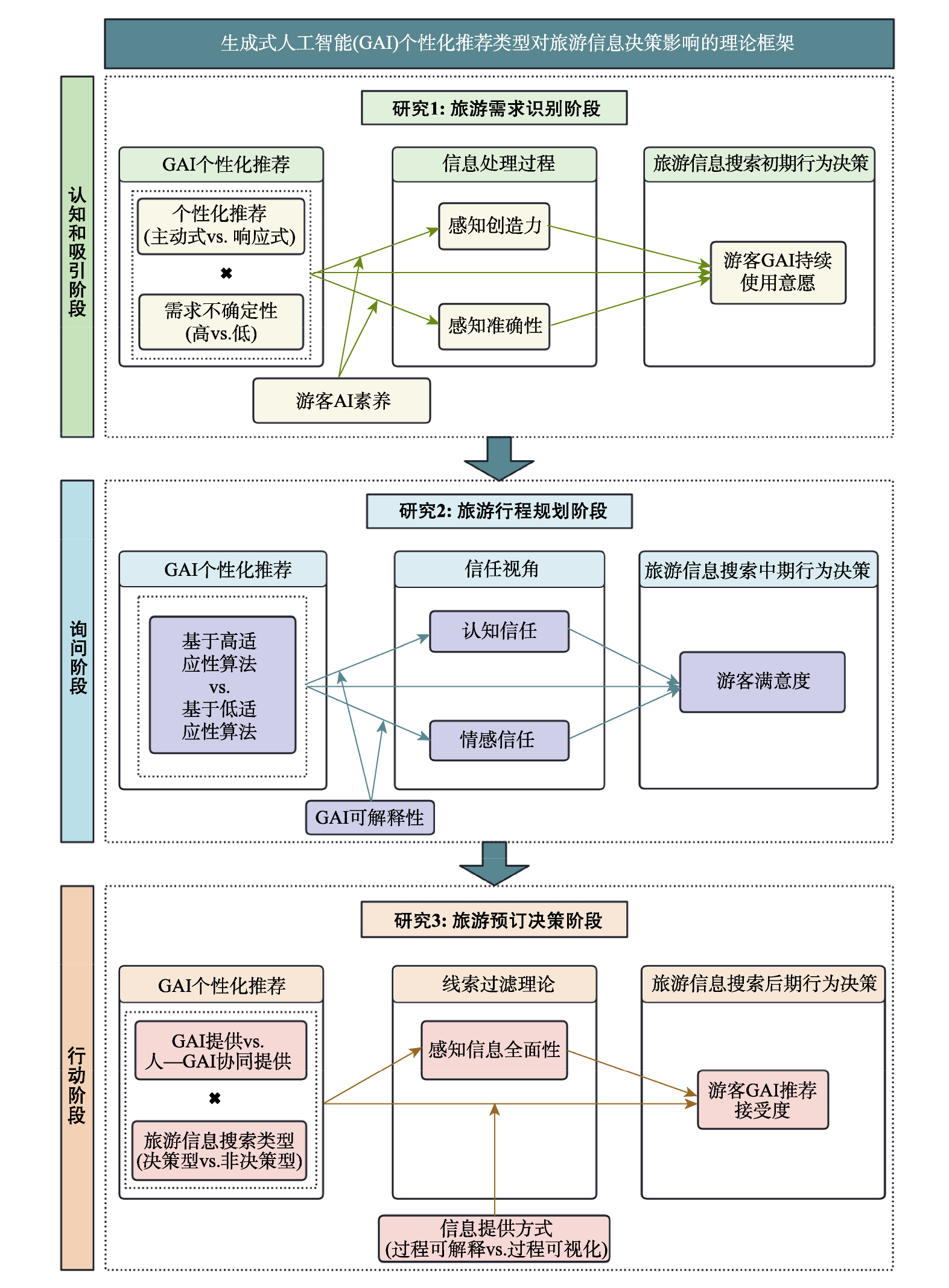
| 研究1 旅游需求识别阶段 | 认知和吸引阶段:用户被动了解品牌, 关注少数有吸引力的品牌。 | ·信息过载 ·偏好匹配 ·信息真实性 | ·缺乏互动 ·难以识别潜在需求 ·逻辑推理能力有限 | ·多模态互动 ·挖掘潜在需求 ·上下文理解能力强 | 主动式vs.响应式:该阶段关键在于由系统主动引导还是由游客输入驱动响应更能识别或满足游客需求。 |
| 研究2 旅游行程规划阶段 | 询问阶段:用户通过多渠道提问, 满足好奇心。 | ·好奇心强 ·性价比最优匹配难 ·选择方案多 ·期望不一致 | ·信息可及性低 ·对比分析能力弱 | ·信息可及性高 ·对话式互动 ·数据实时更新 | 高适应性vs.低适应性算法:该阶段核心任务由精准识别与匹配游客需求转向多方案比较与复杂信息整合, 算法适应性影响决策支持能力。 |
| 研究3 旅游预订决策阶段 | 行动阶段:积极的品牌信息促使用户做出承诺, 产生购买行为。 | ·预订程序繁杂 ·履约问题 ·售后及安全保障问题 ·最优价格比对难 | ·预订流程分散 ·仅执行单一任务 | ·模型算力大 ·预测能力强 ·一站式服务 ·多任务协同 | GAI提供vs.人−GAI协同:该阶段任务由信息处理转向风险控制与决策支持。 |
| 研究内容 | 5A特点 | 旅行前阶段特点 | 传统AI痛点 | GAI个性化特点 | GAI个性化推荐类型 |
|---|---|---|---|---|---|
| 研究1 旅游需求识别阶段 | 认知和吸引阶段:用户被动了解品牌, 关注少数有吸引力的品牌。 | ·信息过载 ·偏好匹配 ·信息真实性 | ·缺乏互动 ·难以识别潜在需求 ·逻辑推理能力有限 | ·多模态互动 ·挖掘潜在需求 ·上下文理解能力强 | 主动式vs.响应式:该阶段关键在于由系统主动引导还是由游客输入驱动响应更能识别或满足游客需求。 |
| 研究2 旅游行程规划阶段 | 询问阶段:用户通过多渠道提问, 满足好奇心。 | ·好奇心强 ·性价比最优匹配难 ·选择方案多 ·期望不一致 | ·信息可及性低 ·对比分析能力弱 | ·信息可及性高 ·对话式互动 ·数据实时更新 | 高适应性vs.低适应性算法:该阶段核心任务由精准识别与匹配游客需求转向多方案比较与复杂信息整合, 算法适应性影响决策支持能力。 |
| 研究3 旅游预订决策阶段 | 行动阶段:积极的品牌信息促使用户做出承诺, 产生购买行为。 | ·预订程序繁杂 ·履约问题 ·售后及安全保障问题 ·最优价格比对难 | ·预订流程分散 ·仅执行单一任务 | ·模型算力大 ·预测能力强 ·一站式服务 ·多任务协同 | GAI提供vs.人−GAI协同:该阶段任务由信息处理转向风险控制与决策支持。 |
| [1] |
梁少博, 史晨睿. (2025). AI助手解释方式如何影响用户质量感知与信任——基于参考资料与思考过程的比较实验. 情报理论与实践, 48(12), 137-146.
doi: 10.16353/j.cnki.1000-7490.2025.12.014 |
| [2] |
刘子萌, 袁勤俭. (2021). 五大线索理论的发展及其应用进展. 现代情报, 41(10), 140-149.
doi: 10.3969/j.issn.1008-0821.2021.10.016 |
| [3] | 吕巍, 杨颖, 张雁冰. (2020). AI个性化推荐下消费者感知个性化对其点击意愿的影响. 管理科学, 33(5), 44-57. |
| [4] | 吕兴洋, 杨玉帆, 许双玉, 刘小燕. (2021). 以情补智:人工智能共情回复的补救效果研究. 旅游学刊, 36(8), 86-100. |
| [5] | 马双, 王永贵, 卢花. (2025). 医生在线团队构建能缓解医疗机会不平等吗?——来自准自然实验的证据. 南开管理评论, 1-29. |
| [6] | 乔向杰, 赵子惠, 刘丁菀. (2026). 生成式AI行程规划持续使用意愿的双阶段适配机制. 旅游学刊, 41(2), 32-47. |
| [7] | 沈鹏熠, 朱澳男, 万德敏. (2025). 聊天机器人拟人化角色与交互行为对顾客持续使用意愿的影响——基于认知和情感的双路径研究. 软科学, 39(5), 19-25. |
| [8] | 张成洪, 陈刚, 陆天, 黄丽华. (2021). 可解释人工智能及其对管理的影响:研究现状和展望. 管理科学, 34(3), 63-79. |
| [9] | 张静, 刘远, 陈传明. (2015). 直觉型决策研究现状和展望. 外国经济与管理, 37(11), 72-84. |
| [10] | 邹波, 杨晓龙, 唐倩, 吴瑶. (2024). 花开并蒂:人与AI协同的场景化产品开发机会识别案例研究. 南开管理评论, 27(1), 51-65. |
| [11] |
Adam, M., Roethke, K., & Benlian, A. (2023). Human vs. automated sales agents: How and why customer responses shift across sales stages. Information Systems Research, 34(3), 1148-1168.
doi: 10.1287/isre.2022.1171 URL |
| [12] |
Aksoy, N. C., Kabadayi, E. T., Yilmaz, C., & Alan, A. K. (2021). A typology of personalisation practices in marketing in the digital age. Journal of Marketing Management, 37(11-12), 1091-1122.
doi: 10.1080/0267257X.2020.1866647 URL |
| [13] | Ali, F., Yasar, B., Ali, L., & Dogan, S. (2023). Antecedents and consequences of travelers’ trust towards personalized travel recommendations offered by ChatGPT. International Journal of Hospitality Management, 114, 103588. |
| [14] |
Bauer, K., von Zahn, M., & Hinz, O. (2023). Expl (AI)ned: The impact of explainable artificial intelligence on users’ information processing. Information Systems Research, 34(4), 1582-1602.
doi: 10.1287/isre.2023.1199 URL |
| [15] |
Blut, M., Wang, C., Wünderlich, N. V., & Brock, C. (2021). Understanding anthropomorphism in service provision: A meta-analysis of physical robots, chatbots, and other AI. Journal of the Academy of Marketing Science, 49(4), 632-658.
doi: 10.1007/s11747-020-00762-y |
| [16] |
Brüns, J. D., & Meißner, M. (2024). Do you create your content yourself? Using generative artificial intelligence for social media content creation diminishes perceived brand authenticity. Journal of Retailing and Consumer Services, 79, 103790.
doi: 10.1016/j.jretconser.2024.103790 URL |
| [17] |
Christensen, J., Hansen, J. M., & Wilson, P. (2025). Understanding the role and impact of Generative Artificial Intelligence (AI) hallucination within consumers’ tourism decision-making processes. Current Issues in Tourism, 28(4), 545-560.
doi: 10.1080/13683500.2023.2300032 URL |
| [18] |
Clegg, M., Hofstetter, R., de Bellis, E., & Schmitt, B. H. (2024). Unveiling the mind of the machine. Journal of Consumer Research, 51(2), 342-361.
doi: 10.1093/jcr/ucad075 URL |
| [19] | Demir, M., & Demir, Ş. Ş. (2023). Is ChatGPT the right technology for service individualization and value co-creation? Evidence from the travel industry. Journal of Travel & Tourism Marketing, 40(5), 383-398. |
| [20] |
Ghahramani, Z. (2015). Probabilistic machine learning and artificial intelligence. Nature, 521(7553), 452-459.
doi: 10.1038/nature14541 |
| [21] |
Grewal, D., Satornino, C. B., Davenport, T., & Guha, A. (2025). How generative AI Is shaping the future of marketing. Journal of the Academy of Marketing Science, 53(3), 702-722.
doi: 10.1007/s11747-024-01064-3 |
| [22] | Gupta, S., Modgil, S., Lee, C. K., Cho, M., & Park, Y. (2022). Artificial intelligence enabled robots for stay experience in the hospitality industry in a smart city. Industrial Management & Data Systems, 122(10), 2331-2350. |
| [23] |
Gursoy, D. (2019). A critical review of determinants of information search behavior and utilization of online reviews in decision making process (invited paper for ‘luminaries’ special issue of International Journal of Hospitality Management). International Journal of Hospitality Management, 76, 53-60.
doi: 10.1016/j.ijhm.2018.06.003 URL |
| [24] | Gursoy, D., Li, Y., & Song, H. K. (2023). ChatGPT and the hospitality and tourism industry: An overview of current trends and future research directions. Journal of Hospitality Marketing & Management, 32(5), 579-592. |
| [25] |
Hoffmann, S., Joerss, T., Mai, R. B., & Akbar, P. (2022). Augmented reality-delivered product information at the point of sale: When information controllability backfires. Journal of the Academy of Marketing Science, 50(4), 743-776.
doi: 10.1007/s11747-022-00855-w |
| [26] |
Hoffmann, S., Lasarov, W., & Dwivedi, Y. K. (2024). AI-empowered scale development: Testing the potential of ChatGPT. Technological Forecasting and Social Change, 205, 123488.
doi: 10.1016/j.techfore.2024.123488 URL |
| [27] |
Huang, D. L., Markovitch, D. G., & Stough, R. A. (2024). Can chatbot customer service match human service agents on customer satisfaction? An investigation in the role of trust. Journal of Retailing and Consumer Services, 76, 103600.
doi: 10.1016/j.jretconser.2023.103600 URL |
| [28] |
Huang, G. I., Wong, I. A., Zhang, C. J., & Liang, Q. L. (2025). Generative AI inspiration and hotel recommendation acceptance: Does anxiety over lack of transparency matter? International Journal of Hospitality Management, 126, 104112.
doi: 10.1016/j.ijhm.2025.104112 URL |
| [29] |
Huang, M.-H., & Rust, R. T. (2018). Artificial intelligence in service. Journal of Service Research, 21(2), 155-172.
doi: 10.1177/1094670517752459 URL |
| [30] | Hung, C-L., Wu, J-H., Chen, P-Y., Xu, X. Y., Hsu, W-L., Lin, L-M., & Hsieh, M-C. (2023). Enhancing healthcare services and brand engagement through social media marketing: Integration of Kotler’s 5A framework with IDEA process. Information Processing & Management, 60(4), 103379. |
| [31] |
Kemp, A. (2024). Competitive advantage through artificial intelligence: Toward a theory of situated AI. Academy of Management Review, 49(3), 618-635.
doi: 10.5465/amr.2020.0205 URL |
| [32] |
Kim, J. H., Kim, J., Baek, T. H., & Kim, C. (2025). ChatGPT personalized and humorous recommendations. Annals of Tourism Research, 110, 103857.
doi: 10.1016/j.annals.2024.103857 URL |
| [33] |
Kim, J. H., Kim, J., Kim, S., & Hailu, T. B. (2024). Effects of AI ChatGPT on travelers’ travel decision-making. Tourism Review, 79(5), 1038-1057.
doi: 10.1108/TR-07-2023-0489 URL |
| [34] |
Kim, J. H., Kim, J., Park, J., Kim, C., Jhang, J., & King, B. (2025). When ChatGPT gives incorrect answers: The impact of inaccurate information by generative AI on tourism decision-making. Journal of Travel Research, 64(1), 51-73.
doi: 10.1177/00472875231212996 URL |
| [35] |
Kim, J., Kim, J. H., Kim, C., & Park, J. (2023). Decisions with ChatGPT: Reexamining choice overload in ChatGPT recommendations. Journal of Retailing and Consumer Services, 75, 103494.
doi: 10.1016/j.jretconser.2023.103494 URL |
| [36] | Knote, R., Janson, A., Söllner, M., & Leimeister, J. M. (2021). Value co-creation in smart services: A functional affordances perspective on smart personal assistants. Journal of the Association for Information Systems, 22(2), 418-458. |
| [37] | Kotler, P., Kartajaya, H., & Setiawan, I. (Eds). (2016). Marketing 4.0: Moving from traditional to digital (1st Edition). New Jersey: Wiley. |
| [38] | Li, C., & Zheng, W. M. (2025). Nipping trouble in the bud: A proactive tourism recommender system. Information & Management, 62(1), 104062. |
| [39] |
Li, D. M., Liu, C. M., & Xie, L. S. (2022). How do consumers engage with proactive service robots? The roles of interaction orientation and corporate reputation. International Journal of Contemporary Hospitality Management, 34(11), 3962-3981.
doi: 10.1108/IJCHM-10-2021-1284 URL |
| [40] |
Li, F. X., & Ma, J. N. (2024). The effect of implied motion in travel photographs on visit intention: The mediating role of mental imagery. Tourism Management, 104, 104919.
doi: 10.1016/j.tourman.2024.104919 URL |
| [41] |
Li, Y., & Lee, S. O. (2025). Navigating the generative AI travel landscape: The influence of ChatGPT on the evolution from new users to loyal adopters. International Journal of Contemporary Hospitality Management, 37(4), 1421-1447.
doi: 10.1108/IJCHM-11-2023-1767 URL |
| [42] |
Li, Y., Li, Y., Chen, Q., & Chang, Y. P. (2024). Humans as teammates: The signal of human-AI teaming enhances consumer acceptance of chatbots. International Journal of Information Management, 76, 102771.
doi: 10.1016/j.ijinfomgt.2024.102771 URL |
| [43] |
Luo, X. Y., Xu, D., Li, Y., & Wan, L. C. (2025). Advancing information search through GenAI: The roles of search type, travel motive and GenAI customization level. International Journal of Contemporary Hospitality Management, 37(5), 1725-1743.
doi: 10.1108/IJCHM-06-2024-0941 URL |
| [44] |
Lv, X. Y., Yang, Y. F., Qin, D. Z., Cao, X. P., & Xu, H. (2022). Artificial intelligence service recovery: The role of empathic response in hospitality customers’ continuous usage intention. Computers in Human Behavior, 126, 106993.
doi: 10.1016/j.chb.2021.106993 URL |
| [45] |
Masialeti, M., Talaei-Khoei, A., & Yang, A. T. (2024). Revealing the role of explainable AI: How does updating AI applications generate agility-driven performance? International Journal of Information Management, 77, 102779.
doi: 10.1016/j.ijinfomgt.2024.102779 URL |
| [46] |
Merfeld, K., Klein, J., Regt, A., Riegger, A.-S., & Henkel, S. (2025). In-store technology personalization: A typology and research agenda based on type of automation and data collection. Journal of Business Research, 191, 115236.
doi: 10.1016/j.jbusres.2025.115236 URL |
| [47] |
McAllister, D. J. (1995). Affect- and cognition-based trust as foundations for interpersonal cooperation in organizations. Academy of Management Journal, 38(1), 24-59.
doi: 10.2307/256727 URL |
| [48] | Mich, L., & Garigliano, R. (2023). ChatGPT for e-Tourism: A technological perspective. Information Technology & Tourism, 25(1), 1-12. |
| [49] |
Niu, B., & Mvondo.G. F. N. (2024). I Am ChatGPT, the ultimate AI Chatbot! Investigating the determinants of users’ loyalty and ethical usage concerns of ChatGPT. Journal of Retailing and Consumer Services, 76, 103562.
doi: 10.1016/j.jretconser.2023.103562 URL |
| [50] | Noor, N., Rao Hill, S., & Troshani, I. (2022). Recasting service quality for AI-based service. Australasian Marketing Journal, 30(4), 297-312. |
| [51] |
Pan, B., & Fesenmaier, D. R. (2006). Online information search: Vacation planning process. Annals of Tourism Research, 33(3), 809-832.
doi: 10.1016/j.annals.2006.03.006 URL |
| [52] |
Qin, H. Y., Zhu, Y. F., Jiang, Y., Luo, S. Q., & Huang, C. (2024). Examining the impact of personalization and carefulness in AI-generated health advice: Trust, adoption, and insights in online healthcare consultations experiments. Technology in Society, 79, 102726.
doi: 10.1016/j.techsoc.2024.102726 URL |
| [53] |
Rai, A. (2020). Explainable AI: From black box to glass box. Journal of the Academy of Marketing Science, 48(1), 137-141.
doi: 10.1007/s11747-019-00710-5 |
| [54] | Saleh, M. I. (2025). Generative artificial intelligence in hospitality and tourism: Future capabilities, AI prompts and real-world applications. Journal of Hospitality Marketing & Management, 34(4), 467-498. |
| [55] |
Seo, I. T., Liu, H. B., Li, H. Y., & Lee, J.-S. (2025). AI-infused video marketing: Exploring the influence of AI-generated tourism videos on tourist decision-making. Tourism Management, 110, 105182.
doi: 10.1016/j.tourman.2025.105182 URL |
| [56] | Shankar, V. (2018). How artificial intelligence (AI) is reshaping retailing. Journal of Retailing, 94(4), VI-XI. |
| [57] |
Shi, J., Lee, M., Girish, V. G., Xiao, G. Y., & Lee, C.-K. (2024). Embracing the ChatGPT revolution: Unlocking new horizons for tourism. Journal of Hospitality and Tourism Technology, 15(3), 433-448.
doi: 10.1108/JHTT-07-2023-0203 URL |
| [58] |
Shi, S., Gong, Y. H., & Gursoy, D. (2021). Antecedents of trust and adoption intention toward artificially intelligent recommendation systems in travel planning: A heuristic- systematic model. Journal of Travel Research, 60(8), 1714-1734.
doi: 10.1177/0047287520966395 URL |
| [59] |
Shrestha, Y. R., Ben-Menahem, S. M., & von Krogh, G. (2019). Organizational decision-making structures in the age of artificial intelligence. California Management Review, 61(4), 66-83.
doi: 10.1177/0008125619862257 |
| [60] | Simon, H., A. (1978). Information-processing theory of human problem solving. In W. K. Estes (Ed.), Handbook of learning and cognitive processes (pp. 271-295). Lawrence Erlbaum Associates. |
| [61] |
Söderlund, M. (2018). The proactive employee on the floor of the store and the impact on customer satisfaction. Journal of Retailing and Consumer Services, 43, 46-53.
doi: 10.1016/j.jretconser.2018.02.009 URL |
| [62] |
Tan, K. P.-S., Liu, Y. V., & Litvin, S. W. (2025). ChatGPT and online service recovery: How potential customers react to managerial responses of negative reviews. Tourism Management, 107, 105057.
doi: 10.1016/j.tourman.2024.105057 URL |
| [63] | Tully, S. M., Longoni, C., & Appel, G. (2025). Lower artificial intelligence literacy predicts greater AI receptivity. Journal of Marketing, 89(5), 1-20. |
| [64] |
Wang, X. H., Zhang, Z. L., Huang, D., & Li, Z. Y. (2023). Consumer resistance to service robots at the hotel front desk: A mixed-methods research. Tourism Management Perspectives, 46, 101074.
doi: 10.1016/j.tmp.2023.101074 URL |
| [65] | Weith, H., & Matt, C. (2023). Information provision measures for voice agent product recommendations—The effect of process explanations and process visualizations on fairness perceptions. Electronic Markets, 33(1), 57. |
| [66] |
Wien, A. H., & Peluso, A. M. (2021). Influence of human versus AI recommenders: The roles of product type and cognitive processes. Journal of Business Research, 137, 13-27.
doi: 10.1016/j.jbusres.2021.08.016 URL |
| [67] |
Wong, I. A., Lian, Q. L., & Sun, D. N. (2023). Autonomous travel decision-making: An early glimpse into ChatGPT and generative AI. Journal of Hospitality and Tourism Management, 56, 253-263.
doi: 10.1016/j.jhtm.2023.06.022 URL |
| [68] |
Xiao, B., & Benbasat, I. (2007). E-commerce product recommendation agents: Use, characteristics, and impact. MIS Quarterly, 31(1), 137-209.
doi: 10.2307/25148784 URL |
| [69] |
Xie, L. S., Liu, C. M., & Li, D. M. (2022). Proactivity or passivity? An investigation of the effect of service robots’ proactive behaviour on customer co-creation intention. International Journal of Hospitality Management, 106, 103271.
doi: 10.1016/j.ijhm.2022.103271 URL |
| [70] |
Xu, X. A., & Liu, J. (2022). Artificial intelligence humor in service recovery. Annals of Tourism Research, 95, 103439.
doi: 10.1016/j.annals.2022.103439 URL |
| [71] |
Zarezadeh, Z. Z., Benckendorff, P., & Gretzel, U. (2023). Online tourist information search strategies. Tourism Management Perspectives, 48, 101140.
doi: 10.1016/j.tmp.2023.101140 URL |
| [72] |
Zhang, B., & Sundar, S. S. (2019). Proactive vs. reactive personalization: Can customization of privacy enhance user experience? International Journal of Human-Computer Studies, 128, 86-99.
doi: 10.1016/j.ijhcs.2019.03.002 URL |
| [73] |
Zhang, J. J., Wang, Y. W., Ruan, Q., & Yang, Y. (2024). Digital tourism interpretation content quality: A comparison between AI-generated content and professional-generated content. Tourism Management Perspectives, 53, 101279.
doi: 10.1016/j.tmp.2024.101279 URL |
| [74] |
Zhang, X., Yu, P., & Cui, H. (2026). How do cognitive styles affect knowledge creation in human-GenAI collaboration? The role of knowledge seeking and GenAI personalisation. International Journal of Information Management, 89, 103062.
doi: 10.1016/j.ijinfomgt.2026.103062 URL |
| [75] |
Zhu, Y. M., Zhang, J. M., Wu, J. F., & Liu, Y. Y. (2022). AI is better when I’m sure: The influence of certainty of needs on consumers’ acceptance of AI chatbots. Journal of Business Research, 150, 642-652.
doi: 10.1016/j.jbusres.2022.06.044 URL |
| [1] | ZHENG Yu, CHEN Yi, WU Yueyan. How do generative AI teammates affect team new product idea generation? A perspective from team process [J]. Advances in Psychological Science, 2025, 33(10): 1684-1697. |
| [2] | ZHU Yanhan, CHEN Guoliang, XU Junying. Mindfulness in organization: Cognition-oriented dynamic derivative process and interventions [J]. Advances in Psychological Science, 2020, 28(3): 510-522. |
| Viewed | ||||||
|
Full text |
|
|||||
|
Abstract |
|
|||||
