

ISSN 1671-3710
CN 11-4766/R
主办:中国科学院心理研究所
出版:科学出版社
CN 11-4766/R
主办:中国科学院心理研究所
出版:科学出版社
心理科学进展 ›› 2026, Vol. 34 ›› Issue (4): 647-665.doi: 10.3724/SP.J.1042.2026.0647 cstr: 32111.14.2026.0647
钟科1, 王振邦1, 杨霖云1, 李佩镅2( )
)
收稿日期:2025-10-13
出版日期:2026-04-15
发布日期:2026-03-02
通讯作者:
李佩镅, E-mail: lipeimei@hceb.edu.cn基金资助:
ZHONG Ke1, WANG Zhenbang1, YANG Linyun1, LI Peimei2()
Received:2025-10-13
Online:2026-04-15
Published:2026-03-02
摘要:
促进消费者的亲环境行为是近年来的热点研究话题。现有研究更多关注亲环境行为意图形成的前因及干预手段, 忽视了个体行为的实际结果可能偏离意图的现象。本研究提出消费者亲环境行为存在“意图−结果不一致效应”, 并计划开展系列研究构建理论框架, 以揭示亲环境行为何时及为何出现主观意图与客观结果的不一致。具体而言, 本研究试图从社会困境中的个体动机冲突切入, 从环境效能考量、自利考量和公正考量三种动机维度考察意图−结果不一致的诱因和表现形式, 分别论证绿色效能错觉效应、新奇陌生排斥效应以及旁观者错怪效应的研究构想, 验证其心理机制并提出针对性干预措施。研究结论为未来绿色消费的研究延展出“客观结果与主观意图差异”这一新的聚焦点, 不仅为政策制定者提供基于行为科学的精准干预方案, 并且对促进绿色消费、推动可持续发展实践有重要理论价值与应用启示。
中图分类号:
钟科, 王振邦, 杨霖云, 李佩镅. (2026). 探索消费者亲环境行为中的意图−结果不一致效应. 心理科学进展 , 34(4), 647-665.
ZHONG Ke, WANG Zhenbang, YANG Linyun, LI Peimei. (2026). Exploring the behavioral intention-outcome inconsistency effect in consumers’ pro-environmental behavior. Advances in Psychological Science, 34(4), 647-665.
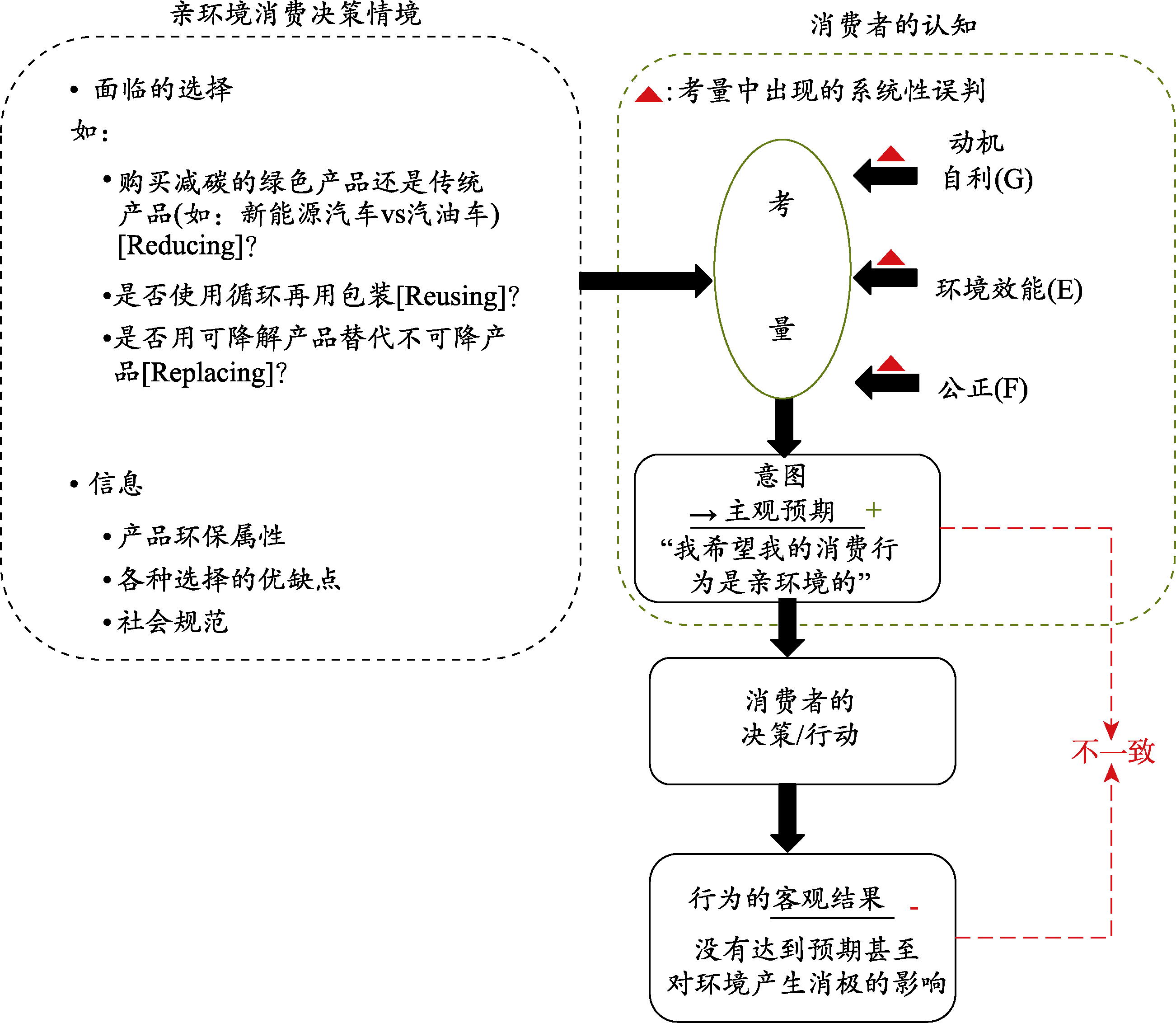
图1 GEF模型与意图−结果不一致效应 资料来源:作者整理
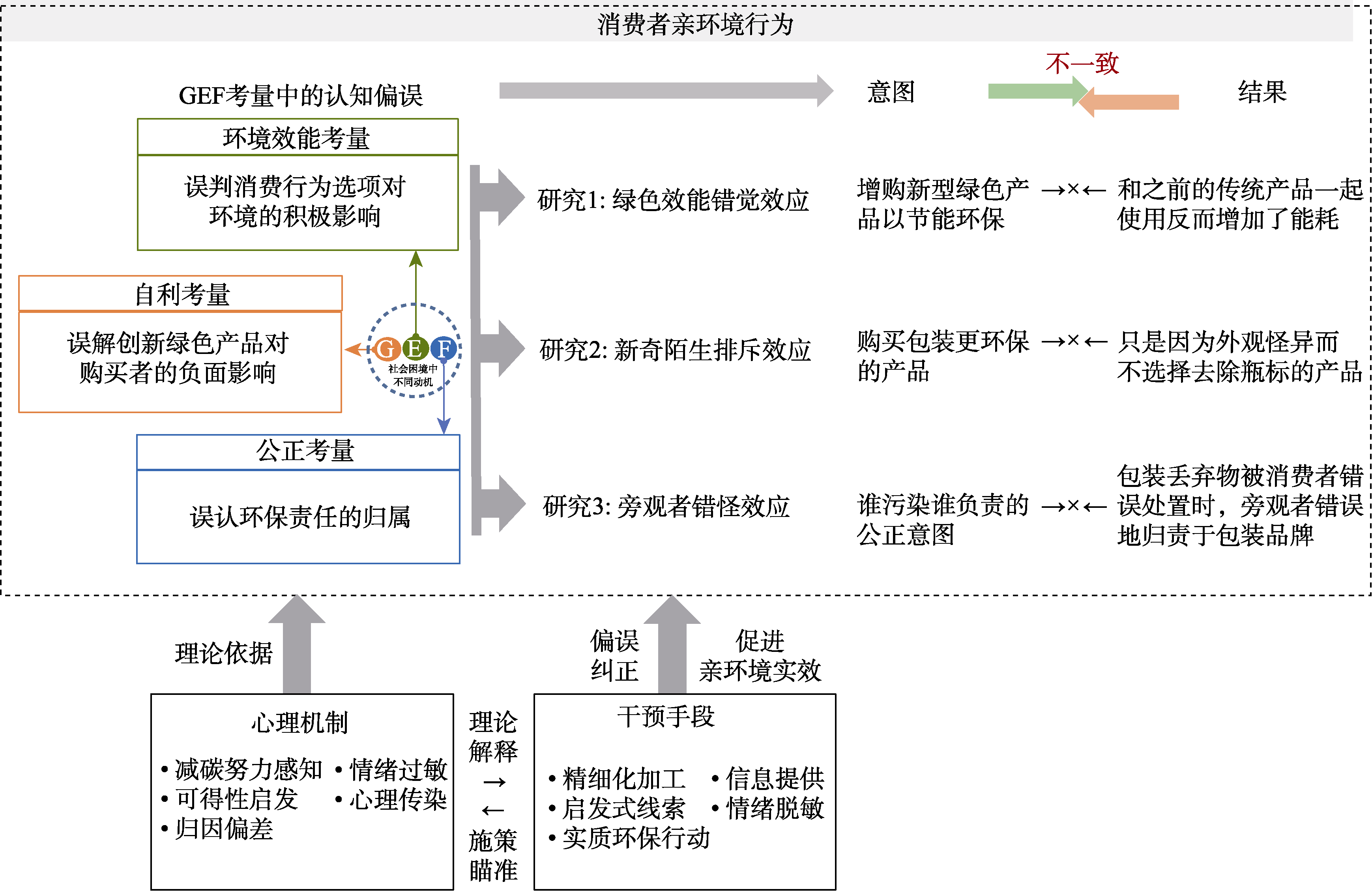
图2 本研究的模型框架图 资料来源:作者整理
| [1] |
陈斯允, 徐惠琪, 李诗颖, 牛小曼, 许丽颖. (2024). 俭以养德?节俭对亲社会行为的双刃剑效应及其理论解释. 心理科学进展, 32(10), 1680-1696.
doi: 10.3724/SP.J.1042.2024.01680 |
| [2] | 代昀昊, 王晓允, 童心楚. (2024). 从共享经济到低碳经济——来自共享单车平台进驻的证据. 数量经济技术经济研究, 41(4), 111-130. |
| [3] | 董雪旺, 徐宁宁, 崔凤军, 管婧婧, 王舟杰. (2023). 游客垃圾分类意愿的影响因素及形成机理研究. 旅游科学, 37(4), 76-96. |
| [4] |
傅鑫媛, 辛自强, 楼紫茜, 高琰. (2019). 基于助推的环保行为干预策略. 心理科学进展, 27(11), 1939-1950.
doi: 10.3724/SP.J.1042.2019.01939 |
| [5] |
龚思羽, 盛光华. (2023). 产品绿色属性信息对消费者决策的双刃剑效应:形成机理与边界机制. 心理科学进展, 31(9), 1611-1625.
doi: 10.3724/SP.J.1042.2023.01611 |
| [6] | 黄敏学, 胡秀, 郑仕勇. (2018). 广告中产品信息呈现越精确越好吗?——可接近性-可诊断性视角. 营销科学学报, 14(Z1), 151-169. |
| [7] |
戚海峰, 于辉, 向伟林, 孙韵益, 徐昌皓. (2019). 绿色消费情境下消费者为什么会言行不一? 心理科学进展, 27(7), 1307-1319.
doi: 10.3724/SP.J.1042.2019.01307 |
| [8] | 盛光华, 岳蓓蓓, 龚思羽. (2019). 绿色广告诉求与信息框架匹配效应对消费者响应的影响. 管理学报, 16(3), 439-446. |
| [9] |
孙瑾, 陈晨. (2024). 资源类型对绿色消费的影响:时间还是金钱更有效?. 心理科学进展, 32(1), 39-57.
doi: 10.3724/SP.J.1042.2024.00039 |
| [10] | 王建明. (2007). 消费者为什么选择循环行为——城市消费者循环行为影响因素的实证研究. 中国工业经济(10), 95-102. |
| [11] | 汪祚军, 李纾. (2012). 对整合模型和占优启发式模型的检验: 基于信息加工过程的眼动研究证据. 心理学报, 44(2), 179-198. |
| [12] |
Aarts, H., Verplanken, B., & van Knippenberg, A. (1997). Habit and information use in travel mode choices. Acta Psychologica, 96(1-2), 1-14.
doi: 10.1016/S0001-6918(97)00008-5 URL |
| [13] |
Ajzen, I. (1991). The theory of planned behavior. Organizational Behavior and Human Decision Processes, 50(2), 179-211.
doi: 10.1016/0749-5978(91)90020-T URL |
| [14] |
Allcott, H. (2011). Social norms and energy conservation. Journal of Public Economics, 95(9-10), 1082-1095.
doi: 10.1016/j.jpubeco.2011.03.003 URL |
| [15] |
Allcott, H., & Mullainathan, S. (2010). Behavior and energy policy. Science, 327(5970), 1204-1205.
doi: 10.1126/science.1180775 pmid: 20203035 |
| [16] |
Andrade, E. B., & Vieites, Y. (2025). Obstacles and opportunities for sustainable consumption: A comprehensive conceptual model, literature review, and research agenda. Journal of Consumer Psychology, 35(4), 637-662.
doi: 10.1002/jcpy.v35.4 URL |
| [17] |
Appiah, M. K., Gyening, E. K., Teye, P. K., Frimpong, C., & Nsowah, A. (2023). The implications of energy literacy on energy savings behavior: A model of contingent effects of energy value and attitude. Energy Reports, 10, 72-85.
doi: 10.1016/j.egyr.2023.06.008 URL |
| [18] |
Aspara, J., Luo, X., & Dhar, R. (2017). Effect of intelligence on consumers' responsiveness to a pro-environmental tax: Evidence from large-scale data on car acquisitions of male consumers. Journal of Consumer Psychology, 27(4), 448-455.
doi: 10.1016/j.jcps.2017.03.002 URL |
| [19] |
Baca-Motes, K., Brown, A., Gneezy, A., Keenan, E. A., & Nelson, L. D. (2013). Commitment and behavior change: Evidence from the field. Journal of Consumer Research, 39(5), 1070-1084.
doi: 10.1086/667226 URL |
| [20] |
Bachman, W., & Katzev, R. (1982). The effects of non-contingent free bus tickets and personal commitment on urban bus ridership. Transportation Research Part A: General, 16(2), 103-108.
doi: 10.1016/0191-2607(82)90002-4 URL |
| [21] | Barth, M., Masson, T., Fritsche, I., Fielding, K., & Smith, J. R. (2021). Collective responses to global challenges: The social psychology of pro-environmental action. Journal of Environmental Psychology, 74, Article 101562. https://doi.org/10.1016/j.jenvp.2021.101562 |
| [22] | Bonini, N., Hadjichristidis, C., & Graffeo, M. (2018). Green nudging. Acta Psychologica Sinica (心理学报), 50(8), 814-826. |
| [23] |
Byun, K. A., Ma, M., Kim, K., & Kang, T. (2021). Buying a new product with inconsistent product reviews from multiple sources: The role of information diagnosticity and advertising. Journal of Interactive Marketing, 55(1), 81-103.
doi: 10.1016/j.intmar.2021.01.003 URL |
| [24] |
Chaihanchanchai, P., & Anantachart, S. (2023). Encouraging green product purchase: Green value and environmental knowledge as moderators of attitude and behavior relationship. Business Strategy and the Environment, 32(1), 289-303.
doi: 10.1002/bse.v32.1 URL |
| [25] | Chang, C. (2011). Feeling ambivalent about going green. Journal of Advertising, 40(4), 19-32. |
| [26] |
Chen, Y. S. (2010). The drivers of green brand equity: Green brand image, green satisfaction, and green trust. Journal of Business Ethics, 93(2), 307-319.
doi: 10.1007/s10551-009-0223-9 URL |
| [27] | Composto, J. W., & Weber, E. U. (2022). Effectiveness of behavioural interventions to reduce household energy demand: A scoping review. Environmental Research Letters, 17(6), Article 063005. https://doi.org/10.1088/1748-9326/ac71b8 |
| [28] | Cooper, E., Dolnicar, S., & Grün, B. (2024). Understanding how a commitment-based pledge intervention encourages pro-environmental tourist behaviour. Tourism Management, 104, Article 104928. https://doi.org/10.1016/j.tourman.2024.104928 |
| [29] |
Delmas, M. A., & Montes-Sancho, M. J. (2010). Voluntary agreements to improve environmental quality: Symbolic and substantive cooperation. Strategic Management Journal, 31(6), 575-601.
doi: 10.1002/smj.v31:6 URL |
| [30] | Derksen, M., van Alphen, J., Schaap, S., Mathot, S., & Naber, M. (2018). Pupil mimicry is the result of brightness perception of the iris and pupil. Journal of Cognition, 1(1), Article 32. https://doi.org/10.5334/joc.34 |
| [31] |
Dermody, J., Zhao, A. L., Koenig-Lewis, N., & Hanmer-Lloyd, S. (2021). Evaluating the challenge of China's crossverging young “Enviro-Materialists”. Journal of Consumer Behaviour, 20(3), 695-708.
doi: 10.1002/cb.v20.3 URL |
| [32] | De Temmerman, J., Slabbinck, H., & Vermeir, I. (2023). The wrap-less revolution: Consumer segmentation by facilitators of and barriers to package-free shopping. Resources, Conservation and Recycling, 199, Article 107265. https://doi.org/10.1016/j.resconrec.2023.107265 |
| [33] |
Di Muro, F., & Noseworthy, T. J. (2013). Money isn’t everything, but it helps if it doesn’t look used: How the physical appearance of money influences spending. Journal of Consumer Research, 39(6), 1330-1342.
doi: 10.1086/668406 URL |
| [34] |
Dubois, P., Albuquerque, P., Allais, O., Bonnet, C., Bertail, P., Combris, P.,... Chandon, P. (2021). Effects of front-of-pack labels on the nutritional quality of supermarket food purchases: Evidence from a large-scale randomized controlled trial. Journal of the Academy of Marketing Science, 49(1), 119-138.
doi: 10.1007/s11747-020-00723-5 |
| [35] |
Fajardo, T. M., & Townsend, C. (2016). Where you say it matters: Why packages are a more believable source of product claims than advertisements. Journal of Consumer Psychology, 26(3), 426-434.
doi: 10.1016/j.jcps.2015.11.002 URL |
| [36] |
Fang, X., Singh, S., & Ahluwalia, R. (2007). An examination of different explanations for the mere exposure effect. Journal of Consumer Research, 34(1), 97-103.
doi: 10.1086/513050 URL |
| [37] | Fella, S., & Bausa, E. (2024). Green or greenwashed? Examining consumers' ability to identify greenwashing. Journal of Environmental Psychology, 95, Article 102281. https://doi.org/10.1016/j.jenvp.2024.102281 |
| [38] | Fishbein,, M., & Ajzen, I. (1981). Attitudes and voting behavior:An application of the theory of reasoned action. In G. M. Stephenson & J. M. Davis (Eds.), Progress in applied social psychology (Vol. 1, pp. 253-313). Wiley. |
| [39] |
Gerrath, M. H., & Biraglia, A. (2021). How less congruent new products drive brand engagement: The role of curiosity. Journal of Business Research, 127, 13-24.
doi: 10.1016/j.jbusres.2021.01.014 URL |
| [40] |
Gershoff, A. D., & Frels, J. K. (2015). What makes it green? The role of centrality of green attributes in evaluations of the greenness of products. Journal of Marketing, 79(1), 97-110.
doi: 10.1509/jm.13.0303 URL |
| [41] |
Gifford, R., & Nilsson, A. (2014). Personal and social factors that influence pro-environmental concern and behaviour: A review. International Journal of Psychology, 49(3), 141-157.
doi: 10.1002/ijop.12034 pmid: 24821503 |
| [42] |
Gorassini, D. R., & Olson, J. M. (1995). Does self-perception change explain the foot-in-the-door effect? Journal of Personality and Social Psychology, 69(1), 91-105.
doi: 10.1037/0022-3514.69.1.91 URL |
| [43] |
Guagnano, G. A., Dietz, T., & Stern, P. C. (1994). Willingness to pay for public goods: A test of the contribution model. Psychological Science, 5(6), 411-415.
doi: 10.1111/j.1467-9280.1994.tb00295.x URL |
| [44] | He, G., Pan, Y., Park, A., Sawada, Y., & Tan, E. S. (2023). Reducing single-use cutlery with green nudges: Evidence from China’s food-delivery industry. Science, 381(6662), Article eadd9884. https://doi.org/10.1126/science.add9884 |
| [45] | Hoffmann, R., Kanitsar, G., & Seifert, M. (2024). Behavioral barriers impede pro-environmental decision-making: Experimental evidence from incentivized laboratory and vignette studies. Ecological Economics, 225, Article 108347. https://doi.org/10.1016/j.ecolecon.2024.108347 |
| [46] | Hua, Y., & Mi, J. (2023). Will attitudes corrected by social norms have a more powerful impact on pro-environmental behavior? Evidence from a process model moderated by self-construal. Journal of Environmental Management, 345, Article 118603. https://doi.org/10.1016/j.jenvman.2023.118603 |
| [47] |
Huoponen, A. (2024). From concern to behavior: Barriers and enablers of adolescents’ pro-environmental behavior in a school context. Environmental Education Research, 30(5), 677-699.
doi: 10.1080/13504622.2023.2180374 URL |
| [48] | Kahneman, D. (2011). Thinking, fast and slow. Farrar, Straus and Giroux. |
| [49] |
Kollmuss, A., & Agyeman, J. (2002). Mind the gap: Why do people act environmentally and what are the barriers to pro-environmental behavior? Environmental Education Research, 8(3), 239-260.
doi: 10.1080/13504620220145401 URL |
| [50] |
Kothe, E. J., Ling, M., North, M., Klas, A., Mullan, B. A., & Novoradovskaya, L. (2019). Protection motivation theory and pro-environmental behaviour: A systematic mapping review. Australian Journal of Psychology, 71(4), 411-432.
doi: 10.1111/ajpy.12271 URL |
| [51] | Lee, J., Chu, W., & Roy, R. (2024). Enhancing consumer evaluation of new products: The role of innovation newness and communication strategy. Journal of Business Research, 182, Article 114766. https://doi.org/10.1016/j.jbusres.2024.114766 |
| [52] | Lee, S. H., Chang, H. J. J., & Zhao, L. (2023). The importance of personal norms and situational expectancies to sustainable behaviors: The norm activation and situational expectancy-value theories. Journal of Retailing and Consumer Services, 73, Article 103371. https://doi.org/10.1016/j.jretconser.2023.103371 |
| [53] | Li, Y., Johnson, E. J., & Zaval, L. (2011). Local warming: Daily temperature change influences belief in global warming. Psychological Science, 22(4), 454-459. |
| [54] |
Liebe, U., Gewinner, J., & Diekmann, A. (2021). Large and persistent effects of green energy defaults in the household and business sectors. Nature Human Behaviour, 5(5), 576-585.
doi: 10.1038/s41562-021-01070-3 pmid: 33707659 |
| [55] | Ling, M., & Xu, L. (2021). How and when financial incentives crowd out pro-environmental motivation: A longitudinal quasi-experimental study. Journal of Environmental Psychology, 78, Article 101715. https://doi.org/10.1016/j.jenvp.2021.101715 |
| [56] |
Lokhorst, A. M., Werner, C., Staats, H., van Dijk, E., & Gale, J. L. (2013). Commitment and behavior change: A meta-analysis and critical review of commitment-making strategies in environmental research. Environment and Behavior, 45(1), 3-34.
doi: 10.1177/0013916511411477 URL |
| [57] |
Lynch, J. G., Jr., Marmorstein, H., & Weigold, M. F. (1988). Choices from sets including remembered brands: Use of recalled attributes and prior overall evaluations. Journal of Consumer Research, 15(2), 169-184.
doi: 10.1086/jcr.1988.15.issue-2 URL |
| [58] | Lyon, T. P., & Montgomery, A. W. (2015). The means and end of greenwash. Organization & Environment, 28(2), 223-249. |
| [59] | Mathôt, S. (2018). Pupillometry: Psychology, physiology, and function. Journal of Cognition, 1(1), Article 16. https://doi.org/10.5334/joc.18 |
| [60] | Mertens, S. N., & Schultz, P. W. (2021). Referent group specificity: Optimizing normative feedback to increase residential recycling. Journal of Environmental Psychology, 73, Article 101541. https://doi.org/10.1016/j.jenvp.2020.101541 |
| [61] |
Nielsen, K. S., Brick, C., Hofmann, W., Joanes, T., Lange, F., & Gwozdz, W. (2022). The motivation-impact gap in pro-environmental clothing consumption. Nature Sustainability, 5(8), 665-668.
doi: 10.1038/s41893-022-00888-7 |
| [62] |
Nogueira, M., Dias, F., & Santos, V. (2023). Sustainable mobility choices: Exploring the impact of consumers' values, attitudes, perceived behavioural control and subjective norms on the likelihood to choose sustainable mobility options. Journal of Consumer Behaviour, 22(2), 511-528.
doi: 10.1002/cb.v22.2 URL |
| [63] |
Peattie, K. (2001). Towards sustainability: The third age of green marketing. The Marketing Review, 2(2), 129-146.
doi: 10.1362/1469347012569869 URL |
| [64] | Prinzing, M., Lades, L. K., Weber, T. O., Fredrickson, B., & Laffan, K. (2024). Pro-environmental behaviors and well-being in everyday life. Journal of Environmental Psychology, 98, Article 102394. https://doi.org/10.1016/j.jenvp.2024.102394 |
| [65] |
Renner, B., Sproesser, G., Stok, F. M., & Schupp, H. (2016). Eating in the dark: A dissociation between perceived and actual food consumption. Food Quality and Preference, 50, 145-151.
doi: 10.1016/j.foodqual.2016.02.010 URL |
| [66] |
Ro, C. (2023). Why a climate researcher pushed the limits of low-carbon travel—and his employer's patience. Nature, 624(7990), 215-216.
doi: 10.1038/d41586-023-03496-3 |
| [67] |
Rogers, R. W. (1975). A protection motivation theory of fear appeals and attitude change. The Journal of Psychology, 91(1), 93-114.
doi: 10.1080/00223980.1975.9915803 URL |
| [68] | Royer, S. J., Greco, F., Kogler, M., & Deheyn, D. D. (2023). Not so biodegradable: Polylactic acid and cellulose/plastic blend textiles lack fast biodegradation in marine waters. PLOS ONE, 18(5), Article e0284681. https://doi.org/10.1371/journal.pone.0284681 |
| [69] |
Schultz, P. W., Khazian, A. M., & Zaleski, A. C. (2008). Using normative social influence to promote conservation among hotel guests. Social Influence, 3(1), 4-23.
doi: 10.1080/15534510701755614 URL |
| [70] |
Schultz, P. W., Nolan, J. M., Cialdini, R. B., Goldstein, N. J., & Griskevicius, V. (2007). The constructive, destructive, and reconstructive power of social norms. Psychological Science, 18(5), 429-434.
doi: 10.1111/j.1467-9280.2007.01917.x pmid: 17576283 |
| [71] |
Schwartz, D., Loewenstein, G., & Agüero-Gaete, L. (2020). Encouraging pro-environmental behaviour through green identity labelling. Nature Sustainability, 3(9), 746-752.
doi: 10.1038/s41893-020-0543-4 |
| [72] | Schwartz, S. H. (1992). Universals in the content and structure of values:Theoretical advances and empirical tests in 20 countries. In M. P. Zanna (Ed.), Advances in experimental social psychology (Vol. 25, pp. 1-65). Academic Press. |
| [73] |
Severis, R. M., Simioni, F. J., Moreira, J. M. M., & Alvarenga, R. A. (2019). Sustainable consumption in mobility from a life cycle assessment perspective. Journal of Cleaner Production, 234, 579-587.
doi: 10.1016/j.jclepro.2019.06.203 |
| [74] |
Sharma, K., Aswal, C., & Paul, J. (2023). Factors affecting green purchase behavior: A systematic literature review. Business Strategy and the Environment, 32(4), 2078-2092.
doi: 10.1002/bse.v32.4 URL |
| [75] |
Shaw, D., McMaster, R., & Newholm, T. (2016). Care and commitment in ethical consumption: An exploration of the ‘attitude-behaviour gap’. Journal of Business Ethics, 136(2), 251-265.
doi: 10.1007/s10551-014-2442-y URL |
| [76] |
Sokolova, T., Krishna, A., & Döring, T. (2023). Paper meets plastic: The perceived environmental friendliness of product packaging. Journal of Consumer Research, 50(3), 468-491.
doi: 10.1093/jcr/ucad008 URL |
| [77] | Sorcaru, I. A., Muntean, M. C., Manea, L. D., & Nistor, R. (2024). From social norms to pro-environmental behavior: The role of destination social responsibility for families traveling with children. Technological Forecasting and Social Change, 209, Article 123830. https://doi.org/10.1016/j.techfore.2024.123830 |
| [78] |
Stern, P. C., Dietz, T., & Guagnano, G. A. (1995). The new ecological paradigm in social-psychological context. Environment and Behavior, 27(6), 723-743.
doi: 10.1177/0013916595276001 URL |
| [79] |
Sun, J. J., Bellezza, S., & Paharia, N. (2021). Buy less, buy luxury: Understanding and overcoming product durability neglect for sustainable consumption. Journal of Marketing, 85(3), 28-43.
doi: 10.1177/0022242921993172 URL |
| [80] |
Sun, M., & Trudel, R. (2017). The effect of recycling versus trashing on consumption: Theory and experimental evidence. Journal of Marketing Research, 54(2), 293-305.
doi: 10.1509/jmr.15.0574 URL |
| [81] | Suri, D., Bongers, N., & Kube, S. (2025). Is pro-environmental effort affected by information about others’ behavior? Ecological Economics, 228, Article 108437. https://doi.org/10.1016/j.ecolecon.2024.108437 |
| [82] |
Taufique, K. M. R., Vocino, A., & Polonsky, M. J. (2017). The influence of eco-label knowledge and trust on pro-environmental consumer behaviour in an emerging market. Journal of Strategic Marketing, 25(7), 511-529.
doi: 10.1080/0965254X.2016.1240219 URL |
| [83] |
Techawachirakul, M., Pathak, A., Motoki, K., & Calvert, G. A. (2023). Negative halo effects of sustainable packaging. Psychology & Marketing, 40(12), 2627-2641.
doi: 10.1002/mar.v40.12 URL |
| [84] |
Tiefenbeck, V., Staake, T., Roth, K.& Sachs, O. (2013). For better or for worse? Empirical evidence of moral licensing in a behavioral energy conservation campaign. Energy Policy, 57, 160-171.
doi: 10.1016/j.enpol.2013.01.021 URL |
| [85] |
Tobler, C., Visschers, V. H., & Siegrist, M. (2012). Consumers’ knowledge about climate change. Climatic Change, 114(2), 189-209.
doi: 10.1007/s10584-011-0393-1 URL |
| [86] |
Treepongkaruna, S., Au Yong, H. H., Thomsen, S., & Kyaw, K. (2024). Greenwashing, carbon emission, and ESG. Business Strategy and the Environment, 33(8), 8526-8539.
doi: 10.1002/bse.v33.8 URL |
| [87] |
Trudel, R. (2019). Sustainable consumer behavior. Consumer Psychology Review, 2(1), 85-96.
doi: 10.1002/arcp.2019.2.issue-1 URL |
| [88] |
Trudel, R., Argo, J. J., & Meng, M. D. (2016). Trash or recycle? How product distortion leads to categorization error during disposal. Environment and Behavior, 48(7), 966-985.
doi: 10.1177/0013916515577635 URL |
| [89] |
Truong, Y., Mazloomi, H., & Berrone, P. (2021). Understanding the impact of symbolic and substantive environmental actions on organizational reputation. Industrial Marketing Management, 92, 307-320.
doi: 10.1016/j.indmarman.2020.05.006 URL |
| [90] |
Tversky, A., & Kahneman, D. (1974). Judgment under uncertainty: Heuristics and biases. Science, 185(4157), 1124-1131.
doi: 10.1126/science.185.4157.1124 pmid: 17835457 |
| [91] | Utgård, J., & Gaustad, T. (2024). Carbon emission reductions and offsets: Consumer perceptions of firm environmental sustainability. Journal of Cleaner Production, 470, Article 143300. https://doi.org/10.1016/j.jclepro.2024.143300 |
| [92] |
Van Valkengoed, A. M., Abrahamse, W., & Steg, L. (2022). To select effective interventions for pro-environmental behaviour change, we need to consider determinants of behaviour. Nature Human Behaviour, 6(11), 1482-1492.
doi: 10.1038/s41562-022-01473-w pmid: 36385176 |
| [93] |
Verplanken, B., Aarts, H., & van Knippenberg, A. (1997). Habit, information acquisition, and the process of making travel mode choices. European Journal of Social Psychology, 27(5), 539-560.
doi: 10.1002/(ISSN)1099-0992 URL |
| [94] | Von Borgstede,, C., Johansson, L. O., & Nilsson, A. (2018). Social dilemmas: Motivational, individual, and structural aspects influencing cooperation. In L. Steg & J. I. M. de Groot (Eds.), Environmental psychology (pp. 175-183). Wiley-Blackwell. |
| [95] |
Walker, K., & Wan, F. (2012). The harm of symbolic actions and green-washing: Corporate actions and communications on environmental performance and their financial implications. Journal of Business Ethics, 109(2), 227-242.
doi: 10.1007/s10551-011-1122-4 URL |
| [96] |
White, K., Habib, R., & Hardisty, D. J. (2019). How to SHIFT consumer behaviors to be more sustainable: A literature review and guiding framework. Journal of Marketing, 83(3), 22-49.
doi: 10.1177/0022242919825649 URL |
| [97] |
Wilke, H. A. (1991). Greed, efficiency and fairness in resource management situations. European Review of Social Psychology, 2(1), 165-187.
doi: 10.1080/14792779143000051 URL |
| [98] |
Wilson, T. D., & Gilbert, D. T. (2008). Explaining away: A model of affective adaptation. Perspectives on Psychological Science, 3(5), 370-386.
doi: 10.1111/j.1745-6924.2008.00085.x pmid: 26158955 |
| [99] | Wyss, A. M., Knoch, D., & Berger, S. (2022). When and how pro-environmental attitudes turn into behavior: The role of costs, benefits, and self-control. Journal of Environmental Psychology, 79, Article 101748. https://doi.org/10.1016/j.jenvp.2021.101748 |
| [100] | Xia, Z. (2022). Digital interventions for a sustainable future. Nature Reviews Psychology, 1(12), 690. |
| [101] |
Xu, L., Zhao, S., Cotte, J., & Cui, N. (2023). Cyclical time is greener: The impact of temporal perspective on pro- environmental behavior. Journal of Consumer Research, 50(4), 722-741.
doi: 10.1093/jcr/ucad016 URL |
| [102] | Xuan, X., & Zheng, Y. (2024). Collaborative mechanism and simulation of low-carbon travel for residents in community-built environment based on evolutionary game. Journal of Cleaner Production, 443, Article 141098. https://doi.org/10.1016/j.jclepro.2024.141098 |
| [103] |
Yan, L., Keh, H. T., & Chen, J. (2021). Assimilating and differentiating: The curvilinear effect of social class on green consumption. Journal of Consumer Research, 47(6), 914-936.
doi: 10.1093/jcr/ucaa041 URL |
| [104] | Yao, K., Ma, X., & Zhang, J. (2024, November 20). Green disguise or real action? The truth behind corporate greenwashing under stringent climate policy. Energy Economics, Article 108059. https://doi.org/10.1016/j.eneco.2024.108059 |
| [105] |
Zhong, K., Yan, Z., Sun, H., & Huang, R. (2025). Overcoming the challenge of “green enough”: Exploring the dark side of incremental green options. Psychology & Marketing, 42(3), 892-906.
doi: 10.1002/mar.v42.3 URL |
| [1] | 张玥, 董艺佳, 蒋奖. 从领域到属性:亲环境行为测量的问题及建议[J]. 心理科学进展, 2025, 33(1): 163-175. |
| [2] | 陈寿勇, 李静. 环境物质主义的发生机制及条件[J]. 心理科学进展, 2024, 32(12): 2109-2123. |
| [3] | 马双, 凌小蝶, 李纯青. 共享经济背景下顾客公民行为和不当行为:基于社会困境理论的视角[J]. 心理科学进展, 2021, 29(11): 1920-1935. |
| [4] | 李海虹, 邓州, 何欣, 申劭婧, 邹雅雯, 朱敏帆, 王芸, 谢晓非. 源于“反常”终于“常理”的禀赋效应[J]. 心理科学进展, 2019, 27(3): 394-405. |
| [5] | 陆欣欣, 涂乙冬. 分享还是不分享:社会困境视角下知识分享[J]. 心理科学进展, 2018, 26(11): 2057-2067. |
| [6] | 王建明, 吴龙昌. 亲环境行为研究中情感的类别、维度及其作用机理[J]. 心理科学进展, 2015, 23(12): 2153-2166. |
| [7] | 刘长江;郝芳. 不对称社会困境中的决策:行为的双重模式[J]. 心理科学进展, 2015, 23(1): 1-10. |
| [8] | 刘长江;郝芳. 社会困境问题的理论架构与实验研究[J]. 心理科学进展, 2014, 22(9): 1475-1484. |
| [9] | 吴宝沛;寇彧. 西方社会价值取向的研究历程与发展趋势[J]. 心理科学进展, 2008, 16(6): 987-992. |
| [10] | 刘长江;李岩梅;李纾. 实验社会心理学中的社会困境[J]. 心理科学进展, 2007, 15(2): 379-384. |
| [11] | 谢晓非;徐联仓. 公众在风险认知中的偏差[J]. 心理科学进展, 1996, 4(2): 23-26. |
| 阅读次数 | ||||||
|
全文 |
|
|||||
|
摘要 |
|
|||||
