

ISSN 1671-3710
CN 11-4766/R
主办:中国科学院心理研究所
出版:科学出版社
CN 11-4766/R
主办:中国科学院心理研究所
出版:科学出版社
心理科学进展 ›› 2026, Vol. 34 ›› Issue (3): 487-498.doi: 10.3724/SP.J.1042.2026.0487 cstr: 32111.14.2026.0487
岳丽明, 刘振南, 高湘萍( )
)
收稿日期:2025-06-20
出版日期:2026-03-15
发布日期:2026-01-07
通讯作者:
高湘萍, E-mail: gaoxp@shnu.edu.cn
YUE Liming, LIU Zhennan, GAO Xiangping()
Received:2025-06-20
Online:2026-03-15
Published:2026-01-07
摘要:
元认知反思是自主学习和高阶思维发展的核心机制, 其神经基础已成为认知神经科学与教育科学交叉领域的重要议题。然而, 现有研究尚缺乏能够系统解释不同类型反思的神经特异性及其网络协同机制的统一框架。本文首先梳理了元认知反思的核心成分, 并提出一个前瞻/回溯与即时/延迟相结合的二维分类框架。在此基础上, 系统回顾了前额叶、顶叶和扣带回三大关键脑区的功能证据, 并总结其在不同类型反思中的作用。通过整合空间网络与时间动态的研究成果, 本文进一步提出特异性−协同模型, 强调大规模脑网络的动态交互既体现不同类型元认知反思监控的神经通路特异性, 也揭示跨网络的协同规律。最后, 文章展望了未来在动态网络建模、生态效度提升和个体化干预等方向的研究前景, 旨在为元认知反思的机制研究提供统一的理论框架, 并为教育实践中的反思性学习提供新的神经科学视角。
中图分类号:
岳丽明, 刘振南, 高湘萍. (2026). 不同类型元认知反思的特异性与协同神经机制:一个整合性理论模型. 心理科学进展 , 34(3), 487-498.
YUE Liming, LIU Zhennan, GAO Xiangping. (2026). Distinctive and synergistic neural mechanisms of metacognitive reflection: An integrative theoretical model. Advances in Psychological Science, 34(3), 487-498.
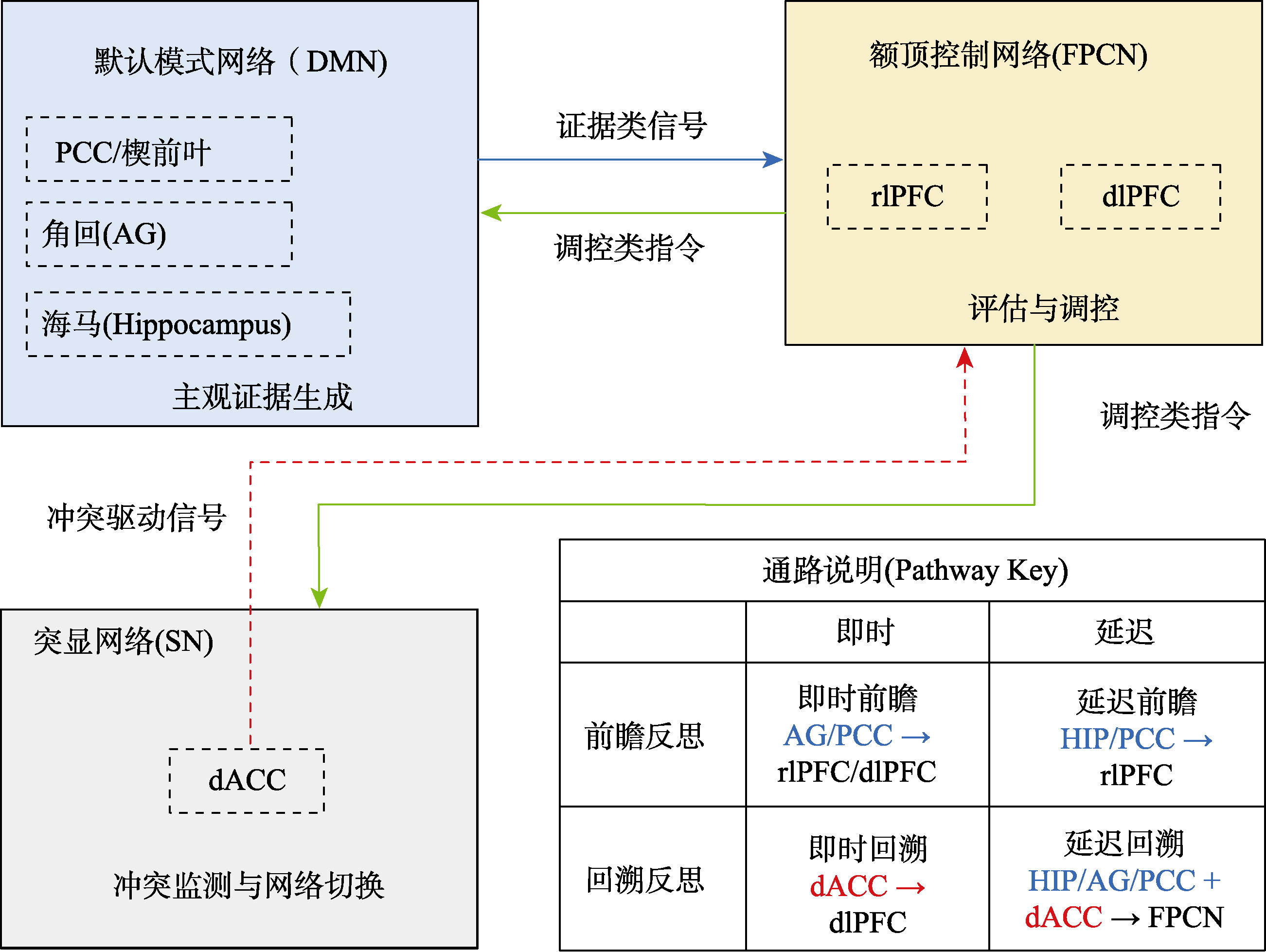
图1 元认知反思的“特异性−协同”双通路脑网络模型 注:本模型整合了元认知反思的“空间网络”与“时间动态”证据。左侧主体展示了元认知反思的宏观协同(Synergy)机制, 由默认模式网络(DMN)、突显网络(SN)与额顶控制网络(FPCN)形成动态闭环。右下侧2×2矩阵则展示了4种不同类型元认知反思监控的特异性(Specificity)神经通路。在该矩阵中, 通过颜色编码清晰地标示出每种通路主导的信息来源:蓝色代表通路主要源自DMN, 红色代表通路主要源自SN。所有通路最终都汇聚于负责信息整合与决策的中枢, 即额顶控制网络(FPCN)的节点(如rlPFC, dlPFC), 并以默认的黑色文本表示。在延迟回溯反思中, 灰色的箭头则特指整合了DMN与SN两种来源信号的多网络协同通路。脑区缩写—ACC:前扣带回皮层(anterior cingulate cortex); AG: 角回(angular gyrus); dACC: 背侧前扣带回(dorsal anterior cingulate cortex); dlPFC: 背外侧前额叶(dorsolateral prefrontal cortex); DMN: 默认模式网络(default mode network); FPCN: 额顶控制网络(fronto-parietal control network); HIP: 海马体(hippocampus); PCC: 后扣带回(posterior cingulate cortex); PFC: 前额叶皮层(prefrontal cortex); rlPFC: 额极皮层(rostrolateral prefrontal cortex); SN: 突显网络(salience network)。彩图见电子版。
| [1] |
Alter, A. L., & Oppenheimer, D. M. (2009). Uniting the tribes of fluency to form a metacognitive nation. Personality and Social Psychology Review, 13(3), 219-235.
doi: 10.1177/1088868309341564 pmid: 19638628 |
| [2] |
Baird, B., Smallwood, J., Gorgolewski, K. J., & Margulies, D. S. (2013). Medial and lateral networks in anterior prefrontal cortex support metacognitive ability for memory and perception. Journal of Neuroscience, 33(42), 16657-16665.
doi: 10.1523/JNEUROSCI.0786-13.2013 pmid: 24133268 |
| [3] | Becker, F., Wirzberger, M., Pammer-Schindler, V., Srinivas, S., & Lieder, F. (2023). Systematic metacognitive reflection helps people discover far-sighted decision strategies: A process-tracing experiment. Judgment and Decision Making, 18, e15. |
| [4] |
Boldt, A., & Yeung, N. (2015). Shared neural markers of decision confidence and error detection. Journal of Neuroscience, 35(8), 3478-3484.
doi: 10.1523/JNEUROSCI.0797-14.2015 pmid: 25716847 |
| [5] |
Buckner, R. L., & DiNicola, L. M. (2019). The brain’s default network: Updated anatomy, physiology and evolving insights. Nature Reviews Neuroscience, 20(10), 593-608.
doi: 10.1038/s41583-019-0212-7 pmid: 31492945 |
| [6] |
Bui, Y., Pyc, M. A., & Bailey, H. (2018). When people’s judgments of learning (JOLs) are extremely accurate at predicting subsequent recall: The “Displaced-JOL effect”. Memory, 26(6), 771-783.
doi: 10.1080/09658211.2017.1406523 URL |
| [7] |
Channon, S., & Crawford, S. (1999). Problem-solving in real-life-type situations: The effects of anterior and posterior lesions on performance. Neuropsychologia, 37(7), 757-770.
pmid: 10408644 |
| [8] |
Chua, E. F., Schacter, D. L., & Sperling, R. A. (2009). Neural correlates of metamemory: A comparison of feeling-of-knowing and retrospective confidence judgments. Journal of Cognitive Neuroscience, 21(9), 1751-1765.
doi: 10.1162/jocn.2009.21123 pmid: 18823230 |
| [9] |
Cole, M. W., Reynolds, J. R., Power, J. D., Repovs, G., Anticevic, A., & Braver, T. S. (2013). Multi-task connectivity reveals flexible hubs for adaptive task control. Nature Neuroscience, 16(9), 1348-1355.
doi: 10.1038/nn.3470 pmid: 23892552 |
| [10] | Cong, P., Long, Y., Zhang, X., Guo, Y., & Jiang, Y. (2024). Elucidating the underlying components of metacognitive systematic bias in the human dorsolateral prefrontal cortex and inferior parietal cortex. Scientific Reports, 14(1), 11380. |
| [11] |
D'Esposito, M., & Postle, B. R. (2015). The cognitive neuroscience of working memory. Annual Review of Psychology, 66(1), 115-142.
doi: 10.1146/psych.2015.66.issue-1 URL |
| [12] | Dias, C., Costa, D., Sousa, T., Castelhano, J., Figueiredo, V., Pereira, A. C., & Castelo-Branco, M. (2022). A neuronal theta band signature of error monitoring during integration of facial expression cues. PeerJ, 10, e12627. |
| [13] | Do Lam, A. T. A., Axmacher, N., Fell, J., Staresina, B. P., Gauggel, S., Wagner, T., Olligs, J., & Weis, S. (2012). Monitoring the mind: The neurocognitive correlates of metamemory. PLOS ONE, 7(1), e30009. |
| [14] | Dunlosky, J., & Metcalfe, J. (2009). Metacognition. Los Angeles, CA: SAGE Publications. |
| [15] | Fandakova, Y., Johnson, E. G., & Ghetti, S. (2021). Distinct neural mechanisms underlie subjective and objective recollection and guide memory-based decision making. eLife, 10, e62520. |
| [16] |
Fleming, S. M., & Dolan, R. J. (2012). The neural basis of metacognitive ability. Philosophical Transactions of the Royal Society B: Biological Sciences, 367(1594), 1338-1349.
doi: 10.1098/rstb.2011.0417 URL |
| [17] | Fleming, S. M., Massoni, S., Gajdos, T., & Vergnaud, J. C. (2016). Metacognition about the past and future: Quantifying common and distinct influences on prospective and retrospective judgments of self-performance. Neuroscience of Consciousness, 2016(1), niw018. |
| [18] |
Fleming, S. M., Ryu, J., Golfinos, J. G., & Blackmon, K. E. (2014). Domain-specific impairment in metacognitive accuracy following anterior prefrontal lesions. Brain, 137(10), 2811-2822.
doi: 10.1093/brain/awu221 URL |
| [19] |
Gehring, W. J., Goss, B., Coles, M. G. H., Meyer, D. E., & Donchin, E. (1993). A neural system for error detection and compensation. Psychological Science, 4(6), 385-390.
doi: 10.1111/j.1467-9280.1993.tb00586.x URL |
| [20] |
Hobot, J., Skóra, Z., Wierzchoń, M., & Sandberg, K. (2023). Continuous theta burst stimulation to the left anterior medial prefrontal cortex influences metacognitive efficiency. NeuroImage, 272, 119991.
doi: 10.1016/j.neuroimage.2023.119991 URL |
| [21] |
Irak, M., Soylu, C., & Yavuz, M. (2023). Comparing event-related potentials of retrospective and prospective metacognitive judgments during episodic and semantic memory. Scientific Reports, 13(1), 1949.
doi: 10.1038/s41598-023-28595-z pmid: 36732355 |
| [22] |
Janowsky, J. S., Shimamura, A. P., & Squire, L. R. (1989). Memory and metamemory: Comparisons between patients with frontal lobe lesions and amnesic patients. Psychobiology, 17(1), 3-11.
doi: 10.3758/BF03337811 |
| [23] |
Kao, Y. C., Davis, E. S., & Gabrieli, J. D. E.(2005). Neural correlates of actual and predicted memory formation. Nature Neuroscience, 8(12), 1776-1783.
doi: 10.1038/nn1595 URL |
| [24] | Kapetaniou, G. E., Moisa, M., Ruff, C. C., Tobler, P. N., & Soutschek, A. (2025). Frontopolar cortex interacts with dorsolateral prefrontal cortex to causally guide metacognition. Human Brain Mapping, 46(2), e70146. |
| [25] |
Kelley, T. D., McNeely, D. A., Serra, M. J., & Davis, T. (2021). Delayed judgments of learning are associated with activation of information from past experiences: A neurobiological examination. Psychological Science, 32(1), 96-108.
doi: 10.1177/0956797620958004 pmid: 33275057 |
| [26] |
Kerns, J. G., Cohen, J. D., MacDonald III, A. W., Cho, R. Y., Stenger, V. A., & Carter, C. S. (2004). Anterior cingulate conflict monitoring and adjustments in control. Science, 303(5660), 1023-1026.
doi: 10.1126/science.1089910 pmid: 14963333 |
| [27] |
Kim, H. (2010). Dissociating the roles of the default mode, dorsal, and ventral networks in episodic memory retrieval. NeuroImage, 50(4), 1648-1657.
doi: 10.1016/j.neuroimage.2010.01.051 URL |
| [28] |
Koriat, A. (1997). Monitoring one's own knowledge during study: A cue-utilization approach to judgments of learning. Journal of Experimental Psychology: General, 126(4), 349-370.
doi: 10.1037/0096-3445.126.4.349 URL |
| [29] |
Koriat, A., & Levy-Sadot, R. (2000). Conscious and unconscious metacognition: A rejoinder. Consciousness and Cognition, 9(2), 193-202.
doi: 10.1006/ccog.2000.0436 URL |
| [30] |
Koriat, A., & Ma’ayan, H. (2005). The effects of encoding fluency and retrieval fluency on judgments of learning. Journal of Memory and Language, 52(4), 478-492.
doi: 10.1016/j.jml.2005.01.001 URL |
| [31] | Li, Z., Dai, W., & Jia, N. (2024). The two-stage processing of judgment of confidence: Evidence from ERP. BMC Psychology, 12(1), 651. |
| [32] |
Menon, V. (2011). Large-scale brain networks and psychopathology: A unifying triple network model. Trends in Cognitive Sciences, 15(10), 483-506.
doi: 10.1016/j.tics.2011.08.003 pmid: 21908230 |
| [33] |
Menon, V., & Uddin, L. Q. (2010). Saliency, switching, attention and control: A network model of insula function. Brain Structure and Function, 214(5-6), 655-667.
doi: 10.1007/s00429-010-0262-0 URL |
| [34] |
Merkebu, J., Kitsantas, A., Durning, S. J., & Ma, T. (2023). What is metacognitive reflection? The moderating role of metacognition on emotional regulation and reflection. Frontiers in Education, 8, 1166195.
doi: 10.3389/feduc.2023.1166195 URL |
| [35] |
Metcalfe, J. (2009). Metacognitive judgments and control of study. Current Directions in Psychological Science, 18(3), 159-163.
doi: 10.1111/j.1467-8721.2009.01628.x pmid: 19750138 |
| [36] | Metcalfe, J., & Finn, B. (2008). Familiarity and retrieval processes in delayed judgments of learning. Journal of Experimental Psychology: Learning, Memory, and Cognition, 34( 5), 1084-1097. |
| [37] | Miró-Padilla, A., Adrián-Ventura, J., Cherednichenko, A., Monzonís-Carda, I., Beltran-Valls, M. R., Moliner- Urdiales, D., & Ávila, C. (2023). Relevance of the anterior cingulate cortex volume and personality in motivated physical activity behaviors. Communications Biology, 6(1), 1106. |
| [38] |
Miyamoto, K., Trudel, N., Kamermans, K., Lim, M. C., Lazari, A., Verhagen, L., ... Rushworth, M. F. (2021). Identification and disruption of a neural mechanism for accumulating prospective metacognitive information prior to decision-making. Neuron, 109(8), 1396-1408.
doi: 10.1016/j.neuron.2021.02.024 pmid: 33730554 |
| [39] |
Modirrousta, M., & Fellows, L. K. (2008). Medial prefrontal cortex plays a critical and selective role in ‘feeling of knowing’ meta-memory judgments. Neuropsychologia, 46(12), 2958-2965.
doi: 10.1016/j.neuropsychologia.2008.06.011 pmid: 18606176 |
| [40] |
Morales, J., Lau, H., & Fleming, S. M. (2018). Domain general and domain specific patterns of activity supporting metacognition in human prefrontal cortex. Journal of Neuroscience, 38(14), 3534-3546.
doi: 10.1523/JNEUROSCI.2360-17.2018 pmid: 29519851 |
| [41] |
Murphy, D. H., Rhodes, M. G., & Castel, A. D. (2024). Age-related differences in metacognitive reactivity in younger and older adults. Metacognition and Learning, 19(3), 863-877.
doi: 10.1007/s11409-024-09391-0 |
| [42] |
Nash, K., Leota, J., Kleinert, T., & Hayward, D. A. (2023). Anxiety disrupts performance monitoring: Integrating behavioral, event-related potential, EEG microstate, and sLORETA evidence. Cerebral Cortex, 33(7), 3787-3802.
doi: 10.1093/cercor/bhac307 URL |
| [43] |
Nelson, T. O., & Dunlosky, J. (1991). When people’s judgments of learning (JOLs) are extremely accurate at predicting subsequent recall: The delayed JOL effect. Psychological Science, 2(4), 267-270.
doi: 10.1111/j.1467-9280.1991.tb00147.x URL |
| [44] | Nelson, T. O., & Narens, L. (1990). Metamemory: A theoretical framework and new findings.In G. H. Bower (Ed.), Psychology of learning and motivation (Vol. 26, pp. 125-173). Academic Press. |
| [45] |
Oku, A. Y. A., & Sato, J. R. (2021). Predicting student performance using machine learning in fNIRS data. Frontiers in Human Neuroscience, 15, 622224.
doi: 10.3389/fnhum.2021.622224 URL |
| [46] | Qiu, L., Su, J., Ni, Y., Bai, Y., Zhang, X., Li, X., & Wan, X. (2018). The neural system of metacognition accompanying decision-making in the prefrontal cortex. PLoS Biology, 16(4), e2004037. |
| [47] |
Rhodes, M. G., & Tauber, S. K. (2011). The influence of delaying judgments of learning on metacognitive accuracy: A meta-analytic review. Psychological Bulletin, 137(1), 131-148.
doi: 10.1037/a0021705 pmid: 21219059 |
| [48] |
Roebers, C. M., Krebs, S. S., & Roderer, T. (2014). Metacognitive monitoring and control in elementary school children: Their interrelations and their role for test performance. Learning and Individual Differences, 29, 141-149.
doi: 10.1016/j.lindif.2012.12.003 URL |
| [49] | Rouault, M., McWilliams, A., Allen, M. G., & Fleming, S. M. (2019). Human metacognition across domains: Insights from individual differences and neuroimaging. Personality Neuroscience, 2, e12. |
| [50] |
Rounis, E., Maniscalco, B., Rothwell, J. C., Passingham, R. E., & Lau, H. (2010). Theta-burst transcranial magnetic stimulation to the prefrontal cortex impairs metacognitive visual awareness. Cognitive Neuroscience, 1(3), 165-175.
doi: 10.1080/17588921003632529 pmid: 24168333 |
| [51] |
Rugg, M. D., & Vilberg, K. L. (2013). Brain networks underlying episodic memory retrieval. Current Opinion in Neurobiology, 23(2), 255-260.
doi: 10.1016/j.conb.2012.11.005 pmid: 23206590 |
| [52] | Saccenti, D., Moro, A. S., Sassaroli, S., Malgaroli, A., Ferro, M., & Lamanna, J. (2024). Neural correlates of metacognition: Disentangling the brain circuits underlying prospective and retrospective second‐order judgments through noninvasive brain stimulation. Journal of Neuroscience Research, 102(4), e25330. |
| [53] |
Seeley, W. W., Menon, V., Schatzberg, A. F., Keller, J., Glover, G. H., Kenna, H., ... Greicius, M. D. (2007). Dissociable intrinsic connectivity networks for salience processing and executive control. Journal of Neuroscience, 27(9), 2349-2356.
doi: 10.1523/JNEUROSCI.5587-06.2007 pmid: 17329432 |
| [54] | Seow, T. X., Fleming, S. M., & Hauser, T. U. (2025). Metacognitive biases in anxiety-depression and compulsivity extend across perception and memory. PLOS Mental Health, 2(3), e0000259. |
| [55] |
Shekhar, M., & Rahnev, D. (2018). Distinguishing the roles of dorsolateral and anterior PFC in visual metacognition. Journal of Neuroscience, 38(22), 5078-5087.
doi: 10.1523/JNEUROSCI.3484-17.2018 pmid: 29720553 |
| [56] |
Shenhav, A., Botvinick, M. M., & Cohen, J. D. (2013). The expected value of control: An integrative theory of anterior cingulate cortex function. Neuron, 79(2), 217-240.
doi: 10.1016/j.neuron.2013.07.007 pmid: 23889930 |
| [57] |
Siedlecka, M., Paulewicz, B., & Wierzchoń, M. (2016). But I was so sure! Metacognitive judgments are less accurate given prospectively than retrospectively. Frontiers in Psychology, 7, 218.
doi: 10.3389/fpsyg.2016.00218 pmid: 26925023 |
| [58] |
Simons, J. S., Peers, P. V., Mazuz, Y. S., Berryhill, M. E., & Olson, I. R. (2010). Dissociation between memory accuracy and memory confidence following bilateral parietal lesions. Cerebral Cortex, 20(2), 479-485.
doi: 10.1093/cercor/bhp116 URL |
| [59] |
Sitaram, R., Ros, T., Stoeckel, L., Haller, S., Scharnowski, F., Lewis-Peacock, J., ... Sulzer, J. (2017). Closed-loop brain training: The science of neurofeedback. Nature Reviews Neuroscience, 18(2), 86-100.
doi: 10.1038/nrn.2016.164 pmid: 28003656 |
| [60] |
Spreng, R. N., Stevens, W. D., Chamberlain, J. P., Gilmore, A. W., & Schacter, D. L. (2010). Default network activity, coupled with the frontoparietal control network, supports goal-directed cognition. Neuroimage, 53(1), 303-317.
doi: 10.1016/j.neuroimage.2010.06.016 pmid: 20600998 |
| [61] |
Sridharan, D., Levitin, D. J., & Menon, V. (2008). A critical role for the right fronto-insular cortex in switching between central-executive and default-mode networks. Proceedings of the National Academy of Sciences, 105(34), 12569-12574.
doi: 10.1073/pnas.0800005105 URL |
| [62] |
Stelz, S., & Altgassen, M. (2025). Prospective and Retrospective Metacognitive Judgments of Prospective Memory Performance Across the Lifespan. Journal of Cognition and Development, 26(3), 493-514.
doi: 10.1080/15248372.2024.2441689 URL |
| [63] |
Sun, Q., & Zhang, L. J. (2022). Understanding learners’ metacognitive experiences in learning to write in English as a foreign language: A structural equation modeling approach. Frontiers in Psychology, 13, 986301.
doi: 10.3389/fpsyg.2022.986301 URL |
| [64] |
Tan, S. J., Wong, J. N., & Teo, W. P. (2023). Is neuroimaging ready for the classroom? A systematic review of hyperscanning studies in learning. NeuroImage, 281, 120367.
doi: 10.1016/j.neuroimage.2023.120367 URL |
| [65] |
Tulving, E. (1985). Memory and consciousness. Canadian Psychology/Psychologie Canadienne, 26(1), 1-12.
doi: 10.1037/h0080017 URL |
| [66] | Uddin, L. Q. (2016). Salience network of the human brain. Academic Press. |
| [67] |
Urban, K., & Urban, M. (2025). Metacognition and motivation in creativity: Examining the roles of self-efficacy and values as cues for metacognitive judgments. Metacognition and Learning, 20(1), 16-30.
doi: 10.1007/s11409-025-09421-5 |
| [68] | Vaccaro, A. G., & Fleming, S. M. (2018). Thinking about thinking: A coordinate based meta-analysis of neuroimaging studies of metacognitive judgements. Brain and Neuroscience Advances, 2(1), 1-14. |
| [69] |
Vilberg, K. L., & Rugg, M. D. (2008). Memory retrieval and the parietal cortex: A review of evidence from a dual process perspective. Neuropsychologia, 46(7), 1787-1799.
doi: 10.1016/j.neuropsychologia.2008.01.004 pmid: 18343462 |
| [70] |
Vincent, J. L., Kahn, I., Snyder, A. Z., Raichle, M. E., & Buckner, R. L. (2008). Evidence for a frontoparietal control system revealed by intrinsic functional connectivity. Journal of Neurophysiology, 100(6), 3328-3342.
doi: 10.1152/jn.90355.2008 pmid: 18799601 |
| [71] | Wang, X., Liu, X., Chen, L., Feng, K., Ye, Q., & Zhu, H. (2023). The forward effect of delayed judgments of learning is influenced by difficulty in memory and category learning. Journal of Intelligence, 11(6), 101. |
| [72] |
Weil, L. G., Fleming, S. M., Dumontheil, I., Kilford, E. J., Weil, R. S., Rees, G., ... Blakemore, S. J. (2013). The development of metacognitive ability in adolescence. Consciousness and Cognition, 22(1), 264-271.
doi: 10.1016/j.concog.2013.01.004 pmid: 23376348 |
| [73] | Wessel, J. R. (2018). An adaptive orienting theory of error processing. Psychophysiology, 55(3), e13041. |
| [74] | Xu, W., Li, X., Parviainen, T., & Nokia, M. (2024). Neural correlates of retrospective memory confidence during face-name associative learning. Cerebral Cortex, 34(5), bhae194. |
| [75] | Yazar, Y., Bergström, Z. M., & Simons, J. S. (2014). Continuous theta burst stimulation of angular gyrus reduces subjective recollection. PLOS ONE, 9(10), e110414. |
| [76] |
Ye, Q., Zou, F., Dayan, M., Lau, H., Hu, Y., & Kwok, S. C. (2019). Individual susceptibility to TMS affirms the precuneal role in meta-memory upon recollection. Brain Structure and Function, 224(7), 2407-2419.
doi: 10.1007/s00429-019-01909-6 |
| [77] |
Ye, Q., Zou, F., Lau, H., Hu, Y., & Kwok, S. C. (2018). Causal evidence for mnemonic metacognition in human precuneus. Journal of Neuroscience, 38(28), 6379-6387.
doi: 10.1523/JNEUROSCI.0660-18.2018 pmid: 29921714 |
| [78] |
Yücetepe, S., & Irak, M. (2024). What guides the judgment of learning: Memory or heuristics? An event-related potential study. Neuropsychologia, 204, 109011.
doi: 10.1016/j.neuropsychologia.2024.109011 URL |
| [79] |
Zheng, Y., Wang, D., Ye, Q., Zou, F., Li, Y., & Kwok, S. C. (2021). Diffusion property and functional connectivity of superior longitudinal fasciculus underpin human metacognition. Neuropsychologia, 156, 107847.
doi: 10.1016/j.neuropsychologia.2021.107847 URL |
| [1] | 薛莹琦, 张瑶, 赵海潮, 何清华, 刘佳丽. 路径整合能力老化及其神经机制[J]. 心理科学进展, 2026, 34(5): 890-905. |
| [2] | 陈曦梅, 李为, 陈红. 基于奖赏-抑制双系统模型饮食失调的神经机制[J]. 心理科学进展, 2026, 34(4): 597-607. |
| [3] | 申玥, 辛聪, 郑远霞, 刘国雄. 儿童亲社会行为中的声誉管理及其心理机制[J]. 心理科学进展, 2026, 34(4): 726-741. |
| [4] | 郭新宇, 汤煜尧, 张丹丹. 同步TMS-EEG技术在心理学研究中的应用[J]. 心理科学进展, 2026, 34(3): 441-460. |
| [5] | 孙焕翔, 张帆, 李思嘉, 张秀玲, 蒋毅. 化繁为简:视觉集合感知的神经机制[J]. 心理科学进展, 2026, 34(2): 251-270. |
| [6] | 务凯. 东方正念的心理治疗机制与神经基础[J]. 心理科学进展, 2026, 34(2): 331-347. |
| [7] | 彭玉佳, 王愉茜, 鞠芊芊, 刘峰, 徐佳. 贝叶斯框架下社交焦虑的社会认知特性[J]. 心理科学进展, 2025, 33(8): 1267-1274. |
| [8] | 隋雪, 安禹思, 许艺楠, 李雨桐. 快速阅读的眼动特征、认知特点及神经机制[J]. 心理科学进展, 2025, 33(8): 1358-1366. |
| [9] | 何鸿, 张馨月, 石京鸿, 刘强. 转回努力训练对心智游移的影响及其机制探索[J]. 心理科学进展, 2025, 33(7): 1077-1090. |
| [10] | 余凌峰, 张婕, 明先超, 雷怡. 无意识恐惧及其神经机制[J]. 心理科学进展, 2025, 33(7): 1234-1245. |
| [11] | 程晓荣, 仇式明, 定险峰, 范炤. 动作如何影响元认知?——基于认知模型和神经机制的探讨[J]. 心理科学进展, 2025, 33(3): 425-438. |
| [12] | 巩芳颍, 孙逸梵, 贺琴, 石可, 刘伟, 陈宁. 教学互动中师生脑间同步性及其调节因素[J]. 心理科学进展, 2025, 33(3): 452-464. |
| [13] | 夏熠, 张婕, 张火垠, 雷怡, 窦皓然. 焦虑个体趋避冲突失调的认知神经机制[J]. 心理科学进展, 2025, 33(3): 477-493. |
| [14] | 靳帅, 刘思佳, 李爽, 刘志远, 郭秀艳. 后悔情绪及其调节[J]. 心理科学进展, 2025, 33(12): 2182-2195. |
| [15] | 刘凯航, 朴忠淑, 田英, 王丽岩, 王洪彪. 从动作模仿到预测加工:运动感染的动态神经机制与实践应用图景[J]. 心理科学进展, 2025, 33(11): 1942-1956. |
| 阅读次数 | ||||||
|
全文 |
|
|||||
|
摘要 |
|
|||||
