

ISSN 1671-3710
CN 11-4766/R
主办:中国科学院心理研究所
出版:科学出版社
CN 11-4766/R
主办:中国科学院心理研究所
出版:科学出版社
心理科学进展 ›› 2026, Vol. 34 ›› Issue (8): 1439-1455.doi: 10.3724/SP.J.1042.2026.1439 cstr: 32111.14.2026.1439
闫凯凯1, 郭博文2, 陈星1, 毛天欣1( ), 饶恒毅1,2()
收稿日期:2025-09-16
出版日期:2026-08-15
发布日期:2026-06-03
通讯作者:
毛天欣, E-mail: maotianxin@shisu.edu.cn;基金资助:
YAN Kaikai1, GUO Bowen2, CHEN Xing1, MAO Tianxin1(), RAO Hengyi1,2()
Received:2025-09-16
Online:2026-08-15
Published:2026-06-03
摘要:
昼夜节律是生物体内源性的近24小时计时系统, 可调控多种认知功能。在节律低谷期, 认知表现通常降低, 高峰期则有所恢复, 且不同功能展现出时序差异。现有研究多未区分其内在驱动机制, 难以系统阐释不同认知功能的特异性调节机制, 且缺乏相关神经证据。本文旨在区分不同机制驱动的昼夜节律效应, 探讨各机制对认知功能的差异化影响, 并从神经机制层面解释这种特异性。未来研究需融合多模态神经数据与计算模型, 结合靶向神经调控技术以确立因果关联, 并探索基于特异性时间窗的精准光照干预策略, 从而为节律紊乱人群提供精准认知保护方案。
中图分类号:
闫凯凯, 郭博文, 陈星, 毛天欣, 饶恒毅. (2026). 昼夜节律对认知功能的特异性调控. 心理科学进展 , 34(8), 1439-1455.
YAN Kaikai, GUO Bowen, CHEN Xing, MAO Tianxin, RAO Hengyi. (2026). The circadian rhythm and its specific regulation of cognitive function. Advances in Psychological Science, 34(8), 1439-1455.
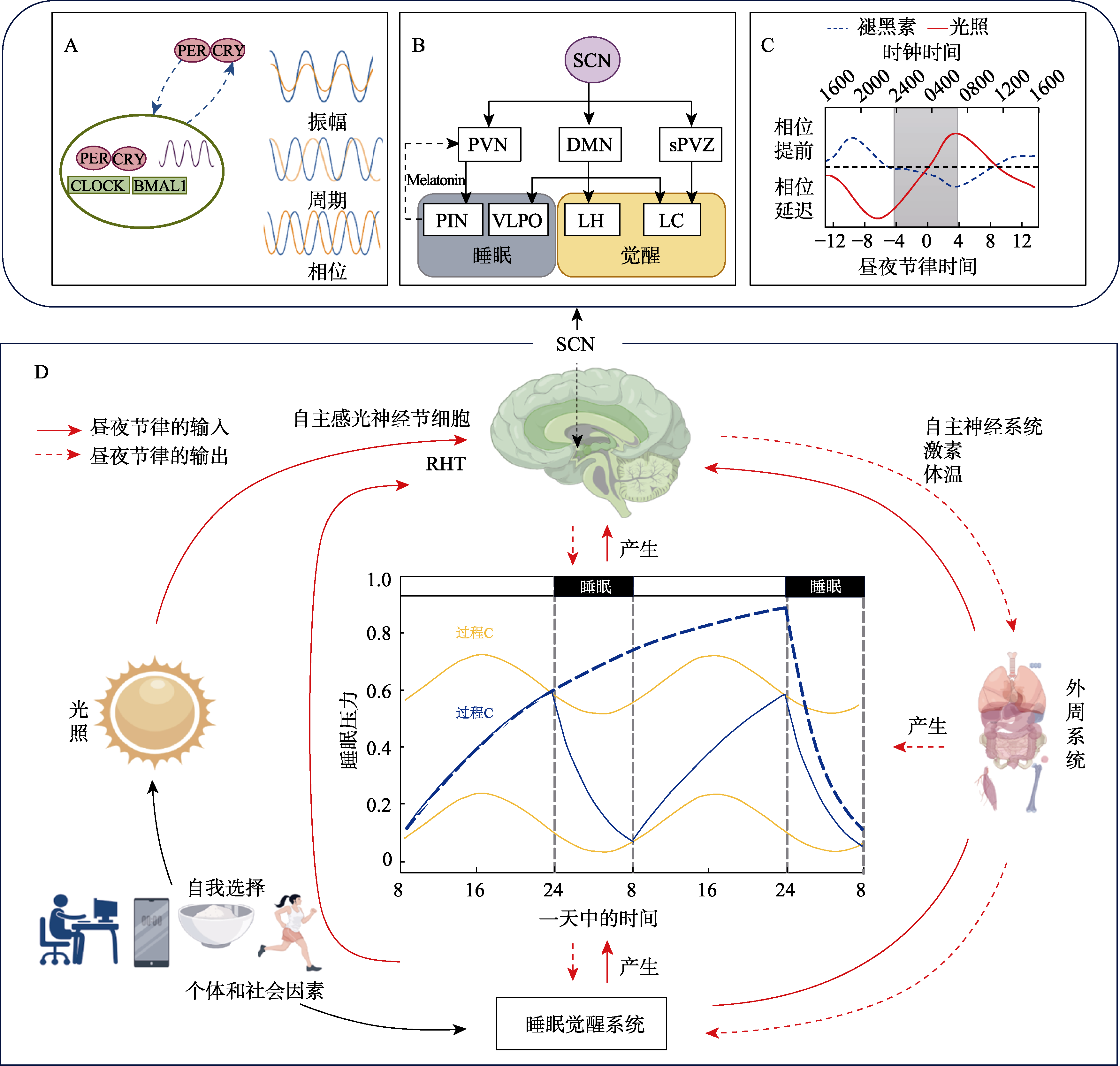
图1 人类昼夜节律系统的多层次调控机制。 注: (A)分子时钟: 核心钟基因及其蛋白产物构成的转录-翻译反馈环路(TTFL); (B)中央时钟的神经投射通路: SCN协调下游核团, 调控睡眠/觉醒转换; (C)内分泌系统: SCN调控的褪黑素与皮质醇节律性分泌; (D)系统整合: 环境输入、中枢协调与生理行为输出的整体框架, 图改编自Borbély等(2016) (中间部分)。彩图见电子版。
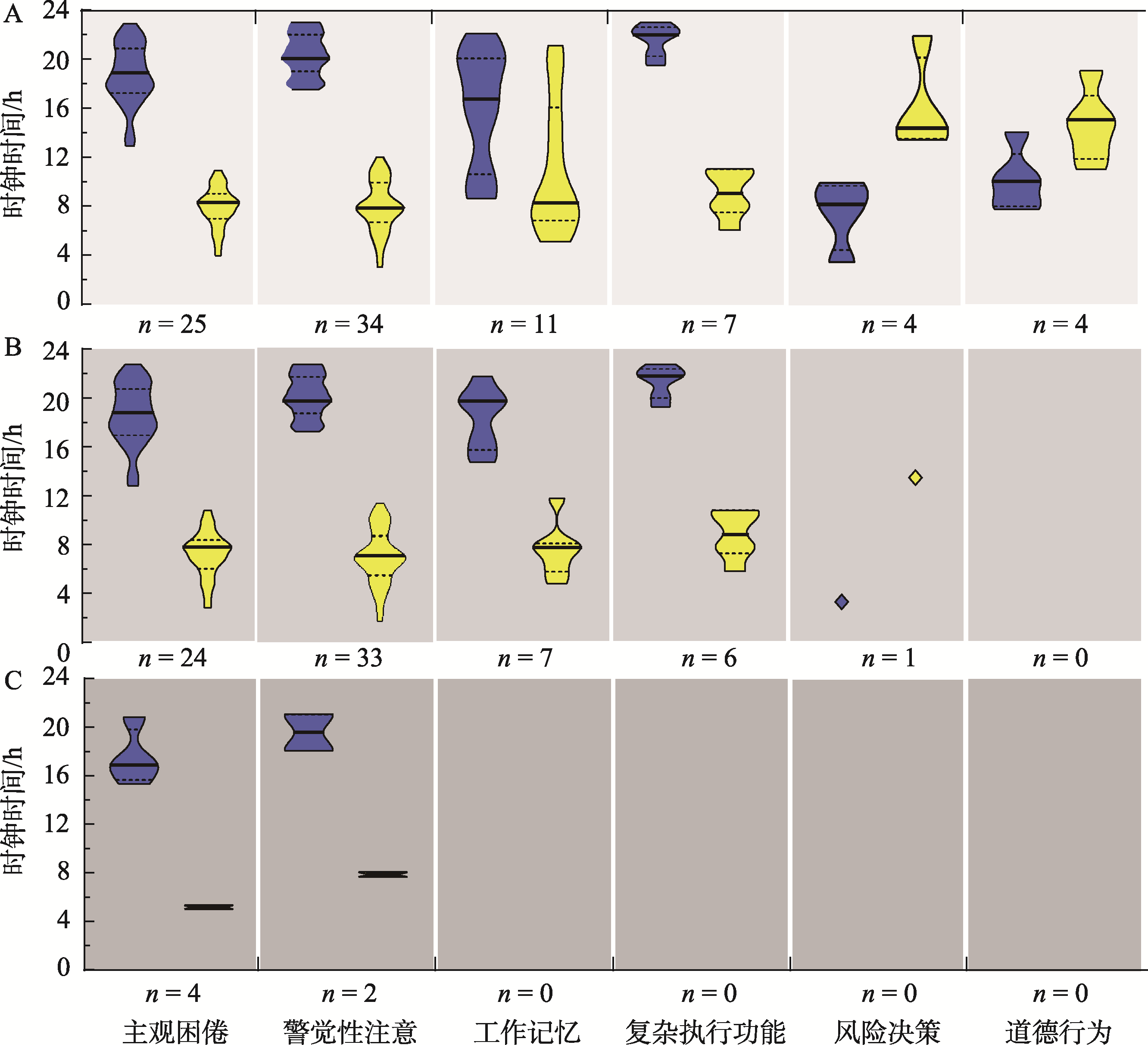
图2 昼夜节律影响不同认知功能表现的时间分布特征。 注: 图中小提琴图展示了各认知功能峰值(蓝色)与低谷(黄色)对应的时间分布, 其下方标注的K值代表该认知功能类别下所包含的独立效应值数量。峰值时刻对应最佳认知状态: 困倦感最低、注意与执行功能最高、风险偏好最低、道德水平最高, 低谷时刻则对应最差状态。A:去除极端时型的数据后的所有研究结果, 反映广义和狭义昼夜节律效应; B:符合图A筛选标准且测量时长 ≥ 24小时并覆盖WMZ时段, 反映具备完整时间覆盖的广义昼夜节律效应; C:符合图A筛选标准的狭义昼夜节律效应。彩图见电子版。
| [1] | 陈江慧, 周玫余, 黄荣凤, 辛浩然, 成姝婷, 李旻典, 仝识非. (2022). 进食节律差异调节棕色脂肪组织的生物钟与代谢基因昼夜节律. 生理学报, 74(5), 726-736. |
| [2] | 董栩然, 王旻舒, 刘梦媛, 王薇. (2014). 光照对昼夜节律与警觉度的影响. 科学通报, 59(23), 2253-2259. |
| [3] | 麦子峰, 孙瑞, 张群, 梁华, 马宁. (2019). 个体行为的昼夜节律效应: 来自华南地区的证据. 心理与行为研究, 17(2), 185-192. |
| [4] | 彭雨笛, 谢恬, 马宁. (2023). 日间节律对个体认知行为的影响. 心理科学, 46(2), 282-290. |
| [5] | 徐成伟, 梁杞梅, 谢秋幼. (2023). 昼夜节律与意识障碍的关系研究进展. 中国康复医学杂志, 38(10), 1468-1473. |
| [6] |
Abe, T., Mishima, K., Kitamura, S., Hida, A., Inoue, Y., Mizuno, K., ... Ogata, K. (2020). Tracking intermediate performance of vigilant attention using multiple eye metrics. Sleep, 43(3), zsz219. https://doi.org/10.1093/sleep/zsz219
doi: 10.1093/sleep/zsz219 URL |
| [7] |
Adam, M., Rétey, J. V., Khatami, R., & Landolt, H. P. (2006). Age-related changes in the time course of vigilant attention during 40 hours without sleep in men. Sleep, 29(1), 55-57.
pmid: 16453981 |
| [8] |
Åkerstedt, T. & Folkard, S. (1995). Validation of the S and C components of the three-process model of alertness regulation. Sleep, 8(1), 1-6.
doi: 10.1093/sleep/8.1.1 URL |
| [9] |
Albrecht, U. (2023). The circadian system and mood related behavior in mice. Advances in Protein Chemistry and Structural Biology, 137, 269-291.
doi: 10.1016/bs.apcsb.2023.02.006 pmid: 37709379 |
| [10] |
An, M., Huang, J., Shimomura, Y., & Katsuura, T. (2009). Time-of-day-dependent effects of monochromatic light exposure on human cognitive function. Journal of Physiological Anthropology, 28(5), 217-223.
pmid: 19823003 |
| [11] |
Arechar, A. A., Kraft-Todd, G., & Rand, D. G. (2017). Turking overtime: How participant characteristics and behavior vary over time and day on Amazon Mechanical Turk. Journal of the Economic Science Association, 3(1), 1-11.
doi: 10.1007/s40881-017-0035-0 pmid: 29130029 |
| [12] |
Azar, O. H., Yosef, S., & Bar-Eli, M. (2013). Do customers return excessive change in a restaurant?: A field experiment on dishonesty. Journal of Economic Behavior & Organization, 93, 219-226.
doi: 10.1016/j.jebo.2013.03.031 URL |
| [13] |
Basner, M., Rao, H., Goel, N., & Dinges, D. F. (2013). Sleep deprivation and neurobehavioral dynamics. Current Opinion in Neurobiology, 23(5), 854-863.
doi: 10.1016/j.conb.2013.02.008 pmid: 23523374 |
| [14] |
Bautista, J., Ojeda-Mosquera, S., Ordóñez-Lozada, D., & López-Cortés, A. (2025). Peripheral clocks and systemic zeitgeber interactions: From molecular mechanisms to circadian precision medicine. Frontiers in Endocrinology, 16, 1606242.
doi: 10.3389/fendo.2025.1606242 URL |
| [15] |
Berson, D. M., Dunn, F. A., & Takao, M. (2002). Phototransduction by retinal ganglion cells that set the circadian clock. Science, 295(5557), 1070-1073.
doi: 10.1126/science.1067262 pmid: 11834835 |
| [16] |
Blake, M. J. F. (1967). Time of day effects on performance in a range of tasks. Psychonomic Science, 9(6), 349-350.
doi: 10.3758/BF03327842 URL |
| [17] |
Blatter, K., & Cajochen, C. (2007). Circadian rhythms in cognitive performance: Methodological constraints, protocols, theoretical underpinnings. Physiology & Behavior, 90(2-3), 196-208.
doi: 10.1016/j.physbeh.2006.09.009 URL |
| [18] |
Blatter, K., Graw, P., Münch, M., Knoblauch, V., Wirz-Justice, A., & Cajochen, C. (2006). Gender and age differences in psychomotor vigilance performance under differential sleep pressure conditions. Behavioural brain research, 168(2), 312-317.
doi: 10.1016/j.bbr.2005.11.018 pmid: 16386807 |
| [19] | Blumberger, D. M., Maller, J. J., Thomson, L., Mulsant, B. H., Rajji, T. K., Maher, M., ... Daskalakis, Z. J. (2016). Unilateral and bilateral MRI-targeted repetitive transcranial magnetic stimulation for treatment-resistant depression: A randomized controlled study. Journal of Psychiatry and Neuroscience, 41(4), 58-66. |
| [20] | Borbély, A. A. (1982). Sleep regulation:Circadian rhythm and homeostasis. In D.Ganten & D.Pfaff (Eds.), Sleep (pp. 83-103). Springer. |
| [21] |
Borbély, A. A. (2022). The two-process model of sleep regulation: Beginnings and outlook. Journal of Sleep Research, 31(4), e13598.
doi: 10.1111/jsr.v31.4 URL |
| [22] |
Borbély, A. A., Daan, S., Wirz-Justice, A., & Deboer, T. (2016). The two-process model of sleep regulation: A reappraisal. Journal of Sleep Research, 25(2), 131-143.
doi: 10.1111/jsr.12371 pmid: 26762182 |
| [23] |
Brøchner, A. C., Binderup, L. G., de Muckadell, C. S., & Mikkelsen, S. (2020). Does the “morning morality effect” apply to prehospital anaesthesiologists? An investigation into diurnal changes in ethical behaviour. Healthcare, 8(2), 101.
doi: 10.3390/healthcare8020101 URL |
| [24] |
Bucciol, A., Landini, F., & Piovesan, M. (2013). Unethical behavior in the field: Demographic characteristics and beliefs of the cheater. Journal of Economic Behavior & Organization, 93, 248-257.
doi: 10.1016/j.jebo.2013.03.018 URL |
| [25] |
Burke, T. M., Scheer, F. A. J. L., Ronda, J. M., Czeisler, C. A., & Wright, K. P. (2015). Sleep inertia, sleep homeostatic and circadian influences on higher-order cognitive functions. Journal of Sleep Research, 24(4), 364-371.
doi: 10.1111/jsr.12291 pmid: 25773686 |
| [26] |
Byrne, J. E. M., & Murray, G. (2017). Diurnal rhythms in psychological reward functioning in healthy young men: ‘Wanting’, liking, and learning. Chronobiology International, 34(2), 287-295.
doi: 10.1080/07420528.2016.1272607 URL |
| [27] | Cajochen, C., Khalsa, S. B. S., Wyatt, J. K., Czeisler, C. A., & Dijk, D. J. (1999). EEG and ocular correlates of circadian melatonin phase and human performance decrements during sleep loss. American Journal of Physiology-Regulatory, Integrative and Comparative Physiology, 277(3 Pt 2), 640-649. |
| [28] |
Cajochen, C., & Schmidt, C. (2025). The circadian brain and cognition. Annual Review of Psychology, 76(1), 115-141.
doi: 10.1146/psych.2025.76.issue-1 URL |
| [29] |
Carlucci, M., Lett, T., Chavez, S., Malinowski, A., Lobaugh, N. J., & Petronis, A. (2023). Diurnal oscillations of MRI metrics in the brains of male participants. Nature Communications, 14(1), 7044.
doi: 10.1038/s41467-023-42588-6 pmid: 37923728 |
| [30] |
Carrier, J., & Monk, T. H. (2000). Circadian rhythms of performance: New trends. Chronobiology International, 17(6), 719-732.
pmid: 11128289 |
| [31] |
Castillo, M., Dickinson, D. L., & Petrie, R. (2017). Sleepiness, choice consistency, and risk preferences. Theory and Decision, 82, 41-73.
doi: 10.1007/s11238-016-9559-7 URL |
| [32] |
Chellappa, S. L., Morris, C. J., & Scheer, F. A. J. L. (2019). Effects of circadian misalignment on cognition in chronic shift workers. Scientific Reports, 9(1), 699.
doi: 10.1038/s41598-018-36762-w pmid: 30679522 |
| [33] |
Chellappa, S. L., Steiner, R., Blattner, P., Oelhafen, P., Götz, T., & Cajochen, C. (2011). Non-visual effects of light on melatonin, alertness and cognitive performance: Can blue-enriched light keep us alert? Plos One, 6(1), e16429.
doi: 10.1371/journal.pone.0016429 URL |
| [34] |
Cornwell, J. F. M., Mandelbaum, O., Bajger, A. T., Crookes, R. D., Krantz, D. H., & Higgins, E. T. (2021). Locomoting Larks and Assessing Owls: Morality from Mode and Time of Day. Social Cognition, 39(1), 59-80.
doi: 10.1521/soco.2021.39.1.59 URL |
| [35] |
Czeisler, C. A., Duffy, J. F., Shanahan, T. L., Brown, E. N., Mitchell, J. F., Rimmer, D. W., ... Kronauer, R. E. (1999). Stability, precision, and near-24-hour period of the human circadian pacemaker. Science, 284(5423), 2177-2181.
doi: 10.1126/science.284.5423.2177 pmid: 10381883 |
| [36] | Daan, S., Beersma, D. G. M., & Borbély, A. A. (1984). Timing of human sleep: Recovery process gated by a circadian pacemaker. American Journal of Physiology-Regulatory, Integrative and Comparative Physiology, 246( 2), 161-178. |
| [37] |
Dijk, D. J., & Czeisler, C. A. (1994). Paradoxical timing of the circadian rhythm of sleep propensity serves to consolidate sleep and wakefulness in humans. Neuroscience Letters, 166(1), 63-68.
pmid: 8190360 |
| [38] |
Dijk, D. J., Duffy, J. F., & Czeisler, C. A. (1992). Circadian and sleep/wake dependent aspects of subjective alertness and cognitive performance. Journal of Sleep Research, 1(2), 112-117.
doi: 10.1111/j.1365-2869.1992.tb00021.x pmid: 10607036 |
| [39] | Dourte, M., Hammad, G., Schmidt, C., & Peigneux, P. (2025). Uncorrelated age-related changes in visuo-spatial working memory binding and thermoregulation. Clocks & Sleep, 7(2), 17. |
| [40] |
Duffy, J. F., & Dijk, D. J. (2002). Getting through to circadian oscillators: Why use constant routines? Journal of Biological Rhythms, 17(1), 4-13.
doi: 10.1177/074873002129002294 pmid: 11837947 |
| [41] |
Finelli, L. A., Baumann, H., Borbély, A. A., & Achermann, P. (2000). Dual electroencephalogram markers of human sleep homeostasis: Correlation between theta activity in waking and slow-wave activity in sleep. Neuroscience, 101(3), 523-529.
pmid: 11113301 |
| [42] |
Folkard, S. (1975). Diurnal variation in logical reasoning. British Journal of Psychology, 66(1), 1-8.
pmid: 1131476 |
| [43] |
Folkard, S., Knauth, P., Monk, T. H., & Rutenfranz, J. (1976). The effect of memory load on the circadian variation in performance efficiency under a rapidly rotating shift system. Ergonomics, 19(4), 479-488.
pmid: 964232 |
| [44] |
Gaggioni, G., Maquet, P., Schmidt, C., Dijk, D. J., & Vandewalle, G. (2014). Neuroimaging, cognition, light and circadian rhythms. Frontiers in Systems Neuroscience, 8, 126.
doi: 10.3389/fnsys.2014.00126 pmid: 25071478 |
| [45] |
Goel, N., Basner, M., Rao, H., & Dinges, D. F. (2013). Circadian rhythms, sleep deprivation, and human performance. Progress in Molecular Biology and Translational Science, 119, 155-190.
doi: 10.1016/B978-0-12-396971-2.00007-5 pmid: 23899598 |
| [46] |
Goel, N., Rao, H., Durmer, J. S., & Dinges, D. F. (2009). Neurocognitive consequences of sleep deprivation. Seminars in Neurology, 29(4), 320-339.
doi: 10.1055/s-0029-1237117 pmid: 19742409 |
| [47] |
Gouldthorpe, C., Power, J., & Davies, A. (2023). Circadian rhythm disorders in patients with advanced cancer: A scoping review. Frontiers in Oncology, 13, 1240284.
doi: 10.3389/fonc.2023.1240284 URL |
| [48] |
Graw, P., Krauchi, K., Knoblauch, V., Wirz-Justice, A., & Cajochen, C. (2004). Circadian and wake-dependent modulation of fastest and slowest reaction times during the psychomotor vigilance task. Physiology & Behavior, 80(5), 695-701.
doi: 10.1016/j.physbeh.2003.12.004 URL |
| [49] |
Grossman, N., Bono, D., Dedic, N., Kodandaramaiah, S. B., Rudenko, A., Suk, H. J., ... Boyden, E. S. (2017). Noninvasive deep brain stimulation via temporally interfering electric fields. Cell, 169(6), 1029-1041.
doi: S0092-8674(17)30584-6 pmid: 28575667 |
| [50] |
Gunia, B. C., Barnes, C. M., & Sah, S. (2014). The morality of larks and owls: Unethical behavior depends on chronotype as well as time of day. Psychological Science, 25(12), 2272-2274.
doi: 10.1177/0956797614541989 pmid: 25287664 |
| [51] |
Guo, W., He, Y., Zhang, W., Sun, Y., Wang, J., Liu, S., & Ming, D. (2023). A novel non-invasive brain stimulation technique: “Temporally interfering electrical stimulation”. Frontiers in Neuroscience, 17, 1092539.
doi: 10.3389/fnins.2023.1092539 URL |
| [52] |
Hansen, D. A., Layton, M. E., Riedy, S. M., & Van Dongen, H. P. (2019). Psychomotor vigilance impairment during total sleep deprivation is exacerbated in sleep-onset insomnia. Nature and Science of Sleep, 11, 401-410.
doi: 10.2147/NSS.S224641 pmid: 31849552 |
| [53] |
Harrison, Y., & Horne, J. A. (2000). The impact of sleep deprivation on decision making: A review. Journal of Experimental Psychology: Applied, 6(3), 236-249.
doi: 10.1037/1076-898X.6.3.236 URL |
| [54] |
Hastings, M. H., Brancaccio, M., Gonzalez-Aponte, M. F., & Herzog, E. D. (2023). Circadian rhythms and astrocytes: The good, the bad, and the ugly. Annual Review of Neuroscience, 46, 123-143.
doi: 10.1146/neuro.2023.46.issue-1 URL |
| [55] |
Honma, S. (2018). The mammalian circadian system: A hierarchical multi-oscillator structure for generating circadian rhythm. The Journal of Physiological Sciences, 68(3), 207-219.
doi: 10.1007/s12576-018-0597-5 URL |
| [56] | Honn, K. A., Halverson, T., Jackson, M. L., Krusmark, M., Chavali, V. P., Gunzelmann, G., & Van Dongen, H. P. A. (2020). New insights into the cognitive effects of sleep deprivation by decomposition of a cognitive throughput task. Sleep, 43(7), 1-14. |
| [57] | Huang, J., Katsuura, T., Shimomura, Y., & Iwanaga, K. (2006). Diurnal changes in salivary melatonin concentrations and ERP in response to sound stimuli in morning-type and evening-type subjects. Journal of the Human-Environmental System, 9(1), 7-12. |
| [58] | Hussain, A., Gopalakrishnan, A., Scott, H., Seby, C., Tang, V., Ostrin, L., & Chakraborty, R. (2023). Associations between systemic melatonin and human myopia: A systematic review. Ophthalmic & Physiological Optics, 43(6), 1478-1490. |
| [59] |
Ingram, K. K., Ay, A., Kwon, S. B., Woods, K., Escobar, S., Gordon, M., ... Jain, K. (2016). Molecular insights into chronotype and time-of-day effects on decision-making. Scientific Reports, 6, 29392.
doi: 10.1038/srep29392 pmid: 27388366 |
| [60] |
Jasper, I., Häußler, A., Baur, B., Marquardt, C., & Hermsdörfer, J. (2009). Circadian variations in the kinematics of handwriting and grip strength. Chronobiology International, 26(3), 576-594.
doi: 10.1080/07420520902896590 pmid: 19360497 |
| [61] |
Jiang, Q., Zhang, Y., Zhu, Z., Ding, K., Zhang, J., Gong, P., & Liu, J. (2023). Does time of day affect dishonest behavior? Evidence from correlational analyses, experiments, and meta-analysis. Personality and Individual Differences, 214, 112330.
doi: 10.1016/j.paid.2023.112330 URL |
| [62] |
Jones, J. R., Chaturvedi, S., Granados-Fuentes, D., & Herzog, E. D. (2021). Circadian neurons in the paraventricular nucleus entrain and sustain daily rhythms in glucocorticoids. Nature Communications, 12(1), 5763.
doi: 10.1038/s41467-021-25959-9 pmid: 34599158 |
| [63] | Kleitman, N. (1963). Sleep and wakefulness (2nd ed.). The University of Chicago Press. |
| [64] |
Kleitman, N., & Jackson, D. P. (1950). Body temperature and performance under different routines. Journal of Applied Physiology, 3(6), 309-328.
pmid: 14794593 |
| [65] |
Kleitman, N., Titelbaum, S., & Feiveson, P. (1938). The effect of body temperature on reaction time. American Journal of Physiology, 121(2), 495-501.
doi: 10.1152/ajplegacy.1938.121.2.495 URL |
| [66] |
Kouchaki, M., & Smith, I. H. (2014). The morning morality effect: The influence of time of day on unethical behavior. Psychological Science, 25(1), 95-102.
doi: 10.1177/0956797613498099 pmid: 24166855 |
| [67] |
Leng, Y., Musiek, E. S., Hu, K., Cappuccio, F. P., & Yaffe, K. (2019). Association between circadian rhythms and neurodegenerative diseases. The Lancet Neurology, 18(3), 307-318.
doi: 10.1016/S1474-4422(18)30461-7 URL |
| [68] |
Li, M., Mai, Z., Yang, J., Zhang, B., & Ma, N. (2020). Ideal time of day for risky decision making: Evidence from the balloon analogue risk task. Nature and Science of Sleep, 12, 477-486.
doi: 10.2147/NSS.S260321 pmid: 32765144 |
| [69] |
Lo, J. C., Groeger, J. A., Santhi, N., Arbon, E. L., Lazar, A. S., Hasan, S., ... Dijk, D. J. (2012). Effects of partial and acute total sleep deprivation on performance across cognitive domains, individuals and circadian phase. Plos One, 7(9), e45987.
doi: 10.1371/journal.pone.0045987 URL |
| [70] |
Maire, M., Reichert, C. F., Gabel, V., Viola, A. U., Phillips, C., Berthomier, C., ... Schmidt, C. (2018). Human brain patterns underlying vigilant attention: Impact of sleep debt, circadian phase and attentional engagement. Scientific Reports, 8(1), 970.
doi: 10.1038/s41598-017-17022-9 pmid: 29343686 |
| [71] |
Manousakis, J. E., Mann, N., Jeppe, K. J., & Anderson, C. (2021). Awareness of sleepiness: Temporal dynamics of subjective and objective sleepiness. Psychophysiology, 58(8), e13839.
doi: 10.1111/psyp.v58.8 URL |
| [72] |
McMahon, W. R., Ftouni, S., Diep, C., Collet, J., Lockley, S. W., Rajaratnam, S. M. W., ... Anderson, C. (2021). The impact of the wake maintenance zone on attentional capacity, physiological drowsiness, and subjective task demands during sleep deprivation. Journal of Sleep Research, 30(5), e13312.
doi: 10.1111/jsr.v30.5 URL |
| [73] | McMahon, W. R., Ftouni, S., Drummond, S. P. A., Maruff, P., Lockley, S. W., Rajaratnam, S. M. W., & Anderson, C. (2018). The wake maintenance zone shows task dependent changes in cognitive function following one night without sleep. Sleep, 41(10), 1-12. |
| [74] | Meyer, N., Lok, R., Schmidt, C., Kyle, S. D., McClung, C. A., Cajochen, C., ... Chellappa, S. L. (2024). The sleep- circadian interface: A window into mental disorders. Proceedings of the National Academy of Sciences, 121(9), e2214756121. |
| [75] |
Monk, T., Buysse, D., Reynolds III, C. F., Berga, S., Jarrett, D., Begley, A. M., & Kupfer, D. (1997). Circadian rhythms in human performance and mood under constant conditions. Journal of Sleep Research, 6(1), 9-18.
doi: 10.1046/j.1365-2869.1997.00023.x pmid: 9125694 |
| [76] | Mozgai, S., Lucas, G., & Gratch, J. (2017). To tell the truth:Virtual agents and morning morality. In J.Beskow, C.Peters, G.Castellano, C.O'sullivan, I.Leite, & S.Kopp (Eds.), Intelligent virtual agents, IVA 2017 (pp. 283-286). Springer International Publishing. |
| [77] | Muck, R. A., Hudson, A. N., Honn, K. A., Gaddameedhi, S., & Van Dongen, H. P. A. (2022). Working around the clock: Is a person’s endogenous circadian timing for optimal neurobehavioral functioning inherently task-dependent? Clocks & Sleep, 4(1), 23-36. |
| [78] |
Munn, B. R., Müller, E. J., Wainstein, G., & Shine, J. M. (2021). The ascending arousal system shapes neural dynamics to mediate awareness of cognitive states. Nature Communications, 12, 6016.
doi: 10.1038/s41467-021-26268-x pmid: 34650039 |
| [79] |
Munnilari, M., Bommasamudram, T., Easow, J., Tod, D., Varamenti, E., Edwards, B. J., ... Pullinger, A. S. (2024). Diurnal variation in variables related to cognitive performance: A systematic review. Sleep and Breathing, 28, 495-510.
doi: 10.1007/s11325-023-02895-0 |
| [80] |
Muto, V., Jaspar, M., Meyer, C., Kusse, C., Chellappa, S. L., Degueldre, C., … Maquet, M. (2016). Local modulation of human brain responses by circadian rhythmicity and sleep debt. Science, 353(6300), 687-690.
doi: 10.1126/science.aad2993 pmid: 27516598 |
| [81] | O’Byrne, N. A., Yuen, F., Butt, W. Z. & Liu, P. Y. (2021). Sleep and circadian regulation of cortisol: A short review. Current Opinion in Physiology, 18, 178-186. |
| [82] |
Ou, S., Cao, Y., Xie, T., Jiang, T., Li, J., Luo, W., & Ma, N. (2023). Effect of homeostatic pressure and circadian arousal on the storage and executive components of working memory: Evidence from EEG power spectrum. Biological Psychology, 184, 108721.
doi: 10.1016/j.biopsycho.2023.108721 URL |
| [83] |
Paech, G. M., Banks, S., Pajcin, M., Grant, C., Johnson, K., Kamimori, G. H., & Vedova, C. B. D. (2016). Caffeine administration at night during extended wakefulness effectively mitigates performance impairment but not subjective assessments of fatigue and sleepiness. Pharmacology Biochemistry and Behavior, 145, 27-32.
doi: 10.1016/j.pbb.2016.03.011 URL |
| [84] |
Patke, A., Young, M. W., & Axelrod, S. (2020). Molecular mechanisms and physiological importance of circadian rhythms. Nature Reviews Molecular Cell Biology, 21(2), 67-84.
doi: 10.1038/s41580-019-0179-2 pmid: 31768006 |
| [85] |
Patton, A. P., Edwards, M. D., Smyllie, N. J., Hamnett, R., Chesham, J. E., Brancaccio, M., Maywood, E. S., & Hastings, M. H. (2020). The VIP-VPAC2 neuropeptidergic axis is a cellular pacemaking hub of the suprachiasmatic nucleus circadian circuit. Nature Communications, 11, 3394.
doi: 10.1038/s41467-020-17110-x pmid: 32636383 |
| [86] |
Piao, Y., Ma, R., Weng, Y., Fan, C., Xia, X., Zhang, W., .... Zhang, X. (2022). Safety evaluation of employing temporal interference transcranial alternating current stimulation in human studies. Brain Sciences, 12(9), 1194.
doi: 10.3390/brainsci12091194 URL |
| [87] |
Polich, J. (2007). Updating P300: An integrative theory of P3a and P3b. Clinical Neurophysiology, 118(10), 2128-2148.
doi: 10.1016/j.clinph.2007.04.019 pmid: 17573239 |
| [88] |
Rajaratnam, S. M., & Arendt, J. (2001). Health in a 24-h society. The Lancet, 358(9286), 999-1005.
doi: 10.1016/S0140-6736(01)06108-6 URL |
| [89] |
Ramírez, C., Talamantes, J., García, A., Morales, M., Valdez, P., & Menna-Barreto, L. (2006). Circadian rhythms in phonological and visuospatial storage components of working memory. Biological Rhythm Research, 37(5), 433-441.
doi: 10.1080/09291010600870404 URL |
| [90] |
Reichert, C. F., Maire, M., Gabel, V., Viola, A. U., Götz, T., Scheffler, K., ... Schmidt, C. (2017). Cognitive brain responses during circadian wake-promotion: Evidence for sleep-pressure-dependent hypothalamic activations. Scientific Reports, 7(1), 5620.
doi: 10.1038/s41598-017-05695-1 pmid: 28717201 |
| [91] | Reifman, J., & Gander, P. (2004). Commentary on the three-process model of alertness and broader modeling issues. Aviation, Space, and Environmental Medicine, 75(3), 84-88. |
| [92] |
Reifman, J., Ramakrishnan, S., Liu, J., Kapela, A., Doty, T. J., Balkin, T. J., Kumar, K., & Khitrov, M. Y. (2019). 2B-Alert App: A mobile application for real-time individualized prediction of alertness. Journal of Sleep Research, 28(2), e12725.
doi: 10.1111/jsr.2019.28.issue-2 URL |
| [93] |
Rey-Mermet, A., & Rothen, N. (2023). The interplay of time-of-day and chronotype results in no general and robust cognitive boost. Collabra: Psychology, 9(1), 88337.
doi: 10.1525/collabra.88337 URL |
| [94] | Rüger, M., Gordijn, M. C., Beersma, D. G., de Vries, B., & Daan, S. (2006). Time-of-day-dependent effects of bright light exposure on human psychophysiology: Comparison of daytime and nighttime exposure. American Journal of Physiology-Regulatory, Integrative and Comparative Physiology, 290(5), 1413-1420. |
| [95] | Ruiz-Herrera, N., Friedman, M., St Hilaire, M. A., Arrona-Palacios, A., Czeisler, C. A., & Duffy, J. F. (2024). Time of day and sleep deprivation effects on risky decision making. Clocks & Sleep, 6(2), 281-290. |
| [96] |
Santhi, N., Lazar, A. S., McCabe, P. J., Lo, J. C., Groeger, J. A., & Dijk, D. J. (2016). Sex differences in the circadian regulation of sleep and waking cognition in humans. Proceedings of the National Academy of Sciences of the United States of America, 113(19), 2730-2739.
doi: 10.1073/pnas.1521637113 pmid: 27091961 |
| [97] |
Sara, S. J., & Bouret, S. (2012). Orienting and reorienting: The locus coeruleus mediates cognition through arousal. Neuron, 76(1), 130-141.
doi: 10.1016/j.neuron.2012.09.011 pmid: 23040811 |
| [98] |
Schmidt, C., Collette, F., Leclercq, Y., Sterpenich, V., Vandewalle, G., Berthomier, P., ... Peigneux, P. (2009). Homeostatic sleep pressure and responses to sustained attention in the suprachiasmatic area. Science, 324(5926), 516-519.
doi: 10.1126/science.1167337 pmid: 19390047 |
| [99] |
Schmidt, C., Collette, F., Reichert, C. F., Maire, M., Vandewalle, G., Peigneux, P., & Cajochen, C. (2015). Pushing the limits: Chronotype and time of day modulate working memory-dependent cerebral activity. Frontiers in Neurology, 6, 199.
doi: 10.3389/fneur.2015.00199 pmid: 26441819 |
| [100] |
Schmidt, C., Peigneux, P., Leclercq, Y., Sterpenich, V., Vandewalle, G., Phillips, C., ... Collette, F. (2012). Circadian preference modulates the neural substrate of conflict processing across the day. Plos One, 7(1), e29658.
doi: 10.1371/journal.pone.0029658 URL |
| [101] |
Schwartz, M. D., Wotus, C., Liu, T., Friesen, W. O., Borjigin, J., Oda, G. A., & de la Iglesia, H. O. (2009). Dissociation of circadian and light inhibition of melatonin release through forced desynchronization in the rat. Proceedings of the National Academy of Sciences, 106(41), 17540-17545.
doi: 10.1073/pnas.0906382106 URL |
| [102] |
Shekleton, J. A., Rajaratnam, S. M. W., Gooley, J. J., Van Reen, E., Czeisler, C. A., & Lockley, S. W. (2013). Improved neurobehavioral performance during the wake maintenance zone. Journal of Clinical Sleep Medicine, 9(4), 353-362.
doi: 10.5664/jcsm.2588 pmid: 23585751 |
| [103] |
Shen, Y., Lv, Q. K., Xie, W. Y., Gong, S. Y., Zhuang, S., Liu, J., Mao, C. J., & Liu, C. F. (2023). Circadian disruption and sleep disorders in neurodegeneration. Translational Neurodegeneration, 12(1), 8.
doi: 10.1186/s40035-023-00340-6 pmid: 36782262 |
| [104] |
Sherman, S. M., Mumford, J. A., & Schnyer, D. M. (2015). Hippocampal activity mediates the relationship between circadian activity rhythms and memory in older adults. Neuropsychologia, 75, 617-625.
doi: 10.1016/j.neuropsychologia.2015.07.020 pmid: 26205911 |
| [105] |
Snipes, S., Meier, E., Meissner, S. N., Landolt, H. P., & Huber, R. (2023). How and when EEG reflects changes in neuronal connectivity due to time awake. iScience, 26(7), 107138.
doi: 10.1016/j.isci.2023.107138 URL |
| [106] |
Spaeth, A. M., Goel, N., & Dinges, D. F. (2014). Cumulative neurobehavioral and physiological effects of chronic caffeine intake: Individual differences and implications for the use of caffeinated energy products. Nutrition Reviews, 72(Suppl), 34-47.
doi: 10.1111/nure.2014.72.issue-s1 URL |
| [107] | St. Hilaire, M. A., & Lockley,. S. W. (2022). Measuring dim light melatonin onset in humans. In R.Jockers & E.Cecon (Eds.), Melatonin (Methods in Molecular Biology, Vol. 2550, pp. 13-20). Humana. |
| [108] |
Stalder, T., Lupien, S. J., Kudielka, B. M., Adam, E. K., Pruessner, J. C., Wüst, S., ... Clow, A. (2022). Evaluation and update of the expert consensus guidelines for the assessment of the cortisol awakening response (CAR). Psychoneuroendocrinology, 146, 105946.
doi: 10.1016/j.psyneuen.2022.105946 URL |
| [109] |
Starnes, A. N., & Jones, J. R. (2023). Inputs and outputs of the mammalian circadian clock. Biology, 12(4), 508.
doi: 10.3390/biology12040508 URL |
| [110] |
Steriade, M. (2006). Grouping of brain rhythms in corticothalamic systems. Neuroscience, 137(4), 1087-1106.
doi: 10.1016/j.neuroscience.2005.10.029 pmid: 16343791 |
| [111] | Strogatz, S. H., Kronauer, R. E., & Czeisler, C. A. (1987). Circadian pacemaker interferes with sleep onset at specific times each day: Role in insomnia. American Journal of Physiology, 253(1), 172-178. |
| [112] |
Tucker, A. M., Whitney, P., Belenky, G., Hinson, J. M., & Van Dongen, H. P. A. (2010). Effects of sleep deprivation on dissociated components of executive functioning. Sleep, 33(1), 47-57.
doi: 10.1093/sleep/33.1.47 pmid: 20120620 |
| [113] |
Valdez, P. (2019). Homeostatic and circadian regulation of cognitive performance. Biological Rhythm Research, 50(1), 85-93.
doi: 10.1080/09291016.2018.1491271 |
| [114] | Valdez, P., Ramírez, C., & García, A. (2012). Circadian rhythms in cognitive performance: Implications for neuropsychological assessment. Chronophysiology and Therapy, 2, 81-92. |
| [115] |
Valdez, P., Ramírez, C., García, A., Talamantes, J., Armijo, P., & Borrani, J. (2005). Circadian rhythms in components of attention. Biological Rhythm Research, 36(1-2), 57-65.
doi: 10.1080/09291010400028633 URL |
| [116] |
Van Dongen, H. P. A., Bender, A. M., & Dinges, D. F. (2012). Systematic individual differences in sleep homeostatic and circadian rhythm contributions to neurobehavioral impairment during sleep deprivation. Accident Analysis & Prevention, 45, 11-16.
doi: 10.1016/j.aap.2011.09.018 URL |
| [117] |
van Eekelen, A. P., & Kerkhof, G. (2003). No interference of task complexity with circadian rhythmicity in a constant routine protocol. Ergonomics, 46(15), 1578-1593.
pmid: 14668176 |
| [118] |
Vranka, M., Frollova, N., Pour, M., Novakova, J., & Houdek, P. (2019). Cheating customers in grocery stores: A field study on dishonesty. Journal of Behavioral and Experimental Economics, 83, 101484.
doi: 10.1016/j.socec.2019.101484 URL |
| [119] |
Walker, W. H. II., Walton, J. C., DeVries, A. C., & Nelson, R. J. (2020). Circadian rhythm disruption and mental health. Translational Psychiatry, 10(1), 28.
doi: 10.1038/s41398-020-0694-0 pmid: 32066704 |
| [120] | West, R., Murphy, K. J., Armilio, M. L., Craik, F. I. M., & Stuss, D. T. (2002). Effects of time of day on age differences in working memory. Journal of Gerontology: Psychological Sciences, 57(1), 3-10. |
| [121] |
Whyte, C. J., Redinbaugh, M. J., Shine, J. M., & Saalmann, Y. B. (2024). Thalamic contributions to the state and contents of consciousness. Neuron, 112(10), 1611-1625.
doi: 10.1016/j.neuron.2024.04.019 pmid: 38754373 |
| [122] | Wiłkość-Dębczyńska, M., & Liberacka-Dwojak, M. (2023). Time of day and chronotype in the assessment of cognitive functions. Advances in Psychiatry and Neurology/Postępy Psychiatrii i Neurologii, 32(3), 162-166. |
| [123] |
Willoughby, A. R., Vallat, R., Ong, J. L., & Chee, M. W. L. (2025). Insights about travel-related sleep disruption from 1.5 million nights of data. Sleep, 48(7), zsaf077.
doi: 10.1093/sleep/zsaf077 URL |
| [124] | Wright, K. P. Jr., Hull, J. T., & Czeisler, C. A. (2002). Relationship between alertness, performance, and body temperature in humans. American Journal of Physiology- Regulatory, Integrative and Comparative Physiology, 283(6), 1370-1377. |
| [125] |
Xie, X., Zhang, M., & Luo, H. (2024). Regulation of metabolism by circadian rhythms: Support from time- restricted eating, intestinal microbiota & omics analysis. Life Sciences, 351, 122814.
doi: 10.1016/j.lfs.2024.122814 URL |
| [126] |
Xing, H., Wu, Z., Chang, Y., Ma, M., Song, Z., Liu, Y., & Dai, H. (2023). Resting-state fMRI study of vigilance under circadian and homeostatic modulation based on fractional amplitude of low-frequency fluctuation and regional homogeneity in humans under normal entrained conditions. Journal of Magnetic Resonance Imaging, 59(1), 211-222.
doi: 10.1002/jmri.28750 pmid: 37078514 |
| [127] |
Zeeuw, J. D., Wisniewski, S., Papakonstantinou, A., Bes, F., Wahnschaffe, A., Zaleska, M., Kunz, D., & Münch, M. (2018). The alerting effect of the wake maintenance zone during 40 hours of sleep deprivation. Scientific Reports, 8(1), 11012.
doi: 10.1038/s41598-018-29380-z pmid: 30030487 |
| [128] |
Zickfeld, J. H., Gonzalez, A. S. R., & Mitkidis, P. (2025). Investigating the morning morality effect and its mediating and moderating factors. Journal of Experimental Social Psychology, 118, 104698.
doi: 10.1016/j.jesp.2024.104698 URL |
| [1] | 游贝贝, 顾怀飞, 文宏伟. 认知功能和中央执行网络对疼痛心理韧性的作用和预测机制[J]. 心理科学进展, 2026, 34(4): 583-596. |
| [2] | 董耀华, 汤煜尧, 张丹丹. 经颅交流电刺激在心理学研究中的应用[J]. 心理科学进展, 2026, 34(2): 239-250. |
| [3] | 昌思琴, 黄辰, 戴元富, 蒋长好. VR训练对轻度认知障碍老年人认知功能的影响及神经机制[J]. 心理科学进展, 2025, 33(2): 322-335. |
| [4] | 蔡嘉琳, 陈彩琦. 认知脱离综合征的特征:与注意缺陷多动障碍等障碍的比较[J]. 心理科学进展, 2025, 33(11): 1967-1982. |
| [5] | 苏瑞, 王成志, 李昊, 马海林, 苏彦捷. 高原运动对认知功能的影响[J]. 心理科学进展, 2024, 32(5): 800-812. |
| [6] | 喻婧, 牛程程, 徐红州, 姜海鑫, 林国俊, 吴柯, 续子含. 志愿服务对老年人认知功能的改善及神经心理机制[J]. 心理科学进展, 2024, 32(3): 413-420. |
| [7] | 张思源, 李雪冰. 不同频率经颅交流电刺激在精神疾病中的应用[J]. 心理科学进展, 2022, 30(9): 2053-2066. |
| [8] | 钱柳, 汝涛涛, 罗雪, 牛佳兴, 马永骏, 周国富. 睡眠限制对认知功能的影响及其潜在作用机制[J]. 心理科学进展, 2020, 28(9): 1493-1507. |
| [9] | 于文华, 鲁忠义. 手势认知功能研究的新视角:“空间化”手势假设[J]. 心理科学进展, 2020, 28(3): 426-433. |
| [10] | 谢家全, 谢昌颐, 杨文登. 饥饿对认知与社会行为的影响及其机制[J]. 心理科学进展, 2020, 28(1): 141-149. |
| [11] | 杨瑜, 李鸣, 陈红. 母性应激对母性行为和心理功能的影响[J]. 心理科学进展, 2020, 28(1): 128-140. |
| [12] | 汝涛涛, 李芸, 钱柳, 陈庆伟, 钟罗金, 李静华, 周国富. 环境光照的认知功效及其调节因素与作用机理[J]. 心理科学进展, 2019, 27(10): 1687-1702. |
| [13] | 任智, 邹夏, 钟沙沙, 刘伟. 吸烟:促进还是损害前瞻记忆?[J]. 心理科学进展, 2017, 25(9): 1521-1526. |
| [14] | 张瑜, 林文娟, 王玮文. 中枢免疫失衡与认知功能障碍:聚焦TNFa的作用[J]. 心理科学进展, 2017, 25(12): 2036-2042. |
| [15] | 赵丹;余林. 社会交往对老年人认知功能的影响[J]. 心理科学进展, 2016, 24(1): 46-54. |
| 阅读次数 | ||||||
|
全文 |
|
|||||
|
摘要 |
|
|||||
