

ISSN 1671-3710
CN 11-4766/R
主办:中国科学院心理研究所
出版:科学出版社
CN 11-4766/R
主办:中国科学院心理研究所
出版:科学出版社
心理科学进展 ›› 2026, Vol. 34 ›› Issue (8): 1427-1438.doi: 10.3724/SP.J.1042.2026.1427 cstr: 32111.14.2026.1427
崔倩( ), 贾云轩, 李佰科
收稿日期:2024-12-31
出版日期:2026-08-15
发布日期:2026-06-03
通讯作者:
崔倩, E-mail: cuiqian119@163.com基金资助:
CUI Qian(), JIA Yunxuan, LI Baike
Received:2024-12-31
Online:2026-08-15
Published:2026-06-03
摘要:
时间错误监控是一项关键的元认知能力, 指个体在时间知觉过程中对潜在偏差进行觉察、评估与调整的认知过程。本文系统梳理了该领域的核心任务范式、元认知调节机制与神经生理基础, 重点阐述了自我评估、反馈调节与决策信心调节这三种机制在调控时间判断准确性中的作用。在此基础上, 结合反馈相关负波、β振荡与α振荡等神经活动证据, 提出了时间错误监控的“两阶段三路径整合模型”, 以解释不同机制之间的协同作用。当前研究仍存在神经机制尚未系统阐明、发展视角研究匮乏、范式生态效度不足等局限。未来研究可结合多模态神经成像技术与纵向发展性设计, 探索更具生态效度的实验范式, 系统揭示跨脑网络的动态协同机制及其神经振荡基础, 并将相关发现应用于精神疾病诊断与认知干预中。
中图分类号:
崔倩, 贾云轩, 李佰科. (2026). 时间错误监控中的元认知调节与神经生理机制. 心理科学进展 , 34(8), 1427-1438.
CUI Qian, JIA Yunxuan, LI Baike. (2026). Metacognitive regulation and neurophysiological mechanisms of temporal error monitoring. Advances in Psychological Science, 34(8), 1427-1438.
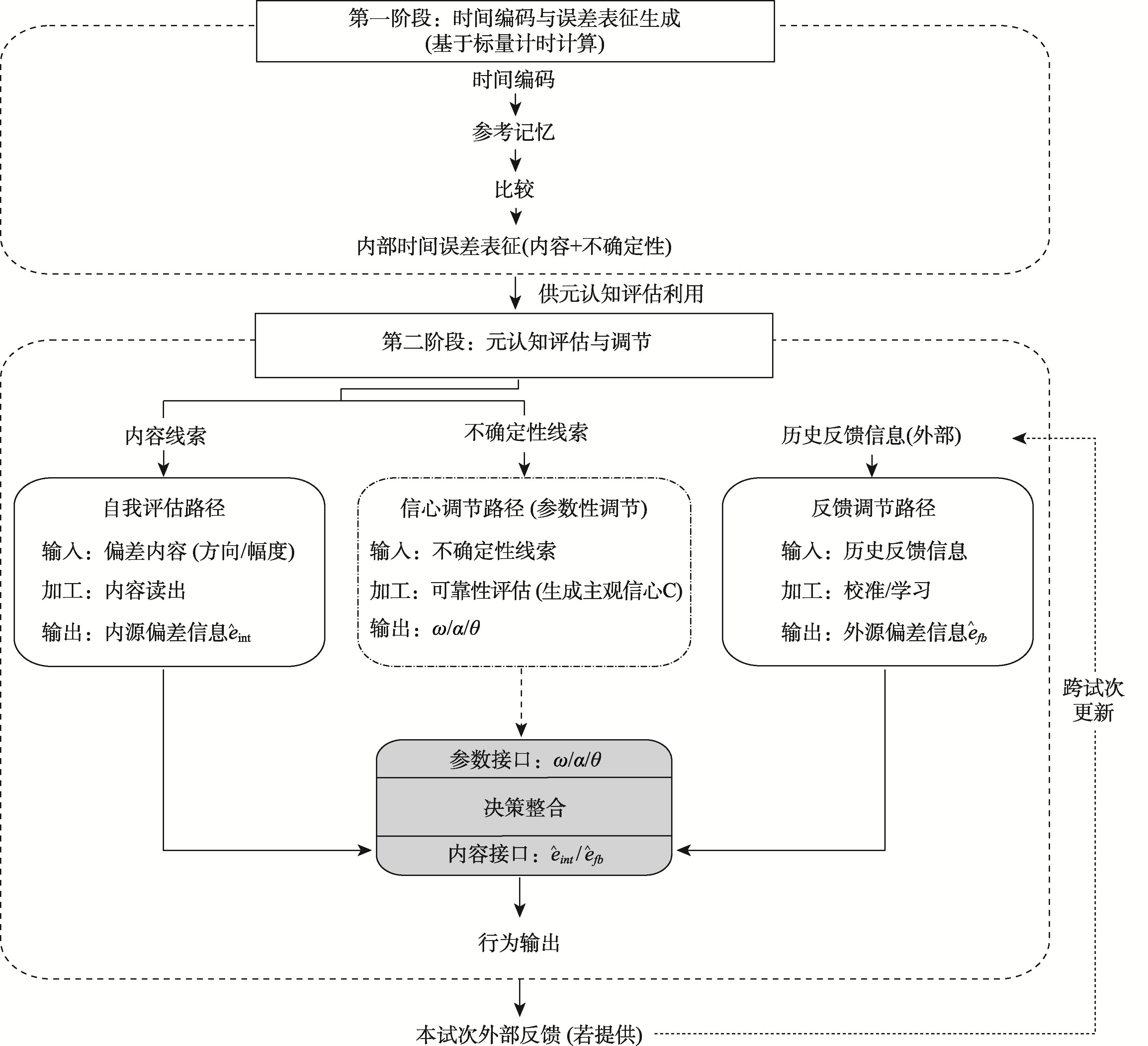
图1 时间错误监控的两阶段三路径模型 注:图中第一阶段基于标量计时理论形成包含偏差内容与不确定性的误差表征; 第二阶段对应基于该表征展开的元认知评估与调节过程, 其中自我评估路径与反馈调节路径分别提供内源与外源偏差信息, 信心调节路径则依据不确定性线索对后续整合过程进行参数调节。图中, ${{\hat{e}}_{int}}$表示基于内部误差表征形成的内源偏差估计, ${{\hat{e}}_{fb}}$表示基于历史反馈信息形成的外源偏差估计; C表示个体对当前时间判断结果可靠性的主观信心; w、α与θ分别表示信息整合权重、反馈学习率与判断阈限。实线箭头表示内容性输入或加工流程, 虚线箭头表示参数调节或更新关系。本试次外部反馈(若提供)经跨试次更新后形成历史反馈信息, 并在后续试次中进入反馈调节路径。
| [1] | 雷威, 刘可智, 梁雪梅, 陈晶. (2020). 决策信心校准水平对元认知监控作用的影响. 心理发展与教育, 36(3), 289-295. |
| [2] |
李亚琴, 赵若兰, 杨庆. (2024). 动机在错误加工中的不一致效应: 争议与整合. 心理科学进展, 32(1), 85-99.
doi: 10.3724/SP.J.1042.2024.00085 |
| [3] |
Akdoğan, B., & Balcı, F. (2017). Are you early or late?: Temporal error monitoring. Journal of Experimental Psychology: General, 146(3), 347-361.
doi: 10.1037/xge0000265 URL |
| [4] | Bader, F., & Wiener, M. (2021). Awareness of errors and feedback in human time estimation. Learning & Memory, 28(5), 171-177. |
| [5] | Bader, F., & Wiener, M. (2024). Neuroimaging signatures of metacognitive improvement in sensorimotor timing. Journal of Neuroscience, 44(9), e1789222023. |
| [6] | Balcı, F. (2022). Tracing the shadow of time. Proceedings of the National Academy of Sciences of the United States of America, 119(10), e2201001119. |
| [7] |
Balcı, F., & Öztel, T. (2026). Temporal foreknowledge: Anticipation and prospective correction of timing errors by diffusion. Psychological Review, 133(2), 253-270.
doi: 10.1037/rev0000556 URL |
| [8] |
Bang, D., & Fleming, S. M. (2018). Distinct encoding of decision confidence in human medial prefrontal cortex. Proceedings of the National Academy of Sciences, 115(23), 6082-6087.
doi: 10.1073/pnas.1800795115 URL |
| [9] |
Ben Yehuda, M., Murphy, R. A., Le Pelley, M. E., Navarro, D. J., & Yeung, N. (2025). Confidence regulates feedback processing during human probabilistic learning. Journal of Experimental Psychology: General, 154(1), 80-95.
doi: 10.1037/xge0001669 URL |
| [10] |
Bilgin, S. N., & Kononowicz, T. W. (2025). Temporal error monitoring: Monitoring of internal clock or just motor noise?. Consciousness and Cognition, 130, 103849.
doi: 10.1016/j.concog.2025.103849 URL |
| [11] |
Boldt, A., & Yeung, N. (2015). Shared neural markers of decision confidence and error detection. The Journal of Neuroscience, 35(8), 3478-3484.
doi: 10.1523/JNEUROSCI.0797-14.2015 URL |
| [12] |
Buzzell, G. A., Richards, J. E., White, L. K., Barker, T. V., Pine, D. S., & Fox, N. A. (2017). Development of the error-monitoring system from ages 9-35: Unique insight provided by MRI-constrained source localization of EEG. NeuroImage, 157, 13-26.
doi: S1053-8119(17)30444-5 pmid: 28549796 |
| [13] |
Carter, C. S., Braver, T. S., Barch, D. M., Botvinick, M. M., Noll, D., & Cohen, J. D. (1998). Anterior cingulate cortex, error detection, and the online monitoring of performance. Science, 280(5364), 747-749.
doi: 10.1126/science.280.5364.747 pmid: 9563953 |
| [14] |
Charles, L., & Yeung, N. (2019). Dynamic sources of evidence supporting confidence judgments and error detection. Journal of Experimental Psychology: Human Perception and Performance, 45(1), 39-52.
doi: 10.1037/xhp0000583 pmid: 30489097 |
| [15] |
Chung, W. Y., Darriba, Á., Yeung, N., & Waszak, F. (2024). Give it a second try? The influence of feedback and performance in the decision of reattempting. Cognition, 248, 105803.
doi: 10.1016/j.cognition.2024.105803 URL |
| [16] |
Conte, S., Richards, J. E., Fox, N. A., Valadez, E. A., McSweeney, M., Tan, E., ... Buzzell, G. A. (2023). Multimodal study of the neural sources of error monitoring in adolescents and adults. Psychophysiology, 60(10), e14336.
doi: 10.1111/psyp.v60.10 URL |
| [17] |
Corcoran, A. W., Groot, C., Bruno, A., Johnston, A., & Cropper, S. J. (2018). Individual differences in first- and second-order temporal judgment. PLoS One, 13(2), Article e0191422.
doi: 10.1371/journal.pone.0191422 URL |
| [18] |
Daniel, R., & Pollmann, S. (2012). Striatal activations signal prediction errors on confidence in the absence of external feedback. NeuroImage, 59(4), 3457-3467.
doi: 10.1016/j.neuroimage.2011.11.058 pmid: 22146752 |
| [19] |
de Lange, F. P., Rahnev, D. A., Donner, T. H., & Lau, H. (2013). Prestimulus oscillatory activity over motor cortex reflects perceptual expectations. The Journal of Neuroscience, 33(4), 1400-1410.
doi: 10.1523/JNEUROSCI.1094-12.2013 URL |
| [20] | Desai, C., Bader, F. & Wiener, M. (2025). Awareness of both global uncertainty and feedback in human time estimation. Attention, Perception, & Psychophysics, 87(7), 2121-2128. |
| [21] |
Doenyas, C., Mutluer, T., Genç, E., & Balcı, F. (2019). Error monitoring in decision-making and timing is disrupted in autism spectrum disorder. Autism Research, 12(2), 239-248.
doi: 10.1002/aur.2041 pmid: 30485714 |
| [22] |
Ficarella, S. C., Rochet, N., & Burle, B. (2019). Becoming aware of subliminal responses: An EEG/EMG study on partial error detection and correction in humans. Cortex, 120, 443-456.
doi: S0010-9452(19)30263-1 pmid: 31476554 |
| [23] |
Flavell, J. H. (1979). Metacognition and cognitive monitoring: A new area of cognitive-developmental inquiry. American Psychologist, 34(10), 906-911.
doi: 10.1037/0003-066X.34.10.906 URL |
| [24] |
Fleming, S. M. (2024). Metacognition and confidence: A review and synthesis. Annual Review of Psychology, 75(1), 241-268.
doi: 10.1146/psych.2024.75.issue-1 URL |
| [25] |
Fleming, S. M., & Daw, N. D. (2017). Self-evaluation of decision-making: A general Bayesian framework for metacognitive computation. Psychological Review, 124(1), 91-114.
doi: 10.1037/rev0000045 pmid: 28004960 |
| [26] |
Frank, D. J., & Kuhlmann, B. G. (2016). More than just beliefs: Experience and beliefs jointly contribute to volume effects on metacognitive judgments. Journal of Experimental Psychology: Learning, Memory, and Cognition, 43(5), 680-693.
doi: 10.1037/xlm0000332 URL |
| [27] |
Frömer, R., Nassar, M. R., Bruckner, R., Stürmer, B., Sommer, W., & Yeung, N. (2021). Response-based outcome predictions and confidence regulate feedback processing and learning. eLife, 10, e62825.
doi: 10.7554/eLife.62825 URL |
| [28] |
Gibbon, J. (1977). Scalar expectancy theory and Weber's law in animal timing. Psychological Review, 84(3), 279-325.
doi: 10.1037/0033-295X.84.3.279 URL |
| [29] |
Gloe, L. M., & Louis, C. C. (2021). The error-related negativity (ERN) in anxiety and obsessive-compulsive disorder (OCD): A call for further investigation of task parameters in the Flanker task. Frontiers in Human Neuroscience, 15, 779083.
doi: 10.3389/fnhum.2021.779083 URL |
| [30] |
Grabot, L., Kononowicz, T. W., Tour, T. D., Gramfort, A., Doyère, V., & van Wassenhove, V. (2019). The strength of alpha-beta oscillatory coupling predicts motor timing precision. The Journal of Neuroscience, 39(17), 3277-3291.
doi: 10.1523/JNEUROSCI.2473-18.2018 URL |
| [31] |
Holmes, A. J., & Pizzagalli, D. A. (2008). Spatiotemporal dynamics of error processing dysfunctions in major depressive disorder. Archives of General Psychiatry, 65(2), 179-188.
doi: 10.1001/archgenpsychiatry.2007.19 pmid: 18250256 |
| [32] |
Isham, E. A. (2020). Temporal experience modifies future thoughts: Manipulation of Libet’s W influences difficulty assessment during a decision-making task. PLoS One, 15(11), e0237680.
doi: 10.1371/journal.pone.0237680 URL |
| [33] |
Kelly, J. W., Donaldson, L. S., Sjolund, L. A., & Freiberg, J. B. (2013). More than just perception-action recalibration: Walking through a virtual environment causes rescaling of perceived space. Attention, Perception, & Psychophysics, 75, 1473-1485.
doi: 10.3758/s13414-013-0503-4 URL |
| [34] |
Kononowicz, T. W., & van Rijn, H. (2015). Single trial beta oscillations index time estimation. Neuropsychologia, 75, 381-389.
doi: 10.1016/j.neuropsychologia.2015.06.014 pmid: 26102187 |
| [35] |
Kononowicz, T. W., Roger, C., & van Wassenhove, V. (2019). Temporal metacognition as the decoding of self-generated brain dynamics. Cerebral Cortex, 29(10), 4366-4380.
doi: 10.1093/cercor/bhy318 |
| [36] |
Kononowicz, T. W., & van Wassenhove, V. (2019). Evaluation of self-generated behavior: Untangling metacognitive readout and error detection. Journal of Cognitive Neuroscience, 31(11), 1641-1657.
doi: 10.1162/jocn_a_01442 pmid: 31274392 |
| [37] |
Koriat, A. (1997). Monitoring one’s own knowledge during study: A cue-utilization approach to judgments of learning. Journal of Experimental Psychology: General, 126(4), 349-370.
doi: 10.1037/0096-3445.126.4.349 URL |
| [38] |
Ladouceur, C. D., Slifka, J. S., Dahl, R. E., Birmaher, B., Axelson, D. A., & Ryan, N. D. (2012). Altered error-related brain activity in youth with major depression. Developmental Cognitive Neuroscience, 2(3), 351-362.
doi: 10.1016/j.dcn.2012.01.005 pmid: 22669036 |
| [39] |
Lak, A., Costa, G. M., Romberg, E., Koulakov, A. A., Mainen, Z. F., & Kepecs, A. (2014). Orbitofrontal cortex is required for optimal waiting based on decision confidence. Neuron, 84(1), 190-201.
doi: S0896-6273(14)00740-5 pmid: 25242219 |
| [40] |
Lake, J. I., LaBar, K. S., & Meck, W. H. (2016). Emotional modulation of interval timing and time perception. Neuroscience and Biobehavioral Reviews, 64, 403-420.
doi: 10.1016/j.neubiorev.2016.03.003 pmid: 26972824 |
| [41] |
Levinson, T., Prettyman, G., Savage, C., White, L., Moore, T. M., Calkins, M. E., ... Wolf, D. H. (2023). Activation of internal correctness monitoring circuitry in youths with psychosis Spectrum symptoms. Biological Psychiatry: Cognitive Neuroscience and Neuroimaging, 8(5), 542-550.
doi: 10.1016/j.bpsc.2023.01.010 pmid: 37019760 |
| [42] |
Li, L., Hou, C., Peng, C., & Chen, Y. (2023). Encoding, working memory, or decision: How feedback modulates time perception. Cerebral Cortex, 33(19), 10355-10366.
doi: 10.1093/cercor/bhad287 URL |
| [43] |
Li, L., & Wang, D. (2021). Adaptive neurons compute confidence in a decision network. Scientific Reports, 11(1), 22190.
doi: 10.1038/s41598-021-01523-9 pmid: 34772969 |
| [44] | Lichtenstein, S., Fischhoff, B., & Phillips, L. D. (1977). Calibration of probabilities:The state of the art. In H.Jungermann & G. DeZeeuw (Eds.), Decision Making and Change in Human Affairs: Proceedings of the Fifth Research Conference on Subjective Probability, Utility, and Decision Making, Darmstadt, 1-4 September, 1975 (pp.275-324). Springer. |
| [45] |
Lutz, M. C., Kok, R., & Franken, I. H. (2021). Event-related potential (ERP) measures of error processing as biomarkers of externalizing disorders: A narrative review. International Journal of Psychophysiology, 166, 151-159.
doi: 10.1016/j.ijpsycho.2021.06.002 pmid: 34146603 |
| [46] |
Masina, F., Tarantino, V., Vallesi, A., & Mapelli, D. (2019). Repetitive TMS over the left dorsolateral prefrontal cortex modulates the error positivity: An ERP study. Neuropsychologia, 133, 107153.
doi: 10.1016/j.neuropsychologia.2019.107153 URL |
| [47] |
Matthews, W. J., & Meck, W. H. (2016). Temporal cognition: Connecting subjective time to perception, attention, and memory. Psychological Bulletin, 142(8), 865-907.
doi: 10.1037/bul0000045 pmid: 27196725 |
| [48] |
Meyniel, F., Sigman, M., & Mainen, Z. F. (2015). Confidence as Bayesian probability: From neural origins to behavior. Neuron, 88(1), 78-92.
doi: 10.1016/j.neuron.2015.09.039 pmid: 26447574 |
| [49] |
Öztel, T., & Balcı, F. (2023). Humans can monitor trial-based but not global timing errors: Evidence for relative judgements in temporal error monitoring. Quarterly Journal of Experimental Psychology, 76(9), 2155-2163.
doi: 10.1177/17470218221145314 URL |
| [50] |
Öztel, T., & Balcı, F. (2024). Metric error monitoring as a component of metacognitive processing. European Journal of Neuroscience, 59(5), 807-821.
doi: 10.1111/ejn.v59.5 URL |
| [51] |
Öztel, T., Eskenazi, T., & Balcı, F. (2021). Temporal error monitoring with directional error magnitude judgements: A robust phenomenon with no effect of being watched. Psychological Research, 85(5), 2069-2078.
doi: 10.1007/s00426-020-01379-0 |
| [52] |
Pavailler, N., Gevers, W., & Burle, B. (2025). Temporal metacognition: Direct readout or mental construct? The case of introspective reaction time. Journal of Experimental Psychology: General, 154(4), 1122-1148.
doi: 10.1037/xge0001708 URL |
| [53] |
Riemer, M., Kubik, V., & Wolbers, T. (2019). The effect of feedback on temporal error monitoring and timing behavior. Behavioural Brain Research, 369, 111929.
doi: 10.1016/j.bbr.2019.111929 |
| [54] |
Riemer, M., & Wolbers, T. (2020). Negative errors in time reproduction tasks. Psychological Research, 84(1), 168-176.
doi: 10.1007/s00426-018-0994-7 pmid: 29460144 |
| [55] |
Ryan, L. J. (2016). Why doesn’t feedback correct Vierordt’s law? Journal of Cognitive Psychology, 28(8), 948-964.
doi: 10.1080/20445911.2016.1221829 URL |
| [56] |
Sandre, A., Banica, I., & Weinberg, A. (2023). Blunted neural response to errors prospectively predicts increased symptoms of depression during the COVID-19 pandemic. Emotion, 23(7), 1929-1944.
doi: 10.1037/emo0001224 pmid: 36877489 |
| [57] |
Severo, M. C., Paul, K., Walentowska, W., Moors, A., & Pourtois, G. (2020). Neurophysiological evidence for evaluative feedback processing depending on goal relevance. NeuroImage, 215, 116857.
doi: 10.1016/j.neuroimage.2020.116857 URL |
| [58] |
Sim, J., Brown, F. L., O’Connell, R. G., & Hester, R. (2020). Impaired error awareness in healthy older adults: An age group comparison study. Neurobiology of Aging, 96, 58-67.
doi: S0197-4580(20)30257-8 pmid: 32949902 |
| [59] |
Simen, P., Balci, F., deSouza, L., Cohen, J. D., & Holmes, P. (2011). A model of interval timing by neural integration. Journal of Neuroscience, 31(25), 9238-9253.
doi: 10.1523/JNEUROSCI.3121-10.2011 pmid: 21697374 |
| [60] |
Steinhauser, R., & Steinhauser, M. (2021). Adaptive rescheduling of error monitoring in multitasking. NeuroImage, 232, 117888.
doi: 10.1016/j.neuroimage.2021.117888 URL |
| [61] |
Steinhauser, M., & Yeung, N. (2010). Decision processes in human performance monitoring. Journal of Neuroscience, 30(46), 15643-15653.
doi: 10.1523/JNEUROSCI.1899-10.2010 pmid: 21084620 |
| [62] |
Unruh-Pinheiro, A., Hill, M. R., Weber, B., Boström, J., Elger, C. E., & Mormann, F. (2020). Single-neuron correlates of decision confidence in the human medial temporal lobe. Current Biology, 30(23), 4722-4732.
doi: 10.1016/j.cub.2020.09.021 URL |
| [63] |
Wiener, M., Parikh, A., Krakow, A., & Coslett, H. B. (2018). An intrinsic role of beta oscillations in memory for time estimation. Scientific Reports, 8(1), 7992.
doi: 10.1038/s41598-018-26385-6 pmid: 29789611 |
| [64] |
Withagen, R., & Michaels, C. F. (2004). Transfer of calibration in length perception by dynamic touch. Perception & Psychophysics, 66(8), 1282-1292.
doi: 10.3758/BF03194998 URL |
| [65] |
Yallak, E., & Balcı, F. (2021). Metric error monitoring: Another generalized mechanism for magnitude representations? Cognition, 210, 104532.
doi: 10.1016/j.cognition.2020.104532 URL |
| [66] |
Yallak, E., & Balcı, F. (2022). Metric error monitoring for a cleaner record of timing. Journal of Experimental Psychology: Human Perception and Performance, 48(10), 1130-1136.
doi: 10.1037/xhp0001050 pmid: 35980703 |
| [67] |
Yeung, N., & Summerfield, C. (2012). Metacognition in human decision-making: Confidence and error monitoring. Philosophical Transactions of the Royal Society B: Biological Sciences, 367(1594), 1310-1321.
doi: 10.1098/rstb.2011.0416 URL |
| [68] |
Yu, F., Chen, X., Zhang, L., Bai, T., Gao, Y., Dong, Y., Luo, Y., Zhu, C., & Wang, K. (2019). Shared response inhibition deficits but distinct error processing capacities between schizophrenia and obsessive-compulsive disorder patients revealed by event-related potentials and oscillations during a stop signal task. Frontiers in Psychiatry, 10, 853.
doi: 10.3389/fpsyt.2019.00853 pmid: 31798483 |
| [1] | 董展鹏, 张婕, 张亚蕊, 雷怡. 安全学习与焦虑障碍: 三阶段神经机制框架[J]. 心理科学进展, 2026, 34(9): 1646-1662. |
| [2] | 滕跃, 孔令楠, 刘丽芬, 杨彬, 党琪, 高军. 母性焦虑驱动过度保护行为: 情绪−认知−行为闭环模型[J]. 心理科学进展, 2026, 34(7): 1219-1238. |
| [3] | 薛莹琦, 张瑶, 赵海潮, 何清华, 刘佳丽. 路径整合能力老化及其神经机制[J]. 心理科学进展, 2026, 34(5): 890-905. |
| [4] | 陈曦梅, 李为, 陈红. 基于奖赏−抑制双系统模型饮食失调的神经机制[J]. 心理科学进展, 2026, 34(4): 597-607. |
| [5] | 申玥, 辛聪, 郑远霞, 刘国雄. 儿童亲社会行为中的声誉管理及其心理机制[J]. 心理科学进展, 2026, 34(4): 726-741. |
| [6] | 郭新宇, 汤煜尧, 张丹丹. 同步TMS-EEG技术在心理学研究中的应用[J]. 心理科学进展, 2026, 34(3): 441-460. |
| [7] | 岳丽明, 刘振南, 高湘萍. 不同类型元认知反思的特异性与协同神经机制:一个整合性理论模型[J]. 心理科学进展, 2026, 34(3): 487-498. |
| [8] | 孙焕翔, 张帆, 李思嘉, 张秀玲, 蒋毅. 化繁为简:视觉集合感知的神经机制[J]. 心理科学进展, 2026, 34(2): 251-270. |
| [9] | 务凯. 东方正念的心理治疗机制与神经基础[J]. 心理科学进展, 2026, 34(2): 331-347. |
| [10] | 彭玉佳, 王愉茜, 鞠芊芊, 刘峰, 徐佳. 贝叶斯框架下社交焦虑的社会认知特性[J]. 心理科学进展, 2025, 33(8): 1267-1274. |
| [11] | 隋雪, 安禹思, 许艺楠, 李雨桐. 快速阅读的眼动特征、认知特点及神经机制[J]. 心理科学进展, 2025, 33(8): 1358-1366. |
| [12] | 何鸿, 张馨月, 石京鸿, 刘强. 转回努力训练对心智游移的影响及其机制探索[J]. 心理科学进展, 2025, 33(7): 1077-1090. |
| [13] | 余凌峰, 张婕, 明先超, 雷怡. 无意识恐惧及其神经机制[J]. 心理科学进展, 2025, 33(7): 1234-1245. |
| [14] | 程晓荣, 仇式明, 定险峰, 范炤. 动作如何影响元认知?——基于认知模型和神经机制的探讨[J]. 心理科学进展, 2025, 33(3): 425-438. |
| [15] | 巩芳颍, 孙逸梵, 贺琴, 石可, 刘伟, 陈宁. 教学互动中师生脑间同步性及其调节因素[J]. 心理科学进展, 2025, 33(3): 452-464. |
| 阅读次数 | ||||||
|
全文 |
|
|||||
|
摘要 |
|
|||||
