

ISSN 1671-3710
CN 11-4766/R
主办:中国科学院心理研究所
出版:科学出版社
CN 11-4766/R
主办:中国科学院心理研究所
出版:科学出版社
心理科学进展 ›› 2026, Vol. 34 ›› Issue (3): 461-486.doi: 10.3724/SP.J.1042.2026.0461 cstr: 32111.14.2026.0461
宋一晓1, 曾铭灼2, 苏涛3( )
)
收稿日期:2025-06-10
出版日期:2026-03-15
发布日期:2026-01-07
通讯作者:
苏涛, E-mail: sutao@gdut.edu.cn基金资助:
SONG Yixiao1, ZENG Mingzhuo2, SU Tao3()
Received:2025-06-10
Online:2026-03-15
Published:2026-01-07
摘要:
人工智能的快速发展深刻改变了社会结构和生产模式, 其在组织中的应用对员工工作效能的影响获得了学者们的密切关注。为探讨人与AI协作系统对员工工作效能的影响及其机制, 本研究对79篇国内外文献的106个独立样本(n = 54726)进行了元分析。研究发现:人机协作应用、AI自主性、AI拟人化及员工KSAs (知识、技能和能力)对员工工作效能有正向影响, 表现为“机会”; 而人工智能危机意识则产生负向影响, 被视为“威胁”。人工智能信任和工作不安全感在人与AI协作系统和员工工作效能的关系中发挥中介作用, 进一步阐释了“机会”与“威胁”双路径。并且, 员工类别、行业属性和文化背景具有一定的调节作用。研究结论表明人与AI协作系统具有双刃剑效应, 既可以通过人工智能信任提升员工工作效能, 也能够通过工作不安全感降低员工工作效能, 且积极效应强于消极效应。本研究在资源保存理论的框架下, 明晰了人与AI协作系统对员工工作效能的影响机制及其边界条件, 为组织正确看待人与AI协作系统带来的影响, 有效发挥AI价值提供指导。
中图分类号:
宋一晓, 曾铭灼, 苏涛. (2026). 机会抑或威胁? 人与AI协作系统对员工工作效能影响的元分析. 心理科学进展 , 34(3), 461-486.
SONG Yixiao, ZENG Mingzhuo, SU Tao. (2026). Opportunity or threat? A meta-analysis of the impact of human-AI collaboration systems on employee work effectiveness. Advances in Psychological Science, 34(3), 461-486.
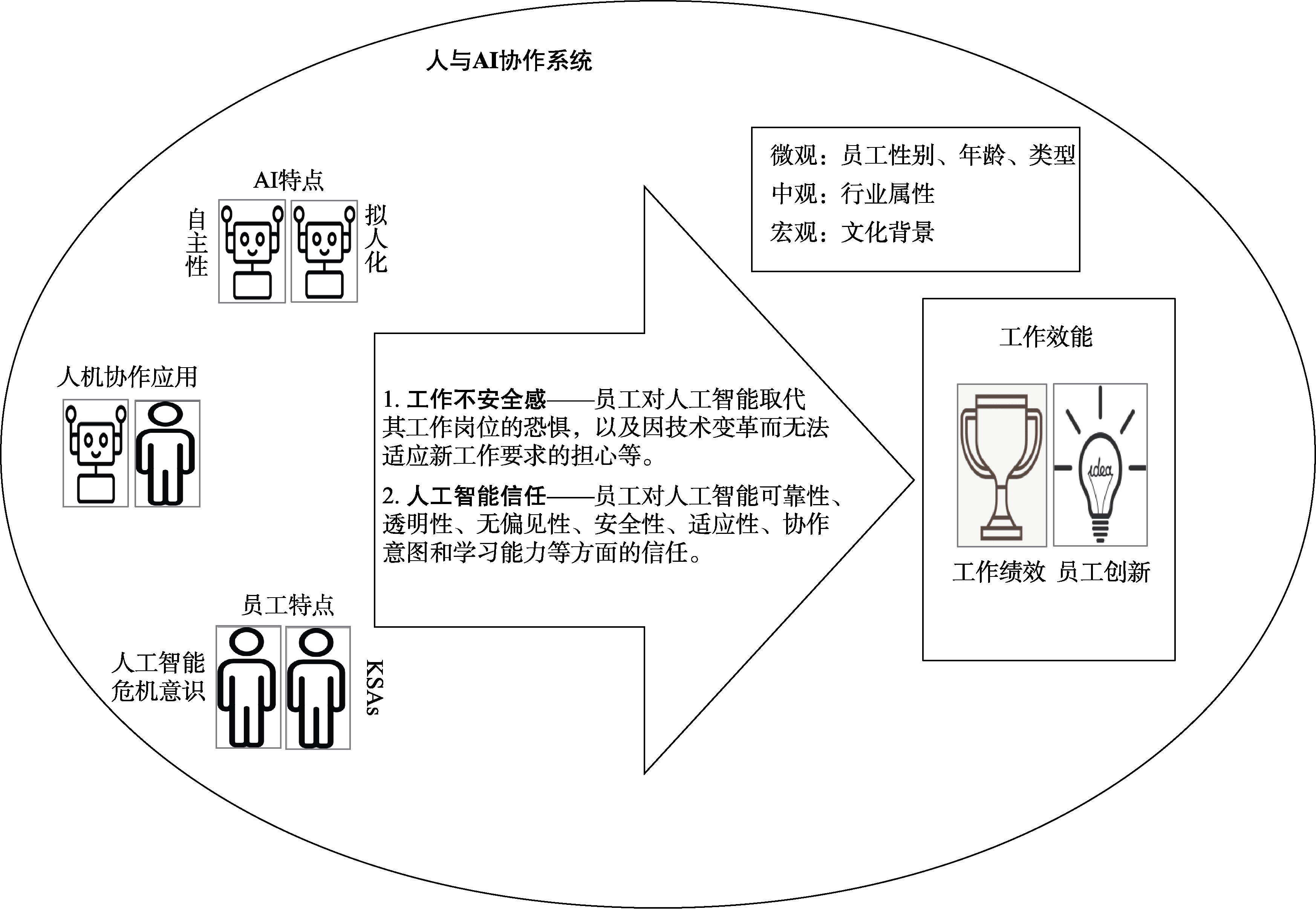
图1 人与AI协作系统对工作效能的影响
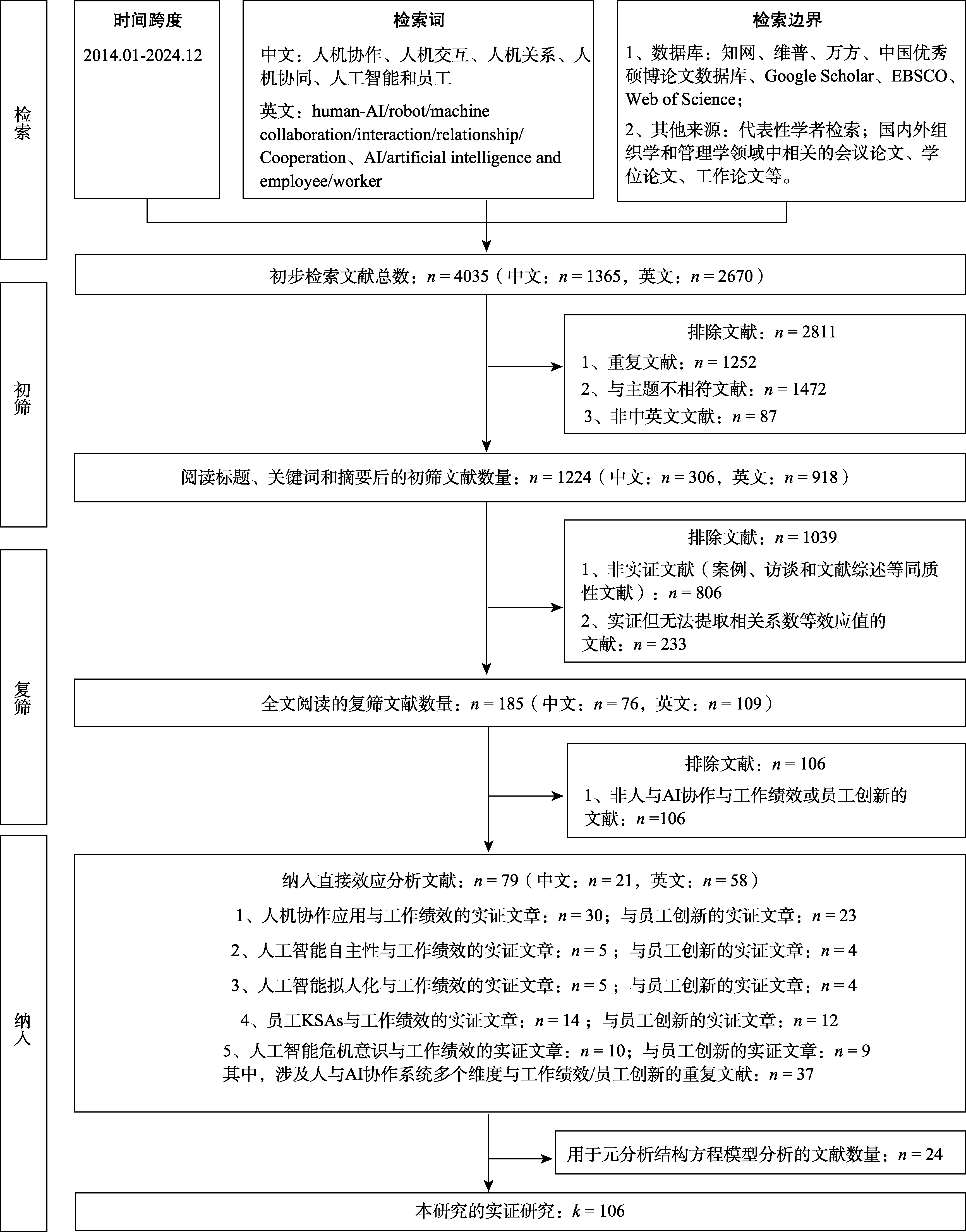
图2 文献检索与筛选流程图
| 自变量 | Fail-safe N | 5K+10 | 需找到的未出版研究数量 | Egger’s检验 | Begg’s检验 | ||
|---|---|---|---|---|---|---|---|
| 截距 | P | Z | P | ||||
| 1 工作绩效 | 16162 | 500 | 165 | 0.11 | 0.956 | 0.32 | 0.750 |
| (1)人机协作应用 | 8715 | 245 | 185 | −0.480 | 0.823 | 0.17 | 0.862 |
| (2)AI特点 | 5707 | 90 | 357 | 2.40 | 0.322 | 1.62 | 0.105 |
| ①AI自主性 | 1595 | 45 | 228 | 1.15 | 0.744 | 0.30 | 0.764 |
| ②AI拟人化 | 1261 | 55 | 140 | 4.01 | 0.089 | 1.67 | 0.095 |
| (3)员工特点 | 4001 | 185 | 114 | −0.70 | 0.897 | 0.50 | 0.619 |
| ①KSAs | 8648 | 110 | 432 | 5.68 | 0.169 | 0.81 | 0.417 |
| ②人工智能危机意识 | 860 | 85 | 57 | 0.86 | 0.803 | 0.35 | 0.729 |
| 2 员工创新 | 10519 | 380 | 142 | −0.85 | 0.762 | 0.29 | 0.772 |
| (1)人机协作应用 | 1004 | 155 | 35 | 1.621 | 0.658 | 0.06 | 0.955 |
| (2)AI特点 | 3029 | 90 | 189 | 0.30 | 0.948 | 0.05 | 0.964 |
| ①AI自主性 | 829 | 45 | 118 | 3.51 | 0.764 | 0.75 | 0.453 |
| ②AI拟人化 | 682 | 55 | 76 | 2.04 | 0.756 | 0.31 | 0.754 |
| (3)员工特点 | 4159 | 155 | 143 | −8.33 | 0.147 | 1.37 | 0.171 |
| ①KSAs | 6281 | 95 | 366 | 1.61 | 0.716 | 0.25 | 0.805 |
| ②人工智能危机意识 | 203 | 70 | 17 | −10.80 | 0.044 | 0.96 | 0.337 |
表1 发表偏倚检验
| 自变量 | Fail-safe N | 5K+10 | 需找到的未出版研究数量 | Egger’s检验 | Begg’s检验 | ||
|---|---|---|---|---|---|---|---|
| 截距 | P | Z | P | ||||
| 1 工作绩效 | 16162 | 500 | 165 | 0.11 | 0.956 | 0.32 | 0.750 |
| (1)人机协作应用 | 8715 | 245 | 185 | −0.480 | 0.823 | 0.17 | 0.862 |
| (2)AI特点 | 5707 | 90 | 357 | 2.40 | 0.322 | 1.62 | 0.105 |
| ①AI自主性 | 1595 | 45 | 228 | 1.15 | 0.744 | 0.30 | 0.764 |
| ②AI拟人化 | 1261 | 55 | 140 | 4.01 | 0.089 | 1.67 | 0.095 |
| (3)员工特点 | 4001 | 185 | 114 | −0.70 | 0.897 | 0.50 | 0.619 |
| ①KSAs | 8648 | 110 | 432 | 5.68 | 0.169 | 0.81 | 0.417 |
| ②人工智能危机意识 | 860 | 85 | 57 | 0.86 | 0.803 | 0.35 | 0.729 |
| 2 员工创新 | 10519 | 380 | 142 | −0.85 | 0.762 | 0.29 | 0.772 |
| (1)人机协作应用 | 1004 | 155 | 35 | 1.621 | 0.658 | 0.06 | 0.955 |
| (2)AI特点 | 3029 | 90 | 189 | 0.30 | 0.948 | 0.05 | 0.964 |
| ①AI自主性 | 829 | 45 | 118 | 3.51 | 0.764 | 0.75 | 0.453 |
| ②AI拟人化 | 682 | 55 | 76 | 2.04 | 0.756 | 0.31 | 0.754 |
| (3)员工特点 | 4159 | 155 | 143 | −8.33 | 0.147 | 1.37 | 0.171 |
| ①KSAs | 6281 | 95 | 366 | 1.61 | 0.716 | 0.25 | 0.805 |
| ②人工智能危机意识 | 203 | 70 | 17 | −10.80 | 0.044 | 0.96 | 0.337 |
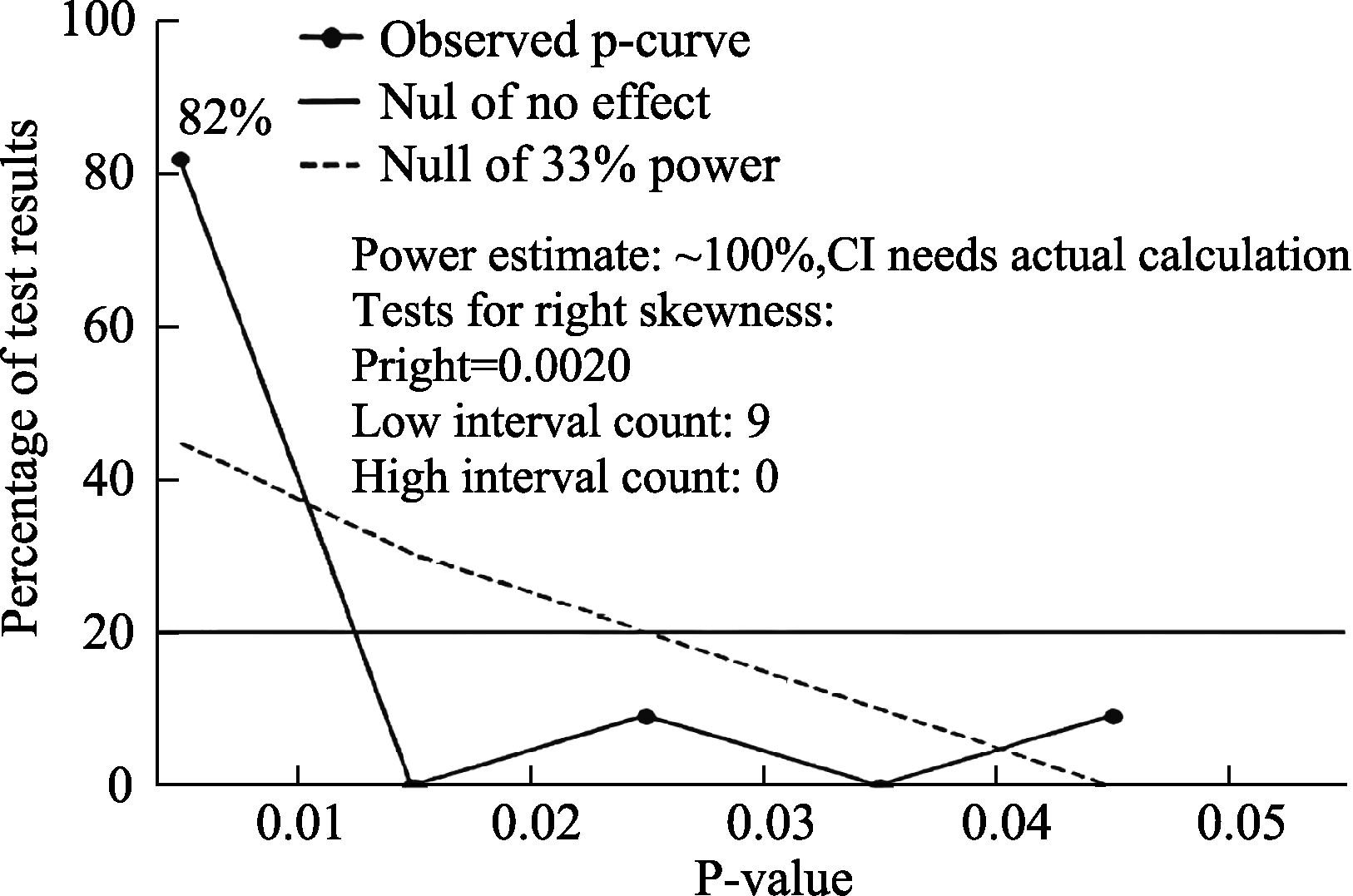
图3 p-curve检验
| 变量 | K | n | 模型 | 同质性检验 | 主效应分析 | |||||||||||
|---|---|---|---|---|---|---|---|---|---|---|---|---|---|---|---|---|
| Q | df(Q) | P | I2 | τ2 | SE | SD | Tau | 点估计及95%置信区间 | 双尾检验 | |||||||
| r | 下限 | 上限 | Z | P | ||||||||||||
| 1 工作绩效 | 98 | 32300 | R | 3702.07 | 97 | 0.000 | 97.38 | 0.11 | 0.021 | 0.000 | 0.34 | 0.32 | 0.25 | 0.38 | 9.40 | 0.000 |
| (1)人机协作应用 | 47 | 14917 | R | 1243.18 | 46 | 0.000 | 96.30 | 0.07 | 0.020 | 0.000 | 0.27 | 0.31 | 0.24 | 0.38 | 7.90 | 0.000 |
| (2)AI特点 | 16 | 4432 | R | 156.06 | 15 | 0.000 | 90.39 | 0.04 | 0.016 | 0.000 | 0.19 | 0.55 | 0.47 | 0.61 | 12.02 | 0.000 |
| ①AI自主性 | 7 | 1981 | R | 51.70 | 6 | 0.000 | 88.39 | 0.03 | 0.022 | 0.000 | 0.17 | 0.62 | 0.53 | 0.70 | 10.11 | 0.000 |
| ②AI拟人化 | 9 | 2451 | R | 44.33 | 8 | 0.000 | 81.96 | 0.02 | 0.012 | 0.000 | 0.13 | 0.48 | 0.40 | 0.55 | 10.21 | 0.000 |
| (3)员工特点 | 35 | 10741 | R | 1887.08 | 34 | 0.000 | 98.20 | 0.18 | 0.049 | 0.002 | 0.42 | 0.21 | 0.07 | 0.34 | 2.86 | 0.004 |
| ①KSAs | 20 | 6532 | R | 369.87 | 19 | 0.000 | 94.82 | 0.06 | 0.021 | 0.000 | 0.24 | 0.49 | 0.41 | 0.57 | 9.78 | 0.000 |
| ②人工智能危机意识 | 15 | 4209 | R | 117.01 | 14 | 0.000 | 88.04 | 0.03 | 0.012 | 0.000 | 0.16 | −0.23 | −0.32 | −0.15 | −5.21 | 0.000 |
| 2 员工创新 | 74 | 22426 | R | 2158.09 | 73 | 0.000 | 96.62 | 0.10 | 0.018 | 0.000 | 0.31 | 0.34 | 0.27 | 0.40 | 9.59 | 0.000 |
| (1)人机协作应用 | 29 | 7717 | R | 664.50 | 28 | 0.000 | 95.79 | 0.09 | 0.026 | 0.001 | 0.30 | 0.43 | 0.34 | 0.52 | 8.16 | 0.000 |
| (2)AI特点 | 16 | 4937 | R | 127.46 | 15 | 0.000 | 88.23 | 0.03 | 0.011 | 0.000 | 0.16 | 0.37 | 0.30 | 0.44 | 9.32 | 0.000 |
| ①AI自主性 | 7 | 2534 | R | 27.23 | 6 | 0.000 | 77.96 | 0.01 | 0.007 | 0.000 | 0.10 | 0.41 | 0.33 | 0.47 | 10.06 | 0.000 |
| ②AI拟人化 | 9 | 2403 | R | 93.71 | 8 | 0.000 | 91.46 | 0.04 | 0.024 | 0.000 | 0.20 | 0.35 | 0.22 | 0.46 | 5.09 | 0.000 |
| (3)员工特点 | 29 | 9772 | R | 1221.08 | 28 | 0.000 | 97.71 | 0.13 | 0.038 | 0.001 | 0.36 | 0.22 | 0.09 | 0.34 | 3.30 | 0.001 |
| ①KSAs | 17 | 6107 | R | 196.20 | 16 | 0.000 | 91.85 | 0.03 | 0.013 | 0.000 | 0.18 | 0.46 | 0.39 | 0.53 | 10.94 | 0.000 |
| ②人工智能危机意识 | 12 | 3665 | R | 209.70 | 11 | 0.000 | 94.75 | 0.06 | 0.030 | 0.001 | 0.25 | −0.17 | −0.30 | −0.02 | −2.28 | 0.022 |
表2 同质性检验和主效应分析结果
| 变量 | K | n | 模型 | 同质性检验 | 主效应分析 | |||||||||||
|---|---|---|---|---|---|---|---|---|---|---|---|---|---|---|---|---|
| Q | df(Q) | P | I2 | τ2 | SE | SD | Tau | 点估计及95%置信区间 | 双尾检验 | |||||||
| r | 下限 | 上限 | Z | P | ||||||||||||
| 1 工作绩效 | 98 | 32300 | R | 3702.07 | 97 | 0.000 | 97.38 | 0.11 | 0.021 | 0.000 | 0.34 | 0.32 | 0.25 | 0.38 | 9.40 | 0.000 |
| (1)人机协作应用 | 47 | 14917 | R | 1243.18 | 46 | 0.000 | 96.30 | 0.07 | 0.020 | 0.000 | 0.27 | 0.31 | 0.24 | 0.38 | 7.90 | 0.000 |
| (2)AI特点 | 16 | 4432 | R | 156.06 | 15 | 0.000 | 90.39 | 0.04 | 0.016 | 0.000 | 0.19 | 0.55 | 0.47 | 0.61 | 12.02 | 0.000 |
| ①AI自主性 | 7 | 1981 | R | 51.70 | 6 | 0.000 | 88.39 | 0.03 | 0.022 | 0.000 | 0.17 | 0.62 | 0.53 | 0.70 | 10.11 | 0.000 |
| ②AI拟人化 | 9 | 2451 | R | 44.33 | 8 | 0.000 | 81.96 | 0.02 | 0.012 | 0.000 | 0.13 | 0.48 | 0.40 | 0.55 | 10.21 | 0.000 |
| (3)员工特点 | 35 | 10741 | R | 1887.08 | 34 | 0.000 | 98.20 | 0.18 | 0.049 | 0.002 | 0.42 | 0.21 | 0.07 | 0.34 | 2.86 | 0.004 |
| ①KSAs | 20 | 6532 | R | 369.87 | 19 | 0.000 | 94.82 | 0.06 | 0.021 | 0.000 | 0.24 | 0.49 | 0.41 | 0.57 | 9.78 | 0.000 |
| ②人工智能危机意识 | 15 | 4209 | R | 117.01 | 14 | 0.000 | 88.04 | 0.03 | 0.012 | 0.000 | 0.16 | −0.23 | −0.32 | −0.15 | −5.21 | 0.000 |
| 2 员工创新 | 74 | 22426 | R | 2158.09 | 73 | 0.000 | 96.62 | 0.10 | 0.018 | 0.000 | 0.31 | 0.34 | 0.27 | 0.40 | 9.59 | 0.000 |
| (1)人机协作应用 | 29 | 7717 | R | 664.50 | 28 | 0.000 | 95.79 | 0.09 | 0.026 | 0.001 | 0.30 | 0.43 | 0.34 | 0.52 | 8.16 | 0.000 |
| (2)AI特点 | 16 | 4937 | R | 127.46 | 15 | 0.000 | 88.23 | 0.03 | 0.011 | 0.000 | 0.16 | 0.37 | 0.30 | 0.44 | 9.32 | 0.000 |
| ①AI自主性 | 7 | 2534 | R | 27.23 | 6 | 0.000 | 77.96 | 0.01 | 0.007 | 0.000 | 0.10 | 0.41 | 0.33 | 0.47 | 10.06 | 0.000 |
| ②AI拟人化 | 9 | 2403 | R | 93.71 | 8 | 0.000 | 91.46 | 0.04 | 0.024 | 0.000 | 0.20 | 0.35 | 0.22 | 0.46 | 5.09 | 0.000 |
| (3)员工特点 | 29 | 9772 | R | 1221.08 | 28 | 0.000 | 97.71 | 0.13 | 0.038 | 0.001 | 0.36 | 0.22 | 0.09 | 0.34 | 3.30 | 0.001 |
| ①KSAs | 17 | 6107 | R | 196.20 | 16 | 0.000 | 91.85 | 0.03 | 0.013 | 0.000 | 0.18 | 0.46 | 0.39 | 0.53 | 10.94 | 0.000 |
| ②人工智能危机意识 | 12 | 3665 | R | 209.70 | 11 | 0.000 | 94.75 | 0.06 | 0.030 | 0.001 | 0.25 | −0.17 | −0.30 | −0.02 | −2.28 | 0.022 |
| 变量 | 1 | 2 | 3 | 4 | 5 | 6 | 7 | 8 | 9 |
|---|---|---|---|---|---|---|---|---|---|
| 1.HAC | 1 | ||||||||
| 2.AUT | 0.67*** (6, 1958) | 1 | |||||||
| 3.ANT | 0.48*** (3, 825) | 0.52*** (9, 2904) | 1 | ||||||
| 4.KSA | 0.49*** (10, 2826) | 0.60*** (9, 2863) | 0.56*** (6, 2387) | 1 | |||||
| 5.AIA | 0.22*** (9, 2256) | 0.30*** (3, 352) | 0.48*** (4, 1387) | −0.20* (9, 3099) | 1 | ||||
| 6.INS | 0.18** (20, 12435) | 0.29** (5, 1170) | 0.31*** (6, 1228) | −0.31*** (7, 1864) | 0.26** (17, 5931) | 1 | |||
| 7.AIT | 0.38*** (6, 1744) | 0.56* (3, 1065) | 0.42*** (16, 4931) | 0.48*** (8, 2888) | −0.46*** (4, 1197) | −0.49a (16, 4152) | 1 | ||
| 8.JP | 0.31*** (47, 14917) | 0.62*** (7, 1981) | 0.48*** (9, 2451) | 0.49*** (20, 6532) | −0.23*** (15, 4209) | −0.23b (9, 2106) | 0.40*** (8, 2153) | 1 | |
| 9.IP | 0.43*** (29, 7717) | 0.41*** (7, 2534) | 0.35*** (9, 2403) | 0.46*** (17, 6107) | −0.17* (12, 3665) | −0.42c (5, 1697) | 0.52*** (8, 2493) | 0.53d (30, 6846) | 1 |
表3 变量相关系数矩阵
| 变量 | 1 | 2 | 3 | 4 | 5 | 6 | 7 | 8 | 9 |
|---|---|---|---|---|---|---|---|---|---|
| 1.HAC | 1 | ||||||||
| 2.AUT | 0.67*** (6, 1958) | 1 | |||||||
| 3.ANT | 0.48*** (3, 825) | 0.52*** (9, 2904) | 1 | ||||||
| 4.KSA | 0.49*** (10, 2826) | 0.60*** (9, 2863) | 0.56*** (6, 2387) | 1 | |||||
| 5.AIA | 0.22*** (9, 2256) | 0.30*** (3, 352) | 0.48*** (4, 1387) | −0.20* (9, 3099) | 1 | ||||
| 6.INS | 0.18** (20, 12435) | 0.29** (5, 1170) | 0.31*** (6, 1228) | −0.31*** (7, 1864) | 0.26** (17, 5931) | 1 | |||
| 7.AIT | 0.38*** (6, 1744) | 0.56* (3, 1065) | 0.42*** (16, 4931) | 0.48*** (8, 2888) | −0.46*** (4, 1197) | −0.49a (16, 4152) | 1 | ||
| 8.JP | 0.31*** (47, 14917) | 0.62*** (7, 1981) | 0.48*** (9, 2451) | 0.49*** (20, 6532) | −0.23*** (15, 4209) | −0.23b (9, 2106) | 0.40*** (8, 2153) | 1 | |
| 9.IP | 0.43*** (29, 7717) | 0.41*** (7, 2534) | 0.35*** (9, 2403) | 0.46*** (17, 6107) | −0.17* (12, 3665) | −0.42c (5, 1697) | 0.52*** (8, 2493) | 0.53d (30, 6846) | 1 |
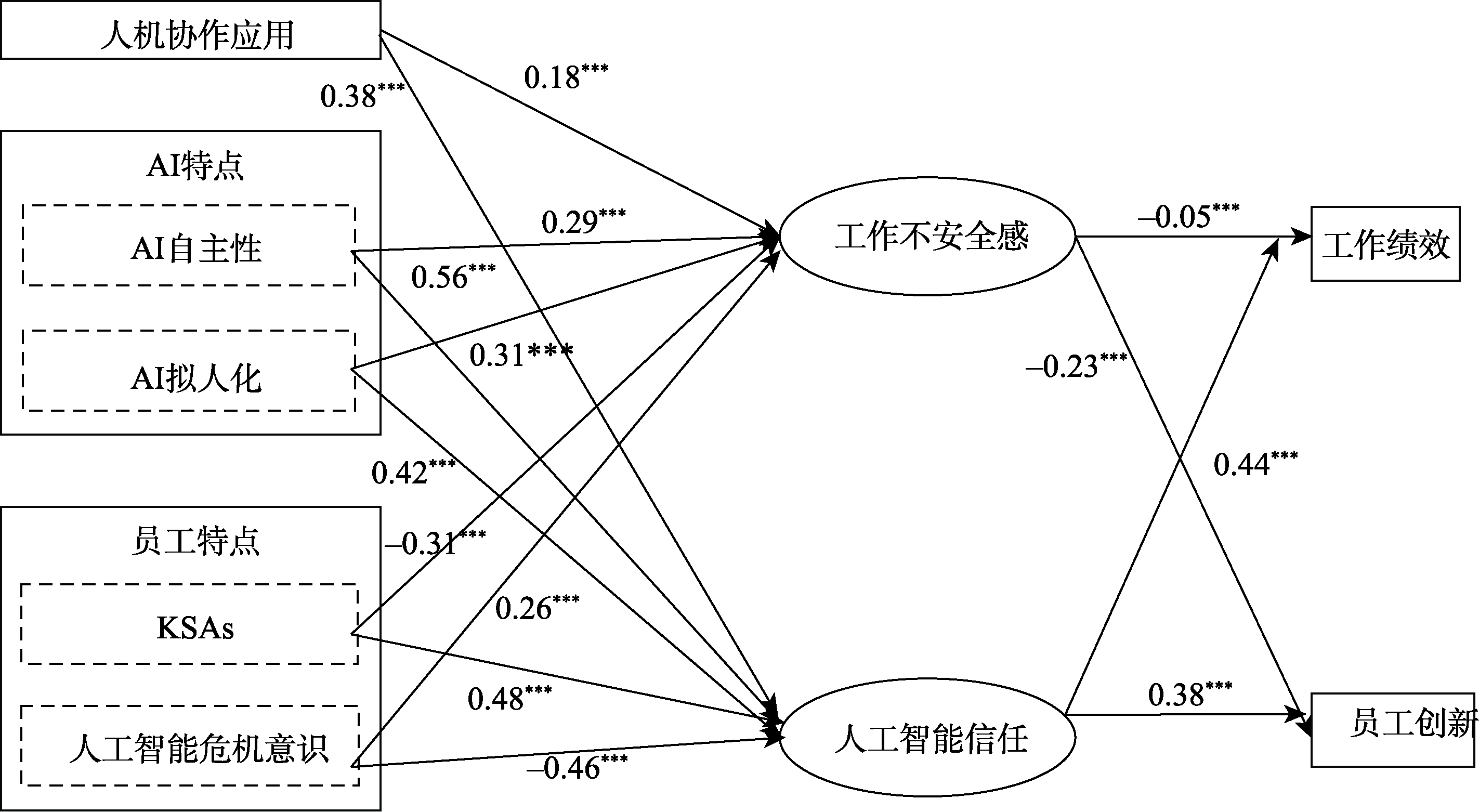
图4 模型路径分析
| 路径 | β | SE | Z | P | Bootstrap95% CI |
|---|---|---|---|---|---|
| Indirect Effect | |||||
| IND1:HAC-INS-JP | −0.01 | 0.001 | −5.76 | 0.000 | [−0.01, −0.01] |
| IND2:HAC-AIT-JP | 0.15 | 0.004 | 37.07 | 0.000 | [0.14, 0.15] |
| IND3:HAC-INS-IP | −0.04 | 0.002 | −18.34 | 0.000 | [−0.05, −0.04] |
| IND4:HAC-AIT-IP | 0.17 | 0.004 | 40.29 | 0.000 | [0.16, 0.17] |
| IND5:AUT-INS-JP | −0.01 | 0.002 | −5.31 | 0.000 | [−0.02, −0.01] |
| IND6:AUT-AIT-JP | 0.21 | 0.005 | 41.30 | 0.000 | [0.21, 0.22] |
| IND7:AUT-INS-IP | −0.07 | 0.003 | −22.00 | 0.000 | [−0.07, −0.06] |
| IND8:AUT-AIT-IP | 0.25 | 0.005 | 47.26 | 0.000 | [0.24, 0.26] |
| IND9:ANT-INS-JP | −0.01 | 0.003 | −5.34 | 0.000 | [−0.02, −0.01] |
| IND10:ANT-AIT-JP | 0.16 | 0.004 | 34.79 | 0.000 | [0.15, 0.17] |
| IND11:ANT-INS-IP | −0.07 | 0.003 | −22.78 | 0.000 | [−0.08, −0.07] |
| IND12:ANT-AIT-IP | 0.18 | 0.005 | 39.32 | 0.000 | [0.18, 0.19] |
| IND13:KSA-INS-JP | 0.01 | 0.030 | 5.33 | 0.000 | [0.01, 0.02] |
| IND14:KSA-AIT-JP | 0.18 | 0.005 | 38.51 | 0.000 | [0.18, 0.19] |
| IND15:KSA-INS-IP | 0.07 | 0.003 | 22.98 | 0.000 | [0.07, 0.08] |
| IND16:KSA-AIT-IP | 0.21 | 0.005 | 43.50 | 0.000 | [0.20, 0.21] |
| IND17:AIA-INS-JP | −0.01 | 0.002 | −5.32 | 0.000 | [−0.02, −0.01] |
| IND18:AIA-AIT-JP | −0.18 | 0.005 | −37.76 | 0.000 | [−0.18, −0.17] |
| IND19:AIA-INS-IP | −0.06 | 0.003 | −21.16 | 0.000 | [−0.06, −0.05] |
| IND20:AIA-AIT-IP | −0.20 | 0.005 | −42.37 | 0.000 | [−0.21, −0.19] |
| Total Indirect Effect | |||||
| TOTALIND1:HAC-JP | 0.14 | 0.004 | 33.31 | 0.000 | [0.13, 0.14] |
| TOTALIND2:HAC-IP | 0.12 | 0.005 | 26.54 | 0.000 | [0.12, 0.13] |
| TOTALIND3:AUT-JP | 0.19 | 0.013 | 14.04 | 0.000 | [0.19, 0.21] |
| TOTALIND4:AUT-IP | 0.16 | 0.014 | 11.20 | 0.000 | [0.17, 0.19] |
| TOTALIND5:ANT-JP | 0.15 | 0.005 | 29.34 | 0.000 | [0.14, 0.16] |
| TOTALIND6:ANT-IP | 0.11 | 0.006 | 20.28 | 0.000 | [0.10, 0.12] |
| TOTALIND7:KSA-JP | 0.20 | 0.005 | 36.57 | 0.000 | [0.19, 0.21] |
| TOTALIND8:KSA-IP | 0.27 | 0.005 | 53.29 | 0.000 | [0.27.0.28] |
| TOTALIND9:AIA-JP | −0.19 | 0.005 | −38.08 | 0.000 | [−0.20, −0.18] |
| TOTALIND10:AIA-IP | −0.26 | 0.005 | −50.34 | 0.000 | [−0.26, −0.25] |
表4 间接效应估计
| 路径 | β | SE | Z | P | Bootstrap95% CI |
|---|---|---|---|---|---|
| Indirect Effect | |||||
| IND1:HAC-INS-JP | −0.01 | 0.001 | −5.76 | 0.000 | [−0.01, −0.01] |
| IND2:HAC-AIT-JP | 0.15 | 0.004 | 37.07 | 0.000 | [0.14, 0.15] |
| IND3:HAC-INS-IP | −0.04 | 0.002 | −18.34 | 0.000 | [−0.05, −0.04] |
| IND4:HAC-AIT-IP | 0.17 | 0.004 | 40.29 | 0.000 | [0.16, 0.17] |
| IND5:AUT-INS-JP | −0.01 | 0.002 | −5.31 | 0.000 | [−0.02, −0.01] |
| IND6:AUT-AIT-JP | 0.21 | 0.005 | 41.30 | 0.000 | [0.21, 0.22] |
| IND7:AUT-INS-IP | −0.07 | 0.003 | −22.00 | 0.000 | [−0.07, −0.06] |
| IND8:AUT-AIT-IP | 0.25 | 0.005 | 47.26 | 0.000 | [0.24, 0.26] |
| IND9:ANT-INS-JP | −0.01 | 0.003 | −5.34 | 0.000 | [−0.02, −0.01] |
| IND10:ANT-AIT-JP | 0.16 | 0.004 | 34.79 | 0.000 | [0.15, 0.17] |
| IND11:ANT-INS-IP | −0.07 | 0.003 | −22.78 | 0.000 | [−0.08, −0.07] |
| IND12:ANT-AIT-IP | 0.18 | 0.005 | 39.32 | 0.000 | [0.18, 0.19] |
| IND13:KSA-INS-JP | 0.01 | 0.030 | 5.33 | 0.000 | [0.01, 0.02] |
| IND14:KSA-AIT-JP | 0.18 | 0.005 | 38.51 | 0.000 | [0.18, 0.19] |
| IND15:KSA-INS-IP | 0.07 | 0.003 | 22.98 | 0.000 | [0.07, 0.08] |
| IND16:KSA-AIT-IP | 0.21 | 0.005 | 43.50 | 0.000 | [0.20, 0.21] |
| IND17:AIA-INS-JP | −0.01 | 0.002 | −5.32 | 0.000 | [−0.02, −0.01] |
| IND18:AIA-AIT-JP | −0.18 | 0.005 | −37.76 | 0.000 | [−0.18, −0.17] |
| IND19:AIA-INS-IP | −0.06 | 0.003 | −21.16 | 0.000 | [−0.06, −0.05] |
| IND20:AIA-AIT-IP | −0.20 | 0.005 | −42.37 | 0.000 | [−0.21, −0.19] |
| Total Indirect Effect | |||||
| TOTALIND1:HAC-JP | 0.14 | 0.004 | 33.31 | 0.000 | [0.13, 0.14] |
| TOTALIND2:HAC-IP | 0.12 | 0.005 | 26.54 | 0.000 | [0.12, 0.13] |
| TOTALIND3:AUT-JP | 0.19 | 0.013 | 14.04 | 0.000 | [0.19, 0.21] |
| TOTALIND4:AUT-IP | 0.16 | 0.014 | 11.20 | 0.000 | [0.17, 0.19] |
| TOTALIND5:ANT-JP | 0.15 | 0.005 | 29.34 | 0.000 | [0.14, 0.16] |
| TOTALIND6:ANT-IP | 0.11 | 0.006 | 20.28 | 0.000 | [0.10, 0.12] |
| TOTALIND7:KSA-JP | 0.20 | 0.005 | 36.57 | 0.000 | [0.19, 0.21] |
| TOTALIND8:KSA-IP | 0.27 | 0.005 | 53.29 | 0.000 | [0.27.0.28] |
| TOTALIND9:AIA-JP | −0.19 | 0.005 | −38.08 | 0.000 | [−0.20, −0.18] |
| TOTALIND10:AIA-IP | −0.26 | 0.005 | −50.34 | 0.000 | [−0.26, −0.25] |
| 调节变量 | K | n | 工作绩效 | K | n | 创新绩效 | ||||||||||||
|---|---|---|---|---|---|---|---|---|---|---|---|---|---|---|---|---|---|---|
| M | SD | B | SE | 95% CI | Z | P | M | SD | B | SE | 95% CI | Z | P | |||||
| 性别 | ||||||||||||||||||
| 人机协作应用 | 44 | 16635 | 0.64 | 0.09 | −0.14 | 0.342 | [−0.81, 0.53] | −0.40 | 0.687 | 29 | 7717 | 0.46 | 0.12 | 0.34 | 0.527 | [−0.70, 1.37] | 0.64 | 0.524 |
| AI自主性 | 5 | 1556 | 0.32 | 0.12 | −0.22 | 0.804 | [−1.80, 1.35] | −0.28 | 0.781 | 7 | 2534 | 0.48 | 0.14 | −0.16 | 0.435 | [−1.01, 0.70] | −0.36 | 0.718 |
| AI拟人化 | 5 | 1342 | 0.55 | 0.12 | −0.99 | 0.791 | [−2.54, 0.56] | −1.25 | 0.210 | 9 | 2403 | 0.46 | 0.11 | 0.02 | 0.789 | [−1.52, 1.57] | 0.03 | 0.977 |
| KSAs | 13 | 5206 | 0.51 | 0.11 | 0.56 | 0.571 | [−0.56, 1.67] | 0.97 | 0.331 | 16 | 5947 | 0.53 | 0.16 | −0.36 | 0.332 | [−1.01, 0.29] | −1.08 | 0.282 |
| 人工智能危机意识 | 9 | 3274 | 0.52 | 0.14 | −0.73 | 0.453 | [−1.61, 0.16] | −1.60 | 0.109 | 10 | 3345 | 0.45 | 0.15 | −0.68 | 0.584 | [−1.83, 0.46] | −1.17 | 0.242 |
| 年龄 | ||||||||||||||||||
| 人机协作应用 | 37 | 10994 | 31.7 | 4.52 | −0.01 | 0.011 | [−0.03, 0.02] | −0.61 | 0.545 | 25 | 7014 | 31.24 | 5.49 | 0.00 | 0.011 | [−0.02, 0.02] | 0.28 | 0.779 |
| AI自主性 | 4 | 656 | 26.68 | 2.32 | 0.03 | 0.019 | [−0.00, 0.07] | 1.82 | 0.069 | 7 | 2534 | 29.89 | 4.80 | −0.00 | 0.011 | [−0.02, 0.02] | −0.34 | 0.737 |
| AI拟人化 | 9 | 2451 | 24.52 | 2.57 | −0.02 | 0.022 | [−0.06, 0.02] | −0.92 | 0.356 | 9 | 2403 | 34.98 | 6.06 | −0.02 | 0.010 | [−0.03, 0.01] | −1.48 | 0.140 |
| KSAs | 13 | 5206 | 30.32 | 4.52 | 0.02 | 0.015 | [−0.01, 0.05] | 1.35 | 0.177 | 13 | 5206 | 33.92 | 5.14 | −0.01 | 0.011 | [−0.03, 0.02] | −0.42 | 0.671 |
| 人工智能危机意识 | 10 | 3258 | 30.06 | 4.56 | 0.01 | 0.012 | [−0.02, 0.03] | 0.43 | 0.671 | 8 | 2921 | 30.51 | 4.45 | −0.02 | 0.025 | [−0.06, 0.03] | −0.63 | 0.526 |
表5 连续变量对效应量的元回归分析
| 调节变量 | K | n | 工作绩效 | K | n | 创新绩效 | ||||||||||||
|---|---|---|---|---|---|---|---|---|---|---|---|---|---|---|---|---|---|---|
| M | SD | B | SE | 95% CI | Z | P | M | SD | B | SE | 95% CI | Z | P | |||||
| 性别 | ||||||||||||||||||
| 人机协作应用 | 44 | 16635 | 0.64 | 0.09 | −0.14 | 0.342 | [−0.81, 0.53] | −0.40 | 0.687 | 29 | 7717 | 0.46 | 0.12 | 0.34 | 0.527 | [−0.70, 1.37] | 0.64 | 0.524 |
| AI自主性 | 5 | 1556 | 0.32 | 0.12 | −0.22 | 0.804 | [−1.80, 1.35] | −0.28 | 0.781 | 7 | 2534 | 0.48 | 0.14 | −0.16 | 0.435 | [−1.01, 0.70] | −0.36 | 0.718 |
| AI拟人化 | 5 | 1342 | 0.55 | 0.12 | −0.99 | 0.791 | [−2.54, 0.56] | −1.25 | 0.210 | 9 | 2403 | 0.46 | 0.11 | 0.02 | 0.789 | [−1.52, 1.57] | 0.03 | 0.977 |
| KSAs | 13 | 5206 | 0.51 | 0.11 | 0.56 | 0.571 | [−0.56, 1.67] | 0.97 | 0.331 | 16 | 5947 | 0.53 | 0.16 | −0.36 | 0.332 | [−1.01, 0.29] | −1.08 | 0.282 |
| 人工智能危机意识 | 9 | 3274 | 0.52 | 0.14 | −0.73 | 0.453 | [−1.61, 0.16] | −1.60 | 0.109 | 10 | 3345 | 0.45 | 0.15 | −0.68 | 0.584 | [−1.83, 0.46] | −1.17 | 0.242 |
| 年龄 | ||||||||||||||||||
| 人机协作应用 | 37 | 10994 | 31.7 | 4.52 | −0.01 | 0.011 | [−0.03, 0.02] | −0.61 | 0.545 | 25 | 7014 | 31.24 | 5.49 | 0.00 | 0.011 | [−0.02, 0.02] | 0.28 | 0.779 |
| AI自主性 | 4 | 656 | 26.68 | 2.32 | 0.03 | 0.019 | [−0.00, 0.07] | 1.82 | 0.069 | 7 | 2534 | 29.89 | 4.80 | −0.00 | 0.011 | [−0.02, 0.02] | −0.34 | 0.737 |
| AI拟人化 | 9 | 2451 | 24.52 | 2.57 | −0.02 | 0.022 | [−0.06, 0.02] | −0.92 | 0.356 | 9 | 2403 | 34.98 | 6.06 | −0.02 | 0.010 | [−0.03, 0.01] | −1.48 | 0.140 |
| KSAs | 13 | 5206 | 30.32 | 4.52 | 0.02 | 0.015 | [−0.01, 0.05] | 1.35 | 0.177 | 13 | 5206 | 33.92 | 5.14 | −0.01 | 0.011 | [−0.03, 0.02] | −0.42 | 0.671 |
| 人工智能危机意识 | 10 | 3258 | 30.06 | 4.56 | 0.01 | 0.012 | [−0.02, 0.03] | 0.43 | 0.671 | 8 | 2921 | 30.51 | 4.45 | −0.02 | 0.025 | [−0.06, 0.03] | −0.63 | 0.526 |
| 指标 | 调节变量 | 类别 | 异质性分析 | 点估计和95% CI | 双尾检验 | |||||||
|---|---|---|---|---|---|---|---|---|---|---|---|---|
| QB | df | P | K | n | r | 下限 | 上限 | Z | P | |||
| 工作绩效 | 员工类型 | 知识型 | 7.42 | 1 | 0.006 | 22 | 5807 | 0.21 | 0.08 | 0.33 | 3.18 | 0.001 |
| 非知识型 | 33 | 10611 | 0.44 | 0.32 | 0.54 | 7.00 | 0.000 | |||||
| 行业属性 | 服务业 | 9.50 | 2 | 0.009 | 36 | 13029 | 0.27 | 0.17 | 0.36 | 5.00 | 0.000 | |
| 制造业 | 14 | 4632 | 0.38 | 0.19 | 0.55 | 3.70 | 0.000 | |||||
| 高新技术业 | 18 | 6018 | 0.52 | 0.39 | 0.62 | 7.10 | 0.000 | |||||
| 文化背景 | 东方 | 7.03 | 1 | 0.008 | 62 | 23227 | 0.26 | 0.19 | 0.33 | 7.16 | 0.000 | |
| 西方 | 18 | 4192 | 0.51 | 0.34 | 0.65 | 5.33 | 0.000 | |||||
| 员工创新 | 员工类型 | 知识型 | 8.75 | 1 | 0.003 | 23 | 8372 | 0.47 | 0.39 | 0.55 | 9.64 | 0.000 |
| 非知识型 | 26 | 8003 | 0.24 | 0.10 | 0.37 | 3.24 | 0.001 | |||||
| 行业属性 | 服务业 | 6.67 | 2 | 0.036 | 23 | 7228 | 0.27 | 0.12 | 0.41 | 3.49 | 0.000 | |
| 制造业 | 9 | 3897 | 0.34 | 0.17 | 0.49 | 3.84 | 0.000 | |||||
| 高新技术业 | 12 | 4171 | 0.50 | 0.38 | 0.61 | 7.11 | 0.000 | |||||
| 文化背景 | 东方 | 0.10 | 1 | 0.752 | 47 | 16192 | 0.37 | 0.30 | 0.44 | 9.25 | 0.000 | |
| 西方 | 8 | 2230 | 0.34 | 0.15 | 0.51 | 3.36 | 0.001 | |||||
表6 分类变量对效应量的元回归分析
| 指标 | 调节变量 | 类别 | 异质性分析 | 点估计和95% CI | 双尾检验 | |||||||
|---|---|---|---|---|---|---|---|---|---|---|---|---|
| QB | df | P | K | n | r | 下限 | 上限 | Z | P | |||
| 工作绩效 | 员工类型 | 知识型 | 7.42 | 1 | 0.006 | 22 | 5807 | 0.21 | 0.08 | 0.33 | 3.18 | 0.001 |
| 非知识型 | 33 | 10611 | 0.44 | 0.32 | 0.54 | 7.00 | 0.000 | |||||
| 行业属性 | 服务业 | 9.50 | 2 | 0.009 | 36 | 13029 | 0.27 | 0.17 | 0.36 | 5.00 | 0.000 | |
| 制造业 | 14 | 4632 | 0.38 | 0.19 | 0.55 | 3.70 | 0.000 | |||||
| 高新技术业 | 18 | 6018 | 0.52 | 0.39 | 0.62 | 7.10 | 0.000 | |||||
| 文化背景 | 东方 | 7.03 | 1 | 0.008 | 62 | 23227 | 0.26 | 0.19 | 0.33 | 7.16 | 0.000 | |
| 西方 | 18 | 4192 | 0.51 | 0.34 | 0.65 | 5.33 | 0.000 | |||||
| 员工创新 | 员工类型 | 知识型 | 8.75 | 1 | 0.003 | 23 | 8372 | 0.47 | 0.39 | 0.55 | 9.64 | 0.000 |
| 非知识型 | 26 | 8003 | 0.24 | 0.10 | 0.37 | 3.24 | 0.001 | |||||
| 行业属性 | 服务业 | 6.67 | 2 | 0.036 | 23 | 7228 | 0.27 | 0.12 | 0.41 | 3.49 | 0.000 | |
| 制造业 | 9 | 3897 | 0.34 | 0.17 | 0.49 | 3.84 | 0.000 | |||||
| 高新技术业 | 12 | 4171 | 0.50 | 0.38 | 0.61 | 7.11 | 0.000 | |||||
| 文化背景 | 东方 | 0.10 | 1 | 0.752 | 47 | 16192 | 0.37 | 0.30 | 0.44 | 9.25 | 0.000 | |
| 西方 | 8 | 2230 | 0.34 | 0.15 | 0.51 | 3.36 | 0.001 | |||||
| (*表示纳入元分析的文献) | |
| [1] | 陈鸿志, 吕健权. (2019). 从拿来主义到协同共生:人力资源管理与社会网络研究的结合. 人力资源管理评论, (1), 60-75. |
| [2] | *程延园, 程雅馨, 何勤. (2022). 智能化工作场域中人机关系对任务绩效的影响——基于自我概念的解释. 科技管理研究, 42(19), 207-216. |
| [3] |
段成龙, 张亚军, 张军伟. (2025). 领导风格与员工越轨创新的关系: 一项元分析. 科技进步与对策, 42(6), 141-150.
doi: 10.6049/kjjbydc.2023110662 |
| [4] | *范静, 陈锋. (2025). 人工智能营销技术使用何以影响销售员工数字化创造力? 财经论丛(浙江财经大学学报), (7), 101-112. |
| [5] | *方颖. (2021). 数字化人机交互知识技能对作业绩效的影响研究 [硕士学位论文]. 西安科技大学, 西安. |
| [6] | *何江, 闫淑敏, 谭智丹, 夏青, 郭子颖, 马钰洁, 毕文琳, 谢显美. (2024). 员工与机器关系: 基于制造企业“机器换人”实践的调研证据. 科研管理, 45(1), 64-73. |
| [7] | *纪秀超. (2022). 人机协作认同对员工工作绩效影响研究 [硕士学位论文]. 山东大学, 济南. |
| [8] |
蒋建武, 龙晗寰, 胡洁宇. (2024). 工作场所人工智能应用对员工影响的元分析. 心理科学进展, 32(10), 1621-1639.
doi: 10.3724/SP.J.1042.2024.01621 |
| [9] | *雷鑫. (2022). 人工智能效应对制造业企业员工工作绩效的非线性影响研究 [硕士学位论文]. 西安理工大学, 西安. |
| [10] |
李超平, 孟雪, 胥彦, 蓝媛美. (2023). 家庭支持型主管行为对员工的影响与作用机制: 基于元分析的证据. 心理学报, 55(2), 257-271.
doi: 10.3724/SP.J.1041.2023.00257 |
| [11] | *李晓曼, 陈丽. (2024). 人机交互对工作创新行为的影响机制研究——来自智慧电厂的证据. 外国经济与管理, 46(10), 105-120. |
| [12] | *李子浩, 施锦诚, 王迎春. (2025). AI技术采用对科研人员创新绩效的影响研究. 科学学研究, 43(10), 2056-2065. https://doi.org/10.16192/j.cnki.1003-2053.20241024.004 |
| [13] | *李姿颖, 朱晓妹, 郭娟. (2023). AI应用场景下人机协同程度对员工工作重塑的影响: 心理赋能的中介作用. 中国人事科学, (9), 35-45. |
| [14] | *刘一鸣, 贾依然, 马惠敏, 王浩燃. (2024). 人工智能技术应用对员工创新行为的影响机制研究. 现代商业, (17), 71-75. |
| [15] | *刘云硕, 刘园园, 张帆, 褚福磊. (2024). 威胁还是挑战: 人工智能使用对员工创新绩效的双刃剑效应. 财经论丛(浙江财经大学学报), (9), 91-102. |
| [16] | *穆鑫岩, 毛日佑, 王婕. (2023). “温度”或“效率”?人工智能使用对员工工作行为的双刃剑效应研究. 中国人力资源开发, 40(9), 6-21. |
| [17] | *邱铄涵. (2022). 人机关系认知对工作重塑的影响研究——工作意义的视角[硕士学位论文]. 电子科技大学, 成都. |
| [18] | *盛晓娟, 郭辉, 何勤. (2022). 人工智能技术运用何以提高员工任务绩效? 北京联合大学学报(人文社会科学版), 20(4), 85-94. |
| [19] | *史青, 周苗苗. (2024). 创新的新动力: 智能时代人机关系驱动员工创新行为的影响研究. 西部经济管理论坛, 35(2), 43-53+63. |
| [20] | 石世英, 赵方方, 彭新新, 张净净, 叶晓甦. (2024). 人机协作对项目团队绩效的影响研究: 有调节的中介效应模型. 土木工程与管理学报, 41(3), 80-86+94. |
| [21] | 苏涛, 陈春花, 陈冰玲, 刘军, 马文聪. (2021). 职场排斥的“四宗罪”:中国情境下的一项元分析. 南开管理评论, 24(6), 106-118. |
| [22] | 苏涛, 陈春花, 崔小雨, 陈鸿志. (2017). 信任之下, 其效何如——来自Meta分析的证据. 南开管理评论, 20(4), 179-192. |
| [23] |
苏涛, 曾浩文, 钟晓琳, 马文聪, 陈修德. (2024). 祸福相依: 自恋型领导对下属效能双面效应的元分析. 心理科学进展, 32(9), 1463-1487.
doi: 10.3724/SP.J.1042.2024.01463 |
| [24] | *王天歌. (2023). 人工智能引入对员工工作行为的影响研究——基于身份认同的理论视角 [硕士学位论文]. 北京外国语大学, 北京. |
| [25] | 王振源, 姚明辉. (2022). 工作场所人机协作对员工影响的研究述评. 外国经济与管理, 44(9), 86-102. |
| [26] |
温忠麟, 方杰, 谢晋艳, 欧阳劲樱. (2022). 国内中介效应的方法学研究. 心理科学进展, 30(8), 1692-1702.
doi: 10.3724/SP.J.1042.2022.01692 |
| [27] | 吴坤津, 宋一晓. (2023). 服从会带来好绩效吗? 心理权利感的中介作用及沟通开放性的调节作用. 商业经济与管理, (1), 15-25. |
| [28] | 谢小云, 左玉涵, 胡琼晶. (2021). 数字化时代的人力资源管理: 基于人与技术交互的视角. 管理世界, 37(1), 200-216+13. |
| [29] | *许玺悦. (2022). 人机团队绩效影响因素及作用机制研究——基于任务技术匹配视角 [硕士学位论文]. 暨南大学, 广州. |
| [30] | *寻迅. (2024). 人工智能设备使用对员工创新行为影响的双路径研究. 当代经理人, (4), 16-30. |
| [31] | *姚德明, 高秀秀. (2024). 数智背景下人机关系对员工服务创新行为的影响——基于社会认知理论. 湖北工业大学学报, 39(6), 24-28. |
| [32] |
尹萌, 牛雄鹰. (2024). 与AI“共舞”: 系统化视角下的AI-员工协作. 心理科学进展, 32(1), 162-176.
doi: 10.3724/SP.J.1042.2024.00162 |
| [33] |
*张恒, 高中华, 李慧玲. (2023). 增益还是损耗: 人工智能技术应用对员工创新行为的“双刃剑”效应. 科技进步与对策, 40(18), 1-11.
doi: 10.6049/kjjbydc.2023030249 |
| [34] | *周文斌, 王才. (2021). 机器人使用对工作绩效的影响及其作用机制——以中低端技能岗位员工为例的研究. 中国软科学, (4), 106-119. |
| [35] | *Ahn, H. Y. (2024). AI-Powered E-Learning for Lifelong Learners: Impact on Performance and Knowledge Application. Sustainability, 16(20), 9066. |
| [36] |
Ahn, J., Kim, J., & Sung, Y. (2022). The effect of gender stereotypes on artificial intelligence recommendations. Journal of Business Research, 141, 50-59.
doi: 10.1016/j.jbusres.2021.12.007 URL |
| [37] |
Ajoudani, A., Zanchettin, A. M., Ivaldi, S., Albu-Schäffer, A., Kosuge, K., & Khatib, O. (2018). Progress and prospects of the human-robot collaboration. Autonomous Robots, 42, 957-975.
doi: 10.1007/s10514-017-9677-2 URL |
| [38] |
Alabed, A., Javornik, A., & Gregory-Smith, D. (2022). AI anthropomorphism and its effect on users' self-congruence and self-ai integration: A theoretical framework and research agenda. Technological Forecasting and Social Change, 182, 121786.
doi: 10.1016/j.techfore.2022.121786 URL |
| [39] | *AL-Khatib, A. (2024). Prioritizing factors for generative artificial intelligence-based innovation adoption in hospitality industry. Management Decision. https://doi.org/10.1108/MD-09-2023-1525 |
| [40] | *Atalla, A. D. G., El-Ashry, A. M., & Mohamed Sobhi Mohamed, S. (2024). The moderating role of ethical awareness in the relationship between nurses’ artificial intelligence perceptions, attitudes, and innovative work behavior: A cross-sectional study. BMC Nursing, 23(1), 488. |
| [41] |
Bechky, B. A. (2003). Sharing meaning across occupational communities: The transformation of understanding on a production floor. Organization Science, 14(3), 312-330.
doi: 10.1287/orsc.14.3.312.15162 URL |
| [42] |
Bhaskara, A., Skinner, M., & Loft, S. (2020). Agent transparency: A review of current theory and evidence. IEEE Transactions on Human-Machine Systems, 50(3), 215-224.
doi: 10.1109/THMS.6221037 URL |
| [43] | Brougham, D., & Haar, J. (2018). Smart technology, artificial intelligence, robotics, and algorithms (STARA): Employees’ perceptions of our future workplace. Journal of Management & Organization, 24(2), 239-257. |
| [44] | Brynjolfsson, E., & Mcafee, A. (2017). Artificial intelligence, for real. Harvard Business Review, 1(1), 1-31. |
| [45] | *Chen, A., Lyu, A., & Lu, Y. (2024). Member’s performance in human-AI hybrid teams: A perspective of adaptability theory. Information Technology & People. https://doi.org/10.1108/ITP-05-2023-0513 |
| [46] | Chen, H., Mehra, A., Tasselli, S., & Borgatti, S. P. (2022). Network dynamics and organizations: A review and research agenda. Journal of Management, 48(6): 1602-1660. |
| [47] | Chen, N., Zhao, X., & Wang, L. (2024a). The effect of job skill demands under artificial intelligence embeddedness on employees’ job performance: A moderated double- edged sword model. Behavioral Sciences, 14(10), 974. |
| [48] |
*Cheng, B., Lin, H., & Kong, Y. (2023). Challenge or hindrance? How and when organizational artificial intelligence adoption influences employee job crafting. Journal of Business Research, 164, 113987.
doi: 10.1016/j.jbusres.2023.113987 URL |
| [49] |
Cheng, G. H. L., & Chan, D. K. S. (2008). Who suffers more from job insecurity? A meta‐analytic review. Applied Psychology, 57(2), 272-303.
doi: 10.1111/apps.2008.57.issue-2 URL |
| [50] |
*Chowdhury, S., Budhwar, P., Dey, P. K., Joel-Edgar, S., & Abadie, A. (2022). AI-employee collaboration and business performance: Integrating knowledge-based view, socio- technical systems and organisational socialisation framework. Journal of Business Research, 144, 31-49.
doi: 10.1016/j.jbusres.2022.01.069 URL |
| [51] |
Darwish, A. F. E., & Huber, G. L. (2013). Individualism vs collectivism in different cultures: A cross-cultural study. Intercultural Education, 14(1), 47-56.
doi: 10.1080/1467598032000044647 URL |
| [52] | Dell'Acqua, F., McFowland III, E., Mollick, E. R., Lifshitz-Assaf, H., Kellogg, K., Rajendran, S., ... Lakhani, K. R. (2023). Navigating the jagged technological frontier: Field experimental evidence of the effects of AI on knowledge worker productivity and quality. Unit Working Paper (24-013). |
| [53] |
*De Visser, E. J., Monfort, S. S., Goodyear, K., Lu, L., O’Hara, M., Lee, M. R., ... Krueger, F. (2017). A little anthropomorphism goes a long way: Effects of oxytocin on trust, compliance, and team performance with automated agents. Human Factors, 59(1), 116-133.
doi: 10.1177/0018720816687205 pmid: 28146673 |
| [54] | Diab, M., & Demiris, Y. (2025). TICK: A Knowledge processing infrastructure for cognitive trust in human-robot interaction. International Journal of Social Robotics. https://doi.org/10.1007/s12369-024-01206-1 |
| [55] |
Ding, L. (2021). Employees’ challenge-hindrance appraisals toward stara awareness and competitive productivity: A micro-level Case. International Journal of Contemporary Hospitality Management, 33(9), 2950-2969.
doi: 10.1108/IJCHM-09-2020-1038 URL |
| [56] |
*Dong, X., Tian, Y., He, M., & Wang, T. (2025). When knowledge workers meet AI? The double-edged sword effects of AI adoption on innovative work behavior. Journal of Knowledge Management, 29(1), 113-147.
doi: 10.1108/JKM-02-2024-0222 URL |
| [57] |
Dutta, D., Mishra, S. K., & Tyagi, D. (2023). Augmented employee voice and employee engagement using artificial intelligence-enabled chatbots: A field study. The International Journal of Human Resource Management, 34(12), 2451-2480.
doi: 10.1080/09585192.2022.2085525 URL |
| [58] |
Felten, E., Raj, M., & Seamans, R. (2021). Occupational, industry, and geographic exposure to artificial intelligence: A novel dataset and its potential uses. Strategic Management Journal, 42(12), 2195-2217.
doi: 10.1002/smj.v42.12 URL |
| [59] |
Frey, C. B., & Osborne, M. A. (2017). The future of employment: How susceptible are jobs to computerisation. Technological Forecasting and Social Change, 114, 254-280.
doi: 10.1016/j.techfore.2016.08.019 URL |
| [60] |
Glikson, E., & Woolley, A. W. (2020). Human trust in artificial intelligence: Review of empirical research. Academy of Management Annals, 14(2), 627-660.
doi: 10.5465/annals.2018.0057 URL |
| [61] |
Good, V., Hughes, D. E., Kirca, A. H., & McGrath, S. (2022). A self-determination theory-based meta-analysis on the differential effects of intrinsic and extrinsic motivation on salesperson performance. Journal of the Academy of Marketing Science, 50(3), 586-614.
doi: 10.1007/s11747-021-00827-6 |
| [62] | Gull, A., Ashfaq, J., & Aslam, M. (2023). AI in the Workplace: Uncovering Its Impact on Employee Well-being and the Role of Cognitive Job Insecurity. International Journal of Business & Economic Affairs, 8(4), 79-91. |
| [63] |
Hauptman, A. I., Schelble, B. G., McNeese, N. J., & Madathil, K. C. (2023). Adapt and overcome: Perceptions of adaptive autonomous agents for human-AI teaming. Computers in Human Behavior, 138, 107451.
doi: 10.1016/j.chb.2022.107451 URL |
| [64] |
*He, C., Teng, R., & Song, J. (2023). Linking employees’ challenge-hindrance appraisals toward AI to service performance: The influences of job crafting, job insecurity and AI knowledge. International Journal of Contemporary Hospitality Management, 36(3), 975-994.
doi: 10.1108/IJCHM-07-2022-0848 URL |
| [65] |
*He, G., Zheng, X., Li, W., Tan, L., Chen, S., & He, Y. (2024). The mixed blessing of leaders’ artificial intelligence (AI)-oriented change behavior: Implications for employee job performance and unethical behavior. Applied Research in Quality of Life, 19, 469-497.
doi: 10.1007/s11482-023-10250-4 |
| [66] |
Hengstler, M., Enkel, E., & Duelli, S. (2016). Applied artificial intelligence and trust—The case of autonomous vehicles and medical assistance devices. Technological Forecasting and Social Change, 105, 105-120.
doi: 10.1016/j.techfore.2015.12.014 URL |
| [67] |
Hobfoll, S. E. (1989). Conservation of resources: A new attempt at conceptualizing stress. American Psychologist, 44(3), 513-524.
doi: 10.1037//0003-066x.44.3.513 pmid: 2648906 |
| [68] | Hobfoll, S.E. (2011). Conservation of resources theory: Its implication for stress, health, and resilience. In S.Folkman (Ed.), The Oxford handbook of stress, health, and coping (pp. 127-147). Oxford University Press. |
| [69] | Huang, J., Lyu, J., Chen, H., & Cheng, D. (2025). Human capital resource emergence in multiple project participation settings. Academy of Management Proceedings, (1), 16734. |
| [70] |
*Huang, L. L., Chen, R. P., & Chan, K. W. (2024). Pairing up with anthropomorphized artificial agents: Leveraging employee creativity in service encounters. Journal of the Academy of Marketing Science, 52(4), 955-975.
doi: 10.1007/s11747-024-01017-w |
| [71] |
*Huang, Y., & Gursoy, D. (2024). How does AI technology integration affect employees’ proactive service behaviors? A transactional theory of stress perspective. Journal of Retailing and Consumer Services, 77, 103700.
doi: 10.1016/j.jretconser.2023.103700 URL |
| [72] |
Huang, Y., & Yu, Z. (2023). Understanding the continuance intention for artificial intelligence news anchor: Based on the expectation confirmation theory. Systems, 11(9), 438-464.
doi: 10.3390/systems11090438 URL |
| [73] |
Huyer, S., & Nuñez, E. (2022). Breaking through the silicon wall: Gendered opportunities and risks of new technologies. Gender, Technology and Development, 26(3), 306-324.
doi: 10.1080/09718524.2022.2146001 URL |
| [74] | *Hwang, A. H. C., & Won, A. S. (2021, May). IdeaBot:Investigating social facilitation in human-machine team creativity. In Proceedings of the 2021 CHI conference on human factors in computing systems (pp. 1-16). New York, NY: Association for Computing Machinery. |
| [75] |
*Jeong, J., & Jeong, I. (2025). Driving creativity in the AI-enhanced workplace: Roles of self-efficacy and transformational leadership. Current Psychology, 44 (9), 8001-8014.
doi: 10.1007/s12144-024-07135-6 |
| [76] |
Jia, N., Luo, X., Fang, Z., & Liao, C. (2024). When and how artificial intelligence augments employee creativity. Academy of Management Journal, 67(1), 5-32.
doi: 10.5465/amj.2022.0426 URL |
| [77] | *Jia, X., & Hou, Y. (2024). Architecting the future: Exploring the synergy of AI-driven sustainable HRM, conscientiousness, and employee engagement. Discover Sustainability, 5(1), 30. |
| [78] |
Jiang, L., & Lavaysse, L. M. (2018). Cognitive and affective job insecurity: A meta-analysis and a primary study. Journal of Management, 44(6), 2307-2342.
doi: 10.1177/0149206318773853 URL |
| [79] | *Jo, D., Lee, J. G., & Lee, K. C. (2014). Empirical analysis of changes in human creativity in people who work with humanoid robots and their avatars. In Zaphiris, P., Ioannou, A. (Eds.), Learning and Collaboration Technologies. Designing and Developing Novel Learning Experiences: First International Conference, LCT 2014, Held as Part of HCI International 2014, Heraklion, Crete, Greece, June 22-27, 2014, Proceedings, Part I 1 (pp. 273-281). Springer International Publishing. |
| [80] | *Kahn, P. H., Kanda, T., Ishiguro, H., Gill, B. T., Shen, S., Ruckert, J. H., & Gary, H. E. (2016, March). Human creativity can be facilitated through interacting with a social robot. In 2016 11th ACM/IEEE International Conference on Human-Robot Interaction (HRI) (pp. 173-180). IEEE. |
| [81] |
*Kang, D. Y., Hur, W. M., & Shin, Y. (2023). Smart technology and service employees’ job crafting: Relationship between STARA awareness, performance pressure, receiving and giving help, and job crafting. Journal of Retailing and Consumer Services, 73, 103282.
doi: 10.1016/j.jretconser.2023.103282 URL |
| [82] |
*Khan, A. N., Soomro, M. A., & Pitafi, A. H. (2025). AI in the workplace: Driving employee performance through enhanced knowledge sharing and work engagement. International Journal of Human-Computer Interaction, 41(17), 10699-10712.
doi: 10.1080/10447318.2024.2436611 URL |
| [83] |
Kim, H., So, K. K. F., & Wirtz, J. (2022). Service robots: Applying social exchange theory to better understand human-robot interactions. Tourism Management, 92, 104537.
doi: 10.1016/j.tourman.2022.104537 URL |
| [84] |
*Kim, J., & Lee, S. S. (2023). Are two heads better than one?: The effect of student-AI collaboration on students' learning task performance. TechTrends, 67(2), 365-375.
doi: 10.1007/s11528-022-00788-9 |
| [85] | *Kong, H., Yin, Z., Chon, K., Yuan, Y., & Yu, J. (2024). How does artificial intelligence (AI) enhance hospitality employee innovation? The roles of exploration, AI trust, and proactive personality. Journal of Hospitality Marketing & Management, 33(3), 261-287. |
| [86] |
*Kumar, P. (2025). Artificial intelligence (AI)-augmented knowledge management capability and clinical performance: Implications for marketing strategies in health-care sector. Journal of Knowledge Management, 29(2), 415-441.
doi: 10.1108/JKM-01-2024-0111 URL |
| [87] | *Li, D., Liu, M., Zhao, Y., Li, Y., Zhang, T., Zhang, W., ... Lv, B. (2024). Why does algorithmic management undermine employee creativity?: A perspective focused on AMO theory. Journal of Organizational and End User Computing, 36(1), 1-16. |
| [88] |
Li, J. J., Bonn, M. A., & Ye, B. H. (2019). Hotel employee's artificial intelligence and robotics awareness and its impact on turnover intention: The moderating roles of perceived organizational support and competitive psychological climate. Tourism Management, 73, 172-181.
doi: 10.1016/j.tourman.2019.02.006 URL |
| [89] |
*Li, J. M., Zhang, R. X., Wu, T. J., & Mao, M. (2024). How does work autonomy in human-robot collaboration affect hotel employees’ work and health outcomes? Role of job insecurity and person-job fit. International Journal of Hospitality Management, 117, 103654.
doi: 10.1016/j.ijhm.2023.103654 URL |
| [90] | *Li, X., Zong, Q., & Cheng, M. (2024). The impact of medical explainable artificial intelligence on nurses’ innovation behaviour: A structural equation modelling approach. Journal of Nursing Management, 2024(1), 8885760. |
| [104] |
Noy, S., & Zhang, W. (2023). Experimental evidence on the productivity effects of generative artificial intelligence. Science, 381(6654), 187-192.
doi: 10.1126/science.adh2586 pmid: 37440646 |
| [105] |
Oldham, G. R., & Cummings, A. (1996). Employee creativity: Personal and contextual factors at work. Academy of Management Journal, 39(3), 607-634.
doi: 10.2307/256657 URL |
| [106] |
*Paliga, M. (2022). Human-cobot interaction fluency and cobot operators’ job performance. The mediating role of work engagement: A survey. Robotics and Autonomous Systems, 155, 104191.
doi: 10.1016/j.robot.2022.104191 URL |
| [107] | *Paliga, M. (2023). The relationships of human-cobot interaction fluency with job performance and job satisfaction among Cobot operators—the moderating role of workload. International Journal of Environmental Research and Public Health, 20(6), 5111. |
| [108] | Papadopoulos, F., Küster, D., Corrigan, L. J., Kappas, A., & Castellano, G. (2016). Do relative positions and proxemics affect the engagement in a human-robot collaborative scenario? Interaction Studies, 17(3), 321-347. |
| [109] |
*Pei, J., Wang, H., Peng, Q., & Liu, S. (2024). Saving face: Leveraging artificial intelligence‐based negative feedback to enhance employee job performance. Human Resource Management, 63(5), 775-790.
doi: 10.1002/hrm.v63.5 URL |
| [110] |
Poquet, O., & De Laat, M. (2021). Developing capabilities: Lifelong learning in the age of AI. British Journal of Educational Technology, 52(4), 1695-1708.
doi: 10.1111/bjet.v52.4 URL |
| [111] |
*Presbitero, A., & Teng-Calleja, M. (2022). Job attitudes and career behaviors relating to employees' perceived incorporation of artificial intelligence in the workplace: A career self-management perspective. Personnel Review, 52(4), 1169-1187.
doi: 10.1108/PR-02-2021-0103 URL |
| [112] |
*Qiu, H., Li, M., Bai, B., Wang, N., & Li, Y. (2022). The impact of AI-enabled service attributes on service hospitableness: The role of employee physical and psychological workload. International Journal of Contemporary Hospitality Management, 34(4), 1374-1398.
doi: 10.1108/IJCHM-08-2021-0960 URL |
| [113] |
Ranta, M., & Ylinen, M. (2023). Board gender diversity and workplace diversity: A machine learning approach. Corporate Governance: The International Journal of Business in Society, 23(5), 995-1018.
doi: 10.1108/CG-01-2022-0048 URL |
| [114] |
*Rebensky, S., Carmody, K., Ficke, C., Carroll, M., & Bennett, W. (2022). Teammates instead of tools: The impacts of level of autonomy on mission performance and human-agent teaming dynamics in multi-agent distributed teams. Frontiers in Robotics and AI, 9, 782134.
doi: 10.3389/frobt.2022.782134 URL |
| [115] |
Russo, C., Romano, L., Clemente, D., Iacovone, L., Gladwin, T. E., & Panno, A. (2025). Gender differences in artificial intelligence: The role of artificial intelligence anxiety. Frontiers in Psychology, 16, 1559457.
doi: 10.3389/fpsyg.2025.1559457 URL |
| [116] |
Savela, N., Kaakinen, M., Ellonen, N., & Oksanen, A. (2021). Sharing a work team with robots: The negative effect of robot co-workers on in-group identification with the work team. Computers In Human Behavior, 115, 106585.
doi: 10.1016/j.chb.2020.106585 URL |
| [117] |
*Shahzad, M. F., Xu, S., & Zahid, H. (2025). Exploring the impact of generative AI-based technologies on learning performance through self-efficacy, fairness & ethics, creativity, and trust in higher education. Education and Information Technologies, 30(3), 3691-3716.
doi: 10.1007/s10639-024-12949-9 |
| [118] |
Sharif, M. N., Zhang, L., Asif, M., Alshdaifat, S. M., & Hanaysha, J. R. (2025). Artificial intelligence and employee outcomes: Investigating the role of job insecurity and technostress in the hospitality industry. Acta Psychologica, 253, 104733.
doi: 10.1016/j.actpsy.2025.104733 URL |
| [119] |
Shoss, M. K. (2017). Job insecurity: An integrative review and agenda for future research. Journal of Management, 43(6), 1911-1939.
doi: 10.1177/0149206317691574 URL |
| [120] | *Sowa, K., & Przegalinska, A. (2019, October). Digital coworker: Human-AI collaboration in work environment, on the example of virtual assistants for management professions. In Collaborative innovation networks conference of Digital Transformation of Collaboration (pp. 179-201). Springer International Publishing. |
| [121] | *Su, F., Liu, W., Xiong, K., & Zeng, Q. (2024). How and when artificial intelligence usage facilitates task performance. Social Behavior and Personality: An International Journal, 52(10), 1-11. |
| [122] |
Sverke, M., Hellgren, J., & Näswall, K. (2002). No security: A meta-analysis and review of job insecurity and its consequences. Journal of Occupational Health Psychology, 7(3), 242-264.
pmid: 12148956 |
| [123] |
*Tahir, M. A., Da, G., Javed, M., Akhtar, M. W., & Wang, X. (2024). Employees’ foe or friend: Artificial intelligence and employee outcomes. The Service Industries Journal, 45(11-12), 1100-1131.
doi: 10.1080/02642069.2024.2375746 URL |
| [124] |
Tams, S., Thatcher, J. B., & Craig, K. (2018). How and why trust matters in post-adoptive usage: The mediating roles of internal and external self-efficacy. The Journal of Strategic Information Systems, 27(2), 170-190.
doi: 10.1016/j.jsis.2017.07.004 URL |
| [125] | *Tang, P. M., Koopman, J., Mai, K. M., De Cremer, D., Zhang, J. H., Reynders, P., ... Chen, I. (2023). No person is an island: Unpacking the work and after-work consequences of interacting with artificial intelligence. Journal of Applied Psychology, 108(11), 1766. |
| [126] |
*Tang, P. M., Koopman, J., Yam, K. C., De Cremer, D., Zhang, J. H., & Reynders, P. (2023). The self‐regulatory consequences of dependence on intelligent machines at work: Evidence from field and experimental studies. Human Resource Management, 62(5), 721-744.
doi: 10.1002/hrm.v62.5 URL |
| [127] | *Taşgİt, Y. E., Baykal, Y., Aydin, U. C., Yakupoğlu, A., & Coşkuner, M. (2023). Do employees' Artificial Intelligence attitudes affect individual business performance? Journal of Organisational Studies & Innovation, 10(2), 19-37. |
| [128] | Tenakwah, E. S., Tenakwah, E. J., Amponsah, M., Eyaa, S., Boateng, E., & Okhawere, N. (2022). Adoption of sustainable technologies during crisis: Examining employees’ perception and readiness across cultures. Sustainability, 14(8), 4605. |
| [129] |
*Teng, R., Zhou, S., Zheng, W., & Ma, C. (2024). Artificial intelligence (AI) awareness and work withdrawal: Evaluating chained mediation through negative work-related rumination and emotional exhaustion. International Journal of Contemporary Hospitality Management, 36(7), 2311-2326.
doi: 10.1108/IJCHM-02-2023-0240 URL |
| [130] |
*Tong, S., Jia, N., Luo, X., & Fang, Z. (2021). The Janus face of artificial intelligence feedback: Deployment versus disclosure effects on employee performance. Strategic Management Journal, 42(9), 1600-1631.
doi: 10.1002/smj.v42.9 URL |
| [131] |
Vaccaro, M., & Almaatouq, A., & Malone, T. (2024). When combinations of humans and AI are useful: A systematic review and meta-analysis. Nature Human Behaviour, 8(12), 2293-2303.
doi: 10.1038/s41562-024-02024-1 pmid: 39468277 |
| [132] |
Venkatesh, V., & Morris, M. G. (2000). Why don't men ever stop to ask for directions? Gender, social influence, and their role in technology acceptance and usage behavior. MIS Quarterly, 24(1), 115-139.
doi: 10.2307/3250981 URL |
| [133] |
*Verma, S., & Singh, V. (2022a). The employees intention to work in artificial intelligence-based hybrid environments. IEEE Transactions on Engineering Management, 71, 3266-3277.
doi: 10.1109/TEM.2022.3193664 URL |
| [134] |
*Verma, S., & Singh, V. (2022b). Impact of artificial intelligence-enabled job characteristics and perceived substitution crisis on innovative work behavior of employees from high-tech firms. Computers in Human Behavior, 131, 107215.
doi: 10.1016/j.chb.2022.107215 URL |
| [135] | *Verma, S., Singh, V., Tudoran, A. A., & Bhattacharyya, S. S. (2024). Elevating employees’ psychological responses and task performance through responsible artificial intelligence. Information Technology & People, 37(7), 2551-2567. |
| [103] |
Ng, T. W. H. (2017). Transformational leadership and performance outcomes: Analyses of multiple mediation pathways. The Leadership Quarterly, 28(3), 385-417.
doi: 10.1016/j.leaqua.2016.11.008 URL |
| [102] |
Nelson, A. J., & Irwin, J. (2014). “Defining what we do-all over again”: Occupational identity, technological change, and the librarian/Internet-search relationship. Academy of Management Journal, 57(3), 892-928.
doi: 10.5465/amj.2012.0201 URL |
| [101] |
Munnukka. J., Talvitie-Lamberg, K., & Maity. D. (2022). Anthropomorphism and social presence in human-virtual service assistant interactions: The role of dialog length and attitudes. Computers in Human Behavior, 135, 107343.
doi: 10.1016/j.chb.2022.107343 URL |
| [100] |
*Mulcahy, R. F., Riedel, A., Keating, B., Beatson, A., & Letheren, K. (2024). Avoiding excessive AI service agent anthropomorphism: Examining its role in delivering bad news. Journal of Service Theory and Practice, 34(1), 98-126.
doi: 10.1108/JSTP-04-2023-0118 URL |
| [99] | McGrath, M. J., Duenser, A., Lacey, J., & Paris, C. (2025). Collaborative human-AI trust (CHAI-T): A process framework for active management of trust in human-AI collaboration. Computers in Human Behavior: Artificial Humans, 6, https://doi.org/10.1016/j.chbah.2025.100200 |
| [98] |
*Marimon, F., Mas-Machuca, M., & Akhmedova, A. (2025). Trusting in generative AI: Catalyst for employee performance and engagement in the workplace. International Journal of Human-Computer Interaction, 41 (11), 7076-7091.
doi: 10.1080/10447318.2024.2388482 URL |
| [97] |
*Marikyan, D., Papagiannidis, S., Rana, O. F., Ranjan, R., & Morgan, G. (2022). “Alexa, let’s talk about my productivity”: The impact of digital assistants on work productivity. Journal of Business Research, 142, 572-584.
doi: 10.1016/j.jbusres.2022.01.015 URL |
| [96] |
*Man Tang, P., Koopman, J., McClean, S. T., Zhang, J. H., Li, C. H., De Cremer, D., Lu, Y Z., & Ng, C. T. S. (2022). When conscientious employees meet intelligent machines: An integrative approach inspired by complementarity theory and role theory. Academy of Management Journal, 65(3), 1019-1054.
doi: 10.5465/amj.2020.1516 URL |
| [95] |
Ma, L., Yu, P., Zhang, X., Wang, G., & Hao, F. (2024). How AI use in organizations contributes to employee competitive advantage: The moderating role of perceived organization support. Technological Forecasting and Social Change, 209, 123801.
doi: 10.1016/j.techfore.2024.123801 URL |
| [94] | *Liu, Y., Akbar, Z., & Chen, N. (2022, June). The effect of human-robot extroversion matching on individual work performance. International Conference on Human-Computer Interaction (pp. 555-570). Springer International Publishing. |
| [93] | Lipsey, M. W., & Wilson, D. B. (2001). Practical meta- analysis. Sage Publications. |
| [92] |
Lim, S. G. E., Ok, C. M., & Lu, L. A. (2024). A meta-analytic review of hospitality and tourism employees’ creativity and innovative behavior. Tourism Management, 105, 104977.
doi: 10.1016/j.tourman.2024.104977 URL |
| [91] |
*Liang, X., Guo, G., Shu, L., Gong, Q., & Luo, P. (2022). Investigating the double-edged sword effect of AI awareness on employee's service innovative behavior. Tourism Management, 92, 104564.
doi: 10.1016/j.tourman.2022.104564 URL |
| [136] |
Wan, Q., Tang, S., & Jiang, Z. (2023). Does the development of digital technology contribute to the innovation performance of China's high-tech industry. Technovation, 124, 102738.
doi: 10.1016/j.technovation.2023.102738 URL |
| [137] |
*Wang, H., Zhang, H., Chen, Z., Zhu, J., & Zhang, Y. (2022). Influence of artificial intelligence and robotics awareness on employee creativity in the hotel industry. Frontiers in Psychology, 13, 834160.
doi: 10.3389/fpsyg.2022.834160 URL |
| [138] | Wang, L., & Xie, T. (2023). Double-edged sword effect of flexible work arrangements on employee innovation performance: From the demands-resources-individual effects perspective. Sustainability, 15(13), 10159. |
| [139] |
*Weng, C., Yuan, R., Ye, D., Huang, B., & Xun, J. (2024). Leveraging responsible artificial intelligence to enhance salespeople well-being and performance. The Service Industries Journal, 44(9-10), 735-765.
doi: 10.1080/02642069.2024.2361291 URL |
| [140] |
*Wu, T. J., Liang, Y., & Wang, Y. (2024). The buffering role of workplace mindfulness: How job insecurity of human- artificial intelligence collaboration impacts employees’ work-life-related outcomes. Journal of Business and Psychology, 39(6), 1395-1411.
doi: 10.1007/s10869-024-09963-6 |
| [141] |
*Yam, K. C., Tang, P. M., Jackson, J. C., Su, R., & Gray, K. (2023). The rise of robots increases job insecurity and maladaptive workplace behaviors: Multimethod evidence. Journal of Applied Psychology, 108(5), 850-870.
doi: 10.1037/apl0001045 URL |
| [142] |
*Yang, D., & He, X. (2022). The Transition of Robot Identity from Partner to Competitor and Its Implications for Human-Robot Interaction. International Journal of Social Robotics, 14(9), 2029-2044.
doi: 10.1007/s12369-022-00932-8 |
| [143] |
*Yin, M., Jiang, S., & Niu, X. (2024). Can AI really help? The double-edged sword effect of AI assistant on employees’ innovation behavior. Computers in Human Behavior, 150, 107987.
doi: 10.1016/j.chb.2023.107987 URL |
| [144] |
Yu, L., Duffy, M. K., & Tepper, B. J. (2018). Consequences of downward envy: A model of self-esteem threat, abusive supervision, and supervisory leader self-improvement. Academy of Management Journal, 61(6), 2296-2318.
doi: 10.5465/amj.2015.0183 URL |
| [145] | *Zang, J., Shao, Q., & Li, H. (2024). Challenge and hindrance: Yin and Yang paths of AI usage’s effects on Chinese employee innovative behaviour. Asia Pacific Business Review. https://doi.org/10.1080/13602381.2024.2367526 |
| [146] | *Zhang, X., Yu, P., & Ma, L. (2025). How and when generative AI use affects employee incremental and radical creativity: An empirical study in China. European Journal of Innovation Management. https://doi.org/10.1108/EJIM-04-2024-0466 |
| [147] |
*Zhang, X., Yu, P., Ma, L., & Liang, Y. (2025a). How the human-like characteristics of AI assistants affect employee creativity: A social network ties perspective. International Journal of Human-Computer Interaction, 41(10), 6431-6449.
doi: 10.1080/10447318.2024.2379719 URL |
| [148] |
Zhou, Q., Chen, K., & Cheng, S. (2024). Bringing employee learning to AI stress research: A moderated mediation model. Technological Forecasting and Social Change, 209, 123773.
doi: 10.1016/j.techfore.2024.123773 URL |
| [1] | 张剑, 彭帅, 付瑞冰. 组织情绪能力对工作不安全感驱动后效的影响机制[J]. 心理科学进展, 2026, 34(3): 381-403. |
| [2] | 侯楠, 高中华, 杨皎平, 李豪. 年长员工数字技术工作不安全感的来源与影响后效[J]. 心理科学进展, 2025, 33(9): 1514-1525. |
| [3] | 席猛, 刘玥玥, 李鑫, 李佳鑫, 史家臻. 算法人力资源管理下的员工算法应对行为与工作绩效[J]. 心理科学进展, 2025, 33(6): 948-964. |
| [4] | 刘庚, 韩翼, 卢俊阳. 领导倾听内涵及其多层次效应[J]. 心理科学进展, 2025, 33(1): 25-41. |
| [5] | 王涛, 占小军, 余薇. AI感知对员工心理和行为的影响及理论解释[J]. 心理科学进展, 2024, 32(7): 1195-1208. |
| [6] | 刘燕, 刘晴晴, 任磊. 道德无涉领导的产生原因及其双刃剑效应[J]. 心理科学进展, 2024, 32(3): 421-432. |
| [7] | 涂艳, 蒿坡, 龙立荣. 工作替代还是工作转型?技术型工作不安全感的内涵、影响后果及来源[J]. 心理科学进展, 2023, 31(8): 1359-1373. |
| [8] | 史燕伟, 谢菊兰, 王雅妮, 张南. 数字化工作重塑及其对工作绩效的促进作用:基于人-任务-技术匹配视角[J]. 心理科学进展, 2023, 31(7): 1133-1145. |
| [9] | 王佳燕, 蓝媛美, 李超平. 二元工作压力与员工创新关系的元分析[J]. 心理科学进展, 2022, 30(4): 761-780. |
| [10] | 林新奇, 栾宇翔, 赵锴, 赵国龙. 领导风格与员工创新绩效关系的元分析:基于自我决定视角[J]. 心理科学进展, 2022, 30(4): 781-801. |
| [11] | 马冰, 杨蓉, 杜旌, 马贵梅. 居危思变?工作不安全感对创新行为的差异化影响?[J]. 心理科学进展, 2022, 30(11): 2381-2394. |
| [12] | 盛小添, 刘耔含, 张西超, 郭恒, 笪姝, 周诗怡. 睡眠与工作:相互作用机制[J]. 心理科学进展, 2018, 26(10): 1844-1856. |
| [13] | 李英武;于宙;韩笑;刘婷安胥. 一般心理能力(GMA)预测绩效:现状、机制及趋势[J]. 心理科学进展, 2015, 23(3): 448-459. |
| [14] | 李超平. 和谐领导的结构、测量及其作用机制[J]. 心理科学进展, 2013, 21(12): 2103-2109. |
| [15] | 张春雨;韦嘉;陈谢平;张进辅. 工作设计的新视角:员工的工作重塑[J]. 心理科学进展, 2012, 20(8): 1305-1313. |
| 阅读次数 | ||||||
|
全文 |
|
|||||
|
摘要 |
|
|||||
